My recent OpEdNews article, “China’s Example and the Need to Rethink Democracy Itself,” prompted an interesting response from editor-in-chief Rob Kall. He agreed that America’s inability to think beyond the next election is becoming one of our greatest national weaknesses. But he asked me to explain more fully what the Chinese call “whole-process people’s democracy.” How does it actually work? Is it merely another name for one-party rule, or does it embody a fundamentally different understanding of democracy?
Those questions deserve a careful answer because most Americans—including many progressives—know surprisingly little about China’s own explanation of its political system. We generally define democracy almost entirely by its procedures. If citizens vote, if competing parties contest elections, if freedom of speech is protected, and if power changes hands peacefully, we call a nation democratic. If those conditions are absent or limited, we usually do not.
Chinese political theory begins somewhere else.
Its proponents argue that democracy should be judged not only by how governments are chosen but also by what governments accomplish for ordinary people. The legitimacy of government lies not simply in electoral competition but in reducing poverty, expanding education, building infrastructure, protecting public health, caring for the environment, and planning for future generations. In that sense, China’s theory of “whole-process people’s democracy” is consequentialist. It asks citizens to judge government by its results.
Whether one ultimately accepts that understanding or not, it raises a larger question that reaches far beyond China.
What is democracy for?
As I reflected on Rob Kall’s question, I found myself thinking not only about Chinese political theory but also about Jesus, liberation theology, Catholic social teaching from Leo XIII to Pope Leo XIV, and even the Marxist ecological economist John Bellamy Foster. Strange as it may seem, these very different traditions converge around a remarkably similar principle. Political institutions should ultimately be judged by what they produce for human beings, especially for those who are most vulnerable.
Jesus expressed the principle with characteristic simplicity. “By their fruits you shall know them.” That sentence may be the clearest statement of consequentialist ethics ever uttered.
Jesus repeatedly judged persons and institutions by their consequences rather than by their claims. Good trees produce good fruit; bad trees produce bad fruit. In the parable of the Last Judgment, nations are evaluated not by their constitutions or political procedures but by whether they fed the hungry, welcomed the stranger, clothed the naked, visited prisoners, and cared for the sick. The decisive question is always: What happens to “the least of these” (Matthew 25: 31-46)?
Liberation theology extends precisely that biblical insight into politics and economics. Gustavo Gutiérrez famously defined theology as “critical reflection on praxis.” Orthodoxy must be tested by orthopraxis. Correct ideas alone are insufficient. A society is judged by the lives its institutions make possible, especially for the poor.
Enrique Dussel sharpened the point by distinguishing between what he called formal and material democracy. Formal democracy concerns procedures: elections, constitutions, legislatures, political parties, and legal rights. These are indispensable achievements. But they are not enough. Material democracy asks whether those institutions actually reproduce and enhance human life. Do they enable communities to flourish? Do they defend the excluded? Do they protect future generations? If they do not, procedural legitimacy alone cannot redeem them.
That distinction helps explain what Chinese theorists mean by “whole-process democracy.”
According to its proponents, democracy is not exhausted by election day. Citizens directly elect representatives at the village level, while higher-level people’s congresses are chosen through successive representative levels. Consultation continues throughout the policy process through congresses, advisory bodies, professional organizations, universities, business associations, workers’ organizations, and representatives of China’s many ethnic communities. Chinese scholars argue that democracy therefore consists not only of elections but of consultation, planning, implementation, evaluation, and revision.
Western observers frequently challenge aspects of this account, raising important questions about political pluralism, freedom of expression, and civil liberties. Those questions deserve serious discussion. Yet the Chinese model also asks a question Americans too seldom ask ourselves: What has our own democracy actually accomplished?
For decades Americans have watched infrastructure age, political polarization deepen, homelessness increase, life expectancy stagnate compared with many peer nations, and public confidence in institutions decline. Elections continue on schedule. Campaigns become ever more expensive. Every election is described as the most important in our lifetime. Yet many structural problems remain stubbornly unresolved.
One reason, I believe, lies in the nature of our political system itself.
The permanent competition between Democrats and Republicans makes sustained national planning extraordinarily difficult. Policies begun by one administration are often dismantled by the next—not necessarily because they have failed but because they belong to political opponents. The electoral calendar becomes stronger than the planning calendar.
China’s political system has evolved differently. Its supporters point to Five-Year Plans embedded within much longer strategic visions extending over decades. Whatever one thinks of particular policies, this institutional continuity makes it easier to pursue infrastructure projects, industrial strategies, poverty reduction, and technological development that require sustained public commitment.
Its advocates also note that senior leaders typically accumulate extensive administrative experience before reaching national office, usually serving at county, municipal, and provincial levels over many years. The underlying ideal is that governing capacity should be demonstrated before greater authority is entrusted.
Perhaps the greatest difference between the two systems concerns the relationship between political power and economic power.
Supporters of China’s system argue that the Communist Party’s historic responsibility is to ensure that concentrated private wealth does not capture the state. Whether contemporary China consistently fulfills that aspiration is a matter of legitimate debate. Yet the aspiration itself points toward an issue Americans can scarcely avoid.
Who governs our republic?
Increasingly, I fear it is what I have elsewhere called the “Epstein class.” By that phrase I do not mean wealthy people as such. Wealth honestly earned has enriched every civilization. I mean something more dangerous: an oligarchic class capable of converting immense private wealth into political influence, legal privilege, media power, and practical immunity from accountability. Jeffrey Epstein became, in my view, not the cause of this phenomenon but its most recognizable symbol.
Seen from this perspective, the defining political question of the twenty-first century is not capitalism versus socialism. Every major economy employs markets. The deeper question is whether markets govern society or whether society governs markets.
Here an unexpected convergence appears.
Beginning with Leo XIII’s Rerum Novarum, Catholic social teaching has consistently rejected both collectivist absolutism and laissez-faire capitalism. It has defended private property while insisting that ownership always carries social obligations. Markets are valuable instruments. They are not sovereign moral authorities. Economic life exists to serve the common good.
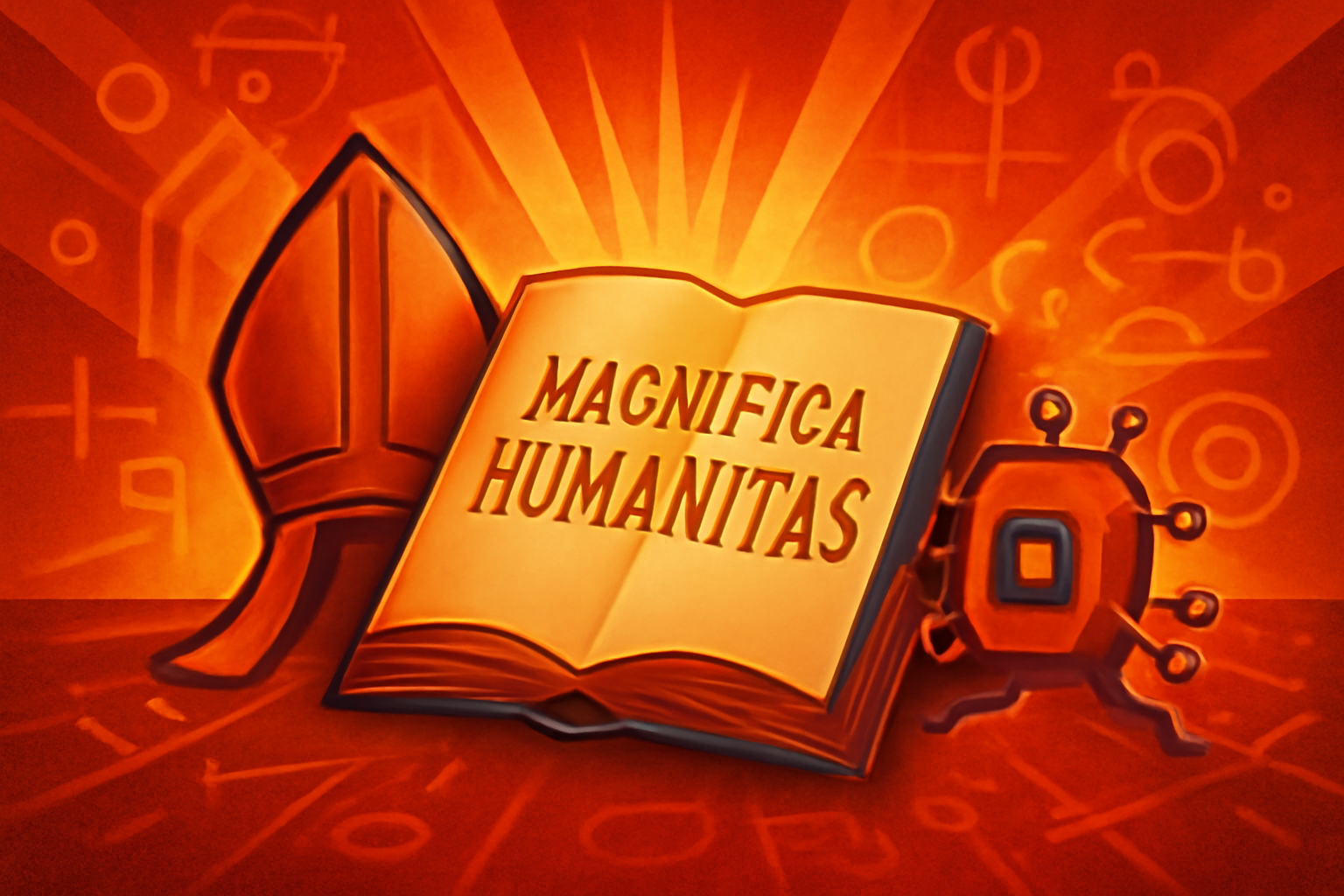
Pope Leo XIV develops that same tradition in Magnifica Humanitas. Reflecting on artificial intelligence, technological power, and global finance, he insists that technology, markets, and capital must remain subordinate to human dignity, ecological responsibility, and the integral flourishing of humanity. They are servants, never masters.
Remarkably, John Bellamy Foster reaches a strikingly similar conclusion from an entirely different intellectual tradition. He warns against what he calls the “fetishism” of artificial intelligence and of the market itself—the tendency to treat technological and economic forces as though they were beyond democratic control. Democratic societies, he argues, should consciously direct economic development toward ecological sustainability and human well-being rather than allowing markets alone to determine humanity’s future.
Franz Hinkelammert anticipated both arguments decades ago. He warned that modern capitalism easily transforms the market into an idol demanding endless sacrifice. Workers become expendable. Communities become disposable. Nature becomes merely another commodity. Against this idolatry, Hinkelammert proposed what he called “the criterion of life.” Every institution, every economy, every political system must finally answer one question:
Does it serve life?
Conclusion
Rob Kall asked me to explain China’s understanding of democracy.
In the end, I found myself confronting a much larger question, Viz., What is government for?
If its highest purpose is merely to organize elections, then the American model has much to teach the world. But if the purpose of government is to secure the common good, protect the vulnerable, subordinate economic power to democratic authority, preserve the earth for future generations, and enable human beings to flourish, then elections are not the end of democracy. They are only one of its instruments.
That is the challenge posed by China’s theory of whole-process democracy. Whether or not one ultimately accepts its answer, it forces us to ask whether democracy should be judged only by its procedures or also by its consequences.
Jesus had no hesitation about the answer.
He never said, “By their constitutions you shall know them.”
He never said, “By their elections you shall know them.”
He said, “By their fruits you shall know them.”
Perhaps that is the question the twenty-first century can no longer avoid. Not simply which nation is more democratic, but which political institutions consistently bear the fruits of justice, peace, sustainability, human dignity, and the common good.
Until we are willing to judge every political and economic system—including our own—by that standard, democracy will remain little more than a procedure. It will never become what it was always meant to be: a way of organizing society so that life, especially the lives of “the least of these,” may flourish.