I'm a Fool who reads your Tarot Cards
To find the Magic in your soul
I see a Priestess there
An Empress, King, and Clown.
A Preacher’s within
And Lovers too
In Chariots down Life's road
Paved with Courage, Light, Fortune and Justice
Turned Upside Down.
Death comes even to the Self-controlled,
To DevilsFallen and to Stars,
To howlers at the Moon
And in the Sun.
Till finally comes our Judgment Day
After mastery of the World
So we fools can start again
Our wayward run.
Chorus
Yes, I Play the Fool with Tarot.
Won't you play the game with me?
There are no rules.
We're all just fools
We're playing
Don't you see?
Just playing
Don't you see?
So, I throw the cards,
You read with me,
But not the way you think.
You see, the Tarot cards
End up reading you.
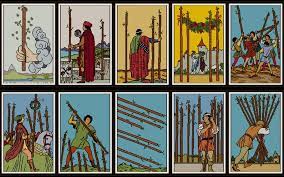
Wands speak of your power,
Your life evolved,
Of eros, strife and grace.
They open heart and soul,
To show what's true.
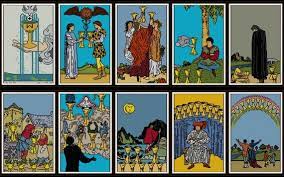
Cups tell of your loves,
Your friendships,
They overflow; they break.
Sometimes they empty out
Their bitter dregs.
Does she still love me?
Will he say “yes?”
And why am I alone?
Tarot gives the answers
Every player begs.

Chorus

Yes, I Play the Fool with Tarot.
Won't you play the game with me?
There are no rules.
We're all just fools
We're playing
Don't you see?

Just playing
Don't you see?
Swords are about what's on your mind
Thoughts that wound, confine, and kill
About freedom from blindness,
Nightmares and from pride,
About trickery and hurt feelings,
Crossed hearts and wounded souls
About blindfolds dropped
To see what others hide.
And then at last,
There are those coins
“Pentacles” they’re named
About the world of matter,
Poverty, and wealth
About old age,
And days gone by
What's been lost and gained
About work and building
Children, choice, and health.
And finally we come to the Court Cards
Kings, Pages, Knights, and Queens,
Who stand for those in life
Who sometimes cause you pain,
Or for those at home or in the world
Through bitter and through sweet
Offer kindness and hope
Without any thought of gain

Bridge

Yes, the Tarot Cards
Reveal it all:
What’s inside,
And what’s out,
The future, past, and present,
Good and bad.
They open up the darkness,
So light can walk about
To show what makes us happy
And sometimes sad.

Chorus

So, join me in this Tarot game.
Yes, play the game with me.
There are no rules.
We're all just fools
We're playing
Don't you see?

Just playing
Don't you see?
Sadly, my nearly year-long saga in Spain is coming to an end. Today is my last full day here. Since last September, my wife, Peggy, and I have shared a sabbatical with my daughter and son-in-law and their family of five children (ages 4 to 15). Right now we’re in Mallorca.
The whole experience has been life changing – almost as important as my study of liberation theology in Brazil (1984), my frequent visits to revolutionary and post-revolutionary Nicaragua (beginning in 1985), all those times I’ve visited Cuba (starting in 1997), and my years of study and teaching in Costa Rica (1992-2013).
In Spain I’ve learned more and changed more than I could ever have anticipated.
Unexpectedly, I’ve entered an unusual community here – of street musicians, cave dwellers, hippies, and grassroots philosophers. I love them all, and as I said, it’s changed my life.
One of them, Simon (from Chile) introduced me to the great Chilean film director, Alejandro Jodorowsky, and to Ana Rodriguez Sotomayor and her milestone book, The Precursors of Printing.
My troglodyte friend, Simon
Those sources and my desire to improve my Spanish comprehension sent me back (via YouTube) to my early teachers from Chile, Costa Rica, Argentina, and Puerto Rico: Franz Hinkelammert (who died last week), Enrique Dussel, and (more recently) Ramon Grosfoguel. Together their drive to decolonize world history has rendered irrelevant my previous understandings (and teaching!) of Eurocentric universal history.
Simon and I also studied together the Mayan sacred book, The Popol Vuh. He introduced me to Tarot, marijuana, and mushrooms. At least once a week, we talked for hours.
Another dear friend, Francesco from Italy, showed me how to read tarot cards. Cesco’s a Bob Dylan scholar. My friend’s two long essays (in Italian) helped me appreciate Dylan more deeply and enthusiastically than ever.
That made my attendance at Dylan’s Granada concert (with my 15-year-old granddaughter, Eva Maria) richer than I could ever have imagined. Eva and I had an artistic experience that night (in the Alhambra) that neither of us will forget. It was magical.
Eva Maria & I pose before entering the Alhambra’s General Life
So, I found it somehow fitting that just a few days ago, with my time in Spain running out, it was Eva who suggested that I read Dan Brown’s novel, Origin. Her suggestion was inspired by connections she saw between my recently published essay on artificial intelligence (AI) on the one hand, and our frequent conversations about faith and religion, along with our shared experience of Spain itself on the other.
Origin is a 2017 “who dunnit” that involves the biblical Book of Genesis, science and evolution, Christian fundamentalism, and artificial intelligence. All of it is set in Spain and many of the places my family and I have visited over the last year.
I’m talking especially about Bilbao and its Guggenheim Museum and Barcelona’s iconic Sagrada Familiacathedral created by Antoni Gaudi. Involved too is what I’ve learned here about Spanish politics, the enduring power of the Spanish Catholic Church, the dictatorship of Francisco Franco (1939-1975), the monarchy in Spain, and resistance to that apparently outmoded institution.
Gaudi’s Sagrada Familia Cathedral in Barcelona
In short, Origin has Dan Brown’s perennial hero, Robert Langdon attempting to solve the murder of the brilliant futurist scholar, Edmund Kirsch. Kirsch claimed to have discovered definitive atheistic answers to religion’s two most persistent questions: (1) Where did we come from, and (2) where are we going?
Scholars from Christianity, Judaism, and Islam found Kirsch’s discoveries so threatening that the only solution to the problem he represented was to silence him permanently.
With the dastardly deed done, Langdon must locate the responsible forces.
Not surprisingly, doing so involves a stunningly beautiful heroine, several additional murders, frantic chases, and Brown’s usual long (sometimes pedantic) discourses on symbols, codes, architecture, history, mythology, science, and technology.
Also involved are long conversations with “Winston,” a computerized embodiment of the very artificial intelligence that my earlier-referenced essay had speculated might represent the next step in human evolution.
The whole thing was quite fascinating and even exciting from its opening interfaith exchanges to its cliffhanger conclusion.
Still however, the book’s central problem seemed somehow outdated. I found it difficult to imagine that in 2017 the “entire world” [actually, 250 million (of 8 billion) people with access to computers and iPhones] would still be interested in, much less threatened by long-resolved (or dismissed as irrelevant) questions of creationism vs. evolution explained in those pedantic screeds.
Except for a quickly shrinking cadre of Christian fundamentalists, that controversy was solved cinematically years ago by Spencer Tracy in “Inherit the Wind” (1960). Granted, the Scopes Monkey Trial (1925) did garner fevered national attention at least in America. But that was almost a century ago.
Since then, we’ve had the death of God movement, John XIII‘s Second Vatican Council, the Catholic Church’s pedophilia crisis, and the resulting general discrediting of organized religion that has all but emptied (Catholic) churches across the world. (Just go to Mass here in Spain on any given Sunday, and you’ll struggle to find anyone under 60 among the worshippers.)
Today (at least among Christians) only religious crazies (like bombers of abortion clinics) are willing to commit murder over differences about the Bible (in which btw, there’s no denunciation of abortion).
Yes, that’s true about questions of creationism vs. evolution, and believers who understand the Bible as:
A single divinely authored book with 73 chapters
Whose most important chapter is Genesis
Whose data conflicts with modern science
And whose meaning is confined to the personal sphere,
While supporting American patriotism
And “spiritual” questions
Of feeling good about oneself
And about life after death,
Punishment and reward
And an apocalyptic, God-willed
World destruction
As punishment for sin
To repeat: very few among Christians are willing to kill or die for such arcane beliefs.
But that’s not nearly so about the Bible and questions of social justice. Instead, as Noam Chomsky (a Jewish atheist) has shown, the U.S. government has shown itself quite willing to kill hundreds of thousands (including a whole team of liberation theologians in El Salvador in 1989) precisely over biblical interpretation that differs from that of the Christians whose irrelevant fundamentalism U.S. leadership approvingly identifies with Christianity.
On the other hand, the assassination-worthy theological enemies of the United States include those who ALONG WITH VIRTUALLY ALL OF MODERN BIBLICAL SCHOLARSHIP:
See the Bible as a library of books written by various authors in various historical periods for various reasons and from various theological (often conflicting) perspectives.
Within this canon, the Book of Genesis and its creation myths are peripheral,
While the Book of Exodus and Israel’s nation-founding story of the liberation of slaves from Egypt represents the Bible’s central focus
Reflecting ancient and modern conflicts between the world’s poor and its rich and powerful classes
[And to “America’s” (and empires’ in general) preferential option for the rich],
While identifying the Book of Revelation’s “Apocalypse” as predicting not the end of the world, but the annihilation of the Roman Empire and (by extension) of empires in general.
With all of that in mind, it’s no wonder that Dan Brown chose a safer and less politically controversial approach to religious controversy than that pinpointed by Chomsky, biblical scholarship, and contemporary politics.
Instead, Brown chose to stick with worn out cliches and simplifications.
Regrettably, he steered far away from Chomsky’s advice: “Keep away from clichés, this world is much more complicated.”
Protestors gather at Granada’s City Hall to protest evictions of cave dwellers from their homes. The sign on the left reads “San Miguel Hill is a neighborhood.” The big black and white banner says “The Caves Resist.” One of the chants during the protest had us all shouting “La Cueva, Mi Techo, Es Mi Derecho” i.e., “The Cave, My Roof Is My Right!”
As everyone who follows this blog knows by now, Peggy and I have been living in Granada for the past five months. We’ve been in Spain with our daughter, Maggie, our son-in-law, Kerry, and their five children Eva (14 years of age), Oscar (12), Orlando (10), Markandeya (7), and Sebastian (3).
Maggie’s family has been here on sabbatical so that our grandchildren might learn Spanish by attending school where only that language is spoken. It has been a wonderful experience for all of us.
Now Peggy and I are about to return to the States for February and March. We’ll spend most of that time in Florida, and then come back to Spain in April. Our plan is to remain here till the end of June. We’ll then fly on to Rome, where we’ll spend a month or so with our son Brendan’s family. (Brendan State Department assignment will have him living there for the next three years.)
In the meantime, very unexpected things have happened to me in Granada. Here we’ve been living in its Albaicin barrio overlooking the famous 13th century Islamic city, the Alhambra. We’ve walked part of the Camino de Santiago, along with traveling to Madrid (and its Prado Museum), to Bilbao (and its Guggenheim Museum), as well as driving to Tarifa (with its nearby Roman ruins), to Valencia, and Cadiz (which so reminded us both of Havana).
However, most unexpected of all have been some friendships I’ve made with cave dwellers and street musicians here in the Albaicin. I’ve already written about that here and here. My new friendships have introduced me to a way of life that I truly admire. With one cave dweller I’ve studied the “Mayan Bible” (the Popol Vuh) and have been introduced to Tarot (which I never thought I’d study, but which now greatly fascinates and benefits me).
The cave dwellers are constantly harassed by the police — or as they call them, “the puta policia” (or effing cops). Last week, those harassers once again invaded the caves, cut off their access to water, and destroyed the property of my friends and their neighbors — all in the name of “protecting” those concerned from their unhealthy way of life.
The other day, I attended a rally by about 200 cave dwellers and sympathizers in front of Granada’s City Hall (pictured above). Some have taken to wearing black nail polish on their left hands as a sign of solidarity with the Cuevistas. I surprised (and maybe scandalized) my family members by doing so myself.
In any case, immediately below, you’ll find an account of all this in another of my poor attempts at poetry. I wrote the “poem” so I’d never forget these people I’ve come to cherish and treasure.
Cave Dwellers and Cops
in the Albaicin’s Plaza Larga
(Jan. 27, 2023)

Since coming to the Albaicin
In Granada five months ago,
Its Plaza Larga has drawn me in,
Its cave dwellers have helped me grow.

Yes, they all live in Cuevas
Dug by gypsies and Moors
They’re troglodytes and drifters
Rebels all to their very pores.

They’re committed to music
Painting, poetry, and Life
Smoking hash and drinking cervezas
To peace and not the knife.
.
Yes, the Larga’s a place
For outsiders like me
They’re poor, ill-clad
But happy
Living NOW as all can see.

One of them there
Wears a jellabiya on Fridays
And yells in a voice
Much too loud.

But no one’s upset by his antics
Or his shouting at the crowd
Instead, they roll eyes or support him.
Ridicule’s never allowed.

I’ve met a man there called Simon
A street busker and shaman indeed
He helps me with my Spanish
Oblivious to any need

Because he’s rich, you see
Not with money, playthings, or goods
But with time, wisdom, and kindness
And absolute freedom from “shoulds.”

There’s another Simon
(I’ve met him).
Much younger and from France
There’s Ida from Denmark
And Ramon from north Spain
And Juan whose Traveler ancestors
Set the Cuevas as their reign.

There’s a girl from Somalia called Filas
She’s dark, skinny, and profane.
She’s friendly and kissy and cheerful
Eats mushrooms and smokes in a chain.

And I’ve met
A young man they call ‘Cesco’
He’s moving here this fall
From his home far away in Italia
(Perhaps he’s the wisest of all).

He’s a Bob Dylan scholar and tarotista
(He did my Tarot today)
He knows everything about Dylan
“Desolation Row,” and what his cards say.

So, I’m grateful to Andalusia
For giving me a gift so unexpected, and so fine
Of friendships with the Chusma
It’s been like draughting aged wine.

Yes, I love crossing borders
With campaneros like these
I’m grateful to Simon and the drifters
Who do whatever they please.

That is. . ..

If not for the “Puta Policia” . . ..
Anxious to show my friends who’s boss
They harass them and fine them.
They smash their guitars
Understanding nothing about them
As if coming from Mars

They sack their poor Cuevas
Burn their goods and possessions
Interrupt their love making,
Their meditation sessions.

They render them homeless.
As if that were good
Can you imagine
Cops destroying their food?

But that’s the lot of drifters
Living everywhere it seems.
Of dropouts whose simple existence
Challenges our bourgeois dreams.

The system just can’t stand them
Detesting their sight and smell
So, it robs the poor of the little they have
And sends them all to hell.

I’d know nothing about this
If not for Simon and friends
If not for the Plaza Larga,
Where singing never ends.

If not for my new friendships
If not for Tarot and song
If not for gypsies and buskers
If not for my stay here so long.

So, despite the puta policia,
I’m grateful to be here
Learning from friends in the Plaza Larga
May God remove their fear.
Since my arrival in Spain (2 months ago), I’ve become friends with a man whom a Spanish acquaintance of mine dismissed as a perroflauta.
Don’t worry; until recently, I never heard that word either. But here’s the way it’s defined online: “A perroflauta (plural “perroflautas“, invariable in gender) is a normally young person with an appearance and behavior reminiscent of those of the hippie movement .”
The flauta (flute) part of the term comes from the fact that most in the category are street musicians. The perro (dog) part refers to the buskers’ habit of taking their dogs along.
As I’ve mentioned in an earlier post, the one I’m referring to is called Simon. He’s Chilean. He plays guitar in the street (all the while dodging the police). And he’s lived here in Spain for the past 20 years.
But Simon is not young. He’s 60 years old. And has no dog accompanying him. Neither would I describe him as a hippie.
So, he’s no perroflauta — which (as Simon informed me) turns out to be a disrespectful, dismissive characterization.
Rather, I think of Simon as a kind of hermit, a cave-dweller (literally), a wise man, a philosopher, a seeker of truth, a sort of shaman. (The two of us plan to study the Mayan Popol Vuh together as part of his helping me with my Spanish.)
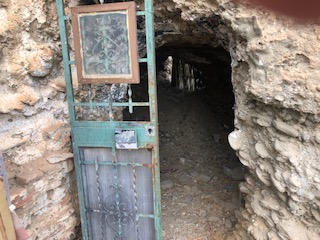
Simon himself jokingly refers to his kind as “troglodytes” — as cave dwellers, since many of them live in caves above the albaicin barrio here in Grenada — as I said, our home for the past couple of months.
In any case, last week I had the privilege of entering Simon’s cave. It took me a long time to get there. Usually, my daily exercise routine has me walking 4 miles. Last week, in order to get to Simon’s cave, I walked twice that distance — up and down severe inclines, along stony dirt paths, and narrow ridges.
My poor arthritic knees have been complaining about all that ever since. And this, even though Simon and I stopped several times so I could rest, while Simon rolled and smoked a couple of joints.
Following Simon to his cave
Below is an overview of Simon’s community. All its members live in caverns originally dug out by gitanos (gypsies) as far back as the 15th century — or maybe (Simon told me) by Arabs before them. Anyway, squatters like Simon have converted many of the dugouts into homes, some of them with electricity and running water:
An overview of our destination
Simon’s cave has no electricity and no water. The fridge in this picture merely serves as a cabinet for storing his food.
Simon’s “fridge” and gas “stove” where he’s brewing T-4-2
Here’s the cave from the outside:
The Cave from the Outside
And here’s Simon’s bedside “stuff” — including a candle and a couple of books on Tarot. My friend’s trying to learn all about it in case the police confiscate his guitar again — or fine him $300 to get it back. (Simon told me he’s had “about a thousand” guitars in is life, and that he’s like to write a book on “How to Lose 1000 Guitars and Still Stay in Business.”) In any case, Tarot reading, he says, would be an alternate source of income if the cops remove his livelihood. He only needs about 10 euros a day to get by.
Bedside Stuff
Here’s the wall hanging at the end of Simon’s bed:
Edvard Munch’s The Scream which the artist admitted“could only have been painted by a madman”
Simon’s bedside reading:
Leibniz, 1646-1716 — A philosophical theory about monads
On each side of Simon’s cave was another dugout about the size of his own dwelling. The floors in each were dirt, the walls still unwhitewashed. Using typical American reasoning, I asked my friend, “Why don’t you make a couple of more rooms for yourself in these caves? You could cover the dirt floors and whitewash the walls in both of them.” The hermit looked puzzled at my reasoning. He shook his head, “No,” he said, “I don’t need the space. And changes like that would only cause envy in the community. That wouldn’t be good for anyone.”
One of the empty caves alongside Simon’s
Towards the end of my visit, I asked Simon about the point of his life — about the point of my life. He paused a long time searching for words. He looked out the door of his cave . . .
The view from inside Simon’s Cave
and said, “I don’t know. I don’t think much about such things. I don’t think about the past or the future. It’s just about living in the present moment.
Do you see what I mean about my hermit friend and his simple wisdom?




 About Things That Matter