In preparation for next Sunday’s commemoration of the Solemnity of Christ’s Body and Blood, here is my “translation” of the day’s sacred texts including its special sequence, “Lauda Sion.” Please read the originals yourselves to see what they might suggest by way of practical application. To me, they say something about priesthood, its perversions, and rejection by Jesus. More universally, they call me to think revolutionary thoughts about throwing off ALL inherited structures responsible, as they are, for war and impending omnicide. As Marx taught, any criticism worth its salt begins with religion.
GN 14: 18-20

 Melchizedek fed Abram,
 Bread and wine.
 Assuring the patriarch
 Of God’s favor
 In his mid-east wars,
 Provided the sheik
 Gave the priest
 A tenth of all he possessed.

 PS 110: 1-4

 Subsequent clergy
 In Melchizedek’s line
 Have done the same
 For kings who tithe
 Promising them
 Enemies become footstools
 Forever and ever!


 I COR 11: 23-26

 Jesus
 Like that gnarly pastor,
 Served bread and wine too
 But for God’s peace
 Not Melchizedek’s war.
 Those who shared
 His simple meal
 Were to re-member the Christ
 And make his presence real
 As Prince of Peace.

 Sequence Lauda Sion

 Yes, Melchizedek’s offering
 Is turned upside-down
 By the priesthood’s
 Severest critic.
 Who feeds both
 Kings and shepherds.
 Apostles and us
 Uniting all
 And replacing
 Antique class-warfare
 And our own
 Damnable understandings
 Of Eucharist
 With a picnic of peace
 So that wheat and grape
 Might become
 OUR flesh and blood,
 To afterwards incarnate
 Christ’s own body
 To complete his work
 On earth.

 LK 9: 11B-17

 So what's the point
 Of this parable's tale
 (Ironically chosen
 By Melchizedek's sons)
 If not to say
 What Eucharist's for
 To feed the hungry
 Towards peace not war.
 No Melchizedek
 No miracle
 No market
 No priesthood
 No transubstantiation's
 Required here.
 “Do it yourselves”
 Jesus told his friends
 (And us).
 And that’s just
 What the apostles
 (And a little boy)
 Did
 To everyone’s satisfaction
 With lots left-over!
 Let those with ears to hear . . .
On this Trinity Sunday, Marianne Williamson’s basic approach to our national problems reminds me of traditional trinitarian doctrine. I mean, when I was a kid in catechism class, the mystery of the Holy Trinity seemed like one of those word-problems I found so difficult in arithmetic. I wondered, how can there be three divine persons in one God? Was it 3+ 1= 1? Or was it 3 ÷ 1 = 1? I was confused.
Williamson’s basic approach to politics presents a similar quandary. Her basic math problem is: How can we solve our myriad national problems? There seem to be so many. However, like what I heard in catechism class, her solution remains theological. But it goes like this 1+1+1+1+1+1+1+1+1+1+1+1 = One.
What she means is that we really have only a single problem. It’s extremely personal, but at the same time very political and highly theological. It’s our relationship with God (though we might with good reason reject that particular word as culturally debased). Williamson observes that (whatever name we might prefer) until we get our God-problem straightened out, all those other difficulties will continue to plague us and threaten our very survival.
That simple but profound spiritual insight is what distinguishes Williamson from other Democratic candidates for president. It’s that ecumenical, all-inclusive spirituality that separates her from Republican Christianists. Specifically, it calls us to profoundly correct our perception of reality from that of the “world” based on fear and greed to a divine perception based on love and compassion.
Think, for instance, about our endless political troubles. Internationally, they’re based on the conviction that we are surrounded by enemies radically different from us. They are so threatening that we must spend billions each day — yes, nearly $2 billion every 24 hours — to protect ourselves against the likes of Russia, China, North Korea, Syria, Yemen(!), ISIS, Iran, Iraq, Afghanistan, Venezuela, Nicaragua, Cuba, and against immigrants and refugees from Guatemala, Honduras, El Salvador, and Mexico.
Domestically, politicians want us to think that we’re threatened
not only by all those foreigners, immigrants and refugees, but by what the
Clintons once termed “super-predators” who tend to be black or brown,
by LGBTQQIA individuals, and by poor people in general. That’s why we end up
imprisoning a greater percentage of our population than any other country —
and that doesn’t even include the immigrants and refugees in our border
concentration camps and baby jails, or those in the black sites (sic!) we
maintain across the globe.
No wonder we anesthetize ourselves to forget it all. So, we consume
drugs like guns, alcohol, pot, amphetamines, other pharmaceuticals, tobacco,
our iPhones, pornography, spectator sports, snacking, comfort food, and TV
binges. That’s quite a list, don’t you think? Each item creates its own problem
in the personal and familial spheres. It’s a never-ending cycle of
threat-fear-denial and escape. And it’s all-encompassing.
However, according to Williamson, all of that — the guns, wars, fear of “the other,” and narcotization of all sorts — are simply means of side-stepping our only real problem: God.
And that’s what’s centralized in today’s Solemnity of the Most Holy Trinity. The day’s readings call us to face the nature of God straight-on. And it has nothing to do with catechism math. Neither, according to today’s biblical selections, is God what we’ve been taught. God is not a judge, punisher, and torturer. Instead, the passages selected for this Solemnity of the Most Holy Trinity invite us to appreciate divine goodness and love for all of humankind, and to use those insights to reduce our countless problems to merely one.
Consider today’s readings. (Please read them for yourself here.)
They describe for us the three-fold nature of the One we find so problematic.
As depicted in the graphic above, she is Mother (Wisdom), Father (Creator), and
Child (as revealed in Jesus the Christ). Here’s my “translation” of
this Trinity Sunday’s readings specifically about the nature of God:
PRV 8:22-31
God as Wisdom Itself
Is embodied in all the world.
As feminine and Mother
She is like a skilled craftswoman
Who set the very foundations of the earth
And shores of the seas
All in a spirit of playfulness
Finding special delight in the human race.
PS 8: 4-9
Which is amazingly loved
By the Creator-Father
For whom
All human beings are like angels
Glorious and honorable
Caretakers and rulers of
Wild and domesticated animals
Birds and sea creatures
And whose traditions across the earth
Have always recognized
And loved
The Reality of God.
ROM 5: 1-4
It is that universally-shared faith
That gives human existence
Worth and value
Making possible
Peace among nations
Giving us hope
But putting us at odds with “the
world”
Which punishes us for our faith
(contradicting, as it does
The world’s fear-full “wisdom”).
But the world’s opposition
Only strengthens
Our sensitivity to
The Holy Spirit of Jesus.
JN 16: 11-15
Who offers
A guiding vision of the future
Expressed in teachings
About humankind’s fundamental
Unity with God
And each other.
Do you see how owning and interiorizing that single trinitarian vision of Mother, Father, and Child holds potential for dissolving our countless problems? The earth belongs to all of us who constitute a single family. Each angelic member is loved by God who as our Female-Male Parent has filled all with the very Spirit of Jesus. His fundamental teaching is to love God with all our heart and our neighbor as our self. That means we need to recognize that those whom we fear as enemies and foreigners are our very Self. Or, as Marianne Williamson puts it, “There is really only one of us here.”
According to Williamson, interiorizing that insight and expressing
it in our personal, familial, social, spiritual and political lives would
absolutely eliminate every single problem I listed earlier.
So how do we get from here to such problem-free existence? That’s where Williamson descends from the sublime to the nitty-gritty. Unlike some others who’ve qualified for the first presidential debate, she’s signed Cenk Uygur’s TYT Progressive Pledge. (You can sign it here.) Watch how she responds to Uygur’s questions:
Yes, I know, that sounds very similar to Bernie Sanders and Elizabeth Warren. However, Marianne’s distinguishing edge is her insistence on calling for the change in spiritual consciousness that is necessary to effect redirection of U.S. policies. In that sense, she’s far more progressive than anyone else in the field.
Opponents and the media, of course, will smile and condescendingly
pat her on the head and say, “Oh, that’s very sweet, Marianne, but quite
naive. Your approach will never work in the dog-eat-dog world we live in.”
However, along with Jesus and countless others whom we profess to admire, Williamson reminds us that it is precisely the “world’s” patronizing approach that is not working. That “realism” has brought us to the brink of atomic, biological, climatic, demographic, and economic annihilation (and as Crossan says, that’s only up to “e” in the alphabet!).
What remains unimplemented on a broad scale is the explicitly spiritual approach of Jesus, Gandhi, of Quakers in the Abolitionist and Women’s Suffragist Movements, of the Baptist preacher Martin Luther King, of Catholic priests like the Berrigan brothers, and of Dorothy Day and the Catholic Workers .
Along with today’s readings, all those spiritually inspired and deeply politicized figures agree with Marianne Williamson: We have only one problem; it’s about family; it’s about correcting our relationship with our Mother and Father in the Holy Trinity of which all humans are an integral part. Williamson is right: we have only one problem; there is really only one of us here. We are infinitely closer than brothers and sisters. Her presidency will move us towards a practical realization of that vision.
Readings for Pentecost Sunday: ACTS 2: 1-11; PS 104: 1, 24, 29-30, 34; I COR 12: 3B-7, 12-13; ROM 8: 8-17; JN 20: 19-23
Today is Pentecost Sunday. Fifty days after Easter, it
celebrates the day that followers of Jesus decided to overcome their fears and
form a community to carry on Jesus work of introducing what he called the
Kingdom of God as an alternative to Rome’s Kingdom of Caesar.
Whether the realization dawned on Easter day itself (as in
today’s Gospel reading from John) or 50 days later (as described in the first
reading from the Acts of the Apostles), today’s celebration reminds us that
Jesus’ Spirit stands 180 degrees opposed to that of empire – the spirit of the
world. That’s because Jesus’ Spirit is embodied in the victims of empire’s
torture and capital punishment. It recognizes the poor rather than the rich as the
bearers of peace, joy, and prosperity. That’s what John means by recalling that
before conferring his Spirit of Peace, Jesus “showed them his hands and his
side.” That’s what today’s Sequence means when it identifies Jesus Spirit as
the “Father of the poor.”
During this election season, I cannot help connecting those Pentecostal insights to Marianne Williamson. That’s because alone among Democratic presidential candidates, she specifically recognizes the incompatibility between Jesus’ teaching that prioritizes love and forgiveness and the spirit that governs our world characterized by fear, greed, lies, and violence. For Williamson, such opposition remains a spiritual truism, whether we connect it with Jesus, Moses, Mohammed, Krishna, the Buddha, or simply with LIFE or NATURE. Acknowledging that, Williamson’s candidacy is calling for a national change of consciousness from fear and greed to one driven by love and compassion.
Yes, she dares to do that with great specificity! And her
wisdom and sincerity in doing so can hardly be questioned. In fact, we know
more about Marianne Williamson, her philosophy, spirituality, and the workings
of her mind than any other candidate. That’s because she’s spent, more than 30
years talking about nothing else. It’s all part of the public record. She’s
used her spirituality (what today’s liturgy identifies with the Spirit of
Jesus) to help individuals, couples, and congregations reach depths of critical
thinking that even progressives might consider far too radical. For instance,
she holds that:
We live imprisoned in a deceptive world much like Plato’s Cave.
There, what the world presents as truth is 180 degrees opposite of the truth of God (though no one need use that historically debased term).
The world’s truth is governed by fear and greed.
It identifies the “other” (e.g., poor people, Muslims, immigrants, refugees, non-whites, Iran, Russia, Venezuela, North Korea, ISIS) as the cause of our problems, while “we” are innocent.
The fact is none of those just listed is our enemy. All of us are more than brothers and sisters; in fact, there is really no meaningful distinction between us. What we do to them, we do to ourselves.
As a result, God’s ultimate truth is governed by love and compassion and by the realization that all humans are ultimately innocent.
That’s true even of Donald Trump, John Bolton, and Mike Pompeo. Though they are sociopaths who need to be removed from office and to face the consequences of their crimes, they too are performing the spiritual service of revealing as never before the corruption of the prevailing system that deceitfully serves the rich rather than the rest of us.
Insights like those have been among Marianne Williamson’s guiding convictions for more than 30 years. And at least since 1998 and the publication of her Healing the Soul of America, she has scandalized many of her would-be followers by connecting her profound spirituality to deeply radical politics. In that book, she predicted the rise of a force like Donald Trump if the “higher consciousness community” and the rest of us failed to make similar connections. The title (and content!) of her latest book, The Politics of Love, doubles down on the radicalness of her analysis.
Imagine governing our country and the world according to the
Spirit described in today’s readings. They are crystal-clear in their
contradiction of what we’ve been led to accept as normal and unavoidable in the
realm of politics. Review the readings for yourself. They tell us that Christ’s
Spirit:
Is international; it loves equally people of all nations (Acts 2: 1-11)
Is abundantly creative and universal involving not just human beings, but all of creation (PS 104: 1, 24, 29-30, 31, 34)
Refuses to recognize religious distinctions, e.g. between Jews and “pagan” Greeks (ICOR 12: 3B-7, 12-13)
Embodies wisdom, understanding, counsel, fortitude, knowledge, and joy (Special Pentecostal Sequence)
Recognizes forgiveness as the key to peace (JN 20: 19-23)
Isn’t it true that most Americans, who describe themselves
as somehow “Christian,” would find the convictions just listed as unrealistic
or even suicidal if applied to politics?
But, of course, those ideals have never been tried. And, according to Williamson, that’s just the point. Failure to apply the spiritual insights advocated by Jesus and those other spiritual avatars have led us to our present impasse. That “realism,” she observes, is what’s really suicidal. It’s destroying our planet and threatening us with nuclear holocaust. For Williamson, making America great again means following a radically different path. It means following the example of Quaker-inspired abolitionists, of the similarly motivated suffragettes, of the Baptist preacher Martin Luther King, of war-resisters like the Catholic priests Phil and Daniel Berrigan, of Dorothy Day and Mohandas Gandhi. Those figures and the tradition they represent constitute the truly “great” part of the American tradition.
To put it bluntly, Marianne Williamson, like the feast of Pentecost itself, is asking Americans to overcome their fears and form the beloved human community envisioned by Jesus, King and those others. But to do so, she says, we must completely reject everything empire values as true and worthy. Instead, Williamson invites us to recognize solidarity with those empire actually despises. Russians, Chinese, Iranians, Venezuelans, Syrians, North Koreans, Muslims, immigrants, the poor in general, even ISIS fighters, and especially the world’s children are beloved by God. Rather than rejection, wars, dronings and sanctions, they deserve respect and inclusion in any negotiations that affect them. At the same time, those actually in power are often thieves, sociopaths and criminals. They deserve compassion but must be treated accordingly. All of that encapsulates the radicalness of Marianne Williamson’s approach to politics. It also encapsulates the Spirit of Jesus – his ultimate gift celebrated this Pentecost Sunday. Is that too radical, even for Christians, even for progressives? The alternative, Williamson reminds us, is just not working out.
Stephen Executed before Paul Falls asleep Envisioning God’s Kingdom While forgiving the ignorant Who cover their ears Against hearing The Human One Who substitutes God’s Reign Of compassion and love For religion’s insatiable Blood thirst.
PS 97: 1-2, 6,7,9
Yes, Jesus’ Kingdom rests Not on executioners’ haste To throw the first stone But on justice Joy and gladness For everyone It confers judgment Revealing The emptiness of Everything Killers venerate.
REV 22:12-14, 16-17, 20
May God’s Kingdom come! Even amid roadside missiles and martyrs’ gore. Hear the urgency! “Come, come, come, come, come, come” Six times over: Come Alpha and Omega First and Last Beginning and End Root and branch Starlight and Bride Water and Life.
JN 17: 20-16
It’s about Unity The Master assures Five times he says: One, one, one, one, one We are Close like Jesus and Abba. Foundationally coherent With them, Stephen, Paul And those myopic men Throwing rocks Powerful enough To awaken Prophet’s rage To know, know, know, know, know, know (Count them!) That God and We are One Rendering stones and blood Impotent To destroy Shared unity At divine core.
It’s Memorial weekend already – the unofficial beginning of summer, 2019. As usual, it’s a day when our country celebrates war and its heroes. That’s simply the American way of commemorating every patriotic occasion.
Appropriately however, this weekend’s liturgy of the word introduces a note of dissent. It centralizes peace as the content of Jesus last will and testament. In so doing, it implicitly contrasts Jesus’ concept of peace with that of Rome or any empire for that matter. The Roman Tacitus described his country’s understanding with the famous aphorism: “They create a desert and call it peace.” For me, Tacitus’ description applies just as well to the United States.
With that in mind, it also seems appropriate to connect
Memorial Day, the peace Jesus advocated and the presidential candidacy of
Marianne Williamson. I say “appropriate” this time because Williamson is the
only candidate in the crowded Democratic field who thematically centralizes the
need for change of specifically spiritual consciousness about all things
political – including matters of war and peace. Her attitude on those issues corresponds
closely with that of Jesus as expressed in today’s Gospel reading.
Marianne Williamson
and Peace
To begin with, Williamson is a harsh critic of the Pentagon
and the policy of perpetual war into which our country has increasingly fallen
since the Second Inter-Capitalist War (1939-’45) and especially since 9/11/01.
In fewer than 100 years, she points out, the real driving
force behind United States military posture has become the interests of Lockheed
Martin, Raytheon, Boeing and other defense contractors. That has Americans, for
instance, buying one hundred B-21 stealth bombers each costing $550 million and
each capable of carrying thermonuclear weapons. That’s $55 billion in total.
Such investment, Williamson says, is completely
over-the-top. Why 100 planes of that type? At the very least, it all seems
completely out-of-proportion to the danger posed by our perceived terrorist enemy.
Terrorists belong to no particular state. Very often they are home-grown. In
any case, their hit-and-run attacks cannot be effectively answered with
wholesale bombing, much less with nuclear weapons. Williamson writes:
“America today is like
the British Red Coats during the Revolutionary War – standing abreast in a straight
line waiting for someone to yell ‘Fire!’ while American colonists were hiding
behind trees like the early guerrilla fighters that they were. Our entire
notion of national security is like something out of another century.”
Instead of such waste and without neglecting legitimate
defense concerns, Williamson calls for effective recognition of the soul force
of peace building. She wants established a US Department of Peace that would
make peace-creation a central goal of national policy, both foreign and
domestic. It would use resources like
those now wasted on those B-21s to support diplomatic efforts with those currently
villainized in order to justify purchase of overpriced weapons systems.
Peace building would reconstruct the cities that US policy
has destroyed. It would support educational opportunities for children, expand
economic prospects for women, and in general alleviate human suffering across
the planet. “That would be the moral thing to do,” Williamson says. “That would
be the loving thing to do. And that would be the smart thing to do.” In summary
she says, “The best way to create a more peaceful world is to treat people with
greater compassion.”
Jesus and Peace
Williamson’s approach to peace-building is in sync with
Jesus last will and testament expressed in today’s liturgy of the word. There
he says: My peace I leave with you. My peace I give you. Not as the world
(meaning Rome) gives, do I give.”
Jesus words and ultimate fate remind us that Rome’s policies
created terrorists no less predictably than our own country’s way of creating “peace.”
It led the empire to identify Jesus as a terrorist and execute him accordingly.
Jesus, I’m sure, must have hated Rome. Like all his Jewish
contemporaries, he must have despised Rome’s imperial presence in Palestine –
especially since it was headed by a man who considered himself God, Savior,
Lord, and Prince of Peace. Scholars remind us that empire was the most
significant factor shaping Jesus’ life. We know for a fact that he opposed it
vigorously – especially its local collaborators personified in the Jewish high
priesthood of his day, along with the scribes, Pharisees and Jewish high court.
However, his resistance was non-violent.
Yes, Jesus’ peace is not what the world calls peace. It’s not Roman peace which was imposed by means of war. Rome’s, like the Pentagon’s, was peace through victory – always supported by Roman religion. In fact, as scripture scholar John Dominic Crossan, puts it in God and Empire: Jesus against Rome then and now, the exact sequence was religion – war – victory – peace. Sound familiar?
By contrast, the
peace Jesus bequeathed had nothing to do with Rome or empire in general. His
peace is brought not by victory, but by justice – especially for the poor. His
was not peace through victory, but peace through justice. As I noted last week,
that point was made in the programmatic sermon the Master gave in Nazareth at
the beginning of his public life. These are the words with which he described
his very purpose: “The Spirit of the Lord in on me, because he has anointed me
to preach good news to the poor. He has sent me to proclaim deliverance to the
captives and recovery of sight to the blind, to release the oppressed, to
proclaim the year of the Lord’s favor (LK 4: 17-19).
Jesus was about serving the poor, releasing the imprisoned,
caring for the disabled, liberating the enslaved, and ending debt servitude.
His peace had nothing to do with victory as the world understands it – as Rome
understood it or as the United States does. The sequence of Jesus’ gift to the
world was religion – nonviolence – justice – peace.
Conclusion
And that’s what Marianne Williamson’s national defense program
is about as well. It entails a spiritual conversion that takes its cue as well from
Gandhi, and Martin Luther King. It also takes heed of Republican Dwight
Eisenhower’s warning about the dangers of the military-industrial complex.
Williamson’s program would:
Have our country live within its means
Emphasize peace building rather than war-making
Rather than bombs and drones, it would rain down rebuilt homes,
schools, hospitals, factories, temples, mosques and churches on the enemies
created by our imperial philosophy of peace through victory
And to those who say that all of that won’t work or that it’s
totally unrealistic, Williamson is fond of responding, “And how’s that realism
working out for you?” In fact, it’s creating more terrorists and mayhem while
simultaneously destroying the planet.
We’ve got to try something different. And that means national spiritual conversion. It’s in that call for repentance, transformation and restorative justice that the campaigns of Jesus and Marianne Williamson coincide. And that coincidence has nothing to do with memorializing, much less glorifying our country’s ceaseless imperial wars.
(By the way, Marianne has not only achieved the 65,000 unique donors required for her to appear in the debates with other presidential candidates. As well, she has surpassed the minimum 1% support in 3 separate national polls. Nate Silver has identified her as a major candidate.)
Readings for Fourth Sunday in Lent: Jos. 5:9A, 10-12; Ps. 34:2-7; 2 Cor. 5: 17-21; Lk. 15: 1-3, 11 32.
Recently, two very good friends challenged me about supporting Marianne Williamson’s run for president. “She has no chance,” they objected. “You should be supporting Bernie instead.”
Their remarks coupled with today’s familiar Gospel account of Jesus’ Parable of the Prodigal Son have prompted me to explain myself. The parable particularly as re-created by the French Nobel laureate, Andre Gide, is about a person like Marianne Williamson who eventually identified and escaped the oppressive reality we all take as normal. In Gide’s interpretation, Jesus’ parable is like Plato’s Allegory of the Cave.
So, today I want to describe what we might call the “deep politics” of Marianne Williamson. After all, it’s her spirituality (her deep politics) that first drew me to support her candidacy. Because of her more than 30 years of work as a spiritual teacher, we can know her more deeply than any other presidential candidate. And that’s important. Our interior lives – our thoughts and values – are finally shaped by our relationship with what we consider ultimately important. They are shaped by what some of us term “God.”
So, let me first talk about Marianne’s deep politics and then connect it with Gide’s interpretation of the Prodigal Son.
To begin with, I’m supporting Marianne Williamson because she represents the most radical candidate in the field “of thousands,” as she often jokes. Using the term “radical” here, I’m referring to its etymological meaning which derives from the Latin word radix meaning “root.”
Alone in the crowded field of Democratic candidates Marianne puts her finger on what’s really ailing our nation. It’s not primarily an economic or military problem. No, at root, it’s a deeply spiritual malady. Yes, ours is a spiritual problem!
The problem is that rather than “free and brave,” we’re all scared out of our wits. We subscribe to values that are 180 degrees opposed to those identified as ultimate by all the world’s great wisdom traditions – be they Christian, Jewish, Muslim, Hindu, Buddhist or atheistic. At their deepest level, all of those traditions converge identifying compassion rather than fear as the supreme human value.
Ms. Williamson says it clearly: fear (which is the opposite of compassion) has us captive. Fear has us identifying Russians, Chinese, Muslims, immigrants, refugees, LGBT community members, poor people in general, and even (at our borders) children and babies as somehow our enemies fundamentally unlike us and threatening us at every turn.
None of that is true, Marianne says. It’s quite the opposite. All of us have far more in common than anything that can possibly separate us. In fact – as she puts it – “There is really only one of us here.” We are not only sisters and brothers, we are really a single person. What I do to you, I do to myself.
That’s really the authentic teaching of Jesus, isn’t it? That’s the meaning of his words, “Love your neighbor as yourself.” We must love our neighbor because our neighbor is our self.
As Williamson explains, that conviction is what moved the abolitionists, the suffragettes, the civil rights campaigners and many who brought the Vietnam War to an end. It’s no accident, she says, that so many of the abolitionists and suffragettes were Quakers, that Martin Luther King was a Baptist preacher, and that anti-war activists like the Berrigan brothers were Catholic priests. Those are the great heroes of the land we call “America.” Like Marianne herself, they all recognized our fundamentally spiritual nature.
So, none of us should say all of this is too idealistic. Instead, we should realize that, in effect, Marianne Williamson is challenging Americans to live up to their faith claims. After all, 70% of us claim to be Christian. Then there are the Jews, Muslims, Hindus, Buddhists I already mentioned, as well as atheists and those claiming to be “spiritual but not religious.” As I said, all of those traditions, at their most profound level, converge in calls to liberty, equality, and fraternity.
And that brings me to Jesus’ Parable of the Prodigal Son and its connection with Marianne Williamson’s deep politics. In what I’m about to say, I’m taking my cue from John Dominic Crossan’s book The Power of Parable: how fiction by Jesus became fiction about Jesus. There, Crossan suggests challenging Luke’s parable as excessively patriarchal. After all, the story is about a bad boy who realizes the error of his ways and returns home to daddy and daddy’s patriarchy with its familiar rules, prohibitions, and tried and true ways of doing things.
Crossan asks, what if the prodigal left home and never looked back? Would he have been better off? Would we be better off by not following his example as described today by Luke – by instead separating from the patriarchy and leaving home for good?
Andre Gide actually asked that question back in 1907 when he wrote “The Return of the Prodigal Son.” In his version, Gide expands the cast of the parable’s characters to five, instead of the usual three. Gide adds the father’s wife and a younger son. The latter, bookish and introspective, becomes the story’s central figure who escapes his father’s walled estate never to return.
According to Crossan, Gide tells his version of Jesus’ parable through a series of dialogs between the returned prodigal and his father, his older brother, his mother, and lastly, his younger brother. In his dialog, the father reveals that the older brother is really in charge of the father’s household. According to daddy, the brother is extremely conservative. He’s convinced that there is no life outside the walls of the family compound. It’s the older son who must be obeyed there. (Are you hearing overtones of Plato’s parable?)
For his part, the older brother, reinforces what the father said. “I am his sole interpreter,” the elder son claims, “and whoever would understand the father must listen to me.” In other words, the elder brother has owned the authority which the father has surrendered to him.
Then the mother comes forward. She tells the prodigal about his younger brother. “He reads too much,” she says, and . . . often perches on the highest tree in the garden from which, you remember, the country can be seen above the walls.” One can’t help detect in the mother’s words a foreboding (or is it a suppressed hope) that her youngest son might go over the wall and never come back.
And that’s exactly what the younger son decides to do. In his dialog with the returned prodigal, he shares his plan to leave home that very night. But he will do so, he says, penniless – without an inheritance like the one his now-returned brother so famously squandered.
“It’s better that way,” the prodigal tells his younger sibling. “Yes leave. Forget your family, and never come back.” He adds wistfully, “You are taking with you all my hopes.”
The younger son turns for the door. His brother cautions him, “Be careful on the steps . . .”
Gide’s version of Jesus’ parable returns me to Marianne Williamson, and how in these pivotal times she has followed the youngest son in Gide’s parable and calls the rest of us to go over the wall with her – to escape Plato’s cave and pass into the “other world” that is possible if only we take seriously the spiritual teachings of the world’s great traditions. Making that transition, she says, means becoming economically literate, re-learning American history, and internalizing what used to be called “Civics.”
So, don’t expect Ms. Williamson to directly invoke her spirituality during her presidential campaign. She’s won’t stump as some kind of preacher or moralist like Pat Robertson or Mike Huckabee. Unlike those other two, Marianne is no come-lately to political analysis and policy recommendations. In fact, twenty years ago in her prescientHealing the Soul of America, she predicted the crisis we’re now experiencing in the person of Donald Trump. No, Williamson will stick to her policy positions – Medicare for all, a Green New Deal, college-debt forgiveness, raising the minimum wage, drastically reducing the inflated military budget, making reparations for slavery, and establishing a cabinet-level secretariat for children and youth.
But aren’t those what (since Bernie) have become the standard positions of progressive Democrats? Of course, they are. But in Marianne’s case, such positions are grounded in a vision honed and sharpened over more than 30 years of forging connections between her deep spirituality and her deep politics.
And that personal reality, that long-term genuineness is precisely what’s required for our world to abandon the destructive reality of business-as-usual – to go over the wall of our father’s compound, to leave Plato’s Cave.
The very profundity of her “deep politics” is precisely why I’m supporting the candidacy of Marianne Williamson. If you’re similarly intrigued, and want to hear her voice in the Democratic debates, please go here and contribute at least $1.00. She needs 65,000 donors to be included.
Readings for 3rd Sunday of
Lent: Ex. 3:1-8A, 13-15; Ps. 103: 1-4, 6-8, 11; I Cor. 10:1-6, 10-12; Lk. 13:
1-9
The
entire world was shocked last week when a right-wing gunman and admirer of
Donald Trump slaughtered at least 50 worshippers in two mosques in Christchurch,
New Zealand.
At the same time, the
world edified when the New Zealand prime minister, Jacinda Ardern, the world’s youngest head
of state, donned a hijab in a sign of solidarity with the Muslim community. The
Muslim worshippers, she said “are us.” She
resolved immediately to change her country’s gun laws (in defiance of the
international gun lobby) including a ban on assault weapons.
Her response contrasted sharply with that of President Trump following a similar massacre in Pittsburgh’s Tree of Life Synagogue last October. Then, instead of calling for solidarity and disarmament, the president famously advised placing armed guards at synagogue doors.
Prime
Minister Ardern’s words and symbolic action were a demonstration of the very
type of repentance to which the non-violent Jesus called his own community (and
us!) in the puzzling episode recounted in today’s Gospel reading for this third
Sunday of Lent.
To make
his point, Jesus comments on two contemporary tragedies that were “in the news
of the day” as prominently as last week’s New Zealand catastrophe. Then he adds
an explanatory parable underlining the time-urgency of his summons to
non-violence. All three elements are highly relevant to Christchurch and our president’s
and our culture’s tendency to solve everything with violence.
The similarities
between Christchurch and the Gospel’s first-mentioned tragedy are undeniable. Like
what happened in New Zealand, it involved the slaughter of worshippers by
reactionary outsiders who despised their victims’ religious faith. Some
Galileans (no doubt identified as insurgents) were killed by Roman soldiers
while offering sacrifice in the temple.
Jesus
asks, “Do you think that because these Galileans suffered in this way because
they were greater sinners than all other Galileans?” Then he answers his own
question, “By no means! But I tell you, if you do not repent, you will all
perish as they did!”
The
second tragedy had eighteen people killed by the collapse of a tower located in
the section of East Jerusalem called Siloam. In this case, it seems that a
tower had fallen by chance and killed some innocents.
Regarding
that second tragedy, Jesus asks, “Or those eighteen people who were killed when
the tower at Siloam fell on them— do you think they were guiltier than everyone
else who lived in Jerusalem? By no means! But I tell you, if you do not repent,
you will all perish as they did!”
But
what does Jesus expect his audience to repent from? Does he want them to stop
being insurgents against Rome? Does he want them to be more faithful to the Ten
Commandments or something?
As
Jesus would say, “By no means!”
How
then do these two events connect?
To get
the connection, put the incidents in context. There they become statements
about violence, counter-violence and the need for non-violent resistance.
Again, that contextualization sheds light on the Christchurch tragedy and our
own culture’s worship of guns, as well as the permission it gives our military
to kill people in their mosques and schools, at their funerals and weddings.
This
approach takes seriously the political intent of the news item shared with
Jesus at the very outset. Luke tells us, “Some people told Jesus about the
Galileans whose blood Pilate had mingled with the blood of their sacrifices.”
No
doubt, this was not news to Jesus. The opening words of today’s gospel were not
meant to communicate news but to complain about the Roman occupiers. Those
introducing the topic were looking for sympathy and agreement. Jesus does not
disappoint.
Pilate,
of course, would have claimed that his temple victims were insurgents against
the Roman occupation; they were “guilty” as terrorists, he would have said.
That was his official line.
Jesus
says, “Don’t believe it” – as if his audience were tempted to believe Roman
lies. “Do you think they were guilty?” Jesus asks. “By no means,” he answers.
Here
Jesus is agreeing with his Galilean compatriots. If the ones Pilate killed were
terrorists, he says, so are all Galileans; we’re all guilty in Pilate’s eyes.
None of us wants the Romans here, Jesus implies. After all, it wasn’t the
Galileans who threw the first stone; it was Pilate and the Roman soldiers who
did so by invading Israel’s sovereign territory.
But
then Jesus suddenly takes another tack. He connects Pilate’s butchery with
another headline of his day – an act of counter-violence taken by the “Zealot”
forces Pilate was attempting to punish. (Zealots were the revolutionary force
committed to ousting the Roman occupiers from Palestine.) Pilate’s action,
Jesus suggests, started the cycle of violence that evoked a disaster at Siloam
at a spot near the Fountain of Ezekias. Siloam was the location of a small
arsenal, where the Romans kept their swords, shields, battering rams and other
weapons.
According to Maria and
Ignacio Lopez-Vigil, a group of Zealot
insurgents had tried to dig a tunnel up to the tower with hopes of seizing the
weapons and turning them against the Romans. But the tower’s foundation was
already in a state of decay, and the tunnel caused the entire construction to
suddenly collapse. The falling tower claimed the lives of several Galilean
families who had built their houses near the arsenal.
Jesus
point: Pilate is certainly a bloodthirsty man. None of us want him or his
armies on our soil. However, those who resist the hated Romans by resorting to
arms are bloodthirsty too. And if we follow their example, we’ll all drown in a
bloody deluge. Or as Jesus put it, “I tell you, if you do not repent, you will
all perish as they did!”
And
time is running short, he adds with his parable about a fig tree. The bloody
deluge has been building for at least three years. We have maybe another twelve
months before the chickens of the deadly cycle of violence come home to roost.
Without repentance, without replacing violent resistance to Roman butchery with
non-violent tactics, we’ll all be cut down like a barren fig tree. (Later on,
remember, Jesus himself demonstrates the kind of non-violent direct action he
had in mind, with his “cleansing” of Jerusalem’s temple.)
Jesus’ prediction of bloodbath, of course, eventually came true, but not as soon as he thought. The Romans would defeat the Zealot uprising in the year 70, and definitively squash all Jewish rebellion in 132. Jesus was right however about the extent of the slaughter. It was horrific resulting in the deaths of more than a million Jews. Such disaster is inevitable, Jesus teaches for all who “live by the sword.”
What
does all of this say to us today? The message is quite relevant. It reminds us
first of all that empire represents the systematized oppression of the poor and
defenseless by the rich and powerful. That was true of Rome; it’s true of U.S.
empire today. We’re still killing those identified as insurgents in their
churches and mosques. In fact, our soldiers do it every day. And far from being
outraged, we applaud them as heroes.
Secondly,
this passage calls us to non-violence and warns us about where the cycle of
violence will inevitably lead. Christchurch NZ provides a window into the world
created by the worship of guns. Another window is provided by Afghanistan and
Iraq, Vietnam, Hiroshima, the Cold War, and the general impoverishment of our
country and world brought on by so-called “defense” spending. All of it has us
drowning in a deluge of blood. And it promises to get worse and eventually
destroy us all. How much time do we have before our chickens come home to roost
– three years, one year. . .?
Christians
represent about 30% of the world’s inhabitants. There are more than two billion
of us. Imagine the world we’d create if we insisted on following the call to
non-violence represented by Jesus’ words in this morning’s gospel!
Imagine the country we’d
create if our politicians followed the example of Jacinda Ardern ‘s
identification with the Muslim community instead of following the divisive
policies of Donald Trump and endorsing the genocidal violence of our armies.
Readings for 7th Sunday in Ordinary Time: 1 SM 28: 2, 7-9, 12-13, 22-23; PS 103: 1-4, 8, 10, 12-13; I COR 15: 45-49; LK 6: 27-38
This Sunday’s instruction from Jesus stands on its own. Comment seems hardly necessary.
Instead, Jesus’ unadorned words
should turn bright red the faces of all in our country who claim to be his
followers. For they contradict our economic system and entire way of life
driven as it is by the military-industrial complex, unending wars, and an
economic system that victimizes the poorest among us, while enriching beyond
belief a tiny minority.
Moreover, Jesus’ teachings call entirely into question the “realism” of mainstream politicians. Such realism ridicules anyone (like Marianne Williamson) who might have us adopt Jesus’ approach before it’s too late.
Think about that in the light
of our readings from the Gospel of Luke these past few weeks. In case you’ve
forgotten, here’s a summary of Jesus’ absolutely radical, highly political program
found in the passages we’ve read. To begin with, he describes his entire purpose
in this way:
“The Spirit of the
Lord is upon me,
because he has anointed me
to bring glad tidings to the poor.
He has sent me to proclaim liberty to
captives
and recovery of sight to the blind,
to let the oppressed go free,
and to proclaim a year acceptable to the Lord.”
Notice the undeniable political thrust of Jesus’ teaching. He emphasizes bringing good news to the impoverished. He wants to clear out the prisons, to cure the disabled and liberate those oppressed (by the Roman empire that controlled Israel in Jesus’ day). Notice he is proclaiming a Jubilee Year with its debt forgiveness, release of slaves, and radical land reform. That’s Jesus’ agenda. It’s undeniably political; it’s directed towards the poor.
And just in case we might miss the point, our readings of just
last week had Jesus continue like this:
“Blessed are you who are
poor,
for the kingdom of God is yours.
Blessed are you who are now hungry,
for you will be satisfied.
Blessed are you who are now weeping,
for you will laugh . . .
But woe to you who are rich . . .
Woe to you who are filled now,
for you will be hungry.
Woe to you who laugh now,
for you will grieve and weep.
Woe to you when all speak well of you,
for their ancestors treated the false
prophets in this way.”
As I indicated last week, those words should shock us. Jesus’
words turn everything upside-down. It’s the poor who are God’s favored, not the
rich. According to his promise, the poor will govern God’s Kingdom (a highly
politicized image for what the world would be like if God were king instead of
Caesar). By contrast, the rich, well-fed, the apparently happy and admired stand
in God’s disfavor.
Read those words again. Imagine if our leaders insisted that they instead of the Ten Commandments be posted in front of our court houses and on school walls! “Blessed are you poor! Woe to you rich!”
But the evangelist still isn’t
finished. Here’s what he has Jesus say in today’s Gospel selection:
“To you who hear, I say, love
your enemies, do good to those who hate you, bless those who curse you, pray
for those who mistreat you. To the person who strikes you on one cheek, offer the other one as well, and from the person who takes your cloak, do not withhold even your tunic. Give to everyone who asks of you, and from the one who takes what is yours do not demand
it back. Do to others as you would have
them do to you . . . (L) end expecting nothing back . . .”
And yet, despite such clear instruction, here’s what our “Christian” criminals in Washington do (with scarcely a whimper of objection from us “believers”):
They spend more on war than the next 12 countries combined.
They’re currently fighting wars against poor people in Afghanistan, Iraq, Syria, and Ethiopia – having just destroyed Libya and previously most of the countries in Central America.
Against all the principles of international law, they’re tightening the screws on Venezuela causing hunger and shortages of medicine in order to spark rebellion against a government that has not attacked the United States.
They have their eyes set on regime change in Nicaragua and Cuba which have harmed the U.S. in no way at all.
They’re cooperating with Saudi Arabia in bombing to smithereens Yemen, the poorest country in the Middle East. (And virtually none of us can explain exactly why. Can you?)
With that in mind, doesn’t it
seem true to say U.S. policy (especially towards the world’s poor) is 180
degrees opposed to what Jesus is reported to have said? It’s as if Jesus taught:
“To you who hear I say, hate your enemies. Annihilate those
who disagree with you. Curse those who speak ill of you. Condemn those who retaliate
against you. If someone defends himself by striking you back, waste him. And take
everything from the person who tries to recover what you yourselves have stolen;
put them in prison and throw away the key. Ignore those who seek alms from you;
they’re just lazy freeloaders. And jail the one who takes what your system
denies him making sure he pays back every cent with interest. Do others before
they can do you. Lend at the highest rate of interest the market will bear –
even if it causes women and children to starve.”
Just look at the world such departures from Jesus’ wisdom have
produced!
Still, when someone (e.g. like Marianne Williamson) comes
forward calling the nation to a radical spiritual change based on the
elementary teaching found not only in Christianity but in all religions – viz. “Do
unto others as you would have them do unto you” – she’s dismissed as “impractical,”
“unrealistic,” and “new age”
No, that teaching is “old age.” It comes from Jesus! It represents his political program.
Isn’t it time for politicians to reverse course and follow
the teachings of the spiritual Master they claim as the Savior of the world? For
starters, truly following Jesus’ political program that we’ve reviewed these
past few weeks would have us:
Assume leadership in the fight against climate change
Cut our defense budget by at least two-thirds
Withdraw from all foreign wars
Repair the damage done by those conflicts
Close our country’s military bases across the world
Forgive the debt of the former colonies
Completely reform our prison system from one dominated by punishment to one centered on rehabilitation
Make reparation to the descendants of former slaves
Renounce interference in foreign elections (as we would have others do in relation to our own voting system)
And so much more
You get the idea. I get the idea. Or maybe we can’t . . .
Readings for 6th Sunday in Ordinary Time: JER 17:5-8; PS 1: 1-5; I COR 15: 12, 16-20; LK 6: 17, 20-21;
There’s a plot going on to neutralize Pope Francis. Even worse, it’s about neutralizing Jesus and his “preferential option for the poor” that has dominated our liturgical readings for the past several weeks.
This week’s readings are no exception. In fact, in today’s
Gospel selection, that option for the poor receives its starkest expression so
far. There, Luke the evangelist has Jesus say clearly that the poor are the
object of God’s special favor, while the rich are not. In Luke’s version of the
Sermon on the Mount, Jesus speaks frankly: “You poor are blessed.” He tells the
rich just as clearly, “you are cursed.” And he does so for no other apparent
reason than that the objects of Jesus’ blessing and cursing are poor and rich
respectively.
Before I get to that, let me say a word about the plot I
just mentioned.
What I’m talking about was reported in January’s Sojourner’s Magazine – the progressive Christian Evangelical monthly published by Jim Wallis. It all appeared there in a piece authored by Tom Roberts, the executive editor of the National Catholic Reporter. The article was entitled “How Right-Wing Billionaires Are Attempting a Hostile Takeover of the Catholic Church.”
There, Roberts described an aggressive project to establish what I would call an ecclesiastical “shadow administration” bent on usurping the authority of the church’s U.S. Conference of Catholic Bishops (USCCB). The undertaking is “financed by the Koch brothers, by Domino Pizza founder Thomas Monaghan, and a slew of other billionaires linked to the Knights of Columbus and conservative Catholic Cardinals – all of whom enjoy favor with Breitbart’s Steve Bannon and the Trump administration.
Seeking to replicate the rise of the Evangelical right in
the 1980s, the group advocates a Catholic version of the prosperity gospel
described by Roberts as “a hybrid of traditional pieties wrapped in
American-style excess and positioned most conspicuously in service of
free-market capitalism.” It is “. . . ‘in your face Catholicism’ . . . often
expressed amid multi-course meals followed by wine and cigar receptions,
private cocktail parties for the especially privileged, traditional Catholic
devotionals, Mass said in Latin for those so inclined, ‘patriotic rosary’
sessions that include readings from George Washington and Robert E. Lee, and
the occasional break for a round of golf.”
Doctrinally, the goal is to bury more deeply than ever what many have called “the best kept secret of the Catholic Church,” viz. its progressive social teachings. Since Pope Leo XIII’s 1891 encyclical, Rerum Novarum, those teachings have repeatedly criticized the abuses of both capitalism and socialism while advocating workers’ rights, labor unions, fair wages, social security, and (especially with Pope Francis) care for the earth in the face of human-caused climate chaos.
The billionaire cabal in question finds especially offensive not just Francis’ emphasis on social justice themes, but the 1983 pastoral by the USCCB questioning the morality of modern warfare and of nuclear weapons. They resent above all the bishops’ 1986 letter entitled “Economic Justice for All” which disagreed specifically with the economic policies of the group’s great hero, Ronald Reagan.
In place of such teachings, the billionaires in question
think that the Catholic social narrative should focus exclusively on sexual
issues: abortion, contraception, gay rights, and the rights of divorced and
remarried people within the Catholic Church. They want the church to be more
celebratory of individualism, entrepreneurship, and of free market fixes for
society’s problems. Their goal is to shrink government in general and diminish
its services to the poor and marginalized in particular.
Doesn’t that sound completely like the Republican agenda?
And with the Catholic Church currently weakened and reeling
from its sex-abuse scandals, the billionaire conspirators are convinced that
the time is completely ripe for their hostile takeover.
But could anything be further from the teachings of Jesus
which a few weeks ago, our Gospel reading summarized as “good news to the poor?”
There, Jesus announced his program with the following words: “The Spirit of the Lord is upon me, because he has anointed me to bring glad tidings to the poor. He has sent me to proclaim liberty to captives and recovery of sight to the blind, to let the oppressed go free, and to proclaim a year acceptable to the Lord.”
This was a proclamation of a new order (what Jesus called “the Kingdom of God”) directed towards improving the lot of the poor, the imprisoned, the ill and oppressed. It was the proclamation of the Jewish “Jubilee Year,” where debts would be forgiven, slaves freed, and wealth redistributed.
Now in today’s Gospel reading, the Master expresses the same
sentiment, only this time in even a more in-your-face manner. Here, it’s worth
quoting the words Luke attributes to Jesus.
“Blessed are you who are poor,
for the kingdom of God is yours.
Blessed are you who are now hungry,
for you will be satisfied.
Blessed are you who are now weeping,
for you will laugh.
Blessed are you when people hate you,
and when they exclude and insult you,
and denounce your name as evil
on account of the Son of Man . . .
But woe to you who are rich,
for you have received your consolation.
Woe to you who are filled now,
for you will be hungry.
Woe to you who laugh now,
for you will grieve and weep.
Woe to you when all speak well of you,
for their ancestors treated the false
prophets in this way.”
Shocking words – all of them, don’t you agree? They are part
of the great reversal in the new order proclaimed by Jesus. There, the values
of the world will be turned on their heads. The poor will be in charge. They
will have food to eat. Laughter will replace their tears.
But the rich will experience great misery (woe). That’s because they have been led astray by
false prophets like those cardinals participating in the billionaire hostile
takeover of the Catholic Church. Those fake prophets console the super-rich
with honeyed words about their specialness
But according to Luke’s Jesus, the rich may be enjoying those
multi-course meals, private cocktail parties, cigar receptions and rounds of
golf now. But when the Kingdom’s new order comes, they will find themselves
hungry. They may be laughing now, but then they will weep and cry. Their false
prophets may praise them now but come the new order, the wealthy will be cursed
as the most wretched of men.
Obviously, Jesus’ teaching contradicts our culture’s worship
of the rich. We think of the rich as heroic entrepreneurs. Jesus sees them as
worthless wretches. We see the poor as losers. Jesus sees them as objects of
God’s special favor.
In other words, Jesus turns our thinking upside down. As Marianne Williamson puts it: Jesus’ truth (God’s truth) is 180 degrees opposed to what our culture values and teaches.
That realization should be Christians’ fundamental guide in reading the news and thinking about world events. It should be the confident guide of our activist efforts.
Everything is the opposite of what our culture claims!
Readings for 4th Sunday in Ordinary Time: JER 1:4-5, 17-19; PS 7:1-6, 15-17; I COR 12:31-13:13; LK 4:21-30
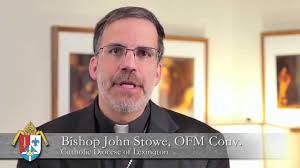
Last week, the bishop of Lexington, Kentucky, profoundly sharpened the recent controversy involving a student from Covington Catholic High School who confronted a Native American elder after this year’s pro-life march in Washington, D.C.
Writing an op-ed in the Lexington Herald-Leader, Bishop John Stowe attempted to deepen the entire conversation. He suggested changing it from superficial wrangling about the apparent disrespect the student displayed to a discussion of whether or not Catholics can support the current occupant of the White House and still be true to their faith.
Bishop Stowe said “no.” It’s a matter of faith, he said.
By taking that position, the Lexington bishop created what I would call a much-needed Dietrich Bonhoeffer moment for the church at a time when Mr. Trump exhibits traits and policies reminiscent of Adolf Hitler during his rise to power in the 1930s. (In the name of their faith, Bonhoeffer and members of his Confessing Church separated themselves from German Christians who supported der Fuhrer.)
The bishop’s words also incurred the wrath of Catholic Trump
supporters much as Jesus in today’s Gospel selection sparked anger in his own
hometown when he called his neighbors’ faith into question.
Let me explain.
First, recall the context of the bishop’s words. Then connect
them to our reading and finally to Bonhoeffer and his church of resistance.
As for context, a video of the stand-off between the high school student, Nick Sandman and the Native American, Nathan Phillips, had just gone viral. Initial viewings led many to condemn the student’s apparent disrespect.
Then, Sandman’s parents hired a P.R. firm to spin his side of the story. As a result, public commentary quickly changed from blaming the adolescent for his apparently offensive smirk. It centered instead on whose version of the story was correct. Was the student (as the PR firm put it) merely smiling in an attempt to deescalate a threatening situation? Or was he making fun of the Native elder by placing his grin inches from the old man’s face?
In an op-ed published in the Lexington
Herald-Leader, Bishop Stowe reframed the debate by adopting the prophetic
tack I just mentioned. He focused on the fact that the young student and many
of his companions were wearing red “Make America Great Again” hats. That’s what the bishop found
incompatible with Catholic faith and its comprehensive approach to life-issues.
He wrote:
“Without engaging the discussion about the context of the viral
video or placing the blame entirely on these adolescents, it astonishes me that
any students participating in a pro-life activity on behalf of their school and
their Catholic faith could be wearing apparel sporting the slogans of a
president who denigrates the lives of immigrants, refugees and people from
countries that he describes with indecent words and haphazardly endangers with
life-threatening policies.”
In other words, Bishop
Stowe was broadening the concept of being “pro-life” – the reason many
Catholics back President Trump – to question that support itself. Catholic faith,
the bishop implied, cannot tolerate Trump’s policies on immigration, refugees or
other words or actions that disrespect Global South countries and endanger life
(think capital punishment, drone assassinations, bombings, and illegal wars).
Such behavior offends core Catholic beliefs about the inviolable sanctity of
human life.
Specifically in
reference to abortion, the Lexington bishop added:
“As the leader of the
Catholic Church in the 50 counties of Central and Eastern Kentucky . . . I
believe that U.S. Catholics must take a look at how our support of the
fundamental right to life has become separated from the even more basic truth
of the dignity of each human person. . . While the church’s opposition to abortion has
been steadfast, it has become a stand-alone issue for many and has become
disconnected to other issues of human dignity.”
Still referencing the abortion issue, Bishop
Stowe concluded:
“The pro-life movement
claims that it wants more than the policy change of making abortion illegal but
aims to make it unthinkable. That would require deep changes in society and
policies that would support those who find it difficult to afford children. The
association of our young people with racist acts and a politics of hate must
also become unthinkable.”
Notice how these words
unabashedly connect President Trump with racism and policies that embody
hatred. They also recognize that many women are driven to abortion by
government policies that make unplanned pregnancies problematic.
Now, that brings me to this Sunday’s Gospel reading and to Jesus’ words that “No prophet is accepted in his hometown.” I make the connection because dozens of people chose to comment very harshly on the bishop’s op-ed. Instead of dealing with the more comprehensive understanding of the phrase “pro-life,” they called Bishop Stowe vile names, brought up the pedophilia issue, and defended Donald Trump as God’s servant. I was surprised that some of the on-line language was actually permitted by the Herald-Leader’s editors.
It was like what happened to Jesus in today’s reading. There the
Master himself is pilloried by his neighbors in Nazareth for challenging (like
Bishop Stowe) their narrow religious prejudices. When Jesus reminds the people
from Nazareth that God cares as much about Syrians and Lebanese as about Jews,
they actually try to murder him.
As I said, that proved the truth of his saying that “No prophet
is accepted in his hometown.” After all, prophets are those who speak for God.
They connect God’s word to events of the day. And that’s what John Stowe did in
his op-ed. He made the connection not only between the teaching of Jesus on the
one hand and the event in Washington on the other. Echoing Dietrich Bonhoeffer
and his Confessing Church, he also used the occasion to denounce Catholic
support for latter-day fascism.
In similar circumstances 85 years ago, Bonhoeffer and the German Confessing Church courageously published their famous Barmen Declaration. It held that no one professing to follow Jesus could possibly accept Hitler as their Fuhrer; only Christ could hold that position.
In response, both Protestants and Catholics denounced Bonhoeffer and the others as traitors. Pope Pius XII would even persist in endorsing Hitler as “an indispensable bulwark against the Russians.”
The words of Bishop Stowe seem intent on preventing Catholics in
his diocese from recommitting a similar error.
As a long-time Kentuckian and member of the loyal opposition
within the Catholic Church, I’m proud of his courage. It’s time for Catholics
and the rest of us to take Bishop Stowe’s words seriously.
Simply put, people of faith cannot support Donald Trump and
still be authentic followers of Jesus. We must do all we can to frustrate Trump’s
policies and see that he is not elected to a second term.
Yes, Bishop Stowe is correct: it’s a matter of faith!



 About Things That Matter