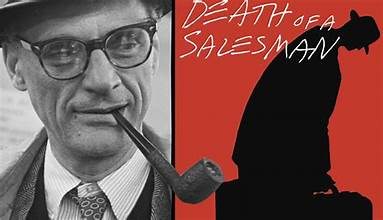
Last Saturday, Peggy and I went to New York City to see Arthur Miller‘s 1949 masterpiece, Death of a Salesman. We left the Winter Garden Theater in silence. Before long I realized I was crying. Yes, weeping. The tears continued for blocks as we walked toward the restaurant where we planned to have dinner.
Even now I’m not entirely sure why I cried.
At first I assumed I was simply identifying with Willie Loman. After all, he is a man in his sixties who suddenly discovers that the work defining his life for more than thirty years has become impossible. His energy is gone. His usefulness is questioned. The world that once seemed to need him has quietly moved on. His death comes long before his suicide.
At eighty-five, I know something about watching one’s capacities diminish. Hearing fades. Energy declines. More and more often the question becomes not, “What can I still accomplish?” but “Who am I if I can no longer do what once defined me?”
But the more I reflected on my tears, the more I realized they weren’t really about Willie. Or at least not only about Willie.
They were about fathers.
Miller’s play understands something painful about fatherhood. There comes a time when our children stop looking up to us and begin looking through us. They discover that their fathers are neither heroes nor villains, but complicated human beings whose virtues and weaknesses are hopelessly intertwined. Every parent eventually faces the unsettling realization that the children whose lives we once shaped will one day render their own quiet judgments about ours.
That recognition stirred memories of my own family—not because our story resembles the Lomans’, but because every family contains misunderstandings, disappointments, words spoken in anger, hopes that never quite found their mark, and love that somehow survives them all.
I suspect many parents left the theater carrying similar memories, perhaps with tears in their eyes too.
The play awakened something else as well.
There are moments in every long life that continue to haunt us—not necessarily because they were our greatest sins, but because they revealed our deepest fears. Watching Willie confronted by the collapse of the image he had tried so desperately to maintain reminded me of occasions when I failed to be as courageous or as truthful as I wish I had been. Decades later those moments still revisit me from time to time.
What lingers is not so much guilt as humility.
As a young man I imagined that moral growth meant eventually overcoming weakness. Experience has taught me something different. Growing older has not meant becoming flawless. It has meant trying to become less defensive about my flaws and less inclined to hide them from myself.
Perhaps that is one of aging’s unexpected gifts.
Most people understand Death of a Salesman as a critique of the American Dream. They are right. Willie spends his life believing success means money, popularity, and being “well liked.” When those illusions collapse, so does he.
But watching the play in 2026, I couldn’t help seeing another tragedy.
Near the end, Willie’s employer proudly demonstrates the latest technological marvel—a bulky tape recorder. Almost immediately afterward Willie is discarded.
Today the tape recorder has become artificial intelligence. Workers everywhere are discovering that technology often celebrates innovation while quietly abandoning the people whose lives it replaces. The gadgets become more impressive. Human beings become more disposable.
That frightened me because in the age of AI, disposability has become one of the defining moral failures of our time. Workers become disposable. The elderly become disposable. The poor become disposable. Even truth itself sometimes seems disposable.
Finally, there was one detail about Willie that made me wince. He is obsessed with being liked. He constantly judges himself and everyone else according to popularity. I wanted to tell him, “Stop worrying about being liked.”
Then I realized I needed to hear the same advice.
I tell myself that I write because I hope my words might contribute, however modestly, to justice, to compassion, to a clearer understanding of our world. That is true. Yet I would be less than honest if I denied the small disappointment that comes when an essay receives fewer readers than I had hoped. In our digital age, “likes” and “views” have become our own version of Willie’s popularity contest.
Arthur Miller understood that temptation long before social media existed.
As Peggy and I walked through Manhattan, the tears gradually subsided. Eventually I realized I wasn’t mourning Willie Loman. I was mourning every illusion about myself that still survives — the illusion that my worth depends on my usefulness; the illusion that I can control how others understand me; the illusion that I should have outgrown weakness long ago; the illusion that being noticed is the same as being loved.
Then another thought quietly entered my mind — one connected with the work I’ve actually done my entire life. Jesus almost never asked the questions our culture asks. He showed remarkably little interest in success, reputation, or productivity. Again and again, he seemed drawn instead to people who had stopped pretending: tax collectors, prostitutes, failures, the poor, the brokenhearted, those who no longer had impressive résumés to defend. His harshest criticism was reserved not for sinners but for those who could no longer tell the truth about themselves.
Perhaps that is why Willie Loman remains such a tragic figure. His deepest failure was not that he sold too little or earned too little. It was that he could never relinquish the story he had invented about himself.
Truth, however painful, might have saved him.
As I grow older, I find myself believing that the spiritual life has less to do with becoming extraordinary than with becoming honest. Perhaps that is what Jesus meant when he said that the truth will make us free. Not successful. Not admired. Free.
Arthur Miller gave me no answers that afternoon. He simply held up a mirror.
And perhaps the tears that surprised me outside the theater were not tears of despair at all. Perhaps they were tears of gratitude—for having lived long enough to discover that Life’s grace is found less in our achievements than in our willingness to stop pretending, tell the truth about ourselves, and entrust the rest to love.

 About Things That Matter
Thank you for sharing your thoughts and feelings
appreciate them
LikeLike