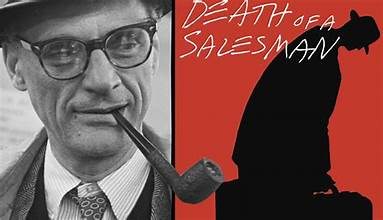
My Tears for Willie Loman

Last Saturday, Peggy and I went to New York City to see Arthur Miller‘s 1949 masterpiece, Death of a Salesman. We left the Winter Garden Theater in silence. Before long I realized I was crying. Yes, weeping. The tears continued for blocks as we walked toward the restaurant where we planned to have dinner.

Even now I’m not entirely sure why I cried.

At first I assumed I was simply identifying with Willie Loman. After all, he is a man in his sixties who suddenly discovers that the work defining his life for more than thirty years has become impossible. His energy is gone. His usefulness is questioned. The world that once seemed to need him has quietly moved on. His death comes long before his suicide.

At eighty-five, I know something about watching one’s capacities diminish. Hearing fades. Energy declines. More and more often the question becomes not, “What can I still accomplish?” but “Who am I if I can no longer do what once defined me?”

But the more I reflected on my tears, the more I realized they weren’t really about Willie. Or at least not only about Willie.

They were about fathers.

Miller’s play understands something painful about fatherhood. There comes a time when our children stop looking up to us and begin looking through us. They discover that their fathers are neither heroes nor villains, but complicated human beings whose virtues and weaknesses are hopelessly intertwined. Every parent eventually faces the unsettling realization that the children whose lives we once shaped will one day render their own quiet judgments about ours.

That recognition stirred memories of my own family—not because our story resembles the Lomans’, but because every family contains misunderstandings, disappointments, words spoken in anger, hopes that never quite found their mark, and love that somehow survives them all.

I suspect many parents left the theater carrying similar memories, perhaps with tears in their eyes too.

The play awakened something else as well.

There are moments in every long life that continue to haunt us—not necessarily because they were our greatest sins, but because they revealed our deepest fears. Watching Willie confronted by the collapse of the image he had tried so desperately to maintain reminded me of occasions when I failed to be as courageous or as truthful as I wish I had been. Decades later those moments still revisit me from time to time.

What lingers is not so much guilt as humility.

As a young man I imagined that moral growth meant eventually overcoming weakness. Experience has taught me something different. Growing older has not meant becoming flawless. It has meant trying to become less defensive about my flaws and less inclined to hide them from myself.

Perhaps that is one of aging’s unexpected gifts.

Most people understand Death of a Salesman as a critique of the American Dream. They are right. Willie spends his life believing success means money, popularity, and being “well liked.” When those illusions collapse, so does he.

But watching the play in 2026, I couldn’t help seeing another tragedy.

Near the end, Willie’s employer proudly demonstrates the latest technological marvel—a bulky tape recorder. Almost immediately afterward Willie is discarded.

Today the tape recorder has become artificial intelligence. Workers everywhere are discovering that technology often celebrates innovation while quietly abandoning the people whose lives it replaces. The gadgets become more impressive. Human beings become more disposable.

That frightened me because in the age of AI, disposability has become one of the defining moral failures of our time. Workers become disposable. The elderly become disposable. The poor become disposable. Even truth itself sometimes seems disposable.

Finally, there was one detail about Willie that made me wince. He is obsessed with being liked. He constantly judges himself and everyone else according to popularity. I wanted to tell him, “Stop worrying about being liked.”

Then I realized I needed to hear the same advice.

I tell myself that I write because I hope my words might contribute, however modestly, to justice, to compassion, to a clearer understanding of our world. That is true. Yet I would be less than honest if I denied the small disappointment that comes when an essay receives fewer readers than I had hoped. In our digital age, “likes” and “views” have become our own version of Willie’s popularity contest.

Arthur Miller understood that temptation long before social media existed.

As Peggy and I walked through Manhattan, the tears gradually subsided. Eventually I realized I wasn’t mourning Willie Loman. I was mourning every illusion about myself that still survives — the illusion that my worth depends on my usefulness; the illusion that I can control how others understand me; the illusion that I should have outgrown weakness long ago; the illusion that being noticed is the same as being loved.

Then another thought quietly entered my mind — one connected with the work I’ve actually done my entire life. Jesus almost never asked the questions our culture asks. He showed remarkably little interest in success, reputation, or productivity. Again and again, he seemed drawn instead to people who had stopped pretending: tax collectors, prostitutes, failures, the poor, the brokenhearted, those who no longer had impressive résumés to defend. His harshest criticism was reserved not for sinners but for those who could no longer tell the truth about themselves.

Perhaps that is why Willie Loman remains such a tragic figure. His deepest failure was not that he sold too little or earned too little. It was that he could never relinquish the story he had invented about himself.

Truth, however painful, might have saved him.

As I grow older, I find myself believing that the spiritual life has less to do with becoming extraordinary than with becoming honest. Perhaps that is what Jesus meant when he said that the truth will make us free. Not successful. Not admired. Free.

Arthur Miller gave me no answers that afternoon. He simply held up a mirror.

And perhaps the tears that surprised me outside the theater were not tears of despair at all. Perhaps they were tears of gratitude—for having lived long enough to discover that Life’s grace is found less in our achievements than in our willingness to stop pretending, tell the truth about ourselves, and entrust the rest to love.

What Is Democracy For? China’s Whole-Process Democracy and the Common Good

My recent OpEdNews article, “China’s Example and the Need to Rethink Democracy Itself,” prompted an interesting response from editor-in-chief Rob Kall. He agreed that America’s inability to think beyond the next election is becoming one of our greatest national weaknesses. But he asked me to explain more fully what the Chinese call “whole-process people’s democracy.” How does it actually work? Is it merely another name for one-party rule, or does it embody a fundamentally different understanding of democracy?

Those questions deserve a careful answer because most Americans—including many progressives—know surprisingly little about China’s own explanation of its political system. We generally define democracy almost entirely by its procedures. If citizens vote, if competing parties contest elections, if freedom of speech is protected, and if power changes hands peacefully, we call a nation democratic. If those conditions are absent or limited, we usually do not.

Chinese political theory begins somewhere else.

Its proponents argue that democracy should be judged not only by how governments are chosen but also by what governments accomplish for ordinary people. The legitimacy of government lies not simply in electoral competition but in reducing poverty, expanding education, building infrastructure, protecting public health, caring for the environment, and planning for future generations. In that sense, China’s theory of “whole-process people’s democracy” is consequentialist. It asks citizens to judge government by its results.

Whether one ultimately accepts that understanding or not, it raises a larger question that reaches far beyond China.

What is democracy for?

As I reflected on Rob Kall’s question, I found myself thinking not only about Chinese political theory but also about Jesus, liberation theology, Catholic social teaching from Leo XIII to Pope Leo XIV, and even the Marxist ecological economist John Bellamy Foster. Strange as it may seem, these very different traditions converge around a remarkably similar principle. Political institutions should ultimately be judged by what they produce for human beings, especially for those who are most vulnerable.

Jesus expressed the principle with characteristic simplicity. “By their fruits you shall know them.” That sentence may be the clearest statement of consequentialist ethics ever uttered.

Jesus repeatedly judged persons and institutions by their consequences rather than by their claims. Good trees produce good fruit; bad trees produce bad fruit. In the parable of the Last Judgment, nations are evaluated not by their constitutions or political procedures but by whether they fed the hungry, welcomed the stranger, clothed the naked, visited prisoners, and cared for the sick. The decisive question is always: What happens to “the least of these” (Matthew 25: 31-46)?

Liberation theology extends precisely that biblical insight into politics and economics. Gustavo Gutiérrez famously defined theology as “critical reflection on praxis.” Orthodoxy must be tested by orthopraxis. Correct ideas alone are insufficient. A society is judged by the lives its institutions make possible, especially for the poor.

Enrique Dussel sharpened the point by distinguishing between what he called formal and material democracy. Formal democracy concerns procedures: elections, constitutions, legislatures, political parties, and legal rights. These are indispensable achievements. But they are not enough. Material democracy asks whether those institutions actually reproduce and enhance human life. Do they enable communities to flourish? Do they defend the excluded? Do they protect future generations? If they do not, procedural legitimacy alone cannot redeem them.

That distinction helps explain what Chinese theorists mean by “whole-process democracy.”

According to its proponents, democracy is not exhausted by election day. Citizens directly elect representatives at the village level, while higher-level people’s congresses are chosen through successive representative levels. Consultation continues throughout the policy process through congresses, advisory bodies, professional organizations, universities, business associations, workers’ organizations, and representatives of China’s many ethnic communities. Chinese scholars argue that democracy therefore consists not only of elections but of consultation, planning, implementation, evaluation, and revision.

Western observers frequently challenge aspects of this account, raising important questions about political pluralism, freedom of expression, and civil liberties. Those questions deserve serious discussion. Yet the Chinese model also asks a question Americans too seldom ask ourselves: What has our own democracy actually accomplished?

For decades Americans have watched infrastructure age, political polarization deepen, homelessness increase, life expectancy stagnate compared with many peer nations, and public confidence in institutions decline. Elections continue on schedule. Campaigns become ever more expensive. Every election is described as the most important in our lifetime. Yet many structural problems remain stubbornly unresolved.

One reason, I believe, lies in the nature of our political system itself.

The permanent competition between Democrats and Republicans makes sustained national planning extraordinarily difficult. Policies begun by one administration are often dismantled by the next—not necessarily because they have failed but because they belong to political opponents. The electoral calendar becomes stronger than the planning calendar.

China’s political system has evolved differently. Its supporters point to Five-Year Plans embedded within much longer strategic visions extending over decades. Whatever one thinks of particular policies, this institutional continuity makes it easier to pursue infrastructure projects, industrial strategies, poverty reduction, and technological development that require sustained public commitment.

Its advocates also note that senior leaders typically accumulate extensive administrative experience before reaching national office, usually serving at county, municipal, and provincial levels over many years. The underlying ideal is that governing capacity should be demonstrated before greater authority is entrusted.

Perhaps the greatest difference between the two systems concerns the relationship between political power and economic power.

Supporters of China’s system argue that the Communist Party’s historic responsibility is to ensure that concentrated private wealth does not capture the state. Whether contemporary China consistently fulfills that aspiration is a matter of legitimate debate. Yet the aspiration itself points toward an issue Americans can scarcely avoid.

Who governs our republic?

Increasingly, I fear it is what I have elsewhere called the “Epstein class.” By that phrase I do not mean wealthy people as such. Wealth honestly earned has enriched every civilization. I mean something more dangerous: an oligarchic class capable of converting immense private wealth into political influence, legal privilege, media power, and practical immunity from accountability. Jeffrey Epstein became, in my view, not the cause of this phenomenon but its most recognizable symbol.

Seen from this perspective, the defining political question of the twenty-first century is not capitalism versus socialism. Every major economy employs markets. The deeper question is whether markets govern society or whether society governs markets.

Here an unexpected convergence appears.

Beginning with Leo XIII’s Rerum Novarum, Catholic social teaching has consistently rejected both collectivist absolutism and laissez-faire capitalism. It has defended private property while insisting that ownership always carries social obligations. Markets are valuable instruments. They are not sovereign moral authorities. Economic life exists to serve the common good.

Pope Leo XIV develops that same tradition in Magnifica Humanitas. Reflecting on artificial intelligence, technological power, and global finance, he insists that technology, markets, and capital must remain subordinate to human dignity, ecological responsibility, and the integral flourishing of humanity. They are servants, never masters.

Remarkably, John Bellamy Foster reaches a strikingly similar conclusion from an entirely different intellectual tradition. He warns against what he calls the “fetishism” of artificial intelligence and of the market itself—the tendency to treat technological and economic forces as though they were beyond democratic control. Democratic societies, he argues, should consciously direct economic development toward ecological sustainability and human well-being rather than allowing markets alone to determine humanity’s future.

Franz Hinkelammert anticipated both arguments decades ago. He warned that modern capitalism easily transforms the market into an idol demanding endless sacrifice. Workers become expendable. Communities become disposable. Nature becomes merely another commodity. Against this idolatry, Hinkelammert proposed what he called “the criterion of life.” Every institution, every economy, every political system must finally answer one question:

Does it serve life?

Conclusion

Rob Kall asked me to explain China’s understanding of democracy.

In the end, I found myself confronting a much larger question, Viz., What is government for?

If its highest purpose is merely to organize elections, then the American model has much to teach the world. But if the purpose of government is to secure the common good, protect the vulnerable, subordinate economic power to democratic authority, preserve the earth for future generations, and enable human beings to flourish, then elections are not the end of democracy. They are only one of its instruments.

That is the challenge posed by China’s theory of whole-process democracy. Whether or not one ultimately accepts its answer, it forces us to ask whether democracy should be judged only by its procedures or also by its consequences.

Jesus had no hesitation about the answer.

He never said, “By their constitutions you shall know them.”

He never said, “By their elections you shall know them.”

He said, “By their fruits you shall know them.”

Perhaps that is the question the twenty-first century can no longer avoid. Not simply which nation is more democratic, but which political institutions consistently bear the fruits of justice, peace, sustainability, human dignity, and the common good.

Until we are willing to judge every political and economic system—including our own—by that standard, democracy will remain little more than a procedure. It will never become what it was always meant to be: a way of organizing society so that life, especially the lives of “the least of these,” may flourish.

July 4th: What Made Me Stop Loving “America”

Every Fourth of July Americans are invited to celebrate freedom, democracy, and the birth of the republic. This year, on the nation’s 250th anniversary, I find myself unable to join the celebration.

A few days ago, listening to Amy Goodman’s Democracy Now!, I heard Princeton historian Eddie Glaude utter words that startled me by expressing exactly what I had been struggling to admit to myself: “I do not love America, and never have, especially now.” Those words open his new book, America, U.S.A.: How Race Shadows the Nation’s Anniversaries, which examines what our official commemorations leave out as much as what they include.

Unlike Professor Glaude, however, I cannot say that I never loved America. Quite the contrary. I was raised to love it instinctively. My journey has not been one from radicalism to disillusionment. It has been the reverse: from unquestioning patriotism to reluctant dissent. It was a conversion I resisted almost every step of the way.

I grew up in what I would call a quietly Republican family. My parents usually described themselves as independents, but I suspect they voted otherwise. I admired my Uncle Ben because, unlike my other uncles, he worked downtown in Chicago at the First National Bank. Success, respectability, and patriotism all seemed to fit naturally together.

My education reinforced those assumptions. I spent nine years in Catholic elementary school, thirteen more in Catholic seminaries, and another five years studying theology in Rome as a young priest. When Martin Luther King Jr. publicly opposed the Vietnam War, I remember wondering why he had wandered into foreign affairs. As far as I was concerned, civil rights were one thing; Vietnam was another.

When Senator Joseph McCarthy died, one of my favorite seminary professors remarked, “A great man died today.” That simple sentence reveals how conservative my early formation really was.

My first presidential vote was cast for Barry Goldwater.

Reality, however, has a way of intruding on ideology.

The Vietnam War was my first great awakening. I remember reading in Time magazine—of all places—that American leaders opposed internationally supervised elections in Vietnam because Ho Chi Minh would almost certainly have won. I can still remember arguing with my father about what that implied. If democracy was our highest value, why were we preventing democratic elections?

At almost the same time Pope John XXIII convened the Second Vatican Council and announced his intention to “open the windows” of the Church to the modern world. I resisted that as well. I defended traditional Catholicism against classmates who seemed eager to dismantle it. I even found myself defending Thomas à KempisThe Imitation of Christ against criticism.

Yet resistance gradually gave way to curiosity.

I immersed myself in the documents of Vatican II. I read theologians like Edward Schillebeeckx, Karl Rahner, and even the young Josef Ratzinger, then one of the Council’s progressive voices. Even more important were the scripture courses taught by our remarkable professor Eamonn O’Doherty. Under his guidance I learned that the Bible is not a single literary form but a library containing myth, poetry, legend, law, debate, parable, apocalypse, and theological reflection. To read every passage as straightforward history is to misunderstand Scripture itself.

That realization liberated me from biblical literalism. More surprisingly, it also taught me to read secular history differently. If biblical texts required careful attention to genre, perspective, and purpose, why should national histories be treated as transparent accounts of objective fact?

That question changed everything.

History came first. Howard Zinn‘s A People’s History of the United States, Oliver Stone and Peter Kuznick’s The Untold History of the United States, Walter Rodney‘s How Europe Underdeveloped Africa, and Frantz Fanon‘s The Wretched of the Earth revealed an America I had never encountered in classrooms. Economics followed. Frances Moore Lappé‘s Food First and Jack Nelson-Pallmeyer‘s The Politics of Compassion exposed structures of hunger and inequality that conventional economics preferred to ignore. Then years of teaching Great Books at Berea College required me to wrestle seriously with Marx alongside Adam Smith, David Ricardo, Thomas Malthus, and Charles Dickens. Little by little, assumptions I had once regarded as self-evident dissolved under the weight of evidence.

But books alone did not transform me.

Liberation theology did.

After earning my doctorate in moral theology, I became fascinated by a movement that insisted theology must begin not from the perspective of the powerful but from that of the poor. Faith, it argued, should be judged by whether it liberates those who suffer, not by whether it justifies existing institutions.

That conviction took me far beyond libraries.

My wife Peggy and I studied and worked throughout Latin America and the Global South—in Brazil, Nicaragua, Cuba, Costa Rica, Mexico, Honduras, Zimbabwe, South Africa, India, and Israel-Palestine. We became friends with Paulo Freire, whose understanding of education as liberation profoundly influenced both of us. In Costa Rica we joined the Departamento Ecuménico de Investigaciones, where Franz Hinkelammert and Helio Gallardo became two of my most important teachers.

Neither man simply gave me new information. They taught me something much more valuable: how to see.

They invited me to view history from below—from the perspective of those who bear the consequences of imperial decisions made thousands of miles away. Peasants, workers, indigenous communities, political prisoners, refugees, and theologians throughout Latin America repeatedly described the United States in ways that initially seemed exaggerated to me. Gradually I realized they understood my country’s history far better than I did.

Liberation theology completed what Vatican II had begun. It taught me that the decisive question is never whether a nation calls itself democratic, Christian, or free. The question is always: What happens to the poor? Everything else is secondary.

Seen from that perspective, a different America emerged.

It was a republic built upon slavery and the dispossession of Native peoples. It repeatedly overthrew governments that threatened American corporate interests. It armed dictators while speaking eloquently about democracy. As Martin Luther King Jr. concluded near the end of his life, it had become “the greatest purveyor of violence in the world today.”

Eventually I encountered an admission even more startling than King’s. In 1948, George Kennan—the architect of America’s Cold War strategy—explained privately what U.S. foreign policy actually sought:

“. . . we have about 50% of the world’s wealth, but only 6.3% of its population…. Our real task…is to devise a pattern of relationships which will permit us to maintain this position of disparity…. We should cease to talk about vague…objectives such as human rights…and democratization…. The less we are then hampered by idealistic slogans, the better.”

For me, that memo confirmed what liberation theologians had already been teaching for years.

So today I find myself agreeing, though for reasons different from Professor Glaude’s opening declaration.

No, I no longer love what is commonly called “America”—if by that we mean an empire built upon military supremacy, economic domination, and stories that conceal as much as they reveal.

But neither have I become cynical.

I still love the American people. I love those who organize, protest, teach, tell the truth, and refuse to surrender the country’s unrealized promise. I love the constitutional ideals that have so often been betrayed. And I love the generations of Americans who have struggled to redeem the republic from its own mythology.

Perhaps that is what Jesus would have understood as well. He loved neither the Roman Empire nor the religious establishment that collaborated with it. His loyalty belonged instead to what he called the Kingdom of God—a social order measured not by wealth or military power but by the well-being of the poor, the hungry, the imprisoned, and the stranger. Liberation theology taught me to ask of every nation, including my own, not whether it proclaims itself exceptional, but whether it stands with those people.

If my understanding of America changed, it was not because I became more cynical. It changed because teachers, colleagues, friends, and ordinary people throughout Latin America, Africa, Asia, and the Middle East patiently taught me to see history through the eyes of those who pay the price for empire.

For that gift—and especially for the friendships that made it possible—I remain profoundly grateful.

On this Fourth of July, perhaps genuine patriotism begins not with celebration, but with truth.