Who Ended the Syrian Crisis, Putin or Pope Francis? Reflections on Saturday’s Peace Vigil in St. Peter’s Square

Peace Vigil

The sudden success of the “Putin Plan” to end the chemical weapons crisis in Syria has occasioned a crisis of faith for me. But even more so has the “Francis Plan” addressing the same crisis and executed last Saturday in St. Peter’s Square. The pope’s plan involved Christians and others of good will fasting and praying to end the impending Syrian catastrophe. I wonder whose plan did most to resolve the crisis. Together their apparent effectiveness makes me wonder about miracles and the power of prayer.

Of course, everyone knows about Putin’s plan to have Syria turn over its chemical weapons to U.N. monitors for purposes of the weapons’ destruction. Its acceptance by Syria and even by war hawks in the United States has caused Putin’s image as a diplomat and peacemaker to skyrocket. That coupled with his defiance of President Obama in the Edward Snowden case, has raised beyond measure his international standing as a defender of human rights. (Meanwhile the Christian “leader of the free world” has shrunk to the size of a shallow militarist who must be restrained by atheists and former communists now occupying the higher ground.)

However, from a faith perspective, I’m thinking that the plan of Pope Bergoglio may have been even more influential than Putin’s. At the very least, the pope’s contribution to solving the Syrian crisis suggests that there might be more to the man than first met the eye. After all, in the case of Syria, the pope went beyond simply wringing his hands over the irrationality and counter-productivity of Obama’s rash proposals. (That’s what other popes have occasionally done in cases of other wars of aggression by other U.S. presidents.)

Instead, Francis called people out into the streets. He hosted and led what amounted to a 5 ½ hour anti-war demonstration in St. Peter’s Square. Without ever mentioning Obama’s name or referring specifically to the United States, he asked people of good will throughout the world to similarly demonstrate wherever they might be. By the tens of thousands they responded in St. Peter’s Square. By the millions they responded across the planet.

I know about the Rome demonstration, because I was there. My wife, Peggy and I just happened to be in the Eternal City last Saturday. We took the occasion to join with thousands and thousands of other believers for that evening-long prayer vigil led by Francis I. Our overwhelming numbers filled the huge historic square in an inspiring demonstration of deep and sincere faith.

We prayed that the United States would come to its senses and realize (as Pope Francis put it) that violence only begets violence, and war only begets war. There is no other way to peace, he reminded us, than by forgiveness, reconciliation, and a dialog that respectfully includes all stakeholders. That means the al-Assad government, its opponents, al-Qaeda, Iran, and (representing the rest of the world) the United Nations. (Let’s face it: apart from its membership in the U.N., the United States is not a real stakeholder in this conflict so distant from its shores.)

So there we stood for hours praying the rosary together, listening to readings from Holy Scripture and the writings of St. Theresa of the Child Jesus. We recited litanies, sang familiar hymns, listened to those words from the pope, and passed long minutes of quiet meditation and personal prayer. (It was amazing to experience so many people being so quiet for so long.) Preceding Benediction of the Blessed Sacrament, a harpist played, and choirs chanted. On huge TV screens, we saw the pope’s eyes tightly closed in prayer. We saw cardinals, bishops, priests, nuns, rich and poor, men and women, young and old, praying for peace. The vigil lasted from 7:15 p.m. till midnight.

It was entirely inspiring and uplifting.

And it apparently had its effect. I awoke Monday morning to find that President Putin had upstaged the Obama administration with (of all things!) a diplomatic proposal to replace the Obama policy of bombing as a first resort.

Imagine that: a “leader” from a country emerging from nearly a century of communism and official atheism making a peace proposal completely in tune with the pope’s wishes and what we were praying for in St. Peter’s Square. And this in the face of the bellicose threats of a Christian presiding over a country where the majority claims to follow Jesus of Nazareth!

Was it some kind of miracle? Had our prayers been answered?

(To be continued in Monday’s post)

Jesus Would Have Supported al Qaeda Sooner than the U.S.! (Sunday Homily)

jesus  terrorist

Readings for 23rd Sunday in Ordinary Time: WIS 9:13-18B; PS 90: 3-6, 12-14, 17; PHMN 9-10, 12-17; LK 14: 25-33. http://usccb.org/bible/readings/090813.cfm

Did you have trouble with today’s gospel reading? I did. Frankly, it makes me wonder about Jesus’ attitude towards violence and armed attempts to overthrow foreign occupation forces like the Roman legions in Palestine – or American armed forces in Afghanistan or their authoritarian clients in Israel, Egypt, Bahrain, Yemen and elsewhere.

I wonder: whose side would Jesus be on in today’s War on Terrorism? I doubt it would be “ours.” Certainly, Jesus was not on the side of Rome. Instead, he was clearly sympathetic to Rome’s armed opponents. That makes me suspect that he would also have sided with those our own government deems “terrorists.”

What do you suppose that means for us and our politics?

Before answering, think about Jesus’ words in today’s selection from Luke. There Jesus is not telling us to love our enemies. He’s saying that we must hate! Yes he is. And the objects of our hatred must be our family members, down to our spouses and children. According to Jesus, we must even hate our own lives!

That’s pretty outspoken, hyperbolic, radical and edgy. In fact, his words make clear why the Romans and their Jewish collaborators in the Temple would have seen Jesus as an insurgent and terrorist. In any case, he was surely not the apolitical, domesticated preacher tradition later made him. He was not blissfully unaware of or uncaring about the searing resentment his people shared about Rome’s occupation of the land whose only sovereign in their eyes was Yahweh.

Yet Jesus’ words today also make it clear that he was not a violent revolutionary like the many other “messiahs” who sprang up in his 1st century context. As Reza Aslan points out, Jesus was not like Theudas, Hezekiah the bandit chief, Judas the Galilean, Menahem, Simon son of Giora, Simon son of Kochba and the rest.

Still today’s gospel makes it clear that there was genuine cause for concern about Jesus and his followers among the Romans and their Jewish clients in the Temple.

To begin with there were those “great crowds” Luke describes as following Jesus everywhere. In revolutionary situations, masses of people thronging about a charismatic troublemaker are reason for serious concern. According to U.S. standards under American Empire, it’s enough for local armed men in suspect locations to merely assemble to justify their being droned. And, of course, we know that at least some of Jesus’ disciples were armed (MK 14:43-52). Presumably others in the “large crowds” carried weapons as well. They would not have been viewed any more kindly by Roman occupation forces than their U.S. equivalents.

Then, listen to Jesus’ rhetoric as recorded by Luke. There’s all that talk about hating everyone near and dear to us that I already mentioned. That’s the second time we’ve encountered such language from the Prince of Peace in the last few weeks. Remember what we read a month ago about his coming not as a peacemaker, but to create division between children, their parents and in-laws? In MT 10:34 Jesus even said specifically that he had come to bring the sword. “I come not to bring peace” he said, “but to bring a sword.” If he actually said those words, how do you think they would have been understood by Roman and Temple authorities?

However, Jesus’ most dangerous statement this morning is the one about willingness to be crucified in order to qualify as his disciple. In occupied Palestine, those words had nothing to do with patiently bearing life’s inconveniences. No, in Jesus’ context, they could only be about opposing Rome and its Jewish collaborators.

Again, it is Aslan who reminds us that crucifixion was the mode of torture and execution the Romans reserved for insurgents. So in a Palestine where rebels were crucified almost every day (sometimes hundreds at a time), Jesus’ words could mean only one thing: his followers must join him in opposing Roman occupation of their Holy Land and in doing so virtually seal their fates.

But then comes the non-violent “catch.” Opposition to imperial occupation of the homeland might be the duty of every patriotic Jew, Jesus implies. But that doesn’t necessarily mean violent opposition. Calculate well, Jesus says – like a man building a tower. Realize whom we are opposing. We’re talking about Rome. Its legions can mobilize 20,000 well trained and heavily armed troops on a moment’s notice. At best we have less than half that number. To avoid suicide, we must “sue for peace” like a wise king threatened by a superior force. In other words Jesus counsels a prudent non-violence to avoid a bloodbath.

Bishop Oscar Romero made a similar recommendation to the revolutionary forces of El Salvador (the FMLN) in the 1970s. He said he could surely sympathize with the anger of the FMLN towards the United States and its puppet regime in El Salvador. He could understand why peasant farmers might see violent revolution as their only option in fighting brutal forces of “order” which wantonly tortured and murdered women, children, and the elderly, along with teachers, social workers, union organizers, priests, nuns, and other resisters.

No doubt Romero would say the same today about young Egyptians opposing the U.S.-supported military dictators in their own country, or about similar insurgents in the U.S.-controlled countries I’ve already mentioned.

But, Romero said, such violence is suicidal in the face of the billions in arms supplied such forces of oppression by the United States. Better to resist non-violently. At least then, the inevitable ensuing bloodbath (the modern equivalent of crucifixion) will be smaller in scope.

In 1st century Palestine, Jesus was not the only one employing such non-violent reasoning. According to John Dominic Crossan in his book, The Power of Parable, strong non-violent movements of resistance to Rome characterized Jesus’ context.

These movements were sandwiched between two epochs of extremely bloody opposition to Rome. The first occurred exactly in the year of Jesus’ birth, 4 BCE. That was the year the Roman client, Herod the Great, died. Jewish freedom fighters seized upon the resulting leadership vacuum as an opportunity to rise up against Herod’s Roman patrons. Jewish insurgents captured the city of Sephoris, the capital of Galilee. In response, the Romans razed the city to the ground and killed everyone who might be associated with the rebellion. Jesus’ family in nearby Nazareth was lucky to escape.

The second period of extremely violent resistance to Rome occurred about 40 years after Jesus’ crucifixion – just before the gospels of Mark, Matthew and Luke were composed. This time the Jews rose up against the Roman occupiers throughout Palestine. The Roman response? They utterly sacked Jerusalem itself, destroying its temple, and killing virtually all those who had heard Jesus’ words and witnessed his deeds.

In between those fierce chapters, Crossan says, there was a period of non-violent resistance to Rome. That’s when Jesus traversed Palestine and spoke so memorably about God’s Kingdom. According to Crossan, Jesus’ era represented a period of “massive, well-organized, unarmed, nonviolent resistance against Rome.”

That’s the probable context for Jesus’ shocking words this morning.

There’s so much more that could be said about all of this. To fill in the blanks, read Crossan’s book, along with Aslan’s Zealot, which recently topped the New York Times Best Seller list.

For today it’s sufficient to note the implications of Jesus’ shocking words. Personally, I’m so glad the church makes us face them. They show that Jesus was far more complex regarding violence than he’s usually made out to be. These difficult readings open a conversation that would otherwise be unthinkable.

Going forward, the conversation might well address the following questions:

• What difficulties do we have with realizing that Jesus situation vis-à-vis Rome was extremely similar to that of today’s “terrorists” vis-à-vis the United States and that Jesus himself was considered a terrorist?
• Is the “War on Terror” a real war or merely empire once again defending its right to plunder, torture, and kill with impunity?
• How is it that U.S. citizens end up supporting massive U.S. violence against “terrorists,” but that we find the latter’s much less injurious response (like the “Boston Marathon Massacre”) so horrendous?
• Put otherwise, how is it that U.S. citizens generally support the wars of their country which Martin Luther King described as “the greatest purveyor of violence in the world today,” while demanding pacifism on the parts of those whom the U.S. attacks.
• Do the ones our government calls “terrorists” have the right to defend themselves against what Edward Herman has termed the “wholesale terror” of the U.S. and its allies? (See his book, The Real Terror Network.)
• Which terrorists do we support – our government and its brutal military or their victims?

What other questions do the readings raise – for you?

How about my reflections?

(Discussion follows)

Syria: The Snowden, Manning (and Godfather) Connections

Godfather

Well, we’re coming up for another vote about attacking a far off country over weapons of mass destruction. This time the target is not Iraq, but Syria. This time the “new Hitler” is not Saddam Hussein but Bashar al-Assad. This time it’s not Colin Powell, but John Kerry who assures the world that it can “trust us” and the secret evidence that can’t be fully shared for reasons of National Security.

Remember the last time a vote like this was taken? It was three days after 9/11. Then Congress passed a resolution for the Authorization for Use of Military Force. It sailed through with only one dissenting vote – that of Congresswoman Barbara Lee.

Before registering her brave dissent, the Congresswoman spoke on the House floor. “As we act,” she said, “let us not become the evil that we deplore.”

President Obama would do well to heed those words this time around. However I’m not merely referring to the fact that we already are the evil we ostensibly deplore. After all, we supported Saddam Hussein in his deployment of chemical weapons against Iran in 1988. We have repeatedly used chemical weapons ourselves – for example, Agent Orange in Vietnam and white phosphorus in Fallujah. (I’m not sure how to classify depleted uranium.)

Instead, I’m referring to the Chelsea Manning and Edward Snowden cases and the Obama administration’s position that the former Army, CIA and NSA employees deplorably (1) revealed state secrets, (2) violated their constitutional oaths, (3) failed to go through the proper channels, (4) aided the enemy, (5) endangered American lives, and (6) did all of this for reasons of personal advancement.

Ironically, these are the very “crimes” the Obama administration is committing relative to Syria. In effect, Obama is a more deplorable whistle-blower than he considers Edward Snowden and Chelsea Manning to be. That is, by confirming the Manning and Snowden revelations, he’s unwittingly blowing the whistle on himself.

Consider the Manning and Snowden parallels one-by-one. In the run-up to the Syria bombing:

• Obama has revealed state secrets: The big “state secret” in question is the most devastating one disclosed by Manning and Snowden. It is that the U.S. is a completely out-of-control rogue state. Its army is not only routinely guilty of “collateral murder.” Its CIA and NSA act like a world police force spying on and attempting to control not only designated enemies but even “friends.” The embarrassment caused by Manning and Snowden’s irrefutable revelations on those scores is what has so enraged the Nobel Peace laureate who resides in the White House. Nevertheless, Obama’s own posturing as World Policeman and Mad Bomber relative to Syria confirm what Manning and Snowden have told us so clearly. Our president and Congress are completely out-of-control.

• Obama is violating his constitutional oath: The State Department has repeatedly accused Chelsea Manning and Edward Snowden of violating their constitutional oaths to defend the Constitution against all enemies foreign and domestic. But the president, of course, and his congressional enablers are doing the same. According to the Constitution, treaties have the same force as domestic law. As a signatory of the United Nations treaty, the U.S. is bound to get Security Council approval before attacking another nation. Yet it refuses to go that route, because it knows that Russia and China will support world opinion which stands overwhelmingly against U.S. intervention in Syria (as does U.S. opinion).

• President Obama declines to “go through the proper channels”: In prosecuting Chelsea Manning and going after Edward Snowden, a constant accusation of the Obama administration has been that the two have failed to go through the proper channels and procedures which the administration claims are adequate and necessary to avoid catastrophe. Yet nowhere is international law clearer than in defining the proper channels that must honored before launching acts of war. Once again, those channels centralize the United Nations and its Security Council. The Obama administration ignores U.N. procedures because they would inevitably determine U.S. intentions to be criminal.

• President Obama is aiding the enemy: In its prosecution of Chelsea Manning and pursuit of Edward Snowden, the State Department has insisted that the two have “aided the enemy.” Even people giving donations to charitable causes perhaps tangentially connected to al-Qaeda run the risk of having similar accusations (and prosecutions). Yet, by all accounts the opposition to Syria’s Bashar al-Assad includes forces tightly allied with al-Qaeda. So by siding with the rebels, President Obama is directly aiding the enemy in ways that absolutely dwarf anything Manning and Snowden (and charitable donors) could even think of doing.

• President Obama is endangering American lives: Iran and Syria correctly claim the right to self-defense recognized by the U.N. Charter. As allies, they promise retaliation against the United States and its principal regional ally, Israel. Will Israel or the U.S. stand aside in the case of such retaliation? Of course not. As Obama himself has said, once the bombs start flying all bets are off. Events simply take on a life of their own. Will Israel itself retaliate using its atomic weapons? How irresponsible can our “leaders” be?

• President Obama is pursuing this insanity for reasons of personal gain: Obama clearly made a mistake in drawing a “red line” and promising “action” in the case of using chemical weapons in Syria. He made another mistake by jumping to the conclusion that the al-Assad government was responsible for their use before all the data was in. Now it fears appearing weak should it follow the lead of British Prime Minister David Cameron who in effect admitted his mistake in not honoring the will of the British people and its Parliament. So like a Mafia Don, in order to maintain “credibility” and save face, Obama feels compelled to break some legs and spray some restaurants with machine gun fire. Otherwise who knows how many congressional seats might be lost next year? Make no mistake: this round of blood-letting will be done for political gain and to save the president’s reputation as a credible “Godfather.”

So the substance of the Manning and Snowden revelations has been confirmed from the highest possible source. The U.S. is indeed a rogue state. It not only spies on the world, it has set itself up as its lone judge, jury, and executioner. It is a supporter of al-Qaeda. It cares not a bit for American lives or anyone else’s for that matter. In fact it is willing to risk a World War to avoid losing face. As such “America” is an outlaw state with “leaders” who routinely violate not only their oaths of office, but the U.N. Charter, world opinion, and the most elementary moral principles.

Not only that, but the procedures used by Manning and Snowden have been validated by Obama’s intentions towards Syria. Evidently he agrees with the whistle-blowers he deplores that the channels and protocols the world has established to avoid catastrophe are not adequate or workable. Like Bush before him, his will alone determines what is right and wrong.

The only thing left to do is award Manning and Snowden the Nobel Peace Prize – not as worthy successors of Barack Obama, but to atone for the mistake of previously giving it to a Mafia Don.

Asian Journal: First Stop, Tuscany

Panzano

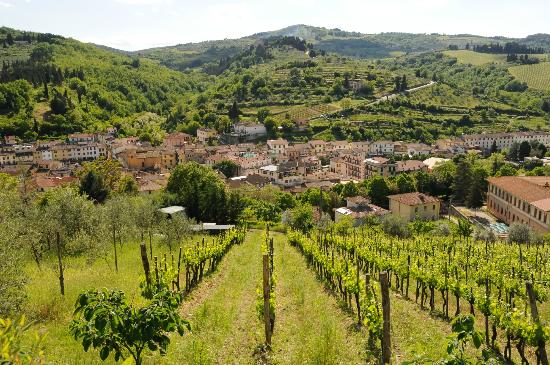
Well, we’re finally off on our five-month-long adventure to India. Peggy and I left last Wednesday (August 28th). Right now we’re in Italy staying in a Tuscan villa in Panzano in Chianti. It’s hard to believe that people actually live in such bucolic beauty surrounded by vineyards, rolling hills and castle-like structures like the one we’re luxuriating in at the moment.

I won’t bore you with the details of our journey here – cancelled flights, lost luggage, racing through airports, schlepping excessive baggage through the streets of Rome, lugging it onto a train between Rome and Florence, mistaking someone else’s bag for my own and carrying it off the train, getting tongue-tied in Italian and having it all come out Spanish. You can imagine the drill.

The reason for our trip? Peggy has won her second Fulbright Award – this time to Mysore, India. (Her last Fulbright in 1997-98 brought all of us to Zimbabwe, where Peggy taught at the University of Harare.) We’re all so proud of her. She’s enriched all of our lives immeasurably by the brilliance and hard work that have brought us to such exotic places.

This time Peggy’s grant will have her teaching at the university in Mysore. But that’s not the good part. Whereas in Zimbabwe, it was Peggy, I and our two boys Brendan and Patrick staying in Harare, this time we’ll be with our daughter, Maggie, her husband, Kerry, and their three children, Eva (4), Oscar (2), and Orlando (1). That’s the group that’s so enjoying our stay in Tuscany right now.

And, yes, our son, Brendan and his girlfriend, Erin, were with us as well. They stayed here for a week and left last evening. Brendan’s on leave from his work at the U.S. Embassy in Afghanistan. He’ll be back at his desk there on Wednesday. His tour in Afghanistan will end on December 29th. We’re all holding our breath and counting the days.

Maggie and her family are here because Kerry has taken a sabbatical from his job with a hedge fund. What an opportunity for them and their children! While in India, the kids will be in Montessori School just as they were back home in Westport, CT. Who knows what adventures await all of us in India?

My own adventure, I hope, will involve deepening my practice of meditation. With everyone’s blessing my plan was to do a ten-day retreat centralizing the Vipassana method of meditation. That would have begun on September 11th, and involved ten hours of meditation each day. Just this morning however, I received word that my application has been refused because of oversubscription. I’m now searching for an alternative.

In any case, if all goes well with the shorter experience, I’ll do a thirty-day retreat later on. We’ll see how things develop.

I’ll be writing regularly about our experiences as the adventure unfolds.

Everyone Likes a Good Joke: Jesus Makes Fun of Pharisaical Hypocrites (Sunday Homily)

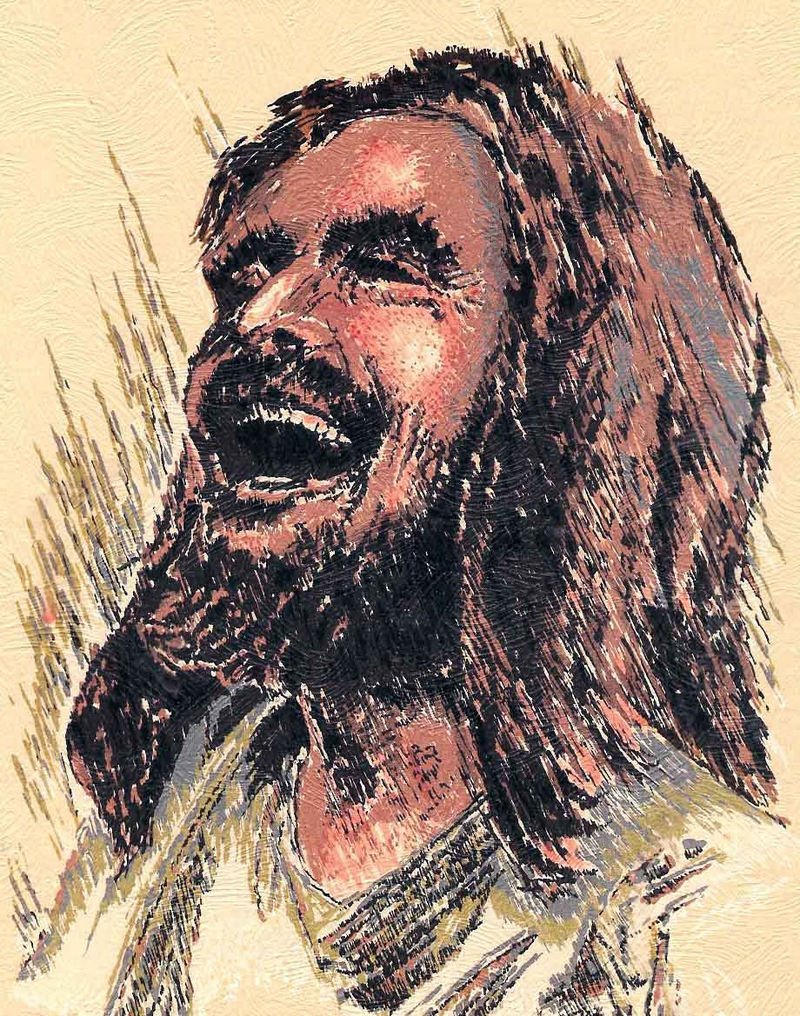
laughing Jesus

Readings for 22nd Sunday in Ordinary Time: SIR 3: 17-18, 20, 28-29; PS 68: 4-5, 6-7, 10-11; HEB 12: 18-19, 22-24A; LK 14: 1, 7-14. http://usccb.org/bible/readings/090113.cfm

In this morning’s gospel, Jesus finds himself invited for dinner to the home of a Pharisee. All present, Luke tells us, are watching Jesus closely. No doubt, they’re keeping an eye on his disciples too. And they don’t approve.

After all, like Jesus, his disciples are mere riff-raff. But at least Jesus is the reputed peasant-rabbi. Everyone’s talking about him. And investigating Jesus is the whole reason for this dinner. So for the moment at least, the Pharisees are willing to cut him some slack.

His hangers-on however are a different story. They’re rough. They smell of fish and sweat, and have no manners. And yet, as Jesus’ friends, they’ve been placed towards the head of the table in places of honor. Granted, they feel out of place, but for that very reason they are enjoying themselves tremendously. You can imagine their rough jokes and loud laughter.

Yes, the Pharisees are watching Jesus and his friends. But obviously, Jesus has been watching them as well. He knows they are expecting some words of wisdom. So . . . he tells them a joke. And the joke’s on them. It contains a sharp barb.

“Thanks for inviting us to this banquet,” Jesus begins. “Unaccustomed as we are . . .” He pauses and smiles. “That’s quite generous of you. After all, none of us can repay your kindness. We are homeless people, as you know. We’re unemployed too, so we are in no position to return your kindness.

The best I can do is offer you some wisdom. So let me tell you what I’ve been observing here.

“Evidently,” Jesus goes on, “it’s your custom to adopt the humility recommended in the biblical Book of Sirach. I can’t tell you how impressed I am; I’m edified by your piety. I mean, you have clearly taken to heart the words of the sage, Jesus ben Sirach – what he said about being humble, especially if we are ‘great’ as all of you are here, I’m sure.”

Jesus eyes his listeners. He can tell that they are waiting for the penny to drop. So he drops it.

“I can see that when you come into a place like this, you take the lowest place available.” With this, Jesus stands up bows his head, stoops his shoulders and slumps towards the lowest place at table. He laughs.

“That way,” the Master continues, “our host, of course, is obliged to publically invite you to a more honored position at table. ‘Friend,’ he’ll say, ‘come up higher, and sit in the place you’ve merited not down there with the unwashed and poor.’”

Now Jesus is standing. He throws out his chest and strides towards the seat right next to his pharisaical host. He chuckles again. “That enables you,” Jesus continues,” with great protestations of unworthiness, to take your ‘rightful’ place at table. Your stock has risen in everyone’s eyes.

“So congratulations are in order,” Jesus says. “All of you have learned your lessons well. You’ve just created a show, and have actually exalted yourself by pretending to be humble. In a sense, you’ve received your reward.”

Jesus is seated now and looking intently at everyone. Their mouths are open with shock.

“So here’s my wisdom, friends. . . . Your ‘humility’ is not what Sirach was recommending. In fact, it’s a form of pride and self-promotion.

“Instead, real humility is this: when you throw a party like this one, invite the poor, the lame and the blind, and then serve them. Place them at the head of your table and treat them as honored guests. People like that can’t or won’t repay you. But in fact, YOU OWE THEM.” Jesus fairly shouts those last three words.

“I’m telling you the truth,” he says. And humility is nothing but the truth.”

Jesus pauses, but he hasn’t finished yet. “You see, those belonging to what you consider the Great Unwashed are actually God’s favorite people. Recall what the psalmist said about them in Psalm 68. He said God is the Father of orphans; he’s the defender of widows, of prisoners, of the homeless, and of farmers without land.”

Jesus is quiet now; his smile is broad and friendly. He searches the faces of his table companions one-by-one.

Then he turns to his host and adds.

“To be fair, my friend, you yourself are on the right track. By inviting us today, you’ve shown that you already understand what I’ve been saying. As I say, none of us can repay you, and yet you’ve invited us to this abundant table. We are sincerely grateful.

“But don’t think that you’ve somehow performed an act of charity by your invitation. No, it’s an act of justice – of compensation to make up for what you have stolen from the poor by underpaying them and taxing them heavily. In supporting the poor and even the “lazy,” you are simply imitating our generous God.

“I mean the earth and its produce are all gifts from God. No one has earned them. No one owns them but the creator. If you have food, then, you are obliged to share it with the hungry – even with those unwilling to work. As difficult as it might be to understand, that’s simply the divine dispensation.

“The earth and the life it supports have been freely given to everyone – even to people like me and my friends who refuse to work and live from the alms of friends like you. No one deserves life or food more than anyone else. So in effect, you are obliged to do what you’ve done.

(Homilist’s note) None of this needs commentary from me.

What’s your commentary?

War Again!

assad

So we’re going to war again – this time in Syria.

And the reason? We’re outraged by the killing of innocent civilians through the use of the “weapons of mass destruction” that we so famously abhor. That is we abhor them when used by others. And these days everything qualifies for the category – even a pressure cooker filled with nails.

Meanwhile, the drone is never described as a weapon of mass destruction. Nor is the white phosphorus used to slaughter masses in Fallujah considered a chemical weapon. And what about the Agent Orange and Agent Blue “we” used in Vietnam and which is still claiming lives and causing horrendous birth deformities fifty years later? How about the depleted uranium that has caused not only deaths but an epidemic of child deformities wherever it has been used?

Have you seen those pictures? No, they’re too “graphic” for our sensibilities. But sensibilities be damned when it’s a question of our enemies atrocities instead of our own which absolutely dwarf the latter.

And where’s the outrage about our cooperation with Saddam Hussein in targeting Iranians, when Hussein was still our friend and ally? Just yesterday it came out that the CIA supplied him with targeting information for his famous use of chemical weapons . We were his collaborators in that crime! But that’s ancient history — way back in 1988.

And yet we rend our garments over this “unspeakable” crime that may have been committed by Bashar Assad – the latest personification of Hitler and evil itself just ahead of Saddam Hussein, Manuel Noriega, Slobodan Milosevic, and Muammar Gaddafi.

No one asks “Can we afford this?” Where are the millions (billions?) necessary for this intervention coming from? What has Syria to do with us? How is it connected with U.S. problems of unemployment, income gaps between the super-rich and the ever-expanding ranks of the poor, failing schools, overcrowded prisons, voter suppression, crumbling infrastructure?

To address those problems we have no money. But for war, don’t ask. There’s always money for war.

And so our newscasters and pundits take John Kerry seriously when he wrings his hands over Syria’s use of chemical weapons. We have no option but to intervene militarily, Kerry assures us. And he’s the head of our “Diplomatic Corps!”

Where’s the diplomacy? Where’s the call for a cease fire, for U.N. peacekeeper intervention, for talks between the admittedly al-Qaeda-affiliated “rebels” and the Assad regime? What are we paying these guys for – these so-called diplomats?

And the mainstream media goes along with all of it. Putting on their most solemn faces and using their most serious voices the newscasters intone: “We have ‘undeniable circumstantial evidence’ that Bashar Assad is the one responsible for chemical weapons deployment. And there’s no time to wait for a fuller investigation.”

Sound familiar? When was the last time such certainty moved us to “shock and awe” an enemy, meanwhile killing untold innocent civilians in the process?

So our brave military stands ready to fire Cruise Missiles into population centers to retaliate for the killing of innocent civilians. The strikes will be as surgical as possible we’re reassured.

Have we learned nothing from recent history?

Is God Speaking to Us through Our Muslim Enemies? (Sunday Homily)

Allah-the-only-true-god

Readings for 20th Sunday in Ordinary Time: Is. 66: 18-21; PS. 117: 1-2; HEB. 12: 5-7, 11-13; LK. 13: 22-30. http://usccb.org/bible/readings/082513.cfm

Messages from God can come from the most unlikely places – even from our enemies and those our culture considers inferior and evil. That’s the teaching I find in today’s liturgy of the word. There God speaks to Babylonians through Jews, and to Romans through Christians. This suggests to me that God might be evangelizing Americans today through Muslims.
_____
Consider our first reading from Isaiah.

Imagine yourself a Babylonian in the 6th century BCE. You belong to an empire – one of the most powerful nations the world has ever seen.

In 586 your people conquered a small insignificant nation called “Israel.” Its leaders have been taken captive, and for more than three generations (586-516) have remained prisoners of your country. They are your enemies. You despise them as inferior, superstitious and violent.

Now towards the end of the 6th century, one of their “holy men,” someone called “Isaiah,” claims that those captives, those refugees, those “fugitives” as Isaiah calls them, are agents of the single God of the Universe. They have been sent specifically to call you away from your polytheistic worship of your Gods, Anshar, Ea and Enlil, and to recognize that there is only one God. They call him Yahweh. This God has special care specifically for refugees, slaves and outcasts in general.

For you, recognizing that entails releasing the prisoners your government has held captive for so long.

Even more, Isaiah says you and your proud people are being called to actually worship that God of refugees, political prisoners, and slaves! That means putting their needs first, while subordinating your own.

As Babylonian, you find all of this incredible and obviously insane.
______
Now to grapple with today’s gospel selection from Luke, imagine that you are a Roman living towards the end of the 1st century CE.

You belong to an empire recognized to this day as the greatest the world has ever known. As with the Babylonians more than 500 years earlier, Palestine and its Jewish people are provincial possessions of the empire; they are your captives. Roman legions continue to occupy Palestine whose haughty people resist their occupiers at every turn.

“Jews are nothing but terrorists, every one of them,” you think.

Among the most infamous of those terrorists was a man called Jesus of Nazareth. You’ve learned that he was a Jewish peasant crucified by Rome about the year 30 CE. You’ve heard that a new kind of religion has formed around that so-called “martyr.” In fact, his followers acclaim him by a title belonging to the Roman emperor alone – Son of God. To you that sounds absolutely seditious.

In any case, this Jesus asserted that the God he called “father” was blind to people’s national origins. He told a parable (in today’s gospel) whose refrain from a thinly veiled God figure was, “I do not know where you are from.” Apparently Jesus meant that in God’s eyes no nation – not even Rome – is superior to any other.

You wonder, was Jesus blind? No nation superior to any other? Did Jesus not have eyes to see Rome’s power, its invincible army, and feats of engineering – the aqueducts, the roads, the splendid buildings and fountains?

According to Jesus, Israel itself is not above other nations in the eyes of God. Nor are his own followers better than anyone else. Even those who drank with him and shared meals with him could not on that account claim special status in God’s eyes.

In fact, the only “superiors” are what Jesus called “the least” – his kind of people: artisans, peasants, the unemployed, beggars, prostitutes, lepers, immigrants, women and children. As in today’s reading from Luke, Jesus calls these people “the last.” In God’s eyes, they are “the first,” he said. Meanwhile those who are first in the eyes of Rome, Israel, and even of his followers end up being outcasts.

Worse still, many Romans, especially slaves and criminals, are embracing this new religion. Some in the Empire’s capital city are already worrying that if not stopped, this worship of an executed criminal from a marginal imperial province might undermine the religion of the Roman Gods, Jupiter, Mithra and of the emperor himself.

How absurd, you think, that Romans could be schooled in matters theological by riff-raff, Jews, and terrorist sympathizers.
_____

Finally, imagine that you are an American today. Many think that your country is the proud successor of Babylon and Rome. In fact, the United States may have surpassed Rome’s greatness. Certainly, it has the most powerful military machine the world has ever known. It has the capacity to destroy the earth itself, should its leaders take that decision.

Some attribute America’s greatness to its embrace of the faith of Jesus of Nazareth and to its partnership with Israel, the biblical People of God. As a result the U.S. has become the light of the world, the “city on a hill that cannot be hidden” (Mt. 5: 14-16). America can do no wrong.

This is not to say that its leaders aren’t fallible. They make their share of mistakes and even commit crimes. Yes, they torture, support dictators across the planet, imprison a higher percentage of their citizens than anyone else, drop atomic bombs, even threaten the extinction of human life as we know it, and have declared a state of permanent war against virtually the entire world.

But as a nation, the United States, you continue to believe, is idealistic; it stands for democracy, freedom and equality. As a result, America continues to enjoy God’s special protection.

Nevertheless, there are those in your midst who say that none of this is true. They are like the descendants of Abraham, Isaac and Jacob living in 6th century Babylon. They are like the first Christians who refused allegiance to Rome. They are the foreigners found in U.S. prisons all around the world – in places like Guantanamo Bay and Abu Ghraib.

By and large, those prisoners, those (in Isaiah’s terms) “fugitives” and exiles share a religious faith (Islam) that is as difficult for most Americans to understand as it was for Babylonians to understand Jews or for Romans to understand Christians. The faith of those held captive by America today is largely the faith of poor people called “terrorists” by your government – just as were the Jews and early followers of Jesus.

However, closer examination shows that Allah is the same as the Jewish God, Yahweh. Moreover Muslims recognize Jesus as the greatest of God’s biblical agents.

With that in mind, you realize that Muslims routinely invoke their faith to resist U.S. imperial rule. And they are critical of the use of Judaism and Christianity to justify oppression of their brothers and sisters in Palestine, Iraq, Afghanistan, Pakistan, Yemen, Bahrain, Somalia, throughout the rest of Africa and elsewhere.

Could it be that these exiles, captives, fugitives, “terrorists,” might be your empire’s equivalents of 6th century Jews in relation to Babylon and of 1st century Christians vis-a-vis Rome? Could they possibly be God’s agents calling us Americans away from heartless imperialism and to the worship of the true God (even if called “Allah”)?

Are our Muslim captives reiterating the words of Jesus in this morning’s gospel: God is oblivious to people’s national origins and to physical ties to Jesus? The Master “does not know where we are from” even if we’ve shared table with him. It makes no difference if we’re Jews or Christians, Babylonians, Romans, Americans, or Muslims.

Only the treatment of “the least” is important in God’s eyes. And for us Americans, those “least,” those “last” happen to be the poor of the Islamic world against whom our government has declared permanent war. And what is their God’s demand? It’s simple: Stop the war on us and our religion!

Is their God – our God – trying to save us – and the planet from the crimes of American Empire?

The fates of Babylon and Rome hang over us all like Damocles’ sword.

Which Side Are You On? (Sunday Homily)

george-bush-and-jesus
Readings for 19th Sunday in Ordinary Time: JER 38:4-8, 8-10; Ps. 40: 2-4, 18; HEB. 12:1-4; LK. 12: 49-53. http://www.usccb.org/bible/readings/081813.cfm

I think we all might agree that today’s United States is marked by deep divisions – a concept raised in today’s gospel reading. Some say our country is more divided now than at any time since the Civil War. I’m talking about conflicts of:

• Conservative against liberal as anywhere you tune in on the AM dial, you’ll hear harsh and threatening words vilifying those who stand for social justice, equality and tolerance.
• Rich against poor as the income gap widens and the poor and immigrants are identified as lazy freeloaders.
• White against black as Stand Your Ground laws and voter suppression measures gain ground, while Trevon Martins are killed with impunity and their brothers are “stopped and frisked” by racist cops.
• Men against women, as the “War against Women” finds expression around issues of contraception, rape, abortion and women priests.
• Straight against gay as the LGBT community still struggles for domestic partnership benefits and recognition of the legitimacy of their love relationships.
• Christian against Muslim, as the United States continues its brutal wars in Afghanistan and throughout the Muslim world with daily drone strikes killing innocents along with those who resist the U.S. War on the World and are branded as “terrorists” for doing so.
• Old against young as twenty-somethings like Bradley Manning, Edward Snowden, and Aaron Swartz are harshly punished for exposing the crimes of their elders.

And Jesus is deeply involved in all of those conflicts. He is routinely invoked as endorsing conservatives, the rich, whites, men, straights, Christians, and the geriatric patriarchal establishment that rules the world. More specifically, a “devout Catholic” like Paul Ryan invokes his Catholicism to endorse social Darwinism as he crafts and promotes budget cuts that favor the wealthy and militate against single mothers, their children, and undocumented workers that increasingly form the backbone of our economy.

Even kindly Francis I invokes Jesus to continue the exclusion of women from the priesthood and the control of women religious by the male hierarchy which by church law remains strictly segregated from intimate contact with women. This same hierarchy finds some of its members deeply implicated in what Pope Francis himself calls a “gay lobby,” all the while denouncing homosexuality.

Such forces and movements embrace a Jesus who endorses conservative values and the status quo.

We get a different picture of Jesus from today’s gospel reading – and from the Christian Testament in general. This Jesus is anything but conservative. He’s not even liberal. He is deeply radical – an enemy of the temple establishment and the Roman Empire. Rather than supporting the status quo, he calls for fire to consume it. He can’t wait, he says, till it’s all gone – to be replaced by God’s reign. Jesus’ words this morning are fierce. No doubt, Jewish insurgents against the Roman occupation of Palestine found them congenial.

Closer to home, today’s Jesus even seems to endorse family strife. Luke has him say, “Do you think that I have come to bring peace to the earth. No, I tell you, but rather division. From now on five in one household will be divided, three against two and two against three; they will be divided father against son, and son against father, mother against daughter, and daughter against mother, mother-in-law against daughter-in-law, and daughter-in-law against mother-in-law.”

In the light of our own divisions, Jesus seems to be calling us to take a stand even if it means opposing our nearest and dearest. Maintaining family peace is less important for Jesus than the radical change demanded by God’s Kingdom. Standing with Jesus means taking sides. In the light of our divisions, it means for me:

• Standing with the poor and immigrant communities and recognizing corporate “persons” as the enemies of the world’s majority.
• Tuning out the hate ranting of the Limbaughs and Hannitys and recognizing that their values are antithetical to those of Jesus.
• Combatting Stand Your Ground Laws, racial profiling and efforts at voter suppression.
• Recognizing the absurdity of men attempting to control and pass legislation about women’s bodies – and of the church patriarchy contradicting virtually all biblical scholars in its chauvinistic exclusion of women from the priesthood.
• Saying clearly that the Bible teaches nothing about homosexual orientation – a totally modern understanding of a perennial human reality whose conformity with nature has been nearly impossible to understand for most in the West so thoroughly indoctrinated by a homophobic version of Christianity.
• Recognizing that the United States is the modern equivalent of the Roman Empire which Jesus resisted along with all patriotic Jews of his time. This implies that Muslims resisting U.S. Empire and occupation of their lands have more in common with Jesus than with us Christians who live in the belly of the beast. What our government calls terrorists are the analogue of the Zealots of first century Palestine. And Jesus’ inner circle of 12 incorporated Zealots. Think about it.

In its most specific terms, today’s gospel reading also asks us to think about the conflict of old against young. Jesus himself, of course, was a young man – barely 30 when speaking these words: “They will be divided father against son, and son against father, mother against daughter, and daughter against mother, mother-in-law against daughter-in-law, and daughter-in-law against mother-in-law.”

Notice that the conflicts named by Jesus are generational. They pit the old against the young and the reverse. (There’s not talk here of brother against sister or sister against brother.) This seems to be a call then for elders to respect their juniors. Are we doing that with Manning, Snowden and Swartz? We should, it seems, if we’re attuned to Jesus’ words this morning.

As for practical responses to Jesus words . . . . How about:

• Staying out of the Big Boxes as much as we can.
• Listening to “Democracy Now” or “All Things Considered” rather than to Limbaugh or Hannity.
• Going door-to-door to register voters in minority neighborhoods this fall.
• Withholding church contributions till our church reverses its stand on women’s ordination.
• Supporting the LGBT community in any way we can.
• Phoning the White House and congressional representatives about ending drone strikes
• Supporting the campaign to award Bradley Manning the Nobel Peace Prize.

What I’m saying is that the gospel call today is to become more deeply radical and determine which side we are on.

Can you think of anything else we might do “take sides” in the spirit of Jesus?

(Discussion follows)

Jesus Is Cutting Your Lawn! (Sunday Homily)

immigrant jesus

Readings for 18th Sunday in Ordinary Time: Wis. 18: 6-9; Ps. 33: 1, 12, 18-20, 22; Heb. 11: 1-2, 8-19; Lk. 12: 32-48. http://www.usccb.org/bible/readings/081113.cfm

Today’s liturgy of the word invites us to consider the hot-button issue of immigration. The issue is contentious because conservatives in our country generally oppose immigration reform. More accurately, they tie changes in the legal status of immigrants to strengthening border security with Mexico and the building of walls along our southern border to keep undocumented immigrants out. Until such measures are foolproof, conservatives generally promise to oppose reform of immigration laws.

That’s ironic because Evangelical Christians make up the strongest component of the U.S. conservative party, the GOP. So the dominant attitude of that party on immigration ends up militating against American Christians’ brothers and sisters in faith. After all, according to a recent study by the Pew Research Center’s Forum on Religion & Public Life, an estimated 83 percent, or 9.2 million, of the 11.1 million people living in the United States illegally are Christians from Latin America and the Caribbean.

Our readings this morning call into question such exclusionary attitudes about immigration. They suggest that far from excluding immigrants, insisting on observance of law, and building walls to keep them out, Christian response to immigrants should take the form of welcoming, wealth-sharing and service.

Let me show you what I mean.

To begin with, today’s first passage from the Book of Wisdom underlines the point that the biblical People of God were all immigrants. They were unwanted strangers whose ancestors had come to Egypt to escape famine in Palestine. Remember those Bible stories of Joseph and his brothers? Read them again (Genesis 37-50). Those legends explain how the families of Jacob’s sons came to be enslaved in Egypt in the first place. As you no doubt recall, Joseph’s brothers sold him into Egyptian slavery.

However, in Egypt, Joseph landed on his feet and eventually became the Pharaoh’s Minister of Agriculture. That meant that when famine struck Joseph’s former homeland, his brothers were forced to come hats-in-hand to beg food from the very one they had betrayed. However, when they came into Joseph’s presence, his own brothers didn’t recognize him. In one of the most beautiful stories in all of world literature, the unrecognized Joseph finally discloses his true identity. Instead of punishing them for their betrayal, Joseph feeds his brothers and invites them to join him in Egypt.

In other words, Joseph’s response to immigrants and refugees was to recognize them as members of his own family and to welcome them “home.”

In today’s second reading, Paul digs further into Israel’s past only to find that Abraham himself (the original father of Israel) was himself an immigrant. He entered a land that God decided was to belong to Abraham and his descendants though the ones dwelling there didn’t share that secret understanding. (The Canaanites, of course, thought Canaan belonged to them.)

So Abraham and his sons were forced to live in poor housing – in tents, Paul recalls for us. All the while, however (like most immigrants) they dreamt of better lodging “with foundations.”

Meanwhile Yahweh saw to it that Abraham’s family grew prodigiously. They begat and begat until they seemed to everyone to be “as numerous as the stars of the sky;” they were as plentiful as grains of sand on the beach. Such legendary fertility eventually came to be seen as threatening and led one pharaoh to order the death of all of the Hebrew immigrant boys (Ex. 1:22). By Yahweh’s special intervention, Moses alone was saved from such genocidal population control.

Again, this was Israel’s God protecting immigrants as his chosen people. That’s the point today’s responsorial psalm underlines with its refrain, “Blessed the people the Lord has chosen to be his own.” Ironically those people were persecuted immigrants.

Then in today’s Gospel, Jesus presents a riddle about the identity of his faithful servants. Jesus asks, “Who, then, is the faithful and prudent steward whom the master will put in charge of his servants to distribute the food allowance at the proper time?” His answer has implications for immigration reform measures.

In any case, you can imagine a lengthy interchange between Jesus and his audience about his riddle. No doubt, some identified “faithful and prudent stewards” with those who kept the absolute letter of the law. Others probably cited the Jewish purity code and said fidelity meant keeping the bloodline pure; it meant keeping foreigners out of the Holy Land and preventing inter-marriage with gentiles. Still others may have responded in economic terms. For them the faithful and prudent steward was probably the one who defended Jewish livelihood by keeping foreigners from taking Jewish jobs.

Jesus’ own response is different. He replies in terms of generosity, as well as in terms of service with its “law of abundance.” Jesus also invokes the law of karma. God’s faithful servants are those who sell what they have and give it to the poor. They are not the ones who are served, but those who serve. Meanwhile those who mistreat God’s servants will reap what they sow.

Above all, notice that the emphasis in Jesus’ words today is on service. His riddle brings us entirely from the “upstairs” culture of dominance into the “downstairs” culture of servants. The steward is the head servant. He’s in charge of others, but his service consists in distributing food allowances to his fellow servants. Even the Master ends up serving. When he returns from the wedding, his servants don’t wait on him. Rather as an expression of gratitude, he brings them upstairs, sits them at table and waits on everyone! (How consoling is that?! The “law of abundance” says that what we receive in life is determined by our own generosity.)

Similarly, we can’t mistreat others without harming ourselves. The law of karma decrees that we reap what we sow. Jesus endorsed that law in today’s reading. More specifically Jesus says that those who mistreat God’s servants will find themselves similarly mistreated. Here Jesus gets quite graphic: to the degree that they beat others, they themselves will be beaten. Again, it’s the law of karma; and it’s inescapable.

What does Jesus’ riddle have to do with immigration? First of all, remember it’s told by a former immigrant. According to Matthew’s story, Jesus lived in Egypt when Mary and Joseph sought refuge from Herod’s infanticide. Yes, Matthew’s Jesus must have known first-hand the experience of being an unwanted immigrant. In Egypt he spoke with a Jewish accent. Or maybe his family didn’t even bother to learn Egyptian.

Remember too that the riddle about faithful servants is posed by the Jesus who identifies with “the least of the brethren.” He said that whatever we do to the least, he considers done to him. In terms of today’s considerations, does that mean that what we do to immigrants, we do to Jesus?

As for Jesus’ response to his own riddle, it reminds us to receive immigrants as we would our Master returning home – yes, as our Master, Jesus himself – the one who ends up serving us! Again, Jesus identifies with the least of our brothers and sisters.

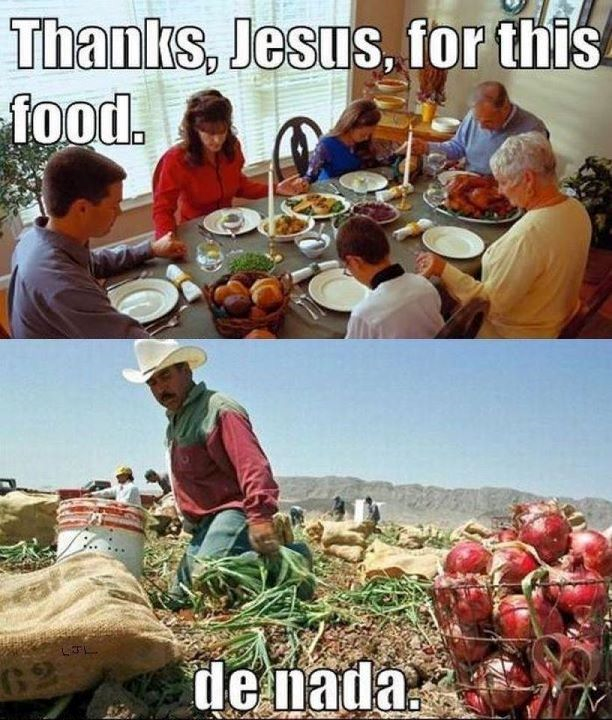
Does that mean that Jesus appears to us today in our service industries and in the informal economy where immigrants work as our kids’ nannies, our house cleaners, as construction workers, hotel maids, and gardeners?

At this very moment might Jesus be out there cutting my lawn, roofing my house or cleaning my bathroom?

When our border guards beat “illegals” (and worse!) are they beating Jesus?

And what does that mean for their karma – and for ours?

Those are riddles worth discussing and solving!

The way we answer will determine the side we come down on in the immigration debate.
(Discussion follows)

Combat Greed (and illness): Boycott McDonald’s, Wal-Mart, Subway . . . (Sunday Homily)

McDonalds

Readings for the 18th Sunday in Ordinary Time: Ecc. 1:2, 2: 21-23; Ps. 90; 3-6, 12-14, 17; Col. 3: 1-5, 9-11; Lk. 12: 13-21. http://www.usccb.org/bible/readings/080413.cfm

This week’s liturgy of the word focuses on greed, its idolatrous nature, and how death (the Great Leveler) puts greed in stark perspective.

According to the prophet, Qoheleth, the shortness of life renders “empty” (vain) any life devoted to amassing wealth. Life is not about money, Paul agrees in this morning passage from Colossians. It’s about following Jesus by bringing forth our true Self which is identical with the God who dwells within each of us. But our time for doing so is short. As the Psalmist puts it in today’s responsorial, our days are numbered; that realization alone, he says, should give us wisdom. Then in today’s gospel selection, Jesus contrasts such wisdom with the foolishness of human surrender to the economics of growth. Paul even terms such greed “idolatry,” the ultimate biblical sin.

Those readings have driven me to think about greed in my own life. It makes me think about my own approaching death and what I do each day to hasten its arrival. At the public level, I’m driven to consider today’s headlines about fast-food workers and the difference in pay between them and their ultimate bosses. It makes me think about resisting greed at both levels (personal and corporate) in very practical, effective ways. Let me explain.

Last week I traveled from our summer home in Michigan back to our permanent residence in Berea, Kentucky. When I arrived home, the cupboard was bare – no food. So I set out to get something to eat for supper. Problem was, our local health food store, “Happy Meadows,” was closed.

Fast food options like McDonald’s, Wendy’s, and Subway called to me. Despite nearly forty years of sharing board with a dedicated vegetarian, the urge to eat meat is still strong. However, I was too haunted by what I’ve learned from “Food Inc.” and similar films, books and articles. Their images of factory farms and the cruel mistreatment of cattle, pigs, and chickens can never be erased from my consciousness. In their light, eating dead animals raised on feed lots and super-cramped pens, and then killed for my platter almost turned my stomach. I just couldn’t bring myself to eat meat.

I remembered that Walgreens and Rite Aid sold packaged fast food. So I went to the drugstore to look around. As I probably should have foreseen, the food offerings there were . . . well, highly drugged. I mean I easily found non-meat offerings on the Walgreens shelves – items like Kraft Mac & Cheese; I found vegetarian frozen pizza, and other similar items. But they were mostly full of fats. And as I looked at some lists of ingredients, I found many I couldn’t even pronounce. Chemicals were often high up on the lists, meaning their presence was rather intense. “Why would I put that stuff in my body?” I thought. “Do I want to get fat and sick?” So I walked out still hungry, still searching for something to eat.

I drove to Subway remembering their veggie sub. The young man behind the counter asked, “May I help you?”

“Just looking,” I said.

I scanned the brightly lit menu over his head. There it was, the Veggie Sub. Should I get the six-inch or the twelve-inch? I looked at the young man again. There he was with his plastic gloves in place smiling and eager to serve me.

Then I remembered. This kid is making $7.35 an hour. Whether he’s aware of it or not, his comrades all across the country are striking to double that wage to $15.00 an hour. They’re walking off the job in places like New York City, Chicago, St. Louis, Milwaukee, Kansas City, Detroit and Flint, Michigan. They’re demanding not just a living wage but the right to unionize. Unionization would mean the end of the Fast Food Industry’s routine practice of “short-working” employees, i.e. preventing them from putting in enough weekly hours to qualify for the benefits that come with full-time employment.

Those striking workers don’t want me here, I thought. So I turned on my heel and left.

Soon I found myself cruising the aisles of Save a Lot. I bought some pasta, and some sauce. I picked up a head of broccoli (Dole! Ugh!). I returned home to throw my supper together.

The little episode helped me come face-to-face with greed – again the topic of today’s liturgy of the word. I had to confront my own greed and that of the corporations that dominate our culture.
My particular greed manifests itself at least three times a day at the table. There my actions say a whole lot: I want meat. I want its flavored grease. I want salt. I want sugar. I want convenience. I want instant gratification.

My spiritual teacher, Eknath Easwaran, would say all of that means, “I want a heart attack. I want diabetes. I want cancer. I want to die as soon as I can.”

My well-ingrained tendencies also imply that “I don’t care about justice or workers who put in forty hours or more (often on two or more jobs) and who still cannot put together a dignified life without Food Stamps. I don’t care that they want to unionize and they’re asking me to boycott McDonald’s, Wal-Mart, and other corporate giants who underpay their workers while amassing obscene fortunes for themselves.

To those workers (and their bosses), the words of Qoheleth apply:

“Here is one who has labored with wisdom and knowledge and skill,
and yet to another who has not labored over it,
he must leave property.”

Usually, these words are taken to apply to the rich who are thought to labor long hours without really enjoying life. In the end, they leave their property to their heirs who benefit from their now-deceased relative’s work.

However, with the Bible’s overwhelming “preferential option for the poor,” I think the words apply even more fittingly to workers like the one in Subway and those in McDonald’s, Wal-Mart, Wendy’s, etc. Those “associates” labor with wisdom, knowledge and skill and then get underpaid. The wealth they produce (their property) goes to their fat-cat bosses. Meanwhile the rest of us are forced to subsidize those fat-cats by making up the difference (in food stamps, Medicaid, WIC Programs, etc.) between the wages the bosses pay their workers and the true living wage those workers deserve.

Yes, so-called “welfare programs” are more directed towards the rich than the poor. For working people such “welfare” should be replaced by a living wage.

Qoheleth says such selfishness and greed creates empty lives, anxiety, sorrow, grief and sleepless nights for all concerned both rich and poor.

A friend of mine constantly reminds me that little can be done to change the world. We just have to go along with the way things are, he often says. Sometimes I think he’s right.

However, today’s liturgy of the word reminds us that he might not be completely correct. At least we can do something about underpaid fast food and big box workers. That’s not trivial. We can relieve the “vanity,” the emptiness of their lives by joining them in their efforts to unionize and achieve a living wage.

We can abstain from the products of McDonald’s, Subway, Wal-Mart and similar corporations – and perhaps even become more healthy in the process.

Our presence here at the Lord’s Supper says we’re willing to do that, so that all may share in the gift of God’s bread with dignity and joy.

Am I right in saying that? What do you think?
(Discussion follows.)