Scott Anderson’s “How the Arab World Came Apart:” It’s Not Islam; It’s the Economy, Genius!

fractured-lands-lead-image

Last Sunday, the New York Times (NYT) devoted its entire Sunday Magazine to a five-part article by Scott Anderson. It was called “Fractured Lands: How the Arab World Came Apart.” The epic piece traced the lives of six Arabs from Egypt, Iraq, Libya, Syria, and Iraqi Kurdistan as each struggled to live through and make sense of the disintegration of the Arab World since the U.S. invasion of Iraq in 2003. In so doing, Anderson attempted to put compelling faces on a longer historical narrative that begs for clarification, order and humanization.

The author succeeds admirably in the human interest portion of his project. More importantly, he supplies invaluable detail about a 100 year-long history of political decisions and processes responsible for the crumbling of the Arab world.

But perhaps his most stunning insight is that “Arabia” has been fractured not principally by internecine religious radicalism, but by a long-standing anti-socialist policy on the part of the United States and its allies. Ever since the conclusion of World War II, that policy has blocked economic reform not only in the Arab world and the Middle East, but also in Latin America, Africa, and South Asia – in other words in the former colonies. In the Middle East, the resulting conflict has only recently taken on heavy religious overtones.

Specifically, in that troubled region, the result of U.S. policy has been warfare and economic sanctions imposed on socialist movements involving both Arab and non-Arab countries – on peoples most of whom happen to be Muslims. As a result, those Muslims have experienced extreme poverty, joblessness, and loss of hope. Consequently, many have gravitated towards a brutal gang of reactive terrorists (ISIS) offering employment, a sense of identity, pride, short-lived hope – and the power that comes from a uniform and a gun. The grunts in this gang know very little about Islam.

In an August 12th interview with Scott Anderson on “Democracy Now,” Juan Gonzalez led the Times correspondent to make that very point. He asked Anderson what he had learned from his 18 months of research that included interviews with 20 ISIS fighters all of whom are now imprisoned in Iraq or in Kurdistan. Anderson responded:

“There was an amazing pattern. . . (T)hey were all young men, kind of with very bleak futures, either unemployed or underemployed, from working-class families, and not religious at all. . . (T)hey were not from religious families. They did not know the Qur’an very well. In a couple of cases, I knew the Qur’an better than they did. . . And I think it was this kind of decision that young men make, that better to live large for a couple of years, and, you know, the power and the so-called glamour. . . that comes of carrying a gun . . . they had more akin to why somebody might join like an inner-city gang or why in Mexico they might join a narco gang. It’s this kind of despair at seeing any sort of future. But it’s not political, it’s not religious. It’s just this impulse to—you know, to have some sort of—I mean, it’s awful to say, in terms of ISIS, but adventure.”

Juan Gonzales then observes, “But that’s a quite different perspective from what we get here . . .  that these are religious zealots who are willing to die for Islam.”

“Yes,” Anderson agrees.

With that astounding exchange in mind, it’s informative to reread the NYT article and the long-term history it reviews to detect the pattern underlying what Anderson uncovers as an economic rebellion with a recent and thick religious overlay that obscures what’s really behind ISIS and the fracturing of the Arab world. For as Anderson implies, the rebellion there is not about religion, but about economy. It is about the conflict between capitalism and socialism that has been raging at least since the 1848 publication of The Communist Manifesto. Far from ending with the fall of the USSR in 1990, the conflict has only intensified, when the West took the Soviet demise as a signal that it could subsequently increase pressure and even overthrow socialist governments everywhere – from Cuba and Venezuela to Yugoslavia and Iraq –  without fear of reprisal.

 To understand, we need to examine the underlying historical pattern responsible not only for the fracturing of the Arab world, but for relations between the developed world (principally the United States) and impoverished nations generally.

That pattern (identified specifically by J.W. Smith and implicitly by John Perkins) runs as follows:

  • Any Western colony that attempts to “break for freedom” (from capitalism and colonial control)
  • By instituting a “socialist” economy prioritizing the needs of its own people, especially its majority poor
  • Will have its leaders accused of being undemocratic dictators – communist, totalitarian, or terrorist.
  • Those countries will find themselves undermined (with Western support) by local dissidents – usually drawn from those privileged under the old colonial order or from those marginalized by the new socialist order.
  • This will cause the governments in question to institute severe national security measures that Western enemies will vilify as dictatorial, thus justifying further measures to overthrow the “repressive” regime.
  • If such methods do not result in the desired regime change, the country in question will ultimately be subjected to direct invasion or other military action on the parts of its former colonial masters.
  • Interventionist military action will be met with resistance and retaliation on the part of imperialism’s victims. (This explains the origins of ISIS.)

To reiterate, this pattern lays the blame for Middle East conflict at the feet of colonialism.  It suggests that since the dissolution of the Ottoman Empire, capitalism’s real enemy in Arab countries and throughout the Middle East has been anti-imperialist socialism not primarily Islam. More precisely, the conflicts in Egypt, Iraq, Libya, Syria, Iran, and Afghanistan have been spawned not by religion, but by resistance to colonialism and by economic policies resistant to free market capitalism.

To grasp that point, let’s think first of all about imperialism or colonialism. Then connect resistance to such foreign adventurism with socialism and the birth of ISIS.

In essence, colonialism is a system of robbery. It has foreign armies invading, conquering militarily weak, resource-rich countries, and then controlling them either through occupying armies or through local militaries armed by the invaders and headed by indigenous collaborators working hand in glove with the colonists. The chief goal of such invasion is resource extraction – wealth transfers for purposes of enriching the colonizers.

Western colonization of Arabia began in earnest after World War I. Up until then (and from the end of the 13th century), what Westerners called the “Middle East” was the center of the Ottoman (i.e. the Turkish) Empire controlled by Muslim sultans.

The Ottoman Empire was the Islamic State of its day and at its height comprised central Hungary, the Balkan Peninsula, Anatolia, Mesopotamia, Syria and Palestine, Egypt, the Caucasus and western Iran. As the Anderson essay shows, the Sultans did not impose their religion or Sharia Law on those they colonized. Instead, they allowed Christians, Jews and others to practice their faiths with no interference. As long as they paid their taxes, tribes and clans throughout the region were allowed a great deal of freedom and self-determination.

After the Ottoman Empire broke down in 1920, the British, French, Italians, and the United States stepped in to fill the void. To control their newly annexed territories (and their oil), they instituted a divide and conquer strategy. This entailed creating small client states that never existed before. These new “nations” included entities such as Jordan, Lebanon, and Yemen. Each was run by local collaborators (royal monarchs and their families) who could be counted on to transfer Arabia’s patrimony at confiscatory prices.

Such divisions were immediately resisted by tribes and clans throughout the region. Their loyalty was (and remains) to local chiefs, not to prime ministers or presidents. Together tribal leaders and their people wanted foreigners out. Many wished to unite all Arabs in a “Pan Arab” movement to restore the unity of the Arab world that had existed under the Islamic State and Caliphate for more than 600 years. The operative sentiment was “Arabia for Arabs.”

Pan Arabism took two main forms, one secular and socialist, the other (much later) religious and Muslim.

It helps to keep Smith’s historical pattern in mind: (1) break for socialist freedom, (2) vilification of socialism’s leaders, (3) empowerment of their natural enemies (secular or religious), (4) repressive measures by the threatened government, (5) (as a last resort) U.S. military action, and (6) insurgent response.

To verify the pattern, let’s begin with Egypt as Anderson does. Then let’s join him in considering the cases of Iraq, Libya, and Syria. Add in the non-Arab examples of Iran and Afghanistan to complete the regional picture. All the while, note the elements of the six-point historical pattern. To repeat, they illustrate that capitalism’s enemy has not changed since 9/11. It remains socialism, not Islam.

The most prominent secular and socialist anti-colonial movement began emerging in 1952, when Gamal Abdel Nasser led a revolution that overthrew the Egyptian monarchy that had cooperated closely with the West. Nasser was an outspoken socialist. His first act as Prime Minister was to institute a wide-ranging land reform program benefitting peasant farmers.

In addition, Nasser was critical of the West in general. He was also anti-imperial and hostile to Israel, which he and his constituents saw as another Western colonial beachhead in the Arab world. Nasser and his supporters saw Jews returning to their “homeland” as opportunistic European invaders whose ancestors hadn’t thought about living in Palestine for well over a millennium.

Nasser was succeeded by Anwar Sadat in 1970. As Anderson shows, Sadat alienated Pan-Arabs by moving closer to a client-patron relationship with the United States. He cooperated with the Carter administration in negotiating a separate Peace Treaty with Israel in 1979, without prior consultation with the other Arab states. For such betrayal, Sadat was assassinated. He was succeeded by Hosni Mubarak, an even more compliant client of the United States who remained in power till he was driven from office by the Arab Spring movement in 2011.

Nasser’s vision was shared by Hafez al-Assad, who came to power in Syria in 1970. Like Nasser, Assad had participated in a revolution against a Western-compliant monarchy. That revolution brought his Pan-Arab Ba’athist Party to power in 1963. The Ba’ath Party derived its name from the Arabic word for “renaissance” or “resurrection.” It envisioned the eventual restoration of a single Arab state. It espoused Arab nationalism and Pan-Arabism – again, Arabia for the Arabs. Besides being anti-imperial and anti-West, Ba’athism was also socialist. Since 2011, the United States and Syria’s former colonial master, France, have taken both indirect and direct action for regime change in Syria.

In 1969 Ba’athism spread to Iraq, where revolutionary forces led by Saddam Hussein toppled the monarchy established and supported by the West. Of course, following the dissolution of the Soviet Union in 1990, Desert Storm (1991) and the invasion of Iraq (2003) involved elaborate military measures by the United States to remove Saddam from office.

The same year Saddam Hussein came to power (1969), the Pan Arab socialist movement spread to Libya under Muammar Gaddafi who also led a revolution against a monarchy supported by the Western colonial powers. Gaddafi gradually moved away from the Ba’athist Pan Arab ideal and embraced Pan Africanism instead. His Third International Theory (published in his Green Book) championed socialism and anti-colonialism for the entire African continent. U.S. military action deposed Gaddafi in 2011.

Besides its links to the six-point pattern indicated above, what socialism in Egypt, Iraq, Syria, and Libya had in common was the fact that it worked. It lifted masses of people from poverty and modernized the relevant countries in a relatively short time. For example, before the 1991 invasion, Iraq boasted the highest standard of living in the Arab world. Similar statements can be made about Nasser’s Egypt, Assad’s Syria, and Gaddafi’s Libya.

Regional resistance to control by Western capitalists also emerged prominently in non-Arab Iran and in Afghanistan – two other artificial countries which came into being at the end of the 19th century. It was in these countries that (with major U.S. implication) opposition to Western imperialism eventually took on the decidedly religious turn that most mistakenly identify today as the root cause of conflict in the Middle East.

However, to begin with (as was the case in Egypt, Iraq, Syria, and Libya), post-World War II Iran experienced a highly secular grassroots rebellion against foreign control of their region following the dissolution of the Ottoman Empire. The rebellion caused the democratic election of Mohammad Mossaddegh to displace the U.S. client, Reza Pahlavi, the Shah of Iran.

Upon his succession to office, the enormously popular Mossaddegh instituted social and economic reforms of the type championed by socialists all over the world: social security, land reform, abolition of forced labor, rent control, agricultural regulation, compensation for workers injured on the job, public housing, and public works – all with the intent (as he said) to “combat disease, poverty, and backwardness.”

Above all, Mossaddegh nationalized Iran’s oil industry. This outraged Great Britain (who controlled Iran’s oil) the United States. So the CIA instituted a coup that removed Mossaddegh from office and replaced him, restoring to office Reza Pahlavi who returned from exile to administer an extremely repressive Western-friendly regime for the next quarter century.

In 1979, the Shah was overthrown in a rebellion. However, this time the uprising was not inspired by socialism, but by an anti-Western, anti-imperial movement organized “in the name of God.” It is here that Islam begins to take over as the face of the perennial regional resistance to Western imperialism that had roiled above and below the surface since 1920.

Something similar happened in Afghanistan. There too a secular socialist movement against the West morphed into a rebellion in the name of God.

In Afghanistan, the secular People’s Democratic Party of Afghanistan took control of the country in 1973 under Nur Muhammad Taraki. It offered equal rights for women, universal education, and land reform. To oppose such reforms and the intervention of the Soviet Union to uphold them, the CIA identified and supported internal opposition, the Mujahedeen – Islamic jihadists who from their founding had adopted as their goal the expulsion of foreigner rulers (viz. the British) from the Middle East. The CIA now empowered them to expel the Soviet invaders and establish an Islamic State to replace socialism.

But Mujahedeen goals were not reached with the expulsion of the Soviets. The jihadists wanted all foreigners out of the region. That meant the expulsion of U.S. troops from Islamic holy centers in Medina and Mecca. The troops had taken up residence there following the 1991 defeat of Saddam Hussein in Operation Desert Storm. That defeat was followed by 12 years of economic sanctions that ended up taking the lives of half a million Iraqi children. Osama bin Laden would later identify those murders, along with the previous 80 years of European control of Arabia, and the stationing of troops in Mecca and Medina as the specific motives for the infamous attacks of 9/11. His rationale was hardly reported in the U.S. mainstream media (MSM).

Since 9/11those media and Western politicians have shifted blame for the dissolution of the Arab world away from neo-colonial capitalist depredations and the interventionist pattern Scott Anderson implicitly reviews. Instead of blaming a failed capitalist system and its related foreign policy, they locate the cause of Middle Eastern chaos in Islam and in Hitler-like tactics of egregiously evil dictators such as Saddam Hussein and Bashar Assad. The problems thus become personalized, cultural and religious. Thankfully for those responsible, they also become largely insoluble thus necessitating permanent war. Thus the grateful include Israel, Saudi Arabia and other “American” client states. They include as well the oil and arms industries, and the corporate-controlled MSM all of whom profit from a chaotic Middle East and from misidentifying the true culprit in the region.

If all of this is true, what then must be done about Anderson’s “Fractured Arab World?”  If the cause of the fissures there is not religion nor Hitler Redivivus, but capitalism itself, its 150-year war against socialism and its six-point pattern of colonial intervention, what policies might replace the failed, counter-productive measures of war, incessant bombing, and drone attacks? If the foot soldiers in the war are not religious zealots, but unemployed and underemployed young people without prospect or hope, what will give them hope and meaning beyond a black uniform, ski mask and gun?

Here’s where we might start:

  • Abandon imperial pretensions and allow nations everywhere to experiment with alternatives to a capitalist system that clearly does not serve them.
  • Stop all vilification of Islam and Muslims.
  • Completely transform the U.S. economy from its fossil fuel dependency, thus removing the major reason for “American” interest in the Middle East.
  • Nationalize the U.S. arms industry, thus severing the connection between war and profit.
  • Cut off all aid to Israel until it complies with repeated U.N. mandates to withdraw from the Palestinian territories it has illegally occupied. This would take seriously bin Laden’s claim that solving the Palestinian problem would also solve the problem of terrorism.
  • As a good-will measure and for the sake of justice, indict, try, and punish George Bush, Tony Blair, Dick Cheney, Donald Rumsfeld, and others responsible for the Iraq War that gave rise to ISIS.
  • Divert the billions now invested in failed wars against terrorism into reconstruction of Afghanistan, Iraq, Libya, Yemen, and other countries devastated by Western wars.
  • Similarly use those billions to provide constructive employment not only for ISIS fighters, but for U.S. soldiers who find themselves armed and in uniform for reasons similar to the young militants referenced in Scott Anderson’s essay.
  • With good will demonstrated in these ways, summon a Peace and Reconciliation Conference to include all stake holders in Middle East conflicts including ISIS..
  • Comply with the decisions of the conference.

That such common sense measures probably seem impossible and completely off the table for most of our diplomats (and readers of this essay!) represents a sad comment on our limits of perception. It exhibits a lack of genuine will on the parts of our “leaders” to solve the problem of global terrorism. It also demonstrates the need for a revolution of our own.


How Biblical Studies Helped My Critical Thinking: Part Two (Personal Reflections Pt. XIII)

Kennedy

These last three weeks I’ve been trying to show how critical reading of biblical texts is connected to critical reading of every other text — including that of my own life. In all cases, “ideological suspicion” Is central.

It alerts readers to the fact that vested Interests tend to distort analysis — but mostly in conservative ways Intent on supporting the status quo. That’s the way as well with most extra-biblical texts like the mainstream media, best-sellers and school text books.

By way of contrast, readings issuing from the viewpoints of the socially-conscious dispossessed tend towards subversion of the status quo. That’s significant for Bible reading because (as I was saying last week) the Bible largely represents the memory of poor and oppressed communities. As such, books within the biblical cannon are nearly unique in history whose records normally preserve the memories of the rich and famous.

So with that in mind, here are twelve more conclusions I’ve drawn about the Bible. Notice the connections to politics and the very complex question of violence so pertinent in a world characterized by a permanent war against terrorism. Again, I present this second list of 12 conclusions to expose the way biblical studies have influenced my political leanings and the ideas that seem so strange to my adult children. .

  1. The experience of the socially activist poor and oppressed leads them to discover a liberating God in the Bible. He habitually overturns political, economic and social structures oppressive of people like themselves.
  1. In other words, the God of the Bible is not a neutral God. The biblical God is a class-biased God who has made a “preferential option for the poor.”  Similarly, Jesus is class-biased, not averse to making sweeping statements about “the poor” and “the rich” as groups without specific reference to individuals within those groups.
  1. Neither is the Bible a neutral text.  In fact, there are no neutral texts at all.  Any text, biblical or otherwise, either supports the status quo or it attempts to subvert it.  A text which does not subvert supports.  There is no third position.  By and large (though not universally) the biblical texts predominantly produced in situations of persecution, attempt to subvert the order of the world; they support God’s order often described in terms of “the reign of God.”  Once again, it is an order which as the antithesis of the world’s present order favoring the rich and powerful, favors instead the poor and oppressed.
  1. Similarly, there is no neutral exegesis of the sacred texts. Every reading is done by a person of a particular gender, race, nationality, and creed, with a particular personal history, and located in a given historical era.  Inevitably such readers possess more or less definite political commitments, and have predetermined understandings of the world.  Each of these elements as well as others inevitably bias his or her exegesis of the text. Each interpretation facilitates some insights but excludes others.  With this in mind, it is revealing to note that almost invariably respected mainstream exegesis has been done by rather comfortable white males of European background.  This means that the vast majority of believers, women, people of color, the poor, the illiterate, as well as Christians of the Third World have been left voiceless.  All of these have been forced to accept as normative well-off European, white, male biblical interpretations.  And once again, these interpretations almost universally have supported maintenance of white male euro-centric privilege.
  1. Today our Third World brothers and sisters are asking us to open ourselves to the levels of meaning they are discovering. They do not claim these are the only possible meanings; for clearly there are others.  Neither do they hold that those who make diametrically opposed interpretations are insincere; for such a claim would obviously be false.  They do, however, observe that these latter interpretations are extremely partial, for normally such readings take no note of their contradictory alternatives produced for example by unlearned people in the Third World.  Meanwhile, the exegesis of the poor and oppressed is normally more comprehensive, for it is well aware of the mainstream interpretation and usually spends a good deal of its time contesting such understandings as ideological.
  1. Meanings uncovered in this way lead to judgments about the structures of poverty and oppression experienced in the world, and to action towards changing those structures. Here the emphasis is on judgment of sinful structures rather than on sinful human beings.  For although personal sin is a painful reality, it is not up to Christians to judge how others stand in God’s eyes.  Nevertheless, God’s word can shed light on the human institutions which victimize both oppressed and oppressors by facilitating and often appearing to necessitate injustice.  An example of such an institution is international capitalism particularly as it impacts the Global South.  Institutions of this kind must be eliminated by Christian action in the world.
  1. Unfortunately, those who profit from the world’s sinful structures do not usually allow them to be changed willingly; instead their more frequent response to movements for change is one of extreme violence often directed towards the most vulnerable, children, the elderly, women, the sick.
  1. As a last resort, defense of these “least of the brethren” may demand that Christians take up arms and give their lives on behalf of the otherwise defenseless. Here other Christians, especially those outside the violent and threatening context in question must exercise extreme caution in judging such actions as contrary to the spirit of the Gospel.  This is especially true if those tempted to judgements of this type are among those whose taxes and/or silence enable their own  government to sponsor the violence which prompts assumption of arms in defense of the otherwise helpless.

21. Likewise criticism of Christians who take up arms in defense of “the least of the brethren” must be restrained since the Gospel is by no means clear consistent in its judgment about such action. In fact, historically speaking, most Christians who read the Bible in good faith have found that it does not require non-violent resistance.  A close reading of the biblical texts, and an examination of church history seems to reveal that highly contextualized considerations rather than some unchangeable principle of non-violent resistance have dictated the responses of Christians in situations of persecution.

  1. In addition, it must be admitted that not all violence is the same. There is a real difference between (a) the violence of the unprovoked attacker (This is clearly against Gospel teaching); (b) the violence of one defending himself or herself against unprovoked attack (This is less evidently against Christian belief); and (c) the violence employed in similar circumstances by one risking his or her own life in defense of the lives of the otherwise defenseless such as children or the elderly (Arguably this may represent a positive response to the Gospel).  To neglect such distinctions is to obscure questions of violence and non-violence.
  1. For these reasons, advocates of non-violence for others must humbly examine their consciences to see if their advocacy is not unwittingly supporting the interests of those oppressing the defenseless. Here it must be noted that most robbers and perpetrators of other forms of violence are quite enthusiastic supporters of “peace” which takes the form of non-violent response on the parts of their victims.  It should also be observed that in this case those upon whom the strategy of non-violence is so enthusiastically urged are the least able to defend themselves.  In fact, historically speaking, the poor and working classes of the world who for the most part are the victims of oppression, stand virtually without means of self-protection, having no armies of their own.  They are the only ones to whom both state and church authority have forbidden violence  as a legitimate means of defending their loved ones from their oppressors of the propertied classes who have huge armies and defense budgets at their disposal.
  1. Perhaps in view of all this, the most that some North American Christians can say is that they themselves are hearing a vocation to non-violent resistance, and that Christians in other very different situations  are being called to determine how best to defend the “least of the brethren.” in their own contexts.  No doubt some Christians there will choose to arm themselves on behalf of their families, friends and fellow citizens.  Others will choose non-violent resistance. Still others will choose a combination of the two approaches.   A great deal will depend on the context in question. Christians living in the U.S.A. must overcome the affliction of tolerating violence in service to U.S. corporate interests while condemning the violence of those who resist such oppression.  “I would assert that people who have not actively opposed the violence of the powerful against the poor, at some cost to themselves,” writes Philip Berryman, “have no moral authority to question the violence used by the poor.”  (Jack Nelson PallmeyerThe Politics of Compassion.”  Maryknoll, New York: Orbis Books 1986, 87.)

Realizations like the ones I’ve noted here — all of them faith-based have inclined me to:

  • Understand world events in ways that privilege the viewpoints of the  world’s poor.
  • Side with them in their conflicts with the rich and powerful.
  • Acquaint myself with the reasons for what the privileged habitually describe as the unprovoked “violence” of those they habitually oppress.
  • See that the violence of the rich and powerful dwarfs that of the poor they exploit.
  • Perceive that since World War II all of the U.S. wars have actually been fought against the world’s poor and oppressed to keep them in that condition.

Biblical Study Helps Me Develop Critical Consciousness (Personal Reflections Pt. XII)

,


Biblical Criticism

Here are the first dozen of the twenty-four conclusions I’ve drawn after my years of biblical study. As the cartoon above indicates, what I gained from Eamonn O’Doherty at St. Columban’s  Major Seminary in Milton, MA was an introduction to the historical/critical approach to the Judeo-Christian tradition. It provided a foundation that was deepened and developed by the scholars I mentioned in my last posting.in this series.

The historical/critical approach acts as a corrective to misreadings that emerge from the naive literary/confessional approach that had previously been mine. I learned that the latter is too open to ideological manipulation at the hands of the dominant culture anxious to secure divine support for a status quo favoring the rich and powerful ruling classes..

Accordingly, those more conventional approaches must be treated, I realized, with “ideological suspicion” which methodically doubts the veracity of conventional interpretations.

Such doubt made me suspect of any interpretation issuing from the United States and Europe. There analysis tended to remain largely apolitical and by that very fact ended up supporting the socio-economic status quo.

That was not the case in the underdeveloped world. (I use that term deliberately. Latin America, Africa, and South Asia, I found, have been deliberately under-developed –robbed of their resources by over-developed nations.)

Scholars in the Global South saw clearly and articulated connections between the biblical texts and imperial exploitation. The texts of both the Jewish Testament and its Christian counterpart are unique in the ancient world in that they were largely produced by victims of imperialism at the hands of Egyptians, Assyrians, Babylonians, Persians, Greeks and Romans. To ignore that fact and to interpret them apolitically is to impoverish them and rob them of their critical power vis-a-vis contemporary imperialist situations.

I’m sure such remarks make it clear how the biblical studies I’ve pursued have sensitized me to the dark realities of empires and the intolerable situations they have produced in the past and continue to produce in the present.

In any case, the twelve conclusions I share here unveil my gradual progression towards critical consciousness engendered by biblical studies. As you’ll see, they inexorably become less general and more sharply political. Judge for yourself:

  1. For the Christian Bible reading is extremely important. In some sense, the Bible is the word of God. However its many separate texts were produced by very human authors concerned with addressing highly politicized situations.
  1. But living is more important still. After all, even in the Bible itself, life and history constitute the primary vehicle of God’s revelation. In fact, it was out of reflection on these basic elements that the sacred texts themselves arose.  In other words, the main purpose of the Bible is not preservation or study of tradition for its own sake, but to help believers make faith-full sense out of the lives they are actually living.
  1. Therefore, as important as it is, Bible reading for the believer is a secondary activity, carried on “after the sun goes down.” It illumines life’s primary activity and vocation, living itself.

Continue reading Biblical Study Helps Me Develop Critical Consciousness (Personal Reflections Pt. XII)

Pope Francis’ Encyclical: My New Book and a Lenten Program

product_thumbnail

I must apologize for my absence from the blog site over the last couple of weeks. It’s that I’ve been putting the finishing touches on a new book I’ve written about Pope Francis’ eco-encyclical, Laudato Si’, which I consider the most important public document of the present century.

The 150 page book is called Understanding Laudato Si’: A Discussion Guide. (It is featured along with a “Buy Now” button on the right hand side of my blog homepage. The price is $8.15 per copy.) The book is aimed at people of faith who’d like to start or participate in discussion groups about climate change as the moral issue Pope Francis calls it.

(By the way, an “encyclical” is a general letter to the church as a whole. It represents the highest most solemn form of papal teaching.)

Laudato Si’ is unique in that it comes from the pen of history’s first Global South pope. So it is shaped by the experience of the former colonies (Latin America, Africa, and South Asia). It is heavily influenced by colonial and neo-colonial exploitation.

More particularly, Laudato Si’ was written by a priest who comes from country victimized by the U.S.-supported “Dirty War” that the Argentinian Army waged against the pope’s homeland from 1976-1983. That war took the lives of at least 30,000 Argentinians – at least one bishop, many priests, nuns, and lay catechists along with union organizers, teachers, social workers and those suspected of supporting the democratic resistance.

No other pope has had such “Third World” experience of aggression at the hands of the United States. No other pope has been influenced directly by liberation theology – which has centralized the concept of “preferential option for the poor” that marks Francis’ papacy.

Read in that light, Laudato Si’ presents the world with understandings of climate change, economics (especially capitalism), history, theology, and church that are uniquely “Global South” rather than the European understandings that shaped the visions of Francis’ predecessors. All the other commentaries I’ve seen have overlooked those differences.

I’ve shared drafts of the book with friends. One wrote: “Your book should be in the hands of every bishop and priest and parish, as well as to the pundits we daily read and hear in the mass media.”

The great African-American feminist scholar, bell hooks, commented: “You make difficult concepts and theories accessible. The work itself embodies the spirit of inclusion you write about so eloquently. Bravo!!!”

A priest-activist working in the Appalachian region wrote:  “Congratulations, this is a winner! . . . You wrote an amazing book.  I read it and I remembered.  I thought about it and I learned.  I critiqued it, and I grew. . . Let’s see how we can spread the analysis.”

I’m hoping that my book will be used this Lent as a discussion guide in parishes throughout the United States.  It is currently under review by my own diocese of Lexington, Kentucky.

In my own parish, St. Clare’s here in Berea, we’ve made the following proposal for dealing with Pope Francis’ call to action. Perhaps readers of this blog might implement something similar in their own parishes:

Lenten Program, St. Clare Church, Berea, Kentucky (Wed. Feb. 10- Sat. Mar. 26, 2016)

The St. Clare Peace and Social Justice Committee proposes a Lenten adult education program that will centralize the Papal Encyclical, Laudato Si’. Participants in the six week program will pursue the following goals:

  • Acquaintance and familiarity with the content and historical background of Laudato Si’.
  • In the light of that encyclical:
    • Sharpening awareness of the environmental crisis itself and of capitalism’s role in that predicament, as well as the parts played by U.S. policy, Global South theology, and the Catholic Church.
    • Rethinking the elements of each person’s Catholic faith including understandings of God, Jesus, church, and salvation.
    • Re-evaluating the relationship between a reconsidered Catholic faith and the environmental crisis.
    • Identifying practical ways of coping with the environmental crisis in the personal, familial, parochial, national and global dimensions of life.

To achieve these goals, each participant will:

  1. Adopt as a Lent 2016 practice, participation in six 90 minute group sessions discussing issues raised by  Laudato Si’.
  2. Sign up in advance for program participation. (Non-obligatory “interest cards” will be found in each pew on Ash Wednesday and on the First Sunday of Lent.)
  3. Before each meeting, read and reflect on the discussion guide adopted by the group (either the one to be provided by the diocese or Rivage-Seul’s Understanding Laudato Si’: A Discussion Guide).
  4. Actively participate in the discussions.

Program Organization

Feb 14:  View the first half of “Time to Choose” followed by a disciplined discussion. (“Time to Choose is a new 90 minute film by Oscar winner, Charles Ferguson. The film makes the case that we can combat climate change; that we have the tools and the knowledge to begin doing so right now.) (Assignment: Read Discussion Guide, pages 1-30)

Feb 21: View second half of “Time to Choose.” Discuss in the light of the Discussion Guide’s summary of Laudato Si’.  (Assignment: Read Discussion Guide, pages 31-50)

Feb 28: View lecture by economist, Richard Wolff on capitalism and the environment. Discuss the pope’s approach to economy facilitated by Chapter Two of the Discussion Guide.   (Assignment: Read Discussion Guide, pages 51-82).

Mar 6: View the first half of “This Changes Everything” (a new 90 minute film by Naomi Klein based on her book by the same name). Discuss in the light of Pope Francis’ “preferential option for the poor” as explained in Discussion Guide (Assignment: Read Discussion Guide, pages 83-100)

Mar 13: View second half of “This Changes Everything” in the light of liberation theology as explained in Discussion Guide. (Assignment: Read Discussion Guide, pages 101-140).

Mar 20: Discuss the Church as Caravan and practical responses to Laudato Si’.

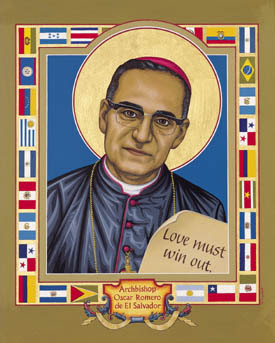
Oscar Romero’s Message: Another God Is Possible; Another God Is Necessary!

PROMO9
PROMO9

(This is the second in a three-part series on our parish’s upcoming celebration of the beatification of San Oscar Romero which will take place on May 23rd. The event will be observed in Berea’s St. Clare’s parish on June 3rd, when our new bishop, John Stowe, will join us.)

In the previous installment of this mini-series inspired by the upcoming beatification of El Salvador’s Oscar Romero, I offered a thumb-nail sketch of the great archbishop’s life. Romero’s witness has been inspiring for many, including Lexington’s new bishop, John Stowe. (As I said, think of the thoughts that must have coursed through the bishop’s mind as he celebrated Mass recently at the very altar where Oscar Romero was shot. We look forward to his sharing those thoughts on June 3rd when he joins our local church to celebrate Monsignor Romero’s beatification.)

In fact, Monsignor Romero’s story should be encouraging to each of us because of its life-changing implications. It connects perfectly with the message of Pope Francis in his “Joy of .the Gospel.” Both tell us that political and spiritual transformation is not only possible; it is necessary to save our world.

First of all consider the example of Oscar Romero. His change was profound both politically and religiously. In both dimensions, he became a radical, like Jesus of Nazareth.

Remember, Monsignor Romero started out conservative in every sense of the word. To a large extent, that’s why he was appointed archbishop in 1977. Romero was considered safe. He was patriotic. He unquestioningly supported his country’s military. He looked on the widespread rebellion of the poor in El Salvador with great suspicion. He considered the would-be revolutionaries communist subversives.

And yet, the archbishop had this close friend on the opposite side of the political fence. He helped Romero grow. That friend was Rutilio Grande. Grande was a Jesuit who took very seriously his vow of poverty.

So the priest moved out of the parish rectory and lived with the poor in their barrio slums. He knew first-hand their struggles, their family break-downs, their unemployment, hunger, low wages, and harassment by local police. Those became his issues, his context for interpreting the Gospel of Jesus.

Even more, Grande knew the Salvadoran military’s strategy for defeating the country’s impoverished insurgents. It was simply this: kill everyone who might possibly be sympathetic to rebel forces. That meant targeting most of the country’s non-elite. It meant butchering many of their parish priests. For Rutilio Grande, the slogan of the White Hand death squad represented an everyday reality and threat: “Be a patriot; kill a priest.”

Eventually, of course, the White Hand killed Father Grande himself. It was his martyrdom that pushed Oscar Romero over the edge and radicalized him. He utterly abandoned his conservatism. He would later say, “When I looked at Rutilio lying there dead, I thought, ‘if they have killed him for doing what he did, then I too have to walk the same path.’” (The “they” Archbishop Romero referred to was his own government, its military, and their backers in the United States.)

So Archbishop Romero started listening to the poor. He attended their “biblical circles,” where peasants shared their thoughts about Sunday gospel readings. Once after listening to simple farmers sharing thoughts about “The Parable of the Sower,” the archbishop stood up without comment and walked away from the group. The local priest followed him and asked anxiously, “What’s the matter, Monsignor, did something offend you?”

“No,” the archbishop responded, “quite the opposite. It’s just that I think I’ve heard the Gospel of Jesus today for the first time.”

This is where Romero’s Other Gospel, Other Jesus, Other God comes in. The archbishop discovered that when poor people read the Bible, they see things that remain invisible for people like us who tend to be white, comfortable, patriarchal, and supportive of empire.

Jesus was none of those things, the archbishop realized. He was brown or black, poor, a victim of empire, and counter-culturally open to the viewpoints and experience of women. Those factors constituted the Master’s standpoint. They deeply influenced how he saw the world.

More specifically, Jesus stood on the same ground as El Salvador’s poor (and by extension, the poor of today’s Global South). He was conceived out of wedlock by a teenage mother. He was an immigrant in Egypt for a while. He was a working man with calloused hands and sweat-stained clothes. His friends, people said, were drunkards and prostitutes. Rabbis expelled Jesus from the synagogue, and thought he was diabolically possessed. Even his family thought he was insane. Jesus became a vagrant without visible means of support. He lived under an oppressive empire. Imperial authorities saw him as an insurgent and terrorist. He ended up a victim of torture and of capital punishment.

All those characteristics, Archbishop Romero realized, described Another Jesus that to him was far more compelling, inspiring and faithful to the gospels than the abstract and other-worldly Jesus elaborated in the theological texts that guided his doctoral studies in Rome.

So San Romero concluded that the poor knew Jesus more deeply and authentically than he ever could. (They had what scholars called a “hermeneutical privilege.”)

The Jesus of the Poor revealed that Other God who alone could save El Salvador. Fidelity to that same Jesus can save our world from the path to destruction we’ve embarked upon. (And this is where Pope Francis’ continuity with Romero’s vision comes in.)

Francis too has chosen to prioritize the experience and understanding of the world that belong to its poor. In doing so, he challenges our very idea of God. He evokes the Other God who alone can save us from the abyss.. For the pope, God is not neutral, but stands with the poor in their struggles against oppression. What does it mean, he asks implicitly, that God chose the poor, oppressed and despised as the primary site of his Self-revelation?

It means the poor of the world are God’s Chosen People. That answer has led Pope Francis to be the voice of the voiceless. And he does so even at risk of being called a communist. In this, he’s like Dom Helder Camara the late and sainted bishop of Recife in Brazil. Dom Helder said, “When I give food to the hungry, they call me a saint. When I ask why the hungry have no food, they call me a communist.”

Pope Francis does more than ask Dom Helder’s question. In his Apostolic Exhortation, “The Joy of the Gospel” (J.G.), he answers it. I’ll tell you what causes poverty, he says. It’s the reigning economic system that is homicidal (J.G. 53), and unjust at its roots (59). It’s allegiance to the “trickle down” ideology of the rich – a theory that has never worked (53). The world really belongs to the poor, the pope insists (57). The rich who refuse to return to the impoverished what is rightfully theirs are robbers and thieves (57). The rights of the poor take precedence over those of private property (189).

The pope’s choice to be the voice of the voiceless extends to the environment as well to impoverished humans. Watch for his encyclical on climate change to be published sometime next month. There he’ll surely give voice to the planet’s animals, plants, mountains, forests, rivers, and oceans. In the face of climate change, he warns us, “God always forgives. Human beings sometimes forgive. But nature never forgives.” So what’s the proper response to the challenges of Oscar Romero, Pope Francis, and (we hope) Bishop Stowe? As I see it, proper response entails:

  • Leaving behind the safety of contemporary Christianity’s conservative ways.
  • Committing to a path of parish renewal and personal faith development intent on acquainting ourselves with the biblical God of the poor.
  • Viewing the world and its conflicts from below – from the viewpoint of the Other Jesus embraced by Monsignor Romero – from that of unwed mothers like Miryam of Nazareth, of immigrants, the mentally unbalanced, sex workers, the homeless, insurgents, terrorists and those being water-boarded and executed by the state.
  • Recognizing that with 1.2 billion members world-wide, a Catholic Church attuned to the spirits of Oscar Romero and Pope Francis has unlimited potential for changing the world.
  • Embracing that change as our collective vocation.
  • Abandoning pet convictions that national allegiance, military action, and trickle-down theories will solve our world’s problems.
  • Embracing the Other Jesus of the poor
  • His Other God
  • And the Other World that Oscar Romero, Pope Francis, and Jesus proclaim as the very essence of God’s Kingdom.

Bishop Stowe Is Sending Us a Message by Attending Oscar Romero Celebration

Stowe

(This is the first in a three-part series on our parish’s upcoming celebration of the beatification of San Oscar Romero which will take place on May 23rd. The event will be observed in St. Clare’s parish on June 3rd, when our new bishop, John Stowe, will join us.)

As one of the first acts of his new Episcopate, Bishop John Stowe will be visiting my parish, St. Clare’s in Berea, Kentucky, to celebrate the beatification of Oscar Romero, the Archbishop of San Salvador, who was gunned down at the altar on March 24, 1980.

In accepting the invitation to join the celebration, then bishop-elect Stowe wrote:

“Oscar Romero is a great inspiration in my life and I am thrilled to know of a community that wishes to celebrate his witness.”  

Bishop Stowe’s words and his decision to attend the celebration are freighted with meaning for Catholics of the Lexington Diocese. They speak volumes about Bishop Stowe’s overriding commitment to social justice. The bishop’s words call our attention not only to the person of Oscar Romero, but to the theology that informed his life, and to our vocation as followers of Jesus the Christ.

In today’s posting, think about Oscar Romero himself. (Subsequent blogs – next Wednesday and the following Monday – will focus on liberation theology as it relates to Romero, and then on practical responses to the archbishop’s beatification).

Oscar Romero was born in 1917. Like our present pope, Francis, he was a Jesuit. Monsignor Romero entered the seminary at the age of 13 and was ordained at 26. He studied in Rome, and received his doctorate in theology there from the Gregorian University. In 1977, he was appointed archbishop of San Salvador.

The monsignor was a bookish man – very traditional, both politically and religiously speaking. He was a conservative in every sense of the word.

However, a turning point came for Oscar Romero less than a month after his consecration as San Salvador’s 4th archbishop. A close friend of his – another Jesuit priest, Rutilio Grande – was assassinated by one of El Salvador’s right-wing death squads. Rutilio Grande was an advocate of the poor, an opponent of government oppression of the peasants and workers, and an advocate of radical theology. He saw Jesus as a prophet – the Son of God bringing good news to the poor.

Romero’s own words reveal the impact of Grande’s death. He said, “When I looked at Rutilio lying there dead, I thought, ‘if they have killed him for doing what he did, then I too have to walk the same path.'” The “they” Archbishop Romero referred to was his own government, its military, and their backers in the United States.

In other words, the penny had dropped for the archbishop. He realized that his country and all of Central America was at war. It was what Noam Chomsky called “the first religious war of the 21st century.” It pitted the United States of America and its right wing allies in Central America against the Catholic Church.

But as Romero said in a speech at the Universite Catholicque in Louvain, Belgium, just before his martyrdom, the U.S. war wasn’t against the entire Catholic Church.  Or as the archbishop himself put it,

“. . . (I)t is important to note why [the Church] has been persecuted. Not any and every priest has been persecuted, not any and every institution has been attacked. That part of the church has been attacked and persecuted that put itself on the side of the people and went to the people’s defense. Here again we find the same key to understanding the persecution of the church: the poor.”

In other words, the archbishop had put his finger on the problem: the Catholic Church was divided between the traditionalists who supported the rich, unfettered capitalism, and U.S. Empire on the one hand, and those who took the part of the poor on the other. Grande’s death convinced the archbishop that he had been on the wrong side. So he switched over and took the part of the poor. In doing so, he in effect signed his own death warrant.

Nevertheless, he began speaking out fearlessly each Sunday against his country’s government, its military, and their supporters in the United States. He railed against El Salvador’s endemic poverty, social injustice, assassinations and torture. He specifically criticized the United States for the military aid it gave to El Salvador’s repressive military government.

President Carter ignored the archbishop’s pleas to stop arming El Salvador’s military and death squads. And when he entered office, President Reagan doubled down on his predecessor’s policy.

Still, Archbishop Romero continued to follow faithfully Rutilio Grande’s path. His weekly radio programs became a sensation throughout El Salvador. He named names and listed the disappeared, tortured, murdered and much more. The archbishop’s broadcasts became the main source of trustworthy news for his oppressed people.

As a result, death threats from the White Hand death squad came to him every day. But such intimidation didn’t work on Oscar Romero.

Finally, though, on March 24, 1980, the chickens came home to roost. In a crime intellectually authored by Roberto D’aubuisson, a darling of U.S. Central American policy, the archbishop was assassinated while celebrating the Eucharist in a convent in San Salvador.

The country was plunged into mourning. 250,000 people attended Archbishop Romero’s funeral. However, only one of the country’s bishops attended his funeral. The others considered him too radical and politicized. They stayed home.

The Salvadoran army however did not. Death squad sharpshooters terrorized the funeral, dropping smoke bombs and killing anywhere from 30 to 50 people while wounding many others. It was a world-class scandal.

But it was by no means the end of the war against the Catholic Church. The White Hand death squad continued to follow its slogan, “Be a patriot; kill a priest.”

Less than a month after Archbishop Romero’s martyrdom, four U.S. women religious (all from Cleveland, Ohio) were brutally raped and murdered: Ita Ford, Maura Clarke, Dorothy Kazel, and Jean Donovan. Then in 1989, a team of six Jesuit liberation theologians at the Central American University along with their housekeep and her 15 year old daughter were slaughtered by Salvadoran soldiers trained at the School of the Americas in Fort Benning, Georgia.

By the war’s end, scores of priests were killed along with lay ministers of the word, teachers, social workers, and union organizers. In 1980 alone, more than 11,000 such activists fell victim to the death squads. By the war’s end, more than 70,000 Salvadorans had been killed by their own government. Imagine the impact of such numbers in a small country of just over 6 million people.

The Long Reach of Pope Francis: how he (and Oscar Romero) touched our diocese & our parish

Pope francis oscar romero


I once was once skeptical about Pope Francis.

When he was elected, my first thought was “Can anything good come out of an Electoral College of Cardinals packed so tightly with clones of the reactionaries, John Paul II and Benedict XVI? Bergoglio must be one of those carbon copies.”

But I was wrong.

Jorge Mario Bergoglio turned into Pope Francis. Far from a triplet brother of his immediate predecessors, the new pope has proven to be truly Latin American. That’s so even to the point of embodying the ideals of liberation theology, or reflection on the gospel from the viewpoint of the poor and oppressed. He has espoused the latter’s “preferential option for the poor,” its trenchant critique of corporate globalization, and its openness to marginalized people of all kinds. What a surprise!

My second thought was, “But he’s already old. His papacy will be short. He won’t be able to accomplish much of enduring impact.

Imagine then my further astonishment, when a mere three years into his papacy, Pope Francis’ touched  in remarkable ways our  tiny and remote diocese of Lexington, Kentucky. Even stranger to say, his reach extended to our little Kentucky parish of St. Clare’s in Berea. It made me wonder if this is happening all over Francis’ world. I hope so.

First of all, consider what’s happened in Lexington.

Our previous bishop was a canon lawyer – an appointee of John Paul II. Bishop Ronald Gainer distinguished himself by urging pro-choice politicians to refrain from receiving Holy Communion. He has since shown other overriding concerns by forbidding Catholic School girls in his new diocese from engaging in sports (such as wrestling, rugby, and football) “…that involve substantial and potentially immodest physical contact.” You get the idea.

After waiting for more than a year, Bishop Gainer’s replacement was at last named. It was John Stowe, a Conventual Franciscan. Father Stowe showed his colors in his introductory press conference. There was not a word about abortion, contraception, or gay marriage, much less about girls’ wrestling.

Instead he introduced himself as “a Franciscan educated by the Jesuits and appointed by a Jesuit Pope who has taken the name Francis.” “I love Pope Francis,” Father Stowe said, “and I will do whatever he asks.”

Turns out, the new appointee is not only a disciple of the pope; he is also a sharp critic of reactionary politics – especially as they affect immigrants. (Fr. Stowe, BTW, speaks fluent Spanish.)

For instance, in 2006, when Fr. Stowe addressed the Mayor’s Congress on Immigration Reform in El Paso, Texas, he criticized the U.S. Congress saying, “We shudder to imagine what the inscription on the Statue of Liberty might read if it had been erected by the current U.S. Congress.” Promising words indeed.

And that brings me to our parish, the long reach of Pope Francis and its connection with our new bishop.

You see, during this past Lent, for the second year in a row, a small group of us met each week to study the pope’s “The Joy of the Gospel” – the Apostolic Exhortation published in November 2013. In one of our concluding sessions, we were searching for something practical to connect the pope’s words with our community of St. Clare’s.

The calendar told us that the beatification of El Salvador’s Oscar Romero was coming up on the 23rd of May. (Beatification is a major step towards canonization or sainthood in the Catholic Church.)

Romero, you recall, was the martyred archbishop of San Salvador. In 1980, he was gunned down at the altar by an assassin connected with El Salvador’s Arena party which was supported by the Reagan administration. Because Romero is considered the patron saint of liberation theology (which the pope saw as too influenced by Marxism), John Paul refused to even call the archbishop a martyr. Instead, he referred to him merely as “a zealous pastor.”

Pope Francis has changed all of that. Romero, he says, was not only a martyr, but has advanced him on the way to official recognition as a saint of the entire Roman Catholic Church.

Well, our little discussion group thought: Why not have our parish celebrate Romero’s beatification?

“Great idea” we all agreed; “We could hire a Mariachi band, invite the Hispanic community and folks from Berea College’s Union Church” (a Church of Christ with whom people from St. Clare’s traveled to El Salvador on more than one occasion). “And then we could follow it all with a big fiesta.”

Someone else added, “And why not invite the new bishop?”

“Wouldn’t hurt to ask,” was the consensus — although we thought his acceptance would be unlikely, since by the end of May, he’d barely have been installed as bishop.

Well, guess what? He agreed to come. That sends a strong signal about his priorities.

So did his letter written immediately after receiving our invitation:

Thank you for your kind words of welcome and the excellent suggestion of celebrating the beatification of Archbishop Romero. I am so happy to know that St Clare’s and Union Church are in a relationship with the Church in El Salvador. That is exactly what Pope Francis is encouraging us to do!

I just returned last night from visiting our Central American Friars; we celebrated the 35th anniversary of Romero’s martyrdom although we were in Costa Rica. This past February 1st, I was able to celebrate mass in the hospital where Romero was killed—all this to say, Oscar Romero is a great inspiration in my life and I am thrilled to know of a community that wishes to celebrate his witness.

I will look for possible dates to celebrate the beatification with your community.

Your message is most welcomed!!

Bishop-elect Stowe’s acceptance of our invitation means that everyone in our parish and from parishes nearby will surely attend an event that might otherwise have been overlooked. Everyone will want to meet the new bishop.

He is sure to have some inspiring words to say about Romero, and hopefully about liberation theology, and U.S. policy in Central America during the 1980s. This will indeed be a teachable moment.

Do you see what I mean about Francis’ long reach? This is already far better than I anticipated three years ago.

(Sunday Homily) Pope Francis Calls for a Global Catholic Climate Movement

Italy Pope Epiphany

Readings for 1st Sunday in Ordinary Time: I SAM 3: 3B-10, 19; PS 40: 4, 7-10; I COR 6: 13C-15A, 17-20; JN 35-42

Recently Pope Francis has come in for some hard criticism from the U.S. right wing. It’s not just because of his rejection of free market capitalism, trickle-down theory, and huge income disparities between the rich and poor. It’s not just his openness to gays and divorcees, and his refusal to obsess about abortion and contraception.

Yes, all of these have undermined what conservatives have seen as a close alliance between the Catholic Church and their pet causes and thinking modes.

However, the straw breaking the back of reactionaries is the pope’s unequivocal warnings about climate change. They’ve gone apoplectic about his intention to publish an encyclical on the matter, and his plans to convoke a conference of religious leaders to address it. The pope’s expressed intention is to influence this year’s U.N. Paris Conference on Climate Change. All of that has raised the specter of a global Catholic climate change movement potentially mobilizing the world’s 1.2 billion members. Think about that for a minute!

In such context, Francis visit this week to the Philippines is extremely significant. The Philippines is not only the home of 80% Asia’s Catholics – more than 100 million. It is also the poster child for the devastation that climate change wreaks on the principal victims of global warming, the world’s poor. In 2013 the archipelago was raked by Typhoon Yolanda whose winds and floods killed more than 7000.

So the world listened when on his way to Manila Pope Francis was asked if climate change is “mostly due to the work of man and his lack of care for nature?” In reply, the pope said:

(F)or the greater part, it is man who gives a slap to nature continually, and we have to some degree become the owners of nature, of sister earth, of mother earth. I recall, and you have heard, what an old peasant once told me: God always forgives, we men forgive sometimes, but nature never forgives. If you give her a slap, she will give you one. I believe that we have exploited nature too much, deforestation, for example.

With words like those, the pope’s critics charge he is speaking beyond his expertise, which involves matters of “faith and morals.” But that’s just the point. The pope is making climate change a moral issue, a matter of ethics even more important than more “traditional” Catholic moral concerns about sex which after all presume the survival of the human species and the planet.

The pope’s critics also ignore, of course, that Francis bases his judgments not only on the testimony of 97% of all climate scientists, but on the research of the Pontifical Academy of Sciences. Its membership roster features the names of the world’s most respected scientists. These include Nobel laureates such as Ernest Rutherford, Max Planck, Otto Hahn, Niels Bohr, and Charles Hard Townes. The Academy’s current president is Werner Arber, himself a Nobel laureate, and the first Protestant to head the group.

But why such right-wing fury? It’s because like Naomi Klein, conservatives see the (for them) disastrous implications of addressing the issue. As announced in the title of Klein’s book, they sense that This Changes Everything. That is, taking on climate change as a moral issue undermines the political right’s program of market deregulation and continued extraction of non-renewable resources.

So pundits like First Things blogger, Maureen Mullarkey have given up on lip sticking the pope and are now in full attack mode. According to Mullarkey Pope Francis is simply “an ideologue and a meddlesome egoist. His clumsy intrusion into the Middle East and covert collusion with Obama over Cuba makes that clear. Megalomania sends him galloping into geopolitical—and now meteorological—thickets, sacralizing politics and bending theology to premature, intemperate policy endorsements.”

For Mullarkey, Pope Francis pretty much stinks.

And that brings me to today’s gospel reading. It’s all about stink – about what Pope Francis calls “the smell of the sheep.” Famously, you recall, the pontiff called on Catholic priests to live closer to the poor, to recognize them as God’s people and their welfare as the guideline for economic and social policy – to “take on,” he said, “the smell of the sheep.”

In other words, conservatives are suspicious of Pope Francis and are on the point of vilifying him because he smells too much like sheep — like the poor. He smells too much like Jesus.

Notice that in today’s gospel, John the Baptizer identifies Jesus as “the Lamb of God.” To begin with, the phrase reminds us of the tribal, Bedouin origin of the biblical “People of God.” Abraham, Isaac, and Jacob, and the great King David were all shepherds. They were primitive people close to the earth. They were tribalists. Jesus was a tribalist. According to John’s image, Jesus didn’t just smell like sheep; he was a sheep! He was in spades like his slave and Bedouin ancestors — like the poor people the pope is centralizing in his visit to the Philippines.

Pope Francis is a tribalist too. And he’s practicing what he preaches — both liberation theology’s “preferential option for the poor,” and the traditionally Catholic principle of subsidiarity. Once again, that means endorsing economic and environmental policy not on the basis of market dictates, but according to human decisions about values like the common good. Humane policy, the pope implies, originates not on Wall Street, but in places like the Philippines’ Tacloban City which was leveled by Typhoon Yolanda. It’s there that the pope’s itinerary reportedly has him dining in the shack of a hurricane victim. (Can you imagine a humble Catholic housewife setting her family table to include the pope?)

As our century’s most powerful illumined voice of conscience, Francis is using his bully pulpit to wake us up. We’re like Samuel in today’s first reading – fast asleep even before the Ark of the Covenant (a reminder of Israel’s enslaved and Bedouin past). But we fail to recognize the biblical tradition’s significance to our lives – its call to tribal values which unfailingly center on animals, human family, and Mother Earth. We fail to see the implications of Paul’s observation in today’s second reading that all human beings – especially the poor and outcast – are temples of God’s spirit. That’s our tradition! That same Spirit resides, the pope says, in the planet that he (like St. Francis himself) calls our Mother and Sister.

So what would a global Catholic climate movement look like? It would entail:

  • Waking up like the young prophet Samuel. Like him we’ve heard God’s call many times. But at last in Pope Francis, we have a thought-leader speaking in a voice the simplest of us can hear. It’s the voice of conscience. And like Eli it’s giving us the proper way to respond: “Speak Lord, for your servant is listening.”

A global Catholic climate movement further entails:

  • Rejection of corporation-based globalization which has us (over)consuming imported necessities that could be home-grown. (This involves lobbying against the Trans-Pacific Partnership.)
  • Joining the fight against fracking and projects like the XL Pipeline
  • Voting accordingly.
  • Urging the institutions we can influence (churches, universities, hospitals . . .) to divest from fossil fuel industries.
  • Adopting a “zero waste” policy in our homes and places of work.
  • Cultivating home gardens.
  • Adopting a vegetarian diet.
  • Educating ourselves about “green burial” and including plans for that in our “living wills.”

The list, of course, goes on. But you get the idea.

This stinkin’ pope is waking us up. He’s showing us the way. Thank God!

Twenty Lessons I learned from My 40 Years of Teaching Social Justice

mike teaching

During the fall semester of 2014, I taught a Religion course at Berea College called “Poverty and Social Justice.” The course was personally significant because it rounded off 40 years of teaching at Berea, where my first class convened in 1974 – exactly 40 years ago. I remember how I came to Berea, fresh from leaving the priesthood, on fire from Vatican II, sensing the increasing importance of liberation theology (see below) and (naively) ready to change the world.

In this 2014 semester, nineteen students (mostly juniors and seniors) participated in REL 126. The students were engaged, committed, funny, energetic and smart. They, along with our readings, films and required community activism, taught me a great deal.  And that, by the way, has been my consistent experience since 1974 – I’m the principal beneficiary of the courses I’ve taught. (I’m thankful every day for the path Life has so gently led me follow.)

In any case, I’d like to share twenty of my own specific learnings here. Of course, none of my students would be able to draw these conclusions. After all, they were exposed to the underlying historical events and to the resulting ideas for the first time during the course. However for me, as I’ve indicated, REL 126 represented a kind of capstone to forty years of teaching and nearly half a century of trying to understand the world from the viewpoint of its disenfranchised majority. Grasping that understanding, I’ve come to realize, is the only hope of salvation our world has.

But before sharing those conclusions, let me tell you a bit more about the course itself.  Like all of my courses over the years, its basic purpose was to stimulate critical thought about poverty, hunger and what the Christian tradition teaches about social justice. Our readings included Ron Sider’s Just Generosity, Cynthia Duncan’s Worlds Apart, and the Bread for the World 2014 Hunger Report. We also analyzed the (still relevant) 1973 Pastoral Letter by the U.S. Catholic bishops of Appalachia, “This Land Is Home to Me.”

In addition, all of us attended monthly meetings of Kentuckians for the Commonwealth (KFTC) and volunteered for their “Get out the Vote” actions. A KFTC activist spent two of our class periods leading us in a game of “Survive or Thrive,” a wonderfully instructive game she had invented to replicate the problems of international “free trade” agreements. The activist wasn’t our only class guest.  A grass roots entrepreneur from a clothing factory in Nicaragua and a Glenmary priest-activist campaigning against Appalachian mountaintop removal also graced our classroom.

Inspired by Howard Zinn’s A People’s History of the United States, and taking Plato’s Allegory of the Cave as our guiding image, the course had us attempting to re-vision U.S. history from the viewpoint of the poor and disenfranchised rather than “the official story” of presidents, generals, the rich and the famous.

So we made sure that our current events source reflected those usually neglected viewpoints. To that end, students watched and reported regularly on “Democracy Now.” We even spent some class time watching and discussing a number of interviews with street-level newsmakers by the show’s anchor, Amy Goodman. Additionally class participants researched and reported on issues highlighted on the program including climate change, police militarization, prison privatization, the philosophy of Ayn Rand, reparations to descendants of African slaves, the campaign for a living wage, the rise of ISIS in the Middle East, and Israel’s bombing of Palestinians in Gaza.

In line with our commitment to understanding the experience of the actually poor and disenfranchised, our approach to the Christian tradition in this religion course was that of liberation theology – understood as “reflection on the following of Christ from the viewpoint of those working for the liberation of the poor and oppressed.” Our readings here were drawn from a series on the topic which I had authored and published on my blog site.

A screening of the film “Romero” along with some other shorter documentaries, put flesh on those intentionally brief to-the-point readings. The documentaries emphasized U.S. sponsorship of third world dictatorships under genocidal U.S. allies like Pinochet (Chile), Saddam Hussein (Iraq), the Duvaliers (Haiti) and Somozas (Nicaragua), Mobutu (Congo), and Diem (Vietnam).

Together our intentionally subversive approaches to history and faith were intended to expose students to the untold history of the United States, and to the untold story of Jesus of Nazareth.  From all of this, I drew the twenty conclusions I mentioned earlier. Remember, my students could never reach such conclusions. My hope is that someday (if they continue reading outside the dominant culture) they might:

  1. Historically speaking, the United States is the country Adolf Hitler and his backers imagined Germany would be had they triumphed in World War II – the absolute ruler of the capitalist world at the service of corporate interests. In short, the U.S. has become the fascist police state Adolf Hitler aspired to lead.
  2. As such the principal enemies of the United States are those Hitler imagined being the protégés of “Jewish Madness”—viz. the world’s poor and disenfranchised.
  3. These are (and have been since the end of World War II) the objects of what C.I.A. whistle-blower, John Stockwell, has termed the ”Third World War against the Poor” located throughout the developing world. It has claimed more than seven million victims.
  4. This war by the United States has made it the principal cause of the world’s problems in general and especially throughout the former colonial world, as well as in the Middle East, Ukraine, and in the revived threat of nuclear war, along with the disaster of climate change.
  5. Its war against the poor has made the United States a terrorist nation. Compared to its acts of state terrorism (embodied e.g. in its worldwide system of torture centers, it unprovoked war in Iraq, illegal drone executions, the unauthorized bombings in Syria, its preparations for nuclear war), the acts of ISIS and al-Qaeda are miniscule.
  6. Far from “the indispensable nation,” the United States is more aptly characterized (in the words of Martin Luther King) as “the greatest purveyor of violence in the world today.” Without the U.S., the world would be far less violent.
  7. At home, “our” country increasingly tracks the path blazed by Nazi Germany. It has become a state where corporate executives and their government servants are excused by one set of laws, whereas U.S. citizens are punished by another. Following this regime, law-breakers go unpunished; those who report them are prosecuted.
  8. This type of law is increasingly enforced by a militarized police state in which law enforcement officers represent an occupying force in communities where those they are theoretically committed to “protect and defend” are treated as enemies, especially in African-American and Latino communities.
  9. As a result, new wave of “lynchings” has swept the United States at the hands of “law enforcement” officers who execute young black men without fear of punishment even if their murders are recorded on video from beginning to end.
  10. In addition, disproportionate numbers of blacks and Latinos have been imprisoned in for-profit gulags that rival in their brutality Nazi concentration camps.
  11. The point of the militarized police state and prison culture is to instill fear in citizens – to discourage them from constitutionally sanctioned free speech, protest and rebellion.
  12. As in Nazi Germany, the dysfunctions of “America’s” police state (including poverty, sub-standard housing and schools, drug addiction, and broken families) are blamed on the usual suspects: the poor themselves, especially non-white minorities. They are faulted as undeserving welfare dependents and rip-off artists. Systemic causes of poverty are routinely ignored.
  13. In reality, welfare and other “government programs” represent hidden subsidies to corporate employers such as Wal-Mart and McDonalds. These latter pay non-living wages to their workers and expect taxpayers to make up the difference through the programs just mentioned.
  14. Government programs such as food stamps could be drastically shrunk and limited to the disabled, children, and the elderly, if all employers were compelled to pay their workers a living wage adjusted for inflation on an annual basis. Currently, that wage must be at least $15.00 an hour.
  15. Moreover, since education quality and achievement are the most reliable predictors of students’ future poverty levels, the U.S. education system should be nationalized, teachers’ salaries should be dramatically increased, and all facilities K through 12 regardless of location should enjoy highly similar quality.
  16. All of this should be financed by declaring an end to the so-called War on Terror, withdrawing from foreign conflicts and reducing by two-thirds the U.S. military budget.
  17. Instead, the current system of corporate domination, state terrorism, war against the world’s poor, and lynching of minority men is kept in place by rigging the nation’s electoral system in favor of right wing extremists. They control the system through practices such as unlimited purchase of government (the Citizens United decision), voter suppression tactics (e.g. voter I.D. laws), redistricting, and rigged voting machines. They do not want everyone to vote.
  18. U.S. citizens are kept unaware of all this by a mainstream media and (increasingly) by a privatized system of education owned and operated by their corporate controllers.
  19. As a result, revolution has been rendered inconceivable.
  20. The only hope and prayer is for a huge general economic crash that will awaken a slumbering people.

The Siege of Gaza: A Palestinian Liberation Theology Perspective

AIPAC

Just this morning it was reported that the Israeli State bombed another U.N. designated refugee shelter in Gaza killing children sleeping beside their parents. The attack raised to 1300 the number of Palestinians killed by Israel since the siege of Gaza began. Most of those killed are civilians – at least 20% children. Meanwhile 53 Israelis have lost their lives – all but a handful were soldiers laying siege to Gazan homes and cities protected by their inhabitants.

The ongoing slaughter of Palestinians by the Israeli State makes crystal clear the identity of the real terrorists in Israel-Palestine. They are the State of Israel on the one hand and its unconditional supporter, the U.S. government on the other. Both in fact are terrorist states.

I’ll go even further and argue here that in the present phase of the conflict between Jews and Palestinians, the Jews have little or no right to claim they are acting in self-defense. They are clearly the aggressors guilty of extreme war crimes.

This time I base that argument on helpful analytic distinctions concerning “violence” commonly made be liberation theologians in general and by Palestinian liberation theologians in particular. I interviewed the latter back in 2006 at the Sabeel Ecumenical Center for Liberation Theology in Jerusalem.

Like liberation theologians everywhere, those at the Sabeel Center attempt to analyze their context (and the Judeo-Christian tradition) from the viewpoint of those without public power or voice. Of course, in Palestine that viewpoint belongs to the Palestinians not the Jews.

According to Sabeel analysts, there are really four types of violence at work in the Israel-Palestine conflict. Three of them are employed by Israel’s leadership against the Palestinians. None of the three is justified. In fact, according to liberation theologians, only one level of violence can ever be excused – in very limited circumstances. And that violence happens to be the very type our media uniformly designates as “terroristic” – ironically, the crime of Palestinians defending themselves against criminal Jewish aggression.

Let me explain by reviewing each level of violence identified in liberation theology, connecting each to the conflict under discussion here:

1.Institutionalized Violence:This refers to the destructive social, political and economic “structures” that shape human activity. For instance, the maintenance of a global economic system that causes 35,000 children to die each day from absolutely preventable hunger is a form of institutionalized violence. It kills children, the sick and elderly as predictably as if victims were shot in the head – 35,000 times every day.

In Palestine, the wall snaking through the region is a violent structure. So is the Israeli Army (IDF). Meanwhile Palestinians have no army. So laws preventing Palestinians from arming themselves also represent violent structures depriving them of their right to self-defense. Even legal arrangements which have prevented Palestinian authorities from paying 40,000 workers (because of alleged connections with Hamas) represent structural violence. In Palestine the primary victims of structural violence by far are Palestinians, not Jews.

Structural violence kills Palestinian children every day.

2.The Violence of Self-Defense:Institutionalized violence inevitably gives rise to a response. In the case of Palestine, blowback first took the form of non-violent protests. In 1947 general strikes and demonstrations by Palestinians were so effective that they led the United Nations to suspend its “Partition Plan,” which had awarded 55% of Palestine to Jews, even though they represented only 30% of the area’s population. But when Jewish settlers responded with heavy-handed military measures, violent resistance on the part of Palestinians became more frequent. It eventually culminated in the Six Day War in 1967 and in the Yom Kippur War in 1973.

Later, Palestinian children threw rocks at soldiers illegally occupying their neighborhoods during the First and Second Intifadas in 1982 and 2000. Then in 2009 Palestinian insurgents began firing rudimentary homemade rockets into Israeli neighborhoods. (I will address suicide bombers below.)

Because the first (institutionalized) level of violence goes unidentified as such, this second level of violence typically appears unprovoked. It is therefore identified as “terrorism” pure and simple – an act of evil people who for some reason (e.g. self-interest, racism or sadism) enjoy killing the innocent. This is how Palestinian rocket attacks are portrayed in the U.S. mainstream media to justify Israel’s third level response.

In reality, Palestinians are defending themselves from structural violence and from the third level of violence – its reactionary form.

3.Reactionary Violence: Reactionary violence is the response of the defenders of violent structures to self-defensive, second level violence. This third level violence is routinely overwhelming and shocking in its disproportionality. It is what we are currently witnessing in Israel’s assault on the Gaza Strip, where Palestinian casualties dwarf Israeli deaths (currently 1300 to 53). The victims of third level response are overwhelmingly civilian – 20% of them children. Third level violence destroys houses, schools, hospitals, homes for the elderly, playgrounds and refugee shelters.

Regardless of such disproportionality and direct attacks on civilians, the media portray this third level of violence as justified and therefore not really “violence” in the negative sense. Such portrayal leads many to think that the resisters have merely gotten or are getting what they have asked for and deserve. After all, the police and military are merely upholding the law.

4.Terrorist Violence:This category is complicated – again by bias (on the part of governments, police, media and academia) favoring violent structures and their defense. Though more aptly applied to what has here been termed “reactionary violence,” the term “terrorism” is usually (and erroneously) applied indiscriminately to category two (above), the violence of self-defense. In the official or popular mind, it almost never finds application to categories one or three.

Such error is rendered nearly inevitable by official definitions of “terrorism” For instance, the F.B.I. defines terroristic violence as “The unlawful (emphasis added) use of force and violence against persons or property to intimidate or coerce a government, the civilian population, or any segment thereof, in furtherance of political or social objectives.”

This definition is noteworthy for its emphasis on law (or legal structures). Terrorism, it says, is “unlawful” use of force and violence. That is, following this definition, the possibility of unjust legal structures is rendered completely invisible and ruled out of consideration.

Yet is it is clear that the enforcement of law itself (by the British in colonial America, the Nazis in the 1930s, the Afrikaners in South Africa, by State governments in the Jim Crow South, or by the State of Israel in Palestine) can intimidate or coerce entire “civilian populations or segments thereof, in furtherance of political or social objectives.”

In other words, state terrorism is not only possible, but has arguably been far more destructive than non-state terrorism. Chomsky and Herman recognized this in their classic The Real Terror Network. There they call state terrorism (such as that directed towards Palestinians by the State of Israel) “wholesale terrorism,” and responses to it (even like suicide bombers) as “retail” terror.

[That raises the question of Palestinian suicide bombers, who first appeared in 1995. For most, this is correctly identified as a quintessential act of terrorism. However distinctions made here suggest the following question: In terms of terrorism, what is the difference between suicide bombers and the Israeli response we are now witnessing in Gaza?

To begin with, the suicide bombing was not “original” violence but a response to first-level (structural) and third level (reactionary) violence. Moreover the response of the Israeli State on average takes ten to twenty times the number of Palestinian civilian lives as the original attack – just as indiscriminately as any suicide bombing.

Such figures describe state “terrorism” writ large. They illustrate Chomsky and Herman’s distinction between wholesale and retail terrorism.]

With all of this in mind, the distinctions offered by liberation theologians in Latin America and in Palestine lead the following conclusions:

• Since it is defending the structural violence of illegal occupation (in violation, for instance, of UN Resolution 242), Israel has no justifiable claim to self-defense.
• Its present offensive in Gaza does not even qualify as (unjustifiable) “reactionary violence.”
• Rather, it represents an act of wholesale terrorism in its indiscriminate attacks on civilians, homes, schools, playgrounds, power plants, and refugee centers.
• Meanwhile Palestinians have the right to self-defense. As Chris Hedges has recently pointed out, this is supported by Article 51 of the U.N. Charter and by Article III of the Geneva Convention regarding the Protection of Civilians during Time of War.
• Nevertheless suicide bombing is an act of terrorism and cannot be morally justified.
• But Zionist response is no different in moral terms and far more destructive as an act of wholesale terrorism.
• In comparison to Israel’s structural, reactionary, and terroristic violence, Hamas’ rocket fire into Israel turns out to be more symbolic than destructive. Its nearly victimless effect is to keep the Jewish population aware of the ongoing injustice of illegal occupation, of the illegal separation wall, and the seven year siege of Gaza, the largest prison camp on the face of the earth.

My conclusion to all of this is the following: It is time for media coverage to abandon their pro-Israel coverage which is itself part of the structural violence destroying Palestinian lives. Even more, it is time for peace activists everywhere to find their voices on behalf of the voiceless.

Regardless of threats to our organizations and careers, we must all speak out clearly on behalf of Palestinians and condemn ethnic cleansing by the State of Israel.