Who Ended the Syrian Crisis, Putin or Pope Francis? Reflections on Saturday’s Peace Vigil in St. Peter’s Square

Peace Vigil

The sudden success of the “Putin Plan” to end the chemical weapons crisis in Syria has occasioned a crisis of faith for me. But even more so has the “Francis Plan” addressing the same crisis and executed last Saturday in St. Peter’s Square. The pope’s plan involved Christians and others of good will fasting and praying to end the impending Syrian catastrophe. I wonder whose plan did most to resolve the crisis. Together their apparent effectiveness makes me wonder about miracles and the power of prayer.

Of course, everyone knows about Putin’s plan to have Syria turn over its chemical weapons to U.N. monitors for purposes of the weapons’ destruction. Its acceptance by Syria and even by war hawks in the United States has caused Putin’s image as a diplomat and peacemaker to skyrocket. That coupled with his defiance of President Obama in the Edward Snowden case, has raised beyond measure his international standing as a defender of human rights. (Meanwhile the Christian “leader of the free world” has shrunk to the size of a shallow militarist who must be restrained by atheists and former communists now occupying the higher ground.)

However, from a faith perspective, I’m thinking that the plan of Pope Bergoglio may have been even more influential than Putin’s. At the very least, the pope’s contribution to solving the Syrian crisis suggests that there might be more to the man than first met the eye. After all, in the case of Syria, the pope went beyond simply wringing his hands over the irrationality and counter-productivity of Obama’s rash proposals. (That’s what other popes have occasionally done in cases of other wars of aggression by other U.S. presidents.)

Instead, Francis called people out into the streets. He hosted and led what amounted to a 5 ½ hour anti-war demonstration in St. Peter’s Square. Without ever mentioning Obama’s name or referring specifically to the United States, he asked people of good will throughout the world to similarly demonstrate wherever they might be. By the tens of thousands they responded in St. Peter’s Square. By the millions they responded across the planet.

I know about the Rome demonstration, because I was there. My wife, Peggy and I just happened to be in the Eternal City last Saturday. We took the occasion to join with thousands and thousands of other believers for that evening-long prayer vigil led by Francis I. Our overwhelming numbers filled the huge historic square in an inspiring demonstration of deep and sincere faith.

We prayed that the United States would come to its senses and realize (as Pope Francis put it) that violence only begets violence, and war only begets war. There is no other way to peace, he reminded us, than by forgiveness, reconciliation, and a dialog that respectfully includes all stakeholders. That means the al-Assad government, its opponents, al-Qaeda, Iran, and (representing the rest of the world) the United Nations. (Let’s face it: apart from its membership in the U.N., the United States is not a real stakeholder in this conflict so distant from its shores.)

So there we stood for hours praying the rosary together, listening to readings from Holy Scripture and the writings of St. Theresa of the Child Jesus. We recited litanies, sang familiar hymns, listened to those words from the pope, and passed long minutes of quiet meditation and personal prayer. (It was amazing to experience so many people being so quiet for so long.) Preceding Benediction of the Blessed Sacrament, a harpist played, and choirs chanted. On huge TV screens, we saw the pope’s eyes tightly closed in prayer. We saw cardinals, bishops, priests, nuns, rich and poor, men and women, young and old, praying for peace. The vigil lasted from 7:15 p.m. till midnight.

It was entirely inspiring and uplifting.

And it apparently had its effect. I awoke Monday morning to find that President Putin had upstaged the Obama administration with (of all things!) a diplomatic proposal to replace the Obama policy of bombing as a first resort.

Imagine that: a “leader” from a country emerging from nearly a century of communism and official atheism making a peace proposal completely in tune with the pope’s wishes and what we were praying for in St. Peter’s Square. And this in the face of the bellicose threats of a Christian presiding over a country where the majority claims to follow Jesus of Nazareth!

Was it some kind of miracle? Had our prayers been answered?

(To be continued in Monday’s post)

Rearranging the Deck Chairs on the Titanic: Reflections on a Reunion of Former Priests

806

The Catholic Church is a sinking ship. So are its orders of priests and nuns. The “reforms” presaged by the election of Pope Francis are like rearranging the deck chairs on the Titanic. They’re busy work for those whom history has rendered superfluous.

Similarly, for all the good will behind them, efforts at reforming orders, congregations and societies of priests and religious are doomed from the start. Typically they endorse the hierarchy’s negligence by failing to address the substantive causes of the crises that afflict the sinking church and its semi-submerged sub-organizations.

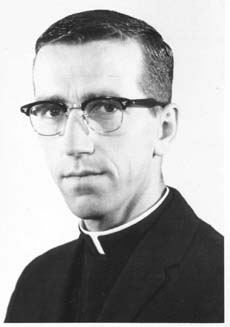
These are the conclusions I drew after attending a joyous reunion of priests and former priests (and their wives) belonging to the Society of St. Columban. That’s the Irish-founded missionary group I joined in 1954 (when I entered the minor seminary at the age of 14) and which I left in 1976. I had been ordained in 1966 (ordination photo above — taken by my classmate, Tom Shaugnessy).

The reunion took place in Bristol, Rhode Island over a three-day period just last week (July 21st-23rd). It was great getting together with friends, colleagues, teachers, former priests and their spouses. It was wonderful to see so many of my one-time missionary friends with their beautiful wives from Ireland as well as Japan, Korea, Chile and other “fields afar” (as the title of one missionary magazine used to put it). Several men’s spouses were former nuns. I can only imagine the wonderful love stories each of those couples might tell.

As with all reunions, there were the usual reminiscences from years long past. We made wisecracks about how all of us have aged, and observations about how quickly time has flown. There was catching up to do about retirement, children, grandchildren, illnesses, deaths of former colleagues, and plans for our declining years – and always in a light-hearted spirit. We even went for a cruise around the Newport Harbor. Great fun!

On the final day, things turned more serious. The newly-elected Regional Director of the Columbans spoke to us about the Society of St. Columban today. After introducing himself, this comparative youngster of 51 years informed his appreciative audience of recent efforts to update the Society in the face of zero vocations over the last number of years in Ireland, the U.S., England, and Australia. The situation is aggravated by the advancing ages of the 400 or so priests who remain in the Society – so many of them over the age of 75.

In response, we were told, the Columbans have made efforts at recruiting seminarians from the “mission” territories. As a result, Columban ordinations have taken place in the Pacific Rim – in Korea, Fiji, the Philippines, and also in Latin America. The Society’s directorate has changed accordingly. With its headquarters now located in Hong Kong instead of Ireland, the current directing council is a rainbow blend of Irish, Latin American, and Philippine “superiors.” Additionally lay associates, both men and women have become more prominent in the Columban scheme of things.

Besides such developments, there have been efforts at dialog with Muslims, especially in Pakistan and the Philippines. Social justice for the poor and ecological concerns have become central themes of documents recently authored by Society “chapters” or long-range planning sessions. Above all continued emphasis on brotherly love and legendary Columban hospitality continue as hallmarks of this group about to celebrate the 100th anniversary of its founding as the “Maynooth Mission to China” in 1918. (“Maynooth” was the name of the Irish National Seminary back then.) With China now open, Columbans are currently making efforts to reintroduce themselves into that continent-sized country thus reclaiming the Society’s original focus.

All of that seemed encouraging. Such updating demonstrates the good will, generosity and continued vitality of men and women still intent on doing good in the world and serving the God their faith envisions. Columbans remain for me the most inspiring community of its kind I’ve ever known.

However questions surfaced for me about the reforms just mentioned. And unfortunately there was little time to raise – much less probe – them during the discussion period that followed the new Regional Director’s fine presentation. For instance:

• What does it mean that Pacific Rim Catholics are more open to the priesthood and mission than Europeans and North Americans? Is faith stronger in the former colonies? Are candidates European wannabes? Or has a pre-Vatican II brand of Christianity been introduced in the Pacific Rim that avoids the crises of the celibate priesthood that emerged following that historic Council whose 50th anniversary we’re currently celebrating?
• Does the incorporation of women and laymen as associates give them equal voice and vote in Society matters? Will there soon be a woman Superior General governing the Society of St. Columban?
• What is the point of Columban-Muslim dialog? Is it conversion of the Muslim dialog partners? Is it enrichment of all conversation participants? Is it collaboration and cooperation? If so, what is the shared project?
• For that matter, what’s the point of missionary work itself? After all, Vatican II recognized the value in God’s eyes of Hinduism, Buddhism, Islam and other faiths. Are missionaries still trying to convert faithful people whose culture seems so distant from a Christianity so long and fatally associated with empire and exploitation?
• What specifically are Columbans doing about ecology and care for the planet? It’s easy for organizations nowadays to claim “green” commitment, but where does the rubber meet the road? Are Columbans encouraging vegetarianism as spiritual and ecological discipline? Are they cutting back on air-conditioning? Are they mandating that their cars be hybrids or have targeted miles-per-gallon ranges? Are they mounting campaigns focused on global warming and the introduction of genetically modified seeds in Latin America and Asia?

Those are some key questions that necessarily remained un-discussed at our Columban reunion. But I did get the opportunity to pose one whose answer led me to draw the conclusions I shared at the beginning – about the Columbans, organizations like them, and the Catholic Church itself being sinking ships. I asked:

• The great Catholic theologian, Karl Rahner, has observed that the Holy Eucharist is constitutive of the church. Without Mass, he said, there simply can be no church. Therefore it is positively sinful on the part of church leadership to deprive Catholics of Eucharist because of an artificial priest shortage caused by blind commitment to mandatory celibacy and an all-male clergy. What are the Columbans doing to lobby for fundamental change in the church to make the Eucharist more available to the communities Columbans serve?

Understandably, the Regional Director gave the expected answer – the only one possible, I think. “Of course,” he said, “where 2 or 3 Columbans get together those questions are always discussed. However, we’re such a small and relatively insignificant organization, we have so little clout. So, no, we haven’t discussed petitions or protests on those matters.”

In other words, the sin of mandatory celibacy for priests, the sin of an all-male clergy will continue until the Vatican repents. But even Francis I is not about to don sack cloth and ashes in that regard.

That institutional obstinacy was underlined for me in the Mass that concluded our magnificent reunion. Two male priests stood before a congregation of “priests forever” – the latter adopting subservient positions in the pews instead of concelebrating. No woman had any role in the Mass. Additionally, the recently mandated pre-Vatican II Latinisms reminded me that the church is actually regressing:

• “Consubstantial” (instead of “one in being”)
• “And with thy spirit” (rather than “also with you”)
• “Shed for you and for many” (not “all”)
• “It is right and just” (instead of “fitting”)
• “Come under my roof” (rather than “receive you”)

The Latinisms are not trivial. They represent subtle messages that the signature liturgical reform of Vatican II is over. In the context of the Columban reunion, they demonstrated how hemmed in good people are by decisions from above.

Talk about rearranging deck chairs . . . . I could almost hear the water bursting through the Ship’s gaping hull.

A Dying Cub Fan’s Last Request

Today’s posting is just for fun. It was sent to me by a life-long friend, Ray Walsh – a White Sox fan – and I thought it worth sharing.

Ray knows I’ve been a Cub fan all my life since the days of “Big Hank Sauer,” Bob Rush, Roy Smalley, Mickey Owen, Wayne Twilliger, and Dee Fondy. Ernie Banks was my boyhood hero. Ray and I had many arguments about who was the better shortstop – Ernie or Luis Aparicio.

I’ve even inflicted my Cub fan-ism on my children. Growing up, my daughter, Maggie, had a crush on Cub first baseman, Mark Grace. No summer time visit home is complete without my sons, Brendan and Patrick, going with dad to Wrigley Field to “root, root, root for the Cubbies” — as old Harry Carey always sang it.

Lately though, I’ve found myself less interested. When I speak with my brother, Jim, on Skype he always fills me in on the latest Cub loss. Last week, Jim was telling me how the Cubs are improving and “should be a .500 ball team this year.” (I remember, by the way, that .500, “breaking even” – winning as many games as they lost – was the best any of us could expect of the Cubs when I was growing up. Usually they didn’t even make that.

And then there was 1969! I remember so well that the Cubs were on their way to their first pennant since 1945, and perhaps their first World Series since 1910. And then there was the big September collapse. I still haven’t forgiven the Mets for overtaking them.

Don’t even mention Steve Bartman!

Oh, well, as they say in Chicago, “Any team can have a bad century.”

I could go on and on about this. But Steve Goodman has done it for me. He’s said it all in this video Ray sent me, “A Dying Cub Fan’s Last Request.” Enjoy!

Announcing a New Wednesday Series on Critical Thinking: is anyone interested?

Critical thinking

During the last couple of weeks my blogs have addressed the Boston Marathon bombings. I’ve suggested the application of elementary principles to clarify thinking about such tragedies. One of them I’ve termed the “principle of reciprocity.” The meaning I’ve assigned the term has to do with the application of a single standard to all cases involving response to tragedies like the Boston bombing on the one hand and U.S. drone attacks on the other.

Reciprocity is related to judgments about nuclear weapons. If the U.S., Israel, Pakistan, and India are allowed to possess them, so should North Korea and Iran. The principle of reciprocity holds that what I judge as good for me should be good for you as well; what is bad for me is bad for you. Any child can understand such a guideline. It’s what we learned in Kindergarten and Sunday school.

Yet our “leaders” seem incapable of grasping what is perfectly clear even to children.

The principle of reciprocity and its implicit challenge to “American” exceptionalism has elicited energetic response on the part of some who have read the blogs as anti-American, insensitive and judgmental. Those responses in turn have led me to perceive a need on my part to explain in a more detailed manner just where I am coming from. The idea would be to help others come to grips with their own principles of critical thought. (We all have them whether we’re aware of it or not.)

You see, over my 36 years of teaching at Berea College in Kentucky, I’ve taught many courses on critical thinking. And this has led me to bring to consciousness my own approach to the discipline. That approach has centralized what I’ve learned in my years of study under Third World thinkers – especially under liberation theologians in Brazil, Costa Rica, Nicaragua, Cuba, and Zimbabwe.

If you’re wondering what I mean by “liberation theology,” just click on the entries in that category located just below the masthead of this blog site. In a single sentence, “liberation theology” is reflection on the following of Jesus of Nazareth from the viewpoint of those committed to the liberation of the world’s poor and oppressed. I consider it the most important theological development of the last 1700 years and the most important intellectual movement of the last 150 years – going back to the publication of the Communist Manifesto in 1848.

I guess what I’m saying is that my understanding of critical thinking comes from a faith perspective.

In any case, inspired by what I’ve learned, my teaching has led me to develop ten principles for critical thinking. I’ve used feature film clips to illustrate what I’m talking about. I’d like to share those principles and clips with readers in bite-sized portions, in Wednesday blogs over the next several weeks.

I hope there will be an audience out there to follow along. If so, please make a simple “I’m on board” comment below. If there’s no audience, at least my entries will serve as a vehicle for talking to myself in order to clarify my own thinking.

The same holds true for my observations about Hitler, his victory in what liberation philosopher,Enrique Dussel calls “the Second Inter-capitalist War,” and the resurfacing of Hitlerism in the United States over the last 35 years. During the coming weeks, on Fridays, I’d like to give an account of that sad and highly threatening process and its relevance to our own day. Is anyone out there interested in following a series on the topic? I wonder.

None of this would change what I consider the anchor of this blog site. In my view, what holds the whole thing down are my Sunday homilies. My project there is to do my small part to rescue interpretation of the Christian tradition from the political right and religious fundamentalists, and to provide reflections on Sunday liturgical readings from the viewpoint of liberation theology as referenced above.

If any of this interests you, please sign up as a “follower” of this blog, so that you’ll receive automatic notification of the Monday, Wednesday, and Friday posts. If you’re reluctant to sign on as a “follower,” do something to remind yourself to check in from time to time. Your critical feedback will be greatly appreciated.

I await responses.

The Holocaust Museum And the Search for Truth

jesus_in_abu_ghraib

What keeps us from recognizing the truth when it’s staring us in the face? That’s the question that occurred to me as I visited the Holocaust Museum last week when I was in DC. The answer is complex. Dealing with its ramifications challenges us to remember what we learned in kindergarten and what many of us were taught in church.

Last week’s visit was my second time through the Holocaust Museum. Its four floors of display, film, recordings, and horrific material memorabilia are dedicated to keeping alive the nightmare of the systematic murder of millions of communists, socialists, Jews, trade union leaders, priests, ministers, nuns, homosexuals, gypsies, and disabled along with other “dysfunctionals” and enemies of the state.

This time Peggy and I along with our youngest son, Patrick (age 26) spent most of our time on the fourth floor. It details Hitler’s rise to power. How did the German people allow that to happen, I wondered? They were Europeans. They were “modern,” producers of great philosophers, theologians, poets, novelists, musicians, scientists, and industrialists. Even more puzzlingly, they were largely Christian living in a major birth-center of the Reformation.

And yet they allowed the prison-camp system to emerge. They allowed Hitler to declare war on the world. The majority claimed ignorance of the gassings and incinerations. But surely, no one was unaware of the vilification of the ovens’ victims. Hitler’s speeches were filled with denunciations of “Jewish madness.” The phrase not only reflected anti-Semitism, but was code for the political left inspired at its core by the Jewish Testament – those communists and socialists that Hitler (and the ruling classes across Europe and the United States) hated and feared more than anything else.

And when Hitler declared war on the world, good Christian Germans lined up to fight for God and country. As Elie Wiesel reminds us, Catholic prison guards gassed Jews during the week, and then went to confession on Saturday and received Holy Communion at Mass on Sunday.

Reviewing all of that in the Holocaust Museum made me uncomfortably aware that the specter of Adolf Hitler is stalking our world today. It actually pains me to say that this time the shadow is cast by the United States. As I write, the “Americans” have established the control of the world that Hitler sought. In effect, Hitler (or more accurately Hitlerism) won that Second Inter-capitalist War.

In fact, since 9/11 the U.S. has declared a Hitler-like war on the world. It recognizes no inhibiting law, and will brook no rival. Its law of the jungle prevails. The war’s enemy: the poor who demand a fair share of the resources located where they live. Acting as the Hessian armed force of multinational financial interests, the United States identifies, arrests, tortures, and eliminates those who insist that the oil, minerals, natural resources, and agricultural produce of their countries belongs to them and not to the foreign interests on whose behalf the United States polices the world.

Part of the police-world the “Americans” have established is unending war; another is the world-wide prison system like the one at Guantanamo Bay, Cuba. The prisons are entirely reminiscent of Auschwitz, Buchenwald, Belsen, and Dachau, though government secrecy keeps us in the dark about the true extent of the clandestine hell-holes. They are centers of torture and degradation that beggar description. They are filled with Muslims, not with Jews. (Ironically Palestinian Jews are spearheading the attack on Muslims. It’s not for nothing that the Palestinians are called “the Jews’ Jews.”)

As for the unending war, according to the highly decorated ex-CIA agent John Stockwell, over the last 60 years, “The Third World War against the Poor” has claimed far more lives than the horrendously iconic figure of six million. In Vietnam alone more than 2 million Vietnamese were slaughtered. In Iraq, the figure of pointlessly butchered reaches beyond 1 million in a war of aggression which the U.N. terms the highest of international crimes.

And yet, our contemporaries, like the good Christians of Berlin and Cologne, are mostly in denial about the extent of the police state that has taken form especially since 9/11. Most deny (at least by their silence) the very existence of secret prisons, torture of suspects, the plain fact of political prisoners, death squads, and systemic cruelty.

Where does that denial come from? Where did it come from as Hitler rose to power? Part of the answer is that the process of take-over was gradual. It took years as Hitler advanced from army corporal, to political prisoner, to best-selling author of “Mein Kampf,” to Member of Parliament, to Chancellor, to dictator.

Similarly, the mission creep of the U.S. National Security State has been gradual as we’ve seen our government claim (and be granted by the judiciary) the right to spy on its citizens, search them without probable cause, imprison them without charge, torture them without limit, and ultimately kill them without trial. In the face of all that, like our German counterparts, most of us have stood dumbly by and have even applauded our oppressors as they expropriate us of our constitutionally guaranteed rights.

Another source of denial is the disruption that truth-telling causes in our own lives. As Paul Craig Roberts has recently pointed out, telling the truth disturbs career trajectories and can even disrupt family relationships. That makes fathers and mothers, ministers and priests, politicians and pundits close their eyes and moderate their speech. Roberts says,

“The power elite, especially the liberal elite, has always been willing to sacrifice integrity and truth for power, personal advancement, foundation grants, awards, tenured professorships, columns, book contracts, television appearances, generous lecture fees and social status. They know what they need to say. They know which ideology they have to serve. They know what lies must be told—the biggest being that they take moral stances on issues that aren’t safe and anodyne. They have been at this game a long time. And they will, should their careers require it, happily sell us out again.”

What to do about this state of affairs? For one we must learn to think critically. At the very least, that means applying daily to what we see and hear the “law of reciprocity.” It’s something even a child of seven can understand, though it seems beyond the capacities of our “leaders” to grasp.

One meaning of the law of reciprocity is that what is good for me is good for you; what is bad for you is bad for me. This means that if the U.S. would consider it unacceptable for Pakistanis to drone their enemies on “American” soil, it unacceptable to drone “American” enemies on Pakistani soil. If it’s wrong for Iranians to have nuclear weapons, it is also wrong for Israel or the United States to have them.

The law of reciprocity makes one wonder what the United States would do if a foreign drone so much as appeared unbidden in American airspace much less if it did its destructive work on the ground.

Besides observing the elements of what we were all taught in kindergarten, it would also help to heed what most of us have heard in church all our lives. That those German prison guards could do their crematorium work during the week and receive communion on Sundays seems somehow contradictory to the teachings of Jesus, don’t you think?

What about the guards at Guantanamo or Abu Ghraib, the soldiers in Fallujah or Haditha, or the drone pilots sitting at the consoles in their air-conditioned theaters? How are they different from the Germans we condemn?

Help me figure this one out. The question is disrupting my life.

What Is Retirement (and Life) for Anyway?

retirement

Last night Peggy and I had some dear friends over for drinks and conversation. Our friends retired two years ago – about a year after I did so myself. So more or less naturally, our conversation turned to retirement and its ups and downs – and to Florida and warmer climes.

The ups of retirement are obvious. They include not having to show up at the office any more. They entail being free each day to decide what to do. Travel, movies, hobbies like golf and tennis can be pursued freely in retirement. There’s more time to spend with children and grandchildren. And there’s space to think, write, study and pray. All of that is what people dream about doing in their golden years.

And so far, even though Peggy has not yet retired (and probably won’t for 3 or 4 years), my first years of retirement have been filled to overflowing with more of the expected ups than I can count. I’ve spent parts of 3 semesters in Costa Rica teaching in a Latin American Studies Program that was completely enjoyable and fun. The program served North American students from a large number of Christian colleges and universities. It was their “term abroad.” And it introduced them to the realities of the underdeveloped world, taking them to impoverished parts of Costa Rica, living with local families in Nicaragua and investigating first-hand the successes and shortcomings of socialist revolution in Cuba.

My part in the program was to introduce our Evangelical (and Republican) students to liberation theology. On the whole, the students were surprisingly open and receptive. And though I’ve always loved teaching, I’ve never found it as enjoyable as in Costa Rica.

Then last spring Peggy and I used her sabbatical to spend five months in Cape Town, South Africa – or, as they say, in the heart of “whitest Africa.” We were completely captivated by Cape Town which we agreed is the most beautiful city we’ve ever seen. We loved Table Mountain and the beautiful sea vistas everywhere we traveled. We also learned a great deal in South Africa, not only about politics and history, but about African spirituality and the powerful energy of rock formations subtly transformed by the San and Koi-Koi Peoples to track the movements of the heavens.

We traveled South Africa’s “Wine Route” and visited game parks with our grandchildren and their parents. I played golf with my son Brendan on a few of South Africa’s best courses. We passed a day on Robben Island, where Nelson Mandela was imprisoned for 17 of his 28 years of punishment in South African jails. We also spent weeks with Ann Hope and Sally Timmel, colleagues of Steve Biko with a life-long commitment to activism and the struggle against apartheid. We compared notes with them about common experiences, shared friendships, theology and spirituality. What a privilege that was!

With South Africa behind us, we’re now looking forward to five months in India. Can you imagine that? My Peggy has won her second Fulbright Fellowship (the other having brought us to Zimbabwe for a year back in ’97-’98). During this Fulbright term, Peggy will be teaching in Mysore. This will be our second trip to India. In 2004 we attended the World Social Forum in Mumbai.

This time we’ll be living in India with our daughter Maggie, our son-in-law, Kerry, and their three small children, Eva (4), Oscar (2), and Orlando (10 months). Kerry is taking his own sabbatical from his work in finance. So this will be an extraordinary opportunity not only to learn from a deeply spiritual culture, but to bond deeply with our grandchildren.

And then there’s this blog. It’s been unexpectedly fulfilling. I’ve never written as much as I have over these past three years, not only on my blog site, but on OpEdNews and in our local newspaper. Writing a homily each week has kept me grappling with my life-long commitment to spirituality, faith and theology. It’s all helped me think more clearly about life and its purpose.

Actually I’ve thought of the blog as a vehicle for reclaiming the formal priesthood I left more than 36 years ago – as has my involvement in the planning committee of a local Ecumenical Table Fellowship. I’ve seen this new work as a demonstration of the fact that Christian faith isn’t synonymous with fundamentalism. Approaching faith historically and contextually can recover the authentic teaching of Yeshua the Nazarene (the opposite of fundamentalism) and engage and animate radicals and progressives in the process.

How are those for retirement ups? At some level, I couldn’t ask for more.

But then there have been unexpected downs. With retirement comes a loss of identity. With my particular work as a college teacher, I had one of the best jobs I could think of. Imagine getting paid to read, study, write, and travel – all so that you might have hours of interesting conversations with young people?

Yes there was drudgery involved – papers to grade, committees, endless meetings, “administrivia.” But there was no heavy lifting. And there were those long vacations – three weeks at Christmas, three months in the summer, and mid-term breaks fall and spring. The “pay” for teaching went way beyond a monthly check. It involved those conversations I mentioned, but also the resulting life-long friendships, “turning on” students to life’s big questions, seeing that “light” go on, and watching students take their places as agents of transformation in the world.

Most of that (except the now-endless vacation) disappeared with retirement. And whereas previously I could walk across Berea’s campus and meet my students and former students at virtually every turn, I now find students (and myself!) largely anonymous. I miss the interactions with young people. I even have to show my identity card when I enter the Seabury Athletic Center to do my morning exercises. “Mike who. . .?”

On the one hand I find the question liberating, but also a little depressing. It means my identity is gradually slipping away. It all reminds me of the inevitable: the final slipping away, and the complete loss of identity and of any conscious trace of having been here at all. That’s not a morbid thought. It’s simply a fact. Following our deaths and within a generation or less, virtually anyone I know will disappear entirely from everyone’s memory.

And that brings me to my question: what is life for anyway? Truth is: I don’t know for sure.

And that’s where faith comes in. I’ve come to understand faith as taking a leap into what we don’t know for sure. I mean life might be just about family, travel, good food and drink, getting strokes from grateful students, breaking par or watching movies. However, I don’t think it is.

Instead, I’ve come to agree with the great mystics of all traditions – Hindu, Buddhist, Muslim, and Christian. At their highest peak, all of those traditions come together on the following points:

1. There’s a spark of the divine within each of us – our deepest identity.
2. Each human being is called to live from that divine place – to actualize God’s love in the world.
3. And that’s the purpose of life.
4. Gradually, as one strives for such actualization, s/he begins to see divine presence in everything, in all of creation.

So that’s what life is about for me – seeing God everywhere and responding accordingly. That’s what retirement is about. Sixteen years ago I decided to leap in that direction. My jump has involved the daily practice of meditation, repetition of my mantram, training the senses, spiritual reading from the mystics, spiritual companionship, slowing down, and one-pointed attention – the eight-point program of Eknath Easwaran, the great meditation teacher from Kerala state in India. In retirement I finally have time to follow Easwaran’s program more wholeheartedly than ever.

None of this excludes the other activities I’ve mentioned. Peggy and I will still travel, and spend time with our children and grandchildren. I’ll still hack around on the golf course, study, write, and give the occasional class. And I’ll continue learning to grapple with and mostly enjoy my anonymity and nobody-ness.

But meditation and its allied disciplines puts all those things in perspective. And it gets me ready for my next incarnation. [Oh yes, I’ve come to agree with the mystics (including Yeshua) that life won’t end for me or anyone else when those last memories fade . . . .]

Do you agree?

Christianity is the Enemy of Humankind (Reflections on the Historical Jesus)

To the least

Last night I concluded a Lenten series of classes on the historical Jesus. As always, the course had its ups and downs. But it was faithfully attended by about 25 soul mates who, like me, remain fascinated by and somehow in love with Jesus of Nazareth.

At last evening’s final meeting, one of the participants – a fierce unflinching seeker of truth, asked the question in the back of everyone’s mind. “So what?” she asked. “If, as we have learned here, Jesus has been distorted beyond recognition by the early church (and especially by Paul and Constantine) why should we believe any of it?”

What a good question! It has forced me to pull together (for myself!) what I have learned from this latest round of studies of the historical Jesus. Let me express them in as clear an unvarnished a way as possible both positively and critically.

First of all, my positive learnings . . . . The study forced me to face the fact that the historical Jesus, un-obscured by later developments is the touchstone for authentic Christian faith. That is, the Jesus of history (vs. the Jesus of later doctrines) trumps all other conceptualizations in terms of being normative for Christian faith. The teachings of the historical Jesus were extremely simple: God is love. God is bread. Salvation consists in sharing food – bread and wine. A world with room for everyone (the Kingdom of God) is entirely possible. Empire is the anti-thesis of love and sharing. It uses religion to enslave. It finds Jesus message of liberation abhorrent. Empire is the enemy.

Second of all, my critical learnings . . . . If anything the Christian Testament makes it extremely difficult to locate the normative historical Jesus. In fact, the canonical gospels often contradict the basic revelations of Jesus. When this happens, those contradictions have to be faced, learned from, and set aside as merely illustrative of the way history and religion are routinely distorted by the rich and powerful. It is evidence of what people either used to believe before Jesus’ revelation, or what they came to believe when the faith of Jesus subsequently interacted with and was domesticated by other cultures and times.

More particularly, examination of the gospels makes it abundantly clear that following the destruction of Jerusalem in the Jewish-Roman War (66-73), the Jesus of history increasingly receded from Christian perception. In his place a Jesus of faith came to prominence. The two are at odds with each other. The Jesus of history strove to liberate the poor. The Jesus of faith became the servant of empire and the rich who run it.

The Jesus of history was a mystic, prophet, teacher, healer, and movement founder. He was intent on reforming Judaism whose leaders had sold Judaism’s soul to the Roman Empire transforming it into a religion of laws, rituals and obedience to the powerful. This Jesus called himself the “Son of Man,” not the “Son of God.” He was perceived by the poor as a “messiah” who would deliver his people from Roman domination. He proclaimed a new social order which he referred to as the “Kingdom of God.” There Rome’s domination model of social organization would be replaced by a sharing model. In God’s kingdom everything would be reversed: the rich would be poor; the poor would be rich; the first would be last; the last would be first; prostitutes and “the unclean” would enter the new order before priests, the rich and the famous.

And although he shied away from accepting the conventional messianic identity associated with “The War” (against the Romans), Jesus’ program of “Good News for the poor” along with his healings and exorcisms confirmed that identification in the eyes of the marginalized and oppressed. It did the same for the Romans and their collaborators to such an extent that they ended up executing him as an insurgent.

The memory of this Jesus of history was preserved and celebrated by the Jerusalem community called “The Way” before its eradication in the horrendous Roman-Jewish War of 66 to 73CE. In obedience to Jesus, they adopted a communal life where food, drink, and material possessions were shared and held in common. Following Jesus’ death, some were even hoping for his “second coming” in their own lifetimes to complete the task of empire-destruction his execution had prevented him from fulfilling.

This prophetic Jesus was replaced by the Jesus of faith who emerged in the post-war world after the Jerusalem church and its leadership had been slaughtered by Rome. At this point, “The Way” (Jesus’ version of reformed Judaism) was replaced by “Christianity.” This religious movement was non-Jewish. It derived from the teaching of Paul of Tarsus (in Turkey) who never met the historical Jesus, and who thought of him in terms of God’s unique and only Son. Paul was a thoroughly Romanized Jewish rabbi intent on acquainting non-Jews with the Jesus he experienced in the visionary psychic experience recorded as his conversion on the Damascus Road.

By ignoring the Jesus of history, Paul’s experience and subsequent preaching laid the foundation for an understanding that centralized a Jesus understood as God’s only Son – a divine being who would have been (and was!) completely unacceptable to the fiercely monotheistic Jews. At the same time, this domesticated Jesus was not threatening to Rome. In fact, he was completely familiar to Romans resembling the “dying and rising gods” of Roman-Greco culture who offered “eternal life” beyond the grave rather than an anti-imperial Kingdom of God in the here and now. In other words, the Jesus of history was co-opted beyond recognition by the Roman Empire.

So what’s the take-away from the study of the historical Jesus? I think the following extremely important lessons:

1. History is unreliable. It has been distorted and manipulated by the powerful to suit their own needs. (If taken seriously, this in itself is an invaluable lesson.)

2. Hard work is required to find historical truth – not just about Jesus but about what happened yesterday!

3. Empire is the enemy. It is a system of robbery whereby the rich and powerful steal resources from the poor they oppress. It is entirely contrary to the will of God (the Principle of Life). It represents a “preferential option” for the rich and powerful. It is absolutely ruthless in its eternal war against the world’s poor and in falsifying history for its own benefit.

4. Those who resist empire can expect to be tortured and assassinated. Nonetheless, from time to time courageous and insightful prophets arise from the non-rich and non-powerful with Good News for the poor. Their very simple message: fullness of life is to be found not in empire, but among the poor and simple of the world (God’s people). Salvation, these prophets teach, consists in sharing the simple realities of bread and wine. In effect: God is Bread.

5. Among the west’s best known prophets of Jesus’ God are Moses, Jesus himself, Gandhi, Bartolommeo de las Casas, Karl Marx, Martin Luther King, Malcolm X, Dorothy Day, and the nameless martyrs (so many of them women!) inspired over the last fifty years by liberation theology.

6. Most people are in denial about these simple facts. They are powerfully assisted in their denial by politicians, scholars, priests, and the media who make the teachings of the prophets extremely complicated. They have transformed the prophets’ message about sharing bread and fullness of life in the here and now into “religion” and a promise of life after death. As such, religion is the enemy of humankind. Christianity is the enemy!

7. Those who accept these learnings should leave institutionalized “religion,” band together, internalize the teachings of the historical Jesus and change the world!

Some Interesting Comments on My Blog Postings

Friends have been so generous in not only reading what I post here, but in taking time to comment on the postings. In case you may have missed them, here are some comments of particular interest:

Jim Cashman sent me this video by way of comment on “Unconditional Support for Israel: Not even God would pass that test!”

Tzanchan 77 commented on “’Unconditional Support for Israel: Not even God would pass that test!”

Ah yes, Christians who butchered us for centuries now preaching to us about morality and how to defend ourselves. Perhaps you might do a review of the story of the town of Jedwabne in Poland during World War 2 when the good Catholics of that town brutalized their Jewish neighbours and then shoved them all into a barn and burned them alive. Not that long ago, Now, we have our tiny slice of land and you won’t even allow us that. My Mother and her family got quietly onto the cattlle cars. She survived if you can call it that, the rest of the family didn’t. Now we say, the hell with you, we will no longer go quietly.

BRS commented on “Lincoln:” A first-rate second-rate film”:

This seems like a pretty tough review of one of the best movies of
the year and an unfair critique an individual universally recognized
as one of the great presidents in American history. Who says it’s one
of the best movies of the year? The people who review movies. Who says
Abraham Lincoln is one of the best Presidents of all time? Anyone who
knows anything about American history.

You’re quite right that Lincoln’s priority was preserving the Union
and I think Spielberg was pretty explicit about communicating that in
his film. What was also clear, to me at least, was that Lincoln was a
really gifted and savvy politician who didn’t have to push for an end
to slavery but chose to when he saw an opportunity. Now, you’ve argued
that the main explanations for this were political and economic. That
northern industrialists to whom he was beholden figured out that
sweatshop labor was cheaper than owning slaves. That the future of the
economy was in low-wage labor and industrial production, railroads and
mining. I don’t know if that’s accurate or not. What I do know is that
Lincoln made the push to end slavery after being re-elected, which
suggests there was little to be had in terms of political gain. Did
ending slavery make economic sense too? It probably did. I don’t know
why any of that matters though. It didn’t change the result. The war
ended and so too did slavery. Now, if you were to read Doris
Kearns-Goodwin’s book, Team of Rivals, from which the movie Lincoln
was adapted, you’d learn that, for Lincoln, ending slavery was as much
about principle as politics and as much about morality as the economy.
Of course preserving the Union was his priority. And, of course,
ending slavery was a secondary consideration driven by moral, economic
and yes, political, imperatives. What’s news about that though? And
what movie did you watch in which that wasn’t clear?

Your argument then, seems to be, Okay, President Lincoln preserved the
Union and ended slavery in America for all time. But, because there
were not entirely noble political and economic considerations and
factors at work (in addition to moral and human ones which you don’t
address) that makes Lincoln a second rate president? I just don’t
follow that.

Second rate means mediocre or inferior in quality or value. It is not
a term to be used lightly and certainly not one you would expect to be
associated with a great –and very human– President like Abraham
Lincoln or an award winning film maker like Steven Spielberg.
Having said all of that, it was fun to read your review of this film. I do hope you will keep submitting topical movie reviews –in addition to your other entries– for all of your readers and followers to enjoy and discuss.

Bill Wilson commented on “The Trouble with Prophets”

There is an additional tragedy about prophets in addition to the fact that we either demonize or ignore them. We pervert their message with terrible consequences. The perversion of the original message Moses mediated to the Hebrews gave us the annihilation of whole communities, if the Torah and the Judges are to be believed. The perversion of Jesus’ message gave us the slaughter of Jews, Moors, native Americans and dissenting Christians, and a residual caste system that co-opts the Gospel and brooks no dissent. The perversion of Marx gave us Stalin, Pol Pot, Mao, Cousescou, et al. It’s almost as if the divine call to justice, mercy and compassion has a built-in self-destruct mechanism.

I think it was Peguy who said, “God writes straight with crooked lines.” Sometimes I think God is using mirror writing of a type that is ultimately indecipherable to us…Paul’s “mirror” on steroids, the reverse side of the tapestry, which will ultimately prove unintelligible on either side. Pardon the cynicism, but I was just rejoicing that Mahoney, however belatedly, has been barred from ministry only to learn from folks far less naive than I, that this move probably contains a major act of revenge by the Opus Dei gang against the cardinal’s liberal record on social issues.

Winston Leyland commented on “Marx and Jesus: The trouble with prophets”

Good article on prophets, Mike. To those mentioned can be added the names of Daniel Berrigan, Thomas Merton (especially in his anti war writings), Oscar Wilde, Harvey Milk and many others. And what a prophetic and catalytic young man was Aaron Swartz.

“Lincoln:” A first rate second rate film

affiche-lincoln-spielberg

My wife and I went to see Stephen Spielberg’s “Lincoln” last night. Both of us came away disappointed and surprised to discover that the film had received multiple Golden Globe nominations.

As a successful exercise in hagiography, Daniel Day-Lewis’ portrayal of a saintly Abraham Lincoln was well done. In those whitewashed terms, Lewis convincingly embodied a simple, straight-forward, wise man obsessed not with image or popularity, but with the passage of the 13th Amendment to the Constitution of the United States. Lewis’ Lincoln was witty, self-deprecatory, an eloquent homespun speaker, and a charming raconteur.  Above all he was a single-minded abolitionist. In fact, apart from their vastly differing charm quotients, there was little to separate President Lincoln from his ally, the caustic and belligerent Thaddeus Stevens (overplayed by Tommy Lee Jones) – the abolitionist chairman of the House Ways and Means Committee.

But as many have observed, Abraham Lincoln was also a racist who openly thought of whites as intrinsically superior to African Americans. Howard Zinn points out that candidate Lincoln was anti-slavery when speaking in the North. He was white supremacist campaigning in the South. In the end he advocated sending former slaves back to Africa. As he said repeatedly, his main purpose as president was not to free the slaves or to pass the 13th Amendment, but to preserve the union even if that meant keeping blacks enslaved forever. Moreover, it’s impossible to distance Lincoln from the wholesale slaughter of the Civil War and its scorched earth campaigns. Even according to Spielberg’s portrait of St. Abraham, Lincoln was willing to sacrifice untold numbers of other people’s sons to his “noble cause;” but he was stubborn in refusing to offer up his own. Abolitionist Wendell Phillips put it well when he described Lincoln as “a first rate second-rate man.”

Similarly, because of the Day-Lewis performance and its unflinching depiction of the absolute slaughter of the War between the States, Spielberg’s film might well be described as a first-rate second-rate movie. It is second-rate because it leaves us with an eighth grade understanding of its subject. It fails to deepen our grasp not only of the complexities of the man Lincoln, but also those of his historical context and the important working class struggle that was represented by the United States’ Civil War. As a result, we’re left with “feel-good” images of elderly white Republicans embracing and singing “Union Forever” because the cause of freedom and equality for all has been advanced by Constitutional amendment.

In reality, the purpose of the newly formed Republican Party was not to free blacks [who remain(ed) largely despised by whites] but to advance the cause of 19th century industrialists, railroaders, and mining interests.  Those exclusively white cabals were part of the struggle between old money and new that had reached its apex in Europe during the revolutionary year of 1848. Across the European world, the old money interests were the land owning agriculturalists that had ruled since the onset of the middle ages. The “new money” people were the products of the Industrial Revolution. In their eyes, it was their turn to call the shots, and they were willing to go to the mat with their rivals, whatever the consequences or cost in working class corpses.

In terms of such ferment, the Civil War represented the mid- 19th century struggle in Europe “crossing the pond.” The Civil War was really about land and gold. Specifically, it was about what to do with the vast acreage recently stolen from Mexico in the war of 1846. It was about who would own and transport all that gold discovered in Old Mexico in 1849. Would that territory be used for plantations worked by slaves? Or would it be used for industry, mining, and railroads? Northern industrialists were determined to use the territory for their own profit. So they sought abolition of slavery in the New West. Republicans like Lincoln also passed legislation subsidizing railroaders as they colonized the land for purposes of moving eastward the spoils of the Mexican War. That form of abolition and subsidy was what precipitated the South’s secession from the Union.

So the Civil War really wasn’t primarily about slavery, but about land and hegemony. Nonetheless, slavery was deeply part of the struggle.  Eliminating that “peculiar institution” played a major role in weakening the competitive advantage the old money had. Abolition would also create a mobile labor force providing a surplus of workers to fill job openings and suppress wages in northern factories. The exigencies of emerging industrial capitalism had made it clear that slaves were more expensive to maintain than wage labor. Hence northern joy at the passage of Amendment 13.

Similarly slave rebellions were co-opted by the new captains of industry. Thus insurgent slaves represented a working class contribution to the mid-nineteenth century changing of the hegemonic guard in the United States. Slave interests melded with those of the industrialists opposing the old aristocracy based on plantations and forced labor. In a sense, in fighting for the North, slaves were going from the fire into the frying pan – from a more egregious form of servitude into a softer form of bondage.

None of this historical context is even hinted at in the Spielberg film. As a result, viewers are left no more enlightened about history or the causes of current struggles than they were before their 150 minute investment. Instead Spielberg perpetuates the myth that significant change comes from the top. He shows us the familiar and misleading portrait of U.S. leaders primarily responding to ideals of freedom and equality and the needs of “the people” rather than to those of the moneyed classes who use “the people” as cannon fodder to advance their venal concerns.

Certainly there were idealistic abolitionists like Thaddeus Stevens. But Abraham Lincoln was not one of them. He was more complex, ruthless and beholden to his patrons than Spielberg allows. Had the director portrayed that Lincoln, had he not erased class differences and conflicts from his portrait, his film would have been first-rate indeed.

What Really Happens after Death? (Conclusion of a two-part series)

Last week I raised the question of what really happens after death. My jumping off point was last Easter’s Time Magazine article by Jon Meacham called “Rethinking Heaven.” There the author contrasted what he called a “Blue Sky” approach to heaven (a kind of Disneyland up above) with a “God’s Space” understanding (bringing God’s Kingdom to earth). I remarked that the “God’s Space” approach seemed more believable and adult than the “Disneyland” heaven. However, the alternative to Disneyland didn’t really help us understand what happens after we breathe our last.

Tony Equale’s blog (http://tonyequale.wordpress.com/) does help. For Equale (a Roman Catholic ex-priest) heaven has little to do with the pearly gates. At the same time he explains more starkly what entering God’s space after death might really entail.

To begin with, Equale says, we must admit our ignorance. We have little idea about heaven or what happens after death. It’s all speculation. Even Jesus himself said precious little about the afterlife, much less about the specifics of a heaven. In any case, anything the Bible might have to say about the afterlife is expressed in religious language which is of necessity highly metaphorical.  It gestures towards something else.

What we do know about Jesus is that his own understanding of death was shaped by his belief in God’s universal love. He had absolute trust in God as a loving Father. Jesus believed that God’s unfailing trustworthiness took away the “sting” of death, so that dying became irrelevant; whatever was to happen could be trusted as the best outcome possible. As a result, death had no dominion over him.

Moreover the heroism of Jesus’ witness was to actually “prove” his claims about God by staking everything on them. Here we’re not talking about a rationalistic proof, but about something existential. In effect Jesus said, “Do you want me to prove I’m right? O.K. then, I will.” So he courted death by doing the things God’s love demands (siding with the poor and oppressed) – a choice that usually brings assassination to any prophet. That was his proof. “You see,” he insisted, “God can be trusted; death is irrelevant in the face of God’s love.” A way of putting that metaphorically is to say that Jesus rose from the dead.

According to Equale, belief in resurrection in those terms — in terms of real flesh and blood people choosing to risk their lives because they trust God’s love – mostly unraveled within a few generations of Jesus’ execution.  Its place was taken by a mixture of Roman and Egyptian ideas about disembodied souls in a “Blue Sky” heaven familiar to three year olds, to Dante, Raphael, and Michelangelo.

According to Equale, where does that leave us? With one choice only, he says – either to trust or not to trust the source of our existence, which Jesus claimed is absolutely loving.  However, even if we make the choice to trust, the reality of God’s love might not be as we want it to be. Tony writes:

“But what if the reality is …that at death we are dissolved back into the elements from which we were formed, to be reused over and over until the whole meets … another implosion to singularity and another big bang — a new universe. What if our little heads and our little hearts are not equal to the unfathomable magnanimity of a “Father” who, more like a “Mother,” wishes to share, and share, and share Herself (and us as part of Herself) endlessly, … we might even add, purposelessly … for the sheer joy of it … to share being-here with ever new things and new “people” with a generosity and self-donation beyond our capacity to imagine … or endure? . . . Do we want to go to that heaven? Are we really as convinced that “God is Love” if it would mean that much love? . . . Do we love our existential source and the universe it has made, as it is — or only as we want it to be?”

These words are reminiscent of the insights of Eckhart Tolle. Tolle says there is no doubt that life continues after death. One has only to enter an untended forest to see that live trees are surrounded by dead leaves, branches, and fallen and decaying trees.  However, closer examination of the dead matter reveals that in every case, the distinction between “dead” and “alive” is misleading. The fallen leaves, branches, and trees are teeming with life. In biblical terms, their lives have been changed not taken away. Of course, it will be the same with our bodies as they decay and molder in their graves. Life will continue in our bodies too. And who knows where that life will end up – in what communities or “people?” Death is always followed by rebirth – and perhaps by rebirth in the cosmic sense of passing again through an entire evolutionary process.

As for our consciousness . . .  That too will persist – insofar as it achieved unity with the source of the profound intelligence that pervades the universe. (The reference here is, for example, to the intelligence manifest in a single human cell. The information contained in that unit is enough to fill one hundred books of six hundred pages each.) That such Source Consciousness is present is evident from the fact of our own awareness. Ours comes from somewhere. As scholastic philosophers put it “nihil ex nilhilo fit” (nothing comes from nothing).  In as much as we have achieved unity with the Consciousness that pervades the universe, “our” consciousness will surely continue. All other consciousness passes away – most of it, experience shows, even before we die.

So the ultimate question about heaven is not whether it is up in the blue sky or in “God’s space” here on earth. It’s not even a question of our attitudes towards climate change, HIV/AIDS or world hunger.  Rather, it’s a question of death and surrender.

In confronting death, in explaining it to our children, are we willing to admit our absolute ignorance?  And if we claim Christian commitment, are we prepared to think of Jesus’ resurrection as a call to complete trust in God come what may? Are we disposed to surrender our very lives, as Jesus did despite threats from those who routinely kill prophets, because of our conviction that death is irrelevant in the face of God’s love and promise? And are we ready to do that even if God’s love is so great that we find it incomprehensible, purposeless, confusing, and even disappointing to the ideas of a three year old like Eva?

Finally, are we willing to make our own the prayer of the medieval mystic, Rabia al-Basri [a woman and Muslim (717-801)]?

“Lord, if I love you because I desire the joys of heaven,

Close its gates to me.

And if I love you, because I fear the pains of hell,

Bury me in its depths.

But if I love you for the sake of loving you,

Hide not your face from me.”