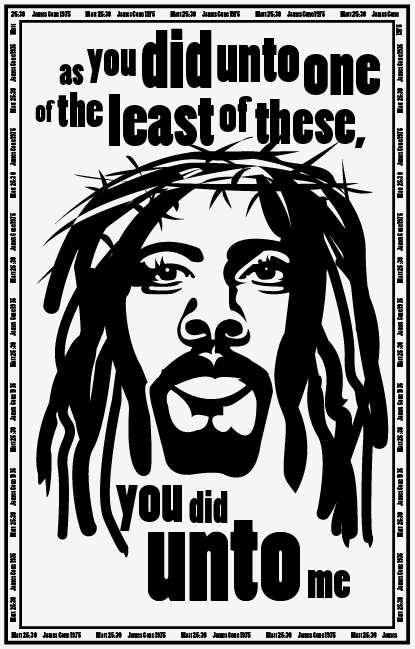
Christianity is the Enemy of Humankind (Reflections on the Historical Jesus)

To the least

Last night I concluded a Lenten series of classes on the historical Jesus. As always, the course had its ups and downs. But it was faithfully attended by about 25 soul mates who, like me, remain fascinated by and somehow in love with Jesus of Nazareth.

At last evening’s final meeting, one of the participants – a fierce unflinching seeker of truth, asked the question in the back of everyone’s mind. “So what?” she asked. “If, as we have learned here, Jesus has been distorted beyond recognition by the early church (and especially by Paul and Constantine) why should we believe any of it?”

What a good question! It has forced me to pull together (for myself!) what I have learned from this latest round of studies of the historical Jesus. Let me express them in as clear an unvarnished a way as possible both positively and critically.

First of all, my positive learnings . . . . The study forced me to face the fact that the historical Jesus, un-obscured by later developments is the touchstone for authentic Christian faith. That is, the Jesus of history (vs. the Jesus of later doctrines) trumps all other conceptualizations in terms of being normative for Christian faith. The teachings of the historical Jesus were extremely simple: God is love. God is bread. Salvation consists in sharing food – bread and wine. A world with room for everyone (the Kingdom of God) is entirely possible. Empire is the anti-thesis of love and sharing. It uses religion to enslave. It finds Jesus message of liberation abhorrent. Empire is the enemy.

Second of all, my critical learnings . . . . If anything the Christian Testament makes it extremely difficult to locate the normative historical Jesus. In fact, the canonical gospels often contradict the basic revelations of Jesus. When this happens, those contradictions have to be faced, learned from, and set aside as merely illustrative of the way history and religion are routinely distorted by the rich and powerful. It is evidence of what people either used to believe before Jesus’ revelation, or what they came to believe when the faith of Jesus subsequently interacted with and was domesticated by other cultures and times.

More particularly, examination of the gospels makes it abundantly clear that following the destruction of Jerusalem in the Jewish-Roman War (66-73), the Jesus of history increasingly receded from Christian perception. In his place a Jesus of faith came to prominence. The two are at odds with each other. The Jesus of history strove to liberate the poor. The Jesus of faith became the servant of empire and the rich who run it.

The Jesus of history was a mystic, prophet, teacher, healer, and movement founder. He was intent on reforming Judaism whose leaders had sold Judaism’s soul to the Roman Empire transforming it into a religion of laws, rituals and obedience to the powerful. This Jesus called himself the “Son of Man,” not the “Son of God.” He was perceived by the poor as a “messiah” who would deliver his people from Roman domination. He proclaimed a new social order which he referred to as the “Kingdom of God.” There Rome’s domination model of social organization would be replaced by a sharing model. In God’s kingdom everything would be reversed: the rich would be poor; the poor would be rich; the first would be last; the last would be first; prostitutes and “the unclean” would enter the new order before priests, the rich and the famous.

And although he shied away from accepting the conventional messianic identity associated with “The War” (against the Romans), Jesus’ program of “Good News for the poor” along with his healings and exorcisms confirmed that identification in the eyes of the marginalized and oppressed. It did the same for the Romans and their collaborators to such an extent that they ended up executing him as an insurgent.

The memory of this Jesus of history was preserved and celebrated by the Jerusalem community called “The Way” before its eradication in the horrendous Roman-Jewish War of 66 to 73CE. In obedience to Jesus, they adopted a communal life where food, drink, and material possessions were shared and held in common. Following Jesus’ death, some were even hoping for his “second coming” in their own lifetimes to complete the task of empire-destruction his execution had prevented him from fulfilling.

This prophetic Jesus was replaced by the Jesus of faith who emerged in the post-war world after the Jerusalem church and its leadership had been slaughtered by Rome. At this point, “The Way” (Jesus’ version of reformed Judaism) was replaced by “Christianity.” This religious movement was non-Jewish. It derived from the teaching of Paul of Tarsus (in Turkey) who never met the historical Jesus, and who thought of him in terms of God’s unique and only Son. Paul was a thoroughly Romanized Jewish rabbi intent on acquainting non-Jews with the Jesus he experienced in the visionary psychic experience recorded as his conversion on the Damascus Road.

By ignoring the Jesus of history, Paul’s experience and subsequent preaching laid the foundation for an understanding that centralized a Jesus understood as God’s only Son – a divine being who would have been (and was!) completely unacceptable to the fiercely monotheistic Jews. At the same time, this domesticated Jesus was not threatening to Rome. In fact, he was completely familiar to Romans resembling the “dying and rising gods” of Roman-Greco culture who offered “eternal life” beyond the grave rather than an anti-imperial Kingdom of God in the here and now. In other words, the Jesus of history was co-opted beyond recognition by the Roman Empire.

So what’s the take-away from the study of the historical Jesus? I think the following extremely important lessons:

1. History is unreliable. It has been distorted and manipulated by the powerful to suit their own needs. (If taken seriously, this in itself is an invaluable lesson.)

2. Hard work is required to find historical truth – not just about Jesus but about what happened yesterday!

3. Empire is the enemy. It is a system of robbery whereby the rich and powerful steal resources from the poor they oppress. It is entirely contrary to the will of God (the Principle of Life). It represents a “preferential option” for the rich and powerful. It is absolutely ruthless in its eternal war against the world’s poor and in falsifying history for its own benefit.

4. Those who resist empire can expect to be tortured and assassinated. Nonetheless, from time to time courageous and insightful prophets arise from the non-rich and non-powerful with Good News for the poor. Their very simple message: fullness of life is to be found not in empire, but among the poor and simple of the world (God’s people). Salvation, these prophets teach, consists in sharing the simple realities of bread and wine. In effect: God is Bread.

5. Among the west’s best known prophets of Jesus’ God are Moses, Jesus himself, Gandhi, Bartolommeo de las Casas, Karl Marx, Martin Luther King, Malcolm X, Dorothy Day, and the nameless martyrs (so many of them women!) inspired over the last fifty years by liberation theology.

6. Most people are in denial about these simple facts. They are powerfully assisted in their denial by politicians, scholars, priests, and the media who make the teachings of the prophets extremely complicated. They have transformed the prophets’ message about sharing bread and fullness of life in the here and now into “religion” and a promise of life after death. As such, religion is the enemy of humankind. Christianity is the enemy!

7. Those who accept these learnings should leave institutionalized “religion,” band together, internalize the teachings of the historical Jesus and change the world!

Some Interesting Comments on My Blog Postings

Friends have been so generous in not only reading what I post here, but in taking time to comment on the postings. In case you may have missed them, here are some comments of particular interest:

Jim Cashman sent me this video by way of comment on “Unconditional Support for Israel: Not even God would pass that test!”

Tzanchan 77 commented on “’Unconditional Support for Israel: Not even God would pass that test!”

Ah yes, Christians who butchered us for centuries now preaching to us about morality and how to defend ourselves. Perhaps you might do a review of the story of the town of Jedwabne in Poland during World War 2 when the good Catholics of that town brutalized their Jewish neighbours and then shoved them all into a barn and burned them alive. Not that long ago, Now, we have our tiny slice of land and you won’t even allow us that. My Mother and her family got quietly onto the cattlle cars. She survived if you can call it that, the rest of the family didn’t. Now we say, the hell with you, we will no longer go quietly.

BRS commented on “Lincoln:” A first-rate second-rate film”:

This seems like a pretty tough review of one of the best movies of
the year and an unfair critique an individual universally recognized
as one of the great presidents in American history. Who says it’s one
of the best movies of the year? The people who review movies. Who says
Abraham Lincoln is one of the best Presidents of all time? Anyone who
knows anything about American history.

You’re quite right that Lincoln’s priority was preserving the Union
and I think Spielberg was pretty explicit about communicating that in
his film. What was also clear, to me at least, was that Lincoln was a
really gifted and savvy politician who didn’t have to push for an end
to slavery but chose to when he saw an opportunity. Now, you’ve argued
that the main explanations for this were political and economic. That
northern industrialists to whom he was beholden figured out that
sweatshop labor was cheaper than owning slaves. That the future of the
economy was in low-wage labor and industrial production, railroads and
mining. I don’t know if that’s accurate or not. What I do know is that
Lincoln made the push to end slavery after being re-elected, which
suggests there was little to be had in terms of political gain. Did
ending slavery make economic sense too? It probably did. I don’t know
why any of that matters though. It didn’t change the result. The war
ended and so too did slavery. Now, if you were to read Doris
Kearns-Goodwin’s book, Team of Rivals, from which the movie Lincoln
was adapted, you’d learn that, for Lincoln, ending slavery was as much
about principle as politics and as much about morality as the economy.
Of course preserving the Union was his priority. And, of course,
ending slavery was a secondary consideration driven by moral, economic
and yes, political, imperatives. What’s news about that though? And
what movie did you watch in which that wasn’t clear?

Your argument then, seems to be, Okay, President Lincoln preserved the
Union and ended slavery in America for all time. But, because there
were not entirely noble political and economic considerations and
factors at work (in addition to moral and human ones which you don’t
address) that makes Lincoln a second rate president? I just don’t
follow that.

Second rate means mediocre or inferior in quality or value. It is not
a term to be used lightly and certainly not one you would expect to be
associated with a great –and very human– President like Abraham
Lincoln or an award winning film maker like Steven Spielberg.
Having said all of that, it was fun to read your review of this film. I do hope you will keep submitting topical movie reviews –in addition to your other entries– for all of your readers and followers to enjoy and discuss.

Bill Wilson commented on “The Trouble with Prophets”

There is an additional tragedy about prophets in addition to the fact that we either demonize or ignore them. We pervert their message with terrible consequences. The perversion of the original message Moses mediated to the Hebrews gave us the annihilation of whole communities, if the Torah and the Judges are to be believed. The perversion of Jesus’ message gave us the slaughter of Jews, Moors, native Americans and dissenting Christians, and a residual caste system that co-opts the Gospel and brooks no dissent. The perversion of Marx gave us Stalin, Pol Pot, Mao, Cousescou, et al. It’s almost as if the divine call to justice, mercy and compassion has a built-in self-destruct mechanism.

I think it was Peguy who said, “God writes straight with crooked lines.” Sometimes I think God is using mirror writing of a type that is ultimately indecipherable to us…Paul’s “mirror” on steroids, the reverse side of the tapestry, which will ultimately prove unintelligible on either side. Pardon the cynicism, but I was just rejoicing that Mahoney, however belatedly, has been barred from ministry only to learn from folks far less naive than I, that this move probably contains a major act of revenge by the Opus Dei gang against the cardinal’s liberal record on social issues.

Winston Leyland commented on “Marx and Jesus: The trouble with prophets”

Good article on prophets, Mike. To those mentioned can be added the names of Daniel Berrigan, Thomas Merton (especially in his anti war writings), Oscar Wilde, Harvey Milk and many others. And what a prophetic and catalytic young man was Aaron Swartz.

“Lincoln:” A first rate second rate film

affiche-lincoln-spielberg

My wife and I went to see Stephen Spielberg’s “Lincoln” last night. Both of us came away disappointed and surprised to discover that the film had received multiple Golden Globe nominations.

As a successful exercise in hagiography, Daniel Day-Lewis’ portrayal of a saintly Abraham Lincoln was well done. In those whitewashed terms, Lewis convincingly embodied a simple, straight-forward, wise man obsessed not with image or popularity, but with the passage of the 13th Amendment to the Constitution of the United States. Lewis’ Lincoln was witty, self-deprecatory, an eloquent homespun speaker, and a charming raconteur.  Above all he was a single-minded abolitionist. In fact, apart from their vastly differing charm quotients, there was little to separate President Lincoln from his ally, the caustic and belligerent Thaddeus Stevens (overplayed by Tommy Lee Jones) – the abolitionist chairman of the House Ways and Means Committee.

But as many have observed, Abraham Lincoln was also a racist who openly thought of whites as intrinsically superior to African Americans. Howard Zinn points out that candidate Lincoln was anti-slavery when speaking in the North. He was white supremacist campaigning in the South. In the end he advocated sending former slaves back to Africa. As he said repeatedly, his main purpose as president was not to free the slaves or to pass the 13th Amendment, but to preserve the union even if that meant keeping blacks enslaved forever. Moreover, it’s impossible to distance Lincoln from the wholesale slaughter of the Civil War and its scorched earth campaigns. Even according to Spielberg’s portrait of St. Abraham, Lincoln was willing to sacrifice untold numbers of other people’s sons to his “noble cause;” but he was stubborn in refusing to offer up his own. Abolitionist Wendell Phillips put it well when he described Lincoln as “a first rate second-rate man.”

Similarly, because of the Day-Lewis performance and its unflinching depiction of the absolute slaughter of the War between the States, Spielberg’s film might well be described as a first-rate second-rate movie. It is second-rate because it leaves us with an eighth grade understanding of its subject. It fails to deepen our grasp not only of the complexities of the man Lincoln, but also those of his historical context and the important working class struggle that was represented by the United States’ Civil War. As a result, we’re left with “feel-good” images of elderly white Republicans embracing and singing “Union Forever” because the cause of freedom and equality for all has been advanced by Constitutional amendment.

In reality, the purpose of the newly formed Republican Party was not to free blacks [who remain(ed) largely despised by whites] but to advance the cause of 19th century industrialists, railroaders, and mining interests.  Those exclusively white cabals were part of the struggle between old money and new that had reached its apex in Europe during the revolutionary year of 1848. Across the European world, the old money interests were the land owning agriculturalists that had ruled since the onset of the middle ages. The “new money” people were the products of the Industrial Revolution. In their eyes, it was their turn to call the shots, and they were willing to go to the mat with their rivals, whatever the consequences or cost in working class corpses.

In terms of such ferment, the Civil War represented the mid- 19th century struggle in Europe “crossing the pond.” The Civil War was really about land and gold. Specifically, it was about what to do with the vast acreage recently stolen from Mexico in the war of 1846. It was about who would own and transport all that gold discovered in Old Mexico in 1849. Would that territory be used for plantations worked by slaves? Or would it be used for industry, mining, and railroads? Northern industrialists were determined to use the territory for their own profit. So they sought abolition of slavery in the New West. Republicans like Lincoln also passed legislation subsidizing railroaders as they colonized the land for purposes of moving eastward the spoils of the Mexican War. That form of abolition and subsidy was what precipitated the South’s secession from the Union.

So the Civil War really wasn’t primarily about slavery, but about land and hegemony. Nonetheless, slavery was deeply part of the struggle.  Eliminating that “peculiar institution” played a major role in weakening the competitive advantage the old money had. Abolition would also create a mobile labor force providing a surplus of workers to fill job openings and suppress wages in northern factories. The exigencies of emerging industrial capitalism had made it clear that slaves were more expensive to maintain than wage labor. Hence northern joy at the passage of Amendment 13.

Similarly slave rebellions were co-opted by the new captains of industry. Thus insurgent slaves represented a working class contribution to the mid-nineteenth century changing of the hegemonic guard in the United States. Slave interests melded with those of the industrialists opposing the old aristocracy based on plantations and forced labor. In a sense, in fighting for the North, slaves were going from the fire into the frying pan – from a more egregious form of servitude into a softer form of bondage.

None of this historical context is even hinted at in the Spielberg film. As a result, viewers are left no more enlightened about history or the causes of current struggles than they were before their 150 minute investment. Instead Spielberg perpetuates the myth that significant change comes from the top. He shows us the familiar and misleading portrait of U.S. leaders primarily responding to ideals of freedom and equality and the needs of “the people” rather than to those of the moneyed classes who use “the people” as cannon fodder to advance their venal concerns.

Certainly there were idealistic abolitionists like Thaddeus Stevens. But Abraham Lincoln was not one of them. He was more complex, ruthless and beholden to his patrons than Spielberg allows. Had the director portrayed that Lincoln, had he not erased class differences and conflicts from his portrait, his film would have been first-rate indeed.

What Really Happens after Death? (Conclusion of a two-part series)

Last week I raised the question of what really happens after death. My jumping off point was last Easter’s Time Magazine article by Jon Meacham called “Rethinking Heaven.” There the author contrasted what he called a “Blue Sky” approach to heaven (a kind of Disneyland up above) with a “God’s Space” understanding (bringing God’s Kingdom to earth). I remarked that the “God’s Space” approach seemed more believable and adult than the “Disneyland” heaven. However, the alternative to Disneyland didn’t really help us understand what happens after we breathe our last.

Tony Equale’s blog (http://tonyequale.wordpress.com/) does help. For Equale (a Roman Catholic ex-priest) heaven has little to do with the pearly gates. At the same time he explains more starkly what entering God’s space after death might really entail.

To begin with, Equale says, we must admit our ignorance. We have little idea about heaven or what happens after death. It’s all speculation. Even Jesus himself said precious little about the afterlife, much less about the specifics of a heaven. In any case, anything the Bible might have to say about the afterlife is expressed in religious language which is of necessity highly metaphorical.  It gestures towards something else.

What we do know about Jesus is that his own understanding of death was shaped by his belief in God’s universal love. He had absolute trust in God as a loving Father. Jesus believed that God’s unfailing trustworthiness took away the “sting” of death, so that dying became irrelevant; whatever was to happen could be trusted as the best outcome possible. As a result, death had no dominion over him.

Moreover the heroism of Jesus’ witness was to actually “prove” his claims about God by staking everything on them. Here we’re not talking about a rationalistic proof, but about something existential. In effect Jesus said, “Do you want me to prove I’m right? O.K. then, I will.” So he courted death by doing the things God’s love demands (siding with the poor and oppressed) – a choice that usually brings assassination to any prophet. That was his proof. “You see,” he insisted, “God can be trusted; death is irrelevant in the face of God’s love.” A way of putting that metaphorically is to say that Jesus rose from the dead.

According to Equale, belief in resurrection in those terms — in terms of real flesh and blood people choosing to risk their lives because they trust God’s love – mostly unraveled within a few generations of Jesus’ execution.  Its place was taken by a mixture of Roman and Egyptian ideas about disembodied souls in a “Blue Sky” heaven familiar to three year olds, to Dante, Raphael, and Michelangelo.

According to Equale, where does that leave us? With one choice only, he says – either to trust or not to trust the source of our existence, which Jesus claimed is absolutely loving.  However, even if we make the choice to trust, the reality of God’s love might not be as we want it to be. Tony writes:

“But what if the reality is …that at death we are dissolved back into the elements from which we were formed, to be reused over and over until the whole meets … another implosion to singularity and another big bang — a new universe. What if our little heads and our little hearts are not equal to the unfathomable magnanimity of a “Father” who, more like a “Mother,” wishes to share, and share, and share Herself (and us as part of Herself) endlessly, … we might even add, purposelessly … for the sheer joy of it … to share being-here with ever new things and new “people” with a generosity and self-donation beyond our capacity to imagine … or endure? . . . Do we want to go to that heaven? Are we really as convinced that “God is Love” if it would mean that much love? . . . Do we love our existential source and the universe it has made, as it is — or only as we want it to be?”

These words are reminiscent of the insights of Eckhart Tolle. Tolle says there is no doubt that life continues after death. One has only to enter an untended forest to see that live trees are surrounded by dead leaves, branches, and fallen and decaying trees.  However, closer examination of the dead matter reveals that in every case, the distinction between “dead” and “alive” is misleading. The fallen leaves, branches, and trees are teeming with life. In biblical terms, their lives have been changed not taken away. Of course, it will be the same with our bodies as they decay and molder in their graves. Life will continue in our bodies too. And who knows where that life will end up – in what communities or “people?” Death is always followed by rebirth – and perhaps by rebirth in the cosmic sense of passing again through an entire evolutionary process.

As for our consciousness . . .  That too will persist – insofar as it achieved unity with the source of the profound intelligence that pervades the universe. (The reference here is, for example, to the intelligence manifest in a single human cell. The information contained in that unit is enough to fill one hundred books of six hundred pages each.) That such Source Consciousness is present is evident from the fact of our own awareness. Ours comes from somewhere. As scholastic philosophers put it “nihil ex nilhilo fit” (nothing comes from nothing).  In as much as we have achieved unity with the Consciousness that pervades the universe, “our” consciousness will surely continue. All other consciousness passes away – most of it, experience shows, even before we die.

So the ultimate question about heaven is not whether it is up in the blue sky or in “God’s space” here on earth. It’s not even a question of our attitudes towards climate change, HIV/AIDS or world hunger.  Rather, it’s a question of death and surrender.

In confronting death, in explaining it to our children, are we willing to admit our absolute ignorance?  And if we claim Christian commitment, are we prepared to think of Jesus’ resurrection as a call to complete trust in God come what may? Are we disposed to surrender our very lives, as Jesus did despite threats from those who routinely kill prophets, because of our conviction that death is irrelevant in the face of God’s love and promise? And are we ready to do that even if God’s love is so great that we find it incomprehensible, purposeless, confusing, and even disappointing to the ideas of a three year old like Eva?

Finally, are we willing to make our own the prayer of the medieval mystic, Rabia al-Basri [a woman and Muslim (717-801)]?

“Lord, if I love you because I desire the joys of heaven,

Close its gates to me.

And if I love you, because I fear the pains of hell,

Bury me in its depths.

But if I love you for the sake of loving you,

Hide not your face from me.”

What Happens after We Die? Rethinking Heaven

(Recently a friend asked me to post something on death and the afterlife. That’s a topic I think about very often. Here’s the first in a two-part blog on life-after-death.)

“We’re all going to die some day, Eva. Mommy will die. Daddy will die. Gaga and Baba will die too.”

“Baba’s going to die?”

“Yes, Baba will die too one day.”

“No, not Baba. Baba will never die. No!”

That touching conversation took place recently between my daughter, Maggie, and her daughter (our granddaughter) Eva. Eva was three then. She calls me “Baba.” She calls her grandma “Gaga.” And Eva was trying to come to grips with death – its inevitability, and the way it touches the ones we love. In that she’s like the rest of us. Death and what happens afterwards is and has always been a great mystery, something of a threat, and an object of denial. We don’t even want to think about it.

Earlier this year, Time Magazine’s Easter edition confronted all of that head-on. So did a friend of mine, Tony Equale, a former priest who blogs at http://tonyequale.wordpress.com/. Tony’s Easter blog was called “We Say That ‘God’ Is Love . . .” The Time article opened the question of heaven in a nicely popular way. However, it successfully avoided shedding light on the question of what really happens after we die. Tony Equale’s piece involved no such evasion. Its answer was clear, extremely thoughtful and challenging.  But it also left me undeniably uncomfortable. I’m not sure I liked the heaven Tony suggested awaits us.

The Time Magazine cover story was a piece by Jon Meacham called “Rethinking Heaven.” Basically, it compared two approaches to the afterlife. The one Meacham termed the “Blue Sky” approach would be familiar enough even to three-year-old Eva and to most Christians for that matter. After death, good people go up in the sky to “heaven,” where they live with God, Jesus, and all the people they love happily ever after.

The other approach favored by Meacham himself and attractive to what he sees as the “younger generation, teens, college aged who are motivated . . . to make a positive difference in the world” is a metaphor for “how you live your life.” “What if,” Meacham asks, “Christianity is not about enduring this sinful, fallen world in search of a reward of eternal rest? What if the authors of the New Testament were actually talking about a bodily resurrection in which God brings together the heavens and the earth in a wholly new, wholly redeemed creation?”  In the words of N.T. Wright, a New Testament scholar, and the former Anglican Bishop of Durham, England, “’heaven isn’t a place where people go when they die.’ In the Bible, heaven is God’s space, while earth (or if you like, ‘the cosmos’ or ‘creation’) is our space. And the Bible makes it clear that the two overlap and interlock.”

A person of faith, the Time Magazine author adds, must decide which “heaven” to believe in. The decision makes a difference. The “Blue Sky” approach makes life on earth and issues such as climate change and HIV/AIDS less important. The alternative makes stewardship imperative. The alternative makes it important to follow “Jesus’ commandment in Matthew 25 to feed the hungry, welcome the stranger and clothe the naked as though they had found Jesus himself hungry, homeless or bereft.”

Like Meacham, I find the “God’s space” approach to heaven on earth more believable and adult than the “Disneyland in the Sky” understanding. Just as I’m convinced that some people endure hell here on earth (the victims of Abu Ghraib come to mind), so also there are people in “heaven” (like Mother Theresa or the Dali Lama). But still, what about death? What happens afterwards? If it’s not Disneyland, what can we expect or hope for? That’s where my friend Tony Equale comes in.

(Next Wednesday: Our Fate after Death)

Nikki Giovanni: Thug Poet!

Nikki Giovanni came through Berea two weeks ago. She’s the great African-American poet who began brightening our world in the 1960s with her poetry and social criticism. At 69 years of age she continues spreading her light. She did it again at a Berea College convocation and in at least two other Berea venues.

When I saw her she dispensed advice on all manner of topics:

Cancer: Nikki is a cancer survivor. She’s had a lung removed, and has learned to make cancer her neighbor. You don’t “battle” cancer, she said. If you do, you know who’s going win that one – cancer every time. Instead, you make friends with the disease and learn to live with it, and try not to make it angry with you. Men can get breast cancer too, she reminded us. Get any lump checked out immediately. Act immediately too on any cancer diagnosis. Don’t delay treatment.

Second opinions: If you’re diagnosed with cancer, be sure to seek a second opinion. But do so far away from the location of the first diagnosis. If your second opinion comes from the same location as the first, the diagnosis is sure to be the same as well.

Obama’s Re-election: So you’re unhappy that a black man is the President. He won! Get over it!

Raising children: I’ve done my work as a mother. I don’t need to hear about my children’s problems. That’s what their best friends are for. I’m not my child’s best friend; I’m his mother. Don’t phone me with complaints or bad news. If it’s not good news, I don’t want to hear about it.

Education: It should be free for everyone — as it is at Berea College. Nikki loves her University of Virginia, and is proud to be associated with it. It has lots of money, and sometimes uses it well.

Phone calls in the middle of the night: Phone calls after midnight never bring good news. Don’t answer the phone then. The bad news will still be bad in the morning.

Taxing the rich: Why do billionaires resist taxes? They don’t need any more money. Take away 30% of what they have, and they’ll still be billionaires – or at least multi-millionaires. Take away 30% of millionaires’ wealth, and they’ll still be rich. Take away 30% of what those making $100,000, and they’ll be quite well off too. But take away 30% of what those making $30,000 earn, and you’ve sunk them into poverty.

Male Violence: “Men,” she said, “It’s not a good idea to hit women.” If you do, you’re not only mistreating your woman, you’re teaching lessons to your children. You’re son will conclude, “Oh, that’s the way men treat the women they love.” Your daughter will conclude, “Oh, that’s the treatment I can expect from the men I love and who say they love me.” And the cycle will continue.

Tupac Shakur: Nikki sees him as one of the great poets of our time. He stood for something. Yes, he was a “thug.” “I love thugs,” she said; “they’re always the victims of pursuit by the police. And on principle I’d always rather stand with the ones being chased than with the chasers.”

Nikki Giovanni also read her poetry about yellow jacket bees, her son Thomas, her “Mommy” who died five years ago, her first acclaimed poem, “Nikki-Rosa,” and phone calls after midnight. She spoke of the “Thug Life” tattoo she wears on her left forearm. She put it there in honor of Tupac Shakur, the great African-American rapper and social critic who was shot dead in 1996. Tupac, she reminded us was one of the great men of our era.

I loved Nikki’s talk. My eyes welled up more than once while she was  speaking. That always happens to me (and continues to embarrass me) whenever I recognize something as true.

Nikki Giovanni is true.

“The Book of Mormon” or “F_ _K You, God!”

Thanksgiving week, my daughter and son-in-law took us to see “The Book of Mormon” in New York City. When first I heard of the plan last summer, I wasn’t enthusiastic. A musical comedy about Mormons? Why would we want to see that? Then I heard that the book, music and lyrics were written by Trey Parker, and Matt Stone (of South Park fame) along with Robert Lopez, a co-creator of Cable TV’s Avenue Q. That irreverent trio gave me hope. So our family started listening to the soundtrack on CD. The music turned out to be catchy, clever, memorable, and poignant. It left us all humming – and laughing. The story was funny and moving as well, but somehow still respectful and even reverent. After seeing the play, I realized that “The Book of Mormon” also communicates an insightful understanding of Christianity and its development.  Even more importantly, it highlights Mormonism’s mythology that reminds playgoers of truths that can indeed change lives – as Mormons claim.

The “Book of Mormon’s” story centers on two young “elders,” Kevin Price and Arnold Cunningham. All of us have met these over-sincere 19 year olds, dressed in black trousers, white short-sleeved shirts and black ties. They knock on our front doors regularly. Kevin is the all-American boy – handsome, energetic, supremely self-confident – and self-centered. Meanwhile, Arnold is dumpy bespeckled and totally admiring of his companion. The two young missionaries been assigned to Uganda. Neither one of them knows where that country is located or even that it’s in Africa. When they realize that their destination is ‘the dark continent,” their minds are filled with “Lion King” images complete with its “Hakuna Matata” problem-free philosophy – “no worries for the rest of your days.”

Instead Price and Cunningham find a completely problem-filled culture. They’re told there are war, poverty, and famine. There’s drought; eighty percent of the people have AIDS; and young girls are forced to get circumcised. In the meantime, Ugandan men are busy raping virgins and even babies on the belief that such intercourse will cure their AIDS. The people’s response? Far from “Hakuna Matata,” it’s “Hasa Diga Eebowai” – “F_ _ k you, God!”

The All-American, Elder Price, is turned off by such blasphemy and by the resistance of Ugandans to Mormonism. Soon he’s checked out for the more comfortable make-believe of Orlando’s Disneyworld,  Meanwhile, Arnold Cunningham is engaged by Uganda’s problems, and finds himself using his empathy and imagination to adapt Mormonism the problem of female circumcision.

Lo and behold, he claims to discover that Joseph Smith actually did address the problem of clitorectemy. All this brings him close to the lovely Nabulungi, whom he initiates into the Latter Day Saints’ community. She and Arnold’s double entendre duet, “Baptize Me,” turns out to be a wonderfully moving love song.

The musical ends with Ugandans being converted to the faith of Latter Day Saints – but to a version that’s fully adapted to their reality. Their concluding number, “Hello” reprises the play’s opening song, but this time in Ugandan form meaningful to an exploited and poor people who long to be freed from war.  Besides this, Arnold Cunningham has become a key figure for the converts on a par with Joseph Smith and Brigham Young.

The Arnold Cunningham story is really the reversal of Christianity’s story and its development over the centuries.  In effect, the historical Jesus was a Ugandan – poor, oppressed, a “marginal Jew” on the edge of empire, out of sight, out of mind to the world’s movers and shakers. Then empire and its hangers-on elevated him to the status of “the Christ.”  He became Europeanized addressing concerns he never centralized – like the after-life’s heaven and hell. Finally, he was Americanized as the champion of the U.S. version of a “City on a Hill.” Only with the advent of liberation theology and the Jesus Seminar was the historical Jesus rescued and rediscovered in his identity as empire’s victim, not its champion. That in itself is a fascinating story – too long to pursue here.

Here though it is appropriate to celebrate the insights preserved in the mythology of Mormonism that “The Book of Mormon” centralizes.  It’s actually a beautiful myth – the story of a man with the most ordinary name possible, Joe Smith – obviously an “everyman.” This average Joe finds riches right in his backyard – gold out there under a tree. It’s like the rabbinic tale of the prayer-shawled pious Jew walking the floor of his tiny cabin praying for riches, while beneath the path he’s tracing on his floor lies a strong box filled with treasure.

Actually, Joe Smith finds a great deal more than gold. For right in his own backyard he discovers that a revelation from God has been written on the golden tablets he finds. The revelation tells how Jesus Christ, the very Son of God, belongs to every culture – even to a late comer like the United States. Jesus actually came to America, Joe finds out.  All life began here. Paradise was actually in Missouri somewhere.

What could be more meaningful (and true) than that? Treasure in your backyard; revelation close to home; your own land as the center of the earth and history? Like so many myths, it’s all true, even if none of it actually happened.

“The Book of Mormon” is well worth seeing – and thinking about. Taken seriously, its story which “blasphemously” rejects a God responsible for life’s tragedies can really change your life.

How Was Your Election Day? This Was Mine

Nov. 6, 2012

6:00 a.m.  My first thought this morning is the same as my last before dropping off to sleep last night: Election Day.   This is it. It’s been such a long campaign season. I’m glad it’s finally almost over. I’m sick of it all. Are we actually about to elect as president one of those plutocrats who crashed the economy four years ago? Only in America . . . .

6:15-7:15: A mighty struggle this morning to keep thoughts of the election out of my mind during meditation and spiritual reading. I keep directing my mind back to the words of my “passage meditation”: “All that we are is the result of what we have thought; we are formed and molded by our thoughts . . .”

7:30: On my way to the gym, I go over the list of people I pray for each day. I stumble over the last inclusion – the prayer for President Obama.  I’ve been praying it over the last four years: “May the president be remembered as the best the United States has ever had. May he be filled with loving kindness. May he be safe from dangers, internal and external. May he be well in body, in heart, and in mind. And may he find peace and be truly happy.”

8:00-8:30: I’m on the elliptical machine at the gym now. I think about that Obama prayer. A lot of good it’s done! This guy has been such a disaster: droning, torture, a Bush-like “surge” in Afghanistan, renewal of the Patriot Act, restrictions on civil liberties, extension of tax cuts for the wealthy, surrender on the public option in healthcare, refusal to explain and defend himself in the face of relentless Republican attacks and GOP rejection of bipartisanship . . . . If he’s reelected, he’ll probably immediately abandon his base again. I feel so angry about that. He just failed to grasp which side his bread is buttered on? Maybe he’s not as smart as we thought.

8:50-9:00: I’m walking home now. Obama actually called us “professional leftists” and “whiners.” I can’t get that out of my mind.  And now he’s ever so cooperatively begging for our vote! What gall!  How arrogant! I feel so insulted, I could almost vote for Romney!

9:15: Now I’m preparing breakfast. Would things really change that much if Obama lost? Can Mitt Romney be much worse? Well, there are those Supreme Court nominations in the offing. All we need are more Clarence Thomases. . . . I’m confused.

9:30: While eating breakfast, I tune in to Amy Goodman’s “Democracy Now.” Election Day focus is on the Republican campaign to suppress the vote. Their crusade strikes me as outrageous, unpatriotic, and treasonous. Why didn’t the Democrats do something about reforming the electoral process when they had the chance? The whole thing is so corrupt, what with “Citizens United,” voting machine conflicts of interest, redistricting, and voter suppression aimed at minorities and Democrats? Why are we still discussing these things on Election Day? The electoral system should have been reformed immediately after the 2000 “hanging chad” disaster. Obama really screwed up by not taking advantage of the mandate for change and the super majority he enjoyed in Congress in 2008. I’m so pissed.

10:00: I’m off to vote in the Madison Southern High School gymnasium. It’s busy there. This is a Red State. I catch myself thinking harsh thoughts about Kentuckians. Then I see some friends. We exchange pleasantries. I approach the desk to sign in to vote. They ask for my ID. I search my wallet for one without a photo – I just don’t want to give in to this voter ID nonsense. I’m white, so the ID works.  I guess they don’t require a photo of whites.

10:15: I sign in to vote. The ballot is a single page and surprisingly uncomplicated – nothing like the 12 page ballot they’re using to suppress the vote in Florida. I’m directed to a desk (with privacy shields) alongside two other voters. This is different from what we used to do in Madison County. In 2000 and before we went into a curtained booth and voted via Diebold machine. I never did trust those things; still don’t.

10:25: I fill out votes for City Council members – searching for names I recognize, most of them former colleagues at Berea College where I used to teach. They’re all “liberal” enough, I guess.

10:27: I VOTE FOR GREEN PARTY CANDIDATE, JILL STEIN. I’m thinking, the Democrats and Obama simply have to get the message that they’ve lost people like me. Anyway, since Kentucky’s such a red state, my vote for president is otherwise meaningless. Now if I were in Ohio or Florida, it would be a different story. I would vote for Obama there. (In fact, a couple of weeks ago, I spent a Saturday afternoon phoning Ohioans to get out the vote for Obama. That’s how conflicted I am.)

11:30: I Skype a friend of mine in Amsterdam. He’s a self-exiled former priest who holds dual citizenship in Great Britain and in the U.S. He’s chosen to boycott this election.  Over the last few weeks he’s been chiding me for supporting Obama. “How can you do that? he’s been asking. Didn’t you watch the third debate? On foreign policy, Obama and Romney are on the same page. It’s absolutely selfish to vote for Obama because he’ll somehow protect your Social Security. The man’s a war criminal – droning, torturing, eliminating civil liberties, suspending habeas corpus. . . . The Democrats are as corrupt as the Republicans. The whole system has to come down, and that means going through a period of purgation that will be hard as hell, but it has to happen.” My friend is pleased when he hears I’ve voted for Stein.

12:00: I have to break away from the Skype conversation to answer a knock on the door. It happens to be another ex-priest. (Our parish is loaded with them – four of us.) We sit on our front porch and talk politics. My friend agrees that the system must come down. What form do you think it will the disintegration take, I ask? “Last week answered that question,” he says. He was referring to Hurricane Sandy. “That even woke up the business suits,” he says. “Did you see that Bloomberg’s magazine ran a headline last week, ‘It’s Global Warming, Stupid’?  Once the suits wake up like that, you’ll see changes.”  He continues, “The dollar’s going to be devalued; the European Union’s going to hell, and simple demographics are running against the fascists. I mean, the whole thing’s disintegrating before our very eyes. And you’re asking ‘what form will it take?’ Open your eyes, man.  And hang on to your seatbelt!” Then he added with a nod towards our status as septuagenarians, “I don’t think you and I will live to see this particular ‘Berlin Wall’ fall. Thank God.”

1:00-5:00: All afternoon I compulsively check my Kindle Fire for . . .  I’m not sure for what. Am I hoping for some news about “who’s winning?” I know the polls won’t close for hours. Still, there might be something about exit polls. All I find though are more last-minute appeals for money from Move-On and others. They’re still asking for telephone calls to undecideds on behalf of Elizabeth Warren. Those appeals have been making me feel guilty for months. Instead of phoning, I watch the end of “Platoon.” It reminds me of Obama’s broken promises about Iraq, Afghanistan, and Guantanamo, and the likelihood that no matter who wins, we’ll soon be attacking Iran at Israel’s behest.

5:30: I go for supper to the home of a friend of mine (also a former priest!). We warm up with Manhattans. Then a spaghetti dinner with my friend’s famous meatballs. Always a treat. My friend, yet another one of us ex-priests, is a self-identified curmudgeon. He’s claims he has given up completely on politics. He’s convinced that nothing in the world ever really changes. Romney and Obama are essentially the same. Life goes on no matter what. The best we can do is tend our own gardens. I think about “Platoon” and find myself thinking he may be right.

7:30: The first returns are coming in now. We keep switching back and forth between FOX, MSNBC, and CNN. The reporters are obviously enamored of their “magic boards” and high tech gadgets. By 9:30 Romney has a lead in electoral votes. But a subtext of the evening (except on FOX) is that Obama will close the deal in Ohio and even, it seems, in Florida. We’ll see.

10:00: I return home and tune into Amy Goodman’s Election Night Coverage. She’s interviewing Green Party candidate, Jill Stein along with Ohio Congressman, Dennis Kucinich. Instead of simply reporting on the “horse race,” they discuss the need for a third party in the U.S.

10:30: Still on Amy Goodman, Lee Rowland of the Brennan Center for Justice along with author Greg Palast report on voter suppression efforts in Florida and Ohio. Palast talks about his experience in Toledo where voters waited in a line of more than a thousand people. Once they got to their destination, they were not allowed to vote, but were given applications for absentee ballots. Incredible!

11:15: They’ve called the election for President Obama. Reportedly, his camp is already talking about a”Grand Bargain” with the Republicans. Bob Herbert of Demos says it’s going to hurt the most vulnerable. Incredible!

12:00: I finally go to bed.

When a Prophet Visits: Matthew Fox Sweeps through Berea

Matthew Fox came through my hometown, Berea Kentucky, a few weeks ago. I’m still energized by the experience. It showed me what happens when a prophet drops by.

Matt’s the ex-Dominican theologian and spiritual teacher who was hounded out of his Order by Pope Ratzinger (aka Benedict XVI). His offense? The same as that of the 101 theologians and pastoral leaders that Fox has posted on his “Wailing Wall of Silenced, Expelled, or Banished Theologians and Pastoral Leaders under Ratzinger.” (The names appear at the end of Fox’s book The Pope’s War: Why Ratzinger’s Secret Crusade Has Imperiled the Church and How It Can Be Saved.)  The names include giants like Karl Rahner, Ivone Gebara, Edward Schillebeeckx, and my former teacher in Rome, the great moral theologian Bernard Haring.

As Matt’s more than 30 books show, he, like the others, was censured by Pope Benedict XVI for being too good a theologian and spiritual guide; he tried too hard to implement the directives of the Second Vatican Council; he was too successful in connecting the Christian Tradition to our post-modern world. All of that our ex-Hitler Youth Pope finds extremely threatening to his overriding pre-Vatican II values: order and Group Think directed from above.

My wife, Peggy, had instigated Matthew Fox’s visit to Berea College. As Director of Women’s Studies she had invited him for her “Peanut Butter and Gender” series of luncheons. Over the years, the twice-monthly event has paralleled the College’s convocation program of speakers and artists.  At “PB&G,” Matt gave a dynamite talk on men’s spirituality. Later on in the afternoon, he spoke to the entire student body wowing everyone in the process.

Of course, I attended both events. But I was even more privileged because Fox visited our home the night before. Over Manhattans he, Peggy and I compared notes, were surprised by friendships we share with others, and spoke of the dismal state the Catholic Church has reached under the “leadership” of the last two and a half popes (Ratzinger, John Paul II, and the last half of Paul VI’s term in office). Additionally, I had an hour or so in the car with Matt as I drove him to the Lexington Blue Grass Airport the morning after his visit. We spoke of Ratzinger’s 1968 “conversion” to the Catholic rendition of religious fundamentalism, and of Matt’s work with the witch, Starhawk (whom he identified with evident admiration as a “genuine liberation theologian”).

However, the highlight of the entire experience was a potluck supper at our home. Peggy had organized that too – for members of our Berea parish, St. Clare’s. The idea was for the Peace and Justice Committee and other progressives to meet with Fox and discuss how to respond to the drabness and irrelevancy of what passes for worship and Christian community in our church.

After an extraordinary potluck supper, about twenty-five of us sat in a big circle in our living room. Everyone joined in with comments, complaints, questions and concerns. Matt took it all in, responded when appropriate, and then shared his insights.

His most telling observation was to reverse the common perception shared by most in the room. That’s the opinion that progressive Vatican II Catholics have somehow been marginalized by the church. Fox turned that notion on its head. He held instead that we are the ones who are orthodox, while the last two (anti-Vatican II) popes are actually schismatic. They and their Vatican Curia are the outsiders, while we are the faithful ones adhering to the official teaching of the Catholic Church which remains the doctrine of Vatican II.

What to do about it all? Fox was helpful there as well. In fact, at the end of The Pope’s War, he lists “Twenty-Five Concrete Steps to Take Christianity into the Future.”  All of those steps were thought- provoking. However in terms of Fox’s “schism” observation, here’s the one that hit hardest for me:

“Instead of ‘Vatican III’ or a so-called lay synod that is gerrymandered by clerical curialists, let the various lay leadership groups hold national and then international gatherings among themselves – synods that are worthy of the name. Let them give marching orders to church officials instead of the other way around. Let the church officials listen to the laity for a change. Let the laity choose the theologians they wish to be their periti at such synods (if any).”

Along those lines, next month the “Call to Action” Conference will be meeting in Cincinnati. A group from our parish will be attending that convocation of progressive Catholics. Matthew Fox will speak there. I’ll be in attendance with my friends.

Expect a report in this blog.

Eucharistic Table Prayer for Peggy’s “First Mass”

Last week I reported on “My Wife’s First Mass.” Here is the “Table Prayer” we wrote for that occasion. As we intend using it again, I’d be interested in any suggestions for making it better.

Eucharistic Table Prayer

Preface:

All of us are welcome here to commemorate and celebrate this Lord’s Supper. No one is excluded from this table. No one can be excluded; this table belongs to Jesus not to us. So come and break bread in a spirit of thanksgiving, recollection, and inclusiveness. Come as you are – with your strong faith, your weak faith, with your doubts, questions, and deep-held convictions. (Pause) In that spirit of inclusiveness, please join me in our prayer of thanksgiving and remembrance.

Leader:

Blessed are you, Great Spirit of the universe.

You are the one in whom we live and move and have our being. You are within and without, above and below, and all around.

You interpenetrate every cell of our bodies – the eye of our eyes, the ear of our ears, the breath of our breath, the mind of our minds, the heart of our hearts, the soul of our souls, the life of our lives.

Dear God, bless us and make us aware of your presence in every here and now – in this here and now:

All:

Holy, holy, holy Lord, God of power and might. Heaven and earth are filled with your glory. Hosanna in the highest. Blessed is the one who comes in the name of the Lord. Hosanna in the highest!

The Table Prayer (Leader):

In particular, O gracious God, our Mother and Father, we thank you for sharing yourself with us in your magnificent creation stretching a hundred billion galaxies across an unfathomably vast universe.

In our own brief human history, we are grateful for your profound personal revelations in the Buddha, Krishna, and the Great Mother worshipped by humans all over the world for more than 50,000 years.

We thank you especially for Jesus of Nazareth who for us embodied your presence like no other.

We recall the heart of his teaching which was simply to love one another even to the point of death.

We remember how he healed and taught and organized and gave his own life as an example he called us to follow.

(Stretching both hands towards the bread and wine) And so, dear God, we ask that the Spirit of this Jesus may come upon these gifts of bread and wine. May they help us recognize his presence among us who taught that he is there wherever two or three are gathered in his name. May our sharing of the consecrated bread and wine not only transform the meaning of this food and drink, but deeply transform us and our very lives.

So we would never forget the transformation of self he called us to, Jesus asked us to break bread together and to share a cup in his name as he did with his friends the night before he died.

It was then that Jesus took bread into his holy hands. He blessed the bread and broke it. Then he gave it to his disciples and said

All:

“Take this all of you and eat it. This is my body which will be given up for you.”

Leader:

Then when the supper was ended, Jesus took a cup of wine. He blessed it and gave it to his friends. He said:

All:

“Take this all of you and drink from it. This is the cup of my blood, of the new and eternal covenant. It will be shed for you and for all, so that sins might be forgiven. Do this in memory of me.”

Leader:

Having shared himself in this way, Jesus led his friends in song. Today we sing:

All sing:

“We remember how you loved us to your death.  And still we celebrate that you are with us here. And we believe that we will see you. When you come in your glory, Lord. We remember; we celebrate; we believe.” (Repeat)

Preparation for Communion (Leader):

In this memorial, we join in spirit with all those great people of faith and who have gone before us. We unite with Peter and Paul, the apostles and martyrs throughout the ages – with Jesus’ mother, Mary, with his “apostle of apostles” Mary Magdalene, with Aquinas, Martin Luther, Jean Calvin, Hildegard of Bingen, Theresa of Avila, Teresa of Lisieux, with Dietrich Bonhoeffer, Martin Luther King, Malcolm, Gandhi, Dorothy Day, Rachel Corrie, Dorothy Kazel, Ita Ford, Maura Clarke, Jean Donovan, Oscar Romero, with the millions who died in the Woman’s Holocaust, and untold others.

We unite ourselves as well with the members of our own families, and with our teachers and friends who are with us still, and especially those who have gone before us in faith.  May all those faithful departed rest in peace.  (Here let’s pause to remember our deceased loved ones, and, if you like, to mention their names aloud.)

Leader:

And now, to prepare ourselves for communion, let us pray in the spirit of Jesus’ Great Prayer.  . . .

“Our Mother and . . .  :”

All:

Our Father who art in heaven, hallowed be thy name, etc.

Leader: Jesus said we should reconcile with each other before worship. So let us now offer each other a sign of peace.

All: Exchange peace greetings.

Leader (Holding up the Elements):

“Come to me all of you who labor and are burdened, and I will give you rest.

All:

“Lord, to whom else shall we go? You have the words of eternal life.”

Leader:

After you have received communion, please return to your seat for some minutes of silent prayer.

Conclusion [Leader (after the meditation period has ended)]:

(Please rise.) Lord God, Creator and Mother, we thank you for calling us together this afternoon. We ask that the symbolic meal we have shared may strengthen us on your way of understanding and of love. Help us to recognize you this week in ourselves, in one another, and especially in those you called the least of our brothers and sisters.  We pray in Jesus’ name.

All:

Amen.

Leader:

Our celebration is ended. Let us go forth to love and serve the Lord!