PERSONAL STEPS AWAY FROM THE PRIESTHOOD: Why I Left the Priesthood (Pt. 3)

 Besides alienation of youth, another “sign of the times” of the late sixties and early seventies was the sexual revolution. Here too the church had lost a great deal of credibility in its refusal, especially at the conciliar level, to discuss clerical celibacy. Charles Davis helped me realize this with his A Question of Conscience justifying his own exit from the priesthood to marry.

The situation deteriorated following the publication of Humanae Vitae in 1968. Many of us wondered how Paul VI could simply reiterate the church’s traditional position on birth control in the face of statistics showing that something like the sensus fidelium had long since decided the question in the opposite direction. Sensus fidelium it should be remembered refers to a widespread harmony of belief and/or practice among Christians; such accord is considered infallible even according to official church teaching.

In any case, polling consistently showed that Catholic couples were practicing artificial birth control according to the same percentages as their non-Catholic counterparts. Was Humanae Vitae just another case of celibate, out-of-touch old men legislating behaviour in a field about which they knew virtually nothing? The answer seemed obvious even in 1968.

As far as I could see, something like the sensus fidelium had also kicked in among priests regarding clerical celibacy. The phenomena were showing that many of them had concluded that if the church were not going to remand legislation exacting clerical celibacy, they would decide the matter for themselves. This, of course, had long been the rumoured situation in Africa and Latin America.

From 1967-1972, while I was in Rome, the situation moved beyond the rumour stage to one of overt practice within the clerical sub-culture there. Dating and other more developed relationships between priests and women friends became common. “Dispensations” in the form of brotherly pastoral advice from priestly peers condoning the morality of it all were also normal. Failing that, approval took the form of wink and nod.

Despite such unofficial permission, the internal tension resulting from the contradictions evident in such relationships proved too much for so many. One by one they (we) left the priesthood, eventually to marry. I recall discussing all of this with Cardinal Wright of Pittsburgh in the Vatican itself, and his getting red in the face exclaiming, “And don’t tell me that the best priests are leaving!” Despite the cardinal’s visage and raised voice, my personal observation and common sense told me he was wrong.

All of this represented chickens coming home to roost. The training we had received in the seminary was truly inadequate regarding the integration of sexuality with our chosen vocation. How could it have been otherwise? Celibacy, I’ve come to understand, is a gift that “happens” to some as their spiritual lives develop. As this occurs, some evidently become so attuned to the unity of all creation and to their own undifferentiated oneness with the Source of Life that they experience little need for intimate sexual expression. Their lives are so consumed with service of others in a community that far transcends couples and families.  

However, the church and seminary training had gotten all of that backwards. Instead of nurturing a truly spiritual life and allowing the charism of celibacy to emerge naturally for those called, the church imposed celibacy on uncomprehending young men, and then asked them to develop a spirituality that would support that heavy burden. It did not work. It could not.

That was true especially for youths with my own background. I had entered the seminary at 14 years of age. My overwhelming desire at that point was to become a priest. Nothing else mattered to me. Celibacy was a sine qua non condition for realizing my dream. I remember as a high school freshman hearing our rector, Dan Boland, explaining that “You can’t carry a chalice in one hand, and push a baby carriage with the other.” At that point in my life, Father Boland’s words made sense.

However, the result of all this was a terribly distorted attitude towards sex. Everything connected with it seemed mortally sinful — thoughts, words, deeds in that field could send you to hell. I recall going through three periods of “scrupulosity” before I was twenty-five. And all of them revolved around sex. Scrupulosity is a type of obsessive-compulsive disorder that has its subjects worrying themselves sick about sin and going to hell. Seminary spiritual directors unwittingly cultivated this disorder in young seminarians by explaining elaborate methods for determining whether one had “given consent” to “impure” thoughts or feelings. I remember those periods of scrupulosity and their attendant sessions in the confessional as truly hellish.  

In accord with all of this, I had no real relationships with girls or women before ordination. I was not allowed to have thoughts of them, much less any friendly interaction. Once at the age of fifteen or so, when I had remarked to my own sister in a “happy birthday” letter that a picture of herself she had sent me was “pretty,” the seminary dean called me to his office to admonish that such remarks were inappropriate. I apologized, said the equivalent of “What was I thinking?” and continued to suppress a dimension of life absolutely central to personal development.

Such suppression was to exact its inevitable retribution later on in the form of immature expressions of developmental stages in a 30 and 40 year old that should have been left behind in my early twenties. For instance, once outside the seminary walls and in Rome more or less on my own, I remember being truly astonished by the beauty of Italian women.

Again, the insanity of all of this came home to me in some vague form just before ordination to the diaconate. I went to my spiritual director for advice. I had been reading about “reluctant celibates” somewhere or other, and came to the conclusion that I was one. My spiritual director advised me that I was merely experiencing pre-ordination jitters. Anyway, he seemed to agree with me, all of this was going to change soon; the days of mandatory celibacy were strictly limited.

Just nine years later, I found myself confessing to that same spiritual mentor (whom I still admire greatly) that I was indeed a reluctant celibate, and had decided to leave the priesthood.

Revocation of mandatory clerical celibacy seemed then, and seems today as far away as ever.

 Next week: Spiritual Steps away from the Priesthood

Why I Left the Priesthood: Pt. 2 Intellectual Influences

I didn’t have much of an intellectual life when I was in the seminary. True, I studied hard and got good grades. I learned what I was expected to know on tests. But the intellectual curiosity just wasn’t there. Why should it have been? As Catholics we had the whole truth; there was nothing new to learn. There was no salvation outside the Church. The pope, at least, knew all the answers. There was no need to think much, except to “defend the faith.” 

Beyond that, thinking critically wasn’t much encouraged at all. In fact, from my high school seminary days till half-way through the major seminary (when I was about 23) a palpable anti-intellectualism pervaded the curriculum. For instance, I remember being taught in my first or second year as a philosophy major that Descartes “didn’t know his head from his elbow.” We never read Descartes, nor anybody of much consequence as far as “the world” was concerned, apart from snippets in the various manuals – and then only as parts of refutations. These quotes, followed quickly by rebuttal, did after all give the distinct impression that Descartes, Kant, Marx, Freud – not to mention the “Modernists” and Protestants in general – were clueless. So why be concerned about them or their writings?

In 1962, of course, things started to change, when John XXIII summoned the Second Vatican Council. I was a senior in college then. And some of our professors started encouraging us to actually read books, and to discover what was happening in the world. I resisted. I had well internalized the passivity which the seminary curriculum had encouraged in terms of not thinking for myself, at least theologically.

I had the good fortune, however, of having classmates and friends who were less gullible than me. They were excited by the prospect of the Council. After a bit of a struggle, one of them even got our library to subscribe to the National Catholic Reporter. In class and outside, others voiced criticisms of a whole host of things I considered sacred. I remember, for instance, a spirited seminary-wide discussion about the worth of continuing to regard The Imitation of Christ as a source of spiritual wisdom. I resisted that too. I remember writing something “learned” defending The Imitation’s author, Thomas a Kempis.

A series of lectures put together by the Paulist Fathers in downtown Boston was especially instrumental challenging my defensiveness. First of all it was a relief to be outside the seminary walls to attend the series. Most importantly though John L. McKenzie, Harvey Cox, Andrew Greeley and others gave powerful lectures as part of the program. Particularly memorable for me, however, was a talk by Barnabas Ahern. As a scripture scholar, he spoke of the human Jesus, and of the way the Gospels had gradually elevated the historical Jesus almost beyond recognition.

Our faith, Ahern reminded us, is that Jesus was a divine person who is fully God and fully human. We believe the first part with all our hearts, he said, but pay only lip service to the second. Ahern’s words made such profound impression on me that the next day I wrote out from memory virtually everything that he had said. His approach showed me what demythologizing in its best sense is all about. I resolved that I wanted to think and speak that way. That represented a tiny step towards adopting as my own a motto suggested to me by one of my mentors years later in Rome: “No more bullshit.”  

Eamonn O’Doherty, one of my scripture professors in the major seminary also moved me in that direction. The beginning of the Council coincided with my class’ entry into our four-year theology program in Milton. Central to it all was Eamonn’s introduction to modern scripture scholarship. Eamonn insisted on dealing exclusively with primary sources. His own notes and lectures provided the commentary. His approach was contextual. And with that I was introduced to genuine critical thinking for the first time. In Eamonn’s class (unlike Moral Theology of all places), questions were encouraged. I especially remember two colleagues (both a couple of years ahead of me) raising many questions I found interesting. Even more intriguing was the fact that they could actually ask them.

I wondered what they were reading. One of them gave me a list of three books – two by Hans Kung. Meanwhile our Liturgy professor acquainted us with Edward Schillebeeckx, and had us read Christ: the Sacrament of the Encounter with God. Soon I was delving into James Kavanaugh’s A Catholic Priest Looks at His Outdated Church. I was on my way.

I didn’t realize it then, but even before my ordination, I was starting my exit from the priesthood. I was beginning to recognize that what I was aspiring to – its rationale, its way of life, its theological justification – just couldn’t stand up to the evidence, not scriptural, nor historical nor theological.

By the time ordination came, I was secretly hoping I’d be sent to do graduate work instead of to the “foreign missions.” I wanted to know more. So I was delighted when my first appointment was to Rome and the Academia Alfonsiana to “do” Moral Theology. Evidently, my superiors planned for me to teach in the seminary following my years in Rome. (My intellectual development there however soon had them rethinking that idea.)

I knew Bernard Haring, the great Catholic moral theologian, taught at the Alfonsiana, and looked forward to studying under him. However, before beginning that three-year program, I had to get a degree in Systematic Theology. (Even after four years of theology in Milton, we had no corresponding degree to show for it.) So I enrolled in the Benedictine Atheneum Anselmianum.

Rome was still electric in the aftermath of Vatican II. After each day’s lectures at the Anselmo, I remember coming home on fire. I really admired Swiss Professor Magnus Lohrer. I can still see him smiling enthusiastically as he explained some fine point of the Council, Thomas Aquinas or Karl Barth – in Latin. Raphael Schulte wasn’t far behind in my estimation. Their excitement about theology, their engagement with the world, their scholarship shook my world and drove me to make up for all that “lost time” at Milton. I read voraciously – everything I could by Rahner, along with books by Congar, Schillebeeckx, Dewart, Cox, Tillich, Moltmann, and (later) by liberation theologians, especially Franz Hinkelammert of Costa Rica. Meal times in the Columban residence on Corso Trieste were spent in hot debate. I remember those discussions so well: liberals versus conservatives – and all the time enduring our rector’s dark scowls.

It was at this point that news started trickling in about seminary colleagues who were leaving the priesthood. The huge post-conciliar exodus from the priesthood had begun. Table talk on Corso Trieste refocused to that topic. Was the priesthood really forever? And what about celibacy? By now everyone knew that renunciation of marriage was quite late coming along as a requisite for ordination. Its imposition and defence had a lot to do with protecting church property from the heirs of priests. Besides all of that, Vatican II had changed the very ideas of priesthood and church. The priesthood of the faithful had been emphasized. And the church itself was primarily understood as a People of God, not as a top-down clerical hierarchy. Clerics were less important. So, what harm if ordained priests realized all of that and acted accordingly?

Such insights and insistent questions spilled over into the General Chapter of the Society of St. Columban, which I attended in Ireland in the early ‘70s. There I and an Irish and Australian colleague were specially elected “youth” delegates – even though all of us were over 30. Because we were such youngsters, we had voice at the Chapter, but no vote. I remember being disappointed, but not surprised at how closed older delegates tended to be to new ideas expressed not only by the three of us (who were literally “back benchers” in the Chapter hall), but to those expressed by forward-looking priests I had come to admire.

We were impatient for change, and for addressing big questions such as the purpose of missionary activity in an ecumenical world, and even priestly celibacy. Lack of serious response had an alienating effect, at least on me. Additionally, personal observation of the way my order worked, of its members’ basic fear of change, of stonewalling, machismo, and denial intensified the impression that those in charge didn’t really know what they were talking about.

But then, of course, alienation of youth was a “sign of the times” in the early ‘70s. Estrangement of young priests from church structures was part of all that.

It was also part of my story.

 Next Week: Personal Steps away from the Priesthood

Why I Left the Priesthood: Part One

At least before all the scandals hit, I had always admitted quite freely and with a certain sense of pride that I had been a priest “in a former life.” I suppose that’s because as a Catholic born before the Second Vatican Council, some positive residuals still lurked in my mind around the ideas of priesthood and church. It’s also because I still sincerely value the training, education, spiritual focus, lasting friendships, and tradition of hospitality that I inherited from my 20 years of formal association with the Society of St. Columban (the organization of priests to which I belonged). Besides, people in the contexts where I’ve worked since then –   mostly at Berea College in Central Kentucky, or in our local St. Clare’s church (where I had also served as a priest in that “former life”) – seemed to appreciate my previous incarnation. So when they’d ask me why I left the priesthood, I used to say,

I don’t think I’ve ever left the priesthood, or even could. They always told us “once a priest, always a priest;” and I think that’s true. The priesthood isn’t something “they” confer on a person. It’s an acknowledgement of an identity, a “character” that no one and no decision by me or by “them” can remove. I, and so many of my colleagues in the seminary, had a priestly character from the beginning, and ordination simply amounted to its acknowledgement and confirmation by the church. So I still think of myself as a priest. It’s true, the sacramental dimension is missing. But apart from that, as a teacher of theology and director of a Peace and Social Justice Studies program, I’m pretty much doing the same work I did before I left the canonical priesthood. I’m still a priest.

 That’s what I used to say. I don’t any longer like that answer. Its approach to the priesthood was too exceptional, setting me and my friends apart from others in a way I’ve come to see as self-serving. None of us was at all that unique. We were pretty much ordinary, working class kids, who escaped factory work (or truck driving, or delivery routes, or the policeman’s beat) to become the first in our families to get a college education. We joined a highly exclusive club that put us on a pedestal from the beginning, and gave us an exaggerated opinion of our own importance. Before we were 30 or had done really anything at all, we were among the most honoured and important people in our communities. That sort of unmerited aura and especially the accompanying expectations eventually drove me from the priesthood as I once knew it. 

Still there was truth in my statement about priestly character. There was indeed something special about me and those who came with me through the seminary. But the specialness belonged not to me or to them uniquely. What my words unwittingly expressed was an intuition about the nature of being human. The intuition is that everyone has that priestly character I was referring to. Luther, I think, (with his dependence on Augustine) was gesturing towards something like that. Though he didn’t say it as clearly as mystics like Teresa of Avila or John of the Cross – or as Hindus or Buddhists do – he was referring to the spark of the divine (the indwelling Spirit) deep within everyone. Awareness of its presence simply dawns on certain people earlier than on others. For some, it never reaches consciousness at all. It happened to dawn on me (more or less) quite early, but not in the way it has over the past decade or so. To get there I had to do a lot of growing, sometimes painful, but often delightful.  The growth was intellectual, personal, and spiritual. Each step moved me further and further from the priesthood as I imagined it for myself and experienced it in others before ordination.

(Next Monday: Intellectual Steps away from the Priesthood)

In Memoriam: Gil Rosenberg

        Our entire church community was greatly saddened this past week when a tragic automobile accident took from our midst a treasured member, Gil Rosenberg. Gil was the devoted husband of June Widman, and the dear father of Jess and Greg. My sons, Brendan and Patrick, knew him as “coach,” because Gil was passionate about basketball and soccer. He coached Greg’s basketball team when our kids were in the Pee Wee and Junior leagues together. And for several seasons, Gil coached girls’ soccer at the Berea Community School. His players deeply respected and loved him. That was evident to all of us sitting in the stands and watching with admiration. Even more evident was Gil’s love and devotion towards his players. He was a great coach.

                Gil’s most evident trait however was his combination of intelligence and wit. As they say in Boston, he was “wicked smaht.” It seemed he could hardly put two sentences together without interjecting a joke, pun, or comic allusion to current events. I’m sure that endeared him to his students in Lexington where he taught writing. No doubt he would have something funny to say about dying right after administering a “final” exam there. Gil was cool. Gil was hip. He was extremely serious, light-hearted and comic all at the same time.

                Oh, I almost forgot: Gil was also Jewish. That’s what made his faithful attendance at St. Clare’s Catholic Church so remarkable. Gil would probably explain, “Why not? Jesus was a Jew, wasn’t he? It’s you guys who should feel weird for making him into a Christian.” And then he’d laugh, search everyone’s faces, and look away. That was his schtick.

                So where is Gil now? Surely he’s in heaven, whatever that means. I recently read a cover story in the Easter edition of Time Magazine. Perhaps you’ve seen it too. It was called, “Rethinking Heaven.” The article compared what the author called the “Blue Sky” understanding of heaven with a this-worldly take that was described as “God’s space” here on earth – a space of love, joy, and justice. Gil often inhabited that space for sure. And he drew others into it too.

                As for the “Blue Sky” approach, it refers to the place up in the sky we all imagined as children. It’s where we live after death with God and Jesus and our loved one who preceded us in death. Few of us can take that literally as adults. It seems to be a metaphor for the greatest happiness we can imagine – indescribable fulfillment and joy. It’s a metaphor for what we can expect from the God revealed by the Jewish Jesus – a God who is a loving Father, but more like a Jewish mother who just gives and gives and gives without ceasing. That’s the Mother; that’s the Father that our faith tells us Gil is somehow with at this very moment.

                All that was required of Gil to enter that heaven was surrender. I can imagine him surrendering, flashing that sly smile of his, and saying, “Let’s see what comes next – the next great adventure.” What came next, I’m sure was some sort of meeting with the Jewish Jesus, who somehow said, “Welcome home, brother.”

                As for us left behind by Gil. . . . We’re still wiping our eyes. We can barely say through our tears, “God’s speed, Gil. You are already missed. Your generosity, your dedication as a coach and teacher, your love and hard work as a father and husband, your keen mind and light-hearted wit will not be forgotten.”

Cape Town Notes

I’m here in Cape Town, South Africa, and have been for the last three and a half months, accompanying my wife, Peggy, who’s completing her sabbatical in this one of the most beautiful cities in the world. We’re living in Llandudno, just outside of Cape Town in a flat we’re renting from friends we met sixteen years ago during a sabbatical year in Zimbabwe. We’re a five-minute walk from the beach which is just spectacular.

View from our deck

For the past month, we’ve been traveling this “cradle of human civilization” along the gorgeous “Garden Route” and beautiful “Wine Route” that attract so many visitors each year. With our daughter Maggie, her husband (Kerry), their two delightful children [Eva (3) and Oscar (1)], and the family’s au pair (Carla) we’ve explored Cape Town, its museums, gardens, and encircling mountains. We’ve also been on safari encountering in the process lions, elephants, wart hogs, hartebeests, impalas, ostriches, black rhinos, giraffes, water buffalo, and zebra.

Setting out to search for lions.

Our son, Brendan, also visited us for a week with his girlfriend, Erin.

Erin and Brendan

Brendan and I played a couple of South Africa’s picturesque golf courses surrounded as they are by endless vineyards and looming mountains.

Brendan teeing off. Mike watching and wishing he could hit the ball like that.

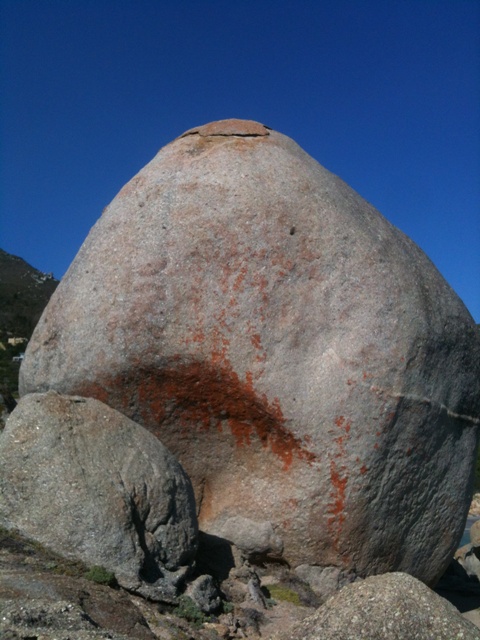
Some of the rock formations here in the southern Cape are remarkable. As Dean Perini points out in his Pathways of the Sun, many of them have been “enhanced” by the Koi-Koi and San people indigenous to this area. The enhancements (for instance, sharpening features in rocks which resemble human faces) serve the same purpose as the completely human fabrications in places like Tikal, Stone Henge, and (perhaps) Easter Island.  They position the movement of the sun, moon, stars, and planets to keep track of equinoxes and solstices. All of those heavenly bodies and seasons influence our bodies (70% water) as surely as they do the ocean tides and the seasons. So it was important to the Koi-Koi and San to mark the precise moments of the annual celestial events for purposes of celebrations, rituals, and feasts.

We’re privileged here in Llandudno to bask in the presence of the great “Mother Rock,” which like so many other mountains, rocks, sacred wells and springs in this area exudes extraordinary cleansing energy. Peggy and I often make our evening meditation before this Rock, and on occasion in a nearby sacred cave.

Sacred Cave
Mother Rock

Yes, the human story began here 300,000 to 500,000 years ago. In the presence of ocean, sacred caves, and holy rocks, we’re attempting to reconnect with the roots of it all and with the animals and ancient peoples who in their harmony with nature’s processes seem much wiser than we post-moderns are proving to be. What a privilege it is to be in Africa.