Two weeks ago, Rob Kall posted an interview with me on OpEdNews. It centered on my book, The Magic Glasses of Critical Thinking: seeing through alternative fact & fake news. I had great fun doing the show. Here it is.
Category: Personal
Apologies for Not Publishing More Regularly: We’re Moving

I’m sorry for the long gap between my last posting and this one. The truth is, however, that Peggy and I are in the process of moving. We’ve sold our house here in Berea. It’s been our home for the last 25 years, after moving from Buffalo Holler out in nearby Rockcastle County where we lived for about 20 years.
Our destination is Westport Connecticut just down the street from our four grandchildren [Ineva (9 years old), Oscar (7), Orlando (5) and Markandeya (3)], our daughter, Maggie, and our son-in-law, Kerry. We want to be part of our grandchildren’s lives.
So, following graduation ceremonies in a couple of weeks, Peggy will be leaving her post as director of Berea’s Women and Gender Studies Program. She’s made such a wonderful contribution to college life, especially through her very popular “Peanut Butter & Gender” speakers’ program. For years under that rubric, she’s hosted stars like bell hooks, Gloria Steinem, Ana Thomas, Matthew Fox, Winona La Duke, Rosemary Reuther, and Vandana Shiva. The list is long and glorious.
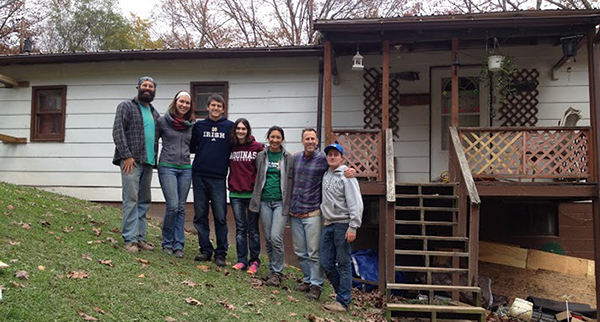
Our new home is one Peggy and I have been lusting after for the 10 years that Maggie and Kerry have been living in Westport. As you can see from the picture above, it’s very pretty with lots of windows and even has a picket fence around it.
Here in Berea, we’ve signed a contract with the buyers and we’ll close a month from tomorrow. That’s the day we must vacate the premises. So, as everyone can imagine, we’re gradually packing our belongings as well as making many trips to Goodwill with clothes and things, and to the library with books we regretfully realize we’ll never open again.
So, I guess what I’m announcing here is a little hiatus from regular blog postings. I just have to devote this next month to full-time packing, and to saying goodbye to the friends we’ve made over our 46 years in this lovely college town, where my office was a 12-minute walk from my front door.
I’m sure everyone will understand. I might be able to write sporadically in the meantime. So please feel free to check in now and then. I’ll write more often once we get settled for the summer at our lake house in Michigan. We plan to move into our new home in Westport in September. Once we’re installed there, I’ll resume my regular writing schedule – probably at the beginning of October.
Wish us luck.
Press Release: The Critical Thinking Manual Progressive Teachers Have Been Waiting For: My New Book

Mike Rivage-Seul has just published the book progressive teachers have been waiting for to ground their post-secondary courses on critical thinking. Available on April 17th from Peter Lang Publishing, the book is called The Magic Glasses of Critical Thinking: seeing through alternative fact and fake news.
Rivage-Seul is an emeritus professor of peace and social justice studies at Berea College in Kentucky, where he taught for more than 40 years. He publishes a monthly column in the Lexington Herald-Leader.
His approach to critical thinking – to education itself – should be familiar to progressives. It starts from the position that the purpose of such process is not primarily to interpret the world, but to change it. Therefore, critical thinking and education should not be neutral. It should equip students with the tools they need for social activism.
Magic Glasses summarizes what Rivage-Seul considers the most important insights he gathered over his years of travel and study throughout Europe and especially in the Global South – specifically in Brazil, Nicaragua, Cuba, Costa Rica, Honduras, Mexico, Zimbabwe, South Africa, and India, as well as in Israel-Palestine.
“As you can tell by the title,” Mike says, “The Magic Glasses could hardly be timelier. The concept comes from the great comedian and social activist, Dick Gregory. He spoke of critical thinking as functioning like a set of spectacles. They confer special insight enabling their wearers to see things quite differently from what is considered ‘normal.’
“However, Gregory warns that the glasses come with three rules. The first is that once you put them on, you can never take them off. The second says that once you put them on, you can never see things the way everybody else does, but only as they truly are. And the third is that you can never force anyone else to wear them.”
In other words, Rivage-Seul’s book might be a dangerous read. For instance, he echoes Global South scholars by seeing sinister intent in the Declaration of Independence’s celebrated statement that “All men are created equal.” With those same scholars, he refers to World War II as the “Second Inter-Capitalist War,” and sees the United States as currently occupying the same global position that Adolph Hitler aspired to attain – with similar effect.
“I’ve been wearing Gregory’s magic glasses for years,” Mike says. “They’ve shaped my all my teaching and have often got students mad at me – at least at first. And you should read some of the comments my newspaper columns get! It’s all because I constantly apply the ten rules for critical thinking that my book explains.”
Those rules include: (1) Reject Neutrality, (2) Reflect Systemically, (3) Select Market (as the root of political differences), (4) Suspect Ideology, (5) Respect History, (6) Inspect Scientifically, (7) Connect with Your Deepest Self, (8) Quadra-sect Violence, (9) Detect Silences, and (10) Collect Conclusions.
As a result of employing those guidelines, Rivage-Seul understands U.S. history, terrorism, the renewed nuclear arms race, world hunger, trade agreements, immigration, Black Lives Matter, and other hot button issues in ways that end up being 180 degrees opposed to the mainstream.
“I’m in good company though,” Mike observes. “I’m trying to channel the spirit of the world’s great critical thinkers. Think about it. None – not Jesus, the Buddha, not Gandhi, Martin Luther King, Dorothy Day, Thomas Merton, or Helen Keller – was neutral. They weren’t worried about ‘balance’ or offending anyone. For them, speaking truth to power and living with the results were all that mattered.
“I’m hoping that my book falls into that tradition.”
That social activist tradition is indeed developed in The Magic Glasses. And each point is illustrated with movie clips from films such as Traffic, The Post, Avatar, Sausage Party, The Distinguished Gentleman, Good Will Hunting, American Sniper, Captain Phillips, American History X, War Dogs, Bulworth, and even with the Broadway musical, Hamilton.
In sum, The Magic Glasses of Critical Thinking represents and attempt to supply secondary and post-secondary teachers with a complete syllabus for a course on critical thinking that will help students radically revision their world in ways that inevitably challenge all of their preconceptions.
As such, Rivage-Seul’s book on critical thinking is not only the one progressives have been waiting for, it’s a page-turner as well. As Rob Kall, the editor-in-chief of OpEdNews puts it in his endorsement:
“I love this book. It’s brilliantly written by a very wise man who’s been serially enriched by spending time with some of the world’s greatest visionaries. And he shares what he learned from his conversations with them. The book is addictively readable. I started to skim the book to see if it was worth putting my time into and found I couldn’t stop reading. Michael Rivage-Seul brings sparkling vivacity to the potentially dry topic of critical thinking. As one who has interviewed hundreds of visionaries, I found this book to offer new perspectives and ways of seeing-which is what building critical thinking skills is all about. This book offers so much more than what its title, at first glance suggests. Have a taste and you, will like me, find yourself wanting to consume all the courses of this delicious meal.”
Captain Fantastic Cleans House Before His Final Journey (Part 3)

This is the 3rd part in my series of reflections on “Captain Fantastic.” The first addressed the film’s theme. The second recalled how Peggy and I attempted to live, like the film’s hero, “off the grid.” This final posting offers my reflections on what’s happened to us over the last 20 years as family considerations have made us compromise.
I’ll be moving on soon.
They say to CT.
But, really, I know
It’s far beyond.
So (as other Swedes put it) I’m ‘death cleaning.’
That means getting rid of
All that stuff which
(Pace, Captain Fantastic, please!)
I’ve managed to accumulate over 77 years
To save my kids the trouble.
What a burden it is!
Books I once labored over and annotated so carefully
And loved and left and forgot
Like my forsaken lovers.
Reduced to inert, mute strangers now
With nothing to say.
Computers and cell phones
And chargers and wires
I don’t even know what they’re for.
Not to mention the clothes and shoes
I haven’t worn for years.
It all cost me (or somebody) thousands.
But now I can’t give it away.
(No one else knows what those wires are for either!)
Then there’s this old house
In Berea, Kentucky
Just seven minutes away
From the place I worked those 40 years.
Where I’m now a stranger
And must show my card to babies
Born when I was sixty
Who guard the shiny gadgets
in the college gym
And ask ‘Mike Who?’
We bought this place 20 years ago.
Painted it twice
Finished the basement
Rented it to students
Bought a lake house in Michigan
And a pontoon Party Boat,
Acquired 2 Volvos (used)
This Apple Watch on my wrist
And more green paper
Than I know what to do with
Along with countless other trinkets.
And now I’m about to leave it all
With little to show.
In the end (and I’m close now)
It all means nothing.
Did it ever?
Surely, you agree.
Once in my early days
I gave no value to such things.
Then, I took literally
The Master’s words (And still do!)
“What does it profit a man
If he gains the whole world,
And loses his soul.”
So, at the age of 14,
I gave it all up
(With joy and such earnestness!)
Left home and family
And for about 20 years
Lived (as a communist, I guess)
Owning very little of what they call ‘mine.’
Wore the same clothes as everyone else.
Ate the same food
Making no choices anywhere
And wanting nothing more
Even gave up women and sex
And the prospect of family.
What freedom then!
And I didn’t even know it.
Meanwhile, I accumulated nothing there
But learned to pray
To think deeply
About things that matter
Ultimately.
To realize that possessions
Are merely dreams
That in the end (like now)
Mean nothing at all.
I hope to take most of that with me
When I move on
And wake up from this dream.
Don’t you?
Captain Fantastic (Part Two): Our Early Attempts to Live off the Grid
(Not a photo of our family. But it reminds me of the way our house in Buffalo Holler looked originally and of how I remember us looking back then.)
This is the second in a three-part series reflecting on the film “Captain Fantastic.” It recalls the years when Peggy and I tried to live off the grid in an Appalachian Holler. I write it in part to remind my children of the reasons for what they sometimes complain about. I’m also hoping it might elicit similar reflections on the part of other readers of this blog.
__________
To begin with, Peggy’s and my aspirations were idealistic like those of Ben and Leslie in Captain Fantastic. When we were first married, the two of us definitely wanted to live off the grid. We had both read E.F. Schumacher’s Small is Beautiful, the Club of Rome’s Limits to Growth, Frances Moore Lappe’s Food First, and Wendell Berry’s The Unsettling of America. We were teaching those books in “Issues and Values,” a wonderful two-semester freshman course on critical thinking at Berea College. Our desire was to walk the walk.
So, in 1980 four years after our marriage, we bought a house shell for $8000 cash in an Appalachian holler. There, everyone was kin. We were “those outsiders” from Berea college.
At times our status as relatively well-off foreigners in a situation of Appalachian rural poverty caused us problems. One morning we awoke to find our car up on blocks and all of its wheels and tires gone. Another day after a heavy snowfall, we discovered that “neighbor boys” had turned our little Subaru on its head. Additionally, our road was unpaved and after heavy rains, the mud prevented us from leaving the holler. (I remember “taking a run” at getting up the hill leading to the main road. Time after time, I’d nearly make it to the top, only to be stalled with spinning wheels just short of the hill’s crest.)
Our phone was the only one in Buffalo Holler, so neighbors would frequently be at our door seeking access.
Despite everything, Peggy and I were determined to acquire the skills necessary to live self-sufficiently. So we learned to roof, plumb, tile, dry wall, dig a well, and to lay and finish wooden flooring. We gathered second-hand barn wood and paneled our walls with it. We gardened and cut logs for our wood-burning stove that was our only source of heat during some of the coldest Kentucky winters either of us can remember. I dug a full basement underneath our house using pick, shovel, and wheelbarrow. It provided us an additional family room, bedroom, office and bathroom. Peggy canned our food. At Christmas we would cut down a pine yule tree from the forest that surrounded us.
We also built a solar addition onto our home’s south-facing end. Its seven long double-paned windows were glass refrigerator doors recycled from a local food store undergoing renovation. Below the windows we placed 10 fifty-gallon drums filled with water to store the heat they gathered from daytime exposure to the sun. (We salvaged the drums from a nearby ice cream factory where they had originally contained chocolate. Each barrel still had an inch or so of syrup covering its bottom. Once carefully removed and frozen that chocolate provided us desserts for the next 2 years!) Mylar solar shades covered our windows at night to keep the heat inside. We also covered the addition’s floor with bricks we had transferred from the torn-down Berea College Sears Building. The bricks would provide additional heat storage for the solar space. One Saturday afternoon we even hosted a group from Appalachian Science in the Public Interest to show off our proud “cutting edge” technology.
Peggy’s and my alternative lifestyle also had us taking our children to live off the grid in other ways. We worked in Brazil for six months during my first sabbatical from Berea. There we learned Portuguese and studied with Paulo Freire. Peggy worked with his literacy team in Sao Paulo’s favelas. Meanwhile, I studied liberation theology with theologians I had been reading for years. We took our kids to revolutionary Nicaragua and later to Cuba. Then we lived in Costa Rica for a year, in Zimbabwe for another 12 months, as well as in South Africa, India, and Mexico for similar periods. So all 3 or our kids learned Spanish as well as studying Shona. During our travels we often lived with local families and always in working class neighborhoods, where our children made fast friends and went to school.
Like the couple in Captain Fantastic, Peggy and I had different ideas about educating our kids. In the film, Leslie had secretly helped Bodevan, their family’s eldest, apply to all the best Ivy League schools, where he was accepted enthusiastically.
When Ben Cash finds out about that, he demands, “Why would you want to go to any of those schools? You already know far more than most of the professors you’d have in those places. And they’d just be preparing you for a lifestyle we all know is bullshit.”
Ben’s words reflected my own attitude. Teaching “Issues and Values” at Berea was helping me see the worth of Appalachian culture, its history, art, music, and simple, close-to-nature lifestyle. The school was committed to social justice for African Americans and to students coming from limited economic circumstances like my own family’s back in Chicago. Wasn’t it fortunate, I thought, that my own three children could have all of that for free?
Peggy’s attitude (like Leslie’s in the film) was wisely different on this score. She fully appreciated all those Berea values we were learning and teaching. However, she also thought that our kids needed to get out of town, where, as high school students, they had already taken so many courses at Berea that they qualified to enter college as sophomores. So Peggy spent a lot of her valuable time taking them to schools that interested them outside of Kentucky. In the end, our daughter Maggie ended up at Wellesley in Boston and at UCLA for her law degree. Brendan went to Lafayette in Pennsylvania and then to Harvard’s Kennedy School. Patrick attended Davidson in North Carolina. All three are extremely grateful to Peggy for that. They’re thankful that my wishes didn’t prevail. In retrospect, I am too. Getting away from home and broadened their horizons.
Still, I remember receiving wonderful urgent phone calls from my daughter at Wellesley. She took several economics courses there. And after class, she’d often phone asking for the “real story” about the way capitalism works, especially in relation to the Third World countries that were such a part of her upbringing. During their college years, I had similar interactions with my sons. To this day, I treasure those calls and conversations.
Similar interactions occur in Captain Fantastic that like mine show the lasting and even overriding benefit of the education Ben’s children received at home. In the end, Bodevan follows his father’s advice and doesn’t go to any of those schools he qualified for. Instead, he goes off to Namibia to gain the social skills he didn’t receive within his family group – but in Africa, rather than New England. His 8-year-old sister sends him off with the words, “Stick it to the Man.” Bodevan replies, “Power to the People.”
Those (resistance and commitment to radical democracy) are the attitudes we’ll need to survive in a world threatened by what in 1974 Robert Heilbroner direly described as “the human prospect.” That prospect threatened by climate chaos and the proliferation of nuclear weapons is what shaped my 40 years of teaching at Berea College.
Next week: I share my retirement experience in the light of Captain Fantastic. I wonder about the compromises I’ve made – not unlike Ben Cash’s accommodations to the outside world. Have I gone too far?
Captain Fantastic: Can We Successfully Live off the Grid? (Part One)

This is the first in a series of 3 posts inspired by Captain Fantastic. Watching the film at the beginning of this new year has caused me to reconsider the direction of my life whose circumstances during retirement have led me to gradually drift away from the simple living ideals that Peggy and I embraced so fervently at the beginning of our life together more than forty years ago. This first posting will introduce the topic and the Captain Fantastic plot. I highly recommend the film. It is extraordinarily thoughtful.
__________
Over the holidays, one of my adult children persuaded me to watch Captain Fantastic. That’s the critically acclaimed film by Matt Ross about a family committed to the back-to-nature lifestyle Peggy and I aspired to at the beginning of our marriage more than 40 years ago. Captain Fantastic stars Viggo Mortensen, who in 2015 received an Academy Award nomination as best actor for his role as the title-character.
My son Patrick (now 31) recommended the film as something I’d love. He said he saw similarities between what’s depicted in the movie and the somewhat regretful experiences of his own childhood with Peggy and me. “You’ll love the film’s father,” Patrick observed wryly. “He’s a lot like you.”
After seeing Captain Fantastic, I could see Pat’s point. The main character, Ben Cash, was a mixed bag. On the one hand, he was indeed inspiring in his commitment to living off the grid. And he was such a good teacher – so open in answering his kids questions and urging them to think for themselves.
On the other hand, Cash’s shortcomings were all too familiar. Like me, he was driven by his clear (not to say rigid) concepts about the way the world works. He was convinced that capitalism is the root of the world’s problems. Socialism offers better prospects. The U.S. medical system is not to be trusted. Ditto for mainstream education. Organized religion is bogus. And holidays like Christmas are not worth celebrating. I could identify with all of that.
But the film offered much more than a nostalgic walk down memory lane. It was more than an opportunity to reflect on my own approach to life with its quirks and shortcomings. It was even more than a demonstration that another world closer to nature is possible. Instead, Captain Fantastic principally represented a reminder of the continued relevancy of the counter-cultural life and education Peggy and I tried to offer our children, even though they’ve largely rejected its intellectual underpinnings. Most importantly of all, it made me see that my present highly consumptive way of life veers sharply from the ideals I once embraced.
Let me show what I mean by first considering the film’s story. Then I’ll share Peggy’s and my attempts to replicate something like it with our own children. Finally, allow me to draw some rather urgent postmortem conclusions about Captain Fantastic’s continued relevancy and challenge to the lifestyle in which I find myself immersed.
Captain Fantastic is about Ben Cash and his family of 4 girls and 2 boys ranging in age from 8 to 18. For 10 years, the 7 of them, along with Leslie, Ben’s wife, had set up camp in the wilds of Washington State where they lived in a large tepee. Over that time, the children had learned the intricacies of foraging, hunting, and growing their own food. They are all homeschooled in philosophy, political science, half a dozen languages, and in the critical analysis of Noam Chomsky. In fact, instead of Christmas, they celebrated Chomsky’s birthday each December.
Captain Fantastic tunes into the Cash tribe’s saga at a moment of extreme crisis. The family’s mom, Leslie, has just committed suicide. She had earlier experienced a psychological breakdown and had been institutionalized. And Ben is blamed for Leslie’s death by her father and eventually by his own children. At one point, Ben’s youngest son shouts at his father, “You killed mom!”
Turns out that Ben’s wife (who doesn’t appear in the film) was no longer fully on board with Ben’s back-to-nature project. Increasingly, the couple had disagreed about its continuation. Apparently, all the resulting tension led to Leslie’s breakdown and eventual suicide. Eventually, Leslie’s wealthy father files a child-abuse lawsuit against his son-in-law in order to gain custody of his children with the intention of returning them to normal life.
None of this means that Leslie had wanted to return to daddy and his way of life. As a committed Buddhist, her final desire was to be cremated and have her ashes flushed down the toilet. This, her Catholic father could not understand, much less accept. So he arranged a traditional Catholic funeral presided over by a priest who barely knew Leslie’s name.
This proves unacceptable to Ben and his children. So they resolve to “rescue” their wife/mother, cremate her body, and flush the ashes. The rest of the film depicts their accomplishment of this feat. It is also about what leads Ben to tone down (but not much) his radicalism and allow his children to attend a mainstream school to help with their socialization.
I can see how all of that reminded Patrick of his life with Peggy and me. The next posting in this series will briefly review that life to set up a contrast and evaluation of the way I’m now living.
Feminists as Our Natural Leaders: Reflections on the 40th Annual Meeting of the National Women’s Studies Association

Last weekend I attended the 40th annual conference of the National Women’s Studies Association (NWSA) in Baltimore, Maryland. I accompanied my wife, Peggy, who directs the Women and Gender Studies Program (WGS) at Berea College, where I taught for 40 years (1974-2014). Peggy was there with a colleague and seven of her WGS students. The gathering’s theme was “Feminist scholars and activists engage the movement for Black Lives.”
Given the theme of the conference, I suppose I shouldn’t have been surprised by the diversity of attendees. Nonetheless, I was astounded by what I saw. It seemed to me that 50% or more of the attendees were women of color (WOC).
From the opening plenary, the atmosphere was absolutely electric and energizing.
Even more, I was pleasantly surprised by the radical nature of everything I observed there. It put me to shame in terms of revealing my own timidity that restrains me from being more outspoken and calling things by their real names in this time of unprecedented crisis. By comparison with what I heard and observed in Baltimore, my own writing, speaking, and teaching are far too understated. As one of the presenters I heard put it, “civility is overrated.” The times cry out for thoughtful radicalism.
“Radical” in this case means discourse attempting to uncover the roots of our world’s problems identified by NWSA speakers as the white supremacist, imperialist, capitalist patriarchy. On feminist analysis, that’s what’s behind today’s resurgent fascism with its racism, misogyny, cult of denial, massive incarceration, voter suppression, police violence, gun worship, daily mass shootings, universal surveillance, union-busting, climate-change reversals, threats of nuclear war, pay disparities between men and women, and overriding fear of immigrants, Muslims, and the heterogendered. In the language of NWSA presenters, the problems are “intersectional” – the results of inter-related elements of a multi-faceted oppressive system with patriarchy as its taproot.
Put otherwise, women aren’t merely victims of some monolithic patriarchy; they are oppressed by misogyny, racism, ageism, and prejudice against queers, immigrants, the aged, and the differently abled. Resistance to such oppression is signaled today by coalescing movements that include black queer feminists, domestic workers, home health care providers, restaurant employees, and agricultural laborers.
With such inclusivity, the discourse I heard at the NWSA was far from the blah, blah spouted by the overwhelmingly conservative, white, elderly and protofascist males who continue to run our country. Unlike the self-described “bad ass organizers” in Baltimore, the academic representatives of the predominantly male political class typically cultivate silence and equivocation in the service of their own professional advancement disguised as intellectual respectability.
For their parts, the NWSA women were far more incisive. That’s because their scholarship is rooted in their insurgent activism. Embracing the role of “outsiders within” (the academic establishment), the goal of feminist hell-raising and scholarship is a just distribution of society’s benefits determined not by what humans can work for or achieve, but by what everybody needs. Their focus is not so much piercing the infamous glass ceiling that prevents the well-educated and wealthy from advancing within corporate hierarchies, but protecting and repairing the floor boards splintering and eroding beneath the very feet of women at the bottom of neoliberal constructions.
Take, for instance, the opening plenary presentation. It centralized a conversation between Angela Davis and Alicia Garza. Davis, of course, is the iconic and by now septuagenarian Black Panther scholar and activist who once led the Communist Party USA (CPUSA). Her current efforts are directed towards abolitionism – the uprooting of prisons, policing, and education as we know them. Alicia Garza is one of the three founders of the Black Lives Matter Movement (BLM). A widely published activist, she currently directs special projects for the National Domestic Workers Alliance. (When, at the beginning of her remarks, Garza asked for any who had participated in BLM demonstrations to stand, a third of the audience, it seemed, got to its feet and received a warmly appreciative ovation.)
Here are some of the (paraphrased) key thoughts Davis (AD) and Garza (AG) shared with us on opening night:
- AD: At this otherwise depressing moment in history, I’m encouraged by the activism evoked by the ongoing right-wing revolution. Left-wing revolution is once again in the air. With the Boycott, Divest & Sanction Movement (BDS), Palestinian liberation is now openly part of the agenda. Together we stand on the left, but on the right side of history.
- AG: Revolution is a process, not a destination. It is the transformation of how power operates – a passage from punitive, predatory, power-over models to cooperative, interdependent ways of operating. Revolution in this sense expands the notion of “our loved ones.”
- AD: The world does not revolve around the United States. The struggle is global. We must learn some humility and be willing to sit at the feet of liberation movements in the Global South – for instance, from the black feminist movements of Brazil.
- AG: Black Lives Matter is not an instance of “identity politics,” as the FBI alleges by inventing the category “black identity extremists.” The FBI category represents just one more official attempt to dismantle BLM. The underlying assumption of its phrasing is that we’re not all in relationship with each other and with over-arching institutions. On the contrary, identity is shaped by capitalism, imperialism, and patriarchy. It’s not that BLM cares only about its particular group. It’s that BLM realizes that when black people get free, everyone gets free.
- AG: Feminism is about challenging normativities.
- AD: We need art, because we can’t say it all.
Women like Angela Davis and Alicia Garza are inspiring. They evince much more courage than most males I know – or, let me say it clearly, much more than me! Once they enter the realm of critical consciousness, feminists become our natural leaders. Somehow they seem less attached to the cult of personality. They know how to cooperate. This isn’t the movement of Jesse Jackson, Al Sharpton, or John Lewis. Its leadership is more collective than that – more empowering and inclusive. Their range of issues are more, well, “intersectional.”
That’s the hope I found at the 40th anniversary meeting of the National Women’s Studies Association meeting. I’m glad I went.
A Diana Ross Concert Sparks Memories of the African-American Rebellion of 1967

Last week, my wife, Peggy, and I attended a Diana Ross concert at the Interlochen Music Camp here in Michigan, where we’re spending our summer. The sold-out performance was spectacular as the 73 year-old Ms. Ross reprised hits like “Ain’t No Mountain High Enough,” “Baby Love,” and “Stop, in the Name of Love.”
The nearly all-white crowd of Baby Boomers spent most of the 90-minute show on its feet applauding, dancing and singing along with the still-beautiful diva who was supported by a remarkable band and a quartet of dynamic back-up singers.
It all took us back to the ‘60s and ‘70s before our hair turned white.
It also made some of us recall an era before Ms. Ross’ hometown, Detroit, became a byword for urban decay reminiscent of the Third World. Back then, it was a vital industrial and cultural center, the birthplace not only of The Supremes’ Motown Sound, but of the Black Panthers, and the focus of the northern phase of the Civil Rights Movement that changed our nation forever.
That phase had protestors responding to poverty and police brutality more violently than our domesticated history would have us recall. Exactly 50 years ago in 1967, it turned Detroit into a flashpoint of the Great Uprising of the African American working class, whose effects are still being felt today.
The rebellion (portrayed in the mainstream press as “riots”) began in Newark, but quickly spread to the Motor City and almost 400 U.S. urban centers. In fact, between 1960 and 1971 there were nearly 1000 such uprisings across the country.
In response the government called out the National Guard. While cities burned, troops with bayonets fixed marched on protestors; tanks rumbled down ghetto streets.
That sort of response to such widespread unrest indicates a nascent civil rights revolution, not mere riots.
The bi-partisan Kerner Commission underscored that point, when it examined the rebellion’s causes. Its Report blamed the uprisings not on the protestors, but on white racism. It called for the equivalent of a huge Marshall Plan to counter the effects of the police brutality and deep poverty that, it said, had sparked the violence.
However, instead of massive investment in public schools, housing, and social programs, the “riots” in Detroit and elsewhere evoked a counter-revolution that we experience still today.
The reaction began with the election of Richard Nixon in 1968. His Southern Strategy took advantage of the very racism denounced by the Kerner Report. Ironically, Nixon’s approach used religion to appeal to the anti-black sentiments of white Christian Evangelicals especially in the nation’s South. It transformed the Republican Party into the out-of-control reactionary force it now represents under Donald Trump. It eventually gave rise to stop-and-frisk policing, to the massive incarceration of blacks and Latinos, and to the widespread execution of unarmed black men and women at the hands of increasingly militarized urban police forces.
Additionally, the counter revolution saw defunding of public schools, public housing, and social programs. It witnessed the transformation of the War on Poverty into the War on Crime. It entailed capitalism’s abandonment of the working class, as it off-shored jobs vital to the economies of cities like Detroit, Newark, and Camden.
Finally, the right wing reaction to black rebellion suspended democracy itself in Detroit, as an unelected Emergency Manager overrode community welfare in favor of austerity measures that further penalized the poor. And as economist, Richard Wolff has indicated, the resultant and much ballyhooed “Detroit Renaissance” amounted to nothing more than gentrification on steroids, where billionaires are subsidized to build glitzy high-rises and restaurants. Meanwhile on the periphery of apparent renewal, 40% of the population remains mired in poverty in a state where 48% of African-American children are poor.
What a contrast: the splendor and betrayed promise of Miss Ross and the Civil Rights Movement, on the one hand, and the disintegration of the counter-revolutionary Detroit (and America) on the other!
It’s time to reject the latter in all its brutality and to re-embrace the former with all the enthusiasm of those Boomers at Interlochen last week.
Without uttering a word about politics, Ms. Ross reminds us that we can do better. The Kerner Report tells us how.
Aging Miraculously: Life’s too Short to Give Up on Faith & Activism!

I’m currently enrolled in an extremely thoughtful on-line course about aging led by the great spiritual teacher, Marianne Williamson. The course is called “Aging Miraculously.”
As I approach my 77th birthday, Marianne is stimulating me to rethink this Third Act of my life. Her course is making me less willing to “retire” from it all as one mistakenly identified with this rapidly changing body. I’m more anxious to “re-fire” the spirit I truly am – the Self that never ages. I’m realizing that the time I have left on earth is far too short for me to surrender to the life of an elderly spectator.
Such awareness was reinforced last night during a conversation with five dear friends of mine. The youngest pair among us were in their mid-60s; the rest of us were in our late 70s and early 80s. (Even writing those words frightens me!)
In any case, there we were reviewing the ills of the world:
- Trump
- The gradual disappearance of democracy
- Its replacement with plutocracy and authoritarianism
- Class warfare: the unending wars of the world’s richest (the U.S. the E.U., Israel, Saudi Arabia) against the planet’s most impoverished (e.g. in Palestine, Somalia, Yemen, Afghanistan, Iraq, Syria. . .)
- Terrorism
The question of faith came up and its power to change all of that.
Now, mind you, all of us in the conversation identified ourselves as followers of Jesus of Nazareth. Nevertheless, my friends (none of them taking Marianne’s course) seemed convinced that faith has no power to alter the problems we were busy rehearsing.
Selfish human nature reigns supreme, one friend insisted. It’s unredeemable. So nothing can ever really change – except for the worse. What we do in church is meaningless as far as engagement with the world is concerned. No one really understands any of it anyway. But that’s the best we can do. It’s naïve and a waste of time and energy to think otherwise. We must settle for the mediocre.
And, in any case, we’re all old! So all that’s left for us is to finish out the few years we have left with our low expectations intact – just enjoying the moment and (cocktails in hand) being happy. Our work is over. God expects no more from us. The world’s problems are no longer ours. They belong to our children. And good luck to them with that!
With Marianne’s instruction in mind, I wanted to shout: “Stop, stop! Cancel! I don’t want to hear that! Precisely because I’m a community elder, I have no time left for such small-time thinking and pessimism.
“In fact, it’s all an insult to God. We’re talking about faith here. – about the power of God and of God’s Word to change the world and its consciousness that condemns us, our children, our grandchildren, and the very planet to destruction. Don’t you see that despite the faith we claim, we’re denying that power? We’re arrogantly claiming that we and the world’s thinking and technology somehow have more clout than God himself – that the Almighty stands impotent before the likes of The Donald, Mad Dog Mattis, our computers, robots – and desperate fears!
“I refuse to believe that. Please stop! Cancel!
“And besides: the power of faith to change the world has been undeniably demonstrated. It’s just that as successfully propagandized, relatively comfortable white “Americans” we’ve bought into the “official story” as narrated on Fox News. It wants us to believe that it’s all hopeless.
“We’ve fallen into their trap!
“However, the fact is that the world has already been changed dramatically by faith-in-action. And for more than 60 years, it’s scared the hell out of the fearful little people at the top. Since the Civil Rights Movement (beginning with Brown in 1954), they’ve been desperate to cram that genie of faith-inspired human liberation back into its bottle. But it simply won’t fit.
“Since Vatican II (1962-’65) and the emergence of liberation theology at Medellin (1968), backward church authorities (like Paul II and Benedict XVI) have been doing the same thing – with the same result. The genie is loose forever. Thank God.
“I’m referring to the undeniable fact that the Civil Rights Movement and liberation theology have changed the world. Without them, you can’t explain Black Lives Matter or the pink tide that has swept Latin America in the past 20 years. You can’t explain the Zapatistas in Mexico, the Bolivarian Revolution of Hugo Chavez, Standing Rock in the Dakotas, the revival of the women’s liberation movement, or LGBTQ activism.
“Without recognizing the power of faith to change the world, you can’t explain movements for independence in Palestine and throughout the Islamic world. Face it: what’s happening there is intimately involved with faith!
“And it is precisely those movements that have given birth to a counter-revolution waged by the fearful little people who pretend to lead us. Don’t be misled: the right wing co-optation of faith has not arisen spontaneously from selfish human nature. Instead, it was part of the well-funded Nixon Southern Strategy to distort Christian faith to counter a growing black power that faith itself had inspired among African Americans everywhere. All of that eventually resulted in the Tea Party and the control of the GOP by Christian conservatives.
“Moreover, fostering and bankrolling evangelicals throughout Latin America (and here at home) was part of Reagan’s response to liberation theology. Already in 1969, Nelson Rockefeller had identified it as a danger to national security. Similarly, the rise of ISIS and Islamic fundamentalism has been nourished by counter-revolutionary forces in Saudi Arabia and the United States. It was Zbigniew Brzezinski who originally assured fighters in Afghanistan that their resistance to Russia had Allah on their side.
“As community elders, we should know all of that. We’ve lived through it. We are products of the hope-filled ‘60s. More importantly, the Catholics among us are products of Vatican II and liberation theology and of the unlimited horizons of faith those movements opened. As a result, we have experience, knowledge, and (hopefully) wisdom unavailable to our children, grandchildren, and to the young in general.
“Keeping those memories and hopes alive represent our specific contributions to saving the world. But time is running out. To retire now without passionately sharing what we’ve learned is not just irresponsible. It deprives us of the joy that comes from fulfilling our very life’s purpose.
“What’s left of this particular incarnation is too short for wasting it on despair and surrender. It’s too short to live as though we are primarily aged bodies rather than the ever-youthful, experienced, informed, and wise Selves that God has created.
“It’s time to get on with Act Three and to finish the performance with a flourish and deep bow.”
Cosmic-Centrism: South Africa’s a Good Place to Start (15th in a series on critical thinking)

In this series, I’ve been tracing my own growth in terms of Ken Wilber’s stages of egocentrism, ethnocentrism, world-centrism, and cosmic-centrism. I’ve been arguing that each stage has its own “alternative facts.” What I believed to be factual as a child, I no longer accept — in any field, faith included. The highest stages of critical thinking are achieved, I believe, by those who accept the alternative facts of mystics and sages across the globe. Their facts receive virtually no recognition from the world at large. Yet, they are truest of all.
The studies and travel I’ve recalled so far in this series had taken me from Chicago and various places in the United States to Europe where I spent five years traveling widely. Then I moved to Appalachia, and from there journeyed to Brazil, Nicaragua, Costa Rica, Guatemala, Cuba, and Zimbabwe. Each step of the way, my awareness expanded. By my 50s, I had pretty much gone beyond ethnocentrism.
Then by 1997 (at the age of 57), I gingerly entered the next phase of Wilber’s growth hierarchy, cosmic-centrism. The door opened that Christmas, when my wife, Peggy, gave me the gift of three books by an Indian teacher of meditation, Eknath Easwaran.
The most important of the three was simply entitled Meditation. The book explained how to meditate and outlined Easwaran’s “Eight Point Program” for spiritual transformation. The points included (1) meditation, (2) spiritual reading, (3) repetition of a mantram, (4) slowing down, (5) one-pointed attention, (6) training of the senses, (7) putting the needs of others first, and (8) association with others on the same path.
As a former priest, I was familiar with such spirituality. After being introduced to meditation during my “spiritual year” in 1960, I meditated every day for the next dozen years or so. Then I stopped. I thought I would never go back.
But after reading Meditation, I decided to perform the experiment Easwaran recommends there. He challenged his readers to try the eight-point program for a month. He said, if no important changes occur in your life as a result, drop the practice. But if significant personal transformation happens, that’s another story.
Suffice it to say that I tried for a month, and now nearly 20 years later, I’m able to report that I’ve never missed a day of meditation. Soon I was meditating twice a day. In short, I had been re-introduced into spiritual practice, but this time under the guidance of a Hindu. However, Easwaran insisted that his recommended practices had nothing to do with switching one’s religion or even with adopting any religion at all.
In other words, meditation had introduced me into the realm of mysticism common to Jews, Christians, Buddhists, Muslim Sufis, and subscribers to other faiths.
Easwaran described mysticism, wherever it appears, as founded on the following convictions: (1) there is a divine spark resident in the heart of every human being, (2) that spark can be realized, i.e. made real in one’s life, (3) in fact it is the purpose of life to do so, (4) those who recognize the divine spark within them inevitably see it in every other human being and in all of creation, and (5) they act accordingly.
Those are the principles of cosmic-centrism.
South Africa
In 2012, during my wife’s sabbatical in Cape Town, South Africa, my eyes started opening to the divine in nature – especially in the ancient rock formations in the southern Cape. As Dean Perini points out in his Pathways of the Sun, many of them have been “enhanced” by the Koi-Koi and San people indigenous to this area. The enhancements (for instance, sharpening features in rocks which resemble human faces) serve the same purpose as the completely human fabrications in places like Tikal, Stonehenge, and (perhaps) Easter Island. They position the movement of the sun, moon, stars, and planets to keep track of equinoxes and solstices. All of those heavenly bodies and seasons influence our own bodies (70% water) as surely as they do the ocean tides and the seasons. So it was important to the Koi-Koi and San to mark the precise moments of the annual celestial events for purposes of celebrations, rituals, and feasts.
Near Cape Town, we lived in Llandudno near the location’s great “Mother Rock.” Like so many other mountains, rocks, sacred wells and springs in that area, it exuded extraordinary cleansing energy. My wife and I often made our evening meditation before that Rock, and on occasion in a nearby sacred cave.
They say that the human story began in South Africa 300,000 to 500,000 years ago. So in the presence of ocean, sacred caves, and holy rocks, we attempted to reconnect with the roots of it all and with the animals and ancient peoples who in their harmony with nature’s processes seem much wiser than we post-moderns are proving to be.
We were entering cosmic space, where the principle of the unity of all creation shapes critical thinking.
(Next week: Learning from spiritual masters in India)
 About Things That Matter