Put the Brakes on the 5G Revolution Before It’s Too Late

Over the last year, since we’ve moved to Westport, CT, I’ve been an active member in a group of retired men. It’s somehow associated with the YMCA and is catchily called “The Ys Men.” Most of the members are former CEOs, lawyers, artists, scientists, academicians, small businessmen, local politicians, and otherwise smart people and community leaders. As such, they represent the epitome of community wise men.

The group has a membership of over 400. Over 200 of them show up for weekly Thursday morning meetings, where we enjoy coffee, donuts, time to meet and greet, and invariably have outstanding speakers. The Ys Men also sponsor many activities including golf, a book club, tennis, bocce, pickle ball, sailing, music appreciation (jazz and classical) and outings to restaurants, theaters, museums, and sporting events. It’s great fun.

Since joining, I’ve been part of a Current Events Discussion Group that meets every other Monday from 8:30 a.m. to 9:45. Usually about 50 men show up. We’ve unpacked issues like the war in Syria, China’s Belt and Road initiative, France’s Yellow Vest movement, and developments in India and Turkey. I always try to contribute to the discussion. At the end of each meeting, participants suggest and vote on the topic for the gathering to follow.

Last week, I proposed that for the November 18th meeting, we discuss a film I had recently seen “5G Apocalypse: Extinction Event.” And my motion carried. So, in less than two weeks, we’ll discuss what I consider one of the most disturbing documentaries I’ve ever come across. You can access it here. What follows is the result of viewing the film several times and reading related material. It’s made me skeptical about the 5G rollout.

The Film Itself

“5G Apocalypse: Extinction Event” addresses the advent of the Fifth Generation (5G) of cell phone technology, which it portrays not only as a severe health threat, but as a menace to our freedom as citizens of a constitutional democracy.

The documentary actually makes three arguments. The first is that 5G technology even as presented by industry and government represents a severe threat to human and environmental health. The second is that those same representations are false; 5G technology emits not only supposedly harmless radio waves, but undeniably harmful radar and microwaves far beyond acceptable levels. The documentary’s third argument is that such emissions secretly generated from s.m.a.r.t. products are ultimately weaponized for purposes of crowd-control – to track people’s movements and subdue them in case of insurrection.

In developing those points, “Extinction Event” presents on the one hand the pro-5G testimony of Federal Communications Commission chairperson, Tom Wheeler, his successor, Ajit Pai, as well as other spokespersons from corporations such as Verizon and Motorola. On the other hand, it offers damning critique from a long array of scientists, military personnel, investigative journalists, politicians, and activists calling attention to the extreme dangers of 5G technology.

The Apparent Debate

As presented in the film, the proponents of the new technology stand united in fast tracking its implementation. We are in a race, they argue, with China, India, and the European Union for getting on top of this latest communications phenomenon. If our competitors (especially Chinese) prevail, it will mean we have ceded to foreigners the capacity to dominate the globe not only economically, but politically.

However, if successful with their proposed rush to market, Americans instead of the Chinese, Europeans, Indians or Russians will emerge in the dominant position just referenced. But, according to Wheeler, Pai and industry spokespersons, success hinges on the government suspending its regulatory power and upon cutting through “red tape” that would otherwise hinder the new technology’s rollout. Here “red tape” refers to delays caused by human and environmental impact studies.

In other words, industry leaders’ haste to secure competitive advantage rules out any government oversight as well as public debate about health and surveillance implications of 5G. One advocate even suggests suspension of the Tenth Amendment of the U.S. Constitution, which assigns all (regulatory) powers to the states or people unless expressly delegated to the Federal Government.

In exchange for such laissez-faire measures, industry representatives promise a utopian future of high-speed internet, enhanced global connections – and billions of dollars in profit for the communications giants.

By way of contrast, critics of the new technology warn of an impending apocalypse. Hundreds of peer-reviewed studies, they say, indicate that 5G technology will:

  • Install cell towers and antennas at the rate of 250 per square mile exposing every inch of the earth to harmful radiation 100 times that of current exposure
  • Cause cellular stress, increased risk of cancer, genetic damage, reproductive issues, memory loss, and Alzheimer’s syndrome
  • Threaten to kill pollinators such as bees and to render the earth’s very soil infertile
  • Change the migratory patterns of birds
  • Make weather predictions more difficult
  • Dwarf the threat to human health represented by tobacco and cigarettes

Of course, the cigarette analogy recalls for 5G resisters the power of harmful industries to hire and mobilize scientists, academicians and the mainstream media to advance “alternative facts” contradicting the alleged consensus of their counterparts. In the case of the 5G controversy, critics point out, such dissenting studies generally appear in the mainstream media alongside ads sponsored by Verizon, AT&T, and other phone giants with vested interests not only in this new technology, but in selling it to an unsuspecting public.

For instance, in May of this year, The New York Times published an article by William Broad entitled “Your 5G Phone Won’t Hurt You but Russia Wants You to Think Otherwise.” As its title indicates, the piece advanced a theory that 5G concerns are part of a Russian plot to secure advantage for their version of 5G technology in the global marketplace. Accordingly, Broad attacked RT America, the U.S-based TV news channel funded by the Russian government, as though it were the major source raising concerns about the dangers of 5G.

The Times report goes on to identify critics of 5G as “a few marginal opponents” who mistakenly identify radio waves as “radiations.” According to Broad, opposition criticism does not appear in reputable journals, but in “little-known reports, publications and self-published tracts, at times with copious notes of dubious significance.”

Broad, however, does not mention the contrary position divulged in The Scientific American. Much less does he reference the longest and most thorough study of the question performed by the National Toxicology Program which is run by the U.S. Department of Health and Human Services. After two years of investigation, the latter concluded that there is “some evidence” of adverse health effects caused by 2G and 3G cell phones. Presumably, 5G technology would provide further evidence.

Ignoring all of that, Broad argues that radio waves used in cell phones are relatively harmless. This is because they lie at the end of the electromagnetic spectrum directly opposite the harmful rays, such as ultraviolet and x-rays, which in high doses can indeed damage DNA and cause cancer.

In response, 5G critics argue that Broad’s rationale too easily dismisses not only serious studies, but also the undeniable fact that radio waves do in fact represent “radiation.” And while such emissions do come from radio waves at the more benign end of the electromagnetic spectrum, they are not without negative health effects – as already noted by Rudolf Steiner in 1924. Moreover, as emitted from portable phones and ubiquitous antennae, cell phone radiation takes place very close to phone users and is backed up by powerful micro and macro towers. As a result, there is a lot more cumulative radiation.

In fact, according to “5G Apocalypse,” international standards for acceptable levels of cell phone radiation are already in place. Cell phones need 0.2 billionths of a microwatt per centimeter squared to operate at all. At 0.05 microwatts per centimeter squared, psychologists have noted behavioral problems in children aged 8-17. The level of 0.1 already enters an area of “extreme concern.” At 4.0 billionths of a microwatt, cell phone users exhibit difficulties with memory and learning. Cellular DNA damage occurs at 6.0. Smart meters reach a level of 7.93 billionths of a microwatt per centimeter squared.

With all of this in mind, Switzerland, Luxemburg, and Lichtenstein cap permissible levels at 9.5. The level is 10 in China, Poland, and Russia. Nonetheless, the United States and Canada allow levels of 600-1000 microwatts per centimeter squared – i.e. tens of thousands of times higher than those known to adversely affect human health.      

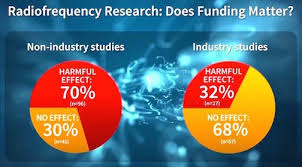
In the end, Broad’s argument seems vulnerable to accusations of having selected its data from those industry studies whose conclusions (as noted in “5G Apocalypse”) differ sharply from non-industry research regarding the harmful effects of radio-frequency emissions. As pictured below, seventy percent of non-industry studies find radio-frequency radiation harmful. In contrast, 68% of industry studies find it harmless.       

/var/folders/h8/h2q627nn53d1t08030blvf140000gn/T/com.microsoft.Word/Content.MSO/3A855E5D.tmp

The Hidden Debate

But that’s not the end of the debate outlined in “5G Apocalypse.” Far from it. Instead, there’s another dimension that is largely ignored in the mainstream media. It involves deliberate falsification of the nature of radiofrequency emissions from the proposed system along with sinister intent on the part of government authorities.

To begin with, the 5G radiations in question do not issue merely from relatively benign radio waves (which, as indicated above have their own problems). They also include radar and intense microwaves expressly intended for military operations against rebellious civilians.   

In fact, the system’s technology is directly modeled on military microwave counterparts originally intended for crowd control and psychological warfare. As portrayed in “Extinction Event,” 5G technology enables all police operations requiring an electromagnetic base to be executed with greatly increased efficiency. This includes constant surveillance and crowd dispersal. The video even goes so far as to describe 5G as a weapons system masquerading as a modern efficiency technology.

As such, the film argues, 5G fits neatly into the military-industrial-complex (MIC) model that Dwight Eisenhower warned against as he left office in 1961. It embodies omnipresent weapon capability available to the MIC minority to control an otherwise unmanageable majority. The technology’s omnipresence promises to send signals from stoves, refrigerators, heating units, microwave ovens, computers and printers. In other words, signals will emanate from any s.m.a.r.t. device. According to “Extinction Event,” the latter acronym should stand for “secret military armament in residence technologies.”

Conclusion

So, how are we to interpret the 5G controversy? Are the opponents of the new technology simply Luddites who reflexively oppose all technological advance? Are they conspiracy theorists in tin foil hats? The telecommunications industry and mainstream media would have us think so.

Despite their efforts however, here’s what we know for certain:

  • U.S. Government proponents of 5G technology (like the Trump administration’s FCC chairperson, Ajit Pai) have deep ties to telecommunications industry.
  • In view of its practice of incessant prevarications, the Trump administration has negative credibility.
  • Similarly, corporate America has been frequently caught in lies and cover-ups that endanger consumers (e.g. in relation to cigarettes and tobacco, climate change, and automobile safety).
  • For the sake of profit, huge corporations such as IBM, Bayer, Ford Motors, and AIG Insurance have shameful records of supporting the most virulent strain of fascism in Nazi Germany. Historically speaking, they routinely support repressive military regimes and place profits ahead of human freedom, democracy, and welfare.
  • Currently they and their counterparts have millions of dollars at their disposal to fund alternative research and sponsor unlimited articles and advertising to advance their agendas and discredit their critics.
  • Those critics have no such resources.

Besides all of that, we also know for certain that:

  • The improvement of the human condition represented by 5G technology is marginal at best. The present speed of our computers is actually quite adequate to meet human need.
  • “We” the people are not in competition with the Chinese for 5G superiority.
  • Instead, it’s the telecommunications giants whose bottom lines and quest for patents make it imperative for them to win the race for 5G control.
  • No matter who wins that race, 5G technology (if proven safe and beneficial) will eventually arrive for everyone on the planet who can afford it.
  • Enough red flags have been raised by credible scientific studies to justify further human and environmental impact studies by qualified independent researchers.
  • A whole array of cautionary scientists, activists, and political leaders are merely calling for slowing down the rush into an unknown future. In the interests of protecting human health, their grandchildren and the environment, they want further study.

Finally, those expressing caution point out that a safe alternative to 5G technology already exists. It takes the form of publicly financed fiber optics. Such alternative:

  • Buries the main source of harmful radiation
  • Requires very little energy per data packet.
  • Goes only where it is needed
  • As a result, offers a high level of privacy and safety as opposed to more hackable, omnipresent 5G arrangements
  • Is ultra-reliable
  • Moreover, a publicly financed fiber-optic alternative eliminates the market-driven “technological imperative” fueled by an imagined race for patents and profit.
  • In the final analysis, that race is the only reason for accelerating a process in dire need of further study and proper oversight.

In summary, advocates of an accelerated, unregulated 5G rollout make it sound like it’s a national imperative for “us” to beat the Chinese in some race into a promising future that will somehow exclude us if they get there first. However, history and the desire of telecommunication giants to bypass environmental and human impact studies show that they are not really concerned about our lives or those of our children and grandchildren, much less of animals and plants. On the contrary, they care principally about profit and are willing to sacrifice all the rest for a healthy bottom line. The rest of us must face the fact that it’s not “us” but multinational corporations like Verizon, Sprint, AT&T, Motorola, and T-Mobile who need to win their race for patents and billions in profits.

Instead of all this great hurry, it’s better to slow down, do the necessary study, take these momentous decisions out of the hands of profiteers, and look before we leap.  

We Baptize Our New Grandson, Sebastian Nels

Last Sunday, we had yet another baptism in our family — this one of our new grandson, Sebastian Nels. And what a beautiful event it was!

Our daughter, Maggie (Sebastian’s mother) was the MC. Sebastian’s godmothers were outstanding. One, Eden Werring, gave a beautifully sung Jewish blessing; the other, Claudine Maidique read the Gibran classic “On Children.” Rob Silvan, the music minister at our new church here in Connecticut (Talmadge Hill Community Church) led us in singing “Down to the River” (from “O, Brother, Where Art Thou”), “Swimming to the Other Side,” “The Prayer of St. Francis, and “This Little Light of Mine.”

Our son, Patrick, was here with his lovely girlfriend, Michelle. And later, we all retired to Maggie’s beautiful home here in Westport for the after-party. It featured a bluegrass band, a hot-dog food truck, and lots of good conversation and laughter. What fun!

As I remarked to Maggie, it was all perfect in its imperfection. The star of the event, however, was little Sebastian Nels. I’ve never seen a more tranquil baby. His quiet demeanor made the remarks I share below (my homily on the occasion) even more relevant. Please allow me share them with you. To begin with here are the readings:

  • LK 3: 21-22: When all the people were being baptized, Jesus was baptized too. And as he was praying, heaven was opened 22 and the Holy Spirit descended on him in bodily form like a dove. And a voice came from heaven: “You are my Son, whom I love; with you I am well pleased.”
  • LK 3:21-22: So, in Christ Jesus you are all children of God through faith, 27 for all of you who were baptized into Christ have clothed yourselves with Christ. 28 There is neither Jew nor Gentile, neither slave nor free, nor is there male and female, for you are all one in Christ Jesus. 29 If you belong to Christ, then you are Abraham’s seed, and heirs according to the promise.
  • MK 10: 13-16: 13 People were bringing little children to Jesus for him to place his hands on them, but the disciples rebuked them. 14 When Jesus saw this, he was indignant. He said to them, “Let the little children come to me, and do not hinder them, for the kingdom of God belongs to such as these. 15 Truly I tell you, anyone who will not receive the kingdom of God like a little child will never enter it.” 16 And he took the children in his arms, placed his hands on them and blessed them.

And here is the homily:

“Sebastian’s First Sermon”

Here we are yet again, gathered for yet another baptism. Having done this with Eva, Oscar, Orlando, and Markandeya, it’s now Sebastian’s turn. These experiences are always so memorable.

Of course, Sebastian knows nothing of why we’re doing this. After all, as my good friend, Guy Patrick (also a former priest), reminds us, religion really isn’t for children, much less for babies. It’s an adult thing. And when children express boredom or rebellion against going to church or religious practice, we should patiently tell them, “Don’t worry, if you’re lucky, you’ll one day ‘get it,’ maybe when you grow up. And if you don’t get it then, perhaps you will in some other life.” (At least, that’s what Guy says. I think he’s right. He usually is about these things.)

So, what’s here for adults to “get”? Today’s readings and that beautiful song, “Swimming to the Other Side,” suggest an answer. Baptism, they tell us, is about personal transformation. It’s about navigating from the world’s way of thinking to God’s way, which lies on the other side of the Jordan, where Jesus himself was baptized. It’s about swimming against the world’s current to what Jesus called the “Kingdom of God.” God’s way of thinking is 180 degrees opposed to that of the world. It’s the very definition of “the other side.”

Think about Jesus’ own baptism. As a 30-something adult, he has evidently reached a decision point about the direction of his life. As a disciple of John, he’s seeking a new course; he wants to “swim to the other side.” So, like so many others (Luke tells us “all the people” were being baptized) he presents himself for a rite of conversion performed by John the Baptist whom Luke describes as completely counter-cultural in his dress, diet, and way of speaking. [Jesus will later describe him as the greatest person who has ever lived (MT 11:11).]

Anyway, Jesus goes down to the Jordan River, is pushed beneath the water, and emerges with a new vocation. He hears a voice that tells him “You are my beloved Son.” Evidently puzzled by that revelation, the next thing he does is to go out into the desert to discover what those words might mean.

He’s on a vision quest. And there, in the desert’s heat and cold, in the company of wild beasts and scorpions, the visions come to him. Fevered from 40 days of starvation and thirst, he sees angels, devils, and fantastic possible futures. He imagines stones as bread. He’s taken to a mountain, and to the pinnacle of the temple. The thought of suicide crosses his mind. He’s shown all the kingdoms of the world. He’s presented with unlimited possibilities.

In all of this, his question is the same as ours. Which will he choose? Will it be the world’s ways of pleasure, power, profit, and prestige? Or will he instead swim against the current and live out his identity as God’s beloved son?

We all know Jesus’ decision. He chose poverty over wealth, non-violence over violence, and identification with the poor, oppressed, tortured and victims of capital punishment. Those were his decisions. They’re what his followers claim commitment to.

What a challenge to us!

Sebastian, quite naturally, understands none of that.

But that doesn’t mean that he’s disconnected from Jesus’ vision quest or that his role here is entirely passive. Quite the contrary. By merely acting like a baby, Sebastian is preaching a sermon – his first one. He’s reminding us of what Jesus discovered in the desert. He’s showing us who we are as we come from the hand of God. He’s reminding us of what’s important in life. And it’s not what the world says. 

It’s not borders or of being American. Sebastian knows nothing of such things – nothing of male privilege, or white privilege, of war, lust, politics, or the power of money.

What he does know is love. He knows that he’s entitled to food and warmth, to the simplest of clothing. He’s aware of his entitlement to care from his mother, father, siblings, grandparents, and from all those strangers who are constantly fawning over him, picking him up, and making all those strange happy sounds. In our adult language, we’d call all of those human rights.

Yes, by simply being a baby, Sebastian is preaching us a sermon. He’s saying, “Be like me.

Set aside what the world values, because those values are categorically opposed to life as those closest to its origins experience it. Swim against the current. Swim to the other side to what Jesus called the God’s Kingdom. At your deepest level, live the consciousness I experience and exemplify.” Become as little children – or as St. Paul puts it: live in a world uncontaminated by race, class, or sexual orientation. In God’s world, Paul says, there is “neither Jew nor Greek, slave nor free, male nor female.”

Of course, we don’t know if any of this will stick for Sebastian. We don’t know if in this lifetime he’ll choose to follow Jesus’ teachings. We pray that he will. But at this moment – before he forgets –  his silence couldn’t be more eloquent in reminding us of the nature of life as it comes from the hands of God! This is his first sermon. Let’s all take it all in, remember it, – and now get on with his baptism.

Unplugged for a Week Along Alaska’s Inside Passage

Just yesterday, our extended family returned from a week in Alaska celebrating a landmark birthday of our daughter. She and our son-in-law observed the occasion by treating us all to a week-long cruise in our country’s northern-most state. Here are my reflections on this never-to-be forgotten experience.
 Unplugged for a week 
In Nature’s wilderness.
We cruised Alaska’s Inside Passage
12 pilgrims (five of them small children)
Finding divine presence
Everywhere
Including games
Of Yahtzee, Go Fish,
Poker, War
And endless rounds of Monopoly.

We started out
In Petersburg’s fishing village
With its canneries
Reeking of halibut and salmon,
Boats of all sorts,
And Alaskan natives
All wearing Levis,
Weathered baseball caps
Padded parkas
And rubber boots
Reaching beyond their calves
In the mid-August rain.
 
Our vessel was a 100-foot yacht
Called “Golden Eagle,”
With its crew of five
All under 30 –
Its captain of 27 years
Eager to talk of God
Justice and Karl Marx,
A wondrously skilled cook,
Two naturalist guides
Wise and competent beyond their years,
And a delightful 20-year-old concierge.
 
With them, we hiked, kayaked, fished
And immersed our selves
In Alaska’s stark wonder
Beyond anything
Previously experienced:
Spruce-covered mountains
Blue calving glaciers
Whales by the score,
Sea lions, seals, otters, bald eagles,
Wild churning waterfalls
And a steaming hot spring
Beside an icy lake,
 
All the while
We read Michener's Alaska
With its tales
Of seductive cave women
12,000 years ago
Of huge mastodons
Saber tooth tigers,
And giant Grizzlies 11 feet tall,
Of sailors, miners, clergymen
Saints and remorseless sinners
Who slaughtered unsuspecting natives
And purposely vitiated them
With rum, racism and rapes
Of native teenage girls
Afterwards kicked and spat upon,
Of heroic Eskimos
With their mighty sled dogs,
And enormous capacity
To endure cold, long journeys
Stupid Russians
And even denser Americans.
 
It was the familiar story
Of imperialist settlers
And their colonial theft
Of native wealth
Arrogant beyond belief
Imagining that white men
Have a Manifest Destiny
To ravish, torture, and kill
Their humble betters
Destroying
Everything in their path
Leaving chaos in their wake
And Mother Nature prostrate,
And bleeding to death.
 
Once we entered
An empty lighthouse
On a tiny island –
A stubborn relic
Of FDR’s New Deal,
A sometime research center
For maritime scholars
And whale-trackers
Who live there like monks
Each summer
And sleep in spartan bunkbeds
Leaving behind crude sketches
Of whales with
Signature painted flukes,
Along with
Flashlights, compasses, charts
And scattered coffee cups –

All proof
Of purposes other
Than ours
And of transcendent life forms
In that vast harsh outpost
Across the well-worn foot path
That became
Captain Bering’s Strait
For millions
Man and beast alike.
 

I Co-Officiate at the Wedding of My Son, Brendan and His Bride, Erin Pearson

The Newly Weds

Our whole family just returned from five days in Paris. We were there for the wedding of my son Brendan. He married Erin Pearson from Waco, Texas — a beautiful and brilliant young woman whom we’ve all grown to love over the last number of years. I co-officiated the ceremony with the Rev. Tom Pearson, Erin’s father. Here are some remarks inspired by the occasion:

Marriage Is a School for Character: Embrace Its Challenges

I’m so proud of this couple. It’s truly a marriage made in heaven. Both Erin and Brendan are hugely qualified public servants. Their shared passion is serving the world and changing it for the better.

Both partners here have studied at Harvard. Erin is a Ph.D. researcher and public health professional. She works across the Global South on women’s reproductive health issues.

Brendan is a career diplomat with our country’s State Department. Currently stationed in Paris, he has previously worked in Mexico, D.C., Afghanistan, and Pakistan.

Knowing just that much about them gives some idea about why I think of them as a truly Dynamic Duo. For them, the sky’s the limit in terms of the impact for good that their union promises to the planet.

Again, I couldn’t be prouder of them or more honored to co-officiate with Erin’s father, Tom, at this wedding ceremony.

But what does a father and father-in-law tell two smart people that might help them in their marriage which begins this momentous day?

There are three things that come to mind – three reminders.

The first is simply that you two deserve heart-felt congratulations. Congratulations for having the courage to take this huge step in your personal growth. You’re both aware that the vows you exchange this day enroll you in what many have called “a school for character.”

The marriage curriculum is daunting. And even though you are both brilliant scholars, you’ll find that what you’ll be taught by married life will be far more challenging than anything you experienced in Cambridge MA. Despite knowing that (as I’m sure you do), it’s wonderful that you’re taking this giant step anyway. Doing so implies that at some level, your desire to join forces to serve others as a couple transcends personal gratification. Again, congratulations for such noble generosity.

Of course, it’s your deep love for each other that impels you to take this step which today seems relatively easy. And that brings me to my second reminder. It’s this: Never forget the vision of each other that you have this moment – the one you had when you first saw each other across a crowded room. Don’t listen to the world’s wisdom about that. The world will eventually try to persuade you that the person you saw across that room was a deceptive illusion and that the trying one you’ll experience in day-to-day living is the truth. However, it’s just the opposite. The one you saw when you first fell in love is the truth. The one you’ll eventually wonder about is the illusion. Your task as a married couple is to work towards that truth about each other you saw years ago and whom you see so lovingly today. Never forget the vision you now share. That’s the truth of this union. Hold on to it; work towards its daily realization. That’s your challenging task.

My third reminder is about dealing with married life’s ups and downs. And here my reminder is best brought out by telling a story. The great spiritual teacher, Eckhart Tolle, tells of a Zen master who communicated to his student the secret of dealing with life’s changes good and bad.

The student was about to leave on a year-long journey. Before going, he asked the master for a practice he might use while on his trip. He complained, “Look, I’ve been here in the monastery for five years. I’ve been a good monk and have done everything according to the book. But I still haven’t achieved enlightenment. Help me.”

“Well,” the master said, “here’s something I’d recommend. . .  No matter what happens to you during the coming year, simply accept it with the words, ‘This is good. It could not be better. Thank you. I have no complaints whatsoever.’”

The student was surprised. “You mean that’s it?” he asked.

“Yes,” the master said. “No matter what happens to you – good, bad, or indifferent, wonderful or tragic – say, ‘This is good; it couldn’t be better. Thank you. I have no complaints whatsoever.’”

With that, the student left on his trip.

A year later, he returned completely frustrated. He said, “Master, I did what you said. No matter what happened to me, pleasant or unpleasant, I always said, ‘This is good; it could not be better; thank you; I have no complaints whatsoever. But nothing has changed.  I haven’t yet achieved enlightenment.’”

The master paused a long time. “Hmm. . .,” he said. “Hmm . . .” Finally, he broke the silence and said, “This is good; it could not be better. Thank you. I have no complaints whatsoever.”

The student heard that . . .  He pondered . . . And at that moment, he achieved enlightenment.

In the light of that story, my recommendation is that you adopt the Zen master’s practice in your married life. No matter what happens to you good, bad, indifferent, tragic or incredibly wonderful, say to yourselves, “This is good; it could not be better. Thank you. I have no complaints whatsoever.” It’s a reminder that simply being alive is a gift. Simply having each other is a gift. Being challenged by the married-life curriculum is a gift.

So, Erin and Brendan, congratulations. Always work towards the vision you had of each other across that crowded room. And always be grateful for everything – even the difficult and painful.

With all of that in mind, we all wish you well. We join you in saying of your marriage, of this wonderful day in Paris, and of life in general “Thank you, Lord. This is incredibly good. It could be no better. We have no complaints whatsoever.”

In Memoriam: Dan McGinn

I got word that a very important person in my life died on March 6th. His name is Fr. Dan McGinn. Like me, he was a member of the Society of St. Columban. Dan was 15 years older than me. He came from Council Bluffs, Iowa. Before I met him, he had been a missionary in Japan for seven years. I studied with him in Rome from 1968 through 1972.

Dan and I hit it off as soon as he arrived at Corso Trieste 57, my second year in Rome. There, while I was studying moral theology at the Academia Alfonsiana, he worked in the Vatican – at the Secretariat for Non-Christians.

Dan usually sat directly across from me at our long dining room table, where the 20 or so men stationed with us in Rome ate three times each day. Three of us were Yanks, the others were Micks, Aussies, Brits and New Zealanders.

It was there that we all had such lively and memorable conversations about our studies, the church, theology, politics, and world events in general. Dan usually took great delight in playing the provocateur. The resulting discussions were intense. In fact, I’ve never experienced anything as consistently stimulating since those heady days following the Second Vatican Council (1962-’65).

Dan used to say that if he ever became a bishop (fat chance!), he’d do the expected and adopt an episcopal coat of arms for himself. He never described the shape of the shield he’d design.

But he was clear about the motto he’d have emblazoned on the banner below it. It would read, he said, “No More Bullshit!”

That was the kind of priest Dan was. He was a rebel. And, I guess, so was I. In many ways, I wanted to be like Dan. I considered him my mentor.

More than anything else, he taught me how to say Mass. I remember the first time I concelebrated with him in our chapel at the Columban house. There were probably five of us participating, and Dan had the lead role. He astonished me. He made the whole thing up.

No reading of prayers. No following the prescribed and inviolable eucharistic scripts. Instead, everything was ad-lib. For instance, even at the consecration – the most sacred part of the Mass – Dan said something like: “On the night before he died, Jesus was there in the Upper Room eating supper with his friends. He took a piece of bread and broke it like this (Dan broke the host) and asked them, ‘Do you see how I’m breaking this bread? This is the way my body will be broken for you. Yes, I love you all that much. This is my body which will be given up for you.’”  The form varied each time Dan said it.

It all struck me as so natural – as the way the Mass must have been celebrated before the Roman obsessive-compulsives established such complete control. I resolved then and there that I’d celebrate my Masses like Dan from then on. And that’s what I did.

Even when I got back to the states and worked in Kentucky for the Christian Appalachian Project (CAP), that’s the way I celebrated Mass. And, like me, most of the people in the parishes I served there found it all so natural, very meaningful and completely acceptable. Even now, I marvel that I got away with that.

Dan also helped me when (towards the end of my time in Rome) I found myself re-evaluating my decision to remain a priest. I broke the news to him during a retreat we were on together at the Mundo Migliore Center at Roca di Papa on the edge of Rome. I remember walking together and discussing my “crisis,” and Dan’s advising that it might be a good idea for me to do a year of discernment before taking a final decision. I followed his advice and spent that year I just mentioned working in central Kentucky with the Christian Appalachian Project.

After I finally left the active priesthood and was working at Berea College, I spoke with Dan a few times on the phone. He told me once that he thought President G.W. Bush was “absolutely the worst we’ve ever had.” (At the time, of course, neither of us knew it could go down-hill a lot  further.)

During those years, I also got on Dan’s mailing list for the poetic political commentary he wrote on what amounted to his blog. Then, at the reunions the Columbans held every three years or so at their former seminary-turned-retirement-home in Bristol Rhode Island, I visited Dan each time I attended – once with my wife, Peggy. At one point he was volunteering as a docent at a local museum.

My last encounter with Dan McGinn came last summer during our most recent Columban reunion. By then he was confined to a nursing home. He no longer remembered me, nor our time in Rome. I found that both sad and threatening. He had been so bright, so engaged, so witty and daring. I admired him so.

With that deep admiration, dear Dan, I send you off. Thank you for your friendship and for being such a good priest. Thank you for teaching me how to celebrate Mass. Thank you for your kind guidance. Know that I’ve tried to adopt your motto as my own. I’m trying to remain, like you – committed to a “no more bullshit” life. You succeeded at that for sure! Thanks again.

In Memoriam: Matthew Setlik (Aug. 20, 1985-Feb. 5, 2019)

I experienced a great sorrow and privilege over the last couple of weeks. The sorrow was the loss of a dear nephew, Matthew – the son of my younger sister, Mary. At the age of just 33, Matthew died suddenly from a virulent strain of cancer following a brief illness. All of us remain devastated. None of us can believe what on the surface we’ve experienced as a great tragedy. Our tears are not yet dry. They won’t be for some time to come.

Nonetheless, I found myself also experiencing Matthews death as a privilege. It took the form of an urgent call to stop my hurried and harried routine to ponder and appreciate the significance of this exemplary young man’s brief life. Even more importantly, Life itself gifted and summoned the entire community of those who love Matthew to reflect on death and its meaning in the light of the faith that formed my nephew. I share that faith with my sister, with Matthew’s family, his Methodist church community in Riverside California, and with many of his dearest friends.

My own fondest memories of Matthew are of his playing with our youngest son, Patrick when they were small children of approximately the same age. They both loved video games. Then, there were the several Suzuki music camps our families shared in Steven’s Point, Wisconsin. Like Patrick and my other son, Brendan, along with my daughter, Maggie, and, of course, Matthew’s sister, Amanda, Matthew was a musician – the son of a dedicated Suzuki mom (and only Suzuki parents know how they can be!). Back then, Matthew was doing piano. Later on, he switched to drumming. He played in a Jazz band, though I never heard him perform. Those summer times in Steven’s Point were memorable.

Afterwards, my connections with Matthew came through Mary. She told me of his studies at the University of Kansas, where he majored in business and finance. She’s described to me his work as a sports agent and with the Special Olympics organization. After Kansas, Matthew taught in Spain. He loved that country and its language. Mary visited him there three times recording it all in lovely artistic photos. She treasured every minute of her time with her son.

Mary told me of Matthew’s marriage to Emily Ann whom he met through their shared work with Special Olympics. Everyone said they were a perfect match. They bought a lovely home near Emily’s parents, Patti and Bob. Matthew loved both of them and considered Bob a father-figure.   

Then several years ago, our paths crossed again at his sister, Amanda’s wedding. My wife, Peggy, and I came away from that experience as enthusiastic members of the very large Matthew Setlik Fan Club. We were completely won over by his out-going spirit, his light-heartedness, and his desire to make everyone feel comfortable and welcome. He was a complete joy. And afterwards, we bragged about him to everyone who would listen.

And now, all of a sudden, it seems, his life has been cut off at just 33 years of age. As I said, and like everyone else we found ourselves confused and moved to tears.

And somehow that brings me to a deeper dimension of this turn of events. I’m reminded that faith was important to Matthew and remains so for Emily, his bride of just two years. To begin with, Matthew’s tragically shortened life reminds me that in our Christian tradition, Jesus himself died at that very age. His life too was cut off just as it seemed to be getting started. The same was true of Martin Luther King whose life ended at just 39 years of age.

Those numbers remind us that the length of time we’re given here on planet earth is all relative. The examples of Jesus and Dr. King tell us that in the big scheme of things, the number of years we spend here is immaterial. I mean, time itself is relative. It’s actually an illusory construct that is nothing but a measure of motion. Einstein himself said something like that. He called time “an illusion – albeit a persistent one.”

The fact is that all of our life-spans are incredibly brief. Outwardly, we’re born, go to school, get a job, some of us marry and perhaps have some children. We buy and sell a few things, accumulate a truckload of trinkets and then die.

All of that is on the outside. Inwardly however, there’s so much more going on, isn’t there? Quite early on, we begin to wonder what our lives are for. What should I do with mine?

Why are we here? Where are we going? Am I wasting – have I wasted – my life? Is there a God? And what happens after we lay our bodies aside?

Surely those question occurred to Matthew. And the choices he made during his all-too-brief life indicate the conclusions he must have drawn. Instead of focusing on money, power and prestige, he and Emily joined forces to become elementary and middle school teachers. As we all know, what an important vocation that is. Yes, it’s a vocation. No one chooses that path to become rich. Instead, the choice is made out of a sense of calling, service, and responsibility for others. Each of us, I’m sure has a special place in our heavens for our dearest teachers.

As for what happens after death . . . None of us really knows. Hindus emphasize one thing, Muslims another. Life after death has been described as a Great Banquet or a great family reunion. Some believe in reincarnation. Then there’s the approach of Dante Alighieri in his Paradiso. It centralizes the “beatific vision” and the “resurrection of the body.” It’s important to note that for all those ancient traditions, the afterlife, for virtuous people like Matthew, is something joyous and fulfilling. The fact that all traditions across the world agree on that point should give us great comfort.

For followers of Jesus, death has a dreamlike quality. It’s not an ending, but a beginning. We fall asleep in the Lord and then wake up. And there’s a reason for that dream connection. Genesis 2:24 tells us that the Lord caused a deep sleep to fall upon Adam. But nowhere does it say that Adam woke up. Instead, what we have in effect throughout the entire Bible is the dream of Adam.

He dreams that death is somehow a punishment (GEN 3:19) as is his relationship with woman and nature. He dreams of a war-God who demands the slaughter of thousands – men, women, and children. He dreams of restrictive laws and of a God who severely punishes breaking them. He dreams that his ethnic group is special, and that all others are God’s enemies worthy of death.

But then come the prophets; then come Jesus and Paul to save us from that nightmare. They correct all of that. They call us to wake up from Adam’s dream. God is not a war-God, they tell us. God is not a punisher, but a loving father. Even the holiest of laws are meant to be broken when human welfare is at stake (MK 2:27).

Death is nothing more than falling asleep and waking up to fullness of life. Jesus demonstrates that by raising Lazarus to life (JN 11: 1-44). He does the same for the daughter of Jairus (MK 5:26-43; MT 9:18-26; LK 8: 40-56). (Everyone was convinced that she was dead. No, Jesus says, she’s only sleeping.) Above all, Jesus’ own resurrection – the center of our shared faith – teaches that death is not the end but a glorious beginning. Reflecting on Jesus’ death and our own, Paul asks triumphantly, “O, death, where is your victory; where is your sting?” (I COR 15: 55-57).

As followers of Jesus, we share that faith. We’ve awakened from the dream of Adam to realize there’s nothing to fear in death. Despite our present overwhelming feelings of severe loss, death is not tragic. It is an inevitable part of life. It is a bridge leading to what Jesus called “fullness of life.” For Matthew and the rest of us, it represents a promotion. Our faith tells us he is better off now than any of us. Yes, that’s our faith.

As for our feelings of loss . . .  Eckhart Tolle tells the story of a Zen master who communicated to his student the secret of dealing with such pain.

The student was about to leave on a year-long journey. Before going, he asked the master for a practice he might use while on his trip. He complained, “Look, I’ve been here in the monastery for five years. I’ve been a good monk and have done everything according to the book. But I still haven’t achieved enlightenment. Help me.”

“Well,” the master said, “here’s something I’d recommend. . .  No matter what happens to you during the coming year, simply accept it with the words, ‘This is good. It could not be better. Thank you. I have no complaints whatsoever.’”

The student was surprised. “You mean that’s it?” he asked.

“Yes,” the master said. “No matter what happens to you – good, bad, or indifferent, wonderful or tragic – say, ‘This is good; it couldn’t be better. Thank you. I have no complaints whatsoever.’”

With that, the student left on his trip.

A year later, he returned completely frustrated. He said, “Master, I did what you said. No matter what happened to me, pleasant or unpleasant, I always said, ‘This is good; it could not be better; thank you; I have no complaints whatsoever. But nothing has changed.  I haven’t yet achieved enlightenment.’”

The master replied, “Hmm. . .  This is good; it could not be better. Thank you. I have no complaints whatsoever.”

The student heard that . . .  He pondered . . . And at that moment, he achieved enlightenment.

Do you see what the story teaches? It means that even in the apparently tragic situation of Matthew’s death – keeping in mind the relativity of time, the dreamlike quality of all our experiences, and given what Jesus taught us about Adam’s dream and the triumph of life over death – there is something extremely important for us to learn. It’s that all of life is a gift. And in the light of that gift, the proper faith response to absolutely everything – even this apparent tragedy – is “Thank you Lord. This is perfect and could not be better. I have no complaints whatsoever.”

So, if you can, join me in saying that prayer now – but perhaps in the following form:

“Dear Lord, thank you for the gift of life and for the experiences we enjoyed with our beloved Matthew. Each of the moments we spent with him was infinitely precious. But so is this present one. All our lives are incredibly short. We thank you for Jesus’ teaching that death is merely a bridge to complete fullness of life. We are happy that Matthew has crossed that bridge and is now happier than he ever was here. Yes, we believe he has received a promotion and is now happier than he ever was here. We know that it’s only a matter of time before we each join him in that better home. So, thank you, Lord. We know this present moment could not be better. It is a complete blessing. We have no complaints whatsoever.

And so, it is; we all pray, ‘Amen.’”   

Report from France: “Yellow Vest” Revolutionary Unity and Its Lessons for Americans

Over Christmas, my daughter and son-in-law took us all on a ski vacation in the French Alps followed by a full week in Paris. Since at my stage of life, skiing is no longer advisable, I decided to focus instead on looking into the country’s Gilet Jaune (GJ) protest movement that’s shaken France to the core.

So, for several months before leaving the U.S., I studied French each day trying to recover the little I retained from 7 years (!) of extended formal French study 3 in high school and 4 in college.

And then, once in France, while my sons, son-in-law, and 4 grandchildren were on the slopes, I studied up on the Gilet Jaunes themselves I read about them in French newspapers, watched TV coverage of their demonstrations,and tried to join them in Albertville my first Saturday in the country, in the Champs Elysee on New Year’s Eve, and in front of the Hotel de Ville my final day in Paris.

As an activist and student of the left, my point was to become a kind of accidental reporter covering a phenomenon that has seen hundreds of thousands of political protestors in the streets across a country whose history since 1789 has given it quasi-ownership rights to the word “revolution.”

Dressed in the yellow safety vests that French drivers are required to wear in case of highway emergencies, the GJs are stopping traffic on busy roadways. They’re occupying toll booths to allow travelers escape from burdensome fees. Some see them as suggesting a “Frexit” that may mirror the UK’s recent Brexit withdrawal from the European Union.

Interviewing those protestors, some U.S. ex-patriots, teachers, and small businesspeople, as well as reading those newspapers and attending GJ protests have all made it clear to me that the Yellow Vests have valuable lessons to teach Americans about overcoming our current political fragmentation. The GJs suggest that it’s possible for both left and right extremes of our own political spectrum to cooperate for mutual benefit regardless of positions even on divisive issues like abortion, gun control, immigration, violence and terrorism.

The Yellow Vest Phenomenon

In the U.S. the GJ movement is typically reported by the Fox News right and even by “progressives” in terms of identity politics. It’s a rebellion, we’re told, against an “eco-tax” on diesel fuel. According to this view, the Yellow Vest rebels are part of a culture war pitting climate skeptics against a government whose vision has been captured by environmental extremists.

Such identification of the GJs with right-wing politics is adopted with good reason. French President Emmanuel Macron lent it credence in his annual New Year’s Eve address. There, he identified the Yellow Vests as “hateful” enemies of the state, of Jews, the media, homosexuals, and of law and order itself.

A more comprehensive view however, was inadvertently suggested by an American ex-pat living in Paris. At first, she described the Yellow Vests as “exactly the same as the U.S. Occupy Movement.” By the end of the interview, however, she portrayed it as mimicking the Republican Tea Party.

In my assessment, both evaluations are accurate. That is, far from being either predominantly conservative, liberal or radical, the Yellow Vest Movement is an all-sides rebellion against neo-liberal globalism itself. It has brought together forces on both the left and right extremes of the French political spectrum. Le Monde describes them as “retirees, the unemployed, poor workers, small businesspeople, and the self-employed within the gig economy.” It’s as if the Occupy Movement had united with Tea Partiers.

In terms understandable to Americans, yellow in France has become the new purple with each shade contributing from its corresponding degree of political consciousness. Right wingers like Marine Le Pen see the Yellow Vests as a protest against open borders that allow foreigners to corrupt French culture. Left wingers see it more broadly as a rejection of a globalism that accords free mobility to capital, while forbidding such movement to labor from France’s former colonies.

All sides see GJs as repudiating the status quo. And they’re working together to overthrow it. Therein lies the lesson for Americans. The lesson is that recognizing broad class interests as opposed to narrow and exclusionary identity-politics can unite normally fragmented citizens against a tyrannous plutocracy that is crushing us all.

The Real Yellow Vest Issues

Yes, a fuel tax purporting to address climate change was the precipitating “last straw.” But the tax was galling not because the French are climate-change deniers, but because it regressively impacted low-income workers living outside of the country’s big cities and dependent on auto commutes to get to work. It’s those people from the French countryside who constitute the majority within the Yellow Vest movement.

That’s because the government had persuaded commuters in France to switch to diesel cars as cheaper and more environmentally-friendly than gas guzzlers. Then, as diesel fuel became more expensive, the government reversed course on diesel cars. Suddenly, the vehicles were a major part of the climate problem.

Additionally, the revenue gathered by the fuel tax was never intended to advance the cause of alternative energy sources. Instead, it would revert to the general fund and end up in bank coffers as loan repayment. In other words, the bankers and their rich cronies who have recently been awarded huge tax reductions, would actually benefit from the fuel tax. Meanwhile, its pain would be felt by those already suffering from austerity measures imposed by the European Union following capitalism’s world-wide recession in 2008.

There’s also concern here about immigration. Open borders across the E.U. are changing the nation’s identity. Additionally, the creation of immigrants and refugees by climate chaos, poverty, and the post-2008 economic depression in France’s former colonies are all contributing to the identity-crisis syndrome decried by the French right-wing.

Nonetheless, ever class-conscious, and with their traditionally strong socialist and communist historical ties, the French (with 80% public approval) have apparently drawn conclusions about root systemic causes. And they’ve taken to the streets. To repeat, this is class struggle that transcends identity politics. Across the political spectrum, those on the left and those on the right are upset about:

· The emerging perception that the E.U. (like free-trade agreements everywhere) is geared towards disempowering the working class while enriching transnational corporations

· The rich not paying their fair share

· Resulting wealth inequality

· Wages that have not kept up with living-costs

· Austerity measures that threaten social programs like universal health care, public education, government-sponsored child care, and month-long worker vacations

· An educational system that devalues teachers, overloads their classrooms, and pays them poorly

Yellow Vest Lessons for Americans

As I said, all of this contains lessons for Americans fragmented into political siloes where the working class (those whose income is dependent on wages) are schooled to identify other workers as our enemies rather than our wealthy bosses, corporatists and financiers. Rightists tell us that our enemies are immigrants and people of color. Leftists say they are patriarchs, gun-rights advocates, and pro-lifers. Gilet Jaunes disagree. They say that the real enemy is what the Occupy Movement identified as the richest 1%; they are the corporate elite, our employers. The GJs would instruct us to get out into the streets and embrace what unifies the working class rather than what divides us on issues such as:

· Abortion: It’s time for grass-roots pro-choice and anti-abortion activists to join forces on the shared terrain of respect for human life. On that score, we are not each other’s enemies. Accordingly, the Gilets Jaunes implicitly invite us all to provisionally bracket the contentious issue on which we’ve been led to disagree so strongly. It’s time, they imply, to join forces to oppose the military-industrial concerns that spend billions to destroy human life for vaguely-defined and questionably-achievable purposes. Their bombings and drone attacks liquidate human life in the wombs of bombing victims as well as in homes, schools, churches, mosques, temples, hospitals, restaurants, and on farms where other wage-earners like the rest of us gather for peaceful domestic purposes. All of us share those purposes. In that sense, we are all pro-life.

· Gun Control: On New Year’s Eve, I attended what I thought would be a GJ protest in the Champs Elysees. The police were out in force on behalf of a government seen as coddling the rich at the expense of the working class. The heavily-armed gendarmes frisked us all before entering the Parisian equivalent of Times Square. In another demonstration (the day I left the country) the police tear gassed everyone as more than 5000 of us rallied outside the French President’s offices in the Hotel de Ville. The Robocop’s menacing presence made me wonder (along with Chris Hedges and Paul Craig Roberts) why we working-people and pensioners allow such service “dogs” (as the rich characterize their own police) to routinely beat and otherwise abuse us without response-in-kind. I found myself ruminating about the historical wisdom of gun-rights advocates. They embrace the history lesson that nothing usually changes until the battered have risen up and retaliated against police goons and strung politicians from the lampposts. Without advocating such violence, the over-the-top response of police in the Champs Elysees and before the Hotel de Ville represented for me another GJ invitation. It was to recognize common ground with those previously seen by leftists as enemies and nothing more. It may be time, the Yellow Vests imply, for gun-control advocates to enter serious and respectful dialog with those they’ve previously seen only as deplorable enemies. Perhaps there’s more wisdom than pacifists have been willing to recognize in Thomas Jefferson’s dictum that the tree of liberty must periodically watered with the blood of tyrants.

· Violence: Relatedly, I found it interesting how opponents of the Yellow Vests routinely attempt to discredit them by characterizing GJ demonstrators as “violent.” Ignored in the accusation is the critical point that any violent attacks by demonstrators on property or on the police is only one form of violence. More accurately, the GJ acts in question are often likely the work of agents provocateursBut even if not, they certainly represent a reaction to a first act of violence in the form of the structural arrangements that precipitated the Yellow Vest movement in the first place. As described to me by a Paris university professor, those structures underpay workers and make it impossible for their children to attain the classic “French Dream” of liberty, equality, and fraternity. They impose austerity measures that deprive pensioners of a decent living and give rise to the widespread homelessness I witnessed on Paris streets and under the city’s bridges. All such inherently violent arrangements dwarf the broken store windows that the GJs are blamed for. And then there’s the third level of violence that critics routinely fail to recognize the outrageous police response to the Gilet Jaunes mentioned above. (I can still smell the tear gas.) The bottom line here is that the state, not the protestors, represents the most prominent purveyor of violence in this French context. Insisting on recognizing this habitually overlooked fact can go a long way towards defusing disagreements between leftists and their right-wing counterparts sparked by a one-dimensional approach to the divisive issue of “violence.”

· Immigration: What the left characterizes as xenophobia is really an implied, mostly unconscious, but highly accurate perception by the right that corporate globalization is totally impractical. It is founded on a fundamental contradiction. That inconsistency claims to champion “free market capitalism.” Yet such economic arrangement accords unrestricted freedom of movement across borders to only one element of the capitalist equation, viz. to capital itself. Meanwhile, labor, the other equally important factor in the system is forbidden such mobility (in the United States) and is restricted to other members of the E.U. on the continent. When the world’s labor force (in the former colonies) intuits the injustice of such double-standard when it votes with its feet to appropriate for itself the privileges routinely accorded capitalists all of us are made to recognize the unworkability of current forms of corporate globalization. The same is true of refugees caused by climate change and resource wars. Like free trade agreements, both are intimately connected with current forms of globalization. Such recognition in turn reveals a common struggle shared by both the political right and left. Following GJ partisans, our focus should correspondingly shift from villainizing fellow workers who happen to be immigrants to the corporatists who exploit both them and us by their destructive trade alliances. Invariably, those pacts benefit the 1% rather than those they (dis)employ. In other words, massive immigration should drive all of us to oppose reigning models of free trade and their destructive impact on workers everywhere as well as on human habitat.

· Terrorism: Something similar can be said of the war on terror. Those whom our leaders would have us fear as “terrorists” are arguably patriots desiring to “Make the Caliphate Great Again (MCGA). Often, they are partisans claiming ownership of their homelands. They’re Pan Arabs who envision an “Arabia for Arabs,” rather than for oil-thirsty westerners whose culture contradicts the values and monumental historical achievements of Islam in science and culture. At the very least, the so-called “terrorists” represent blowback against western aggression epitomized in the invasion of Iraq, the greatest war crime of the twenty-first century. Donald Trump’s MAGA supporters should be able to recognize such common ground both with MCGA enthusiasts and with anti-war activists in the United States. Once joined there, both the U.S. left and right could further cooperate in advocating reinvestment of what used to be called “the peace dividend” in a Green New Deal and its benefits for wage earners of every political stripe.

Conclusion

My accidental research project in France has given me hope. It’s helped me see as unnecessary the counter-productive divisions between descendants of Tea Party Activists and of their counterparts in the Occupy Movement. Actually, we have more in common than we might think. It’s the powers-that-be who want us fragmented and at each other’s throats!

If we could but recognize our points of unity, rather than the ideological fissures we’ve been schooled to cherish, we might well be as successful as today’s French Revolutionaries in making politicians more receptive to the real issues that unite wage earners across the country and throughout the world.

After all, polls across the political spectrum indicate we all want similar outcomes. We all want profound change that disempowers the world’s 1% and spreads around the wealth we’ve all produced, but that has instead been funneled upwards to the plutocrats.

Above all, adopting the cooperative spirit of the Gilet Jaunes means finding an alternative to the neo-liberal form of capitalism with its dreadful austerity measures. It’s destroying the planet and making paupers of us all.

Christmas Vacation in the French Alps!

I can hardly believe this. But here I am with my whole family in the French Alps for a skiing vacation at the Ski Loge Broski in Belleville near San Martin.

I used to be a skier. However, after nearly 50 years away from the slopes, I’m thinking it wouldn’t be a good idea for me to resume here at the age of 78. So, if anything, I’ll confine my skiing activity to the cross-country variety.

We arrived in France last Saturday. Our eldest son, who is now living in Paris, hosted us overnight in a very comfortable three-bedroom apartment.  

One of the reasons I’m especially happy to be in France is that it’s currently the center of what may well be a truly revolutionary movement not only in France, but across Europe. I’m referring to the Gilet Jaune  (yellow vest) protesters who have been demonstrating on weekends here for the past month or so.

In the course of our drive to Belleville, we encountered some of them who had occupied a toll station. The waved us through the facility without making us stop to pay. Anyone can see how that contributes to winning hearts and minds.

In my understanding, the Yellow Vests are very like the OccupyMovement we experienced in the United States beginning in 2011. Like the Occupiers, the umbrella issue of the Gilet Jaunes is what (outside the United States) is called “neo-liberalism.” That’s the lionization of deregulated free-market capitalism which benefits the 1% while demanding austerity from the rest of us.

It’s that austerity in the form of low wages, raised taxes on gasoline and cut-backs in social programs that has angered Europeans, most notably in France, Spain, Greece, and Italy – not to mention the Brexit advocates across the pond. People here are now talking about “Frexit.” If that occurs, it will signal the end of the European Union.

When we return to Paris next weekend, while others in my family will be visiting museums, I plan to attend the protests scheduled in the city center. To that end, I’ve been brushing up on my French. In any case, I’m sure I’ll be able to get along quite well in English.

Everyone in the country, I’m finding, has an opinion on the Gilet Jaune movement and is quite willing to share thoughts on the topic.

I’ll report here on what I find.

In the meantime, having arrived here only late last night, I’m off to explore the environs here in Belleville.

More later . . .

The Canonization of George H.W. and the Elevation of the Bush Crime Family

Readings for the 2nd Sunday of Advent: BAR 5:1-9; PS 126: 1-6; PHIL 1:4-6, 8-11; LK 3:1-6

It all made me very sad. I’m referring to this week’s post-mortem celebration of George H.W. Bush. I was saddened not only because of a family’s loss, but because of what the event said about our country’s amnesia concerning Mr. Bush’s crimes.

Absent that forgetfulness, I saw the funeral as the transformation of a deplorable mass murderer into some kind of Christian saint. It demonstrated what’s wrong with our country and with its supporting Christian ideology.

I’m emboldened to make such irreverent observations because the readings for this Second Sunday of Advent. They reintroduce us to the great prophet, John the Baptist who got himself martyred because of his own irreverent criticism of the royal family of his day. And the Bushes, who occupied the very highest offices in our country for 20 years [8 as vice-president + 4 as president (Bush 41) + 8 as president (Bush 43)] come as close to royalty as our country will allow. So, consider these remarks as coming from John’s voice in the wilderness. They may get me in trouble too.

In any case, I watched H.W.’s celebratory funeral unfold, I couldn’t help thinking of the other side of the story that I and my students at Berea College had learned about the man back in 1990. That’s when participants in my Freshman Seminar section researched Bush’s Desert Shield and Desert Storm disasters as they developed. We produced a book on it all: Eye on the Storm: Berea College Students Examine the First Gulf War.

The book was finally published in 2002 as Mr. Bush’s disgraced son prepared for the even more disastrous Second Gulf War. Here’s how the book-jacket blurb described our work:

“This book shows how the Gulf War was motivated by greed for oil, how it violated elementary ethical principles, and even more elementary human rights. Additionally, this study indicates how such motivations and violations were papered over by a basically uncritical, cheerleading press.

But not all Americans joined in the cheers. There was significant opposition to the war throughout the United States. That opposition surfaced strongly at Berea College, in Berea, Kentucky. There, teach-ins and rallies were held regularly; many students traveled to Washington to join the national protest; General Studies courses focused on understanding the war. One student, whose essay appears in this volume, spent days encamped in front of Berea College’s administration building to make his dissenting voice heard.

That voice and the others appearing in this volume, deserve to be heard. So do dissenting voices today, at Berea and throughout the country. For the Bush war on our immediate horizon threatens not simply to repeat the history of twelve years ago, but to make its horror seem benign.”

Right now, all of that seems eerily prophetic – especially in the light of Bush 43’s indirect creation of ISIS, the absolute devastation of Iraq, and the more-than-one-million deaths caused by his war of aggression.

But before I get to what I and my students learned about W’s father, think of the contrasting story we heard and witnessed about the patriarch last week. 

“He was such a good and noble man,” all the mainstream commentators seemed to whisper in hushed and reverent chorale refrain. “A class act,” Ms. Clinton said. “I so admire his family – so dignified even in mourning,”others gushed. “He was so unlike the present occupant of the White House.” “There’ll never be another like him – such a statesman. “A wonderful father,” Mr. Bush’s son (the greatest war criminal of the 21st century) proclaimed from a pulpit of all places!

That’s what we heard. What we saw was even worse.

All the surviving war-criminal heads of American Empire had come together in Washington’s National Cathedral to normalize a mafia don and invoke God in doing so. There they were: Carter, Clinton, George W., Obama, and Donald Trump. As Chomsky has said, they’re all war lords and mass murderers, every one of them.  

But each had his church game-face on as if they themselves were followers rather than enemies of the non-violent Jesus who was ironically a victim of imperialists exactly like themselves. That’s right: Jesus was tortured and executed in an imperialized province – his own day’s equivalent of our oligarchs’ killing fields in Southeast Asia, the Middle East, Africa, and Latin America.

But there they all sat solemnly honoring one of their own – a rich patrician, a CIA spook, an inveterate racist, a bald-faced liar, and contemptible war criminal. So, we heard the prayers (I’m not sure addressed to whom); we witnessed the crime- boss’ canonization, and our hearts went out to the members of the Bush crime family.

And yes, we all listened in respectful silence. Instead, all of us should have been shouting “Shame! Shame!”

And that returns me to my students’ research. What we discovered was eye-opening. We found out that:

  • George H.W. Bush’s father, Prescott Bush, did business with the Nazis during World War II. In other words, President Bush came from a right-wing Nazi-sympathizer family. (Can you imagine the dinner-table-conversations young George overheard and participated in?)
  • Bush was a racist and misogynist. He pioneered dog-whistle campaign tactics to become POTUS through his infamous Willie Horton campaign ad. He opposed Anita Hill in her testimony against his SCOTUS appointee, Clarence Thomas. (We later learned that Mr. Bush was a serial groper as well.)
  • H.W. was the first ex-CIA Director (1976-’77) to become U.S. president – having served as Vice-President during Ronald Reagan’s genocidal war of terror in Central America which claimed the lives of hundreds of thousands in Guatemala, Nicaragua, El Salvador, and Honduras. In those official capacities, and contradicting the hypocritical “war on drugs,” Bush employed the drug cartel boss, Manuel Noriega, as a CIA asset. He looked the other way as Noriega dealt drugs that eventually ended up in the veins of U.S. citizens.
  • Then just before leaving office, Mr. Bush pardoned his Iran-Contra co-conspirators — the ones responsible for all those Central American deaths.   
  • After the fall of the Berlin Wall, Bush invaded Panama to arrest Noriega (1989) when the Panamanian leader got too independent for his own good. In the process Bush oversaw the killing of anywhere from 3000 to 10,000 impoverished and unarmed Panamanians in the country’s poorest neighborhood. He destroyed the Panamanian Army so that the U.S. would have reason to stay on after a recently-signed treaty turned over ownership of the Panama Canal to local authorities. 
  • According to a long-standing goal articulated in 1988 by Miles Ignotus, the real reason for Bush’s First Persian Gulf War (1990-’91) was to “Seize Arab Oil.”
  • To that end, Bush induced former CIA asset, Saddam Hussein to invade Kuwait by allowing his ambassador to Baghdad, April Glaspie, to mislead Saddam into believing that the Bush administration would not interfere with his invasion of Kuwait.
  • Bush also manipulated U.S. public opinion by using a 15-year-old “eye-witness” from Iraq to falsely allege that Iraqi soldiers tore infants from incubators and left them to die on hospital floors. Bush’s lies swung national opinion in favor of his war.  
  • In the first Gulf War, Bush oversaw the slaughter of retreating Iraqi soldiers, shooting untold (literally!) thousands of them in the back in what perpetrators described as a “turkey shoot.”
  • In a clear effort to dispel the “Vietnam Syndrome,” Mr. Bush elevated the concept of “fake news” to an entirely new level by strictly controlling reporters’ access to combat zones in Panama and Iraq.

That last point deserves special notice, because of my daughter Maggie’s contribution to my class’ study of the Persian Gulf War. At the time of our work, Maggie was in the 6th grade at our local Berea Community School (BCS). For her science project that year, we decided to study the war’s coverage by our local Lexington Herald-Leader.

Together, we collected and examined all editions of the paper from day-one to the war’s official end. We categorized its news accounts, editorials, and cartoons as pro-war, anti-war, or simply descriptive. We counted words and measured column inches.

As you might expect, Maggie found that Bush’s implementation of his “embedded journalist” strategy proved completely successful in his prescient creation of fake news and alternative facts. Words criticizing the war were few and far between. But Maggie’s project ended up achieving recognition beyond BCS. It got her into a regional competition for best science project. As a result, she was exposed to the concept of fake, state-controlled news long before Donald Trump. So were the judges who reviewed her work.

It was all so ironic, isn’t it — transforming a war criminal into a noble saint?  It’s a complete distortion of American history – not to mention of God, Jesus, and Christianity itself.

But what else can we expect in a nation whose entire people have been systematically taught to ignore what all our leaders have done without exception at least since World War II. None of them deserve our admiration.

Our “Christian” leaders are not much better. They’ve wedded themselves to blood-thirsty, deceptive regimes. They’ve sent the authentic story of Jesus of Nazareth down Orwell’s memory hole. In his place they would have us worship as our saviors the rich white patricians who rob us blind while terrorizing and exterminating poor red, yellow, brown and black people across the globe?

As John the Baptist might say, “Shame! Shame!”

Herbert Marcuse, Walter Benjamin and the Teachings of the Hunchback, Paul of Tarsus

hunchback

This is my 4th blog entry connected with a course I’ve been taking in New York City for the past 7 weeks. The course is called “The Frankfurt School and the Paradoxical Idea of Progress: Thinking beyond Critical Theory.” It’s taught by the great critical theory scholar, Stanley Aronowitz and has been a great joy for me. I love the subject; my classmates are very smart, and Stanley is . . . well, Stanley. He’s provocative, delightfully quirky, and extremely sharp even after the stroke that (at his age of 85) has confined him to a wheelchair. It’s a great privilege studying with him. As you can see from my previous blogs here, here, here, and here, the course readings from Theodore Adorno, Herbert Marcuse, and Walter Benjamin have been challenging. The ones analyzed below are equally so. This week, my responses are to Marcuse’s Eros and Civilization, and to a brief essay from Walter Benjamin called “Theses on the Philosophy of History.”

___________________________________________________________________

Herbert Marcuse, Walter Benjamin and the Teachings of the Hunchback Paul of Tarsus

What is the basis of critical thinking? Is it rationality? Is it logic? No, it’s theology.

That, at least, is the implied argument of the critical theorists, Herbert Marcuse and Walter Benjamin. For them, the foundation of critical thought is what economist and liberation theologian, Franz Hinkelammert (the convener Costa Rica’s Critical Thinking Group) terms “the critique of mythic reason.” That is, the foundation of critical thought for Marcuse and Benjamin is myth involving interaction between human beings and the divine or ineffable transcendent. Marcuse’s preferred mythology is Greek. Benjamin suggests that his derives from the Judeo-Christian tradition in general and from St. Paul in particular.

The purpose of what follows is to summarize and offer some brief commentary on the relevant arguments of both Marcuse and Benjamin. To do so, this essay will first of all place Marcuse’s use of mythology within the context of his more general argument as outlined in his Eros and Civilization. Marcuse’s thought will then be compared with that of Walter Benjamin as expressed in his “Theses on the Philosophy of History,” with each Benjamin’s highly poetic 18 theses “translated” into more straight-forward prose. The essay will conclude by arguing that Benjamin’s theological approach is more effective than Marcuse’s in terms of critical theory. It will add, however, that Benjamin’s use of the Judeo-Christian tradition stops short of the depth achieved by Hinkelammert’s commentary informed by the theology of liberation – and in particular by Hinkelammert’s analysis of the writings of Paul of Tarsus whose thought he identifies as the root of what has come to be known as critical theory.

Eros and Civilization

Herbert Marcuse’s seminal Eros and Civilization attempts to elaborate the critical implications of Freud’s psychoanalytic theory (245). In doing so, it builds on the model of repression so brilliantly explained by Freud in his own Civilization and its Discontents. Marcuse connects Freud’s theory of the inevitable conflict between civilization and its laws on the one hand, and the fundamental human drive for complete happiness on the other.

With Freud, Marcuse identifies that drive with the Greek word Eros understood on his view, as much more expansive than mere sexual love (205). In doing so, Marcuse acknowledges the term’s mythological roots. Even more, Christian theologians might find theological overtones in his use of Eros which arguably makes the drive for complete happiness equivalent to “God” as described by the author of the Christian Testament’s First Letter of John which identifies God with love itself (I JN 4:7-21).

In the process of stating his argument, Marcuse critically reviews the stages of human development shared by all human beings from birth, through early family life, education, employment, marriage, later family life, and death.

Marcuse notes that throughout those stages, humans gradually internalize restrictions on the self-centered drives (especially sexual) common to all humans. Such restrictions are necessary for the ordering of human community that avoids Hobbes war of each against all. Nevertheless, Marcuse finds that the social control required for such order soon develops into “surplus repression” far beyond that required for rational order (35, 37, 87f, 131, 235).

In the light of that reality, Marcuse’s overriding question becomes how to identify and escape excessive control that ends up serving the interests of dominant few, while immiserating all others. The chief misery imposed by those classes is that of alienated labor which requires that humans spend most of their lives performing (and recovering from) mind-numbing and body-destroying activities that have little or no intrinsic value (45).

Again, in order to answer his question about exiting this situation, Marcuse traces the origins of surplus repression. It begins, of course, in the family with a child’s relationship to his parents, especially (in the west’s patriarchal culture) with one’s relationship to father. Following the pattern of Freud’s myth of the primal horde, male children begin their lives confronted with a father who unreasonably imposes surplus repression upon them. His excessive demands cause rebellion paralleling that described in the Primal Horde myth (15). However, in most cases, rather than actually murdering the father, rebellion usually takes the form of sexual deviation from patriarchal restrictions.

Deviation from sexual restrictions is especially important, because (in the words of Erich Fromm) “Sexuality offers one of the most elemental and strongest possibilities of gratification and happiness.” Moreover, “. . . the fulfillment of this one fundamental possibility of happiness” of necessity leads to “an increase in the claim for gratification and happiness in other spheres of the human existence” (243). In other words, the human sexual drive represents the spearhead of Eros, the fundamental life force. That basic drive, Marcuse argues, lurks at the heart of all rebellion against civilization’s super-repression.

Eros differs from sexuality in that it is far less focused on genitalia (205). Even more, it locates its contested terrain on the fields of myth, art, philosophy, liberating education, and play.
Play proves especially important for Marcuse, because (in contradiction to society’s demands for productivity – and its “performance principle” expressed in alienated labor) “play is unproductive and useless precisely because it cancels the repressive and exploitative traits of labor and leisure” (195). It manifests existence without anxiety or compulsion and thus incarnates human freedom (187).

As noted earlier, the repressed human drive towards such liberation finds expression in philosophy, art, folklore, fairy tales, phantasy, and myth. Marcuse finds the latter especially expressive in the cases of Orpheus, Dionysius, Prometheus, Narcissus, Pandora. Accordingly, he devotes two entire chapters (8 &9) to analysis of Greek mythology. Myths provide instances of phantasy’s expression that “speaks the language of the pleasure principle, of freedom from repression, of uninhibited desire and gratification” (142).

Nevertheless, phantasies based on Greek mythology, though preserving the truth of “The Great Refusal” (to be entirely controlled by alienated labor), remain according to Marcuse’s analysis, “entirely inconsequential” in terms of actual resolving the problem in question (160).

In other words, while Marcuse focuses on a divine Eros in a promising way, he throws up his hands regarding the question of how to talk about its liberating reality to those for whom the very Greek mythology he finds so meaningful lacks resonance. He similarly characterizes folklore, fairytale, literature and art as also insignificant in terms of yielding a reality principle that realistically provides liberation from the “surplus repression” of the one that prevails (160).

This leads to the question: if Greek mythology is so ineffective, then why spend two chapters on the subject? Why did not Marcuse instead explore the liberating dimensions of the mythology of the Judeo-Christian tradition with which so many in the West can indeed identify? It might even be said that for the 75% of “Americans” who identify as Christian, their religious tradition amounts to a kind of underlying popular philosophy that supplies meaning for their lives. Therefore, finding and describing connections between that tradition and liberation from surplus repression would hardly be “inconsequential.”

Clearly, Marcuse was aware of such possibilities. His friend and Frankfurt School colleague, Erich Fromm, had already identified them in his The Dogma of Christ also published (like Eros and Civilization) in 1955. Moreover, Marcuse himself references such possibilities in Eros and Civilization, although he doesn’t elaborate the allusion. There, he observes:

“The message of the Son was the message of liberation: the overthrow of the Law (which is domination) by Agape (which is Eros). That would fit in with the heretical image of Jesus as the Redeemer in the flesh, the Messiah who came to save man here on earth. Then the subsequent transubstantiation of the Messiah, the deification of the Son beside the Father would be a betrayal of his message by his own disciples – the denial of the liberation in the flesh, the revenge on the redeemer. Christianity would then have surrendered the gospel of Agape-Eros again to the Law . . .” (69-73)

Here Marcuse introduces a crucial distinction between the actual teachings of Jesus of Nazareth on the one hand and his “transubstantiation” from a human being into the very equal of God. Beforehand, Marcuse says, Jesus was actually a heretic, an earthly Messiah intent on liberating actually existing human beings from oppressive legal systems. His followers, however gradually transformed his liberating Gospel of Agape-Eros into an instrument enforcing a super-repressive Law.

Having opened this promising door of critical analysis, Marcuse unexplainedly leaves it ajar without pursuing its promise.

Benjamin’s 18 Theses

In his final entry in Illuminations: Essays and Reflections, a collection of Walter Benjamin’s works reflecting his work as a critical theorist, Walter Benjamin ventures into the realm of Judeo-Christian theology that Marcuse so carefully avoids. Benjamin does so in the context of offering a series of eighteen theses on historical materialism and its philosophy of history. By the way, I take “historical materialism” to mean the philosophical conclusion holding that historical experience creates ideas rather than ideas creating historical experience.

Following this conclusion, Benjamin presents a highly contextualized approach to history wherein each of the latter’s moments is shaped by all previous ones as well as by prevailing ideologies and the historian’s own experience of life.

In other words, the writing of history is not simply a matter of recording events that unfolded in time understood as homogenous and empty of cultural influences and repercussions from what came before. Neither is it merely a matter of recording the past for the sake of preserving disconnected memories. Rather, historiography has the social purpose of shedding light on present dangers and crises for purposes of discovering exits from such existential threats.

Crucially for Benjamin (as already indicated), historical method is not only materialistic in the sense just referenced; it is also highly theological. As we shall see, Benjamin’s very first thesis in his list of 18 makes this point by suggesting Pauline theology as the guiding force of critical thought. Subsequently, virtually every thesis in the author’s list contains some reference to elements such as: theology itself (253), redemption, Messianic power, Judgment Day, the kingdom of God, spiritual things (254), good tidings, the Messiah, redeemer, Antichrist (255), theologians (256), angels, Paradise (257), monastic discipline, friars, meditation, Protestant ethics (258), savior (259), mysticism (261), Messianic time (263), the Torah, and prayer (264).

Moreover, like medieval religious practice, Benjamin’s theses are intended to turn the attention of readers away from the world and its affairs – but this time as described by traitorous politicians entrapped by a stubborn belief in the religion of progress (258). In fact, given Benjamin’s theological interests (4, 253) it is easy to interpret his theses on the philosophy of history as attempts to reinterpret theology in the service of historical materialism.

All of this may become evident in the following summaries of each our author’s 18 theses:

Thesis I: In an atmosphere of smoke and mirrors, and guided by theology, critical thought in the form of historical materialism promises inevitable victory over its opponent – viz. automated technology. And this, despite the latter’s deceptions that distort and reverse perception of reality into its mirror-opposite.

Thesis II: Historical materialists agree that Past (lost opportunities), Present (attempts to reverse those losses) and future (refusal to deal with the consequences of present action) exist in dynamic dialectical relationship captured by the words of history, redemption, and envy.

Thesis III: It is true that no event is insignificant in the long course of history. However, the significance of particular events can only be known at history’s conclusion.

Thesis IV: Despite apparent setbacks in workers’ struggles against ruling class domination, the long arc of history bends towards the victory of the poor and oppressed, because their subtle courage, humor, cunning and fortitude are more powerful than the gross tools of their oppressors.

Thesis V: Historical materialists (vs. mere chroniclers of past events) realize that recollection of past events is valuable only insofar as those events relate to and illuminate the present.

Thesis VI: The threats represented by ruling class attempts to reduce traditions about the past to tools supporting conformism must be resisted so that the past’s recollection might serve resistance and liberation instead.

Thesis VII: Historians who recount history without connecting it to present existential threats serve the interests of the world’s rulers (past and present) who steal the spirit and artifacts of those they’ve subdued. Historical materialists swim against that current.

Thesis VIII: History must reflect the “pedagogy of the oppressed,” which makes us aware of the changes necessary to overcome the perennial state of danger that has always characterized human existence and its struggle against oppression, which even its opponents treat as inevitable.

Thesis IX: As history’s messengers (angels), historical materialists perceive “progress” as responsible for an unending series of catastrophes. Ironically however, the devastating power of those very calamities prevents historical materialists from successfully alerting audiences to their own loss and lack of perception.

Thesis X: The accepted understanding of history (as a detached chronicling of the past) only serves traitorous politicians who have surrendered to fascism with its uncritical belief in progress, its manipulation of the masses, and its totalitarian structures.

Thesis XI: The conformity of the German working class is grounded in the conviction that “progress” includes and benefits its members. Alienated and enslaving factory work has been dignified by this belief. However, contrary to the convictions of “vulgar Marxism,” technology need not destroy, but could actually enhance and make nature more fruitful.

Thesis XII: It is angry recollection of the past rather than concern for the future and future generations that inspires resistance and rebellion in the working class which is the real repository of meaningful history.

Thesis XIII: Any valid critique of the Social-Democratic concept of progress (as anthropocentric, boundless, and irresistible) must be context-based rather than ignorant of historical context – as is the common Social-Democratic understanding of history.

Thesis XIV: Since only the present moment (the mystical nunc stans) is real, any consideration of the past has value only insofar as it sheds light on the present always characterized by ruling-class domination.

Thesis XV: Revolutionary holidays stop the ongoing continuum of history at decisive junctures – eternalizing the moment of liberation like the clocks simultaneously stopped by bullets on the first evening of fighting in the French Revolution, July 1789.

Thesis XVI: In contrast to historicists, historical materialists experience the present not as a transition to the future, but as an end in itself shaped by past events.

Thesis XVII: Unlike historicism, materialist historiography is not merely additive and does not treat time as homogenous, empty and inexorably in motion. The materialist approach is more contemplative, since it allows thinking (and therefore time) to stop so that history’s flow might be perceived as a unified whole. This pause and perception enables the historian (and his audience) to identify history’s underlying oppression and to uncover openings (past and present) for revolutionary change as the overriding project of one’s life.

Thesis XVIII: Humankind’s 50,000-year stature in a 14 million-year-old universe is nearly insignificant. As a result: (A) Alleging causal connections between historical events remains highly speculative (though any given present is both influenced by the past and contains intimations of a salvific future) and (B) the Jewish concept of time (as fundamental openness to a better future) is helpful here, since it is neither empty nor homogenous, nor magical.

Franz Hinkelammert’s Reading of Benjamin

Analyzing the story recounted in Benjamin’s first thesis on the philosophy of history, liberation theologian, Franz Hinkelammert specifically connects Benjamin with Paul of Tarsus and with critical theory. In doing so, Hinkelammert advances the theory of this brief review, viz. that theology constitutes the foundation of critical theory.

In fact, Hinkelammert considers Paul as the West’s first critical thinker. As such, Paul’s thinking, Hinkelammert argues, anticipates critical theory’s historical materialism, universalism, anarchism, and identification of the messianic function of the world’s poor and oppressed (Hinkelammert: La malidicion que pesa sobre la ley: Las raices del pensamiento critico en Pablo de Tarso. Editorial Arlekin. San Jose, Costa Rica, 2010. 16). More specifically, Hinkelammert recognizes the apostle as the hunchback pulling the strings of the puppet (historical materialism) in Benjamin’s cryptic parable (pictured above) recounted in the opening lines of “Theses on the Philosophy of History.”

Hinkelammert justifies doing so on the basis of the following observations:

• By his own admission, Benjamin’s basic orientation was decidedly towards the biblical past.
• He lamented that the biblical “wizened” founders of modern thought remained hidden and out-of-sight (Benjamin 253, Hinkelammert 23).
• In one of Benjamin’s surviving fragments, the latter’s closest friend, Gershom Scholem, celebrated Paul as the most notable example of a revolutionary Jewish mystic (Hinkelammert 14).
• Like the hunchback in Benjamin’s story, Paul suffered from some kind of physical deformity as described in II COR 12:7-9.
• Benjamin description of the parable’s puppet as wearing “Turkish attire” reminds us that its hidden alleged puppet-master, St. Paul, came specifically from Tarsus which is located in modern day Turkey (Hinkelammert 15).
• Other commentators like Jacob Taubes have found the presence of Paul’s thinking prominent not only in Benjamin, but in the most important currents of modern thought including that of Freud and Nietzsche. (The latter by the way, signaled support for this review’s thesis by villainizing Paul for the apostle’s anarchism, defense of the poor and oppressed, and prefiguration of Marx and of historical materialism) (16).
• Above all, Paul’s criticism of Law as the sin of the world, prepared the way for critical theory’s criticism of market law and of the state as the armed force imposing the will of the ruling class on the oppressed majority (17). For both Paul and critical theorists, complying with an oppressive law remains completely immoral (18).

Conclusion

Tellingly for this review’s thesis – that theology is the basis of critical theory – Hinkelammert points out that after Benjamin’s suicide in 1940, his fragment “Capitalism as Religion” came to light. The fragment drew a direct line from orthodox Christianity to capitalism whose system and ideology, Benjamin argues, replicates point-by-point (in secular terms) the elements of medieval Catholic orthodoxy.

However, according to Hinkelammert, Benjamin failed to note, much less exploit, the critical difference between such orthodoxy and the original message and praxis of the thoroughly Jewish prophet, Jesus of Nazareth. Had he done so, Hinkelammert observes, Benjamin would have strengthened his conclusion about the connections between Paul and historical materialism, since the teachings of St. Paul followed so closely those of the radical prophet and mystic Jesus of Nazareth.

In the end, it is Paul’s critique Law as well as the apostle’s anarchism and defense of the poor that prefigures the elaborations of Marx and Freud as understood by critical thinkers Benjamin and Marcuse. Only by embracing Paul’s influence, Benjamin correctly observes, can historical materialism claim its assured destiny as victor over the technological automaton intent on destroying us all.

Contemporary critical thinkers and activists would do well to heed Benjamin’s advice. They would do well to join liberation theologians in exploiting the popular power of a reinterpreted Judeo-Christian tradition that supports subversion, anarchism, and the hermeneutical privilege of the poor.