A Gospel for Palestinians under Siege

Readings for the 20th Sunday in Ordinary Time: JER 38: 4-10; PS 40: 2-4, 18; HEB 12:1-4; LK 12: 49-53

Today’s gospel excerpt presents real difficulties for a thoughtful homilist. That’s because it shows us an apparently confrontational Jesus — one who sounds completely revolutionary. It raises an uncomfortable question: why would the Church choose such a passage for Sunday worship? What are we supposed to do with a Jesus who doesn’t sound like the soft-focus “Prince of Peace” in our stained-glass windows?

In the context of Zionist genocide and starvation of Palestinians, perhaps this is providential. Maybe this gospel can help us understand a truth that polite Christianity often avoids: people living under the heel of settler colonialism supported by empire — even people of deep faith — sometimes find themselves pulled toward resistance that is anything but gentle.

We forget that Jesus and his community were not free citizens in a democracy. They were impoverished, heavily taxed subjects of an occupying army. Roman power loomed over their fields, their marketplaces, their synagogues. By today’s international standards, they were an occupied people with the legal right to resist.

And in Luke’s gospel today, Jesus says, without apology:

“I have come to set the earth on fire, and how I wish it were already blazing… Do you think that I have come to bring peace on earth? No, I tell you, but rather division.”

In Matthew’s parallel account, the language sharpens:

“Do not suppose that I have come to bring peace. I did not come to bring peace, but a sword.”

These are not the soundbites that make it into Christmas cards. They make us ask: what happened to “Turn the other cheek” and “Love your enemies”?

Some scholars, like Reza Aslan, suggest that Jesus’ nonviolence applied primarily within his own oppressed community, while his stance toward the Roman occupiers was far less accommodating. Others, like John Dominic Crossan, argue that Jesus was unwaveringly committed to nonviolent resistance, and that later gospel writers softened or altered his message to make it more palatable in times of war.

Either way, the backdrop remains the same: an occupied land, a foreign military presence, a people dispossessed. In that context, fiery words about “division” and “swords” are not abstract theology. They are the language of a people under siege, the language of survival.

This is where the parallels to our world are hard to miss. Today, in the land we call Israel-Palestine, we see a modern occupation with its own walls, checkpoints, home demolitions, and armed patrols. We see Palestinian families pushed off their land in the name of “security.” We see the weight of military might pressing down on those who have little power to push back.

This is not to glorify violence but to say that this kind of daily humiliation, dispossession, and threat inevitably breeds anger, desperation, and — for some — the temptation to meet force with force. The gospel today, like the headlines from Gaza and the West Bank, confronts us with the messy, often tragic choices that emerge under occupation.

As Christians, we have to wrestle with this. Would we cling to a nonviolent ethic, like the Jesus Crossan describes? Or, living under bulldozers and armed patrols, would we find ourselves understanding — perhaps even empathizing with — those who choose other paths?

Jesus’ words today refuse to let us take the easy way out. They call us to name the real causes of conflict — not some vague “ancient hatred,” but the concrete realities of military domination, settler colonialism, and American imperialism. They challenge us to imagine what peace would require: not simply the silencing of the oppressed, but the dismantling of systems that oppress them in the first place.

Because if we only condemn the flames without questioning the spark, we miss the deeper gospel truth: that justice is the only soil in which true peace can grow.

3rd Report From Rome: Some Reservations about Leo XIV’s Papal Inauguration

[What follows is the 3rd installment describing a wonderfully synchronic event that coincided with my wife Peggy’s and my visit to Rome to spend three weeks with my son and his family there. The visit just happened to coincide with the elevation of fellow Chicagoan Robert (Fr. Bob) Prevost to the papal throne. Today’s account is about Pope Leo’s inauguration. You can find the other two installments here and here.]  

Peggy and I got up early this morning – 5:00. Our intention was to get to St. Peter’s Square in time to secure seats for Pope Leo’s inauguration which would begin at 10:00.

However, our ride to the basilica was half an hour late. That meant we didn’t get seats.

And though we were able to situate ourselves much closer to the center of action than we did a week ago for the introduction of the new pope, our late arrival left us standing in the increasingly hot sun from 7:00 till noon.

It was worth it though. It gave me plenty of time to observe and reflect on the thousands upon thousands of faithful and simply curious who filled the Square and about a mile of the Via Conciliazione – the broad avenue that extends from the basilica’s piazza towards the Castel Sant’ Angelo.)

The Ceremony

In the meantime, all of us were inspired by the St. Peter’s Basilica choir and their transcendent renditions of Catholic choral classics like “Christus Vincit” and “Salve Regina.” We also ended up praying the five Glorious Mysteries of the rosary in Latin (viz., (1) the Resurrection, (2) the Ascension, (3) the Descent of the Holy Spirit on the Apostles, (4) the Assumption of the Blessed Virgin into Heaven, and (5) Her Crowning as Queen of Heaven and Earth). I was surprised how easily the Latin came back to me.

The whole thing and what followed was made visible for everyone on perhaps 20 huge jumbotrons located strategically throughout the entire venue.

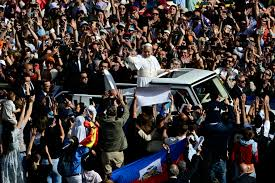
Then about 9:30 Pope Leo arrived. He was standing in the back of his popemobile smiling and giving his blessing to the adoring crowds as the vehicle drove around St. Peter’s square and down the length of the Via Conciliazione.  He passed very close to the place Peggy, our Roman host, and I were standing. The crowd’s enthusiasm, shouts, and applause made it all quite thrilling.

At 10:00 right on the dot, the ceremony began. Everyone in the crowd had been given memorial booklets with the texts of every hymn, litany, and prayer, along with brief descriptions of ceremonies like the bestowal of the papal ring and other signs of papal authority. Texts (including the pope’s homily) were also projected on those large screens. So, it was all quite easy to follow and understand.

The center of it all was the papal Mass, with Leo the celebrant, while various members of the clergy and laity handled the biblical readings and some of the prayers in Latin, Italian, Spanish, English, and Greek.

At communion time, a whole army of priests (perhaps 50 or more) dressed in black cassocks and white surplices processed to various stations throughout the crowd to distribute the “hosts” that Catholics believe are the very body of the risen Christ. I noticed how some recipients received the wafer on their tongues, others in their hands. One priest close to me refused to place the host in extended palms. He repeatedly insisted on laying the host on the recipient’s tongue. The priest who gave me communion placed the wafer reverently in my hand with the traditional words, “The body of Christ.”  

“Amen,” I replied. (I hadn’t received Catholic communion in years.)

All that describes the surface level of my experience this morning. But what did I really see and hear? Let me respond at three levels, one inspirational, one historical, and one political.

Evaluation

At the inspirational level I saw thousands of Catholics and others thirsting for a meaningful spiritual experience of transcendent, invisible dimensions of life. After all, we live in a world rendered increasingly meaningless by materialism, consumerism, war, shifts in global power, and social change almost beyond comprehension. Seeing such people praying the rosary with eyes closed and lips moving was inspiring indeed. So was their reverence in receiving Holy Communion.

At the historical level, I saw something more problematic. I witnessed:

  • An out-of-touch museum performance piece
  • Overwhelmingly led by men in pretentious medieval costume representing the most patriarchal institution in the western world
  • Now led by a nice American priest who actually believes he’s somehow the “Vicar of Christ”
  • Who founded the Catholic Church
  • Despite the evidence of even Catholic scripture scholarship that such conviction remains unsupported by credible evidence. It shows instead that Yeshua of Nazareth remained a good Jew throughout his brief life and had no apparent intention of founding the gentile “church”
  • That emerged definitively in the 4th century when (under Constantine) a powerful faction of the Christian community threw in its lot with the Roman Empire becoming in effect its Department of Religion,
  • Notwithstanding the fact that Yeshua died a victim of Roman torture and capital punishment.

However, most problematic of all were the event’s political dimensions. In that connection I saw a pope who (once again!) during a time of genocide and this time standing before its perpetrators (in the persons of J.D. Vance and Marco Rubio) spoke in generalities and empty platitudes instead of calling attention to their crime. As indicated in yesterday’s piece, I had been hoping for more – perhaps something in the vein of Episcopal Bishop Mariann Edgar Budde’s words to President Trump on behalf of Palestinians and migrants.

Conclusion

When I’ve expressed my concerns to friends and family members, I’m often told that the new pope must be careful and diplomatic. After all, he’s just starting out.

My reply however is that we’re in a state of emergency. The fact of genocide is undeniable in Gaza. Women and children are starving to death. Each morning, it seems, we’re told that as many as 150 Palestinians (mostly those women and children) were killed overnight. Such victims can’t wait.

The pope has potentially more moral power in his voice than anyone else in the world. If he truly believes himself to be the vicar of the prophetic Yeshua, he must use that voice now.

He must forget caution and diplomacy.

Good Friday: Heretical Trumpists Celebrate an Imperial Jesus

Today is Good Friday. This morning’s New York Times (NYT) correctly identified the day as “part of the holiest week in the Christian calendar.”

It also recalled President Trump’s campaign promise to “bring back Christianity.”  According to him and his first lady that means following “the living Son of God who conquered death, freed us from sin, and unlocked the gates of Heaven for all of humanity.”  The pair wants this to be “one of the great Easters ever.”

The article went on to recall how Mr. Trump’s aspirations were following and expanding the lead of George W. Bush who established the first White House Office of Faith Based and Community Initiatives in the early 2000s.

Mr. Trump’s “personal pastor,” Paula White-Cain who heads the Office affirms its ability “to weigh in on any issue it deems appropriate.” Chief among them, she said, were the desire to “eradicate anti-Christian bias” including deviation from the position that there are two sexes, male and female.  Such concerns have afforded the Faith Office “unprecedented access” for faith leaders to “officials in intelligence, domestic policy and national security.”

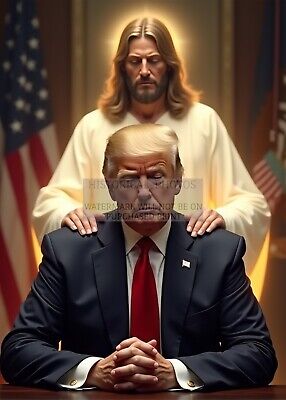
Accordingly, Mr. Trump has often met with pastors from states like Colorado and Pennsylvania. On returning home, those reverends have shared photos taken with the president sometimes with heads bowed in prayer, imposing hands of blessing on the president’s head, or with Mr. Trump joining them in singing hymns.

All of this led the NYT article and accompanying video to identify the White House as “one of the safest places in the world to be a Christian.”  In fact, one of the Christian pastors interviewed for the piece said that “he doesn’t see any rails on the limits of the faith office.”

Good Friday Perspective

As a Jesus scholar and theologian, I found all this quite ironic, false, and heretical. In my view it is reminiscent of Germany of the 1930s, when Christian pastors and Catholic bishops routinely endorsed the leader of the Third Reich, who also affirmed allegiance to the Jesus reflected in Mr. and Ms. Trump’s profession of faith.

The reality was, however, that Hitler’s Germany and the policies supported by Trump’s MAGA crowd reveal an actual hatred for Jesus mourned and celebrated this Good Friday. After all he was the son of an impoverished unwed teenage mother who was houseless at birth. He was an immigrant in Egypt. He was an unemployed construction worker. He was a harsh critic of the Jewish political and religious establishment, of the Roman Empire, and of the rich in general. He said that the future belonged to the poor, the non-violent, and those persecuted for justice sake. He ended his life as a victim of imperial torture and capital punishment.

Conclusion

So, if there are no rails, no limits, on Mr. Trump’s faith office how about lowering them for pastors like Episcopal Bishop Mariann Edgar Budde?  (Remember how she infuriated Donald Trump and JD Vance at Trump’s inaugural prayer service at the National Cathedral in Washington. She did so merely by pleading with Mr. Trump to “have mercy” on LGBTQ people and immigrants targeted by his policies.)   

If there are no rails, how about lowering them for rabbis, ministers, priests, and faithful demanding that Mr. Trump stop the Hitlerian genocide he’s committing in Zionist Israel?

If there are no rails, how about implementing policies that recognize and honor Jesus in the children of poor unwed teenage mothers, in the houseless, in immigrants, in the working class, in opponents of the rich and powerful, in those protesting the hypocrisy of Jewish Zionists, in U.S.-supported torture facilities, and on death row.

Only changes like those can convince followers of the historical Jesus that the White House is “one of the safest places in the world to be a Christian.” Only changes like those can make this “one of the great Easters ever.”

Marianne Williamson Should Go for Broke As The Peace Candidate

Readings for the Second Sunday of Lent: Genesis 12: 1-4A; Psalms 33: 4-5, 18-22; 2nd Timothy 1: 8b-10; Matthew 17: 1-9

On this Second Sunday of Lent and in the context of the Ukraine conflict, I want to return to the topic I addressed in last week’s homily – Marianne Williamson’s apparent sell-out to western warmongers in her position paper called “The Tragic Conundrum of Ukraine.”

Since then, Ms. Williamson has become the first Democrat to declare her candidacy to unseat Joe Biden as President of the United States. Yes, it’s official; she’s running again for president.

My point in what follows is this: For Williamson to have even the least chance of achieving her goal, she must go for broke. She must reverse her position on the Ukraine war and declare herself in no uncertain terms THE PEACE CANDIDATE.

Doing so would not only separate Williamson from Biden and the others who will eventually enter the 2024 race. More importantly, it would align her more securely with the principles of her own spiritual guidebook, A Course in Miracles (ACIM). As well, it would embody the example of Yeshua (the voice ACIM claims to channel) as reflected in today’s Gospel reading. There following what we’ve come to see as his “transfiguration,” Yeshua too decides to go for broke in his opposition to imperialism.

My point here is that to garner any meaningful notice as a candidate, Williamson needs to spiritually transfigure as well.

To show what I mean, let me (1) address Williamson’s candidacy as it relates to the war in Ukraine on the one hand and to ACIM on the other, (2) recall Yeshua’s adoption of a “go for broke” strategy in opposing Roman imperialism, and (3) recommend a similar strategy for Williamson if she truly wants to be a player in 2024.

Williamson & ACIM

First, recall who Marianne Williamson is and how easily she will be dismissed if she continues endorsing business as usual by adopting “the official story” and conventional wisdom about Ukraine as expressed in her “Conundrum” statement: She’s the one:

  • Dismissed by many as a “vanity candidate” intent only on selling books.
  • Characterized as “new agey, soft, and unrealistic.”
  • Portrayed by SNL’s Kate McKinnon as “woo-woo,”
  • And as one who would address political problems by burning sage and manipulating crystals.
  • Ridiculed for alleging that “a dark psychic force” has made us all victims of collectivized hatred advanced by Donald Trump.

This time around, the same accusations will inevitably surface again unless Williamson does something authentic to distinguish her from Biden and the neocons and their bellicosity on Ukraine.

Instead, however, her statement on the war aligns itself with the largely white “West” (13% of the world’s population) as if it rather than the world’s mostly non-white majority “knows better.” She says, for instance,

“I believe there is legitimate justification for military support for Ukraine from Western allies, including the United States.” And “. . . Vladimir Putin’s actions today are a threat to which the Western world must now respond.” (Emphasis added).

One wonders why this emphasis on the largely white west. Again, does it somehow know better than mostly non-white cultures (e.g., in China and India) that have developed insights, wisdom, and spiritualities based on experiences thousands of years older than our own?

Does this western centrism represent an unconscious hangover from the colonial past that has enriched “the west” and impoverished the rest?

But more especially, how explain Williamson’s apparent rejection of the most obvious teachings of A Course in Miracles, which she has championed for decades?

Here’s what I mean. According to A Course in Miracles:

  1. Its teachings are basically Christian mysticism that finds the root of all problems in a skewed relationship with God – or Source, the Ground of Being, the Great Spirit, the Tao, Brahmin, Allah, Life, Cosmic Consciousness, etc.
  2. That mysticism also reveals that “America” is not an exceptional nation. (Or as Ms. Williamson is fond of putting it “No one is special, and everyone is special.”)
  3. Instead, all of us are living in a pseudo-reality reminiscent of Plato’s Cave, where prisoners mistake shadows manipulated by their keepers for reality far removed from the real world.
  4. Consequently, what the dominant culture accepts as “reality” is actually 180 degrees opposite the Truth.
  5. Its upside-down “reality” is rooted in fear, greed, dishonesty, and violence.
  6. This means that while the prevailing culture would blame our problems on others (like Russia), the Truth is that we (the United States) are 100% responsible for our own “conundrums.”
  7. Facing and correcting our own behavior are necessary first steps in solving any dilemma or conflict.
  8. Such inventory and rectification reveal that no one is attacking us. Instead, we are the attackers.
  9. Recognizing all of this is the key to peace.  
  10. It embodies the miraculous in the ACIM sense of “a radical transformation of consciousness.”

Now, imagine if Marianne Williamson’ presidential campaign emphasized those ten points. It certainly would get attention. It would separate Williamson from the homogenized gaggle of candidates. It would raise the essential questions that no one dares raise. It would mark Ms. Williamson as a true leader worth following.

What I’m saying here is that unless Williamson finds the courage to go for broke by embracing the principles that she has taught for so many years and by identifying as The Peace Candidate, she’ll be lost in the shuffle. She’ll be ridiculed and dismissed once again.

Yeshua Goes for Broke

Today’s Gospel reading presents Jesus as setting an example Marianne Williamson would do well to follow. By resolving to take a leading part in a Passover demonstration against Jewish cooperation with imperial Rome, Yeshua risks it all.

Think about it.   

Today’s reading finds the young construction worker from Nazareth on his way to Jerusalem, where he knows something extremely risky is about to happen. Yet he’s determined to be part of it. The risky action has to do with the temple and opposing the collaboration of its leaders with the Roman Empire.

The temple has become worse than irrelevant to the situation of Yeshua’s people living under Roman oppression. What happens there not only ignores Jewish political reality. The temple leadership has become the most important Jewish ally of the oppressing power. And Jesus has decided to address that intolerable situation despite inevitable risks of failure.

Everyone knows that a big demonstration against the Romans is planned in Jerusalem for the weekend of Passover. There’ll be chanting mobs. The slogans are already set. “Hosanna, hosanna, in the highest” will be one chant. Another will be “Hosanna to the Son of David!” “Hosanna” is the key word here. It means “save us!” (The Romans won’t notice that the real meaning is “Save us from the Romans.” “Restore an independent Israel – like David’s kingdom!”) It was all very political.

Yeshua has heard that one of the main organizers of the demonstration is the guerrilla Zealot called Barabbas. Barabbas doesn’t call what’s planned a “demonstration.” He prefers the term “The Uprising” or “the Insurrection” (Mk. 15:6-8).

Barabbas has a following as enthusiastic as that of Yeshua. After all, Barabbas is a “sicarius” – a guerrilla whose solemn mission is to assassinate Roman soldiers and their Jewish collaborators. His courage has made him a hero to the crowds. (Scripture scholar, John Dominic Crossan compares him to the Mel Gibson character in “The Patriot.”)

Yeshua’s assigned part in the demonstration will be to attack the Temple and symbolically destroy it. He plans to enter the building with his friends and disrupt business as usual. They’ll all loudly denounce the moneychangers whose business exploits the poor. They’ll turn over their tables.

As a proponent of nonviolence, Yeshua and his band are thinking not in Barabbas’ terms of “uprising,” but of forcing God’s hand to bring in the Lord’s “Kingdom” to replace Roman domination. Passover, the Jewish holiday of national independence could not be a more appropriate time for the planned demonstration. Yeshua is thinking in terms of “Exodus,” Israel’s founding act of rebellion.

And yet, this peasant from Galilee is troubled by it all. What if the plan doesn’t work and God’s Kingdom doesn’t dawn this Passover? What if the Romans succeed in doing what they’ve always done in response to uprisings and demonstrations? Pilate’s standing order to deal with lower class disturbances is simply to arrest everyone involved and crucify them all as terrorists. Why would it be different this time?

So before setting out for Jerusalem, Yeshua takes his three closest friends and ascends a mountain for a long night of prayer. He’s seeking reassurance before the single most important act of his life. As usual, Peter, James and John soon fall fast asleep. True to form they are uncomprehending and dull.

However, while the lazy fall into unconsciousness, the ever alert and thoughtful Yeshua has a vision. Moses appears to him, and so does Elijah. (Together they represent the entire Jewish scriptural testament – the law and the prophets.) This means that on this mountain of prayer, Yeshua considers his contemplated path in the light of his people’s entire tradition.

According to the Jews’ credal summary in Deuteronomy 26, their whole national story centered on the Exodus. Fittingly then, Yeshua, Moses, and Elijah “discuss” what is about to take place in Jerusalem. Or as Luke puts it, “And behold, two men were conversing with him, Moses and Elijah, who appeared in glory and spoke of his exodus that he was going to accomplish in Jerusalem.” Yeshua’s Exodus!!

It is easy to imagine Moses’ part in the conversation. That would be to remind Yeshua of the chances Moses took when he led the original Exodus from Egypt. That might have failed too. Nevertheless . . .

Elijah’s part was likely to recall for Yeshua the “prophetic script” that all prophets must follow. That script has God’s spokespersons speaking truth to power and suffering the inevitable consequences.

Elijah reminds Yeshua: So what if Barabbas and those following the path of violence are defeated again? So what if Yeshua’s nonviolent direct action in the temple fails to bring in the Kingdom? So what if Yeshua is arrested and crucified? That’s just the cost of doing prophetic business. Despite appearances to the contrary, Yeshua’s faithful God will somehow triumph in the end.

Conclusion

Is there a message in today’s reading for Marianne Williamson, who is undoubtedly the best equipped public figure to take on the essentially spiritual role of Peace Candidate?

I think there is.

The readings call her to:

  • Insist that we’ve indeed all be grasped by a “dark psychic force” that ignores shared humanity and sees war as a first option rather than as a last resort.  
  • Be transfigured into 2024’s Peace Candidate by heeding Moses, Elijah, and Yeshua, the champions of her native Jewish faith.
  • Be transformed as well by listening to the world’s non-western, mostly non-white majority and their reluctance or downright refusal to endorse U.S. insistence on controlling the world far from its own shores.
  • Recognize that in line with the teachings of A Course in Miracles, the U.S. and NATO are 100% responsible for the Ukraine crisis.
  • Call for an immediate ceasefire and diplomatic negotiations to end the war.
  • Go for broke by ignoring those who will characterize her opposition to the war as naïve and unrealistic – as if risking nuclear annihilation were more sophisticated and mature.
  • Truly embrace the teachings of A Course in Miracles that identifies the source of peace in its refusal to be frightened by non-existent threats and attacks.
  • Or as The Course puts it: “Nothing real can be threatened. Nothing unreal exists. Herein lies the PEACE of God.” (Emphasis added)

Liberation Theology: the Answer to Tom Paine’s Prayers?

A recent OpEdNews article entitled “Jesus for the Left, Jesus for the Right” adopted the following lead, “The fact that the religious left and the religious right can both use the Bible to back up their opposing agendas shows us that the Bible is meaningless.”

I found the essay interesting, especially since it quotes me as a liberation theologian advocating a “Jesus for the left” position that (in my brother-author’s opinion) is no more well-founded than the “Jesus for the right” view. Both are simply matters of bias, he held. Each side merely chooses biblical texts that support its prejudices while ignoring problematic ones that contradict them. The left likes socialism and selects accordingly. The right opposes socialism and does the same thing.

As his remedy, my dialog partner argued for:

  • Reason not the Bible
  • Deism not religion
  • Thomas Paine not Jesus

This Article

What follows here attempts a largely appreciative response to my friend’s argument. In fact, I and most liberation theologians and biblical scholars agree with Paine’s critique of pre-Enlightenment religions founded on the naïve approaches to the Bible enumerated in the article under review.

Nonetheless, I found my friend’s critique did not go far enough. His equation of Jesus- for-the-left with Jesus-for-the-right remains mired in Thomas Paine’s pre-modern approach to biblical texts.

I wish it had gone further. 

I mean my friend’s piece ignored the fact that “Jesus for the left” theology takes seriously relevant discoveries in archeology, history, ancient languages, and in texts like the Dead Sea Scrolls. It wrestles with developments in literary analysis and critical studies involving recognition of diverse literary forms. It does the detective work of redaction criticism that traces down the historical and political reasons for editors’ changes in scrolls over centuries of revision with its additions, omissions, contradictions, and errors.

In other words, Jesus-for-the-left scholarship is founded on scientific method and advances unknown to Thomas Paine and other sons and daughters of the Enlightenment. Unfortunately, they are also largely ignored by Jesus-for-the-right advocates who as a result remain vulnerable to the criticisms of Paine and my brother author.

Without getting too far into the weeds of modern biblical scholarship, let me show what I mean by first expressing appreciation for Paine’s critique of religion, by secondly illustrating the advances in biblical science since Paine, and thirdly by reflecting on liberation theology as a politically powerful alternative to Paine’s 18th century Deism.

Paine’s Criticism  

A great deal of Thomas Paine’s criticism of traditional religion as understood before the Enlightenment was spot on. That approach to the Bible was unscientific. It understood the Bible as a single book inspired by a single author (viz., God). Before the advent of modern biblical scholarship, the Bible’s interpreters tended to read texts literally as though they were all infallible statements of historical fact. This led to the inanities and contradictions Paine struggled against and which my dialog partner rightly lampooned.

So, as a seeker of truth, Paine could write with reason:

“I do not believe in the creed professed by … any church that I know of . . . All national institutions of churches . . . appear to me no other than human inventions set up to terrify and enslave mankind and monopolize power and profit. . . Whenever we read the obscene stories . . . with which more than half the Bible is filled, it would be more consistent that we call it the word of a demon than the word of God. It is a history of wickedness that has served to corrupt and brutalize mankind. . .The Bible and the Testament are impositions upon the world. . . The fall of man, the account of Jesus Christ being the Son of God, and of his dying to appease the wrath of God, and of salvation, by that strange means, are all fabulous inventions, dishonorable to the wisdom and power of the Almighty.”

Harsh words, no?

However, I don’t know a single liberation theologian who would argue with Paine’s criticism. In fact, it is a principal purpose of liberation theology to free humans from what Paine rightly calls the terror and enslavement of religious forms meant to consolidate the power and profit of the professionally religious. Liberation scholars do so by basing their approach to the Bible on the discoveries of modern scientific scholarship.

Paine would have welcomed both their commitment to science and the revolutionary implications of their work.

Biblical Science

The discoveries in question are myriad and complex.

At the simplest level though, they tell us that what we call “The Bible” (The Book) is not a book at all, but a collection of books – an entire library written by different authors at different times, under vastly different circumstances, and for different and often contradictory purposes involving what we call today “class struggle.” No wonder then that we often find an upper-class God supporting the royal classes with their debaucheries, exploitation of the poor, and bloody wars all fought (as they are today) in the name of their deity.

All of that becomes even more complicated when we realize most of the literary forms within the Bible are far from history as we understand it. Yes, there are “Annals of Kings” (like Saul, David, and Solomon). But those represent the work of court historians whose job was to glorify their employers, not to tell the truth; all of them must therefore be taken with a grain of salt.

But besides such “histories” the Bible also contains myth, legend, debate, and fiction. There are letters. There are ancient laws that seem superstitious and ludicrous to moderns. There is poetry and song. There are birth stories and miracle accounts that all follow predetermined patterns. There are prophetic texts and wisdom literature including proverbs, jokes, and plays on words. And then there’s that strange literary form called “apocalypse” which, scholars tell us, was a form of resistance literature written in code during times of foreign occupation and oppression. If all of these are read as history, as statements of fact, or as somehow predicting the future, it’s easy to see how misunderstandings result.

What’s more, virtually all biblical scholars (even the most politically conservative like Josef Ratzinger, aka Benedict XVI) tell us that the Bible’s basic story is that of the formation of the Jewish people. And that account, the scholars say, begins not in Eden, but in Egypt and the deliverance of slaves from bondage there. It’s a story of liberation. All the rest is commentary.

The rest is also an account of the struggle between the poor and oppressed on the one hand against the royalty, generals, priests, and scribes on the other who consistently tried to wrest away from the poor a God the privileged wanted to support the elites’ status quo. It was a struggle between the establishment and the prophets who defended the poor as God’s favorites. What we find in the Bible then is a “battle of gods,” a kind of theogony.

According to the scholars I’m referring to, Jesus appeared in the Jewish prophetic tradition. He was a poor man himself – a prophet, a mystic, a storyteller, a healer, a social critic, an opponent of oppression by priests, kings, and emperors. And the one certain thing we know about him was that he offended the Establishment (Rome and its temple and court collaborators) to such an extent that they arrested, tortured, and killed him. Significantly, they used a form of execution reserved for rebels, revolutionaries, and terrorists.

Yes, Jesus was on the side of the poor and oppressed. But close examination of texts shows that even the evangelists (Mark, Matthew, Luke, and John) often altered the Master’s radical pronouncements to suit their own more conservative purposes. Scholars like those in the famous Jesus Seminar have developed criteria for (tentatively) separating the wheat of Jesus’ own words from the chaff of his editors. Liberation theologians avail themselves of such scholarship.  

Alternative to Deism

So, if it’s all so complicated, why not just pitch it all in favor of Paine’s reason and Deism which conceptualizes God as the Great Watchmaker in the sky who set the world spinning according to its own rules and hasn’t been heard from since? Why not just reason everything out abstractly?

To my mind, the answer is because we are human beings. And humans need stories. Perhaps some, like my dialog partner find abstract reason and an even more abstract concept of God more inspiring and helpful. If so, good on them.

But I repeat: most of the rest of us need stories. In fact, many like Nesrine Malik hold that with everything falling apart in our world, we need more not fewer stories.

My reply is that we already have the stories we need. And the ones found in the Bible are shared across the western world and by Islam. We all know those tales. They can bring us together and shed a penetrating transcendent light on issues that plague our world just as they did those of Jews living under foreign imperialism – including Jesus and the early Christians under Rome.

When those issues are confronted in the face of the liberating God of the Exodus or of Jesus and his pronouncements about God’s Kingdom, they can generate the power to move people to revolutionary action.

The experience inspired by liberation theology in Latin America during ‘70s and ‘80s is proof enough of that. Without liberation theology one cannot explain the Nicaraguan revolution, nor similar movements in El Salvador, Brazil, or Argentina. One cannot explain the pink tide that subsequently swept all of Latin America including the Bolivarian Revolution of Hugo Chavez.

What I’m saying is that liberation theology provides a scientifically based revolutionary potential that Tom Paine would have admired.

(However, it must also be acknowledged that without liberation theology, one cannot explain the rise of the religious right in America and elsewhere in the world. Its Jesus-for-the-right was instrumentalized for reactionary purposes by the Reagan administration precisely to combat liberation theology which was seen by the CIA and State Department as a threat to U.S. national security.

That is, besides inspiring social activism, liberation theology evoked the exact type of persecution and martyrdom suffered by the early church under Rome. Such parallels say a great deal about liberation theology’s authenticity.)    

Conclusion

I hope it is evident from the foregoing that I very much respect what my friend wrote in “Jesus for the Left, Jesus for the Right”. However, I worry about its call to surrender religion and spirituality to right-wing forces. To my mind, there is no more powerful or important ground to defend.

Like the Constitution and American history, spirituality has always been and remains contested terrain. The fact that the left and right have differing interpretations and narratives by no means proves anything about “meaninglessness.”

In fact, it’s quite the opposite. The struggle over history’s versions, over the Constitution’s interpretations, and especially over biblical texts only serves to illustrate their importance and the need to approach them with the scientific spirit of Thomas Paine.

Had he been exposed to modern biblical science, I believe Paine would have embraced liberation theology. He may have seen it as his counterpart, Noam Chomsky does in the film clip at the head of this essay. Paine may even have accepted liberation theology as the answer to his prayers.

Rediscovering Mary Magdalen but Losing the Historical Jesus: Clysta Kinstler’s “The Moon under Her Feet” 

Everybody loves Mary Magdalen. That’s true for me especially.

As I’ve shown in previous articles (e.g., here, here, here, here, here, here, and here) I’m intrigued by recent attempts by Magdalene scholars like Lynn Picknett to restore the Magdalene (whatever the term might mean) to the status accorded her in the Gnostic Gospels as “the apostle of apostles.”

Traditionally identified by a hostile Christians patriarchy as a forgiven, humiliated, and groveling former prostitute, the Magdalene of the new scholarship would even further rehabilitate her into an Egyptian priestess and quasi-goddess.

That’s the case with Clysta Kinstler’s 1989 novel, The Moon under Her Feet. The book was recently recommended to me by a dear friend and fellow Magdalene admirer. The Moon was reviewed early on in the New York Times. It is beautifully written. Its endnotes alone are worth the book’s purchase. They reveal the author’s careful research and startling ability to make overlooked connections between relevant scholarly pursuits including history, mythology, and biblical interpretation.

Nevertheless, as a liberation theologian, I must admit my disappointment with Kinstler’s tale. It indeed provides intriguing insights about main character, the Magdalene. But as for her ultimate lover, Yeshua of Nazareth, Kinstler’s novel falls prey to the trap set by the Emperor Constantine in the 4th century.

The trap transforms Yeshua from a prophetic working-class revolutionary into a socially harmless Egyptian “dying and rising” god with little relevance to the world he sought to replace – one dominated then and now by imperialism, oppression, and unnecessary poverty all obscured by a justifying set of myths supportive of ruling classes and their self-serving social order.

Let me show you what I mean by first describing Mary Magdalen as portrayed in The Moon under Her Feet, second by doing the same for Yeshua her ultimate consort, and third by contrasting that figure of Yeshua with his portrayal in liberation theology. My conclusion will underline the importance of making such contrast.

The Moon and the Magdalen  

Throughout The Moon under Her Feet, its main character, Mari Anath, gradually assumes her role as head of the Jerusalem Temple’s priesthood of women. According to Kinstler’s account, these holy women still represented an essential part of the Jewish tradition. “Mari” was an extremely popular name in first century Palestine.  “Anath” was the Hebrew equivalent of the Greek warrior-goddess, Athena. “Magdalene” signified the high priestess’ office. For Kinstler, the term actually meant “high priestess.”

The holy women in Magdalene’s cloister resided inside the Temple’s entrance, just beyond the location of the currency exchange services where the despised Roman denarius was traded for the ritually more acceptable Jewish shekel.

Mistrusted by the patriarchal Pharisees and Jewish high priests, the women within the Temple convent enjoyed the reverence of ordinary Jews who still honored Ashera, the traditional but officially suppressed spouse of Yahweh. From Israel’s earliest origins, peasants, craftspeople, fishermen, the poor, beggars, and social outcasts insisted on worshipping Ashera alongside Yahweh. In fact, their devotion meant that no king could enjoy popular support without the blessing of the High Priestess – without her anointing and union with her in a ritual marriage called Hieros Gamos.

Therein lies a major theme of The Moon under Her Feet. For as the high priestess, Mary the Magdalene had to negotiate marriage invitations from her first husband, Phillip the Herodian, and from his brother Herod Antipas. Philip sought Mary’s blessing on his tetrarch rule over his four Jewish provinces. The quest of his brother, Herod Antipas, was to validate his claim to a Goddess-blessed kingship of the Galilee, the region of Palestine where Yeshua was born. 

Accordingly, the Magdalene joined Philip’s harem as a teenager thus confirming the legitimacy of his tetrarchy. Later, after securing an amicable divorce from Philip, Mary found herself the object of his brother’s quest for Goddess confirmation of his own reign over Galilee which his subjects were loath to recognize, since he was so obviously a mere puppet of Israel’s Roman occupiers.

To escape her fate, Mari Anath induces a near death experience in which she travels to the underworld and thereby achieves a vastly intensified spiritual enlightenment which subsequently serves her well as the consort of Yeshua. Her famous anointing of his feet with tears and precious ointment officially designates Yeshua as God’s Christos (messiah). The consummation of marriage with him represents the Hieros Gamos required of any valid king. Without the Magdalene, Jesus is no messiah. He is no king (Kinstler 260).

The Moon and Yeshua

Before assuming her duties as head priestess, Mari Anath’s role model was her namesake, Almah Mari. As reigning high priestess, Almah became the mother of Yeshua who precisely as her offspring, had been pre-designated to be Israel’s expected Messiah – its liberator from Roman domination.

 “Almah Mari” meant “pure maiden,” or “virgin.” However, the latter term did not connote asexual abstinence, but independence from male claims to spousal ownership.

For the Magdalene, her mentor was the very incarnation of Isis-Ashera, “Queen of All the Worlds; Mistress of Heaven, Earth and Hell; Mother of all things; eternal Wisdom, Truth and Beauty; keeper and protectress of all who call upon” her (14, 148). Those titles reflected Almah Mari’s love for Egypt to which she (and her son) often returned for inspiration and study.

According to the Magdalene’s faith, Almah Mari’s son, Yeshua, followed the path of typical deities belonging to the Egyptian mystery cults so popular in Rome and its provinces during the first century of the common era. Characteristically, they were virgin born, descended to earth, lived there and taught a while, were sacrificially killed, journeyed through the underworld to conquer its forces of darkness, rose from the dead, and finally ascended to heaven. From there, they offered eternal life to devotees who participated in rituals where the god’s body was eaten in the form of bread and whose blood was drunk in the form of wine or ale (41, 73).

More specifically, the Magdalene understood Yeshua as the incarnation of Osiris and the very presence of Dumuzi, the oldest of the mystery cults’ dying and resurrected gods (306). According to the Magdalen’s mythically complex theology, Yeshua was his own father — the spouse of his mother impregnated by the Sacred King Sharon. [Soon afterwards, Sharon took his own life thus following the ritual prescribed for gods of the mystery cults in question (40).]

In Kinstler’s story, Yeshua was also the identical twin brother of Seth, whom Yeshua later renamed Judas Scarios (204). As Seth, Judas had won the heart of the Magdalene, fathered two children with her, and eventually married her as the last of her three husbands (following Philip Herod, and Yeshua himself).

Jesus in Liberation Theology

Rejecting such speculation and complex mythologies, liberation theology emphasizes what can be known of Jesus from history, archeology, written records, laws, and the predictable constants of class struggles across the centuries against imperialism and its exploitation.

It employs what Jesuit theologian Roger Haight calls the secular “principle of analogy.” It holds that “we cannot normally expect to have happened in the past what is thought or proven to be impossible in the present.” This means that liberation theology is committed to demythologizing the religious understandings that Kinstler’s tale takes so seriously. It recognizes them for what they were – ideologies justifying relationships of royal classes over disempowered subjects.

To Haight’s analogy principle about the past, I always add the corollary, “we can expect to have happened in the past what normally occurs in similar circumstances in the present.” This recognizes for instance that one can justifiably assume that imperially occupied and oppressed people in first century Palestine normally responded the way their counterparts do in the modern world: they harbored deep resentments, formed resistance movements, attacked their oppressors, and suffered the brutal consequences at the hands of merciless occupiers who despised the insurgents. Extensive Roman records show that this was indeed the case in first century Palestine.    

From that perspective, the Yeshua of liberation theology emerges as one of innumerable miracle-workers in Palestine claiming to be the “messiah.” In context, that term could mean only one thing: restoration of Israel’s independence from its Roman imperial occupiers.

Like all such would-be Christs, Jesus was executed by the Romans who killed criminals like him using the method they reserved for insurgents – hanging on crosses publicly displayed to discourage others tempted to follow suit. After consumption by dogs and vultures, what was left of executed insurgents like Jesus probably found final disposal in a common grave.

However, what separated Jesus from others like him was a distinctive belief that soon after his execution emerged among his female disciples. Led by an obscure figure called Mary Magdalene, the women gradually persuaded doubtful male disciples that their Master had somehow returned to life.

The belief spread and caused Jesus’ followers to reassemble in communities that lived according to Jesus’ “communistic” ideals. They sold their surplus possessions, distributed the proceeds to the poor, and held everything else in common (Acts 2:42-47).

In other words, Jesus’ followers continued to embody what liberation theologians describe as the divine “preferential option for the poor.” Awareness of that option coincided with Israel’s own national beginnings. Those origins revealed the Hebrew God, Yahweh, as the champion of slaves in their resistance to Egyptian slavers.

For Israel, Yahweh was the enemy of everything Egyptian, including Egyptian gods and their accompanying mythologies, the culture’s royal families, and (of course) its temples with their priests and priestesses.     

With all of this in mind, liberation theology is highly critical of understandings that emerged with the emperor Constantine in the 4th century of the Common Era that transformed a working-class prophet into a Roman “mystery cult” God.

After Constantine, Jesus became interchangeable with those earlier-described dying and rising gods such as Osiris, Isis, and Mithra. To repeat, that’s pretty much what happened to Jesus. He became one of those gods – for Constantine and the Christian tradition he shaped – and now for Clysta Kinstler.

Conclusion

I remember reading somewhere that after Nicaea and its “definition” of Jesus’ identity as “fully God and fully man,” it became virtually impossible to distinguish Christian worship ceremonies (what became the “Mass”) from those honoring dying and rising gods such as Isis, Osiris, Mithra, or the Great Mother. I wondered how that was possible.

After reading The Moon under Her Feet, I find my question answered. I see how easily even a crucified peasant prophet like Yeshua – one said to have been executed and risen from the dead – could be transformed from a working-class hero to a harmless royal god.

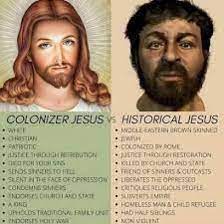
Under Kinstler’s pen, the Master not only comes from the temple culture of which he was so critical, he even takes on royal appearance with “Hasmonean” features, reddish hair, and blue eyes that turned to hazel and then brown (146).

Yeshua ends up looking like this:

Meanwhile, contemporary forensic archeologists say Jesus probably looked like this:

In other words, by the process depicted in The Moon under Her Feet, the poor are once again robbed not only of a major hero, but of the God whose incarnation looks like them and champions their liberation and a world order structured in their favor.

Easter Reflection: Did Jesus Really Rise from the Dead?

Readings for Easter Sunday:ACTS 10:3A, 37-43; PS 118: 1-2, 16-17, 22-23; COL 3:1-4; JN 20: 1-9.

Did Jesus really rise from the dead? Or is belief in his physical resurrection childish and equivalent to belief in the Easter Bunny or Santa Claus?

I suppose the answer to those questions depends on what you mean by “really.” Let’s look at what our tradition tells us.

Following Jesus’ death, his disciples gave up hope and went back to fishing and their other pre-Jesus pursuits. Then, according to the synoptic gospels, some women in the community reported an experience that came to be called Jesus’ “resurrection” (Mt. 28:1-10; Mk. 16: 1-8; Lk. 24:1-11). That is, the rabbi from Nazareth was somehow experienced as alive and as more intensely present among them than he was before his crucifixion.

That women were the first witnesses to the resurrection seems certain. According to Jewish law, female testimony was without value. It therefore seems unlikely that Jesus’ followers, anxious to convince others of the reality of Jesus’ resurrection, would have concocted a story dependent on women as primary witnesses. Ironically then, the story’s “incredible” origin itself lends credence to the authenticity of early belief in Jesus return to life in some way.

But what was the exact nature of the resurrection? Did it involve a resuscitated corpse? Or was it something more spiritual, psychic, metaphorical or visionary?

In Paul (the only 1st person report we have – written around 50 C.E.) the experience of resurrection is clearly visionary. Paul sees a light and hears a voice, but for him there is no embodiment of the risen Jesus. When Paul reports his experience (I Cor. 15: 3-8) he equates his vision with the resurrection manifestations to others claiming to have encountered the risen Christ. Paul writes “Last of all, as to one untimely born, he appeared also to me.”

In fact, even though Paul never met the historical Jesus, he claims that he too is an “apostle” specifically because his experience was equivalent to that of the companions of Jesus who were known by  name. This implies that the other resurrection appearances might also be accurately described as visionary rather than physical.

The earliest gospel account of a “resurrection” is found in Mark, Ch. 16. There a “young man” (not an angel) announces Jesus’ resurrection to a group of women (!) who had come to Jesus’ tomb to anoint him (16: 5-8). But there is no encounter with the risen Jesus.

In fact, Mark’s account actually ends without any narrations of resurrection appearances at all. (According to virtually all scholarly analysis, the “appearances” found in chapter 16 were added by a later editor.) In Mark’s original ending, the women are told by the young man to go back to Jerusalem and tell Peter and the others. But they fail to do so, because of their great fear (16: 8). This means that in Mark there are not only no resurrection appearances, but the resurrection itself goes unproclaimed. This makes one wonder: was Mark unacquainted with the appearance stories? Or did he (incredibly) not think them important enough to include?

Resurrection appearances finally make their own appearance in Matthew (writing about 80) and in Luke (about 85) with increasing detail. Always however there is some initial difficulty in recognizing Jesus. For instance, Matthew 28:11-20 says, “Now the eleven disciples went to Galilee, to the mountain to which Jesus had directed them. And when they saw him they worshipped him; but some doubted.” So the disciples saw Jesus, but not everyone was sure they did. In Luke 24:13-53, two disciples walk seven miles with the risen Jesus without recognizing him until the three break bread together.

Even in John’s gospel (published about 100) Mary Magdalene (the woman with the most intimate relationship to Jesus) thinks she’s talking to a gardener when the risen Jesus appears to her (20: 11-18). In the same gospel, the apostle Thomas does not recognize the risen Jesus until he touches the wounds on Jesus’ body (Jn. 26-29). When Jesus appears to disciples at the Sea of Tiberius, they at first think he is a fishing kibitzer giving them instructions about where to find the most fish (Jn. 21: 4-8).

All of this raises questions about the nature of the “resurrection.” It doesn’t seem to have been resuscitation of a corpse. What then was it? Was it the community coming to realize the truth of Jesus’ words, “Whatever you do to the least of my brethren, you do to me” (Mt. 25:45) or “Wherever two or three are gathered together in my name, I am there in their midst” (Mt. 18:20)? Do the resurrection stories reveal a Lord’s Supper phenomenon where Jesus’ early followers experienced his intense presence “in the breaking of the bread” (Lk. 24:30-32)?

Some would say that this “more spiritual” interpretation of the resurrection threatens to destroy faith.

However, doesn’t such perception of threat reveal a quasi-magical understanding of faith? Does it risk limiting faith to belief in a God who operates outside the laws of nature and performs extraordinary physical feats that amaze and mystify? Doesn’t it flatten the significance of resurrection belief to simply one more “proof” of Jesus’ divinity?

But faith doesn’t seem to be principally about amazement, mystification and proof analogous to the scientific. It is about meaning.

And regardless of whether one believes in resurrection as resuscitation of a corpse or as a metaphor about the spiritual presence of God in communities serving the poor, the question must be answered, “What does resurrection mean?”

Surely it meant that Jesus’ original followers experienced a powerful continuity in their relationship Jesus even after his shameful execution. Their realm of experience had expanded. Both Jesus and his followers had entered broadened dimensions of time and space. They had crossed the threshold of another world where life was fuller and where physical and practical laws governing bodies and limiting spirits no longer applied. In other words, the resurrection was not originally about belief or dogma. It was about a realm of experience that had at the very least opened up in the context of sharing bread – in an experience of worship and prayer.

Resurrection meant that another world is possible — in the here and now! Yes, that other world was entered through baptism. But baptism meant participation in a community (another realm) where all things were held in common, and where the laws of market and “normal” society did not apply (Acts 2:44-45).

In order to talk about that realm, Jesus’ followers told exciting stories of encounters with a revivified being who possessed a spiritual body, that was difficult to recognize, needed food and drink, suddenly appeared in their midst, and which just as quickly disappeared. This body could sometimes be touched (Jn. 20:27); at others touching was forbidden (Jn. 20:17).

Resurrection and Easter represent an invitation offered each of us to enter the realm opened by the risen Lord however we understand the word “risen.” We enter that realm through a deepened life of prayer, worship, community and sharing.

We are called to live in the “other world” our faith tells us is possible – a world that is not defined by market, consumption, competition, technology, or war.

Pope Francis’ encyclical, Fratelli Tutti supplies the details.

Christmas Reflection: “Oh, Come Let Us Ignore Him”

Every year at this time, the entire Christian world of more than 2.5 billion people pauses to observe the birth of a martyred Jewish construction worker about 2000 years ago. In America, we tirelessly observe this winter festival with increasing intensity from about Halloween, through Thanksgiving, and the entire month of December – for two solid months.

All during that time, our radio airwaves, and every shop we enter repeat the familiar songs and hymns we’ve come to associate with Christmas. Many of the carols celebrate “the newborn king.” Some even issue the invitation, “Oh, come let us adore him” – as God. Only occasionally (as in the “Little Drummer Boy”) is there the slightest hint that Jesus was “a poor boy too.” But that insight is quickly obscured by that same song’s four references to Jesus as “king.”

However, Jesus’ unmistakable poverty, his conception out of wedlock, his homelessness at birth, his status as asylum-seeker and immigrant in Egypt (MT 2:13-18), his social location in the working class, his association with Zealot insurrectionists (MT 10:4; MK 3:18; LK 6:15; ACTS 1:13), and the fact that he ended up a victim of torture and capital punishment at the hands of empire reveal far more about Yeshua than those popular sentimental Christmas jungles and hymns about a “newborn king.”

But even if we take those latter glorifications seriously, they unwittingly communicate a revolutionary message that the Christmas season completely ignores – one that finds important application to our troubled times.

I’m referring to the fact that calling the impoverished Yeshua “king” turns upside down reigning conceptions about the One some call “God,” and about the people divinely designated to rule the world.

Such references unconsciously point to the truth of Jesus’ words that the “meek” or (better put), the lowly, the humble, the unpretentious, those without public power, the despised and discarded, the gentle and non-violent, are (in God’s eyes) the ones divinely destined to “have the earth for their possession” (Psalm 37: 11; Matthew 5:5). History belongs to them. Despite appearances, it is on their side.

What else can it mean that we call “king” a brown or black homeless child born in a barn and who will remain poor, deep in political trouble all his life and will finish on death row? What else can it mean that such a one was selected to be (according to Christian faith) the ultimate revelation of life’s meaning.

On this Christmas Day 2021, all such considerations should send us to look for God in today’s people and places Yeshua was so deeply a part of. Christmas reflections on the historical Yeshua should find him living in those tents that now dot all our big cities. He’s sleeping under some bridge in DC or NYC. He’s dodging drive-by bullets on Chicago’s South Side and shivering in the cold on the Tijuana border. He’s walking his last mile after his appeal for a stay of execution has been ignored by Trump’s SCOTUS packed with “pro-life” Catholics. His appeal is ignored by governors opening gifts with their lily-white children and filling their bellies with turkey and all the trimmings, after singing “Silent Night” with misty eyes in their heretical megachurch based on prosperity gospel lies.

In the face of all that, the proper hymn to sing is “Oh, come let us ignore him.” Yes, ignore that white supremacist, Jesus. And instead, let us adore the real Yeshua in that filthy, stinking barn. He’s there sharing a roof with the rats and beasts with whom our police forces equate those whose neighborhoods and barrios their militarized platoons occupy as enemy terrain.

If we were to find Yeshua in those unlikely places, how different our interminable Christmas season would be. Yes, suppose Americans (and the world’s other two billion Christians) spent two months each year giving serious reflection to Jesus’ social circumstances as presented in the biblical texts that scholars call “the infancy narratives.”

Doing so would change “the season” to one of national repentance, instead of the orgy of “Christmas shopping” for those who already have more than they need. We’d double down on support for Rev. Barber’s Poor People’s Campaign. We’d organize to spend the season (any beyond) doing everything possible to eliminate the specific elements that plagued the life of Yeshua — namely:

  • Identification of “God” with scepters, armies, priests, and “power over”
  • Royalty of all kinds
  • Poverty
  • Homelessness
  • Persecution of asylum seekers
  • And immigrants
  • Imperialism in all its expressions
  • Honoring imperial military service as though it were heroic (It’s not!)
  • Infanticide (today by drone instead of sword)
  • Wars invariably waged against the world’s poor
  • Torture of those same impoverished souls
  • Capital punishment of the poor [never (please note) the rich]
  • Etc.

In other words, historical reflection would cause us to embrace the one whose life and rejection by organized religion and the imperial state reveal the true social location of divine incarnation.

As for the Jesus of our hymns, carols, and Christmas jingles, “Oh (please!), come let us ignore him.”

P.S. We might replace the ignored one’s hymns with Woody Guthrie’s “Jesus Christ:”

Too Much Christ, Not Enough Jesus

Recently, a friend (also a former priest) allowed me to read a master’s dissertation he wrote while in Rome 40 years ago. As a 34-year-old Kiltegan missionary with experience in Africa, my friend (now in his early 70s) was exploring the meaning of the term “conversion.” It was a query, I suspect, sparked by his personal struggle with questions raised by his own discomfort with missionary work aimed at converting “pagan” Africans to Christianity.

Reading my friend’s dissertation recalled my own similar struggles as a member of the Catholic missionary group, the Society of St. Columban. Like the Kiltegans, the Columbans emerged from Ireland in the first half of the 20th century. My group’s original work was converting Chinese rather than Africans. As I was completing my graduate studies in Rome, I too had my own doubts about the Columbans’ project.

So, for me reading my friend’s work was a trip down memory lane. His thesis addressed the work of theologians I remember admiring during the late 1960s.

I’m talking about the revered thinkers Bernard Lonergan, Karl Rahner, and a lesser-known Jesuit theologian, William Lynch. I recall so well puzzling over their dense prose as it tried to make sense of the Judeo-Christian tradition in the light of the Second Vatican Council (1962-1965). Who was Jesus, they asked, and what was his relationship to the “modern world?” As I said, my friend’s question to them was about their understanding of the term “conversion?”

Lonergan’s, Rahner’s, and Lynch’s answers to such questions revealed their developed world perspectives. Lonergan was a Canadian; Rahner a German; Lynch, an American. All three were heavily influenced by existentialist and Heideggerian philosophy that at the time contrasted so refreshingly with the Thomistic approach of pre-conciliar theology that heavily relied on Thomas Aquinas and medieval scholastic philosophy. 

However, I (and theologians in general, including, I presume, my friend) have long since moved beyond the impenetrable, abstract, thought of the three theologians in question. Influenced by Jesus scholarship and by liberation theology, the reflections of today’s scholars are much more biblically and historically grounded – much more reliant on concrete social analysis than on existential speculation.

Let me try to show what I mean.

Lonergan, Rahner & Lynch

Without venturing too far into the deeper weeds of their relevant speculations, here’s how Lonergan, Rahner and Lynch approach the question of conversion:

  • Lonergan: Conversion is acceptance of truth rather than the world’s falsehoods. Its end point is awakening from an uncomprehending slumber. Its heightened consciousness yields a changed attitude towards the problem of evil, which is ultimately theological before the world’s otherwise incomprehensible tragedies. Conversion emerges from one’s unique experience of God which is analogous to falling in love. It is not rational; it is not dependent on argument. Conversion simply happens as a gift from God to one inexplicably grasped by the reality of Christ crucified, dead, and risen.
  • Rahner: Conversion is the owning of one’s human nature which is absolute openness (potentia obedientialis) to ultimate reality (aka “God”). Conversion is the process of becoming receptive to what the world discloses about itself against the backdrop of the Ground of Being.  That receptivity is modeled in the person of Jesus the Christ.  
  • Lynch: Conversion represents a radically changed way of experiencing the world. The world of the convert revolves around a different center than it does for the unconverted. He or she perceives and embraces the fact that all of creation is driven by eros – by the basic life-force that informs everything that is. For Lynch, Jesus understood that fact and because of living its truth, represents the ultimate version of humanity. He reveals to human beings who they are.

All these insights are profound and helpful to academics seeking a deeper understanding of the term conversion. And, as I earlier indicated, I once found them to represent the apex of theological reflection. I agreed, that (1) human beings are basically asleep to life’s deeper dimensions, (2) conversion entails awakening and (3) finally embracing a shared human nature as fundamental openness to Ultimate Reality that some call “God.” (3) Accepting that reality involves perceiving the Life Force (eros) that informs and unites all of creation. (4) Such perception gives the lives of the converted a new center not shared by “the world,” but (5) embodied instead in the person of Jesus the Christ crucified, dead, and resurrected.

That’s what I once believed. But that was before I encountered Jesus-scholarship and liberation theology. It was before (precisely as a Global South advocate) I took seriously the imperative to change the world rather than explain it to intellectuals.

Jesus Scholarship & Liberation Theology

Jesus-scholarship and liberation theology agree that conversion involves awakening to a reality other than that generally accepted by “the wisdom of the world.” But it understands awakening as development of class consciousness. Theological awakening moves the center of reflection from imperial locations such as Rome, Canada, Germany, and the U.S. to the peripheries of neo-colonies and the slums of Sao Paulo, Managua, and Mexico City.  

For liberation theologians, reality is not fundamentally theological or philosophical, but historical, economic, political, and social. It has been created by phenomena that Raul Peck says summarize the last 500 years of western history. Three words, he tells us, encapsulate it all – civilization (i.e., white supremacy), colonialism, and extermination. Those terms and the bloodstained reality they represent rather than abstract theological speculation, summarize the real problem of evil. That problem is concrete, material, and historical, not primarily theological. It is not mysterious, philosophical, or even theological.

Accordingly, liberation theology’s reflections start with the real world of endemic poverty, climate change, and threat of nuclear war. Closer to home, they begin in biblical circles where poor slum dwellers ask why there’s no electricity or plumbing – why their children are threatened by gang members and drug dealers. Only as a second step does theological reflection enter the picture. In reading the Gospels, the poor (not developed world theologians) discover the fact that Jesus and his community faced problems similar to their own. In the process, they find new relevance in the narratives of Jesus’ words and deeds.

This leads to a third step in liberation theology’s “hermeneutical circle” – planning to address community problems and to the identification and assignment of specific tasks to members of the reflection group in question. Will we demonstrate in front of city hall? Who will contact the mayor? What about community policing?

Answering and acting on questions like those represent the third step in liberation theology’s circle of interpretation. They are a form of reinsertion into community life. That reengagement then begins the circle’s dynamic all over again.

In summary then, liberation theology begins with social analysis that defines the context of those who (regardless of their attitudes towards theology) would not merely understand the world but are intent on transforming it in the direction of social justice. That by the way is the purpose of liberation theology itself – highlighting the specifically biblical stories whose power can change the world. Accordingly, liberation theology is reflection on the following of Christ from the standpoint of the world’s poor and oppressed who are committed to the collective improvement of their lives economically, politically, socially, and spiritually.

And this is where Jesus enters the reflective process in ways that traditional theologians (even like Lonergan, Rahner, and Lynch) end up avoiding. For liberation theologians, Jesus is not merely crucified, dead, and risen. He also had a life (traditional theology’s “excluded middle”) including actual words and deeds before the eventuation of those culminating events.

In other words, Jesus is not primarily the transcendent Universal Christ. He is an historical figure who (as William Lynch correctly has it) relocates the center of the world and history. However, as just seen, he moves that center from the privileged terrain of Rome or the United States to their imperialized provinces and colonies. For liberation theology, kings and emperors are not the center of history, but people like the construction worker from Nazareth. That’s the astounding revelation of Jesus. It turns one’s understanding of the world upside-down.

Put still otherwise, (according to biblical stories whether considered historical or fictional) Jesus represents God’s unlooked-for incarnation in the earth’s wretched. He was the son of an unwed teenage mother, an infant refugee from infanticide, an asylum seeker in Egypt, an excommunicate from his religious tribe, a friend of drunks and street walkers, and a victim of torture and capital punishment precisely for opposing Rome’s colonial control of Palestine.

Conclusion   

Yes, I remember admiring the likes of Lonergan, Rahner, and Lynch. But they no longer speak to me. Their abstract words, tortured existential questions, and impenetrable grammar obscure the salvific reality so easily accessible and fascinating in the character of Jesus belonging to the Gospel stories – and to those impoverished and oppressed by what bell hooks calls the white supremacist, imperialist, capitalist patriarchy.

Unfortunately, however, the world and its theologians have always been reluctant to recognize that figure for what he was. The change he requires is too drastic. It would mean taking sides with the wretched of the earth.

Instead, theologians even like Lonergan, Rahner, and Lynch have preferred to focus on Christ crucified, dead and resurrected without the biblical narrative of the construction worker’s words and deeds that stand 180 degrees opposite truths taken for granted in the world’s imperial centers.

But it is precisely that down-to-earth Jesus that our world today needs more than an abstract Universal Christ. Conversion to that despised and rejected messiah means rejecting identification with empire’s pretensions and goals. It means taking to the streets with the  Sunrise and Black Lives Matter movements. It means running the risk of sharing with Jesus his own fate as a victim of arrest, torture, and even capital punishment.

That’s what Jesus meant by urging his followers to take up the cross and follow him.