China’s More “Christian” Approach to Homelessness Than “America’s”

Readings for 5th Sunday of Easter: ACTS 6: 1-7; PS 33: 1-2, 4-5, 18-19; I PT 2: 4-9; JN 14: 1-12.

This will be a quick “homily” this week — largely to share with you the difference between China and the United States in terms of housing and feeding the hungry.

The point is to show that China’s system is superior to that of the United States relative to concerns of Jesus and the early church as described in today’s readings for the Fifth Sunday of Easter. (That’s why I embedded the above video about lack of homelessness in China.) In fact, care of the poor, hungry, and homeless has been a recurring theme in our Sunday liturgies of the word since Easter.

Previously we saw that the early Christians practiced a kind of “communism with Christian characteristics.” Remember that? I mean, we’re told that the Christians eliminated poverty in their communities by sharing their goods and property “from each according to their ability to each according to their need” (ACTS 2: 44-45 and 4: 32-35).

China, we saw, is doing something similar and as a result (unlike capitalist economies) it’s succeeded in eliminating extreme poverty for more than 700 million people. That’s unprecedented – and dare I say it, very Christian.

Today’s readings emphasize once again the importance Jesus’ early followers gave to feeding the hungry — specifically, the children of single moms. But the selections also emphasize the Christian ideal of providing decent (and even luxurious) homes for everyone. According to today’s pericope from the Gospel of John, everyone deserves a mansion.

Such provision, the readings tell us, is based on the direct example of Jesus, who, we’re reminded, is the very image of God. Or as John the Evangelist has Jesus say, “I and the Father are one. Whoever has seen me has seen the father.”

Traditionally, those words have been taken to mean simply that “Jesus is God.”

But I’d venture to say that that’s not the most accurate way of putting it. I mean, more penetrating reflection shows that it seems more consonant with Jesus’ words not to say that “Jesus is God,” but rather that “God is Jesus.”

What’s the difference?

Well, it goes like this. . .. Saying that Jesus is God presumes that we all know who God is. However, we don’t.

Oh, we can speculate. And theologians and philosophers throughout the world have done so interminably. Think of the Greeks and their descriptions of God as a Supreme Being who is all-knowing, omnipotent, and perfect. Such thinking applied to Jesus leads to a concept of him that is totally abstract and removed from life as we live it from day to day. The God in question is well removed from the problems of hunger and homelessness addressed in today’s readings.

Those selections do not say that Jesus is God, but that God is Jesus. It’s not that in thinking about God one understands Jesus. It is that in seeing Jesus, one understands God. Jesus says, “He who sees me, sees the Father.”

To repeat: the distinction is important because it literally brings us (and God) down to earth. It means that Jesus embodies God – inserts God into a human physique that we all can see and touch and be touched by.

If we take that revelation seriously, our gaze is directed away from “heaven,” away from churches, synagogues, and mosques. Our focus instead becomes a God found on the street where Jesus lived among the imperialized, and the despised – the decidedly imperfect. In Jesus, we find God revealed in the offspring of an unwed teenage mother, among the homeless and immigrants (as Jesus was in Egypt), among Jesus’ friends, the prostitutes, and untouchables, and on death row with the tortured and victims of capital punishment. That’s the God revealed in the person of Jesus. He is poor and despised, an opponent of organized religion and imperial authority.

Following the way and truth of that Jesus leads to the fullness of life.

Take, for instance, today’s first reading from the Acts of the Apostles. It shows us a faith community focused on providing food for those single moms and their children. The first Christians worship a God who (as today’s responsorial puts it) is merciful before all else. That God, like Jesus, is trustworthy, kind, and committed to justice.

So, we sang our response, “Lord, let your mercy be on us, as we place our trust in you.” In doing so, our thoughts should have been directed towards the corporal works of mercy which the church has hallowed through the ages. Do you remember them?  Feed the hungry, they tell us; give drink to the thirsty; clothe the naked; visit the sick and imprisoned, bury the dead, and shelter the homeless.

In fact, providing shelter – homes for the homeless – was so central for early Christians that it became a fundamental metaphor for the human relationship to God. So, today’s reading from First Peter describes the early community as a single house whose cornerstone is Jesus himself.

Then in today’s gospel, John refers to Jesus’ Father as the one who provides a vast dwelling with many luxurious apartments. You can imagine how such images spoke to impoverished early Christians who would have been out on the street without the sharing of homes that was so important to early church life.

So don’t be fooled by the upside-down version of Christianity that somehow identifies our land with its homelessness, hunger, and widespread poverty as somehow Godlier that China, where extreme poverty and homelessness have been eliminated.

Rather, remember that God is Jesus. God is the one reflected in the lives and needs of the poor, the ill, and despised. With Jesus, the emphasis is on this world – on eating together, feeding the hungry,
sheltering the homeless, on elimination of poverty, and sharing all things in common. That was Jesus authentic Way – the one followed so faithfully by the early church focused on God’s mercy and the merciful acts it inspires. It should be our Way as well.

So, look at the video above with the example of Jesus and the early church in mind. Notice the contrast (in the video itself) between China’s approach to poverty and homelessness and the laissez faire (i.e., unchristian) approach we have in this country.

Then reflect on the need for (Christian) revolution here in the United States. China shows it’s possible.

The Mainstream Media Finally Discovers Noam Chomsky: For All the Wrong Reasons

For years, many progressives have complained that the mainstream media (MSM) have ignored perhaps the most insightful political commentator in the western world. I’m referring to Noam Chomsky who in a rare moment of recognition was identified (nearly 45 years ago!) by Time Magazine as “arguably the most important intellectual alive today.”

Despite the unaccustomed mainstream kudo, the iconic scholar, social dissident, and progressive hero has for all the intervening years been systematically excluded from news show interviews. He’s virtually never asked for commentary or quoted in the mainstream press.

And why not? After all, he’s the harshest, most relentless critic the MSM has. It’s no stretch to say he’s their Public Enemy #1.

For instance, Chomsky’s magisterial Manufacturing Consent details how organs such as The New York Times (NYT) and Wall Street Journal (WSJ) serve not to inform the public, but to deceive them into accepting public policies that harm not only “Americans” but the entire world. Most recently, he has argued that the only western politician to tell the truth about the Ukraine War is Donald Trump.

One would think such provocative argument (always backed by impeccable documentation) would merit an interview on “Meet the Press” or somewhere on NPR. But no such luck. For the MSM, the otherwise celebrated MIT Professor of Linguistics continues his relegation to a proverbial voice in the wilderness.

However as of last week, all of that has changed. Since then, the MSM has finally taken notice. And when Professor Chomsky declines comment, Rupert Murdoch’s gang (along with “progressive” online commentators) are scandalized by his refusal to engage about what even those progressives characterize as the Wall Street Journal’s “fantastic” journalism. They accordingly shift into cancel culture overdrive.

For instance, Krystal Ball and Saagar Enjeti hinted they might have to remove from the set of “Breaking Points” a prominently displayed copy of Manufacturing Consent. Kyle Kulinski ruefully described the revelations as a severe “gut punch” discrediting his hero. He just couldn’t get over it.

Why the change?

You guessed it: SEX.

Chomsky’s Sex Scandal

New documents released by The Journal reported that the 94-year-old Chomsky met several times with Jeffrey Epstein. Epstein, of course, is the convicted and “suicided” pedophile who probably worked for the CIA and the Israeli Mossad. Chomsky’s meetings, we’re told breathlessly, occurred well after Epstein had been convicted and jailed for soliciting minors for prostitution. So, the esteemed professor must have known.

The document in question was a previously undisclosed Epstein appointment calendar that also included CIA director, William Burns, former Israeli Prime Minister Ehud Barak, and Bard College President Leon Botstein. 

This was not a question, everyone hastened to add, of Chomsky’s presence in Epstein’s infamous Black Book; nor is his name listed in any flight log for the pedophile’s “Lolita Express.”

Still, why his silence and abrupt, “It’s none of your business,” when questioned about his admissions that he met several times with the infamous Epstein?

Moreover, we’re told that Chomsky and his wife once even attended a dinner Epstein arranged for them with Woody Allen and his wife – after which (shudder) Chomsky identified Allen as “a great artist.” (How incriminating is that?! I mean, Allen has only 16 Academy Award nominations for Best Original Screenplay – the most such nominations ever.)

Chomsky’s Response

Yep, that’s it. By all accounts, that’s the heart of the scandal. Again, it’s not that the 94-year-old is suspected of having illicit sex. It’s not even that (unlike Bill Clinton) he got a massage from a possibly underaged “masseuse.” Rather, it’s that he met several times with a convicted felon, Jeffrey Epstein, and had dinner with Woody Allen and his wife, that he admired Allen as an artist, and that he reminded suddenly interested journalists of his right to privacy about such matters.

That’s it.

In his own defense, Chomsky reiterates:

  • His private life is no one’s business.
  • He has no moral obligation to disclose information about its details.
  • In any case, the answers to relevant questions about his meeting with Epstein are already in print and so have no need to be rehashed.
  • Moreover, Chomsky invokes “a principle of western law that once a person has served his sentence, he’s the same as everybody else.”
  • And so, as a believer in the rule of law and the U.S. Constitution, Chomsky looked on Epstein accordingly.
  • When reminded that (thanks to U.S. Labor Secretary, Alexander Acosta) Epstein’s “punishment” was far less than merited, Chomsky points out that the one to be blamed in that case is Acosta, not Epstein.
  • Finally, Chomsky notes, though Jeffrey Epstein did give large contribution to MIT, he is by no means the worst person to do so. (Chomsky observes for instance that outside his office window at MIT is a university building called The David Koch Cancer Center. Now, in Chomsky’s eyes, that’s the real scandal at MIT. He describes Koch as a candidate for one of the “most extraordinary criminals in human history.” Koch, he says, was responsible for shifting the Republican Party from a moderately sane political organization to being the most dangerous organization in human history which may destroy us all. No one, Chomsky charges says anything about that.)

Thus runs Chomsky’s impeccable, basically libertarian, and anarchistic reasoning.

In addition, we know that:

  • Part of Epstein’s “cover” included his habit of meeting, patronizing, and being photographed with famous people including prominent academics. Michael Wolff’s Too Famous reports that Epstein’s collection of framed photographs included pictures taken with a pope, several U.S. presidents, the Dali Lama, Bill Gates
  • According to former Harvard Law Professor, Alan Dershowitz (who despite having been accused of rape by one of Epstein’s underaged “proteges” remains a regular commentator on Murdoch’s Fox News), Epstein maintained relationships with prominent academic leaders to prop up his own social credentials.
  • He accordingly met with top scientists and intellectuals.
  • For their part, the academic leaders in question understandably courted Epstein who had built up a reputation as a generous funder of higher education.
  • It would make sense then for an academic of Chomsky’s stature to function as an MIT fundraiser.

Conclusion

In view of the above, who could be surprised at Professor Chomsky’s “It’s none of your business” impatience with reporters and news sources who have ignored him for years. Of course, he’s impatient with their sudden “interest” not in his trenchant analysis of their own journalistic crimes, but in what turns out to be “human interest” and “personality” issues that ignore his huge body of work and the bigger picture. Such misdirection has for decades been the very target of Chomsky’s criticism in the more than 100 books he has written.

Similarly, the same media so anxious to pursue the superficial, remain strangely incurious and un-investigative in pursuit of the real issues connected with Jeffrey Epstein, viz.:

  • The hidden details of and responsibility for his “suicide.”
  • Epstein’s connections with the CIA and Mossad.
  • The content of the vaults of Epstein’s endless films recording the crimes of the rich, famous, and politically powerful – all now in the possession of U.S. law enforcement agencies.
  • Why no plea deal has been made with Epstein accomplice, Ghislaine Maxwell, in exchange for what she knows about those same prominent figures.
  • The full details of Epstein’s Black Book.
  • Those Lolita Express flight logs.
  • And why the Epstein records have remained sealed for so long and possibly will remain sealed for decades to come?

And why are progressive media so ready to take seriously the suddenly “fantastic journalism” of Rupert Murdoch’s crowd? Why did they shift so abruptly into Cancel Culture overdrive? Evidently, all is forgiven for Fox News and WSJ, while all is cancelled and forgotten about the incomparable contributions of the previously “most important intellectual alive today.”

Can no one recognize a hit job when they see it? Can’t they recognize the fingerprints of the CIA? Can’t the left identify a classic case of guilt (or character assassination) by association? Why no suspicion that Wall Street Journal and Fox News magnate, Rupert Murdoch have finally seized upon a chance to discredit one of their harshest critics? Why no curiosity about a possible CIA attempt to draw attention away from William Burns’ association with Epstein disclosed on the same appointment schedule with Chomsky’s name on it?

However we might answer such questions, the bottom line here is that Noam Chomsky’s reputation should in no way be sullied by any sensationalism surrounding  this latest “revelation.”

Williamson & RFK Jr. vs. Biden & Harris = Democracy vs. An Unelected Bureaucracy 

Readings for 4th Sunday of Easter: ACTS 2:14A, 36-41; PSALM 23: 1-6; 1 PETER 2: 20B-25; JOHN 10: 1-10

This 4th Sunday after Easter is sometimes called “Good Shepherd Sunday.” That’s because in today’s final reading (Jn. 10:1-10), Yeshua identifies himself in those terms, and the responsorial from the Book of Psalms (23:1-6) is the very familiar selection that begins with the words, “The Lord is my shepherd; there is nothing I shall want.”

What often goes unrecognized in such readings are their highly politicized meanings. In Jewish tradition, they describe the qualities scripturally idealized in Israel’s leadership. All of them, “The Book” says should be “good shepherds” at the service of their flocks.

The readings are particularly relevant this week when our incumbent president has declared his intention to run for a second term. His declaration has raised questions about the nature of American democracy.

In addition, he is described by many as running “unopposed,” despite strong challenges from two fellow party members, Marianne Williamson, and Robert F. Kennedy Jr. (RFK).

In fact, Williamson’s domestic agenda offers a clear alternative to Biden’s. The same is true of Kennedy’s foreign policy directions.

Taken together Williamson and Kennedy suggest an interesting president-vice president duo.

With that in mind, let’s break convention by evaluating Biden and his opposition in the light of today’s liturgical readings.

Biden’s Candidacy & Democracy  

Yes, just last week, octogenarian Joe Biden declared that he wants to be U.S. president for another four years.

Given concerns about his declining mental capacities (and even his biological continence), that’s quite breathtaking.

Nevertheless, it’s okay with the New York Times (NYT). Their morning-after editorial reminded readers that

“Strange as it may sound, the American government can function without a healthy president. The U.S. marched toward victory in World War II while Franklin Roosevelt was ailing in 1944 and 1945. Four decades later, the government managed its relationship with a teetering Soviet Union while Ronald Reagan’s mental capacities slipped. In each case, White House aides, Cabinet secretaries and military leaders performed well despite the lack of a fully engaged leader.”

In other words, it’s all happened before. So, don’t worry. It’s somehow the American way. There are historical precedents for governance under incompetent figurehead presidents who willy-nilly have surrendered power to unelected bureaucrats.

And there should be no debate about it.

I mean, it’s also fine with NYT editors that Biden’s simple declaration was enough for the National Democratic Committee (NDC) to decree no need for presidential debates on the Democratic side.

And this despite those two other declared candidates for Democratic leadership, viz., Marianne Williamson and Robert F. Kennedy Jr.  

Currently, Williamson is polling in double figures. And if a primary between her and Biden were held today with voters under 50, she would win by a landslide. RFK’s numbers are similarly on the rise. He’s polling at 14% — well above several of Trump’s rivals considered to be legitimate candidates and worthy of debating him.

Nonetheless, no voice for Williamson and Kennedy. No debate. That’s democracy American style.

And by the way, all of this takes no account of the fact that even a clear majority of staunch Democrats though somehow approving of Biden’s first-term performance, wish that the old man would forgo running for a second term.

He’s just too old.

Biden vs. Williamson

All of this raises questions about “American” democracy. Is it really a democracy? I mean apparently, we’ll vote for some old white guy who may well be losing his mind. However, in the end, we’re just choosing neocons like Jake Sullivan, Victoria Nuland, and Antony Blinken and anonymous “White House aides, Cabinet secretaries and military leaders”?

What a shame – literally!

In terms of today’s readings, we already know the neocon agenda. It has nothing to do with care for people. They ignore us completely. Their agenda is spelled out clearly by NATO and in the declaration of The Project for the New American Century composed by Victoria Nuland‘s husband, the arms merchant, Robert Kagan. Domestically their program comprises tax breaks for the rich, privatization of public services, and market deregulation. That’s Neoconism. It’s unjust. But old Joe’s promise is that his version will be less painful than the Republicans’ outright fascism.  

Internationally, Biden’s neocon program is:

  • Amerika Uber Alles – i.e., the superiority of 4.1% of the world’s population over the other 95.9.
  • No tolerance of economic or military rivals.
  • Forever wars.
  • Bombing, sanctions, and regime change for the West’s former colonies who dare chart their own paths.
  • In general, keeping the Russians out, Americans in, and the Germans down.
  • Unconditional support for Ukraine

That’s It.

Now compare that with Williamson’s domestic policy. Most prominently, it calls for:

  • Medicare for all.
  • Transformation of our nation’s primary and secondary schools into “palaces of learning.”
  • Universally free college education.
  • Government sponsorship of a serious national conversation about race and reparations.
  • Empowerment of labor unions.
  • Infrastructure spending consonant with a Green New Deal.
  • Redirection of military spending into social programs such as housing and mental health services.
  • Demilitarization of the nation’s police forces.
  • Establishment of a cabinet level Secretariat of Peace.

And then there’s RFK Jr.’s foreign policy that is stronger than Williamson’s which I’ve criticized elsewhere. RFK’s approach calls for:

  • Facing the fact that Ukraine is losing its war with Russia (suffering casualties seven or eight times as great as their opponent).
  • Prioritizing diplomatic solutions to the war.
  • Establishing strict controls over the Military-Industrial Complex (MIC).
  • Defanging the CIA as responsible for most of the world’s international problems.

Today’s Readings

Keeping such differences in mind for purposes of comparison, consider today’s readings as they centralize the primacy of Jesus’ “Way” over the policies advocated by the Democratic neocons and the Republican fascists.

Today’s selections present the ideals that should move people of conscience regardless of their attitudes towards transcendent faith. Please note that the ideal is not the lesser of two evils.  

ACTS 2: 14A, 36-41Jewish Peter continues last week’s first Christian sermon: Peter says, “The crucified Jesus whom you mistakenly executed achieved the full Christ-consciousness the world has been waiting for.” When the crowd heard this, they asked, “What then must we do?” Peter answered: “In the Spirit of the Christ, reject the world’s values and join us in the reformation of life dictated by our own holy faith.” Thousands of good Jews said “yes” that very day.

PSALM 23: 1-6His listeners’ “yes” was premised on a traditional Jewish understanding of God: The Divine One is an accompanying kind Good Shepherd – the traditional symbol of a king. The divine order leaves no one in want, but provides food and drink, housing, rest, comfort, refreshment, courage, protection for everyone without distinction. 

1 PETER 2: 20B-25In a later letter Peter elaborated: If the world hates and hurts you for trusting such a God, know that you must be doing something right. You’re actually following in the footsteps of Jesus. Remember how they insulted him and that he remained nonviolent even when it cost him his life. Such awareness will keep you whole and on the right path blazed for us by our beloved Good Shepherd.

John 10: 1-10An even much later reflection on Jesus as Good Shepherd: Jesus often used strange imagery to confuse his enemies. For instance, he referred to himself as a shepherd and to foreign occupiers (“strangers”) as sheep rustlers. In today’s reading, he calls himself the “gate” of the sheepfold, but also the “gatekeeper.” In the spirit of Psalm 23 (above), he speaks of his friends as his “sheep” and the purpose of his shepherding as protection and fullness of life for them.

Conclusion

On this Good Shepherd Sunday, it’s time for Americans to say, “enough is enough.” We must open our eyes to the fact that Joe Biden is a mere out-of-touch figurehead. He’s a sheep rustler — not our friend.

Arguably, his foreign policy is worse than Trump’s. He’s surrounded by unimaginative warmongers whose only concern appears to be the welfare of Wall Street and its Military Industrial Complex (MIC).

Choosing to support the Democrats and its confused “leader” and his unimaginative, undemocratic agenda is suicidal.

It’s time to support genuine alternatives. Marianne Williamson and RFK Jr. provide them. At the very least, we’ve got to push to get the three candidates up on the stage for a series of real debates. That’s doable.

That in itself would represent a decisive step towards democratic process currently denied us by our system hijacked by the DNC.

Are We Meeting the Risen Christ in Russia and China?

Here’s a video I made fully 9 months ago — at the end of July — about the Ukraine War. It elaborates the argument that I centralize in the homily below.

Readings for the 3rd Sunday of Easter: ACTS 2, 14, 22-33; PSALM 16:1-11; 1 PETER 1: 17-21; LUKE 24: 13-25

Our celebration of the resurrection myth, and of Life’s unlimited powers and possibilities continues for a third week. It invites thoughtful people to scan the list of contemporary events to identify where resurrection might be happening – where death is being defeated by Life’s overwhelming force.

With that in mind, today’s readings for this Third Sunday of the Resurrection suggest that we embrace resurrection as an unexpected new world order arising unperceived before our very eyes.

Could it be that it is surfacing at the hands of Russia, China., and other BRICS Plus nations?  

That emerging order can remind attentive truth seekers that movement towards the entirely new and seemingly “impossible” arrangement that Yeshua referred to as the Kingdom of God is not only possible, but necessary. It’s required to draw our species back from the brink of annihilation habitually fostered by a necrophilic United States with its cult of bombing, sanctions, and threats of total annihilation.

Though it might be hard to endure, please let me show you what I mean.

U.S. As Enemy of Humankind

To begin with, resurrection calls us to face death. And in the context, I’m suggesting, we must face the fact that the entity most responsible for plunging the world towards omnicide is our own country.

The Sandinista hymn of the 1980s expressed that clearly when it denounced Yankee imperialism as the “enemy of humankind.”

With that shocking phrase, the Sandinistas were only echoing what in 1967 Martin Luther King had said about the U.S. when he identified it (not the Russians or the Chinese) as the world’s “greatest purveyor of violence.”

Even closer to our own time is Vijay Prashad’s description of NATO (of course headed by the United States) as the “machine that destroys humanity.”

Careful thought makes it difficult to deny the truth of such denunciations:

  • “We” are the most belligerent country in the world maintaining about 750 military bases across the planet – about 3 times as many as all other countries combined.
  • “Our” war budget is similarly unprecedented, outlandish, and grossly inflated to more than $2 billion per day.
  • “We” are the ones responsible for wars in Korea, Vietnam, Afghanistan, Iraq, Libya, Syria, Somalia, Yemen, Ukraine, and who know where else?
  • Besides all of that and on an unprecedented scale, “we” have intervened militarily and wantonly changed regimes across the planet for more than a century, especially where the regimes in question have tried to improve the lives of ordinary people rather than the bottom lines of American corporations.
  • “Our” country is the only one that has ever actually used nuclear weapons and has repeatedly and unilaterally opted out of arms control agreements.
  • With just 4.6% of the world’s population, the United States aspires to control countries like Russia, China, India, and the whole continent of Africa whose populations (not counting the rest of the Global South) total more than half the world’s inhabitants.
  • “America” is historically the world’s greatest polluter and is even responsible in large measure for environmental degradation in the Global South (including China), where U.S. corporations have largely relocated for the last forty years.
  • In summary, the U.S. has worked hard to ensure that it possesses the same control of the world that Hitler coveted for capitalist Germany.

Accordingly, it is easy to see how victims of such policies might well see the U.S. as the greatest purveyor of violence, as the enemy of humankind, and as heading a belligerent organization well characterized as the machine that destroys humanity.

Today’s Readings

Such stark realizations no doubt weigh heavy on the minds of once-proud “Americans” – if they even let them in. We might be like the two disciples in today’s Gospel reading. Like Americans with the historical consciousness just rehearsed, the two were sad and discouraged. For them, all seemed lost. They could think and talk of nothing else but their disappointment about Yeshua’s crucifixion and their frustrated hopes and convictions that he was the messiah their people had hoped would liberate them from Rome’s oppression.

But then amid their sad commiserations, the risen Yeshua somehow joins them. Improbably, the two men don’t recognize him. So, they recount the tale of their dashed hopes for the stranger’s benefit.

But then by breaking bread with them, Yeshua gets his friends to see the truth of what I said earlier – that death must precede resurrection. The old must die, he says, before the ultimately new can arise. Death and resurrection manifested in bread sharing are part of Life’s process – part of the divine “prophetic script.”

For us, and according to that blueprint, death of “America’s” preeminence must precede the New Life our world absolutely requires.

Hope from Russia & China

Still, prophetic script or not, if you’re like me, you remain discouraged by the awful realization of what our country has become. But where’s the resurrection hope to be found?

Strange to say, I see it in two great movements taking place before our eyes – one that’s violent with Russia as its protagonist, the other that’s non-violent and headed by China.

“What?” you might object. How can Russia’s invasion of Ukraine have anything to do with resurrection? The same might be asked about China and its authoritarianism we’ve heard so much about.

Though we might not be able to see the Ukraine War as “resurrectional” (Let me coin that word!) – as changing the world for the better, our brothers and sisters in the Global South can. That’s especially true if they adopt liberation theology’s understanding of “violence.”

You see, according to Global South church leaders like archbishops Dom Helder Camara and El Salvador’s St. Oscar Romero, all violence is not the same. Much of it isn’t even recognized as such. And a great deal of what we do denounce as violence is justified self-defense. For instance, most don’t even recognize international sanctions as violent. But they are. They kill hundreds of thousands.

Neither do mainstream commentators see regime change policies and coups as violence. But they are, especially when regimes that would prevent starvation are replaced by business-friendly governments concerned only with corporate profits.

According to this kind of analysis, Russia’s action in Ukraine is justified self-defense. It’s defense against a U.S.-led NATO’s attempts (since 1990) to reduce Russia to the vassal-like status of the west’s traditional colonies.  

It’s no stretch to say that Russia’s resounding “NO” to NATO represents what most Global South countries would choose to shout at NATO if they had Russia’s military might. Arguably, that’s why so many from what we used to call the Third World refuse to condemn Putin or Moscow.

As for China’s non-violent movement towards the “other world” required by our times. . .. It’s enough to point out that China hasn’t bombed anyone in more than 40 years. Instead of dropping bombs on the poor, in effect its Belt and Road Initiative drops schools, roads, ports, high speed railroads, and other infrastructure on them. Like the risen Christ, it “breaks bread” as a sign of God’s presence. It has eliminated extreme poverty for almost one billion of the world’s starving. No wonder Latin America, Africa, and South Asia embrace Beijing and reject DC.  

Conclusion

Let me hasten to conclude that I’d be among the first to admit that any war, self-defensive or not, can only be justified as a last resort. And it should justifiably shock anyone to find an alleged follower of the risen Christ lending anything like approval to armed conflict.

But then, it’s also true that most would-be Christians (me included) are emphatically not pacifists. Are you? They (we) fight wars against fellow Christians all the time – as exemplified in Ukraine itself.

However, in attempting to justify violence, one must ask several crucial questions as explained in today’s Sunday reflection. We must ask what kind of violence are we talking about?

  1. Is it largely unperceived structural violence like that embodied in NATO, the machine that destroys humanity?
  2. Is it the violence of self-defense as seems the case in Russia’s refusal (on behalf of the world habitually bullied by the U.S.) to submit to humiliating and suicidal surrender to the 4% attempting to impose its will on everyone else?
  3. Is it the reactionary violence of that 4% to the second level of violence (expressed e.g., by the U.S. arming and advising Ukrainian proxies) to punish Russia’s “NO”?
  4. Or is it the violence of state terrorism represented by all those wars and policies of regime change implemented on weaker (mostly non-white) nations over decades upon decades by the United States?

Of these, only the second level of violence can (reluctantly) be justified in any way.

Ironically, however, the other three are routinely accepted (even by people of faith). Meanwhile, the second level is usually vilified as somehow violating imperialism’s sacrosanct “rules-based order.”

The suggestion here has been that recognizing and accepting the distinctions just explained have something basic to do with resurrection. So does “breaking bread” with the hungry as a sign of resurrection and God’s presence. It’s all about the experience of death to old necrophilic practices and beliefs while recognizing newness of life and new world orders as unlikely manifestations of the risen Christ.   

Communism with Christian Characteristics: China’s Good Example  

Readings for the Second Sunday of Easter: Acts 2: 42-47; Psalm 118: 2-4, 13-15, 22-24; First Peter 1: 3-9; John 20: 19-31

Today’s rich reading from Luke’s Acts of the Apostles shows how China’s socialist policies – relentlessly vilified by our political leaders, educators, mass media, and churches – are far more in accord with the spirit of Yeshua and the early church than the corresponding policies of the United States.

That shocking fact is born out by the results of measures that China has for decades identified with its drive towards “Common Prosperity.” Even since the time of Mao Zedong, the campaign’s goal has been to narrow the wealth gap between the country’s rich and poor.

And in a very short time, China has advanced towards its goal far beyond what Americans have been led to understand. That is while hunger, tent cities, ineffective schools, deteriorating infrastructure, and large population swaths without health care proliferate among us, things are quickly moving in the opposite direction under the aegis of the Chinese Communist Party (CCP).

Think, for instance, of the CCP’s verified announcement (vastly underreported in the United States) that it has virtually eliminated extreme poverty for over 800 million of its people.  No wonder that according to surveys sponsored by U.S. pollsters, the Chinese government boasts approval ratings of nearly 90% of its people.

One might think that such unprecedented accomplishments and support would be widely celebrated across the planet. You’d think that it would be taken as a sign that “socialism with Chinese characteristics” is superior to neoliberalism’s laissez-faire system.

However, China’s success is not even widely acknowledged or celebrated among Christians who (judging by the reading from Acts just referenced) would embrace such accomplishment as a sign of progress towards the North Star Yeshua proclaimed as the “Kingdom of God.” You’d think they’d embrace it because the early Christians practiced what might be called “communism with Christian characteristics.”

Let me show you what I mean. Take that reading from the Acts of the Apostles.

Today’s Reading

Think about what we read there – a description of life among Jesus’ first followers after the experience they called his “resurrection”:

“All who believed were together and had all things in common; they would sell their property and possessions and divide them among all according to each one’s need.”

Luke the evangelist repeats that refrain later in the same source when he writes:
“Now the whole group of those who believed were of one heart and soul, and no one claimed private ownership of any possessions, but everything they owned was held in common . . . There was not a needy person among them, for as many as owned lands or houses sold them and brought the proceeds of what was sold. They laid it at the apostles’ feet, and it was distributed to any as had need.” (Acts 4:32-36).

There you have it. The early Christians:

* Lived communally
* Rejected private property
* Including land and houses
* Instead held everything in common
* Pooling all their resources
* And distributing them “from each according to ability to each according to need.”
* As a result, they eliminated poverty from their midst.

Did you catch the operative words: they divided their property “among all according to each one’s needs?” As Mexican biblical scholar Jose Miranda points out in his Communism in the Bible, those are the words of the Bible not of Marx or Engels. In other words, the formula “from each according to his ability to each according to his need” comes straight from the Acts of the Apostles. They have nothing to do with atheism. On the contrary, they have everything to do with faith.

They have everything to do with following Jesus who himself might be called a communist. He’s the one who said, “Every one of you who does not renounce all he has cannot be my disciple” (Luke 14:3).

Jesus, not Marx, is the one who set concern for those in need as the final criterion for judging the authenticity of one’s life. He said, “I was hungry, and you gave me to eat; I was thirsty, and you gave me to drink, was a stranger and you took me in, was stripped naked and you clothed me; sick and you visited me, imprisoned and you came to see me” (MT 25: 35-36). Everything, Jesus insists, depends on recognizing his presence in the poor and oppressed and responding accordingly.

Common Objections

Of course, it’s often pointed out that the Christian experiment in communism was short-lived. Jesus’ followers soon backed off from their early idealism. That observation is supposed to invalidate their communistic lifestyle as impossibly utopian and therefore no longer applicable as Christians’ guiding North Star. In fact, this objection is taken as justifying the persecution of the communism the text idealizes and recommends!

But the same argument, of course, would apply to the Ten Commandments in general or to the Sermon on the Mount – or to the U.S. Constitution for that matter. In our day (and in the course of their histories) all those statements of ideals have only sporadically been lived out in practice. Should we then throw them all out? Should we persecute those espousing the Sermon on the Mount ideals or observance, for instance, of the Fourth Amendment? Few in the Christian community or in the U.S. political world would make that argument.

Others anxious to distance themselves from the communistic ideals of early Christianity would point out that the communal life adopted by Jesus’ first followers was voluntary not imposed from above. In doing so, they point to another passage in Luke’s Acts of the Apostles. That’s the one involving Ananias and Saphira – a couple whose life is exacted for claiming to have sold their property while keeping some of it back for themselves.

Referring to their property, Peter says to Ananias, “Was it not still yours if you kept it, and once you sold it was it not yours to dispose of?” (Acts 5:4) But (again as Miranda points out) what was optional was not selling their property – Christianity’s indispensable condition. What was optional was the choice to become a disciple of Christ. Choosing the latter option required practicing communism!

As for economic systems imposed from above. . .. Can you name one that isn’t?

How many of us have really chosen to live under capitalism? The answer is that none of us have. That’s because to make an informed choice, one must know the alternative. However, our families, schools, churches and civic organizations, our films and novels and news programs mostly conspire to vilify alternatives and keep them hidden.

Besides that, our government and military have made sure that experiments in alternatives (like the one implemented in China) are consistently portrayed as failures – lest their “bad example” undermine capitalist claims to be the only viable system.

Even worse, our church leaders (who should know better) jump on the anti-communist band wagon and present Jesus as a champion of a system he would despise. Church people speak and act as if Luke’s passage from Acts had read:

“Now the whole group of those who believed lived in fierce competition with one another and made sure that the rights of private property were respected. They expelled from their midst any who practiced communalism. Consequently, God’s ‘invisible hand’ brought great prosperity to some. Many however found themselves in need. The Christians responded with ‘tough love’ demanding that the lazy either work or starve. Many of the unfit, especially the children, the elderly and those who cared for them did in fact starve. Others however raised themselves by their own bootstraps and became stronger as a result. In this way, the industrious increased their land holdings and banked the profits. The rich got richer and the poor, poorer. Of course, all of this was seen as God’s will and a positive response to the teaching of Jesus.”

When are we going to stop this bastardization of Christianity?

Conclusion

The emphatic answer should be RIGHT NOW – beginning today on this Second Sunday of Easter!

To do so, we must before all else face it: Jesus’ followers practiced “communism with Christian characteristics!” Yes, they did!

Then as followers of Yeshua the Christ, we should:

* Read Jose Miranda’s manifesto, Communism in the Bible.
* If we can’t bring ourselves to sell what we have, give it to the poor, and live communally, at least conspire with like-minded people to share tools, automobiles, gardens – and perhaps even jobs and homes in an effort to reduce poverty and our planetary footprints.
* “Out” the “devout Catholic,” Joe Biden and other “Christians” in our government whose budgets attempt to balance federal accounts by increasing the ranks of the poor whose poverty the communism of the early Christian community (and of contemporary China) successfully eliminated.
* Pressure our government to get off China’s back and allow it to experiment in prophetic ways of living that can save our planet.
* I’m sure you can add to this list.

Please do so in your comments.

The Hidden Politics of Holy Week in Spain

So here we are back in Spain after a couple of months (February and March) back in the States.

You might remember that Peggy and I had come here last September to be with the family of our daughter and son-in-law. They had decided to spend the entire school year here in Granada so that their five children (aged 14 to 4) might learn Spanish while broadening their cultural horizons in Europe.

Peggy and I arrived back here yesterday afternoon on a thankfully uneventful seven-hour Delta Airlines flight from New York’s JFK airport. We landed in a rather frigid Madrid and then took a six-hour bus trip from Spain’s capital city to Granada.

There we’re living in the Albaycin neighborhood alongside a mosque within sight of the famous Alhambra, the Moorish walled city built in the 13th century. It’s such a privilege to be here absorbing the rich Spanish culture highlighted in our neighborhood five times a day by Islamic calls to prayer from a minaret right next to our rented apartment.

Our return coincides with Holy Week and the Spanish custom of elaborate processions ostensibly recalling the events of that first Holy Week when the Prophet from Nazareth celebrated his Last Supper with his disciples, was arrested in the Garden of Gethsemane, was tortured, and crucified by the Romans, and rose from the dead on Easter Sunday.

The events however are highly political in both the historical and contemporary senses that might largely escape the casual tourist. In that hidden sense, they are marches against Spain’s original and actual enemies and those of its ideological mentor, the Catholic Church.

Let me show you what I mean.

Holy Week Processions

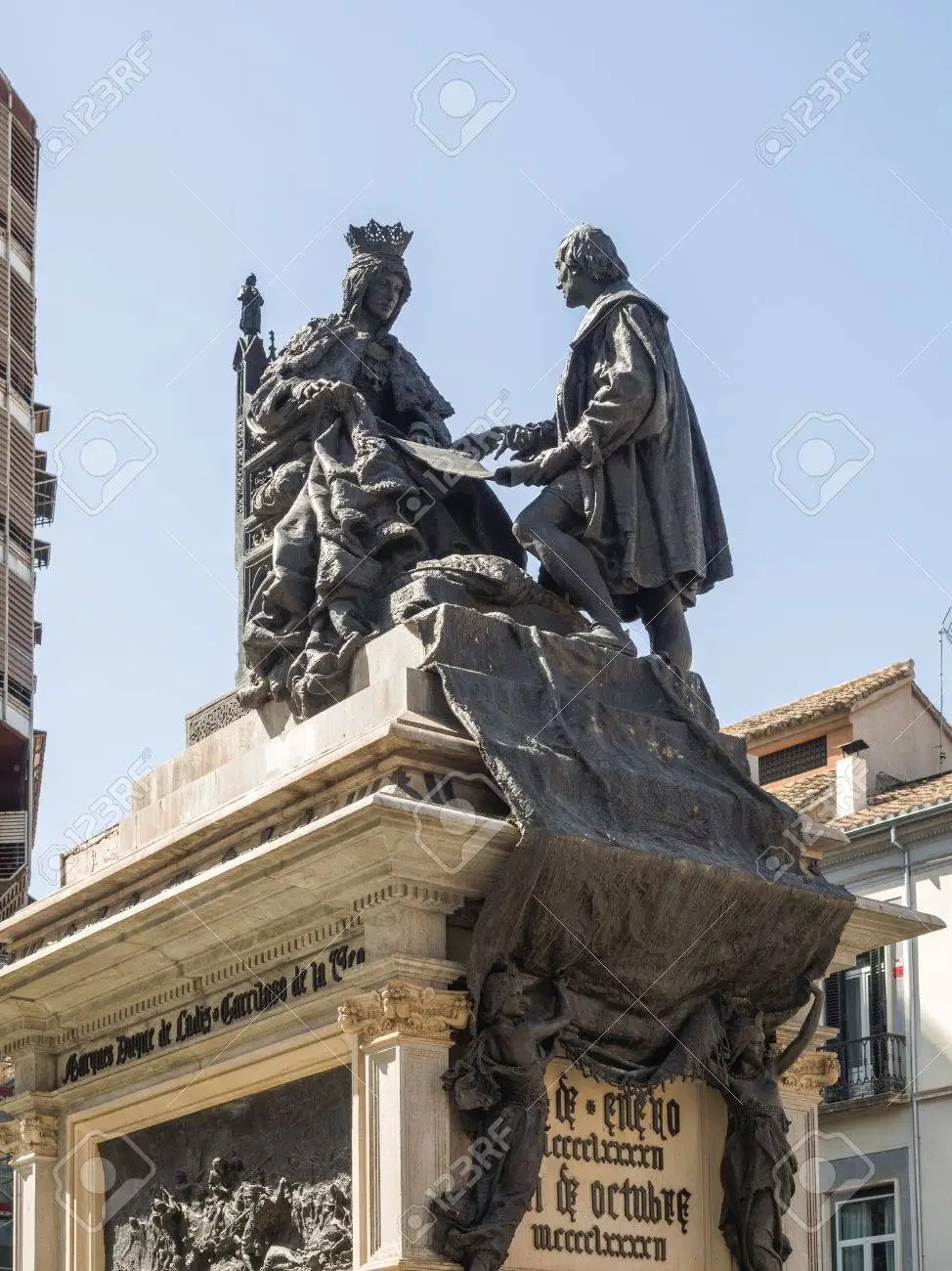
The processions are spectacular. In Granada they wend their way down the Gran Via Colon, past the city’s monstrous cathedral, and passing before the giant statue depicting the “Reyes Catholicos” (Catholic kings) Ferdinand and Isabella (1474-1504) giving permission to Christopher Columbus to embark on his world-changing voyage.  

The processions feature huge golden floats burdened with dozens of enormous flaming candles and centralizing much larger-than-life statues of a regal, purple-clad Virgin-in-mourning, or of crucified and tortured Savior. Clerical types (including women) walk behind the statues dressed in cassocks and surplices and carrying candles, crucifixes, and thuribles that fill the air with fragrant incense.

Each float is borne aloft by perhaps 30 unseen men whose humble identity is concealed by brocaded veils beneath which they perform their shared demonstration of macho strength and endurance. From time to time along the parade route, the anonymous bearers stop, fall to their knees. Then suddenly they arise as a single body to the delight and applause of the adoring crowds.

Others in the procession include participants whose costumes inevitably remind Americans of the Ku Klux Klan. However, their pointed hats, veiled faces, and white or red robes are really signs of penitence by sinners admitting their guilt, but mercifully shielding their identities.

Other processors include black-clad gypsy women carrying long, lit candles in their right hands just below their waists.

All of this is accompanied by band after band of drummers, trumpeters, trombonists, and tuba players. They march to deafening rhythmic beats. Here and there, they stop to play mournful dirges in honor of the suffering Jesus.

Hidden Meanings

All of this is quite beautiful and quaint – that is until you analyze what’s really happening in terms of Spain’s history that includes:

·       The emergence of the nation-state under Ferdinand and Isabella.

·        Their project’s unprecedented political goal, viz., the erasure of diverse Andalusian cultures [including Jews, Visigoth Christians, Muslims, Gitanos, pagan naturalists, (think “witches”], and emerging Protestants of various “heretical” descriptions].

·       To that end, the institution of the Spanish Inquisition (1478-1834)

·       Its infamous persecution of Jews, Muslims, Protestants, gypsies, witches, and “heretics” of all sorts  

·       The folding of all those identities into a single nationalty called “Spaniard,” which had never till then existed.

·       Our contemporary loss of Christian faith and its replacement with the worship of capitalism and its God called “Market.”

In the light of those realities, think about the processional elements earlier described. With their 15th-century historical context in mind:

·       The statue of the regally clad virgin Mary becomes an image celebrating Queen Isabella whose royal robes have nothing to do with the decidedly non-royal mother of the poor construction worker from Nazareth.

·       Those wearing those pointed hats reminiscent of the Klan become persecuted “heretics” wearing “dunce caps” (so named by those ridiculing the 13th century Scottish mystic, John Duns Scotus).

·       The statues depicting the batterers and humiliators of the suffering Jesus become the Jews expelled from Spain by Ferdinand and Isabella and whom Christian tradition blamed as “God killers” instead of Jesus’ real assassin, the Roman Empire.

·       As well, Jesus’ torturers include the dunce heretics par excellence, viz., the hated Moors.

·       The black clad women carrying long lighted candles just below their waists become the witches persecuted by the Inquisition. The candles are phallic symbols of their true purpose in life – viz., giving sexual pleasure to men.

·       The processions’ martial war drums become warnings to the enemies of the Reyes Catholicos (again, Jews, Muslims, heretics, witches, gypsies) to be afraid – very afraid. The crown’s Catholic inquisitors will kill you.

·       The unseen statue bearers become the oppressed artisans and workers who have always borne the burden of supporting royalties and church hierarchies of all types.

·       The secular crowds jamming the Gran Via Colon are believers now transformed into mere “Tourists” who represent for Spain a huge influx of cash in service of the only God that matters, the only we’re left with – Capitalism and Market.

Conclusion

When you think about it, Lent and its Easter conclusion represent the ongoing spiritual struggle that involves us all. The season is bookended by Mardi Gras and Holy Week both of which feature political marches masquerading as parades and processions.

Mardi Gras celebrates the human drive towards happiness and community fulfillment – both of which were embodied in that Nazareth construction worker whose first recorded miracle changed gallons upon gallons of water into the finest of wines. Shrove Tuesday’s parades are joyful, drunken, and highly sexualized. Think of those images of dancers from Brazil. Recall Louis Armstrong and New Orleans jazz.

Happiness, joy, fun.

The second of Lent’s bookends is more somber. It’s what I’ve been describing here – the so-called sublimation of all that’s human and joyful into what’s dark, threatening, serious, churchy, and oppressive. And it’s all performed in the name of religion that contradicts that spirit of water changed to wine at a young couple’s wedding.

Why the change?

The answer’s contained in the politics of it all – then and now. More than anything, Spain’s Holy Week processions are reactionary protests intended to obscure and deny the enriching diversity of human experience. The processions are monuments against variety in national identity, in beliefs, in spiritualities, and cultures. They celebrate the elite. They militate against Jews, Muslims, gypsies, witches, Protestants, workers, artisans, and heretics of all sorts. Their musical background is martial and warlike.  

To the discerning eye, Spain’s Holy Week events are also stark reminders of contemporary culture’s inheritance of Inquisitional intolerance.  Like Ferdinand and Isabella, capitalism and its Market God would flatten out the differences that make us human. No variety called socialism, communism, anarchism, or e.g., China’s “whole process people’s democracy” is permitted. Everyone must conform to the nation-state’s sameness.

When you think about it, that syndrome transforms the crucified and risen Jesus into the patron of oppression.

What a distortion!

Its realization alone might be enough to rescue his message: It’s spring. It’s Easter. Celebrate life, not death. The nation-state is a fraud.    

The Hypocrisy of Non-Religious People Regarding Women

Historical painting altered to show which of those signing the Declaration of Independence were slave holders.

Recently, a valued contributor to OpEdNews (where I’m a senior editor) published an article entitled “The Hypocrisy of Religious People Regarding Women.” In it, he argued that all “revealed” religions, Judaism, Christianity, Islam, Mormonism and Baha’? (sic) are guilty of promoting misogyny.”

They are hypocritical regarding women, he wrote, because of the many “pathetic and damaging examples of misogyny in the Hebrew Bible.”

In support of his argument, he referenced the Genesis story about the first man and first woman (Gen1:26-27 and 2:21-23) and the interpretation of that story by the anonymous author of First Timothy. The latter took the myth to mean that women sinned first and therefore deserve punishment and subjection to men (1 Tim 2:11-14).

Moreover, the author alleged, the hypocrisy of religious people extends far beyond Judaism and Christianity to include Hinduism and Buddhism. Islam was highlighted as especially hypocritical since, he wrote, it encourages husbands to beat their disrespectful or disobedient wives.

To remedy such outrages, our friend called for the replacement biblical teachings with Deism, especially as espoused by the Founding Fathers like Thomas Paine. The Founders, he inferred, were not only champions of women, but adopting their free thought and nonreligious approach to God would save humanity from the social evils hypocritically supported by “religious people.”

In this brief essay, I’d like to respectfully disagree with my OEN colleague. Let me do so by (1) saying a word about hypocrisy, (2) showing the diversity of “religious people,” who are not nearly all guilty of misogyny, and (3) suggesting that Deism as represented by our Founders (including Thomas Paine) is itself deeply embedded in extreme hypocrisy not only towards women, but towards indigenous and black people as well.

Hypocrisy’s Meaning

Here I can be quite brief.

Hypocrisy does not mean “beliefs harmful to others” as my colleague seems to imply. Rather and relative to misogyny, it entails adopting an anti-woman course of action while knowing and even affirming that doing so is wrong. That’s what hypocrisy means – lack of correspondence between one’s professed convictions on the one hand and one’s actions on the other.

This means that proving that all “religious people” are “hypocritical regarding women,” would entail showing that what all of them believe and say about women is insincere. Alternatively, the author s use of the term hypocrisy might suggest that all “religious people” (or maybe just most of them?) mistreat women and hate them (that’s what misogyny means) because of the believers’ religious convictions.

Obviously, such assertions are untrue.

And that brings me to my second point which needs fuller explanation.

Religious Diversity

Here I must make two obvious points. The first is that all “religious people” cannot be tarred with the same brush. And besides, the beliefs of religious people about women and those “revealed texts” are also quite diverse.

That many believers might be hypocritical cannot be denied. However, it’s difficult to identify just who falls into that category (as defined above). It’s risky for anyone who can’t read minds. Perhaps rather than identifying the beliefs of some as hypocritical, it would be better to call them uninformed, immature, or simplistic.

As for religious diversity, one must understand this about religion: It’s just religion.  It’s just part of the intellectual and spiritual makeup of most humans. If they’re hypocrites, religious folks will be religious hypocrites. If they’re conservative and reactionary, their interpretation of their religious books will reflect that. If they’re not, they won’t. The same is true of liberal and radical believers.

Regarding “revelation,” not all religious people share the same convictions. For instance, some religious people think their holy books are magical, inspired, revealed, and/or inerrant – the very word of God.

Many others have a broader understanding of inspiration and revelation. Even if they regard their “holy books” as somehow inspired, they realize that they’ve been mediated through or simply composed by fallible human beings who often write into them their own prejudices e.g., towards violence, misogyny, racism, and/or nationalism.

Critical thinkers anxious to avoid the simplistic prejudice of simply ignoring such differences and tarring all “religious people” with the same brush overlook such uncritical preconceptions. They often end up throwing the baby out with the bath.

The “baby” in this case represents the monumental achievements for which “religious people” have been responsible (precisely as religious) in world history and our own local story here in the United States – even regarding women’s rights.

Remember that the abolitionists were mostly Quakers, i.e., religious people. Moreover, there would have been no Black Civil Rights Movement without black Baptists. More specific to the argument here, neither would the ‘60s and ‘70s have seen the emergence of the women’s liberation movement, or that of gay rights, prison reform, and anti-war demonstrations without the example set by the civil rights activists centered in community churches.

Then, internationally, there are the cases of the Hindu Mahatma Gandhi, who played such a key role in the liberation of India from European colonialism — and his Islamic counterpart, Badshah Kahn (sometimes called the Muslim “Gandhi”). Gandhi so identified with women that he once said, “Mentally I have become a woman. . ..”

It’s also a fact supported by Islamic scholars that Muhammad himself in the early 600s CE was far more a champion of women than his cultural contemporaries. He was responsible for greatly expanding their legal entitlements to include inheritance and property ownership. In contradiction to the customs of his day, he recognized that women have rights within their own marriages.

Additionally, and returning to our own hemisphere, one cannot adequately explain movements in Latin America for social justice (including for women) in places such as in Nicaragua and El Salvador without understanding the impact of liberation theology. To characterize such inspiration as “hypocritical” is insulting to thousands of Christian students, teachers, union organizers, social workers, priests, and nuns who gave their lives because of the inspiration to work for social justice (again, including for women) they found in their faith.

More specifically, think about El Salvador and its martyrs including Oscar Romero, the five women religious murdered and raped there. Think of the team of six liberation theologians (along with their housekeeper and her daughter) assassinated for their “crimes” by members of the Atlacatl Battalion trained in the United States. None of them was a hypocrite. All of them were “religious people.” Many of them were women.

Deist Hypocrisy

And that brings me to my third point. It’s this: Deists among our Founding Fathers were profoundly hypocritical (in the sense defined above). They were especially so towards women, the indigenous, and slaves from Africa. I’m referring to men like Thomas Jefferson, George Washington, Alexander Hamilton, and even Thomas Paine.

We can assert their hypocrisy unmistakably because all of them agreed that “everyone” was created equal. Their writings show for example that they had no doubt that slavery was wrong. Yet, despite their frequent assertions to that effect, most of them continued holding slaves till their dying day.

Similarly, despite their statement about “all men,” they were responsible for the genocide of First Peoples in the land they settled.

And, of course, everyone knows that they refused to recognize women as the equals of men. In fact, it wasn’t until 1920 that women were even allowed to vote. And this country still has not passed the Equal Rights Amendment, much less had a woman fill the office of president. Meanwhile, for example, fully sixteen Muslim countries have voted in women as their head of state.

Conclusion

Yes, there are “pathetic and damaging examples of misogyny in the Hebrew Bible.”

And yes, despite their claims to be “free thinkers” and “rational,” the Deists of the Thomas Paine era also provide equally pathetic and damaging examples of misogyny, genocide, and enslavement of human beings they knew to be the “men” that God created equal to themselves.

Moreover, as revealed in their own writings, the Deists in question fulfilled the definition of “hypocritical” more unmistakably than their religious counterparts. That is, they said that slavery was wrong, but mostly held slaves till their dying day. They prosecuted genocidal wars against millions of First Peoples, even though as “brilliant” and rational free thinkers, they knew the “Indians” were human beings.

And despite the appeals of their own wives (like Abigail Adams), they refused to recognize women’s equality. In other words, they left themselves quite open to charges of being wildly hypocritical misogynists.

In summary, I reiterate to my earlier points. That is, despite the huge generalities in the OEN article “The Hypocrisy of Religious People Regarding Women”:

  • All “religious people” cannot be tarred with the same brush.
  • They are not nearly all hypocritical.
  • In fact, many of them have been champions of women (and the enslaved and indigenous) precisely because of their religious faith.
  • Neither is any religion inherently misogynist, racist, or genocidal.
  • Including Deism.
  • All of them are just religions.
  • If their adherents are misogynist (or racists) their religion will reflect that.

 If not, they won’t.

  • Generalizations about the beliefs of others are not only disrespectful, but they also run the risk of hypocrisy.

“Argentina 1985”: Its Untold Story That Americans Should Know

This Sunday, I’ll be watching the 95th Oscars Ceremony with special interest. That’s because of my concern about U.S. atrocities abroad and the related fact that the nominee for best international film is “Argentina 1985.”

It tells the gripping story behind Argentina’s “Trial of the Junta,” which in 1985 brought to justice the country’s military dictatorship responsible for the prosecution of its infamous “Dirty War” (1976-1984).

Apart from its artistic merits and my already noted focus, the film interested me personally, because precisely in 1985 while I was studying liberation theology in Brazil, my family and I lived under the related military dictatorship for more than six months. We even passed several nights lodged in Rio’s Clube Militar (Military Club), thanks to my Portuguese language instructor in Boulder Colorado whose father was a general in the Brazilian army.

Knowledge of Brazil’s then-recent history, its 1964 military coup, and its prosecution of liberation theologians made the Clube a scary place. We all knew the days of Brazil’s junta were numbered too. So, what was happening in Argentina sparked deep thoughts about a coming day of reckoning further north.

With all of that in mind, let me recommend “Argentina 1985,” point out a key omission relevant to North Americans, and indicate some of the film’s implicit and salutary political portents for us all. (Spoiler alert!)

Argentina 1985    

“Argentina 1985” is dark and gripping. It’s about fascism, government corruption, absolute cruelty, torture, death squads, bomb threats, child abuse, propaganda, and citizen intimidation.

At the same time it’s the cinematically familiar story of a reluctant leader who turns a group of unprepared and unlikely players into an unstoppable team eventually victorious over an invincible foe.

At the film’s outset team members are introduced one after another. We find them naïve, idealistic, practical, wise, funny, focused, and hard working in the extreme. Perhaps its most effective unofficial member is the main character’s pre-teen son who comically demonstrates wisdom and savoir faire far beyond his years.  

The film’s real hero though is Julio Cesar Strassera, Brazil’s Chief Prosecutor. He’s aided by his young Assistant Prosecutor, Luis Moreno Ocampo who’s constantly worried about his mother’s opinions. She’s extremely conservative and a loyal supporter of Argentina’s military. She’s Catholic and a co-parishioner of one of the junta’s main defendants.

Together Strassera and Ocampo guide their young team (despite crippling time restraints, death threats, and bomb scares) in fulfilling their superhuman task of gathering an overwhelming number of testimonies from hundreds of Dirty War eyewitnesses, victims, and their family members.

The dramatic result portrayed convincingly in “Argentina 1985” is a whole series of moving accounts of torture, rape, and murder. Responsibility for all those crimes is inexorably laid at the doorstep of the country’s military dictatorship.

Toward the film’s conclusion, after hearing Strassera’s summarizing argument, most audience members, I’m sure, feel (as I did) like joining the packed Argentine courtroom in its ovation of thunderous applause. That feeling of vindication is reinforced when the worst of the accused generals receive severe sentences including life behind bars.

What’s Not Told

Unfortunately for North American audiences, what’s not told in “Argentina 1985” is the key role that the United States government played in that sad country’s Dirty War. That’s unfortunate because the omission allows U.S. viewers to experience the film as exclusively about Argentinians and not about us. Consequently, as we’ll see presently, casual viewers likely miss the salutary lessons the film contains for viewers like us.

Let me be specific.  

According to US archives, the United States government aided Argentine generals throughout the dictatorship’s bloody time in office. That means that Henry Kissinger’s hands are red. But so are Jimmy Carter’s and Ronald Reagan’s.

The blood in question belonged to more than 30,000 Argentinians. It was an old U.S. story about supporting fascistic right-wing forces employing a scorched earth policy against leftists. The idea was to kill everyone who might possibly be on “the other side.”

The resulting victims included teachers, student activists, indigenous leaders, union organizers, social workers, radical clergy, and nuns, along with their friends and family members who might have been influenced by their ideas, words, and examples. Most of these were identified as suspected communists, socialists, subversives, guerrillas, and terrorists.

It was all part of Operation Condor, a U.S.-backed anti-leftist campaign that from 1975 to 1989 wreaked havoc throughout Latin America, especially in Argentina, Uruguay, Chile, Paraguay, Bolivia, and Brazil. Conservative estimates say the Operation took 60,000 to 80,000 lives in the Southern Cone. Condor involved a series of military coup d’états within the countries just named.

In those contexts, the U.S. role was to plan the campaigns and coordinate them across national boundaries. The Ford, Carter and Reagan administrations also provided the dictatorships in question with military training, economic assistance, and technical instruction including methods of kidnapping and disappearance, assassination, the use of torture, and the operation of death squads. In Argentina, hundreds of babies were taken from imprisoned and disappeared female victims only to be “adopted” by associates of the ruling generals.

An indispensable element of Operation Condor was near total control of the mass media for purposes of disseminating pro-regime propaganda. The latter consistently described the relevant countries as under siege. It attempted to garner public support by invoking nationalism and patriotism against “criminal” subversives threatening revolt and chaos. Pro-regime media encouraged citizens to report any suspicious activities on the parts of their neighbors.

And yes, “Argentina 1985” is right. All of this came to light in 1983 when democracy was restored in Argentina. It was then that the new government established the National Commission for Forced Disappearances (CONADEP). That commission eventually engaged Chief Prosecutor Strassera and his team of young lawyers and volunteers to collect testimony from hundreds of victims and witnesses. In the process, the investigators were able to identify by name the leaders of the dictatorship’s death squads and torture centers. As well, Strassera’s team documented the existence of hundreds of secret prisons and detention gulags throughout the country.

Eventually, in 1985, enough evidence had been gathered to present a convincing case before the “Trial of the Juntas.” Again, this was correctly depicted in “Argentina 1985.” As described in the film, the trial convicted the dictatorship’s top officers with many of them receiving sentences of life in prison.

All of that was in 1985. However, just four years later, Argentine President Carlos Menem pardoned the powerful convicts in what he described as an act of “healing and reconciliation.”

So much for Strassera’s victory.

Lessons for U.S. Viewers

In the light of the film’s information and omissions, here are just a few of the valuable lessons it contains:

  • It could happen here! I mean, I’m sure you’ve noticed our country’s creeping fascism. And if you’ve read e.g., Jonathan Katz’s Gangsters of Capitalism, you know that fascism has always been popular among the U.S. elite. In fact, at the moment, they seem on the verge of taking over even formal control.
  • Atrocities wreaked abroad have their way of returning home to plague those not paying attention to history or foreign policy.
  • It’s totally dangerous to revere the military. Their job is to kill people and destroy their property – usually quite indiscriminately. They are protectors of the status quo. They are not our friends. It’s not hard to imagine U.S. soldiers or police torturing you or your children tomorrow. Ask Chelsea Manning or Julian Assange.
  • The laudable ideals of “healing and reconciliation” and even nonviolence are typically weaponized by the powerful to benefit them and override more important democratic values such as justice, equal standing before the law, and legitimate self-defense.
  • The powerful rarely pay for their crimes. Impunity is their rule.
  • Since they are owned by the rich and powerful, the mass media (MSM) cannot be depended upon as reliable sources of information. Like the military, MSM presenters are not our friends.
  • Most often, the young and inexperienced are better servants of truth than the “veteran” old who have been co-opted by the unjust systems that bought-and-paid-for governments represent.
  • Our government is no better than the ones it arms and supports.

With all of this in mind, be sure to watch “Argentina 1985.” And let it be a lesson about history and U.S. atrocities. Let it also be a forewarning.

International Women’s Day: The U.S. Role in Repressing Afghan Women

This is International Women’s Day. And what was once my favorite news program, Amy Goodman’s “Democracy Now” (DN) was full of relevant coverage. One of the featured pieces was entitled “Stand up for Afghan Women”: U.N. Calls Afghanistan World’s Most Repressive Country for Women, Girls.” The piece lamented the sad situation plaguing Afghanistan’s female population.

By now the story has become familiar: women required to wear hijabs, girls excluded from schools, and both forbidden to drive cars, work outside the home, or to travel without male accompaniment.

And all of this decried by the United States government which is, we’re told, the champion of women’s rights not only in Afghanistan but throughout the Muslim world.

The problem however with that picture is that the last part is false. That is, far from being the champion of women’s rights in Afghanistan, the United States is the one ultimately responsible for their oppression in that sad country and elsewhere.

In effect, the U.S. is the creator of the Taliban which in 1992 overthrew the Russian-sponsored socialist government that beginning in 1973 freed Afghan women from the repressive restrictions just referenced.

More specifically, supported by the Soviet Union, the so-called “Saur Revolution” improved immeasurably the lives of Afghan women. It introduced progressive policies including land reform and mass literacy projects that benefitted both genders. Child marriage was abolished. Female dress codes were eliminated, freeing women to wear western clothing if desired.

Under socialism, formerly closed employment opportunities for women were opened in both the public and private sectors. Women were allowed to enter schools at all levels. They became university professors, government officials, doctors, nurses, lawyers, judges, parliamentarians and more. In record time, women comprised 50% of the government’s bureaucracy, 70% of the country’s teachers, and 40% of its doctors. Sixty percent of the faculty at Kabul University (KU) were females. For the first time in Afghanistan’s history, women comprised most of the KU student body.

All of that was reversed by United States now familiar divide-and-conquer regime change strategies – this time in Afghanistan. Alarmed by socialism’s advance, Jimmy Carter’s national security advisor Zbigniew Brzezinski saw that Saur progressive reforms though popular in urban centers were not well-received in rural tribal areas. So, he decided to support the landlords, warlords, and religious mullahs there to work regime change in Kabul.

The assistance included the Carter administration’s arming and training Islamic fundamentalists (the Mujahidin) beginning in 1979.

That movement eventually drove from power Afghanistan’s progressive socialists (along with their Russian supporters) with their women-friendly policies. Eventually too, the Mujahidin morphed into the Taliban.

We know the rest of the story:

  • 20 years of U.S. occupation and bombing of Afghanistan
  • With the expressed intent of preventing the Taliban from returning to power
  • But leading directly to the deaths of more than 250,000 Afghans
  • With the same number of deaths caused indirectly
  • Including (between 2015 and 2019 alone) more than 26,000 Afghan children
  • Along with the creation of over 2.2 million refugees.

We also know about:

  • Last year’s chaotic U.S. departure from the country
  • The immediate return of the Taliban to power
  • And the subsequent application of U.S. sanctions
  • That are currently causing an unprecedented humanitarian crisis that affects women and their children much more than the Taliban officials.

Everybody knows, of course, that all of this is intentional. The real target of U.S. sanctions is not the Taliban government. No, it’s all part of our government’s familiar regime change strategy aimed at making the lives of ordinary people (including women and children) so miserable that they will arise and overthrow their government.

We shouldn’t be fooled by any of it. Instead, (especially on this International Women’s Day),  we should face up to the fact that the United States government doesn’t give a damn about women’s rights either abroad or at home.

At home, its Christian Taliban wing led by its SCOTUS Catholics, Donald Trumps, Ron DeSantises, and Marjorie Taylor Greenes would entirely control women’s bodies and their reproductive rights from the exclusion of sex education to the outlawing of contraception and abortion. Remember that for more than 50 years, “America” has found itself unable to officially recognize that under the Constitution, women have the same rights as men.

In summary, while portraying Muslim-majority countries as inherently misogynistic, U.S. government propaganda and even news sources like “Democracy Now” ignore the fact that the United States was responsible for overthrowing Afghanistan’s progressive governments attempting to improve the lives of its women.

In other words, history shows that our government is as misogynistic as the forces it sponsors.

Marianne Williamson Should Go for Broke As The Peace Candidate

Readings for the Second Sunday of Lent: Genesis 12: 1-4A; Psalms 33: 4-5, 18-22; 2nd Timothy 1: 8b-10; Matthew 17: 1-9

On this Second Sunday of Lent and in the context of the Ukraine conflict, I want to return to the topic I addressed in last week’s homily – Marianne Williamson’s apparent sell-out to western warmongers in her position paper called “The Tragic Conundrum of Ukraine.”

Since then, Ms. Williamson has become the first Democrat to declare her candidacy to unseat Joe Biden as President of the United States. Yes, it’s official; she’s running again for president.

My point in what follows is this: For Williamson to have even the least chance of achieving her goal, she must go for broke. She must reverse her position on the Ukraine war and declare herself in no uncertain terms THE PEACE CANDIDATE.

Doing so would not only separate Williamson from Biden and the others who will eventually enter the 2024 race. More importantly, it would align her more securely with the principles of her own spiritual guidebook, A Course in Miracles (ACIM). As well, it would embody the example of Yeshua (the voice ACIM claims to channel) as reflected in today’s Gospel reading. There following what we’ve come to see as his “transfiguration,” Yeshua too decides to go for broke in his opposition to imperialism.

My point here is that to garner any meaningful notice as a candidate, Williamson needs to spiritually transfigure as well.

To show what I mean, let me (1) address Williamson’s candidacy as it relates to the war in Ukraine on the one hand and to ACIM on the other, (2) recall Yeshua’s adoption of a “go for broke” strategy in opposing Roman imperialism, and (3) recommend a similar strategy for Williamson if she truly wants to be a player in 2024.

Williamson & ACIM

First, recall who Marianne Williamson is and how easily she will be dismissed if she continues endorsing business as usual by adopting “the official story” and conventional wisdom about Ukraine as expressed in her “Conundrum” statement: She’s the one:

  • Dismissed by many as a “vanity candidate” intent only on selling books.
  • Characterized as “new agey, soft, and unrealistic.”
  • Portrayed by SNL’s Kate McKinnon as “woo-woo,”
  • And as one who would address political problems by burning sage and manipulating crystals.
  • Ridiculed for alleging that “a dark psychic force” has made us all victims of collectivized hatred advanced by Donald Trump.

This time around, the same accusations will inevitably surface again unless Williamson does something authentic to distinguish her from Biden and the neocons and their bellicosity on Ukraine.

Instead, however, her statement on the war aligns itself with the largely white “West” (13% of the world’s population) as if it rather than the world’s mostly non-white majority “knows better.” She says, for instance,

“I believe there is legitimate justification for military support for Ukraine from Western allies, including the United States.” And “. . . Vladimir Putin’s actions today are a threat to which the Western world must now respond.” (Emphasis added).

One wonders why this emphasis on the largely white west. Again, does it somehow know better than mostly non-white cultures (e.g., in China and India) that have developed insights, wisdom, and spiritualities based on experiences thousands of years older than our own?

Does this western centrism represent an unconscious hangover from the colonial past that has enriched “the west” and impoverished the rest?

But more especially, how explain Williamson’s apparent rejection of the most obvious teachings of A Course in Miracles, which she has championed for decades?

Here’s what I mean. According to A Course in Miracles:

  1. Its teachings are basically Christian mysticism that finds the root of all problems in a skewed relationship with God – or Source, the Ground of Being, the Great Spirit, the Tao, Brahmin, Allah, Life, Cosmic Consciousness, etc.
  2. That mysticism also reveals that “America” is not an exceptional nation. (Or as Ms. Williamson is fond of putting it “No one is special, and everyone is special.”)
  3. Instead, all of us are living in a pseudo-reality reminiscent of Plato’s Cave, where prisoners mistake shadows manipulated by their keepers for reality far removed from the real world.
  4. Consequently, what the dominant culture accepts as “reality” is actually 180 degrees opposite the Truth.
  5. Its upside-down “reality” is rooted in fear, greed, dishonesty, and violence.
  6. This means that while the prevailing culture would blame our problems on others (like Russia), the Truth is that we (the United States) are 100% responsible for our own “conundrums.”
  7. Facing and correcting our own behavior are necessary first steps in solving any dilemma or conflict.
  8. Such inventory and rectification reveal that no one is attacking us. Instead, we are the attackers.
  9. Recognizing all of this is the key to peace.  
  10. It embodies the miraculous in the ACIM sense of “a radical transformation of consciousness.”

Now, imagine if Marianne Williamson’ presidential campaign emphasized those ten points. It certainly would get attention. It would separate Williamson from the homogenized gaggle of candidates. It would raise the essential questions that no one dares raise. It would mark Ms. Williamson as a true leader worth following.

What I’m saying here is that unless Williamson finds the courage to go for broke by embracing the principles that she has taught for so many years and by identifying as The Peace Candidate, she’ll be lost in the shuffle. She’ll be ridiculed and dismissed once again.

Yeshua Goes for Broke

Today’s Gospel reading presents Jesus as setting an example Marianne Williamson would do well to follow. By resolving to take a leading part in a Passover demonstration against Jewish cooperation with imperial Rome, Yeshua risks it all.

Think about it.   

Today’s reading finds the young construction worker from Nazareth on his way to Jerusalem, where he knows something extremely risky is about to happen. Yet he’s determined to be part of it. The risky action has to do with the temple and opposing the collaboration of its leaders with the Roman Empire.

The temple has become worse than irrelevant to the situation of Yeshua’s people living under Roman oppression. What happens there not only ignores Jewish political reality. The temple leadership has become the most important Jewish ally of the oppressing power. And Jesus has decided to address that intolerable situation despite inevitable risks of failure.

Everyone knows that a big demonstration against the Romans is planned in Jerusalem for the weekend of Passover. There’ll be chanting mobs. The slogans are already set. “Hosanna, hosanna, in the highest” will be one chant. Another will be “Hosanna to the Son of David!” “Hosanna” is the key word here. It means “save us!” (The Romans won’t notice that the real meaning is “Save us from the Romans.” “Restore an independent Israel – like David’s kingdom!”) It was all very political.

Yeshua has heard that one of the main organizers of the demonstration is the guerrilla Zealot called Barabbas. Barabbas doesn’t call what’s planned a “demonstration.” He prefers the term “The Uprising” or “the Insurrection” (Mk. 15:6-8).

Barabbas has a following as enthusiastic as that of Yeshua. After all, Barabbas is a “sicarius” – a guerrilla whose solemn mission is to assassinate Roman soldiers and their Jewish collaborators. His courage has made him a hero to the crowds. (Scripture scholar, John Dominic Crossan compares him to the Mel Gibson character in “The Patriot.”)

Yeshua’s assigned part in the demonstration will be to attack the Temple and symbolically destroy it. He plans to enter the building with his friends and disrupt business as usual. They’ll all loudly denounce the moneychangers whose business exploits the poor. They’ll turn over their tables.

As a proponent of nonviolence, Yeshua and his band are thinking not in Barabbas’ terms of “uprising,” but of forcing God’s hand to bring in the Lord’s “Kingdom” to replace Roman domination. Passover, the Jewish holiday of national independence could not be a more appropriate time for the planned demonstration. Yeshua is thinking in terms of “Exodus,” Israel’s founding act of rebellion.

And yet, this peasant from Galilee is troubled by it all. What if the plan doesn’t work and God’s Kingdom doesn’t dawn this Passover? What if the Romans succeed in doing what they’ve always done in response to uprisings and demonstrations? Pilate’s standing order to deal with lower class disturbances is simply to arrest everyone involved and crucify them all as terrorists. Why would it be different this time?

So before setting out for Jerusalem, Yeshua takes his three closest friends and ascends a mountain for a long night of prayer. He’s seeking reassurance before the single most important act of his life. As usual, Peter, James and John soon fall fast asleep. True to form they are uncomprehending and dull.

However, while the lazy fall into unconsciousness, the ever alert and thoughtful Yeshua has a vision. Moses appears to him, and so does Elijah. (Together they represent the entire Jewish scriptural testament – the law and the prophets.) This means that on this mountain of prayer, Yeshua considers his contemplated path in the light of his people’s entire tradition.

According to the Jews’ credal summary in Deuteronomy 26, their whole national story centered on the Exodus. Fittingly then, Yeshua, Moses, and Elijah “discuss” what is about to take place in Jerusalem. Or as Luke puts it, “And behold, two men were conversing with him, Moses and Elijah, who appeared in glory and spoke of his exodus that he was going to accomplish in Jerusalem.” Yeshua’s Exodus!!

It is easy to imagine Moses’ part in the conversation. That would be to remind Yeshua of the chances Moses took when he led the original Exodus from Egypt. That might have failed too. Nevertheless . . .

Elijah’s part was likely to recall for Yeshua the “prophetic script” that all prophets must follow. That script has God’s spokespersons speaking truth to power and suffering the inevitable consequences.

Elijah reminds Yeshua: So what if Barabbas and those following the path of violence are defeated again? So what if Yeshua’s nonviolent direct action in the temple fails to bring in the Kingdom? So what if Yeshua is arrested and crucified? That’s just the cost of doing prophetic business. Despite appearances to the contrary, Yeshua’s faithful God will somehow triumph in the end.

Conclusion

Is there a message in today’s reading for Marianne Williamson, who is undoubtedly the best equipped public figure to take on the essentially spiritual role of Peace Candidate?

I think there is.

The readings call her to:

  • Insist that we’ve indeed all be grasped by a “dark psychic force” that ignores shared humanity and sees war as a first option rather than as a last resort.  
  • Be transfigured into 2024’s Peace Candidate by heeding Moses, Elijah, and Yeshua, the champions of her native Jewish faith.
  • Be transformed as well by listening to the world’s non-western, mostly non-white majority and their reluctance or downright refusal to endorse U.S. insistence on controlling the world far from its own shores.
  • Recognize that in line with the teachings of A Course in Miracles, the U.S. and NATO are 100% responsible for the Ukraine crisis.
  • Call for an immediate ceasefire and diplomatic negotiations to end the war.
  • Go for broke by ignoring those who will characterize her opposition to the war as naïve and unrealistic – as if risking nuclear annihilation were more sophisticated and mature.
  • Truly embrace the teachings of A Course in Miracles that identifies the source of peace in its refusal to be frightened by non-existent threats and attacks.
  • Or as The Course puts it: “Nothing real can be threatened. Nothing unreal exists. Herein lies the PEACE of God.” (Emphasis added)