More than a year ago, OpEdNews’ visionary editor-in-chief, Rob Kall, started a project called the Arc of Justice Alliance (AJA). Its original intent was to offer a progressive alternative to the Republican Project 2025. The latter’s goal is to reduce the federal government to a size (in the words of Republican operative Grover Norquist) that could be drowned in a bathtub.
The AJA agenda would rescue democracy from Norquist’s tub.
But what exactly might that mean in a political environment where the old slogans no longer persuade anyone. Frankly put, “defending democracy” sounds hollow when millions increasingly suspect that what we call democracy has already been purchased, managed, and stage-directed by forces far beyond ordinary citizens’ control.
What I intend to argue here is that if the AJA hopes to become more than another mildly progressive pressure group orbiting around a dying Democratic Party, it must become far more radical in addressing the fact that in terms of “democracy,” the United States is a failed state. It must reform to a system more closely resembling China’s “whole process democracy.”
A Failed Epstein State
Facing America’s failure might be uncomfortable. However, the facts speak for themselves. “Our” country is not governed primarily by its voters. Instead, it is run by what might best be called the Epstein Class.
By that phrase I do not mean only the disgraced financier Jeffrey Epstein himself. Epstein has become symbolic of something much larger — a transnational ruling network of billionaires, intelligence operatives, media owners, financiers, weapons contractors, corporate monopolists, and political fixers whose power transcends elections and party labels.
Others call this network the “Deep State.” But that term can become too vague or conspiratorial. “Epstein Class” points more directly to the fusion of wealth, secrecy, sexual compromise, surveillance, and political immunity characterizing elite power in late capitalism.
The point is not that every billionaire belongs to a secret cabal meeting in underground bunkers. The point is structural. Wealth itself has become sovereign. Under contemporary capitalism, money no longer merely influences politics. It governs politics.
This is why elections change so little.
Wars continue regardless of campaign promises. Wall Street remains untouchable. Pharmaceutical corporations write healthcare policy. Silicon Valley harvests personal data with almost no restraint. Intelligence agencies operate beyond meaningful democratic oversight. Billionaires evade taxes while homelessness explodes beneath the skyscrapers they own.
And yet we are constantly told we live in “the world’s greatest democracy.”
The AJA should challenge that phrase directly.
Because what if the central political issue of our time is not “democracy versus dictatorship,” but rather which class exercises dictatorship?
That was, of course, the insight of Karl Marx. Marx argued that every state ultimately serves one ruling class or another. Under capitalism, democratic institutions often mask what is essentially the dictatorship of wealth. We live under the dictatorship of the Epstein Class.
In America today that dictatorship increasingly stands exposed.
China’s Democracy
Ironically, this is where China enters the conversation in ways many Western progressives still fear to acknowledge.
Western media constantly portrays China as authoritarian. And certainly, the Chinese Communist Party exercises centralized authority in ways foreign to American political culture. But the deeper question is rarely asked: centralized authority on behalf of whom?
China’s defenders argue that the CCP, whatever its flaws, governs primarily in the interests of long-term national and collective development rather than in the interests of an unrestrained billionaire oligarchy.
One need not romanticize China to recognize the force of that claim.
Over the last forty years China has lifted hundreds of millions out of poverty, constructed immense infrastructure systems, expanded public transportation, modernized entire regions, and maintained long-range national planning capacities almost unimaginable in the contemporary United States.
Meanwhile America’s political system appears increasingly incapable of governing at all.
Bridges collapse. Infrastructure decays. Healthcare bankrupts families. Universities drown students in debt. Entire cities become unaffordable. And yet the billionaire class accumulates wealth on a scale previously unimaginable in human history.
This is why the AJA must begin questioning not simply particular policies, but the very definition of democracy itself.
China’s political system offers at least one important conceptual challenge through its notion of “whole-process democracy.”
Whole Process Democracy
To Western ears the phrase often sounds like propaganda. But its underlying critique of Western liberal democracy deserves serious attention.
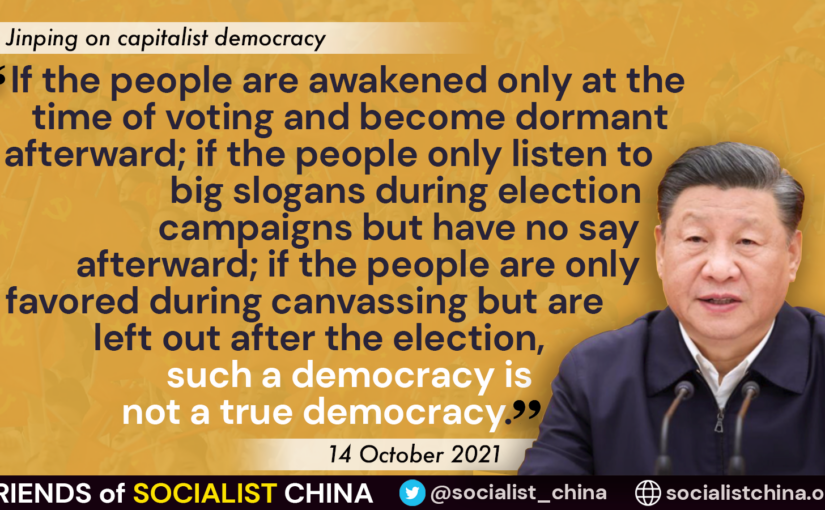
Western democracies generally define democracy procedurally: elections, competing parties, free speech, and formal civil rights. Chinese political theory argues that such democracy is incomplete because it leaves economic power largely untouched.
What good is voting, Chinese critics ask, if billionaires own the media, shape public consciousness, finance political campaigns, dominate economic life, and effectively dictate policy no matter which party wins office?
Chinese “whole-process democracy” proposes that democracy should involve continuous public participation throughout governance — consultation, planning, implementation, supervision, and evaluation — not merely occasional voting rituals.
Equally important, Chinese theorists insist democracy must be evaluated not only by procedures but by outcomes: poverty reduction, healthcare, infrastructure, education, housing, stability, and collective well-being. In other words, Chinese democracy is not procedural; it is consequentialist.
Again, one need not idealize China to recognize how devastating this critique becomes when applied to the United States.
Because by those standards, America’s democratic system increasingly looks dysfunctional and oligarchic.
The AJA should say this openly.
Practical Goals
Indeed, the Alliance should become one of the few organizations in the United States willing to demand a redefinition of democracy itself.
That redefinition would begin by acknowledging at least four realities.
- Democracy cannot exist where billionaires dominate the economy, media, intelligence structures, and political system simultaneously.
- The “free market” has evolved into a form of private tyranny insulated from democratic accountability.
- What Americans call “freedom” increasingly means freedom for oligarchs to exploit, speculate, surveil, monopolize, and destabilize society itself.
- A functioning democracy requires some form of permanent public authority strong enough to restrain oligarchic power.
This last point is especially difficult for Americans because our political culture has long distrusted centralized authority. Yet history increasingly suggests that Norquist’s bathtub and Project 2025 did not eliminate concentrated power. It merely transferred power into private hands.
Democracy w/ Chinese Characteristics
China’s concept of “socialism with Chinese characteristics” emerged precisely from this recognition. The “Chinese characteristics” refer not only to economics but to China’s deep civilizational traditions emphasizing social harmony, collective responsibility, long-term planning, and state obligation toward public welfare.
Influenced by centuries of Confucius and Confucian political philosophy, Chinese political culture traditionally viewed government not as a neutral referee between competing private interests, but as guardian of social balance and national continuity.
That outlook was reinforced by China’s traumatic “Century of Humiliation,” when foreign powers fragmented, occupied, and exploited the country. From the Chinese perspective, weak government invited chaos, colonization, and national disintegration.
Consequently, modern China developed a system combining market activity with strong state direction over finance, infrastructure, industrial policy, and long-term development.
In this, western critics see authoritarianism. Many Chinese citizens see protection against billionaire fragmentation and social collapse.
Conclusion
The AJA need not endorse every aspect of the Chinese model. But it should have the courage to learn from it.
At minimum, the Alliance should recognize that what presently exists in the United States is not genuine democracy but governance by the Epstein Class — a billionaire oligarchy shielded by intelligence systems, media control, campaign financing, and corporate monopolization.
And once that truth is acknowledged, new political possibilities emerge. Those possibilities include:
- Recognition that the real enemy of democracy is the Epstein Class that must be controlled and directed towards serving the rest of us.
- This means that democracy should no longer mean merely choosing between competing representatives of the same donor class every four years.
- Instead, it should mean collective power over finance, healthcare, media, technology, housing, infrastructure, and long-term social priorities.
- In summary, democracy should mean subordinating wealth to human need rather than subordinating human beings to wealth.
The bottom line here is that the central struggle of our century will not be between democracy and dictatorship at all. It is a contest between the dictatorship of billionaire capital and some new democratic form of collective public authority capable of restraining it.
If the Arc of Justice Alliance truly hopes to change America, it must become bold enough to say so. It must directly confront anti-Chinese propaganda and be willing to learn from Chinese experience.

