It may surprise readers of this blog to find out that I’m currently studying Tarot. Yes, I am. My busker friend, Simon, here in Andalusia got me interested by introducing me to the work of Ruth Rodriguez Sotomayor, the great Ecuadorian scholar of “The Precursors of Printing.”
Sotomayor’s work calls us to value “texts” that preserve the wisdom, philosophies and worldvisions of humans before the invention of the printing press — and of those after its invention who had not yet learned to read.
Tarot cards (which first appeared in the 15th century) fall into the latter category. They form a kind of book expressing a profound spirituality of preliterate people in the various cultures which produced them. In Joseph Campbell’s terms, the book in question describes a hero’s journey from ignorance to complete self-consciousness.
And that’s a story we all need in this post-religious age. Please take time to view the video at the top of this posting. Then read the comments that follow. They reveal the absolute hunger that our American contemporaries experience for deep spirituality and how sincerely those who have rejected organized religion respond to the message of the Tarot book.
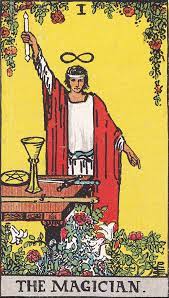
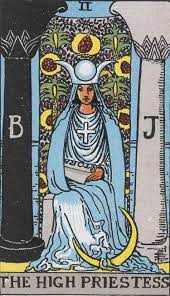
What I’m claiming is that Tarot cards remain an invaluable tool for navigating the mysteries of one’s life. The 21 “Major Arcana” (Magician, Priestess, Empress, Emperor, Hierophant, Lovers, Charioteer, Justice, Hermit, Wheel of Fortune, Strength, Hanged Man, Death, Temperance, Devil, Tower, Stars, Moon, Sun, Judgment, and World) represent that life in general as stages in “The Fool’s Journey.”
Here, the Fool represents every man and woman. We are all fools, the cards disclose, in the process of discovering our deepest Self as a blend of divine characteristics embodied in the Magician and Priestess. That’s what the Fool discovers in his/her paradigmatic trek. At the end, s/he stops being a fool and assumes a more evolved identity as a Knight or Female Warrior continuing an evolutionary journey beginning with his/her cyclical return to the castle of the King-Father and Queen-Mother.
The 58 “Minor Arcana” depict that subsequent evolution as the Female Warrior and/or Knight secure deeper understandings of their relationships to Source, other human beings, to ideas and to work. In the end, they employ their inherent Divine Energy to establish dominion in those more specific realms while appropriating their unconscious identity as royal kings and queens.
Let’s review the entire process card by card. Here are the first six. I’ll survey the rest in subsequent postings.
Fool’s Journey
According to Tarot’s numerology, the Fool has no number. He is a zero, a clean slate. He is naïve, over-confident, daring, and bordering on stupid. He starts out confidently on his life’s path completely unaware of his True Identity as a blended Magician and Priestess. Notice how confidently he is about to step off a cliff’s edge despite the warnings of his dog:
His/Her Unconscious Magician: This second card represents the Fool’s true (but unconscious) masculine identity – dynamic, muscular, gifted, capable, and commanding. The Magician understands and creatively harmonizes himself with Life’s four elements of fire, water, air, and earth, along with its fifth element (its quintessence) of God’s Enabling Energy (or “grace”).
2. Her/His Unconscious Priestess: This third card expresses the Fool’s true (also unconscious) female identity – pure feminine energy seated at the gates of Solomon’s Temple guarding the secrets of divine power. She is receptive and listening. Like the Magician, she is the Fool’s mentor and teacher. She gives the Fool ancient scrolls to explain how to use the Magician’s gifts of fire, water, air, and earth. Above all, she teaches the Fool how to use his or her intuition
3. The Empress (the external expression of the Fool’s inner Priestess): She embodies the Fool’s experience of earthly mother (or mother figure). She is nurturing, unconditionally loving, generous, and giving.
4. The Emperor (the external expression of the Fool’s inner Magician): He depicts the Fool’s experience of earthly father (or father figure). He guides, directs, and sets boundaries.
5. The Hierophant (Pope): The Fool eventually leaves home and encounters the Hierophant from whom s/he seeks guidance in a first encounter with formal education and organized religion. Under this influence, the Fool learns what it’s like to be part of a collective.
As I said, subsequent postings will review the remaining Tarot cards.
Recently, my friend Simon the street musician (who is acting as my Spanish coach) loaned me a book called El Gran Libro Practico del Tarot (The Great Book of Tarot Practice). It offers a detailed introduction to the use of Tarot cards as sources of popular wisdom and prediction of future events.
Simon himself is trying to become expert in tarot – as an alternative source of employment should what he calls the “puta policia” (the effing cops) confiscate his guitar (again!) or should he otherwise be deprived of his current livelihood.
Of course, I was skeptical of the entire project.
Instead, however, I found Simon’s book fascinating. My thought quickly connected it with the work of Franz Hinkelammert, my teacher and colleague at Costa Rica’s Departamento Ecumenico de Investigaciones – the liberation theology think tank where Peggy and I studied off and on since 1992. I thought particularly of Franz’s book called The Critique of Mythological Reason.
In its light, I saw tarot cards as representing valuable attempts to draw together common mythological elements found in religions across the planet (e.g., in Egypt, India, China, among indigenous peoples and in the European west) and in various historical periods, for purposes of making sense of shared human experience. That in itself made the cards precious.
More than that however, I perceived their power to lead practitioners to either surrender to (political and spiritual) forces beyond their control or as empowering them to resist those forces precisely as subjects challenging control by concepts of “normality,” by scientific determinism, or by narrow moralities, legal restrictions, emperors, or popes.
In the latter (Hinkelammertian) sense, Tarot cards can lead practitioners to own the fact that their nonconformity is not “crazy,” and that:
Their mythological and religious traditions commonly rejected by “enlightened” post-moderns are instead highly valuable and liberating.
Practitioners are themselves “magicians” empowered to change “reality” itself so that it benefits human beings and their desire to live and to live well.
They (not those ruling by some fictitious “divine right”) are royalty – empresses and emperors empowered to create a world with room for everyone not just the ruling elite.
They are similarly priestesses and popes “infallibly” empowered to determine their own spirituality independent of ecclesiastical officials
Particularly when precisely as conscious subjects combining feminine and masculine loving energies, they join their complementary powers
To create a world shaped by faith, hope, love, prudence, justice, fortitude, and temperance
And not by “establishment” (capitalist) values of pride, covetousness, lust, anger, envy, sloth, and gluttony.
Such creation entails doing battle with internalized cultural values and with powers and principalities determined to squash holy nonconformity.
To communicate these simple truths, Tarot cards employ images expressing popular understandings of geography, physics, astronomy, astrology, psychology, and (above all) religion and spirituality with their complex interpretations of numerology and color. The cards invite heightened sensitivity to history, poetry, art, music, image, metaphor, simile, the invisible, unpredictable, and ineffable. Each tarot card yields a meaning that corresponds to the degree of sensitivity to such elements attained by its reader.
With all of this in mind, practitioners find the western world of tarot populated by allusions to Greek Gods, the underworld, heaven, angels, devils, saints, and familiar biblical stories such as the Garden of Eden, the Tower of Babel, the crucifixion and resurrection of Jesus, and the Final Judgment. Here for instance, white refers to purity, black to death, blue to spirituality, green to earth, red to passion, yellow to illumination, gold to the (masculine) sun, and silver to the (feminine) moon.
As for personal revelations occurring when cards are “dealt” for the benefit of a particular individual . . .. Here I must claim a kind of agnosticism.
However, given what quantum physics has revealed about everything consisting of energy and light, who’s to say that the energies of the personal subject in question do not influence the way cards fall and what their falling reveals to a skilled reader?
I must give all of this further consideration (and will in future postings). I’m grateful to Simon though for further opening my mind to the relevant possibilities.
Recently I got involved in a debate about the relevance of religion. A fellow contributor to OpEdNews took the position that because its myths can be interpreted to support either right or left-wing political positions, the myths themselves are meaningless and so is religion itself.
Accordingly, the latter, he said, should be rejected entirely in favor of 18th century rationalism like that expressed by Thomas Paine. For my debate partner, a world without myth is a richer, more peaceful (!), less problematic one.
I can’t get that argument out of my mind especially at this Christmas season.
The position in question ignores the fact of class struggle and that any document worth its salt be it the Bible, the Declaration of Independence, the Constitution, or the writings of Paine himself will be subject to conflicting interpretations by forces of the left and right. Far from rendering meaningless the documents just referenced, the conflicts only underline their importance and power.
Nowhere does that become clearer than in the cases of mythology, poetry, and art. No holiday better underlines the power of myth and the battle over its interpretation than Christmas.
Capitalism’s Christmas
Of course, right-wing interpretations of Christmas have carried the day in America for well more than a century – perhaps always. I’m talking about the holiday’s commercialization. It unveils the true religion of America. It discloses the fact that ours is perhaps the world’s most prominent religious fundamentalist culture.
That’s hard for many to see because America’s religion is a masked capitalism that pretends to be secular. However, capitalism’s God is real and all powerful. It’s called Market. In the Freudian sense, it’s a fetish – a human creation treated like a conscious subject with an infallible mind and will of its own. Market decrees who’s rich, who’s poor, who lives, and who dies. It directs our holy wars. For true believers to transgress its decrees for instance by advocating socialism is heretical and punishable by war, death, and excommunication in the form of economic sanctions. (Cuba is a case in point.)
Market’s accompanying supporting myths are powerful too. All of them, of course are unprovable and unfalsifiable. They involve tales of a guiding “Invisible Hand,” Natural Order, a basically competitive Human Nature, Bulls, and Bears, free markets, trickle-down, democracy, the richest country in the world, and “America as leader of the free world.” No amount of contrary evidence can disprove such fairy tale convictions for Market’s faithful. That means that despite protests to the contrary, it’s all religion. It’s all myth.
Even those who insist on “the reason for the season” routinely reduce the religious meaning of Christmas to maudlin reflections on cute babies, mangers, shepherds in bathrobes, and church services that do nothing to challenge capitalism, commercialization, and the God called Market. Popular Christianity’s silence on the point ends up endorsing the whole embarrassing mess and its entrenched superstitions.
And so, Christmas is dominated by Market’s epiphanies such as Black Friday, “shopping days till Christmas,” special sales, plastic toys, meaningless gifts, and the deity’s final decree whether the season was economically successful or a flop. It’s all about Santa Baby, Rudolf, and Jingle Bells. Not a mention here of the Jesus Myth and its fundamental challenge to all of that.
(By the way, that the Bible’s Christmas story is a myth says nothing about its truth. In fact, from time immemorial, humans everywhere have employed myth to express the deepest truths about life that would otherwise remain ineffable – arguably the most important ones that escape our five senses. They’ve used mythological markers like those appearing in the Christmas story – divine signs, virgins conceiving, angel appearing, special stars shining, sorcerers perceiving hidden meanings, symbol-laden gifts, dreams, evil kings, and narrow escapes.)
Christmas Truth
And so, what’s the truth of Christmas? For those of us who recognize class struggle, as well as the truth and power of mythology, it’s about:
Sometimes I feel myself almost hating Christmas. Even within my own family, I can’t mention the meanings just listed without eyes rolling in my adult children’s heads – without being accused of negativity and politicizing an otherwise happy holiday. Let’s keep Christmas meaningless is the unspoken injunction.
It’s like the debate I mentioned at the outset. There the unspoken imperative is to close our eyes to the reality of class struggle. It is to surrender the most meaningful language we have – that of myth, poetry, image, art, and history – to the forces of the right to support their own capitalist religion, their own Market God, and their hideous distortion of one of mythology’s most powerful stories.
But I’m reluctant to do so. Like the entire Jesus story, Christmas is about a new political reality (the Kingdom of God). It’s about a coming Great Reversal where the rich will be poor and the poor rich. It’s about debt forgiveness, and about living a communal ideal that is far closer to what capitalism treats as the heresy of communism than to the masked religious creed supporting the destructive idolatry of the Great God Market.
As I was saying, I've been studying the "Mayan Bible," The Popol Vuh, with a new friend of mine here in Grenada, Spain. He's a wise man, a cave-dweller, artist and street musician. I've already written about him here and here. I've summarized the introduction to the Popol Vuhhere. This current posting summarizes what the book calls "The First Narration" of the Mayan classic. I hope it communicates the book's Spirit.
Useless Humans Made of Mud, Straw, and Greed
In a hushed ancient Reality
Without Time, Space, or Movement
But only sea and sky,
The Great Creators and Shapers,
The Trinity of
Tupeu, Gucumatz, and Huracan,
Wonderfully
Manifested their
Unbounded energy
Sourced from divine meditation (45).
The Gods gave birth
To oceans, rivers, and streams
And to the earth itself
Sowing it
With food from heaven
To nourish
Every creature to come.
All of it
Made the deities exceedingly happy
(And their council of Elders too, 47).
For theirs was an act
Of holy evolution
Enabling their creatures
“To perfect themselves.”
Yes!
All mortals, they said,
Are called to perfection (48).
And so,
Lions, Tigers, and deer
Serpents, snakes, and vipers
Filled the earth (48).
Birds swarmed in the skies
Chanting wordless hymns
Of praise and thanks
To the Creators and Shapers (49).
But sadly,
None of the new creatures
Found voice
For conscious
Expressions of thanks.
This saddened the Gods
Who therefore
Condemned the animals
To feed one another
With their own
Mute corpses (49).
So, the Great Ones changed course
Deciding to make
A more perceptive
And vocal creature
Capable of offering them
Conscious gratitude and praise.
First they made
An Earth Creature of mud.
But it turned out to be
Weak, blind, immobile,
And impotent (50).
Worse still: It could not
Praise or thank
Grandmother Moon (Xmucane)
Or Grandfather Sun (Xpiyacoc 52).
Next, they created men of straw.
Yes, they could reproduce.
But their children
Were no more than dolls.
They lacked heart, soul,
Understanding and consciousness.
Empty and useless,
They wandered the earth
In disgrace (53).
So, in fury Gods
Destroyed the earth
In a Great Flood
Of water and sticky resin.
The strawmen were
Slaughtered, crushed,
Eaten, decapitated
And thrown about
Like sacks of wheat
By all manner of animals.
Even dogs
And household pots and pans
Got into the act (53-54).
But the evil Vacub Caqix
Somehow survived it all.
Extraordinarily proud
And exceedingly rich,
His eyes could see nothing but silver.
He claimed to be sun and moon
Even before either was seen (55).
Vacub Caqix’s pride
Displeased the Gods
Who sent the heroes
Hun Ahpu and Ixbalanque
To teach the hard lesson
That Greatness is not measured
By wealth and possessions (57).
The two demigods
Inflicted Vacub with sickness
And a great toothache (60).
They knocked him
From the tree
Whose fruit gave him life.
But not before
He disarmed (literally!) Hun Ahpu
And ordered Mrs. Vacub
To prepare the severed limb
For a cannibal supper (59-60).
Indeed, Vacub Caquix
Was resilient.
He begot
Two powerful sons
Zipacna and Cabracan
Both movers and shakers
Who claimed
They had made
And could destroy
The earth itself.
As a result,
The Gods and their Elder Counselors
Decreed that
Vacub’s Evil Trinity
Father and sons
Must die (60).
Disguising themselves
As dentist-healers
Hun Ahpu and Ixbalanque
Persuaded a reluctant Vacub
To let them pull
His aching tooth
(Even though Vacub’s
Teeth and silver-blinded eyes
Originated his power 62).
The demigods replaced
The pulled teeth
With dentures
Made of white corn.
Defanged,
And unable to eat,
Vacub the Proud
Was vanquished!
His eldest son, Zipacna
Was another story.
His great stupid strength
Caused everyone
To fear him.
Though he naively
Trusted others
And tried to help (63),
Everyone (including the Gods)
Wanted him dead.
Once 400 young bucks
Tricked him
Into digging his own grave.
But after three days
In the tomb,
He rose in fury
To kill them all.
But Hun Ahpu and Ixbalanque
Killed the famished monster
By making him pursue
A dinner of giant fake crab
Up a rocky peak
Until the mountain
Collapsed upon him
For good.
And then there was Cabracan
Vacub’s younger son,
The proud mountain destroyer (68).
Pretending to be wandering hunters,
Hun Ahpu and Ixbalanque
Sought the monster’s help
In reaching a mountaintop
Whose peak (they said)
Touched the sun.
As they traveled up the slopes,
The demigods shot birds
With their blowguns (69).
At nightfall,
They seduced a hungry Cabracan
To eat a poisoned pigeon.
That’s how he died.
These are only samples
Of the great works
Of Hun Ahpu and Ixbalanque (70).
Their lesson:
Greatness is not a matter of wealth,
Or of physical strength,
Or destructive power.
It is a matter of living
Before the Gods
In praise and thanksgiving.
This week, Joe Biden summoned 49 African presidents to D.C. for an international conference.
In doing so, the administration offered assurances (through National Security spokesperson, Jake Sullivan) that in contrast to previous gatherings, it would not scold or lecture Africa’s leaders about not obeying U.S. demands, e.g., in the United Nations. (There, by the way, just recently African leaders had to endure something like a schoolboy’s dressing-down when many abstained from supporting American resolutions condemning Russia’s invasion of Ukraine.)
Rather, Sullivan claimed that this time the purpose of the conference would be to listen respectfully to the leaders in question and to help them work out solutions to the continent’s problems on their own terms. Participants would be treated, Sullivan pledged, with respect and as equals.
The reason for the change in attitude? It’s that the United States finds itself currently locked in mortal competition for global influence with its chief rival, China. And, of course, that includes Africa.
There, the U.S. seeks not just access to the continent’s vast mineral and other resources, but also to Africa’s strategic geographical position and its market of over 1 billion consumers. The United States also wants to prevent spread of Chinese influence into what it and its European partners continue to understand as their inviolable post-colonial domain. For those reasons, it’s important to enter into agreements with nations such as the Democratic Republic of the Congo, with South Africa, Libya, Egypt, and Kenya.
But if that’s its goal, the United States has a problem that renders it virtually incapable of competition with China in Africa – or anywhere else for that matter.
I’m referring to U.S. ideology and its history.
As the world’s chief proponent of economic neoliberalism, the ideology of the United States makes it all but constitutionally unwilling to accommodate anything that smacks of socialism.
Relatedly, the U.S. track record shows that wherever there’s a whiff of leftist state ownership, market control, or increased taxes on the elite, Americans will predictably apply sanctions, engage in regime change, or even assassinate, or invade. Think of Egypt’s coup that stopped the Arab spring in its tracks. Think of Ghaddafi’s ignominious fate and of Mrs. Clinton’s epitaph on his behalf, “We came, we saw, he died. Ha, ha!”
All of Africa – all the Global South – remembers such disgraceful interference with their national aspirations.
On the other hand, the People’s Republic of China is hampered by no such limitations. After all, it is run by a party that calls itself “communist.” That party describes its own economy as “socialism with Chinese characteristics.” Its mixed economy has a huge section owned and controlled by the government. Its private sector is tightly regulated. China therefore has no quarrel with public ownership, market regulation, or with taxing the rich. It loves socialism.
Additionally, China’s track record has it freely cooperating with neo-liberal regimes, with despot kingdoms, and with other states aspiring to socialism. Compared with similar arrangements with the United States, China’s loan contracts, Belt-and-Road projects, and other agreements generally come with far fewer if any strings attached.
So, if an African country wants to follow China’s suit of socialism, its leaders will not have to fear sanctions or regime change, much less assassination or invasion from its international economic partner.
To repeat: that’s not the case in dealing with the United States. And that’s why the latter will never triumph in its Global South competition with China!
As I’ve mentioned in an earlier post or two (e.g., here and here) I’ve made a friend here in Spain who lives in a cave and makes his living playing guitar on the street. Simon is 60 years old and manages to live on the 10 Euros or so that his music affords each day.
At my invitation, I spend at least an hour or so with him weekly in conversation — usually on Wednesdays. The point is to better my grasp of Spanish. In the process, I’m learning about the underclass in the Granada area, and about simple living among those who have chosen to drop out of the rat race. I’m learning so much.
In any case, my friend is very thoughtful. He and I are studying together the Mayan “Bible,” the Popol Vuh. It contains that culture’s myths about the origin of the universe. For ecologists such as Joanna Macy, the book points us in the direction of the “deep ecology” that all of us must travel to save the planet. Simon is definitely moving that way.
For those who might be interested, my next number of posts will share my thoughts on the readings my friend and I are discussing. For instance, what follows is my summary of the book’s 40 page introduction (complete with page references to the volume pictured above). See what you think.
The Popol Vuh
The Popol Vuh is the Bible of the Mayan people (31). Unlike some other indigenous peoples, the Mayans were particularly sensitive ecologically speaking (11).
Accordingly, and unlike the West’s mechanical view, the Popol Vuh represents a work of what Joanna Macy calls “deep ecology.” It imagines an organic, living universe inhabited by conscious animals who communicate with human beings in ongoing dialog (9-11, 17).
Moreover, according to the Mayan Bible, everything in the universe is part of a whole – of a “holonarchy” (10). It contains no distinction between human beings and nature. Rather, everything exists within a network of relationships (11). Each human embodies a connection with particular elements of created reality, e.g., with mud, wood, or corn. (17). Besides this, every human has a twin spirit (or nahual) within the animal kingdom. Examples of nahuals (totems?) include the swordfish, jaguar, quetzal, serpent, owl, etc. (17, 21).
At its beginning, the Popol Vuh recounts the origins of the universe as created by Great Spirits called “Creators” and “Shapers.” They represent different aspects of Nature – viz., Gaholom [the infinite Divine Empty Space within which creation takes place] Tzacol [the Divine Will incarnate in nature), Bitol (the Divine Energy found within every creature], and Alom [the DivineMystery — the incomprehensible, and ineffable within created reality] (39-40).
Creation results from an interplay between those Creators and Shapers. Gaia (a complex entity comprising soil, oceans, atmosphere, and all living beings) is the result (21). Creation is divided into four parts, north, south, east, and west, represented by the colors white, yellow, red, and blue (14).
According to the Mayans, human beings are complex creatures. They have somehow evolved from simians (21). The masculine embodiment, Hunahpu and Ixbalanque are at the same time heroes and abusers of their powers. They often are depicted as mistreating animals. Sometimes they even practice human sacrifice – though it’s not clear to what extent such inclusions in the Popol Vuh were late additions influenced by colonialism, feudalism, and their accompanying bellicosity (28).
Meanwhile, their mother, Xquic, is kind to the animals and always enjoys success in her relationship with them (24). However, it is the Great Abuela, Xmucane, (not a masculine God) who turns out to be the Heart of the Earth (25). She embodies the ethic of care for the other who always has value and manifests Spirit – even the humble ant (26).
The moral of the Popol Vuh is “Treat all creatures – all of creation – with loving care or one day disaster will strike” (20). The entire non-human world will rise to mutilate and destroy its abusers (21).
Living here in Spain, for the last few months has given me a new appreciation of Islam. As some might remember, my wife, Peggy, and I are here with our daughter, son-in-law, and their five children (ages 3-14). We plan to stay till the end of June.
Our rented apartment stands in Granada’s historic Albaicin district overlooking the 10th century Islamic walled city, the Alhambra. Right next to us you’ll find a mosque with a tall minaret. Five times a day we hear the muezzin summon us all to pray. Many of the churches here are also converted mosques distinguishable by their keyhole or horseshoe arches.
This intense Islamic presence has led me to rethink the prejudices I’ve inherited about Islam as backward, misogynistic, violent, and anti-Christian. For the most part, these are misconceptions.
Let me show what I mean.
Islam as Christianity
To begin with, I’ve come to understand that Islam is a kind of reformed Christianity. Yes, I think It’s a branch of Christianity. In fact, one might say that the transformation of Christianity and the ecumenical movement itself began with Muhammad (570-632) in the 7th century – roughly 1000 years before the Great Reformation begun by the likes of Jan Hus (1369-1415), Martin Luther (1483-1546), and Jean Calvin (1509-1564).
As a Christian reformer, Muhammad (like some other “heretics”) recognized Jesus as the greatest of the prophets, but not divine. He evidently saw the divinity part as a Roman fabrication. At the Council of Nicaea (325) it turned the great Jewish Reformer into a dying and rising Roman mystery cult god like the Roman Legion favorite Mithra.
Mystery cults believed in gods who descended to earth, died, rose from the dead, and then offered to their faithful eternal life if they ate the god’s body and drank its blood under the form of bread and wine. The upshot for Christians was a central liturgical ceremony (the Mass) that in Roman times was mostly indistinguishable from mystery cult ceremonies.
Muhammad saw through all of that. He rejected Jesus’ divinization as a violation of Judaism’s (and emerging Islam’s) fundamental monotheistic principle. Consequently, and even apart from Islam as a separate religion, that rejection gives Muhammad his own place in the line of the great biblical prophets and reformers. His surahs in the Holy Quran could easily be considered a later addition to the Bible.
As an ecumenist, Muhammad recognized several religious traditions as inspired. Accordingly, his Islamic movement blended Jewish traditions, Christian beliefs, and Arabic spirituality and practice. So, 1300 years or so before the start of Christian ecumenism (at the Edinburg World Missionary Conference in 1910), Muhammad started the ball rolling.
As I’ve suggested elsewhere, Muhammad was also a type of liberation theologian. He was a champion of social justice and an early feminist.
Islamic Scholarship
Muhammad was as well an advocate of education and learning. And since Islam was undeterred by Vatican fundamentalism and its suspicion of science, Islamic scholars in centers such as Baghdad’s House of Wisdom anticipated by centuries the achievements of Europe’s Renaissance, Scientific Revolution, Enlightenment, and Industrial development.
So, precisely during the centuries when Christian Europe was sunk in its Dark Ages, Islam experienced a contrasting Golden Age of Learning across Eurasia and up into the Philippines. And this despite mighty resistance from Rome and Europe’s Catholic royalties still mired in superstitious darkness.
In fact, during the 1400 years that Europe was controlled by Moorish armies, Islam’s enlightened philosophers, theologians, mathematicians, astronomers, inventers, architects, poets, and artists did some of their best work (like our neighboring Alhambra) “over the heads” so to speak, of their resistant and backward European Inquisitionists.
It was only after the Moors had been driven from Europe that leaders like those mentioned earlier followed Muhammad’s lead with their versions of church reform. It was only then that artists like DaVinci and scientists like Copernicus, Galileo, and Newton copied (usually without attribution) the achievements of their scholarly Muslim antecedents.
Islamophobia
Well, if all of that is true, why do so many have such negative attitudes towards Islam? There are many reasons. Here are ten of them:
Eurocentric Education: How many of us westerners (whatever our level of education) have studied Islam and its history? How many know that Europe’s “dark ages” were accompanied by that just-mentioned Golden Age of Islamic science and learning precisely within (but also far beyond) Europe’s borders? Speaking for myself, I must admit that my own Eurocentric schooling has excluded encounter with humankind’s most significant Islamic achievements. These include the monumental contributions of Muslim scholars such as Al-Farghani (+861) in astronomy, Avicenna (980-1037) in medicine, and Averroes (1126-1198) in philosophy.
Christian Ideology: Christian ideology explains the eurocentrism of western education and its erasure of such Muslim highlights. That is, the west’s promotion of the prophet Jesus to the divine status of God’s only son inexorably led to the establishment of Europe as supposed ruler of the entire world whose principal rival was Islam.
Christianity’s Deadly Syllogism: Christianity established itself as world hegemon according to something like the following quasi-syllogism. (1) Jesus Christ is God, (2) God owns the entire world, (3) The Catholic Church (led by Rome’s pope) is Christ’s representative on earth, (4) In God’s place, the church of (European!) Rome therefore enjoys the exclusive right to govern the entire world, (5) Lands (like Arabia) not controlled by the church are illegally occupied by God’s enemies, viz., Arabs (6) Those enemies deserve to die by holy wars and torture.
The Legacy of the Crusades: The holy war part of the syllogism’s conclusion took the form of Christian Crusades (1095-1291) aimed at “recovering” from Arabs parts of Arabia considered as belonging to Europeans according to the ideology just summarized. (Again, our Eurocentric education leaves virtually unquestioned the “fact” that Jerusalem and surrounding holy sites were European property and therefore “recovered” by the Crusades.)
A Similar Legacy of the Inquisition: The torture practices of the Spanish Inquisition (1478-1834) were aimed precisely at Muslims and Jews. The atrocities and accompanying rationale left deep impressions of anti-Semitism and Islamophobia on the collective western psyche.
Reducing Islam to Islamic Fundamentalism: The negative (but largely unconscious) legacies of Crusades and Inquisition have led most Eurocentrists to ignore progressive Islam and to identify it exclusively with its most narrow, closed, and conservative versions – for instance as practiced today in Iran or Saudi Arabia.
Ignoring Islam’s Political Achievements: As biblical and Jesus scholar Reza Aslan reminds us, there are 1.5 billion Muslims in the world. Pakistan’s dominant interpretation of the Quran is not the same as Turkey’s. The same is true for Indonesia and Saudi Arabia. In Aslan’s words: in Turkey for instance, women “are 100% equal to men.” Muslims have elected seven women as their country’s head of state.
U.S. Empowerment of Muslim Fundamentalism: Tendencies to reduce Islam to its fundamentalist versions have been aided and abetted by U.S. political and military practice. Over the years, the United States has given rise to and allied itself with Islam’s most reactionary interpretations. In Iran, for instance, decades of support for the ultra-secularist dictator, Reza Pahlavi, led to a nationalist pendulum swing that replaced him with an ultra-conservative form of Islam. In Saudi Arabia, the U.S. has allied itself with Islam’s most fundamentalist form, Wahabism. In Afghanistan, U.S. support of the narrow-minded Mujahedeen eventually gave rise to al-Qaeda and ISIS.
The Aftermath of 9/11: The latter, of course, have been blamed for the attacks of 9/11/2001. This in turn led to furious Islamophobia in the United States and among its allies.
Misdirected Feminist Concerns: Again, Reza Aslan reminds us that Iranian and Saudi Arabian controversies over women’s attire are not universal in Islamic countries. Moreover, he points out that concerns about female genital mutilation do not represent an Islamic problem, but an African one. 90% of females in Eritrea undergo circumcision. Eritrea is a Christian country. 70% of women in Somalia are subjected to the practice. Somalia too is a Christian country.
Conclusion
Muslims may not agree with my assessment of their religion as a kind of reformed and ecumenical Christianity. But I think the evidence is there and would love to hear from Muslims on this point. At the very least, Muslims and Christians have far more in common (good and bad, progressive and not) than our culture allows.
In any case however, (as Aslan suggests) Islam like Christianity and other spiritualities is “just a religion.” This means it is not inherently violent, patriarchal, backward, or misogynist. In those terms, it instead takes on the values of its practitioners. If they are violent, their practice of Islam (or Christianity) will be violent. If not, it will be peaceful. The same is true for patriarchy, misogyny, and rejection of science. With its 1.5 billion adherents, Islam is far too big and widespread to be pigeonholed in such stringent terms.
Living here in Spain has helped me realize all of that. It has exposed my Eurocentric miseducation while helping me think about and appreciate the west’s profound debt to the prophet Muhammad.
What if I told you that virtually everything you’ve been taught about European and American history is false? What if I said that far from leading human development in the fields of science, industry, culture, philosophy, and religion, Europeans and their American cousins have on a world scale been marginal and unoriginal?
What if you were told instead that African, Arab, Persian, Chinese, and indigenous peoples across the planet have demonstrated superior intelligence, more scientific originality, greater technological proficiency, and deeper spirituality than their western counterparts?
Well, believe it or not, those are the conclusions of critical thinkers in the Global South. As I pointed out in a recent posting, the latter are reconceptualizing and debunking Euro-Centric colonized history. In the process, they put Europeans and American “achievements” in their proper place as minor, derivative and ultimately destructive.
I’m referring to critical thinking specialists like Franz Hinkelammert of Costa Rica, Enrique Dussel of Argentina, and Ramon Grosfoguel of Puerto Rico. [The first (age, 91) is a colleague of mine; the second (age, 87) was my teacher in Brazil in 1984]. The work of all three centralize liberation theology.
Together with other Global South philosophers, sociologists, political scientists, economists, and theologians, they are inviting the rest of us to understand that the history we’ve been taught is narrow and misleading. It falsely presents as “universal” the historical experiences of nations and cultures that globally are of marginal importance at best. At worst, they are larcenous and plagiarist.
According to the thinkers I’m referencing, Eurocentric history has become universalized only because of its imposition on richer more original cultures through the militarized processes of imperial colonialism. All of us are its victims.
Euro-centric Fake History
For instance, westerners are taught that philosophy surfaced for the first time in “ancient” Greece six centuries before the dawn of the Common Era. It was only then that ideas of universal good, justice, and democracy came to be thought about in systematic ways.
None of that is true according to the thinkers referenced here. Philosophy and concern for universal values emerged not in Greece, but in the more ancient centers of learning located in Egypt, among African Bantu peoples, in ancient Babylon (modern Iraq), and eventually in China, India, as well as among Native Peoples in Abya Yala (the Americas). (The latter, by the way, were all immigrants from Asia. They brought with them their essentially Asian values.)
Take, for instance, the concept of justice. It was enshrined in the Babylonian Code of Hammurabi (1792-1750 BCE). The latter defined justice as caring for widows, orphans, the poor, and immigrants. That is, justice centralized not one’s own spouse, but that of others; not one’s own child, but the abandoned children of others; not members of the royal household, but those without material resources; not one’s own people, but foreign residents. That understanding of the good was adopted a thousand years later by, for instance, the prophetic tradition of ancient Israel, including the Jewish prophet Yeshua of Nazareth.
Anti-Colonial History
To counter western misconceptions, critical thinkers from the Global South paint a new anti-colonial and decolonized picture of humankind’s origins. It recognizes the African beginnings of homo sapiens (300,00 years ago) and its eastward movement from Africa with its Bantu and Egyptian cultures to the ancient cities of Babylon (modern Iraq) to Arabia, India, China, across the Bering Straits to Turtle Island and then southward all the way to Tierra del Fuego. To this ancient human migration, Europe and the Mediterranean cultures were comparative latecomers and quite marginal until about 140 years ago.
This of course runs counter to Eurocentric narratives like that of Georg Wilhelm Friedrich Hegel (1770-1831) who found the roots of human culture in the Mediterranean, in 5th century (BCE) Athens while denigrating Far Eastern cultures like China’s as infantile, prescientific, and morally deficient. In fact, however, the Mediterranean was nothing more than the center of a marginal (and comparatively inferior) culture.
By way of contrast, critical historians like Dussel point out that:
Egyptian philosophers anticipated the analysis, theories, and insights of Aristotle and Plato 3000 years before the latter’s’ celebrated writings.
Ancient Babylon (modern Iraq) represents one of the world’s oldest settlements. Bagdad is perhaps the most sacred city in world history – much more important than Rome, London, or Berlin. (It and its historical relics were absolutely destroyed by 21st century barbarians and iconoclasts led by George W. Bush. According to Dussel, that destruction was a worse tragedy than would have been the levelling of all three European cities just mentioned.)
The “West” owes a huge debt of gratitude to Islamic science which was not inhibited by Roman Catholicism’s fundamentalism and anti-science dogma. As a result, during Christianity’s “dark ages,” Islam experienced a Golden Age that spread learning across Eurasia from the Atlantic to the Pacific and up into the Philippines. It’s no accident, for instance, that Europeans ended up using Arabic numbers. They were invented by Arabs in Bagdad, not in Paris. Moreover, Copernicus “discovered” what Islamic astronomers had known for 600 years. And the Pythagorean theorem was not invented by Pythagoras in Greece, but by Syrian scholars 1000 years earlier.
The Chinese had their own versions of the Renaissance and Industrial Revolution long before Europe’s. In fact, the Renaissance began in China. Already by 1463 Chinese scholars began translating Plato from Greek to Latin. Geniuses like Leonardo DaVinci depended heavily upon and even merely copied the insights already elaborated in Chinese tomes.
Chinese scholars had invented paper in the 6th century CE, the printing press in the 8th century, and paper money in the 9th. (The printing press wasn’t “invented” in Europe until 1436.)
Already in 1434, a delegate from China appeared in the court of Eugenio IV in Florence with books presenting profound treatises on astronomy, agricultural tools, and military weapons.
Throughout the Middle Ages, Europe was completely dependent on China for fine textiles such a silk. Kings and queens ate and drank from Chinese porcelain (“China”).
In 1870, China produced more steel than England and the United States combined. Chinese engineers traveled to Sheffield to teach industrialists there how to make steel.
Western Distortions
The West’s so-called Enlightenment specifically targeted the insights just cited as backward and belonging to “Dark Ages.” Enlightenment thinking sought a completely new beginning divorced from a “superstitious” past.
By the same token, it rejected Hammurabi’s Code as the product of an era superstitiously thought to be governed by gods and goddesses through their priests, temples, and cathedrals. All of that was eventually rejected as unenlightened.
Ironically, however, ancient religious ideas were merely swapped for more destructive modern ones. The gods of the Dark Ages were replaced by a new God called “Market” – a true fetish in the sense of “an inanimate object worshipped for its supposed magical powers or because it is considered to be inhabited by a spirit.”
Far from decreeing concern for widows and orphans, the poor and strangers, a fetishized Market demanded their rejection as unworthy and disposable. The Market god’s idea of justice continues to demand self-centeredness. Its “invisible hand” gives everyone their due even if it means their (deserved) destruction and that of the natural environment required to support life itself. The outworkings of market are final, infallible, and therefore beyond question.
According to Global South critical thinkers, it is that god and that theology that are responsible for modern “inquisitions,” wars, nuclear brinksmanship, mass extinctions, and environmental omnicide.
Conclusion
All of this means that:
American “exceptionalism” and its older European counterpart are true largely in the negative sense that both Europe and “America” were long excepted (absent) from the antecedent intellectual, industrial, and spiritual achievements of superior and more original cultures.
The “history” we’ve been taught is filled with lies and omissions. It is ideological in the sense that it has been fabricated to support economic, political, and social structures responsible for transferring knowledge and wealth from universal history’s most productive peoples who are not white Europeans. Rather, they are Egyptians, Persians, Chinese, Muslim Arabs, and the indigenous descendants of Asian migrants in Abya Yala.
Western insistence on “intellectual property” is disingenuous. For centuries, Europeans have appropriated (mostly without attribution) ideas and productive processes that have originated in much older cultures now accused of “stealing” what originated with them. In fact, ALL of the great “European” inventions of the 18th and 19th centuries (including the steam engine) were anticipated elsewhere.
In all of this, religion (far from irrelevant and transcended by secularism) has been and continues to be central. To begin with, the claim that God exclusively revealed himself (sic) to Europeans through institutions such as the Catholic Church (and later by Reformation national churches) delegitimized more ancient and more deeply spiritual traditions such as Hinduism and Buddhism. Beyond that, capitalism with its fetishized Market God has been responsible for far more barbaric deaths than the much-maligned War Deity of the Old Testament.
The Chinese People’s Republic is no upstart. It’s “miracle” is no miracle. Instead, current developments represent a 6000-year-old cultural, industrial, and mercantile leader reassuming its accustomed place of world leadership.
Haitian filmmaker, Raoul Peck’s summary of European history’s three basic points is correct. He described them as (1) “Civilization” (i.e., white supremacy), (2) colonialism, and (3) extermination.
Readings for the Solemnity of Our Lord Jesus Christ, King of the Universe: 2 SM 5: 1-3, PS 122: 1-5; COL 1: 12-20; LK 23: 35-43
Since taking up residency in Spain two months ago, I’ve developed a new understanding of why I’ve learned Spanish. It has allowed me to access lines of critical thought that would otherwise be closed to me as a resident of the imperial Global North.
Those lines have given me a new understanding of this Sunday’s liturgical focus, viz., the celebration of “The Solemnity of Our Lord Jesus Christ, King of the Universe.” They have shown me how that phrase, “King of the Universe” can be understood in two ways, one that is oppressive and the other that is liberating – one that is Eurocentric and the other that is truly universal.
The Solemnity calls westerners to change our minds from Eurocentrism to one that sees Jesus as promising a New Order where the poor and oppressed displace the earth’s traditional rulers.
Let me try to explain what I mean.
Critical Thinking
To begin with: a word about the critical thinking I’m referencing. (I intend to write much more about this in upcoming posts.)
I’m talking about Global South scholars who have shaped my worldview over my last 50 years. They include Costa Rica’s Franz Hinkelammert, Mexico’s Enrique Dussel, and Puerto Rico’s Ramon Grosfoguel. I consider the first two to be colleagues and mentors of mine. I worked with them in Brazil and Costa Rica.
My initial reason for reconnecting with these scholars while in Spain was to sharpen my understanding of the language here. However, what I’ve learned has gone far beyond that superficial intention.
That’s because the current project of my mentors is the reinterpretation of the “universal history” of humanity in ways that are anti-colonial and decolonized, and that put in ideological perspective the understanding of Jesus as “King of the Universe.”
Fake Eurocentric History
Their critical vision holds that the traditional tri-partite periodization of western history as (1) antiquity, (2) middle ages, and (3) modernity is deceptively Euro-centric and colonial. It completely distorts human experience as if universal history were synonymous with European history – as if God’s self-revelation began with the Hebrews 1200 years before the dawn of the Common Era, as if philosophy started in 5th century (BCE) Greece, and as if modernity began with the European Renaissance in the 16th century CE.
According to Hinkelammert, Dussel, and Grosfoguel, none of that is true. It ignores the fact that in terms of world history, Europe and its understandings of God, philosophy, astronomy, physics, and industrial development are completely marginal. Theology and philosophy began in Africa (think Egypt and the Bantu nations) thousands of years before Moses and Socrates.
Its development moved eastward towards India and China, leaving a marginalized Europe on the periphery.
For instance, China experienced its Renaissance long before Europe. Islam’s understanding of the world based on scientific principles (including the heliocentric universe) preceded Galileo’s and Newton’s by centuries. In fact, the latter European “greats” largely copied their insights from Chinese books printed on presses that predated Guttenberg’s by hundreds of years.
China also developed processes of steel production long before Europe. In the 19th century, it sent advisors to England’s city of Sheffield to teach industrialists there how best to make their world-changing product.
Of course, there is so much more to be said here. But you get the idea. My teachers are insisting that Europe’s culture and achievements, far from groundbreaking were marginal and derivative – not at all central.
This means that establishing the central figure of European religion as the “King of the Universe” was completely ideological, misleading, and imperial. It was part of a colonial project that allowed European despots to delegitimize much older and more deeply spiritual visions – like those of India and China. Europeans used the universalization of their religion to justify their holocausts of “pagans,” “witches,” “Indians,” and “infidels” all in the name of their false “universal” God.
Jesus’ Universal Meaning
But none of this means that Jesus does not have a universal meaning which is in fact portrayed in today’s liturgical readings for the celebration of the “Solemnity of Our Lord Jesus Christ, King of the Universe.”
The texts identify Jesus as a member of a class that perhaps alone merits the term “universal,” viz., the poor and oppressed everywhere – the victims of imperial kingdoms be they European, Muslim, Chinese, or Indian.
The historical experience of such people is shared across cultures. It includes poverty, houselessness, hunger, rejection by their “betters,” rebellion, police harassment, arrest, imprisonment, torture, and execution. It’s all remarkably similar regardless of the historical period or culture in question.
According to Christian belief, that’s the “universal” experience their God chose as the vehicle for revealing the Divine Self. And it’s all reflected in today’s final reading from Luke, Chapter 23. Consider its content for a moment.
Here, Reza Aslan’s best-seller, Zealot, is the most accessible guide I’ve come across. It clarifies what I’ve been saying by paying particular attention to Jesus’ cross, and to the Roman inscription identifying Jesus as “King of the Jews,”
Take the cross first. It was the mode of execution reserved primarily for insurrectionists against the Roman occupation of Palestine. The fact that Jesus was crucified indicates that the Romans believed him to be a revolutionary terrorist. Aslan asks, how could it have been otherwise? After all, Jesus was widely considered the “messiah” – i.e., as the successor of David in today’s first reading who was expected to lead “The Great War” against Israel’s oppressors.
Moreover, Jesus proclaimed the “Kingdom of God,” a highly politicized metaphor which could only be understood as an alternative to Roman rule. It would return Israel, Jesus himself promised, to Yahweh’s governance and accord primacy to the poor and marginalized. The Romans drew logical conclusions.
Put otherwise, the Roman cross itself provides bloody testimony to the radical threat from below that the empire saw personified in Jesus.
That threat was made specific in the inscription the Romans placed over the head of the crucified Jesus. It read, “King of the Jews.”
Typically, those words are interpreted as a cruel joke by the Roman procurator, Pontius Pilate – as if he were simply poking fun at those who saw Jesus as the worthy successor of Israel’s lionized King David.
However, according to Aslan, nothing humorous or ironic was intended by the inscription. Instead, it was a titulus. Every victim of crucifixion had one – a statement of the reason for his execution.
The motive for Jesus’ crucifixion was the same as for the many others among his contemporaries who were executed for the same crime: aspiring to replace Roman rule with home rule – with an Israel governed by Jews instead of Romans. The titulus on Jesus’ cross, along with the cross itself identify him as the antithesis of what he eventually became, a tool of Eurocentric empire.
Conclusion
For years while I was teaching at Berea College in Kentucky, I taught a Great Books course called “Religious and Historical Perspectives.” It was the best education I’ve ever received.
However, the course followed that tripartite historical organization referred to above — ancient roots (in Israel, Greece, and Rome), Middle Ages (with virtually no mention of the Ottoman Empire), and Modern developments (focused on Galileo, Newton, and figures like Marx, Dawin, and Freud).
There was hardly a word about Islam, and none about the great world cultures of India and China. In other words, for all its virtues, the course was completely Eurocentric and colonial. Its treatment of Judeo-Christian texts implicitly justified belief that God chose the Mediterranean West as the exclusive site for his (sic) Self- Revelation.
Moreover, references to Jesus’ “kingship” along with the iconography of the European Renaissance gave the unspoken impression that “Christ the King,” along with his mother “Mary Queen of Heaven and Earth” were from the royal class or at least its supporters.
According to Hinkelammert, Dussel, liberation theologians, and so many others from the Global South, all of that not only distorts history itself, but the true meaning of the significance of a Divine King who was truly universal in the sense of sharing the invariable lot of the poor and oppressed.
According to perspectives from the Global South, the “Kingship” of Yeshua of Nazareth promises to turn the world upside-down. In the words attributed to Jesus mother in Luke’s Gospel (1: 46-55), Jesus reigning from the cross embodies Mary’s promise to “put down the mighty from their seats and exalt the humble.”
From that perspective, today’s liturgical celebration promises the eventual triumph of the marginalized over their royal , imperial, eurocentric oppressors. It’s all about the coming Great Reversal.
Since my arrival in Spain (2 months ago), I’ve become friends with a man whom a Spanish acquaintance of mine dismissed as a perroflauta.
Don’t worry; until recently, I never heard that word either. But here’s the way it’s defined online: “A perroflauta (plural “perroflautas“, invariable in gender) is a normally young person with an appearance and behavior reminiscent of those of the hippie movement .”
The flauta (flute) part of the term comes from the fact that most in the category are street musicians. The perro (dog) part refers to the buskers’ habit of taking their dogs along.
As I’ve mentioned in an earlier post, the one I’m referring to is called Simon. He’s Chilean. He plays guitar in the street (all the while dodging the police). And he’s lived here in Spain for the past 20 years.
But Simon is not young. He’s 60 years old. And has no dog accompanying him. Neither would I describe him as a hippie.
So, he’s no perroflauta — which (as Simon informed me) turns out to be a disrespectful, dismissive characterization.
Rather, I think of Simon as a kind of hermit, a cave-dweller (literally), a wise man, a philosopher, a seeker of truth, a sort of shaman. (The two of us plan to study the Mayan Popol Vuh together as part of his helping me with my Spanish.)
Simon himself jokingly refers to his kind as “troglodytes” — as cave dwellers, since many of them live in caves above the albaicin barrio here in Grenada — as I said, our home for the past couple of months.
In any case, last week I had the privilege of entering Simon’s cave. It took me a long time to get there. Usually, my daily exercise routine has me walking 4 miles. Last week, in order to get to Simon’s cave, I walked twice that distance — up and down severe inclines, along stony dirt paths, and narrow ridges.
My poor arthritic knees have been complaining about all that ever since. And this, even though Simon and I stopped several times so I could rest, while Simon rolled and smoked a couple of joints.
Following Simon to his cave
Below is an overview of Simon’s community. All its members live in caverns originally dug out by gitanos (gypsies) as far back as the 15th century — or maybe (Simon told me) by Arabs before them. Anyway, squatters like Simon have converted many of the dugouts into homes, some of them with electricity and running water:
An overview of our destination
Simon’s cave has no electricity and no water. The fridge in this picture merely serves as a cabinet for storing his food.
Simon’s “fridge” and gas “stove” where he’s brewing T-4-2
Here’s the cave from the outside:
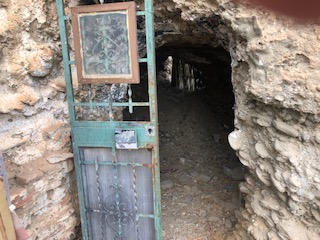
The Cave from the Outside
And here’s Simon’s bedside “stuff” — including a candle and a couple of books on Tarot. My friend’s trying to learn all about it in case the police confiscate his guitar again — or fine him $300 to get it back. (Simon told me he’s had “about a thousand” guitars in is life, and that he’s like to write a book on “How to Lose 1000 Guitars and Still Stay in Business.”) In any case, Tarot reading, he says, would be an alternate source of income if the cops remove his livelihood. He only needs about 10 euros a day to get by.
Bedside Stuff
Here’s the wall hanging at the end of Simon’s bed:
Edvard Munch’s The Scream which the artist admitted“could only have been painted by a madman”
Simon’s bedside reading:
Leibniz, 1646-1716 — A philosophical theory about monads
On each side of Simon’s cave was another dugout about the size of his own dwelling. The floors in each were dirt, the walls still unwhitewashed. Using typical American reasoning, I asked my friend, “Why don’t you make a couple of more rooms for yourself in these caves? You could cover the dirt floors and whitewash the walls in both of them.” The hermit looked puzzled at my reasoning. He shook his head, “No,” he said, “I don’t need the space. And changes like that would only cause envy in the community. That wouldn’t be good for anyone.”
One of the empty caves alongside Simon’s
Towards the end of my visit, I asked Simon about the point of his life — about the point of my life. He paused a long time searching for words. He looked out the door of his cave . . .
The view from inside Simon’s Cave
and said, “I don’t know. I don’t think much about such things. I don’t think about the past or the future. It’s just about living in the present moment.
Do you see what I mean about my hermit friend and his simple wisdom?







 About Things That Matter