(With apologies to my wife, Peggy.)
“The Memory Song”
(With apologies to my wife, Peggy.)

Readings for the 4th Sunday of Advent: 2 Samuel 7: 1-5, 8B-12, 14A, 16; Psalms 89: 2-5, 27, 29; Romans 16: 25-27; Luke 1: 38
In terms of teaching theology and elucidating the Bible, I’m happy for our nation’s experience of Donald Trump. Otherwise, not so much.
The reason for my contentment is Mr. Trump’s blatant exploitation of religion and his ability to persuade so many people of faith that he is a man of God. Think of his now infamous Bible posing in front of DC’s St. John’s Church after having police clear the area of Black Lives Matter protesters.
The event clearly illustrated a perennial religious dynamic that is essential for critical thinkers to understand. I’m referring to what Chilean scripture scholar, Pablo Richard, calls the “battle of the gods.”
The Battle of the Gods
The combat in question pits the God of the rich against the God of the poor. Specific to our readings on this fourth Sunday of Advent, it sets the God of Moses against the God of King David’s crime family. Yes, his crime family.
To begin with, the God of the poor set free a motley group of slaves from Egypt and instituted Moses’ order that favored them rather than their Egyptian slavers. Its “preferential option” prioritized the interests of widows, orphans, and resident non-Hebrews living in Israel. Covenant law eventually forgave the debts of impoverished Hebrews every fifty years. In the process, it disadvantaged landlords and bankers. It made no provision for reestablishing the royal class that had made the lives of slaves so miserable in Egyptian captivity.
Then about a thousand years before the birth of Yeshua, all of that changed. Israel’s upper classes decided to reinstitute an order reminiscent of Egypt. It had the rich lording power over the poor, taxing them heavily, instituting forced labor, and sending Israel’s young men to fight and die in gratuitous wars of conquest as conscripts in a standing army.
Saul was Israel’s first king. He was succeeded by King David and then by his son, Solomon. Both father and son were ruthless womanizers committed to increasing their own wealth and power at the expense of the poor. Theirs was truly a crime family masquerading as God’s beloved appointees.
Family dysfunctions included internecine murders and wars, incestuous rape (2nd Samuel 13) and lasting vendettas. David’s deathbed will and testament was worthy of any Mafia don (I Kings 2: 2-12). However, to achieve the power for which they thirsted, both David and Solomon had to convince their subjects that they were indeed men of God.
That called for fabricated visions and assurances from the divine. Both David and Solomon assisted by their court prophets and scribes enthusiastically obliged. And so, David made sure it was recorded that he was a man “after God’s own heart” (I Samuel 13:14). Meanwhile, Solomon’s own court historians portrayed him as the wisest man who ever lived (I Kings 3: 11-15).
Central to the ruse was a reframing of Moses’ Sinai Covenant to favor the newly emergent royalty and their hangers-on rather than the poor. That’s what we find in this Sunday’s first reading from 2nd Samuel. There, David and his court prophet, Nathan, conspire to change the beneficiaries of the Mosaic Covenant from the poor and oppressed to the royals. In this way, the covenant becomes not a divine promise to protect widows and orphans, but to assure a lasting dynasty for David’s crime family. Put otherwise, the Covenant of Moses was replaced by the Covenant of David.
The great prophets of Judah and Israel rebelled against such palace distortions of faith.
Some tried to work within the new system holding kings’ feet to the fire, reminding them of their obligations towards the weak and vulnerable. Others gave up on the royals and called them out for their self-serving cruelty and corruption.
The great prophets celebrated during this advent season, John the Baptist and his disciple Yeshua of Nazareth, fell into the latter category. They had no use for the royals, the temple priests, their lawyers and apologists. They reserved special abhorrence for their country’s Roman occupiers.
Evidently, Yeshua inherited all of that from his mother, Miryam. She and her husband, Yosef, gave all of their children revolutionary names (Matthew 13: 55-56). Yeshua was named after the great liberator Joshua. The evangelist called “Luke” recorded Miryam as singing a fierce revolutionary song calling for the dethronement of the rich and mighty everywhere (Luke 1: 46-55).
All of that is reflected in today’s readings. What follows are my “translations.” You can find them here to see if I got them right.
Readings for 4th Sunday of Advent
2 Samuel 7: 1-5, 8B-12, 14A, 16: The wily King David conspired with his court prophet, Nathan to persuade their people that God was on his side. The strategy was to build a magnificent temple (actually about the size of a middling parish church today) and then to claim a well-publicized “vision.” There, according to Nathan’s testimony, David’s battlefield accomplishments would be celebrated by God himself. But even more importantly, his country’s constitution (called “The Covenant”) would be subtly changed from centering on the welfare of widows, orphans, and immigrants, to assuring that David’s crime family would stay in power forever.
Psalms 89: 2-5, 27, 29: The arrangement was then celebrated in song (Psalm 89) praising the goodness of God for establishing David’s throne “for all generations.”
Romans 16: 25-27: Paul’s allegiance, however, was not to any earthly king, but to what Yeshua proclaimed as the Kingdom of God. It embraced the welfare of “all nations.” Following Yeshua, Paul’s understanding re-established the pre-Davidic Covenant (favoring those widows, orphans, and immigrants) which David’s Covenant (in its hijacked form) had attempted to replace.
Luke 1: 38: Vaguely following the example of David, Luke’s early church made up a visionary tale about Yeshua’s very conception. There, the angel Gabriel secures Mary’s permission to have the Holy Spirit impregnate her. The resulting child will be great, the angel said, and (like David) initiate a kingdom to which “there will be no end.” However, Yeshua’s New Covenant would once again centralize not the royal class, but Yahweh’s beloved widows, orphans, and immigrants. As Mary would say beginning eight verses later (LK 1: 46-55), it would “take down the mighty from their thrones and exalt the humble.” So much for palace crime family conspiracies.
Conclusion
So, portraying the Trumps, or Bushes, or Clintons or Kennedys or Obamas as “crime families” is not at all far-fetched or somehow unchristian. On the contrary, insofar as any of them neglect the poor – the widows, orphans, immigrants, asylum seekers, or victims of their wars – they are just that. They’re like the criminal family of David and Solomon.
Yes, they go to church, invoke God’s blessings on America at the end of every formal speech, and even attend “prayer breakfasts.” But like David and Solomon (and most of the kings portrayed in the Bible), they are really in bed with the rich and powerful, with the bankers and corporate heads, and with compliant pastors, priests and court prophet equivalents. At best, they are completely disinterested in the spiritual descendants of Egypt’s slaves. At worst, they are actual enemies of workers, widows, orphans, immigrants as well as of those who side with the unemployed, houseless, and those without medical care.
In summary, this fourth Sunday of Advent provides a stark reminder to critical thinking people of faith. It tells us not to be seduced by Bible-waving presidents or by pastors who endorse them and their God of the rich.
Neither Yeshua whose birthday we are about to celebrate nor his cousin John nor his revolutionary mother had anything to do with that God. Before him, they were all complete atheists. So should we be.
Their God was the God of Moses, not of David. Their God was precisely the one rejected by the rich and the powerful – the One who Miryam said “puts down the mighty from their thrones and exalts the humble,” who “fills the hungry with good things, while the rich he sends empty away” (Luke 1: 53).

Recently Amy Goodman’s “Democracy Now” explored “The Case for People’s Vaccines.”
While those interviewed by Ms. Goodman called for early and affordable access to inoculations in the Global South, no mention was made of perhaps the most promising source of such therapies. The neglected source was not only promising, but implicitly revealed the swindle represented by Big Pharma’s anticipated exorbitant prices for Covid-19 vaccines.
It may surprise readers to know that the source in question is Cuba.
Cuba’s Achievement
In fact, Cuba is the first nation in Latin America to receive authorization from the World Health Organization (WHO) to perform officially sanctioned tests of the four vaccines it now has under development. Those trials have already completed their clinical stages. Promising results so far have Cubans looking forward to completing the (cost free) inoculation of its entire population of 12 million by the end of March 2021.
The vaccines under trial are named Soberana 01, Soberana 02, Abdala (CIGB66) and Mambisa (CIGB669). None of them is dependent for its preservation on super-cold temperatures.
Mambisa is worthy of special note, since as a nasal spray, it requires no needles, but responds locally to the specifically respiratory nature of Covid-19.
Failure to report such developments even on “Democracy Now” illustrates the complicity of our mainstream media in shunning any news from socialist nations like Cuba that might possibly illustrate the superior ability of their economies to deliver high quality, no-cost healthcare to citizens even during a worldwide pandemic. Moreover, absent the profit motive, Cuba will predictably deliver its vaccines to its neighbors at vastly cheaper prices than its capitalist counterparts.
Cuba’s Vaccine History
This prediction is based on the fact that Cuba has long been a supplier of vaccines and doctors not only to the Global South, but to countries such as Italy during the height of Covid-19’s first wave. Additionally, with its unequaled ratio of doctors to citizens, the island nation’s response to the pandemic has effectively limited documented coronavirus infections despite supply problems caused by the continued U.S. embargo of the island.
All four developments (the superabundance of doctors, the relative control of Covid-19, Cuba’s research capacities, and the export of medical care to other countries) result from the foresight and vision of Fidel Castro, the revered father of his country. In the early 1980s he sparked initiation of a vigorous homegrown biotech sector – largely to cope with the U.S. embargo’s persistent attempts to deprive the island of medical supplies.
The result was the emergence of 20 research centers and 32 companies employing 20,000 people under the umbrella of the state-run BioCubaFarma Corporation. Recently, spokespersons connected with the corporation tweeted, “The #CubanVaccineCOVID19 is dedicated to the sower of dreams: Fidel. Our tribute to the one who believed in the strength and future of #CubanScience.”
BioCubaFarma produces 8 of the 12 vaccines Cuba uses to immunize its own population against diseases such as measles and polio. Cuba has also exported hundreds of millions of vaccine doses to more than 40 countries (e.g. to deal with meningitis and hepatitis B).
Conclusion
All of this represents just one more illustration of socialism’s comparative efficiency in the face of crises like the COVID-19 pandemic. Even a poor blockaded country like Cuba can respond to an unprecedented crisis such as the coronavirus without holding sick people hostage to the confiscatory demands of privatized natural monopolies like Big Pharma. The latter’s claims to mammoth profits based upon (largely government-funded) costly research are simply ideological cover for overweening corporate greed that none of us should stand for.
People’s vaccines can be produced at warp speed and at low cost – despite news blackouts even on “Democracy Now.”

Readings for the third Sunday of Advent: Isaiah 61: 1-2A, 10-11; Luke 1: 46-48, 49-50, 53-54; I Thessalonians 5: 16-24; John 1: 6-8, 19-28
As most are aware, U.S. students currently owe bankers and creditors more than $1.5 trillion. Progressives like Bernie Sanders and Elizabeth Warren want that debt written off. Their opponents however wonder what would be the economic impact of such debt forgiveness? Wouldn’t it spell disaster for the nation’s economy and for banks “too big to fail?”
Economic historian and ex-Chase Manhattan analyst, Michael Hudson answers those questions in ways intimately connected with the readings for this Second Sunday of Advent. He does so in his magisterial study, …and Forgive Them Their Debts: lending, foreclosure and redemption from Bronze Age finance to the jubilee year.
Written in the face of massive worldwide indebtedness far beyond that of U.S. students, the book’s basic thesis is that debts that can’t be paid won’t be paid. So, the only solution is to write off those obligations.
Far from spelling disaster for the world’s economies, Hudson says such amnesty would rejuvenate them. completely.
How does he know?
Because debt amnesties were standard procedure throughout the history of the ancient Near East from 2500 BC in Sumer to 1600 BC in Babylonia and its neighbors. During that long period, it was the common practice for new rulers to proclaim debt jubilee on the day of their ascension to the royal throne. As seen in the Bible’s Book of Leviticus 25, Israel adopted that practice when its ruling class returned from their “Babylonian Captivity” in the 6th century BCE.
And the result?
Uniformly, Hudson says, it was shared prosperity and the prevention of huge wealth differentials between rich and poor. According to Hudson, the same result can be expected if debts were forgiven today.
The Bible & Debt Forgiveness
And that brings us to our readings for this Third Sunday of Advent. They’re all about a central pillar of Jewish social organization and profound spirituality. I’m referring to debt forgiveness and its “preferential option for the poor.”
As seen in Leviticus 25 and in the words of the prophet Isaiah in today’s first reading, the very word “gospel” (“good news” in Isaiah’s words) is assigned to the proclamation of “Jubilee” – the Jewish Testament term for the periodic practice of wiping debt slates clean every 50 years. That custom borrowed from the Babylonians (and others) prevented oligarchies from using debt as a lever to pry land ownership and other forms of wealth away from impoverished debtors.
In other words, Jubilee was an expression of a divinely structured economy whose ideal (unlike our own) prioritized the welfare of widows, orphans, and resident foreigners. That bottom-up arrangement is what I mean by “preferential option for the poor.”
Yeshua & Debt
Such preference constituted the emphasis in the work of the prophet, Yeshua of Nazareth as well. As a populist leader in the 1st century CE, he made debt amnesty (Jubilee) a central focus of his public platform. Mainstream scripture scholarship has identified such focus in what it terms Yeshua’s “programmatic” declaration in the Gospel of Luke 4:16-30. Quoting our first reading directly, he is remembered as saying:
18 “The Spirit of the Lord is on me,
             because he has anointed me
            to proclaim good news to the poor.
He has sent me to proclaim freedom for the prisoners
    and recovery of sight for the blind,
to set the oppressed free,
19     to proclaim the year of the Lord’s favor. . .”[a]
 20 “Today this scripture is fulfilled in your hearing.”
Yes, the Master’s principal concern was about the economic and social welfare of the poor. The words “the year of the Lord’s favor” are synonymous with Jubilee.
Today’s Readings
To get a better idea of what I’m saying, please read today’s liturgical selections directly as found here. My “translations” run as follows:
Isaiah 61: 1-2A, 10-11: A Jubilee year! Debts forgiven! Interest payments written off! Here is good news for the poor whose captive hearts are broken in their miserable debtors’ prisons – reminiscent of their ancestors’ captivity In Babylon. It is all a matter of divine justice, salvation and overwhelming joy – like a wedding celebration where both bride and groom, once poor, are now adorned with splendid jewels.
Luke 1: 46-48, 49-50, 53-54: Jesus’ mother shared that nuptial joy. Though dirt poor like her husband and son, she thirsted for the promised Great Reversal. There the hungry would be well fed, while the rich would at last experience a well-deserved famine. What happiness for the vindicated poor in God’s New Order of justice!
I Thessalonians 5: 16-24: Paul shared Mary’s happiness revealed in her son and by the prophets before him. While the rich despise prophetic proclamations of God’s reckoning, the poor cherish them word for word. They know the prophetic arc of justice bends in their direction.
John 1: 6-8, 19-28: Such was the message of John the Baptist too. Justice at last, jubilee for the poor! The light surrounding the man was so bright that even corrupt religious leaders mistook him for the reincarnation of Elijah himself –or maybe the promised messiah. But no, said John; he was merely a voice proclaiming God’s just path that all are called to trod. His baptism of mere water would be displaced by Yeshua’s social and spiritual revolution of raging fire. Jubilee for the poor at last!!
Conclusion
All of this might seem like ancient history. However, it’s really common sense that is extremely relevant to the issue of writing off the world’s unpayable debts in general and student loans in particular. These considerations also tell us a lot about distortions of Christianity to the point of complete irrelevance.
Regarding loans, Hudson teaches that periodic debt forgiveness (as in Jubilee) is absolutely necessary to correct the dynamics of borrowing and lending. It’s a matter of simple math. Compound interest grows exponentially; incomes increase linearly. As a result, debt will always outrun income.
Consequently too, debts that can’t be paid won’t be paid. Requiring the impossible hamstrings any economy. It robs consumers of spending power. They can’t buy homes and other goods that keep markets humming.
(This was demonstrated in post-WWII Germany. There, in contrast to the aftermath of WWI, German debts were for all practical purposes forgiven. An economic “miracle” followed.)
As for Christianity in relation to all of this . . . Scripture scholars tell us that the lives and concerns of Yeshua’s people were principally three: (1) foreign (Roman) occupation, (2) land reform, and (3) debt forgiveness. That the Master addressed all of these problems directly in accord with the divine “preferential option for the poor” accounts for his wild popularity among the peasant farmers who constituted his audience of focus.
In this he separated himself from Rabbi Hillel and the Pharisees who rejected wealth redistribution through Jubilee. His separation eventually led to his arrest, torture, and submission to a form of capital punishment reserved for rebels against the Roman Empire.
This, however, is not the picture the Christ that most of us carry around in our minds. There, as Hudson points out, Jesus’ resonance with the material concerns of his people has been transformed into insipid spiritual platitudes that would never have made him a threat to the religious leaders of his day, much less to the Roman Empire.
Restoring any relevance to Christianity in our contemporary world hinges on recovering the radical Jesus of history and his connection with issues like debt forgiveness of student loans. It also hinges on our willingness to stand up for the debt-impoverished (ourselves!!) – despite empire’s vile threats.
Just for fun . . .

Last year at this time, two very different religious leaders – one considered left of center, the other a fundamentalist preacher – converged in agreement about the meaninglessness of Christmas. They both concurred: except as a secular winter festival, Christmas is religiously meaningless.
On the left, Pope Francis called the Christian world’s upcoming Christmas celebration a “charade.” He said there’d be parties, gift exchanges, and family gatherings in the name of celebrating Jesus’ birth, but it would all be absurd pretense.
That’s what charade means: an absurd pretense intended to create a pleasant or respectable appearance.
And the pope was right. Starting around Thanksgiving, so-called Christians pretend to honor “the Prince of Peace” – the one who took no one’s life, but sacrificed his own rather than take up arms — who was himself a political refugee – conceived out-of-wedlock – brown-skinned, poor, and living under imperial occupation – the one who would be a victim of torture and capital punishment – who was all the things that good Christian supporters of Donald Trump and of the U.S. War on Terror hate and despise.
That’s right. our culture despises Jesus and all he really stands for.
And that’s where the fundamentalist preacher comes in. He agrees with the pope – well kind of.
About the same time Pope Francis was talking charade, Rev. Joshua Feuerstein, denounced Starbucks for hating Jesus. The good reverend was outraged by the coffee giant’s holiday cups which display no specific reference to Jesus. That’s a sign, Feuerstein said, that Starbucks agrees with the movement to remove Christ from Christmas. Starbucks hates Jesus. So let’s boycott Starbucks!
On the one hand, could anything be more absurd? The world is burning. Our way of life is destroying God’s creation. Our country is waging war against the poor everywhere – in Afghanistan, Iraq, Libya, Yemen, Somalia . . . We supply weapons to all sides in the endless war our “leaders” have declared. And our man was worried about Starbucks’ drinking cup! He denounced Starbucks for simply recognizing what is: Jesus has long since been removed from Christmas.
On the other hand, there was wisdom in Rev. Feuerstein’s accusations. And it’s not just Starbucks that “hates Jesus;” it’s our entire culture – including our churches. In that sense, Feuerstein agrees with Francis. However, hating Jesus has nothing to do with coffee cups. As I said, it means despising those Jesus identified with in the Gospel of Matthew (25:31-46) – the poor immigrant refugee from our endless bombing campaigns, the hungry street person, the homeless beggar, the imprisoned desperado, the coatless person we pass on our way into Starbucks.
So what to do to avoid making this Christmas an empty charade?
We can start by recognizing that Christmas is a winter festival and nothing more. Every culture has them. They are times for ice sculptures, bright lights, reunions with family, for feasting, drinking, parties and exchanges of gifts. All of that distracts us from the oncoming season’s dark and cold – and from our destruction of God’s planet.
That’s the way it was in ancient Rome too. Rome had its Saturnalia. In fact, December 25th was the birthday of the Sun God, Mithra, who was a favorite with Roman legionnaires. In that sense, Mithra’s birthday was a military holiday – a celebration of empire and its wars. Our militarized culture should be at home with that.
So let’s end the charade. Have fun. Eat, drink, and be merry. That’s what winter festivals are about. But forget the blasphemy of associating Jesus with any of it. Raise your Starbuck’s cup and toast a happy feast of Mithra!
Readings for the First Sunday of Advent: Isaiah 63: 16B-17, 19B; 64: 2-7; Psalm 80: 2-3, 15-16, 18-19; I Corinthians 1: 3-9; Mark 13: 33-37
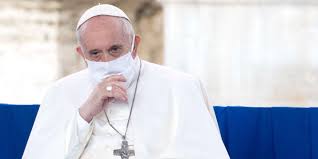
Last week, Pope Francis wrote a beautiful Covid-19 reflection in the New York Times (NYT).
He recalled how the pandemic’s unsung heroes reminded him of his own brush with death when he was just 21 years old. At that tender age, he was hospitalized with a pulmonary infection that ultimately cost him part of a lung.
At the height of his crisis, two nuns working as nurses in his Argentine hospital ignored doctors’ prescriptions and doubled the dosage of penicillin and streptomycin in one case and increased his pain killers on the other. Their courage in doing so, the Pope is convinced, saved his life.
Generous, courageous souls like the two religious sisters who helped him then have reemerged, Francis noted, during the pandemic. They’re the “saints next door.” They’ve saved innumerable lives as nurses, doctors, caregivers. They’re the essential workers who in many countries have regularly been applauded at doorsteps and windows with genuine gratitude and awe.
The selflessness of such heroes has sometimes cost them their lives. But many among those champions sacrificed freely knowing as Francis put it, that “it is better to live a shorter life serving others than a longer one resisting that call.” They represent the antibodies to an infection among us far more dangerous than Covid 19 – the virus of indifference.
Writing pointedly in the premiere U.S. newspaper, Francis identified that more dangerous virus with governments that have not put the well-being of their people first. Instead, they have “shrugged off the painful evidence of mounting deaths.” They’ve pandered to groups opposing travel restrictions, social distancing and facemasks as if such measures constitute “some kind of political assault on autonomy or personal freedom!” Francis said that worship of that kind of liberty has become for many a kind of ideology obstructing all understandings of common good.
In Francis’ view, such selfish shortsightedness shows that Covid-19 is merely one of the pandemics currently afflicting our planet. Hunger, violence and climate change are others. All of them lack perspective and generosity.
Responding effectively means attuning our sensibilities to the pain of others who have been deprived of life’s basic needs – work, food, housing and human dignity. Responding means recognizing that we’re never saved alone; we are bound by human solidarity and reciprocity.
Reading the pope’s words, I couldn’t help thinking of parallels between them and our readings for the first Sunday of Advent. Together, they call us to reverse course – to wake up from our collective stupor to the presence of what some call God in the neighbors, heroes and martyrs whom Francis’ words identify so poignantly.
What follow are my “translations” of the readings in question. Please check the originals here to see if I’ve got them right.
 Isaiah 63: 16B-17, 19B; 64: 2-7

 We have lost our way;
 We’ve hardened our hearts;
 We no longer even know
 What faithfulness means.
 We feel somehow unclean,
 Polluted and aimless.
 Yet, we long to see more deeply
 To reality’s very heart
 As never before.
 Reunion with You, Divine Mother
 Is what we ultimately crave –
 To be refashioned
 As if we were clay
 In your lovely hands.

 Psalm 80: 2-3, 15-16, 18-19

 So, please show us your face.
 Save us from ourselves.
 Strengthen us.
 Bring us home.
 Demonstrate again
 Your care for us
 As a shepherd guarding her flock,
 As a gardener tending her vine.

 I Corinthians 1: 3-9

 Oh, wait
 You’ve already done that
 Haven’t you?
 You’ve answered our prayer
 In Yeshua, the Christ.
 His loving kindness
 And revolutionary teachings
 Bring clarity, insight
 And serene understanding.
 They restore
 Meaning to our communal lives.

 Mark 13: 33-37

 Above all
 (Like the Buddha)
 Yeshua commanded us
 To wake up
 To see
 What sleepers miss:
 Constant divine manifestations
 At our very doorstep
 When we expect
 Them least
 Morning, noon and night.

Recently, the editorial board of OpEdNews (OEN) — where I’m a senior editor — opened an on-line thread about QAnon and similar right-wing political movements. In the course of the exchanges, editors criticized the latter simply as “conspiracy nuts” whose screeds should be banned from OEN.
After all, conspiratorial political analysis (often supported by odd mythologies, cosmologies and spiritualities) centralizes reptilian aliens. It ends up holding that the world is controlled by a cabal of pedophiles up to their necks in the business of human trafficking. The cabal is somehow associated with the “illuminati,” and with Luciferian Satan worship connected with the consumption of the adrenalized blood of trafficked children. For many, such references raise the specter of anti-Semitism.
Moreover, the conspiratorialists in question support President Trump as a champion of children victimized by such commerce. His actions on their behalf is demonstrated, they say, by his 20 executive orders intended to inhibit such traffic. His border wall is largely responsible for restraining it dramatically. All of this, they observe, is ignored by the corrupt mainstream media.
Additionally, QAnon and others of their stripe dismiss Covid-19 as a “plandemic” fabricated to “reset” the world economy even more in favor of its controlling one-percenters while intensifying their already oppressive management of the remaining 99%. Accordingly, mask mandates and social distancing measures should be resisted in the name of common sense and personal liberty.
Without enumerating them all, OEN editors wondered, what’s not to reject in such apparently unhinged allegations?
This Essay
The point of the following is to answer that question. In fact, it will argue that in religious and historical perspective, the QAnon conspiracy theorists speak more truth than perhaps even they intuit. As we’ll see, the world has indeed been controlled for millennia by a Luciferian Satanic cabal headed by groups of Illuminati with many deeply engaged in the practice of worldwide pedophilia. What’s more, allegations of anti-Semitism though worrisome, often have the effect of protecting pedophiles and deflecting attention from the major business interest that the vice represents.
The values of those involved their opponents say, are so alien to decent people that the guilty ones might as well be invaders from another planet. They seem completely controlled by what psychologists call the primitive reptilian brain. Excluding higher brain functions, it fosters pathological obsession with money, power, pleasure and social status; it excludes empathy and compassion. Reptilian aliens indeed.
We’ll also see that none of the terms many find off-putting – not Lucifer, Satan or illuminati – is sinister, much less evil or self-evidently crazy. And there’s a certain sense in which both Satan and Lucifer have long been undeniably worshipped especially by all westerners including Christians and Jews. And finally, the existence of a controlling unelected cabal and a huge worldwide pedophilia ring is itself beyond question – as is the fact that the already rich are benefitting spectacularly from the coronavirus pandemic.
I want to make this case because realizing the elements of sanity in movements like QAnon opens the door to dialog and cooperation with those on the right whom progressives can too easily dismiss as one-dimensional conspiracy fanatics. Again, they’re not crazy. They’re mostly working-class people who like the rest of us know something’s deeply wrong with the world. They correctly grasp that what’s wrong involves the elite, widespread child abuse and human trafficking largely ignored by the mainstream media.
Worldwide Pedophilia
For starters, QAnon’s allegations of globally organized pedophilia reflect an undeniable fact. Personally, I know what I’m talking about, because as a former priest, it turns out that I was unwittingly inducted into what everyone now sees as a de facto global pedophilic ring impacting more than 1.2 billion people. I’m referring to the Roman Catholic child rapists systematically protected by colleagues, bishops and popes. Think about it: the phenomenon is worldwide; it’s pedophilic; its coverup constitutes a conspiracy. Saying so is not insane.
Additionally, as shown in the recently released McCarrick Report, the Catholic ring had connections to an even wider pedophilic practices among the world’s elite. Its iceberg tip as suggested (in the Epstein scandal) enjoyed connections with the CIA, mi5, mi6, Mossad, and mafias of various types throughout the world. It’s arguably linked to Hollywood, academia and governments across the planet.
Again, all of that is just the tip of a huge iceberg whose gargantuan proportions simply stand to reason. The case of the Catholic Church shows that the pedophilic appetite is there. And, of course, it’s not confined to the clergy. This means that there is big money to be made in the trafficking of children connected with general prostitution, massage parlors, pornography, stripping, live-sex shows, mail-order brides, the foster child system, military prostitution, sex tourism, body organ harvesting, and associated money laundering and blackmail operations.
(Just a microcosmic example. . . One trafficked girl can be forced to have sex with 10 to 15 men each day. A 2003 study in the Netherlands found that on average, a single sex slave like that can earn her procurers at least $250,00 a year. Needless to say, business models involving that kind of money are highly attractive to organized crime and others.)
And it is by no means a stretch to argue that government officials are involved in the traffic – not any more than to allege that they profit from and protect the drug trade and ancillary money-laundering. We know too much to deny that. We know about the CIA’s direct role in the Central American drug trade during the 1980s (and beyond), as well as the connections between Mexico’s drug cartels and police and government officials in Mexico.
Relatedly, ex-NSA officer and whistle blower, Bill Binney, has maintained in pubic interviews that employing his former bosses’ unprecedented surveillance technology, the NSA could easily keep track of, reveal, and take legal measures against the entire human trafficking network. He says that with ten people, he himself could within thirty days identify not only domestic enemies, but every traitor, every elite child molester, and every money-laundering white-collar criminal in the world.
So, it’s not unduly conspiratorial to allege that members of the world’s elite get together to conceive, plan and protect the operations involving children just listed. Again, we know too much about J. Edgar Hoover and his deals with mafia kingpins. In addition, the Epstein scandal itself and its implications of government officials, royals from various countries, the CIA, Israel’s Mossad, Catholic Church officials, and bankers for purposes of money-laundering, reveals a level of criminal planning that fulfills the very definition of conspiracy.
For instance, what do you think the world’s financial elite are doing during G7 and similar conferences? If it’s true that human trafficking is among the fastest growing enterprises in the world yielding billions to trillions in revenue each year, do you think they can avoid its discussion? If not involved in its day-to-day activities, bankers simply can’t avoid involvement in its money-laundering schemes? It would be insanely naïve to think otherwise.
Instead, it is perfectly sensible to affirm that a powerful faction of the world’s elite (if you don’t like the word “cabal”) is deeply involved in pedophilic and associated operations that are fostered, protected, and extended virtual immunity from prosecution. Their processes, procedures and crimes go virtually unreported in the mainstream media. (Think of how little we’ve heard from Ghislaine Maxwell since her arrest).
The Illuminati
And it’s all connected with the “illuminati,” secret societies and conservative rejection of the same. Everything in the modern world is. That’s especially true in the United States whose very founders were children of the Enlightenment; they were illuminati. And in the 18th century, people like them had to form secret societies such as the Free Masons complete with identifying handshakes and passwords. They needed them simply to protect themselves from the Catholic Church establishment and their royal antagonists.
Additionally, and despite the spirit of the French Revolution, the illuminati worldwide had not yet entirely jettisoned belief in God. Instead, they were deists. They had largely rejected the Bible in favor of a “watchmaker divinity” who had created a self-governing, clock-like universe, set it spinning according to Newton’s laws and had not been heard from since. Many of the Founding Fathers of the United States were all illuminati in that sense.
Ironically and to this day, Christian fundamentalists find that kind of Founding Father secularism highly objectionable. They continue to mistrust science, evolution, psychotherapy, Marxist criticism, and modern biblical scholarship. No wonder the term “illuminati” retains sinister overtones for Republicans whose most powerful wing is comprised of white Christian evangelicals.
No wonder the latter can overlook the moral failings of Donald Trump and even see him as a messiah. Such apparent contradiction survives as one of our nation’s anti-intellectual cornerstones.
Satanic, Luciferian Cults
As for Lucifer and Satan . . . The Constantinian betrayal of the authentic Jesus tradition (during the 4th century CE) turned Christians generally into Satan worshippers. Paradoxically, it also had them vilifying Jesus who was originally identified as the Great Bearer of Light (Lucifer) for his liberating message that contradicted the world’s self-serving imperial morality.
To be more specific, the book of Job shows that the being called “Satan” was in Hebrew lore a prominent member of God’s heavenly court. In fact, Satan was originally the representative of the Persian Empire in those celestial precincts. (Evidently, it was impossible for the ancient biblical authors to believe that an entity as powerful as Persia could not find representation in the ultimate seat of power.) As the imperial advisor of Yahweh, Satan was the defender of empire’s law and order.
It was precisely this Satan whom Jesus repeatedly repudiated in the gospel accounts of his words and deeds (see Matthew 4:10 and Mark 8:33). In his tale about Jesus’ temptation in the desert, Luke (4:6) has Satan (now identified with the devil) showing Jesus all the kingdoms of the world and telling him “I shall give to you all this power and glory; for it has been handed over to me, and I may give it to whomever I wish. All this will be yours, if you worship me.” In other words, according to early Christian tradition, attainment of imperial power is dependent on Satan worship.
Jesus’ rejection of Satan’s offer was a rebuff to empire that reached its apotheosis in the Book of Revelation where (according to Apocalypse mythology) Satan and his imperial legions were expelled definitively from Yahweh’s heavenly realm (Revelation 12: 7-12).
Such rejection in the atmosphere of hated imperial Rome, led Jewish Christians to imagine Jesus as “Lucifer,” the bearer of light – the ancient world’s avatar consistently associated with the morning star, the planet Venus, and with human wisdom and liberation.
The point is that all of this was reversed when under Constantine a prevailing faction of church leaders agreed to exercise condominium with Rome over its vast empire. To do so, they had to in effect deify Satan and call him “God” while vilifying Jesus’ revolutionary spirit by demonizing Lucifer. Thus, Jesus’ antinomian, anti-imperial stance became heresy, while obedience to law and empire became orthodoxy.
So, even according to biblical texts, there is truth to the contemporary conspiratorial position that the world is run by worshippers of Satan.
Anti-Semitism
Standard articles about QAnon and anti-Semitism begin by observing that the movement is not doctrinally anti-Semitic. Nevertheless, because of its denunciations of a world-controlling elite including figures such as George Soros and the Rothschilds, QAnon is often accused of that bigotry. Moreover, as we’ve seen, it and similar groups allege that the elite in question are connected to criminal enterprises that sometimes include the consumption of adrenalized blood by the so-called Satanists just referenced.
In the eyes of the American Israel Public Affairs Committee and others, such criticisms and allegations, understandably evoke “anti-Semitic tropes” that are considered enough to justify labeling and dismissing those using them as basically anti-Semitic. However, (again, though understandable in the light of the Holocaust’s unspeakable horrors) the charges ignore at least six important factors:
In summary, all of this impedes honest discussion of human trafficking in general and pedophilia in particular. Such prevention has arguably been an important factor enabling individuals like Jeffrey Epstein, Alan Dershowitz, and Ghislaine Maxwell to spend decades freely engaging in the traffic of underage females.
Conclusion
None of the foregoing is meant to endorse QAnon or related so-called conspiracy theories. It is however to say that their adherents should not be dismissed out of hand. In fact, they occupy terrain that is largely friendly to progressives – despite their support of Donald Trump. For instance:
Realizing such areas of convergence makes dialog and cooperation possible. That in turn helps us overcome the divide and conquer strategies of our keepers who would have us believe that potential allies are irredeemable deplorables who should be excluded even from the revolutionary pages of OpEdNews.

Readings for the Solemnity of Our Lord Jesus Christ, King of the Universe: EZ 34: 11-12, 15-17; PS 23: 1-3, 5-6; I COR 15: 20-26, 28; MT 25: 31-46.
This Sunday’s readings raise the central political question of our day: what is the purpose of government? Is it simply to protect the private property of the well-to-do? Or is it to sponsor programs to directly help the poor who (unlike their rich counterparts) cannot on their own afford adequate food, shelter, clothing, health care, and education – even if they are working full-time?
For the last forty years or so, the former view has carried the day in the U.S. So it has become fashionable and politically correct even (especially?) for Christians to advocate depriving the poor of health care to help them achieve the American Dream, “ennobling” the unemployed by removing their benefits, criminalizing sharing food with the poor, and “punishing” perpetrators of victimless crimes by routinely placing them in solitary confinement.
Currently, the idea that government’s task is to help corporations even it means hurting the poor, elderly, and newly arrived has been incarnated in Washington’s response to Covid-19. It has amounted to a giant give-away to billionaires including the president’s own family. Today’s poor, middle class and future generations will pick up the tab for that particular wealth redistribution upward.
Today’s readings reject all of that. And they do so on a specifically political liturgical day – the commemoration of the “Solemnity of Our Lord Jesus Christ, King of the Universe.” Yes, this is a political liturgy if ever there was one. It’s all about “Lords” and “Kings” and how they should govern in favor of the poor. It’s about a new political order presided over by an unlikely monarch – a king who was executed as a terrorist by the imperial power of his day. I’m referring, of course, to the worker-rebel, Jesus the poor carpenter from Nazareth.
Today’s readings promise that the rebel – the “terrorist” – Jesus will institute an order utterly different from Rome’s. That order recognizes the divine nature of immigrants, dumpster-divers, those whose water has been ruined by fracking and pipelines, the ragged, imprisoned, sick, homeless, and those (like Jesus) on death row. Jesus called it the “Kingdom of God.” It’s what we celebrate on this “Solemnity of Jesus Christ King of the Universe.”
(Btw: in the eyes of Jesus’ executioners, today’s commemoration would be as unlikely as some future world celebrating the “Solemnity of Osama bin Laden, King of the Universe.” Think about that for a minute!)
In any case, our readings delineate the parameters of God’s new universal political order. To get from here to there, they call governments to prioritize the needs of the poor and those without public power. Failing to do so will bring destruction for the selfish leaders themselves and for the self-serving political mess they inevitably cultivate.
Our first selection gets quite specific about that mess. There the prophet Ezekiel addresses the political corruption Lord Acton saw as inevitable for leaders with absolute power. Ezekiel’s context is the southern kingdom of Judah in the 6th century BCE. It found itself under immediate threat from neighboring Babylon (Iraq). In those circumstances, the prophet words use a powerful traditional image (God as shepherd) to inveigh against Israel’s pretentious potentates. In God’s eyes, they were supposed to be shepherds caring for their country’s least well-off. Instead, they cared only for themselves. Here’s what Ezekiel says in the lines immediately preceding today’s first lesson:
“Woe to you shepherds of Israel who only take care of yourselves! . . . But you do not take care of the flock. 4 You have not strengthened the weak or healed the sick or bound up the injured. You have not brought back the strays or searched for the lost. You have ruled them harshly and brutally.”
In other words, according to Ezekiel’s biblical vision, government’s job is to address the needs of the weak, the sick and the injured. It is to tenderly and gently bring back the wayward instead of punishing them harshly and brutally.
A great reversal is coming, Ezekiel warns. The leaders’ selfishness will bring about their utter destruction at the hands of Babylon.
On the other hand, Judah’s poor will be saved. That’s because God is on their side, not that of their greedy rulers. This is the message of today’s responsorial psalm – the familiar and beloved Psalm 23 (“The Lord is my shepherd. . . “) It reminds us that the poor (not their sleek and fat overlords) are God’s “sheep.” To the poor God offers what biblical government should: nothing but goodness and kindness each and every day. Completely fulfilling their needs, the divine shepherd provides guidance, shelter, rest, refreshing water, and abundant food. Over and over today’s refrain had us singing “There is nothing I shall want.” In the psalmist’s eyes, that’s God’s will for everyone – elimination of want. And so, the task of government leaders (as shepherds of God’s flock) is to eradicate poverty and need.
The over-all goal is fullness of life for everyone. That’s Paul’s message in today’s second reading. It’s as if all of humanity were reborn in Jesus. And that means, Paul says, the destruction of “every sovereignty, every authority, every power” that supports the old necrophiliac order of empire and its love affair with plutocracy, war and death instead of life for God’s poor.
And that brings us to this Sunday’s culminating and absolutely transcendent gospel reading. It’s shocking – the most articulate vision Jesus offers us of the basis for judging whether our lives have been worthwhile – whether we have “saved our souls.” The determining point is not whether we’ve accepted Jesus as our personal savior. In fact, the saved in the scene Jesus creates are confused, because their salvific acts had nothing to do with Jesus. So, they ask innocently, “Lord, when did we see you hungry and feed you, or thirsty and give you drink? When did we see you a stranger and welcome you, or naked and clothe you? When did we see you ill or in prison, and visit you?”
Jesus’ response? “Amen, I say to you, whatever you did for one of the least brothers of mine, you did for me.”
But more than personal salvation is addressed here. Jesus homage to Ezekiel’s sheep and shepherd imagery reminds us of judgment’s political dimension. So does Jesus’ reference to the judge (presumably himself) as “king.” And then there’s the church itself which centralizes this climactic scene precisely on this Solemnity of Jesus Christ King of the Universe. All three elements say quite clearly that “final judgment” is not simply a question of personal salvation, but of judgment upon nations and kingdoms as well. To reiterate: in Matthew’s account, the final judgment centralizes the political.
And what’s the basis for the judgment on both scores? How are we judged as persons and societies? The answer: on the basis of how we treated the immigrants, the hungry, ill-clad, sick, and imprisoned.
On that basis, Jesus’ attitude towards the United States as earlier described ought to be quite clear. It’s the same as Ezekiel’s when he predicted the destruction of Israel at the hands of Iraq:
“Depart from me, you accursed, into the eternal fire prepared for the devil and his angels. For I was hungry and you gave me no food, I was thirsty and you gave me no drink, a stranger and you gave me no welcome, naked and you gave me no clothing, ill and in prison, and you did not care for me.”
Ironically enough, that “fire prepared for the devil and his angels” is today embodied in the west coast’s raging fires kindled by our mistreatment of Mother Nature – whom we routinely submit to the most horrendous form elder abuse.
Referencing his own text, Ezekiel might say, “You read it here first.”

Here in Connecticut, where we’ve been living these last three years, the non-denominational church that Peggy and I are aspiring to join is sponsoring a six-month “mindfulness dialog” on “Reimagining Religion.” About a dozen people are participating under the leadership of Danny Martin, a former Catholic priest and Thomas Berry scholar.
So far, I’ve found the whole experience both inspiring and a bit troubling. As I’ll explain below, the inspiration comes from a very thoughtful mindfulness dialog process itself. The trouble comes from the tendency of the process to overlook the proverbial elephant in the room in terms of contemporary political realities. Those realities have an imperial United States of America assuming exactly the international dominance to which Adolph Hitler aspired almost a century ago. In the prophetic spirit of the Judeo-Christian tradition, such development cannot be ignored or given second place by those wrestling with religion’s significance.
The Mindfulness Approach
To begin with, our approach to reimagining religion has three phases, connecting, exploring, and discovering:
In the connecting phase, we’re combing through our lives in terms of experiences of mystery, beauty, love, and oneness with nature. These, we’re finding, put many in the presence of the “mysterium tremendum” that evokes awe, reverence, adoration – and religious responses involving story and ritual.
The exploring stage has most turning to poetry and non-Christian texts in search of meaningful story. Participants seem to share the conviction that we need a “new story” to replace the one most of us have rejected. The latter was based on belief in an old white man in the sky. He evicted our first parents from their original paradise. He then sent his divine son to redeem sinful humankind so we might gain heaven and avoid hell. We need a better story; we all seem to agree.
As for discovery. . . Our whole experience has us thinking more deeply about changes in our lives based on loving family members and neighbors precisely as ourselves (because in some real sense they truly are us) and on reverence for nature.
That Troubling Elephant
My reservations about our approach so far concern our apparent reluctance to address what strikes me as the main God-related experience facing humankind today (at least in terms of the Judeo-Christian tradition).
That experience involves the worldwide oppression of the former colonies and their resulting experience of poverty, hunger, environmental destruction and war. That entire syndrome directly involves people like us, since our country, the United States of America, is principally responsible for the oppression just referenced. In the words of Martin Luther King, we are the “greatest purveyor of violence in the world.”
To ignore such realities is analogous to German Christians in the 1930s overlooking the rise of fascism with its imperial ambitions and immediate persecution of communists, socialists, Jews, people of color, Roma, homosexuals, the disabled and immigrants. I can imagine the irrelevance of German Christians in 1933 gathering in a church basement to discuss reimagining religion. How would we judge them in that context if they focused primarily on their interior and interpersonal lives while Germany was ablaze and about to set the world itself on fire?
Of course, not all German Christians did that. In fact, in the face of fascism’s rise and Hitler’s establishment of his Third Reich, Dietrich Bonhoeffer’s Confessing Church took on a project very like our own. As a result, just before his execution by the Nazis (for participating in a plot to assassinate der Fuhrer) Bonhoeffer in his Letters and Papers from Prison, advocated imagining “Christianity without religion.” That is, he wanted to reappropriate the faith of Moses and Jesus without the traditional trappings, rituals and language that narcoticized and blinded believers to the socio-political reality staring them square in the face.
The New Old Story
To my mind and in our analogous context, “connecting” should mean coming to grips with America’s role in creating the world that our system of political economy, neo-colonial ambitions, environmental devastation and militarism has set on fire. That in itself requires deep and serious study and discussion. It’s time to revisit official and competing stories of American history.
Then, “exploring” means linking the resulting new understandings with the authentic biblical narrative as revealed by modern scripture scholarship. Its relevance to the global circumstances I’m describing here is exceedingly clear. That’s because modern scholarship shows that the essence of the Judeo-Christian tradition does not centralize increasingly inapt Genesis mythologies. Instead, it tells a story of oppression and liberation that runs as follows:
In the light of this narrative, answering the question “What then must we do?” takes on highly political and threateningly controversial features that few outside the former colonies are willing to address. That’s because most even there who drew the obvious political conclusions about opposing empire have been assassinated by the current imperial power that is absolutely intolerant of anti-imperial faith.
A Reimagined Creed
In the light of truths like the foregoing, in Jesus against Christianity, Jack Nelson-Pallmeyer calls for reimagining fundamental Christian professions of faith such as the Apostles Creed. In concentrating on Jesus’ birth and resurrection, he says, they fail to honor the thrust of Jesus’ life towards resistance to domination systems, and identification with the poor and outcast.
But what forms would a reimagined creed take? Below are printed two responses to that question – the familiar Apostles Creed on the one hand and a reimagined form on the other. Personally, I find that the latter contributes mightily to our task of reimagining religion.
 The Apostles'Creed

 I believe in God, the Father almighty,
 Creator of heaven and earth, and in Jesus
 Christ, His only Son, Our Lord, who was
 conceived by the Holy Ghost, born of the
 Virgin Mary, suffer under Pontius Pilate,
 was crucified, died and was buried.  He descended
 into hell; the third day he arose again from
 the dead.  He ascended into heaven, sits at the
 right hand of God, the Father almighty; from
 thence he will come to judge the living and the
 dead. I believe in the Holy Ghost, the holy
 Catholic church, the communion of saints, the
 forgiveness of sin, the resurrection of the
 body, and in life everlasting.  Amen.

 A Reimagined Creed

 We believe in humankind
 and in a world in which
 it is good to live for all people
 in love, justice, brotherhood and peace.
 We must continually act out these beliefs.
 We are inspired to do so, because we believe
 in Jesus of Nazareth
 and we wish to orient our lives to him.
 In so doing, we believe that we
 are drawn into the mysterious relationship
 with the One, whom he called his father.
 Because of our belief in Jesus
 we make no claims to exclusivity.
 We shall work together with others
 for a better world.
 We believe in the community of the faithful,
 and in our task to be the salt of the earth
 and the light of the world.
 But all of this in humility
 Carrying our cross every day.
 And we believe in the resurrection
 whatever it may mean. Amen.
Conclusion
Whenever I think of it, I’m drawn to the conclusion that my entire adult life has been devoted to reimagining religion. I was encouraged in that endeavor by my study and teaching of Dietrich Bonhoeffer’s life and works. Whether we’re aware of it or not, Bonhoeffer’s represents the kind of prophetic faith our CT church group is trying to reimagine.
At the same time, I bear in mind the words and example of an outspoken mentor of mine during my graduate studies in Rome so many years ago. His name was Dan McGinn. Dan was about 15 years older than me. By his example, he taught me how to celebrate the Eucharist spontaneously and without written text.
In any case, Dan always said that if he were ever made bishop (There was absolutely no chance of that!) his episcopal motto under his coat of arms would read “No more bullshit.”
I’m tempted to recommend adopting Dan’s motto for ourselves as our church group tries to reimagine religion. While not exactly B.S., our traditional forms of belief (even the Apostles’ Creed) have been rejected as such by much of our world. Hence the relevance of our task.
What I’m suggesting here is that reappropriating the biblical story cited above and reformulating our creed accordingly would go a long way towards the culturally imperative assignment of making our faith relevant to the undeniable resurgence of fascism in our contemporary context.

