View from the Border: Christians Torturing Christians, Lawyers Following Jesus

Readings for the Second Sunday in Ordinary Time: IS 49: 3, 5-6; PS 40: 2-10; I COR 1: 1-3; JN 1: 14A, 12A; JN 1: 29-34

So, I’m here in Tijuana, Mexico. As I noted last week, I’ll be in Baja California for three weeks working with a border rights project called Al Otro Lado (AOL). It’s helping refugees and immigrants claim their internationally recognized entitlement to asylum from repressive governments, gangs, the ravages of climate change, and from a worldwide economic system whose “free trade” agreements have destroyed jobs and created grinding poverty across the globe.

Yes, I’ve entered another world here – vastly different from what I experience every day in my new home in super-affluent Westport CT. And I love it. It’s brought me to a social location similar to the ones experienced by most of the world’s inhabitants – including Jesus and his friends 2000 years ago.

What I’ve found at this Mexican border is closer to the reality of my former home in central Kentucky’s Appalachia where so many live from hand to mouth as part of the national precariat that ironically (as Rev. William Barber says) has come to include 43% of Americans – in the world’s richest country.

Here in Tijuana, I’ve met two kinds of people that give me great hope despite the power of a third group that dominates public policy and discourse. All three groups stand starkly revealed in the light of today’s liturgical readings. As we’ll see presently, those selections from the Jewish and Christian Testaments call Jesus’ followers to a universal community that overcomes the narrow ethnocentrism required to justify torturing one’s fellow human beings.   

Consider that last group first – the dominant one. They’re best represented by Donald Trump and the Republican Party whose mostly white members (sporting their red MAGA hats) loudly trumpet their Christian faith. Nevertheless, this group takes great delight, it seems, in making their brown and black fellow Christians suffer.

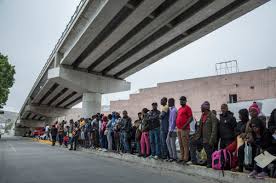
It’s a kind of sadistic cruelty that puts obstacle after illegal obstacle in front of mostly non-white Christians seeking a healthier, safer life for their children and themselves. Despite court orders to the contrary, the process continues to separate small children (and even infants and babies) from their parents. It confines asylum seekers in what refugees themselves call “the icebox” (hielera) – a holding tank through which those lucky enough to get a “Credible Fear Interview” (CFI) must legally endure for no more than 72 hours – but where stays sometimes stretch out for 3 or 4 weeks. The tank is kept at 48 degrees Fahrenheit while detainees are allowed to wear no more than one layer of clothing, are given aluminum blankets to cover themselves at night and are served frozen and expired food. It’s a form of state-sponsored torture. There’s no other word for it.

Meanwhile, those who have not yet qualified for a CFI are forced to wait 3 or 4 months for the privilege to endure such cruelty. Each of them is given a number placing them on “The List” for eventual refrigerator admission. So, thousands have their ciphers scratched on little pieces of paper that they’re warned not to lose.

The announced time for reading list names is usually 7:30 in the morning. But occasionally, the names are called at 4:00 a.m.; other days, the time 10:00. And those missing the summons, must reapply for another number and begin their wait all over again. Most days only 40 people are called to the hielera over a scratchy bullhorn with names read quickly in distorted, barely audible tones. But some days, as many as 700 names are called. Other days, no one is summoned.

Under such a “system,” you can imagine how people are kept off-balance. It inflicts confusion, anxiety, frustration, disappointment and pain on impoverished people who have already experienced great hardship walking with their small children and their most treasured possessions all the way from places like Honduras and El Salvador. Just imagine missing the announcement of your number!

But that’s the entire point: to make asylum seekers fail – to render the process as difficult, excruciating, frustrating and futile as possible. That’s white Republican Christianity for you.

Meanwhile, the Christians at the gate awaiting hielera admission provide examples of courage, optimism, kindness and hope. That’s the second group I’ve seen here over the past week – a hopeful one in the face of their fellow Christians’ meanness. In fact, all AOL volunteers have witnessed those edifying qualities every day despite the long lines, despite the frustration and dashed hopes. Those waiting in line are typically earnest, patient, smiling, and easy to speak with.

The children are the best – running around, playing, drawing pictures with the crayons supplied by border workers anxious to help. This second group is awe-inspiring and uplifting.

But it’s the third group that is for me the most admirable. Here, I’m referring to the volunteers in Al Otro Lado.  In the past year, over 3000 of them have passed through the program. Most come from the U.S. The majority of them are young women. Many are law students or lawyers. 3000 in a single year!! Does that give you hope or what?

Volunteers prepare asylum seekers for their CFIs and provide free legal counsel otherwise unavailable to their confused clients. Typically, the counsellors stay for a week. Many stay longer. Some come back every few months. None of the thousands of volunteers – much less the permanent staff – is motivated by money or material ambition. It’s all about service, respect for clients, contesting the insanity of the entire process and about giving, giving, giving . . . And all of this, despite the Sisyphean nature of the work – despite knowing that most of those served will not be successful in overcoming the system’s bias against them. Instead, they’ll be sent back to the very life-threatening situations they’re trying to escape.

It’s all entirely inspiring and without any pretense of faith motivation. Nonetheless, it’s also entirely coincident with the spirit of today’s liturgical readings. I mean, the irony is that AOL volunteers are nearer the spirit of this Sunday’s readings than those loudly professing their faith as followers of Mr. Trump and the version of Christianity that so many white people endorse.

To show what I mean, here are my “translations” of today’s texts. Read them for yourself here to see if you agree – to see if I’ve got them right.  

IS 49: 3, 5-6
God’s people
Serve; they do not rule.
This has been our purpose
From the very beginning
As individuals and communities.
Loving kindness to others
Is a sign of strength.
It is the glory of being human
To reject narrow ethnocentrism
For the good
Of the whole human race.
 
PS 40: 2-10
Lord, help me to love
As you do
Hearing the cry
Of the afflicted
Putting aside
All religious nonsense
And living simply
According to your
Law of love
Calling us
To social justice
And to speak truth
Without fear.
 
I COR 1:1-3
This is what it means
To do God’s will
And follow holy Yeshua
As our Master Teacher
Living gracefully
And at peace
With everyone.
 
JN 1: 14A, 12A
Yes, Jesus
Is our model
Our source of strength
And of child-like openness
To God’s real presence
In flesh and blood
Sisters and brothers
Among us.
 
JN 1: 29-34
The great prophet
John the Baptist
First recognized
Jesus’ fiercely gentle power
Against the world’s
Foolish ‘wisdom,’
Fear, selfishness
And violence.
Jesus, John said,
Embodies eternal wisdom
The very Spirit of God.
So should we all.

Do you see what I mean about the three groups I’ve met here in Tijuana? The refugees and AOL staff embody on the one hand and recognize on the other the Jesus we’ve been reviewing every Sunday since Christmas with our readings focused on “the infancy narratives.” The refugees here in Tijuana embody the Homeless One who was born in a stable, the Refugee from Herod’s infanticide, the Immigrant who lived those years in Egypt.

And despite not wearing any faith convictions on their sleeves, the AOL volunteers embody the global perspective, openness to the afflicted, and the Spirit of John the Baptizer and of Yeshua himself that are centralized in today’s readings.

We can only pray that Trump Christians might one day see the truth as clearly. We can only pray that all of us might see like that. The lives of people like Jesus depend on it.

Report from Tijuana: A (Near) 80-Year Old’s Experience at Ground Zero of the Immigration Crisis

Saturday, Jan. 11, 2020, 7:10 p.m.

Today near the middle of my 80th year, I’m off to Tijuana to work for a couple of weeks with refugees and immigrants at the border. I mention my age not because I feel old, but because 80 used to seem ancient to me. Yes, I’ve done lots of these fact-finding trips before beginning with our family’s six months in Brazil during the military dictatorship there back in 1984. Then there were all those trips to revolutionary Nicaragua beginning the next year, and many visits to Cuba. This time around, I find myself wondering if my age will be a factor in the eyes of my co-workers.

In any case, this is the first in a series of daily reports I plan to make on this blog site. I want to take readers with me on this particular expedition of first-hand observation and discovery.

So, I’m now seated on Delta Flight 2685, in seat 23B on my way from New York’s JFK Airport to San Diego CA. It’s a 5 hour and 45-minute flight. I’ll stay overnight in San Diego’s Gaslight District. Then, tomorrow I’ll cross over into Tijuana, and begin work on Monday at 9:00 a.m.

My plan is to join forces with Al Otro Lado (AOL), a Tijuana-based social justice and legal services organization whose task is to help asylum-seekers in their quest to find refuge in the United States. I’m not sure what my function with the group will be. I might end up sweeping, washing floors, making beds, working in the kitchen, and serving meals. That would be fine. But I’m hoping my Spanish will be of some use. (For the past six weeks or so, I’ve been burnishing my skills in hour-long Skype sessions with a wonderful Spanish teacher in Cuernavaca.)

My main task however is to learn. I want to build on what I’ve gathered throughout my professional life as a theologian, researcher, teacher and habitual traveler to Global South stress points.

More specifically, my past observations (during those long stays in Mexico, Nicaragua, Guatemala, Costa Rica, Honduras, Brazil and Cuba) as well as my study with Global South thought leaders (especially in Costa Rica’s Departamento Ecumenico de Investigaciones and during my years teaching in an on-site Latin American Studies Program) have already taught me that today’s refugees are seeking escape from:

  • The effects of U.S. wars during the 1980s which destroyed families, church communities, businesses, towns, and entire countries. Those wars were aimed at keeping in power brutal dictators who served U.S. business interests such as Chiquita Banana. They were intended to prevent democracy from replacing the tyranny of Latin America’s wealthy classes allied with their counterparts across the U.S. border.
  • Gang violence inflicted on whole communities by the now decommissioned national soldiers and paramilitaries employed 40 years ago by the United States in South and Central America in the wars just referenced. [During the years of cooperation with the CIA and U.S. Army, those terrorists (that’s what they were) supported their illegal war efforts by deep involvement in drug trafficking – with CIA facilitation. Now, with the wars over, the former U.S. assets are simply continuing the work they learned all during those years of conflict – including the associated threats, bribes, kickbacks, death squads, assassinations, rapes, and torture.]
  • The devastating results of free trade pacts (like the North and Central American Free Trade Agreements – NAFTA and CAFTA) that have allowed the United States to e.g. dump cheap corn on the international market thus driving millions of small farmers off their land and into unemployment in big city slums.
  • The effects of climate change such as rising temperatures, hurricanes, floods, droughts, and forest fires, exacerbated by the entire Republican Party which insists not only on denying scientific fact, but on doubling down on the ecocide’s causes.
  • Domestic violence exacerbated by rampant unemployment (caused by those free trade deals) that has made mothers and their children absolutely desperate to escape the violent men in their lives.

Virtually none of those causes are explained to the American people. Instead, the multifaceted central role of the U.S. government and CIA in creating the crisis is completely overlooked as politicians and the mainstream media (MSM) ahistorically “explain” the problem in terms of freeloaders, drug dealers, rapists, gangbangers and general criminality.

Ignored as well is the undeniable moral obligation of the United States to make reparations by rebuilding the economies and infrastructures they’ve destroyed and by giving generous and easy asylum (not to mention jobs and cash payments) to the refugees manufactured in the process. WE ABSOLUTELY OWE THESE PEOPLE SHELTER, PROTECTION, AND RESTITUTION! THIS IS NOT A QUESTION OF CHARITY. WE ARE MORALLY OBLIGED!

As you can see, my project here is to help balance our MSM-cultivated ignorance by acquainting readers with actual refugees and immigrants and their full stories.

Please tune in tomorrow for an update.

In Memoriam: John Capillo

Last week Peggy and I received the very sad news that our long-time friend, John Capillo, had died suddenly on New Year’s Eve. Mercifully, there was no long illness. Stomach pains brought him to the emergency room. He was diagnosed with pneumonia, suffered septic shock, and suddenly was gone. He was 76 years of age.

For us, it was John’s second death. Years ago, Peggy and I said goodbye to him as he lay in coma in a Lexington (KY) hospital. We laid hands on him as we left his bedside then and thanked him for all his gifts to us and the world. But afterwards the unexpected happened. He was given a reprieve; he came back from the dead to live among us for several more years. It seemed entirely miraculous.

In any case, this time it’s final. And our world won’t be the same without this extraordinary man. He was a priest, a prophet, a teacher, storyteller, and a social justice warrior of astonishing accomplishment.

I first met John Capillo 40 years ago, when he and Terri and their new baby, Maureen, moved to Berea, Kentucky. One Sunday, the three of them showed up for Mass at St. Clare’s Church, where Peggy and I had been parishioners since our own arrival in town 5 years earlier. By then, we had our own daughter, Maggie, who was just about Maureen’s age.

Immediately, I learned that, like me, John had been a priest – ordained in New York’s Brooklyn archdiocese. That did it: we soon became fast friends – as did Maggie and Maureen. Peggy and Terri also shared a deep friendship.

At the beginning, John’s day job was carpentry. He had learned the trade during his first priestly assignment in Puerto Rico (or was it Guatemala? I forget.) John had showed up there to help rebuild after a hurricane or something. However, (as he told me early on) when he declared his do-good intention, an old man took him aside and said, “Padre, we know how to build houses. We need you to be our priest.”

And so, John did just that with the enthusiasm, commitment and insight that characterized his entire life. However, his desire to make the gospel relevant moved him to take chances with liturgy and edgy homilies that rendered him suspect to his superiors. The resulting conflicts with authority eventually drove him from the priesthood and into family life.

Nevertheless, John never did give up carpentry or building. One Sunday shortly after arriving in Berea, he came to Sunday Mass with bandages on his left hand. The previous week, he had cut off a finger with his Skill Saw.

Undeterred, at one point, he built a solar addition onto our house in Buffalo Holler about 5 miles outside Berea’s city limits. The project was designed by Appalachian Science in the Public interest. It caught John’s imagination, because, like Peggy and me, he and Terri were going through a “back to nature” phase. He thrived on environmental harmony, innovation, recycling and simple living.

In fact, years later John built an even more innovative structure for himself. It was made entirely from strong woven-plastic bags filled with dirt. John had done a study on the process and technology. And soon he was filling the required bags and carefully laying out the building’s perimeter. Layer after layer created outside walls, interior divisions, and then a roof.

Everything was laid out carefully to take advantage of the sun, but also to orient the house towards sacred energies John perceived as housed in the east, north, west, and south. He wanted to steep himself deeply in such emanations, even while asleep. The whole project expressed John’s deep and never-abandoned desire for enlightenment and unity with God.

Yes, I saw John as a kind of saint. He was. I’ve met few people like him – always on point, never caught up in trivialities, deeply interested in meaning, and counter-cultural to a fault. That’s the way prophets are.

That’s the way John was. He cared little about externals. His diet was simple; he always ate what was set before him. He didn’t drink liquor. His beard was scruffy, his hair unkempt, his clothes always nondescript. But his soul was absolutely luminescent.  His laugh was raucous and full of joy. His loud Ha-Ha’s punctuated every story he ever told.

And he told many. In fact, he considered storytelling his calling and avocation. He studied its technique. And he always used that skill to talk about things that matter – as explained in the books he devoured as the voracious reader he was. John was an inveterate book clubber. He also read my blog, commented on it often, and frequently had us talking shop at Berea Coffee and Tea. Conversations always revolved around God, politics, philosophy and family.

But John was no armchair philosopher. He was a fierce activist on behalf of El Salvador during Central America’s troubled 1980s. As he put it, he “went to school” there – learning from the people during his frequent visits about the destructive role U.S. policy played not only in Salvador, but throughout the colonial world of Latin America, Africa, and South Asia.

John was a deeply, deeply critical thinker. At one point, he spent a month in El Salvador with Peggy and her class of Berea College students as they worked with local residents struggling to overcome the disastrous effects of U.S. policy.

John’s greatest activist accomplishments came after he joined our mutual friend, Craig Williams’ Kentucky Environmental Foundation (KEF). It was and remains a grassroots organization committed to environmental justice. KEF’s main focus became delivering Berea’s Madison County from arrogant U.S. Army plans to dispose of World War II chemical weapons containing mustard gas and other genocidal poisons. The Army had planned to simply burn it all in a thoughtless incinerator near our homes, schools and local businesses.

However, with John’s help, KEF stopped the planners in their tracks. KEF mobilized the entire county and state to prevent that particular disaster from happening. It actually defeated the U.S. Army! Eventually, KEF linked up with similarly victimized communities throughout the United States and the world to work for and celebrate analogous accomplishments.

It was all truly heroic. And John was a huge part of all that. For years, KEF was his final regular job. And in that capacity, he mentored numerous Berea College students including our own daughter, Maggie, who had the privilege of working closely with him and Craig as a student-volunteer.

Here’s a list of some other ways I experienced John as activist, prophet, teacher, and friend:

  • Any of us organizers and educators could always count on John to attend and participate in meetings of any kind, anywhere if they addressed issues of spirituality, activism, critical thinking and/or critical living.
  • He was an advocate and friend of Berea’s and Madison County’s large Hispanic community often working as a translator for its members in court and in social services offices.
  • He was a frequent guest in my own (and Peggy’s) Berea College classes where he edified and provoked students with his informative stories and explanations about our country’s Central American wars and about the environmental dangers of incineration. He was so effective with students.
  • For years, John was a faithful and active member of the Berea Interfaith Task Force for Peace, which during the ‘80s was organized around nuclear disarmament and opposition to our government’s tragic interventionism in Nicaragua and El Salvador.
  • One January, the two of us taught a month-long Berea College course on environmental justice. The course took place in Alabama, where another U.S. Army incinerator threatened the local mostly African American community. The offering was called “Taking on the Military Industrial Complex.” You can imagine the conversations John and I had in the process.
  • Years later, John joined Peggy and me in Oaxaca for a month-long course with Mexico’s Gustavo Esteva — himself an extraordinary critical thinker – who deeply influenced so many of us through his seminars, lectures, prophetic example and books like Grassroots Postmodernism. John loved Gustavo.
  • John was there for me when I tried to start a home church.
  • He visited me at our lake house in Michigan last summer. We spent the entire afternoon on our back porch talking of our usual things – family, politics, church, theology, books. John was extraordinarily proud of his four children and of his grandchildren. I treasure that memory.

As I said, John Capillo was a saint. He was one of my closest friends. Unfortunately, he won’t be coming back from the dead this time (physically, that is). Peggy, Maggie and I will miss him. The world is poorer for his absence.

When God Had A Wife: Ashera, Magdalene & Modern Biblical Scholarship

Why is the world in such trouble?

Biblical scholars Lynn Picknett and Clive Prince present a compelling answer in their 2019 gem, When God Had A Wife: the fall and rise of the sacred feminine in the Judeo-Christian Tradition.

We’re all upset, they tell us, because our patriarchal universe is completely unbalanced. Politically it is overwhelmingly run by members of a single gender. It’s a man’s world whose arrangement excludes almost completely more than half the human race.

That’s true even spiritually. For instance, the Roman Catholic Church with more than 1.3 billion members has a hierarchy composed entirely of men. Outrageously, it holds officially that women are divinely excluded from its ruling elite. Other Christian denominations as well as the Jewish and Islamic communities are not far behind in their patriarchal orientation.

How could we expect balance and harmony in a world like that? No one can.

Of course, none of that should come as a surprise to anyone – especially to women. What is surprising and extremely important in Picknett and Prince’s exposition is their argument that our culture’s spiritual imbalance stands in sharp contradiction to earliest biblical traditions. There in both its Jewish and Christian Testaments the sacred feminine was originally honored as much as the sacred masculine.  

To demonstrate the truth of their position, Picknett and Prince reinterpret the concept of monotheism itself. They take readers on a tour of often-overlooked and downplayed middle eastern biblical sites, expose them to goddess-centered texts, and centralize the figures of Simon Magus, his lover and inspiration Helen, as well as Mary Magdalen who fulfills the same role for Jesus himself. It’s a mind-blowing trip with momentous implications for those committed to solving the world’s problems at their patriarchal and profoundly religious roots.

Monotheism and Patriarchy

Begin by considering the connection between patriarchy and monotheism itself. For the authors of When God Had A Wife, monotheism does not represent a sophisticated advance over a “primitive” polytheism. Quite the reverse. Monotheism instead embodies a drastically narrowed impoverishment of human spiritual experience. It entirely excised the divine feminine which humans across the planet have always thirsted for, recognized and honored. In fact, according to our authors, monotheism is synonymous with “the menfolk.” It is itself a patriarchal project. 

To develop that point, Picknett and Prince show readers that even the Bible is not basically monotheistic in its alleged identification of a single Old White Man in the Sky watching and judging our every decision. It’s not that other gods are merely pretenders who do not exist. It’s not even that the biblical tradition is devoid of goddesses. The latter are evidently visible for scholarly detectives like our authors who have been seeking clues for her presence in primary source manuscripts and secondary scholarship for more than 30 years. (The result has earned them world-wide recognition that even includes a cameo appearance in Hollywood’s version of “The Da Vinci Code.”)

Actually, within Judaism, monotheism (exclusive recognition of one God alone) was a late development. In a tradition that reputedly began about 1200 BCE, monotheism emerged exclusively only around 530 BCE – after the Babylonian exile. It was then that Judah’s elite represented by Ezra, Josiah, and Nehemiah reformulated the nation’s longstanding traditions. Their patriarchal work removed, downplayed, and/or reinterpreted all references acknowledging the existence and power of “foreign” gods other than Yahweh, Judah’s national deity. The reformulators took special pains to erase references to goddess worship.

Ezra’s reforms obscured, for instance, the fact that the people’s origin traditions identified an entire family of Gods as the ones responsible for the creation of the cosmos. Headed by the Great God, El, the family was called Elohim. It included 70 sons. Israel’s Yahweh was one of them – an inferior subordinate of El. His assignment was to protect the nation of Israel. (Note El’s name in the term Yisra-El itself.) Only at the beginning of the first millennium BCE was El replaced by Yahweh as Israel’s particular God.

More importantly for Picknett and Prince, El had a wife. The arrangement was only natural to the ancient mind – divine families mirrored human ones complete with father, mother, sons and daughters. It was just like the Greek and Egyptian myths familiar to all acquainted with classical literature. In fact, El’s wife sometimes had names drawn directly from cultures surrounding the Hebrew nation (Egypt’s in particular). Thus, she was variously identified as Anat, Qadesh, Isis, Sophia, and (the favorite) Asherah. As the quintessential shape shifter, the Hebrew goddess was variously a lustful, raunchy and sexually insatiable seductress, a fierce warrior, a loving wife, a beloved mother, and a wise crone.

Consider Ashera then. Despite patriarchal attempts to write her out of the Bible, and despite similar cultural obstacles obscuring the perception of most contemporary scholars, Asherah’s prominence for ancient Hebrews emerges unmistakably from:

  • The hundreds of female figurines unearthed from early iterations of pre-exilic Hebrew temples, i.e. before the end of the 6th century BCE. (That’s right: Asherah was officially worshipped in Jerusalem’s temple as well as in a Hebrew counterpart on the Nile Island called “Elephantine,” and in Samaria’s sanctuary on Mt. Gerizim.)
  • Their absence from similar sites following the 6th century reform
  • The presence of Asherah’s symbol [some version of a palm-like tree and/or mysterious (and always feminine) cherubim] inscribed on temple doors and other holy places closely associated with worship of El
  • Even more specific dedications sweetly referring to “El’s Asherah” or “Yahweh’s Asherah” on or near temple sites
  • Prohibitions by the anti-goddess prophets of outdoor worship associated with Asherah’s iconic trees
  • Indications in the oldest biblical texts that female biblical heroines like the Judge Deborah may have been priestesses of Asherah herself
  • Ashera’s reappearance as a domesticated “Sophia” in the Book of Wisdom (and elsewhere) redacted by patriarchs reluctantly responding to widespread popular demand for acknowledgement of the sacred feminine. Describing her as Sophia, even these conservative biblical texts identify the goddess as Yahweh’s first thought and co-creator with him. (More about this below. . .) 

The bottom line here is that goddess worship was central to ancient Israel’s past. Only heroic (not to say malevolent) efforts by the nation’s 6th century (BCE) reformers coupled with the cultural blindness of mainstream biblical scholarship has kept that powerful truth from penetrating the consciousness of Jews and Christians everywhere.

Jesus (& Simon Magus) as Feminist

Despite such obstacles past and present, our authors go on to explain the survival of goddess worship within the Judeo-Christian tradition. In the process, they take us on a geographical odyssey from Judah to Alexandria and then to Samaria illustrating how recognition of the sacred feminine was advanced not only by the “proto-feminist” Jesus of Nazareth, but by two unexpectedly key figures: the arch-heretic Simon Magus (i.e. Simon the Magician) and John the Baptist.

As just indicated, even the best efforts of its scribal menfolk, could not keep goddess worship out of Judah’s public consciousness. Without honoring her actual name, popular pressure evidently forced the patriarchs to somehow acknowledge Ashera’s identity and influence. That pressure was increased by the spread of Greek (Hellenistic) culture especially as it emanated from Alexandria where fully 1/3 of the population was Jewish. (Greek culture was far more woman-friendly than its Jewish counterpart.)

Accordingly, as evidenced in the Book of Wisdom (produced at the end of the 3rd century BCE), the sacred feminine resurfaced under the title Sophia, a de-sexualized, sanitized, domesticated and abstract female principle called “Wisdom” and portrayed as God’s First Thought — his co-creator of the universe.

For its part, Samaria also proved central to the preservation of goddess traditions. Contrary to the impression given in the canonical gospels, the region was not a minor, out-of-the-way location. Instead, it covered a major swath of territory in northern Israel which was always more prosperous than its southern neighbor. The opposite impression comes from the anti-Israel and pro-Judah bias of the Jewish Testament in general and from a similar prejudice against Samaria itself in Mark, Matthew, Luke, and John.

In any case, Samaria played a major role in Jesus’ public life as did its inhabitants. Scandalously, a Samaritan emerged as the hero of one of Jesus’ most famous parables. Additionally, according to John’s Gospel, Jesus made his first public declaration of his messianic identity to a Samaritan woman.

John the Baptist had Samaritan connections too. So did Simon Magus, who (as we’ll see presently) was both a disciple and rival of Jesus. And since Simon as well as Jesus were disciples of John, and since both of them ended up centralizing devotion to flesh-and-blood embodiments of Sophia, it makes sense to attribute similar focus to the Baptist.

In fact, all three – Jesus, John the Baptist and Simon the Magician had equal first century claims to the title of Christ or Messiah. (Well into the second century, John’s disciples invoked Jesus’ own praise of their master as “the greatest prophet” to argue John’s superiority to Jesus.) It’s therefore a fluke of history that today’s “Christians” are not Johannites or Simonists.  

As for Simon Magus . . . Christian polemic portrays him as a contemptuous minor figure not only in Luke’s Acts of the Apostles but throughout early Christian tradition. However, historically speaking, he himself was widely revered as the Son of God. He was a wonder worker on a par with his Nazarene rival. Both men presented themselves as prophets of Sophia. Both were besotted with women who for them embodied God’s Wisdom complete with all the sexual overtones reminiscent of goddess worship everywhere.

The latter is most evident in the case of Simon, a free thinker who, like Jesus, rejected the group consensus of his own time in favor of the Wisdom of God. Simon’s Sophia went by the name Helen whom he portrayed as God’s First Thought. She was a former prostitute whose status as such, Simon argued, incarnated the patriarchy’s degrading treatment of women in general. Accessing Helen’s wisdom involved daily sexual relations with the beloved.

Jesus’ relations with his own Sophia, Mary Magdalen, mirrored that of Simon the Magician. Clearly his favorite, Mary was Jesus’ link with his many female disciples. She was probably his sexual consort if not his wife and mother of his children. (It was simply a given, the authors argue, that any Jewish man above 20 years of age had to be married. So, at the age portrayed in the gospels, Jesus was either a widower or a divorcee.)

At the same time, Mary Magdalene was a rival of Peter the apostle who according to Magdalene’s Gospel and other recently discovered texts was an extreme misogynist and enemy of the one Jesus saw as the embodiment of the divine feminine – God’s First Thought. Jesus’ identification of Mary as “the apostle of apostles” wounded Peter to the quick.

All of this has evident implications not only for questions about the sacred feminine in general, about goddess worship and church leadership, but also for “the contemporary rise of the sacred feminine in the Judeo-Christian tradition” and for restoring balance in our increasingly troubled world.

Conclusion

Reading When God Had A Wife was like taking a short course in biblical studies. Thankfully, it recalled for me what I had learned more than half a century ago in the most important courses I took in preparation for priestly ordination in the Catholic seminary. And that recollection made me wonder why the knowledge communicated in When God Had A Wife has not yet filtered down to those who occupy the pews in churches and synagogues, and prayer mats in mosques.

It’s as if there were some conspiracy to keep everyone ignorant, naïve and childish in their approach to faith. For instance, our authors reminded me that in the seminary well more than 50 years ago, I had learned about text criticism, form criticism and redaction criticism. I wonder why all of that isn’t common knowledge.

The answer of Picknett and Prince is that there has indeed been a conspiracy by the ruling elite to keep everything secret. The goddess had to be removed from the Judeo-Christian pantheon to more firmly establish patriarchal monotheism, which, remember, has always been about “the menfolk.”

It’s that latter insight that will stick with me long after I’ve forgotten the wonderfully detailed and exquisitely documented work presented in When God Had A Wife. The interests of the menfolk explain more convincingly than anything else the reluctance of those who should know better to share with the rest of us the rich fruits of biblical scholarship.

After all, if “the faithful” knew about variant texts, literary forms and redacted interpretations, they might call into question the exclusive right claimed by priests, bishops, cardinals, popes, rabbis, and imams to explain their Old White Man up in the Sky. They might embrace instead female leadership and Yahweh’s Wife – Ashera, Anat, the Cosmic Mother, or Isis.

For that matter, they might demand ecclesial leadership modeled on the discipleship of Mary Magdalene or Simon Magus’ Helen.   

It’s because Picknett and Prince have the courage to forcefully and convincingly suggest such revisions that I cannot recommend more highly their supremely accessibly and wonderfully popularized When God Had A Wife: the fall and rise of the sacred feminine in the Judeo-Christian tradition.

Pete Buttigieg & Fake “Good News” About Jesus’ Poverty

Readings for Holy Family Sunday: SIR 3:2-6, 12-14; PS 128: 1-2, 3, 4-5; COL 3: 12-21;NT 2: 13-15, 19-23

Last week Pete Buttigieg annoyed white Evangelicals by calling attention to Jesus’ poverty.

As reported in The Washington Post, his Christmas tweet read: “Today I join millions around the world celebrating the arrival of divinity on earth, who came into this world not in riches but in poverty, not as a citizen but as a refugee. No matter where or how we celebrate, merry Christmas.”

In response, many mostly white evangelicals went apoplectic.  “Jesus was not poor,” they countered. “And he certainly was not one of those despicable refugees. At his birth, his parents were simply obeying imperial law by returning to Joseph’s town of origin.  Bethlehem just happened to have all its rooms filled with similar obedient taxpayers. So even though Joseph and Mary were quite capable of paying, their hotel bill, they had to accept an overnight stay in a smelly, rodent-infested stable. Which of us wouldn’t do the same?”

__________

The next day, when we discussed the controversy over breakfast, my daughter asked, “What’s the big deal? Why do those people care so much?”

I answered, “It’s because if Jesus was poor and a refugee from state violence, the whole anti-poor, anti-refugee program of the Republican Party is nullified at least from the standpoint of faith.” It means for instance that:

  • When they support Donald Trump’s exclusion of immigrants and refugees at the U.S. border, Republicans are really excluding the modern-day equivalents of Jesus, his mother and father as depicted in today’s Gospel selection. There, the Jewish King Herod’s planned slaughter of innocent babies drives Joseph and Mary to flee to Egypt with their new son. In other words, the Holy Family sought refugee status in Egypt.
  • Republicans are refusing to recognize Jesus’ later specific identification with such emigrants, when in the clearest representation of final judgment (MT 25), he says, “Whatever you do to the least of the brethren (i.e. the hungry, thirsty, immigrants (“strangers”), the sick and imprisoned), you do to me.” Those words absolutely identify Jesus with the categories of people just mentioned – all of them impoverished.
  • Jesus advised his followers that they themselves must become poor (MT 19:21).  He’s remembered as telling them “. . . sell what you have, give it to the poor, and come follow me.” (Would Jesus recommend poverty to his followers and remain un-poor himself?)
  • The earliest Christian communities took literally Jesus’ injunction about becoming poor. In the Acts of the Apostles we read, “There were no needy ones among them, because those who owned lands or houses would sell their property, bring the proceeds from the sales and lay them at the apostles’ feet for distribution to anyone as he had need.” That is, the earliest Christians’ desire to follow Jesus drove them to imitate his lowly social status.
  • Jesus described his entire mission as directed towards the poor. He said, “The Spirit of the Lord is on me, because he has anointed me to preach good news to the poor. He has sent me to proclaim deliverance to the captives and recovery of sight to the blind, to release the oppressed, to proclaim the year of the Lord’s favor.”

Even more, as economist Michael Hudson points out in his monumental And Forgive Them Their Debts, Jesus’ programmatic reference to the “year of the Lord’s favor” points to the Jewish Jubilee Year. “Jubilee” was the biblically mandated period when all debts were to be forgiven and land returned to its original (mostly poor) owners. Hudson points out that such debt forgiveness was practiced throughout the ancient mid-east. It was more general than a biblical mandate.

According to Hudson, when new leaders acceded to the throne, they created a clean slate. All debts were forgiven. The corresponding legislation in the Book of Deuteronomy had Israel following suit.

Jesus’ “Good News” to the poor was that (following Deuteronomy) their debts needed forgiveness. Inevitably, that demand was understood by all concerned (especially by Rome’s imperialists and their puppet clients in Jerusalem’s temple) as a highly threatening call to social justice. (Can you see how that understanding of Jesus’ Good News Gospel would be similarly threatening to Republicans while at the same time encouraging Democrats seeking relief for debt -crushed students?)

As I told my daughter, that’s why it’s important to evangelical Trumpists that Jesus not be a poor man himself, that he not be an advocate for the poor, or that he not be a refugee. The contrary calls everything Republicans stand for into question. It makes Donald Trump, his exclusion of refugees, and his baby jails eerily similar to King Herod as depicted in today’s final reading.

__________

But everything I’ve said so far overlooks an even deeper point that I developed in my Christmas reflections last Wednesday. My point there was that the “infancy narratives” (found only in Luke and Matthew) constitute what biblical scholars for the last century and more have recognized as Midrash and Haggadah. That is, following rabbinic tradition, these accounts represent fictional stories based on readings of the Jewish Testament and intended to make a theological point.

And in the case of Herod’s slaughter of the innocents and the Holy Family’s seeking refugee status in Egypt, Matthew’s theological point for his specifically Jewish audience (vs. Luke’s gentile readers) is that Jesus is the New Israel. As such, he relives his people’s early history. [And that entire history from its very beginning (and repeated in its occupation of Palestine in 1948) is that of a refugee people – refugees from Pharaoh’s enslavement to Hitler’s genocide and ubiquitous anti-Semitism.] We might even say that the Jewish Testament’s very message (reiterated in the case of Jesus) is that REFUGEES ARE GOD’S CHOSEN PEOPLE.

Put otherwise, the story of the Holy Family’s “Flight into Egypt” is far more than a rabbinic riff on Moses’s escape from the slaughter of Hebrew children under the Egyptian pharaoh 1200 years earlier. It actually has Jesus:

  • Begin is life, like the family of Abraham, Isaac and Jacob in “The Promised Land”
  • Go down into Egypt to escape disaster
  • Leave Egypt
  • Spend 40 days in the desert (recapitulating Israel’s 40 years there)
  • Like Moses, dispense a New Law (i.e. the Beatitudes)
  • Precisely on a mountain (the analogue of Mt Zion) — as opposed to Luke’s location of the same teaching “on a plain.”

In summary, and in the context of Mayor Pete’s observation about Jesus’ poverty and refugee status, the point made in today’s Gospel reading is not the relatively superficial one that Jesus was poor. By all accounts he was.

No, it’s the much deeper theological point that the earliest Christian believers (like Matthew) identified Jesus with an entire people whose very essence was their refugee status. They were enslaved, had no possessions at all, had no liberty, were completely despised by their captors, and were victims of imperialism, infanticide and even genocide.

And yet this man rejected and executed by empire ended up (according to early Christian faith) destined to rule the entire cosmos.

Could any message be more revolutionary or encouraging to the world’s refugees, immigrants, poor, victims of slavery and genocide? It’s that the future belongs to them; the world belongs to them. In God’s eyes, borders are irrelevant. God is on their side. History is on their side. They have nothing to lose but their chains!

Thanks, Mayor Pete, for starting a dialog that in this election year might help Christians recognize and embrace the real Jesus and his implications for today’s problems of poverty, state-sponsored violence, immigration, and debt.

Evidently, they are not implications Republicans care to entertain.

The Christmas Story: Fact or Fiction?

Grandchildren are wonderful. And so are Christmas pageants.

Last Sunday, just minutes before the curtain went up on our church’s annual play, one of the shepherds (my seven-year-old grandson Orlando) approached me with an urgent question seemingly from out of the blue. “What’s the evidence (he used that word) that Jesus ever lived? How do we know,” he asked, “that he existed at all? Huh? Huh? Where’s the evidence?”

Caught off guard, I replied, “Well, that’s complicated. I suppose we have as much evidence as for any figures from the ancient past. How do we know, for instance, that Julius Caesar ever existed?”

With that, Orlando ran off to tend the sheep.

But of course, my answer – except for the first part about complications – was completely inadequate. It revealed how we elders have dodged sharp questions from our children and grandchildren long enough. We’ve not been honest with them in answering burning queries concerning the very meaning of life and the nature of the sources we claim to be inspired. As a result, we’ve driven them away into a world that is consequently (as Caitlin Johnstone has so delicately put it) completely F**ked. That is, we’ve filled their minds with fictions that pretend to explain the world but that won’t finally hold water.

Let’s face it: we don’t have nearly the evidence for Jesus’ existence that we have for Caesar’s. And there’s good reason for that hard reality – reason that cuts to the very heart of so many questions about figures from yesteryear and even about our contemporaries. It’s the reason we need “people’s histories” like Howard Zinn’s.

Fact is, we never know much about poor people from any historical period (including our own). And Jesus left no direct record. He wrote nothing. Possibly he was illiterate.

Moreover, the record-keepers of Jesus time (and the Romans were exquisite about records – that and building roads and killing people) just weren’t interested in the nobodies they ruled, especially in marginal provinces like Israel – and especially from towns like Nazareth, a true nowheresville.

Yes, the Romans kept records about their puppet kings and temple collaborators. But even those flunkies weren’t interested in the others, much less about the innumerable insurgents they routinely offered for execution with the special process Rome reserved for terrorists –  crucifixion.

Despite the impression we get from the Christian Gospels (which were written long after the fact) the whole world wasn’t watching Jesus’ trial and execution, much less his birth. No, there probably wasn’t any trial at all. And Jesus’ body was likely thrown into a common grave after it was consumed by buzzards and dogs.

So, actually, my response to Orlando’s question (if he were capable of understanding it) should have been: “If you’re asking about the birth of Jesus and the story you’re about to perform on stage . . . No, we don’t have any evidence that it happened in the way you’ll portray it.

“In fact, the story you’re enacting probably didn’t take place at all. Most likely, there were no angels or shepherds, magi or guiding star.

“I say that because only Luke and Matthew tell stories like that. They’re not found in Mark (the earliest of the Gospels) nor in John, the last one of the four. This means that Mark and John either didn’t know of what scholars call “the infancy narratives” (including the virgin birth) or they didn’t think the tales important enough to include. And if the Christmas stories actually occurred, neither of those possibilities is very likely.

“You see, the infancy narratives are what scholars call Midrashim or Aggadah — interpretative parables based on ancient Jewish texts like Isaiah 7:14, which reads: ‘a virgin (actually a young girl) shall conceive, and bear a son, and shall call his name Immanuel.” The stories are invented to make a theological point – in this case, that from the beginning Jesus embodied a special manifestation of Israel’s God, Yahweh.”

Personally, I remember when I was first introduced to Midrashim and Aggadah – when I was much older than my seven-year-old grandson. That was something like 55 years ago, when at about 24 years of age, I was beginning my seminary study of ancient biblical texts. I still remember my shock at learning that the story of the Wisemen was Midrashic fiction. What? No magi? No star? No gold, frankincense and myrrh? My mind quickly raced ahead. What then about Jesus’ resurrection? Could that be Midrash too? I was deeply threatened and devastated.

And it took me a long time to come to terms with the faith-implications I saw so clearly then. However, that was the beginning of my ability to think critically even about the most threatening questions I could imagine. There is nothing, I concluded, that cannot be asked. Truth is truth; we can’t be afraid of it, no matter where it leads. God (however we might imagine him or her or It) cannot be contradicted by truth. (But all that’s another story.)

Of course, Orlando wouldn’t be able to understand any of this. And at this point, he doesn’t care. Instead, he’s just learned about historical “evidence” and is testing out that idea. But some day, he may be interested – as most readers are at this point. He’ll wake up some day (as I did much later in life) with adult questions. But because our churches and elders who know better, treat adults as children, he’ll end up throwing the baby out with the bathwater.

But what is the baby we’re talking about?  It’s the point-of-faith conveyed in all the infancy narratives. It’s that “God” or History or Life Itself is for everyone – not just for the analogues of Rome and its Temple mannequins.

No, God is present in unwed teenage mothers. God appears in babies born in smelly rat-infested hovels. God’s there in immigrants and refugees fleeing genocidal tyrants like Herod. God is present on death row – in tortured insurgents and victims of capital punishment. And some of them (like Jesus himself, Gandhi, King, Dorothy Day and Malcolm) are more alive and influential today than ever they were when they walked the earth. Resurrection is real.

The Jesus stories convey all these things. Yes, all those supporting stories – including the infancy narratives – are true.

Some of them might even have happened.

Brexit: The UK Joins the World-Wide Rebellion against Neoliberalism

Most of us are scratching our heads over the magnitude of the Labor Party’s loss in last week’s election in the United Kingdom. The mainstream media (MSM) would have us believe that the Tory Party’s victory under Boris Johnson represents a massive rejection of left politics by the British working class.

However, that’s by no means the only conclusion possible. Indeed, it is entirely credible to conclude the opposite, viz. that last week’s vote was a resounding victory for the working class. That is, it represented their rejection of the very type of free trade pacts that have made lives miserable for wage earners across the planet.

It’s also possible to conclude that the British elections have issued to the world a clarion call to reform all free trade pacts while suggesting a clear direction for reform.    

Let me explain.

The Elections and Brexit

To begin with, think about the elections and Brexit. 

That, of course, is what the voting was about – Brexit (British withdrawal from the European Union). No other country has yet exhibited the courage needed to do so – not even Greece, despite the extreme austerity the EU has imposed upon it for years – and despite the promises of SYRIZA and the will of the people expressed in huge demonstrations and national referenda.

So, unlike the Greeks, the Brits set the stage for the actual exit of a member state from the European Union, which is the kind of free trade pact that has cursed working classes for more than 25 years.

Remember that: the EU is basically a free trade arrangement. Its central feature is its single market allowing its “four freedoms:” free movement of goods, services, capital, and people within EU borders.

The EU was formed in 1993. Its counterpart across the pond, NAFTA (The North American Free Trade Agreement) was signed a year later. Then came CAFTA (The Central American Free Trade Agreement) in 2004. As indicated, working classes have been suffering ever since not only from NAFTA and CAFTA but from EU austerity administered by unelected and therefore unaccountable bureaucrats headquartered in far-off Brussels.  

With such hardship and lack of democratic control in mind, voters chose Johnson over Jeremy Corbyn. That’s because no one, including Corbyn and his Labor Party, was as clear as Johnson and his Tories about withdrawing from the EU come hell or high water.

On the other hand, Corbyn and Labor were not only relentlessly vilified by the country’s corporate media; they also remained ambivalent and split about Brexit. Together those factors proved fatal. The best the denigrated Laborites could do was to promise yet another referendum on the topic.

Clearly, that wasn’t enough. Evidently, the British were tired of the entire debate. As a result, Labor suffered the consequences. However, British laborers made the point that eluded their Greek counterparts: no more unelected decision-makers in Brussels, no more free trade agreements favoring capital over workers; no more neoliberal austerity, and no more unrestricted immigration to drive down wages.

Last week’s election results represented the Brits way of courageously joining the protests against neoliberal capitalism now taking place across the planet.

Free Trade and Immigration

Now, think about free trade agreements and that just-mentioned issue of immigration. Obviously, it has become a free trade sore point both here and in the United Kingdom. However, immigration pain has originated from opposite but intimately related sources.  

Within the boundaries of the EU, the immigrant problem has stemmed from the earlier-listed “four freedoms,” while in North and Central America it comes precisely from the fact that only three of those freedoms are honored.

More specifically, the EU free trade arrangement recognizes that provision of goods and services essentially involves both capital and labor as roughly equal partners. Consequently, if a treaty allows free movement of capital across borders, justice and the logic of capitalism demands that it also permit similar liberty to labor which is as essential to the free market equation as capital. So, borders must be permeable to immigrants from one member-country to another.

This recognition has led to major relocations of population across frontiers that were closed in the pre-EU world. Movements of this sort have occurred with a vengeance in Great Britain, whose borders have long been open to immigrants from the country’s former colonies, e.g. India and Pakistan.  Add to these the climate and war refugees who have also found refuge in Europe in general including Great Britain, and you’ll begin to understand why many there might blame their growing sense of lost national identity exclusively on the European Union. Boris Johnson has given effective voice to such discontent.

Similar unhappiness with the NAFTA and CAFTA has surfaced in North and Central America.

However, there the pinch of globalization is caused by closed rather than open borders.

That is, while NAFTA and CAFTA allow free movement of goods, services, and capital across the borders of the United States, Canada, Mexico, and the countries of Central America, they deny such freedom of movement to labor. Consequently, the agreements have at their disposal a captive labor force. So, while capital can go wherever it finds low wages, Mexican labor for instance cannot freely move to high wage areas in the United States or Canada. This has been a source of great frustration (and poverty) for workers under NAFTA and CAFTA.

As a result, Latinix workers have taken matters into their own hands. In what some have called a modern reconquista (a reconquering or reclaiming) of lands confiscated from Mexico in the middle of the 19th century, thousands of immigrants from Mexico and Central America have ignored one-sided laws prohibiting labor’s mobility. Regardless of the consciousness behind them, their actions implicitly insist that if capital is allowed to move freely across borders, so should labor be permitted cross-border transit.

Such economic rebels added to victims of climate change and of U.S. wars in Central America during the 1980s comprise the immigrant multitudes that President Trump has blamed for U.S. economic problems. In reality, they represent the collateral damage of free trade pacts as much as do their counterparts in the European Union.

(In other words, despite Trump’s assertions, it is right wing capitalists not liberals or progressives who insist on absolutely open southern borders – however, for themselves, but not for workers.)

Reforming Free Trade

So, what’s the answer to the EU, NAFTA, and CAFTA conundrums? Is it abandonment of free trade agreements altogether?  Not necessarily. (And this brings us to the implications of reform involved in last week’s vote.)

In a word, the answer is DEMOCRACY.

That is, the defects of free trade agreements can only be remedied satisfactorily by democratizing them to protect jobs, cultures, and local social values.

To begin with, democracy demands that all stakeholders (not merely corporate representatives, lawyers, bureaucrats, and politicians) be present at the renegotiating conference table. This includes trade unionists, environmentalists, and groups representing the specific rights of indigenous peoples, women and children. All those affected must have equal voice and vote. Nothing else will work. Nothing else is just.

Yet, if all stakeholders have voice and vote, they will predictably complicate matters. (Democracy, remember, is messy.) Predictably, they’ll make demands that will radically restrain the freedoms of the corporations involved – even to the point of rendering unworkable the type of trade pacts we’ve come to know.

For instance, (and perhaps most crucially) workers in places not only like Greece and Italy, but in Mexico and Central America will require the same freedom their employers enjoy to move to where the money is. Developed world workers will demand compensation for their lost jobs. Everyone will vote for the unrestricted right to unionize. They’ll want seats on corporate boards of directors. At the same time, environmentalists will demand industrial technology that is clean and non-polluting. They’ll want waste and chemical dumps along with polluted rivers and aqua firs repaired.

Once again, meeting such demands requires profound democratic changes in common understandings of international trade arrangements. We can thank UK voters for suggesting that requirement in the clearest of terms.

Conclusion

Following Labor’s defeat in the UK, the corporate media and mainstream politicians have rushed in to announce the end of progressive programs like those advocated by Jeremy Corbyn and Bernie Sanders. For instance, Joe Biden argued that British Prime Minister Boris Johnson’s resounding victory should “warn Democrats against veering too far left in their fight to defeat President Donald Trump.”

Instead, thoughtful analysts should see the results of Great Britain’s electoral process as yet another instance of a world-wide rebellion against neoliberal capitalism. Bernie and Elizabeth Warren are essential elements of that insurgency.

True, voters have elected a Trump-like figure in Boris Johnson. And he will predictably immiserate the lives of wage earners even further. However, voters’ overriding intention was to reject EU membership once and for all. For them, one-sided free trade agreements that prioritize capital over labor are no longer acceptable.

Such unambiguous rejection of capitalism-as-we-know it, is now evident throughout the world – including at our border, where immigrants and refugees implicitly declare the system’s absolute failure in their own lives.   

Three Simple Questions about Brexit & NATO for Y’s Men of Westport and Wise People Elsewhere

Our Y’s Men of Westport/Westin (CT) and its Current Affairs Discussion Group has decided that the focus of its next meeting will be Brexit (British exit from the European Union) and the future of NATO (the North Atlantic Treaty Organization).

The Y’s Men umbrellas a group of 400 or so retired men who meet weekly for fellowship and informative programs on community and national concerns. Its clever name comes from some association with the YMCA that has never been clearly explained to me.

In any case, one of the Y’s Men’s many subgroups meets bi-weekly to discuss world issues precisely like Brexit and NATO. That topic was chosen because at the time of its selection, NATO was holding its 70th anniversary meeting in London.  Meanwhile, Great Britain was looking forward to a General Election on December 12th, which would once again centralize the Brexit issue.

In preparation for the meeting, the leader of the Current Affairs Group shared numerous articles with us. One was entitled “12 Questions about Brexit You Were Too Embarrassed to Ask.” Others were drawn mainly from the New York Times, the Washington Post, the Wall Street Journal, and The Economist.  They detailed further information about Great Britain’s attempt to withdraw from the international trade agreement known as the European Union. Other articles asked the question whether or not NATO should or should not be dissolved.

As it turns out, both issues are intimately connected with questions of borders and immigration. After all, the European Union has virtually erased borders across the continent to facilitate what it terms its “four freedoms.” These include free movement of goods, services, capital, and people. Meanwhile NATO is also and obviously a multinational body. In fact, it treats member states as one. According to its central policy, an attack on any single member is considered an attack on all.

So, with those two issues in mind (borders and immigration) let me pose three questions related to Brexit and NATO. They are intended not only for Westport’s Y’s Men, but for thoughtful people in general.

Here are the questions:

  1. Are you in favor of absolutely open borders for people?
  2.  Are you in favor of absolutely open borders for multinational corporations (MNCs) and/or military operations?
  3. What’s the connection between Brexit and borders on the one hand and NATO on the other?

Open Borders for People

So, what about immigration and open borders? Should foreign workers be allowed to cross unrestrictedly from one country to another as they currently are under the European Union rubric?

To this question, I’m quite confident that most people’s initial answer would probably be “no.”

At least that’s what 52% of Great Britain’s voting population said last March when asked whether or not their country should remain within the European Union. By most accounts, disapproval of the Union’s policy of unrestricted immigration lay behind the votes of those approving exit from the EU.

That’s because open borders in Europe have led to massive relocations of population across frontiers that were closed in the pre-EU world. Such migrations especially intensified “foreign” presence in Great Britain whose borders had already long been open to immigrants from the country’s former colonies, e.g. India and Pakistan.  Add to these the climate and war victims who have also found refuge in Europe in general including Great Britain, and you’ll begin to understand why many there might rashly blame their growing sense of lost national identity exclusively on the European Union. Boris Johnson has given voice to such discontent.

And all of that stands to reason, doesn’t it?  That’s true even for those of us who (unlike the British) have not actually experienced free movement of people from one country to another. We can hardly imagine a world without passports, visas, or government control of entry or exit. It all sounds like a recipe for anarchy and chaos.

In our context, it would mean, for instance, that low wage workers could enter the United States and take our jobs. Our way of life would be completely upended. Our culture would be profoundly and unacceptably altered as well.

No, I’d venture to say that open borders are completely unacceptable to most of us.  That’s why conservatives can get away with constantly ridiculing opponents of Mr. Trump’s border wall as advocating “open borders.” Life without borders simply doesn’t make sense. It’s clearly threatening to most Americans. And it’s largely the lived experience of open borders that has driven Great Britain out of the European Union.

Open Borders for MNCs

Yet despite our objections to free movement of people, most of us take for granted open borders for transnational corporations. We do and so does Mr. Trump! So, I’m quite confident in predicting that the answer of most Y’s Men to my second question would be “yes” — at least implicitly. “Yes, I approve of free movement of capital from one country to another. And yes, (in the case of NATO) I approve of attacks on other countries even though those forays pay no attention to borders.” Or (perhaps more accurately) the “wise” response might be: “Well, I’ve never thought about that.”

The latter response comes from the fact that on the face of it and for most of us, the movement of capital and of armies seems somehow harmlessly abstract and less devastating than the unrestricted movement of people. Moreover, we’re taught that treaties like the EU, NAFTA (North American Free Trade Agreement), CAFTA (Central American Free Trade Agreement) and the proposed TAFTA (Transatlantic Free Trade Area) are good for us because they create jobs. So, why not allow transnational companies like Exxon, Wal-Mart, Monsanto, Ford Motor, Kennecott Mining, Weyerhaeuser Lumber, Ralston Purina, and Del Monte to cross borders freely?

The answer to that query comes loud and clear especially from the Global South – from indigenous tribes, Mexicans, Hondurans, Guatemalans, or Salvadorans. They shout: “Free movement of capital is far more devastating to us than you’ve experienced in the European Union or imagine in North America. Free movement of capital destroys more jobs than it creates. It’s the main reason behind what you describe as your ‘immigration crisis.’”

Their evidence? Mom and Pop stores are driven out of business by Wal-Mart. Millions of campesino farmers are forced off their land when, for instance, Ralston Purina lobbyists persuade the U.S. government to dump subsidized corn on the Mexican market. The displaced farmers are forced off the land and driven into urban slums. Food consumption patterns are altered by McDonalds. Indigenous tribes have burial sites dug up and defiled by Exxon’s oil pipelines. Rain forests are cut down indiscriminately by Weyerhaeuser regardless of the impact on ecosystems and climate. Entire ways of living and interacting with nature and community are disrupted and thrown into chaos.

But that’s not the end of the devastation wreaked by the open borders most of us take for granted. NATO and its de facto leader, the U.S. military, demonstrate little to no respect for borders either. Think about it. Despite international laws to the contrary, those military entities claim the right to indiscriminately cross national frontiers to bomb and drone wherever they see fit — and without the required approval of the United Nations. In the recent past they’ve done so on a large scale in the former Yugoslavia, as well as in Afghanistan, Iraq, Libya, Syria, and Ethiopia. We don’t even know where they’re bombing; borders make no difference to them.

And the chaos produced by such disregard of borders is unbelievable.  As its result, homes, schools, hospitals, churches, synagogues, mosques, stores, warehouses, factories, water, sewage, and communication systems lay in ruins across the planet.

The NATO Connection

But what’s the connection between all of this and NATO?  The short answer is that a disbanded NATO represents a source of funding for remedying the just noted deficiencies of free trade agreements like the EU, NAFTA, CAFTA, and TAFTA.  

To begin with, those defects can only be remedied satisfactorily by democratizing them to protect jobs, cultures, and local social values. And that will cost a lot of money. That’s because true reform demands that all stakeholders (not merely corporate representatives, lawyers, bureaucrats, and politicians) be present at the renegotiating conference table. This includes trade unionists, environmentalists, and groups representing the specific rights of indigenous peoples, women and children. All those affected must have equal voice and vote. Nothing else will work. Nothing else is just.

Yet, if all stakeholders have voice and vote, they will predictably complicate matters. (Democracy, remember, is messy.) Predictably, they’ll make demands that will radically restrain the freedoms of the corporations involved – even to the point of rendering unworkable the type of trade pacts we’ve come to know.

For instance, (and perhaps most crucially) workers in places not only like Greece and Italy, but in Mexico and Central America will require the same freedom their employers enjoy to move to where the money is. Developed world workers will demand compensation for their lost jobs. Everyone will vote for the unrestricted right to unionize. They’ll want seats on corporate boards of directors. At the same time, environmentalists will demand industrial technology that is clean and non-polluting. They’ll want waste and chemical dumps along with polluted rivers and aqua firs repaired. Those whose towns, homes, churches, schools, and hospitals have been destroyed by NATO wars will want them rebuilt. They’ll demand compensation for the needless deaths caused by the bombs, drones, planes, tanks, and military personnel employed in the service of corporate-friendly trade pacts.

Again, all of that will take money – lots of it!

And the source of the money should be NATO. It must be dissolved. And its annual funding must be diverted to meet the working class demands just listed.

After all, the organization has outlived its usefulness. Its enemies have disappeared. The Soviet Union (the very raison d’etre for NATO) vanished 30 years ago. Moreover, announcements that the Russians are coming once again and that a new Yellow Peril is on the horizon are nearly laughable.

In fact, when those threats are examined, they turn out to be only pale reflections of standard practices the United States has engaged in since the conclusion of the Second Inter-capitalist War.

Take Russia first. Its “crimes” include:

  • Interference in the 2016 U.S. elections
  • Alleged cyber-attacks
  • Dissemination of “fake news”
  • Aggression against the Ukraine
  • Annexation of Crimea

China’s alleged threat is represented by:

  • Its repression of democracy in Hong Kong
  • Its attempts to take over the world through its Belt and Road Initiative
  • “Stealing” intellectual property of U.S. corporations
  • Its jailing of Uighurs and other Muslim minorities

To repeat: “crimes” like those have been central (and on much larger scales) to United States policy for the past 75 years and more.

For instance, since 1823 under the Monroe Doctrine, the United States has routinely claimed the right to intervene militarily in its “backyard” (all of Latin America) whenever it perceives any undue foreign influence in the region. All during the 1980s, the U.S. invoked Monroe to counter Russian influence in Central America.

Yet, the U.S. insists that Russian military action in the Ukraine and Crimea (which arguably remain parts of Russia) is a threat to world peace. And this even though the new leadership in Ukraine promises to seek membership in NATO in clear violation of a 1990 agreement that the alliance would not expand eastward. In fact, NATO bases currently surround Russia. If the U.S. claims Monroe Doctrine protection for itself, logic demands honoring parallel claims by Russia.

Similarly, immediately following the fall of the Soviet Union, the United States interfered in the Russian electoral process to ensure that Boris Yeltsin would be elected president there. And U.S. interference in electoral processes world-wide is beyond dispute.

The bottom line here is that Russia is only doing in its backyard what the United States has long practiced in its own backyard and across the world.

The case is similar with the alleged Chinese threat. Remember, Hong Kong is not in China’s backyard; it is indisputably part of China itself. Moreover, if the U.S. and its NATO allies were implementing their own Belt and Road Initiative, they would be trumpeting it as an example of their generosity and openhanded foreign aid.

As for China’s alleged stealing of intellectual property . . . As Vijay Prashad has noted, such ownership is a fiction concocted by industrially developed countries to guarantee that their former colonies will remain in situations of extreme dependence and relative poverty. The concept of intellectual property ignores the essentially communal nature of human knowledge. For instance, concepts foundational to modern science (such as the links between the Vedic zero in the east and imaginary numbers in the west) are part of the world’s intellectual commons. To pretend otherwise itself constitutes an act of intellectual larceny.

In fact, reverse engineering has long been the backbone of industrial development everywhere in the world including the United States as it strove during the 19th century to catch up with its European competitors. It is inevitable that workers and states will attempt to understand and replicate rather than purchase the technology they are asked to operate.

Conclusion

With all of the foregoing said about trade agreements, military spending and the artificially manufactured threats posed by Russia and China, it now becomes possible to recognize that the Global North has no enemies. And in turn, that realization frees up huge caches of money already there, allocated, and set for diversion towards correcting the defects of so-called free trade agreements – even like the European Union.

The money’s to be found in the NATO budget; it’s also there in Pentagon allocations.  (In fact, just last week, the U.S. Congress set aside more than $2 billion each day for military purposes, even though the prime reason for doing so has completely disappeared from the world stage.)

So, the answers to my original questions might well be these:

  1. No:  Immigrants should not be allowed to move unrestrictedly from one country to another
  2. Unless that freedom is extended to MNCs. Or to reverse the assertion: MNCs should not be allowed to move unrestrictedly from one country to another unless labor is accorded the same freedom.
  3. A disbanded and now pointless NATO can provide any funds necessary for democratizing otherwise one-sided trade pacts like the European Union, NAFTA, CAFTA, and TAFTA.

Do you agree?

On Joining John the Baptist in Rebellion against the Religious Establishment – and the Republican Party

dangerous

Readings for Second Sunday of Advent: IS 11: 1-10; PS 72: 1-2, 7-8, 12-13; ROM 15: 4-9; MT 3: 1-12

“The meaning of the Incarnation is this: In Jesus Christ, God hits the streets. And preparing for that is the meaning of Advent.” (Jim Wallis. “Advent in 2016: Not Normal, Not Now, Not to Come.”)

__________

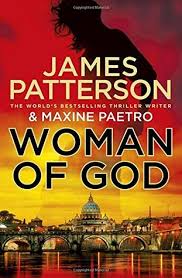
Three years ago I published a review of James Patterson’s novel, Woman of God. It continues to get clicks – perhaps more than anything I’ve published on my blog.  I think that’s because so many of us find ourselves searching for a richer, more relevant church experience that connects with the extraordinarily dangerous times we’re living in. They have in fact been shaped by “the most dangerous organization in the history of the world.”

Woman of God is the story of Brigid Fitzgerald, a medical doctor who though female, becomes a priest and candidate for the papacy.

Brigid and her husband (also a dissident priest) decide to form their own Catholic parish. They do so because of the studied irrelevance of the Catholic Church to pressing problems of the real world. The two call their congregation the “Jesus, Mary and Joseph (JMJ) Church.” They insist on remaining Catholics not allowing their opponents to drum them out of the church as just another break-away Protestant sect.

The JMJ Church spreads rapidly, largely because it connects Jesus’ Gospel with issues of peace and social justice. And though vilified by her local bishop and physically threatened by right wing Catholics, Brigid eventually becomes widely celebrated and is summoned to Rome not for condemnation, but papal approval.

I couldn’t help thinking of Woman of God as I read today’s liturgy of the word this Second Sunday of Advent. Like the JMJ Church, the first two readings along with the responsorial psalm emphasize the connection between faith and social justice.

Then in today’s Gospel, the prophet, John the Baptist, like Brigid Fitzgerald, initiates an alternative community of faith far from the temple in the desert wilderness. John’s credibility leads “all Jerusalem and Judea” to see him as a prophet. In fact, (as John Dominic Crossan has pointed out) John becomes for the Jewish grassroots their de facto alternative “High Priest.”

To see what I mean, consider that first selection from the prophet Isaiah. It directly links faith with justice for the poor, oppressed and marginalized. In Isaiah’s day (like our own) they were typically ignored. By way of contrast, Isaiah’s concept of justice consists precisely in judging the poor and oppressed fairly and not according to anti-poor prejudice – in Isaiah’s words, not by “appearance or hearsay.”  (A clearer statement against contemporary police and/or government profiling can hardly be imagined.)

Not only that, but according to the prophet, treating the poor justly is the key to peace between humans and with nature. Centralizing their needs rather than those of the rich produces a utopian wonderland where all of us live in complete harmony with nature and with other human beings. In Isaiah’s poetic reality, lions, lambs, and calves play together. Leopards and goats, cows and bears, little babies and deadly snakes experience no threat from each other. (This is the prophetic vision of the relationship between humans and nature – not exploitation and destruction, but harmony and mutual respect.)

Most surprising of all, even believers (Jews) and non-believers (gentiles) are at peace. Today’s excerpt from Paul’s Letter to the Romans seconds this point. He tells his correspondents to “welcome one another” – including gentiles – i.e. those the Jewish community normally considered enemies. (That would be like telling us today to welcome Muslims as brothers and sisters whom God loves as much as any of us.)

Today’s responsorial psalm reinforces the idea of peace flowing from justice meted out to the “least.” As Psalm 72 was sung, we all responded, “Justice shall flourish in his time, and fullness of peace forever.” And again, the justice in question has the poor as its object. The psalmist praises a God and a government (king) who “rescue the poor and afflicted when they cry out” – who “save the lives of the poor.”

In his own time, the lack of the justice celebrated in today’s first three readings infuriates Jesus’ cousin, John the Baptist. His disgust forces him out of the temple and into the desert. It has him excoriating the religious leaders of his day as a “brood of vipers.”

Unmistakably clothed as a prophet – in garments that absolutely repudiate the “sacred garb” of his effete opponents – John lambasts the Scribal Establishment which had normalized relationships with the brutal occupation forces of Rome. As opposition high priest, John promises a religious renewal that will lead to a new Exodus – this time from the power of Rome and its religious collaborators.

I hope you can see as I do the parallels between the context of John’s preaching and our own. We live in a culture where those in charge contravene our faith by openly slandering the poor and marginalized celebrated in today’s readings as especially dear to God.

I mean, following the elections of 2016, all the levers of power (the presidency, the Supreme Court, the House and Senate) found themselves in the hands of billionaires and their friends – the 1% that the Occupy Movement identified so accurately eight years ago. Ironically that richest 1% has succeeded in scapegoating the country’s poorest 1% (immigrants) as a major cause of our country’s problems. Moreover, they equally vilify other poor and marginalized people: the impoverished in general, brown and black-skinned people, women, the LGBTQ community, environmentalists, protestors and anyone who exposes the crimes of the billionaire class.

As a result, we entered a period of unprecedented national darkness that still promises to rival that of Germany, 1933-1945. Until the mid-term elections of last year, virtually everything was controlled by the single organization Noam Chomsky calls “the most dangerous in the history of the world.”

More dangerous than the Nazis? Yes, Chomsky insists. Hitler did not have the power to destroy the planet by nuclear war. Hitler ruled Germany before climate change threatened innumerable species, Mother Earth herself, and continued human existence. And yet the entire Republican Party denies that the problem even exists! Yes, it is the most dangerous organization in the history of the world.

And despite all of that, there’s not a peep about it from the pulpit. People keep going to Mass as though the most important upcoming event is the arrival of St. Nicholas at the parish potluck – or the Christmas bazaar.

So, what should we do in the face of such disconnect?

How about following the example of John the Baptist, Brigid Fitzgerald and her husband?

This would entail:

  • Admitting that present forms of church are hopelessly disconnected from the unprecedented tragedy and threat represented by the accession to power of anti-poor climate change deniers.
  • Publicly moving out of our local church building.
  • Perhaps, opening a store front JMJ Catholic church on the Main Street Jim Wallis referred to in his article referenced above.
  • Empowering faithful women in the JMJ community to preach and celebrate the Eucharist.

Objectors will say:

  • We have no authority to do this.
  • It’s better to continue our reform efforts from within.
  • This will only cause division in our church.
  • The status quo really doesn’t bother me, because I use the quiet provided by Sunday Mass to facilitate my own prayer life.
  • (If, like me, you’re of a certain age) I’m too old for such radical disruption of my life.

To such objections John the Baptist might reply:

  • “I had no official authority to start my desert community of resistance and reform. In fact, I was identified by the authorities as an enemy of the state. Eventually they cut off my head. So don’t expect approval.”
  • Reform from within? “I gave up on that early on. So did my cousin, Jesus. Both of us operated outside the temple system which we criticized harshly.”
  • Division in our faith communities? “That didn’t bother me either. Can you get much more divisive or polarizing than calling religious leaders a ‘brood of vipers’?”
  • Withdrawing into personal prayer? “The spiritual masters in my Essene community convinced me that prayer and meditation are essential elements undergirding prophetic action. However, pietism is useless unless it leads to the kind of witness I gave and risk I took on the banks of the Jordan.”
  • Too old? “Again, my Essene mysticism would not permit me to identify with the physical as if I were primarily a body with a soul. The truth is that we are first of all ageless spirits who happen to inhabit temporary bodies. The imperative for action is no less incumbent on older people than on the young. Hell, the elders criticized me for being too young to oppose them. I was barely 30 when they killed me.”

As Jim Wallis has intimated, the specter of John the Baptist should haunt us this second Sunday of Advent and drive our faith communities onto Main Street. These unprecedented times call for radical response outside the sacred precincts and independent of the sleepwalkers awaiting the arrival of St. Nicholas.

Pope Francis Calls Possession of Nuclear Weapons Sinful

Readings for First Sunday of Advent: IS 2:1-5; PS 122:1-9; ROM 13: 11-14; PS 85:8; MT 24: 37-44

Last weekend, Pope Francis outright condemned the manufacture and possession of nuclear weapons. (I’ll bet you didn’t notice that in the mainstream media.)

The pope did so during his visit to Hiroshima and Nagasaki, where he met with survivors of the two Japanese cities which were virtually wiped off the map when atomic bombs were dropped on them in 1945. The weapons of unprecedented mass destruction killed more than 200,000 people in matters of minutes.

During his remarks, Pope Francis said, “A world without nuclear weapons is possible and necessary. . .  The use of atomic energy for the purpose of war is immoral, just as the possessing of nuclear weapons is immoral . . .”

The pope’s visit and sharp condemnation could not come at a more opportune time either historically or liturgically (on this First Sunday of Advent). Historically, they follow hard upon the conviction of the Kings Bay Plowshares 7, a group of seven Catholic peace activists who in April of last year entered the Kings Bay Naval Submarine Base in Georgia to symbolically destroy the nuclear weapons housed there. (Kings Bay harbors at least six nuclear ballistic missile submarines. Each of them carries 20 Trident missiles.)

The Seven included Liz McAlister, the wife of deceased peace activist Phil Berrigan, as well as Martha Hennesy, the granddaughter of Dorothy Day, the legendary co-founder of the Catholic Worker Movement.  

As I pointed out a couple of weeks ago, the group’s own “weapons” for accomplishing their task were hammers, crime scene tape, and baby bottles containing their own blood. Once inside, they splashed their blood on the walls of the base’s administration building. They used their hammers to “destroy” the nosecone of one of the Trident missiles. They also posted a formal indictment of the U.S. government charging it with crimes against peace.

At their trial the activists had planned to mount a “necessity defense.”  However, the presiding judge forbade them to cite their religious motivations. That nullified their planned argument that their “crime” was morally necessary to prevent the far greater catastrophe of a nuclear war.

The Seven had also planned to present Daniel Ellsberg as an expert witness to articulate that defense. All of us recall Ellsberg as the most famous whistle blower in U.S. history. In 1971, he risked a lifetime behind bars when he leaked the famous Pentagon Papers that revealed Washington’s hidden strategy behind the Vietnam War. His recent book The Doomsday Machine: confessions of a nuclear war planner details his work as a Defense Department analyst and nuclear weapons strategist.

However, Ellsberg too was forbidden to testify. Had he done so, he would have argued that the Seven were faithfully following the prophet Isaiah’s command to “beat swords into plowshares” (IS 2:4).

(By the way, with the judge’s restrictions in place, the Plowshares 7 were convicted of conspiracy. On their sentencing within 90 days, the activists will face more than 20 years in prison.)

All of this – Pope Francis’ words about the sinfulness of nuclear weapons manufacture and possession as well as the conviction of the Plowshares 7 – is relevant to this Sunday’s liturgy of the word and historically relevant in the way just explained. That’s because today’s first reading contains those words from the prophet Isaiah.

Contradicting his people’s earlier understanding of God as a “Man of War,” Isaiah’s words describe divine opposition to all war and a fortiori, of course, to nuclear war. They envision a precisely enlightened human future when the people of the world will “beat their swords into plowshares and their spears into pruning hooks,” and where “one nation shall not raise the sword against another.”

Then in today’s Gospel reading from the 24th chapter of Matthew’s Gospel, Jesus (like the Buddha before him) calls his followers to simply wake up rather than prepare for war against their Roman occupiers led by a violent “Son of Man.” As Matthew’s readers will discover in his 25th chapter, “waking up” means recognizing Christ’s presence in the “least of the brethren.” Jesus implies that such recognition precludes war of any kind and (again a fortiori) nuclear war.

To get what I mean, please read for yourself today’s biblical selections. You can find them here. Despite their obscurity (especially in today’s apocalyptic Gospel passage), you’ll see that they’re about waking up and renunciation of war. At least that’s what I see in them, as you can tell from my “translations” immediately below:  

IS 2:1-5

For the prophet Isaiah,
Jerusalem and its Temple
Called people everywhere
To lift their gaze
Above the world’s
Hills and highest mountains
To the realm of peace and light
He believed possible.
To get there, he said,
Disarm and demilitarize.
Transform all
Weapons of mass destruction
Until they look like
Hoes and shovels,
Tractors and cultivators.
 
PS 122: 1-9
 
Yes, it’s possible to turn this world
Into a house of worship –
A City of Peace –
Where all human beings
Enjoy the prosperity
That disarmament makes possible.
That’s the key to reconciliation and happiness.
 
ROM 13: 11-14
 
St. Paul calls us to wake up!
Only our selfishness,
He says,
Prevents the advent
Of that other peaceful world.
So, don’t be deceived, he said,
By the world’s empty promises
Of fulfillment by (Christmas) consumption
And militarization.
Instead, seek that other world first
And everything else you need
Will follow automatically.
 
PS 85:8
 
Lord, please show us
How to get from here to there!
 
MT 24: 37-44
 
Jesus warned his friends
About using violence
To achieve peace.
They hoped that
Daniel’s “Son of Man”
Would dethrone imperial Rome
By force of arms.
“Be careful what you wish for,”
Jesus cautioned.
“Your hoped-for apocalypse
Will recall the devastation
Of Noah’s Flood.
Civilian casualties
Will run at 50% —
Killing innocent
Men and women alike
(Just as at Hiroshima
And Nagasaki).
True change however
Comes from disarmament
(as Isaiah taught)
And from extreme wakefulness
(as the Buddha instructed).
Pray then for blessed insomnia!
Wake up
To the signs of the time!”

Don’t you agree that Pope Francis is wonderful? His faithful following of Jesus and of St. Francis of Assisi has led him to call things by their right names. Nuclear war is sinful, he has said unmistakably. Possessing nuclear weapons is immoral. Catholics and the entire world need to take those words to heart and act upon them.

The Plowshares Seven show us what such open-hearted action means. The Seven are willing to go to prison for enacting the logical consequence of the words of Pope Francis and of Jesus in a world cursed by nuclear weapons.

But few are paying attention. Few take notice. Since Francis’ words weren’t about abortion, homosexuality, or refusing communion to politicians, the pope’s words of condemnation received little attention in the mainstream media. Moreover, those words seemed pointed sharply at the U.S. which alone has ever used nuclear weapons and possesses more of them than any nation on earth. And who among us (much less, among the corporate media) is willing to endure such condemnation?

Fewest of all among us are willing to take seriously the challenge of the Plowshares 7. Who among us is willing to do prison time for the sake of following the prophetic ones who identified disarmament, wakefulness and enlightenment as the only effective path to happiness and peace?

Advent is the time for entertaining those questions. What are your answers? What are mine?

(Discussion follows)