As things stand now, I’m not going to vote in the general election in November 2020. What choice do I have?
Now that Bernie’s dropped out, It’s between two mentally impaired dirty old men – Donald Trump on the one hand, and Joe Biden on the other. Both are showing clear signs of dementia.
Trump stands accused of sexual assault by multiple women. Biden has a still unanswered but very credible similar charge outstanding. And no one in Biden’s party or in the press will even raise that accusation for discussion. (Trust me: Trump will! So, goodbye, Uncle Joe.)
And both men are serial liars. With Trump, that is a foregone conclusion. But Biden’s a liar too.
In one of his previous candidacies, his history of plagiarism made him surrender his bid. He’s lied about his education and his achievements in law school. Then there are those lies about his civil rights activism, about his history with Nelson Mandela, and about his attacks on Social Security. He just makes stuff up.
And neither one of them – neither Trump nor Biden – can put two sentences together without confirming their dementia. Every time he opens his mouth, Trump sounds like the doddering Mafia Don he is. He slurs his words, repeats himself, and can’t even remember what he just said. He hasn’t a worthwhile thought in his head. Never has.
Biden’s even worse! His sentences wander; he forgets what he’s talking about; he constantly leaves his audiences wondering, “What?” Or “That’s (to put it nicely) simply embarrassing!”
In a country of more than 350 million people, is this the best we can do? Are these our best and our brightest?
(However, I have to say that debate between these buffoons will make great television. It will be highly amusing and comical. But that’s what politics in this country has come to. It’s all Kabuki theater; it’s a cruel joke.)
That’s another reason I’ll not vote in November. The political system in general is completely broken. The politicians that are supposed to represent me have nothing to do with my concerns. They’ve completely sold out. They represent no one but their rich cronies. (Now I know how people in the Soviet Union must have felt in the late ‘80s.) The system just isn’t worth my participation.
And that goes for AOC, Ilhan Omar, the rest of the so-called “squad “(and Bernie too). In the most recent bailout, they all caved. They gave grandstanding speeches about the injustice of it all. But in the end, they voted against us, didn’t they? Their loyalties are to party and career, not to me or to you. We have NO ONE to represent us.
Democracy in this country is dead. The system is completely rigged. They don’t even want us to vote. The obstacles they’ve set in terms of the electoral college, gerrymandering, disenfranchisement, crooked voting machines, interminable lines, and Citizens United make a mockery of the entire process.
And please don’t try to shame me into voting because of the Supreme Court. That body is totally corrupt as well – completely politicized. No justice there – not even a glimmer of hope. Only clowns like the sexual predator Clarence Thomas (whom Biden ended up supporting over Anita Hill), the accused rapist Brett Kavanaugh, and a coward like John Roberts (who, remember hardly spoke a word while presiding over the recent sham impeachment hearings). The SCOTUS has no credibility at all. It’s irreformable. So, dear Ruth, you may go in peace.
The hell of it is that we don’t have any time for reform. Mother Nature won’t allow it. Climate change is breathing down our necks. What are the scientists giving us – 10 more years – or is it 8? You can now subtract 4 from that number. Neither Trump nor Biden will do what needs to be done. (Remember, Joe told his corporate friends, “Nothing fundamental will change.”)
And no one cares. I mean, with COVID-19, we can make the entire world stop. But with the far worse threat of climate change: not so much. It’s all business as usual. And it’s all nuts.
But in a way, maybe that’s the only ray of hope we have – from Mother Nature. While our system won’t object to climate destruction, maybe Our Great Mother just won’t allow this madness to go on. In any case, it’s now up to her. She will have her way.
It’s all so discouraging on this morning after Bernie’s surrender. In the face of it all, and as things stand now, that’s why I’ll boycott this election in November.
Remember as a child reading about the “Great Stock Market Crash of 1929?” Well, in the same way our grandchildren will read about the “Great Health Market Crash of 2019.” And the latter will impress them as more devastating than the former.
Yes, the present crisis is much more revelatory and potentially devastating than the infamous crash of ’29. And President Trump’s mismanagement of the disaster will be recalled as even more out-of-touch than Mr. Hoover’s. However, Franklin Roosevelt’s analog may surprise us. It’s not Bernie Sanders.
To begin with, what we’re currently witnessing is a U.S. health market failure; make no mistake about that. It’s no unforeseen act of God before which any leader worthy of the name can claim “I take no responsibility for it at all.” Rather, what we’re facing is a completely predictable crash of a public good (health and healthcare) that has been stupidly marketized. The failure of the health market has caused all related systems (i.e. everything) to grind to a halt.
Privatized health markets now stand unmistakably shown to be completely shortsighted and fatuous. They have proven entirely incapable of responding to anything but the bottom line and short-term quarterly reports.
Such limitation and uncoordinated focus come from the fact that there’s no money to be made in stockpiling face masks, ventilators, available hospital beds or in maintaining reserve armies of doctors and healthcare workers who might be needed well after the publication of next month’s statement of profit and loss. Yet those standing armies with ample supplies of ordnance for fighting disease are now proving more vital than their make-work military counterparts stationed in more than 300 bases across the planet. And for what?
Additionally, we’re also witnessing a complete collapse of national leadership. For the first three months of the impending crash, Mr. Trump actually made fun of the virus and called it a “hoax.” He promised that it would “miraculously” disappear if people only continued their normal lives and work habits without paying attention to the medical experts. Then, finally, three months into the emergency, he claimed he always knew it was a pandemic – even before anyone else. So much for his leadership.
Moreover, Trump’s preparation for this foreseeable plague took the incredible form of funding reduction for the Center for Disease Control and his disbanding of the Pandemic Response Team established precisely for eventualities like the current epidemic. Now, that in itself is prima facie cause for resignation or impeachment.
It’s also enough to make the unperceptive despair and throw up their hands in helpless disgust especially after the apparent demise of Bernie Sanders’ presidential campaign. Without Bernie, who’s going to assume political leadership on a par with Mr. Roosevelt’s. (And it’s here that FDR’s surprising equivalent emerges.)
The sad truth is that he’s on the other side of the globe. He’s in China in the person of Xi Jin Ping. He heads a centrally planned system which for all its limitations is proving to be the only kind capable of responding efficiently to crises like COVID-19.
For example, did you know that the Chinese system enabled Wuhan authorities to build a large state of the art hospital in just ten days? The emergency medical facility is two stories tall and is complete with several isolation wards and 30 intensive care units. It can hold up to 1,000 patients. Under the U.S. form of capitalism, it would take years just to obtain property rights for such an undertaking – not to mention waging the court battles that would ensue. The Chinese did it in a week and a half.
In other words, only our culture’s endemic ethnocentrism prevents us from seeing the limitations of capitalism-as-we-know it. Our blindness locks us in despair and keeps us from recognizing that the world no longer depends on U.S. leadership for anything. What we’re witnessing instead is the collapse of the United States into the status of failed state and embarrassing underdevelopment. We’re beholding instead the passing of the baton of world leadership to China.
This brings to mind the sudden collapse of the Soviet Union exactly 30 years ago.
Put otherwise and bluntly, the COVID-19 disaster understood as a Great Health Market Crash:
Involves a market failure just as devastating as the one in ’29.
It has consequently brought the world economy to a depression-like standstill with overwhelming unemployment, resulting poverty and disastrous loss of life and the possibility of long breadlines
The crisis is worldwide in scope and as such puts on display varying national responses that can easily be compared and evaluated
It shows clearly that countries like South Korea, China, and even Cuba (with its army of doctors), all of which used to be considered “underdeveloped” countries, have surpassed the United States in categories much more important than stock market averages and military strength. In fact, all those nations and others as well take better care of their people who enjoy superior health care, longer lives, and more flexible and efficient economies.
The entire complex of events definitively demonstrates the passing of the baton of world leadership to China
Or as Nicholas Kristoff recently put it so gently: “The United States is in a weaker position than some other countries to confront the virus because it is the only advanced country that doesn’t have universal health coverage, and the only one that does not guarantee paid sick leave. With chronic diseases, the burden of these gaps is felt primarily by the poor; with infectious diseases, the burden will be shared by all Americans.”
I can think of no better description of a failed state and underdeveloped country brought to its knees by “The Great Crash of ’19.”
Readings for Palm Sunday: LK 19:28-40; IS 50: 4-7, PS 22: 8-9, 12-20, 23=24, PHIL 2:6-11, LK 22: 14-23:58.
It’s puzzling to see white Evangelicals rallying around Donald Trump. He’s the one who owns casinos and strip clubs, who has been married three times and brags about sexually assaulting women.
How is it possible for white evangelicals to support such a person whose policies favor the rich and punish the poor, who despises immigrants, advocates torture, and whose appetite for profit seems insatiable.
After all, Jesus was a poor laborer who criticized the rich in the harshest of terms. He and his family knew what it was like to be unwelcome immigrants (in Egypt). He himself was a victim of torture, not its administrator. Far from a champion of empire, he was executed as a terrorist and enemy of Rome. His followers were not about accumulating wealth but shared what they had according to ability and need.
When you think of it, all of this seems antithetical to not only to Trumpism, but to the declared positions of virtually the entire Republican Party. They’re all imperialists. All of them are friends of the one percent. They all want to increase military spending — apparently without question or limit.
How did all of that happen?
Today’s Palm Sunday readings provide some clues. Luke’s Passion Narratives reveal a first century Christian community already depoliticizing Jesus in order to please Roman imperialists. The stories turn Jesus against his own people as though they were foreign enemies of God.
Think about the context of today’s Palm Sunday readings.
Note that Jesus and his audiences were first and foremost anti-imperialist Jews whose lives were shaped more than anything else by the Roman occupation of their homeland. As such, they weren’t waiting for a Roman-Greco “messiah” who, like the Sun God Mithra, would die and lead them to heaven. They were awaiting a Davidic messiah who would liberate them from the Romans.
So, on this Palm Sunday, what do you think was on the minds of the crowds who Luke tells us lined the streets of Jerusalem to acclaim Jesus the Nazarene? Were they shouting “Hosanna! Hosanna!” (Save us! Save us!) because they thought Jesus was about to die and by his sacrificial death open the gates of heaven closed since Adam’s sin by a petulant God? Of course not. They were shouting for Jesus to save them from the Romans.
The palm branches in their hands were (since the time of the Maccabees) the symbols of resistance to empire. Those acclaiming Jesus looked to him to play a key role in the Great Rebellion everyone knew about to take place against the hated Roman occupiers.
And what do you suppose was on Jesus’ mind? He was probably intending to take part in the rebellion just mentioned. It had been plotted by the Jews’ Zealot insurgency. Jesus words at the “Last Supper” show his anticipation that the events planned for Jerusalem might cause God’s Kingdom to dawn that very weekend.
Clearly Jesus had his differences with the Zealots. They were nationalists; he was inter-nationalist who was open to gentiles. The Zealots were violent; Jesus was not.
And yet the Zealots and Jesus came together on their abhorrence of Roman presence in the Holy Land. They found common ground on the issues of debt forgiveness, non-payment of taxes to the occupiers, and of land reform. Within Jesus’ inner circle there was at least one Zealot (Simon). Indications might also implicate Peter, Judas, James, and John. And Jesus’ friends were armed when he was arrested. Whoever cut off the right ear of the high priest’s servant was used to wielding a sword – perhaps as a “sicarius” (the violent wing of the Zealots who specialized in knifing Jews collaborating with the Romans).
But we’re getting ahead of our story. . . Following his triumphant entry into Jerusalem, Jesus soon found himself and his disciples inside the temple participating in what we’d call a “direct action” protest. They were demonstrating against the collaborative role the temple and its priesthood were fulfilling on behalf of the Romans.
As collaborators, the temple priests were serving a foreign god (the Roman emperor) within the temple precincts. For Jesus that delegitimized the entire system. So, as John Dominic Crossan puts it, Jesus’ direct action was not so much a “cleansing” of the temple as the symbolic destruction of an institution that had completely lost its way. It was this demonstration that represented the immediate cause of Jesus’ arrest and execution described so poignantly in today’s long gospel reading.
Following the temple demonstration, Jesus and his disciples became “wanted” men (Lk. 19:47). At first Jesus’ popularity affords him protection from the authorities (19:47-48). The people constantly surround him eager to hear Jesus’ words denouncing their treasonous “leaders” (20:9-19), about the issue of Roman taxation (20:20-25), the destruction of the temple (21:1-6), the coming war (21:20-24) and the imminence of God’s Kingdom (21:29-33).
Eventually however, Jesus has to go underground. On Passover eve he sends out Peter and John to arrange for a safehouse to celebrate the feast I mentioned earlier. The two disciples are to locate the “upper room.” They do so by exchanging a set of secret signs and passwords with a local comrade.
Then comes Jesus’ arrest. Judas has betrayed Jesus to collect the reward on Jesus’ head – 30 pieces of silver. The arrest is followed by a series of “trials” before the Jewish Council (the Sanhedrin), before Pilate and Herod. Eventually, Jesus is brought back to Pilate. There he’s tortured, condemned and executed between two other insurgents.
Note that Luke presents Pilate in way completely at odds with what we know of the procurator as described for example by the Jewish historian Josephus. After the presentation of clear-cut evidence that the Nazarene rabbi was “stirring up the people,” and despite Jesus’ own admission to crimes against the state (claiming to be a rival king), Pilate insists three times that the carpenter is innocent of capital crime.
Such tolerance of rebellion contradicts Crossan’s insistence that Pilate had standing orders to execute anyone associated with lower class rebellion during the extremely volatile Passover festivities. In other words, there would have been no drawn-out trial.
What’s going on here? Two things.
First of all, like everyone else, Luke knew that Jesus had been crucified by the Romans. That was an inconvenient truth for Luke’s audience which around the year 85 CE (when Luke wrote) was desperately trying to reconcile with the Roman Empire which lumped the emerging Christian community with the Jews whom the Romans despised.
Luke’s account represents an attempt to create distance between Christians and Jews. So, he makes up an account that exonerates Pilate (and the Romans) from guilt for Jesus’ execution. Simultaneously, he lays the burden of blame for Jesus’ execution at the doorstep of Jewish authorities.
In this way, Luke made overtures of friendship towards Rome. He wasn’t worried about the Jews, since by the year 70 the Romans had destroyed Jerusalem and its temple along with more than a million of its inhabitants. After 70 Jewish Christians no longer represented the important factor they once were. Their leadership had been decapitated with the destruction of Jerusalem.
Relatedly, Jesus’ crucifixion would have meant that Rome perceived him as a rebel against the Empire. Luke is anxious to make the case that such perception was false. Rome had nothing to fear from Christians.
I’m suggesting that such assurance was unfaithful to the Jesus of history. It domesticated the rebel who shines through even in Luke’s account when it is viewed contextually.
And so, what?
Well, if you wonder why Christians can support Donald Trump . . . if you wonder why they so easily succumb to empires (Roman, Nazi, U.S.) you’ve got your answer. It all starts here – in the gospels themselves – with the great cover-up of the insurgent Jesus.
And if you wonder where the West’s and Hitler’s comfort with xenophobia in general and anti-Semitism in particular come from, you have that answer as well.
The point here is that only by recovering the obscured rebel Jesus can Christians avoid the mistake they made 87 years ago in Germany. Then instead of singing “Hosanna” to Jesus, they shouted “Heil Hitler!” to another imperialist torturer, xenophobe, and hypocrite.
The readings for Palm Sunday present us with a cautionary tale about these sad realities and the trend among white evangelicals that impossibly transforms Donald Trump into a Christian hero. The imperialists Pontius Pilate, Adolf Hitler, and Mr. Trump all belong in the same anti-Christ category.
The Coronavirus plague should be putting everything in perspective for us all. It should make us ask what life’s really about, no matter if we’re rich or middle class. (The poor are another story.) That’s because COVID-19 has forced everyone who’s solvent into something like the same boat. It’s made us realize that the vessel has just sprung a huge leak that threatens to take us all down collectively and personally – unless we make some fundamental changes on both fronts. The possibilities for change are endless, hopeful and encouraging.
Our Shared Reality
First of all, think about our shared boat. All of us have been born into a consumerist culture that tells us life’s about money, beautiful clothes, luxury automobiles, travel to exotic places, entertainment, and eating in fine restaurants.
Suddenly though, none of that has much meaning.
In my own case, since the springing of the Coronavirus leak, I don’t even have anywhere to spend the money I already have. My two old Volvos have been parked in our driveway for 2 weeks; I haven’t used a drop of gasoline; there’s no place for us to go. I can spend all day in my pajamas, and nobody will know the difference. I live a 70-minute train ride from Broadway, but it’s all been shut down. I can’t even watch March Madness or Lebron on TV. There’s no spring training or the prospect of a baseball season. And as for fine restaurants, I can’t even buy a donut and java at “Coffee An’,” our local hangout, or even at Starbucks.
And I imagine it’s like that for billionaires too. I mean, what do they do all day? Like me, they’re confined as they shelter in place. Like me, they get up in the morning, read the newspaper or some online source, eat breakfast, maybe go for a run, take a shower, eat lunch, nap for a while, talk with some friends or associates on the phone, read a chapter or two in a book or an article in a magazine, have a drink for happy hour, eat supper with family, watch a Netflix movie, have a nightcap, and go to bed. That’s it.
And tomorrow will be the same. What else can they do? What more can their money buy them? I mean, it’s pretty much the same for all of us who are lucky enough not to be homeless or in prison. Under the Coronavirus regime, Jeff Bezos’ life can’t be that much different from my own.
So, as I watch financiers thrilled at the prospect of a surging stock market stimulated by a number I can’t even imagine, I wonder what for? Where are they going to spend the profits they anticipate? Who’s going to buy the stuff they imagine will be produced? Their situation is the same as mine.
And where did all that money come from anyway? (They didn’t have it for Bernie’s Medicare for All.) What does it mean? Why is green paper – or fiat numbers someone decided to put on investors’ computer screens – so powerful? And what did any of those Wall Streeters do to earn it? In present circumstances, how does it make their lives better than mine?
It all seems somehow made up. And in a very real sense, so does the rest of the stuff I’ve mentioned so far.
Solutions
And then there’s Mr. Trump’s solution to this health crisis. In a word, it’s DENIAL. Of course, that’s one way of dealing with our sinking ship. Just ignore the problem and get back to normal. Or as Trump puts it: “Open the country for business again. Right now! Start driving those cars and buying that junk. Eat up those Big Macs and put some fat on those bones of yours. Fire up those plants and darken the skies with smoke again. Bury those pipelines and frack like fu*k. (I’m sure he puts it that way.) Cut down some more rainforests. Fill up those plastic shopping bags and throw them in the ocean. Get on with the business of poisoning the planet. Above all, produce those bombs, planes, tanks, and missiles. And be sure to use them. There are so many sh*t-hole countries to destroy and so little time.
“And, by the way, be sure to ignore the scientists (again!). Hell, if we left it up to the doctors and their hypochondriacal tendencies, the stores, stadiums, shows and showrooms would be shuttered for two years. And then what?
“So, damn the torpedoes, full speed ahead, and for the sake of our grandchildren, let the old people and other weaklings die – even if millions expire prematurely. Who cares? With the market in the tank, there’s nothing for them to live for anyway. Better dead than bored and broke.”
That’s the Trump many of us know and loathe. Thankfully however, his denial’s not the only way of dealing with the problem – although (disappointingly) the congressional bail-out package shows that ALL of our politicians (including Sandberg and Warren) pretty much agree with the president!
For the rest of us however, it’s high time to move in another direction – to reassess what we take as “normal,” cut our losses, and get back to the basics that lockdown has forced upon our awareness. In fact, COVID-19 might be the Process of Life, it might be Mother Nature, it might even be God (!) telling us to review and revise our entire way of life – the way environmentalists have been suggesting since Francis of Assisi, Henry David Thoreau, and Jacques Cousteau.
But our world has gone beyond them too. I mean, given the beneficial developments unforeseen by those proto-ecologists, we might finally be able to transcend their insights and pressure our politicians to move towards the prospects that futurists described for us in the 1960s and ‘70s. Remember their speculations about “the leisure society” that computers and “cybernation” would make inevitable? What will we do, they asked, with all that free time?
Now’s the time to stop and answer their question. Despite our dear leader’s recommendations, it would clearly be insane to return to the suicidal “normal” that seemed inescapable just two weeks ago. We have to make everyone understand that.
New Directions
So, if not in Trump’s and our senators’ direction, where should we go? How about:
For sure, nationalizing health care into a single payer system. If nothing else, the present pandemic has revealed the absolute inadequacy and intolerability of the healthcare status quo. Medicare for All needs to be the sine qua non element of effective response.
Break up any business that’s “too big to fail.” (Aren’t you tired of bailing out the rich?) Breaking up corporate giants makes sense even according to strict free market principles. Adam Smith himself saw monopolies as counterproductive. If businesses make inadvisable decisions, they should be allowed to crash, burn and be replaced by more efficient firms.
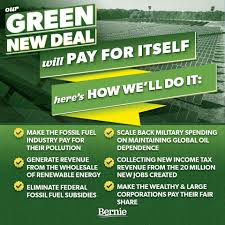
Mimic the success of FDR by implementing a Green New Deal (GND) to absolutely restructure our economy in ways that take seriously the crisis of climate chaos. Besides redirecting production away from carbon and towards green technology, the GND would provide enhanced unemployment insurance, forgiveness of college loans, paid maternity leave, free childcare, higher minimum wages. . .
Almost as certainly, our country also needs some form of Universal Basic Income (UBI). As we’ll see immediately below, the work furloughs forced upon us by COVID-19 have made it clear that many of our jobs are pretty close to busywork. So many of those jobs can be safely eliminated.
Yes, when you think about it, so much of the work we do is unnecessary. Do we really need advertising, health insurance companies, defense contractors, malls and retail outlets, oil giants, and businesses that destroy our health and environment? Do we really need McDonalds and Burger King?
What we’re learning now is that we can get along without any of them.
And certainly, we don’t have to do all that traveling – the hours upon hours spent in morning and evening rush hour traffic. And then there’s all that time that road warriors waste in airports traveling to meetings that might just as well take place via Skype or Zoom.
The same is true for a lot of our schooling. Do we really need to maintain all those expensive campus plants, when present experience teaches us that remote learning is quite effective, inexpensive and time saving?
And above all, worldwide focus on real national security problems like pandemics and lack of adequate medical care has put in perspective those other completely manufactured problems connected with our endless wars. Is our national security really served by them? Or is that make-work – is it busywork too?
So, how about eliminating those 300 foreign military bases and the millions of soldiers, independent contractors, and related jobs as well? Again, it’s busywork – make-work that’s completely unnecessary and wasteful of taxpayer money.
Additionally, the release of non-violent inmates from Rikers and other prisons brings to light the fact that if we’d legalize drugs and treat addiction as the health problem it is, we wouldn’t need all those penal institutions either.
Conclusion
So, the present pandemic, at least in some respects, might be the proverbial blessing in disguise.
It’s suggesting that we eliminate all the jobs now revealed as unnecessary. Doing so will suddenly make it possible for us to reduce the time we all spend trying to “look busy.” Suddenly, it becomes possible for us to share the decreasing number of jobs that can’t be done cybernetically. We could share the remaining jobs working just 4 hours each day, or 3 days a week. We could work 6 months each year and have 6 months off. Or we could spend 1 year on the job and take 2 off.
The list of changes suggested by our current crisis is endless. And I’m sure any of us could add to the list of labor-saving discoveries the current lockdown has brought to light.
In summary, our forced retreat invites us to realize that we’re all in the same boat and (and as someone else said) once our basic needs have been met, the best things in life are free.
Readings for the Fifth Sunday of Lent: Ezekiel 37: 12-14; Psalms 130: 1-8; Romans 8:8-11; John 11: 1-45
On this fifth Sunday of Lent our readings prepare for Easter by directing us to consider death and resurrection both politically and personally.
The readings are especially poignant and relevant at a time when as a people we appear to be in a cruel political captivity not unlike that of Israel more than 2500 years ago. Besides that, the loss of loved ones to the Coronavirus has brought into so many families the experience of Martha and Mary bereft of their beloved brother Lazarus who was so dear to their family’s close friend, Jesus the Christ.
Our Own Babylonian Captivity
Today’s first reading reminds us that we’re like Israel during its Babylonian Captivity. The prophet Ezekiel addresses that latter situation right off the bat. His sixth century was the saddest of times for his people – the era of his nation’s Great Exile. The Hebrews had been defeated and humiliated by Babylon (modern day Iraq). Judah’s leaders and a large portion of its populace had been abducted to that enemy state. Jerusalem lay in ruins. The exiles felt as if they had been slaughtered culturally. They were far from home, controlled by foreign masters, and apparently abandoned by God.
Like his audience, we’re undeniably in the grip of cruel masters. During the COVOD-19 crisis, our version of captivity has our “public servants” treating us as if we were aliens in a Babylon that belongs to them and their rich donors. It’s as if we were powerless defeated foreigners under their power rather than their employers. That’s shown by the fact that they’ve dealt with the Coronavirus problem not by improving the people’s healthcare system. Instead they’ve used the crisis to take care of the bank accounts of their sponsors who end up being our captors! In other words, we’re the victims of a coup by the corporate elite and their congressional minions. There seems no way out.
That’s the way Matt Stoller, research director at the American Economic Liberties Project, has described the bailout. His recent column for the Guardian is entitled “The coronavirus relief bill could turn into a corporate coup if we aren’t careful.”
According to Stoller, suddenly, under the pressure of COVID-19 congressional representatives on retainer from corporations like Boeing and Citibank found the very money they claimed wasn’t there when it came to providing for us the same healthcare that every other industrialized nation offers taxpayers. Suddenly that money materialized out of nowhere, but not to cure the failed “healthcare market,” but to heal instead their failed stock market and to save a moribund capitalism.
Predictably, they’ll use that money not principally to address COVID-19, but to eventually buy up distressed businesses and taxpayers’ homes. (Stoller warns that we may end up with just three retailers in this country: Amazon, Walmart, and Costco.) In the process, they’ll gift dividends to their investors and bonuses to their CEOs. They’ll also further consolidate their control of the nation’s and world’s economy. It’s pure Disaster Capitalism as described so well by Naomi Klein. Absolutely no one asked legislators, “How are you going to pay for the generosity you’ve just extended to your corporate sponsors?”
Meanwhile, “our” representatives have given highly conditioned, means-tested crumbs to the rest of us. It’s what the Mafia does. As Jimmy Dore says, they rip off the ones who pay them protection money all year. Then give their proteges a turkey at Thanksgiving – and expect gratitude in return.
I mean, none of what the Congress passed showed any awareness of dealing directly with the actual problems facing our nation in the face of COVID-19. They’ve done nothing to immediately address the lack or face masks, hospital beds, or respirators, — much less that universal healthcare insurance which our situation absolutely cries out for.
No, healthcare and all the rest have been left to the mechanisms of trickle-down economics and private insurance companies. The implication is that if we take care of Wall Street first, our immediate healthcare needs will somehow be met one day when private enterprise finally decides to produce what we so desperately need right now. We’ve seen this horror movie before.
And just watch the dead bodies pile up while we wait. It’s already happening. And the crisis hasn’t nearly peaked.
We are captives. We are enslaved in this New Babylon by resuscitated Robber Barons!
Biblical Analogs
Nonetheless, in the face of all this, today’s readings urge us not to give up hope either in the face of seemingly inescapable exploitation nor in that of premature death. As such the readings are not just happy talk. They’re seriously calling us instead to face the undeniable fact that this too will pass. It will. And (hard as it might be to believe) what we’re promised instead is God’s Kingdom. The Robber Baron system is on its last legs.
Babylon’s empire fell; so did Rome’s. And genuine tears, compassion, and words of comfort like those Jesus shared with Martha and Mary can somehow restore life that seemed hopelessly lost. Both Ezekiel and Jesus believed in resurrection. In the present crisis, their followers are urged to do the same.
Review the readings for yourself here. What follows are my own “translations” of their content.
Ezekiel 37: 12-14Death as a Metaphor for Political Captivity: Five hundred years before Jesus, while God’s people were imprisoned in what we now call Iraq, the Prophet Ezekiel predicted their release from captivity and return to Judah. It would be, he promised, like a resurrection from the dead. God’s people would once again experience her goodness and feel Life’s Spirit rushing through their veins.
Psalm 130: 1-8: The Spirit of God Favors Such Release: This is because when people cry out to their Great Mother, God always hears. She is completely trustworthy, kind, and above all, forgiving.
Romans 8: 8-11: And ThisDespite the World’s Denial: No one ever enjoys fullness of life living by the values of the world. That’s because we are not merely bodies as the world teaches. No, we are Divine Spirits who enjoy our bodies to serve the world, just as Jesus did. So, don’t worry. What the world calls defeat and death can never be final. The Divine Spirit we share will always return to life.
John 11: 5A, 26: So, those who follow the path trod by our Enlightened Master are never afraid of death. They never give up.
John 11: 1-45: A Living Parable Showing that Death Does Not Have the Final Word: Lazarus along with his sisters Mary and Martha were among Jesus’ best friends. So, the Master was heartbroken when word reached his hideout that Lazarus was deathly ill. However, his careful measures to avoid the police kept Jesus from getting to Lazarus’ home before it was too late. When he finally arrived, a distraught Martha gently scolded him for his delay. Mary was softer in her expression of disappointment. “I’m sorry,” Jesus said through his own tears, “but don’t you see that nothing in this world – not even death – is final. Life always has the last word. That’s true for Lazarus; it will be true for our suffering people.” Unconvincingly, both Martha and Mary nodded agreement. He embraced both sisters fondly and asked to be taken to Lazarus’ tomb. Once there, from his profound heartache, Jesus shouted, “I’m so sorry, Lazarus. I loved you so much, my dear brother!” And true to his words, Jesus’ grief and evident love somehow made everyone realize that he was right: death is not the end. Everyone’s sorrow turned instantly to joy. It was miraculous!
Conclusion
Once again, I know that in our present crisis, it’s almost impossible to take those hopeful readings to heart. It’s hard to believe that one day we’ll be released from the captivity of the rich and powerful who are using the COVID-19 crisis to even further consolidate their power over us. It’s hard in such circumstances to believe that Life and History are on our side.
But that’s what our readings today call us to. Improbably it seems, they ask us to believe that Life and Justice will eventually triumph over the ways of the world that seem so overwhelming and powerful — that seem to be winning.
The hammerlock the rich have on all of us is painful and seems absolutely inescapable. They don’t care about us and neither do most of our elected officials.
Meanwhile as we sweep up our crumbs, as we await our Thanksgiving turkey, we have to watch our loved ones die for lack of testing kits, face masks, hospital beds, protective clothing for heroic healthcare workers, and universal healthcare coverage for the rest of us. It’s all so sad. As with Ezekiel’s people in Babylon, as with tearful Martha and Mary – and Jesus – we’re hard put to believe in resurrection. But Easter is on the horizon. . .
So now the word in the mainstream media (MSM) is that Donald Trump has successfully co-opted the so-called “American left.” After all, they tell us, he’s implemented Universal Basic Income (UBI); he’s promised to set up government hospitals to treat COVID-19 patients; he’s proposed delayed foreclosures and evictions and has strengthened unemployment measures for laid-off workers. Unwittingly, we’re told, he has become a “socialist.” And worst of all (for his opponents) under that new identification, his approval ratings have risen.
Does this mean he’ll be reelected next fall even though his handling of the coronavirus crisis has been abysmal? Remember: he mocked it at first. The testing kits he promised still haven’t materialized. And, as usual, his pathological duplicity makes it impossible for anyone to know what’s really going on in the man’s little head. Do his promises mean anything, or will they be rescinded tomorrow?
Nonetheless, there’s a grain of truth in his latest manifestation as socialism’s champion.
Additionally, if we understand fascism as “capitalism in crisis”, Trump’s co-optations can be unmasked as mirroring faithfully those of his forebears in that system. And finally, there’s hope to be found in the president’s rising numbers.
Trump’s Socialism
To begin with, it must be acknowledged that all of the above (UBI, government-sponsored healthcare, policies preventing homelessness, and unemployment insurance) are indeed key planks in any socialist platform.
At the same time, it is also true to say that the president has very little choice in the matter. History has shown that in circumstances like these, heads of state interested in self-preservation and regardless of their ideological propensities, best serve their interests by intervening in the marketplace on behalf of their official constituents.
Put otherwise, the crisis at hand has once again exposed the fact that capitalism’s regular-as-clockwork systemic dysfunctions can only be remedied by socialist programs. (There are no exceptions to that rule.) That’s because government-coordinated socialism is far more efficient in addressing pressing crises than the necessarily disjointed, atomized and uncoordinated capitalist responses. This has been demonstrated most recently by China’s quick success in dealing with COVID-19.
In reality, however, Trump’s proposals are far from genuinely socialist. To begin with, ALL of them are emphatically temporary. His version of UBI are intended to last a month or two; his government hospitals are narrowly targeted at coronavirus patients (all others are still on their own and at the mercy of giant health insurance and pharmaceutical conglomerates); the evictions and foreclosures will resume when the current crisis has passed. Republicans will also reprise their attacks on unemployment insurance (and Social Security) when and if we return to “normal.”
By way of contrast, socialism’s remedies are permanent; they represent once-and-for-all transformations of the reigning economic system. Socialism is about Medicare for All, affordable housing, rent-control, job guarantees and adequate wages.
Moreover, socialism is an international movement of working-class people. Its philosophers — those who favor the working classes instead of their exploiters — are the ones our educational system of indoctrination has taught us to hate. We’ve been taught to despise Karl Marx, but to love Milton Friedman. Despite our ironic distaste for them, our class’ philosophers have always addressed themselves to “the workers of the world.”
Today’s socialists recognize what the coronavirus crisis has laid bare, viz. that even apart from present circumstances, we’re all in this together. Socialists also see clearly that our common enemy is the greed and self-centeredness that globalized capitalism itself has forced on our employers. Without heartless devotion to the “bottom line,” virtually none of those we work for would ever survive under free enterprise competition that rewards and necessitates starvation wages for so many and environmental devastation for us all. The system has made our employers our mortal but largely unrecognized enemies.
Trump’s Fascism
As opposed to socialism’s internationalism, Trump is a nationalist. Recall his inaugural proclamation, “From now on it’s only going to be America First, America First.” Nothing could be further from the ideals of citizens of the world. That is, insofar as circumstances have forced socialism upon him, Herr Trump is a National Socialist.
And that’s exactly what the fascists who came to power in the 1930s were. They were National Socialists in contrast to the international socialists and communists they hated so fiercely. In fact, Trump’s nationalism and his attempts at co-opting socialist policies to mollify a rebellious populace represents his tearing a page right out of Mein Kampf.
Think about it. As already mentioned, fascism is best defined as “capitalism in crisis.” Or as Benito Mussolini described it more exactly, fascism is corporate capitalism united with state power. In ultimate form, it enforces its order through a police state armed against its traditional enemies, viz. communists, socialists, labor organizers, Jews, non-whites, the disabled, immigrants, gypsies, etc. All those scapegoats receive blame for the inescapable inefficiencies and dysfunctions of the newly christened old system. All of them found places in fascism’s death camps.
Why then the name-change in the 1930s? Why the “National Socialist German Workers’ Party?” It’s because the Great Stock Market Crash of 1929 and the depression that followed had completely discredited capitalism. No one wanted to be associated with it any more than (until recently) people wanted to be associated with socialism and Marxism after the fall of the Berlin Wall. Following the Crash everyone, left and right, claimed to be some kind of socialist.
It’s similar today, even though the name itself is not yet so much in fashion. Still, socialist policies are much in favor among the American people. A solid majority wants Medicare for All. The Fight for $15.00 minimum wage is extremely popular among wage workers. In this age of climate chaos, environmental protection laws receive widespread approval. The same is true for free college education and forgiveness of student loans. And Social Security remains the most popular program ever instituted by the federal government.
More particularly, at this time of corona crisis, people need money to pay their bills. They want those monthly checks. Under the threat of COVID-19, they don’t want to worry about deductibles and co-pays. They need rent relief.
Hope behind Trump’s Ratings
All of that is hopeful. Any rise in Trump’s approval ratings because of the policies just reviewed reveal that Americans favor what the Republican Party is ideologically incapacitated to provide. Republicans will never permanentize the programs we all want.
And if they do, that’s o.k. too. Whether a red administration or a blue one meets genuinely human needs is beside the point.
More likely, however, the temporary programs currently receiving approval simply describe for true socialists (whether they embrace the name or not) the policy trajectories they must follow, propose, fight for and finally implement. Now’s the time to insist on a Green New Deal.
Readings for 4th Sunday of Lent: 1 Samuel 16: 6-7, 10-13A; Psalm 23: 1-6; Ephesians 5: 8-14; John 9: 1-41
This week’s liturgy of the word centralizes the concepts of blindness and darkness on the one hand and vision and light on the other. The constellation of readings is extremely relevant to our situation during this election season and time of Coronavirus.
Taken together, they claim that in the end, the processes of the Loving Universe (aka God) differ sharply from the choices of “the world.” While the world chooses the rich and powerful to lead, God chooses the least. What the world calls “seeing” is really blindness enshrouded in darkness. What it calls blindness is deeply perceptive and surrounded in light.
I’ll get to those readings in a minute. But before I do, consider their relevance to our culture’s own highly cultivated blindness.
On Our Blindness
Yes: from birth we’re taught to deny what’s staring us all in the face. We’re actually trained to be blind by our parents, culture, teachers and holy men. That imposed condition is exhibited today as we confront the world’s current pandemic crisis brought on by the Coronavirus.
Think of how our politicians both Republican and Democrat want us to deny what we’ve all seen with our own eyes.
Begin with the Republicans and Mr. Trump. (This is quite amusing.) Mr. Trump actually wants us to believe that he deserves a grade of “A” for dealing with the crisis that surfaced last December and which he ridiculed, belittled, and mocked all the way up until last week. Despite that clear record, the man’s dared to say, “This is a pandemic. I felt it was a pandemic long before it was called a pandemic.”
What?
Then there was Joe Biden’s admonition last week that we all close our eyes to the achievements of the Cuban revolution. This man was shocked and appalled by Bernie Sanders recognition regarding Cuba that “. . . (I)t’s simply unfair to say everything is bad.”
“No,” Biden insisted, since Cuba is a “brutal dictatorship,” it’s somehow wrong to recognize the truth acknowledged even by the vice president’s own mentor (Barack Obama). Obama said, “The United States recognizes progress that Cuba has made as a nation, its enormous achievements in education and in health care.” Biden doesn’t want us to see any of that.
But there’s more – even apart from the arguable fact that for nearly 20 years, the most brutal human rights violations in Cuba have been carried out by the United States in its heinous hellhole known as Guantanamo Bay.
Cuba’s Enlightened Humanity
The “more” is that Cuba is exhibiting much greater humanity and skill in dealing with the Coronavirus than is the United States. That is, even in this time of pandemic, “we” not only refuse to lift sanctions on Cuba, Iran, Venezuela, and the other countries we’re punishing for crimes very similar to our own and even surpassed by “friends” such as Israel, Saudi Arabia, Brazil and the Philippines. We’re actually intensifying the sanctions in the case of Iran while it’s an epicenter of the coronavirus pandemic. Evidently, for our leaders, there’s no recognition of human solidarity that transcends political considerations. They want us to forget that we’re all in this together – to be blind.
Meanwhile, Cuba has given docking privileges to a British cruise ship (and medical treatment to its passengers and crew) after those same privileges were refused elsewhere – even by Great Britain’s former colonies. Cuban authorities gave permission, they said, out of “humanitarian concerns” and the need for “a shared effort to confront and stop the spread of the pandemic.”
But Cuba’s response to the Coronavirus goes far beyond a one-off act of compassion. The country’s entire healthcare system is better equipped than ours for dealing with recurring epidemics like COVID-19, SARS, MERS, Ebola, Zika, and flu. And it’s not just a question of a Caribbean version of Medicare for All.
No, Cuba has a whole army of doctors to care not only for its own people, but also stands ready to respond to crises outside its borders. And it has done so repeatedly – even during the COVID-19 pandemic. The country also offers free medical education to students from the United States, provided they pledge themselves to serve their local communities on their return home. Moreover, every barrio in the country has a doctor known by name, because she makes house calls!
Add to this Cuba’s highly developed system of urban and community gardens, its use of animal-intensive rather than carbon-intensive plowing, and its generally low-carbon economy, and you’ll see why it’s better equipped than we are to deal with food shortages caused by a breakdown of the commercial supply chain during emergencies like the one we’re now experiencing.
Then there’s the Cuban education system vilified here as propagandistic – as though ours were not. Besides the exemplary literacy program implemented at their revolution’s outset, Cubans study colonialism, imperialism, and the way capitalism works to cause, profit from and exacerbate inevitable human disasters like pandemics, hurricanes, world hunger, and climate change. The 60-year blockade and quarantine imposed on the island along with the presence of the Guantanamo Bay prison camp provide teachers with close-to-home illustrations of capitalism’s brutality. Meanwhile, our version of schooling (even at doctoral levels) never touches such matters. So, whose system is propagandistic?
The bottom line here is that far from being a brutal dictatorship, Cuba presents us with a model of response not only to COVID-19, but to healthcare in general, climate change, and education. It’s just that we’ve been made so blind by our political “leaders,” teachers, and priests that we cannot see it.
Today’s Readings
With all of that in mind, consider today’s liturgical readings and what they have to say about seeing, insight, and light on the one hand blindness, superficiality and darkness on the other. Again, the selections could hardly be more relevant in this election season and time of COVID-19. Here are my “translations” of the texts. Once again, I urge you to read them for yourself here.
1 Samuel 16: 1B, 6-7, 10-13A
The Spirit of Life chooses national leadership from the least in the working class: The prophet Samuel was a great seer gifted with divine insight. Sent to the home of Jesse in Bethlehem, he sought Israel’s new King not from among the wealthy, but from a herdsman’s seven sons. However, his sharp prophetic perception found none of them worthy. “Have you no other son?” the prophet asked. “Well,” Jesse said, “David, my youngest is out in the field tending the sheep. But surely, he can’t be . . .” “Bring him to me,” the prophet growled. So, the youngest entered, red-faced and handsome. Seeing with God’s eyes, Samuel proclaimed, “This indeed is God’s chosen.” He then anointed David’s head with oil. And God’s Spirit rushed in upon the unsuspecting youth.
Psalm 23: 1-6
We can trust such choices by the Great Spirit: This is true because ultimately the Holy Spirit is humanity’s shepherd; there is nothing, then, to fear. She has created for us peaceful pastures near gentle refreshing waters. She is our guide and encouragement even in moments of darkness when we are overwhelmed by threatening circumstances. Her spirit nourishes us and protects us from all enemies and has done so throughout our entire lives. Who could ask for more?
Ephesians 5: 8-14
Trusting the insights of seers like Jesus confers salvific vision: Thanks to the enlightened Jesus (and other seers), our once darkened lives are now filled with light, goodness, justice and truth. We can finally see! In fact, we can become light itself. So, when shameful evil comes into our presence, it is exposed as such; it is transformed into light and quite disappears. Seeing with enlightened eyes is like awaking from a deep sleep or even rising from the dead.
John 9: 1-41
An illustration of how Jesus, his example and teaching can cure our blindness: As Light of the World, Jesus demonstrated the very meaning of enlightenment, when he met a beggar who was blind from birth (a metaphor for each of us). Living in blind darkness, Jesus said, is not the result of sin, but is part and parcel of the human condition. Escaping such shared handicap means overcoming the “wisdom” of the crowd, parental formation and religion itself. It means making choices based on personal experience of divine insight and then following Jesus (or some other enlightened avatar).
Conclusion
Wow! What clear direction at this crucial time! Seeing with God’s eyes reveals a world 180 degrees opposite the one endorsed by our culture, politicians, and even most church leaders. One hundred-eighty degrees!! If they say white, think black. If they say true, think lie. If they say peace, think war. We will not go far wrong adopting the working principle that our leaders lie whenever they move their lips. And that’s the truth.
Specifically, at this time of national choice and raging pandemic, the readings suggest that all of us are blind and zombie-like; we’re the walking dead. We can’t see what’s staring us in the face.
Contradicting today’s first reading, we reject worker-friendly leadership in favor of billionaires and corporate lackeys.
Blind as we are, we’re easily convinced by serial liars like Trump and Biden that up is down and that greed is good.
We actually still believe that even after Vietnam, Iraq, Fallujah, Abu Ghraib, Guantanamo, Yemen, prison camps and baby jails on our southern border – after alliances with the likes of Bolsonaro, Duterte, MBS, Netanyahu . . . — we can still lecture the world about our need to combat “brutal dictatorships.”
We still believe that our election system – even after retention of the Electoral College, Citizens United, gerrymandering, voter suppression, hackable voting machines, and mile-long lines on election days – is still somehow the world’s gold standard for democracy.
Above all, we still impossibly believe that capitalism is at all capable of functioning effectively at times of crisis like the ones we’re facing now. (Here in mid-March, it can’t even produce Coronavirus test kits equivalent to what China’s been using since December!) Somehow the belief in capitalism’s superiority persists even when the record shows that in time of war, natural disaster, and predictable systemic failures, we always resort to socialism. In fact, the rich demand it! That’s because socialism is less rigid and more efficient!
In the case of Cuba, we can’t even recognize that a poor socialist country, oppressed and impoverished by 60 years of U.S. quarantine and blockade has shown itself more flexible, generous and humane than its uber-rich capitalist neighbor to the north.
This came in yesterday’s e-mail from a good friend.
Yes there is fear.
Yes there is isolation.
Yes there is panic buying.
Yes there is sickness.
Yes there is even death.

But,
They say that in Wuhan after so many years of noise
You can hear the birds again.
They say that after just a few weeks of quiet
The sky is no longer thick with fumes
But blue and grey and clear.

They say that in the streets of Assisi
People are singing to each other
across the empty squares,
keeping their windows open
so that those who are alone
may hear the sounds of family around them.

They say that a hotel in the West of Ireland
Is offering free meals and delivery to the housebound.
Today a young woman I know
is busy spreading fliers with her number
through the neighborhood
So that the elders may have someone to call on.

Today Churches, Synagogues, Mosques and Temples
are preparing to welcome
and shelter the homeless, the sick, the weary
All over the world people are slowing down and reflecting
All over the world people are looking at their neighbors in a new way
All over the world people are waking up to a new reality
To how big we really are.
To how little control we really have.
To what really matters.
To Love.

So we pray and we remember that
Yes there is fear.
But there does not have to be hate.
Yes there is isolation.
But there does not have to be loneliness.
Yes there is panic buying.
But there does not have to be meanness.
Yes there is sickness.
But there does not have to be disease of the soul
Yes there is even death.
But there can always be a rebirth of love.

Wake to the choices you make as to how to live now
Today, breathe.
Listen, behind the factory noises of your panic
The birds are singing again
The sky is clearing,
Spring is coming,
And we are always encompassed by Love.
Open the windows of your soul
And though you may not be able
to touch across the empty square,
Sing.

Fr. Richard Hendrick, OFM
March 13th 2020”
Last Tuesday (March 10th), opinion columnist, Thomas Friedman published and OpEd In the New York Times. It was entitled “Joe Biden, Not Bernie Sanders Is the True Scandinavian.”
There, Friedman argued that despite Mr. Sanders’ frequent references to Denmark as the standard for “democratic socialism,” the country is actually a hotbed of free market capitalism. Hence, Biden’s more balanced views on trade, corporations and unions make him more “Scandinavian” than his rival. Hence too, Biden’s free market capitalism is vastly preferable to Sanders’ socialism with its proposal of a totally planned economy.
To prove his point, Friedman’s crucial focus was not so much on Denmark as on three well-worn rhetorical questions addressed to the senator from Vermont:
Does money grow on trees or does it come from heroic capitalist risk-takers who deserve their profits because of the jobs they provide? And shouldn’t they be rewarded accordingly?
Aren’t at least some capitalist entrepreneurs admirable, or are they all examples, as Sanders would have it, of “corporate greed and corruption?”
What’s better at producing jobs and prosperity, a free enterprise economy or one based on central planning? (It was here that the question of Denmark came sharply to the fore.)
All three questions were entirely disingenuous and misleading. Let me explain.
In Praise of Risk Takers
To begin with (and to answer Friedman’s first question) money obviously doesn’t grow on trees and capitalist risk-takers do, of course, play an important role in the provision of jobs and prosperity. And risk deserves corresponding reward. All true.
However, what Friedman neglects to mention is that capitalists aren’t alone in highly productive risk-taking. No, far from being passive beneficiaries of entrepreneurial courage and largesse, workers and the risks they take clearly confer huge benefits on their employers. Hence, if their employers’ gambles deserve reward, so do their own.
By this I mean not only the obvious – viz. that capitalist enterprises would never succeed without workers. I mean as well that the capitalist system actually forces employees to be more adventuresome risk-takers than their employers. While the latter typically risk only their money, workers within the system risk their very lives and the existential welfare of their families.
Think about it. In preparing themselves to enter the world of work, college students bet four years or more of their lives as well as thousands of dollars in borrowed money on the wager that their “major” (be it Economics, Business, English, Math, Science, Pre-Med, etc.) will actually someday land them a job. That’s a gamble that benefits not only employers, but the rest of us as well.
Moreover, if they’re fortunate enough to land a job, the graduates’ work often forces them to change location to places far from their families and friends. That too involves leave-takings, courage and high-stakes risk.
And if their gamble does not pay off (unlike their employers) there’s no Chapter 11 for them to invoke. Thanks to politicians like Joe Biden, they still have to pay back those college loans, and/or live far from the support of their extended families.
It’s similar for those who do not go to college. Every day, countless numbers of them risk their very lives in jobs whose dangers are far more threatening than losing money in a failed business venture. So, if roofers fall from a great height, if fishermen are swept overboard, or if carpenters cut off a finger or hand, they often have no benefits to sustain them while recovering or to insure their eventual return to the workforce. All of that represents acceptance of risk that benefits employers. It contributes far more to economic prosperity than dangers involved in the process of securing loans in the comfort of a banker’s office or in a simple telephone call.
So, no, Mr. Friedman, money does not grow on trees. It comes from employers risking their money. However, in at least equal measure it derives from the risks taken by their employees. The latter deserve guaranteed reward that can fittingly come from government’s repaying them with as much abundance as it currently extends to their employers.
A Corrupt System
As for Friedman’s question about greed and corruption. . . Is Sanders correct in saying that all capitalists are somehow consumed by avarice?
Of course not. And it’s clearly deceptive to accuse Mr. Sanders of saying so. And this even though we have ample evidence that many capitalists (including our current president) are indeed wildly greedy and deeply unethical.
The truth is that many more of them are no more acquisitive and dishonest than the rest of us.
However, the capitalist system itself is indeed corrupt. That’s because it rewards immorality in the form of underpaying workers, environmental destruction, and acceptance of huge income inequalities in the face of widespread hunger and poverty.
For starters, consider how the dynamics of an unregulated wage market forces workers to accept the lowest remuneration possible. This is especially true in job categories deemed “unskilled.” Because of such classification, and absent minimum wage guarantees, capitalist theory rewards such occupations (belonging to waitpersons, cleaners, grocery clerks, vegetable pickers, etc.) with wages as close as possible to what’s absolutely necessary to keep body and soul together. (It’s why, for instance, Wal-Mart workers often end up qualifying for food stamps – a form of socialism, as Mr. Sanders rightly observes.)
Generous employers who decide to exceed the market-determined minimum will typically find themselves undersold by competitors who more obediently follow the dictates of unfettered markets. Because of wage differentials with their rivals, the generous ones will soon find themselves shuttering their enterprises and witnessing from afar the success of their more tight-fisted counterparts.
It’s similar with the environment. Competitive market forces reward producers who choose to externalize their costs. Meanwhile, market forces penalize conscientious manufacturers who for example, put scrubbers on their smokestacks or filters on corrosive effluents otherwise polluting nearby bodies of water.
This is because the use of environmentally friendly technologies cost money. They necessarily raise costs of production. They disadvantage those who implement them as they compete with their marketplace opponents who lack environmental conscience. Such destructive outcomes result not from personal greed and corruption, but from systemic failure.
And finally, in an unregulated market, the underpayment of workers along with the externalization of environmental costs (as well as colonial theft of resources) inevitably and historically results in wide income gaps that can only be described as unconscionable.
To illustrate this point, it suffices to cite a single now-familiar statistic that Mr. Sanders often does call out: three American entrepreneurs own as much wealth at the bottom half of U.S. wage earners. And this in a context where an estimated 48.8 million Americans, including 16.2 million children, live in households that lack the means to feed themselves on a regular basis.
Almost anyone with a conscience would be justified in calling such a system “greedy and corrupt.” However, the application of those epithets is justified not principally by the shortcomings of entrepreneurs, but by the capitalist system itself.
Capitalism vs. Socialism
And that brings us to Thomas Friedman’s final question to Bernie Sanders. Despite its acknowledged shortcomings, isn’t capitalism the best we can do? Is Sanders really claiming that planned economies are more productive than their free market alternatives?
Of course, Mr. Sanders says no such thing. This is because despite their rhetoric of “democratic socialism” and “free market economy,” the senator from Vermont no more champions an entirely planned economy than Friedman does an economy without any regulation at all.
In reality, both have no alternative but to advocate some form of mixed economy. That’s because mixed economies are the only game in town. Except for black markets (which almost everyone recognizes as criminal), no economy in the world can function without heavy regulation. And Mr. Sanders’ version of “democratic socialism” is nothing more than Rooseveltian New Dealism, which ironically was required during the 1930s to save capitalism itself.
More specifically, the New York Times columnist praises Denmark’s “broad social safety net” its “expanded welfare state, high level of taxation, as well as its spirit of cooperation between all stakeholders. All these taken together with free markets explain for him the country’s enviable living standards.
For his part, what Sanders demands repeatedly is not the dissolution of corporations, but that they play by the rules and pay their fair share of taxes.
None of this implies however that Friedman and Sanders want the same mixed economies.
Instead, they differ in argument about whom the economies they favor should be mixed in favor of. Friedman wants an economy mixed in favor of the opulent risk-takers he lionizes along with the rest of mainstream media and education. Ignoring worker risk-taking, he evidently believes in shopworn trickle-down theory.
Nevertheless, Friedman’s economic class has shown again and again that it is not averse to socialism when the stock markets crash, when their opulent sea-side homes are destroyed by natural disasters, or when national survival demands “war socialism” complete with ration cards and patriotic slogans about sharing.
Sanders on the other hand, wants an economy mixed directly in favor of working classes and the impoverished. Rather than trickle-down, his ideal might be called percolate-up. It’s a theory that (in watered-down form) has actually worked throughout Europe in the form of post-WWII welfare states, in Denmark, and (yes!) in the United States under FDR.
Conclusion
So, what’s the formula that might deliver the world from the ills of low wages, environmental destruction, and huge income gaps between rich and poor?
In the light of the inevitability of mixed economy, any answer to that question must strike a compromise between economies mixed in favor of the rich and those mixed in favor of working classes and the poor.
The formulation of that compromise would run as follows: “As much market as possible with as much planning as necessary.”
Yes, maximize incentives that might motivate capitalists to innovate, produce, and create jobs. That’s what Thomas Friedman, Joe Biden, and Denmark’s entrepreneurial classes seek.
But also recognize and implement the interventions in the marketplace necessary to ensure the emergence of a world with room for everyone. That’s really all Bernie Sanders is after: As much market as possible, with as much planning as necessary to ensure that kind of capacious planet.
In the end, this is not a debate about who or what is more Scandinavian. It’s about recovering what experience under FDR and Europe’s welfare states have shown is entirely feasible.
Readings for the Second Sunday of Lent: Genesis 12: 1-4A; Psalms 33: 4-5, 18-22; 2nd Timothy 1: 8b-10; Matthew 17: 1-9
The sudden revival of Joe Biden’s candidacy on Super Tuesday represents a victory for cautious centrists in the Democratic Party. They’re afraid of Bernie Sanders and his self-proclaimed revolution on behalf of the working class, low income earners, and the environment threatened by the devastations of climate change. They fear Sanders strategy of “Going for Broke.”
That strategy came in for criticism a few days ago from Paul Krugman in his New York Timesop-ed called precisely that: “Bernie Sanders Is Going for Broke: Is maximalism the best political strategy?”
In the light of today’s liturgical readings for this Second Sunday of Lent, the phrase “going for broke” has special meaning. The day’s Gospel selection recounts the familiar story of Jesus’ “Transfiguration,” where on a high mountain, the Master’s appearance is transformed (enlightened) before three of his apostles as he dialogs there with Moses and Elijah. Today, I’d like to give that dramatic parable a unique spin and explain it in historical context — as liberation theologians might. I’ll retell the story in terms of Jesus establishing a go for broke strategy for himself and his followers on their paths of faith.
Before I get to that, however, consider Krugman’s rejection of that approach.
Krugman’ Rejection of Maximalism
The jumping off point for his criticism of “maximalism” was a Sanders ad centralizing Barack Obama’s praise for the Vermont senator over the years. Krugman argued that such association is disingenuous since (in Krugman’s words) Sanders’ approach is a “go for broke maximalism” as opposed to Obamism which the columnist described as accepting “incremental, half-a-loaf-is-better-than-none politics.”
Echoing traditionalist appeals for gradualism in the face of the Civil Rights and Women’s Suffragist movements (not to mention Republican talking points), Krugman alleged, that Sanders’ maximalism is unrealistic. After all, it includes “complete elimination of private health insurance and a vast expansion of government programs that would require major tax increases on the middle class as well as the wealthy.” And Sanders would do all of this, the columnist argued, on the theory that it would win over white working-class constituents and bring a surge of new voters.
Krugman concluded “unfortunately, no evidence supports this political theory.”
Apart from the fact that Sanders’ strategy actually does find historical precedent in Roosevelt’s New Deal in the 1930s (as Krugman himself argued on “Democracy Now” a week earlier), the columnist’s words ignore the fact that only a “go for broke” strategy can save the planet at this moment of climate emergency.
Simply put, the planet cannot endure another four years of Bidenesque gradualism (much less of Trumpian denial). Instead, the required strategy is what Sanders and progressive Democrats have proposed as the Green New Deal, which Biden, Krugman, and establishment incrementalists studiously ignore.
Jesus’ Embrace of Maximalism
This Sunday’s Gospel reading announces Jesus’ strategy of maximalism in the face of his people’s unprecedented crisis in the early years of the first century. (Actually, however, Jesus’ crisis is dwarfed by the one the entire human race faces today.)
Be that as it may, consider Jesus’ maximalism. Today’s reading finds the young carpenter from Nazareth on his way to Jerusalem, where he knows something extremely risky is about to happen. Yet he’s determined to be part of it. The risky action has to do with the temple and the collaboration of its leaders with the Roman Empire.
The temple has become worse than irrelevant to the situation of Jesus’ people living under Roman oppression. What happens there not only ignores Jewish political reality. The temple leadership has become the most important Jewish ally of the oppressing power. And Jesus has decided to address that intolerable situation despite inevitable risks of failure.
Everyone knows that a big demonstration against the Romans is planned in Jerusalem for the weekend of Passover. There’ll be chanting mobs. The slogans are already set. “Hosanna, hosanna, in the highest” will be one chant. Another will be “Hosanna to the Son of David!” “Hosanna” is the key word here. It means “save us!” (The Romans won’t notice that the real meaning is “Save us from the Romans.” “Restore an independent Israel – like David’s kingdom!”) It was all very political.
Jesus has heard that one of the main organizers of the demonstration is the guerrilla Zealot called Barabbas. Barabbas doesn’t call what’s planned a “demonstration.” He prefers the term “The Uprising” or “the Insurrection” (Mk. 15:6-8).
Barabbas has a following as enthusiastic as that of Jesus. After all, Barabbas is a “sicarius” – a guerrilla whose solemn mission is to assassinate Roman soldiers and their Jewish collaborators. His courage has made him a hero to the crowds. (Scripture scholar, John Dominic Crossan compares him to the Mel Gibson character in “The Patriot.”)
Jesus’ assigned part in the demonstration will be to attack the Temple and symbolically destroy it. He plans to enter the temple with his friends and disrupt business as usual. They’ll all loudly denounce the moneychangers whose business exploits the poor. They’ll turn over their tables.
As a proponent of non-violence, Jesus and his band are thinking not in Barabbas’ terms of “uprising,” but of forcing God’s hand to bring in the Lord’s “Kingdom” to replace Roman domination. Passover, the Jewish holiday of national independence could not be a more appropriate time for the planned demonstration. Jesus is thinking in terms of “Exodus,” Israel’s founding act of rebellion.
And yet, this peasant from Galilee (even like Paul Krugman and establishment Democrats) is troubled by it all. What if the plan doesn’t work and God’s Kingdom doesn’t dawn this Passover? What if the Romans succeed in doing what they’ve always done in response to uprisings and demonstrations? Pilate’s standing order to deal with lower class disturbances is simply to arrest everyone involved and crucify them all as terrorists. Why would it be different this time?
So before setting out for Jerusalem, Jesus takes his three closest friends and ascends a mountain for a long night of prayer. He’s seeking reassurance before the single most important act of his life. As usual, Peter, James and John soon fall fast asleep. True to form they are uncomprehending and dull.
However, while the lazy fall into unconsciousness, the ever alert and thoughtful Jesus has a vision. Moses appears to him, and so does Elijah. (Together they represent the entire Jewish scriptural testament – the law and the prophets.) This means that on this mountain of prayer, Jesus considers his contemplated path in the light of his people’s entire tradition.
According to the Jews’ credal summary in Deuteronomy 26, their whole national story centered on the Exodus. Fittingly then, Jesus, Moses, and Elijah “discuss” what is about to take place in Jerusalem. Or as Luke puts it, “And behold, two men were conversing with him, Moses and Elijah, who appeared in glory and spoke of his exodus that he was going to accomplish in Jerusalem.” Jesus’ Exodus!!
It is easy to imagine Moses’ part in the conversation. That would be to remind Jesus of the chances Moses took when he led the original Exodus from Egypt. That might have failed too. Nevertheless . . .
Elijah’s part was likely to recall for Jesus the “prophet script” that all prophets must follow. That script has God’s spokespersons speaking truth to power and suffering the inevitable consequences.
Elijah reminds Jesus: So what if Barabbas and those following the path of violence are defeated again? So what if Jesus’ non-violent direct action in the temple fails to bring in the Kingdom? So what if Jesus is arrested and crucified? That’s just the cost of doing prophetic business. Despite appearances to the contrary, Jesus’ faithful God will somehow triumph in the end.
Conclusion
Is there a message for us here as Bernie Sanders (the most honest politician our country has produced in generations) calls us towards a maximalist response to a world-wide crisis so much worse than the one that faced Jesus’ people under Roman domination?
I think there is.
Today’s readings tell us that God’s People are not to be led by frightened little men who place security and their own careers above compassion for the poor, the oppressed, and Mother Nature Herself. Faith is not primarily about cooperating with denialists, settling for half-a-loaf or about gradualism advocated by the rich and their comfortable allies. The crisis facing the human race is unprecedented. It calls for maximalism far beyond what Krugman criticizes in Sanders. At the very least, it calls for a Green New Deal, which Krugman could not even bring himself to mention.
No: faith is not at all about gradualism. It’s about risk on behalf of God’s creation and the poor, who will suffer most from the ravages of climate change.
Yes, Mr. Krugman, there are people like you and Mrs. Biden who say they are concerned, but who cancel out such claims by fearful, self-defeating caution and cowardly willingness to sacrifice even the lives of their children and grandchildren for a near-term, more-of-the-same future. There, Mr. Biden has promised his corporate supporters, “Nothing fundamental will change.”
Such people cannot claim to be followers of the prophetic Jesus of Nazareth. In our present crisis, those of us who do are called to adopt nothing short of the maximalism Paul Krugman fears.