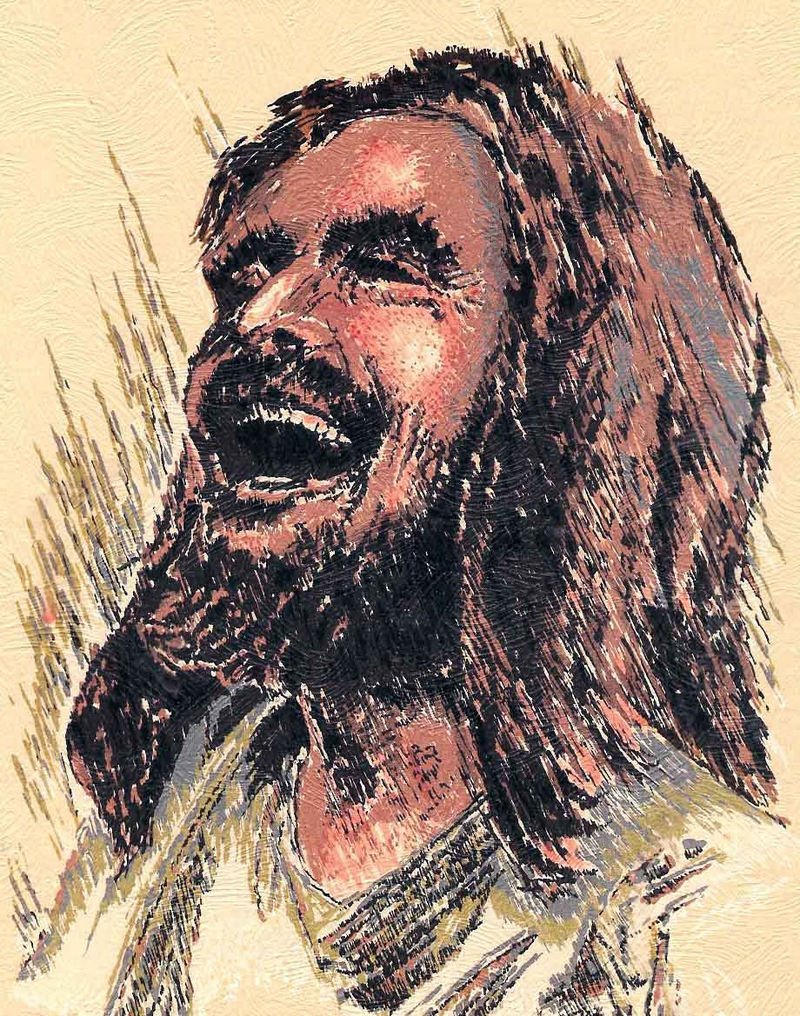
So, let me get this straight. Marianne Williamson should be
disqualified as a viable presidential candidate because she has too much faith
in the power of prayer, of mind, of love, and of God.
The disqualification was sparked by a tweet she made as
Hurricane Dorian was bearing down upon the southern coast of the United
States. It read: “The
Bahamas, Florida, Georgia and the Carolinas…may all be in our prayers now.
Millions of us seeing Dorian turn away from land is not a wacky idea; it is a
creative use of the power of the mind. Two minutes of prayer, visualization,
meditation for those in the way of the storm,”
It was a call to faith addressed to a nation where the majority considers itself followers of the one who said, “If you have faith, even as a mustard seed, and say to this mountain ‘move from here to there,’ it will obey you” (MT 17:20).
[Yes, faith and its power to “move mountains” is an idea that appears multiple times in the Jesus tradition, indicating that the phrase probably originated with the Master himself. But, of course, Jesus’ words presume that his listeners, like most of us, had no such minimal faith. Hence, he implied, our belief remains powerless.]
Jesus’ faith
aside though, consider the content of Ms. Williamson’s tweet. It simply asked
her followers:
To face the power of our human minds and spirits as much greater and connected with natural forces than we generally believe.
In view of that fact, to activate their collective force to avert disaster.
And to do so by stilling that mind through meditation, by praying for those in the hurricanes path, and by visualizing their prayers answered.
Read it again: that’s exactly what the tweet says! Nothing more; nothing less.
In other words, it was all quite harmless and potentially powerful. There was nothing in it of fear, hatred, climate-change denial or blame of victims – all the responses we’ve come to expect from the outrageous tweets of more conventional politicians. Instead, there was only expression of solidarity, compassion, faith, stillness, and acceptance of what traditional spirituality tells us of the untapped power of the human spirit that consciously aligns itself with the divine.
As I’ve already indicated, the tweet also implied a connection between human consciousness and Mother Nature herself – something underlined in the mystical traditions belonging to all the world’s great faiths and to mainstream science as well. (As Francis of Assisi would remind us, all of us are in some sense a part of “Brother Hurricane” Dorian.)
But, horror of horrors (!) such expression of traditional faith and scientific insight was enough to disqualify Williamson from presidential candidacy. Whoopi Goldberg and panel members on “The View” ridiculed her. Others characterized her as no better than that of religious fundamentalists.
To my mind,
however, it proves just the opposite.
Williamson’s tweet demonstrates how truly different she is from her fellow candidates as well as from the fundamentalists who have hijacked the faith of Jesus. And how refreshing! Her viewpoint is what our times require, where expressions of faith are limited to “thoughts and prayers” after mass shootings — or to divisive imposition of narrow beliefs about abortion and rejection of LGBTQQIAAPs.
In fact, Marianne Williamson is so different from what we expect from politicians and secular leftists that when she simply expresses solidarity with those in the Bahamas, Florida, Georgia and the Carolinas (whose prayers no doubt echoed Marianne’s tweet) she reveals herself as absolutely mystifying, incomprehensible, and unacceptable.
Let’s face that too: Williamson’s tweet expressed extraordinary solidarity with those in Dorian’s path. Without doubt, many of them were praying that the hurricane’s force might be mitigated or diverted. In fact, if we found ourselves in their circumstances, the religious among us (and “foxhole Christians” as well) would be offering similar prayers: “Please, Lord, save me and my family from this hurricane. Change its path. Keep us safe.”
And what would be wrong with that? It’s an absolutely human response to impending disaster.
No, the hubbub over Ms. Williamson’s tweet is but another demonstration of why her candidacy is indispensable. We need her to profoundly change our political conversation, to move that conversation from fear and denial to compassion, and to unveil the true nature of faith engaged with an overly-secularized world.
Readings for 24th Sunday in Ordinary Time: WIS 9:13-18B; PS 90: 3-6, 12-14, 17; PHMN 9-10, 12-17; PS 119: 135; LK 14: 25-33
Marianne Williamson’s campaign is not dead. True, she will
not be appearing on the stage of the third Democratic debate. Although she has
the required number of donors, Williamson has not yet attained the necessary 2%
in four polls approved by the Democratic National Committee (DNC). Nonetheless,
her campaign continues its concentration on Iowa, where she’s been working for
the last several months. Her people confidently anticipate her participation in
Debate # 4.
Recently, the New York Times (NYT) ran a long very positive column on Marianne. It was called “The Gospel according to Marianne Williamson.” It reminded readers of Ms. Williamson’s identity, her growing and highly enthusiastic audiences, and the persuasive power of her remarkable eloquence.
The article assured readers that Williamson is far more than some New Age guru or the spiritual advisor of Oprah Winfrey. Jokes and criticisms aside, she has nothing to do with crystals or burning sage. Instead, she is a widely-hailed, best-selling author, spiritual teacher, counsellor, and generally wise person. For more than 40 years, she has been a student and teacher of A Course in Miracles (ACIM), a book published in 1974) which Williamson describes as “basic Christian mysticism.”
It’s that latter qualification – Williamson’s connection
with Christian mysticism – that makes her continued campaign extremely relevant
to this Sunday’s liturgy of the word. That’s because the theme of today’s
readings contrasts the wisdom of God with the wisdom of the world just as does
ACIM. Serious consideration of that contrast illustrates the unique importance
of Marianne Williamson’s candidacy at this particular juncture in the history
of our nation and world.
For ACIM, the world’s wisdom is based on fear; God’s wisdom
is based on love. In fact, according to A Course in Miracles, love and
fear are the only two motivational forces in the entire world. That’s true in
our personal relationships, but also in politics. Either we see others as
enemies poised to attack us at every opportunity, and act accordingly. Or we
recognize our very selves in those the world would teach us to fear, mistrust,
and hate.
More specifically, the politics of fear sees Muslims, Russia, China, the Taliban, ISIS, immigrants, people of color, LGBTQQIAAPs, and poor people in general as our enemies. Meanwhile, a politics based on love recognizes that none of those the world teaches us to fear is basically hostile. Rather, when we take 100% responsibility for the problems designated enemies ostensibly represent, a path opens up to achieving peace with all concerned.
Does such conviction seem woo-woo or unrealistic to you? If
it does, please be reminded first of all, that such belief is basic not only to
Christian faith, but (as Williamson constantly reminds us) to all the world’s great
religious traditions, including Islam. It is basic also to many secular
traditions that consider themselves atheistic or agnostic.
Secondly, remember that according to Christian faith, “God”
is synonymous with “love,” so that Williamson’s “Politics of Love” means the
politics of God. That means (thirdly) that rejection of political love as
woo-woo trivializes Christian faith and Jesus himself.
With all of that in mind, please read for yourselves this Sunday’s liturgical readings. (You’ll find them here.) To repeat, they contrast the wisdom of the world with the Wisdom of God. In any case, and for what it’s worth, here are my “translations” of their content. Their thoughtful review will help you see what I’m getting at in saying that Marianne Williamson’s “Gospel” is far deeper than revealed in the NYT article just referenced.
WIS 9:13-18B
The wisdom of God Unlike the world’s Is sure and decisive. For human thought processes Focused on the body And its shifting reality Are necessarily confused. Hence, we cannot judge wisely Without assistance From the Holy Spirit Who consistently reveals God’s Reality As filled with love.
PS 90: 3-6, 12-14, 17
This is because Time has no meaning For God. Everything but Love Passes in an instant. Consequently Our prayer must be: “Teach us Your changeless vision Filled with kindness Joy and gladness.” Only such Synonyms for love Give meaning To our lives.
PHMN 9-10, 12-17
For example, An elderly and imprisoned Paul Long ago Rejected the world’s wisdom About slavery. Seeing with the eyes of Christ He says Miraculously transformed Onesimus From slave and chattel Into a man A partner A son and brother. “Follow my example,” The shackled one implores.
PS 119: 135
We agree: Show us your face, O, Lord, In slaves And in those behind bars. Yes, teach us your ways.
LK 14: 25-33
But the Master warns: “If, like me, you live According to God’s Wisdom, The World Will surely crucify you As the subversive You must be To qualify As my disciple. But be sure to Subvert non-violently For otherwise, The militarized Powers of the world Will surely crush you. Sabotage instead By insistent example That refuses To value anything The world treasures.”
Those are radical thoughts. They are 180 degrees opposed to
the “wisdom of the world.” Yes, the very wisdom of God teaches that we have no
enemies other than those our thoughts and resulting actions have created. It’s
reconciliation with our designated enemies (recognizing them as embodiments of
our very selves) that holds the promise of our very salvation.
No Democratic candidate other than Marianne Williamson dares
call us to such radicality. It’s that change in attitude that ACIM defines as
“miraculous.” Only that sort of basic transformation in consciousness can save
us from the unprecedented catastrophes facing our world today.
As Ms. Williamson puts it: “It’s unreasonable to expect those who drove us into the ditch we’re in now to be the ones qualified to get us out.”
No: our present context necessitates an entirely new leadership and consciousness – a new wisdom based on love rather than fear. That’s the vision Marianne Williamson offers us this election season. And it’s not New Age woo-woo. In reality, the wisdom in question is not new at all. It’s reflected in the teachings of Jesus. It’s the wisdom of Paul. It’s the theme of today’s liturgical readings.
Readings for 22nd Sunday in Ordinary Time: SIR 3: 17-18, 20, 28-29; PS 68: 4-5, 6-7, 10-11; HEB 12: 18-19, 22-24A; LK 14: 1, 7-14.
[What follows is a dramatic re-creation of Luke’s rather abstract account of Jesus’ dinner at a Pharisee’s home. (See the narrative here.) While Luke seems to have the Master recommending impossible (for Jesus) hypocrisy and self-promotion, the re-creation seems more probable and gets at Jesus’ real message about the Kingdom of God and its preferential option for the poor.]
In this morning’s gospel episode, Jesus finds himself invited for dinner to the home of a Pharisee. All present, Luke tells us, are watching Jesus closely. No doubt, they’re keeping an eye on his disciples too. And they don’t approve.
After all, like Jesus, his disciples are mere riff-raff. But at least Jesus is the reputed peasant-rabbi. Everyone’s talking about him. And investigating Jesus is the whole reason for this dinner. So for the moment at least, the Pharisees are willing to cut him some slack. He’s sitting near his hosts towards the head of the table.
His hangers-on however are a different story. They’re rough. They smell of fish and sweat, and have no manners. And yet, as Jesus’ friends, they’ve been granted a place at table — down towards the end. Even there, they feel out of place, but for that very reason they are enjoying themselves tremendously. You can imagine their rough jokes and loud laughter.
Yes, the Pharisees are watching Jesus and his friends. But obviously, Jesus has been watching them as well. He knows they are expecting some words of wisdom. So . . . he tells them a joke. And the joke’s on them. It contains a sharp barb.
“Thanks for inviting us to this banquet,” Jesus begins. “Unaccustomed as we are . . .” He pauses and smiles. “That’s quite generous of you. After all, none of us can repay your kindness. We are homeless people, as you know. We’re unemployed too, so we are in no position to return your kindness.
The best I can do is offer you some wisdom. So let me tell you what I’ve been observing here.
“Evidently,” Jesus goes on, “it’s your custom to adopt the humility recommended in the biblical Book of Sirach. I can’t tell you how impressed I am; I’m edified by your piety. I mean, you have clearly taken to heart the words of the sage, Jesus ben Sirach – what he said about being humble, especially if we are ‘great’ as all of you are here, I’m sure.”
Jesus eyes his listeners. He can tell that they are waiting for the penny to drop. So he drops it.
“I can see that when you come into a place like this, you take the lowest place available — down there where my friends are.” With this, Jesus stands up bows his head, stoops his shoulders and slumps towards the lowest place at table. He laughs.
“That way,” the Master continues, “our host, of course, is obliged to publicly invite you to a more honored position at table. ‘Friend,’ he’ll say, ‘come up higher, and sit in the place you’ve merited not down there with the unwashed and poor.’”
Now Jesus is standing. He throws out his chest and strides towards the seat right next to his pharisaical host. He chuckles again. “That enables you,” Jesus continues,” with great protestations of unworthiness, to take your ‘rightful’ place at table. Your stock has risen in everyone’s eyes.
“So congratulations are in order,” Jesus says. “All of you have learned your lessons well. You’ve just created a show, and have actually exalted yourself by pretending to be humble. In a sense, you’ve received your reward.”
Jesus is seated again and looking intently at everyone. Their mouths are open with shock.
“So here’s my wisdom, friends. . . . Your ‘humility’ is not what Sirach was recommending. In fact, it’s a form of pride and self-promotion.
“Instead, real humility is this: when you throw a party like this one, invite the poor, the lame and the blind, and then serve them. Place them at the head of your table and treat them as honored guests. People like that can’t or won’t repay you. But in fact, YOU OWE THEM.” Jesus fairly shouts those last three words.
“I’m telling you the truth,” he says. And humility is nothing but the truth.”
Jesus pauses, but he hasn’t finished yet. “You see, those belonging to what you consider the Great Unwashed — like my friends — are actually God’s favorite people. Recall what the psalmist said about them in Psalm 68. He said God is the Father of orphans; he’s the defender of widows, of prisoners, of the homeless, and of farmers without land.”
Jesus is quiet now; his smile is broad and friendly. He searches the faces of his table companions one-by-one.
Then he turns to his host and adds.
“To be fair, my friend, you yourself are on the right track. By inviting us today, you’ve shown that you already understand what I’ve been saying. As I say, none of us can repay you, and yet you’ve invited us to this abundant table. We are sincerely grateful.
“But don’t think that you’ve somehow performed an act of charity by your invitation. No, it’s an act of justice – of compensation to make up for what you have stolen from the poor by underpaying them and taxing them heavily. In supporting the poor and even the “lazy,” you are simply imitating our generous God.
“I mean the earth and its produce are all gifts from God. No one has earned them. No one owns them but the creator. If you have food, then, you are obliged to share it with the hungry – even with those unwilling to work. As difficult as it might be to understand, that’s simply the divine dispensation.
“The earth and the life it supports have been freely given to everyone – even to people like me and my friends who refuse to work and live from the alms of people like you. No one deserves life or food more than anyone else. So in effect, you are obliged to do what you’ve done.”
(Homilist’s note) None of this needs commentary from me.
What’s your commentary?
P.S. You might be helped in formulating your thoughts by this short interview of scripture scholar, Reza Aslan, by Russell Brand. In the exchange, Aslan explains how Jesus, the Buddha, and Mohammed were more interested in economics than in theology. They were economic radicals intent on turning their societies upside-down. None of them intended to found a new religion.
Just yesterday, our extended family returned from a week in Alaska celebrating a landmark birthday of our daughter. She and our son-in-law observed the occasion by treating us all to a week-long cruise in our country’s northern-most state. Here are my reflections on this never-to-be forgotten experience.
Unplugged for a week In Nature’s wilderness. We cruised Alaska’s Inside Passage 12 pilgrims (five of them small children) Finding divine presence Everywhere Including games Of Yahtzee, Go Fish, Poker, War And endless rounds of Monopoly.
We started out In Petersburg’s fishing village With its canneries Reeking of halibut and salmon, Boats of all sorts, And Alaskan natives All wearing Levis, Weathered baseball caps Padded parkas And rubber boots Reaching beyond their calves In the mid-August rain.
Our vessel was a 100-foot yacht Called “Golden Eagle,” With its crew of five All under 30 – Its captain of 27 years Eager to talk of God Justice and Karl Marx, A wondrously skilled cook, Two naturalist guides Wise and competent beyond their years, And a delightful 20-year-old concierge.
With them, we hiked, kayaked, fished And immersed our selves In Alaska’s stark wonder Beyond anything Previously experienced: Spruce-covered mountains Blue calving glaciers Whales by the score, Sea lions, seals, otters, bald eagles, Wild churning waterfalls And a steaming hot spring Beside an icy lake,
All the while We read Michener's Alaska With its tales Of seductive cave women 12,000 years ago Of huge mastodons Saber tooth tigers, And giant Grizzlies 11 feet tall, Of sailors, miners, clergymen Saints and remorseless sinners Who slaughtered unsuspecting natives And purposely vitiated them With rum, racism and rapes Of native teenage girls Afterwards kicked and spat upon, Of heroic Eskimos With their mighty sled dogs, And enormous capacity To endure cold, long journeys Stupid Russians And even denser Americans.
It was the familiar story Of imperialist settlers And their colonial theft Of native wealth Arrogant beyond belief Imagining that white men Have a Manifest Destiny To ravish, torture, and kill Their humble betters Destroying Everything in their path Leaving chaos in their wake And Mother Nature prostrate, And bleeding to death.
Once we entered An empty lighthouse On a tiny island – A stubborn relic Of FDR’s New Deal, A sometime research center For maritime scholars And whale-trackers Who live there like monks Each summer And sleep in spartan bunkbeds Leaving behind crude sketches Of whales with Signature painted flukes, Along with Flashlights, compasses, charts And scattered coffee cups –
All proof Of purposes other Than ours And of transcendent life forms In that vast harsh outpost Across the well-worn foot path That became Captain Bering’s Strait For millions Man and beast alike.
Readings for 21st Sunday in Ordinary Time: Is. 66: 18-21; PS. 117: 1-2; HEB. 12: 5-7, 11-13; LK. 13: 22-30.
Messages from God can come from the most unlikely places – even from our enemies and those our culture considers inferior and evil. That’s the teaching I find in today’s liturgy of the word. There God speaks to Babylonians through Jews, and to Romans through Christians. This suggests to me that God might be evangelizing Americans today through Muslims. _____ Consider our first reading from Isaiah.
Imagine yourself a Babylonian in the 6th century BCE. You belong to an empire – one of the most powerful nations the world has ever seen.
In 586 your people conquered a small insignificant nation called “Israel.” Its leaders have been taken captive, and for more than three generations (586-516) have remained prisoners of your country. They are your enemies. You despise them as inferior, superstitious and violent.
Now towards the end of the 6th century, one of their “holy men,” someone called “Isaiah,” claims that those captives, those refugees, those “fugitives” as Isaiah calls them, are agents of the single God of the Universe. They have been sent specifically to call you away from your polytheistic worship of your Gods, Anshar, Ea and Enlil, and to recognize that there is only one God. They call him Yahweh. This God has special care specifically for refugees, slaves and outcasts in general.
For you, recognizing that entails releasing the prisoners your government has held captive for so long.
Even more, Isaiah says you and your proud people are being called to actually worship that God of refugees, political prisoners, and slaves! That means putting their needs first, while subordinating your own.
As Babylonian, you find all of this incredible and obviously insane. ______ Now to grapple with today’s gospel selection from Luke, imagine that you are a Roman living towards the end of the 1st century CE.
You belong to an empire recognized to this day as the greatest the world has ever known. As with the Babylonians more than 500 years earlier, Palestine and its Jewish people are provincial possessions of the empire; they are your captives. Roman legions continue to occupy Palestine whose haughty people resist their occupiers at every turn.
“Jews are nothing but terrorists, every one of them,” you think.
Among the most infamous of those terrorists was a man called Jesus of Nazareth. You’ve learned that he was a Jewish peasant crucified by Rome about the year 30 CE. You’ve heard that a new kind of religion has formed around that so-called “martyr.” In fact, his followers acclaim him by a title belonging to the Roman emperor alone – Son of God. To you that sounds absolutely seditious.
In any case, this Jesus asserted that the God he called “father” was blind to people’s national origins. He told a parable (in today’s gospel) whose refrain from a thinly veiled God figure was, “I do not know where you are from.” Apparently Jesus meant that in God’s eyes no nation – not even Rome – is superior to any other.
You wonder, was Jesus blind? No nation superior to any other? Did Jesus not have eyes to see Rome’s power, its invincible army, and feats of engineering – the aqueducts, the roads, the splendid buildings and fountains?
According to Jesus, Israel itself is not above other nations in the eyes of God. Nor are his own followers better than anyone else. Even those who drank with him and shared meals with him could not on that account claim special status in God’s eyes.
In fact, the only “superiors” are what Jesus called “the least” – his kind of people: artisans, peasants, the unemployed, beggars, prostitutes, lepers, immigrants, women and children. As in today’s reading from Luke, Jesus calls these people “the last.” In God’s eyes, they are “the first,” he said. Meanwhile those who are first in the eyes of Rome, Israel, and even of his followers end up being outcasts.
Worse still, many Romans, especially slaves and criminals, are embracing this new religion. Some in the Empire’s capital city are already worrying that if not stopped, this worship of an executed criminal from a marginal imperial province might undermine the religion of the Roman Gods, Jupiter, Mithra and of the emperor himself.
How absurd, you think, that Romans could be schooled in matters theological by riff-raff, Jews, and terrorist sympathizers. _____
Finally, imagine that you are an American today. Many think that your country is the proud successor of Babylon and Rome. In fact, the United States may have surpassed Rome’s greatness. Certainly, it has the most powerful military machine the world has ever known. It has the capacity to destroy the earth itself, should its leaders take that decision.
Some attribute America’s greatness to its embrace of the faith of Jesus of Nazareth and to its partnership with Israel, the biblical People of God. As a result the U.S. has become the light of the world, the “city on a hill that cannot be hidden” (Mt. 5: 14-16). America can do no wrong.
This is not to say that its leaders aren’t fallible. They make their share of mistakes and even commit crimes. Yes, they torture, support dictators across the planet, imprison a higher percentage of their citizens than anyone else, drop atomic bombs, even threaten the extinction of human life as we know it, and have declared a state of permanent war against virtually the entire world.
But as a nation, the United States, you continue to believe, is idealistic; it stands for democracy, freedom and equality. As a result, America continues to enjoy God’s special protection.
Nevertheless, there are those in your midst who say that none of this is true. They are like the descendants of Abraham, Isaac and Jacob living in 6th century Babylon. They are like the first Christians who refused allegiance to Rome. They are the foreigners found in U.S. prisons all around the world – in places like Guantanamo Bay and Abu Ghraib.
By and large, those prisoners, those (in Isaiah’s terms) “fugitives” and exiles share a religious faith (Islam) that is as difficult for most Americans to understand as it was for Babylonians to understand Jews or for Romans to understand Christians. The faith of those held captive by America today is largely the faith of poor people called “terrorists” by your government – just as were the Jews and early followers of Jesus.
However, closer examination shows that Allah is the same as the Jewish God, Yahweh. Moreover Muslims recognize Jesus as the greatest of God’s biblical agents.
With that in mind, you realize that Muslims routinely invoke their faith to resist U.S. imperial rule. And they are critical of the use of Judaism and Christianity to justify oppression of their brothers and sisters in Palestine, Iraq, Afghanistan, Pakistan, Yemen, Bahrain, Somalia, throughout the rest of Africa and elsewhere.
Could it be that these exiles, captives, fugitives, “terrorists,” might be your empire’s equivalents of 6th century Jews in relation to Babylon and of 1st century Christians vis-a-vis Rome? Could they possibly be God’s agents calling us Americans away from heartless imperialism and to the worship of the true God (even if called “Allah”)?
Are our Muslim captives reiterating the words of Jesus in this morning’s gospel: God is oblivious to people’s national origins and to physical ties to Jesus? The Master “does not know where we are from” even if we’ve shared table with him. It makes no difference if we’re Jews or Christians, Babylonians, Romans, Americans, or Muslims.
Only the treatment of “the least” is important in God’s eyes. And for us Americans, those “least,” those “last” happen to be the poor of the Islamic world against whom our government has declared permanent war. And what is their God’s demand? It’s simple: Stop the war on us and our religion!
Is their God – our God – trying to save us – and the planet from the crimes of American Empire?
The fates of Babylon and Rome hang over us all like Damocles’ sword.
Dan Geery is a friend of mine who publishes regularly on OpEdNews. His first novel, A Summer with Freeman, is terrific book — so well written. Its sparkling and hilarious prose seemed like the work of a veteran novelist, not that of a first timer. The dialog is funny and realistic. And the whole story about fourteen-year-old Joey Simpson and his first summer with a new friend, fifteen-year-old Freddie Freeman, made me recall my own coming of age as I’m sure it does for most of Dan’s readers. This is movie-quality work.
Set in the 1950s, the book has all the elements most of us recall:
Unhappiness at school
Summers with time to do the unthinkable
Building forts and get-aways from parents and younger siblings
Experiencing bullying
Trying to be tough, despite it all
Overriding interests in comic books, girls and sex and early dabbling in cigarettes and liquor
Fascination with cars and driving
Key friendships with bigger, tougher, older, and wiser guys who were “wilder” and devil-may-care
Early crushes and idealizations of their objects, who often turn out to be the opposite of what the crushes fancied
General confusion before the mysteries of life
For me, the most unforgettable moments included:
Narrow escapes from the local bully and his gang especially in a furious bike-get-away and a concluding showdown at the local swimming hole
Freeman’s wild ride in the convertible he vengefully “borrowed” from the bully himself
An encounter with a pretty, flirtatious waitress in the local diner
Joey’s painful meetings with the women of his dreams, Maggie and Anabelle
Joey and Freeman’s downing two bottles of gin in the woods
Catholic Joey’s confession to an overly-inquisitive priest
I must admit that I once tried my hand at writing book-length fiction. And, according to my guide, Writing a Novel and Getting it Published, it transformed me into a successful novelist at least according to the book’s definition. It said a successful novelist is “any writer who has completed a project generally recognizable as a novel.” By those standards, yes: I made it. However, that’s where my success concluded. My novel turned out to be stodgy, moralistic, and filled with “telling” rather than “showing.”
Daniel Geery’s first novel, A Summer with Freeman, has none of that. It’s a rollicking read and an evocative entertaining tale that will have you smiling, if not laughing, from beginning to end.
Readings for the 20th Sunday in Ordinary Time: JER 38: 4-10; PS 40: 2-4, 18; HEB 12:1-4; LK 12: 49-53
Today’s
gospel excerpt presents problems for any serious homilist. That’s because it
introduces us to an apparently violent Jesus. It makes one wonder; why does the
Church select such problematic passages for Sunday reading? What’s a pastor to
make of them?
On the
other hand, perhaps it’s all providential. I say that because, today’s gospel
might unwittingly help us understand that even the best of imperialism’s
victims (perhaps even Jesus) are drawn towards reactive, revolutionary, or
self-defensive violence. After all, Jesus and his audiences were impoverished
victims of Roman plunder. By the standards most Christians today accept, they
had the right to defend themselves “by any means necessary.”
Here’s
what I mean. Without apology, today’s reading from Luke has the ‘Prince of
Peace” saying, “I have come to set the earth on fire, and how I wish
it were already blazing . . . Do you think that I have come to establish peace
on the earth? No, I tell you, but rather division.”
In a
parallel passage, Matthew’s version is even more direct. He has Jesus saying,
“Do not suppose that I have come to bring peace to the earth. I did not come to
bring peace, but a sword.”
Is that
provocative enough for you?
What’s
going on here? What happened to “Turn the other cheek,” and “Love your enemy?”
There are two main
answers to the question. One is offered by Muslim New Testament scholar, Reza
Aslan, the other by Jesus researcher, John Dominic Crossan. Aslan associates the shocking
words attributed to Jesus in this morning’s gospel directly with Jesus himself.
Crossan connects them with the evangelists, Luke and Matthew who evidently
found Jesus’ nonviolent resistance (loving enemies, turning the other cheek)
too difficult to swallow for people living under the jackboot of Roman
imperialism.
For his
part, Aslan points out that the only God Jesus knew and the sole God he
worshipped was the God of Jewish scripture. That God was a “man of war” (Exodus
15:3). He repeatedly commands the wholesale slaughter of every foreign man,
woman, and child who occupies the land of the Jews. He’s the “blood-spattered
God of Abraham, and Moses, and Jacob, and Joshua (Isaiah 63:3). He is the God
who “shatters the heads of his enemies” and who bids his warriors to bathe
their feet in their blood and leave their corpses to be eaten by dogs (Psalms
68: 21-23). This is a God every bit as violent as any the Holy Koran has to
offer.
For
Aslan, Jesus’ words about turning the other cheek and loving enemies pertained
only to members of the Jewish community. They had nothing to do with the
presence of hated foreigners occupying and laying claim to ownership of Israel,
which in Jewish eyes belonged only to God. Accordingly, Jesus words about his
commitment to “the sword” expressed the hatred he shared with his compatriots
for the Roman occupiers.
In
other words, when it came to Roman imperialists, Jesus was not a pacifist. He
issued no call for nonviolence or nonresistance. Quite the opposite.
John Dominic Crossan
disagrees. For him the earliest layers of tradition (even the
“Q” source in Matthew and Luke) reveal a champion of
non-violent resistance. In fact, the Master’s earliest instructions to his
disciples tell them to travel freely from town to town. But in doing so, they
are to wear no sandals, carry no backpack, and no staff. He instructs: “Take
nothing for the journey–no staff, no bag, no bread, no money, no extra shirt”
(LK 9:3).
Crossan
finds the prohibition against carrying a staff highly significant. The staff,
of course, was a walking stick. However, it was also a defensive weapon against
wild animals – and robbers.
So,
with this proscription Jesus seems to prohibit carrying any weapon – even a
purely defensive one like the staff all travelers used.
Apparently,
that was too much for the evangelist, Mark. Recall that he wrote the earliest
of the canonical gospels we have – during or slightly before the Great Jewish
Rebellion against Rome (66-70 CE). Matthew and Luke later copied and adapted
his text for their own audiences – one Jewish (in the case of Matthew), the
other gentile (in the case of Luke). Mark remembers Jesus’ directions like
this: “He instructed them to take nothing but a staff for the journey–no bread,
no bag, no money in their belts” (MK 6:8).
Notice
that Mark differs from what Crossan identifies as the earliest Jesus traditions
upon which Matthew and Luke depended. Instead of prohibiting carrying a staff,
Mark’s Jesus identifies the staff as the only thing Jesus’ disciples are
allowed to carry. Evidently, that seemed more sensible to a pragmatic Mark than
the words Jesus probably spoke. I mean, everyone needs to at least protect
themselves from violent others.
Matthew
and Luke prove even more pragmatic. By the time we get to them (almost two
generations after Jesus’ death and fifteen or twenty years after Mark), we find
their Jesus commanding that his disciples carry, not just a staff, but a sword
– an offensive, lethal weapon. Matthew even portrays Jesus’ right-hand-man,
Peter, actually armed with a sword the night Jesus was arrested. Jesus has to
tell him: “Put away your sword. Those who live by the sword will perish by the
sword” (MT 26:52). (It makes one wonder if Peter was absent the day Jesus gave
instruction about turning the other cheek and loving one’s enemies. Or is Aslan
correct about Jesus’ militancy?)
In
other words, on Crossan’s reading, it is the gospel authors, not Jesus himself,
who subscribe to belief in the blood-spattered God of the Jewish Testament.
Jesus’ God was the Forgiving One who recognized no one as enemy, and who (as his
later actions showed) refused to defend himself. His dying words were about
forgiving his executioners.
Crossan
reasons that this more pacifist Jesus is probably the authentic one, precisely
because his words (and actions) contradict so radically the Jewish tradition’s
violent God.
So,
whose words do we encounter in today’s gospel? Can we attribute them to the
historical Jesus or to his disciples who found themselves unable to accept the
Master’s radical non-violence?
Whatever
our answer, the shocking words we encounter today remind us that even people of
great faith (Mark, Matthew, Luke – or perhaps even Jesus himself) despise
imperial invaders. Their arming themselves and fighting revolutionary wars
(like the 66-70 Uprising) are completely understandable.
In any
case, by gospel (and Koranic?) standards such rebellion is more justified than
the entirely unacceptable violence of imperial invasion.
Does
any of this shed light on ISIS response to U.S. Middle Eastern invasions,
bombings, torture centers and dronings? As a Christian, what would be your
response if foreigners did in our country what U.S. soldiers and pilots are
doing in Arabia? Would you be a non-violent resister as Crossan says Jesus was?
Or would you take up arms – the way violent insurgents have done in Iraq,
Afghanistan, Libya, Yemen, Ethiopia, and elsewhere?
Which
Jesus do you follow? Can you understand religious people who in the face of
United States imperialism say: “I have come to set the earth on fire, and how I
wish it were already blazing . . . Do you think that I have come to establish
peace on the earth? No, I tell you, but rather division.”
Sunday’s New York Times carried a thought-provoking editorial by opinion writer at large, Charles Warzel. It was entitled, “Epstein Suicide Conspiracies Show How Our Information System Is Poisoned.” The article lamented the power of Twitter and other social media to spread toxic conspiracy theories reflecting our current culture’s worst “choose your own reality” tendencies.
According to Warzel, Twitter and other versions of social
media have actually “outmatched” the power of the mainstream media (MSM). And
this to such an extent that an FBI field office recently identified fringe
conspiracy theories as a domestic terror threat.
Warzel illustrated his point by focusing on Twitter speculation regarding the Clinton’s involvement in the Jeffrey Epstein “suicide” and on President Trump’s role in advancing the theory. The editorial complained about resulting “dueling hashtags” with their viral accusations of foul play.
The unexpressed message of the whole exercise seemed to be that
conspiracy theories are bad in themselves and that one would do better to
simply accept the more reasonable official story emanating from the CIA, FBI,
and prison officials that Epstein actually did commit suicide as
explained by those official sources. Fevered accusations of foul play are ipso
facto unreasonable.
Others whose opinions have appeared in sources such as OpEdNews have made that point more explicitly. Forget exciting conspiracies, they cautioned, simply accept the boring reality that Epstein killed himself just as we’ve been told.
The point I wish to make here strongly disagrees. I contend
that in cases like Epstein’s mysterious death, conspiracy theories are not only
good; they are inevitable and necessary. Additionally, the overwhelming power
of Twitter and other social media to “outmatch” that of mainstream media
represents the public’s healthy recognition of the fact that the government
officials and the MSM (like The New York Times) are no longer reliable.
Their “official stories” must be presumed false unless otherwise demonstrated
by irrefutable evidence. Such evidence will come to light not by internal
investigations, but by full legal process involving (yes!) conspiracy theories,
discovery and trial.
“Conspiracy” Is A Legal Category
My first point is to recognize the fact that the term “conspiracy”
is not synonymous with fiction or paranoid fantasy. It is a legal term referring
to the crime that occurs when two or more people plan actions forbidden by law.
In other words, criminal conspiracies happen all the time. People go to jail
for them.
In fact, “conspiracy theories” are routinely employed by
prosecutors who use them to initiate investigations when such crime is
suspected. Without lawyers’ conspiracy theories, there would never be any criminal
trials involving two or more suspects.
With such theories in mind, prosecutors gather evidence. Some of it is circumstantial or inferential (it’s usually what sparks legal inquiry). Other evidence constitutes direct or “smoking gun verification. Juries and judges evaluate evidence of both kinds. When it is convincing beyond reasonable doubt (based on direct and/or circumstantial evidence), the legal system convicts conspirators and sentences them accordingly.
The bottom line here: It does not discredit a theory to call
it “conspiratorial.”
Official Stories Are Suspect
My second point is that the public has not merely good, but excellent
reason to discount official theories about, well, EVERYTHING! Think about:
Iraq and Colin Powell’s testimony before the United Nations about the certainty of Saddam Hussein’s weapons of mass destruction
The New York Times’ endorsement of his testimony as “masterful and compelling”
The literally thousands of obvious lies that our current chief executive has uttered – and how he adds to them each day
Secretary of State (and former CIA chief), Mike Pompeo’s boastful admission that he and the agency he formerly headed lie, cheat, and steal on a routine basis. In fact, he said, the CIA sponsors whole courses for its agents on how to do so effectively. (Imagine a witness at trial admitting on stand that he is an inveterate liar. Would his testimony be taken seriously?)
The testimony of numerous CIA defectors revealing that the CIA has routinely conspired to assassinate heads of state and others considered enemies or persons who know too much
Epstein’s Death Is Welcome
My third point is that there exists reasonable circumstantial and direct motive for suspecting that important people had good cause to want Jeffrey Epstein dead and that he was murdered accordingly. All of them are related in Whitney Webb’s comprehensive historical account of government-sanctioned sex enterprises like Epstein’s. In fact, Webb’s four-part series ends up detailing motives for Epstein’s murder on the part of the powerful including the following:
Epstein was a convicted pedophile who preyed on underage girls. (He even called his private plane “the Lolita Express.”)
Bill Clinton with his checkered sexual history traveled on Epstein’s plane at least two dozen times.
Donald Trump admired Epstein for his taste in younger women.
Trump has been described (e.g. in Webb’s series) as “mentored” by Roy Cohn, another pedophile who used tape recordings and videos for purposes of blackmail.
Alexander Acosta was told to back off prosecution of Epstein because of the latter’s association with “Intelligence.”
It is standard operating procedure for “Intelligence” to film and record sexual deviance for purposes of blackmail and evidence-gathering.
Epstein sponsored frequent parties involving a virtual Who’s Who of world leaders and other celebrities.
The parties were also said to be attended by “call boys” and “call girls.”
Epstein had tapes of sexual deviance, some of them locked in a safe indicating their special content.
Reasons for suspecting that Epstein was killed or purposely allowed
to commit suicide include the following:
Epstein was an extraordinarily important federal prisoner.
After his arrest, he was placed on suicide watch – at least for a time following his apparent suicide attempt last month.
He was sequestered in a highly secure federal prison presumably with special capacities for monitoring inmates on such watch, including video cameras and guards trained for such duties.
Nonetheless, Epstein somehow found himself with a rope, a belt, with sheets or some other material sufficient to hang himself.
He was inexplicably given unmonitored time to accomplish the task.
Where Do We Go from Here?
There is no claim here that the details presented above somehow “prove” foul play regarding the “suicide” of Jeffrey Epstein. However, they do provide basis for reasonable conspiracy theories sufficient (and necessary) to warrant legal indictments – perhaps of Ghislaine Maxwell, Epstein’s reputed procurer of unsuspecting girls. The conspiracy theories in question warrant discovery processes, trials, presentation of evidence, deliberation by juries of peers, verdicts, and eventual clarification of the whole Jeffrey Epstein saga.
Only such legal processes will yield truthful conclusions. Internal investigations by proven and admitted liars will not do. Neither will out-of-hand dismissal of “conspiracy theories” as though the phrase exclusively describes fictional fantasies or paranoid imaginings. As presented by Charles Warzel and others such dismissals simply mean that the theories in question are socially, culturally, and politically unacceptable – too threatening to consider. So, rational analysts should back off.
Actually, as shown above, the theories are good and necessary. And so are the vilified social media through which The People thankfully counteract MSM disinformation and its defense of the given order and the official stories undergirding its undeserved legitimacy.
I could hardly believe my eyes Saturday morning, when I read in Alternet that Jeffery Epstein was found dead in his jail cell of apparent suicide. And I find it hard to believe that he killed himself, especially since he’s been on “suicide watch” since the discovery of apparently self-inflicted bruises on his neck last month. Instead, I suspect he was killed by the CIA. My suspicion is based on my close reading for the past few days of muckraker, Whitney Webb‘s three-part expose´, “The Jeffery Epstein Scandal: Too Big to Fail.”
Webb’s series makes the point that the Epstein pedophilia scandal threatened to blow apart the entire U.S. government house of cards. It opened up a potentially devastating window not only on the sordid lives of Epstein and his close friends, Donald Trump and Bill Clinton, but on the profound corruption of the entire U.S. government and of international politics as a whole. Though connected with the pedophilia scandal in the Catholic Church, the scale of the Epstein branch of institutionalized child abuse absolutely dwarfs the shameful hypocrisy of justly vilified ecclesiastical criminals.
Epstein’s federal trial was scheduled to begin next summer. This means that the details of his crimes (and, more importantly, those of his high-placed patrons’) would steal headlines at the height of the general election of 2020. The evidence to be presented there is said to comprise more than one million pages.
In the light of what I’ll detail below, one can only imagine the surprises contained therein and whom those pages implicate. And given Epstein’s close association with Donald Trump and the Clintons (not to mention the other billionaire residents of Palm Beach Island in Florida), the trial and evidence presented at that crucial moment would likely have had an impact of the presidential election. Wayne Madsen for one, speculates that it may have already influenced the resignations of several Republicans from the House of Representatives.
Epstein, of course, is the alleged hedge fund tycoon whose central role in a pedophilia network came to light when he was arrested last July on Federal charges of sex trafficking of minors in Florida and New York. Previously, he had been convicted of molesting an underage girl, but had mysteriously served what’s been described as the most lenient sentence in history for crimes like his — 13 months in a county jail during which he was free to leave during the day.
Alexander Acosta, Donald Trump’s Secretary of Labor was responsible for securing the ludicrous sentence, when Acosta served as Attorney General for the Southern District of Florida. On Epstein’s arrest last July, the FBI found hundreds of photos, videos, and recordings of child molestations some of them allegedly involving prominent public figures.
According to Webb’s expose´ , the Epstein story is merely the tip of a dark iceberg much bigger than most of us realize. The darkness below the surface stretches back more than 75 years. It involves not only Epstein, but the CIA, its Israeli counterpart the Mossad, the Mafia as a CIA asset, the mysterious MEGA Group of influential billionaires, many government officials, and other high rollers with familiar names.
Webb’s series unveils what she terms “Government by Blackmail” an all-encompassing political strategy that began at least as far back as the conclusion of the Second Inter-Capitalist War. As the phrase suggests, Government by Blackmail consists in luring heads of state and other powerful world figures into compromising situations (often with underage “prostitutes” of both sexes), filming them in the process, and then using such evidence as leverage to extort huge sums of money, to extract favors and actually shape the world’s political economy. It extended to the Mafia, for instance, a virtual license to kill without legal repercussion.
As an alleged intelligence asset himself (of either the CIA, Mossad, or both) Epstein’s job was to gather the required evidence. To that end, he placed in compromising and seductive situations government officials from across the world. His mansions, private islands, and fleet of jet planes provided the venues. They were the sites of fabulous parties featuring alcohol, drugs, and underage “call boys” and “call girls.” All the locales were equipped with sophisticated recording devices, both audio and video, and two-way mirrors for recording acts of criminal pedophilia and other crimes or embarrassments on the parts of Epstein’s “friends” and acquaintances. Invitees included heads of state from across the planet Donald Trump and Bill Clinton, of course, among them.
But, Webb reveals, Epstein is only the latest iteration of Government by Blackmail. He’s the clone of figures like the Mafia kingpin Myer Lansky, and Lew Rosenstiel (of Schenley distilleries). During the ’70s and ’80s Rosenstiel, Lansky’s close friend, regularly threw what his fourth wife (of five) called “blackmail parties.” According to Webb, the photos and recordings gathered there long kept Lansky out of trouble from the federal government. They also delivered entire cities to Mafia control in the post WWII era. In fact, Lansky entrapped for blackmail purposes, numerous top politicians, army officers, diplomats and police officials. He had photos of FBI director, J. Edgar Hoover in drag and performing homosexual acts.
Rosenstiel’s protegee and successor as blackmailer-in-chief was Roy Cohn, who at the age of 23 was a close adviser of Senator Joseph McCarthy. More importantly, he was also associated with Mafia bosses, J. Edgar Hoover, the Reagan White House and has been described as a mentor of Donald Trump. His mentor!
Simultaneously, Cohn took on the central role in the blackmail pedophile racket Lansky and Rosenstiel had started. As usual, its main targets were politicians often interacting with child prostitutes. That was the source of Cohn’s power. So were his dear friends in high places including (besides Clinton and Trump) Ronald Reagan and his wife Nancy, Barbara Walters, Rupert Murdoch, Alan Dershowitz, Andy Warhol, Calvin Klein, Chuck Schumer, William Safire, William Buckley, William Casey, and top figures in the Catholic Church.
It’s those latter figures that connect Cohn’s pedophile ring as inherited by Jeffery Epstein with the Church’s scandal. It directly involved “the American pope,” Francis Cardinal “Mary” Spellman, and Cardinal Theodore “Uncle Teddy” McCarrick. Father Bruce Ritter’s Covenant House (a multi-million-dollar charity for homeless and run-away boys and girls) was also deeply implicated. In fact, when Ritter’s involvement in sex acts with his underage protegees came to light, it was secular powers more than ecclesiastical forces that rallied to his defense.
Another pre-Epstein blackmail king was Craig Spence, a former ABC News correspondent who became a prominent DC lobbyist and CIA agent. All during the 1980s he provided child prostitutes and cocaine for Washington’s power elite. For purposes of blackmail, Spence used the now-familiar devices of video cameras, tape recordings, and two-way mirrors. His little black book and “favor bank” records have been described as involving a Who’s Who of Washington’s government and journalistic elite, this time including Richard Nixon, William Casey, John Mitchell, Eric Sevareid, John Glenn, and key officials of the Reagan and George H.W. Bush administrations, as well as media celebrities and military officers. According to the Washington Times, during the Bush administration, Spence had permission to enter the White House late at night to supply “call boys” to top level officials there.
Significantly, in the light of Epstein’s demise, just shortly before his death (also quickly ruled a suicide) Spence expressed fears that the CIA might kill him — apparently for knowing too much about connections between Nicaragua’s Contras and CIA cocaine smuggling to support them. But according to Spence himself, his knowledge went much deeper. Shortly before his similarly alleged suicide, he told Washington Times reporters: “All this stuff you’ve uncovered (involving call boys, bribery and the White House tours), to be honest with you, is insignificant compared to other things I’ve done. But I’m not going to tell you those things, and somehow the world will carry on.”
The Contra connection shows how in all of this, the Great Enemy of the hidden powers described here (involving the White House, CIA, FBI, Mafia, Mossad, powerful lobbyists, “fixers,” and billionaire political donors) was socialism and communism. The latter’s world project was 180 degrees opposed to governance by the moneyed elite as represented by the blackmail project of Epstein and his predecessors.
And so, it was important for blackmailers to support the prosecution of Ethel and Julius Rosenberg, back McCarthyism and J. Edgar Hoover, to undermine the Soviet Union, attack Cuba and Fidel Castro, protect organized crime bosses, and to make sure that projects like the Sandinista Revolution of 1979-90 failed. To those ends, it was even more important to inveigle left-wing politicians and officials from socialist countries into the international blackmail dynamic described here.
As for Epstein himself, following Cohn’s death (from AIDS) in 1986, he quickly took up his mentor’s mantle. As described earlier, Epstein became an FBI informant in 2008 — yet more evidence of the agency’s long-standing involvement with and protection of pedophile rings for purposes of blackmail.
In summary, the Epstein scandal has finally made public a decades-long pedophilic blackmail operation at the highest level. Ultimately run by the FBI and CIA, (i.e. with the knowledge, approval and participation of law enforcement), it has involved prominent politicians, businessmen, police and military officials, celebrities, and ecclesiastical officials. The scandal has touched the current U.S. president and may still bring him down.
In the meantime, it has left behind a trail of broken lives in the persons of the children exploited for the pleasure of old white men whose debauched proclivities have been parlayed into economic and political power. On Epstein’s watch, the operation has spread to Central America and beyond, becoming truly international in the process.
During the 2016 presidential campaign, Pizzagate fascinated right-wing conspiracy theorists. It alleged that the Clintons were somehow involved in a child prostitution operation run out of the Comet Ping Pong restaurant and pizzeria in Washington, D.C.
If an allegedly debunked (?) Pizzagate theory caused such stir, and if an epidemic pedophilia expose´ within the Catholic Church has brought it to its knees, one can only imagine the revolutionary potential of the documented disclosures that would inevitably have come to light in a Jeffrey Epstein trial. It had potential to reveal pedophilic involvement by public figures far surpassing the scandal in the Roman Catholic Church. It could still bring down not only the Trump administration, but the whole international House of Cards.
Readings for 19th Sunday in Ordinary Time: WIS 18:6-9; PS 33 1,12, 18-19, 20-22; HEB 11: 1-2, 8-19; MT 24:42A, 44; LK 12: 32-48
Despite their apparent obscurity, this week’s readings should be powerful and encouraging for people of faith. They are about faith that enables followers of Jesus to see what remains opaque to a purblind world.
By definition faith cannot adjust to what the world takes for granted. It is commitment to what materialists cannot see – to what the mainstream denies. After all, the world’s normalcy exalts individualism, money-grubbing, meaningless entertainment, oppression of “the othered,” endless war, and the never-satisfied quest for pleasure, power, profit, and prestige.
Faith, on the other hand, believes in a world that remains
unseen by the dominant culture. It’s the world as it comes from the hand of
God: beautiful, simple, loving, forgiving, and belonging to everyone.
As a result, people of faith are called to stand with those
our dominant culture rejects. In “America,” that means standing with the poor
and homeless, with immigrants, Muslims, people of color, LGBTTQQIAAP humans,
socialists, communists, environmentalists, and social justice warriors. .
. That’s the short list, today’s
readings suggest, of those who are favored by God.
Put more simply, faith realizes that all of us are one. All
are children of God. All creatures from smallest to greatest are loved by God.
It’s that simple. It cannot be said too often. That’s why some of us formally celebrate
creation’s oneness each week with others who share our simple outlook. That’s
why the world’s spiritual teachers of all faiths insist that each day must
begin with some spiritual discipline (such as meditation or centering prayer).
Such quiet time reminds practitioners that we do not belong to this world.
That’s why Jesus told us to “pray always.”
There is nothing more important than living from the truth that all creation is one. NOTHING! That faith alone can save our world from the impending disaster sadly looming on our near horizon in the form of nuclear war and climate disaster.
But it is so hard to swim against the stream, isn’t it? It’s
exhausting. After all, we’re surrounded by daily events that contradict it at
every turn. Everything in our world conspires to tell us that we’re atomized
individuals hostile to everyone unlike us. Think of the daily mass shootings,
endless sanctions of designated enemies, obvious public lies, redefinitions of
truth, police brutality, worship of money, resources absolutely wasted on war, and
the distortions of God and religion for selfish purposes. Think of our belief
that our country, the principal cause of the world’s problems, is somehow
special, exceptional, and favored by God. Nothing could be further from the
truth.
Thank God for Sacred Scripture that calls us back to Center.
(That’s the beautiful thing about the Bible – almost alone in ancient western
tradition it represents the consciousness and voice of the poor, rather than those
of kings, generals, and court prophets.)
In any case, and for what they’re worth, here are my “translations” of this week’s readings as they’d be understood by their authors who were themselves marginalized people surrounded by Great Powers intent on exploiting and even obliterating them. Please read them for yourself here. At first, and in their original form, they might strike you as obscure. However, read thoughtfully, they are powerful. So, here’s what I take them to say in these dark times. See if you agree.
WIS 18:6-9 (A reflection on Israel’s Exodus)
Our tradition is that of An enslaved people Exhibiting the meaning Of faith As courageous commitment To an unseen glorious future Where the mighty Are dethroned And brought to justice While the exploited Are exalted As God’s own people.
PS 33: 1, 12, 18-19, 20-22 (Blessed are the people God has chosen to be his own)
Yes, God’s Chosen People Are the famished And those threated By death. They are driven by A divine Life Force Calling them To struggle for justice. The Force is kind And protective Of the oppressed.
HEB 11: 1-2, 8-19 (Follow the example of our forebears)
In fact, Faith is a verb, An active commitment By the hopeless poor To a just future That the world Cannot even see. It’s what our ancient ancestors Lived by Giving them hope Even when they were Only a few immigrants Among a hostile Foreign people Fearful that the poor Unbelievably fertile “invaders” Would eventually outnumber And replace them.
MT 24: 42A, 44 (Don’t give up the fight)
So, wake up! God’s future will dawn Just when the World’s saying “That can never happen.”
LK 12: 32-48 (These readings are meant for everyone)
Yes, we might be small in number And it might take a long time, But we are the agents God has chosen To bring about Our Master’s future Where money’s not important, The rich serve the poor, The thieves are thwarted, And empires overthrown By true humanists, Yes, humanists Like Jesus And us!