The November Elections, Pope Francis, and the Catholic Vote

romneyryan

On September 6th, the Washington Post published a report called “White Catholics Struggle to Get on Board the Trump Train.” The article’s assumption was that obviously Caucasian Catholics are expected to vote Republican. However, the report noted, some are having second thoughts in the light of the Trump candidacy – presumably because of his waffling on the issue of abortion.

Unexplainably, the Post article completely ignored the overall progressive thrust of Pope Francis’ teaching and the un-Republican influence it might be having on Catholic voters. Instead, it bolstered its “of course” assumption about Catholics voting Republican by puzzling over the fact that four years ago Catholics who attended Mass at least once a month favored Mitt Romney by 38 points. This year, Donald Trump’s lead among such Catholics has shrunk to 17 points..

True, the WaPo article did suggest that Pope Francis might have something to do with the trends it described. After all, Francis had explicitly intimated that Mr. Trump was unchristian for intending to build a wall along the U.S.-Mexican border. Followers of Jesus, Francis said, build bridges, not walls. In response Trump dismissed the pope as “very political.”

However, the Post completely ignored the issues of climate change, a world economy based on arms manufacture, capital punishment, and world-wide income disparities – Pope Francis’ signature issues that he himself highlighted in his speech last year to the U.S. Congress.

The Post carried on as if that speech and the pope’s landmark encyclical on climate change had never occurred. It was as though the Church were still mired in the reactionary era of John Paul II and Benedict XVI, when Catholics seemed obsessed with one issue alone: abortion without connecting it (as Francis has done) to problems of poverty, war, environmental destruction, and an overwhelmingly punitive “justice” system.

So how should Catholics vote who are tuned into Pope Francis’ more comprehensive moral concerns? According to the pope’s eco-encyclical, his Apostolic Exhortation, The Joy of the Gospel, and his address to the U.S. Congress, Catholics should vote:

  • Against climate change deniers and for those who share the pope’s climate concerns.
  • Against champions of dirty fossil fuels and in favor of those supporting alternative, renewable energy sources.
  • Against those who would exclude refugees from finding shelter in the United States and in favor of those advocating sanctuary.
  • Against those who favor arms sales abroad and in favor of proponents of divestment from the arms industry.
  • Against champions of capital punishment and in favor of those calling for its abolition.
  • Against those proposing tax cuts for the wealthy and in favor of increased redistributive taxes on their incomes.
  • Against those whose answers to global terrorism are war, bombing, and drone assassinations, and in favor of those who offer legal and diplomatic solutions to the problem of national security.
  • Against those who are selective in their “pro-life” advocacy, and for those who connect respect for life not just with abortion, but with providing care for unwanted children brought to term, with clean energy, environmental protection, universal health care, investment in public education, and opposition to capital punishment and war.

In the run-up to the elections, these are the issues Catholics should quiz Ms. Clinton and Mr. Trump about – as well as candidates for other public offices.

Colin Kaepernick as Heretical Prodigal Son (a Sunday Homily)

kaepernick-homily

San Francisco 49ers quarterback, Colin Kaepernick, shocked us all recently by refusing to stand up for the singing of “The Star-Spangled Banner” before football games. His bold action seems intimately connected with Andre Gide’s daring reinterpretation of Jesus’ parable of The Prodigal Son which is centralized in today’s liturgy of the word.

To begin with, think about the reasons for Kaepernick’s action and the response it has evoked. Explaining himself, the Pro Bowl quarterback said, “I am not going to stand up to show pride in a flag for a country that oppresses black people and people of color. To me, this is bigger than football and it would be selfish on my part to look the other way. There are bodies in the street and people getting paid leave and getting away with murder.”

In effect Kaepernick was supporting the Black Lives Matter movement (BLM). He was pointing out the fact that from the African-American point of view we don’t actually live in anything like “the land of the free and the home of the brave.”

Instead our homeland is a place where African-Americans are still not as free as white people, and where most of us are scared out of our wits. White people walk around frightened of terrorists, black men, immigrants, Muslims, and a whole host of ailments whose remedies Big Pharma hawks to us incessantly through our computers and flat screens. Free and Brave? Not so much.

By sitting down during the singing of the National Anthem Kaepernick was symbolically calling attention to that contradiction. He was separating himself from the comfort of his patriarchal home dominated by the false consciousness of American exceptionalism, machismo, militarism, and knee-jerk jingoism.

All of reminds me of the hero of The Prodigal Son story retold in today’s liturgy of the word. (We’ll return to Kaepernick in a moment.) No, I’m not talking about the father of the so-called prodigal. Instead, I’m referring to the central character in Andre Gide’s version of today’s over-familiar tale.

Here’ I’m taking my cue from John Dominic Crossan’s book The Power of Parable: how fiction by Jesus became fiction about JesusThere Crossan suggests challenging Luke’s parable as excessively patriarchal. After all, the story is about a bad boy who realizes the error of his ways and returns home to daddy and daddy’s patriarchy with its familiar rules, prohibitions, and tried and true ways of doing things.

But what if the story were about escaping the confines of a falsely-secure patriarchal reality. What if prodigal left home and never looked back? Would he have been better off? Would we be better off by not following his example as described today by Luke – by instead separating from the patriarchy, its worship of power, violence, and patriotism and never looking back? Would we be freer and braver by following the example of Colin Kaepernick?

The French intellectual Andre Gide actually asked such questions back in 1907 when he wrote “The Return of the Prodigal Son.” In his version, Gide expands the cast of the parable’s characters to five, instead of the usual three. Gide adds the father’s wife and a younger son. The latter, bookish and introspective, becomes the story’s central figure who escapes his father’s walled estate never to return.

According to Crossan, Gide tells his version of Jesus’ parable through a series of dialogs between the returned prodigal and his father, his older brother, his mother, and lastly, his younger brother. In his dialog, the father reveals that the older brother is really in charge of the father’s household. According to daddy, the brother is extremely conservative. He’s convinced that there is no life outside the walls of the family compound. This is the way most people live.

Then the mother comes forward. She tells the prodigal about his younger brother. “He reads too much,” she says, and . . . often perches on the highest tree in the garden from which, you remember, the country can be seen above the walls.” One can’t help detect in the mother’s words a foreboding (or is it a suppressed hope) that her youngest son might go over the wall and never come back.

And that’s exactly what the younger son decides to do. In his own dialog with the returned prodigal, he shares his plan to leave home that very night. But he will do so, he says, penniless – without an inheritance like the one his now-returned brother so famously squandered.

“It’s better that way,” the prodigal tells his younger sibling. “Yes leave. Forget your family, and never come back.” He adds wistfully, “You are taking with you all my hopes.”

Gide’s version of Jesus’ parable returns us to Colin Kaepernick, and how in these pivotal times he has followed the youngest son in Gide’s parable as he goes over the wall into the unfamiliar realm of uncertainty, danger, and creative possibility.

Echoing the younger son’s lack of material concern, Kaepernick has said, “I am not looking for approval. I have to stand up for people that are oppressed. … If they take football away, my endorsements from me, I know that I stood up for what is right.”

In response to Kaepernick’s audacity, patriarchal authority figures came out of the woodwork not only to denounce his point about cops killing unarmed black people, but to connect his protest with patriotism and the military.

“Many have given their lives defending the freedom and justice the flag stands for,” they all repeated. “Kaepernick is slapping all those brave service men and women in the face. If he doesn’t like it here, let him move to Cuba, Venezuela, North Korea or Russia. Then he’ll come to his senses.”

The shrillness of such reaction, suggests that the powers that be might be deathly afraid themselves – afraid that the rest of us might see Kaepernick’s point and start following his example.

What if we all suddenly grasped the BLM message. What if we realized that our military isn’t really defending us from anything, but instead is at the service of international corporations intent on stealing the resources of poor countries especially these days in the Middle East?  What if we started reading and discussing General Smedley Butler’s War Is a Racket? What if we drew obvious conclusions from Fallujah, Haditha, Abu Ghraib, and the fact that the Pentagon can’t account for $6.5 trillion of our tax money?

Such realizations might force many of us to remain seated during the pre-game rituals that reek so much of patriarchal machismo and pure propaganda. And that might lead to political rebellion, refusal to pay taxes, and formation of parties representing alternatives to Democrats and Republicans.

In other words, Colin Kaepernick has taken a small step. But because of his courage we’re all better off, and our country’s false reality is correspondingly weakened.

Imagine football fans all over the country wearing their Kaepernick jerseys and refusing to stand for “The Star-Spangled Banner.” That would be a start towards those other more radical measures I mentioned

The Day I Chickened Out on My Colin Kaepernick Moment

kaepernick-poem

This morning the Lexington Herald-Leader published an essay I wrote about Colin Kaepernick’s refusal to stand for the ritual singing of “The Star-Spangled Banner before games involving his San Francisco 49ers. I had published a longer version of the piece on my blog and on OpEdNews.

Turns out that the Herald-Leader op-ed received more response from Lexingtonians than any of the other editorials I have published in that venue. Most of the comments were quite critical of Kaepernick – and of me.

That doesn’t really bother me. As a matter of fact, it makes me hopeful. It shows that Kaepernick has touched a nerve. Perhaps he has even started a movement. What if all progressives sympathetic to Black Lives Matter (BLM) and unsympathetic to post 9/11Permanent Warfare decided to follow his example? Other sports figures have already begun to do so.

Mind you, it’s not so easy to follow their example. It takes a lot of courage for fans to remain seated during the National Anthem and endure the remarks, taunts, denunciations, and even threats of unthinking “patriots” who (despite overwhelming evidence to the contrary) still identify the United States as the land of the free and the home of the brave.

The evidence I’m thinking of involves not only out-of-control police executions of unarmed African-Americans, but unending wars against impoverished Muslims in Iraq, Afghanistan, Libya, Syria, Yemen, Somalia and elsewhere. I’m thinking of Fallujah, Haditha, Abu Ghraib – and before that of Vietnam, Laos, Grenada, and Panama. Even before any of that, I’m referring to “War Is a Racket” written  by General Smedley Butler way back in 1935.

With all of that in mind, I am no stranger to the impulse to remain seated during the singing of the National Anthem. I hate the ritual. What does such patriotic display have to do with sporting events? And as I have just suggested, I object to honoring a nation that Martin Luther King identified as the“greatest purveyor of violence in the world.”

Yet (to my embarrassment) I still cave in to group pressure at sporting events.

The following piece published as a Sunday Homily on my blog a couple of years ago describes the conflict between my higher Christ-inspired impulses and the craven behavior I hope to change in the future thanks to the courageous example of Colin Kaepernick. Can you join me in this aspiration?

As I say, we could start a movement of principled people against hypocrisy.

“I Stood Up”

Recently, between innings
Of a Cubs-Pirates game
At Wrigley Field,
They celebrated a Marine from Iraq –
A local boy
Who emerged from the Cubs’ dugout
Waving
To a hero’s welcome
From a crowd on its feet
Cheering
Between swigs of PBR
As if the poor kid had hit
A game-winning dinger.

Reluctantly I stood up with the rest.

I now regret my applause.
I should have remembered shaved-headed
Brain-washed innocents
Kicking in front doors
Petrifying children
Calling their parents “mother f_ _kers”
And binding tender wrists
With plastic handcuffs.
To rid the world of evil.

Pitiful brainwashed innocents,
They are
Driven to war by poverty
And debt
To HadithaFallujahAbu Grahib,
To weddings transformed in a flash and bang
Into funerals
Leaving mourners shocked and awed –
Collateral Murder,”
By what King called
“The greatest purveyor of violence in the world”
And what the Sandinista hymn identified as
“The enemy of mankind.”

I should have remembered
Iraq (and Afghanistan btw)
Were wars of choice,
Of aggression,
The supreme international crime.”

Why did I not recall Zechariah?
(And here come my references to the readings for this Sunday)
And the peace-making Messiah
Christians claim he prophesied.
The prophet’s Promised One would be
Gentle and meek
Riding an ass
Rather than a war horse
Or Humvee
And banishing chariots, cross-bows
And drones raining hell-fire
From the skies.
His kingdom disarmed
Would encompass the entire world.
Refusing to call
Any of God’s “little ones”
(To use our military’s terms of art)
Rag-heads” or “Sand ni_ ggers

Paul called such imperial hate-speech “flesh.”
(Judging by appearances like skin color, nationality, religion)
“Live according to Christ’s Spirit,” Paul urged.
(Compassion for all, works of mercy)
No room for door-kickers there.

I should have remembered Jesus
And his yoke.
So good and light
He said
Compared with
The heavy burdens
The Roman War-makers
Laid on their subjects
Who kicked in Nazareth’s doors
And called parents like Joseph and Mary
“Mother f_cking Jews.”

Their imperial generals were “learned” and “wise”
In the ways of the world
But they piled crushing burdens
On the shoulders
Of those “little ones”
Jesus preferred –
In places far from the imperial center
Like Palestine (or Iraq today).
Victims there might be out of sight
And mind
For those enjoying bread, circuses
Cubs and Pirates,
But not for the All Parent
Described by the Psalmist today
As gracious, merciful, slow to anger, hugely kind, benevolent to all, compassionate, faithful, holy, and lifting up (rather than crushing) those who have fallen under the weight of the burdens Jesus decries.

I should have asked,
If following that Messiah
If worshipping that All Parent
Allowed standing and applauding
A robot returned
From a war
Where over a million civilians have been slaughtered
To rid the world of violence.
(In 1942 would I have joined the crowd
Applauding an S.S. “hero” in a Munich stadium
Just back from the front –or Auschwitz?
Or a pilot who had bombed Pearl Harbor
At a “Wrigley Field” in Tokyo?)

No: I should have had the courage
To remain seated.
And so should we all
Instead of
• Celebrating the military
• Waving flags on the 4th of July
• Paying war taxes
• And wondering with Fox newscasters
What makes America great?

Colin Kaepernick’s the Real Hero, Not Desperate U.S. Soldiers

kaepernick

Can you imagine yourself as a twenty-something – a black person sitting in the San Diego Chargers football stadium – with 70,000 angry mostly white people booing you and you alone? Can you imagine how that would feel – or what it would do to your psyche and to your feeling of being oppressed – not to mention your performance on the field?

Well, that’s the position the San Francisco 49ers Colin Kaepernick was in last Thursday night. Every time he touched the ball (virtually each of his plays, since he’s the 49ers’ quarterback) he was booed mercilessly by a hostile overwhelmingly white crowd. Many of them obviously took the opportunity to scapegoat Kaepernick for their anger towards the Black Lives Matter Movement (BLM).

That’s because in the spirit of BLM, this 28 year-old bi-racial athlete has used the pre-game singing of “The Star Spangled Banner” to protest the numerous killings of unarmed black men and women by police officers over the past few years. He refuses to stand. He’s sitting it out.

As Kaepernick himself put it: “I am not going to stand up to show pride in a flag for a country that oppresses black people and people of color. To me, this is bigger than football and it would be selfish on my part to look the other way. There are bodies in the street and people getting paid leave and getting away with murder.”

Ignoring those reasons, the quarterback’s critics have somehow turned his protest into his alleged attack on the honor the military who have given their lives “defending our freedom.” So when Thursday’s Chargers-49ers contest coincided with San Diego’s 28th annual Salute to the Military, the pre-game ceremony took on added meaning. It featured a special flag ceremony that only heightened Kaepernick’s “unpatriotic” stance – and the reaction against it.

Specifically, before the game a huge flag was spread across the playing field, its borders held aloft by service men and women in Army, Navy, Marine, and Air Force uniforms. It was then that the National Anthem was sung. While everyone else stood with caps doffed and right hands over hearts, Kaepernick took a knee. He knelt while the others stood. Afterwards the boos rained down – on him and him alone.

For me, the boos called attention not simply to many white people’s opposition to BLM, but to our unthinking, unconditional support for capitalism and the U.S. military in general. The fact is that those soldiers, sailors, marines and pilots on that San Diego football field are not in any way defending our freedom. Instead they are victims of nationalistic propaganda and of a failed economic system.

Think about it: since 9/11 and well before (e.g. Korea, Vietnam, Grenada, Panama), U.S. military personnel have been simply brain-washed agents of U.S corporations defending the “right” of modern robber barons to steal resources, markets and cheap labor. General Smedley Butler said as much long ago. “War is a racket,” he charged.

The fact is that despite their good intentions, the military agents on that San Diego field do not deserve celebration any more than Hitler’s servicemen did.

Daniel Geery says it would be more fitting to celebrate conscientious objectors, deserters, and members of Iraq Vets against the War. It would be better to cheer young people who choose to actually do something productive with their lives. As he has identified them, they “serve us as nurses, doctors, teachers, construction workers, garbage men, laborers, cooks, waiters and waitresses, writers, inventors, organic farmers, architects, scientists, engineers, computer programmers, landscapers, and all those who choose to actually do something with their lives. . . Far better to be a prostitute, even, than to be a military person. You are at least hiring out to bring pleasure to others, not misery and destruction.”

Problem is, the “capitalist” economy is unable to provide enough of such jobs. So it funnels a desperate under-educated surplus workforce into the military whose commercials promise that there they can “Be all that you can be.” And the commercials are right. Under capitalism many simply can’t be more than killers for corporations. For them there is no alternative other than subscribing the neo-Cartesian principle, “I kill therefore I am.”

So subconsciously realizing capitalism’s failure to provide adequate jobs, but unable to face that music, propagandized fans express their anger by booing a scapegoat – a worker like themselves instead of the system’s managers.

Nonetheless, Kaepernick remains steadfast in his brave witness. He said, “I am not looking for approval. I have to stand up for people that are oppressed. … If they take football away, my endorsements from me, I know that I stood up for what is right.”

We should keep those words (and Colin Kaepernick’s example) in mind the next time we’re asked to stand for the National Anthem. Can we be as insightful and courageous?

“War Dogs”:  What Everybody Knows: War is All about the Money

war dogs

“What do you know about war? They’ll tell you it’s about patriotism, democracy . . . You want to know what it’s really about? War is an economy.”

That’s the way director, Todd Phillips’ “War Dogs” begins. It’s the (mostly true) tale of two bumbling stoners from Miami Beach who become wealthy arms dealers supplying weapons to the U.S. military and its allies in Iraq and Afghanistan.

The story line reminds us that money is the major reason for the endless wars the U.S has waged across the Muslim world since 9/11. It also reminds us of our moral duty to oppose the corrupt war system that is eminently reformable with a few simple measures – if for no other reason than saving money that is currently wasted.

To begin with, it’s true: war has nothing to do with patriotism, democracy or freedom. It’s simply good for the economy. In fact, war is the economy – or at least its heart where the military budget consumes 57% of the U.S. budget’s annual discretionary spending – $3.8 trillion to be exact. (That’s very nearly as much as the rest of the world combined spends on “defense.”)

In other words, our economy is dependent on blood sacrifice. Pope Francis said as much last September when he spoke to members of the U.S. Congress. He remarked, “Why are deadly weapons being sold to those who plan to inflict untold suffering on individuals and society? Sadly, the answer, as we all know, is simply for money – money that is soaked in blood.”

At the conclusion of “War Dogs,” Todd Phillips echoes the pope’s phrase, “as we all know.” For as the credits roll, Leonard Cohen sings his own “Everybody Knows.”

And what is it that everybody knows about war?  At some level, we all know that it has fundamentally corrupted our society. Our way of life is based on murder. Yet we refuse to put a stop to the killing. It’s as if we see no alternatives, though they’re staring us in the face.

We’ve become so inured to permanent mayhem that we rarely ponder what it all means for the defenseless poor of the world who (rather than the rich) habitually end up on the wrong end of the guns, bullets, drones, bombs, missiles, air planes, tanks and ships with which our government and U.S. corporations greedily supply the entire world.

For example, here’s what our war economy has meant for the people of Yemen the poorest country in the Middle East. (Their plight is barely reported in the U.S corporate media.) For the past year and a half, Yemen has been the target of bombs dropped by Saudi Arabia, the richest country in the Middle East, with the full support and cooperation of the United States, the richest country in the world. For the impoverished of Yemen this class war has meant:

  • 2,7 million Yemenis driven from their homes.
  • 7000 Yemenis killed – 3,000 of them civilians, including hundreds of children.
  • 30,000 Yemenis injured.

In the end however, “War Dogs” only hints at such disaster. It only suggests the profound corruption of the entire war system. That’s because its two twenty-something principals, Ephraim Diveroli (played by Jonah Hill) and David Packouz (Miles Teller) are only small-time bottom-feeders in a system that allows the two –  virtually without education or knowledge of the world – to secure a $3 million Pentagon contract for 100 million rounds of Ak47 ammunition for use in Afghanistan and the longest-running war in U.S. history. The bullets, of course, will be fired at poor people in Afghanistan.

The top-feeders in the system put Diveroli’s and Packouz’s profits to shame; by comparison, the latter come off like choir boys. The big guys are after much, much more.  Their corporate names include the Carlyle Group, Halliburton, Boeing and Motorola. Most recently, the personal names at the top are Bush, Cheney, and Obama. Their bald-faced corruption and indifference to human suffering is absolutely mind-boggling. It has:

  • $6.5 trillion (yes, “trillion” with a “T!”) gone entirely missing from the Pentagon budget without any explanation or even a single audit of the Defense Department over the past 20 years.
  • A father (and former U.S. president), George H.W. Bush, working for a defense-oriented firm (the Carlyle Group), while his son waged permanent war all over the world.
  • A vice president’s company (Halliburton) receiving $39.5 billion in federal war contracts without any bidding from competing firms.
  • A spokesperson for the sitting U.S. president defending the killings in Yemen by saying that the sale of weapons to Saudi Arabia would “positively impact the U.S economy and further advance the president’s commitment to create jobs by increasing exports.”

[Imagine if such words and/or practice were reported of a designated enemy like Russia, Korea, Venezuela or Cuba! Imagine a cynical system of war in those countries involving family members, government colleagues, business cronies, and revolving doors connecting presidencies, vice presidencies and defense industry offices. We’d have no trouble identifying it all as “corrupt” and “criminal” Yet somehow we can’t make the same designations when our own government (with our tax dollars!!) is involved.]

Yet that is exactly what “War Dogs” should invite thoughtful viewers to do. It should have us demanding:

  • The cessation of war against the Muslim’s world’s poor.
  • Audits of the Defense Department as rigorous as those monitoring welfare programs for the poor.
  • The nationalization of weapons manufacture to remove the profit motive from war.
  • A 50% cut in the nation’s military budget.
  • The investment of that 50% in rebuilding the homes of the poor destroyed by the U.S. military.
  • The opening of U.S. borders to refugees created by U.S. wars in Yemen, Syria, Libya, Iraq, Afghanistan, Somalia, and elsewhere.
  • The imposition of special war taxes to fund (and discourage) each additional war our country’s leaders choose to engage.
  • The centralizing of such recommendations in the upcoming presidential debates.

Each one of these proposals is not only anti-war; it is economically sound. Or as Diveroli explains to Packouz whose anti-war sentiment makes him initially demur at joining his friend in the gun-running business: This isn’t about being pro or anti-war . It’s about money. “This is . . . pro-money!” It’s about our tax money.

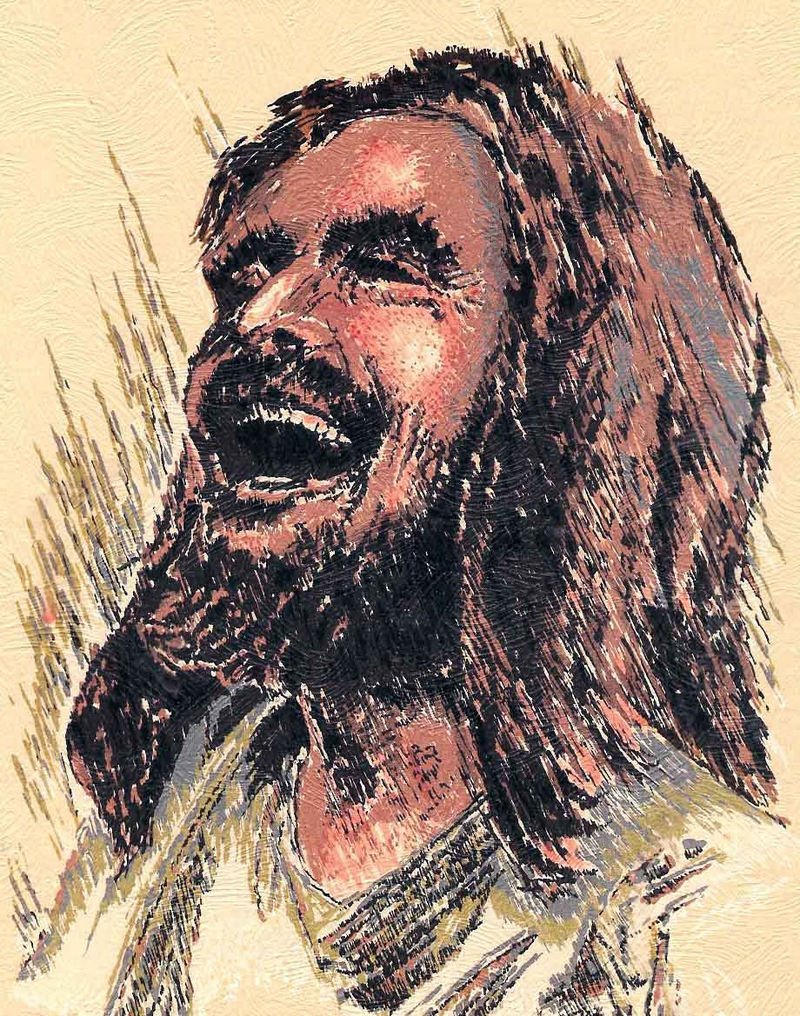
Everyone Likes a Good Joke: Jesus Makes Fun of Pharisaical Hypocrites (Sunday Homily)

laughing Jesus

Readings for 22nd Sunday in Ordinary Time: SIR 3: 17-18, 20, 28-29; PS 68: 4-5, 6-7, 10-11; HEB 12: 18-19, 22-24A; LK 14: 1, 7-14.

In this morning’s gospel, Jesus finds himself invited for dinner to the home of a Pharisee. All present, Luke tells us, are watching Jesus closely. No doubt, they’re keeping an eye on his disciples too. And they don’t approve.

After all, like Jesus, his disciples are mere riff-raff. But at least Jesus is the reputed peasant-rabbi. Everyone’s talking about him. And investigating Jesus is the whole reason for this dinner. So for the moment at least, the Pharisees are willing to cut him some slack.

His hangers-on however are a different story. They’re rough. They smell of fish and sweat, and have no manners. And yet, as Jesus’ friends, they’ve been placed towards the head of the table in places of honor. Granted, they feel out of place, but for that very reason they are enjoying themselves tremendously. You can imagine their rough jokes and loud laughter.

Yes, the Pharisees are watching Jesus and his friends. But obviously, Jesus has been watching them as well. He knows they are expecting some words of wisdom. So . . . he tells them a joke. And the joke’s on them. It contains a sharp barb.

“Thanks for inviting us to this banquet,” Jesus begins. “Unaccustomed as we are . . .” He pauses and smiles. “That’s quite generous of you. After all, none of us can repay your kindness. We are homeless people, as you know. We’re unemployed too, so we are in no position to return your kindness.

The best I can do is offer you some wisdom. So let me tell you what I’ve been observing here.

“Evidently,” Jesus goes on, “it’s your custom to adopt the humility recommended in the biblical Book of Sirach. I can’t tell you how impressed I am; I’m edified by your piety. I mean, you have clearly taken to heart the words of the sage, Jesus ben Sirach – what he said about being humble, especially if we are ‘great’ as all of you are here, I’m sure.”

Jesus eyes his listeners. He can tell that they are waiting for the penny to drop. So he drops it.

“I can see that when you come into a place like this, you take the lowest place available.” With this, Jesus stands up bows his head, stoops his shoulders and slumps towards the lowest place at table. He laughs.

“That way,” the Master continues, “our host, of course, is obliged to publically invite you to a more honored position at table. ‘Friend,’ he’ll say, ‘come up higher, and sit in the place you’ve merited not down there with the unwashed and poor.’”

Now Jesus is standing. He throws out his chest and strides towards the seat right next to his pharisaical host. He chuckles again. “That enables you,” Jesus continues,” with great protestations of unworthiness, to take your ‘rightful’ place at table. Your stock has risen in everyone’s eyes.

“So congratulations are in order,” Jesus says. “All of you have learned your lessons well. You’ve just created a show, and have actually exalted yourself by pretending to be humble. In a sense, you’ve received your reward.”

Jesus is seated now and looking intently at everyone. Their mouths are open with shock.

“So here’s my wisdom, friends. . . . Your ‘humility’ is not what Sirach was recommending. In fact, it’s a form of pride and self-promotion.

“Instead, real humility is this: when you throw a party like this one, invite the poor, the lame and the blind, and then serve them. Place them at the head of your table and treat them as honored guests. People like that can’t or won’t repay you. But in fact, YOU OWE THEM.” Jesus fairly shouts those last three words.

“I’m telling you the truth,” he says. And humility is nothing but the truth.”

Jesus pauses, but he hasn’t finished yet. “You see, those belonging to what you consider the Great Unwashed are actually God’s favorite people. Recall what the psalmist said about them in Psalm 68. He said God is the Father of orphans; he’s the defender of widows, of prisoners, of the homeless, and of farmers without land.”

Jesus is quiet now; his smile is broad and friendly. He searches the faces of his table companions one-by-one.

Then he turns to his host and adds.

“To be fair, my friend, you yourself are on the right track. By inviting us today, you’ve shown that you already understand what I’ve been saying. As I say, none of us can repay you, and yet you’ve invited us to this abundant table. We are sincerely grateful.

“But don’t think that you’ve somehow performed an act of charity by your invitation. No, it’s an act of justice – of compensation to make up for what you have stolen from the poor by underpaying them and taxing them heavily. In supporting the poor and even the “lazy,” you are simply imitating our generous God.

“I mean the earth and its produce are all gifts from God. No one has earned them. No one owns them but the creator. If you have food, then, you are obliged to share it with the hungry – even with those unwilling to work. As difficult as it might be to understand, that’s simply the divine dispensation.

“The earth and the life it supports have been freely given to everyone – even to people like me and my friends who refuse to work and live from the alms of friends like you. No one deserves life or food more than anyone else. So in effect, you are obliged to do what you’ve done.

(Homilist’s note) None of this needs commentary from me.

What’s your commentary?

(Sunday Homily) Is God Speaking to Us through Our Muslim Sisters and Brothers?

Islam

Readings for 20th Sunday in Ordinary Time: Is. 66: 18-21; PS. 117: 1-2; HEB. 12: 5-7, 11-13; LK. 13: 22-30.

Messages from God can come from the most unlikely places – even from our enemies and those our culture considers inferior and evil. That’s the teaching I find in today’s liturgy of the word. There God speaks to Babylonians through Jews, and to Romans through Christians. This suggests to me that God might be evangelizing Americans today through Muslims.
_____
Consider our first reading from Isaiah.

Imagine yourself a Babylonian in the 6th century BCE. You belong to an empire – one of the most powerful nations the world has ever seen.

In 586 your people conquered a small insignificant nation called “Israel.” Its leaders have been taken captive, and for more than three generations (586-516) have remained prisoners of your country. They are your enemies. You despise them as inferior, superstitious and violent.

Now towards the end of the 6th century, one of their “holy men,” someone called “Isaiah,” claims that those captives, those refugees, those “fugitives” as Isaiah calls them, are agents of the single God of the Universe. They have been sent specifically to call you away from your polytheistic worship of your Gods, Anshar, Ea and Enlil, and to recognize that there is only one God. They call him Yahweh. This God has special care specifically for refugees, slaves and outcasts in general.

For you, recognizing that entails releasing the prisoners your government has held captive for so long.

Even more, Isaiah says you and your proud people are being called to actually worship that God of refugees, political prisoners, and slaves! That means putting their needs first, while subordinating your own.

As Babylonian, you find all of this incredible and obviously insane.
______
Now to grapple with today’s gospel selection from Luke, imagine that you are a Roman living towards the end of the 1st century CE.

You belong to an empire recognized to this day as the greatest the world has ever known. As with the Babylonians more than 500 years earlier, Palestine and its Jewish people are provincial possessions of the empire; they are your captives. Roman legions continue to occupy Palestine whose haughty people resist their occupiers at every turn.

“Jews are nothing but terrorists, every one of them,” you think.

Among the most infamous of those terrorists was a man called Jesus of Nazareth. You’ve learned that he was a Jewish peasant crucified by Rome about the year 30 CE. You’ve heard that a new kind of religion has formed around that so-called “martyr.” In fact, his followers acclaim him by a title belonging to the Roman emperor alone – Son of God. To you that sounds absolutely seditious.

In any case, this Jesus asserted that the God he called “father” was blind to people’s national origins. He told a parable (in today’s gospel) whose refrain from a thinly veiled God figure was, “I do not know where you are from.” Apparently Jesus meant that in God’s eyes no nation – not even Rome – is superior to any other.

You wonder, was Jesus blind? No nation superior to any other? Did Jesus not have eyes to see Rome’s power, its invincible army, and feats of engineering – the aqueducts, the roads, the splendid buildings and fountains?

According to Jesus, Israel itself is not above other nations in the eyes of God. Nor are his own followers better than anyone else. Even those who drank with him and shared meals with him could not on that account claim special status in God’s eyes.

In fact, the only “superiors” are what Jesus called “the least” – his kind of people: artisans, peasants, the unemployed, beggars, prostitutes, lepers, immigrants, women and children. As in today’s reading from Luke, Jesus calls these people “the last.” In God’s eyes, they are “the first,” he said. Meanwhile those who are first in the eyes of Rome, Israel, and even of his followers end up being outcasts.

Worse still, many Romans, especially slaves and criminals, are embracing this new religion. Some in the Empire’s capital city are already worrying that if not stopped, this worship of an executed criminal from a marginal imperial province might undermine the religion of the Roman Gods, Jupiter, Mithra and of the emperor himself.

How absurd, you think, that Romans could be schooled in matters theological by riff-raff, Jews, and terrorist sympathizers.
_____

Finally, imagine that you are an American today. Many think that your country is the proud successor of Babylon and Rome. In fact, the United States may have surpassed Rome’s greatness. Certainly, it has the most powerful military machine the world has ever known. It has the capacity to destroy the earth itself, should its leaders take that decision.

Some attribute America’s greatness to its embrace of the faith of Jesus of Nazareth and to its partnership with Israel, the biblical People of God. As a result the U.S. has become the light of the world, the “city on a hill that cannot be hidden” (Mt. 5: 14-16). America can do no wrong.

This is not to say that its leaders aren’t fallible. They make their share of mistakes and even commit crimes. Yes, they torture, support dictators across the planet, imprison a higher percentage of their citizens than anyone else, drop atomic bombs, even threaten the extinction of human life as we know it, and have declared a state of permanent war against virtually the entire world.

But as a nation, the United States, you continue to believe, is idealistic; it stands for democracy, freedom and equality. As a result, America continues to enjoy God’s special protection.

Nevertheless, there are those in your midst who say that none of this is true. They are like the descendants of Abraham, Isaac and Jacob living in 6th century Babylon. They are like the first Christians who refused allegiance to Rome. They are the foreigners found in U.S. prisons all around the world – in places like Guantanamo Bay and Abu Ghraib.

By and large, those prisoners, those (in Isaiah’s terms) “fugitives” and exiles share a religious faith (Islam) that is as difficult for most Americans to understand as it was for Babylonians to understand Jews or for Romans to understand Christians. The faith of those held captive by America today is largely the faith of poor people called “terrorists” by your government – just as were the Jews and early followers of Jesus.

However, closer examination shows that Allah is the same as the Jewish God, Yahweh. Moreover Muslims recognize Jesus as the greatest of God’s biblical agents.

With that in mind, you realize that Muslims routinely invoke their faith to resist U.S. imperial rule. And they are critical of the use of Judaism and Christianity to justify oppression of their brothers and sisters in Palestine, Iraq, Afghanistan, Pakistan, Yemen, Bahrain, Somalia, throughout the rest of Africa and elsewhere.

Could it be that these exiles, captives, fugitives, “terrorists,” might be your empire’s equivalents of 6th century Jews in relation to Babylon and of 1st century Christians vis-a-vis Rome? Could they possibly be God’s agents calling us Americans away from heartless imperialism and to the worship of the true God (even if called “Allah”)?

Are our Muslim captives reiterating the words of Jesus in this morning’s gospel: God is oblivious to people’s national origins and to physical ties to Jesus? The Master “does not know where we are from” even if we’ve shared table with him. It makes no difference if we’re Jews or Christians, Babylonians, Romans, Americans, or Muslims.

Only the treatment of “the least” is important in God’s eyes. And for us Americans, those “least,” those “last” happen to be the poor of the Islamic world against whom our government has declared permanent war. And what is their God’s demand? It’s simple: Stop the war on us and our religion!

Is their God – our God – trying to save us – and the planet from the crimes of American Empire?

The fates of Babylon and Rome hang over us all like Damocles’ sword.


Scott Anderson’s “How the Arab World Came Apart:” It’s Not Islam; It’s the Economy, Genius!

fractured-lands-lead-image

Last Sunday, the New York Times (NYT) devoted its entire Sunday Magazine to a five-part article by Scott Anderson. It was called “Fractured Lands: How the Arab World Came Apart.” The epic piece traced the lives of six Arabs from Egypt, Iraq, Libya, Syria, and Iraqi Kurdistan as each struggled to live through and make sense of the disintegration of the Arab World since the U.S. invasion of Iraq in 2003. In so doing, Anderson attempted to put compelling faces on a longer historical narrative that begs for clarification, order and humanization.

The author succeeds admirably in the human interest portion of his project. More importantly, he supplies invaluable detail about a 100 year-long history of political decisions and processes responsible for the crumbling of the Arab world.

But perhaps his most stunning insight is that “Arabia” has been fractured not principally by internecine religious radicalism, but by a long-standing anti-socialist policy on the part of the United States and its allies. Ever since the conclusion of World War II, that policy has blocked economic reform not only in the Arab world and the Middle East, but also in Latin America, Africa, and South Asia – in other words in the former colonies. In the Middle East, the resulting conflict has only recently taken on heavy religious overtones.

Specifically, in that troubled region, the result of U.S. policy has been warfare and economic sanctions imposed on socialist movements involving both Arab and non-Arab countries – on peoples most of whom happen to be Muslims. As a result, those Muslims have experienced extreme poverty, joblessness, and loss of hope. Consequently, many have gravitated towards a brutal gang of reactive terrorists (ISIS) offering employment, a sense of identity, pride, short-lived hope – and the power that comes from a uniform and a gun. The grunts in this gang know very little about Islam.

In an August 12th interview with Scott Anderson on “Democracy Now,” Juan Gonzalez led the Times correspondent to make that very point. He asked Anderson what he had learned from his 18 months of research that included interviews with 20 ISIS fighters all of whom are now imprisoned in Iraq or in Kurdistan. Anderson responded:

“There was an amazing pattern. . . (T)hey were all young men, kind of with very bleak futures, either unemployed or underemployed, from working-class families, and not religious at all. . . (T)hey were not from religious families. They did not know the Qur’an very well. In a couple of cases, I knew the Qur’an better than they did. . . And I think it was this kind of decision that young men make, that better to live large for a couple of years, and, you know, the power and the so-called glamour. . . that comes of carrying a gun . . . they had more akin to why somebody might join like an inner-city gang or why in Mexico they might join a narco gang. It’s this kind of despair at seeing any sort of future. But it’s not political, it’s not religious. It’s just this impulse to—you know, to have some sort of—I mean, it’s awful to say, in terms of ISIS, but adventure.”

Juan Gonzales then observes, “But that’s a quite different perspective from what we get here . . .  that these are religious zealots who are willing to die for Islam.”

“Yes,” Anderson agrees.

With that astounding exchange in mind, it’s informative to reread the NYT article and the long-term history it reviews to detect the pattern underlying what Anderson uncovers as an economic rebellion with a recent and thick religious overlay that obscures what’s really behind ISIS and the fracturing of the Arab world. For as Anderson implies, the rebellion there is not about religion, but about economy. It is about the conflict between capitalism and socialism that has been raging at least since the 1848 publication of The Communist Manifesto. Far from ending with the fall of the USSR in 1990, the conflict has only intensified, when the West took the Soviet demise as a signal that it could subsequently increase pressure and even overthrow socialist governments everywhere – from Cuba and Venezuela to Yugoslavia and Iraq –  without fear of reprisal.

 To understand, we need to examine the underlying historical pattern responsible not only for the fracturing of the Arab world, but for relations between the developed world (principally the United States) and impoverished nations generally.

That pattern (identified specifically by J.W. Smith and implicitly by John Perkins) runs as follows:

  • Any Western colony that attempts to “break for freedom” (from capitalism and colonial control)
  • By instituting a “socialist” economy prioritizing the needs of its own people, especially its majority poor
  • Will have its leaders accused of being undemocratic dictators – communist, totalitarian, or terrorist.
  • Those countries will find themselves undermined (with Western support) by local dissidents – usually drawn from those privileged under the old colonial order or from those marginalized by the new socialist order.
  • This will cause the governments in question to institute severe national security measures that Western enemies will vilify as dictatorial, thus justifying further measures to overthrow the “repressive” regime.
  • If such methods do not result in the desired regime change, the country in question will ultimately be subjected to direct invasion or other military action on the parts of its former colonial masters.
  • Interventionist military action will be met with resistance and retaliation on the part of imperialism’s victims. (This explains the origins of ISIS.)

To reiterate, this pattern lays the blame for Middle East conflict at the feet of colonialism.  It suggests that since the dissolution of the Ottoman Empire, capitalism’s real enemy in Arab countries and throughout the Middle East has been anti-imperialist socialism not primarily Islam. More precisely, the conflicts in Egypt, Iraq, Libya, Syria, Iran, and Afghanistan have been spawned not by religion, but by resistance to colonialism and by economic policies resistant to free market capitalism.

To grasp that point, let’s think first of all about imperialism or colonialism. Then connect resistance to such foreign adventurism with socialism and the birth of ISIS.

In essence, colonialism is a system of robbery. It has foreign armies invading, conquering militarily weak, resource-rich countries, and then controlling them either through occupying armies or through local militaries armed by the invaders and headed by indigenous collaborators working hand in glove with the colonists. The chief goal of such invasion is resource extraction – wealth transfers for purposes of enriching the colonizers.

Western colonization of Arabia began in earnest after World War I. Up until then (and from the end of the 13th century), what Westerners called the “Middle East” was the center of the Ottoman (i.e. the Turkish) Empire controlled by Muslim sultans.

The Ottoman Empire was the Islamic State of its day and at its height comprised central Hungary, the Balkan Peninsula, Anatolia, Mesopotamia, Syria and Palestine, Egypt, the Caucasus and western Iran. As the Anderson essay shows, the Sultans did not impose their religion or Sharia Law on those they colonized. Instead, they allowed Christians, Jews and others to practice their faiths with no interference. As long as they paid their taxes, tribes and clans throughout the region were allowed a great deal of freedom and self-determination.

After the Ottoman Empire broke down in 1920, the British, French, Italians, and the United States stepped in to fill the void. To control their newly annexed territories (and their oil), they instituted a divide and conquer strategy. This entailed creating small client states that never existed before. These new “nations” included entities such as Jordan, Lebanon, and Yemen. Each was run by local collaborators (royal monarchs and their families) who could be counted on to transfer Arabia’s patrimony at confiscatory prices.

Such divisions were immediately resisted by tribes and clans throughout the region. Their loyalty was (and remains) to local chiefs, not to prime ministers or presidents. Together tribal leaders and their people wanted foreigners out. Many wished to unite all Arabs in a “Pan Arab” movement to restore the unity of the Arab world that had existed under the Islamic State and Caliphate for more than 600 years. The operative sentiment was “Arabia for Arabs.”

Pan Arabism took two main forms, one secular and socialist, the other (much later) religious and Muslim.

It helps to keep Smith’s historical pattern in mind: (1) break for socialist freedom, (2) vilification of socialism’s leaders, (3) empowerment of their natural enemies (secular or religious), (4) repressive measures by the threatened government, (5) (as a last resort) U.S. military action, and (6) insurgent response.

To verify the pattern, let’s begin with Egypt as Anderson does. Then let’s join him in considering the cases of Iraq, Libya, and Syria. Add in the non-Arab examples of Iran and Afghanistan to complete the regional picture. All the while, note the elements of the six-point historical pattern. To repeat, they illustrate that capitalism’s enemy has not changed since 9/11. It remains socialism, not Islam.

The most prominent secular and socialist anti-colonial movement began emerging in 1952, when Gamal Abdel Nasser led a revolution that overthrew the Egyptian monarchy that had cooperated closely with the West. Nasser was an outspoken socialist. His first act as Prime Minister was to institute a wide-ranging land reform program benefitting peasant farmers.

In addition, Nasser was critical of the West in general. He was also anti-imperial and hostile to Israel, which he and his constituents saw as another Western colonial beachhead in the Arab world. Nasser and his supporters saw Jews returning to their “homeland” as opportunistic European invaders whose ancestors hadn’t thought about living in Palestine for well over a millennium.

Nasser was succeeded by Anwar Sadat in 1970. As Anderson shows, Sadat alienated Pan-Arabs by moving closer to a client-patron relationship with the United States. He cooperated with the Carter administration in negotiating a separate Peace Treaty with Israel in 1979, without prior consultation with the other Arab states. For such betrayal, Sadat was assassinated. He was succeeded by Hosni Mubarak, an even more compliant client of the United States who remained in power till he was driven from office by the Arab Spring movement in 2011.

Nasser’s vision was shared by Hafez al-Assad, who came to power in Syria in 1970. Like Nasser, Assad had participated in a revolution against a Western-compliant monarchy. That revolution brought his Pan-Arab Ba’athist Party to power in 1963. The Ba’ath Party derived its name from the Arabic word for “renaissance” or “resurrection.” It envisioned the eventual restoration of a single Arab state. It espoused Arab nationalism and Pan-Arabism – again, Arabia for the Arabs. Besides being anti-imperial and anti-West, Ba’athism was also socialist. Since 2011, the United States and Syria’s former colonial master, France, have taken both indirect and direct action for regime change in Syria.

In 1969 Ba’athism spread to Iraq, where revolutionary forces led by Saddam Hussein toppled the monarchy established and supported by the West. Of course, following the dissolution of the Soviet Union in 1990, Desert Storm (1991) and the invasion of Iraq (2003) involved elaborate military measures by the United States to remove Saddam from office.

The same year Saddam Hussein came to power (1969), the Pan Arab socialist movement spread to Libya under Muammar Gaddafi who also led a revolution against a monarchy supported by the Western colonial powers. Gaddafi gradually moved away from the Ba’athist Pan Arab ideal and embraced Pan Africanism instead. His Third International Theory (published in his Green Book) championed socialism and anti-colonialism for the entire African continent. U.S. military action deposed Gaddafi in 2011.

Besides its links to the six-point pattern indicated above, what socialism in Egypt, Iraq, Syria, and Libya had in common was the fact that it worked. It lifted masses of people from poverty and modernized the relevant countries in a relatively short time. For example, before the 1991 invasion, Iraq boasted the highest standard of living in the Arab world. Similar statements can be made about Nasser’s Egypt, Assad’s Syria, and Gaddafi’s Libya.

Regional resistance to control by Western capitalists also emerged prominently in non-Arab Iran and in Afghanistan – two other artificial countries which came into being at the end of the 19th century. It was in these countries that (with major U.S. implication) opposition to Western imperialism eventually took on the decidedly religious turn that most mistakenly identify today as the root cause of conflict in the Middle East.

However, to begin with (as was the case in Egypt, Iraq, Syria, and Libya), post-World War II Iran experienced a highly secular grassroots rebellion against foreign control of their region following the dissolution of the Ottoman Empire. The rebellion caused the democratic election of Mohammad Mossaddegh to displace the U.S. client, Reza Pahlavi, the Shah of Iran.

Upon his succession to office, the enormously popular Mossaddegh instituted social and economic reforms of the type championed by socialists all over the world: social security, land reform, abolition of forced labor, rent control, agricultural regulation, compensation for workers injured on the job, public housing, and public works – all with the intent (as he said) to “combat disease, poverty, and backwardness.”

Above all, Mossaddegh nationalized Iran’s oil industry. This outraged Great Britain (who controlled Iran’s oil) the United States. So the CIA instituted a coup that removed Mossaddegh from office and replaced him, restoring to office Reza Pahlavi who returned from exile to administer an extremely repressive Western-friendly regime for the next quarter century.

In 1979, the Shah was overthrown in a rebellion. However, this time the uprising was not inspired by socialism, but by an anti-Western, anti-imperial movement organized “in the name of God.” It is here that Islam begins to take over as the face of the perennial regional resistance to Western imperialism that had roiled above and below the surface since 1920.

Something similar happened in Afghanistan. There too a secular socialist movement against the West morphed into a rebellion in the name of God.

In Afghanistan, the secular People’s Democratic Party of Afghanistan took control of the country in 1973 under Nur Muhammad Taraki. It offered equal rights for women, universal education, and land reform. To oppose such reforms and the intervention of the Soviet Union to uphold them, the CIA identified and supported internal opposition, the Mujahedeen – Islamic jihadists who from their founding had adopted as their goal the expulsion of foreigner rulers (viz. the British) from the Middle East. The CIA now empowered them to expel the Soviet invaders and establish an Islamic State to replace socialism.

But Mujahedeen goals were not reached with the expulsion of the Soviets. The jihadists wanted all foreigners out of the region. That meant the expulsion of U.S. troops from Islamic holy centers in Medina and Mecca. The troops had taken up residence there following the 1991 defeat of Saddam Hussein in Operation Desert Storm. That defeat was followed by 12 years of economic sanctions that ended up taking the lives of half a million Iraqi children. Osama bin Laden would later identify those murders, along with the previous 80 years of European control of Arabia, and the stationing of troops in Mecca and Medina as the specific motives for the infamous attacks of 9/11. His rationale was hardly reported in the U.S. mainstream media (MSM).

Since 9/11those media and Western politicians have shifted blame for the dissolution of the Arab world away from neo-colonial capitalist depredations and the interventionist pattern Scott Anderson implicitly reviews. Instead of blaming a failed capitalist system and its related foreign policy, they locate the cause of Middle Eastern chaos in Islam and in Hitler-like tactics of egregiously evil dictators such as Saddam Hussein and Bashar Assad. The problems thus become personalized, cultural and religious. Thankfully for those responsible, they also become largely insoluble thus necessitating permanent war. Thus the grateful include Israel, Saudi Arabia and other “American” client states. They include as well the oil and arms industries, and the corporate-controlled MSM all of whom profit from a chaotic Middle East and from misidentifying the true culprit in the region.

If all of this is true, what then must be done about Anderson’s “Fractured Arab World?”  If the cause of the fissures there is not religion nor Hitler Redivivus, but capitalism itself, its 150-year war against socialism and its six-point pattern of colonial intervention, what policies might replace the failed, counter-productive measures of war, incessant bombing, and drone attacks? If the foot soldiers in the war are not religious zealots, but unemployed and underemployed young people without prospect or hope, what will give them hope and meaning beyond a black uniform, ski mask and gun?

Here’s where we might start:

  • Abandon imperial pretensions and allow nations everywhere to experiment with alternatives to a capitalist system that clearly does not serve them.
  • Stop all vilification of Islam and Muslims.
  • Completely transform the U.S. economy from its fossil fuel dependency, thus removing the major reason for “American” interest in the Middle East.
  • Nationalize the U.S. arms industry, thus severing the connection between war and profit.
  • Cut off all aid to Israel until it complies with repeated U.N. mandates to withdraw from the Palestinian territories it has illegally occupied. This would take seriously bin Laden’s claim that solving the Palestinian problem would also solve the problem of terrorism.
  • As a good-will measure and for the sake of justice, indict, try, and punish George Bush, Tony Blair, Dick Cheney, Donald Rumsfeld, and others responsible for the Iraq War that gave rise to ISIS.
  • Divert the billions now invested in failed wars against terrorism into reconstruction of Afghanistan, Iraq, Libya, Yemen, and other countries devastated by Western wars.
  • Similarly use those billions to provide constructive employment not only for ISIS fighters, but for U.S. soldiers who find themselves armed and in uniform for reasons similar to the young militants referenced in Scott Anderson’s essay.
  • With good will demonstrated in these ways, summon a Peace and Reconciliation Conference to include all stake holders in Middle East conflicts including ISIS..
  • Comply with the decisions of the conference.

That such common sense measures probably seem impossible and completely off the table for most of our diplomats (and readers of this essay!) represents a sad comment on our limits of perception. It exhibits a lack of genuine will on the parts of our “leaders” to solve the problem of global terrorism. It also demonstrates the need for a revolution of our own.



Did Jesus Justify Armed Resistance to Roman Imperialism? What about Insurgent Resistance to U.S. Imperialism? (Sunday Homily)

Jesus-Said-Video-Preview.jpg

Readings for the 20th Sunday in Ordinary Time: JER 38: 4-10; PS 40: 2-4, 18; HEB 12:1-4; L 12: 49-53

Today’s gospel excerpt presents problems for any serious homilist. That’s because it introduces us to an apparently violent Jesus. It makes one wonder; why does the Church select such problematic passages for Sunday reading? What’s a pastor to make of them?

On the other hand, perhaps it’s all providential. That is, today’s gospel might unwittingly help us understand that even the best of imperialism’s victims (perhaps even Jesus) are drawn towards reactive, revolutionary, or self-defensive violence. After all, Jesus and his audiences were impoverished victims of Roman plunder. By the standards most Christians today accept, they had the right to defend themselves “by any means necessary.”

Here’s what I mean. Without apology, today’s reading from Luke has the ‘Prince of Peace” saying, “I have come to set the earth on fire, and how I wish it were already blazing . . . Do you think that I have come to establish peace on the earth?  No, I tell you, but rather division.”

In a parallel passage, Matthew’s version is even more direct. He has Jesus saying, “Do not suppose that I have come to bring peace to the earth. I did not come to bring peace, but a sword.”

Is that provocative enough for you?

What’s going on here? What happened to “Turn the other cheek,” and “Love your enemy?”

There are two main answers to the question. One is offered by Muslim New Testament scholar, Resa Aslan, the other by Jesus researcher, John Dominic Crossan. Aslan associates the shocking words attributed to Jesus in this morning’s gospel directly with Jesus himself. Crossan connects them with the evangelists, Luke and Matthew who evidently found Jesus’ nonviolent resistance (loving enemies, turning the other cheek) too difficult to swallow for people living under the jackboot of Roman imperialism.

For his part, Aslan points out that the only God Jesus knew and the sole God he worshipped was the God of Jewish scripture. That God was a “man of war” (Exodus 15:3). He repeatedly commands the wholesale slaughter of every foreign man, woman, and child who occupies the land of the Jews. He’s the “blood-spattered God of Abraham, and Moses, and Jacob, and Joshua (Isaiah 63:3). He is the God who “shatters the heads of his enemies” and who bids his warriors to bathe their feet in their blood and leave their corpses to be eaten by dogs (Psalms 68: 21-23). This is a God every bit as violent as any the Holy Koran has to offer.

For Aslan, Jesus’ words about turning the other cheek and loving enemies pertained only to members of the Jewish community. They had nothing to do with the presence of hated foreigners occupying and laying claim to ownership of Israel, which in Jewish eyes belonged only to God. Accordingly, Jesus words about his commitment to “the sword” expressed the hatred he shared with his compatriots for the Roman occupiers.

In other words, when it came to Roman imperialists, Jesus was not a pacifist. He issued no call for nonviolence or nonresistance. Quite the opposite.

John Dominic Crossan disagrees. For him the earliest layers of tradition (even the “Q” source in Matthew and Luke) reveal a champion of non-violent resistance. In fact, the Master’s earliest instructions to his disciples tell them to travel freely from town to town. But in doing so, they are to wear no sandals, carry no backpack, and no staff. He instructs: “Take nothing for the journey–no staff, no bag, no bread, no money, no extra shirt” (LK 9:3).

Crossan finds the prohibition against carrying a staff highly significant. The staff, of course, was a walking stick. However, it was also a defensive weapon against wild animals – and robbers.

So with this proscription Jesus seems to prohibit carrying any weapon – even a purely defensive one like the staff all travelers used.

Apparently, that was too much for the evangelist, Mark. Recall that he wrote the earliest of the canonical gospels we have – during or slightly before the Great Jewish Rebellion against Rome (66-70 CE). Matthew and Luke later copied and adapted his text for their own audiences – one Jewish (in the case of Matthew), the other gentile (in the case of Luke). Mark remembers Jesus’ directions like this: “He instructed them to take nothing but a staff for the journey–no bread, no bag, no money in their belts” (MK 6:8).

Notice that Mark differs from what Crossan identifies as the earliest Jesus traditions upon which Matthew and Luke depended. Instead of prohibiting carrying a staff, Mark’s Jesus identifies the staff as the only thing Jesus’ disciples are allowed to carry. Evidently, that seemed more sensible to a pragmatic Mark than the words Jesus probably spoke. I mean, everyone needs to at least protect themselves from violent others.

Matthew and Luke prove even more pragmatic. By the time we get to them (almost two generations after Jesus’ death and fifteen or twenty years after Mark), we find their Jesus commanding that his disciples carry, not just a staff, but a sword – an offensive, lethal weapon. Matthew even portrays Jesus’ right-hand-man, Peter, actually armed with a sword the night Jesus was arrested. Jesus has to tell him: “Put away your sword. Those who live by the sword will perish by the sword” (MT 26:52). (It makes one wonder if Peter was absent the day Jesus gave instruction about turning the other cheek and loving one’s enemies. Or is Aslan correct about Jesus’ militancy?)

In other words, on Crossan’s reading, it is the gospel authors, not Jesus himself, who subscribe to belief in the blood-spattered God of the Jewish Testament. Jesus’ God was the Forgiving One who recognized no one as enemy, and who (as his later actions showed) refused to defend himself. His dying words were about forgiving his executioners.

Crossan reasons that this more pacifist Jesus is probably the authentic one, precisely because his words (and actions) contradict so radically the Jewish tradition’s violent God.

So whose words do we encounter in today’s gospel? Can we attribute them to the historical Jesus or to his disciples who found themselves unable to accept the Master’s radical non-violence?

Whatever our answer, the shocking words we encounter today remind us that even people of great faith (Mark, Matthew, Luke – or perhaps even Jesus himself) despise imperial invaders. Their arming themselves and fighting revolutionary wars (like the 66-70 Uprising) are completely understandable.

In any case, by gospel (and Koranic?) standards such rebellion is more justified than the entirely unacceptable violence of imperial invasion.

Does any of this shed light on ISIS response to U.S. Middle Eastern invasions, bombings, torture centers and dronings? As a Christian, what would be your response if foreigners did in our country what U.S. soldiers and pilots are doing in Arabia? Would you be a non-violent resister as Crossan says Jesus was? Or would you take up arms – the way violent insurgents have done in Iraq, Afghanistan, Libya, Yemen, Ethiopia, and elsewhere?

Which Jesus do you follow? Can you understand religious people who in the face of United States imperialism say: “I have come to set the earth on fire, and how I wish it were already blazing . . . Do you think that I have come to establish peace on the earth?  No, I tell you, but rather division.”

I Attend a New Age Conference Channeling an Angelic Being: afterwards My Political Prayers Receive Surprising Answers

Kryon

Just recently, my wife Peggy and I attended a two-day New Age retreat in Grand Rapids, MI. We were there at the invitation of two good friends who own a Health and Wellness store in Lakeview.

At the conference, we encountered a “loving angelic entity” from the “other side” who impacted both of us – and an audience of about 250 people – clearly beyond any cynical expectations I may have had. As I’ll explain, the gathering was very Catholic in several ways. Moreover, I was surprised when some highly political prayers I offered there seemed to find rather immediate answers. It was almost enough to convert me – but not without reservations.

The angelic being in question is called Kryon. And he speaks through a medium by the name of Lee Carroll, who’s been channeling him for 26 years. Turns out that Carroll is a delightfully humorous spell-binder himself. He’s a former engineer with a Ph.D. and a reformed skeptic about everything he now teaches so effectively. Years ago, he says, he wouldn’t have been caught dead at a meeting like the one I’m describing. Somehow, I could relate to that.

Here’s what Carroll teaches:

  • Time itself is an illusion – a human construct. The present is all we have. The “past” is a mere memory; the “future” is projection. (In other words, as Einstein said, time is not absolute; it bends with gravity and changes relative to speed of motion.)
  • The evolutionary process is directed. There is indeed “Intelligent Design” in all of it. In fact, left to itself, without direction, the evolution of human consciousness should have taken much, much, much, much longer to develop than the 14 billion years our galaxy has existed.
  • Many of us (called “old souls”) have long participated in the evolutionary process. We’ve passed this way more than once and will do so again and again – but without having to relearn the hard lessons that have wounded us all.
  • In fact, “Old Souls” have an “Akashic Record” of our previous lives that can be accessed with the help of an experienced guide.
  • In tune with Mayan prophecy, “old souls” recognize that a New Age has dawned since 2012 in which people are rejecting obsolete male-centered spiritualties and are turning towards more feminine, indigenous, holistic, positive, experiential approaches to the divine which is the most essential dimension of being human.
  • Eventually within the realm of this dawning consciousness, war will not even be considered as a political option.
  • According to the Mayan calendar, this New Age with a corresponding change in consciousness occurs every 26,000 years, when the earth aligns perfectly with the center of the universe – on this occasion creating circumstances for the greatest, most intense human consciousness ever available.
  • As a result of such cosmic events, for the next 15 years or so, we are entering a sacred time and space where people are waking up to possibilities for creating another world. It is a time of rebellion, where profound changes can happen very quickly making another world truly possible.
  • Put otherwise, the human race is moving forward into a mystical dimension. [Or as the eminent Catholic theologian, Karl Rahner put it: “In the days ahead, you will either be a mystic (one who has experienced God for real) or nothing at all.”]
  • There humans can leave aside the authoritarianism of old religions and step into their own power, into their authentic identities, into their true soul purposes.
  • This shift in consciousness empowers humans to change reality which (from their own bodies to the furthest distant stars) listens to people’s commands.
  • That is, our bodies and the planet know what is best for us; they want to heal us and await our commands.
  • More specifically, if aging people command their bodies to “youth,” their bodies will obey thus allowing seniors to control how fast they age.
  • Kryon has emerged on the scene precisely because the 2012-2030 shift in consciousness is taking place across the planet.
  • However, in the new and exciting age, conservative forces are emerging fighting desperately to prevent the cosmic transformation in question.
  • But none of us should fear the future. Despite appearances, the forces of light (not darkness) are winning.

These are the kind of messages Lee Carroll spoke at the workshop during his three channelings of Kyron’s spirit.

And how is one to enter this new age? According to Dr. Carroll, one does so by forming communities of like-minded mystics. Entrance is facilitated through self-talk, i.e. by reciting personally-chosen affirmations aloud so that the extremely attentive and always responsive cells of our bodies can hear. One drives home such talk using techniques such as “tapping” and wide-ranging prayers offered in ceremonies like Despacho, a Native American prayer ritual which some of us experienced on the final day of our workshop.

The practice of tapping involves lightly drumming on the crown of the head across the meridian separating the left and right sides of the cerebral cortex. (Recall that the left hemisphere of the human brain is more logical; the right side, more intuitive and holistic.) One taps while breathing deeply and reciting a positive, believable, focused, and original affirmation chosen by the tapper.

Typical affirmations include:

  • “My innate intelligence recognizes and supports the eternal nature of my being.”
  • “I am living in a new energy and all around me are new potentials.”
  • “My needs are always met.”
  • “I am in the right place at the right time for everything is in divine order.”

Cerebral cortex drumming is then followed by similar tapping on the heart. The idea is first of all to unite the powers of one’s left and right brain. Tapping one’s heart attempts to plant the affirmation in the human organ that is 5000 times more powerful than the human brain.

Again, before I rolled my eyes too far, I recalled that we Catholics should be familiar with tapping and positive affirmations. We do something similar through the ritual practice of “laying on of hands” accompanied by invocations of the “Holy Spirit.” This happens, for instance, during sacramental ceremonies such as ordination and confirmation. When I thought about it, I realized that placing hands on the crown of ordinandi and confirmandi while invoking the Holy Spirit can be seen as ceremonially attempting to integrate their powers of logic, intuition, and openness to the transcendent Ground of All Being.

Then there’s the Catholic practice of “beating one’s breast” – as in mea culpa, mea culpa, mea maxima culpa. That’s really a version of “tapping” one’s heart. The difference is however, that New Age tapping is completely positive without a trace of guilt, fault, negativity or “beating.” To me that seemed healthier.

As for the Despacho ceremony . . .; it was truly remarkable. It showed me (again!) the power of female priesthood that the Catholic Church ignores. The two-hour ritual was led by a colleague of Dr. Carroll – Michelle Karen. Only about 50 of the 250 workshop participants took part – most of them women.

Michelle is a French deeply insightful astrologer who learned Despacho from shamans of a Native American community in Peru. She had us all sit in a circle while she (with our participation) created a beautiful mandala on a piece of colored fabric. In a circle outlined with sugar (symbolizing the sweetness of life) she had us each place one white and one red carnation petal with a bay leaf sandwiched between. (Obviously, we couldn’t use the more authentic coca leaf.) The red petal represented the female principle of creation; the white, the male. The bay leaf stood for our desire to change our consciousness.

Then successively, while humorously and perceptively explaining the meaning of each element, Michelle added at least 25 other items. They symbolized prayers for the planets, oceans, air, animals, insects, our deceased relatives and friends, and so much else. The symbolic additions to the burgeoning mandala included salt, leaves, twigs, toys, ribbons, hair – you get the idea. With the addition of each element, Michelle offered a corresponding prayer, breathed on the item and touched it to her forehead.

Towards the end of Despacho, each of us was asked to silently offer our most solemn prayers and in the form of a rose petal place them on top of the finished mandala. We were to do so with great care, Michelle advised, because the Despacho ceremony is extremely powerful. We should expect our prayers to be amazingly answered within days.

Our final product was gorgeous. Michelle wrapped it in the underlying fabric and commissioned an “honorary shaman” chosen from our group to later on ceremonially burn the package whose smoke would carry our prayers to the Universal God.

The prayers I offered were mostly quite personal. However, I also decided to add political petitions I’ve been praying each morning for the last eight years or so. (Ever-compassionate Peggy later told me that they seemed rather negative. She didn’t approve. Maybe she’s right.) In any case, my prayers for most of the past decade have included:

  • May U.S. Empire be brought to its knees.
  • May Israel similarly be defeated before liberated Palestinians.
  • May the Republican Party and Fox News disintegrate.
  • And may President Obama be remembered as the best president the United States has ever had. (I’ve given up on this one!)

Wild prayers, no? (I suppose you see what Peggy meant.) But here’s the thing: three days after the conclusion of the Kryon Workshop, Roger Ailes, the head of Fox News, resigned as its CEO. Commentators identified the event as earth-shaking in terms of the Republican Party, since Ailes had shaped its strategy since the Nixon years. Fox News, they predicted, would become more moderate (while, no doubt remaining right wing – thus more closely approaching the center-right position of the U.S. mainstream media).

Then that same day, after Donald Trump accepted the GOP’s nomination for president, a figure no less than George W. Bush expressed his worry that he might end up being the last Republican president ever.

What? Despacho prayers answered after just four days? Should I take credit? (Just kidding.)

Whatever: just two petitions to go. And events promise that the Universe may soon honor those requests as well.

So have I converted to become a Kryonite? Not quite. While I appreciated the weekend and recognize the soundness (and even Catholicity) of much of the underlying spirituality, and while I admired the wonder of female leadership in worship, I was pulled up short towards the end of our retreat.

It happened on Sunday, when Dr. Carroll seemed to get a bit off-script.  He ended up sounding quite like a climate change denier. (Though he claimed, “I’m actually a ‘Greenie’.”) Based on the insights of a single scientist friend of his, Carroll asserted that the planet is essentially cooling and that an ice age is on the way. “It’s a natural process,” he added. Humans have nothing to do with it. Technology will soon appear to save us. Moreover, the oceans can clean up any of the oil spills we might throw at them. “Everyone knows this outside the United States, but not here.”

Hmm. During the Q&A I raised my hand to question. But the session was cut short before I was recognized. I wanted to ask him:

  • Sure, an ice age may be coming, but when? A thousand years from now?
  • With due respect to your scientist friend, ninety-seven percent of climate scientists tell us the catastrophe of climate chaos is upon us. We don’t have 1000 years (or even 100) to wait.
  • What about greenhouse gases?
  • And rising sea levels?
  • How do you explain the consecutive months and years of record-setting rising temperatures?
  • And aren’t “Americans” virtually alone in the world in denying climate change?

Despite my reservations and unanswered questions, it should be clear that there was much to recommend the Kryon Workshop I’ve been describing. It shows a widely shared hunger for meaningful non-patriarchal spirituality – for optimism and hope rather than guilt, sin and hell. It demonstrates the effective leadership of wise women – counsellors, healers, shape-shifters like Michelle Karen.

It highlights the undeniable fact that we have indeed entered a New Age in which old forms are disintegrating and losing credibility while women and other angelic spirits are asking us to rethink everything and create the “other world” we all want and need.

It might even have confirmed my belief in the power of prayer.