Starting a House Church: A Faith-Inspired Response to Trumpism (First in a series of four)

barth

Recently, I surprised friends and readers of this blog by announcing plans to “re-appropriate my priesthood” and start a house church. It would be a faith-based response, I said, to Trumpism and its planetary threat. The community, I hoped, would mobilize the spiritual power that in fact dwarfs the U.S. presidency and the president’s capacity as Commander-in-Chief of the mightiest military in the history of the world.

Some of my former priest-colleagues wondered, “Why on earth would you want to do that?”

After all, the church is for all practical purposes dead and the priesthood along with it.

And good riddance. By and large, the church remains sexist, religiously fundamentalist, and arguably the most conservative force on the face of the earth.

“And there’s more,” they said.  “Virtually no one believes in priestly powers any more. According to Catholic faith, it all hangs on two quasi-magical endowments that priests alone allegedly have to: (1) transform bread and wine into the literal body and blood of Christ, and (2) forgive mortal sins that would otherwise send their perpetrators to hell. Few who think about it take such beliefs seriously any more. The others are just coasting along in thoughtless denial. Their children however perceive the nonsense and are jumping the sinking ship in droves. That’s why if ‘former Catholics’ were an actual denomination, they would constitute the third largest church in the United States.

“Moreover, Catholics are virtually indistinguishable from Protestants (or non-believers for that matter) in their life-styles and political positions. They even practice birth control in exactly the same percentages as other Americans. It’s a similar case with divorce and same-sex relationships. And many Catholics vote Republican, despite papal social teachings on social justice, the environment, and war.

“So what’s the point of the Catholic Church with its anachronistic priesthood? It has become a mere social club – good for keeping old friendships alive, but little more. Most of its committees, sodalities, youth and men’s groups are self-serving. Do-gooders could easily find other organizations elsewhere to satisfy their passion for social change – without having to fight resistant Catholic fundamentalists in the process.”

To be frank, I find such objections persuasive.  Despite the best efforts of Pope Francis, the church seems more dead than alive. For all practical purposes, it whistles past the crises that characterize our age. The Sunday Masses I attend completely ignore the unprecedented contemporary context of threats from nuclear war, climate change, racism and sexism.

And yet, I remain firm in my intention to proceed with the house church. That’s because despite the institutional church’s having lost its way, I still find in my faith a source of spiritual strength and political resistance that for me is irreplaceable.

I intend to start a house church also because the objections just mentioned overlook the fact that Catholic Church pews also seat resisters like me. There are people whose faith has been shaped by the reforms of the Second Vatican Council. In the spirit of the conciliar document, “The Church in the Modern World,” their faith engages them not only with world events, but with one another.

For instance, in my own community, a group of more than 20 has met regularly over the past two or three decades as our church’s Peace and Social Justice Committee. Our gatherings often find us reflecting on liturgical readings. Discussions connect them with political organizing, welcoming refugees, war-resistance, the environmental crisis, and with the needs of local unemployed and impoverished families. Work with Habitat for Humanity has been a constant commitment.

I’m loathe to let such relationships and commitments go. At the same time, I’m convinced there has to be a better, more focused, more regular and consistent way of harnessing the deep faith the 20 or so of us share, especially in the face of Trumpism. To repeat: we’re in an unprecedented situation that calls for an unprecedented response.

I’m convinced that the best response is to experiment with house church Sunday liturgies that would bring our sub-community and others together on a weekly basis to reflect, pray, break bread, and plan creative acts of resistance. The liturgies will take place on Saturday evenings (i.e. on the Sabbath) and thus allow those wishing to attend Mass in our church the next morning, to do so.

In the end, my reasons for starting a house church are rooted in history and theology – in post-Vatican II understandings of church, of Eucharist, and of priesthood. A changed understanding of each – more in accord with the leadership of Pope Francis gives hope and direction.

I will try to explain what I mean in subsequent postings over the next three weeks.

Catholic Action vs. Trumpism: An Invitation to an Alternative Weekly Mass[1]

lords-supper

As indicated in earlier postings (here and here), the ascension of Donald Trump and his group of billionaire confidants to national leadership calls people of faith in general and Catholics in particular to adopt extraordinary and vigorous responses to the grave threat their ascent signifies.

This posting represents one such response. Its call is especially urgent in the light of the fact that the Trump administration and Republicans in general embody what Noam Chomsky has termed “the most dangerous organization in the history of the world.” Their unanimous climate-change denial accords them the title. In fact, they not only deny the human causality of climate chaos, they plan to proceed full speed ahead with the practices (oil and gas drilling and fracking) that our planet’s finest minds identify as its causes. The Republicans (with the Democrats not far behind) are leading us all like lemmings to the precipice of planetary destruction and the end of human life as we know it.

This is no exaggeration.  As Pope Francis has written so eloquently:

“Doomsday predictions can no longer be met with irony or disdain. We may well be           leaving to coming generations debris, desolation and filth. The pace of consumption, waste and environmental change has so stretched the planet’s capacity that our contemporary lifestyle, unsustainable as it is, can only precipitate catastrophes, such as those which even now periodically occur in different areas of the world. The effects of the present imbalance can only be reduced by our decisive action here and now. We need to reflect on our accountability before those who will have to endure the dire consequences.” (Laudato Si’ 161).

It is clear that despite Francis’ strong words, “decisive action” in the face of Trumpism’s climate-change denial and other destructive policies has no chance of issuing from the diocesan Catholic Church nor from our local Catholic community in Berea. So the invitation here is to Catholics and other people of faith to create an alternative (or, if you will, a complementary) community of faith to celebrate a house-church Mass each week. Its liturgy will be characterized by sharp awareness of the unique political context we are now entering. Each will be followed by discussions planning direct action against Trumpism in all of its forms.[2]

The Mass will be simple and prayerful. It will take place on Saturday evenings in a home (Peggy’s and mine to begin with). Together we will sing some inspiring songs, reflect on the week’s liturgical readings in the light of the Church’s rich social justice tradition, and break bread eucharistically before sharing a pot-luck supper. Each meeting will incorporate planning for specific acts of resistance.

The first convening of this alternative community will take place on Saturday, January 21st, the day after Mr. Trump’s inauguration which is scheduled for January 20th. Here are the details:

Berea’s Weekly Alternative Home-Church Mass

Place: 404 Jackson St.

Time: 5:00-7:00

The Mass:

  • Welcome (5:00)
  • Singing, opening prayers, & Liturgy of the Word (5:00-5:45)
  • Eucharist (around the dining room table) & Pot Luck (5:45-6:45)
  • Planning the week’s direct action (6:45-7:00)
  • 7:00 (promptly): Dismissal

Beginnings, no doubt, will be small and modest. But we should not be discouraged. Ideas about how to proceed more inspiringly will surely develop as all group members share their suggestions.

[1] Starting next Tuesday, I will start a 4-part series here explaining the history and theology behind home liturgies including an explanation of current theologies of the Eucharist and “Real Presence.”

[2] For those who remember: The faith community envisioned here might be thought of as a more spiritually-focused Berea Inter-Faith Task Force for Peace.

I’m Happy that Trump Stole the Election: At Last, Everyone Can See “America” for What It Is!

election-stolen

For years I’ve been arguing with friends that Adolf Hitler actually won the Second Inter-Capitalist War (1939-’45). [As a matter of fact, in 2001, I wrote an article to that effect; it was published (in Spanish) by Costa Rica’s Ecumenical Research Institute (DEI).]

It took a while for his fascism to triumph here, I argued. But triumph it did. U.S. support of fascism in the Global South was bound to come home. Moreover, I said, the United States represents the planet’s greatest threat to world peace. It not only spends more on the military than the rest of the world combined, it is also the instigator of most of its wars. The world scourge of “terrorism” is a U.S. product directly traceable to its military interventions on behalf of Big Oil. Additionally, “America’s” human rights record is abysmal. If it dropped off the map tomorrow, the world would be much better off.

Domestically, I said, U.S. “democracy” is a sham. In reality, those calling the shots are not “The People,” but large corporations aided and abetted by the military – what Dwight Eisenhower called “the military industrial complex.” In fact, Eisenhower’s phrase represents a nearly perfect definition of fascism. According to Benito Mussolini, it’s the union of government and corporations. “Corporatism,” he called it. That’s our system, pure and simple.

Despite my arguments, my friends have continued to insist robotically, “We’re the greatest country in the world. We’re its leading democracy. We’re the richest country in the world. We respect human rights like no other.”

On and on the argument continued.

Since November 8th, however, I’m happy to report the argument is over. With the accession of the Trump team to power, the truth of my argument has become transparent. Pretense is no possible. Now no one can deny:

  • The U.S. is a complete plutocracy. It is fascism incarnate.
  • It is criminal in its approach to human rights.
  • It is indeed the greatest threat to world peace and human survival.
  • Its system of so-called “democracy” is rigged and is probably finished.
  • The U.S. is not the richest country in the world.

Begin with the question of plutocracy and fascism. The take-over by the rich – by Mussolini’s corporations – is complete and transparent. And sitting right next to them at “The Table” are the military men. Add them up:  A self-identified billionaire heads the whole show. The president of Exxon will be his secretary of state. Goldman-Sachs officials will hold several cabinet posts. The Secretary of Defense will be a general. Same for the head of Homeland Security. And then there’s Trump’s National Security Advisor – also an ex-general. It’s all suggestive of a military coup.

As for human rights . . . The president-elect has promised to expand the U.S. prison at Guantanamo, where prisoners are held in violation of Habeas Corpus requirements. He has also threatened to torture terrorist suspects – and to kill their families! Yes, he’ll water-board, he said, and do “a hell of a lot worse” than that. Such statements, of course, run contrary to international law and fly in the face of the Nuremberg Principles. Though Trump recently has claimed to reverse his stance, his nomination, for instance, of National Security Advisor calls such disclaimers into question. Michael Flynn, has also been a torture advocate. So under Trump look for more Bush II-style legal justifications of “enhanced interrogation” techniques which included waterboarding and infliction of physical pain stopping just short of the point of death. As they say, torture by any other name . . .

Such positions on what the rest of the world regards as inhumane and illegal are just part of the reason why the U.S. is now and has been for years generally regarded as the greatest threat to world peace. Gallup polls have born that out. Look it up on the web, and here’s what you’ll find:

“According to the leading western polling agencies (WIN/Gallup International), the prize for ‘greatest threat’ is won by the United States. The rest of the world regards it as the gravest threat to world peace by a large margin. In second place, far below, is Pakistan, its ranking probably inflated by the Indian vote.”

And this does not even take into account the incoming administration’s position on climate change. Trump’s nominations to head the Environmental Protection Agency (EPA) and the Department of Interior remove any doubt that the U.S. is the greatest threat to human survival. Both of them are vehement climate-change deniers – as are the president-elect himself and the entire Republican Party now in charge of most of the nation’s levers of power. None of them is a climate scientist. Yet as a group, and despite the contrary conclusions of 97% of climate scientists, they choose to impose their unsupported opinion on the entire planet regardless of its predicted impact their own grandchildren. Their promise to withdraw from COP 21 agreements regulating carbon emissions isolates the United States as a truly rogue nation – a criminal state. It makes the Republican Party what Chomsky has called “the most dangerous organization in the history of the world.”

The U.S. is also no longer a democracy. Here Donald Trump was right. The whole system is rigged. And (once again) with Republicans holding all those power levers, it will possibly never be set right. Think about what’s just happened:Republicans have “won” the recent election on a constitutional technicality. That is, despite the fact of losing the popular vote by 2.7 million votes, they’ve been awarded the White House on the basis of “electoral votes.” But even that claim is questionable (even without considering charges of Russian interference in the election on behalf of Donald Trump). For instance, as Greg Palast has shown, 73,000 votes from African-American precincts in Detroit and Flint (heavily Democratic areas) were not even counted. The story is similar in Ohio and Florida, where Trump’s margins of victory were also razor thin. Yet in all three states, Republicans and supporting partisan judiciaries have opposed even recounting ballots by hand. Simply put: that’s not democracy.

And democracy might never return because of Republican-tilted electoral machinations including:

  • Retention of the Electoral College system that has allowed the GOP to win 40% of the last five elections without having won the popular vote.
  • The Citizens United decision permitting unlimited and largely secret funding of political candidates.
  • Control of the mainstream media by corporate power identified or aligned with the billionaires now running the show in Washington.
  • Voting on Tuesdays instead of on a Sunday or special holiday.
  • Exclusion of third party candidates from debates.
  • Repeal (in effect) of the Voting Rights Act.
  • Gerrymandering of congressional districts.
  • Use of entirely hackable voting machines.
  • Voter suppression techniques: including short supply of voting machines in minority districts, machine “malfunctions” in poor communities, voter I.D. requirements, stripping convicts of their right to vote . . .
  • Judicial refusals to allow ballot recounts even when voting count differences between candidates fall within statistical margins of error.
  • Refusal to establish a bi-partisan National Electoral Commission to supervise elections under clear uniform and reviewable procedures in every state.

All of this –  the plutocracy and its fascism, the criminal disregard of human rights, permanent war and climate-change denial, and the impossibility of even pretending to be democratic – has rendered the United States not only venal and rogue, but POOR. Even at the economic level, we are shockingly impoverished with 14.8 percent of the population living below the official poverty line. But apart from that, U.S. infrastructure is falling apart, our public education system is harshly segregated and unequally provisioned between rich and poor. Our health-care system ranks last overall among 11 industrialized countries “on measures of health system quality, efficiency, access to care, equity, and healthy lives.” All of that makes Americans poor, even as stock prices boom and some among us are unfathomably rich.

None of that promises to improve under a Trump presidency. The president-elect’s cabinet nominations including for Secretary of Labor and for Housing and Urban Development tell the story. One is the enemy of unions and “living wage” movements; the other wants to dismantle public housing despite a nationwide epidemic of homelessness. Trump’s Attorney General is a white supremacist. Under such “leadership,” U.S. poverty will deepen. Gaps between rich and poor will widen. Our status as a Third World country will solidify.

All of that is now clear. We can no longer pretend. Hitler won. Fascism has triumphed. The racism, sexism, homophobia, and xenophobia at the top stand clear for all to see. Clarity like that is good. And since complacency is now intellectually unfeasible, the Cassandras among us can now unite with the formerly complacent to attack the problem at hand. Doing so must entail the following steps:

  1. Facing the undeniable fact that the billionaires are now in charge.
  2. Realizing that their power comes from money, but that money represents only one form of control.
  3. Identifying and mobilizing power’s other modalities including: people in the streets, community grassroots organizations, and progressive churches.
  4. Recalling history and the fact that meaningful change has never started from the top. Even the New Deal resulted from pressure by labor unions, socialists, and the Communist Party. Similarly, the Civil Rights, Women’s Suffrage, Gay Rights, and Anti-War Movements began at the grassroots. None of these began as majoritarian campaigns, but in the face of fierce resistance by the majority.
  5. In the light of that history, supporting organizations that have already coalesced: Bernie Sanders’ “Our Revolution,” the Green Party, Black Lives Matter, 350.Org., the Standing Rock Water Protectors, Code Pink, Labor Unions, the Fight for Fifteen movement, and a revived Occupy crusade.
  6. Focusing on the most important issues:* Displacement of Patriarchy

    * Economic Reform

    * Climate Chaos

    * Nuclear Disarmament

    * Racial Justice

    * Reform of the voting system

    Working and organizing around these issues starting now.

Mary’s “Virginity”: Its Warning about Donald Trump and Sexual Assault by the Military (Sunday Homily)

sexual-assault

 Readings for 4th Sunday in Advent: IS 7:10-14; PS 24 1-6; ROM 1: 1-7; MT 1: 18-24.

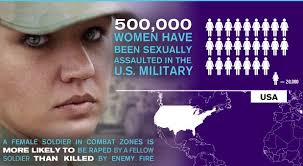
Do you ever wonder what effect Donald Trump’s proclivity for sexual assault might have on the problem of military rape? After all, his racist, sexist, and xenophobic comments along with his personal behavior have already emboldened copycat words and actions by many of his followers including schoolchildren. Will Mr. Trump similarly embolden enlisted men and officers to follow the example of their Commander-in-Chief?

That question becomes relevant on this Fourth Sunday of Advent because the readings for today emphasize Jesus’ “virgin birth.” Such emphasis resurrects a persistent tradition identifying Mary’s “miracle” as the result of military rape.

If that tradition were true, what light would it shed on the problem of rape in the military in connection with the example of its Commander-in-Chief?

Let me put that question in context by offering some background for today’s reading from Matthew along with a reference to the selection from Isaiah traditionally seen as a prophecy of Jesus’ virginal conception.

To get from here to there, try to understand the situation of Joseph and Mary as young marrieds in a context of imperial aggression. They’re a teenage couple; they are poor and living in an occupied country. Joseph is a jack-of-all-trades – that’s what the Greek word we translate as “carpenter” meant in first century Palestine. Like everyone from his class, he was unemployed most of the time. But he’d fix your leaking roof if you hired him. When he could, he’d harvest grapes and wheat for local landlords.

And he was probably deeply involved with the local insurgency against Roman occupation. (Nearly every impoverished patriot is in such situations.) Additionally, the only commentary we have on Joseph’s character is Matthew’s single word “just.” He was a just man. (By the way, his son, James – the one who headed the Jerusalem church following his brother’s death – was also known as “James the just.”) In the Hebrew culture of Jesus’ day, justice meant taking the side of the powerless. It appears to have been a central value Joseph passed on to his children.

As resisters, Joseph’s kind would have been considered terrorists by the Romans. In fact, the very year in which Jesus was likely born (6 BCE) Galilee’s countryside would have been crawling with Roman soldiers fighting against people like Jesus’ supposed father. The occupiers were busy laying siege to the city of Sepphoris, the capital of Galilee – a mere hour’s walk from Joseph’s village.

There the insurgency had taken a decisive stand against Rome’s puppet, King Herod. And like Americans in Iraq’s Fallujah under “Mad Dog” Mattis, the Romans were determined to make an example of the city by laying it waste utterly. Before their final offensive, that involved night raids, kicking in doors, and raping young Jewish girls. (All forces of occupation – including our own today – know the drill.)

In any case, according to that persistent tradition about her “virginity,” that’s where Mary came in. She was a young teenager about 12 or 14. Although she eventually became Joseph’s “dream girl” (MT 1:18-25), she was probably linked with him by the village matchmaker perhaps when they were both still toddlers. They had not yet begun to live together, because they were probably waiting for Mary to come officially “of age” – able to bear children.

Be that as it may, Mary suddenly finds herself pregnant out of wedlock. Can you imagine her worry? Innumerable teenage girls can relate to her panic – and disgrace. Obviously, Mary did not want to be just another of her community’s “virgins.” [Matthew’s term “parthenos” (virgin) to refer to Mary was often connected with children of unknown paternity. Such offspring were disparagingly called “virgins’ kids.” “Virgin” is what (behind their hands) local matrons called an unwed mother.]

According to the story, Joseph too shared Mary’s disgrace and embarrassment. He wanted a divorce (i.e. release from his commitment to marry). And he probably demanded it with the anger and recrimination that are inevitably associated with the dreaded “d” word.

Joseph’s anger, suspicion, and thoughts about divorce may also have come from his hatred of the Romans. (And here comes that persistent tradition about Mary’s “virginity.”) It even remembers the rapist’s name. According to Celsus’ “True Doctrines” written about 178 C.E., the rapist was called “Panthera.” That was also the name of one of the Roman legions involved in that siege of Sepphoris.

Such suspicious circumstances around Jesus’ questionable conception also find some support in John’s gospel, where Jesus is called a “Samaritan” (8:48). That was a harsh term equivalent to our “bastard.” Additionally, Mark refers to Jesus simply as “Son of Mary” (6:3) – a quite unusual reference in a culture where children were identified by their father’s name.

With all of that in mind, and if Celsus’ tradition has merit, it’s easy to understand how the thought of taking up with a girl defiled by a Roman “pig” (what Jews called the occupiers) probably turned Joseph’s stomach. No wonder he wanted a divorce.

That is, if the tradition has merit . . .  You see, we can take our pick here. And that brings me to the point about the historical veracity of the stories around Jesus’ birth: all of the traditions are entirely questionable as far as historical fact is concerned.

For instance, the familiar account of Jesus’ virgin birth is found only in two of the canonical gospels (Matthew and Luke). Mark and John make no mention of it. That means that they either didn’t know about the tradition, or Mark and John didn’t think it important enough to include. (By the way, if Jesus’ conception was as miraculous as we’ve always been taught, how likely is either of those alternatives?)

And then there’s that business – recounted in today’s first reading – about Isaiah’s supposed prediction of Jesus’ virginal conception. Matthew takes Isaiah’s words completely out of context.

Actually, Isaiah’s not referring to Jesus at all, but to his own time more than 500 years earlier. And the Hebrew term he uses is not the equivalent of “virgin.” That’s a mistranslation. The word the prophet employs simply means “young girl.” Isaiah’s prediction is that a “young girl” of his own time will conceive. The prophet’s words had nothing to do with Jesus or virgin birth.

The point here is we’re not dealing with “history” in the story of Jesus’ virgin birth. Instead we’re confronted with a miraculous “birth story,” – a literary genre that characterizes accounts of virtually all “Great Men” in the ancient world. Its point is that God’s Spirit entered into Jesus from the very outset – long, long before his actual birth.

In that light, historically speaking, rape is a much more likely explanation of Jesus’ conception than intervention by the Holy Spirit. Think about it. That’s simply a fact.

How then was Jesus begotten? If Joseph was his father, we understand how Jesus was so concerned with social justice. And through this pre-birth story we can hear (once again!) a summons to learn from Joseph the way Jesus and his brother James did. It’s also a reason for re-evaluating our culture’s drumbeat of indoctrination against “terrorists.” Jesus came from a family the Romans would have considered terrorist.

If Panthera humiliated Jesus’ mother (and Joseph), and Jesus was the product of rape – and if rape is an inevitable strategy of war – then that’s an additional reason for pressuring the U.S. military to aggressively investigate and punish perpetrators of military rape. It’s also a reason for refusing to honor the U.S. military in general, for opposing war, working for peace, and appreciating Jesus’ solidarity with the poorest of the poor.

Finally, it’s yet another cause for reflection on the unsuitability of Mr. Trump as Commander-in-Chief. Predictably, his example will embolden soldiers to objectify, demean and rape the ones the president-elect termed“fat pigs, dogs, slobs, and disgusting animals.” It is certain that the Roman military made similar characterizations of Jewish girls like Jesus’ mother.

The bottom line here is that (as Pope Francis would have it) if we’re not resisting war, military culture in general, its Commander-in-Chief and working for peace, our observation of this Christmas season is pure theater and sham.

On Re-appropriating My Priesthood


Ordination[1]

I’m so appalled at the prospect of a Donald Trump presidency and the threats it poses to everyone and everything I care about:  the environment and climate chaos, avoidance of nuclear war, victims of torture and false imprisonment, Muslims, drone attacks, wealth disparities, women’s reproductive rights, people of color, the LGBT community, our public school system, the right to privacy, human rights in general, labor unions – my children and my grandchildren.

In fact, as I’ve written recently, a Trump presidency portends the dawning of a Fourth Reich, where the victims of incineration will be not only Jews, but all of us, as the White House teems with climate change deniers whose policies threaten all species and the continuity of human life itself.

So the question is, what can we do about it? What talent does each of us have to respond to Trumpism? As parents and grandparents, teachers, writers, counsellors, school board officials, musicians, public speakers, church members, and public citizens, what does each of us have to offer these unprecedentedly dangerous times.

My own answer is my priesthood.

Only gradually and reluctantly have I come to that conclusion. After all, 40 years ago I exited the Catholic priesthood, got married and raised a family of three outstanding children. I remained active in my local church. And as a professor at Berea College and associate of Costa Rica’s Ecumenical Research Institute (DEI), I continued my role as a theologian with a doctoral degree from Rome’s Academia Alfonsiana. For years I taught in a Latin American Studies Program that took students to Nicaragua, Guatemala, and Cuba. In those capacities, I wrote books and articles and offered courses connected with liberation theology.  However, I resigned myself to my role as lay person – a member of the church’s “loyal opposition.”

And the opposition was absolutely called for. Over the years I’ve found myself dismayed as two consecutive regressive popes (John Paul II and Benedict XV) waged a vicious campaign against liberation theology and systematically removed from the hierarchy and Catholic seminaries progressives and theologians like me. The result over the two generations has been the production of a largely reactionary Catholic clergy who long for the good old days before the Second Vatican Council (1962-’65).

So as a lay person, I’ve often found myself sitting passively in my pew while rebelling internally against the reintroduction into the Catholic liturgy Latinisms and even Latin itself. I’ve listened uncomfortably to well-intentioned priests offer ill-prepared pious platitudes in their homilies rather than reflections connected with the historical Jesus and his relationship to the problems that householders like me face in our private and public lives. And, to speak truly, I was blaming them unfairly. After all, how could they possibly offer what their retrenched seminary training prevented them from receiving?

Still, it struck me as ironic that hundreds of people in my parish come together for about 2 hours each Sunday to reflect on their most dearly held (Gospel) values, but come away having barely tapped into the unlimited power for changing their personal lives and the world itself that those values supply. What a waste, I thought – not only for the parishioners directly involved, but for the world.

Then came a breath of fresh air reminiscent of Pope John XXIII’s famous “opening of windows” more than 50 years ago. Argentina’s Jorge Bergoglio became Pope Francis – a man intent on recovering the spirit of Vatican II. Deeply influenced by the liberation theology his predecessors had warred against, he published “The Joy of the Gospel” (J.G.) and then his eco-encyclical, Laudato Si’ (L.S.). Both publications were bolstered by unprecedentedly honest and refreshing public statements. (Who can forget his question about homosexuality: “Who am I to judge?”)  Francis not only called the church to profound reform; he called the world itself to a “bold cultural revolution.”

As for church reform, Francis called for a “new chapter” in the history of the Catholic Church and for the Church to embark on a “new path” (J.G. 1, 25) on which things cannot be left as they presently are (25). He called for new ways of relating to God, for new narratives and new paradigms (74). He wanted new customs, ways of doing things, new times, schedules, and language (27) — with emphasis on better prepared and delivered homilies (135-159).

Despite (lamentably) continuing to exclude women from the priesthood, the pope ordered the church to expand their roles in church life.  He recognized women as generally more sensitive, intuitive, and otherwise skilled than men (103, 104).

Clearly, then, the pope was speaking (as he said) not primarily to pastors and bishops, but to everyone (33). Decisions about change, he said, should be guided by the principle of decentralization (16, 32). They should be made at the parish level, because parishes are more flexible than Rome or the local chancery, and more sensitive to the specific needs of local people (28). The inventiveness of local communities should not be restrained, he said, but limited only by the openness and creativity of the pastor and local community (28). Such decisions should be respected by local bishops (31).

As for connecting the gospel with world issues, Pope Francis identified the struggle for social justice as “a moral obligation” that is “inescapable” (220, 258). He saw “each and every human right” (including education, health care, and “above all” employment and a just wage) as intimately connected with “defense of unborn life” (192, 213). He also completely rejected war as incapable of combatting violence caused by “exclusion and inequality in society and between peoples” (59). Pope Francis rejected unfettered markets and the “trickle down” ideologies as homicidal (53), ineffective (54), and unjust at their roots (59).

In Laudato Si’ the pope issued an urgent call to the Church and the world to address issues connected with human-caused climate chaos.  In this the entire encyclical (see my book, Understanding Laudato Si’: a Discussion Guide) might be seen as a complete rejection of Trumpism and of the entire Republican Party’s denial of that problem.

So, once again: what to do about it?

Experience shows that the anti-Vatican II clergy resistant to Pope Francis remains incapable of responding either to the latter’s Apostolic Exhortation (J.G.) or to his eco-encyclical (L.S.). Much less has it demonstrated a willingness to address the issues of political-economy, racism, sexism, homophobia, xenophobia, war, torture, etc.  raised by the emergence of Trumpism. (Once again, it is wrong to blame the clergy for this. Their training has made effective response impossible.)

So I’ve decided to do something about it myself. I’ve decided to reactivate my priesthood.

Honestly, I have to admit that the process of doing so began about 5 years ago following my retirement after 40 years of teaching at Berea College. It was then that I set goals for myself. One of them was an ill-formed, vague resolve to “reclaim my priesthood.”

As a preliminary step, I started a blog. Its center piece was the publication of a “Sunday Homily” each week. The reflections tried to connect world events, personal, and family problems with each Sunday’s liturgical readings.

Eventually, my homilies were picked up by OpEdNews – a completely secular progressive news source run by a Jewish editor. Over the years, I’ve published more than 200 such homilies covering Catholic lectionary readings for all three liturgical cycles. The result has been the creation of a kind of cyber community of readers that averages 1600 views of each reflection every week.

Now, in view of the crisis of Trumpism, I’ve decided that my contribution to resistance will be to translate that cyber community into a real-time assembly of faith. It will actually attempt do something to implement Pope Francis’ summons to church reform, and address in particular issues connected with climate chaos.

What I’m proposing is not a Protestant or even an ecumenical gathering. Rather my call is to an alternative Catholic “parish” in my town. Of course, this is not unusual; most towns of any size have more than one Catholic parish. Though specifically Catholic, all people will be welcome – Catholics, Protestants, atheists . . . In particular, “drop-outs” from our local community of faith are encouraged to join.

I imagine the gathering will be very simple – nothing of a show or performance. Rather, people will gather in my home (to begin with). We’ll sing or chant for a while, read the week’s liturgical selections, and share reflections. Afterwards we’ll gather at the dining room table for a brief Eucharistic breaking of bread followed immediately by a pot-luck meal. The week’s meeting will conclude with a planning session outlining activities for the coming week to resist the inroads of Trumpism.

All of this reminds me of the activities of Dietrich Bonhoeffer’s “Confessing Church” in the 1930s when Lutherans and others decided they had to do something to resist Hitler’s fascism. What I’m proposing here is an analogue, where people of faith call on their tradition to confront fascism’s re-emergence.

I’m convinced that only resistance fortified by deep faith can effectively combat that reincarnation. And even if only two or three join me in this proposal, I’m determined to go through with it. After all Jesus did say: “Wherever two or three are gathered in my name, I am there in their midst” (MT 18:20).

If You Think Jesus Approves of GOP Policies towards the Poor, Here Are Two Riddles for You . . . (Sunday Homily)

trump-christian

Readings for Third Sunday of Advent: IS 35: 1-6A, 10; PS 146: 6-10; JAS 5: 7-10; MT 11: 2-11

If Trump cabinet nominations are any indication, the president-elect will continue pursuing what have long been the GOP’s two main domestic goals. They are eliminating labor unions and cutting social services such as Food Stamps and Medicaid. Even Trump Republicans (led by their groper-in-chief) will do so while at the same time invoking values they call “Christian.”

Today’s liturgy of the word shows that the GOP position flies in the face of the entire Judeo-Christian tradition expressing (as it does) God’s special concern for the poor and oppressed.

More specifically, the readings demonstrate that the anti-poor policies of the Christian right are actually a slap in the face to Jesus himself. That’s because (once again) in today’s selections, the recipients of God’s special concern turn out to be (in Jesus’ words in our gospel reading) not just “the least.” Rather, in their collectivity, they are identified with the very person whom our sisters and brothers on the right aspire to accept as their personal Lord and Savior.

The vehicle for today’s version emphasizing Jesus’ identification with the poor is a riddle. It’s found at the very end of that reading from Matthew. Matthew has Jesus posing it by saying:

  1. John the Baptist is the greatest person ever born.
  2. Yet the least in the Kingdom of God is greater than John.

That leaves us with the question: How can this be? How can “the least” be greater than the one identified by Jesus himself not only as the foremost prophet of the Jewish Testament, but the greatest human being who ever lived?

In the context of Matthew’s gospel, the answer is the following:
1. Jesus is the one far greater than John. (As the Baptist admitted in last week’s reading from Matthew, John was not even worthy to loosen the straps on Jesus’ sandals.)
2. But Jesus identified himself with “the least.” Recall that in his parable of the last judgment (Matthew 25), Jesus says, “Whatever you did to the least of my brethren, you did to me.”
3. Therefore the “least” as identified with “the greatest” (Jesus) is greater than John and should be treated that way – as Jesus himself.

Riddle solved. The rest of today’s liturgy adds the details as it develops the theme: recognize the least as God’s favorites – as Jesus himself – and treat them as the most important people in the world.

And who are these “least?” According to Isaiah in today’s first reading, they are the blind, deaf, lame, and mute. They are ex-pats living in exile. The psalmist in today’s responsorial, widens the list by adding the oppressed, hungry, imprisoned, and immigrants. He includes single moms (widows) and their children.

In today’s gospel selection, Jesus recapitulates the list. For him “the least” (who are greater than John) include the imprisoned (like John himself sitting on Herod’s death row). They are (once again) the lame, the deaf, the mute, and lepers. They even include the dead who are raised to life by Jesus.

Do we need any more evidence to support the biblical authenticity of what Pope Francis continually references as God’s “preferential option for the poor?”

Does the Christian Right believe the teaching contained in Jesus’ riddle?

Well, maybe not. I mean, here’s another riddle for you: How can Christians oppose labor unions and eliminate Food Stamps and Medicaid, while still calling themselves followers of Jesus?

Sorry: I can’t solve that one.

On Joining John the Baptist in Rebellion against the Religious Establishment – and Trumpism (Sunday Homily)

dangerous

Readings for Second Sunday of Advent: IS 11: 1-10; PS 72: 1-2, 7-8, 12-13; ROM 15: 4-9; MT 3: 1-12

“The meaning of the Incarnation is this: In Jesus Christ, God hits the streets. And preparing for that is the meaning of Advent.” (Jim Wallis. “Advent in 2016: Not Normal, Not Now, Not to Come.”)

__________

A few days ago I published a review of James Patterson’s novel, Woman of God. It’s the story of Brigid Fitzgerald, a medical doctor who though female, becomes a priest and candidate for the papacy.

Brigid and her husband (also a dissident priest) decide to form their own Catholic parish. They do so because of the studied irrelevance of the Catholic Church to pressing problems of the real world. The two call their congregation the “Jesus, Mary and Joseph (JMJ) Church.” They insist on remaining Catholics not allowing their opponents to drum them out of the church as just another break-away Protestant sect.

The JMJ Church spreads rapidly, largely because it connects Jesus’ Gospel with issues of peace and social justice. And though vilified by her local bishop and physically threatened by right wing Catholics, Brigid eventually becomes widely celebrated and is summoned to Rome not for condemnation, but papal approval.

I couldn’t help thinking of Woman of God as I read today’s liturgy of the word this Second Sunday of Advent. Like the JMJ Church, the first two readings along with the responsorial psalm emphasize the connection between faith and social justice.

Then in today’s Gospel, the prophet, John the Baptist, like Brigid Fitzgerald, initiates an alternative community of faith far from the temple in the desert wilderness. John’s credibility leads “all Jerusalem and Judea” to see him as a prophet. In fact, (as John Dominic Crossan has pointed out) John becomes for the Jewish grassroots their de facto alternative “High Priest.”

To see what I mean, consider that first selection from the prophet Isaiah. It directly links faith with justice for the poor, oppressed and marginalized. In Isaiah’s day (like our own) they were typically ignored. By way of contrast, Isaiah’s concept of justice consists precisely in judging the poor and oppressed fairly and not according to anti-poor prejudice – in Isaiah’s words, not by “appearance or hearsay.”  (A clearer statement against contemporary police and/or government profiling can hardly be imagined.)

Not only that, but according to the prophet, treating the poor justly is the key to peace between humans and with nature. Centralizing their needs rather than those of the rich produces a utopian wonderland where all of us live in complete harmony with nature and with other human beings. In Isaiah’s poetic reality, lions, lambs, and calves play together. Leopards and goats, cows and bears, little babies and deadly snakes experience no threat from each other. (This is the prophetic vision of the relationship between humans and nature – not exploitation and destruction, but harmony and mutual respect.)

Most surprising of all, even believers (Jews) and non-believers (gentiles) are at peace. Today’s excerpt from Paul’s Letter to the Romans seconds this point. He tells his correspondents to “welcome one another” – including gentiles – i.e. those the Jewish community normally considered enemies. (That would be like telling us today to welcome Muslims as brothers and sisters whom God loves as much as any of us.)

Today’s responsorial psalm reinforces the idea of peace flowing from justice meted out to the “least.” As Psalm 72 was sung, we all responded, “Justice shall flourish in his time, and fullness of peace forever.” And again, the justice in question has the poor as its object. The psalmist praises a God and a government (king) who “rescue the poor and afflicted when they cry out” – who “save the lives of the poor.”

In his own time, the lack of the justice celebrated in today’s first three readings infuriates Jesus’ cousin, John the Baptist. His disgust forces him out of the temple and into the desert. It has him excoriating the religious leaders of his day as a “brood of vipers.”

Unmistakably clothed as a prophet – in garments that absolutely repudiate the “sacred garb” of his effete opponents – John lambasts the Scribal Establishment which had normalized relationships with the brutal occupation forces of Rome. As opposition high priest, John promises a religious renewal that will lead to a new Exodus – this time from the power of Rome and its religious collaborators.

I hope you can see as I do the parallels between the context of John’s preaching and our own. We live in a culture where those in charge contravene our faith by openly slandering the poor and marginalized celebrated in today’s readings as especially dear to God. I mean since November 8th, all the levers of power (the presidency, the Supreme Court, the House and Senate) find themselves in the hands of billionaires and their friends – the 1% that the Occupy Movement identified so accurately five years ago. Ironically that richest 1% has succeeded in scapegoating the country’s poorest 1% (immigrants) as a major cause of our country’s problems. Moreover, they equally vilify other poor and marginalized people: the impoverished in general, brown and black-skinned people, women, the LGBTQ community, environmentalists, protestors and anyone who exposes the crimes of the billionaire class.

As a result, we are about to enter a period of unprecedented national darkness that promises to rival that of Germany, 1933-1945. For at least the next four years our country will be controlled by an organization Noam Chomsky calls “the most dangerous in the history of the world.”

More dangerous than the Nazis? Yes, Chomsky insists. Hitler did not have the power to destroy the planet by nuclear war. Hitler ruled Germany before climate change threatened innumerable species, Mother Earth herself, and continued human existence. And yet the entire Republican Party denies that the problem even exists! Yes, it is the most dangerous organization in the history of the world.

And despite all of that, there’s not a peep about it from the pulpit. People keep going to Mass as though the most important upcoming event is the arrival of St. Nicholas at the parish potluck – or the Christmas bazaar.

So what should we do in the face of such disconnect?

How about following the example of John the Baptist, Brigid Fitzgerald and her husband?

This would entail:

  • Admitting that present forms of church are hopelessly disconnected from the unprecedented tragedy and threat represented by the accession to power of anti-poor climate change deniers.
  • Publicly moving out of our local church building.
  • Perhaps, opening a store front JMJ Catholic church on the Main Street Jim Wallis referred to in his article referenced above.
  • Inviting former Catholics, college students, and other disaffected church members to join.
  • Publishing the invitation in local newspapers.
  • Meeting in the store front for Eucharist each Sunday at the very times the local church celebrates Mass.
  • Empowering faithful women in the JMJ community to preach and celebrate the Eucharist.
  • Gathering in the storefront on Wednesday evenings for prayer and to plan the week’s acts of resistance to Trumpism in all of its manifestations.
  • Using those premises as a sanctuary for the bottom 1% threatened by ICE and police.

Objectors will say:

  • We have no authority to do this.
  • It’s better to continue our reform efforts from within.
  • This will only cause division in our church.
  • The status quo really doesn’t bother me, because I use the quiet provided by Sunday Mass to facilitate my own prayer life.
  • (If, like me, you’re of a certain age) I’m too old for such radical disruption of my life.

To such objections John the Baptist might reply:

  • “I had no official authority to start my desert community of resistance and reform. In fact, I was identified by the authorities as an enemy of the state. Eventually they cut off my head. So don’t expect approval.”
  • Reform from within? “I gave up on that early on. So did my cousin, Jesus. Both of us operated outside the temple system which we criticized harshly.”
  • Division in our faith communities? “That didn’t bother me either. Can you get much more divisive or polarizing than calling religious leaders a ‘brood of vipers’?”
  • Withdrawing into personal prayer? “The spiritual masters in my Essene community convinced me that prayer and meditation are essential elements undergirding prophetic action. However, pietism is useless unless it leads to the kind of witness I gave and risk I took on the banks of the Jordan.”
  • Too old? “Again, my Essene mysticism would not permit me to identify with the physical as if I were primarily a body with a soul. The truth is that we are first of all ageless spirits who happen to inhabit temporary bodies. The imperative for action is no less incumbent on older people than on the young. Hell, the elders criticized me for being too young to oppose them. I was barely 30 when they killed me.”

Again, as Jim Wallis has intimated, the specter of John the Baptist should haunt us this second Sunday of Advent, and drive our faith communities onto Main Street. These unprecedented times call for radical response outside the sacred precincts and independent of the sleepwalkers awaiting the arrival of St. Nicholas.

James Patterson’s “Woman of God”: Its Call to Reform the Catholic Church from Below

woman-of-god-image

James Patterson surprised me recently by publishing a book about the Catholic Church and faith. Usually, of course, Paterson deals with the world and adventures of ex-F.B.I. agent Alex Cross. There Patterson’s fiction revolves around spies, the C.I.A., terrorists, murder and general mayhem.

So I was intrigued when I came across Woman of God. I was even more surprised to find it addressing the problem of reform in the Catholic Church. In fact, the book might be seen as a parable – if we understand parable as a fictional story inviting its audience to conversion and action. The action in question is transformation of the Catholic Church independent of established church authority.

Woman of God traces the life of Brigid Fitzgerald, a not particularly religious physician, whose first assignment takes her to Africa’s Sudan. There horrendous experiences with grinding poverty, terrorist attacks, battlefield operations and dying children drive her to rediscover her long-abandoned faith.

The book is filled with prayers and mystical reflections about the unity of creation and of humankind. It also details Brigid’s series of romantic relationships and marriages that all end tragically. As a result, I sometimes thought I was reading one of those Christian romances where each and every plot turn is cloyingly related to God, faith and prayer.

But Patterson somehow pulls this one off.

With her faith deepening with every chapter, Brigid’s second marriage joins her with a progressive Catholic priest. Together they start the Jesus, Mary and Joseph (JMJ) Catholic Church. It offers an alternative to the local parish, but stubbornly continues to identify as Catholic, even over the objections and threats of the local bishop. Eventually, Brigid herself becomes a priest – ordained by a dissident prelate.

Gradually JMJ becomes a movement that spreads across the United States. So does Brigid’s fame as a married female cleric. Accordingly, she receives threats from conservative Catholics and accolades from almost everyone else. A final seal of approval comes from the pope himself, when Brigid (and her daughter) are summoned to Rome to meet the Holy Father. When he eventually dies, there is even speculation that Brigid herself might be chosen pope.

The connections between Woman of God and bottom-up reform of the Catholic Church are obvious – especially in the light of prospects that threaten the very continuity of human life on our planet. As parable, the book calls committed Catholics to actually do something by way of resistance that calls upon the Church’s long (a neglected) social justice tradition. it’s time, the story suggests, to start a JMJ church of our own.  Committed Catholics must become the change Pope Francis called for in his landmark Apostolic Exhortation, The Joy of the Gospel.

Chris Hedges’ recent article on the state of our country intimates something similar. We’re living in circumstances that parallel events in 1933 Germany, he says. As Hedges argues, all of our institutions – government, military, police, media outlets, schools and universities, churches and synagogues – have been too long silent. We’ve simply gone along with their own gradual corruption. When it’s all over, we’ll stand there scratching our heads and wondering how we could have let it all happen.

Regarding the role of churches, Hedges predicts we will ask:

“Where were the great moral and religious truth tellers? Why did they use the language of identity politics as a substitute for the language of social justice? Why did they refuse to condemn as heretics those on the Christian right, which fused the symbols of the state with those of the Christian religion? Why did they collaborate with the evil of corporate capitalism? Why did they retreat into churches and synagogues, establishing exclusive social clubs, rather than fight the injustice outside their doors? Why did they abandon the poor? Why did they replace prophetic demands for justice with cloying political correctness and personal piety?”

Chris Hedges suggests that only a deeply engaged spirituality focusing on social justice can save Catholics from repeating the “go-along-to-get-along” mistakes they committed under Nazism. We need the U.S. equivalent of Dietrich Bonhoeffer’s Confessing Church. We need a JMJ community that will make its business resistance of all forms of Trumpism in the name of Jesus’ God.

Recall what Bonhoeffer, Pastor Niemoller, Karl Barth and others did when Adolf Hitler came to power. They saw their churches silent at best, and at their worst actually cooperating with Hitler by giving him their blessings. So they started their “Confessing Church.” Originally the movement concentrated on ecclesiastical threats from Hitler. Later however those foci broadened to embrace persecuted Jews. In the face of concentration camp atrocities, its members ended up asking

“Why does the church do nothing? Why does it allow unspeakable injustice to occur? … What shall we one day answer to the question, where is thy brother Abel? The only answer that will be left to us, as well as to the Confessing Church, is the answer of Cain. (“Am I my brother’s keeper?” Genesis 4:9)

Catholics should make the Confessing Church’s question our own as Nazism has morphed into the contemporary Alt-right. In the face of its current unprecedented threat, corresponding action is required that works every day for the defeat of the neo-fascism Trumpism represents. And the Catholic Church with its unparalleled social teaching (recently expanded by Pope Francis’ Laudato Si’) offers us the guidance we need to shape the responses of a present-day Confessing Church.

Following the parabolic example of Brigid Fitzgerald and her JMJ Church, here’s what we might do:

  • Admit that in most cases, present forms of church are hopelessly disconnected from the unprecedented tragedy and threat represented by the accession to power of the Neo-Fascist Alt-Right.
  • Recognize the power of the Catholic tradition as expressed by Pope Francis as he addresses climate change, environmental destruction, income inequalities, racism, xenophobia, and interminable wars.
  • Publicly move out of our local church building.
  • Open store front JMJ Catholic churches with names such as “St. Francis’ Catholic Church of Resistance.”
  • Invite former Catholics, college students, and other disaffected church members to join.
  • Publish the invitation in local newspapers.
  • Meet in the store front for Eucharist each Sunday at the very times the local church celebrates Mass.
  • Empower faithful women in the JMJ community to preach and celebrate the Eucharist.
  • Gather in the storefront on Wednesday evenings to plan the week’s acts of resistance to Trumpism in all of its manifestations.

Certainly there will come objections from sincere Catholics. They will say:

  • We have no authority to do this.
  • It’s better to continue our reform efforts from within.
  • This will only cause division in our church.
  • The status quo really doesn’t bother me, because I use the quiet provided by Sunday Mass to facilitate my own prayer life.
  • (If, like me, you’re of a certain age) I’m too old for such radical disruption of my life.

To such objections Brigid Fitzgerald might reply:

  • As baptized Catholics, we have all the authority we need. Given the unprecedented threats we face, none of us can wait for top-down leadership to address them adequately. (This was the conclusion of the Confessing Church.)
  • Reform from within? Remember: some of us are operating in churches where announcements deemed “too political” are forbidden. Some parishes don’t even have Peace and Social Justice Committees.
  • Division in our churches? The divisions that already exists are precisely the problem. Papering over such fissures actually prevents even naming the problem of Trumpism.
  • Withdrawing into personal prayer? The times will not allow us the luxury of such pietism in the face of a threat that is truly planetary.
  • Too old? Christian faith will not allow us to identify with the physical as if we were primarily bodies with souls. Our spirits are ageless. The truth is that we are primarily ageless spirits who happen to inhabit temporary bodies. The imperative for action is no less incumbent on older people than on the young. Moreover, the JMJ movement promises to invite energetic college students (and others) to join us as leaders in our community.

This is not time for those with experience to step back and relax. Like Brigid Fitzgerald our experiences have caused us to mature. They have made us wise. That wisdom tells us that time is running out – for us personally, for our children and grandchildren, and for the planet itself. These unprecedented times call for radical response.

Thank you, James Patterson for your parable and its summons to Catholics. It remains for us to respond.

Trump’s Republicans Are “The Most Dangerous Organization in the History of the World” (Sunday Homily)

climate-change

Readings for First Sunday in Advent: IS 2: 1-5; PS 122: 1-9; ROM 13: 11-14; MT 24: 37-44

It’s impossible for thoughtful homilists not to be stopped dead in their tracks by the opening words of today’s Gospel selection.

Jesus said to his disciples:
“As it was in the days of Noah,
so it will be at the coming of the Son of Man.                                                                                       In those days before the flood,
they were eating and drinking,
marrying and giving in marriage,
up to the day that Noah entered the ark.
They did not know until the flood came and carried them all away.
So will it be also at the coming of the Son of Man. . .”

Of course, everyone knows the Noah tale. There God warned the great patriarch that a huge flood was coming to destroy the earth, because its inhabitants had become so violent.

Presumably, Noah shared such forewarnings with his contemporaries – or at least with those wondering why he was constructing so mammoth a vessel. Apparently no one listened. You might even say they were in denial about the coming deluge. But the disaster came anyway and swept them all away.

Jesus’ words seem unmistakably pertinent to themes of climate change today — particularly in a context where USians have just elected a climate change denier to the White House and have given control of all branches of government to a party of “representatives” who refuse to recognize that humans can or should do anything about predicted natural disasters that threaten to completely replicate the catastrophe recounted in the legend of Noah and his Ark.

Such denial has rendered the Trump-led Republican Party (in the words of Noam Chomsky) “the most dangerous organization in the history of the world.”  And that includes Hitler’s Nazis. Even aside from their not possessing nuclear weapons, the Nazis did not have the power to destroy all of human life even if they wanted to. The Republicans do.

And they are completely dedicated to that project. They are racing as fast as possible towards the destruction of organized human life. In the meantime, their allegiance to the fossil fuel industry and unwillingness to fund alternative sources of energy will undoubtedly produce millions of refugees from low-lying coastal regions throughout the world. The resulting influx of refugees from sea-level rise will render any exclusionary “walls” impotent and useless.

Jesus’ words in today’s Gospel reading become even more pointed since they connect the Noah story with imperialism — another great producer of refugees. The device for doing so is the Master’s reference to “the Son of Man.” That’s the character that the Book of Daniel invokes as the judge of all the empires that had conquered Israel – from Egypt to the Greeks. In his own day, Jesus apparently identified himself with that judge in relation to his people’s imperial enemy in first century Palestine, viz. the Roman Empire. Colonial violence, Jesus promises, will be Rome’s downfall.

Besides their suicidal climate change denial, Republicans , of course (like their Democratic counterparts), are champions of empire and U.S military supremacy.

Today because of their denial and dedication to empire, Trump and his party have taken Rome’s place as an even more dangerous Enemy of Humankind. Jesus words call us to “wake up” and recognize that danger.

All of us, the Noah reference suggests, must awaken and pray for a holy insomnia that refuses to accept as somehow “normal” the most dangerous organization in the history of the world.

If we don’t take to the streets and refuse to join Republicans’ rush to the precipice, there will surely come. . . LA DELUGE!

Cubs Win! Cubs Win! Now Anything Is Possible!

cubs

(Here’s a piece I wrote at the beginning of November — before the disaster of November 8th. Because the reflection is so upbeat, I hesitate to publish it now. Optimism somehow seems inappropriate after the recent election. But for what it’s worth, this is what I reported before Trump’s election.)

The worm has turned. Now anything is possible.

It’s the dawning of the Age of Aquarius. The 2012 New Era of the Mayan Calendar has begun. And along with those new beginnings, Theo Epstein’s arrival as President of the Chicago Cubs has changed everything there in just five (albeit painful) years.

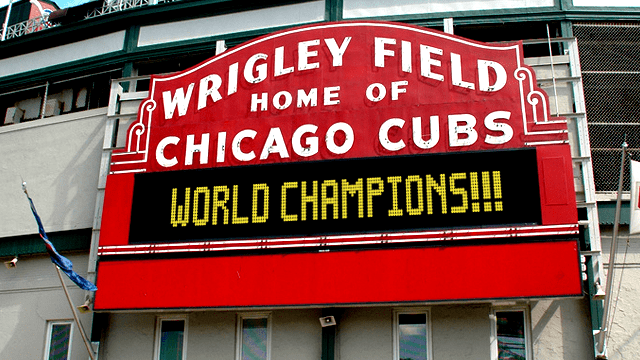
Now the Chicago Cubs have won their first pennant in 46 seasons – their first World Series championship in 108 years!!

Count ‘em: one hundred and eight years!! (As they say, “Anyone can have a bad century.”)

Look, I know that in the end sports don’t really mean anything. I know that my colleagues on the left would tell me that it’s all part of the scam. It’s a distraction from what’s really important – love, peace, social justice and the struggle for their practical realization.

Professional sports are one of the ways working stiffs like me are tricked into channeling our energies towards false identities, superficial causes, and corporate celebrations. It’s a narcotic; a dope more powerful than religion. It keeps us asleep and tranquilized, when we should be out in the street throwing Molotov Cocktails.

I know. I know.

But I have to admit that I’ve happily allowed myself to be scammed like that for all of my 76 years – or at least for 66. I mean I’ve been a Cub fan ever since my family on Chicago’s North Side got their first television around 1950, when I was 10 years old. Since then every summer afternoon from April through October (and at night when they were on the road), the Cubbies have broken my heart and the hearts of all their fans (as Steve Goodman put it) “year after year, after year– after year, after year, after year.”

Who among us can forget 1969, when they blew a 9 ½ game lead in August and finished 8 games behind the Miracle Mets? What about the horrendous turn of events in 2003 when they wasted a 3-1 series lead against the Miami Marlins and missed going to the World Series by just 5 outs?  (Thanks, Steve Bartman!)

All that time, I’ve lived and died with the Cubs – mostly died. Ernie Banks was my boyhood hero. I imitated his batting stance. Yet, the “lovable losers” have disappointed with unbelievable consistency . As I said, they’ve been doing it to us all for those 108 miserable years!

All that time, at seasons’ end, we’ve been forced to say “Wait until next year.”

Well, the wait is over. Next year has arrived! The Chicago Cubs won their first World Series. And (I blush to admit) it made me very happy.

Thanks to the generosity of my daughter and son-in-law, I was in Wrigley Field’s “friendly confines” for game four of this year’s wrangle with the Cleveland Indians. The atmosphere inside and outside the park was absolutely electric. And when the Cubs scored first, the din made me think I was about to lose my hearing. It was delightfully excruciating. “Go, Cubs, go. Go, Cubs, go!”

My euphoria however soon turned to déjà vu. The Indians came back and turned that early lead into a 7-2 rout against my home team. We left the park tired and cold with a distinct feeling of “here we go again.” The Indians had a nearly insurmountable 3-1 series lead. The feeling was sooo familiar.

Next year, anyone?

But the Cubs came back! They won their final game in Chicago, and then two more on the road in Cleveland. Three in a row!

The final contest was a rain-delayed, extra inning thriller that no one with my Cub history will ever forget. Even there the Cubs blew what had been a 4 run lead in the 8th inning when their best un-hittable relief pitcher (Aroldis Chapman) gave up a 2-run homer. It was heart-stopping. But the Cubs went on to win.

So what do I take away from it all.

Sports are transcendent. They’re better than church – more fun. They give us a chance to identify and commune with people of all stripes and identities recognizing our common humanity despite those differences. It is possible to overcome it all.

Sports give us hope. They help us realize the truth of Mother Jones’ observation: “You lose, you lose, you lose, you lose, and then you win.”

Triumph is inevitable. It’s the way the Universe is constructed. At least that’s what the great spiritual Masters – and sports fans all over the world – tell us.

Now if we can just transfer those convictions and realizations to what’s really meaningful, we might be able to turn our entire battered world into friendly confines.