(Sunday Homily) North Korea: Jesus’ Plan for De-escalation

Kim Jong-un

Readings for 23rd Sunday in Ordinary Time: EZ 33: 7-9; PS 95: 1-2, 6-9; ROM 13: 8-10; MT 18: 15-20 http://usccb.org/bible/readings/091017.cfm.

“Meet the Press” and other news programs were abuzz last Sunday over the apparent testing of a hydrogen bomb by North Korea. In the aftermath, President Trump not only threatened nuclear war with North Korea (again!). He also harshly criticized South Korea for proposing to engage its neighbor in diplomatic talks. The president tweeted that such proposals would be fruitless, since North Korea “understands only one thing.”

So rather than talk, the president evidently prefers bombing – nuclear bombing – in an area of the world that is home to half the world’s population as well as to its largest militaries and most prosperous economies. He’s threatening nuclear war in a region that hosts 83 U.S. bases, and where authorities estimate that even a conventional artillery barrage from the North would kill 64,000 (including South Koreans and U.S. military personnel) in the first three hours.

Meanwhile, Kim Jong-un, of North Korea (like Trumps admired “friends,” for example General Sisi of Egypt, the Saudi princes, and Rodrigo Duterte of the Philippines) is, no doubt a repressive dictator who cares little for human rights. However, his development of nuclear weapons and repeated shows of force are not unreasonable. After all, he is exquisitely aware of what happened to Saddam Hussein and Muamar Gaddafi after they stopped similar programs. Like all North Koreans, he recalls his people’s history that saw his country invaded and flattened by the United States during the Korean War which cost 1,316,579 North Korean lives.

Even now, President Kim also feels that his country is encircled and under severe U.S. threat and provocation. Consider how we would feel if North Korea (or Russia or China) had 83 bases in Mexico, if its ships were constantly patrolling in the Gulf of Mexico, or if it were regularly dropping mock nuclear weapons on D.C. What would Washington do under such circumstances? Yet, mutatis mutandis, the United States has been provoking North Korea in exactly these ways for years.

What then would be a proper response to North Korea’s counter-threats?

Today’s liturgy of the word gives specific directions. There, Matthew the Evangelist addresses the problem of conflict resolution. He emphasizes dialog not revenge and violence. In fact, he outlines four alternatives towards resolving disputes even like the one between the United States and North Korea. He has Jesus say that if step one doesn’t work, move on to the subsequent strategies. The four alternatives include (1) healing conversation with one’s adversary, (2) arbitration with a mediator or two, (3) consultation with the entire community, and (4) shunning the offending party.

More specifically, Matthew has Jesus say, “If your brother sins against you, go and tell him his fault between you and him alone . . . If he does not listen, take one or two others along with you, so that ‘every fact may be established on the testimony of two or three witnesses.’ If he refuses to listen to them, tell the church. If he refuses to listen even to the church, then treat him as you would a Gentile or a tax collector.”

Obviously, these words did not come from Jesus himself. To begin with, there was no “church” at Jesus’ time. Jesus was thoroughly Jewish and a reformer of Judaism rather than the founder of some new religion or “church.”

It was different for Matthew who was writing for a community of specifically Jewish Christians some fifty years after Jesus’ death. By then, questions of community order within the emerging church had become prominent. So Matthew invents this saying of Jesus to deal with them.

Another reason for reaching this conclusion is the reference to treating a recalcitrant individual “as you would a Gentile or a tax collector.” This phrase reflects traditional Jewish avoidance of Gentiles and hatred of Roman collaborators. It runs counter to the practice of Jesus who time and again in the Gospels causes scandal by practicing table fellowship and community with the very people Matthew’s instruction indicates are outsiders to be shunned by believers.

Were Matthew following the Spirit of Jesus, the evangelist’s instructions for addressing conflict resolution might involve the following process: (1) private dialog with one’s adversary, (2) arbitration with a mediator or two, (3) consultation with the entire community, and (4) moving in with the offending party – or at least taking them out for dinner regularly.

In any case, the emphasis in Jesus’ own approach is communion, not shunning or refusal to talk. Nowhere does Jesus’ approach say that one should refuse meeting until the offending party stops offending. Much less does the process outlined include “if he refuses to listen, kill him and his entire people.”

“But,” you object, “The words attributed to Jesus in today’s gospel selection are about church order, not about international politics, much less the irrationality embodied in Kim Jong-un. Jesus’ instruction, you might say, is about private disputes among Christians and are laughably impractical in the political sphere.

And that’s just my point. To repeat: Matthew’s account does not reflect the teaching or practice of Jesus. Jesus’ actual teaching was not confined to the private realm. His practice was highly political.

Eating with tax collectors, street walkers, lepers, Pharisees, Gentiles (including members of the Roman army) represented doing the unthinkable, the unexpected, the forbidden. . .  It meant crossing boundaries, breaking taboos, acting counter-culturally, and offending people on all sides of sizzling debates.

This is what the example of Jesus calls us to do even in the case of North Korea. Its emergence calls for departure from business as usual. It requires admission of guilt and responsibility on the part of the United States. It demands a complete reversal of “American” policy.

Today’s second reading from Paul’s letter to the Christian community at Rome puts a finer point on the reasons for such response on the part of those pretending to follow the teachings of Jesus.

Paul reminds us of Jesus’ summary of God’s law. He writes:

“Brothers and sisters: Owe nothing to anyone, except to love one another; for the one who loves another has fulfilled the law. The commandments, ‘You shall not commit adultery; you shall not kill; you shall not steal; you shall not covet,’ and whatever other commandment there may be, are summed up in this saying, namely, ‘You shall love your neighbor as yourself.’ Love does no evil to the neighbor; hence, love is the fulfillment of the law.”

Emmanuel Levinas helps us understand that Jesus’ teaching on neighbor love is much more radical than commonly accepted. Loving your neighbor as yourself, Levinas says, does not mean “Love your neighbor because s/he is like you.” No, according to Levinas, it means, “Love your neighbor as yourself, because s/he is you.”

In other words, there is no meaningful distinction between you and any other human being you care to name – even if we call them “communists” or “terrorists.” Moreover, if you shared the same history as your “enemy,” you would be doing exactly the same thing that currently enrages you. As a result, no killing can be justified. It is suicide. That’s the thrust of Jesus’ words: to kill the other is to kill yourself. Killing of any kind is suicide.

What does that mean for followers of Jesus’ way in relation to North Korea? At least the following, I think:

  • Recognize and publicize North Korea’s willingness to enter dialog about a “freeze for a freeze.” That’s a reference to Kim Jong-un’s apparent willingness to halt development of his nuclear weapons program in exchange for the U.S. halting its war games off the North Korean coast and for stopping deployment of the THADD (terminal high-altitude area defense) anti-missile system in South Korea.
  • Actually enter into such dialog.
  • Freeze the U.S. nuclear weapons modernization program.
  • Discourage our children from serving in our country’s armed force that threatens the world with nuclear destruction.
  • Imagine what would happen if even a quarter of our country’s 160 million people who claim to be Christian refused the self-destruction the words of Jesus and Paul imply.

For Christ’s sake, Mr. Trump, do the unthinkable. Hard as it might be: repent. Listen to North Korea. Reverse course. How dare you threaten collective suicide!

Face It: President Trump Is Right; There Was “Violence on Many Sides”

Trump Charlottesville

Commentators on both left and right were understandably outraged by President Trump’s tepid remarks about the violence in Charlottesville last weekend. He condemned what he referred to as “violence — on many sides.”

Can you imagine his words if the driver of that car in Virginia had been Muslim?

Yet, the president’s (for once) measured response proves to be unwittingly perceptive and wise.

That’s because in Charlottesville, there was indeed violence on many sides. In fact, if we adopted President Trump’s low-key perspective, our responses to violence in any form might be similarly measured and sage. It would help us recognize that in Charlottesville only the antifa violence enjoyed any degree of justification.

Let me explain.

Violence is never one-dimensional. As Dom Helder Camara, the sainted Catholic archbishop of Recife in Brazil, pointed out years ago, in most cases, there is a predictable “spiral of violence” that is often overlooked. It involves structures, self-defense, police response, and sometimes terrorism on the part of individuals and (most often) the state.

Consider Charlottesville; it clarifies by representing every turn of the spiral.

In the eyes of African-Americans, the statue of Confederate General Robert E. Lee represents the structural violence of slavery and white supremacy. Such institutionalized violence is invisible to most white people. However, the alt right reaction to the statue’s removal finally rendered monument’s real institutionally violent meaning unmistakable. It represents white nationalism, and not “southern pride” after all. As a result, nationalists’ march was itself an act of institutionalized violence.

That violent assertion of white supremacy led to a second level of violence on the part of African-Americans and their allies. When their peaceful protest was attacked by the white nationalists, the protestors defended themselves – yes, violently. Archbishop Camara identified such self-defense (against institutionalized cruelty) as virtually the only form our culture recognizes (and typically condemns) as violence. And yet, it is perhaps, the only justifiable type. Everyone has the right to self-defense.

The third level of violence entered when the Charlottesville police “stood down” in the face of the mayhem taking place before their eyes. Usually, police (third level) response simply restores the violent status quo ante. Ironically, however, in the case of Charlottesville, it was police inaction that represented Dom Helder’s third level of violence.  Their standing-down facilitated the alt right attacks.

Finally, in Charlottesville last weekend, there was the terroristic violence of the Nazi sympathizer and Trump supporter who murdered Heather Heyer and injured many others when he plowed his car into those demonstrating against the institutionalized violence represented by white supremacists. That’s the fourth turn in the “spiral of violence.” In the case of Charlottesville, such terrorism too was aligned with violence’s structural form.

Unfortunately, the driver’s terroristic expression might soon be institutionalized itself as states like North Carolina are on the verge of granting motorists the legal right to run over protestors who might be blocking traffic. In that case, an individual’s terroristic act would be transformed into state terrorism, which happens to be terrorism’s most common incarnation as seen, for example, in drone killings, torture, and threats of nuclear war.

So, as you can see, the president was right. Violence is indeed many-sided. Applying Trump’s Principle of Understanding might well make him and all of us much more thoughtful and cautious in responding to tragedies like Charlottesville last week. It would always prompt us to examine context and make crucial distinctions. It would help us recognize that of all forms of violence, only the second (self-defensive) level has any hope of justification at all.

Violence is a powerful word. President Trump inadvertently reminds us that we should be careful in its use and in any actions it might inspire.

The Republican Spirit Is Not the Holy Spirit (Pentecost Homily)

trump's audience

Readings for Pentecost Sunday: ACTS 2:1-11; PS 104: 1, 24, 29,-31, 34; I COR 12: 3B-7, 12-13; JN 20: 19-23.

We all saw it last Thursday, didn’t we?

A rich white septuagenarian president stood (ironically) in a garden before a crowd of other rich white old men. He bravely announced a decision whose negative repercussions will be mostly felt after all of them are dead. What courage!

“We’re withdrawing from the Paris Climate Accord,” the speaker fearlessly proclaimed. “We’re putting ourselves first! It’s the American way! It’s the capitalist way! America first! America first!”

The old men in the audience wildly applauded the ignorant dolt at the lectern who probably can’t remember the last time he cracked a book. And why not? They’re just uninformed dolts themselves. And yet, they have to gall to contradict the near-unanimous conclusions of the smartest people on the planet.

Can you spell “arrogance?” Can you smell it? Or maybe you can hear it. It sounds like this: ”U.S.A! U.S.A.! We’re putting ourselves first! We’re making America great again!”

None of them seem to care, do they? As I said, they won’t bear the brunt of their egotistical stupidity – of their ecological terrorism. Instead, their children and grandchildren will be stuck with the unpayable tab. And so will ours. Our children and the grandkids we know and love will be the ones whose lives will be immiserated by these fools.

“But Who cares about them?” the rich old white men say by their actions. “To hell with children everywhere. To hell with the planet for that matter. We’ll be long dead when the hurricanes blow, the heatwaves desiccate, and the forest fires rage. We’ll be gone when the waves of refugees swarm the globe in search of water, food, and shelter after the rising seas have destroyed their homes and livelihoods. Good luck with all that, kids! We don’t care about you. We care about what’s really important: MONEY! Can’t get enough of it!”

No wonder Noam Chomsky calls this rogue group of Christian terrorists (the Republican Party) “the most dangerous organization in the history of the world.”

Yes, that’s what Chomsky said. That’s what I just said. Yes, be reminded, on this Pentecost Sunday that these people call themselves Christians, and they’re more dangerous than ISIS. Most of them, I suppose, have been baptized and confirmed. They believe they have received Jesus’ Holy Spirit. Evidently on this day of Pentecost, they hear that Spirit saying:

  • Before all else, be separate; be individuals; God is not everyone’s Parent – just yours.
  • There is no such thing as the common good; the earth belongs only to those who can pay for it – or fight wars to steal it.
  • Your country is an island specially blessed by God.
  • So put yourselves first just as Jesus did.
  • Despise foreigners just like the Master.
  • Ignore the suffering of others; that’s the Christian way.
  • And if they threaten you in any way, kill them just as Jesus killed his enemies.
  • And even if they don’t, (as a Great Woman once said) “Let them eat cake!”

It’s all so familiar. But, of course, such belief has nothing to do with Jesus or his Holy Spirit celebrated in Pentecost’s liturgy of the word. There the whole thing is about human unity, mutual responsibility and care for the most vulnerable.

Look at that first reading. It depicts the Holy Spirit as uniting people from across the globe. No “me first,” no “us first” here. The list of God’s children is long and diverse for a reason: Parthians and Medes and Elamites, Mesopotamians, Judeans, Cappadocians, and people from Pontus and Asia, Phrygia, and Pamphylia, Egypt, Libya, Cyrene and Rome, Jews and converts to Judaism, along with Cretans and Arabs. The list’s length means that everyone is included. Everyone (as the Responsorial Psalm puts it) is a beloved creature of the Great All-Parent. No one is dispensable in God’s eyes.

The reading from First Corinthians makes the same point. There Paul reminds his friends that they are all members of a single Body of Christ. That’s Paul’s favorite image. We are all one body, he said, made one by Jesus Spirit — whether we’re Jews or Greeks, slaves or free, woman or man. There’s no room for “Romans first” here – not even “Jews first.”

But then, today’s gospel reading reminds us that God does in fact play favorites. God has made a “preferential option” putting the welfare of some ahead of others. The preferred ones, Jesus indicates, are the very ones who will be most harmed by climate chaos. They are not the septuagenarians who usually end up running empires. Instead, they are empire’s wounded victims.  That’s the meaning of the risen Christ’s showing his wounds to his apostles. He once again discloses himself as the tortured victim of capital punishment – as  present in the planet’s most vulnerable. By showing his wounds, Jesus reinforced what he’s recorded as saying at the end of Matthew 25, “Whatever you do to the least in my family, you do to me.”

Could anything be more contradictory to what was said and celebrated last Thursday in the imperial Rose Garden? Could anything be further from “To hell with children; to hell with the planet, to hell with the poor who will be the first to suffer from climate change?”

On this Pentecost Sunday, every baptized and confirmed person should be outraged at the hypocrisy.

Chemical Weapons Victims — Theirs and Ours: The Power of Photos

takeoverworld.info

It is extremely interesting to compare the Trump administration’s response to the use of chemical weapons in Syria and its apparent ignorance of similar weapons use by the U.S. and U.K. in Fallujah in March and November of 2004 under the leadership of Mad Dog Mattis, our current Secretary of Defense.

We all know about Mr. Trump’s reaction a few days ago to the deployment of chemical weapons in Syria.

In the face of denials by the Syrian government, and on evidence that remains undisclosed, the Trump crowd was determined to “punish” the al-Assad government for the heinous crime of using chemical weapons.

In his justification for “punitive measures” on April 6th, President Trump paid particular attention to the photographic evidence of chemical weapons use by the al-Assad government. Specifically, he reminded us of the child victims involved.

The pictures Mr. Trump was referring to included these:

Haley Gas Victims

And this one:

Gas Victims

And this one:

Baby Victims

But what about the U.S.-inflicted atrocities behind photos like this one?:

Fallujah 1

Or this one?:

Fallujah 2

Or this one?:

Fallujah 3

According to a study published in 2010,”Beyond Hiroshima – The Non-Reporting Of Fallujah’s Cancer Catastrophe,” those are pictures of the deaths and birth defects directly resulting from “American” use of depleted uranium and chemical weapons including white phosphorous in Fallujah in 2004.

And it’s not simply a question of birth defects.

According to the same study infant mortality, cancer, and leukemia rates in Fallujah have surpassed the rates recorded among survivors of the U.S. atomic bombing of Hiroshima and Nagasaki in 1945. Following the Fallujah offensives, the rates in question rose by 60%. Dr Mushin Sabbak of the Basra Maternity Hospital explained the rises as resulting from weapons used by the U.S. and U.K. “We have no other explanation than this,” he said.

And the problem extends far beyond Fallujah. Increased cancer rates and astronomical rises in birth defects have been recorded in Mosul, Najaf, Basra, Hawijah, Nineveh, and Baghdad. As documented by Mozhgan Savabieasfahani, an environmental toxicologist at the University of Michigan, there is “an epidemic of birth defects in Iraq.” She writes,

“Sterility, repeated miscarriages, stillbirths and severe birth defects – some never described in any medical books – are weighing heavily on Iraqi families.”

Australian anti-war activist, Donna Mulhearn, who has travelled repeatedly to Fallujah, talking with Iraqi doctors as well as affected families, added to the list:

“babies born with parts of their skulls missing, various tumors, missing genitalia, limbs and eyes, severe brain damage, unusual rates of paralyzing spina bifida (marked by the gruesome holes found in the tiny infants’ backs), Encephalocele (a neural tube defect marked by swollen sac-like protrusions from the head), and more.”

Several highly remarkable aspects of the situation just described immediately present themselves. For one there is the almost total silence of the media about the crimes of the U.S. and U.K. Then there is the lack of outrage (or even awareness?)  on the parts of President Trump and U.N. ambassador, Nikki Haley.

And what about those members of Congress so concerned about damage and pain to unborn fetuses? (I mean, what we have here in effect is a massive abortion operation by the United States in an entirely illegal war which has already claimed more than a million mostly civilian casualties.)

However, what is most remarkable about the contrast between responses to Syria and Iraq is the continued surprise of “Americans” by reprisal attacks by Muslims, which continue to be identified by our media as irrational and evil “terrorist attacks.”

That is, on the one hand, the U.S. feels free to self-righteously rush to judgment and “punish” the suspected perpetrators of the Syrian attacks. But on the other, it downplays, classifies, or otherwise suppresses photographs and scientific reports testifying to its own much worse crimes. Once again, those outrages are carried out against unborn fetuses, living children, women, the elderly and male adults – the very same population cohorts that so concern our “leaders” when they are attacked by designated enemies.

The logic is inescapable. What’s good for the goose is good for the gander. If the U.S. is outraged by the killing of innocents and feels the need to “punish” the suspected perpetrators, someone else the right to treat the United States in the same way. (We might not know of the crimes of our government and military, but the whole Arab world knows!)

So we shouldn’t be surprised by any “terrorist” attacks that mimic on a comparatively small scale the U.S. response to the killing of the “beautiful little babies” that so concern Mr. Trump.

That’s the cost of hypocrisy, double standards, wars of aggression, and the use of outlawed weapons of mass destruction. In war ghastly offensives elicit ghastly counter-offensives.

A Boisterous Meeting with Republican Congressman, Andy Barr

Andy Barr

On Saturday, I attended a raucous meeting with Andy Barr – the Republican lawmaker who represents Kentucky’s 6th congressional district. About 300 people were there, and were loaded for bear.

In the hubbub before the meeting, a friend told me that Barr had scheduled the Richmond gathering to avoid an even bigger assembly in Lexington. According to my friend, Barr’s original intention was to meet his constituents there at the Kentucky Theater. However, anticipation of a huge angry crowd led the congressman to relocate to Richmond’s smaller community, where he evidently thought fewer would be in attendance. (I’m sure he was surprised that so many people showed up anyway – no less angry, it’s certain, than Lexingtonians.)

Meanwhile back in Lexington, the meeting went on as planned. However, audience questions were addressed to empty chairs representing the “empty suits” who declined their constituents’ invitation, viz. Mr. Barr, Mitch McConnell, and Rand Paul.

The Richmond meeting began with everyone standing, hands over heart reciting the “Pledge of Allegiance.” For me it was the Colin Kaepernick moment I’ve been long promising myself. I remained seated to protest the Neo-fascism increasingly associated with the national banner so profoundly dishonored by our current “leadership.”

Then Barr gave a tedious presentation on Trumpcare. He described it in terms of a “liberation” from the Obamacare that, he said, all of us hate. [The remark drew boos and cries of dissent from the crowd that gave no evidence of Trump supporters other than Mr. Barr’s staffers. (And I found myself even wondering about them!)]

Barr’s Power Point presentation on the American Health Care Act (aka Trumpcare) was full of jargon and blah-blah. The crowd’s jeers showed it was clearly anxious to have its own voice heard. The representative and others from the audience had to repeatedly remind interrupters that they were only prolonging the congressman’s painful monologue, and needed to allow him to finish. Mercifully, he did after about 20 minutes. As one woman later scolded, “You have to learn to do less talking and more listening.”

Some of the questions that followed focused on Donald Trump:

  • “What is it like to work for a bat-poop (sic) crazy idiot like Donald Trump?” one woman asked.
  • “Lyin’ DJT has you Republicans looking like fools,” another commenter added.
  • “As a respecter of the Constitution, what are you going to do about Trump’s obvious breaches of the emoluments clause?” (Art. 1, section 9, clause 8)

However, most questions addressed wider-ranging issues. All of them showed that their posers had done their homework. The questions addressed health care, climate change, discrimination against Muslims, provisions for persons with disabilities, taxes, the defense budget, and defunding of the arts and public radio. Nearly all of the questions were highly charged with emotion.

Responses from the congressman were what you’d expect:

  • Trumpcare offers you choice and saves money.
  • There are many opinions about the extent of human causes of climate change, so we don’t want to act in haste. (This response prompted the questioner to reply, “Sir, your stunning ignorance on this question represents a failure in your solemn responsibility as our representative to be better informed.”)
  • During his speech to congress (9/24/15) even Pope Francis didn’t call for more government laws. (Clearly, Mr. Barr was unfamiliar with the pope’s eco-encyclical Laudato Si’ (LS). There Pope Francis calls on national governments to submit to an international body with legislative authority to protect rainforests, oceans and endangered species, as well as to promote sustainable agriculture (LS 53, 173-175).
  • Radical Islamic terrorism is the number one threat facing our country. (Evoking laughter, boos and general dissention from the audience)
  • The budget deficit means we have to cut back on public spending. (Provoking a person beside me to yell out, “How about taxing the rich?”)
  • Defense of the country is my number one responsibility.

Recently, on “Democracy Now,” Ralph Nader reminded viewers of the importance of attending meetings like the one in Richmond. It’s the principal place, Nader said, where citizens can exercise direct power over government officials scared-to-death of losing their jobs in 2018. Until Trump’s election, “Coffee with the Congressman” meetings had more staffers than constituents in attendance. Now across the country, the order of the day features standing room only audiences as loaded for bear as the Richmond crowd.

It’s up to us to keep the pressure on. Let’s make the next meeting even more uncomfortable for our government employees from the insulated Beltway.

(Sunday Homily) Everybody’s Right (Even Donald Trump) and Is Doing the Best S/he Can

trump-crowd

Readings for First Sunday in Lent: GN 2:7-9, 3:1-7; PS 51: 3-6, 12-13, 17; ROM 5: 12-19; MT 4: 1-11.

Today is the first Sunday of Lent. Its liturgy of the word reminds me of what’s been on my mind these days as I’m working on my critical thinking book. For the last two weeks, I’ve shared some of those thoughts here on my blog.

So, I wrote a week ago about the stages of human development – from egocentric to ethnocentric, to world-centric and cosmic-centric. It probably reminded some of the work of Abraham Maslow and Jean Piaget. Actually, though, my principal reference was to Ken Wilber who, in his A Theory of Everything and elsewhere attempts to integrate and transcend those more familiar works. I recommend Wilber very strongly.

In any case, it strikes me, on this first Sunday of Lent that the season’s challenge is to expand our awareness to something approaching what Jesus manifests in today’s Gospel selection. There, the carpenter from Nazareth is depicted as passing forty days in the desert enduring temptation the whole time.

The story not only recalls the history of Israel’s forty years in the desert; it tracks Jesus’ growth through the stages of human development that all of us must pass through. No one can skip any of them. And the limits of our particular stage of growth make it very difficult and even impossible for us to understand stages beyond our own. Thus, for instance, a person like Donald Trump cannot begin to understand someone like Pope Francis.

This means that when we were children at the egocentric stage, we couldn’t really understand ethnocentrism, much less world-centrism or cosmic-centrism. Similarly, those at the ethnocentric stage cannot understand the evolutionary stages beyond their own. To them it all seems like nonsense and even dangerous.

No one is to blame for any of that. It’s perfectly natural. However, the fear of moving forward can freeze some at lower stages of development. Some remain egocentric all their lives. And it’s the same with ethnocentrism and world-centrism. Nonetheless, we’re all called to the fullness of being human as embodied in avatars like Jesus of Nazareth. In his fullness of human development, he recognized the unity of all creation and everyone’s essential innocence. So as the Compassionate Christ, he saw that (given their stage of development) everyone’s right and is doing the best s/he can. As a result, he could even forgive his executioners who (as he said) “know not what they do.”

Jesus was committed, however, to moving human consciousness forward. He called that stage “the Kingdom of God” — a this-worldly reality. To get there, Jesus recognized that it is not at all necessary for everyone to advance to Kingdom-consciousness or even world-centrism. A small group embodying such awareness would be sufficient to move the entire world forward. [In Wilber’s terms, there’s a tipping point at about 10% of the world’s population. He estimates that at present about 40-60% of the world is fixated at the ethnocentric stage. About 25% are at world-centrism, and about 7% stand at cosmic-centrism. Only a 3% growth in the latter would reach the tipping point.]

Notice Jesus growth as depicted in this morning’s highly condensed symbolic story. Jesus’ first temptation is ego-centric – to feed himself by turning stones into bread. His second temptation is ethnocentric – connected with his nation’s temple and the quasi-magical attributes accorded the structure by his Jewish contemporaries. Jesus’ final temptation is world-centric – to exercise dominion of “all the nations of the world.” By rejecting all three (including the imperial, dominator hierarchy implied in the final temptation), Jesus symbolically achieves the cosmic-consciousness we’re all summoned to. The story ends with his being ministered to by angels. (Thus the divine growth hierarchy I’m trying to explain here is affirmed.)

The bottom line is that Jesus’ vision quest in the desert maps out our Lenten path. It leads from self-centeredness to cosmic consciousness of unity with the One in whom we live and move and have our being. There egoism no longer makes sense, nor does nationalism. Instead all the thinking and values of this world are turned on their heads. God alone matters. Forgiveness of everyone – compassion towards all — is natural.

If that sounds excessively utopian, the point is made about the inability of those at lower stages of development to understand and accept the Christ-consciousness towards which we’re all summoned to stretch. Those who claim to be Christians must simply take Jesus at his word, and pray for further growth.

In other words, the Christ-consciousness that Jesus attained can look at those whom we at lower stages of development might be tempted to vilify and despise and simply forgive them. Our forgiveness recognizes that we too passed through the stages at which they might be frozen. Put still otherwise, we can recognize that the childish, the greedy, the nationalists, and others seduced by the thinking of our world – and we ourselves – are right (given our respective stages of growth) and are doing the best we can.

So Lent challenges us all. Our path this season cannot be traveled without struggle. Its goal cannot be achieved without breaking free from selfishness, xenophobia, and the arrogance of life in an imperial center whose ways are unsustainable and far removed from its evolutionary roots. That’s the point of Lent’s prayerfulness, penance, fasting, and abstinence.

Practically speaking realizing our True Self this Lent – being transformed like Jesus – moving the world’s consciousness forward — might mean:

  • Renewing our prayer life. Even unbelievers can do this. How? I recommend reading Eknath Easwaran’s Passage Meditation to find out. Yes, meditate each day during Lent. It will bring you into contact with your True Self. (And, I predict, you won’t stop at the end of 40 days – it’s that life-transforming.)
    • Abstaining from fast food and reclaiming the kitchen. Leave behind for forty days the typically chemicalized, fatty, sugar-hyped American diet, and perhaps experiment with vegetarianism. That seems far more beneficial than traditional “fast and abstinence.”
    • Shopping locally and refusing to set foot in any of the Big Boxes during Lent’s 40 days. Think of it as homage to Jesus’ counter-cultural resort to the desert.
    • Escaping ethnocentrism and imperial sway, by adopting as your news source OpEdNews and/or Al Jazzera rather than the New York Times.
    • Resolving each day to actually respond to one of those many appeals we all receive to make phone calls and write letters to our “representatives” in Congress.

In the “Comment” space below, please share other suggestions.

Yes, it’s Lent once again. We faced up to our origins in dust last Ash Wednesday. A good Lent which leaves behind selfishness, ethnocentrism and allegiance to empire will also challenge us to move the world forward towards the Christ-consciousness that Jesus embodies.

Critical Thinking & Fake News (1st in a series)

fake-news

I’m currently writing a book on critical thinking. A first draft is being reviewed by Peter Lang Publishers. Peer reviewers are giving it the once-over. In this series, I’d like to expose some of the book’s key ideas. What I share immediately below tries to set the stage for  the analysis that will follow in subsequent postings, usually on Tuesdays.

_____

By all accounts, we’re living in a post-fact age, where it’s increasingly difficult to tell truth from falsehood. That’s why in our culture, contemporary debate rages over terms such as “post-truth,” “truthiness,” “alternative facts,” “fake news,” outright “bullshit,” and “propaganda.”

In fact, according to the Oxford Dictionary, the 2016 Word of the Year (WOTY) was “post-truth.” That same year, the Australian Macquarie Dictionary identified “fake news” as its own WOTY. The trend is unmistakable – signaled as far back as 2006, when “truthiness,” a term coined by Stephen Colbert, took the Oxford Dictionary honor. The Colbert term synthesized the trend’s direction. “Truthiness” was defined as “The quality of seeming or being felt to be true, even if not necessarily true.”

That’s what the post-truth era centralized: feelings over analysis. “Trust your gut and not your brain,” as Beppe Grillo put it while urging Italians to vote with his conservative Five Star Party against constitutional reforms.

Shortly after being elected, Donald Trump’s team took the trend a step further. Republican strategist Kellyanne Conway, introduced the phrase “alternative facts.” She was debating “Meet the Press” host, Chuck Todd about the size of Trump’s 2017 inauguration audience.

Conway defended the position expressed by Sean Spicer, President Trump’s Press Secretary. He had described the crowd was the largest in inauguration history. Todd disagreed citing D.C. police estimates that it was four times smaller than the number attending Barack Obama’s second inauguration. Conway responded, “. . . Our press secretary, gave alternative facts to that. . .” Todd answered, “Look, alternative facts are not facts. They’re falsehoods.”

Philosopher Harry G. Frankfurt would put Todd’s point in even starker terms. Drawing on the title of his best-selling book, Frankfurt would say it’s simply “B.S.”  In On Bullshit the professor contrasts liars and bullshitters. The Liar, Frankfurt writes, cares about truth and attempts to hide it; bullshitters don’t care if what they say is true or false. Their only concern is whether or not their listeners are persuaded.

According to another philosopher, Ken Wilber, polls taken during the 2016 election cycle showed that truthiness was valued more highly by a majority of voters than researched facts. Day after day, Wilber writes, newspapers would keep count of questionable statements made by Donald Trump the previous day. Reporters would write things like, “Our fact checkers have found that Mr. Trump told 17 lies on the campaign trail yesterday.” To a lesser extent, they criticized Ms. Clinton’s statements. And yet, when asked who is more truthful, Donald Trump or Hillary Clinton? the polls consistently ranked Trump first. This signified, Wilber says, that poll respondents valued persuasiveness more highly than what news reporters called truth.

Truthiness, alternative facts, and bullshit have given rise to widespread concern about “fake news.” During the 2016 presidential campaign, the phrase received prominence when it was discovered that Eastern European bloggers had concocted from whole cloth wild stories about Hillary Clinton and Barack Obama. The stories were directed towards supporters of Donald Trump, and the concoctions’ only purpose was to have the tales go viral – while earning thousands of dollars for their authors. So, readers were treated to headlines such as: “JUST IN: Obama Illegally Transferred DOJ Money to Clinton Campaign!” and “BREAKING: Obama Confirms Refusal to Leave White House, He Will Stay in Power!”

Such headlines might make one laugh. However, Noam Chomsky reminds us that “fake news” is by no means a trivial matter. However, its principal perpetrators are not Macedonian teenagers trolling for cash. They are the C.I.A., the NSA, and the White House (under any president). Their messages are communicated to the rest of us through the mainstream media (MSM) whose function is the dissemination of propaganda. In Necessary Illusions, Chomsky and Edward Herman put it this way:

“The mass media serve as a system for communicating messages and symbols to the general populace. It is their function to amuse, entertain, and inform, and to inculcate individuals with the values, beliefs, and codes of behavior that will integrate them into the institutional structures of the larger society. In a world of concentrated wealth and major conflicts of class interest, to fulfill this role requires systematic propaganda.”

In other words, at least according to Chomsky and Herman, fake news has long been with us. It is the official policy of the country’s ruling elites.

Now that’s the “fake news” that should really concern us. It’s just about all we get from the mainstream media in this country. And it’s been that way at least since the end of the Second Inter-Capitalist War. In that sense, Donald Trump’s continual lambasting of the press is right on target. (Next week: There Really Are Alternative Facts!)

Sister Giant: The Higher Consciousness Community Meets Liberation Theology

giant-pic

It had to happen. I mean you can’t establish dictators and despots throughout the world and not have it eventually come home. And it has in Donald Trump. His election has brought the spirits of U.S. darlings Pinochet, Somoza, Marcos, and Duvalier to our shores. We should all be terrified.

By the same token, you can’t inflict such despotism on people of faith without their eventually discovering in their traditions a God who stands on the side of the poor and oppressed rather than with their wealthy oppressors. That happened with the emergence of liberation theology over the last 50 years among Christians in Chile, Nicaragua, the Philippines, Haiti and elsewhere. In 1979 it happened in Iran with the first Islamic revolution that has since spread across the Middle East. (I’ve written about that here, here, here, and here.)

And now it’s happening in the United States. Of course, awareness of the connection between Christian faith and release from oppression dawned most prominently with the Civil Rights Movement and the Southern Christian Leadership Conference. Then during the ‘70s and ‘80s Catholics joined in as they observed (often first-hand as I did) U.S oppression throughout Latin America. During the ‘90s and the first decade of the current century, I could even see it emerging among the white U.S. Evangelical students I taught during their term abroad in Central America. As a result, I increasingly witnessed them reading and referencing non-fundamentalists and liberationists like Rob Bell, Shane Claiborne, Brian McLaren, Jim Wallis, and others.

And now with the arrival of Trump, a highly political form of liberation theology has hit the “Higher Consciousness Community.” I’m referring to followers of Marianne Williamson, Neale Donald Walsch, Eckhart Tolle, Louise Hay, Abraham Hicks, and other teachers of the “spiritual, but not religious” seekers proliferating throughout the United States and the world.

Just last week, I personally witnessed unmistakable signs of the latter awakening in Washington, DC during the best three-day conference I’ve experienced in more than 40 years of attending such events. It was Marianne Williamson’s Sister Giant Conference. And judging by the standing ovations nearly all the speakers received from the 2000 attendees, they had similar experiences. (There were also 4000 live-streamers listening and watching.)

As you might judge from the conference title, Sister Giant attendees were mostly women.

Many of them, two weeks earlier, had attended the DC Women’s March. And it was evident that their enthusiasm from that event carried over.

Both the march and the conference empowered women, who at Sister Giant were urged to own their power by speakers like Bernie Sanders, Karenna Gore (Daughter of Al Gore), Jean Houston, Rabbi Michael Lerner, Congresswoman Pramila Jayapal, Dennis Kucinich, William J. Barbour, Opal Tometi (co-founder of Black Lives Matter), and Zephyr Teachout. Each of them recognized women as the de facto leaders of the anti-Trump Movement.

Many other speakers presented as well including stand-up comic, John Fugelsang who actually told liberation theology jokes. For instance, he pointed out that the Vatican is ahead of the White House on science. Referring to the Bible’s Adam’s Rib Story, he observed that “The very first woman transitioned to a woman from a man.”

Meanwhile conference-organizer, Marianne Williamson, supplied her own transitions and highlighted points made. Between speakers, she kept us all focused with her insightful reflections on relevant passages in A Course on Miracles, and spontaneous, unself-conscious prayers like those found in her book Illuminata. She was wonderful. (And unbelievably, she will be coming to speak here in Berea at the end of March.)

From all of this, randomly organized thoughts worth sharing here include:

  • This country (the U.S.A.) was never meant to work for people like me.
  • The U.S. government has lost all legitimacy.
  • Our economic system (capitalism) contradicts Jesus’ teaching and universal religious values in general; it is based on greed, competition, inequality, racism, violence, and environmental destruction.
  • Donald Trump has shown everyone that he is absolutely unqualified for office.
  • In fact, most people in the Sister Giant audience were better qualified than D.T.
  • The world was not born fair; we have to make it that way.
  • Large groups of desperate people do desperate things.
  • No serious religious path gives anyone a pass allowing them to ignore the suffering of other sentient beings.
  • If Jesus finds injustice intolerable, so must his would-be followers.
  • Native Americans (e.g. at Standing Rock) talk to God, not about God.
  • Neutrality always serves the oppressor, never the victim.
  • In view of Donald Trump’s election, it might be time to make America Great Britain again!
  • The main axis of social change is vertical rather than horizontal.
  • American Muslims are the canaries in our coal mine.
  • You are either a feminist or a masochist.
  • It’s time for a Pro-Democracy Movement in the United States.
  • My calendar and my checkbook proclaim infallibly what my values are.
  • America needs a new bottom line (not a measure of efficiency and power, but of how loving and generous we are as we stand responsibly before the grandeur of the universe.)
  • We must begin planning for the day when we have to take to the streets — net neutrality and Social Security will be the issues.

Such liberationist thoughts only palely reflect the richness of thoughts shared at the Sister Giant conference. But I hope they give you some idea of what’s needed to exorcise the despotic spirits of Pinochet, Somoza, Marcos, Duvalier – and of Donald Trump.

Trump’s Anti-Catholic Persecution: My Personal Response

trump-immigrants

Last Saturday night we had our first meeting of a house church a number of us are trying to get off the ground. Ten people showed up. At least half of them admitted being there principally to humor me – because they’re such good friends. For that I remain extremely grateful.

By their very presence and participation, those good friends helped me clarify my own calling in these troubled times. They helped me realize that these are times of anti-Catholic persecution, and that the renewed oppression calls for thoughtful response. Please allow me to explain.

To begin with, at Saturday’s meeting, there was plenty of talk about Donald Trump. Everyone spoke of a sense of foreboding and depression at the events of the preceding week – the president’s first in office. There was all that xenophobia about Mexicans described as criminals and rapists – all that talk of The Wall.

One good friend described his impression of standing on a track in the face of an onrushing train with no power to stop it.

But another invoked the term metanoia – the Greek word for repentance in the sense of complete change of mind and action. He implied that as people of faith, we have to change profoundly. We need to man-up, woman-up and act like subjects rather than as powerless objects moved about by the tweets of the Bully-in-Chief. (His words made me reconsider my own immobility and resistance to change.)

Well, we finished our discussion, broke bread and shared wine around our dining room table. Afterwards, as we ate our potluck meal, we spoke of possible action during the coming week. There was talk of boycotting Trump products and services, writing letters, making phone calls, and even traveling to Standing Rock.

Following our liturgy, I felt a sense of profound gratitude for the generosity and good will my friends had shown. (They even stayed beyond the allotted time.) All the same, I worried that our suggested actions might never touch, for example, conservatives who voted for Mr. Trump or send ripples beyond our emerging little church.

I wondered what I might do personally to change that.

In the middle of that night, around 4:00 in the morning, I awoke suddenly with a possible response. It involves confronting the fact that a new government-sponsored persecution of Catholics is breaking out in our midst.

I’m not exaggerating. I mean, if I consider attacks on predominantly Muslim countries as veiled attacks on Islam, I should also consider attacks on predominantly Catholic countries as attacks on Catholicism.

Such antagonism has long and bloody precedent. In fact, all during the 1980s the United States fought what Noam Chomsky calls “the first religious war of the 21st century. On Chomsky’s analysis, it raged against the Catholic Church in Latin America whose bishops had together dared to affirm a “preferential option for the poor” as their official position. The conflict created chaos particularly in Central America, took the lives of hundreds of thousands of Latin American Catholics. Today its aftermath remains a principal cause behind the stream of refugees entering the U.S. through Mexico.

Donald Trump’s policies against refugees represents an extension of that 1980s religious war. In its current form, it vilifies and excludes Catholics as devoid of the moral standards the Church prides itself on teaching.

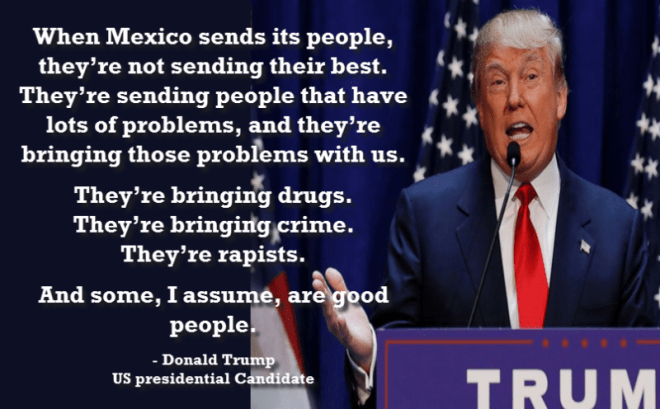
Think about it, Donald Trump has identified Mexicans and Central Americans (again, most of them Catholic) as morally deficient. The president said:

“When Mexico sends its people, they’re not sending their best. They’re not sending you. They’re not sending you. They’re sending people that have lots of problems, and they’re bringing those problems with us. They’re bringing drugs. They’re bringing crime. They’re rapists. And some, I assume, are good people.”

Here Mr. Trump identifies good Mexican Catholics among us as the exception, not the rule. The vast majority, he claims, are drug dealers, criminals, and rapists.

However, my own specifically Catholic experience gives the lie to his words. He’s demonizing my fellow parishioners –  people I consider my brothers and sisters in Christ. I know them by name: Amelia, Carlos, Ana, Isidro, Graciela, Ramon. . .  Criminals? Rapists? Drug dealers?

There are at least 100 such people in my Berea Kentucky church of 200 families. And that doesn’t even count the DACA students in our local Berea College. Under Trump, all of these people and their families stand accused not only by the president, but by those he emboldens to harass them. In other words, our fellow Catholics are in danger, so are their sources of income, their health and well-being.

Recently after church, I spoke with some of the endangered. They all agreed; they feel threatened and quite frightened. Moreover, they would appreciate more evident solidarity and support from Anglo parishioners who, in the case of our Berea church attend a separate Mass (at 9:00 a.m.) while Hispanics attend either a Spanish language Mass at 11:00, or both the 9:00 and 11:00 Masses.

How then might I respond to the plight of their Hispanic brothers and sisters in Christ? Here’s what I’m thinking: I might

  • Clearly identify in my own mind President Trump’s policies as anti-Catholic and specifically threatening to my fellow parishioners.
  • Lobby my senators and congressional representative to vote against Mr. Trump’s immigration policies.
  • Use the term “anti-Catholic” in my phone messages to those politicians.
  • Use similar language in writing to Speaker of the House, Paul Ryan, who describes himself as a “devout Catholic.”
  • Try to persuade the parish council in my local church to declare our parish a sanctuary for the refugees and immigrants among us.
  • In general, show solidarity with my fellow undocumented parishioners.
  • Begin participating in the 11:00 “Hispanic Mass” instead of the 9:00 mostly Anglo ceremony.
  • Be undeterred by my diffidence about not speaking Spanish well enough, realizing instead that my good will goes a long way towards establishing the sense of solidarity and support that our Hispanic brothers and sisters need.
  • Pair up with new friends and offer to spend time with them in conversation to help them learn English.

I suspect that actions like those, if adopted more generally, would start parish-wide conversations about Mr. Trump’s policies that affect “brothers and sisters in Christ.” They might raise the awareness of conservative parishioners – and possibly even of our church leadership. Such actions hold the promise of mobilizing many against the Trump administration’s fearful xenophobic juggernaut that, as I’ve said, is quite anti-Catholic.

I smile as Imagine what might happen across the country if Catholics responded in these ways.

Thank you, my good friends for helping me see the possibilities. Now it’s time for me to get to work.

It’s Time To Post Luke’s Beatitudes in Front of the White House (Sunday Homily)

davidic-covenant

Readings for Fourth Sunday in Ordinary Time (Second in the Extraordinary Time of Donald Trump) ZEP 2:3, 3:12-15; PS 146:6-7, 8-10; ICOR 1: 25-31; MT 5: 1-12A.

So we’re a Christian nation, right? At least that’s what right wingers would have us believe, despite the presence of millions of Jews, Muslims, Hindus, Buddhists – and atheists – among us.

Well, if we’re so Christian, here’s an idea for you. How about posting the Beatitudes in front of U.S. courthouses instead of the Ten Commandments? How about posting them on the walls of our schools, and in front of the White House? Doesn’t that seem more appropriate? I mean the Beatitudes come from the specifically Christian Testament. The Ten Commandments, on the other hand, come from the Jewish Testament.

I predict that will never happen. In fact, I’ll bet dollars to donuts, there’d be a hue and cry (on the part of Christians, mind you) that would prevent the move. And do you know why? Because the Beatitudes centralized in today’s liturgy of the word are too radical and un-American for the “Christian” right. They make sweeping judgments about classes. They indicate that the rich (evidently no matter how they got their money) are at odds with God’s plan, while the poor (regardless of why they’re poor) are his favorites.

No, I’m not so much talking about the version of the Beatitudes found in the Gospel of Matthew which were read in today’s Gospel excerpt. In Matthew, Jesus’ words are already softened. Instead, my reference is to Luke’s probably earlier version that expresses harsher judgments.

Here’s the way, Luke phrases Jesus’ words in Chapter 6 of his Gospel:

20 And he lifted up his eyes on his disciples, and said:

“Blessed are you who are poor, for yours is the kingdom of God.

21 “Blessed are you who are hungry now, for you shall be satisfied.

“Blessed are you who weep now, for you shall laugh. . .

24 “But woe to you who are rich, for you have received your consolation.

25 “Woe to you who are full now, for you shall be hungry.

“Woe to you who laugh now, for you shall mourn and weep.

26 “Woe to you, when all people speak well of you, for so their fathers did to the false prophets.

Do you see what I mean? Luke’s version doesn’t spiritualize poverty the way Matthew does. Matthew changes Jesus’ second-person statement about poverty (“Blessed are you who are poor”) to a third-person generalized and spiritualized “Blessed are the poor in spirit.” Similarly, Luke’s “Blessed are you who are hungry now” becomes “Blessed are those who hunger and thirst for justice” in Matthew.  In this way physical hunger is turned into something spiritual or psychological. Obviously, Matthew’s community was not as poor as Luke’s – or as the people Jesus habitually addressed.

In fact, the entire Judeo-Christian tradition is so valuable exactly because – unlike most of ancient literature – it represents the lore of poor people about their relationship with God.

Granted, that tradition became the object of class struggle about 1000 years before Jesus’ time, with the contested emergence of a royal class.

That is, starting with King Saul, the royalty of Judah and Israel tried mightily to turn a poor people’s faith into an ideology supporting the country’s elite. More particularly, under King David, palace oligarchs distorted the divine promise to slaves escaped from Egypt. That promise had been “I will be your God and you will be my people.” David turned it into a promise of a permanent dynasty for himself and his descendants. In other words, the country’s royalty transformed the Mosaic Covenant into a Davidic Covenant serving the elite rather than the poor.

However, the people’s prophets resisted them at every step. We find examples of that in all of today’s readings. For instance, in our first selection, the seventh century (BCE) prophet, Zephaniah, addresses the world’s (not simply Israel’s) poor. With his country’s aristocrats and priests in mind, he denounces their lies and “deceitful tongues” and urges them to treat the “humble and lowly” with justice as was prescribed by Moses.

Then with the responsorial Psalm 146 (probably written in the late sixth century) we all found ourselves chanting the words Matthew attributes to Jesus: “Blessed are the poor in spirit; the Kingdom of God is theirs.” The “Kingdom of God,” of course, is shorthand for what the world would be like if God were king instead of those corrupt royal classes. The psalmist says that change would bring justice for the oppressed, hungry, imprisoned, physically handicapped, the fatherless, the widow, and the resident alien. All of these were specific beneficiaries of the Mosaic Covenant.

Today’s third reading from I Corinthians promises a Great Reversal. There Paul of Tarsus (in modern day Turkey) identifies Jesus’ earliest followers as those who “count for nothing” in the eyes of the world. (Do you see the return to the Mosaic Covenant?)  Jesus followers are riffraff. Paul identifies them as unwise, foolish, and weak. They are lowly and despised. Yet in reality, Paul assures his audience, the despised will finally be proven wise and holy. Ominously for their betters, Paul promises that those who count for nothing will reduce to zero those who in the world’s eyes are considered something.

Jesus, of course, appears in Zephaniah’s and Paul’s prophetic tradition as defender of the poor and the Mosaic Covenant. Matthew makes that point unmistakably by changing the location of Luke’s parallel discourse. In Luke, Jesus announces the Beatitudes “on a level place” (LK 6:17). Matthew puts Jesus “on a mount” for the same sermon. His point is that Jesus is the New Moses who also received the Old Covenant on a mount (Sinai). Put otherwise: the so-called Beatitudes represent the New Law of God.

That’s why it makes more sense to place the Beatitudes on a plaque in front of our courthouses, on the walls of our schools, and in front of the White House.

But as I said, don’t hold your breath. Can you imagine Donald Trump and his super-wealthy cabinet members (and their constituents) having to read Luke’s words every day?

“Woe to you who are rich, for you have received your consolation.

25 “Woe to you who are full now, for you shall be hungry.

“Woe to you who laugh now, for you shall mourn and weep.

26 “Woe to you, when all people speak well of you, for so their fathers did to the false prophets.

No, in its essence, the Judeo-Christian tradition belongs precisely to poor people. It belongs to those whom the Trump administration (and perhaps Americans in general) think “count for nothing.” As Paul intimates, those are the very ones who will rise up and reduce to zero those who in the world’s eyes are considered something.

That message is no more welcome today than it was 2000 years ago.