With Dr. King, We Must ‘Break the Silence’

Worse than ISIS

Readings for Third Sunday of Easter: Acts 3: 15, 17-18; PS 4: 2, 4, 7-9; I JN 2: 1-5A; LK 34: 24-32; LK 24: 35-48

With so much talk of war these days, it’s time to follow the example of Dr. Martin Luther King and once again break silence about our country’s evil character. Yes: it’s character is evil! We’re a war-mongering country, a terrorist country. As King said 51 years ago this month, we’re “the world’s greatest purveyor of violence.”

It’s time to face up to the fact that the United States has been taken over by Christianists far more violent than the Islamists we excoriate. To wit: “we” stand ready to risk all-out nuclear war with Russia. “Our” reason? An alleged chemical weapons attack by Bashar al-Assad, the president of Syria. Our indisputable proof? None at all! It’s Iraq all over again!

And the hell of it is that to these Christian extremists, nuclear holocaust – the destruction of the planet – is acceptable, even desirable, because it will assure the Second Coming of the very Jesus who is presented in today’s Gospel selection as the great bringer of peace.

Just to be clear: No Muslims threaten the world with equivalent religious extremism.

(BTW If you think that statements like the above are unfair, because not all — not even the majority — of Christians hold such beliefs, think about how Muslims feel, when the views of their extremists are similarly universalized.)

In their zealotry, the fundamentalists in Washington somehow ignore the fact that the first words of the risen Jesus repeated in today’s Gospel (as they were in last week’s reading), are “Peace be with you.” They ignore the Jesus who was completely non-violent. He preached the Golden Rule. He said we should love our enemies. He accepted his own death rather than defend himself, his friends, or family. He died praying for his enemies.

Moreover, the Christianists in Washington are completely hypocritical. In the name of the international law, they’re outraged by the “dozens” perhaps killed in the alleged Syrian chemical weapons attacks. Meanwhile, they’ve killed more than a million Iraqis in a completely illegal war. Daily, they assassinate suspected terrorists, including American citizens, with death squads now mechanized as drones.

Meanwhile in Yemen, the poorest country in the Middle East, and in clear violation of international restrictions and the U.S. Constitution, those same Christian extremists have caused the deaths of thousands and threaten the lives of millions.

More specifically, since 2014, they have been responsible for the deaths of 10,000 and for the injury of 40,000 more. They’ve caused a devastating cholera epidemic and a famine that the UN describes as “the worst humanitarian crisis in the world.”

It’s all been the result of a U.S.-supported Saudi bombing campaign that directly targets hospitals, water supply sources, and sewage treatment plants – all prohibited be international law. In the process, the U.S. supplies those medieval Saudi kings with weapons, targeting information, and airborne refueling services. Pure terrorism!

Face it: our crimes in Yemen represent a far, far worse violation of international law than the alleged chemical weapons attack in Syria.

Yes: today, King’s words ring truer than ever. We continue to be “The world’s greatest purveyor of violence!” We’re a terrorist nation.

And how do the Christianists get around Jesus’ clear words? Typically, they spiritualize today’s Gospel greeting. “Peace be with you.” They say it refers to the interior peace that passes understanding.

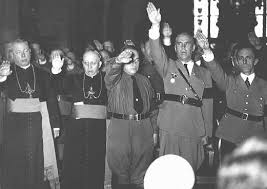
How reminiscent of the Nazis who went to Mass, meditated and enjoyed “inner peace” on Sundays, while for the rest of the week they stoked ovens where they incinerated communists, socialists, blacks, homosexuals, and Jews!

Inner peace is fine. However, reality in the belly of the beast suggests that such spiritualizing is out-of-place. We need to be reminded that inner tranquility is impossible for citizens of a rogue nation. None of us should enjoy inner peace today.

Rather than giving us comfort, pastors should be telling us that there can be no interior peace for terrorist Christian fundamentalists. They — our nation’s officials — are traitors to the Risen Christ!

Focusing on a utopian interior peace and denouncing transgressions of international law while butchering children across the globe is simply obscene.

It’s time for all of us to face up to the facts. It’s time to join the martyred Dr. King in breaking our silence!

Scrap Thomas’ Denialism Before It’s Too Late: We’re in a Situation Worse than Nazi Germany

Hitler bishops

Readings for 1st Sunday after Easter: ACTS 4:32-35; PS 118L 2-4, 13-15, 22-24; 1JN 5: 1-6; JN 20: 19-31

Last Sunday, which was both Easter and April Fools’ Day, I published my monthly column in the Lexington Herald-Leader. It pulled no punches. As a matter of fact, I was surprised that the Leader’s editors decided to print it.

My column contrasted the fact that fully 70-75% of Americans claim to be followers of Christ. They say they believe in Jesus’ resurrection – in the triumph of life over death. And yet, as a culture, we remain necrophobic, necrophilic, and entirely denying the direction of history announced in Jesus’ resurrection.

On the one hand, we’re overwhelmingly afraid of death. Despite the words of our national anthem, ours is not the home of the brave. Quite the opposite. Even our police officers are granted unrestricted license to kill if they simply allege, “I feared for my life.” Evidently, they’re all dreadful necrophobes.

On the other hand, we Americans love death and killing. The movies we patronize are about almost nothing else. Our constant solution to almost any problem you care to name is “Arm them!” “Fight them!” “Kill them!” “Nuke ’em!”

Yet, face it: Jesus could endorse none of that. He was completely non-violent and courageous in facing death. Along with every spiritual genius I can think of, he said we should treat others exactly the way we would want to be treated – because they are us. In effect, he taught that killing another person amounts to suicide.

So, Jesus refused to take up arms to save himself, his friends, or his family. If you live by the sword, he promised, you will die by that same instrument. Jesus prayed for his executioners. He said we should love our enemies, not kill them.

As a collective faith community, Christians are sadly in denial about the clear political meaning of those facts. No follower of Jesus should ever take up arms. The irony is that accepting that reality alone has the power to save our species and planet.

My column went further. Echoing Noam Chomsky, it alleged that the U.S. has been taken over by the most dangerous organization in the history of the world – viz. by the Republican Party. Despite its Christian pretensions, its positions on climate change and nuclear war make it worse, I said, than the forces of Attila the Hun, worse than ISIS, the Taliban, or Hitler’s Nazis.

The Republicans and supporting conservative Democrats place greed for money over the lives of our children and grandchildren. How dare they! Who gave those greedy few the authority to decide for 7 billion people? Why aren’t we all up in arms – precisely in Jesus’ name?

Usually when I publish such thoughts in the Leader, readers’ responses are quite vehemently negative. But do you know what happened this time? Not a single negative comment. Instead I received a whole series of supportive e-mails and word-of-mouth comments completely agreeing with my sentiments.

“You really let it all hang out there, Mike,” was a typical remark, “but I agree with every word you wrote.”

What can that mean, I wonder. If so many of us believe that our country has been taken over by forces more insidious than Hitler’s, and if Jesus is who his words and actions say he is, how can we stand by idly and watch it happen? Are we, the people, about to rebel? Are we approaching a tipping point? Have we gone beyond the denial that is no longer tenable?

Such questions are relevant in the light of the Gospel reading for this First Sunday after Easter. It’s about a man in denial about Jesus’ identity. The man meets the risen Christ (the champion of life over death), recognizes God in him, and changes profoundly as a result.

Of course, I’m referring to the original doubting Thomas. His nickname was “the twin” perhaps because he’s our twin in cowardice and hopefully in faith. Recall his story. Pray that it can be ours as well. If not, our “Christian”-dominated culture is beyond redemption.

The disciples are there in the Upper Room where they had so recently broken bread with Yeshua the night before he died. And they are all afraid. John says they are afraid of “the Jews.” However, it seems, like us, they fear death more than anything else. They dread it because they are convinced that death spells the end of everything they hold dear – their ego-selves, families, friends, culture, and their small pleasures. Besides that, they are afraid of the pain that will accompany arrest – the isolation cells, the beatings, torture, the unending pain, and the final blow that will bring it all to a close. Surely, they were questioning their stupidity in following that failed radical from Galilee.

So, they lock the doors, huddle together and turn in on themselves.

Nevertheless, the very fears of the disciples and recent experience make them rehearse the events of their past few days. They recall the details: how Yeshua so bravely faced up to death and refused to divulge their names even after undergoing “the third degree” – beatings followed by the dreaded thorn crown, and finally by crucifixion. All the while, he remained silent refusing to name the names his Roman interrogators were looking for. He died protecting his friends. Yeshua was brave and loyal.

His students are overwhelmingly grateful for such a Teacher. . .

Then suddenly, the tortured one materializes there in their midst. Locks and fears were powerless to keep him out. They all see him. They speak with him. He addresses their fears directly. “Peace be with you,” he repeats three times. Yeshua eats with them just as he had the previous week. Suddenly his friends realize that death was not the end for the Teacher. He makes them understand that it is not the end for them either – nor for anyone else who risks life and limb for the kingdom of God. No doubt everyone present is overwhelmed with relief and intense joy.

“Too bad Thomas is missing this,” they must have said to one another.

Later on, Thomas arrives – our fraternal double in fear and disbelief. His absence remains unexplained. Something had evidently called him away when the others evoked Jesus’ presence by their prayer, recollections, and sharing of bread and wine. Like us, he hasn’t met the risen Lord.

“Jesus is alive,” they tell our twin. “He’s alive in the realm of God. He took us all with him to that space for just a moment, and it was wonderful. Too bad you missed it, Thomas. None of the rules of this world apply where Yeshua took us. It was just like it was before he died. Don’t you remember? Yeshua brought us to a realm full of life and joy. Fear no longer seems as reasonable as it once did. He was here with us!”

However, Thomas remains unmoved. Like so many of us, he’s is a literalist, a downer. He’s an empiricist looking for the certainty of physical proof. Thomas is also a fatalist; he evidently believes that what you see is what you get. And for him there has been no indication that life can be any different from what his senses have always told him. Life is tragic. Death is stronger than life; it ends everything. And that means that Yeshua is gone forever. Who could be so naïve as to deny that?

Our twin in unfaith protests, “In the absence of physical proof to the contrary, I simply cannot bring myself to share your faith that another way of life is possible. And make no mistake: Yeshua’s enemies haven’t yet completed their bloody work. They’re after us too.”

Can’t you see Thomas glancing nervously behind him? “Are you sure those doors are locked?”

Then lightning strikes again. Yeshua suddenly materializes a second time in the same place. Locks and bolts, fear and terror – death itself – again prove powerless before him.

Yeshua is smiling. “Thomas, I missed you,” he says. “Look at my wounds. It’s me!”

Thomas’ face is bright red. Everyone’s looking at him. “My God, it is you,” he blurts out. “I’m so sorry I doubted.”

“Don’t worry about it,” Yeshua assures. “You’re only human, and I know what that’s like, believe me. I too knew overwhelming doubt. Faith is hard. On death row, my senses told me that my Abba had abandoned me too. I almost gave up hope. It’s like I’m your twin.

“But then I decided to surrender. And I’m happy I did. My heart goes out to you, Thomas. My heart goes out to all doubters. I’ve been there.

“However, it’s those who can commit themselves to God’s promised future in the absence of physical proof that truly amaze and delight me. Imagine trusting life’s goodness and an unseen future characterized by non-violence! Imagine trusting my word that much, when I almost caved in myself? That’s what I really admire!

“My prayer for you, Thomas, and for everyone else is that you’ll someday experience the joy that kind of faith brings. Working for God’s peace – for fullness of life for everyone – even in the face of contrary evidence – that’s what faith is all about. May it be yours.”

My point in writing that Easter Sunday article was something similar.

If 70-75% of us truly followed Jesus and left behind both our necrophobia and necrophilia, we’d get out in the streets and bring down the arrogant impostors who have seized power in this country. None of them would be able to resist such numbers in revolt.

Pray that Thomas’ transformation and faith might be ours as well, and that a tipping point has been reached or is on the way. The future of our world literally depends on it.

We need to overcome the faithless denial our love of violence and death suggests. That’s the call of today’s Gospel.


The Salvation of Our Country and Church Comes from Iranians and Mexican Immigrants (Sunday Homily)

Readings for 4th Sunday in Lent: 2CHR 36:14-16, 19-24; PS 137:1-6; EPH 2:4-10; JN 3: 14-21

NAFTA

Today’s liturgy of the word reminds us to look for salvation in unexpected places. In fact, it strongly suggests that the very ones our culture despises, and our church relegates to second class status have been chosen by God to save us. Specifically, I’m talking about Iranians relative to our country and Latin Americans in relation to the church.

Take Iranians first. (They are called “Persians” in today’s first reading.) There, one of them (King Cyrus) is identified in Chronicles as Judah’s “messiah” or anointed. The identification is given even though Cyrus was not a Jew, but an adherent of Zoroastrianism, a religion even more foreign to Judaism than Islam. Yet according to Chronicles, this Iranian king was God’s servant chosen to end Judah’s long exile in Babylon (modern day Iraq). That’s what I mean by salvation coming from an unexpected place.

Then in the second reading from Ephesians, Paul refers to Jesus of Nazareth in those same Cyrusian terms. Jesus is the Christ, God’s anointed, Paul says – and an unlikely “Christ” at that. After all, the Nazarene was the son of an unwed teenage mother; an refugee-immigrant in Egypt at the beginning of his life; a working stiff rather than a priest or scholar; possessed by the devil (according to the religious establishment); a drunkard and whore-monger according to those same sources; an enemy of the temple and state; and a victim of torture and of capital punishment in the form reserved for terrorists. Nevertheless, just as Cyrus brought Judah back from their 70 year-long exile in Babylon, Paul says, Jesus, the executed criminal, brought all of us back from the metaphorical death caused by living according to the deathly standards of the world. In Paul’s eyes, those standards obscure the gifts of God by convincing us that we have to earn life rather than accepting everything as God’s gift. Or as Paul puts it: “salvation is not the result of works,” but of God’s graciousness.

That graciousness (John the evangelist reminds us in today’s Gospel reading) is unending; it covers all the bases, has no exceptions and lasts forever. It turns each of us into Christs – into God’s only son (or daughter) – into saviors of the world. In other words, each one of us is the unlikeliest Christ of all.

O.K. each of today’s readings tell us to look for salvation in unexpected places – even within ourselves. But what are we post-moderns to understand by “salvation” itself? Think about it. The answer should be clear both in terms of country and church. In both spheres our condition can only be described as absolutely desperate and in need of deliverance.

Politically, we’re currently like lemmings rushing headlong towards the final precipice. Under the aegis of the organization Noam Chomsky calls “the most dangerous in the history of the world,” our Republican “leaders” are in denial about the greatest peril the human race has ever faced. Here I’m referring to climate chaos that threatens to deprive our grandchildren and even us and our children of the most basic necessities of life.

Besides that, our rulers insist on developing nuclear arsenals whose destructive power boggles the mind. And they seem extremely anxious to unleash them. The U.S. commander in chief has gone so far as to wonder aloud, “If we have nuclear weapons, why can’t we use them?” If we’re not looking for salvation from all of that, we must be asleep entirely.

And as for faith . . . My own Christian community, the Catholic Church, it is in dire need of salvation too. It is crumbling before our eyes.

My parish in Berea, Kentucky is a case in point. There we’ve had a series of restorationist pastors hell-bent on reinstating the pre-Vatican II order I grew up in during the 1940s and ’50s.
Clericalism is their watchword and guiding vision. Outside the sanctuary, they wear birettas and cassocks. While celebrating Mass they seem rule-bound, uncreative, unthoughtful, and totally oblivious not only to the reforms of the Second Vatican Council, but to Pope Francis’ more recent summons to radical change as described in his Apostolic Exhortation, The Joy of the Gospel (JG), and in his eco-encyclical, Laudato Si’ (LS).

As a result of such backwardness, church numbers are dwindling drastically. Parishioners I’ve seen at Mass every Sunday over my 46 years at St. Clare’s have gone missing. Alternatively, and like my own children, they have joined the ranks of the second largest denomination in the country – Former Catholics. Loyal progressives in my parish are at their wits’ end wondering how to cope with leadership tone-deaf to their desperate voices.

My own response has been to recognize what theologian and church historian, Figueroa Deck has identified as the “sleeping giant” of Latino Catholicism. That has me attending our parish’s Hispanic Mass at 11:00, rather than the increasingly reactionary and Euro-centric Anglo Mass at 9:00. I “go to the eleven o’clock” not only to escape the deadly retrogression of 9:00 a.m. antiquarianism, but in subconscious recognition, I think, of the fact that our Hispanic parishioners represent the cutting, salvific edge of the Catholic Church.

For decades now, the Latin American Church has embodied Catholicism’s most vital element.That’s personified in Pope Francis himself, our first Latin American pontiff, who I’m told is rejected by our current parish leadership – the same way Washington rejects Latin American immigrants.

Francis, of course, comes from Argentina. He’s followed the lead of Latin American theologians of liberation with his adoption of Jesus’ own “preferential option for the poor.” That entails recognition that the poor (including, most prominently, our immigrant population) know more about the world than our rich leaders – or even than us in more comfortable classes.

I mean, immigrants possess a version of what W.E.B. Dubois called “double consciousness,” while the rest of us see only one side of what’s occurring before our eyes. On the one hand, the daily observation of the undocumented (as our motel cleaners, nannies, gardeners, construction workers, and fellow parishioners) tells them what it means to be a white American. On the other, they know intimately the experience of exclusion by those same whites.

Immigrants know how the economy works for whites, and how it excludes browns and blacks. They know that rich capitalists and their money enjoy absolute freedom to cross borders, regardless of the negative impacts such mobility might (and does!) have on Global South economies. At least subconsciously, migrant workers recognize the simultaneous contradiction of their being excluded from such mobility, despite the fact that labor is an even more important part of the economic equation than capital. So even though the law (created by the rich) forbids them, immigrants vote with their feet to claim the rights the system unjustly denies them. Our “immigration problems” are the result.

The double consciousness of immigrants can be salvific for the church. If its expressions are heeded, they can save the church. As expressed by our Hispanic Pope Francis, the undocumented in our midst call us to a church where (in the words of The Joy of the Gospel) we cannot leave things as they presently are” (JG 25), but must include new ways of relating to God, new narratives and new paradigms (74).

Similarly, in the world of politics, Iranians (the descendants of Chronicles’ Cyrus the Great) inspired this time by Islam are calling us to changes in foreign policy. They implore us to just leave them (and their oil) alone. Ironically, their desire is that they be liberated from a kind of Babylonian captivity that places them under the jackboot of the United States and (still more ironically) Israel.

What I’m suggesting is that the descendants of Cyrus are still God’s instrument of our salvation. So in our present desperate context, are marginalized Catholic immigrants whose presence reminds us of Pope Francis’ wisdom and of the penetrating understanding of life that comes from refugees and the immigrants our government’s free trade policies create on the one hand, while refusing them sanctuary on the other.

Both bring us the new ways of relating to God, the new narratives and the new paradigms salvation requires.

The Ten Commandments Call Us to Joy and Peace, Not to Guilt and War

Heston

The emphasis in today’s liturgy of the word is on the wonders of God’s law. Today’s first reading reviews the expanded version of the familiar “Ten Commandments” which many of us were made to memorize as children. Then the responsorial psalm praises God’s Law as perfect, refreshing, wise, right, joyful, clear, enlightening, true, just, precious, and sweet.

On hearing that string of adjectives, many might raise their eyebrows in disbelief. “Joyful, “refreshing,” “precious,” “sweet?” “That’s not been my experience of the Ten Commandments,” we might say. “My experience of what’s called “God’s law” is entirely negative. When I hear references to the Ten Commandments I think of repressed fundamentalists wanting the Commandments posted on school walls and enshrined on lawns before every courthouse.”

And it’s true: negative reaction to talk of “Commandments” is completely understandable. From childhood, authority figures intent on controlling the most intimate details of our lives have threatened us with “The 10 Commandments,” “sin” and “punishment.” From the time we were children, and especially as adolescents and young adults “God’s Law” seemed to militate against everything we really wanted to do – especially in the area of sexuality.

However, a bit of reflection shows how misplaced such reactions are. It reveals that “God’s Law” is not something posted on a classroom wall or on a plaque in front of a government building. It’s not written in stone either. Instead, it’s enshrined deep in the human heart. And human happiness – world peace – is impossible without observing that law which in its essence is no different from nature’s law.

That recognition in turn suggests how important it is for us to come to agreement about moral and ethical behavior if we truly want peace in the world. The U.N. has realized that and has sponsored research into the content of what it terms “a universal ethic.” According to the U.N., there are just four basic “commandments”: (1) Don’t kill; (2) Don’t rape; (3) Don’t lie, and (4) Don’t steal.

People as diverse as Roman Catholic theologian, Hans Kung and professional atheist Richard Dawkins agree but go further in what seem to me very helpful ways.

In fact, at the age of 89, Kung has dedicated the last part of his career to peacemaking by building bridges between religions whose differences are so often the cause or pretext for violent conflict. Kung works on the four principles that (1) International peace is impossible without peace between religions; (2) there can be no inter-religious peace without inter-religious dialog; (3) there can be no inter-religious dialog without agreement about a global ethic, and (4) our world cannot survive without such an ethic that is universally accepted.

So in terms of “God’s law,” what do all major religions agree about? The Golden rule is the point of convergence.

Christianity puts it this way: “So in everything, do to others what you would have them do to you, for this sums up the Law and the Prophets “ (Mt. 7:12). In Confucianism the same statute is expressed in these terms, “Do not do to others what you would not like yourself. Then there will be no resentment against you, either in the family or in the state” (Analects 12:2). Buddhism’s version runs, “Hurt not others in ways that you yourself would find hurtful” (Udana-Varga 5,1). Hinduism agrees in these words, “This is the sum of duty; do naught unto others what you would not have them do unto you” (Mahabharata . 5, 1517). Islam’s expression is, “No one of you is a believer until he desires for his brother that which he desires for himself (Sunnah). In Taoism the same law finds this formulation: “Regard your neighbor’s gain as your gain, and your neighbor’s loss as your own loss” (Tai Shang Kan Yin P’ien). Zoroastrianism says, “That nature alone is good which refrains from doing to another whatsoever is not good for itself” (Dadisten-I-dinik, 94,5). Judaism says, “What is hateful to you do not do to your fellowman; this is the entire law; all the rest is commentary” (Talmud, Shabbat 3id).

Even Richard Dawkins, perhaps the world’s most famous atheist endorses the Golden Rule. In formulating his own Ten Commandments, he leads off with his own version of that principle. Here are Dawkins’ Ten Commandments:”

* Do not do to others what you would not want them to do to you
* In all things, strive to cause no harm
* Treat your fellow human beings, your fellow living things, and the world in general with love, honesty, faithfulness and respect.
* Do not overlook evil or shrink from administering justice, but always be ready to forgive wrongdoing freely admitted and honestly regretted.
* Live life with a sense of joy and wonder
* Always seek to be learning something new
* Test all things; always check your ideas against the facts, and be ready to discard even a cherished belief if it does not conform to them.
* Never seek to censor or cut yourself off from dissent; always respect the right of others to disagree with you.
* Form independent opinions on the basis of your own reason and experience; do not allow yourself to be led blindly by others.
* Question everything

Dawkins also has something to say about that fraught area of sexuality I mentioned earlier. He adds four additional statutes:

* Enjoy your own sexual life (as long as it does not harm to others), and let others enjoy their sexual lives in private according to their own inclinations which in any case are none of your business.
* Don’t discriminate against or oppress anyone because of their sex, race or (insofar as possible) species.
* Don’t indoctrinate your children. Teach them to think for themselves, how to weigh evidence, and how to disagree with you.
* Respect the future beyond the temporal limits of your own life.

Now those laws are “delightful,” many would agree. They make sense because they reflect human nature and nature’s laws. They also can be perfectly aligned with God’s Law presented in today’s initial reading.

Imagine the world we’d create if we joined our brothers and sisters in all those religions I referenced and promoted Dawkins commandments with the same vigor the fundamentalists promote their repressed interpretations of the Ten Commandments.

Kung is right: we might witness an out-breaking of world peace.

A Teenager Far Smarter Than Donald Trump or Marco Rubio (Sunday Homily)

emma-gonzalez

Readings for 2nd Sunday of Lent: GN 22: 1-2, 3A, 10-13, 15-18; PS 118: 10, 15-19; ROM 8: 31B-34; MK 9: 2-10

We’re all still reeling from the St. Valentine’s massacre in Parkland, Florida.

The massacre itself represented a horrendous act of domestic terrorism tolerated by the NRA-sponsored policies of the two wings of the Money Party that rule our country.

It also exemplified an act of child sacrifice that Party not only condones, but in-practice advocates as it refuses to implement common-sense gun laws prohibiting the ownership of weapons of war by U.S. citizens.

For them, the right to own AR-15s is more important than the lives of our children and grandchildren. Guns are more important than kids’ lives. Or more accurately: the millions of dollars supplied to our politicians by the NRA is more important than anything.

That’s idolatry pure and simple. It’s worship of Baal and Moloch. Politicians like Donald Trump try to rationalize it. But their “logic” comes across as ludicrous and just plain stupid. For example, did you hear what President Trump’s solution to school shootings is? Arm the teachers! (He said that with a straight face!)

But do you know who’s not fooled by such stupidity?

Our nation’s children!

Last week all across the country, high school kids were out in the streets, speaking at town meetings, and confronting their senators and even the president with common sense and wisdom far beyond that of their completely unprincipled elders. Those so-called “leaders” were absolutely shamed by the eloquence of high schoolers more than 50 years younger than, for instance, “the leader of the free world.”

Emma Gonzalez, a senior at Marjory Stoneman Douglas high, where the massacre took place, was the most impressive of all.

“We are going to be the last mass shooting,” she told the crowd. “We are going to change the law. That’s going to be Marjory Stoneman Douglas in that textbook, and it’s all going to be due to the tireless efforts of the school board, the faculty members, the family members and most importantly the students.”

And the kids followed through. They marched on Washington. They confronted the President. Their outspoken questions left Florida Senator Marco Rubio speechless as he attempted to defend his acceptance of NRA campaign funds.

There’s no question about it. Our children are more effective leaders than the country’s elected officials. Our children are standing strong against child sacrifice.

Their stand highlights the contemporary relevance of today’s liturgy of the word as it presents us with the transfiguration stories of Abraham and Jesus of Nazareth.

First of all, consider the familiar narrative of Abraham and Isaac, its rejection of child sacrifice, and how it transfigured or transformed the roots of Jewish faith.

At first glance, the text seems to praise the great patriarch for his readiness to plunge a knife into Isaac’s heart. It has God saying, “For now I know that your fear God, since you have not withheld your son, your only son from me.” It’s as though Abraham’s readiness to do violence to his son were a unique proof of his faith.

Such understanding however is to forget that in ancient Mesopotamia it was required of all parents to sacrifice their firstborn sons. So despite the text’s claim, there would have been nothing remarkable about Abraham’s willingness to sacrifice his son. Everyone in Abraham’s culture had that sort of primitive “faith.”

Scripture scholars conclude that the words just quoted (“For now I know that your fear God, since you have not withheld your son, your only son from me.”) represent an editorial addition inserted centuries after the reported event, when people no longer remembered the ancient and universal requirement of tribal gods to sacrifice the first-born of family and flock.

The editors were priests and scribes in service to Israel’s royal family. They adjusted the Abraham story to suit their employers’ needs for patriotic cannon-fodder. This explains the addition of the words indicating God’s pleasure at parents’ willingness to sacrifice their children.

In contrast to that textual adjustment, and as originally told, the Abraham-Isaac tale was about the ancient patriarch’s transfigured understanding of God. It was about his discovery of Yahweh as the God of Life who prohibited rather than required child sacrifice. [Note that even in today’s English translation, it is “God” (meaning Baal, the biblical name denoting foreign idols) who gives Abraham the order to sacrifice his son. But it is “the Lord” (meaning Yahweh, the God of Abraham) who tells the patriarch to stay his hand.]

So, Abraham’s real merit is found not in his willingness to sacrifice his son, but in his unwillingness to do so. In that sense, Abraham in this instance is like Yahweh, the non-violent God of life, who (Abraham discovers) never endorses child sacrifice. That realization should have transfigured Abrahamic faiths forever. Unfortunately, it did not.

Jesus carries on and expands Abraham’s insight. He rejects violence of any type. He is the one who said: “love one another. Love your enemies. Forgive one another. Be compassionate. Be merciful. Seek God’s reign and God’s justice. Put away the sword. Rise and do not be afraid.”

Today’s gospel about Jesus’ “transfiguration” concludes with a voice directing us to “Listen to him.”

If Americans did, our world would indeed be transfigured. We would be transfigured – totally transformed. We would lay down our arms.

In other words, Abraham and Jesus are calling us away from idol-worship – away from sacrifices to Baal, Moloch, Money, Guns and the NRA.

In the context of the Valentine’s Massacre in Parkland, Florida, the spiritual icons of Judaism and Christianity are calling us to listen to our child-leaders like Emma Gonzalez.

“This is my beloved daughter,” we are being told. “Listen to her.”

Trump’s Suicidal SOTU Rant

sawing-off-branch-sitting-on

Readings for Fifth Sunday in Ordinary Time:JB 7: 1-4, 6-7; PS 147: 1-6; I COR 9: 16=19, 22-23; MK 28-39

It was like watching a man sitting high above on a tree limb sawing away at it and bragging about the quality and sharpness of his saw. I’m talking about President Trump’s first State of the Union (SOTU) message last night. It was ridiculous in its necrophilic braggadocio.

“Look how great I am,” the braggart kept repeating one way or another. I’m promoting “clean coal” and oil that will make the planet unlivable for your grandchildren. (Applause!) I’m proposing a wall in the desert to keep poor people out (instead of dykes everywhere to protect low-lying cities against rising sea levels). I’m willing to start a nuclear war that will be the end of us all. (Even wilder applause!) In the meantime, as head of the Family Values Party I have the courage and integrity to destroy immigrant and refugee families – to tear parents away from their children and send them back to countries that our great economic system has ruined. (Wildest applause of all!)

Encouraged by the cheers, the president just kept sawing away reminding everyone with eyes to see and ears to hear that his perch will soon come crashing down.

The hell of it is, however, that we’re all sitting on that branch with him.

It was Trump’s SOTU position on immigrants and refugees that was particularly offensive in the light of this Sunday’s reading from the Gospel of Mark. There the evangelist announces a theme central to his Gospel, to the teachings of Jesus, and those of Paul of Tarsus. It is that laws that don’t serve people are invalid. They should not be obeyed.

That’s the opposite of the Republican position on immigration. It puts legalism ahead of the welfare of human beings. It says: “We’re a country of laws. Those immigrants who have crossed borders illegally don’t deserve to be here. They’re ruining our country. We must send them back even if it means depriving children of their parents. Otherwise, what will become of our great legal system? Laws are sacred, (and to repeat and repeat) we’re a country of laws.”

The insanity of that positon is illustrated by comparing the GOP attitude towards laws and people with its approach to laws relative to money and products. As Robert Reich recently pointed out so eloquently, Republicans value the latter more than people. For the GOP, money and merchandise have the right to cross any border. People do not.

That’s to forget that immigration is an economic problem. Immigrants are part of a globalized labor force. They are an essential part of an economic equation that includes capital (money, factories, offices, etc.) on the one hand and labor on the other. You can’t have one without the other. Yet, as I said, capital and merchandise are allowed to cross borders regardless of their impact on people, while labor must stay put. That’s a policy that values things over human beings.

And it’s all legal, only because moneyed people in their smoke-filled back rooms say so. They confect laws to justify the whole arrangement. And they do so over the strong objections of local peasants, for instance, in Mexico who understand that “free trade” and subsidized corn entering their country from the U.S. spells the end of their incomes and way of life. The laws in question override the concerns of environmentalists and trade unionists who recognize that the “legal” trade agreements of the rich ravage their ecosystems and destroy far more jobs than they create. However, in the name of self-serving “law” created precisely by the rich and powerful, it’s all O.K.

Jesus and Paul recognized the syndrome even in the early first century. So, they both embodied in their persons and proclaimed in their teachings that laws that fail to serve human beings need not be obeyed. In fact, they should be disobeyed!

That’s the case in this morning’s Gospel reading, where Mark sets the tone for his entire Jesus narrative by having the master’s very first public act be the transgression of the Jewish Sabbath Law – the holiest of all. The theme will become central to the conflict between the scribal establishment and Jesus which Mark will centralize.

In any event, and regardless of their motivation (inspired by faith or not), the global labor force is in practice asserting with their feet their agreement with Jesus and Paul. They are insisting on their rights as indispensable parts of the economic equation. Like capital, they are crossing borders regardless of laws, walls, ICE agents, and saw-obsessed, suicidal presidents. In the end, they will not be denied.

Keep that in mind, as you read my little reflection that follows below:

Jesus very first cure,
Mark is careful to note,
Took place on the Sabbath
Which the scribes kept by rote
Without thinking at all
Of its purpose or aim
Which was to help people
Rather than blame
Them for curing the sick
Or raising the dead.
Acting like him
Fulfills the law, Jesus said.

His act of defiance
Sets a tone for Mark’s book
And sends a strong message
If we but care to look.

It says law’s invalid
If it doesn’t serve man.
It’s a tool of oppression
It’s more worthless than
The ills and the sickness,
And sins Jesus forgave.
It’s worse than our death
It’s worse than the grave.

So, in the spirit of Jesus
We must break any law
That acts like a tooth
That looks like a claw
To bite and tear mothers
Their husbands and sons
Their daughters and grandkids.
You know the ones
I’m talking about
In this day and age:
Immigrants and refugees.
It should fill us with rage
When they’re excluded from here
For breaking a law
That only serves rich men.
(That’s what Jesus saw.)

So “devout Catholic,” Paul Ryan
Should take careful note.
He’s one of those people
Thinking only by rote
About all that money
And about Wall Street stock
About what they hold sacred
Though their laws truly mock
The teachings of Jesus
About the poor and the lame
And how meeting their needs
Is the Good News he came
To announce to us all
If we choose but to hear:
From those fleeing oppression
We have nothing to fear.

The Unschooled Prophet Shouts Down the Learned Rabbi (a one-minute Sunday reflection)

Readings for the Fourth Sunday in Ordinary Time

Truth to Power

He strides into the synagogue
Stinking whores, beggars and bandits creeping behind.

The presiding rabbi knows why he’s there.
He’s come to disrupt his Holy Mass.
“I know who you are: The Holy One of God”
The robed demon screams in terror.

“You hypocrite!”
The prophet shouts back.
“You know nothing of holiness,
Be gone!”

The devil slinks out, tail between legs
To await another day
Leaving the intruder to teach the enthralled masses.

They all wonder:
“Where did he learn to speak like that?
This workman with calloused hands and patched robes
Unschooled like us.

Truth to power
Maybe we can do the same.”

Yes, maybe we can do the same!

The Lamb of God, Pope Francis & the Smell of Sheep

Francis Sheep

Readings for 2nd Sunday in Ordinary Time: I SAM 3: 3B-10, 19; PS 40: 4, 7-10; I COR 6: 13C-15A, 17-20; JN 35-42

Over his years in office, Pope Francis has come in for some harsh criticism from the U.S. right wing. But most of the time he had been simply ignored.

It’s not just because of his rejection of free market capitalism, trickle-down theory, and huge income disparities between the rich and poor. It’s not just his openness to gays and divorcees, and his refusal to obsess about abortion and contraception.

Yes, all of these have undermined what conservatives have seen as a close alliance between the Catholic Church and their pet causes and thinking modes — not to mention the Republican Party.

However, the straw breaking the back of reactionaries was probably the pope’s unequivocal warnings about climate change. For those conservatives, the publication of his eco-encyclical, Laudato Si, 2 ½ years ago raised the threatening specter of a global Catholic climate change movement potentially mobilizing the world’s 1.2 billion members.

The question is: why did the reactionaries prevail? Why after almost 3 years have Catholics not fore-fronted such a movement? Why, instead, did a majority of them in the 2016 elections vote for climate-change-denier, Donald Trump?

Could it be that the right wing persuaded Catholics that the pope was overstepping his authority? Or, on their own, did they intuit the drastic lifestyle conversion implied in effectively addressing climate chaos in the ways Pope Francis suggested? As announced in the title of Naomi Klein’s book, did they sense that This Changes Everything? Did they fear that taking on climate change as a moral issue would undermine the American Way of Life based on insane Republican (and Democratic) policies promising unlimited economic growth on a locked and limited planet?

Were they somehow convinced by the rhetoric like that of First Things blogger, Maureen Mullarkey who simply dropped all pretense and turned to full attack mode? According to Mullarkey , Pope Francis was simply “an ideologue and a meddlesome egoist. His clumsy intrusion into the Middle East and covert collusion with Obama over Cuba makes that clear. Megalomania sends him galloping into geopolitical—and now meteorological—thickets, sacralizing politics and bending theology to premature, intemperate policy endorsements.”

Do the Catholics ignoring Pope Francis agree with Mullarkey that he pretty much stinks?

Wrestling with such questions in those terms is inspired by today’s gospel reading. It’s all about stink – about sheep and what Pope Francis calls “the smell of the sheep.” (Famously, you recall, the pontiff called on Catholic priests to live closer to the poor, to recognize them as God’s people and their welfare as the guideline for economic and social policy – to “take on,” he said, “the smell of the sheep.”)

Is it possible that conservatives have been put off by Pope Francis and vilify him because he smells too much like sheep — like the poor. He smells too much like Jesus.

Notice that in today’s gospel, John the Baptizer identifies Jesus as “the Lamb of God.” To begin with, the phrase reminds us of the Bedouin origin of the biblical “People of God.” Abraham, Isaac, and Jacob, and the great King David were all shepherds. They were primitive people close to the earth. They were tribalists. In that sense, Jesus was a tribalist. According to John’s image, Jesus didn’t just smell like sheep; he was a sheep! He was in spades like his slave and Bedouin ancestors — like the poor people the pope has centralized during the entirety of his papacy.

Pope Francis shares Jesus’ closeness to and concern for tribal people. And he’s practicing what he preaches — both liberation theology’s “preferential option for the poor,” and the traditionally Catholic principle of subsidiarity. That means he endorses economic and environmental policy not on the basis of market dictates, but according to human decisions about values like the common good. Humane policy, the pope implies, originates not on Wall Street, but in places like the slums of his native Argentina and the Philippines.

As our century’s most powerful illumined voice of conscience, Francis has used his bully pulpit to wake us up. But we don’t seem to be listening. We’re like Samuel in today’s first reading – fast asleep even before the Ark of the Covenant (a reminder of Israel’s enslaved and Bedouin past). But we fail to recognize the biblical tradition’s significance to our lives – its call to tribal values which unfailingly center on animals, human family, and Mother Earth. We fail to see the implications of Paul’s observation in today’s second reading that all human beings – especially the poor and outcast – are temples of God’s spirit. That’s our tradition! That same Spirit resides, the pope says, in the planet that he (like St. Francis himself) calls our Mother and Sister.

So what kind of conversion do we need? What would a global Catholic climate movement look like?

It would entail:

  • Waking up like the young prophet Samuel. Like him we’ve heard God’s call many times. But at last in Pope Francis, we have a thought-leader speaking in a voice the simplest of us can hear. It’s the voice of conscience. And like Eli it’s giving us the proper way to respond: “Speak Lord, for your servant is listening.”

A global Catholic climate movement further entails:

  • Embracing conservation as a moral issue deeply connected with faith
  • Forming a serious study group to internalize Pope Francis’ faith-based approach to climate change
  • Rejecting of superficial criticisms like Mullarkey’s suggesting that the pope is somehow an outlier on the question of climate
  • Repudiating of corporation-based globalization which has us (over)consuming imported necessities that could be home-grown.
  • Joining the fight against fracking and projects like the XL Pipeline
  • Voting accordingly.
  • Urging the institutions we can influence (churches, universities, hospitals . . .) to divest from fossil fuel industries.
  • Adopting a “zero waste” policy in our homes and places of work.
  • Cultivating home gardens.
  • Adopting a vegetarian diet.
  • Educating ourselves about “green burial” and including plans for that in our “living wills.”

The list, of course, goes on. But you get the idea.

Pope Francis is showing us the way out of our collective insanity. It is not too late for Catholics and others of good will to wake up and join his Global Movement to save the planet.


Towards Christmas in the Spirit of Thomas Merton

Merton

Readings for Third Sunday in Advent: IS 61:1-2A, 10-11; LK 1: 46-50; 53-54; I THES 5: 16-24; JN 1: 6-8, 19-28.

Five years ago, I had an important spiritual experience that’s relevant to today’s liturgy of the word. I had the privilege of visiting the hermitage of St. Thomas Merton, the great Trappist mystic. (See my reflections here.)

It all happened in New Haven, Kentucky, just down the road from the Maker’s Mark distillery – far from any great urban centers and nearer to places with names like Bardstown, Paint Lick, and Gravel Switch. The experience inspired counter-cultural thoughts about Christmas. It made me struggle with the question (still unresolved for me): is it possible to once and for all break with this annual orgy of consumerism so counter to the gospel’s commitment to the poor?

At Fr. Louis’ Gethsemane, twenty of us sat in a circle in his living room absorbing the Life Force that still hovers over his simple cinderblock cabin. Trappist Brother Paul, the convener of the Merton Study Group responsible for the event, marvelously channeled “Louie’s” spirit by reading Brother Paul’s own poetic reflection on Matthew’s words, “Blessed are the poor in spirit.”

Paul’s thoughts connected nicely not only with Merton, but with this morning’s readings for this third Sunday of Advent. There, John the Baptizer, his predecessor Isaiah, and Jesus’ own mother Mary reiterate the essential connection between Jesus’ gospel and standing in solidarity with the poor not only in spirit, but in actual fact. As Christmas approaches, the sentiments of the Baptizer, Isaiah and Mary suggest counter-cultural ways of commemorating the birth of the prophet from Nazareth.  I wish I and my family were strong enough to entertain them seriously.

For me those culturally eccentric suggestions began emerging when in the course of his remarks, Brother Paul recalled Sister Emily Dickinson’s words that reflect the mystical dimension of Matthew’s (and presumably Jesus’) understanding of both spiritual and physical poverty. As for the former, Brother Paul defined spiritual poverty as the emptiness reflected in Monk Dickinson’s words,

“I am nobody.

Who are you?

Are you nobody too?

. . . How dreary to be somebody.”

Those words almost paraphrase what John the Baptist says in today’s Gospel selection. When asked who he is, the one identified by Jesus as the greatest man who ever lived (MT 11:11) says in effect, I am a poor man in Emily Dickinson’s sense. I’m a nobody – merely a voice out of nowhere. I am “a voice crying out in the wilderness.”  Only an empty vessel can be filled with the Holy Spirit.

So forget about me, John says, and focus on the one who is to come. His words will set you on fire that will sear everything in you that is not of the Spirit Jesus embodies – everything that separates you from your brothers and sisters, especially material wealth. That kind of self-denial and openness to Jesus’ Holy Spirit is the very definition of Matthew’s spiritual poverty.

And the specific message of the One to come?  (And here’s where material poverty enters the picture.)  Jesus announces the Divine Spirit’s preferential option for the actually poor and its rejection of the materially rich. That bias towards the actually poor is reflected in today’s first reading. As remembered by Luke in Jesus’ preview of his own career, the words of the prophet Isaiah read:

The Spirit of the Lord is upon me, because he has anointed me to bring good news to the poor. He has sent me to proclaim release to the captives and recovery of sight to the blind, to let the oppressed go free, to proclaim the year of the Lord’s favor.” (LK 4: 16-22)

Here Jesus’ focus is real poverty and people subject to captivity and oppression.

As for the Holy Spirit’s rejection of the rich, that is clearly stated in the revolutionary poem attributed to Jesus’ mother and read today as our responsorial hymn. Mary describes her understanding of God with the following words:

“The Mighty One . . . has shown strength with his arm; he has scattered the proud in the thoughts of their hearts. He has brought down the powerful from their thrones, and lifted up the lowly; he has filled the hungry with good things, and sent the rich away empty.”

These are truly revolutionary words about dissolving the ideological mind-sets that unify the rich (“the thoughts of their hearts”), about overthrowing the powers that be (removing them from their thrones), about ending hunger, and rejecting wealth on principle.

The class consciousness reflected in this categorical rejection the rich as such reminds us that in the eyes of Jesus’ mother and (the record shows) of her son, there is something intrinsically wrong with any wealth that differentiates rich from poor. This implies that for Mary and Jesus, poverty is not the opposite of wealth.  Rather, the opposite of wealth is God’s justice – a new order possible in this here and now, in this “year of the Lord’s favor,” as Jesus puts it. There, the rich will be necessarily unseated and the poor will have their fill.

If all of this is true – if God’s salvation means eliminating differences between rich and poor – what are we to do in this world of income gaps, torture, racism and militarized police?  The question is particularly apt at this Christmas season. And Thomas Merton’s monastic spirit along with the testimony of his ascetic counterpart, John the Baptizer, implies answers.  It suggests that at the Christmas season we might do well to:

  • Generally withdraw our allegiance from the cultures of New York and Los Angeles and in spirit draw closer to Paint Lick, Gravel Switch – and Merton’s Gethsemane.
  • Consciously simplify our Christmas celebration this year.
  • On the feast commemorating the birth of a homeless child whose mother saw so clearly the opposition between wealth and justice, imitate John’s simple vestment (and that of the Trappists) by giving our gifts of clothes not to the already well-attired, but to the poor.
  • Imagine what would happen if we took those gifts so carefully wrapped and placed beneath our tree and simply gave them away unopened and at random to poor people and their children as we meet them on the street.
  • In the spirit of John the Baptizer, located far from Jerusalem’s temple, boycott church this Christmas, especially if your community (after distributing its de rigueur Christmas baskets) ignores Mary’s summons to social revolution in favor of “Christmas as usual.”
  • Instead make up our own liturgy (around the Christmas tree) to replace the normal orgy of material gift-exchange.
  • Boycott entirely this year’s “white Christmas” and (in the light of the Black Lives Matter movement) celebrate Kwanzaa instead – telling our children why this year is different.
  • Make a Christmas resolution to at last get serious about changing our lives in 2021 by beginning (or intensifying) the regular practice of prayer (or meditation) in the spirit of John the Baptist, Jesus, his mother and Thomas Merton.
  • Realize that inevitably the cultivation of spiritual emptiness (“nobodiness”) resulting from such regular spiritual practice will lead us to serve others in a way that will address the seemingly intractable problems of poverty (both spiritual and material), hunger, captivity and oppression.

I’m not suggesting that any of this would be easy. Going counter-cultural, especially around an event like Christmas, involves a certain self-emptying. It involves detaching from cultural expectations (not to mention those of our children and other family members). In some sense, it means becoming nobody in front of those who expect us to do what everyone else is doing. In other words, going counter-cultural at Christmas conflicts with what Sister Emily calls our dreary attempts to be somebody.

In fact, the cultural pressures are so strong, that it might be impossible for most of us to withdraw cold-turkey from Christmas as we’ve known it. Still, if we desire to be change agents like John the Baptist, Isaiah, Mary, Jesus and Thomas Merton, we’ve got to start somewhere.

I’m still trying to inch towards something like I’ve just described. Do you have any suggestions that can help me move more quickly?

The Republican Tax Plan Prefers Caesar to Jesus & God’s Kingdom

Tax Plan

Readings for the Solemnity of Our Lord Jesus Christ, King of the Universe: EZ 34: 11-12, 15-17; PS 23: 1-3, 5-6; I COR 15: 20-26, 28; MT 25: 31-46. http://www.usccb.org/bible/readings/112717.cfm

Today’s readings raise the central political question of our day: what is the purpose of government? Is it simply to protect the private property of the well-to-do? Or is it to sponsor programs to directly help the poor who (unlike their rich counterparts) cannot on their own afford adequate food, shelter, clothing, health care, and education – even if they are working full-time?

For the last thirty-five years or so, the former view has carried the day in the U.S. So it has become fashionable and politically correct even (especially?) for Christians to advocate depriving the poor of health care to help them achieve the American Dream, “ennobling” the unemployed by removing their benefits, criminalizing sharing food with the poor, and “punishing” perpetrators of victimless crimes by routinely placing them in solitary confinement.

Today most prominently, the idea that government’s task is to help corporations even it means hurting the poor, elderly, and newly arrived is embodied in Republican tax reform plan. It amounts to a giant give-away to billionaires including the Trump family. Today’s poor, middle class and future generations will pick up the tab for that particular wealth redistribution upward.

Today’s readings reject all of that. And they do so on a specifically political liturgical day – the commemoration of the “Solemnity of Our Lord Jesus Christ, King of the Universe.” Yes, this is a political liturgy if ever there was one. It’s all about “Lords” and “Kings” and how they should govern in favor of the poor. It’s about a new political order presided over by an unlikely monarch – a king who was executed as a terrorist by the imperial power of his day. I’m referring, of course, to the worker-rebel, Jesus the poor carpenter from Nazareth.

Today’s readings promise that the rebel – the “terrorist” – Jesus will institute an order utterly different from Rome’s. That order recognizes the divine nature of immigrants, dumpster-divers, those whose water has been ruined by fracking and pipe lines, the ragged, imprisoned, sick, homeless, and those (like Jesus) on death row. Jesus called it the “Kingdom of God.” It’s what we celebrate on this “Solemnity of Jesus Christ King of the Universe.”

(Btw: in the eyes of Jesus’ executioners, today’s commemoration would be as unlikely as some future world celebrating the “Solemnity of Osama bin Laden, King of the Universe.” Think about that for a minute!)

In any case, today’s readings delineate the parameters of God’s new universal political order. To get from here to there, they call governments to prioritize the needs of the poor and those without public power. Failing to do so will bring destruction for the selfish leaders themselves and for the self-serving political mess they inevitably cultivate.

Today’s first reading gets quite specific about that mess. There the prophet Ezekiel addresses the political corruption Lord Acton saw as inevitable for leaders with absolute power. Ezekiel’s context is the southern kingdom of Judah in the 6th century BCE. It found itself under immediate threat from neighboring Babylon (Iraq). In those circumstances, the prophet words use a powerful traditional image (God as shepherd) to inveigh against Israel’s pretentious potentates. In God’s eyes, they were supposed to be shepherds caring for their country’s least well-off.  Instead, they cared only for themselves. Here’s what Ezekiel says in the lines immediately preceding today’s first lesson:

“Woe to you shepherds of Israel who only take care of yourselves! . . . But you do not take care of the flock. You have not strengthened the weak or healed the sick or bound up the injured. You have not brought back the strays or searched for the lost. You have ruled them harshly and brutally.

In other words, according to Ezekiel’s biblical vision, government’s job is to address the needs of the weak, the sick and the injured. It is to tenderly and gently bring back the wayward instead of punishing them harshly and brutally.

A great reversal is coming, Ezekiel warns. The leaders’ selfishness will bring about their utter destruction at the hands of Babylon.

On the other hand, Judah’s poor will be saved. That’s because God is on their side, not that of their greedy rulers. This is the message of today’s responsorial psalm – the familiar and beloved Psalm 23 (“The Lord is my shepherd. . . “)  It reminds us that the poor (not their sleek and fat overlords) are God’s “sheep.”  To the poor God offers what biblical government should: nothing but goodness and kindness each and every day. Completely fulfilling their needs, the divine shepherd provides guidance, shelter, rest, refreshing water, and abundant food. Over and over today’s refrain had us singing “There is nothing I shall want.” In the psalmist’s eyes, that’s God’s will for everyone – elimination of want. And so the task of government leaders (as shepherds of God’s flock) is to eradicate poverty and need.

The over-all goal is fullness of life for everyone. That’s Paul’s message in today’s second reading.  It’s as if all of humanity were reborn in Jesus. And that means, Paul says, the destruction of “every sovereignty, every authority, every power” that supports the old necrophiliac order of empire and its love affair with plutocracy, war and death instead of life for God’s poor.

And that brings us to today’s culminating and absolutely transcendent gospel reading. It’s shocking – the most articulate vision Jesus offers us of the basis for judging whether our lives have been worthwhile – whether we have “saved our souls.” The determining point is not whether we’ve accepted Jesus as our personal savior. In fact, the saved in the scene Jesus creates are confused, because their salvific acts had nothing to do with Jesus. So they ask innocently, “Lord, when did we see you hungry and feed you, or thirsty and give you drink?  When did we see you a stranger and welcome you, or naked and clothe you?  When did we see you ill or in prison, and visit you?”

Jesus’ response? “Amen, I say to you, whatever you did for one of the least brothers of mine, you did for me.”

But more than personal salvation is addressed here. Jesus homage to Ezekiel’s sheep and shepherd imagery reminds us of judgment’s political dimension. So does Jesus’ reference to the judge (presumably himself) as “king.” And then there’s the church itself which centralizes this climactic scene precisely on this Solemnity of Jesus Christ King of the Universe. All three elements say quite clearly that “final judgment” is not simply a question of personal salvation, but of judgment upon nations and kingdoms as well. To reiterate: in Matthew’s account, the final judgment centralizes the political.

And what’s the basis for the judgment on both scores? How are we judged as persons and societies? The answer: on the basis of how we treated the immigrants, the hungry, ill-clad, sick, and imprisoned.

On that basis, Jesus’ attitude towards the United States as earlier described ought to be quite clear. It’s the same as Ezekiel’s when he predicted the destruction of Israel at the hands of Iraq:

“Depart from me, you accursed, into the eternal fire prepared for the devil and his angels. For I was hungry and you gave me no food, I was thirsty and you gave me no drink, a stranger and you gave me no welcome, naked and you gave me no clothing, ill and in prison, and you did not care for me.”

Ironically enough that “fire prepared for the devil and his angels” is today being stoked in Iraq just as it was in the days of Ezekiel. This time the Babylonians call themselves the Islāmic Caliphate.

As Ezekiel might say, “You read it here first.”