Catholic Action vs. Trumpism: An Invitation to an Alternative Weekly Mass[1]

lords-supper

As indicated in earlier postings (here and here), the ascension of Donald Trump and his group of billionaire confidants to national leadership calls people of faith in general and Catholics in particular to adopt extraordinary and vigorous responses to the grave threat their ascent signifies.

This posting represents one such response. Its call is especially urgent in the light of the fact that the Trump administration and Republicans in general embody what Noam Chomsky has termed “the most dangerous organization in the history of the world.” Their unanimous climate-change denial accords them the title. In fact, they not only deny the human causality of climate chaos, they plan to proceed full speed ahead with the practices (oil and gas drilling and fracking) that our planet’s finest minds identify as its causes. The Republicans (with the Democrats not far behind) are leading us all like lemmings to the precipice of planetary destruction and the end of human life as we know it.

This is no exaggeration.  As Pope Francis has written so eloquently:

“Doomsday predictions can no longer be met with irony or disdain. We may well be           leaving to coming generations debris, desolation and filth. The pace of consumption, waste and environmental change has so stretched the planet’s capacity that our contemporary lifestyle, unsustainable as it is, can only precipitate catastrophes, such as those which even now periodically occur in different areas of the world. The effects of the present imbalance can only be reduced by our decisive action here and now. We need to reflect on our accountability before those who will have to endure the dire consequences.” (Laudato Si’ 161).

It is clear that despite Francis’ strong words, “decisive action” in the face of Trumpism’s climate-change denial and other destructive policies has no chance of issuing from the diocesan Catholic Church nor from our local Catholic community in Berea. So the invitation here is to Catholics and other people of faith to create an alternative (or, if you will, a complementary) community of faith to celebrate a house-church Mass each week. Its liturgy will be characterized by sharp awareness of the unique political context we are now entering. Each will be followed by discussions planning direct action against Trumpism in all of its forms.[2]

The Mass will be simple and prayerful. It will take place on Saturday evenings in a home (Peggy’s and mine to begin with). Together we will sing some inspiring songs, reflect on the week’s liturgical readings in the light of the Church’s rich social justice tradition, and break bread eucharistically before sharing a pot-luck supper. Each meeting will incorporate planning for specific acts of resistance.

The first convening of this alternative community will take place on Saturday, January 21st, the day after Mr. Trump’s inauguration which is scheduled for January 20th. Here are the details:

Berea’s Weekly Alternative Home-Church Mass

Place: 404 Jackson St.

Time: 5:00-7:00

The Mass:

  • Welcome (5:00)
  • Singing, opening prayers, & Liturgy of the Word (5:00-5:45)
  • Eucharist (around the dining room table) & Pot Luck (5:45-6:45)
  • Planning the week’s direct action (6:45-7:00)
  • 7:00 (promptly): Dismissal

Beginnings, no doubt, will be small and modest. But we should not be discouraged. Ideas about how to proceed more inspiringly will surely develop as all group members share their suggestions.

[1] Starting next Tuesday, I will start a 4-part series here explaining the history and theology behind home liturgies including an explanation of current theologies of the Eucharist and “Real Presence.”

[2] For those who remember: The faith community envisioned here might be thought of as a more spiritually-focused Berea Inter-Faith Task Force for Peace.

On Re-appropriating My Priesthood


Ordination[1]

I’m so appalled at the prospect of a Donald Trump presidency and the threats it poses to everyone and everything I care about:  the environment and climate chaos, avoidance of nuclear war, victims of torture and false imprisonment, Muslims, drone attacks, wealth disparities, women’s reproductive rights, people of color, the LGBT community, our public school system, the right to privacy, human rights in general, labor unions – my children and my grandchildren.

In fact, as I’ve written recently, a Trump presidency portends the dawning of a Fourth Reich, where the victims of incineration will be not only Jews, but all of us, as the White House teems with climate change deniers whose policies threaten all species and the continuity of human life itself.

So the question is, what can we do about it? What talent does each of us have to respond to Trumpism? As parents and grandparents, teachers, writers, counsellors, school board officials, musicians, public speakers, church members, and public citizens, what does each of us have to offer these unprecedentedly dangerous times.

My own answer is my priesthood.

Only gradually and reluctantly have I come to that conclusion. After all, 40 years ago I exited the Catholic priesthood, got married and raised a family of three outstanding children. I remained active in my local church. And as a professor at Berea College and associate of Costa Rica’s Ecumenical Research Institute (DEI), I continued my role as a theologian with a doctoral degree from Rome’s Academia Alfonsiana. For years I taught in a Latin American Studies Program that took students to Nicaragua, Guatemala, and Cuba. In those capacities, I wrote books and articles and offered courses connected with liberation theology.  However, I resigned myself to my role as lay person – a member of the church’s “loyal opposition.”

And the opposition was absolutely called for. Over the years I’ve found myself dismayed as two consecutive regressive popes (John Paul II and Benedict XV) waged a vicious campaign against liberation theology and systematically removed from the hierarchy and Catholic seminaries progressives and theologians like me. The result over the two generations has been the production of a largely reactionary Catholic clergy who long for the good old days before the Second Vatican Council (1962-’65).

So as a lay person, I’ve often found myself sitting passively in my pew while rebelling internally against the reintroduction into the Catholic liturgy Latinisms and even Latin itself. I’ve listened uncomfortably to well-intentioned priests offer ill-prepared pious platitudes in their homilies rather than reflections connected with the historical Jesus and his relationship to the problems that householders like me face in our private and public lives. And, to speak truly, I was blaming them unfairly. After all, how could they possibly offer what their retrenched seminary training prevented them from receiving?

Still, it struck me as ironic that hundreds of people in my parish come together for about 2 hours each Sunday to reflect on their most dearly held (Gospel) values, but come away having barely tapped into the unlimited power for changing their personal lives and the world itself that those values supply. What a waste, I thought – not only for the parishioners directly involved, but for the world.

Then came a breath of fresh air reminiscent of Pope John XXIII’s famous “opening of windows” more than 50 years ago. Argentina’s Jorge Bergoglio became Pope Francis – a man intent on recovering the spirit of Vatican II. Deeply influenced by the liberation theology his predecessors had warred against, he published “The Joy of the Gospel” (J.G.) and then his eco-encyclical, Laudato Si’ (L.S.). Both publications were bolstered by unprecedentedly honest and refreshing public statements. (Who can forget his question about homosexuality: “Who am I to judge?”)  Francis not only called the church to profound reform; he called the world itself to a “bold cultural revolution.”

As for church reform, Francis called for a “new chapter” in the history of the Catholic Church and for the Church to embark on a “new path” (J.G. 1, 25) on which things cannot be left as they presently are (25). He called for new ways of relating to God, for new narratives and new paradigms (74). He wanted new customs, ways of doing things, new times, schedules, and language (27) — with emphasis on better prepared and delivered homilies (135-159).

Despite (lamentably) continuing to exclude women from the priesthood, the pope ordered the church to expand their roles in church life.  He recognized women as generally more sensitive, intuitive, and otherwise skilled than men (103, 104).

Clearly, then, the pope was speaking (as he said) not primarily to pastors and bishops, but to everyone (33). Decisions about change, he said, should be guided by the principle of decentralization (16, 32). They should be made at the parish level, because parishes are more flexible than Rome or the local chancery, and more sensitive to the specific needs of local people (28). The inventiveness of local communities should not be restrained, he said, but limited only by the openness and creativity of the pastor and local community (28). Such decisions should be respected by local bishops (31).

As for connecting the gospel with world issues, Pope Francis identified the struggle for social justice as “a moral obligation” that is “inescapable” (220, 258). He saw “each and every human right” (including education, health care, and “above all” employment and a just wage) as intimately connected with “defense of unborn life” (192, 213). He also completely rejected war as incapable of combatting violence caused by “exclusion and inequality in society and between peoples” (59). Pope Francis rejected unfettered markets and the “trickle down” ideologies as homicidal (53), ineffective (54), and unjust at their roots (59).

In Laudato Si’ the pope issued an urgent call to the Church and the world to address issues connected with human-caused climate chaos.  In this the entire encyclical (see my book, Understanding Laudato Si’: a Discussion Guide) might be seen as a complete rejection of Trumpism and of the entire Republican Party’s denial of that problem.

So, once again: what to do about it?

Experience shows that the anti-Vatican II clergy resistant to Pope Francis remains incapable of responding either to the latter’s Apostolic Exhortation (J.G.) or to his eco-encyclical (L.S.). Much less has it demonstrated a willingness to address the issues of political-economy, racism, sexism, homophobia, xenophobia, war, torture, etc.  raised by the emergence of Trumpism. (Once again, it is wrong to blame the clergy for this. Their training has made effective response impossible.)

So I’ve decided to do something about it myself. I’ve decided to reactivate my priesthood.

Honestly, I have to admit that the process of doing so began about 5 years ago following my retirement after 40 years of teaching at Berea College. It was then that I set goals for myself. One of them was an ill-formed, vague resolve to “reclaim my priesthood.”

As a preliminary step, I started a blog. Its center piece was the publication of a “Sunday Homily” each week. The reflections tried to connect world events, personal, and family problems with each Sunday’s liturgical readings.

Eventually, my homilies were picked up by OpEdNews – a completely secular progressive news source run by a Jewish editor. Over the years, I’ve published more than 200 such homilies covering Catholic lectionary readings for all three liturgical cycles. The result has been the creation of a kind of cyber community of readers that averages 1600 views of each reflection every week.

Now, in view of the crisis of Trumpism, I’ve decided that my contribution to resistance will be to translate that cyber community into a real-time assembly of faith. It will actually attempt do something to implement Pope Francis’ summons to church reform, and address in particular issues connected with climate chaos.

What I’m proposing is not a Protestant or even an ecumenical gathering. Rather my call is to an alternative Catholic “parish” in my town. Of course, this is not unusual; most towns of any size have more than one Catholic parish. Though specifically Catholic, all people will be welcome – Catholics, Protestants, atheists . . . In particular, “drop-outs” from our local community of faith are encouraged to join.

I imagine the gathering will be very simple – nothing of a show or performance. Rather, people will gather in my home (to begin with). We’ll sing or chant for a while, read the week’s liturgical selections, and share reflections. Afterwards we’ll gather at the dining room table for a brief Eucharistic breaking of bread followed immediately by a pot-luck meal. The week’s meeting will conclude with a planning session outlining activities for the coming week to resist the inroads of Trumpism.

All of this reminds me of the activities of Dietrich Bonhoeffer’s “Confessing Church” in the 1930s when Lutherans and others decided they had to do something to resist Hitler’s fascism. What I’m proposing here is an analogue, where people of faith call on their tradition to confront fascism’s re-emergence.

I’m convinced that only resistance fortified by deep faith can effectively combat that reincarnation. And even if only two or three join me in this proposal, I’m determined to go through with it. After all Jesus did say: “Wherever two or three are gathered in my name, I am there in their midst” (MT 18:20).

James Patterson’s “Woman of God”: Its Call to Reform the Catholic Church from Below

woman-of-god-image

James Patterson surprised me recently by publishing a book about the Catholic Church and faith. Usually, of course, Paterson deals with the world and adventures of ex-F.B.I. agent Alex Cross. There Patterson’s fiction revolves around spies, the C.I.A., terrorists, murder and general mayhem.

So I was intrigued when I came across Woman of God. I was even more surprised to find it addressing the problem of reform in the Catholic Church. In fact, the book might be seen as a parable – if we understand parable as a fictional story inviting its audience to conversion and action. The action in question is transformation of the Catholic Church independent of established church authority.

Woman of God traces the life of Brigid Fitzgerald, a not particularly religious physician, whose first assignment takes her to Africa’s Sudan. There horrendous experiences with grinding poverty, terrorist attacks, battlefield operations and dying children drive her to rediscover her long-abandoned faith.

The book is filled with prayers and mystical reflections about the unity of creation and of humankind. It also details Brigid’s series of romantic relationships and marriages that all end tragically. As a result, I sometimes thought I was reading one of those Christian romances where each and every plot turn is cloyingly related to God, faith and prayer.

But Patterson somehow pulls this one off.

With her faith deepening with every chapter, Brigid’s second marriage joins her with a progressive Catholic priest. Together they start the Jesus, Mary and Joseph (JMJ) Catholic Church. It offers an alternative to the local parish, but stubbornly continues to identify as Catholic, even over the objections and threats of the local bishop. Eventually, Brigid herself becomes a priest – ordained by a dissident prelate.

Gradually JMJ becomes a movement that spreads across the United States. So does Brigid’s fame as a married female cleric. Accordingly, she receives threats from conservative Catholics and accolades from almost everyone else. A final seal of approval comes from the pope himself, when Brigid (and her daughter) are summoned to Rome to meet the Holy Father. When he eventually dies, there is even speculation that Brigid herself might be chosen pope.

The connections between Woman of God and bottom-up reform of the Catholic Church are obvious – especially in the light of prospects that threaten the very continuity of human life on our planet. As parable, the book calls committed Catholics to actually do something by way of resistance that calls upon the Church’s long (a neglected) social justice tradition. it’s time, the story suggests, to start a JMJ church of our own.  Committed Catholics must become the change Pope Francis called for in his landmark Apostolic Exhortation, The Joy of the Gospel.

Chris Hedges’ recent article on the state of our country intimates something similar. We’re living in circumstances that parallel events in 1933 Germany, he says. As Hedges argues, all of our institutions – government, military, police, media outlets, schools and universities, churches and synagogues – have been too long silent. We’ve simply gone along with their own gradual corruption. When it’s all over, we’ll stand there scratching our heads and wondering how we could have let it all happen.

Regarding the role of churches, Hedges predicts we will ask:

“Where were the great moral and religious truth tellers? Why did they use the language of identity politics as a substitute for the language of social justice? Why did they refuse to condemn as heretics those on the Christian right, which fused the symbols of the state with those of the Christian religion? Why did they collaborate with the evil of corporate capitalism? Why did they retreat into churches and synagogues, establishing exclusive social clubs, rather than fight the injustice outside their doors? Why did they abandon the poor? Why did they replace prophetic demands for justice with cloying political correctness and personal piety?”

Chris Hedges suggests that only a deeply engaged spirituality focusing on social justice can save Catholics from repeating the “go-along-to-get-along” mistakes they committed under Nazism. We need the U.S. equivalent of Dietrich Bonhoeffer’s Confessing Church. We need a JMJ community that will make its business resistance of all forms of Trumpism in the name of Jesus’ God.

Recall what Bonhoeffer, Pastor Niemoller, Karl Barth and others did when Adolf Hitler came to power. They saw their churches silent at best, and at their worst actually cooperating with Hitler by giving him their blessings. So they started their “Confessing Church.” Originally the movement concentrated on ecclesiastical threats from Hitler. Later however those foci broadened to embrace persecuted Jews. In the face of concentration camp atrocities, its members ended up asking

“Why does the church do nothing? Why does it allow unspeakable injustice to occur? … What shall we one day answer to the question, where is thy brother Abel? The only answer that will be left to us, as well as to the Confessing Church, is the answer of Cain. (“Am I my brother’s keeper?” Genesis 4:9)

Catholics should make the Confessing Church’s question our own as Nazism has morphed into the contemporary Alt-right. In the face of its current unprecedented threat, corresponding action is required that works every day for the defeat of the neo-fascism Trumpism represents. And the Catholic Church with its unparalleled social teaching (recently expanded by Pope Francis’ Laudato Si’) offers us the guidance we need to shape the responses of a present-day Confessing Church.

Following the parabolic example of Brigid Fitzgerald and her JMJ Church, here’s what we might do:

  • Admit that in most cases, present forms of church are hopelessly disconnected from the unprecedented tragedy and threat represented by the accession to power of the Neo-Fascist Alt-Right.
  • Recognize the power of the Catholic tradition as expressed by Pope Francis as he addresses climate change, environmental destruction, income inequalities, racism, xenophobia, and interminable wars.
  • Publicly move out of our local church building.
  • Open store front JMJ Catholic churches with names such as “St. Francis’ Catholic Church of Resistance.”
  • Invite former Catholics, college students, and other disaffected church members to join.
  • Publish the invitation in local newspapers.
  • Meet in the store front for Eucharist each Sunday at the very times the local church celebrates Mass.
  • Empower faithful women in the JMJ community to preach and celebrate the Eucharist.
  • Gather in the storefront on Wednesday evenings to plan the week’s acts of resistance to Trumpism in all of its manifestations.

Certainly there will come objections from sincere Catholics. They will say:

  • We have no authority to do this.
  • It’s better to continue our reform efforts from within.
  • This will only cause division in our church.
  • The status quo really doesn’t bother me, because I use the quiet provided by Sunday Mass to facilitate my own prayer life.
  • (If, like me, you’re of a certain age) I’m too old for such radical disruption of my life.

To such objections Brigid Fitzgerald might reply:

  • As baptized Catholics, we have all the authority we need. Given the unprecedented threats we face, none of us can wait for top-down leadership to address them adequately. (This was the conclusion of the Confessing Church.)
  • Reform from within? Remember: some of us are operating in churches where announcements deemed “too political” are forbidden. Some parishes don’t even have Peace and Social Justice Committees.
  • Division in our churches? The divisions that already exists are precisely the problem. Papering over such fissures actually prevents even naming the problem of Trumpism.
  • Withdrawing into personal prayer? The times will not allow us the luxury of such pietism in the face of a threat that is truly planetary.
  • Too old? Christian faith will not allow us to identify with the physical as if we were primarily bodies with souls. Our spirits are ageless. The truth is that we are primarily ageless spirits who happen to inhabit temporary bodies. The imperative for action is no less incumbent on older people than on the young. Moreover, the JMJ movement promises to invite energetic college students (and others) to join us as leaders in our community.

This is not time for those with experience to step back and relax. Like Brigid Fitzgerald our experiences have caused us to mature. They have made us wise. That wisdom tells us that time is running out – for us personally, for our children and grandchildren, and for the planet itself. These unprecedented times call for radical response.

Thank you, James Patterson for your parable and its summons to Catholics. It remains for us to respond.

The November Elections, Pope Francis, and the Catholic Vote

romneyryan

On September 6th, the Washington Post published a report called “White Catholics Struggle to Get on Board the Trump Train.” The article’s assumption was that obviously Caucasian Catholics are expected to vote Republican. However, the report noted, some are having second thoughts in the light of the Trump candidacy – presumably because of his waffling on the issue of abortion.

Unexplainably, the Post article completely ignored the overall progressive thrust of Pope Francis’ teaching and the un-Republican influence it might be having on Catholic voters. Instead, it bolstered its “of course” assumption about Catholics voting Republican by puzzling over the fact that four years ago Catholics who attended Mass at least once a month favored Mitt Romney by 38 points. This year, Donald Trump’s lead among such Catholics has shrunk to 17 points..

True, the WaPo article did suggest that Pope Francis might have something to do with the trends it described. After all, Francis had explicitly intimated that Mr. Trump was unchristian for intending to build a wall along the U.S.-Mexican border. Followers of Jesus, Francis said, build bridges, not walls. In response Trump dismissed the pope as “very political.”

However, the Post completely ignored the issues of climate change, a world economy based on arms manufacture, capital punishment, and world-wide income disparities – Pope Francis’ signature issues that he himself highlighted in his speech last year to the U.S. Congress.

The Post carried on as if that speech and the pope’s landmark encyclical on climate change had never occurred. It was as though the Church were still mired in the reactionary era of John Paul II and Benedict XVI, when Catholics seemed obsessed with one issue alone: abortion without connecting it (as Francis has done) to problems of poverty, war, environmental destruction, and an overwhelmingly punitive “justice” system.

So how should Catholics vote who are tuned into Pope Francis’ more comprehensive moral concerns? According to the pope’s eco-encyclical, his Apostolic Exhortation, The Joy of the Gospel, and his address to the U.S. Congress, Catholics should vote:

  • Against climate change deniers and for those who share the pope’s climate concerns.
  • Against champions of dirty fossil fuels and in favor of those supporting alternative, renewable energy sources.
  • Against those who would exclude refugees from finding shelter in the United States and in favor of those advocating sanctuary.
  • Against those who favor arms sales abroad and in favor of proponents of divestment from the arms industry.
  • Against champions of capital punishment and in favor of those calling for its abolition.
  • Against those proposing tax cuts for the wealthy and in favor of increased redistributive taxes on their incomes.
  • Against those whose answers to global terrorism are war, bombing, and drone assassinations, and in favor of those who offer legal and diplomatic solutions to the problem of national security.
  • Against those who are selective in their “pro-life” advocacy, and for those who connect respect for life not just with abortion, but with providing care for unwanted children brought to term, with clean energy, environmental protection, universal health care, investment in public education, and opposition to capital punishment and war.

In the run-up to the elections, these are the issues Catholics should quiz Ms. Clinton and Mr. Trump about – as well as candidates for other public offices.

Is Pope Francis a Positive Force or a Dangerous Illusion?

Francis wolf

A good friend of mine recently shared a link from the Real News Network that deserves a response. It was an interview with Chris Hedges criticizing Pope Francis for not being radical enough in his denunciation of capitalism and imperialism. The award-winning journalist gave the impression that the pope should have denounced both as such and offered alternatives.

I was surprised by Hedges’ remarks. That’s because my personal assessment is that the pope actually has done all three. He has been scathing in his denunciation of capitalism; he has denounced colonial imperialism, and has offered clear alternatives to capitalism-as-we-know-it. The pope did so during his” homecoming” trip through Latin America late last summer, during his subsequent six-day trip to the United States, and especially in his landmark encyclical, Laudato Si’ (LS).

On his Latin American tour, Pope Francis’ was quite direct in his denunciation of capitalism and imperial colonialism.

For instance, addressing the World Meeting of Popular Movements in Santa Cruz, Bolivia, Francis traced today’s global problems back to their origins in European colonialism beginning in 1492. But he also identified new forms of colonialism exercised through corporations, loan agencies, “free trade” treaties, and imposition of “austerity measures.”

Such actors and policies, he said, subordinate states to outside powers which also exercise control through misguided measures ostensibly aimed at controlling drug trafficking, political corruption, and terrorism. More subtly, external powers colonize, destroy local cultures and foster cultural uniformity through communications monopolies, which the pope described as “ideological colonialism.”

“Let us say NO to forms of colonialism old and new,” he said.

Still in Latin America, the pope went on to criticize capitalism-as-we-know-it as “an invisible thread” connecting problems of world poverty, worker exploitation, landlessness among farmers, homelessness, and destruction of the natural environment. That system imposes the mentality of profit at any price without concern for its impact on displaced peasants and workers or for its destructive effects on “Mother Earth.”

The system, he said “is by now intolerable: farm workers find it intolerable, laborers find it intolerable, communities find it intolerable, peoples find it intolerable … The earth itself – our sister, Mother Earth, as Saint Francis would say – also finds it intolerable.”

For me, all of that represents not only criticism of imperialism, but of the free market system.

Then during his visit to the United States, Pope Francis offered an extremely harsh denunciation of capitalism itself. There he in effect referred to economic system we know as “filthy,” “rotten,” and “putrid.” He called the Wall Street speculators “hypocrites.” Moreover, the pope directly confronted the members of his audience by calling the system they represented “the greatest purveyor of violence” in the world today. And he implied that  the politicians seated before him were a bunch of gangsters.

Even Chris Hedges may have missed all of that, because the polite, soft-spoken, and gentle pontiff was a gracious enough guest to say none of those things directly. He did so instead by offering Dorothy Day, Martin Luther King and Thomas Merton as embodiments of our country’s greatest values.

It was Dorothy Day who is remembered as saying, “We need to overthrow . . . this rotten, decadent, putrid industrial capitalist system which breeds such suffering in the whited sepulcher of New York.”

It was King who called the United States itself, “the greatest purveyor of violence in the world today.”

And it was Thomas Merton, the apostle of non-violence, who classified U.S. politicians and military leaders among the world’s gangsters when he said, “The world is full of great criminals with enormous power, and they are in a death struggle with each other. It is a huge gang battle . . .”

Moreover, Pope Francis did not leave his audience merely reeling from such heavy blows un-complemented by clear systemic alternatives to the filthy rotten arrangement he addressed. Instead, the pontiff called for a deep restructuring of capitalism-as-we-know-it. This would involve turning the present system’s preferential option for the rich precisely on its head, replacing it with his favorite guideline, the “preferential option for the poor.” Even more particularly, restructuring would require a central international legislative body endowed with power to override national economic practices judged to be environmentally unsound.

Both recommendations are found clearly stated in Laudato Si’ which the pope cited in his congressional address (LS 53, 173-175). Surprisingly, both have already been implemented world-wide.

To begin with, the New Deal, the Great Society and (even more so) Europe’s introduction of the welfare state already represent arrangements which forefronted the needs of the working classes and poor. The reform measures were at the very least strong gestures towards economies mixed in favor of the poor rather than of the Wall Street rich. Such reforms demonstrated that another economic order is indeed possible.

As for the world body with power to enforce environmental legislation, the World Trade Organization (WTO) already has it, though perversely in its present form. According to the provisions of the North American Free Trade Agreement (and of the proposed Trans-Pacific Partnership), multinational corporations (MNCs) now have the power to sue before the WTO and invalidate U.S. environmental protection standards if those laws can be shown to diminish a corporation’s expected profits.

What the pope is proposing is an international body that turns the WTOs mandate upside-down.  The body the pope proposes would have binding power to protect the environment from the depredations of MNCs – i.e. is to eliminate their profits if they result from environmental destruction.

So I respectfully suggest that Chris Hedges is mistaken when he says Pope Francis has pulled his punches. The pontiff has been quite specific in offering alternatives to the system he has so sharply critized. As an honored guest, he gently delivered knock-out blows clearly observable to attentive listeners.

It remains for prophets like Hedges and others to highlight and reinforce them and in this way to advance us towards the Other World Pope Francis would convince skeptics is possible.


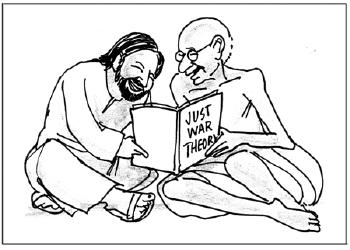
Pope Francis: Please Write That Encyclical against War!

Just War

Readings for 6th Sunday after Easter: Acts 15:1-2, 22-29; Ps. 57: 2-3, 5, 6, 8; Rev. 21: 10-14; 22-23; Jn. 14: 23-29.

Last week, David Swanson, the author of War is a Lie shared an interview with the great Jesuit peace activist, John Dear. The latter had just returned from Rome where he participated in a conference convoked by Ghanaian Cardinal Peter Turkson. Cardinal Turkson authored first versions of Laudato Si’, Pope Francis’ landmark encyclical on the environment. He is often mentioned as a possible future pope.

Father John (who doesn’t like to be called “Father Dear”) reported the conference as “unprecedented.” That’s because activists, theoreticians, and scholars of Peace Studies ended by recommending (in a document over the signature of Cardinal Turkson) that Pope Francis publish another encyclical – this one repudiating the Church’s centuries-long endorsement of Just War Theory.

That theory, of course, lays out principles for judging whether or not a given armed conflict might be justified.

The Turkson document repudiated the idea that modern warfare might ever be justified. This is not only because of the terrible destruction caused by modern weaponry, but because, in fact, 90% of casualties of today’s wars end up being innocent civilians. For those reasons, the conference in Rome recommended that Pope Francis not only repudiate war itself, but discourage Catholics from participating in modern military forces.

Imagine what would happen if Pope Francis were to accept those recommendations – especially on top of his denunciations of capitalism-as-we-know-it, his firm embrace of environmentalism, and his statements about homosexuality (“Who am I to judge?”). Catholic radicals would love it, liberals would be inspired. Conservatives who often identify faith and the military would be shocked and scandalized.

Where would you come down?

Think about that question in the light of today’s readings. Think about what “radical,” “conservative” and “liberal” mean for us as individuals and community members in our faith tradition. How would Jesus be classified? What about Paul? What would they say about entirely rejecting the idea of just wars?

Today’s Liturgy of the Word gives us a clue. It presents us first of all with an example of a key conflict between religious conservatives and radicals within the first century infant church. Paul, Barnabas, Silas and Barnabas lead the radical-to-liberal wing. Peter and Jesus’ brother, James are the leaders of the conservatives.

Paul and his friends come from the gentile world. Their concern is to make Jesus both understandable and acceptable to non-Jews. For their audience, circumcision and dietary restrictions (like not eating pork) represent great obstacles to accepting Jesus’ “Way.”

On the other hand, Peter and Jesus’ brother, James, are Jews through and through. They remember the importance of full observance of the law within the Jewish tradition. They recalled for instance that during the second century Seleucid persecution of the Jews under Antiochus IV Epiphanes, many Jews gave their lives rather than eat forbidden foods. Faced with Paul and his colleagues, the conservative faction wondered: were those lives sacrificed in vain? And besides, circumcision was the identifying mark of Jewish manhood. What good follower of the biblical God set that all-important commandment aside?

The issue is so serious that it provoked a meeting of church leaders – what scholars call the “Council of Jerusalem.” Like Vatican II (1962-’65) it called together church leadership to discuss burning issues of the day and to make changes that responded effectively to what Gaudium et Spes called the “signs of the times.”

Today’s gospel reading implies that leaders could come together with confidence because of Jesus’ promise that his Holy Spirit would continue teaching the church even after he is gone. The Spirit would remind the church of what Jesus himself taught – and more besides.

According to today’s readings, it was the “more besides” that the Jerusalem conservatives were resisting. They didn’t deny, of course, that Jesus himself was a Jewish prophet. (It was Jesus’ prophetic radicalism that angered the Scribes and high priests.) Jesus frequently placed love and compassion above God’s most important commandment, the Sabbath law; he associated with the “unclean;” he even befriended and worked miracles for gentiles. Jesus was never bound by the letter of the law as were his conservative opponents.

At the same time however, Jesus was Jewish to the end. He had no intention of founding a new religion. He was a Jewish reformer. No one could deny that. Jesus didn’t revoke the Law. He simply gave it an enlightened, more humane interpretation. He himself had been circumcised!

It was with these understandings that the Council of Jerusalem convened. And according to Luke, the author of Acts, it was a battle royal. Luke says the meeting was filled with “dissension and debate.”

What we find in today’s first reading is the final decree of the Council of Jerusalem. Concerning circumcision, it says “never mind.” As for dietary restrictions, they could be ignored. The Council was concerned with not placing unbearable burdens on converts. In other words, it couldn’t have been less conservative. The Holy Spirit was leading them in the opposite direction.

The Council of Jerusalem is reputed to have happened no more than 30 years after the death of Jesus. But by the time John of Patmos writes his book of Revelation at the end of the first century, look where his church had come. His vision of the “New Jerusalem” which we read about in today’s second reading doesn’t even have a temple. Jerusalem without a temple?! The city is founded not on the 12 patriarchs of Israel, but on the 12 apostles. How radical is that!?

I suppose what I’m saying is that Christians shouldn’t be afraid of radical change in matters of faith. It’s our tradition – right from the beginning.

In fact, in today’s gospel, John has Jesus say specifically that we should not be agitated or fearful. Rather, our hearts should be filled with peace because of our reliance on the Holy Spirit. John’s Jesus teaches that the Spirit’s presence guarantees the community is moving in the right direction, even when the Spirit’s teachings shock and scandalize – as long as it’s moving towards Jesus’ compassion, love, and ease of burden. The guarantee remains even when the Spirit’s guidance seems to dilute what many consider essential – like circumcision, dietary laws and the Jerusalem Temple.

What “essentials” is the church being called to set aside today? Priestly celibacy? An all-male priesthood? Prohibition of contraception? Are any of these really essential?

And what about just war? Are John Dear and Cardinal Turkson right about its absolute unacceptability to followers of Jesus? Could Jesus ever endorse atomic bombs, drone strikes, cluster bombs, or any of today’s wars that end up claiming mostly civilian victims?

If we fear to say “No” to any of those questions, we should keep Jesus’ words in mind: “Don’t be afraid or agitated; the Holy Spirit guides.”

The bottom line: today’s readings teach that there is no future in timid conservatism. Instead we are called to Christian radicalism (or going to the root of things). The Holy Spirit is that root.

And so we can pray with confidence: “Holy Spirit, in our world racked by war, inspire Francis to write another encyclical. Let him surprise and shock us one more time. Wake us up as a community of faith! Move us towards compassion, love and ease of burden as you did the Jerusalem Council.

We believe that under your guidance, we can never go wrong!”

Second Thoughts on Pope Francis & Family Issues

Confessional

Last week I posted a (mostly) tongue-in-cheek comment on Pope Francis’ Apostolic Exhortation, Amoris Laetitia. The document represented the pope’s reflections on the synod of bishops that met over the last two years to reformulate the Church’s teachings on marriage, sexuality and the family.

Obviously, all of those elements find themselves mired in profound crisis in the contemporary world. Given that fact, and despite the pope’s efforts to save the day in the face of the intransigence of the world’s episcopacy, the document proved to be highly disappointing.

Notwithstanding what I wrote last week, Amoris Laetitia left me wishing that the Church could bring itself to speak in plain language accessible to us all.

But no:  the encyclical was full of platitudes and written in opaque Vaticanese. It demonstrated the out-of-touchness of Church leadership, and its inability and/or unwillingness to help today’s women and men face up to their real problems in the light of a rich faith tradition perfectly capable of providing such assistance.

No wonder so many young people – so many couples – have long since dismissed the Church as irrelevant and counterproductive in terms of making sense of their lives in a globalized world!

[News flash to the Vatican: Outside of your little realm, the major problem facing couples today is not whether divorced people should be allowed to receive Holy Communion! It’s not even whether or not artificial birth control is morally acceptable. (Catholics have long since resolved that “problem;” they use contraceptives in the same percentage as everyone else.)]

Instead, think of the real problems we all face around the fraught matters Amoris Laetitia pretends to address, but which it only dances around, and in the end avoids. These problems were recently outlined by psychologist, Dr. Harriet Fraad, in an interview with economist, Richard Wolff. They include the following:

  • The introduction of the internet and easy birth control has changed the nature of dating and sexual relationships.
    • Increasingly, couples meet online instead of through family and friends.
    • It is no longer socially unacceptable for them to have sex before marriage.
    • In fact, hardly anyone waits till marriage.
    • This makes marriage less necessary and attractive as a means of achieving access to sex.
  • Divorce statistics (as well as witnessing the unhappiness of their parents) similarly discourage marriage. Fifty percent of first marriages end in divorce; 60% of second marriages and 70% of third marriages finish the same way. And after divorce women are usually left holding the bag in terms of child support.
  • Families are stressed when economic circumstances make it necessary for both parents to get jobs. That typically means women end up working a double shift – in the workplace and in the home.
  • The prospect of overwork eventual divorce leads more and more women to choose to remain single. Many become Sugar Babies to Sugar Daddies – older, well-established men who pay off their Baby’s overwhelming college loans or credit card debt.
  • Men, on the other hand, find themselves deprived of their traditional, male-defining role as bread-winners. Anger results – deflected towards guns, the military, sports addictions, evangelical religions (where women are subordinate) and pornography.
  • Children suffer the consequences of it all. They are left alone after school, when most of their problems emerge – not the least of which is obesity.
  • With all those realities in mind, marriage is increasingly viewed as an unnecessary hassle — a luxury good – accessible and desirable only for the well-to-do.
  • So young people end up postponing or rejecting it altogether.
  • They opt instead for serial cohabitations without commitment.
  • Or they become “Herbivore” men, “Dried Fish” women, or MGTOWS.

It’s not that Pope Francis doesn’t bring up many of these problems. Nor is he incapable of addressing them in ways helpful to struggling families. In fact, his three major publications (including Amoris Laetitia) provide clear principles for doing so.

  • His eco-encyclical, Laudato Si’, teaches clearly that all things are connected. The role of religion (which means “binding force”) is to make connections apparent.
  • Similarly that encyclical along with his Exhortation, “The Joy of the Gospel,” identifies capitalism-as-we-know-it as the connecting structural cause of contemporary problems. Its demands pits employers against their employees and men against women; it underpays them or deprives them of work; it requires them to work longer hours, drives both parents into double shifts, destroys families in the process, and then claims to represent “family values.”
  • And finally, in Amoris Laetitia itself the pope identifies conscience (informed by thoughtful consideration of the Christian tradition) as the most reliable guide humans have at their disposal.

Simply highlighting those principles and calling Catholics to adult dialog about their application to dating, marriage, divorce, contraception, abortion, and child-rearing would have done much more than the largely impenetrable document the Vatican actually produced.

Did Jesus Really Rise from the Dead?

Resurrection

Readings for Easter Sunday:ACTS 10:34A, 37-43; PS 118: 1-2, 16=17, 22-23; COL 3:1-4; JN 20: 1-4.

Did Jesus really rise from the dead? Or is belief in his physical resurrection childish and equivalent to belief in the Easter Bunny or Santa Claus?

I suppose the answer to those questions depends on what you mean by “really.” Let’s look at what our tradition tells us.

Following Jesus’ death, his disciples gave up hope and went back to fishing and their other pre-Jesus pursuits. Then, according to the synoptic gospels, some women in the community reported an experience that came to be called Jesus’ “resurrection” (Mt. 28:1-10; Mk. 16: 1-8; Lk. 24:1-11). That is, the rabbi from Nazareth was somehow experienced as alive and as more intensely present among them than he was before his crucifixion.

That women were the first witnesses to the resurrection seems certain. According to Jewish law, female testimony was without value. It therefore seems unlikely that Jesus’ followers, anxious to convince others of the reality of Jesus’ resurrection, would have concocted a story dependent on women as primary witnesses. Ironically then, the story’s “incredible” origin itself lends credence to the authenticity of early belief in Jesus return to life in some way.

But what was the exact nature of the resurrection? Did it involve a resuscitated corpse? Or was it something more spiritual, psychic, metaphorical or visionary?

In Paul (the only 1st person report we have – written around 50 C.E.) the experience of resurrection is clearly visionary. Paul sees a light and hears a voice, but for him there is no embodiment of the risen Jesus. When Paul reports his experience (I Cor. 15: 3-8) he equates his vision with the resurrection manifestations to others claiming to have encountered the risen Christ. Paul writes “Last of all, as to one untimely born, he appeared also to me.”

In fact, even though Paul never met the historical Jesus, he claims that he too is an “apostle” specifically because his experience was equivalent to that of the companions of Jesus who were known by  name. This implies that the other resurrection appearances might also be accurately described as visionary rather than physical.

The earliest gospel account of a “resurrection” is found in Mark, Ch. 16. There a “young man” (not an angel) announces Jesus’ resurrection to a group of women (!) who had come to Jesus’ tomb to anoint him (16: 5-8). But there is no encounter with the risen Jesus.

In fact, Mark’s account actually ends without any narrations of resurrection appearances at all. (According to virtually all scholarly analysis, the “appearances” found in chapter 16 were added by a later editor.) In Mark’s original ending, the women are told by the young man to go back to Jerusalem and tell Peter and the others. But they fail to do so, because of their great fear (16: 8). This means that in Mark there are not only no resurrection appearances, but the resurrection itself goes unproclaimed. This makes one wonder: was Mark unacquainted with the appearance stories? Or did he (incredibly) not think them important enough to include?

Resurrection appearances finally make their own appearance in Matthew (writing about 80) and in Luke (about 85) with increasing detail. Always however there is some initial difficulty in recognizing Jesus. For instance Matthew 28:11-20 says, “Now the eleven disciples went to Galilee, to the mountain to which Jesus had directed them. And when they saw him they worshipped him; but some doubted.” So the disciples saw Jesus, but not everyone was sure they did. In Luke 24:13-53, two disciples walk seven miles with the risen Jesus without recognizing him until the three break bread together.

Even in John’s gospel (published about 90) Mary Magdalene (the woman with the most intimate relationship to Jesus) thinks she’s talking to a gardener when the risen Jesus appears to her (20: 11-18). In the same gospel, the apostle Thomas does not recognize the risen Jesus until he touches the wounds on Jesus’ body (Jn. 26-29). When Jesus appears to disciples at the Sea of Tiberius, they at first think he is a fishing kibitzer giving them instructions about where to find the most fish (Jn. 21: 4-8).

All of this raises questions about the nature of the “resurrection.” It doesn’t seem to have been resuscitation of a corpse. What then was it? Was it the community coming to realize the truth of Jesus’ words, “Whatever you do to the least of my brethren, you do to me” (Mt. 25:45) or “Wherever two or three are gathered together in my name, I am there in their midst” (Mt. 18:20)? Do the resurrection stories reveal a Lord’s Supper phenomenon where Jesus’ early followers experienced his intense presence “in the breaking of the bread” (Lk. 24:30-32)?

Some would say that this “more spiritual” interpretation of the resurrection threatens to destroy faith.

However, doesn’t such perception of threat reveal a quasi-magical understanding of faith? Does it risk limiting faith to belief in a God who operates outside the laws of nature and performs extraordinary physical feats that amaze and mystify? Doesn’t it flatten the significance of resurrection belief to simply one more “proof” of Jesus’ divinity?

But faith doesn’t seem to be principally about amazement, mystification and proof analogous to the scientific. It is about meaning.

And regardless of whether one believes in resurrection as resuscitation of a corpse or as a metaphor about the spiritual presence of God in communities serving the poor, the question must be answered, “What does resurrection mean?”

Surely it meant that Jesus’ original followers experienced a powerful continuity in their relationship Jesus even after his shameful execution. Their realm of experience had expanded. Both Jesus and his followers had entered broadened dimensions of time and space. They had crossed the threshold of another world where life was fuller and where physical and practical laws governing bodies and limiting spirits no longer applied. In other words, the resurrection was not originally about belief or dogma. It was about a realm of experience that had at the very least opened up in the context of sharing bread – in an experience of worship and prayer.

Resurrection meant that another world is possible — in the here and now! Yes, that other world was entered through baptism. But baptism meant participation in a community (another realm) where all things were held in common, and where the laws of market and “normal” society did not apply (Acts 2:44-45).

In order to talk about that realm, Jesus’ followers told exciting stories of encounters with a revivified being who possessed a spiritual body, that was difficult to recognize, needed food and drink, suddenly appeared in their midst, and which just as quickly disappeared. This body could sometimes be touched (Jn. 20:27); at others touching was forbidden (Jn. 20:17).

Resurrection and Easter represent an invitation offered each of us to enter the realm opened by the risen Lord however we understand the word “risen.” We enter that realm through a deepened life of prayer, worship, community and sharing.

We are called to live in the “other world” our faith tells us is possible – a world that is not defined by market, consumption, competition, technology, or war.

Pope Francis’ encyclical, Laudato Si’ supplies the details.

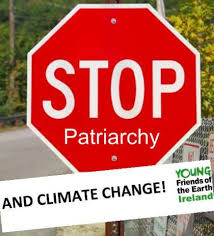
Why Male Clerics Promote Papal Teaching on Abortion & Contraception But Not on Climate Change

Patriarchy climate change

Why is it that under Pope John Paul II and Benedict XVI Roman Catholics heard no end of sermons about the evils of contraception and abortion? And yet today we’ve heard hardly a pulpit peep about Pope Francis’ encyclical on climate change – published fully nine months ago. On the contrary, chanceries throughout the country (including the Lexington diocese) have been scrambling to sweep Laudato Si’ under the sanctuary carpet.

Could it be that Pope Francis has touched on an issue that lays moral burdens on men, their businesses and pocketbooks, and not primarily on women? The latter, of course, bear the main burden of unwanted pregnancies. So the all-male clergy has found itself courageously outspoken in defending human life, the “personhood” of fetuses (based on medieval science), and in prohibiting contraception rationalized on a similarly grounded morality of “natural law.” So, papal pronouncements about such questions are definitive, infallible, and universally binding (on women!).

Meanwhile, Laudato Si’ challenges the patriarchal economic system of capitalism, the coal and oil industries, Wall Street, and the one percent. Good Catholic men are up to their necks in all of that. So are bishops and the clergy in general.

So, the “pro-life” hierarchy hastens to distance itself from its infallible leader. They do so even though Francis claims to defend life in ways that far surpass concerns about sperm, eggs, zygotes, fetuses, and stem cell research. He’s defending the future of the planet and the human race!

An example of such double-standard is provided by the Lexington diocese’s Discovering Laudato Si’: a Small Group Discussion Guide. It not only softens Pope Francis’ teaching about climate; it actually contradicts them. For instance:

  • Pope Francis says that the issue of human caused climate change has been settled by the vast majority of climate scientists. The diocesan guide says “The debate will probably not be resolved anytime soon.”
  • Pope Francis writes that addressing the issue is “urgent” and must be confronted “here and now.” The diocesan booklet affirms that we are not called to “rush headlong into the fray. . . We have been given time to reflect, to absorb, to be transformed.” The Church’s slow response, it says, has precedent and purpose.
  • Pope Francis spends the preponderance of his encyclical addressing the structural causes of climate chaos including the unbridled market, the effects of colonialism and neo-colonialism, and even specific issues such as carbon trading. Yet the diocesan booklet says that it is not yet time for “larger responses.” In the meantime, we are told, “Pope Francis has given us many little tasks we can begin right away.” Basically they are to reduce, recycle, reuse.
  • Pope Francis celebrates climate change activists and their organizations. He quotes approvingly from their Earth Charter, recommends boycotts, and employs the language of “climate debt” borrowed from those resisting mining operations in Latin America. Yet Discovering Laudato Si’ discourages such organizing. “Fortunately,” it says, “the Pope is not calling us to ecological crusade.” Joining movements, it adds, is worse than doing nothing.

While all this hesitancy and caution in defense of LIFE writ large? Why the endless chatter about moral obligations primarily directed at women?

Might it be that a pope has finally said something that threatens patriarchy?

As they say, if men could get pregnant, abortion would be the eighth sacrament.

How Rush Limbaugh Hijacked the Pope’s Climate Encyclical — & Our Parish Lenten Study Group

pope francis limbaugh 3

It’s Lent. Traditionally it’s a time for adult education in our parish. This year we decided to study the pope’s landmark encyclical, Laudato Si’.

The first meeting drew a group of 16 parishioners – almost all over the age of 60.

Perhaps understandably, the opening discussion never got much beyond statements familiar to most of us. More specifically, during our conversation we heard opinions voiced that:

  • The 125 year old Catholic social justice tradition is indeed admirable.
  • While capitalism has its problems, communism is just as bad or even worse.
  • Little can be done about global warming or about any social justice issues for that matter; it’s all due to irreformably corrupt human nature.
  • None of us is personally willing to change our lives much in response to the pope’s summons.
  • However, we might stop using Styrofoam cups during the parish fellowship hour after Mass.
  • We’re all on the same page and are preaching to the choir.
  • Some within the group have already moved off the grid and are generating electricity from solar panels.

Of course, most of those statements are questionable and worth discussing.

In any case, participants weren’t entirely to blame for the conversation’s lack of urgency. After all, the dialog exactly mirrored the source the group decided to use to focus its discussion – Discovering Laudato Si’: A Small Group Study Guide published by the Lexington diocese. It disappointingly succeeds in defusing the pope’s radical document in a way that Rush Limbaugh or any climate-change-denier might endorse. In its selection of papal texts, but especially in its introduction and conclusion, the guide actually adopts an overall tone and specific argument that:

  • The climate change debate is unresolved (p.10).
  • In the meantime, there is no urgency. In fact the church’s slowness of response is wisely traditional and purposeful (p. 27).
  • So Catholics shouldn’t “rush into the fray” (27).
  • In fact, it is not yet time for “larger responses” (27).
  • Instead the pope’s immediate summons is to personal change which itself necessarily takes time (27).
  • This means concentrating on “many little tasks” that address our own “ecological bad habits” (26).
  • Proper response, then, to the pope’s encyclical is to reduce, reuse, and recycle (27).
  • Our tiny tasks also include “helping the poor,” even though they often ask more than we can give, and even though helping them can be “dirty and dangerous,” and the poor themselves can be “angry, violent, or erratic” (24).
  • “Fortunately” we are not called to become climate change crusaders (26).
  • Doing so would be as bad as doing nothing (27).
  • And by the way, Marxism insists that “all capital and property should be controlled by the government” (5-6).

In view of such gradualism, complacency, misinformation, and discouragement of concerted activity, who couldn’t understand the group’s bemused lack of urgency in dealing with climate change and related issues?

And yet, the diocesan study guide flies exactly in the face of Laudato Si’ which adopts a strong position on the side of climate science. Its sense of urgency is unmistakable as is its overwhelming and specific focus on “the large issues.” According to Pope Francis, these call for abandonment of capitalism-as-we-know-it, for drastic structural change, joining world-wide movements, and restructuring economies according to a “preferential option for the poor.” Consider each of those elements.

First of all, the Pope unambiguously sides with climate science. Throughout the encyclical he endorses its findings:

  • “A very solid scientific consensus indicates that we are presently witnessing a disturbing warming of the climate system” (23).
  • The pope classifies climate change denial among what he calls obstructionist attitudes which range from a “denial of the problem to indifference, nonchalant resignation or blind confidence in technical solutions” (14).
  • In any case, the pope adopts what the 1992 Rio Declaration called “the Precautionary Principle.” It states that “where there are threats of serious or irreversible damage lack of full scientific certainty shall not be used as a pretext for postponing cost-effective measures which prevent environmental degradation” (186).
  • Laudato Si’ adds that “If objective information suggests that serious and irreversible damage may result, a project should be halted or modified, even in the absence of indisputable proof. Here the burden of proof is effectively reversed, since in such cases objective and conclusive demonstrations will have to be brought forward to demonstrate that the proposed activity will not cause serious harm to the environment or to those who inhabit it” (186).

Secondly, there is a sense of undeniable urgency in the pope’s words:

  • “Doomsday predictions can no longer be met with irony or disdain” (161)
  • Humankind today finds itself in a state of global “crisis.” (The word appears nearly 30 times in the encyclical. According to Merriam Webster, “crisis” means an unstable situation of extreme difficulty or danger.”)
  • “Our contemporary lifestyle can only precipitate catastrophes” (161).
  • Consequences of inaction will be “dire” (161)
  • “Decisive action” is called for “here and now” (161)
  • “We urgently (emphasis added) need a humanism . . . in the service of a more integral and integrating vision” (141)

Thirdly, see how Pope Francis approves of “environmental crusades” and their actions. He says:

  • “Public pressure must be exerted in order to bring about decisive political action” (179).
  • “A change in lifestyle could bring healthy pressure to bear on those who wield political, economic and social power. This is what consumer movements accomplish by boycotting certain products . . . This shows us the great need for a sense of social responsibility on the part of consumers.” (206)
  • “The Earth Charter asked us to leave behind a period of self-destruction and make a new start” (206). (TheEarth Charter – part of a worldwide environmental movement – is an international ethical framework for building a just, sustainable, and peaceful global society in the 21st century.)
  • “The worldwide ecological movement has already made considerable progress and led to the establishment of numerous organizations committed to raising awareness of these challenges” (14)

Fourthly, the Pope centralizes the “larger issues” including re-evaluation of capitalism-as-we-know-it. His critique of the reigning economic system is found prominently in Laudato Si’  (LS), The Joy of the Gospel (JG), and elsewhere in his speeches and homilies. He has said:

  • Unfettered markets and their “trickle-down” ideologies are homicidal (JG 53), ineffective (54), and unjust at their roots (59).
  • The right to private property should not be exercised primarily for personal gain (LS 93)
  • In fact, the unfettered pursuit of money is “the dung of the devil” (Speech Santa Cruz, Bolivia, 2015).
  • Instead “ownership” of private property is primarily an administrative responsibility to be exercised for the common good (LS 95, 129, 156, 159).
  • The earth’s wealth more rightly belongs to the poor than to the rich: “Not to share one’s wealth with the poor is to steal from them and to take away their livelihood. It is not our own goods which we hold, but theirs” (JG 57).
  • The poor have been robbed of their resources and reparations need be made (LS 30, 51).
  • “If you were to read one of the sermons of the first fathers of the Church, from the second or third centuries, about how you should treat the poor, you’d say it was Maoist or Trotskyist.” (Pope Francis 2010 address)
  • “We don’t want this globalized economic system which does us so much harm. (Speech in Cagliari, Sardinia 9/22/13).
  • “Enforceable international agreements are urgently needed” (LS 172)

Fifthly, according to Pope Francis all of these concerns belong to ordinary people who as moral agents,  must presumably educate themselves about their details:

  • The pope’s summons to address these issues is not directed towards the experts, but to “every person living on this planet . . . all people . . .” (LS 3).
  • In fact, the struggle for social justice and participation in political life is a “moral obligation” that is “inescapable” (JG 220, 258).

Sixthly, the pope offers an alternative to capitalism-as-we-know-it. The alternative is an economy structured according to a “preferential option for the poor.” This dictates:

  • Understanding Christian faith as essentially a call to prioritize the needs of the poor.” (In 2010 the future Pope Francis explained, “The option for the poor . . . is the Gospel itself.”)
  • An economy erected from the bottom-up. Its sponsoring question is how can we insure that farmers have land, that workers have jobs, and that everyone is decently housed?
  • Concern for all forms of life in the face of global warming, water and air pollution, massive extinctions, disappearance of rainforests, wasted food, waste in general, uncontrolled urbanization, rampant crime and loss of human meaning.
  • Drastic modification of market dynamics entailing at least the following: governments (1) intervening in the marketplace to insure the rights of all to jobs with living wages, housing, education, and health care, along with land for small farmers, (2) similarly regulating market forces to protect the global environment and all life forms from the most primitive to the highest, and (3) thereafter turning economies over to carefully monitored and controlled market forces under binding international agreements.

Finally, all of this – The Joy of the Gospel, Laudato Si’, the pope’s various speeches, and especially his address to the U.S. Congress raises specific questions about political activism and informed voting. For instance, does it mean voting:

  • Against climate-change deniers and for those who share the pope’s climate concerns?
  • Against champions of dirty fossil fuels and in favor of those supporting alternative, renewable energy sources?
  • Against those who would exclude refugees from finding shelter in the United States and in favor of those advocating sanctuary?
  • Against those who favor arms sales abroad and in favor of proponents of divestment from the arms industry?
  • Against champions of capital punishment and in favor of those calling for its abolition?
  • Against those proposing tax cuts for the richest 1% and in favor of increased redistributive taxes on their incomes?
  • Against those whose answer to global terrorism is war, bombing, and drone assassinations, and in favor of those who offer legal and diplomatic solutions to the problem of national security?
  • Against those who are selective in their “pro-life” advocacy, and for those who connect respect for life not just with abortion, but with providing care for unwanted children brought to term, with clean energy, environmental protection, universal health care, investment in public education, and opposition to capital punishment and war.
  • Conclusion

Pope Francis eco-encyclical is much more radical than the Lexington diocese pamphlet suggests. The study guide’s domestication of the pope’s urgent summons is not trivial. It fundamentally changes its message which is absolutely revolutionary (LS 114).

The earlier-mentioned Rush Limbaugh grasped that fact immediately. He said

“Pope Francis attacked unfettered capitalism as ‘a new tyranny’ and beseeched global leaders to fight poverty and growing inequality . . . Francis went further than previous comments criticizing the global economic system, attacking the ‘idolatry of money’. . . This is just pure Marxism coming out of the mouth of the pope. . .”

He added

“Essentially what this papal encyclical is saying is that every Catholic should vote for the Democrat Party. Well, no, that’s what it is! How else do you interpret it when the pope comes out and sounds like Al Gore on global warming and climate change? Or when the pope sounds like Clinton or when the pope sounds like any Democrat?”

Limbaugh, of course, is wrong. Plenty of Democrats (including the current president) shy away from the pope’s call for international control of pollution, for debt-forgiveness, colonial reparations, universal health care, abolition of capital punishment, cut-backs in military spending, and limiting “pro-life” concerns to the abortion issue.

Nonetheless, the diocesan study guide’s insistence on gradualism, avoiding big issues and rejecting international climate “crusades” renders it unlikely that diocesan discussion groups will ever move beyond timidity, caution, boredom and resistance to discussing the issues it raises both small and (especially) large.

After all, Cultural Revolution entails serious conversations about relevant cultural elements that Americans find difficult: economic systems, historic relations between the U.S. and the “Third World,” theological convictions, models of church, what group participants actually believe about God, Jesus and the Bible – as well as about significant practical responses to what is arguably the most important public document of the present century.

Becoming revolutionary means opening participants’ hearts and minds so all of us might move beyond pseudo-certainties, drop defenses, learn something new, and possibly endure personal transformation. Most of us are not much used to any of that.

Nonetheless those are the tasks before us in our Lenten study group – along with the questions appended below:

FOR DISCUSSION

  1. Is personal transformation desirable for you – personally, politically, and theologically? How might our discussion group stimulate such personal change?
  2. Are you willing to engage in serious reconsideration of the relationships between climate issues and economic systems, U.S. history, Global South realities, and reinterpretations of Christian faith?
  3. Is it really true that members of St. Clare parish are reluctant to respond positively and energetically to Laudato Si’?
  4. Would parishioners be willing to fund a solar energy project that would move the parish off the grid?
  5. What about petitioning Bishop Stowe to sponsor a similar project to move the entire diocese off the grid?
  6. What do you think is the most important issue raised by Laudato Si’?
  7. Is the pope correct in identifying climate change as a moral concern? Does it have the same importance, for instance, as abortion?
  8. What within you is the biggest obstacle to accepting Pope Francis’ message? Is it possible for you to provisionally remove or somehow suspend that blockage for purposes of discussing Laudato Si’? How would you do that?
  9. How would our Sunday liturgies change if our community recognized the truth and urgency of Laudato Si’?
  10. Do you agree that within our church there are many different ideas about matters of faith such as the identity of God, the status of Jesus, the authority of the Bible, the nature of salvation, and the connection between faith and issues such as climate change
  11. If so, how do we reconcile such fundamental differences with Catholic identity?
  12. Do you think it important to clarify what group participants actually believe about such matters?
  13. What should be done about theological and political differences – pastorally, liturgically, and in terms of community action?
  14. What practical steps might be taken to make the parish of St. Clare more vital, relevant, prophetic (like the pope) and effective in the world?