What Joe Biden Should Learn from Obama’s Autobiography: Listen to Jeremiah Wright

I’ve just finished Barack Obama’s remarkable autobiography, A Promised Land. Its biblical title invites reflection about the theological orientation and resulting policies of the man the book portrays. By his own testimony, that direction was originally set by Jeremiah A. Wright, Mr. Obama’s former pastor at Trinity United Church of Christ on Chicago’s South Side.

James Cone, the father of Black liberation theology has described Dr. Wright as Black liberation theology’s foremost contemporary exponent. So, in Mr. Obama, the United States experienced not only its first Black president, but its first chief executive to have been shaped spiritually by liberation theology.

With all of that in mind, the point of the following review of The Promised Land will be that had Mr. Obama employed what he learned at the feet of Jeremiah Wright, his policies would have been markedly different from their actual forms. Practically speaking, they would have more resembled those of Franklin Delano Roosevelt than a continuation of the neoliberal legacy of Bill Clinton. They would have set the country on a profoundly different and more widely beneficial trajectory from the one we are currently following.

Professed devout Catholic, Joe Biden, should take note. The radical biblical tradition espoused not only by Wright and Cone, but by King and William Barber – i.e., championed by thought leaders among Mr. Biden’s most crucial constituents – won’t support a return to “normalcy.” It requires policies that prioritize the needs not of Wall Street, but of the poor. It demands departure from Barack Obama’s business as usual.     

Liberation Theology

And that brings me precisely to liberation theology.

In case you’ve forgotten, liberation theology is reflection on the following of Yeshua the Christ from the viewpoint of the poor and oppressed committed to improving their collective life economically, politically, socially, and spiritually.

Its Judeo-Christian orientation is about political and economic starting points and end points.

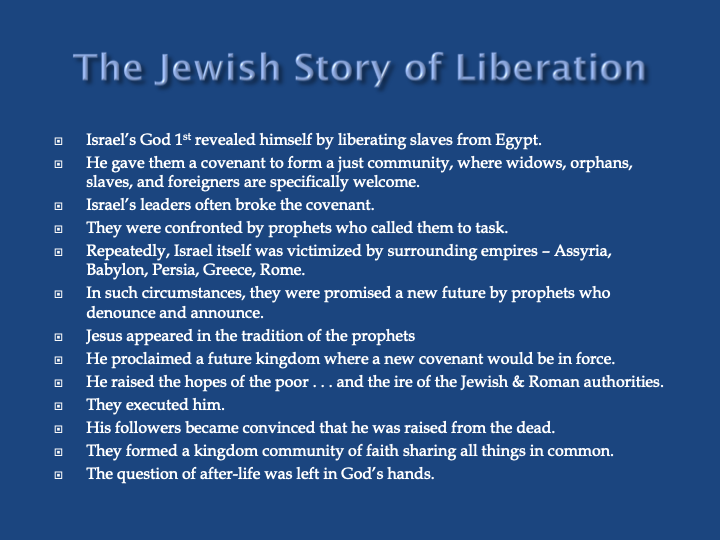
Sociologically speaking, it begins (as OpEdNews’ Rob Kall would say) from the “bottom up.” In the case of the Jewish tradition, it starts with the liberation of slaves in Egypt by a Life-Force they called “Yahweh.” It ends with Yahweh’s pledge to give the enslaved (as Mr. Obama’s book title reminds us) “A Promised Land.”

In its Christian form, the tradition starts with a poor houseless child who grows into a prophet. He promises dispossessed victims of the Roman Empire the end point of “the kingdom of God.” By this he meant a world where God is king instead of Caesar – a world with room for everyone. For liberation theology, that’s the North Star – the guiding vision meant to shape all of life, economically, politically, socially, and spiritually – a world where no one is excluded or marginalized

Following that star, liberation theology emphasizes what the Christian Testament’s Paul of Tarsus calls “the wisdom of God” contrasted sharply with “the wisdom of the world” (I Cor. 2: 1-16).  In modern terms, the wisdom of the world is trickle-down; it begins with the well-off. It holds that if the wealthy prosper, the tide that lifts their luxury yachts will lift all boats. By contrast, God’s bottom-up wisdom begins with the well-being of the poor.

Unfortunately, the policies, Mr. Obama describes in A Promised Land ended up reflecting the former over the latter.     

Jeremiah Wright’s Influence on Mr. Obama

That reflection contrasts dramatically with what scandalized America’s right wing when it first encountered Jeremiah Wright’s liberation theology. The discovery occurred soon after they realized that Barack and Michelle Obama not only were parishioners of a fiercely radical black pastor, but that he had officiated at their wedding (A Promised Land 23).

That sent conservatives scurrying to unearth evidence of Wright’s (and by extension Obama’s) unacceptably extreme viewpoints. In fact, what their excavations uncovered nearly terminated Mr. Obama’s political ambitions (140).

That’s because (true to liberation theology’s form) Wright’s words explicitly foregrounded the experience of the poor as victims of what he called U.S. terrorism. His sermons often traced it from the genocide of Native Americans, through the enslavement of Africans, to Middle Eastern policies that, he said, invited the tragic events of 9/11/2001. It led him to refer to his country as the “USA of KKK,” and to conclude, “Not God bless America,” but “God damn America” (140).

Despite all of that, and notwithstanding his eventual repudiation of his former pastor, President Obama’s testifies in A Promised Land that Rev. Wright remained an important part of his consciousness (142).  And so, throughout his narrative, the former chief executive gives indications of critical truths often reminiscent those voiced (albeit more forcefully) by his one-time pastor. For instance, Mr. Obama recalls that:

Personally

  • As part of a generation willing to question the U.S. government (456), he frequently found Wright’s black liberation theology inspiring and as channeling the understandable rage of black people in general (119, 141).
  • Not only did Rev. Wright’s disturbing insights become part of his consciousness, but so did the radical thought of W.E.B. Dubois, Martin Luther King, John Lewis, Bob Moses, Fannie Lou Hamer and Diane Nash (11) – along with those of the Hindu Mahatma Gandhi and the belatedly revered socialist, Nelson Mandela (598).
  • He realized that despite the convictions of many liberals, America’s race problems are far from being solved (128).
  • He felt impatient with having to soften blunt truths that whites find disturbing (121).
  • He himself had often experienced police harassment (395).

Internationally

  • He found sympathy with the assessment of critics like Wright that America’s “. . . ideals have always been secondary to conquest and subjugation, a racial caste system and rapacious capitalism, and that to pretend otherwise is to be complicit in a game that was rigged from the start” (xv).
  • In fact, after World War II, the U.S. had “. . . bent global institutions to serve Cold War imperatives or ignored them altogether . . . meddled in the affairs of other countries, sometimes with disastrous results;” and its “. . . actions often contradicted the ideals of democracy, self-determination and human rights. . .” (329).
  • America’s war in Vietnam was no less brutal than the Soviet Union’s repression of Hungary (469).
  • The criminal U.S.-supported Shah of Iran and his feared SAVAK secret police were typical of murderous client regimes supported by America in the Global South following World War II (310, 450-1).
  • The Shah’s regime was part of U.S. Mideast policy that needlessly alienated Muslims throughout the world. That policy tolerated corruption and repression in the region and routinely humiliated Palestinians (358).
  • China represents an attractive alternative (to the United States’) model for the developing world (481).
  • That’s true especially after so many Global South countries embraced the illusory “wisdom” of the Washington Neoliberal Consensus and thus followed America over a fatal precipice (330).

Obama’s Repudiation of Wright (and radical change)

Despite such insights, Mr. Obama’s presidential ambitions not only made it necessary for him to repudiate Jeremiah Wright, but evidently to adopt a series of policies that contradicted the tenets of liberation theology. His policies prioritized the welfare of the rich over those of the working class and poor. Accordingly, the president ends up admitting that:

  • Because of the financial crisis, he did not follow through on his campaign promises to U.S. workers (177).
  • For him, the financial markets (presumably as opposed to wage earners) were the only audience that really mattered (304).
  • His interventions alone were responsible for saving bankers from wage earners’ justified anger and retaliation (297).
  • Resulting white working-class anger, e.g., in Pennsylvania about jobs lost through such neoliberal policies, was justified (144).
  • In retrospect, bank nationalization and prosecution of crooked bankers might have been a better solution to the Crisis of 2008 than the bailouts favored by his economic team (280, 296, 305). 
  • By avoiding that solution and bowing to bankers’ interests, Obama consciously missed a once-in-a-generation chance to reengineer the overall economy in a bottom-up way reminiscent of FDR’s New Deal (304).
  • He could have done so, because of his 70% approval rating coupled with the super majority he possessed in the Congress at the outset of his first term (225, 378, 243).

Nowhere in his autobiography does Mr. Obama reveal his repudiation of Wright’s outspokenness than in the case of the Deepwater Horizon oil tragedy of 2010. There, BP Oil had unleashed the most devastating oil spill in the history of offshore drilling. It lasted for 87 days and pumped out into the ocean at least 20,000 (and possibly 50,000) barrels of oil daily (569).

As time wore on and scientists and engineers scrambled to cap the leaks, Republicans increasingly blamed the president for the failure to do so. They even referred to it as “Obama’s Katrina” (569).

What Mr. Obama’s best instincts told him to say in response was reminiscent of Wright’s candor – this time in favor of perhaps the earth’s most oppressed being, Mother Earth Herself. According to the former president, he should have said:

“. . . the only way to truly guarantee that we didn’t have another catastrophic oil spill in the future was to stop drilling entirely; but that wasn’t going to happen because at the end of the day we Americans loved our cheap gas and big cars more than we cared about the environment except when a complete disaster was staring us in the face, and in the absence of such disaster, the media rarely covered efforts to shift America off fossil fuels or pass climate change legislation, since actually educating the public would be boring and bad for ratings; and the one thing I could be certain of was that for all the outrage being expressed at the moment about wetlands and sea turtles and pelicans, what the majority of us  were really interested in was having the problem go away, for me to clean up yet one more mess decades in the making with some quick and easy fix, so that we could all go back to our carbon-spewing, energy-wasting ways without having to feel guilty about it” (570-71).

Again, that’s what, Obama admits, he wanted to say: stop drilling altogether, get rid of your big SUVs, pay the true price of gasoline, and pass courageous climate change legislation despite effects on the “American Way of Life.”

Instead, the president describes his Casper Milquetoast response with the following words: “. . . I somberly took responsibility and said it was my job to ‘get this fixed.’”

Missed Opportunities

In other words, in contrast to liberation theology’s and Jeremiah Wright’s “preferential option for the poor,” Obama’s policy preference supported the corporate status quo. He short-changed those represented by what he elsewhere describes as “his kind of crowd” from the days when he worshipped at Trinity United – “democracy activists, heads of nonprofits and community organizers working at a grassroots level on issues like housing, public health, and political access” (466).

That in a nutshell encapsulates Obama’s choice not to follow the outspokenness not only of Jeremiah Wright, but of FDR’s ghost with whom POTUS #44 wistfully compares himself throughout his memoir (177, 239, 240, 264, 388, 524, 547, 549).

Following Roosevelt, Mr. Obama’s legacy could have been different. He could have bailed out wage earners instead of the bankers. He could have instituted a 21st century New Deal prioritizing health care, infrastructure renewal, clean energy technology, and a green counterpart to the Civilian Conservation Corps.

Moreover, Barack Obama was more up to selling those programs than any president within living memory. He was better equipped for game-changing fireside chatting than even Roosevelt himself. No chief executive since FDR enjoyed his natural charm, charisma or eloquence.

Yet by his own admission, he wasted what that other Roosevelt called his “bully pulpit” by failing to persuade the American people to support legislation in their own best interests regarding single-payer health care, immigration reform, clean energy, nuclear disarmament, and cessation of endless wars (594).

Conclusion

None of this is to say that his own words in A Promised Land reveal President Barack Obama as somehow nefarious or intentionally two-faced. As presidents go, he emerges as a decent man. And no one can deny the significance of his enormous achievement as the first black man to overcome the tremendous obstacles barring election to the highest office in the land. Moreover, once in office, #44 acquitted himself with impeccable moral integrity (595). His staff worked extremely hard. Mr. Obama was the kind of boss most of us would like to work for – upbeat, sensitive, inclusive and willing to laugh at himself (534). He is also a gifted writer.

Neither is any of this to say that Mr. Obama should have been as outspoken as Jeremiah Wright. Such style might be appropriate for a prophetic pastor on Chicago’s south side, but it’s surely not the way to get elected president.

As a theologian however, I find it regrettable that the former president so completely cut himself off from the lessons learned at the feet of his early mentor. (And this is where Catholic Joe Biden has something to learn from his boss’ admitted regrets.) Had President Obama quietly embraced Dr. Wright’s lessons, had he ignored the Geithners, Emanuels, and Sommers, had he prioritized the needs of the poor, had he offered us another New Deal, we’d likely be living in a far greener country with far less wealth disparity, injustice and anger ( 522, 524).

And judging by Mr. Roosevelt’s success with the electorate, the Democrats would today enjoy much firmer standing in the White House and halls of Congress.    

Biblically speaking, Barack Obama would have brought us all that much closer to A Promised Land.

Truth-Telling Is Not Anti-Semitism or Holocaust Denial: A Personal Reflection

This is a follow-up to and revision of my last posting about a Zoom call that recently caused a stir on OpEdNews

Rob Kall, the editor in chief of OpEdNews (OEN) recently published a provocative edition of a weekly Zoom call among editors and contributors to his website. It was provocative because the remarks of one of the participants about fascism and the Great Holocaust caused several Jewish attendees to take offense and vehemently accuse him of holocaust denial and anti-Semitism.

Basically, the offending remarks identified Germany’s wealthy Jewish 1% as providing Hitler’s fascism with pretext for his genocide of the other 99%.  (I’ve summarized what was actually said here.) The discussion that ensued led Rob to wisely recommend caution in approaching such sensitive topics.

Rob’s recommendation reminded me of a sobering experience I had years ago in Mexico. It put me in the position of the OEN provocateur. It also caused me to reflect on the role of self-criticism that is part and parcel of the Judeo-Christian tradition and of critical thinking in general.

My Report from Israel

The experience I’m referring to came when I was invited to give a “Report from Israel” after a three-week study tour of Israel, Jordan, and Egypt sponsored by Berea College, where I taught in the Philosophy and Religion Department for 40 years. The invitation came from the Unitarian Universalist (U.U.) congregation of San Miguel de Allende.

My report was heavily influenced not only by our time spent in the Palestinian community, but by a separate visit my wife, Peggy, and I made to the Sabeel Ecumenical Center for liberation theology in Jerusalem. Scholars there connected the Palestinians’ situation with colonialism. They pointed out that ever-expanding Jewish settlements stood in blatant contravention of UN Resolution 242. It was a continuation of the European colonial system that had supposedly been abolished following World War II. In Israel-Palestine, Jewish occupation represented the familiar European settler pattern repeated throughout the former colonies. It had (Zionist) settlers from Germany, Russia, Poland, Hungary, Rumania, and elsewhere arriving unexpectedly in lands belonging for millennia to poor unsuspecting Palestinian peasants, and then confiscating their homes, fields and resources.

With all of that fresh on my mind, the thesis of my U.U. presentation was clear and unambiguous. “The real terrorists in Israel,” I said, “are the Zionists who run the country.” I didn’t consider my basically historical argument particularly original or shocking. The Sabeel Center and Noam Chomsky had been making it for years.

What I didn’t realize was that almost everyone in my audience was Jewish. (I didn’t even know about San Miguel’s large Jewish population – mostly “snowbirds” from New York City.) Nonetheless, my remarks that Sunday stimulated an engrossing extended discussion. Everyone was respectful, and the enthusiastic conversation even spilled over beyond the allotted time.

The trouble started after the head of San Miguel’s Center for Global Justice (CGJ) where Peggy and I were working at the time invited me to publish my talk as an article in San Miguel’s weekly English newspaper, Atención.

I’ll never forget what followed; it was very similar to what occurred during Rob’s OEN Zoom call. All hell broke loose:

  • A barrage of angry letters flooded the Atención pages for the next two weeks and more.
  • As a result, Atención threatened to cancel the column space set aside for the CGJ each week.
  • San Miguel’s Bibliotheca (library) talked about ending the CGJ’s access to meeting rooms there.
  • My article was removed from Atención’s archives.
  • Someone from the AIPAC (American-Israeli Public Affairs Committee) phoned my provost at Berea College reporting me for my inflammatory article, asking whether I really taught there and if my credentials were genuine.
  • The CGJ’s leadership was forced to do some back-pedaling distancing itself from me and my remarks.
  • They lit candles of reconciliation at a subsequent U.U. meeting begging forgiveness from the community and absolution for that mad man from Berea.
  • The guiding assumption in all of this was that my argument was patently false.

In other words, an article that should have stimulated critical thinking and discussion (with CGJ activists leading the way as a voice for Palestine’s voiceless) was met instead with denial, dismissal, and apology.

Biblical Perspective

Of course, I know that criticizing Zionists for their treatment of Palestinians is quite different from the holocaust denial that some on the OEN call perceived a few weeks ago.

It is also probably futile for members of the goyim like me to comment on the topic. Frankly, I’m unqualified to do so, because:

  • My relatives and loved ones weren’t the ones slaughtered in Hitler’s crematoria and gas chambers.
  • They weren’t among the peasants, laborers, shopkeepers, mothers, fathers, grandparents and children whose lives were cruelly wasted and destroyed by the Third Reich.
  • Instead, as Elie Wiesel has pointed out again and again, my Christian religious cohorts were the very ones who incinerated Jews during the week, went to confession on Saturday, were given absolution, received Holy Communion on Sunday, and then returned to their gruesome work the following day.

Yet, it must be acknowledged that my religious tradition is also specifically Judeo-Christian. Its central figure is the Jewish prophet, Jesus of Nazareth, who was a reformer of Judaism and had no intention of founding a new religion. Jesus was not a Christian; from his birth to his death, he was a proud and faithful Jew.

In a sense, then, especially as a theologian in this tradition, I too am somehow a spiritual Semite. (Whether they realize it or not, all Christians are.) Additionally, what separates Zionists from other contemporary neo-colonizers is their claimed religious identity. So, to ignore the role of religion here overlooks the proverbial elephant in the room.  

Recognizing the elephant gives license to say that what really happened in the Zoom conversation and in reaction to my remarks in San Miguel mirrored exactly the traditional dynamic between Jewish prophets like Amos and Jesus and their contemporaries. Both Amos and Jesus (as typical Jewish prophets):

  • Denounced their nation’s elite in no uncertain terms
  • Predicted that their crimes would lead to destruction of the entire nation
  • Were vilified as unpatriotic, self-hating Jews
  • Were threatened with ostracism, imprisonment and death
  • And were often (as in the case of Jesus) assassinated for their prophetic words      

Put otherwise, the Jewish prophets were social critics – the kind of clear-eyed seers who weren’t afraid to blame the powerful in their own nation for crimes that brought harm, ruin, death and destruction to the entire nation. The prophets did not blame the widows, orphans, foreigners, peasants, unemployed, beggars, prostitutes, or the hobbled and ill. Instead, they unstintingly impugned the equivalents of Germany’s Jewish 1% while recognizing that the crimes of those few inevitably brought ruin, pain, exile and death even to the innocent among their own people. It’s simply the way the world works. The blameworthy crimes of the powerful cause suffering, death and massacre for the innocent majority. Pointing that out is simply telling the truth.

Conclusion

Despite what I said about being unqualified to comment on words that seem cruel and insensitive to victimized Jews, I do know something about being tarred with a broad brush. As a Roman Catholic and former priest, I could easily be accused of being part of a worldwide pedophilic ring represented by the priesthood and hierarchy of the Roman Catholic Church. It would even be true to say that the ring has connections to a still wider movement of pedophiles among the world’s elite whose iceberg tip revealed (e.g. in the Epstein scandal) connections with the CIA, mi5, mi6, Mossad, and Mafias of various types throughout the world.

All of that would be true even though I never personally encountered any hint of pedophilia in all my more than 20 years preparing for and direct involvement in the Roman Catholic priesthood. It remains true despite the innumerable saints, martyrs, and holy men and women I’ve known personally and from the otherwise hallowed history of the Catholic Church.

The point here is that as an American, and much more as a former priest, I’ve been deeply associated with horrendous institutional delinquencies that I’d rather not discuss, because they hit too close to my spiritual and cultural identity. In other words, as both a Roman Catholic and a U.S. citizen, I find in my own community, uncomfortable truths that parallel the “accusations” against the Jewish 1% in Hitler’s Germany and against contemporary Zionists. I feel resentment at the very mention of such truths.

Nonetheless, and despite my hurt feelings, truth remains truth. And in the spirit of Amos and Jesus, I must face the facts and draw appropriate conclusions. Doing so draws me out of parochial consciousness and self-defensive denial. It creates room for the dialog and recognitions that might head off further community disaster.

As Paulo Freire puts it in The Politics of Education, all critical thinking begins with self-criticism.

My Recent Interview on the Rob Kall “Bottom Up” Radio Show

Here’s an interview posted last week by Rob Kall on OpEdNews, where Rob is the editor in chief and where I’m now serving as a senior editor. The exchange took place at the beginning of the Coronavirus pandemic. As you’ll see, I’m speaking from my basement office in our home in Westport, Connecticut. (I’m thinking that I should do something to make the venue seem less like a basement. . .) Anyway, it’s the third time Rob has had me on his show.

Border Reality in Tijuana: Horror, Heartbreak – and Heroism

Readings for 3rd Sunday in Ordinary Time: Isaiah 8:23-9:3; Psalm 27: 1, 4, 13-14; I Corinthians 1: 10-13, 17; Matthew 4:23; Matthew 4: 12-23

In recent weeks, I’ve been trying to report on my rich but heartrending experiences in Tijuana Mexico where I’m volunteering for a legal services group, Al Otro Lado (AOL). We offer professional counseling and support to refugees at our country’s heaviest border crossing here in Baja California. For someone in his 80th year, workdays here have been incredibly busy, very exhausting, but also extremely rewarding.

I mean, who wouldn’t be edified to witness the example of heroic but impoverished fathers and mothers AOL counsels each day. Their love for their children is so powerful that it has driven them to leave the homes and countries they love and actually walk hundreds of miles to what they imagine will be safer conditions for their little ones? (How desperate do you have to be to do that?!) It’s like the mythic journeys celebrated in some of the greatest stories human beings have ever produced.  

And yet, whose heart wouldn’t be broken to realize that helping these heroines and heroes fill out reams and reams of invasive forms and questionnaires will in most case lead nowhere but back to their original unbearable circumstances? That’s because the heartless Trump administration is doing everything in its power to thwart the dreams of these mythic champions.

Refugee Testimony

To be more specific, here’s what I’ve been told over the past two weeks while taking testimony from refugees seeking asylum in the U.S. (What follows is virtually in the refugees own words.) See if you find them as distressing as I have:

  • My country (e.g. Mexico, Honduras, El Salvador, or Haiti) is controlled by drug cartels created by the U.S. so-called “war on drugs.”
  • Small business owners in my barrio must offer the gangs protection money or otherwise cooperate with them – either that or suffer horrific consequences.
  • They try to get the rest of us to pay “war taxes” and/or to transport or distribute drugs.
  • For refusing to do so, my father (and/or a brother, or uncle) has been murdered. They’ve beat me up too. They almost stabbed me to death. They’ve burnt down our family’s house.
  • And the gangs are currently threatening to kill me and remaining members of my family if we don’t give in.
  • I can’t move elsewhere in my country to escape all of this, because the gangs are everywhere. They’ve followed me to the border, made threatening phone calls, parked prominently outside my place of work. They always seem to know where I live.
  • Moreover, it doesn’t help to go to the police. They either fear the gangs or cooperate with them. We’re all afraid of the police; they are so corrupt and unhelpful.
  • I’m desperate, so I and my family have walked across three countries to get here.

Women hovering over young children, clinging infants, and adorable babies report:

  • I’ve been a victim of domestic violence for years.
  • My husband who’s alcoholic regularly beats me and my children.
  • Since I left him, there’s been no escape; he stalks me wherever I go.
  • I can’t live like this anymore.
  • I’ve got to get as far away from this man as possible.

To repeat: those are the stories all us volunteers for AOL hear each day. I bring them up today because they turn out to be intimately connected with the liturgical readings for this third Sunday in Ordinary Time. Those selections offer encouragement to our mythic heroes, because their stories are quite like those of 6th century (BCE) Jews reflected in today’s first reading as well as of Jesus of Nazareth in today’s gospel selection. In fact, heroes’ journeys, exile, and refugeeism turn out to be prominent recurring biblical themes. Think about it.

Biblical Parallels

Consider for example today’s first selection from the prophet Isaiah. It celebrates Israel’s homecoming after a 50-year exile in Babylon (modern Iraq). It was then that their leaders had been forced to emigrate from Israel to Babylon. In other words, they were victims of wholesale kidnapping when Babylon’s rulers desired to prevent uprisings in the land they had just conquered and occupied. So, like our clients here in Tijuana, the removed ones became victims of heartless force and violence back home.

And then in the Gospel (500 years later), we find John the Baptist and Jesus similarly victimized by regimes almost as ruthless as the Trump administration. Today’s gospel reading focuses on Jesus himself becoming a political refugee for the second time. [Remember that first time in Matthew’s “infancy narratives,” when he and his parents sought expatriate status in Egypt to escape wholesale state infanticide (MT 2:13-23)?]

This time, that same King Herod has arrested Jesus’ mentor, the outspoken John the Baptizer. (The king would shortly have him beheaded.) And that in turn forces Jesus, as John’s protege, to go underground. So, the young teacher flees for refuge specifically among non-Jews in the Gentile region of Zebulon and Naphtali in eastern Galilee.

Significantly, that entire territory constituted a rebellious district and a hotbed of revolution. As such, it was largely out of Herod’s control. (To some extent, the king had only himself to blame for that, because it was in Zebulon and Naphtali that he had forcefully resettled migrants, non-Jews, and the poor.) In any case, Jesus finds comparative safety in that mixed context of foreigners, rebels and refugees.

Nevertheless, Matthew’s gospel makes it clear that Jesus’ semi-clandestine status didn’t silence him. Instead, he simply took up where John had left off proclaiming their shared conviction that another non-imperialized world is possible. As a world without Caesars – as a world with room for everyone – Jesus called it the “Kingdom of God.” It’s what refugees and immigrants have always wanted.

What I’m trying to say is that here in Tijuana, AOL deals every day with refugees from violence pretty much like what’s portrayed in today’s biblical selections. Circumstances have forced most of them into exile every bit as effectively as 6th century (BCE) Jews were forced into Babylon. They are just as frightened as Jesus must have been when he fled to eastern Galilee to hide out in a district virtually ungovernable by the reigning King Herod.

Calling attention to the similarities between the stories of heroes at our southern border and those of Israel in general and of Jesus in particular should offer encouragement to both today’s refugees and those who work with them (like the AOL permanent volunteers I’ve found so inspiring). The message for everyone is “this too will pass.” In any case, here are my “translations” of the readings in question. You can find them here in their original form.

Today’s Readings (in Translation)

Isaiah 8:23-9:
Our long, alienated exile
Is finally over.
Anguish, darkness
Gloom and distress
Have been replaced                                       
By light, joy and merriment.
The burdens                                                   
Of foreign taskmasters
Have been lifted
Their instruments of torture,
Smashed.
It is time to celebrate.
 
Psalm 27: 1, 4, 13-14
Indeed, fear is gone
Removed by the Divine One
Who is Light, Salvation,
Refuge and Loveliness
The Source of
Bounty, courage, strength,
And life.
 
I Corinthians 1: 10-13, 17
For us, Yeshua
Is the wellspring
Of such delight
Despite Empire’s
Divide-and-conquer strategy.                        
So, as his followers
We should never
Split into petty factions
But stay united instead.
 
Matthew 4:23
Yes, embracing 
God’s Kingdom
Where disease                                               
Is banished –
Has us rejecting
The World’s division
Its insanity –
Its fundamental sickness.
 
Matthew 4: 12-23
That World even
Imprisoned John the Baptizer
And caused
Yeshua himself
To hide underground
Among anarchists.
Yet he never stopped
Insisting that                                      
Another world is possible
With room for everyone                    
Even persuading
Working class people
To leave behind
Job security
For its sake
With the added bonus
Of free health care
For everyone!

Conclusion

A key foundational principle of liberation theology is the “hermeneutical privilege of the poor.”

It means that since poor people stand on the same ground as the ones whose experience is centralized in the Bible, their interpretations of texts (hermeneutics) are probably more accurate than the readings of the non-poor and even of academics trained in biblical science. The poor and oppressed see elements of historical accounts, parables, and other literary forms that remain opaque to the rest of us.

The truth of that privilege has come home to me strongly since I began my stint two weeks ago here in Baja California. It has forced me to see the world through the eyes of the refugees our group accompanies each morning at the el Chaparral crossing.

So, when I considered this week’s liturgical readings from Isaiah and Matthew, I saw what I never saw before, though I was previously quite familiar with both passages. Today’s readings, I realized, are about escapees from persecution similar to what our refugees from Mexico and Central America have experienced.

In summary, Tijuana’s refugees are more authentically God’s people – God’s favorites – than the rest of us.

I thank the heroes I’ve met here in Baja California for teaching me that lesson. They are mythic giants indeed.

Liberation Theology: Seeing Divine Intervention on Behalf of the Poor

Readings for 27th Sunday in Ordinary Time: HAB 1: 2-3; 2:2-4; PS 95: 1-2, 6-7, 8-9; 2 TM 1: 6-8, 13-14; 1 PT 1:25; LK 17: 5-10

Last week’s homily on “Dives and Lazarus” evoked an interesting comment from one of the most faithful and thoughtful readers of this blog. The point of address was a statement in my related reflections on liberation theology, viz. that in the biblical tradition “God passes from being a neutral observer of earth’s injustices to an active participant with the poor as they struggle for justice here on earth.”

In response, the reader commented, “The disheartening truth is that I see no evidence of this ever having been the case in the literal sense. Metaphorically, yes, and in prophetic but unfulfilled texts, but I fail to see even one concrete example. The rich and the poor seem to be equal in that both will have to wait for some nebulous afterlife to receive their reward. Meanwhile, the rich, proverbially, get richer.”

The comment is providentially related to this Sunday’s readings, which address the question of unanswered prayers and the frustration of those who look for evidence of God’s presence in the world and find none. Before I get to that, however, let me respond directly to what the reader said.

To begin with, I agree with his comment in that:

  1. It is often “disheartening” to look for God’s intervention on behalf of the poor (or any of us for that matter) and to see none.
  2. No one will see or ever has seen “literal,” “concrete,” and undeniable evidence of such intervention.
  3. So, in relation to faith and speech about God, metaphor used by “seers” (i.e. prophets gifted with capacity to see what’s opaque to the rest of us) is all we have.
  4. Contrary to biblical tradition, our inherited, domesticated religious culture insists that the rich and poor are equal in God’s eyes and that we must endure obscene wealth disparities till after death.
  5. As a result, wealth disparities flourish; the rich get richer.

So, relative to such observations and according to liberation theologians, what do the seers (those who can see beyond the shadows in our “Plato’s Cave”) tell us about God’s siding with the poor? Just this:

  1. God is Love and has established a loving order with room for everyone. This loving order of Universal Intelligence represents the larger, unchanging dispensation in which we live and move and have our being. It is the world as God created it.
  2. Throughout history, human structures (familial, economic, social, political, etc.) have been set up by the rich and powerful in opposition to the divine order. This is the origin of race-consciousness, nations, borders, latifundial holdings, slavery, poverty and wars. None of these represent the world as it comes from the hand of God, where the world belongs to everyone.
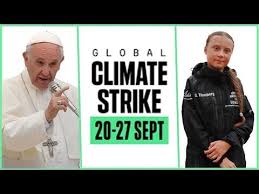
  3. The spokespersons for that other world are the “prophets” who have always been among us pointing out the in-breaking of the Love that is always there (e.g. Krishna, the Buddha, Jesus, Mohammed, Marx, Gandhi, King, Greta Thunberg . . .) Uniformly, they point out the opposition between the order of Universal Intelligence and the “wisdom of the world;” they indicate where Love is manifesting Itself; they invite the rest of us to “see” and to align with Love’s order.
  4. Those who listen to the prophets are the indispensable agents of Universal Intelligence for the “salvation” of humanity from the inevitable destructive results of the world’s “wisdom.” They are everywhere for those with eyes to see.
  5. In the end, however, Love’s order will prevail regardless of human activity; it alone is Real; the rest is illusion and doomed to pass.

With that in mind, please turn your attention to today’s liturgy of the word. You can find the readings here. In the meantime, what follows are my “translations.” As you’ll see, they directly address unanswered prayers and Love’s order as decreed by Universal Intelligence.

 HAB 1: 2-3; 2:2-4
 
I’ve been praying
Dear God,
For your Kingdom to come,
For violence to cease
For relief from our misery.
Yet you seem deaf
To my pleas.
After all,
Wars continue
Violence increases
Everyone’s at
Each other’s throat.
What should I think?
 
Only this:
(And write it in stone!)
My timetable,
My order
Is vastly different
From yours.
What’s invisible,
What seems delay to you
Is always there
And perfectly timely for me.
So, be patient
Keep your commitment
To my just order.
My answer to prayer
Is never late.
It’s omnipresent.
 
PS 95: 1-2, 6-7, 8-9
 
I have heard your response,
Dear God
I’m thankful and happy
For the reminder.
Your words
Are solid as rock.
It’s true:
You know far more
Than us.
You have never
Let us down.
I will therefore not ever
Lose faith
Against your
Proven fidelity.
 
2 TM 1: 6-8, 13-14
 
Such words of response
Are wise.
They are the expression
Of a Holy Spirit,
Within us all.
It can set
The world ablaze
With love.
It is courageous
And disciplined,
It expresses the
Strength of God.
It enables us
To endure even prison
And hardships
Of all kinds.
It is the very Spirit
Of Jesus, the Christ.
 
1 PT 1:25
 
We’re happy to say that
We share
Such enduring faith
With sisters and brothers
Past and present.
What joy to live
In such holy company!
 
 
LK 17: 5-10
 
When Jesus’ followers
Prayed for stronger faith,
He reminded them
That even a little bit
Can change
Expectations profoundly.
Never forget, he said,
That you are not in charge;
Love is.
You are only Love’s servants.
God is not
Your errand boy
Beholden to
Culturally-shaped
Plans and needs.

With those readings in mind, i.e. when we allow God’s word to open our eyes and ears, when we listen to the prophets (God’s spokespersons), we see concrete manifestations of God’s presence and siding with the poor everywhere. Right now, they’re evident, I think, in:

  1. Nature Itself: Regardless of human efforts to obscure and deny the divine, its presence calls constantly to us in events so close to us and taken-for-granted that they’ve become invisible. I’m thinking about the sun, the ocean, trees, the moon, stars, wild flowers – and our own bodies whose intelligence performs unbelievable feats each moment of our lives.
  2. Liberation Theology: This rediscovery of God’s preferential option for the poor has changed and is changing the world. One cannot explain the pink tide that swept Latin America during the 1970s, ‘80s, and 90s – not Brazil, Argentina, Nicaragua, Venezuela – without highlighting the inspiration provided by liberation theology. Neither can one explain the rebellion of the Muslim world against western imperialism without confronting Islam’s inherent liberating drive – again on behalf of the disenfranchised, impoverished, and imperialized.
  3. Contemporary Social Movements: Think Occupy, Black Lives Matter, the Sunrise Movement, Yellow Vests, Standing Rock, the Green New Deal, and prophetic figures like (once again) Greta Thunberg, Naomi Klein, Bill McKibben, and Pope Francis with his landmark climate encyclical Laudato si’ . All of these movements and figures stand on the side of the poor and are having their effect.
  4. Marianne Williamson’s Campaign: Of all the current candidates for president, Marianne Williamson most articulately and faithfully bases her “politics of love” on the five prophetic insights referenced above. The mere fact that she is actually running for president signals an actual and potential awakening of American consciousness far beyond what’s (thankfully) portended even in the candidacies of Bernie Sanders and Elizabeth Warren.

Martin Luther King once famously said that the moral arc of the universe is long, but that it bends towards justice. “Justice” in his vocabulary meant overcoming the laws and social structures crafted by the rich and powerful to keep the poor in their place. King (and Malcolm as well) was a practitioner of African-American liberation theology. As such, he was gifted with eyes to see differently — to see the Judeo-Christian tradition as revealing a God on the side of the poor.

That’s what our Sunday liturgies of the word reveal consistently. This week is no exception. It invites us to open our eyes.

Dives & Lazarus: a primer on liberation theology

Readings for the 26th Sunday in Ordinary Time: AM 6: 1A, 4-7; PS 146: 7-10; I TM 6: 11-16; LK 16: 19-31 

Today’s liturgy of the word provides us with a virtual catechism of liberation theology – Christianity’s most important theological development in the last 1500 years, and the West’s most important social movement of the last 150 years.

I have come to those conclusions over a period of more than forty years studying liberation theology. My interest began in Rome during my graduate studies there, 1967 through 1972. There I first heard Peru’s Gustavo Gutierrez speak. (Fr. Gutierrez is considered the father of liberation theology.)

Subsequently I read Gutierrez’s bookA Theology of Liberation (1971) and was completely taken by it. Reading the book gave me the feeling that I was hearing Jesus’ Gospel for the very first time.

You might ask, what is liberation theology? To answer that question fully, please look at my blog entries under the “liberation theology” button. I’ve written a series on the question. In my blogs, you’ll find that I always define it in a single sentence. Liberation theology is reflection on the following of Christ from the viewpoint of the world’s poor and oppressed. That’s the class of people to which Jesus himself belonged. They constituted the majority of his first followers.

When read from their viewpoint, accounts of Jesus’ words and deeds – the entire Bible for that matter – take on depths of meaning and relevance to our contemporary world that are otherwise inaccessible to people like us who live in the heart of the wealthy world. From the viewpoint of the poor, God passes from being a neutral observer of earth’s injustices to an active participant with the poor as they struggle for justice here on earth. Jesus becomes the personification of that divine commitment to the oppressed. After all, he was poor and oppressed himself. The Roman Empire and its Temple priest collaborators saw to that.

My interest in liberation theology deepened as my teaching career developed at Berea College in Kentucky from 1974 to 2010. There I was encouraged to continue my study of liberation theology. So, I spent extended periods in Brazil, Nicaragua, Costa Rica, Honduras, Guatemala, Cuba, Mexico, Zimbabwe, South Africa, India and elsewhere studying under liberation theologians, dialoging and publishing with them. The poor in all of those countries were suffering from the aggression the United States directed against them.

Meanwhile at Berea, I found the conclusions of liberation theologians validated by the college’s very fine scripture scholars. They had almost no acquaintance with liberation theology, and yet what they were teaching perfectly harmonized with its central tenets. It’s just that they stopped short of drawing what seemed to me the obvious political conclusions from their work.

More specifically, Berea’s scholars identified the Exodus (Yahweh’s liberation of slaves from Egypt) as God’s original and paradigmatic revelation. The whole tradition began there, not in the Garden of Eden. Moreover, the Jewish prophetic tradition emphasized what we now call “social justice.” Even more, Jesus of Nazareth appeared in the prophetic tradition, not as a priest or king. Jesus directed his “ministry” to the poor and outcasts. The Gospel of Luke (4: 18-19) has Jesus describing his program in the following words:

“The Spirit of the Lord is upon me, because he has anointed me to bring good news to the poor. He has sent me to proclaim release to the captives and recovery of sight to the blind, to let the oppressed go free, and to proclaim the year of the Lord’s favor.”

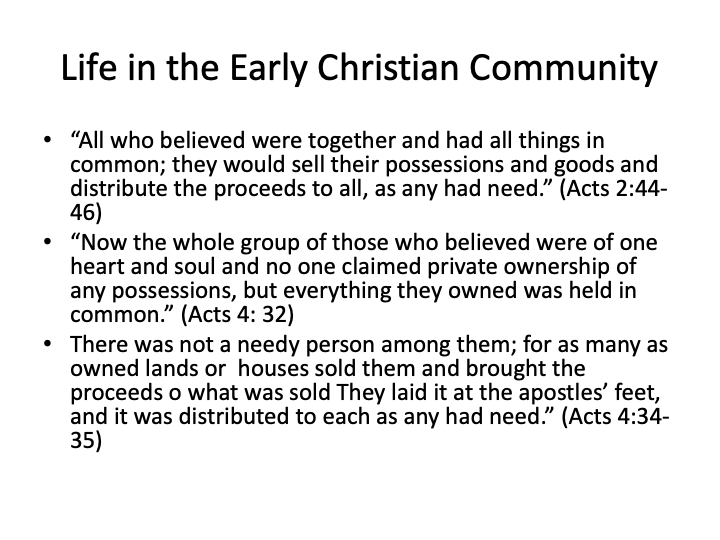
After his death, Jesus’ followers continued along those lines. They lived communally, having sold all their worldly possessions and distributed the proceeds to the poor.

All of that finds vivid expression in today’s liturgy of the word. As I said, it’s a kind of catechism of liberation theology. The reading from Amos the prophet describes the sin that most offends God – wealth disparity in the face of extreme poverty. Amos decries a “wanton revelry” on the part of the wealthy that sounds like the “American Way of Life” or the “Lives of the Rich and Famous” that we Americans find so fascinating.

The prophet describes a rich class that lives like King David himself – in luxurious houses, overeating, drinking wine by the bowlful, and generally ignoring “the collapse of Joseph,” i.e. the poverty of their country’s most destitute. For that, Amos says, the rich will ultimately suffer. All their wealth will be confiscated and they will be driven into shameful exile.

In railing against the rich and defending the poor, Amos was calling Judah back to the worship of Yahweh whose attributes are described in today’s responsorial psalm. There God is depicted as loving the just and thwarting the ways of the wicked. The psalm describes Yahweh as securing justice for the oppressed, giving food to the hungry, and setting captives free. He gives sight to the blind and protects resident aliens, single mothers and their children.

Then today’s excerpt from 1st Timothy outlines the characteristics of those who worship that God by following in Jesus’ footsteps. They keep the commandment which is to do unto others as we would have them do unto us.

According to St. Paul, that means pursuing justice and living with devotion, faith, love, patience, and gentleness.

Finally, the gospel selection from Luke chapter 16 dramatizes the sinful relationship between rich and poor and the destinies awaiting both. Luke tells the story of the rich man and “St. Lazarus” who is honored by the poor throughout Latin America.

It is significant that Lazarus is given a name in Jesus’ parable. Usually we know the names of the rich, while it is the poor that remain anonymous. Here matters are reversed. To remedy this anomaly, tradition has assigned the wealthy man a name. He’s called Dives, which is simply the Latin word for rich man.

For his part, Lazarus is quintessentially poor, hungry, and lacking medical care. His sores are open and the only attention they receive are from dogs that lick his wounds. Meanwhile, Dives seems completely unaware of Lazarus’ presence, though the beggar is standing at his very doorstep. Within the sight of Lazarus, the wealthy one stuffs himself with food to such a degree that the scraps falling from his table would be enough to nourish the poor beggar. But not even those crumbs are shared. How could Dives share? He doesn’t even know that Lazarus exists.

So, the two men die, and things are evened out. The rich man goes to hell. We’re not told why. Within the limits of the story, it seems simply for the crime of being rich and unconsciously blind to the presence of the poor. For his part, Lazarus goes to the “bosom of Abraham,” the original Hebrew patriarch.

Lazarus is rewarded. Again, we’re not told why. Within the story, it seems simply because he was poor and Yahweh is partial to the poor, just as he was to the slaves God intervened to save when they were starving in Egypt.

Seated with Abraham, Lazarus feasts and feasts at the eternal banquet hungry people imagine heaven to be. Dives however is consumed by flame in the afterlife. Fire, of course, is the traditional symbol of God’s presence, or purification, and of punishment. This seems to suggest that after death, both Dives and Lazarus find themselves in the presence of God. However what Lazarus experiences as joyful, Dives experiences as tormenting.

And why? Simply, it seems, because Dives was rich, and Lazarus was poor.

Does the parable tell us that what awaits us all after death is a reversal of the economic conditions in which we now find ourselves? The first will be last; the last first. The rich will be poor, and the poor will be rich. That in itself is highly thought-provoking.

In any case, Yahweh is presented as champion of the poor in this parable, just as in the reading from Amos, in today’s responsorial psalm, and in Paul’s letter to Timothy. And according to liberation theologians, that’s the central characteristic of God throughout the Judeo-Christian tradition. God is on the side of the poor and hates obscene wealth disparity.

You can well imagine how such insight inspired the poor and oppressed throughout the world when it emerged as “liberation theology” following the Second Vatican Council. Poor people everywhere (and especially in Latin America) took courage and were inspired to demand social justice from the rich who had been ignoring them in the New World since the arrival of Columbus 500 years earlier. In fact, Liberation theology motivated social movements more powerfully than any thought current since the publication of the Communist Manifesto in 1848.

And that’s why the reigning empire, the United States of America took action against liberation theology. It initiated what Noam Chomsky calls “the first religious war of the 21st century.” It was a war of the United States against the Catholic Church in Latin America – yes against the Catholic Church. The war killed hundreds of thousands of priests, nuns, lay catechists, social workers, union organizers, students, teachers, and journalists along with ordinary farmers and workers.

Today’s liturgy of the word reminds us not to let the United States have the final word. We are called to divest ourselves of our wealth and to take notice of St. Lazarus at our gates. God is on the side of the poor, not of the rich.

Sunday’s Readings “Translated”

Here are my “translations” of the liturgical readings for the 26th Sunday in ordinary time. As we’ll see more explicitly in my Sunday Homily, they provide a virtual catechism of liberation theology, which I consider the most important theological development of the last 1500 years.

AM 6:1A, 4-7
 
The Spirt of Life informs us that:
Complacent “religious” people
Are in for a sad surprise.
They might be enjoying
Their “Sleep Number” mattresses
And Lazy Boy chairs;
While gorging on Wagyu Beef
And meats
No one else can afford;
They might be attending
A-list concerts
And drinking Chateau Lafite
While reeking of Chanel Grand Extrait.
But the world’s on fire!
And its flames will soon consume
Even the decadent lifestyles
Of the super-rich.
 
 
PS 146: 7, 8-9, 9-10
 
For the poor,
There’s a certain Schadenfreude
In all of this.
For God’s future assures
Downfall for the rich
While promising
Justice for the oppressed
Rich food for those now hungry
And liberation for the imprisoned.
The obtuse will see,
We’re told.
The overworked
Will be relieved.
Immigrants and refugees
Will be safe at last.
Children born out of wed-lock
And abandoned women
Will finally know peace.
 
1 TM 6:11-16
 
So, be of good heart.
Despite appearances,
That golden future awaits
Those who live like Jesus.
He was so committed
To the poor
To justice, non-violence
Patience and love
That the imperialized world
Could not stand it.
Nevertheless, his powerful
Christ-consciousness
(That you btw have promised
To live by)
Will bring the world
A completely new order
And enlightenment beyond
Our wildest imaginings.
 
2 COR 8:9
 
In fact, Jesus accomplished
All of that
By becoming a poor man
Not a rich one
So that we might know
Where true wealth lies
And live accordingly.
 
LK 16: 19-31
 
Jesus illustrates
His meaning
With the story
(Told to the complacent believers)
Of poor Lazarus
Who often begged
From a rich man.
But soon had Dives
Begging from him
And experiencing
The awful frustration
Of unbridgeable gaps
In consumption
And in ability
To communicate
The desperation
And torment,
Of hunger and thirst
Even if revealed
By a ghost from the other side.

Announcing: A New Series on Presidential Candidate, Marianne Williamson

[The quadrennial election-season is upon us. Accordingly, today’s posting is the first in a series on Marianne Williamson and her candidacy for President of the United States. The series will explore parallels between her platform (as articulated in her 20th anniversary edition of “Healing the Soul of America”) on the one hand and “A Course in Miracles” (ACIM) on the other. Postings to follow will also connect ACIM and Williamson’s policies with liberation theology – the most important theological development of the last 1500 years, and the inspiration for the Global South’s most effective social movement since the middle of the 19th century. The thesis here will be that Marianne Williamson is actually a U.S. liberation theologian, but in the tradition of 19th century abolitionists, as well as that of women suffragists, Martin Luther King, and Mohandas Gandhi. As such, her candidacy promises our country the revolutionary impetus that liberation theology provided for the profound socio-political changes Latin America has experienced over the last six decades.  Apart from more formal explanations of this thesis, the latter’s point will be made in the form of weekly Sunday homilies reflecting on the narratives of Jesus’ words and deeds as presented in each week’s liturgical readings.]

Marianne Williamson for President! She’s a Liberation Theologian

On Monday, January 28th, Marianne Williamson declared herself a candidate for President of the United States. In making her declaration, this great spiritual leader, who has a larger social media following than any Democratic candidate declared so far, implicitly proposed addressing in 21st century, non-religious ways the spiritual hunger that Williamson and others in the “higher consciousness community” consider endemic to the human condition, whether that hunger is recognized or not.

However, the difference between Williamson and others in that community is that she consistently applies her spiritual insights to the public sphere. And as we shall see shortly, she does so in a manner that completely respects the convictions of Christians, Jews, Muslims, Sikhs – and atheists, along with those who describe themselves as “spiritual but not religious.”

Because of its inclusive approach, Ms. Williamson’s candidacy promises to build on the accomplishments of 19th century abolitionists, and on those of 20th century women suffragists, and participants in the American civil rights movement. The abolitionists and many suffragists were highly committed Quakers. And, of course, King was a Baptist minister.  Following in their footsteps, Williamson promises to at last offer progressives (and the country at large) entry into a sphere that conservatives – Christian fundamentalists to be exact – have controlled at least since the 1980s. It’s the essential realm of faith and spirituality.

Failure to enter that sphere has hamstrung the left whose “enlightened” tendency has been to reject and ridicule rather than embrace what many consider the deepest dimension of being human. That tendency has not simply cost progressives votes on election day. Even more fundamentally, it has incapacitated them by its implied blindness to the spiritual hunger shared even by humans in general. Put otherwise, Williamson is confronting the right on its own turf.

In daring to do so, she is boldly following in the footsteps of Martin Luther King who demonstrated the ability of faith to awaken critical thinking capacities belonging to ordinary people. King as well as Malcolm X, and the abolitionists that preceded them all tapped into the undeniable power that religious language, symbols and metaphors possess to actually motivate ordinary people to work for social justice and profound political change. The same, of course, is true of Mahatma Gandhi and the liberation theologians of the Global South. In fact, I’ll argue in future postings that Marianne Williamson could easily be classified as a liberation theologian.

Before I get to that however, please recognize that during her campaign Williamson does not plan to wear her identity as spiritual teacher on her sleeve. And that’s her strength too. Instead, she’ll employ her spiritual consciousness and conviction fostered by years of spiritual discipline to guide her campaign in the right direction which will inevitably call for deep psychological – not to say – spiritual – transformation for all of us.

Recently, she described that transformational direction in an extended interview with CNN’s John Berman. Williamson said her most prominent issues would be:

  • Medicare for All
  • A permanent tax cut for the middle class
  • Free education for all children (including tuition for public colleges)
  • Government support for children’s services
  • A Green New Deal

Those, of course, are proposals similar to what have been proposed by Elizabeth Warren and Bernie Sanders, whom Williamson supported in 2016.

Why then run, Berman asked, before Sanders and Warren have officially announced? Won’t her campaign be somewhat redundant in the face of two veteran politicians who, he intimated, have a much better chance of getting elected?

Williamson’s response was significant in that it clearly underlined not so much her competitive edge even over candidates like those just mentioned, but the added value her candidacy represents. Ms. Williamson wants to expand the conversation, she said, to address the psychological and spiritual issues underlying what she sees as the severe disease that mortally threatens the American body politic. As long as those remain unaddressed, conversation and policy proposals, however excellent and whatever their sources, will remain at less-helpful superficial levels. It will be like watering the leaves of a plant, when its roots remain dry and shriveling.

And what root causes is Williamson referring to? Basically, she says, it’s an amoral economic system. It is capitalism-as-we-know-it that has focused on short term gains while allowing market forces instead of common-sense spiritual principles (as elementary as the Golden Rule and democracy) to assume their irreplaceable and decisive roles in the organization of our country’s politics.

Such assumption now has millions of children living in chronic despair and trauma. (Williamson always begins with child welfare.) The system has also created layers of racism and fostered wars across the planet. It has made our country destructively expert at waging wars but unwilling to wage peace.

Williamson reminded her interviewer that Franklin Roosevelt considered the administrative aspects of the presidency as secondary to the moral leadership the position affords. She pointed out that her 35 years of naming and addressing such moral dimensions of public policy is what qualifies her to exercise the moral leadership F.D.R. referenced. That’s Williamson’s competitive edge. It’s her added value. It’s what no other Democratic candidate offers so clearly.

When asked about paying for her program, Williamson chuckled. She asked: Isn’t it interesting that interviewers always raise that tired canard? When it comes to giving a $2 trillion tax break to billionaires, very few, she said, will ask, “Where will the money come from?” Even less do they raise that question when it comes to fighting wars – not even wars like the one against Saddam Hussein in Iraq that was entirely illegal and based on lies.

Marianne Williamson had a similar response when asked about the reparations she advocates for African-American descendants of slaves. She’s proposing a fund of $100 billion for the purpose. It would be paid out over a period of 10 years to finance economic and educational projects to benefit the community in question.

There are precedents for this she added. After World War II, Germany paid out $89 billion in reparations to Jewish organizations in the country. President Reagan signed into law the American Civil Liberties Act to similarly repair harm done to every survivor of the internment camps set up for the Japanese-Americans during the same World War. Moreover, following our nation’s Civil War, General Tecumseh Sherman proposed giving every freed slave 40 acres and a mule. Instead, former slaves were given the Black Code Laws that plagued them till the mid-1960s. It’s time, Ms. Williams said, to make good on Sherman’s reparational promise which was never kept.

From all of this, you can see that Marianne Williamson with her huge social media following is a serious candidate. For people of faith and advocates of social justice without a shred of religious faith, she presents a strong antidote to the religious right that has cornered the field of language, symbols, and metaphors by which most people in the world make sense of the world.

Williams knows that field inside-out. She recognizes that surrendering that field to reactionary forces is what renders progressives relatively weak before the 75% of Americans who identify as Christians. In the spirit of the abolitionists, women suffragists, and civil rights activists – in the spirit of Gandhi and liberation theologians – she wants to reclaim that turf and the specifically moral influence missing in the Democratic White House since the FDR era.

(Next week: My Meeting with Marianne Williamson. )

My Interview on Rob Kall’s “Bottom-Up” Podcast/Radio Program

Two weeks ago, Rob Kall posted an interview with me on OpEdNews. It centered on my book, The Magic Glasses of Critical Thinking: seeing through alternative fact & fake news. I had great fun doing the show. Here it is.

My Meeting with Marianne Williamson

Marianne

[This is my second blog entry in a series on the relation between liberation theology and A Course in Miracles (ACIM).]

More than a year ago, I met Marianne Williamson directly for the first time. I say “directly” because at the time I felt I already knew her. I had read her book, A Return to Love, which Marianne herself describes as ACIM Cliff Notes. And every Tuesday evening from 7:30-9:30, my wife, Peggy, and I watched Marianne’s livestream lectures from the Marble Collegiate Church in New York City. On top of that, I had been a student of A Course in Miracles for more than a year. (I’ll say more about that presently.)

In any case, at Peggy’s invitation, the great spiritual teacher and eloquent interpreter of A Course in Miracles came to Berea College as a convocation speaker. As expected, she charmed and inspired us all with her insightful connections between ACIM and the crisis of leadership and truth discernment in the age of Donald Trump whose presidency had begun just two months earlier. Her message emphasized that spirituality and higher consciousness have political consequences.

The evening of Marianne’s presentation, Peggy had arranged a lovely dinner at Berea’s Boone Tavern Hotel. In a group of fifteen or so Berea faculty, the president of Berea college and I were the only males present. Conversation was light and filled with small-talk until Marianne asked us all to introduce ourselves with some brief words about our personal spiritual journeys.

When it came my turn, I shared my background as a former Catholic priest. I spoke of my training in meditation as part of my seminary experience. I confessed that I had eventually abandoned meditation’s practice, but how a Christmas gift from Peggy in 1997 had renewed my commitment to its twice-daily practice.

The gift, I said, was a book by Eknath Easwaran called Passage Meditation. It explained how to meditate and recommended Easwaran’s “Eight Point Program” that changed my life. His eight points included meditation, spiritual reading, selection and use of a personal mantram, slowing down, one-pointed attention, training of the senses, putting the needs of others first, and practicing community with similarly committed friends.

I also mentioned that professionally I considered myself a liberation theologian. Marianne asked what I meant by that. I answered as I always do in a single sentence. I said: Liberation theology is reflection on the following of Christ from the viewpoint of the poor and oppressed who are socially aware in the sense of knowing who their oppressors are and of being willing to work for oppression’s end. Its emergence since the Second Vatican Council (1962-’65) represents, I claimed, the most important theological development of the past 1500 years. It is the most significant social movement of poor people since the publication of the Communist Manifesto in 1848.

That evening Peggy and I drove Marianne and her secretary, Wendy, from Berea to the Cincinnati airport two hours distant from Berea. The whole time, the four of us discussed A Course in Miracles and liberation theology. Marianne expressed interest in the latter and as we parted for the evening mentioned that perhaps the two of us might collaborate in writing a downloadable web series she was planning specifically about Jesus and connections between his person and the gospels on one hand and A Course in Miracles on the other. I was thrilled by the prospect.

At that point, I had been working with A Course in Miracles for almost a year. And it was profoundly changing my understanding of everything – of God, the world, truth, Jesus, the spiritual life in general – and myself and my life’s purpose. In that sense, the book was an answer to my prayers, for I had long experienced a burning desire to deepen my spiritual life and practice. I was surprised by ACIM’s impact.

(Next week: ACIM: Its Content)