[What follows is the 3rd installment describing a wonderfully synchronic event that coincided with my wife Peggy’s and my visit to Rome to spend three weeks with my son and his family there. The visit just happened to coincide with the elevation of fellow Chicagoan Robert (Fr. Bob) Prevost to the papal throne. Today’s account is about Pope Leo’s inauguration. You can find the other two installments here and here.]
Peggy and I got up early this morning – 5:00. Our intention was to get to St. Peter’s Square in time to secure seats for Pope Leo’s inauguration which would begin at 10:00.
However, our ride to the basilica was half an hour late. That meant we didn’t get seats.
And though we were able to situate ourselves much closer to the center of action than we did a week ago for the introduction of the new pope, our late arrival left us standing in the increasingly hot sun from 7:00 till noon.
It was worth it though. It gave me plenty of time to observe and reflect on the thousands upon thousands of faithful and simply curious who filled the Square and about a mile of the Via Conciliazione – the broad avenue that extends from the basilica’s piazza towards the Castel Sant’ Angelo.)
The Ceremony
In the meantime, all of us were inspired by the St. Peter’s Basilica choir and their transcendent renditions of Catholic choral classics like “Christus Vincit” and “Salve Regina.” We also ended up praying the five Glorious Mysteries of the rosary in Latin (viz., (1) the Resurrection, (2) the Ascension, (3) the Descent of the Holy Spirit on the Apostles, (4) the Assumption of the Blessed Virgin into Heaven, and (5) Her Crowning as Queen of Heaven and Earth). I was surprised how easily the Latin came back to me.
The whole thing and what followed was made visible for everyone on perhaps 20 huge jumbotrons located strategically throughout the entire venue.
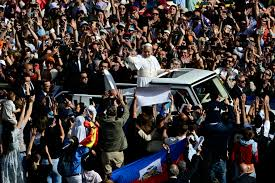
Then about 9:30 Pope Leo arrived. He was standing in the back of his popemobile smiling and giving his blessing to the adoring crowds as the vehicle drove around St. Peter’s square and down the length of the Via Conciliazione. He passed very close to the place Peggy, our Roman host, and I were standing. The crowd’s enthusiasm, shouts, and applause made it all quite thrilling.
At 10:00 right on the dot, the ceremony began. Everyone in the crowd had been given memorial booklets with the texts of every hymn, litany, and prayer, along with brief descriptions of ceremonies like the bestowal of the papal ring and other signs of papal authority. Texts (including the pope’s homily) were also projected on those large screens. So, it was all quite easy to follow and understand.
The center of it all was the papal Mass, with Leo the celebrant, while various members of the clergy and laity handled the biblical readings and some of the prayers in Latin, Italian, Spanish, English, and Greek.
At communion time, a whole army of priests (perhaps 50 or more) dressed in black cassocks and white surplices processed to various stations throughout the crowd to distribute the “hosts” that Catholics believe are the very body of the risen Christ. I noticed how some recipients received the wafer on their tongues, others in their hands. One priest close to me refused to place the host in extended palms. He repeatedly insisted on laying the host on the recipient’s tongue. The priest who gave me communion placed the wafer reverently in my hand with the traditional words, “The body of Christ.”
“Amen,” I replied. (I hadn’t received Catholic communion in years.)
All that describes the surface level of my experience this morning. But what did I really see and hear? Let me respond at three levels, one inspirational, one historical, and one political.
Evaluation
At the inspirational level I saw thousands of Catholics and others thirsting for a meaningful spiritual experience of transcendent, invisible dimensions of life. After all, we live in a world rendered increasingly meaningless by materialism, consumerism, war, shifts in global power, and social change almost beyond comprehension. Seeing such people praying the rosary with eyes closed and lips moving was inspiring indeed. So was their reverence in receiving Holy Communion.
At the historical level, I saw something more problematic. I witnessed:
- An out-of-touch museum performance piece
- Overwhelmingly led by men in pretentious medieval costume representing the most patriarchal institution in the western world
- Now led by a nice American priest who actually believes he’s somehow the “Vicar of Christ”
- Who founded the Catholic Church
- Despite the evidence of even Catholic scripture scholarship that such conviction remains unsupported by credible evidence. It shows instead that Yeshua of Nazareth remained a good Jew throughout his brief life and had no apparent intention of founding the gentile “church”
- That emerged definitively in the 4th century when (under Constantine) a powerful faction of the Christian community threw in its lot with the Roman Empire becoming in effect its Department of Religion,
- Notwithstanding the fact that Yeshua died a victim of Roman torture and capital punishment.
However, most problematic of all were the event’s political dimensions. In that connection I saw a pope who (once again!) during a time of genocide and this time standing before its perpetrators (in the persons of J.D. Vance and Marco Rubio) spoke in generalities and empty platitudes instead of calling attention to their crime. As indicated in yesterday’s piece, I had been hoping for more – perhaps something in the vein of Episcopal Bishop Mariann Edgar Budde’s words to President Trump on behalf of Palestinians and migrants.
Conclusion
When I’ve expressed my concerns to friends and family members, I’m often told that the new pope must be careful and diplomatic. After all, he’s just starting out.
My reply however is that we’re in a state of emergency. The fact of genocide is undeniable in Gaza. Women and children are starving to death. Each morning, it seems, we’re told that as many as 150 Palestinians (mostly those women and children) were killed overnight. Such victims can’t wait.
The pope has potentially more moral power in his voice than anyone else in the world. If he truly believes himself to be the vicar of the prophetic Yeshua, he must use that voice now.
He must forget caution and diplomacy.

 About Things That Matter