Pentecost and the Sin of Christian Nationalism

Readings for Pentecost Sunday: Acts 2: 1-11; Psalm 104: 1, 24-34; 1 Corinthians 12: 3b-7, 12-13; John 20: 19-23

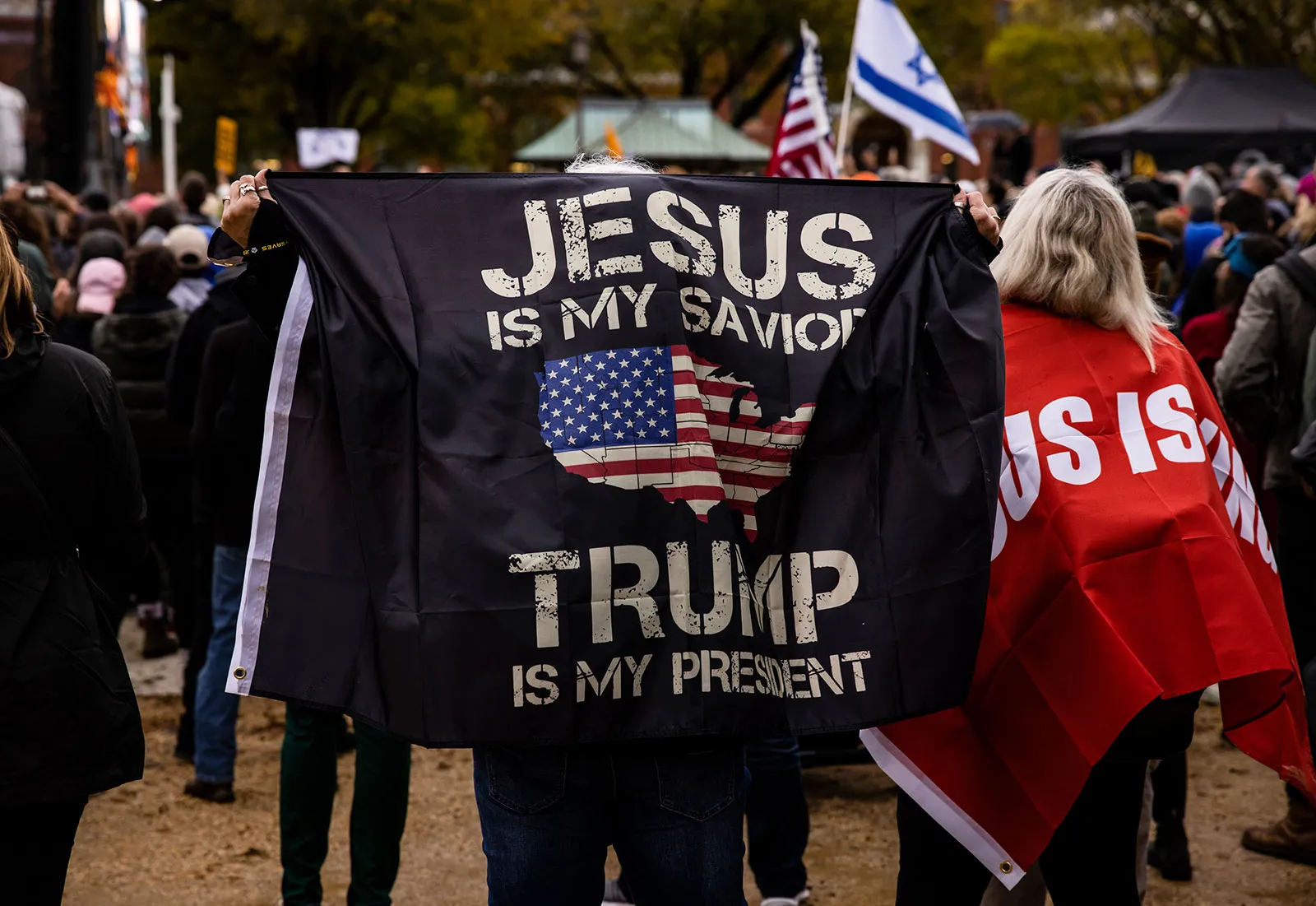
Last Sunday thousands gathered on the National Mall in a celebration blending Christianity, nationalism, military imagery, and devotion to Donald Trump. Crosses stood beside flags. Speakers praised America as a specially chosen nation. Calls for “strong borders,” “Christian values,” and “taking our country back” blended almost seamlessly with prayers and worship songs.

Watching it, I found myself thinking about today’s feast of Pentecost.

Because Pentecost presents us with a vision of God exactly opposite to the spirit of Christian nationalism.

Christian Nationalism

Christian nationalism tells us that our divine Creator belongs especially to one nation, one culture, one language, and one people. It imagines God as the protector of borders, armies, national destiny, and cultural purity. At its extremes, it turns Christianity into a religious justification for fear of outsiders, suspicion of immigrants, and hostility toward those judged foreign or threatening.

Pentecost says the very opposite.

The first reading from Acts could not be clearer. Luke almost overwhelms us with his list of peoples gathered in Jerusalem: “Parthians, Medes, Elamites, inhabitants of Mesopotamia, Judea and Cappadocia, Pontus and Asia…” The catalog continues almost tediously. But Luke’s purpose is deliberate. He wants us to understand something essential about the Holy Spirit.

The Spirit descends not upon one nation, but upon “devout Jews from every nation under heaven.”

And the miracle is not that everyone suddenly speaks the same language. The miracle is that each person hears the apostles “in his own native tongue.”

That detail matters enormously.

Pentecost vs. Empire

Empires always demand conformity. Political power typically insists on one approved language, one authorized culture, one acceptable version of reality. But at Pentecost, diversity (D.E.I.?) itself becomes the medium through which God speaks. The Spirit does not erase difference; the Spirit honors it.

Which means Pentecost stands as a direct challenge to much of what now passes for Christianity in the United States.

We are living through a period where immigrants are routinely described as invaders, criminals, parasites, and threats to civilization itself. Families fleeing violence or hunger are treated as enemies. Human beings seeking asylum are loaded onto airplanes in chains while politicians boast about deportation numbers to cheering crowds.

And all of this is increasingly wrapped in Christian language.

Crosses appear beside assault rifles. Bible verses are quoted at political rallies. Jesus is invoked to justify cruelty at the border and indifference toward refugees. The faith of the Sermon on the Mount is steadily transformed into a religion of walls, exclusion, punishment, and fear.

Pentecost vs. Locked Doors

Yet today’s Gospel begins with disciples hiding behind locked doors “for fear.”

That line may describe not only the apostles but our nation itself.

Fear locks doors. Fear builds walls. Fear turns strangers into enemies and neighbors into threats. Long before barriers are erected at borders, barriers are erected within hearts. We begin dividing humanity into “us” and “them,” the deserving and undeserving, the saved and the dangerous.

Then Jesus enters the room.

Notice what he does not say. He does not urge the disciples to protect themselves from foreigners. He does not call for the defense of traditional culture. He does not speak of national greatness or civilizational conflict.

He says simply: “Peace be with you.”

Then he breathes on them and says, “Receive the Holy Spirit.”

That image of breath is deeply important. In both Hebrew and Greek, the words for breath, wind, and spirit are intimately connected. The Spirit is the breath of God shared with humanity itself. In Genesis, God breathes into the earth creature and Adam becomes alive. Here in John’s Gospel, Jesus breathes once again, recreating humanity.

This means that every human being carries the same sacred breath. Not just Americans. Not just Christians. Not just people with passports or legal documents. Everyone.

That conviction lies at the center of biblical faith. Again and again Israel is reminded: “You yourselves were once strangers in Egypt.” The test of fidelity to God is never simply doctrinal correctness or patriotic fervor. It is always social practice. How are the vulnerable treated? How are outsiders welcomed? How are the poor regarded?

A Reversal of Babel

In terms of language, inclusion, equality, and understanding, Pentecost reverses Babel.

At Babel humanity united around domination and imperial ambition. The result was confusion and division. At Pentecost humanity rediscovers unity not through forced sameness but through mutual listening and understanding. The Spirit creates communion without demanding uniformity.

St. Paul expresses the same vision in today’s second reading: “There are different gifts but the same Spirit.” Different languages, different cultures, different histories — yet one body.

That understanding could hardly be further from the spirit now overtaking so much of American religion and politics with their denigration of diversity, equality, and inclusion.

Today Christianity is often reduced to tribal identity politics draped in religious symbols. The cross is wrapped in the national flag. Compassion is dismissed as weakness. Cruelty becomes strength. Public humiliation of migrants and refugees is treated as proof of political courage.

And those who seriously challenge such cruelty are quickly denounced.

In this context, think of Renee Goode and Alex Pretty. Their offense was their willingness to identify publicly with the excluded, the displaced, and the demonized. In response they have been ridiculed, attacked, and condemned — often by people who loudly proclaim themselves followers of Jesus.

That should not surprise us. The Spirit of Pentecost has always made respectable religion uncomfortable.

Because the Spirit exposes the contradiction between our worship and our politics. We pray “Come Holy Spirit” while supporting systems that degrade the foreigner, punish the poor, and normalize indifference toward suffering.

The Sequence we heard today may contain the most important prayer in the entire liturgy: “Bend the stubborn heart and will; melt the frozen, warm the chill.” For ours has become a frozen society.

We have grown numb to suffering on a massive scale. Migrants die of thirst in our deserts and drown in our seas. Families disappear into detention systems. Entire populations are bombed, displaced, or starved while much of the world watches passively. And most of us continue our ordinary routines scarcely disturbed.

Pentecost interrupts that numbness.

It insists that the foreigner speaks with a voice we are spiritually obligated to hear. It insists that God’s Spirit cannot be confined within national borders. It insists that no people are illegal in the eyes of the One in whom “we live and move and have our being.”

Of course, nations have the right to regulate immigration. Few would deny that. But Pentecost also makes clear that whenever fear, cruelty, and dehumanization become public policy, Christians are obligated to resist.

After all, Jesus himself entered history as a refugee child carried into Egypt by terrified parents fleeing political violence.

Today many who claim to follow him would likely report the Holy Family to immigration authorities.

That irony should stop us cold.

“Lord, send out your Spirit and renew the face of the earth,” we prayed in today’s psalm.

Conclusion

But renewal cannot happen while hearts remain locked behind doors of fear. The Spirit enters only when those doors are opened — when we finally recognize that the breath within ourselves is the same breath carried by the stranger, the refugee, the immigrant, and the excluded.

That is the real meaning of Pentecost. And it remains just as dangerous today as it was two thousand years ago.
When Bible Readers Like Charlie Kirk Ignore Its Class-Consciousness

The recent assassination of Charlie Kirk provoked a flurry of commentary about God, faith, and politics. Among the more thoughtful responses was David BrooksNew York Times column, “We Need to Think Straight About God and Politics.” His essay reminded me once again how central theology remains for understanding today’s world—and how dangerous it is for progressives to ignore it.

But despite Brooks’ good intentions, his article was fundamentally flawed. He missed the Bible’s class-consciousness, a theme that runs through its central narratives and prophetic voices. In doing so, he overlooked the way modern biblical scholarship interprets scripture: as a profoundly political document that consistently sides with the poor and oppressed against the wealthy and powerful. Without acknowledging this, Brooks failed to resolve the very problem he set out to explore: how God and politics relate.

Ironically, Charlie Kirk—whose white Christian nationalism has been condemned by many—grasped something Brooks did not: that the Bible is not politically neutral. But Kirk twisted that insight. Rather than recognizing God’s solidarity with the marginalized, Kirk placed the divine firmly on the side of the dominant white, patriarchal class. His theology inverted the teachings of the Jewish prophet Jesus of Nazareth, who identified God with the poor, the dispossessed, and the oppressed.

In what follows, I want to clarify this point by (1) summarizing Brooks’ argument, (2) contrasting it with Kirk’s theological vision, and (3) comparing both with the insights of modern biblical scholarship, which I’ll describe as “critical faith theory.” My thesis is simple: without acknowledging the achievements of such theory with its implied class-consciousness, we cannot understand either the Bible’s meaning or its challenge to today’s politics.


Brooks’ Confusion

Brooks began by observing that Kirk’s funeral blurred the lines between religion and politics. Speakers portrayed Kirk as a kind of martyr, invoking Jesus’ example of forgiveness, while Donald Trump and his allies used the occasion to unleash vengeance and hatred. Brooks admitted he was disturbed and confused: why such a volatile mix of faith and politics? Shouldn’t religion stay in the private sphere, separate from political life?

To make sense of it, Brooks reached for the old notion of complementarity. Religion and politics, he suggested, are distinct but mutually supportive. Politics deals with power; religion provides the moral compass reminding us that everyone, regardless of ideology, is a sinner in need of grace. On this view, the Bible does not offer a political program. It simply sets the stage for moral reflection.

In short, Brooks tried to preserve a moderate middle ground. Faith should shape moral values but not dictate political programs.

The problem is that this neat separation has little to do with the Bible itself.


Kirk’s Fundamentalist Class-Consciousness

Kirk, unlike Brooks, made no such distinction. He declared openly: “I want to talk about spiritual things, and in order to do that, I have to enter the political arena.”

Brooks responded with incredulity, but Kirk’s reasoning is clear. His fundamentalist reading of scripture led him to embrace a particular worldview that has always been political. He believed the Bible is the literal word of God, with Moses, David, Solomon, and the gospel writers transcribing divine dictation. He accepted the traditional Christian narrative—codified since the fourth century—that humanity is fallen through Adam and Eve’s sin, redeemed by Jesus’ sacrificial death, and destined for heaven or hell depending on baptism and personal acceptance of Christ.

This theology, which became the official religion of the Roman Empire in the fourth century, was weaponized to support conquest, colonization, and oppression. From the Crusades to the slave trade to European colonialism, Christian rulers used this story to justify domination of Muslims, Jews, Indigenous peoples, Africans, and other non-white, non-Christian populations. Christianity, in its imperial form, became the religion of empire.

Kirk, then, was not wrong to insist that “spiritual talk” inevitably enters politics. But he saw Christianity as legitimizing the rule of a largely white, patriarchal elite. His class-consciousness was real—but inverted.


Critical Faith Theory: A Different Story

Modern biblical scholarship tells a very different story. Beginning in the late 18th and 19th centuries, historians, linguists, archaeologists, and literary critics began examining scripture using the tools of critical analysis. They discovered that the Bible is not a single book with one author but a library of texts written and edited over centuries. These texts include myth, poetry, law codes, prophecy, letters, gospels, and apocalypses. They contain conflicting theologies: some justifying empire, others resisting it.

What emerges from this scholarship is not the story of Adam’s sin and Jesus’ death reopening heaven’s gates. Rather, it is the story of liberation from slavery and God’s solidarity with the poor.

The central narrative begins with the Exodus, the liberation of enslaved people from Egypt. Israel’s God revealed himself as a liberator, entering into a covenant with the freed slaves to form a just society where widows, orphans, foreigners, and the poor would be protected. When Israel’s leaders violated that covenant, prophets arose to denounce them and call the nation back to justice.

Over centuries, Israel itself was conquered by empires—Assyria, Babylon, Persia, Greece, Rome. Prophets promised deliverance from oppression, not heavenly rewards in a distant afterlife.

Jesus of Nazareth stood squarely in this prophetic tradition. A poor construction worker from Galilee, he proclaimed the arrival of God’s kingdom—a radically new order of justice and peace. He challenged religious elites, preached solidarity with outcasts, and raised the hopes of the oppressed. Rome executed him as a rebel through crucifixion, a punishment reserved for political insurgents.

His followers, convinced he was raised from the dead, created communities that practiced what today might be called Christian communism. The Book of Acts records that believers shared possessions in common and distributed resources “as any had need.”

This was not an abstract spirituality but a concrete economic alternative. As I’ve pointed out elsewhere, it might be called “communism with Christian characteristics.” As Luke the evangelist put it in his Book of Acts 2:44-45, “All who believed were together and had all things in common; they would sell their possessions and goods and distribute the proceeds to all, as any had need.” In Acts 4:32, the same author writes: “Now the whole group of those who believed were of one heart and soul, and no one claimed private ownership of any possessions, but everything they owned was held in common.”

This approach to scripture—often called liberation theology—describes God as having a “preferential option for the poor.” Far from being neutral, the Bible takes sides. It consistently identifies God with the marginalized, not the powerful.


Jesus as the Rejected One

The class-consciousness of the Bible is perhaps most powerfully expressed in the figure of Jesus himself who, remember, is considered the fullest revelation of God.

Think about who he was: the son of an unwed teenage mother, raised by a working-class father, living under imperial occupation. As a child he was a political refugee in Egypt. As an adult he befriended prostitutes, tax collectors, and drunkards. He clashed with religious authorities and was executed as a political criminal. His death—torture and crucifixion—was reserved for those considered dangerous to empire.

This is not the profile of someone embraced by elites. It is the life of someone MAGA nationalists like Kirk would reject as unworthy, threatening, or “vermin.” Yet Christians confess this despised and rejected man as the revelation of God.

Jesus himself underlined this identification when he said in Matthew 25:40, “Whatever you do to the least of my brothers and sisters—the hungry, the thirsty, the stranger, the prisoner—you do to me.” The divine is encountered not in palaces, temples, or megachurches, but among the poor and excluded.

That is the class-conscious heart of the Bible.


Why It Matters

The contrast between Brooks, Kirk, and liberation theology highlights three very different approaches to God and politics.

  • Brooks wants to keep religion in the realm of private morality, supplementing politics but never shaping it directly. The problem is that the Bible itself refuses to be apolitical.
  • Kirk recognizes the political dimension but twists it to sanctify empire, patriarchy, and white supremacy. His theology reflects the imperial Christianity that oppressed much of the world.
  • Critical faith theory insists that the Bible sides with the oppressed. Its story begins not with sin and guilt but with liberation from slavery, continues with prophetic denunciations of injustice, and culminates in Jesus’ solidarity with the poor.

For progressives, this matters enormously. Too often the left cedes the Bible to the right, assuming it is inherently conservative. But modern scholarship shows the opposite: the Bible is a revolutionary text. It challenges systems of exploitation and offers resources for building communities of justice, equality, and care.


Conclusion

The assassination of Charlie Kirk has sparked renewed debate about God and politics. Moderates like David Brooks remain confused, trying to maintain a polite separation between religion and politics. Kirk, by contrast, embraced a political theology but aligned God with the ruling class.

The Bible itself, however, tells a different story. Through the lens of critical faith theory, we see its central theme: God’s preferential option for the poor. From the Exodus to the prophets to Jesus and the early church, scripture consistently sides with the oppressed.

Progressives ignore this at their peril. To cede the Bible to the right is to abandon one of the most powerful sources of hope, resistance, and liberation in human history. If read with eyes open to its class-consciousness, the Bible remains what it has always been: not the book of empire, but the book of revolution.