Why China Governs—and America Can’t


Democracy isn’t about elections every four years. It’s about serving the majority—and by that standard, the U.S. is failing while China succeeds.
The ongoing dismantling of the American state under the Trump regime and the Republican blueprint known as Project 2025 does not represent an aberration or a temporary descent into madness. It represents the logical fruition of a political system structurally incapable of governing itself for the long term.

Trump merely makes visible what has long been true: the United States lacks the institutional continuity, political discipline, and moral orientation required to compete with societies capable of sustained planning. In that sense, America is not “falling behind.” It is revealing its nature and vulnerabilities . And that identity increasingly resembles what we once condescendingly labeled the Third World.

To grasp why, we must abandon the illusion that the United States is governed by a coherent state. It is not. It is governed by a revolving door of factions, donors, ideologues, lobbyists, and media spectacles that swing wildly every four to eight years, undoing whatever fragile policy coherence preceded them. Distrust of government is elevated to a civic virtue; sabotage is rebranded as freedom; long-term planning is treated as a threat rather than a necessity.

China operates on the opposite principle. It is governed by a permanent coordinating institution—the Chinese Communist Party—that does not dissolve after elections or permit private plutocrats to hollow out the state when their profits are threatened. One may object to its ideology or criticize its methods, but one cannot deny its structural advantage: it governs continuously. It plans in ten-, fifteen-, and twenty-five-year increments. It treats infrastructure, education, energy, and industrial policy as matters of national survival, not ideological fashion.

That single fact—the presence or absence of a permanent governing authority capable of subordinating private wealth to public purpose—explains nearly everything that follows.

Project 2025 throws the American contrast into stark relief. Its animating impulse is not reform but eradication. Get rid of government. Gut regulatory agencies. Purge the civil service. Replace professional competence with ideological loyalty. Distrust science. Abandon climate research. Defund education and public health. Criminalize critical thought—especially Black, feminist, Indigenous, or Hispanic history—on the grounds that such inquiry undermines patriotism. Schools, in this vision, are meant to produce obedience, not understanding.

Energy policy under this regime borders on parody. Halt solar and wind development. Dismiss climate science as a hoax. Revive “beautiful clean coal,” as if atmospheric chemistry were a branding exercise. Withdraw from international climate agreements.

Meanwhile, China dominates global solar manufacturing, battery technology, rare-earth processing, and electric transportation—not because it is morally superior, but because it decided decades ago that energy transition was inevitable and acted accordingly.

The same pattern appears elsewhere. Arms-control treaties painstakingly negotiated over generations are abandoned on impulse. Nuclear safeguards are weakened. Diplomacy gives way to bullying. Alliances are treated as protection rackets. Institutions created after World War II to stabilize a fragile global order are mocked, hollowed out, or discarded.

Then the pendulum swings. Democrats return to power and timidly attempt to repair the damage. Agencies are restaffed. Climate policy is resurrected. Treaties are reentered. Education funding is restored.

But everyone knows the clock is already ticking. In four or eight years, the reversal will be reversed again. Businesses hesitate. Allies hedge. Long-term investment stalls. Why plan for a future that may be ideologically illegal after the next election?

This is paralysis disguised as democracy.

The only policies that survive these oscillations are those serving the rich and powerful: permanent war, regime change abroad, an ever-expanding military budget, corporate bailouts, and surveillance systems untouched by austerity. On these matters there is bipartisan consensus, because these are the interests of the class that actually governs the United States.

China, meanwhile, continues to move forward—not because it is benevolent, but because it is coherent. High-speed rail networks span the country. Ports, airports, and logistics hubs are built in record time. Universities expand. Technical education is prioritized. Poverty is treated as a social problem to be solved, not a moral failing to be punished.

The results are not theoretical. China has earned repeated recognition from the United Nations for lifting roughly 800 million people out of extreme poverty since the late 1970s—an achievement without historical precedent. This figure appears consistently in UN Development Programme and World Bank assessments. No amount of ideological hostility can erase that record.

Equally striking is the question of legitimacy. Contrary to Western assumptions, governance in China does not rely solely on repression. Long-running surveys conducted by Harvard University’s Ash Center for Democratic Governance—tracking Chinese public opinion over more than a decade—show consistently high and rising levels of public satisfaction with the national government, often exceeding 90 percent approval.

Compare this with the United States. Pew Research Center and Gallup polling over the past two decades reveal historic lows in trust toward the federal government, with confidence often hovering below 25 percent. Majorities of Americans report believing that elected officials do not care what people like them think, that government serves special interests, and that the political system is fundamentally broken. Decreasing numbers of Americans vote regularly, yet feel powerless. Chinese citizens vote for local officials and report that the permanent national system works.

This forces an uncomfortable question: what do we actually mean by democracy?

If democracy is reduced to the ritual of elections every two to four years—elections dominated by money, media manipulation, and structural exclusion—then the United States qualifies. But if democracy is understood more substantively, as governance that serves the material needs and long-term well-being of the majority, then the American claim collapses. By the testimony of citizens themselves—the people most closely involved—the United States fails at this task. China, by the same measure, succeeds.

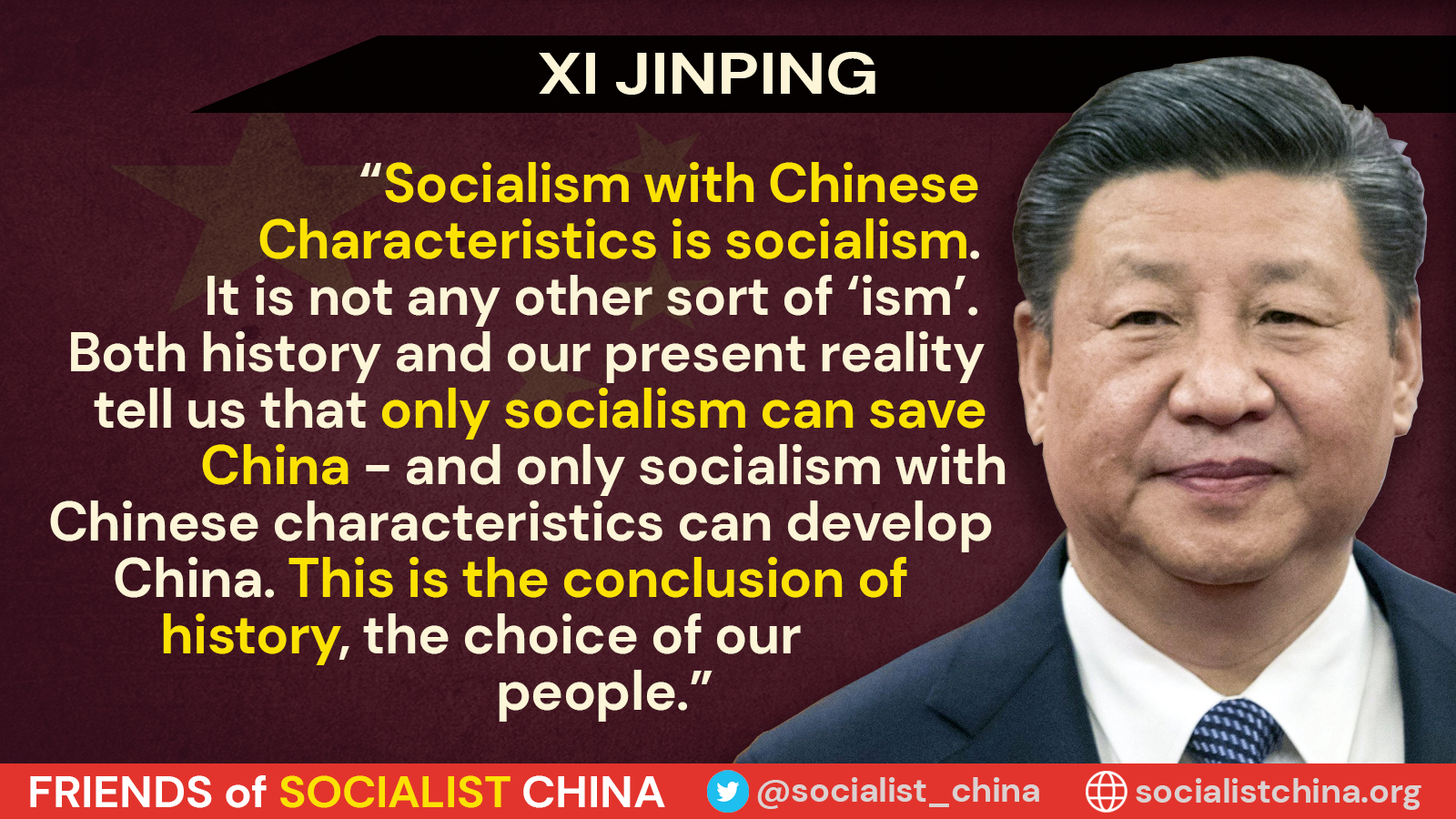
This does not mean China is socialist in any classical sense. “Socialism with Chinese characteristics” might more accurately be described as capitalism with Chinese characteristics: a hybrid system that tolerates markets while refusing to surrender political authority to them. The crucial word is authority. The Chinese state asserts the right to govern. The American state apologizes for its existence.

Ironically, the United States would need something like its own version of “socialism with American characteristics” to survive: a system that subordinates finance to production, treats health care and education as public goods, plans energy transitions over decades, and insulates core institutions from electoral whiplash. But such a transformation would require exactly what the American system cannot produce: permanent and irreversible investments in national health care, education, climate measures, nuclear disarmament, rent control, day care, labor unions, and wages that keep up with inflation.

Project 2025 is not the cause of American decline. It is the confession. It openly declares that the American right no longer believes in governing—only in dismantling. And because the system permits such nihilism to recur endlessly, because it contains no mechanism for enforcing continuity in the public interest, decline is not merely possible. It is inevitable.

The tragedy is not that China may surpass the United States. Civilizations rise and fall. That is history. The tragedy is that America is choosing decline in the name of freedom while hollowing out the very capacities that make freedom meaningful. A society that cannot plan, cannot remember, and cannot serve its people is not free.

It is merely ungoverned.

And ungoverned societies, no matter how wealthy they once were, eventually come to resemble the Third World they once presumed to lecture.

U.S. Divide & Rule Strategy vs. China’s Unifying Belt & Road Initiative

Readings for Pentecost Sunday: Genesis 11: 1-9; Psalm 104: 1-2, 24, 35, 27-30; Romans 8: 22-27; Acts 2: 1-11.

Last week Russia’s Vladimir Putin got the red-carpet treatment when he and virtually his entire government leadership met with Xi Jingping and his governing counterparts for a two-day summit in Beijing.

The collective west was apoplectic in response.

What were these two villains up to? Surely, they’re conspiring to take over the world.

The Washington Post fretted about connections between Russia and China on the one hand and with Iran and North Korea on the other.

But of course, what transpired last week in China is far bigger than any of that. It’s not just a worrisome alliance between the countries just mentioned. Ultimately, it’s a question of pacts between China, Russia, and the entire Global South (aka the Global Majority) that’s now taking practical form in BRICS+. And the threat there is not primarily military. It’s economic.

It’s the fearful (to the west) specter of a world order of cooperation, mutual benefit, and majority rule replacing that of western neocolonial empire with its ancient “divide and rule” tactics.

In the context of this Pentecost Sunday homily, you might even call such replacement “spiritual,” “biblical,” or (yes) “Pentecostal.”

Let me show you what I mean by elucidating what the west can’t understand about Russia and China’s shared project, about the difference between that project and the one favored by the collective west, and finally about the connections between all of that and today’s readings for this Pentecost Sunday.

The Project of the Collective West 

What the collective west cannot understand about China is that its worldview is radically different from its own.

Especially since the Reagan-Thatcher era, the west has returned to the Hobbesian and social Darwinian superstition that human beings are primarily individuals constantly at one another’s throats.

They’ve become convinced that humans are basically selfish and locked in a “war of all against all.” Hence, “forever wars” are normal and the best we can do.

Westerners have also come to believe that government is somehow the enemy, that its size must be reduced to such an extent that it (as Grover Norquist said) can be drowned in a bathtub. This means that market regulation and taxation must be reduced to a minimum.

Even more importantly, the prevailing western belief system holds that its somehow natural and divinely ordained that just 4.2% of the world’s population (i.e. the United States) should run the world. White people are exceptional. In traditional terms, the DICTATORSHIP of the collective west’s bourgeoisie (of the G7) is part of the natural order.

As a result, any threat to such hegemony must be crushed.

Westerners take all that as self-evident truth forgetting that IT’S JUST A POINT OF VIEW – that btw happens to perfectly support huge wealth disparities and favorable profit margins of the military industrial complex. They forget that there are alternatives – other viewpoints that happen to be working far better than the positions just listed.

The Project of Russia and China

And that brings us back to Beijing.

China, Russia, and the Global Majority have a different approach to political economy. And virtually no one in the west gets it.    

And it is here that China leads the way. It is led by a workers’ party that as such seeks to replace the “divide and rule” dictatorship of the bourgeoisie with the leadership of working classes and their political representatives.

This simply means that the Chinese Communist Party (CCP} aspires to walk a fine line that prioritizes the welfare of the majority over that of corporations, billionaires, and of a state entirely beholden to their interests.  The CCP has the final word. It protects local currency. Without stifling private enterprise, it protects its majority from the dictatorship of the bourgeoisie.

Accordingly, the CCP for example easily exercises eminent domain to advance projects (e.g. high-speed rail) deemed necessary to serve the common good. The CCP recognizes and suppresses as “corruption” egregious exercise of power on the part of the billionaire classes.

In short, Chinese political theory rejects “divide and rule” in favor of common good, multi-polarity, national sovereignties, and international cooperation. It seeks a world with room for everyone, with abundance for all, and where independent nations trade freely for mutual benefit. It is a world governed by international law directed by the United Nations. That’s the vision of “socialism with Chinese characteristics.”

Pie in the sky, you say?

Not really. Witness China’s success in eliminating extreme poverty in record time. Witness the success of its Belt and Road initiative. Witness all the countries lining up to join BRICS +.

For China, the west’s “divide and rule” gives way to multipolarity and cooperation. In contrast to the United States’ forever wars and its 700 military bases throughout the world, China hasn’t fired a shot outside its borders in more than 40 years and has only one military base outside its borders.

Today’s Readings
And that brings us to the readings for this Pentecost Sunday. They too contrast “divide and rule” strategies with those of mutual understanding.

What follows are my “translations” of the readings. Check out the originals here to see if I’ve got them right.

Genesis 11: 1-9: So, you think the “divide and rule” principle came from the Romans? If so, you’re wrong. “Divide and rule” came from the mysterious “Powerful Ones” (the biblical Elohim) who once ruled this earth. Where they came from no one knows. Perhaps from another planet or from all those leagues under the sea. In any case, they were terribly threatened by the humans they needed to supply them with the beef, gold and young virgins. (Powerful Ones always seem to require those.) So, when the Elohim saw humans cooperating to build cities with skyscrapers reaching to the heavens, the Powerful Ones intervened. They somehow made it impossible for people to understand each other. Suddenly they were divided into incomprehensible language groups. Ever since, other Powerful Ones (yes, like the Romans and the “Americans”) have aggressively adopted their own “divide and rule” strategies. They invent borders along with cultural, religious, and racial identities to keep humans apart lest they discover the immense power of universal cooperation.

Psalm 104: 1-2, 24, 35, 27-30: Far from dividing humans, Yahweh’s Great Spirit wills a New Earth whose creatures share the same breath and live in complete harmony, not division. Yahweh’s earth provides abundance for all including food and every good thing imaginable. Everything belongs to humans as a gift from Yahweh. She is indeed to be praised.

Romans 8: 22-27: This abundant Spirit of God is on our side as we earthlings struggle to replace the results of the Powerful Ones’ “divide and rule” strategies with God’s New Earth and its abundance for all. That shared plenty is what we’re all hoping for even though it’s hard to see in this purposely divided world. Resist! Be strong! Believe! Hope! God’s New Earth is possible! Another world is on the horizon. It is necessary.

Acts 2: 1-11: Fifty days after Yeshua’s assassination, his Spirit of community replaced the Elohim’s “divide and rule” scheme. With the descent of Yeshua’s Spirit, all language barriers vanished. Parthians, Medes, and Elamites, inhabitants of Mesopotamia, Judea and Cappadocia, Pontus and Asia, Phrygia and Pamphylia, Egypt and the districts of Libya near Cyrene, as well as travelers from Rome, both Jews and converts to Judaism, Cretans and Arabs, all understood that they shared a single Spirit uniting them all. They vowed to resume building the City of God –TOGETHER.

Conclusion

Yes, today’s readings suggest that China, Russia, and the Global Majority represented by BRICS + are on the right track. The United States and the collective West are not.

If Planet Earth is to survive, something like China’s approach to government, national sovereignty, common good, abundance for all, international cooperation, and multipolarity must replace Hobbes, social darwinism, forever wars, minority dominance, and divide and rule.

Ironically, the CCP is closer to the spirit of Pentecost than the “Christian” west.

Xi Jinping To Biden: You Can Do Multipolarity The Hard Way or the Easy Way; It’s Your Choice!

Readings for the 33rd Sunday in Ordinary Time: Proverbs 31: 10-13, 19-20, 30-31; Psalms 128: 1-5; 1st Thessalonians 5: 1-6; Matthew 25: 14-3

What do you do about an economic system you no longer believe in? What if it’s just interested in the monetary bottom line – making money without doing any real work. What if it shows no concern for women and their children?

Do you simply go along with something like that?

The readings for this Sunday show that it’s an age-old question.

Last week’s meeting between Joe Biden and China’s president, Xi Jinping raised it again.

Let me show you what I mean.

Biden Meets Xi

So, they finally met. Xi Jinping and old man Biden in San Francisco. That happened last Thursday at the insistent request of U.S. president’s team.

According to Alexander Mercouris, Xi showed up on his own terms predetermining where the summit would take place, making sure the streets would be cleaned up, and that there would be no anti-China demonstrations. China also set the meeting’s agenda.

Before that, however, the Chinese president gave two speeches to high level representatives of the U.S. business community, including Elon Musk and Bridgewater CEO, Ray Dalio. At both, he received standing ovations for saying that China’s doors are open for mutually beneficial business deals.

And the point of those agreements would not be to advance “America First,” or “China First” agendas, but to benefit everyone on the planet – prioritizing women and children.

China’s system, Xi implied, is not about favoring the wealthy according to some trickle-down theory. It’s about improving the lives of everyone, beginning with the least – as shown by China’s elimination of extreme poverty in its own context.  

Perhaps despite all that, the U.S. business community liked what it heard. Again, those standing ovations. It likes Xi. It knows which side its own bread is buttered on.  

But then came Xi’s meeting with Biden. What happened there?

Well, according to the Chinese readout as summarized by Mercouris, President Xi gave our old man a stern lecture.

America and China are at an unprecedented crossroads, Xi said. The U.S. can either take the path of cooperation or of opposition. The choice is up to America since it’s responsible for most of the world’s turmoil. Its response to virtually every problem is military.

According to Xi, choosing cooperation will help both countries prosper and the entire world as well. The path of opposition promises to end in tragedy for everyone.

China has its own problems, Xi went on. It has no desire to replace America as world hegemon. However, in our planet’s new multi-polar context, it will not abide U.S. interference in China’s internal affairs.

For instance, tensions between China and Taiwan will inevitably be resolved according to their shared timetable. The U.S. should therefore stop arms shipments to Taiwan. The latter is, after all, recognized as part of China by the State Department itself. Trying to further widen any gap between Taiwan and China promises those tragic consequences that Xi had referenced earlier.

And what was old man Biden’s response?

Platitudes and false smiles. Nothing about lifting sanctions or cancelling plans for more arms shipments to Taiwan. Just something about American and Chinese military officials maintaining communication and vague references to cooperation on climate change.

Then, after marveling at the luxurious design of Xi’s Chinese-made limousine, Biden bid his counterpart adieu smiling broadly. As Xi’s car drove away, the old man gave a triumphant fist pump as if he had accomplished something significant.

Subsequently, “our leader” convened a brief press conference where he promptly dismissed Xi as a “dictator.”

So much for diplomacy, not to mention maturity – from an octogenarian!

Today’s Readings

To repeat: I bring all of that up because today’s readings centralize something like the choice Xi Jinping described – between on the one hand something like the American hard, unfeeling exploitative economic system where the rich reap where they did not sow and on the other hand, a system like China’s that takes care of women and children.

That is, according to today’s liturgy of the word, prioritizing human need entails centralizing the role of women. Meanwhile, systems that primarily serve the rich are condemned in Jesus’ famous Parable of the Talents.

See for yourself. Here are my “translations” of today’s readings. You can find the originals here.

Proverbs 31: 10-13, 19-20, 30-31

Deeply centered women are the anchors of the world – far more than the superficially beautiful and apparently charming. The value of virtuous women is beyond precious jewels. They not only benefit their own families with food and clothing; they also recognize and share what they have with the marginalized and poor. In fact, homemakers should be paid for housework and given high positions in government.

Psalms 128: 1-5

Whether they know it or not, such women and those they care for are blessed. They are following the Divine Mother’s path. The gardens they cultivate (actual and metaphorical) overflow with rich foods. Face it: they are responsible for the very continuance and prosperity of humanity. The men in their lives should honor them accordingly.

I Thessalonians 5: 1-6

In fact, women’s pregnancy processes provide an apt image for the Divine Mother’s New World that we all anticipate. The enlightened among us (as opposed to those living in darkness) can already feel that the labor pangs are about to begin. Alert and clear-headed, the light-bearers stand ready like midwives to assist in the birthing.  

Matthew 25: 14-30

Such assistance in service of our Mother’s New Reality calls for departure from business as usual – from a system that rewards the 1% who do no actual work, but who rely on investments that end up enriching the already affluent while further impoverishing and punishing the poor and exploited.

Parable of the Talents

As I was saying, the readings just reviewed are about economic systems – one that treats its beneficiaries like the family they are, the other that prioritizes money and profit. The first three readings from Proverbs, Psalms and 1st Thessalonians reflect the values of a tribal culture where women’s productive capacity was still highly valued.

On the other hand, Jesus’ Parable of the Talents centers on the male world of investment and profit-taking without real work. In the end, the story celebrates dropping out and refusing to cooperate with the dynamics of finance, interest, and exploitation of the working class.

Taken together, the readings put one in mind of the contrast between China’s more people-oriented economy over against the U.S. exclusively profit-oriented system.

More specifically, Jesus’ parable contrasts obedient conformists with counter-cultural rebellion like the one embodied in Xi Jinping’s “Socialism with Chinese Characteristics.” The former invest in an economic system embodied in their boss – “a demanding person” the parable laments, “harvesting where he did not plant and gathering where he did not scatter.”

In other words, like neo-liberal capitalism itself, the boss is a hard-ass S.O.B. who lives off the work of poor women farmers like those celebrated in the Proverbs selection. The conformists go along with that system to which they can imagine no acceptable alternative.

Accordingly, the servant who is entrusted with five talents (more than 2 million dollars!) gains 2 million more and the one given two talents doubles his money as well. 

Meanwhile, the non-conformist hero of the parable (like China) refuses to adopt a system where, as Jesus puts it, “everyone who has is given more so that they grow rich, while the have-nots are robbed even of what they have.”

Because of his decision to drop out, the rebel suffers predictable consequences. Like Jesus and his mentor, John the Baptist, the non-conformist is marginalized into an exterior darkness which the rich see as bleak and tearful (a place of “weeping and grinding of teeth”).

However, Jesus promises that exile from the system of oppression represents a first step towards the inauguration of the very Kingdom of God. It is filled with light and joy.

Conclusion

China has taken more than that first step. It has rejected the U.S. model of world hegemony in favor of a multi-polar world.

If you don’t believe that, just think of China’s elimination of extreme poverty for almost a billion human souls. Its Belt and Road Initiative (now enrolling at least 150 countries) is a model of what the U.S. used to celebrate as “foreign aid,” but without strings attached or connection to regime change.

And all of this as well without juvenile fist pumps, name-calling, or sanctions that expel the disobedient into that darkness outside with its wailing and grinding of teeth.   

Yes, we need a change of economic systems – and of leadership that shows the maturity, patience, and diplomacy of Xi Jinping.   

The Ukraine War, Serenity & the Dawn of Hope

Readings for 33rd Sunday in Ordinary Time: MAL 3: 19-20A; PS 98: 509; 2 THES 3: 7-12; LK 21: 28; Lk 21: 5-19

As I read the news each day, I find myself wondering if we’re living in the “end times” described in biblical “apocalyptic” literature like we find in today’s liturgy of the word. I hope we are.

That’s because in the Bible, “apocalypse” isn’t a threat of doom, but a promise of hope. It’s not about the end of the world, but the end of the corrupt (imperial) order in which believers so often found themselves. The Book of Revelation (Unveiling), for example, pulls back the curtain covering first century Roman corruption and promises that it will all soon end.

In that sense, something similar seems to be happening today. (That’s what I try to point out in the video above.) Something new and hopeful is dawning worldwide.

For example, in Ukraine and on behalf of the Global South, Vladimir Putin is digging in the heels of those traditionally oppressed by U.S. imperialism and European colonialism and shouting a firm “NO!” to the bullies involved.

And then last week, I could hardly believe it when China’s President, Xi Jinping quoted Reinhold Niebuhr‘s “Serenity Prayer” at German Chancellor, Olaf Scholz. In effect Xi told Scholz that a new multipolar world has dawned and there’s nothing he or NATO can do about it.

I bring all of that up because this Sunday’s liturgy of the word addresses the promise of God’s new order (aka the Kingdom of God). It promises a reordering of the political, economic, and spiritual status quo that turns everything upside down. The promised purge features the definitive downfall of those now governing the planet. It promises justice, peace, and happiness for the rest of us. That’s the real meaning of the Jesus’ proclamation. It describes what the world would be like if the GREAT SOURCE (not Rome or the United States) were in charge of the world. 

However, the liturgy also affirms the uncomfortable fact that before that Great Reversal, true followers of Jesus must endure severe persecution — very troubled times like our own. According to the Master, great trials must precede the Kingdom’s institution. Jesus promised arrests, judicial silencings, jailings, and general persecution for those with the courage to follow his example as an opponent of empire and injustice.

See that theme for yourself by reviewing today’s readings here. In any case, what follows are my “translations” of those selections. They describe the new order (or what scripture scholar, John Dominic Crossan calls “God’s Great World Clean-up”) as advocated by the Jewish prophetic tradition and by Jesus himself. In today’s Gospel reading, Jesus outlines the inevitable consequences for any who act to hasten the Kingdom’s eventual arrival:

MAL 3: 19-20A

 Scorching times are coming
 For the rulers
 Of this world!
 Root and branch
 They will be destroyed
 In purging fire
 When God’s Great Clean-up
 Finally sets things right.

PS 98: 5-9
  
 The Great Purge
 Will at last establish
 God’s justice
 On earth
 Including environmental rectification
 For the entire planet,
 With its seas and mountains.
 Above all,
 It will mean
 Equity and justice
 For the whole human race.
 Everyone should be
 Happy about that.
  
 2 THES 3: 7-12
  
But don’t relax.
Long ago,
 Some in Paul’s community
 Thought the Purge
 Would take place
 “Any day now.”
 So, they stopped working.
 “Don’t do that,”
 Said Paul.
 “Your faith
 Shouldn’t make you 
 A burden to others.”
  
 LK 21:28
  
 However,
 Just because
 The Great Purgation
 Has yet to occur,
 Don’t lose faith.
 Know that it is
 Still somehow
 At hand
  
 LK 21: 5-19
  
So, you’re wondering,
Are you,
When exactly
The Great Clean-up
Will take place?
It will happen in three stages
 
First, there’ll be
Wars, terror and insurrections
Along with natural disasters
That will leave
Religion in a shamble.

Secondly, all kinds of charlatans
Will show up
Claiming to speak for Jesus.

Thirdly, even family members
And religious authorities
Will blame believers for all of it.
They will hate, persecute, and arrest them 
For simply following the Master,
Handing them over
To civil authorities
Deeply fearful
Of the wisdom 
Of their unassailable defenses.

 Jesus’ recommendations?
 1.     Reject false Christs.
 2.     Trust the Holy Spirit within.
 3.     Endure imprisonment.
 4.     Persevere!

All of that represents an extremely high bar, don’t you agree? Following the martyr, Jesus – the tortured one, the one imprisoned on death row, the victim of capital punishment – is never easy.

But does that mean that those of us living beneath the lofty bar set by Jesus are lost? Can we not be part of God’s Great World Clean-up?

Let’s hope that we can.

At the very least however, here’s what we can do in line with today’s final reading:

  • Reject false Christs by realizing that the meek and mild Jesus of mainstream Christianity is a distortion of the one recognized as subversive by the Roman Empire and by the compromised Judaism of his day. Jesus meek and mild represents the false Christ the Master himself warns against in today’s Gospel reading.
  • Instead, embrace Jesus’ rebel Spirit as much as possible by for example refusing to patriotically accept “official stories” about either Russia or China. Despite their very evident limitations, both are resisting imperialism and neo-colonialism.
  • Pray for the Spirit of civil disobedience that inspired great people of faith like the prophet from Nazareth.
  • Don’t be discouraged by delays in the Kingdom’s arrival or by the apparent victories of its enemies. Persevere!

Socialism’s Specter Revives in China’s Belt and Road Initiative

The Chinese are coming! The Chinese are coming! This time they’re here to spread socialism not by war and invasion, but by good example, economic development and cultural exchange. And in the process, they are eating our lunch. They are demonstrating that it is possible for poor and troubled economies to develop as quickly as China’s by following the latter’s example of mixing the best elements of capitalism and socialism to benefit working class people rather than primarily the rich and elite.  Their efforts are showing every sign of success.

Progressives should take heart. Socialism’s specter is once again on the prowl.  

Specifically, I’m referring to the Belt and Road Initiative (BRI) that actually looks like a Chinese version of a new Marshall Plan for countries representing 65% of the world’s population. Many of the countries involved would otherwise be unable to afford such development.

Particulars of the BRI include Chinese export of construction materials, especially iron and steel and their use to erect a huge power grid with wind and solar focus. The materials are being used to construct highways, rail facilities and sea ports to the benefit of Europe, Asia, the Middle East, and Latin America. The BRI will also include cultural exchanges and educational assistance. It will eventually account for 40% of the world’s domestic product.

That’s the impressive swath China’s trillion-dollar infrastructure-based development strategy that has been in place for the past six years – since it was announced by the country’s president, Xi Jinping in 2013. In his words, the Belt and Road Initiative is “a bid to enhance regional connectivity and embrace a brighter future.”

However, many in the west are not buying that rosy description. To them the BRI seems like a new form of colonialism. Since much of it is based on loans, critics have even described it as a “debt trap” intended to create dependency in order to reduce participating countries to the status of vassals of an imperial Chinese state.

Ironically, such criticisms actually reflect the patterns of western colonialism and neocolonialism whose “foreign aid” has in fact intentionally continued the traditional underdevelopment of the former colonies in Latin America, Africa, and South Asia. The critique also overlooks the fact that the Chinese plan is based on Marxist principles which are inherently anti-colonial and international rather than imperial and national.

In practice, all of this has yielded a system often described as state capitalism. That is, the Chinese state (like every other economy in the world!) has a mixed economy that (as I mentioned earlier) incorporates the best elements of capitalism and socialism. This gives the Chinese a huge publicly- owned sector along with a smaller, but still large private sector strictly regulated by the state. Crucially, however, and unlike our own mixed economy, the Chinese version aims at mixing its economy not in favor of the elite, but in favor of the working classes.

This is in strict accord with Marxist theory, which recognizes that capitalism is a necessary stage in the history of economic development. It cannot be skipped, because capitalism is required for the development of productive forces that are sine qua non preconditions for the transition to full-blown socialism.

Moreover, the whole world has been watching. We’ve seen China’s implementation of a worker-friendly state-capitalist form of economy as responsible for 80% of the poverty-reduction the world has experienced over the past two or three generations. That is, China has been more successful in reducing poverty than capitalism or any country subscribing to neoliberalism’s trickle-down model. The latter, of course, favors the 1% and expects 95% of the world’s population to endure austerity measures in order to pay the social costs for capitalism’s dysfunctions. None of that is lost on denizens of poor countries.

And now through the Belt and Road Initiative, those same less developed former colonies as well as the poorer countries of the EU are given opportunity to follow China’s example economically and even politically.

Regarding politics, the Chinese example and initiative are demonstrating that a one-party state like China’s might work better at least in some contexts than what we in the west understand by “democracy.” Surprisingly, for the west (where there appears to be a tacit agreement never to allow us to hear anything positive about competing systems) the Chinese version of political organization has proven to yield governance far more meritocratic, flexible and legitimate than our own.

Its meritocracy insures that no one will rise to national leadership in China who has not come through the ranks and demonstrated outstanding leadership capabilities at each step along the way. The whole process takes about 30 years. This means that by Chinese standards, someone like George W. Bush or Barrack Obama (much less Donald Trump) would not qualify to govern even a small province in China. They simply lack the experience and resulting knowledge that in China are prerequisite for assuming greater responsibilities.

Such leadership has made the Chinese system far more flexible in terms of reform than our own. Thus, in China the revolution began with the country following the Soviet model of development. That changed with the Cultural Revolution (1966-1976) which extended the revolution’s benefits to rural populations. This in turn was followed by Deng Xiaoping’s opening to the west around 1977, by entrance into the World Trade Organization years later, and now by Xi Jinping’s Belt and Road Initiative. Every one of those changes was profound and quickly made. Western capitalism has proven incapable of similar flexibility even in the face of climate chaos that threatens planetary life as we know it.

Moreover, in terms of public approval the Chinese system is proving much more legitimate than western models based on periodic elections. Increasingly, those latter models are corrupted by money. As in the United States, often inexperienced politicians (even comedians and reality show personalities) are elected by pluralities below 50%. A month or so after elections, their approval ratings can sink below 40%. This is because those elected prioritize the needs of their corporate donors rather than those of the people they’ve theoretically been elected to serve. As a result, we’ve increasingly lost faith in democracy-as-we’ve-experienced-it. In many elections, only a minority of Americans even bother to vote.

Meanwhile in China, Pew polling has nearly 80% of the population satisfied with the country’s direction. An even greater majority expects their lives to get better in the near future. Those numbers are testimony to government legitimacy far beyond what we experience in the United States.

So, while western governments and their economies lionize the past and strive to implement 18th century free-market policies, China’s Belt and Road Initiative is offering a different option.

And it’s doing so under the principles of internationalism and anti-colonialism based on sound Marxist theory. That theory has not only taken huge strides towards lessening world poverty; it has provided the world with an example of unprecedented economic dynamism. It’s no wonder that socialism these days is getting a new lease on life. It’s no wonder that its’ specter is once again haunting the world.