The do-nothing approach of the know-nothing Trump administration to the COVID-19 crisis has raised a fundamental question for me. Why are we paying federal taxes?
I mean, if (unlike countries even such as South Korea and China) “the greatest country in the world” can’t even make sure that its citizens have enough cotton swabs for coronavirus tests, what is it doing for us? Why am I paying taxes?
And I’m just talking cotton swabs – not to mention low-tech items like test kits themselves or plastic gloves, protective clothing for nurses and doctors, face masks for the rest of us, hospital beds, or ventilators. Cotton swabs!
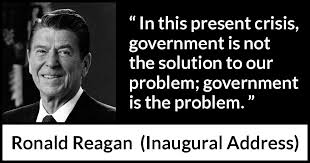
Of course, the answer is that we’ve somehow bought in to Reaganism. To use his words, it somehow convinced us that “Government is not the solution to our problem; government is the problem.”
Remember that? I do.
It was Reagan’s version of the Edmund Burke quote: “That government is best which governs least. . .” Or as Republican operative, Grover Norquist, put it, “I’m not in favor of abolishing the government. I just want to shrink it down to the size where we can drown it in the bathtub.”
Whatever the phrasing, its bottom line over the last 40 years has the government doing less and less for its citizens – and we end up paying more and more.
It’s as if we had two choices: (1) pay taxes those who provide us with the services we need (like healthcare, education, affordable housing, serviceable roads and bridges) or (2) pay them to those who on principle do nothing for us. Pay for something or pay for nothing! By electing Republicans (and many Democrats too), we’ve been making the latter choice.
Is that crazy or what?
And what’s the government doing with my tax dollars – and yours? It’s like we’re paying protection money — to our representatives — to protect us from the services we’re paying for.
I thought government’s first duty was to keep us safe. Right now, though, in the face of the biggest threat to our safety in the last 75 years, our “representatives” are doing nothing – absolutely nothing to that end.
And they’re proud of it.
In fact, we’re on track to re-elect the lot of them again next November.
Readings for the 5th Sunday of Easter: ACTS 6: 1-7; PSALMS 33: 1-2, 4-5, 18-19; 1 PETER 2: 4-9; JOHN 14: 1-12
Although it might not be apparent at first glance, the readings for this Fifth Sunday of Easter address homelessness. During this COVOD-19 pandemic, it’s an exceptionally vexing problem that finds many Americans unable to pay their rent or mortgages. In New York City, for example, many of those rendered homeless end up seeking shelter and the possibility of social distancing within the city’s subway cars.
As if in response to such developments, today’s selections centralize the concern of the Great Cosmic Mother for her children in similar situations of powerlessness and abandonment.
These, the readings tell us, were also the concern of Yeshua’s Jewish followers immediately following his death and the mysterious experience they came to call his “resurrection.” For those reformers of Judaism, social problems like hunger and homelessness were not to be solved by force or organized abandonment, but by compassion, sharing, service, and loving kindness.
Homeless in America
But before I get to that, think for a moment about homelessness in America. It’s deeply connected with the U.S. prison system which has actually become the de facto form that low-income housing assumes here.
That point was made last week on “Democracy Now,” when Amy Goodman interviewed Dr. Ruth Wilson Gilmore. She’s the co-founder of California Prison Moratorium Project (CPMP). CPMP represents an abolitionist decarceration movement in the United States which houses approximately one in four prisoners in the entire world. (Perhaps coincidently, the U.S. has also produced the same proportion of COVID-19 deaths.)
To begin with, Wilson Gilmore contrasted the U.S. approach to crime with those of other industrialized countries. Within our borders the emphasis is on deprivation, isolation, punishment, pain and force. By contrast, many other systems emphasize rehabilitation.
Of their “Reformative Justice” dispensations the interviewee said “Where life is precious, life is precious. In places where the state, the government, municipalities, social justice organizations, faith communities, labor unions work together to lift up human life, the incidence of crime and punishment, including incidents of interpersonal harm, are less likely to occur. . . We also see that in places where inequality is the deepest, the use of prison and punishment is the greatest.”
In the same interview, Wilson Gilmore went on to specifically address the problem of homelessness here and what she called our country’s strategy of “organized abandonment.” By that she meant urban organization like New York City’s, where working class neighborhoods are routinely razed to make room for gentrified condos and exotic shopping experiences.
There, displaced lower-class renters are left on their own. Some, of course, are welcome to return to their old neighborhoods as waitpersons, delivery personnel, janitors, nannies and caregivers. That’s bad enough, but others are excluded altogether. They’re left homeless and find themselves with nowhere to seek shelter and social distancing but in those MTA subway cars I just mentioned.
Nevertheless, instead of dealing with the real problem of homelessness, NYC’s mayor and the state’s governor have justified increased deployment of transit police who apply to the systemically abandoned the same sort of force that their counterparts use in American prisons.
In the U.S., Wilson Gilmore observed, force and violence turn out to be the default strategy employed to address most problems.
Today’s Readings
All of that contrasts sharply with the approach to homelessness depicted in today’s readings. They describe the first Christian community of Jewish Reformers. After all, they were followers of the great Hebrew prophet from Nazareth whose family found itself without shelter at the time of his birth. He later promised the poor that in God’s New Order (what he called God’s “Kingdom”) far from being displaced, they would inherit the earth itself.
What follows immediately are my “translations” of the readings in question. Please look at the originals here to see if I’ve captured their spirit in relation to hunger and homelessness.
ACTS 6: 1-7: Soon after Jesus died, a cultural social justice rift surfaced among members of his Jewish Reform Movement. Some (called “Hellenists”) were not Jewish enough for the rest of Jesus’ followers. Hellenists were too Greek – too like the despised goyim. So, in the daily distribution of food, Hellenized widows were neglected. In response, Jesus’ apostles appointed “deacons” precisely to provide daily bread for those women and their children. As a result, the Jesus Movement grew spectacularly among the Hellenists. Even many Jewish priests joined up.
PSALMS 33: 1-2, 4-5, 18-19: It is this sort of concern with fairness and justice that mirrors the love, trustworthiness, kindness, and generosity of our Great Mother Goddess. Even in times of severe famine, it is her will that no one starve or go homeless. She is merciful, and we place our trust in her.
1 PETER 2: 4-9: Jesus’ nickname for his friend Simon was “Rocky” (perhaps because he was especially good at throwing stones at Roman soldiers during the first recorded Intifada). In any case, Rocky (Peter) called early members of Jesus’ Reform Movement “living stones” in a divine House of Spirits. Jesus himself, Peter said, was its “corner-stone.” (Speaking from experience, Peter knew what stones can do to confuse enemies and bring them down.)
JOHN 14: 1-12: More than three generations after Jesus’ death, John the Evangelist, recalled Jesus as continuing the House of Spirits imagery. He has Jesus say: “In God’s GREAT HOUSE there are no homeless or hungry people. When you shelter the homeless, you are really sheltering me. That is the way of the Great Mother; it is my way too – the one I’ve manifested time and again by my concern for and identification with the unhoused, hungry, sick, blind, widowed, mistreated and despised. Follow my example. Even exceed it,” Jesus urged.
Conclusion
Taking seriously the centralization of housing as expressed in today’s readings should lead believers to dissent from our culture’s treatment of the incarcerated and homeless. Imprisonment and organized abandonment are no way to treat those left without shelter by policies favoring the wealthy instead of God’s favorites – those unhoused, hungry, sick, blind, widowed, mistreated and despised just referenced.
The readings also suggest the need for new policy initiatives. Such measures will include not merely taking care of food needs of single moms and their children (as depicted in today’s episode from the Acts of the Apostles) but also support for :
Outlawing evictions and foreclosures
Widespread cancelling of rents and mortgages
Building 12 million green housing units over the next 12 years
Massive investment in public housing under community control.
Rent freezes, rent control, tenant protections, and anti-displacement measures across the nation.
Of course, the chances of those measures taking legislative shape under the current political dispensation are about nil.
But that in itself shows how far Christians have strayed from actually following Yeshua.
Instead, we’re more like those among early Christians who looked down upon the culturally diverse Hellenists and neglected their widows and children.
So, today’s readings issue a special call to us to from Jesus, his main man, Rocky and the entire cadre of Jesus’ surviving apostles to become deacons – service workers at the disposal of the hungry and homeless.
After all, it’s the way of the Great Cosmic Goddess.
At last the left-wing environmentalists have come to their senses. Even the most extreme of them like Michael Moore has admitted that climate change is a hoax. So-called energy alternatives do more harm than good. And nothing can or should be done to address the Chicken Little faux problem of global warming – unless it’s reducing the number of people who have irresponsibly overpopulated the planet.
That’s the position adopted by more than one right-wing commentator gloating over Moore’s newly released documentary, “Planet of the Humans.” And for those who haven’t paid attention to the environmental movement, the evaluation might well ring true.
The film Itself
In making its case, “Planet of the Humans” for instance presents formidable rows of solar panels as perhaps only enough to energize a kitchen toaster. The film demonstrates that the elements required to manufacture wind turbines and electric cars require environmental devastation that destroys tribal lands and exactly parallels the coal industry’s mountaintop removal. And biomass is just crazy. The same holds true for ethanol and elephant manure. Too often, the purveyors of solar and wind technologies turn out to be fly-by-night con artists.
As for the heroes of the environmental movement, there just aren’t any (except, perhaps, for India’s Vandana Shiva who in a brief cameo dissents from biomass madness). Forget about the Sierra Club and Al Gore. Gore’s in bed with Virgin Airlines’ Richard Branson, Mike Bloomberg, Arnold Schwarzenegger, Barack Obama, and the Koch brothers. They’re all compromised, interested only in corporate profit, and speak uniformly with forked tongues.
The same holds true for Bill McKibben and his organization 350.org. He’s fumbling, inarticulate, and evasive – just the opposite of how many of us have seen him repeatedly over the years in venues like Amy Goodman’s “Democracy Now.”
No wonder climate change denialists loved the film. Observing their gleeful victory dances will disappoint progressives who likely find themselves upset with Michael Moore, whom so many have come to admire for his other films and his general political leadership. Even a sense of betrayal might not be out of place as the film undercuts an environmental movement at a particularly crucial juncture where time to save the planet is rapidly running out.
Josh Fox’s Counterpoint
In response to such understandable disappointment, Josh Fox the producer-director of “Gas Land,” – a documentary critique of the fracking industry – appeared recently on Krystal Ball’s and Sagaar Enjeti’s “Rising” news program. There, Fox criticized “Planet of the Humans” as fundamentally misleading. He pointed out the film’s puzzling misdirection in support of its thesis that renewable energy is not the panacea for climate change that environmentalists claim. However, according to Fox, “Planet of the Humans” errs when it:
Attacks and dismisses the basic premise of the alternative energy movement that relies on solar and wind sources, but not exclusively as the film suggests. Alternative energy must be complemented by reductions in consumption, by conservation of public lands, and by recycling and reusing.
Holds instead that reduction of consumption and population control represent the only viable ways forward. (The Malthusian overtones of such argument are especially reprehensible, Fox said, during a time of pandemic.)
Focuses on 10-year old technology as if huge strides have not been made in the past decade with both solar and wind power
Similarly advances the arguments that are not merely 10-years but 40-years old. They mirror perfectly what the fossil fuel industry has been saying during that near half century despite the fact that its leaders have known the links between their product and climate change the whole time. Even with that knowledge, they’ve argued (as the film itself implies) that the need for and viability of alternative energies is a matter of debate. In reality however, virtually the entire scientific community is in contrary agreement on the issue.
Spends an extraordinary amount of time addressing the pitfalls of biomass as though it were a major part of the alternative energy proposals. (In reality it accounts for 1.4% of non-fossil fuel alternatives.)
Ignores the environmental movement of the past 10 years, while arguing at the same time that a new more radical environmental movement is required
Specifically, avoids mentioning the extremely important Green New Deal, the Sunrise Movement, and the work of activist heroes like Naomi Klein, Greta Thunberg, and Bill McKibben around divestment from the fossil fuel industry. Instead, McKibben is specifically singled out as though he were a shill for the industry he’s been working against for decades. He’s criticized for support of biomass despite the fact that he informed the filmmakers beforehand that this is no longer the case.
Ignores the fact that most within the alternative energy movement stand in agreement with the filmmakers’ position that capitalism and renewable energy do not mix. At this moment of crisis with its need for an F.D.R.-like mobilization of productive resources, socialism is much more compatible with the movement’s goals.
Additional Points of Criticism
One could add to Fox’s criticism the facts that:
As John Gilkison has indicated, criticizing today’s electric cars for their continued dependence on coal, oil and gas is like disqualifying Model Ts in 1908 as viable transportation alternatives because they still relied on horse drawn wagons for delivery of materials to the Ford factory.
Obviously, wind power is not dependent on mountaintop removal procedures. In fact, mountaintops in Vermont do not at all represent the ideal spot for wind generators. Those would be found in the wind corridor stretching from North Dakota and Montana in the north to western Texas in the south.
Biomass does, of course, have a valuable place among today’s energy alternatives. It takes the form of fuel for wood stoves used by individual homeowners to supplement the energy generated by their rooftop panels.
The film misleads on the subject of population. At one point, it says that in a period of just 200 years, the globe’s population increased by a factor of 10. During the same period, energy consumption “on average” rose by the same measure. Clearly however, figures for average energy consumption make it appear that everyone on the planet is equally responsible for energy depletion. They are not. The United States with less than 5% of the world’s population, consumes around 25% of its energy. Meanwhile people on the African continent and elsewhere in the Global South consume far less. So, rather than giving the impression that there are too many people in the world, it would be more accurate to say there are too many Americans. The film avoids making that specific, but hugely important point.
Conclusion
“Planet of the Humans,” of course, is correct in positing that energy corporations like BP and Exxon are trying mightily to co-opt the concept of green technology. Moreover, the corporate version of energy alternatives continues to centralize and control solar and wind sources in massive plants. So, they build expensive energy-intensive installations that depend on solar panel arrays the extent of football fields or on thousands of easily destructible mirrors located in the desert to reflect and somehow gather the sun’s energy. The business model of these concerns has them retaining control of “smart grids” just as they did with the dumb ones formerly powered by oil and coal.
Moore’s film is correct: such “solutions” are top-down and hugely problematic.
However, there are more democratic bottom-up models of energy production. These have homeowners installing solar panels and water heaters on their own rooftops. Bottom-up models similarly turn every office building into its own energy production unit. In this way, solar energy democratizes production and takes it away from the giant corporations. Even today it has those concerns actually paying consumers for the energy homeowners’ solar panels feed back into the larger system. Jeremy Rifkin, for example, has written a great deal on this.
So, we’re left wondering why Michael Moore chose to ignore such patent truisms. Instead, he leaves his audience without constructive scientifically founded hope or alternative. He releases this disturbing film at this particular point in history when the Green New Deal is on the table. He gifts its opponents with the argument that even the “extreme left” now admits that anthropogenic climate change, if it exists at all, represents an insoluble problem.
Why in the face of contrary evidence, did Moore choose to support the right’s position like that? Why ignore the advances in the opposite direction that have emerged over the last 10 years? Why vilify climate heroes like Bill McKibben?
There are no apparent answers to these questions. Michael Moore’s credentials as filmmaker and progressive activist are impeccable. Progressives are still scratching their heads. . .
Readings for 4th Sunday of Easter: ACTS 2:14A, 36-41; PSALM 23: 1-6; 1 PETER 2: 20B-25; JOHN 10: 1-10
This week’s readings for the Fourth Sunday of Easter contain an important message for us in this time of Coronavirus. They call us to personal and community transformation – to persist in our recently imposed collective abandonment of the world’s values around profit, pleasure, power and prestige – the ones that are destroying our planet and that were rejected by the great prophet from Nazareth.
Given our immediate context, the readings’ implied message is: Don’t simply pick up where you left off. Instead embrace the new life that Mother Nature has so recently imposed. When the smoke clears, don’t go back to normal.
That’s the highly political theme of today’s readings. They focus on the image of “Life Itself as our guiding Shepherd,” and Jesus as the gate to the sheepfold protecting those within from destructive “strangers.” In biblical symbolism, such references are loaded with political meaning. Since the time of King David, Judah’s kings had always been referred to as shepherds.
So, when today’s familiar responsorial says, “The Lord is my shepherd. I shall not want.” It’s laying out a list of imperatives for kings like David. As God’s administrators, they are to make sure people have food and drink, shelter, leisure, and a clean and verdant environment.
And when John the evangelist has Jesus refer to himself as the sheepfold’s gatekeeper, John is calling attention to Jesus’ Way as leading from one reality (the world’s) to another, the fold he called the Kingdom of God. There, everything will be reversed. The first will be last; the last, first. The rich will be humiliated and the poor have the earth for their possession.
Unbelievably, the coronavirus has shed a bright light both on the corruption of what we’ve come to consider “normal,” and on what Arundhati Roy calls the “portal” and Jesus calls “the gate” leading to a revolutionary reality with kingdom overtones.
The Old Normality
To begin with, consider the old normal, specifically here in the United States.
Like the USSR in 1989, the USA has collapsed before our eyes in a matter of weeks. Yes, it’s already a fait accompli. And no one knows what to do about it.
The country’s economy has drawn to an absolute standstill. And it’s not going to return to normal any time soon. Unemployment is projected to exceed Great Depression proportions. People already routinely line up for blocks-long breadlines.
Moreover, the predominantly capitalist nature of America’s mixed economy has switched overnight to a predominantly socialist one. Instead of being allowed to perish (as capitalist theory would demand) the country’s largest enterprises have proven to require repeated bailouts from the central government. It happened with the Dot Com Burst of 2000, with the Great Recession in 2008, and now with the COVID-19 Crash of 2020. The system is completely unstable, and its survival requires those periodic infusions totaling trillions of dollars each time. Meanwhile millions go hungry and are left unemployed and wondering where their next meal might come from.
That’s called “socialism.” And in a matter of weeks, it’s happened in what we brag about as “the richest in the world.”
At the same time, the central government pledged by its Constitution to protect its citizens claims no responsibility to do so. It has left that obligation to local governments and to mutual aid organizations.
The resulting chaos has lifted the curtain that previously had prevented our realizing the actual swath of the sudden systemic collapse. Besides the political breakdown just noted, the disarray has touched at the very least, the following key elements:
Healthcare: Like nothing else, the COVID-19 crisis has laid bare the insanity of the U.S. healthcare non-system. We spend twice as much as the rest of the world in this area and end up with a vastly inferior product. U.S. healthcare has proven completely unable to respond to an absolutely predictable viral crisis. Disgracefully, with a far smaller population than China’s, we currently lead the world in Coronavirus deaths. As a result, polls show that a strong majority from both parties want to switch to single payer healthcare. However, presidential candidates from both parties, revealing their ownership by the insurance and pharmaceutical industries, steadfastly refuse to even consider that option.
U.S. Industry: America’s system of production has also proven far less able to respond to COVID-19 than China’s. Our industries cannot even produce enough cotton swabs, much less, simple products like virus test kits, hospital beds, or protective gear for its first responders. That too represents a failure of the underlying neoliberal capitalist system that has off-shored productive capacity for more than 40 years.
However, the systemic failure unfolding before our eyes goes much further. It touches:
A phantom democracy: Ours is a phony democracy. It is based on bribery masquerading as “campaign contributions.” Its voting machines are easily hackable. The reigning system of gerrymandering has politicians choosing voters rather than the reverse. Voter suppression is widespread and obvious. No wonder only about half of Americans bother to vote.
A decayed infrastructure: Roads are potholed. Bridges are increasingly dangerous.
Homelessness: Our streets are filled with people sleeping on grates, while homes and office spaces lie empty. The system can’t bring the two together.
Overflowing Prisons: The United States imprisons a greater proportion of its people than any other country in the world. Most of them are black and brown. This racist system has an imprisonment rate 5 times higher than most countries in the world. And conditions in the privatized prisons are generally abominable.
A propagandized mainstream media (MSM): Six giant corporations – Time Warner, Disney, Murdoch’s News Corporation, Bertelsmann of Germany and Viacom — own most newspapers, TV and radio stations. They act more like government propagandists and stenographers for politicians rather than fulfilling their traditionally assigned Fifth Estate function. Like those living in the former USSR, most of us have learned to mistrust the MSM in favor of on-line sources – the new samizdat equivalents.
A corrupt military: The U.S. military fights perpetual wars no one understands: To put down rebellions against its imperial policies, it currently spends (officially) nearly $2 billion each day ($718 billion in total annually). During the Obama administration, Americans dropped more than 26,000 bombs on Afghanistan, Iraq, Libya, Syria, Yemen, Somalia, and Pakistan. Its drones terrorized populations in those countries on a daily basis. In other words, the United States continues to be what Dr. Martin Luther King called “the greatest purveyor of violence in the world.”
A politicized “justice” system: The court system has been packed for the next generation to favor corporations and the rich rather than ordinary people. That’s true all the way up to the Supreme Court whose key decisions (like Citizens United) have neutered democracy and punished women and the poor. Its predominant right-wing members should be called “Injustices” rather than Justices.
Today’s Readings
With all of that in mind, consider today’s readings as they centralize the primacy of Jesus’ “Way” over destructive values like those that the United States has come to embody. What follows are my “translations;” you can find the originals here.
ACTS 2: 14A, 36-41: Jewish Peter continues last week’s first Christian sermon: Peter says, “The crucified Jesus whom you mistakenly executed achieved the full Christ-consciousness the world has been waiting for.” When the crowd heard this they asked, “What then must we do?” Peter answered: “In the Spirit of the Christ, reject the world’s values and join us in the reformation of life dictated by our own holy faith.” Thousands of good Jews said “yes” that very day.
PSALM 23: 1-6: His listeners’ “yes” was premised on a traditional Jewish understanding of God: The Divine One is an accompanying kind Good Shepherd – the traditional symbol of a king. The divine order leaves no one in want, but provides food and drink, housing, rest, comfort, refreshment, courage, protection for everyone without distinction.
1 PETER 2: 20B-25: In a later letter Peter elaborated: If the world hates and hurts you for trusting such a God, know that you must be doing something right. You’re actually following in the footsteps of Jesus. Remember how they insulted him and that he remained nonviolent even when it cost him his life. Such awareness will keep you whole and on the right path blazed for us by our beloved Good Shepherd.
John 10: 1-10: A even much later reflection on Jesus as Good Shepherd: Jesus often used strange imagery to confuse his enemies. For instance, he referred to himself as a shepherd and to foreign occupiers (“strangers”) as sheep rustlers. In today’s reading, he calls himself the “gate” of the sheepfold, but also the “gatekeeper.” In the spirit of Psalm 23 (above), he speaks of his friends as his “sheep” and the purpose of his shepherding as protection and fullness of life for them.
Conclusion
As already indicated, Arundhati Roy recently picked up Jesus’ gate theme. At the prospect of ending the current lockdown, she spoke of our standing before a “portal” leading to a new way of life. It opens onto the new world our Great Holy Mother Earth has displayed for us these last six weeks.
Whatever the immediate causes of the virus, it seems that the Goddess of All has used it to make us realize that the world’s catastrophic way of consumption, environmental destruction, hurry and stress is not inevitable. Rather, it is clearly possible for the entire world to leave all of that behind.
Our Mother has shown us unmistakably that we humans are the actual virus afflicting the world. With our infernal machines ground to a halt, the sky cleared, birds and animals returned to their natural habitat, and rivers ran clear again.
In fact, another world (previously considered impossible, unrealistic, and utopian) has been shown to be indeed possible. Its restoration constitutes the very meaning of the religious term “repentance.”
Readings for Third Sunday of Easter: ACTS 2:14, 22-32; PSALMS 16:1-11; 1PETER 1:17-21; LUKE 24:13-35
Today’s Gospel story is about dashed hopes redeemed by acceptance of Jesus’ Spirit of love encapsulated in the simple act of breaking bread with strangers. It’s about the replacement of discouragement and fear with hope and the prospect of entirely unforeseen, even miraculous possibilities.
Given our present context of pandemic, quarantine and presidential campaigns, I can’t read it without thinking of the dashed hopes of progressives. I can’t help thinking about the defeat of the self-styled revolutionary, Bernie Sanders and the presumed nomination of the de facto restorationist, Joe Biden.
For progressives, it all seems disastrous and beyond redemption. Where’s the hope? However, the example of former candidate, Marianne Williamson who synthesizes her Jewish tradition with that of Christians, offers reason for hope. It’s just too bad that we didn’t listen to her sooner.
Before I get to that though, think first about our context.
Our Lost Campaign
Begin by considering the irony of the present moment. Here we are stuck with, Joe Biden, the weakest entry in the original candidate field. Meanwhile, the strongest candidate – the one absolutely demanded by our extraordinary times – has slipped into political oblivion. I’m talking about Marianne Williamson.
Recall that at the beginning, more than 20 candidates announced themselves as contestants for the Democratic nomination. As far as the mainstream media (MSM) was concerned, Joe Biden was the odds-on favorite. Marianne Williamson, a spiritual teacher by vocation, was dismissed out of hand.
The irony is that now that the smoke has cleared, Joe Biden has indeed prevailed. And Marianne Williamson is looking better all the time.
Biden prevailed despite his pedestrian debate performances. All of them were entirely unnoteworthy except for his appearing generally confused, inarticulate, and (as ever) prone to embarrassing gaffes.
More specifically, doddering Uncle Joe showed himself to be a staunch upholder of a moribund status quo that the Coronavirus crisis has revealed to be crumbling all around. Clearly in cognitive decline, and even as the United States registers more COVID-19 deaths than any country in the world, the man can’t even acknowledge what’s apparent to most people everywhere. The U.S. healthcare system is a complete and utter disgrace. It must be replaced by a single payer arrangement like that afforded the citizens of all other industrialized nations. For more than 50 years, none of them has had trouble figuring out how to pay for public healthcare. Old Mr. Biden can’t seem to wrap his mind around that simple fact. Poor man.
Marianne Williamson
Then there was Marianne Williamson. At the beginning, she was an object of media ridicule. She was portrayed as a fluffy woo-woo new ager. Her inspiration drawn from A Course in Miracles (ACIM) was laughed at by the pundits. “Miracles?” They didn’t understand that in ACIM vocabulary, the term refers to any change of perception from fear to love. And such change is exactly what’s demanded by our times – particularly, as it turns out, during this COVID-19 pandemic.
Yes, Marianne was dismissed out of hand. However, those of us who have been following her for years and who had read her Healing the Soul of America, knew better. For us, she was a much deeper Bernie Sanders. In fact, when candidates like Mayor Pete, Kamala Harris, Amy Klobuchar, Corey Booker, Beto O’Rourke, and Tulsi Gabbard rushed to stop Sanders and endorse Biden, virtually alone among former candidates, Marianne stuck with Bernie.
She advocated all of his programs, but her rationale for doing so was much deeper. It was grounded in what she called a “politics of love.” It recognized clearly that our country’s fundamental malady is spiritual rather than economic. Hers was the very message Americans need to hear at this watershed moment. Fear is the world’s way; love is the Spirit of Life. A politics based on love is not only possible, we must realize, but required.
And over the years, Marianne has proven herself more eloquent in delivering that message than any of her candidate peers. She is far more articulate and inspiring than any of them – any of them! If she were in Silent Joe’s place, she’d be on TV every day encouraging all of us in this season of distress and explaining how to deal with it internally and externally. And she’d crush Lyin’ Donald Trump’s tedious pressers by contrast.
But even more valuable at this time of COVID-19, Ms. Williamson would lay out her inspiring policy rationale. It is first of all, that we can’t believe any of our politicians who mouth the neoliberal “Washington Consensus” with its trickle-down rationale and its idea of American exceptionalism. Even more generally, she’d insist that the wisdom of the world is 180 degrees opposite that of the underlying wisdom of Life Itself, whether we refer to it like that or call it Mother Earth, Nature with a capital ‘N,’ the Ground of Being, or for that matter, “God.”
Yes, she says, America has been great. And that greatness must be restored. However, it is found not in some top-down arrangement, where leadership comes from billionaires, bankers, hedge funders, giant corporations, or politicians. Instead, the greatness of the United States is found in its founding fathers and mothers, in abolitionists, women suffragists, labor unions, the New Deal, the Civil Rights Movement, and the Green New Deal. Such understanding means that we must look for bottom-up leadership and policies rather than the stale top-down proposals emanating from D.C. and the likes of Biden and Trump.
In the current crisis, she’d say, American greatness is found in the immigrants (many of them undocumented) whom we’ve come to depend on to harvest our food, serve us in grocery stores, deliver our packages, and sweep floors and clean toilets in our hospitals. Ironically, the very ones vilified by President Trump are our economy’s real essential workers – more so than any of our politicians. Those workers are heroes and we all owe them a huge debt. They should be bailed out first. In fact, if bailouts are in question, the order of rescue should be (1) ordinary people, (2) mom and pop businesses, and (3) banks and corporations – not the reverse.
Today’s Readings
To get all of this in faith perspective, please read today’s liturgical selections for yourself here. See if you can discern the connection with what I’ve been saying. My own “translations” runs as follows:
ACTS 2:14, 22-32: The Earliest Christian FaithAddressed by Jews to Jews: Jesus was a wonderworker who fulfilled the “prophetic script” of being rejected and assassinated by his own people. But as with past prophets (as described by David) his soul has proven to be immortal. He lives! His Spirit cannot die.
PSALMS 16:1-11: Jesus’ Spirit Shows Us the Path to Life: We take refuge in that Spirit which his followers have inherited. When we’re disturbed it tells us what to do. It makes us happy, joyful, and confident even in the face of death.
1PETER 1:17-21: Follow That Path: Yes, they spilled Jesus’ blood like a lamb led to slaughter. But that wasn’t the end of him. His Holy Spirit remains (as it always has) to save us from a meaningless life devoted to the mere accumulation of gold and silver.
LUKE 24:13-35: The Miraculous Walk: That firstEaster morning two of Jesus’ disciples were walking to a town seven miles from Jerusalem. Sadly, they could talk of nothing other than the tragic events of the previous weekend. Jesus joined them unrecognized. With a jester’s smile, he asked about himself and his story. The two earnestly recounted the tale of their dashed hopes concerning a wonder worker from Nazareth assassinated by the religious establishment – and the women’s crazy account of a miraculously empty tomb, angels and new life. “There’s nothing odd about that,” Jesus explained still smiling. It’s the “prophetic script.” It’s what has always happened among our people. Still not recognizing Jesus, the two begged him to have supper and stay the night with them. During the meal, Jesus broke bread as he had at his Last Supper. And in that action, the two disciples recognized Jesus. Suddenly, he disappeared. The disciples practically ran back to Jerusalem to report what they saw as the result of breaking bread with a stranger who turned out to be the (risen) Christ. The world has never been the same since.
Conclusion
Yes, instead of Marianne Williamson, we’re stuck with sleepy Joe Biden. And, if you’re like me, you’re discouraged by this awful turn of events. Together we’re like those two disciples that first Easter Sunday walking down the road to Emmaus. And so far, this homily has been like the conversation of those two before Jesus joined them to put everything in perspective. It’s been about what might have been. All seems lost.
But the Christ-consciousness championed by Marianne (and Jesus himself) asks us to bring our darkness into the light of resurrection belief (however we understand it). That consciousness makes it clear that miracles are possible. In ACIM’s sense of fundamental changes in perception from fear to love, they happen all the time.
And at the moment, with the entire world shut down (who would have thought that possible?) we stand before what Arundhati Roy calls a “portal.” The doorway leads from our old world to a new one of the type described for us not only by Marianne Williamson, but by Jesus himself and all the great avatars of human history.
While Joe Biden calls us to turn back, Marianne Williamson joins Jesus in urging us forward into an awaiting new world. There the first are last and the last are first. It’s a planet with room for everyone.
We now know Marianne Williamson won’t be the one to lead us through the beckoning portal. It’s up to us all to rise to the occasion and resurrect everything to a new way of life. Yes, it’s up to us.
I found “Murder Most Foul” intriguing. Its retelling of the assassination of JFK was provocative as it attributed it to Deep State forces. But the lack of melody was disappointing. It was also difficult to understand the connections between Dylan’s narrative and the over-long list of songs he centralized. It seemed mostly random and unconnected. Along with references to his story, my own “translation” tries to subtly connect as many of those song titles as I could to Dylan’s well-told tale. I’ve referenced “Only the Good Die Young,” “I’d Rather Go Blind,” “Scratch My Back,” “Please Don’t Let Me Be Misunderstood,” “Twilight Time,” “Another One Bites the Dust,” “The Old Rugged Cross,” “In God We Trust,” “Cry Me A River,” “That Old Devil Moon,” “One Night of Sin,” “Misty,” “Anything Goes,” “Blue Sky,” “Deep in a Dream,” and “The Blood-Stained Banner.”
Near the Ides of last March
The Seer from Duluth
Sang a swan’s song
To all
About murder and truth.

He sang to a world
Sick and under arrest
In a globe-wide pandemic
And put to the test
By an earth in decay
In the Antichrist’s age
When faith, hope and love
Disappeared from the page
(Of our nation’s own book).

It all began
(He said)
On a Dallas dark day
In the blinding-bright sun
Which brought hell to pay
To an Aquarian Age
Shaped by spinning magicians
With a shot that all heard
But nobody listened.
They exploded the head,
They blew the brains out
Of the King JFK
(But we’re all left in doubt)

He was a sacrificed lamb
Put down like a dog
Mocked and shocked
By the killers
While spreading a fog
Yes, everyone watched
But few can recall
What our own eyes revealed
We saw nothing at all.

It was carefully planned
During nights filled with sin
And carefully timed
With LBJ in
Standing prepared
To step forward and take
The place of late Claudius
At 2:38.

The message was sharp:
We forbid New Frontier
Segregation will stay
With everyone here
With ghettoes in ruins
Illumined at night
By red lights and crime
It’s all such a fright
Ruled by cops on the beat
To enforce
Elm Street’s nightmare
For the sake of elite
For the sake of what’s right for
Cash on the barrelhead
(After all, business is business).

We’ve seen this crime’s movie
Again and again
But frankly, Miss Scarlet,
We don’t give a damn
We’re distracted by Woodstocks
Beatles, acid and flags
We’re forbidden to ask
As if mouths filled with gags
Prevented owl’s questions
Beyond what we’re told
About Oswald and Ruby
We’re left out in the cold
With mouths firmly shut
With those questions so old
All left unanswered
(And subject to scold).

It’s all unfair to Jackie
And Marilyn too
It’s unfair to us
To me and to you
We’re blind by our choice
To back-scratchers all
Who refuse to take questions
Whenever we call.
They kill all the young
The brave and the good
They make us all fearful
That we’ll be misunderstood
At this twilight time
As rivers we cry
Watching our heroes
All bite dust and die
As we sing about crosses
And the God who’s a lie.

So, we’re all feeling misty
Lonely but brave
Under the old devil’s moon
As in Plato’s dank Cave
We wander in mystery
Where anything goes
We’re deep in a dream
When we’ll wake
No one knows.
We’re surrounded by darkness
Nightfall and death
Under a banner
That’s blood-stained
With nothing that's left
But music and jazz
And that prophet
In howl
Who shakes us to wake us
About murderS most foul.
Readings for 2nd Sunday of Easter: ACTS 2: 42-47; PSALMS 118: 2-4, 13-15, 22-24; 1st PETER: 1: 3-9; JOHN 20: 19-31
Last week, on Easter Sunday, I presented Jose Mujica as a model president. Mujica, I pointed out, was the president of Uruguay from 2010 to 2015. He had been a Marxist Tupamaros (Robinhood) guerrilla since his student days. He was arrested, imprisoned and tortured for 12 years – 3 of them spent in solitary confinement at the bottom of a well. As president, he introduced profound changes in Uruguayan politics. As I noted, he took steps towards the legalization of all drugs in an effort to defeat the country’s drug gangs.
But perhaps Mujica’s most impactful step came in the example he offered national chief executives everywhere in his rejection of the typical presidential lifestyle. He gave away 90% of his yearly salary to the poor and dedicated that money to providing housing for the country’s homeless. He sold the presidential limousine in favor of retaining his old Volkswagen beetle. He continued living with his wife in his run-down peasant farmhouse.
In my frustration over this year’s Hobson’s choice between Trump and Biden, I couldn’t help thinking: what if we chose a U.S. president who did something like that? What if, instead of looking for leadership to billionaires like Trump or lifelong politicians like Biden, we elected someone like Jose Mujica – a peasant, a worker, a radical thinker? How would that change American politics? How would that change the world?
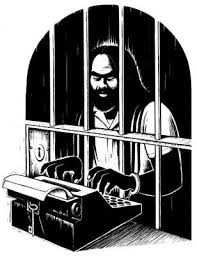
What if we elected someone like Mumia Abu-Jamal? Abu-Jamal, of course, is the Marxist Black Panther journalist who had spent years as a political prisoner on death row. Allegedly he killed a Philadelphia police officer in 1981 – a charge he has always vehemently denied. In any case, he regularly publishes insightful, edgy comment from prison and is often interviewed on NPR and programs like “Democracy Now.” What if Mumia were our president?
I raise those questions because they’re suggested by the readings for this second Sunday of Easter. They expose us to the shocking fact that resurrection for the first Christians turned everything completely upside-down. They actually embraced communism and recognized as their leader a worker, a victim of capital punishment from death row. Yes, they embraced the communist ideal that inspired both Mujica and Mumia Abu-Jamal.
Today’s Readings
The readings are brilliant and timely in that they not only give us an insight into the primitive Christian community. They also urge us to turn our politics upside-down. They do so first by offering an abstract description of the original Christian community, and then by fleshing out that description with narrative about a key encounter of a skeptic with the risen Christ who embodies the basis of the communist vision – identification with society’s victims and despised.
Here are my “translations” of those readings. You can find the originals here to see if I’ve got them right:
ACTS 2: 42-47: The first Christians were communists. Following the teachings of Jesus, they prayerfully shared meals each day and all their possessions – from each according to ability to each according to need. Their example was so awe-inspiring that everyone loved them, and their numbers grew rapidly.
PSALMS 118: 2-4, 13-15, 22-24: Christian communalism was a dim reflection of the benevolence of Life Itself as demonstrated in nature and throughout human history. No one truly owns anything; it’s all GIFT. Though unrecognized by the world, renouncing private property is the rejected cornerstone of human community – the key to surmounting every human problem. Accepting this truth, even in the worst of times, those committed to justice manifest super-human strength, courage, and joy.
FIRST PETER: 1: 3-9: It’s as if they were all born again into a new creation filled with hope that is stronger than death itself. Talk about inheritance! Communal sharing has made us richer than kings and their vast storehouses of gold. We’ve experienced the very goal of history – even though the world’s opposition to our sharing obscures the fact that we are on the right path – the one blazed by Jesus himself (and the other great divine incarnations). There is no other portal to human happiness.
JOHN 20: 19-31: Fear of the world, its violence and opposition to Jesus’ communalism has intimidated us into denying his way. Yes, we’re all denialists like the one they called “The Twin” (Didymus). He is our double in rejecting in absentia Jesus’ Holy Spirit of peace and forgiveness, of sharing and community that make peace possible. Correcting false perception means recognizing Christ himself in those the world has wounded and assassinated for daring to follow him.
Christian Communism
Please do read for yourselves today’s first reading, ACTS: 2: 42-47. It’s significant that on this week after Easter, the passage immediately directs us not to “spiritual” concern with heaven and the afterlife, but to material property, land and the primacy of the marginalized in organizing community life. Here’s a fuller description of the way the early Christians lived. You’ll find it in ACTS, Chapter 4:
“Now the whole group of those who believed were of one heart and soul, and no one claimed private ownership of any possessions, but everything they owned was held in common. With great power the apostles gave their testimony to the resurrection of the Lord Jesus, and great grace was upon them all. There was not a needy person among them, for as many as owned lands or houses sold them and brought the proceeds of what was sold. They laid it at the apostles’ feet, and it was distributed to each as any had need.” (Acts 4:32-35).
Note that the description immediately connects the interior lives of believers (heart and soul unity) with communizing the group’s possessions. They sold their land and houses, pooled the resulting resources and redistributed wealth on the basis of need. All of this was an expression, the passage says, of early Christian belief in the new way of life expressed in the term “resurrection.” Communism was the logical, practical expression of following Jesus’ teaching. Doing so brought the community grace, i.e. favor with God and with those outside their community.
How different that understanding is from what, in effect, we’ve been taught since infancy about capitalism as somehow God’s way. It’s as if the above passage read:
“Now the whole group of those who believed entered into competition with one another. They fiercely guarded their possessions and considered private property as sacred. With great power the apostles gave their testimony to the dog-eat-dog world Jesus described as God’s Kingdom. So, they all viewed the “needy” as lazy and unproductive. They evicted them when they defaulted on rent and then tore down their hovels to enrich themselves and develop gentrified neighborhoods. In this way, Jesus’ early followers became rich and prosperous, while the poor got their just deserts – poverty and misery.”
I’m not exaggerating. That emphasis on private property, on the law of the jungle, and justifying a resulting gap between rich and poor is embraced by many Christians as if the godly life Jesus endorsed could be described exactly as above.
Jesus’ Place in Communism
Now switch your attention to the Gospel reading for today. It brings us inside the first Christian house church whose communism was described abstractly in the reading from the Acts of the Apostles. It shows Jesus’ closest followers affirming the enduring relevance of their hero as a leader remarkably like Mumia Abu-Jamal. He’s dark-skinned and condemned under false charges by the state. He not only comes from death row; he was actually a victim of torture and capital punishment. And yet, he somehow lives and continues to teach his way to community happiness!
Recall the scene. Jesus’ closest friends are in hiding, imprisoned by fear of the Romans who had just executed their great teacher and of their traitorous fellow countrymen – the Temple priests and scribal establishment – who cooperated with the foreign occupiers.
So, the doors are locked and bolted. Jesus’ inner circle feels threatened, lost and betrayed by their own naivete in following a quixotic revolutionary who had filled them with such hope for the arrival of the Kingdom of God.
Inevitably, however, conversation must have turned to Jesus, his teachings and to rehearsal of the tragic events of the Passover weekend just completed. And those memories evoke Jesus’ presence, even for the iconic skeptic, Thomas called Twin (Didymus) and “Doubting.”
Thomas is really our Twin in his reluctance to believe that salvation can come from an executed criminal – or, perhaps more accurately, that life is stronger than death. And yet, like Karl Marx, he discovers that the deliverance of the human race comes from below, from a despised member of the working class, not from above and the royal or priestly classes so admired by the mainstream.
Conclusion
Thomas’ reluctant faith and that of his community as presented in today’s readings, call us to a twofold realization. The first is that our entire way of life is on the wrong track. Happiness and the good life (escape from out profound unhappiness) are not found in individual pursuit of wealth as the capitalist story of Jesus would have it.
No, it’s found in radical sharing that has us orienting community life towards the welfare of the least among us – as was the practice of the first Christian community. (That is, as I’ve shown elsewhere, mixed economies are all we have. But they should be mixed in favor of the poor in percolate-up ways rather than in favor of the rich with trickle-down policies.)
The second Thomistic (and Marxist) realization is similar. It’s that we’ve been looking for community leadership in all the wrong places. Our leaders need to come not from David’s palaces, not from Temple priests, but from the streets, from carpenters’ workshops, and even from death row.
Imagine, if we embraced the communism exemplified in today’s readings as our guiding North Star. Imagine if instead of Trump or Biden, Jose Mujica or Mumia were our president. Imagine if we could overcome the denialism of our twin, Thomas the Doubter. That’s the kind of radicality followers of Jesus are called to.
I recently wrote a piece here and for OpEdNews entitled “Why I Won’t Vote in November.” It evoked passionate response from readers I greatly respect. They saw it as conceding the reelection of Donald Trump. It was an exercise, I was told, in elitism. It ignored the plight of children in cages at our border as well as Trump’s mishandling of the COVID-19 crisis. It overlooked what should be the main goal of progressives – the defeat of Donald J. Trump at all costs.
My point however was that the goal of defeating Donald Trump is indeed not enough. It won’t cure what’s wrong in America. And that’s because it’s the entire system we live under that must be replaced. It’s entirely corrupted. Democracy has already been all but exterminated in our country. And I deceive myself if I think otherwise.
The whole system (from the executive office to the Congress to the Supreme Court) is anti-worker, anti-people, and pro-corporation. It must be allowed to fall and be replaced. More specifically, the nation’s voting system is corrupt beyond recall, Democratic candidates (like Biden) are perennially pathetic – only marginally different from the Republicans – and Joe Biden epitomizes the pathos and systemic failure as few have before him.
A Corrupt Voting System
Begin with the voting system.
They don’t even want us to vote! They’re quite clear about that. And I’m not just talking about the Republicans. No one – Republican or Democrat – is taking serious steps towards eliminating the Electoral College, instituting public funding of all campaigns, creating a voting holiday, establishing same-day voting registration, eliminating hackable voting machines, or turning over the electoral process to a bi-partisan centralized commission to eliminate gerrymandering and ensure that the same rules apply to every state. That’s how bad it is.
As a result of all that, voting has become a complete sham. It contradicts the received wisdom insisting that “every vote counts.” That’s a lie. Look at all the electoral shenanigans in Wisconsin, North Carolina, Georgia and elsewhere. The whole point is to remove partisan-threatening voters from the rosters. No wonder fewer than 60% of eligible voters participate. Consciously or unconsciously, the dropouts know the system’s rigged. They have no dog in the fight.
And let’s be clear, it’s not the “elites” that aren’t voting. It’s the poor, minorities, and working classes who long ago came to the conclusion that their votes don’t matter. To begin with, their ballots might not be counted. But even if they are, those elected won’t attend to the concerns of wage workers, the unemployed, homeless and uninsured.
Still, our overseers (and others) want to shame the rest of us into voting, even when the “lesser of two evils” brings us the same tired polices that serve no one but themselves and their rich employers. What I’m saying is that despite those efforts at shaming, I more and more see the point of working-class non-voters. And if nothing fundamental changes, I’m going to join them.
Perennially Weak Candidates
As for the position of the Democratic National Committee (DNC) that my not voting equals a vote for Donald Trump. . . How about huge VOTE that the DNC itself has cast for Trump by its absurd choice of yet another milk toast candidate – this one far weaker than their last? She couldn’t beat Trump; so, how can he? He’s weaker than Hillary, Gore, Kerry, Dukakis, or Mondale. And how did those centrists work out for us? No, it’s the Democratic Party that’s voting for Donald Trump. They love Republican policies. In fact, they’d rather have Trump than Bernie Sanders. They are champions of the status quo.
That’s shown by the fact that their “victors” like Clinton and Obama came to represent nothing more than Republican Lite. What disappointments both of them turned out to be! Big promises followed by the same neo-liberalism, the same trickle-down nonsense, the same wars, the same destruction of the planet. Despite Obama’s slogan, there was no hope, no change.
It all makes me wonder why the Democratic Party keeps giving us such uninspiring, self-defeating choices? That’s on them. It’s on them for giving us a candidate this time who, even in the midst of the present pandemic, insists that he’d veto Medicare for All – which the majority of Americans desperately need. He’s also like Trump in wanting us all to go back to work even if it means that many will die as a result – for the sake of the economy and Wall Street profits. And don’t even talk about his positions on the Green New Deal, free college tuition, forgiveness of debt, or Social Security.
The Case of Joe Biden
In fact, have you ever heard Mr. Biden offer a single defining policy initiative of any kind? Even one? I haven’t. And that’s because (Correct me if I’m wrong) he hasn’t given us any. His only claim is that he’s not Donald Trump. That’s it.
I’m asking then: do citizens deserve blame for perceiving that the fight is fixed in favor of the donor class of both parties? Both candidates are their champions not ours. So, are we blameworthy for realizing that we’ve seen this movie before? Should we be ashamed for demanding that Biden actually earn our votes – that he take action to convince voters that he’s worth voting for as someone other than a leering old man marginally nicer than the other imbecile?
In fact, Biden’s not that much better. Like Trump he’s a pathological liar. He’s also a worse mass murderer. Remember, Biden promoted the Iraq war. (It was no mistake. Anyone paying attention could see right through his justifications and those of Colin Powell.) That war has killed more than a million Iraqis. Even Trump hasn’t gone that far.
Moreover, the immigration policy Biden cooperated with was overseen by a president who quickly became known as the “Deporter-in-Chief.” Additionally, with the cooperation of the mass media, Biden has managed to evade addressing credible charges of sexual assault.
As I said, the system’s rigged. The Democratic Party is as bought-off as the Republicans. Neither the reigning system of political economy nor the Democratic Party is worth supporting. We’ve got to let them fall and be replaced. And the sooner we all realize that, the better.
Conclusion
Yes, I agree that it might make one feel heroic (in a quixotic sort of way) to pledge standing for hours in a driving rain to vote for a near corpse to save us all from Donald Trump. Still, those in soaking sneakers will surely know that their votes very literally might not count. And even if, by some miracle they do, voting for the geezer in question won’t significantly inhibit the inexorable process of climate change. Neither will it lessen the prospect of nuclear war. (After all, it was the Obama administration that decided to modernize the nuclear arsenal.) And it won’t bring us Medicare for All, forgiveness of student debt, or even guarantee the salvation of Social Security.
But you can bet it will mean millions, billions and trillions for the donor class.
Remember, our savior from Mr. Trump has promised those all-important constituents that “Nothing fundamental will change.” Take him at his word. What’s the point?
It was a miracle
No one thought possible
Before Ash Wednesday.
Suddenly,
Traffic stopped,
Stores closed,
Schools shuttered,
Even churches.
Focus shifted
To health, family,
Leisure,
Jokes, stories,
Children, grandchildren
Lovemaking,
Reading, studying,
Conversing, writing,
Napping, dreaming,
Cooking and eating
Together.
Houses never cleaner –
Or messier (Your call).
Finally knowing
That Special Other,
And our very selves.
Imagining and living
Without hated jobs
And nosey bosses.

With cards freshly reshuffled.
The New Deal came
They said couldn’t be.
Hearts opened
Skies cleared
People sang
From porches
And open windows.
Eyes smiled
With other masks
Dropped and replaced.
Could you tell?

And now it’s Easter
Sad tears for the dead
Clear eyes
To see that their passing
Was no Act of God
Or preordained,
That New Life,
Another way
Is possible NOW
(It always was)
Where no one
Dies like that,
And no one’s work
Brings tears,
Where all finally
Get that recompense
Guidance and well-being
Each child deserves.

So, no matter what
Wall Street’s
Wolves and vultures
Might howl and screech,
From behind
Presidential Podia,
Tell them:
There’ll be no return
To the tombs we knew
Before Good Friday,
Ash Wednesday
And our cleansing
Lenten fast.
Seize the day:
It’s Easter
NOW
Like never before!
On this Easter Sunday, I want to tell you a story of resurrection. It involves the ex-president of Uruguay, Jose Mujica, and his personal resurrection from three years in a tomb. It’s about how he not only advanced his country’s resurgence from its profound drug problem, but set a shining example of national leadership from his country’s highest office.
The story is intimately connected with that of the poor man, Jesus, whose immortality billions celebrate today. As today’s readings tell us, this healer, teacher and champion of the poor spent three days in a tomb and is more alive today than ever he was 2000 years ago.
Focus on Mujica’s story comes from a personal experience that I had last January when I spent a couple of weeks at the border in Tijuana Mexico. There I worked with pro bono lawyers and volunteers offering legal help to immigrants, refugees and asylees. The group is called Al Otro Lado.
In helping clients fill out paperwork, I discovered that most of the Mexicans, Hondurans, Guatemalans, and others I interviewed were driven from their countries of origin by drug gangs.
On the one hand, the experience made me think in general about drugs, addiction, and our country’s century-long “War on Drugs.” On the other hand, it drove me to reflect more deeply on resurrection and the possibilities for new life we celebrate on this Easter day.
The War on Drugs
Start with the war on drugs. Of course, we’re no closer to winning it than when first it began in 1914. (Before then, you could buy cocaine-based remedies, for example, at your local drug store – and at a low price.)
Moreover, so many of the problems that plague our world can be traced back to that spectacularly unsuccessful war. It’s not just the addiction and the gangs. It’s also the billions upon billions of dollars that have been wasted, the corruption of governments and law enforcement agencies throughout the world, the millions of souls who have been incarcerated or forced to leave their countries, as well as the thousands upon thousands who have been murdered by drug gangs and their police mob counterparts.
It all made me think: what if there were no drug war? What if drugs were entirely legal again? Wouldn’t that drive the gangs out of business? And wouldn’t all those other related problems disappear? Wouldn’t that lead to a kind of resurrection of humanity?
Think about it. Drug decriminalization and legalization would profoundly change the world!
But you might wonder (as I did) wouldn’t drug decriminalization and legalization also vitiate the planet? Wouldn’t our kids (and maybe we ourselves) all get hooked and end up staggering around in drug-induced stupors?
As it turns out, the answer is No. As Johann Hari points out in his page-turner study, Chasing the Scream, (as is the case with alcohol) less than 10% of those who use even cocaine, crack, and Oxycontin get hooked. The other 90% often take those controlled substances for recreation every weekend (and even on some weekdays) and still carry on normally in their families. They hold steady jobs and contribute to their communities. Even those who become addicted mature out of their problem after about 10 years. This means that the War on Drugs, laws against narcotics, and the resulting havoc are connected with something like 10% of users.
All of this is because drug addiction is not the result of chemical “hooks,” so that anyone taking them becomes ipso facto obsessed. Instead, addiction is caused primarily by personal and social problems connected with childhoods marked by abuse, with loneliness, meaningless work, and lack of human connection.
Addictions are psychological and social diseases. They are not crimes. Punishing drug use as criminal only causes more drug use by aggravating its causes. It also feeds the gangs.
The Case of Uruguay
And that brings me to Jose Mujica and his resurrection from three years in a tomb. Mujica was a Tupamaros (Robin Hood) guerrilla during Uruguay’s revolutionary war against the country’s military dictatorship during the 1970s and ‘80s. He was captured by government forces, tortured mercilessly, and imprisoned for 12 years – three of them in the bottom of a well that his captors thought would be his final resting place. Those years gave him lots of time to think about life and his country’s problems.
When the revolution Mujica supported eventually triumphed, he in effect returned from the dead only to be elected his country’s president for five years (2010-2015). It was then that he set about decriminalizing the use of drugs beginning with marijuana. Contrary to all expectations, he was successful in reaching that goal.
[Not only that: as president, Mujica himself continued to live with his wife in their simple farmhouse. He gave 90% of his income as president to the poor (living on $775 per month), sold his presidential limousine to travel on public transportation, and passed legislation to give a laptop to every child in the country.]
The point here, however that the president’s action on the drug front represented a first step towards bankrupting his country’s drug cartels. His ultimate goal was to provide for users of all drugs a cheaper, safer, cleaner product, and set up locations for safe drug consumption. The facilities would be staffed by medical personnel, and by counsellors and life coaches intent on helping their clients find work, housing, and more meaningful lives.
In this way, drug cartels would suffer defeat and the country’s drug problem would be solved. Similar results from comparable policies had already been achieved in Switzerland, Portugal and elsewhere.
Easter Readings
Now, keeping in mind what I’ve just said about Mujica and drug use in general, connect it all to Easter. Read today’s liturgical selections. They recall that like Jose Mujica, Jesus of Nazareth set about bringing healing to the sick, liberation of captives from prison, and relief for the oppressed. Christian faith professes that such commitment brings enlightenment and (somehow) never-ending life. (What follows are my “translations.” The originals can be found here.)
ACTS 10:34A, 37-43: Peter’s First Proclamation of Jesus’ Resurrection: From the beginning, Jesus of Nazareth embodied God’s Holy Spirit of healing the sick and liberating the oppressed. For that, the Romans crucified him (their policy with all rebels). However, three days later, some of us (not all) were privileged to recognize him as still alive during our ritual meals together. Inspired by that experience, we ask you to join us in continuing Jesus’ work of healing and liberation.
PS 118: 1-2, 16-17, 22-23: Response to Peter’s Proclamation: Thank you, Divine Mother for this happy day! You have been so good to us, so powerful and unfailingly compassionate. You use the world’s “weakest” to contradict its idea of power. With you, we acknowledge that the “weakest” are actually the strongest. Thank you, again!
COL 3: 1-4: Where God’s Holy Spirit Is Found: Yes, our Easter faith is that the Holy Spirit is found in the sick, the oppressed, in those executed by the state, and in those the world despises. Realizing this truth represents OUR resurrection! Let’s keep our eyes on the prize – the ultimate triumph promised us by the example of Jesus (and Jose Mujica).
Easter Sequence: On Death Row and in Drug Addicts: Thank you, Divine Mother, for contradicting the world’s judgment that the poor and despised (like Jesus on death row or drug addicts today) are somehow sinful. In fact, the supreme victim of empire’s capital punishment has proved more immortal than Rome itself. Jesus lives; Rome is all but forgotten! We can’t even find his tomb or decaying body. Help us, Divine Mother, to synchronize our lives’ energies with those of our Master.
John 20: 1-9: And in Female Leadership: Jesus’ beloved and dearest disciple, Mary Magdalen, achieved full enlightenment when everyone else was in dark mourning over Jesus’ death. Three days later, on visiting Jesus’ tomb, she realized that his True Self was not even there! So, she (even as a woman without standing before the law!) became the first to recognize what later was called Jesus’ “resurrection.” Meanwhile, Peter, “the first pope,” was slower than others to accept what Mary saw immediately. She (the despised) rather than the men, was the first truly enlightened follower of Jesus. As the Master himself said (in the Gospel of Thomas) she rather than Peter should be recognized as the “apostle of apostles.”
Conclusion
Today’s readings along with Chasing the Scream and its story of Jose Mujica invite readers to imagine a world turned upside-down — where death and burial do not have the final word — where prisoners are freed and those the world writes off as dead return to fullness of life. In our world torn apart by a futile drug war, the readings can call us to imagine a human community where those sick with addiction are treated as human beings instead of being criminalized. In the spirit of Easter, that would be a resurrected world:
With greatly reduced crime and a shrunken prison system
Where police forces could be downsized and rehabilitated in the eyes of poorer communities as a welcome rather than a threatening presence
Where countries like Mexico would be liberated from control by drug cartels
Where refugees from those countries would be dramatically reduced or eliminated, thus greatly impacting immigration problems and the perceived need for baby jails and expensive border walls.
Where the billions upon billions of dollars currently spent in a clearly unsuccessful war on drugs including those huge police forces, overcrowded prisons, and enormous bureaucracies intended to administer it all could be re-channeled to help the merely 10% percent of drug users whose habits are problematic.
In short, cessation of the Drug War, decriminalization and legalization of drugs of all kinds, would reshape our world in ways that would reduce and/or eliminate many of its most vexing problems. It would truly be an Easter event.