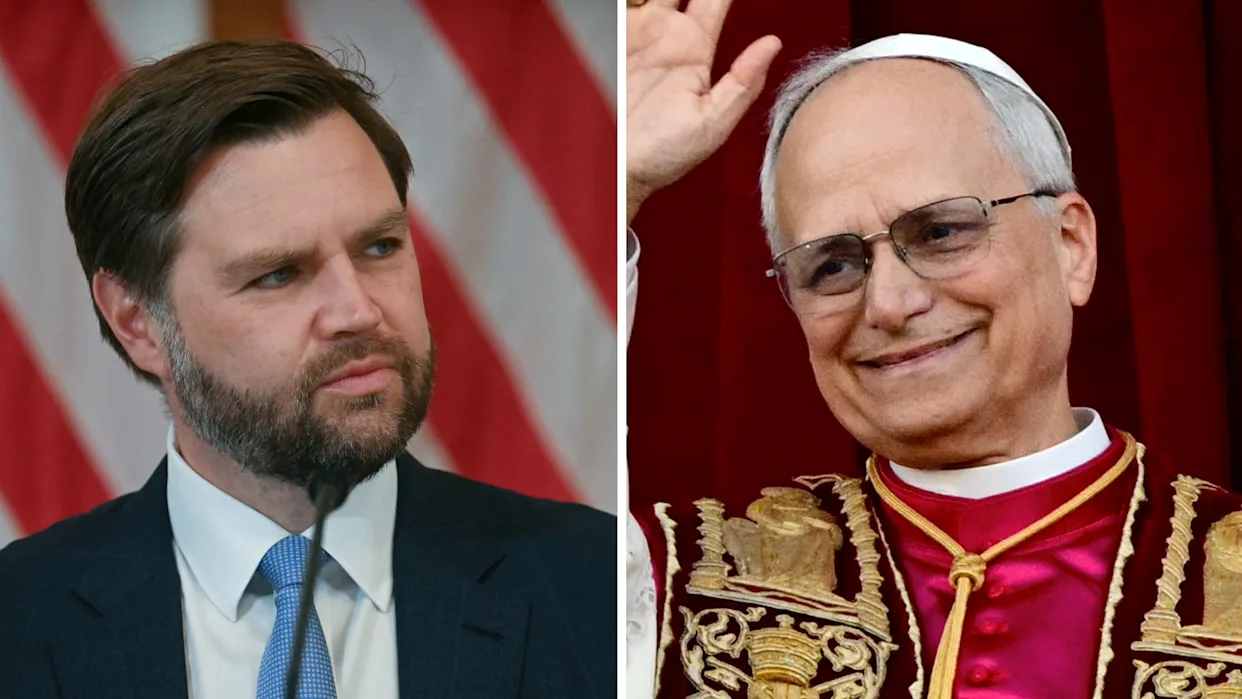
Not long ago, I wrote about what I called the “dangerous simplicity” of Pope Leo XIV’s claim that “God is never on the side of those who use violence.” At the time, the point may have seemed abstract—more a matter of theological nuance than urgent public concern.
However, a recent exchange between JD Vance and Pope Leo XIV has brought the issue sharply into focus. In fact, somewhat ironically, Vance’s attempt to challenge the pope ends up illustrating exactly the point I was trying to make.
I mean, the JD Vance- Pope Leo disagreement has all the markings of a classic argument: one side appealing to moral clarity, the other to historical reality. But beneath the surface, something more revealing is happening.
In trying to correct the pope, Vance ironically ends up exposing a deeper truth about violence itself – even the violence directly involving vice-president himself and the United States foreign policy he supports.
The Vance-Leo Exchange
The pope’s statement about nonviolence is simple, even beautiful: “God is never on the side of those who use violence.” It sounds like something that ought to end the discussion. Who could be against that?
But Vance pushes back. He begins politely enough: “I like that the pope is an advocate for peace… I think that’s certainly one of his roles.” Then comes the challenge: “On the other hand, how can you say that God is never on the side of those who wield the sword?”
And then he goes straight to the example that almost always ends arguments: World War II.
“Was God on the side of the Americans who liberated France from the Nazis?” he asks. “Was God on the side of the Americans who liberated Holocaust camps and liberated those innocent people? I certainly think the answer is yes.”
The Conceptual Complication
Most people instinctively agree. It’s hard not to. The defeat of Nazism feels like the clearest possible case of justified violence. But that’s exactly where things get interesting.
Because once you admit that not all violence is the same, the pope’s simple statement starts to unravel. And that’s the point.
“Violence” isn’t one thing. It comes in different forms, and if we don’t distinguish between them, we end up confused or, worse, manipulated.
Start with what might be called structural violence. This is the kind most people don’t notice because it’s built into everyday life. It’s the violence of systems that quietly destroy people: poverty wages, lack of healthcare, racism, occupation, economic exploitation, colonialism, imperialism, and wars launched for power or profit. No bombs need to fall for this kind of violence to be deadly.
Then there is defensive violence. This is what Vance is talking about, whether he realizes it or not. It’s the violence used to resist oppression. When Palestinians revolt against settler colonialism, when Iranians resist a war of agression, that’s defensive violence. It’s visible, it’s messy, and it’s almost always condemned by those in power. But it’s also widely recognized as legitimate, even in international law.
Next comes repressive violence. This is what happens when those in power try to crush resistance and restore the unjust system. It comes wrapped in phrases like “law and order,” “security,” or “self-defense.” But its real aim is to keep things exactly as they are – to defend the status quo, illegal occupation, colonialism, unwarranted attacks. . ..
And finally, there is terroristic violence. This is the deliberate use of overwhelming force, fear, and destruction to achieve political goals. It is often associated with non-state actors, but historically it has been most devastatingly practiced by states themselves.
Once you see these distinctions, everything looks different.
The Nazi Example: Gaza & Iran
Take Vance’s World War II example. The Nazi regime embodied structural and terroristic violence on a massive scale. The Allied response can reasonably be understood as defensive violence aimed at stopping that destruction. So far, so good.
But now bring that same framework into the present.
Vance insists, “I certainly think the answer is yes” when asked if God was on the side of those who liberated the camps. Yet at the same time, he supports policies that many observers describe as enabling or excusing mass violence elsewhere. He also adds, almost as a safeguard, “And I agree, Jesus Christ certainly does not support genocide…”
The irony is hard to miss.
Because when it comes to Gaza, what many see is not defensive violence but something much closer to repressive and terroristic violence. Entire neighborhoods flattened. Civilians trapped. Children buried under rubble. These are not incidental side effects. They are the predictable outcomes of overwhelming force used in densely populated areas.
At the same time, those who resist are quickly labeled “terrorists,” regardless of the conditions that gave rise to their resistance. This is exactly how the language of violence gets turned upside down. Structural violence becomes invisible. Defensive violence becomes criminal. Repressive violence becomes “security.” And large-scale destruction becomes “self-defense.”
The same pattern appears in the escalating conflict with Iran, which critics describe as a “war of aggression.” In that case, what is being framed as preemptive defense can just as easily be seen as structural and repressive violence on a global scale. Once again, the categories matter.
Jesus & Nonviolence
This is where the pope’s statement, for all its appeal, begins to look less helpful. Saying that “God is never on the side of those who use violence” might inspire people in the abstract. But in the real world, it risks putting the enslaved and the enslaver, the occupier and the occupied, the bomber and the bombed, all in the same moral category.
That’s not clarity. That’s confusion.
And confusion, in matters like these, is dangerous.
There is another layer to this discussion that makes things even more complicated. Christians often speak of Jesus Christ as if he were simply “nonviolent.” But that description, taken without qualification, can mislead.
Jesus lived under Roman occupation, one of the most brutally efficient systems of structural and repressive violence the world has ever known. The authorities who executed him did not see him as harmless. They saw him as a threat. His message challenged the legitimacy of their power and exposed the injustice built into their system. So they executed him by crucifixion, a method of execution they reserved for rebels against the state.
To call him simply “nonviolent” risks stripping away that context. It can turn a figure who confronted empire into one who passively accepts it.
Conclusion
And that brings us back to a hard but necessary truth: appeals to “nonviolence” are often used selectively. They are frequently directed at those who are already suffering, while those who benefit from structural violence continue largely unchallenged.
That is why some have gone so far as to say that “nonviolence” can function as a kind of scam. Not because the ideal itself is worthless, but because it is so easily weaponized. The powerful celebrate their own violence as necessary or heroic. The resistance of their victims is condemned as dangerous or immoral.
In the end, the exchange between Vance and Pope Leo XIV doesn’t settle anything. Instead, it exposes the fault line.
Vance is right to challenge the idea that all violence is the same. His World War II example makes that clear. But he stops short of applying that insight consistently to the present.
The pope is right to insist that violence is morally perilous and cannot be casually justified. But his sweeping statement risks erasing distinctions that are essential for understanding what is actually happening in the world.
Between those two positions lies a more difficult path. It requires looking honestly at the different forms violence takes and asking, in each case, who is doing what to whom and why.
Only then does the question of where God stands begin to make any sense at all.


