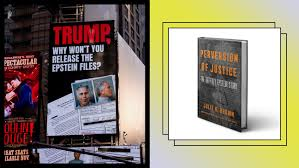
Like many Americans who have not yet surrendered their capacity for outrage, I’ve been haunted by the Jeffrey Epstein Affair. It refuses to go away—not because corporate media wish to pursue it (they manifestly do not), but because it cuts to the rotten core of empire itself.
For years now, we’ve been promised the release of the “Epstein files”—thousands of pages of testimony and hours of videotape implicating political leaders, judges, corporate moguls, Hollywood celebrities, and clergy. We’re told they exist. We’re also told—by the very elites most likely ensnared—that there’s “nothing to see here.” The truth, however, seems closer to what insiders have whispered: that those files contain enough evidence to topple governments across the Western world.
What has especially caught my attention is the strange “reluctance” to release those files publicly, and the curious way the story itself has been managed. Instead of honest transparency, we have smoke screens: Epstein dies in custody under suspicious circumstances; Ghislaine Maxwell is shuffled quietly from high-security to minimum-security prison; Donald Trump alternately promises to release Epstein’s files, then dismisses the whole thing as a “hoax.”
Why?
Because the evidence points not only to sexual predation, but to the use of sex, blackmail, and child trafficking as tools of statecraft—involving not just corrupt billionaires, but also the intelligence agencies of the United States, Israel, and the United Kingdom.
Epstein, Maxwell, and Intelligence
Let’s be clear: Jeffrey Epstein was no mere “hedge fund manager.” His wealth was largely unexplained, his client lists opaque. Multiple sources—including Alexander Acosta, the U.S. Attorney who gave Epstein his infamous “sweetheart deal” in Florida—have testified that Epstein “belonged to intelligence.” Acosta was told explicitly: back off, Epstein was “above your pay grade.”
But which intelligence service? All signs point to several.
Mossad (Israel): Ghislaine Maxwell’s father, Robert Maxwell, was long known to be a Mossad asset. His daughter continued that role, serving as Epstein’s partner in recruiting, grooming, and trafficking underaged girls. Several credible reports suggest Epstein and Maxwell’s operation doubled as a Mossad “honey trap”—a means of collecting dirt for purposes of blackmail on powerful Western leaders.
CIA (United States): Epstein’s New York townhouse was reportedly wired floor to ceiling with hidden cameras. Who collected and stored that footage? Who protected him after each arrest threat? The CIA had both motive and opportunity: control through blackmail has always been central to its toolkit. (BTW, in her recent interview with Deputy Attorney General, Todd Blanch, Ms. Maxwell denied that there were any recording devices in Epstein’s New York mansion — a claim that is easily refuted.)
MI6 (Britain): Epstein’s circle overlapped heavily with British aristocracy, including Prince Andrew. The United Kingdom’s intelligence services, like their American and Israeli counterparts, benefited from access to compromising materials and plausible deniability through “private” networks.
In other words, Epstein’s operation was not an aberration. It was systemic—a private-public partnership between elites and intelligence agencies designed to entrap and control.
Trump’s Place in the Web
So where does Donald Trump fit in? The circumstantial evidence is overwhelming:
Friendship with Epstein: Trump himself admitted they were close. Photographs and flight logs confirm this. They partied together in the 1980s and 90s—often in the presence of girls who were clearly underage.
Connections to Organized Crime and Intelligence: Trump’s “mentor,” Roy Cohn, was not just a Mafia lawyer but also a fixer with CIA ties. Trump inherited from Cohn both his ruthlessness and his network.
The Access Hollywood and Carroll Cases: Trump’s own recorded boasts of sexual assault, along with civil judgments against him for sexual abuse, demonstrate a pattern of predation that makes his involvement with Epstein’s underage network plausible, even likely.
Obstruction of Evidence: Trump promised as president to release the Epstein files but instead allowed the FBI to redact his own name from them. His sudden dismissal of the entire affair as a “hoax” is not the language of innocence but of guilt management.
Ghislaine Maxwell’s Treatment: Under Trump, Maxwell was moved to a lower-security facility and treated more like an informant than a convicted trafficker. Why? Perhaps because she knows too much, and her silence needed to be purchased with privileges.
Circumstantial Evidence and the Law
Of course, defenders say all of this is “only circumstantial.” But American courts have long recognized that circumstantial evidence can be just as probative as direct evidence. After all, few crimes of power leave smoking guns. What we have instead are:
Patterns of association.
Unexplained wealth and protection.
Testimonies suppressed.
Defendants obstructing evidence.
Intelligence agencies circling like vultures.
These, taken together, paint a picture no less damning than a video recording.
The Larger Stakes
What makes this affair explosive is not merely whether Donald Trump is guilty of pedophilia. It is that the entire Western system—Washington, London, Tel Aviv—may be implicated in using sexual blackmail as a governing tool.
Ordinary people may not follow Russiagate, gerrymandering, or campaign finance reform. But they understand rape. They understand pedophilia. They understand that leaders who use children in blackmail operations have crossed a line that should end not only their careers but also the legitimacy of the system they serve.
If the Epstein files are ever released unredacted, the consequences could be revolutionary.
That is precisely why they remain hidden.
And precisely why we must demand their unveiling.
Notes and Sources
Alexander Acosta’s statement about Epstein “belonging to intelligence” – The Daily Beast, July 2019.
Gordon Thomas, Robert Maxwell: Israel’s Superspy (2003).
Whitney Webb, One Nation Under Blackmail, Vols. 1–2 (2022).
Vicky Ward, “Jeffrey Epstein’s Sick Story Played Out for Years in Plain Sight,” Vanity Fair, July 2019.
BBC, “Prince Andrew and Jeffrey Epstein: What You Need to Know,” November 2021.
Flight logs and photos released in U.S. District Court (Southern District of New York) filings, 2019.
Wayne Barrett, Trump: The Deals and the Downfall (1992).
Ryan Coogler’s 2025 vampire horror film has already shattered box office records for the genre. Coogler, of course, is the acclaimed director of Creed, Black Panther, and its sequel Black Panther: Wakanda Forever.
Under his direction, Sinners has quickly emerged as a contender for Academy Awards. The film unfolds as a startling parable about white supremacy, the Ku Klux Klan, and the transformative power of music—specifically Delta Blues—as a force of resistance and exorcism.
Its allegorical nature is signaled immediately in a brief prologue: “There are legends of people born with a gift of making music so true, it can pierce the veil between life and death conjuring spirits from the past and the future. . ..” From the outset, viewers are alerted that what follows is not merely a story but a mythic enactment, one that reveals hidden and uncomfortable truths alongside enduring strengths.
At the heart of the narrative is Sammie, a gifted young blues musician whose talent verges on the supernatural. The son of a Baptist minister, he is known as “Preacher Boy.” His cousins—identical twin gangsters “Smoke” and “Stack” (both portrayed by Michael B. Jordan)—return to their Mississippi hometown from Chicago in 1932 with plans to open a juke joint. There, however, they encounter a form of evil more insidious than anything they experienced working for Al Capone in the North: a vampire embodiment of the Ku Klux Klan, led by a mysterious Irishman named Remmick.
As a bloodthirsty Klansman driven by racism and greed, Remmick embodies the white supremacist urge to exploit and destroy Black cultural achievements. His Irish music lures listeners, yet his touch alone is enough to infect victims, transforming them into vampires. Their numbers grow at a terrifying pace.
Inside the juke joint, however, Preacher Boy counters with his own magic. His blues conjure ancestral spirits, who appear in traditional African garb, mingling with dancers in an atmosphere charged with sweat, alcohol, and raw sexuality. Recalling the evening years later, Preacher Boy—portrayed in this sequence by blues legend Buddy Guy—reflects, “it was the best day of my life.”
Everything reaches its climax in a violent confrontation: vampires swarm the juke joint, leading to its destruction and a final showdown between Preacher Boy and Remmick. For a time, it seems the Klansmen have prevailed. Yet Preacher Boy ultimately defeats Remmick, while “Smoke” kills the leader of the local Klan chapter. In this way, Preacher Boy’s power as an exorcist is at least partially affirmed.
Still, Sinners resists any one-dimensional reading. Its parable connects the African American struggle against white vampirism with broader histories of oppression and survival, including:
The resistance of Native Americans, who as survivors of genocide developed means to neutralize “white blood-suckers.”
The brutalities of slavery and the cotton economy.
The prison chain gang system and the terror of lynching.
The complex roles of mixed-race women, some of whom could “pass” as white, alongside their Aunt Jemima counterparts, confined to domestic labor yet equally sexual.
Competing spiritual traditions—those of colonial missionaries, Black Baptists, the Klan, Native Americans, Voodoo, and even Satan worship.
The place of Chinese immigrants, often positioned as bridges between Black and white communities.
For those who can stomach its gore, Sinners is both horrifying and revelatory. It insists that horror has been central to the Black historical experience—every bit as present as the beauty and resilience expressed through music. As Coogler himself explains, the Delta blues were created by artists “living under a back-breaking form of American apartheid,” and he describes the genre as “our country’s most important contribution to global popular culture.”
In that light, the film’s brutality is not gratuitous but emblematic. As a vampire horror story, Sinners is gruesome, but African American history has been far bloodier. Compared to that reality, the horror on screen feels restrained.
Readings for the 20th Sunday in Ordinary Time: JER 38: 4-10; PS 40: 2-4, 18; HEB 12:1-4; LK 12: 49-53
Today’s gospel excerpt presents real difficulties for a thoughtful homilist. That’s because it shows us an apparently confrontational Jesus — one who sounds completely revolutionary. It raises an uncomfortable question: why would the Church choose such a passage for Sunday worship? What are we supposed to do with a Jesus who doesn’t sound like the soft-focus “Prince of Peace” in our stained-glass windows?
In the context of Zionist genocide and starvation of Palestinians, perhaps this is providential. Maybe this gospel can help us understand a truth that polite Christianity often avoids: people living under the heel of settler colonialism supported by empire — even people of deep faith — sometimes find themselves pulled toward resistance that is anything but gentle.
We forget that Jesus and his community were not free citizens in a democracy. They were impoverished, heavily taxed subjects of an occupying army. Roman power loomed over their fields, their marketplaces, their synagogues. By today’s international standards, they were an occupied people with the legal right to resist.
And in Luke’s gospel today, Jesus says, without apology:
“I have come to set the earth on fire, and how I wish it were already blazing… Do you think that I have come to bring peace on earth? No, I tell you, but rather division.”
In Matthew’s parallel account, the language sharpens:
“Do not suppose that I have come to bring peace. I did not come to bring peace, but a sword.”
These are not the soundbites that make it into Christmas cards. They make us ask: what happened to “Turn the other cheek” and “Love your enemies”?
Some scholars, like Reza Aslan, suggest that Jesus’ nonviolence applied primarily within his own oppressed community, while his stance toward the Roman occupiers was far less accommodating. Others, like John Dominic Crossan, argue that Jesus was unwaveringly committed to nonviolent resistance, and that later gospel writers softened or altered his message to make it more palatable in times of war.
Either way, the backdrop remains the same: an occupied land, a foreign military presence, a people dispossessed. In that context, fiery words about “division” and “swords” are not abstract theology. They are the language of a people under siege, the language of survival.
This is where the parallels to our world are hard to miss. Today, in the land we call Israel-Palestine, we see a modern occupation with its own walls, checkpoints, home demolitions, and armed patrols. We see Palestinian families pushed off their land in the name of “security.” We see the weight of military might pressing down on those who have little power to push back.
This is not to glorify violence but to say that this kind of daily humiliation, dispossession, and threat inevitably breeds anger, desperation, and — for some — the temptation to meet force with force. The gospel today, like the headlines from Gaza and the West Bank, confronts us with the messy, often tragic choices that emerge under occupation.
As Christians, we have to wrestle with this. Would we cling to a nonviolent ethic, like the Jesus Crossan describes? Or, living under bulldozers and armed patrols, would we find ourselves understanding — perhaps even empathizing with — those who choose other paths?
Jesus’ words today refuse to let us take the easy way out. They call us to name the real causes of conflict — not some vague “ancient hatred,” but the concrete realities of military domination, settler colonialism, and American imperialism. They challenge us to imagine what peace would require: not simply the silencing of the oppressed, but the dismantling of systems that oppress them in the first place.
Because if we only condemn the flames without questioning the spark, we miss the deeper gospel truth: that justice is the only soil in which true peace can grow.
Readings for 18th Sunday in Ordinary Time: Ecclesiastes 1:1-2, 2:21-23; Psalm 90 3-6, 13, 14, 17; Colossians 3: 1-5, 9-11; Luke 12: 13-21
I’ve recently been invited to join the Arc of Justice Alliance (AJA). It’s a new progressive think-and-action movement designed to offer a coordinated, long-term alternative to the far right’s increasingly authoritarian agenda.
No doubt you’ve heard of the Republican Project 2025. Backed by the Heritage Foundation and other major right-wing institutions, it’s a blueprint for seizing executive power, dismantling federal regulatory structures, militarizing domestic politics, and further entrenching white Christian nationalism. It is as serious as it is terrifying.
The Arc of Justice Alliance is our answer. It recognizes a hard truth: for over 50 years, the U.S. right has invested billions into building a machine—media networks, policy mills, judicial pipelines, and ideological training camps for candidates. Progressives, by contrast, have often been merely defensive, scattered and uncoordinated. That’s changing now. AJA is bringing together scholars, activists, spiritual leaders, artists, and organizers to craft a long-term vision for democratic justice, human rights, and environmental sanity.
But here’s something that may surprise you: one of the right’s most potent weapons has been theology.
The Republican machine has spent decades coopting the Judeo-Christian tradition, turning it into a moral fig leaf for capitalism, nationalism, and even genocidal violence. Faith has been hijacked—not just by televangelists, but by policy strategists who know how powerful religion can be in shaping hearts and winning votes.
The results? A public religion that celebrates guns over peace, capitalism over compassion, and settler colonialism— in Palestine and elsewhere—over human dignity.
As a liberation theologian, I’ve been invited by AJA to help reclaim the authentic Judeo-Christian tradition. To rescue the voices of the prophets—from Moses to Jesus to Paul—from those who’ve turned them into champions of empire. We’re done letting Jesus be portrayed as a flag-waving American whose top moral priorities are deregulated markets, gun rights, and misogyny.
This week’s liturgical readings couldn’t be more timely. They mock the cult of wealth accumulation and call for spiritual liberation from materialist obsession. Ecclesiastes calls it “vanity” to work endlessly, lose sleep over your earnings, and die before enjoying anything. Psalm 90 reminds us life is brief—we might not wake up tomorrow. Paul tells us to set our minds on things beyond consumerism, and Jesus, in the Gospel of Luke, outright laughs at the man who builds bigger barns while ignoring his soul.
These aren’t just pious musings. They’re indictments.
They expose what capitalism demands of us: exhaustion, anxiety, competition, disconnection. They also expose what it consistently fails to deliver: peace, community, purpose, or justice.
Here’s the deeper issue: capitalism isn’t just an economy—it’s a theology. It teaches that your worth is your wealth. That you are alone, in competition, in a world of scarcity. That power, not compassion, is what keeps you safe. That “salvation” is financial security.
But the deeper tradition—the one the AJA seeks to reclaim—teaches something radically different.
It teaches that our lives matter not for what we earn, but for how we love. That justice, not greed, is the heartbeat of the universe. That our deepest wealth is found in community. That joy is a collective act of resistance.
And crucially, it teaches that we must name and dismantle the systems—economic, political, and religious—that keep us enslaved to fear and false gods.
That’s why we’re building the Arc of Justice Alliance. Not just as an intellectual exercise, but as a spiritual and moral response to empire. We are building a machine of our own—not to mirror the right’s authoritarianism, but to match its discipline and exceed it in vision.
So let’s stop pretending the Gospel is about prosperity. Let’s stop letting capitalism wear a halo.
Let’s laugh, like Jesus did, at the absurdity of endless accumulation. Let’s build networks of joy, resistance, and solidarity. Let’s speak clearly, act boldly, and remember what freedom really looks like.
This is what the moment demands. And this is what the AJA stands for.
This is a reposting of a second article I wrote about the Epstein affair. I published this one in 2020. I repost it here because of its extreme relevance to the reemergence of the whole scandal in the national consciousness. The review of “Where’s My Roy Cohn?” points out the centrality of pedophilia and related blackmail in our nation’s (and the world’s) governance. It touches our political system at the highest levels.
“Where’s My Roy Cohn?”: A U.S. Coup D’état by Nihilists, Mobsters, Pedophiles and Blackmailers
Recently, I spent two weeks in Tijuana working with Al Otro Lado (AOL). I’ve written about that experience here, here, and here.
AOL is a legal defense service for refugees seeking asylum mostly from gang-rule in Mexico and Central America. The emigrants want escape from countries whose police forces and allied power holders are controlled by ruthless drug rings whose only goal is accumulation of money and social dominance.
As I did my work helping clients fill out endless forms concocted by those who would illegally exclude them, everything seemed so hopeless. I wondered how those gangs achieved such power? Isn’t it a shame, I thought, that entire countries are now controlled by criminal mobs with names like “MS 13,” “Nueva Generacion,” and “18?” How sad for these people!
Then, during my flight home to Connecticut, I happened to watch the documentary “Where’s My Roy Cohn?” (WMRC). It introduced viewers to the dark and criminal mentor of Donald Trump. (See film trailer above.)
On its face, the film illustrated the absolute corruption of the U.S. government as the unwavering servant of the elite as the only people who count. But in the light of my experience in Tijuana, it made me realize that our country too is literally controlled by shadowy gangs to an extent even worse than what’s happening south of our border. I mean, the United States of America now has the most prominent protege of Roy Cohn, an unabashed mafioso, actually sitting in the Oval Office! Both Cohn and, of course, his disciple turn out to be absolute nihilists without principle or any regard for truth.
The film made clear how both men tapped into a similar nihilist strain within huge numbers of Americans who identify with the Republican Party and ironically with the Catholic faith and Christian fundamentalism. Nonetheless, WMRC wasn’t explicit enough in probing either Cohn’s corruption, that of Donald Trump or of our reigning system’s complex of government, education, church and mainstream media.
It failed to show how the phenomena of Roy Cohn and Donald Trump represent mere surface indications of a profoundly anti-democratic coup d’état that has gradually unfolded in our country over the last 40 years. The actuality of this takeover was revealed most clearly in the recent impeachment proceedings. They provided a kind of last straw undeniably exhibiting how nihilist “Christians” have seized power in perhaps irreversible ways.
The Film
To see what I mean, begin by watching “Where’s my Roy Cohn?” for yourself. It not only details Cohn’s life as an infamous New York mafia consigliere. It also shows how he started his career in crime as the 23-year-old advisor of the equally villainous Senator Joseph McCarthy of Wisconsin. (McCarthy, of course was the force behind the nation-wide communist scare of the early 1950s.)
However, most importantly WMRC describes the film’s subject as the mentor of Donald Trump. By both their admissions, each recognized in the other a kindred spirit. Each used mafia and friends in high places (from Ronald Reagan to New York’s Cardinal Spellman) to enrich himself in terms of power and money. In the end, the alliance brought Trump to “the highest office in the land.”
To that point, here’s the way the film’s (highly accurate) preview-teaser reads: “Roy Cohn, a ruthless and unscrupulous lawyer and political power broker, found his 28-year career ranged from acting as chief counsel to Senator Joseph McCarthy’s Communist-hunting subcommittee to molding the career of a young Queens real estate developer named Donald Trump.”
In the course of the film, witnesses testify that Cohn taught Trump his basic approach to life. To wit: here are Cohn’s (and by extension, Donald Trump’s) implicit Ten Commandments. They also summarize the guiding principles of perhaps the majority of the most prominent politicians in the U.S. and across the world:
Value money as the highest good.
Manipulate the law to enhance personal wealth and privilege
Put your own interests above everyone else’s
Bully opponents mercilessly
Wrap yourself in the flag while you do so
Never admit wrong-doing or failure
When accused change the subject and make vigorous counteraccusation
Lie unceasingly with great confidence and bluster
Declare even the worst defeat a victory
Win at all costs
All of that was actually Cohn’s personal ethos. It worked for him throughout his life. It is reaping at least short-term benefits for Donald Trump as well. In fact, with Cohn as his mentor and as the man’s protege, Donald Trump would seem to merit all the adjectives on the film’s cover envelope: ruthless, unscrupulous, powerful, flamboyant, notorious, despicable . . .
Deeper Corruption
Unmentioned however in the film is Cohn’s connection with the very way our country (and the world) is run. It’s largely a blackmail game connected not merely with money and power, but with sex, pedophilia, blackmail and complete disregard for truth or moral principle. In fact, Whitney Webb’s four-part study of pedophile-racketeer, Jeffrey Epstein is called just that: “Government by Blackmail.”
And right at its heart, we find Trump mentor, Roy Cohn, listed prominently among figures like the Mafia kingpin Myer Lansky, and Lew Rosenstiel (of Schenley distilleries). For decades following World War II, they were real powers behind mayors, governors, congressmen, senators, presidents, and (yes) behind the world’s remaining kings and potentates, along with assorted church officials.
In fact, according to Webb, all during the ’70s and ’80s, Rosenstiel, Lansky’s close friend, regularly threw what his fourth wife (of five) called “blackmail parties.” The photos and recordings gathered there long kept Lansky out of trouble from the federal government. They also delivered entire cities to Mafia control in the post WWII era. In the end, Lansky blackmailed numerous top politicians, army officers, diplomats and police officials. He had photos of FBI director, J. Edgar Hoover in drag and performing homosexual acts.
Again, according to Webb’s research, Rosenstiel’s protegee and successor as blackmailer-in-chief was Roy Cohn himself who was closely associated with the Mafia bosses referenced prominently in “Where’s My Roy Cohn,” as well as with J. Edgar Hoover and the Reagan White House. (Nancy Reagan even phoned Cohn to thank him for enabling the election of her husband.)
Simultaneously, Cohn took on the central role in the blackmail pedophile hustle Lansky and Rosenstiel had started. As usual, its main targets were politicians often interacting with child “prostitutes.”
That was the real source of Cohn’s power. So were his dear friends in high places including (besides Clinton, the Reagans and Trump) Barbara Walters, Rupert Murdoch, Alan Dershowitz, Andy Warhol, Calvin Klein, Chuck Schumer, William Safire, William Buckley, William Casey, and top figures in the Catholic Church.
It’s those latter figures that connect Cohn’s pedophile ring as inherited by Jeffery Epstein even with the Church’s child abuse scandal. It directly involved the aforementioned “American pope,” Francis Cardinal “Mary” Spellman of New York, and Cardinal Theodore “Uncle Teddy” McCarrick of Washington D.C. Father Bruce Ritter’s Covenant House (a multi-million-dollar charity for homeless and run-away boys and girls) was also deeply implicated. In fact, when Ritter’s involvement in sex acts with his underage wards came to light, it was secular powers more than ecclesiastical forces that rallied to his defense.
Right-Wing Coup and Presidential Impeachment
All of that leads me back to where I started – to the right-wing coup d’état whose final straw debunked any pretense of democracy that may have been persuasive to some before impeachment proceedings put them completely to rest. “Where’s My Roy Cohn” showed the profound extent of the take-over in question – never far distanced from predominantly male sexual perversion.
Yes, we all know about such depravity within the Catholic Church – all the way up the chain of command. But the Cohn film along with the ancillary Epstein revelations it ignores reveal the centrality of that debauchery to standard operating procedure among government officials in the United States and across the world. It’s evidently what they do.
Am I exaggerating? Go back to the above list of Cohn’s and Epstein’s “friends.” See for yourself: they include presidents, princes, prelates, professors, pundits, pushers, and publishers. All of them have always had a lot to fear from the tapes and videos made by Cohn. But the same holds true for the ones confiscated from Epstein’s special safe, and from the still unpublished manifestoes of passengers on Epstein’s “Lolita Express” to the man’s “Orgy Island.” Additionally, there’s remains a lot to learn from the testimony of Epstein’s procurer, Ghislaine Maxwell. Inexplicably the latter remains at large and allegedly unlocatable by international agencies possessing the world’s most sophisticated technology.
In other words, what we know about connections between Cohn, Epstein, the Mafia, CIA, DOJ, White House, and church officials represent the mere tip of an iceberg whose continued submersion seems assiduously assured by the agencies involved, by Britain’s royals, and other powerful entities — all aided and abetted by an entirely cooperative MSM.
[And no: it’s not baseless “conspiracy reasoning” to implicate the deep state officials just mentioned – not in the face of Jeffrey Epstein’s mysterious “suicide” whose suspicious circumstances (within a specifically federal prison) include transgression of standard protocols for prisoners on suicide watch, missing surveillance tapes, sleeping guards, unexplained screams reported by fellow inmates as coming from Epstein’s cell, and lack of follow-up by the MSM.]
In other words, it’s not just that our country has been taken over by right-wing mobsters. No, it’s much more than that: our very world is run by gangsters, pedophiles, blackmailers, and their enablers – with Donald Trump its most recent and blatant evidentiary manifestation of anti-democratic policies.
Ignoring the rest of the world for a moment, consider what we’ve learned from the impeachment process about the extent of America’s de facto coup under Donald Trump whose criminal actions have gutted the Constitution of the United States at its core. Thus:
There no longer remains a separation of powers.
An indicted executive can control his own trial.
Subpoenas mean nothing to the reigning executive. By his decree alone, he can override summonses, forbidding those receiving them from appearing in court.
Impeachment “jurors” can embrace unmitigated bias with impunity announcing their judgment well before the trial’s commencement.
The presiding judge – even as he acknowledges the appearance of his court’s politicization – can with straight face permit a “trial” without evidence or witnesses.
Thus, prosecutors (i.e. the very House of Representatives) are left entirely impotent.
The hell of it is that these are all merely the latest developments in a criminal, unconstitutional, and anti-democratic process that has been in motion for nearly half a century. It has attacked the very pillars of democracy including the Supreme Court, Public Education, the mainstream media (MSM), and the Catholic Church – not to mention the Christian fundamentalists who constitute the heart of the Republican Party. It’s no wonder that Noam Chomsky has identified the latter as the most dangerous organization in the history of the world.
To be more specific, its “Christian” base hold firmly to tenets like the following that can only be described as “Cohnistic,” Trumpian, nihilistic, or (in religious terms) heretical:
There are no basic ethical principles (except that abortion is immoral).
Human life has no value except in its fetal stages.
The concept of truth is completely meaningless. This is because the public’s attention span and memory are so limited that repeated deceits make no lasting impression and will soon be forgotten.
The U.S. Constitution (except for the Second Amendment) is entirely insignificant.
There are two sets of laws, one for the elite and another for the rest of us.
As legal persons, corporations have more rights than living human beings.
International law applies only to U.S. enemies, never to the United States or its allies.
While the United States has the right to assassinate, bomb, drone, invade and occupy wherever it wishes, defense or retaliation against such aggression is criminal and liable to maximum punishment.
Conclusion
Do you see what I mean in describing our situation here in “America” as worse than our neighbors to the south?
It’s a truism to observe that whatever imperial governments – from Rome to Great Britain to our own – do abroad eventually returns to haunt them at home. My experience in Tijuana coupled with watching “Where’s My Roy Cohn” underlined the veracity of that terrible axiom. It all made me realize that our government has been taken over by cynical nihilists – and more than that by mobsters, pedophiles, blackmailers and heretical religious fanatics.
So, my take-away from border work in Tijuana is not only dismay, sadness, and despair for refugees at or border. It’s the same sentiments for ourselves.
With elections on the horizon, it’s also the question, what are we going to do about it? We have to determine which available candidate is freest from the sick contagion I’ve just described.
An AI-Assisted Homily on Overwork, Jesus, and Choosing the Better Part
Readings for 16th Sunday in Ordinary Time: Genesis 18:1-10a; Psalm 15: 2-5; Colossians 1:24-28; Luke 10: 38-42
Facing the Final Question
What will you regret most when you’re dying?
Chances are, like most people, it won’t be that you didn’t work hard enough. Instead, you’ll wish you’d spent more time with your loved ones—more dinners with friends, more laughter, more life.
“Every male patient I nursed said the same thing: they missed their children’s youth and their partner’s companionship.” — Hospice Nurse
Women often expressed the same sorrow, though many—especially from older generations—hadn’t been the household breadwinners. Still, the verdict was nearly universal: we’ve built lives around the treadmill of work, and at the end, that’s what we mourn.
A Culture Addicted to Work
Let’s be honest: our culture worships overwork.
Especially in the United States, where the average worker puts in three more hours per week than their European counterparts. That’s nearly a month more labor every year.
And when it comes to vacation time? The average American takes less than six weeks off per year. The French take nearly twelve. Swedes? Over sixteen.
Into this burnout culture comes today’s Gospel reading from Luke—a bracing call to step back and reconsider our priorities. A reminder that Jesus, too, challenged the grind.
Jesus, the Counter-Cultural Radical
We often forget just how radical Jesus was.
Deepak Chopra, in The Third Jesus, reminds us that Christ actually instructed his followers not to worry about money, food, or the future.
“Do not worry about your life, what you will eat or drink; or about your body, what you will wear.” — Jesus (Matthew 6:25)
And today’s Responsorial Psalm adds more layers. The “Just Person” is praised for refusing to lie, slander, or take bribes. That all sounds virtuous—nothing shocking there.
But then comes the line:
“They lend not money at usury.”
Wait—what? Lending at interest is considered robbery in the Bible. Imagine if Christians and Jews actually followed that commandment. Our entire debt-driven economy would have to be reimagined.
Rethinking Martha and Mary
Now let’s talk about Mary and Martha.
Most traditional sermons interpret the story spiritually: Martha represents worldly busyness, while Mary models a quiet, contemplative life devoted to prayer.
But that interpretation misses the human, grounded context of the Gospel.
In Un Tal Jesús (“A Certain Jesus”) by María and José Ignacio López Vigil—a powerful retelling of the Gospels popular across Latin America—Jesus is portrayed as joyful, deeply human, and radically present.
In their version, this story doesn’t take place in a quiet house, but in a noisy Bethany tavern run by Lazarus, with Martha and Mary hustling behind the scenes. Passover pilgrims are crowding in. It’s hot, chaotic, and full of life.
Martha is working furiously. Mary? She’s seated beside Jesus—laughing.
Jesus Tells Riddles
Jesus: “What’s as small as a mouse but guards a house like a lion?” Mary: “A key! I guessed it!”
Jesus: “It’s as small as a nut, has no feet, but climbs mountains.” Mary: “A snail!”
Jesus: “Okay, one more. It has no bones, is never quiet, and is sharper than scissors.” Mary: “Hmm… I don’t know.” Jesus: “Your tongue, Mary. It never rests!”
They’re cracking jokes, swapping riddles, enjoying one another. Not praying. Not planning. Not “producing.” Just being.
Martha, frustrated and overworked, finally bursts out: “Jesus, tell my sister to help me!”
And he answers gently but firmly: “Mary has chosen the better part.”
Jesus and the Sacredness of Play
That might sound scandalous to us—Jesus dismissing work?
But it’s entirely consistent with his teachings. Jesus valued community over productivity, joy over profit, presence over anxiety.
And that should make us pause.
What if we took that seriously?
What if we reorganized our lives—and our economy—around the idea that play, rest, joy, and social connection are sacred?
What if we voted for leaders who supported:
Shorter workweeks
Guaranteed time off
Universal income
Job sharing
A culture centered around well-being instead of output?
In the End, What Really Matters?
Because when we reach the end, we won’t say:
“I wish I’d worked more overtime.” “I should’ve answered more emails.” “I’m glad I missed those birthday dinners.”
We’ll long for the laughter we didn’t share, the walks we skipped, the stories we never heard, the moments we missed with the people we loved most.
Of course everybody’s talking about Jeffrey Epstein. The topic is often presented simply as a tale of his perversion possibly with connections to Donald Trump. But it’s much more than that. As Whitney Webb has pointed out in two 500 page books on Epstein, it’s about “Government by Blackmail.” It’s about Israel’s Mossad and why Zionists can exercise nearly absolute control over the U.S. government, no matter who’s president. With Webb’s help, I saw all that six years ago, when I published the following essay on OpEdNews and when I followed it up by another piece on the use of the phrase “conspiracy theory” to dismiss any deeper probes into Epstein’s identity. So, here’s what I wrote in 2019.
___________
Epstein Was Suicided; That’s How Our CIA Does Business
I could hardly believe my eyes this morning, when I read in Alternet that Jeffery Epstein was found dead in his jail cell of apparent suicide. And I find it hard to believe that he killed himself, especially since he’s been on “suicide watch” since the discovery of apparently self-inflicted marks on his neck ten days ago. Instead, I suspect he was killed by the CIA. My suspicion is based on my close reading for the past few days of muckraker, Whitney Webb‘s three-part expose’, “The Jeffery Epstein Scandal: Too Big to Fail.”
Webb’s series makes the point that the Epstein pedophilia scandal threatened to blow apart the entire U.S. government house of cards. It opened up a potentially devastating window not only on the sordid lives of Epstein and his close friends, Donald Trump and Bill Clinton, but on the profound corruption of the entire U.S. government and of international politics as a whole. Though connected with the pedophilia scandal in the Catholic Church, the scale of the Epstein branch of institutionalized child abuse absolutely dwarfs the shameful hypocrisy of justly vilified ecclesiastical criminals.
Epstein’s federal trial was scheduled to begin next summer. This means that the details of his crimes (and, more importantly, those of his high-placed patrons’) would steal headlines at the height of the general election of 2020. The evidence to be presented there is said to comprise more than one million pages.
In the light of what I’ll detail below, one can only imagine the surprises contained therein and whom those pages implicate. And given Epstein’s close association with Donald Trump and the Clintons (not to mention the other billionaire residents of Palm Beach Island in Florida), the trial and evidence presented at that crucial moment would likely have had an impact of the presidential election. Wayne Madsen for one, speculates that it may have already influenced the resignations of several Republicans from the House of Representatives.
Epstein, of course, is the alleged hedge fund tycoon whose central role in a pedophilia network came to light when he was arrested last July on Federal charges of sex trafficking of minors in Florida and New York. Previously, he had been convicted of molesting an underage girl, but had mysteriously served what’s been described as the most lenient sentence in history for crimes like his — 13 months in a county jail during which he was free to leave during the day.
Alexander Acosta, Donald Trump’s Secretary of Labor was responsible for securing the ludicrous sentence, when Acosta served as Attorney General for the Southern District of Florida. On Epstein’s arrest last July, the FBI found hundreds of photos, videos, and recordings of child molestations some of them allegedly involving prominent public figures.
According to Webb’s expose’, the Epstein story is merely the tip of a dark iceberg much bigger than most of us realize. The darkness below the surface stretches back more than 75 years. It involves not only Epstein, but the CIA, its Israeli counterpart the Mossad, the Mafia as a CIA asset, the mysterious MEGA Group of influential billionaires, many government officials, and other high rollers with familiar names.
Webb’s series unveils what she terms “Government by Blackmail” an all-encompassing political strategy that began at least as far back as the conclusion of the Second Inter-Capitalist War. As the phrase suggests, Government by Blackmail consists in luring heads of state and other powerful world figures into compromising situations (often with underage “prostitutes” of both sexes), filming them in the process, and then using such evidence as leverage to extort huge sums of money, to extract favors and actually shape the world’s political economy. It extended to the Mafia, for instance, a virtual license to kill without legal repercussion.
As an alleged intelligence asset himself (of either the CIA, Mossad, or both) Epstein’s job was to gather the required evidence. To that end, he placed in compromising and seductive situations government officials from across the world. His mansions, private islands, and fleet of jet planes provided the venues. They were the sites of fabulous parties featuring alcohol, drugs, and underage “call boys” and “call girls.” All the locales were equipped with sophisticated recording devices, both audio and video, and two-way mirrors for recording acts of criminal pedophilia and other crimes or embarrassments on the parts of Epstein’s “friends” and acquaintances. Invitees included heads of state from across the planet Donald Trump and Bill Clinton, of course, among them.
But, Webb reveals, Epstein is only the latest iteration of Government by Blackmail. He’s the clone of figures like the Mafia kingpin Myer Lansky, and Lew Rosenstiel (of Schenley distilleries). During the ’70s and ’80s Rosenstiel, Lansky’s close friend, regularly threw what his fourth wife (of five) called “blackmail parties.” According to Webb, the photos and recordings gathered there long kept Lansky out of trouble from the federal government. They also delivered entire cities to Mafia control in the post WWII era. In fact, Lansky entrapped for blackmail purposes, numerous top politicians, army officers, diplomats and police officials. He had photos of FBI director, J. Edgar Hoover in drag and performing homosexual acts.
Rosenstiel’s protegee and successor as blackmailer-in-chief was Roy Cohn, who at the age of 23 was a close adviser of Senator Joseph McCarthy. More importantly, he was also associated with Mafia bosses, J. Edgar Hoover, the Reagan White House and has been described as a mentor of Donald Trump. His mentor!
Simultaneously, Cohn took on the central role in the blackmail pedophile racket Lansky and Rosenstiel had started. As usual, its main targets were politicians often interacting with child prostitutes. That was the source of Cohn’s power. So were his dear friends in high places including (besides Clinton and Trump) Ronald Reagan and his wife Nancy, Barbara Walters, Rupert Murdoch, Alan Dershowitz, Andy Warhol, Calvin Klein, Chuck Schumer, William Safire, William Buckley, William Casey, and top figures in the Catholic Church.
It’s those latter figures that connect Cohn’s pedophile ring as inherited by Jeffery Epstein with the Church’s scandal. It directly involved “the American pope,” Francis Cardinal “Mary” Spellman, and Cardinal Theodore “Uncle Teddy” McCarrick. Father Bruce Ritter’s Covenant House (a multi-million-dollar charity for homeless and run-away boys and girls) was also deeply implicated. In fact, when Ritter’s involvement in sex acts with his underage protegees came to light, it was secular powers more than ecclesiastical forces that rallied to his defense.
Another pre-Epstein blackmail king was Craig Spence, a former ABC News correspondent who became a prominent DC lobbyist and CIA agent. All during the 1980s he provided child prostitutes and cocaine for Washington’s power elite. For purposes of blackmail, Spence used the now-familiar devices of video cameras, tape recordings, and two-way mirrors. His little black book and “favor bank” records have been described as involving a Who’s Who of Washington’s government and journalistic elite, this time including Richard Nixon, William Casey, John Mitchell, Eric Sevareid, John Glenn, and key officials of the Reagan and George H.W. Bush administrations, as well as media celebrities and military officers. According to the Washington Times, during the Bush administration, Spence had permission to enter the White House late at night to supply “call boys” to top level officials there.
Significantly, in the light of Epstein’s demise, just shortly before his death (also quickly ruled a suicide) Spence expressed fears that the CIA might kill him — apparently for knowing too much about connections between Nicaragua’s Contras and CIA cocaine smuggling to support them. But according to Spence himself, his knowledge went much deeper. Shortly before his similarly alleged suicide, he told Washington Times reporters: “All this stuff you’ve uncovered (involving call boys, bribery and the White House tours), to be honest with you, is insignificant compared to other things I’ve done. But I’m not going to tell you those things, and somehow the world will carry on.”
The Contra connection shows how in all of this, the Great Enemy of the hidden powers described here (involving the White House, CIA, FBI, Mafia, Mossad, powerful lobbyists, “fixers,” and billionaire political donors) was socialism and communism. The latter’s world project was 180 degrees opposed to governance by the moneyed elite as represented by the blackmail project of Epstein and his predecessors.
And so, it was important for blackmailers to support the prosecution of Ethel and Julius Rosenberg, back McCarthyism and J. Edgar Hoover, to undermine the Soviet Union, attack Cuba and Fidel Castro, protect organized crime bosses, and to make sure that projects like the Sandinista Revolution of 1979-90 failed. To those ends, it was even more important to inveigle left-wing politicians and officials from socialist countries into the international blackmail dynamic described here.
As for Epstein himself, following Cohn’s death (from AIDS) in 1986, he quickly took up his mentor’s mantle. As described earlier, Epstein became an FBI informant in 2008 yet more evidence of the agency’s long-standing involvement with and protection of pedophile rings for purposes of blackmail.
In summary, the Epstein scandal has finally made public a decades-long pedophilic blackmail operation at the highest level. Ultimately run by the FBI and CIA, (i.e. with the knowledge, approval and participation of law enforcement), it has involved prominent politicians, businessmen, police and military officials, celebrities, and ecclesiastical officials. The scandal has touched the current U.S. president and may still bring him down.
In the meantime, it has left behind a trail of broken lives in the persons of the children exploited for the pleasure of old white men whose debauched proclivities have been parlayed into economic and political power. On Epstein’s watch, the operation has spread to Central America and beyond, becoming truly international in the process.During the 2016 presidential campaign, Pizzagate fascinated right-wing conspiracy theorists. It alleged that the Clintons were somehow involved in a child prostitution operation run out of the Comet Ping Pong restaurant and pizzeria in Washington, D.C.
If a debunked Pizzagate theory caused such stir, and if pedophilia expose’s within the Catholic Church have brought it to its knees, one can only imagine the revolutionary potential of the documented disclosures that would inevitably come to light in a Jeffrey Epstein trial. It would reveal pedophilic involvement by public figures far surpassing the scandal in the Roman Catholic Church. It could bring down not only the Trump administration, but the whole international House of Cards.
Readings for the Solemnity of Saints Peter and Paul, Apostles: ACTS 12:1-11; PSALM 34: 2-9; 2 TIMOTHY 4: 6-8, 17-18; MATTHEW 16; 13-19.
Every morning as I watch Amy Goodman’s “Democracy Now,” I feel sickened by the reports from Gaza. No doubt that most reading these words have similar experiences. And why not?
In Gaza as everyone knows genocidal Zionists are systematically causing the deaths of untold thousands of children and their mothers. The Zionist monsters starve, bomb, and even gun down their victims as they line up at distribution sites where food is used as bait. The brutes are causing a manmade drought intentionally aimed at depriving infants of water for the formula they cannot live without.
You know the result.
The Zionists do all that in blatant contravention not merely of all human values and international law, but of the Jewish tradition itself. Their genocidal atrocities also contradict the teachings of the one Christians identify as the greatest of the Jewish prophets and whom they worship as the incarnation of God himself.
For that reason, it’s impossible for me to understand how any of that can be squared with the teachings of Yeshua and his critical understanding of his beloved Jewish tradition. It’s impossible for me to comprehend how self-proclaimed pro-life Christians (so concerned about unborn fetuses) can stand by in silence and even applaud when tens of thousands of children along with their mothers, fathers, and grandparents are slaughtered before their very eyes.
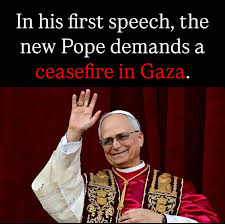
Where’s the specifically Christian protest from Yeshua’s followers? Apart from his general calls for a ceasefire, how come the new pope isn’t showing more leadership on this question?
Contrast their and his relative silence with the prophetic words of Episcopal bishop Mariann Edgar Budde directly confronting her president and vice president on behalf of the most vulnerable in her own country. She was vilified and dismissed by Christians and Jews as disrespectful and overly political.
However, she was only following in Yeshua’s footsteps. After all, he confronted the leaders of his day as hypocrites, whited sepulchers, snakes, and broods of vipers (MT. 23:1-39). And he in turn was only following the examples of great Jewish prophets like Amos, Isaiah, and Elijah. All of them today would be called anti-Semitic, and “self-hating Jews.”
I write such painful words because this Sunday’s “Solemnity of Saints Peter and Paul” celebrates another pair of self-hating Jews. Their following of Yeshua caused them to be seen as enemies of their people and of the Roman imperial power of their day. As a result, they were imprisoned and were ultimately victims of capital punishment.
And they in turn were only following the example of Yeshua himself as I’ve already said. He suffered ostracism, imprisonment, torture, and execution for his own unstinting opposition.
But wouldn’t outspokenness be dangerous for a new pope who’s just getting his papacy off the ground? Wouldn’t it be too polarizing and politically alienating for him to speak directly to Netanyahu, Trump and Vance the way Bishop Budde did? Even more, wouldn’t it be unthinkable for him to actually go to Gaza on papal pilgrimage?
In the context I’ve just described, the readings for the day suggest that those who claim to inherit the tradition of Peter and Paul and of Yeshua’s prophetism should never fear danger, ostracism, or political alienation. They should be the first to put their lives on the line, to risk imprisonment and even death to oppose those who prove unfaithful to the holy Jewish faith. Today’s readings assure the Divine Spirit of the universe will always have their backs.
The first reading from the Acts of the Apostles describes Peter’s harrowing escape from prison. The second reading has Paul claiming that he was “rescued from the lion’s mouth.” That was a clear reference to the famous story of Daniel in the lion’s den.
Yes, the founders of what became Christianity were the enemies of their days’ Jewish authorities – the same “leaders” who were also the sworn enemies of the One identified in today’s selection from the Gospel of Matthew as “the Christ” – i.e., as God’s anointed one.
Of course, Yeshua’s outspokenness brought him to death row too. He passed through the torture chamber where he was nearly beaten to death and crowned with thorns – afterwards only to be hung on a cross – the form of agonizing death that the Romans reserved for enemies of their emperors every bit as cruel and lacking in moral principle as Netanyahu, Trump, and Biden.
In fact, that’s the heart of the Christian tradition – identification with the poor, the oppressed, the imprisoned, tortured, and executed. That’s the meaning of the belief that God manifested the divine essence most fully among the poorest of the poor. God’s Self was maximally revealed in a construction worker, on death row, in a victim of torture, and assassination by the state. Contemporary theologians speak of such revelation in terms of God’s “preferential option for the poor.”
But there’s the difference between Peter, Paul, and Yeshua on the one hand and Pope Leo on the other. All three of the former were impoverished nobodies. They were poor Jewish workers standing up for their comrades in the face of oppression by what Romans characterized as the wealthiest, most militarily powerful empire in the history of the world. (Sound familiar?)
Unlike Yeshua, Peter, and Paul, the newly elected Pope Leo is not a nobody. Unquestionably, he potentially possesses one of the most powerful voices of moral conscience in the world.
Imagine if he used it with Yeshua’s outspokenness on behalf of those martyred children in Gaza!
Imagine if Pope Leo displayed the courage and commitment of his alleged predecessor, Peter or that of St. Paul. Imagine if he showed the fortitude of Bishop Budde or of Greta Thunberg and her colleagues who were recently turned back from bringing food and medical aid to starving Gazans. Compared to the pope, Budde and Thunberg are nobodies too.
So, imagine if Pope Leo decided that his first papal pilgrimage would be to Gaza. Imagine if he celebrated Mass in the ruins of the refugee camp in Khan Yunis? No one could ignore it. The Zionist and American perpetrators of genocide would be completely humiliated.
There’d have to be a ceasefire during his visit. Food aid would be released.
Imagine if he stayed in Gaza till hostilities finished.
That’s why I plead: Pope Leo, in the name of your predecessor, St. Peter, in the name of Paul, and above all in the name of the great Jewish prophet Yeshua, please go to Gaza! Use your power to put a stop to the monstrous slaughter!
[What follows is the 3rd installment describing a wonderfully synchronic event that coincided with my wife Peggy’s and my visit to Rome to spend three weeks with my son and his family there. The visit just happened to coincide with the elevation of fellow Chicagoan Robert (Fr. Bob) Prevost to the papal throne. Today’s account is about Pope Leo’s inauguration. You can find the other two installments here and here.]
Peggy and I got up early this morning – 5:00. Our intention was to get to St. Peter’s Square in time to secure seats for Pope Leo’s inauguration which would begin at 10:00.
However, our ride to the basilica was half an hour late. That meant we didn’t get seats.
And though we were able to situate ourselves much closer to the center of action than we did a week ago for the introduction of the new pope, our late arrival left us standing in the increasingly hot sun from 7:00 till noon.
It was worth it though. It gave me plenty of time to observe and reflect on the thousands upon thousands of faithful and simply curious who filled the Square and about a mile of the Via Conciliazione – the broad avenue that extends from the basilica’s piazza towards the Castel Sant’ Angelo.)
The Ceremony
In the meantime, all of us were inspired by the St. Peter’s Basilica choir and their transcendent renditions of Catholic choral classics like “Christus Vincit” and “Salve Regina.” We also ended up praying the five Glorious Mysteries of the rosary in Latin (viz., (1) the Resurrection, (2) the Ascension, (3) the Descent of the Holy Spirit on the Apostles, (4) the Assumption of the Blessed Virgin into Heaven, and (5) Her Crowning as Queen of Heaven and Earth). I was surprised how easily the Latin came back to me.
The whole thing and what followed was made visible for everyone on perhaps 20 huge jumbotrons located strategically throughout the entire venue.
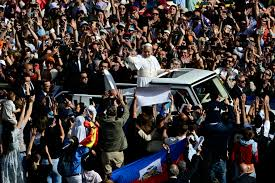
Then about 9:30 Pope Leo arrived. He was standing in the back of his popemobile smiling and giving his blessing to the adoring crowds as the vehicle drove around St. Peter’s square and down the length of the Via Conciliazione. He passed very close to the place Peggy, our Roman host, and I were standing. The crowd’s enthusiasm, shouts, and applause made it all quite thrilling.
At 10:00 right on the dot, the ceremony began. Everyone in the crowd had been given memorial booklets with the texts of every hymn, litany, and prayer, along with brief descriptions of ceremonies like the bestowal of the papal ring and other signs of papal authority. Texts (including the pope’s homily) were also projected on those large screens. So, it was all quite easy to follow and understand.
The center of it all was the papal Mass, with Leo the celebrant, while various members of the clergy and laity handled the biblical readings and some of the prayers in Latin, Italian, Spanish, English, and Greek.
At communion time, a whole army of priests (perhaps 50 or more) dressed in black cassocks and white surplices processed to various stations throughout the crowd to distribute the “hosts” that Catholics believe are the very body of the risen Christ. I noticed how some recipients received the wafer on their tongues, others in their hands. One priest close to me refused to place the host in extended palms. He repeatedly insisted on laying the host on the recipient’s tongue. The priest who gave me communion placed the wafer reverently in my hand with the traditional words, “The body of Christ.”
“Amen,” I replied. (I hadn’t received Catholic communion in years.)
All that describes the surface level of my experience this morning. But what did I really see and hear? Let me respond at three levels, one inspirational, one historical, and one political.
Evaluation
At the inspirational level I saw thousands of Catholics and others thirsting for a meaningful spiritual experience of transcendent, invisible dimensions of life. After all, we live in a world rendered increasingly meaningless by materialism, consumerism, war, shifts in global power, and social change almost beyond comprehension. Seeing such people praying the rosary with eyes closed and lips moving was inspiring indeed. So was their reverence in receiving Holy Communion.
At the historical level, I saw something more problematic. I witnessed:
An out-of-touch museum performance piece
Overwhelmingly led by men in pretentious medieval costume representing the most patriarchal institution in the western world
Now led by a nice American priest who actually believes he’s somehow the “Vicar of Christ”
Who founded the Catholic Church
Despite the evidence of even Catholic scripture scholarship that such conviction remains unsupported by credible evidence. It shows instead that Yeshua of Nazareth remained a good Jew throughout his brief life and had no apparent intention of founding the gentile “church”
That emerged definitively in the 4th century when (under Constantine) a powerful faction of the Christian community threw in its lot with the Roman Empire becoming in effect its Department of Religion,
Notwithstanding the fact that Yeshua died a victim of Roman torture and capital punishment.
However, most problematic of all were the event’s political dimensions. In that connection I saw a pope who (once again!) during a time of genocide and this time standing before its perpetrators (in the persons of J.D. Vance and Marco Rubio) spoke in generalities and empty platitudes instead of calling attention to their crime. As indicated in yesterday’s piece, I had been hoping for more – perhaps something in the vein of Episcopal Bishop Mariann Edgar Budde’s words to President Trump on behalf of Palestinians and migrants.
Conclusion
When I’ve expressed my concerns to friends and family members, I’m often told that the new pope must be careful and diplomatic. After all, he’s just starting out.
My reply however is that we’re in a state of emergency. The fact of genocide is undeniable in Gaza. Women and children are starving to death. Each morning, it seems, we’re told that as many as 150 Palestinians (mostly those women and children) were killed overnight. Such victims can’t wait.
The pope has potentially more moral power in his voice than anyone else in the world. If he truly believes himself to be the vicar of the prophetic Yeshua, he must use that voice now.
Tomorrow morning at 6:00, Peggy and I will drive to Vatican Square with some new Roman friends to attend the inauguration of Pope Leo XIV. The ceremony will begin at 10:00. That means we’ll be there four hours ahead of time. The attempt to secure good seats promises a long morning.
As you may recall, what Carl Jung called “synchronicity” has brought us to Rome at this precise time. Our ostensible purpose for being here was simply to spend three weeks with our son, daughter-in-law, and three small granddaughters (ages 5, 3, and 1). We wanted to spend as much time as possible getting to know the girls, whose parents’ foreign employment patterns would otherwise make that far more complicated.
However, my real synchronic purpose for being here, I’m convinced, is to reconnect me with my deep Catholic roots for purposes of final evaluation before transition into Life’s next dimension.
With that process in mind and at the age of 84, I feel overwhelmed by Rome’s beauty – its tree-lined streets, omnipresent sidewalk cafes, its lavish fountains, statuary, Renaissance paintings and churches, its operas and ballets. Today all that seems even more wonderful than it did more than half a century ago when I spent five years here (1967-’72) getting my doctoral degree in moral theology.
Those were magic years for me, when after spending my teenage and early adult years in a seminary hothouse, I finally began waking up to the real world. It all shook me to the core.
And here I’m not just thinking of personal growth experiences, but of the dawning of political awareness about the Vietnam War, the Civil Rights Movement, Women’s Liberation, and of Liberation Theology which I’ve come to understand as “critical faith theory.” (By that last phrase I mean understanding the way Christianity has been used by western colonial powers to enslave, brainwash, and justify repeated exterminations of Muslims, “witches,” Native Americans, kidnapped Africans, and colonized people across the planet.)
Along those lines, being here in Rome during the ongoing holocaust in Gaza makes me think of Pope Pius XII’s virtual silence on the Jewish Holocaust in the 1930s and ‘40s. It has me wondering if Leo XIV will follow in his shameful footsteps.
I mean, the new pope will have a golden opportunity to confront his fellow American Catholics undeniably responsible for the ongoing slaughter in Palestine. I’m referring to J.D. Vance, Marco Rubio, and possibly Joe Biden. It’s as if during the Holocaust, Pius XII had the chance to publicly confront Hitler or Goering.
Will Leo use this golden opportunity to call them (and the absent Mr. Trump) to task the way the courageous Episcopal bishop Mariann Edgar Budde did when presented with a similar opportunity in the early days of the Trump administration? Recall that as the episcopal leader of 40,000 congregants in the D.C. area, Bishop Budde had Trump and Vance squirming in their seats as she pled for mercy on behalf of the immigrants, refugees, Palestinians, and others whom those key members of her audience show every evidence of despising.
Will the papal leader of 1.2 billion Catholics show similar courage tomorrow? Or will he take refuge in “safe” generalities, “diplomatic” bromides, and empty platitudes about “peace,” justice, and mercy?
My guess is that it will be the latter. But we’ll see.