3rd Report From Rome: Some Reservations about Leo XIV’s Papal Inauguration

[What follows is the 3rd installment describing a wonderfully synchronic event that coincided with my wife Peggy’s and my visit to Rome to spend three weeks with my son and his family there. The visit just happened to coincide with the elevation of fellow Chicagoan Robert (Fr. Bob) Prevost to the papal throne. Today’s account is about Pope Leo’s inauguration. You can find the other two installments here and here.]  

Peggy and I got up early this morning – 5:00. Our intention was to get to St. Peter’s Square in time to secure seats for Pope Leo’s inauguration which would begin at 10:00.

However, our ride to the basilica was half an hour late. That meant we didn’t get seats.

And though we were able to situate ourselves much closer to the center of action than we did a week ago for the introduction of the new pope, our late arrival left us standing in the increasingly hot sun from 7:00 till noon.

It was worth it though. It gave me plenty of time to observe and reflect on the thousands upon thousands of faithful and simply curious who filled the Square and about a mile of the Via Conciliazione – the broad avenue that extends from the basilica’s piazza towards the Castel Sant’ Angelo.)

The Ceremony

In the meantime, all of us were inspired by the St. Peter’s Basilica choir and their transcendent renditions of Catholic choral classics like “Christus Vincit” and “Salve Regina.” We also ended up praying the five Glorious Mysteries of the rosary in Latin (viz., (1) the Resurrection, (2) the Ascension, (3) the Descent of the Holy Spirit on the Apostles, (4) the Assumption of the Blessed Virgin into Heaven, and (5) Her Crowning as Queen of Heaven and Earth). I was surprised how easily the Latin came back to me.

The whole thing and what followed was made visible for everyone on perhaps 20 huge jumbotrons located strategically throughout the entire venue.

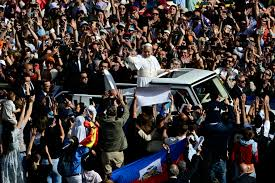
Then about 9:30 Pope Leo arrived. He was standing in the back of his popemobile smiling and giving his blessing to the adoring crowds as the vehicle drove around St. Peter’s square and down the length of the Via Conciliazione.  He passed very close to the place Peggy, our Roman host, and I were standing. The crowd’s enthusiasm, shouts, and applause made it all quite thrilling.

At 10:00 right on the dot, the ceremony began. Everyone in the crowd had been given memorial booklets with the texts of every hymn, litany, and prayer, along with brief descriptions of ceremonies like the bestowal of the papal ring and other signs of papal authority. Texts (including the pope’s homily) were also projected on those large screens. So, it was all quite easy to follow and understand.

The center of it all was the papal Mass, with Leo the celebrant, while various members of the clergy and laity handled the biblical readings and some of the prayers in Latin, Italian, Spanish, English, and Greek.

At communion time, a whole army of priests (perhaps 50 or more) dressed in black cassocks and white surplices processed to various stations throughout the crowd to distribute the “hosts” that Catholics believe are the very body of the risen Christ. I noticed how some recipients received the wafer on their tongues, others in their hands. One priest close to me refused to place the host in extended palms. He repeatedly insisted on laying the host on the recipient’s tongue. The priest who gave me communion placed the wafer reverently in my hand with the traditional words, “The body of Christ.”  

“Amen,” I replied. (I hadn’t received Catholic communion in years.)

All that describes the surface level of my experience this morning. But what did I really see and hear? Let me respond at three levels, one inspirational, one historical, and one political.

Evaluation

At the inspirational level I saw thousands of Catholics and others thirsting for a meaningful spiritual experience of transcendent, invisible dimensions of life. After all, we live in a world rendered increasingly meaningless by materialism, consumerism, war, shifts in global power, and social change almost beyond comprehension. Seeing such people praying the rosary with eyes closed and lips moving was inspiring indeed. So was their reverence in receiving Holy Communion.

At the historical level, I saw something more problematic. I witnessed:

  • An out-of-touch museum performance piece
  • Overwhelmingly led by men in pretentious medieval costume representing the most patriarchal institution in the western world
  • Now led by a nice American priest who actually believes he’s somehow the “Vicar of Christ”
  • Who founded the Catholic Church
  • Despite the evidence of even Catholic scripture scholarship that such conviction remains unsupported by credible evidence. It shows instead that Yeshua of Nazareth remained a good Jew throughout his brief life and had no apparent intention of founding the gentile “church”
  • That emerged definitively in the 4th century when (under Constantine) a powerful faction of the Christian community threw in its lot with the Roman Empire becoming in effect its Department of Religion,
  • Notwithstanding the fact that Yeshua died a victim of Roman torture and capital punishment.

However, most problematic of all were the event’s political dimensions. In that connection I saw a pope who (once again!) during a time of genocide and this time standing before its perpetrators (in the persons of J.D. Vance and Marco Rubio) spoke in generalities and empty platitudes instead of calling attention to their crime. As indicated in yesterday’s piece, I had been hoping for more – perhaps something in the vein of Episcopal Bishop Mariann Edgar Budde’s words to President Trump on behalf of Palestinians and migrants.

Conclusion

When I’ve expressed my concerns to friends and family members, I’m often told that the new pope must be careful and diplomatic. After all, he’s just starting out.

My reply however is that we’re in a state of emergency. The fact of genocide is undeniable in Gaza. Women and children are starving to death. Each morning, it seems, we’re told that as many as 150 Palestinians (mostly those women and children) were killed overnight. Such victims can’t wait.

The pope has potentially more moral power in his voice than anyone else in the world. If he truly believes himself to be the vicar of the prophetic Yeshua, he must use that voice now.

He must forget caution and diplomacy.

2nd Report From Rome: Will Leo Show The Courage of Bishop Budde?

Tomorrow morning at 6:00, Peggy and I will drive to Vatican Square with some new Roman friends to attend the inauguration of Pope Leo XIV. The ceremony will begin at 10:00. That means we’ll be there four hours ahead of time. The attempt to secure good seats promises a long morning.  

As you may recall, what Carl Jung called “synchronicity” has brought us to Rome at this precise time. Our ostensible purpose for being here was simply to spend three weeks with our son, daughter-in-law, and three small granddaughters (ages 5, 3, and 1). We wanted to spend as much time as possible getting to know the girls, whose parents’ foreign employment patterns would otherwise make that far more complicated.

However, my real synchronic purpose for being here, I’m convinced, is to reconnect me with my deep Catholic roots for purposes of final evaluation before transition into Life’s next dimension.

With that process in mind and at the age of 84, I feel overwhelmed by Rome’s beauty – its tree-lined streets, omnipresent sidewalk cafes, its lavish fountains, statuary, Renaissance paintings and churches, its operas and ballets. Today all that seems even more wonderful than it did more than half a century ago when I spent five years here (1967-’72) getting my doctoral degree in moral theology.

Those were magic years for me, when after spending my teenage and early adult years in a seminary hothouse, I finally began waking up to the real world. It all shook me to the core.

And here I’m not just thinking of personal growth experiences, but of the dawning of political awareness about the Vietnam War, the Civil Rights Movement, Women’s Liberation, and of Liberation Theology which I’ve come to understand as “critical faith theory.” (By that last phrase I mean understanding the way Christianity has been used by western colonial powers to enslave, brainwash, and justify repeated exterminations of Muslims, “witches,” Native Americans, kidnapped Africans, and colonized people across the planet.)

Along those lines, being here in Rome during the ongoing holocaust in Gaza makes me think of Pope Pius XII’s virtual silence on the Jewish Holocaust in the 1930s and ‘40s. It has me wondering if Leo XIV will follow in his shameful footsteps.

I mean, the new pope will have a golden opportunity to confront his fellow American Catholics undeniably responsible for the ongoing slaughter in Palestine. I’m referring to J.D. Vance, Marco Rubio, and possibly Joe Biden. It’s as if during the Holocaust, Pius XII had the chance to publicly confront Hitler or Goering.   

Will Leo use this golden opportunity to call them (and the absent Mr. Trump) to task the way the courageous Episcopal bishop Mariann Edgar Budde did when presented with a similar opportunity in the early days of the Trump administration? Recall that as the episcopal leader of 40,000 congregants in the D.C. area, Bishop Budde had Trump and Vance squirming in their seats as she pled for mercy on behalf of the immigrants, refugees, Palestinians, and others whom those key members of her audience show every evidence of despising.

Will the papal leader of 1.2 billion Catholics show similar courage tomorrow? Or will he take refuge in “safe” generalities, “diplomatic” bromides, and empty platitudes about “peace,” justice, and mercy?

My guess is that it will be the latter. But we’ll see.

My Wife’s First Mass

My wife, Peggy, said her first Mass last Sunday.

I remember my own “first Mass.” It was at the beginning of January in 1967. Strictly speaking, it wasn’t really my first Mass. I had been ordained a priest in the Missionary Society of St. Columban on December 22, 1966. So it was maybe my 12th Mass. But it was a Big Deal anyway – on a par with a wedding reception.

All my relatives were there – at some country club dining room in Downers Grove, Illinois just after New Year’s. There I was at the head table, the uncomfortable focus of all the attention. I was sitting there with my mom and dad and with Fr. Stier, my pastor. As I recall some Columbans were present as well.

As I said, it was a big deal – speeches and everything. Of course, I was the final speaker. I don’t remember what I said – except one phrase where I thanked my mom and dad, brother, Jim, and sisters, Rosanne and Mary for “virtually praying me through the seminary.” That was true. In retrospect, I don’t understand how I made it through all those years from the time I entered the seminary at 14 till I was ordained at 26. It’s enough to make you believe in the power of prayer – or something.

The miraculous nature of it all stands out because for all practical purposes, the training all those years was without women. Can you imagine that – during the most formative years in a person’s life? Thank God for my mother and sisters and for the summer vacations which brought me into (very guarded) contact with women. How can men become human without them?

In any case, I somehow overcame all of that too. So here I was a couple of weeks ago and after 37 years of marriage at my bride Peggy’s First Mass. No Big Deal. No head table. No speeches. Just Peggy standing there, hands extended the way we’ve all seen priests do, and leading us all in the Eucharistic Prayer that both of us had composed for the occasion. It was beautiful.

I say “no big deal” because the context is an ecumenical community of Catholics, Lutherans, Presbyterians, Baptists, and others who have taken seriously the idea of “priesthood of the faithful.” So if “the faithful” are priests, women are priests – or at least the priesthood should be open to them.  Why shouldn’t they officiate at the Eucharist in this community seeking to break free from the bondage of patriarchal church traditions?

Even Catholics in the group didn’t blink when they saw Peggy there. We’re ready for change. Despite our best efforts, most of us have become alienated both from our local church and from the Church of Rome. And it hasn’t been just one issue – not simply the patriarchy or the absence of women in church leadership positions. It wasn’t just the pedophilia crisis, not just the Vatican’s put-down of progressive sisters, or the “Republicanization” of the hierarchy, the amnesia about Vatican II, the silly liturgical language changes that no one understands (e.g. “consubstantial” has replaced “one in being”), not just the childish sermons. It’s all of that and the general irrelevance of the church whose hierarchy despite Vatican II is hundreds of years behind the post-modern curve. It’s surprising we haven’t just written it all off as b.s.  In fact, of course, many have

On the other hand, Peggy’s First Mass was a huge deal. It and our ecumenical community represent an awakening of “the faithful” and the fruition of seeds sown at the Second Vatican Council whose 50th anniversary we are about to celebrate.

The Spirit still moves and cannot be contained.

Next Wednesday: the “Table Prayer” Peggy and I composed

Why I Left the Priesthood: Part One

At least before all the scandals hit, I had always admitted quite freely and with a certain sense of pride that I had been a priest “in a former life.” I suppose that’s because as a Catholic born before the Second Vatican Council, some positive residuals still lurked in my mind around the ideas of priesthood and church. It’s also because I still sincerely value the training, education, spiritual focus, lasting friendships, and tradition of hospitality that I inherited from my 20 years of formal association with the Society of St. Columban (the organization of priests to which I belonged). Besides, people in the contexts where I’ve worked since then –   mostly at Berea College in Central Kentucky, or in our local St. Clare’s church (where I had also served as a priest in that “former life”) – seemed to appreciate my previous incarnation. So when they’d ask me why I left the priesthood, I used to say,

I don’t think I’ve ever left the priesthood, or even could. They always told us “once a priest, always a priest;” and I think that’s true. The priesthood isn’t something “they” confer on a person. It’s an acknowledgement of an identity, a “character” that no one and no decision by me or by “them” can remove. I, and so many of my colleagues in the seminary, had a priestly character from the beginning, and ordination simply amounted to its acknowledgement and confirmation by the church. So I still think of myself as a priest. It’s true, the sacramental dimension is missing. But apart from that, as a teacher of theology and director of a Peace and Social Justice Studies program, I’m pretty much doing the same work I did before I left the canonical priesthood. I’m still a priest.

 That’s what I used to say. I don’t any longer like that answer. Its approach to the priesthood was too exceptional, setting me and my friends apart from others in a way I’ve come to see as self-serving. None of us was at all that unique. We were pretty much ordinary, working class kids, who escaped factory work (or truck driving, or delivery routes, or the policeman’s beat) to become the first in our families to get a college education. We joined a highly exclusive club that put us on a pedestal from the beginning, and gave us an exaggerated opinion of our own importance. Before we were 30 or had done really anything at all, we were among the most honoured and important people in our communities. That sort of unmerited aura and especially the accompanying expectations eventually drove me from the priesthood as I once knew it. 

Still there was truth in my statement about priestly character. There was indeed something special about me and those who came with me through the seminary. But the specialness belonged not to me or to them uniquely. What my words unwittingly expressed was an intuition about the nature of being human. The intuition is that everyone has that priestly character I was referring to. Luther, I think, (with his dependence on Augustine) was gesturing towards something like that. Though he didn’t say it as clearly as mystics like Teresa of Avila or John of the Cross – or as Hindus or Buddhists do – he was referring to the spark of the divine (the indwelling Spirit) deep within everyone. Awareness of its presence simply dawns on certain people earlier than on others. For some, it never reaches consciousness at all. It happened to dawn on me (more or less) quite early, but not in the way it has over the past decade or so. To get there I had to do a lot of growing, sometimes painful, but often delightful.  The growth was intellectual, personal, and spiritual. Each step moved me further and further from the priesthood as I imagined it for myself and experienced it in others before ordination.

(Next Monday: Intellectual Steps away from the Priesthood)