Liberation Theology as Critical Thinking: Why God Talk Still Matters

I recently found myself in conversation with a young activist—brilliant, earnest, morally serious—who made a claim that was both understandable and unsettling. Young people, he said, simply don’t want to hear from old people like me, especially old white men. We’ve had our turn. We made a mess. And whatever we call “wisdom,” grounded in our long lives and accumulated experience, feels to them less like insight and more like obstruction.

I understood immediately why he would feel that way. My generation was born during the Great Depression and its aftermath; the boomers who followed presided over imperial wars, environmental devastation, runaway capitalism, and the hollowing out of democratic institutions. Zoomers have every reason to be suspicious of elders who lecture them about patience, realism, or incremental change. The house is on fire. Who wants to hear a sermon about proper etiquette?

And yet, something about the conversation troubled me—not because I felt personally dismissed, but because of the assumptions beneath the dismissal. In particular, the identification of “young people” with young Americans struck me as dangerously parochial. Outside the United States, especially in the Global South, students and young intellectuals are often strikingly comprehensive in their critical thinking. They do not imagine that wisdom expires with age, nor that critique began with TikTok.

Across Latin America, Africa, and parts of Europe, young activists routinely engage figures who are not only old, but long dead: Marx, Engels, Gramsci; Frantz Fanon, Simone de Beauvoir, W.E.B. Du Bois, Mary Daly, and Malcolm X. They read these thinkers not out of antiquarian curiosity, but because the structures those thinkers analyzed—capital, empire, race, class—remain very much alive. Ideas endure because oppression endures.

Nowhere is this more evident than in the tradition known as liberation theology.

Liberation Theology

Liberation theology is often caricatured in the United States as a quaint Latin American experiment, a left-wing theological fad that peaked in the 1980s and was later disciplined by Rome. That caricature misses the point entirely. Liberation theology is not primarily a set of doctrines; it is a method. More precisely, it is a disciplined form of critical thinking rooted in the lived experience of the poor. (In this connection, see my book, The Magic Glasses of Critical Thinking: seeing through alternative fact and fake news.)

At its core lies a deceptively simple question: From whose point of view are we interpreting reality? Classical theology asked what God is like. Liberation theology asks where God is to be found. And its answer—radical then, still radical now—is among the poor, the exploited, the colonized, and the discarded.

This shift has enormous epistemological consequences. It means that theology is not done from the armchair, nor from the pulpit alone, but from within history’s conflicts. Truth is not neutral. Knowledge is not innocent. Every analysis reflects interests, whether acknowledged or denied.

This is why liberation theologians insist on what they call praxis: reflection and action in constant dialogue. Ideas are tested not by elegance but by their consequences. Do they liberate, or do they legitimate domination?

That is critical thinking in its most rigorous form.

Beyond the American Youth Bubble

In Latin America, thinkers such as Gustavo Gutiérrez, Elsa Tamez, Leonardo Boff, Jon Sobrino, and figures like Franz Hinkelammert, Enrique Dussel, Paulo Freire, and Helio Gallardo pushed this method far beyond church walls. They integrated history, economics, philosophy, pedagogy, and political theory into theological reflection. They read the Bible alongside dependency theory and Marxist political economy, not because Marx was a prophet (he was!), but because capitalism is a religion—and a deadly one.

Freire’s Pedagogy of the Oppressed remains one of the most influential works of critical pedagogy worldwide. Its central insight—that education is never neutral, that it either domesticates or liberates—could easily be applied to theology, media, or political discourse. What Freire called “conscientization” is nothing other than the awakening of class consciousness.

Contrast this with much of American youth culture, where “critical thinking” is often reduced to identity signaling or stylistic rebellion, easily co-opted by market logic. The phenomenon of Charlie Kirk and similar figures is instructive here. Kirk’s appeal to college students is not an aberration; it is a symptom. Young people are starving for meaning, for narrative coherence, for moral seriousness. Into that vacuum rush slick, biblically uninformed ideologues like Kirk who weaponize Scripture in service of hierarchy and exclusion.

The Bible as Popular Philosophy

For millions of Americans, the Bible remains the primary source of moral reasoning—and often of historical understanding as well. This is frequently mocked by secular intellectuals, but mockery is a luxury we can no longer afford. The Bible functions in the United States as a form of popular philosophy. People may know little about economics, geopolitics, or climate science, but they believe they know what the Bible says.

And what they believe it says shapes their views on Israel and Palestine, abortion, feminism, sexuality, immigration, and race.

The tragedy is not that the Bible matters, but that it has been systematically stripped of its prophetic core and repackaged as an ideological weapon. White, patriarchal, misogynistic, anti-gay, xenophobic, and racist forces have successfully co-opted a tradition that is, at its heart, a sustained critique of empire, wealth accumulation, and religious hypocrisy.

This is not accidental. Empires have always sought divine sanction.

Yeshua of Nazareth & Class Consciousness

What liberation theology insists upon—and what American Christianity has largely forgotten—is that the Judeo-Christian tradition is saturated with class consciousness. From the Exodus narrative to the prophets, from the Magnificat to the Beatitudes, the Bible relentlessly sides with the poor against the powerful.

Yeshua of Nazareth did not preach generic love or abstract spirituality. He announced “good news to the poor,” warned the rich, overturned tables, and was executed by the state as a political threat. His message was not “be nice,” but “another world is possible—and this one is under judgment.”

Liberation theology takes that judgment seriously. It refuses to spiritualize away material suffering or postpone justice to the afterlife. Salvation is not escape from history but transformation of it.

To say this today is not to indulge in nostalgia. It is to recover a critical tradition capable of resisting the authoritarian, nationalist, and theocratic currents now surging globally.

The Need for More God Talk, Not Less

Here is where my disagreement with my young interlocutor becomes sharpest. The problem is not that there is too much God talk. The problem is that there is too little serious God talk.

When theology abdicates the public square, it leaves moral language to demagogues. When progressives abandon religious discourse, they surrender one of the most powerful symbolic systems shaping mass consciousness. You cannot defeat biblical nationalism by ignoring the Bible.

Liberation theology offers an alternative: God talk grounded in history, class analysis, and the lived experience of the oppressed. It exposes false universals. It unmasks ideology. It insists that faith, like reason, must answer to reality.

This is not theology for clerics alone. It is a way of thinking—rigorous, suspicious of power, attentive to suffering—that belongs at the heart of any emancipatory project.

Old Voices, Living Questions

Perhaps young Americans are right to be wary of elders who speak as if experience itself confers authority. It does not. But it is equally short-sighted to assume that age disqualifies insight, or that the past has nothing left to teach us.

Outside the United States, young people know better. They read old texts because the structures those texts analyze persist. They mine ancient traditions because myths and stories carry truths that statistics alone cannot.

Liberation theology stands at precisely this intersection: ancient scripture and modern critique, myth and materialism, faith and class struggle. It reminds us that critical thinking did not begin with social media, and that wisdom does not belong to any generation.

If we are serious about liberation—real liberation, not branding—then we must reclaim every tool that helps us see clearly. Theology, done rightly, is one of them.

Not because God solves our problems.

But because the question of God forces us to ask, relentlessly: Who benefits? Who suffers? And whose side are we on?

When Bible Readers Like Charlie Kirk Ignore Its Class-Consciousness

The recent assassination of Charlie Kirk provoked a flurry of commentary about God, faith, and politics. Among the more thoughtful responses was David BrooksNew York Times column, “We Need to Think Straight About God and Politics.” His essay reminded me once again how central theology remains for understanding today’s world—and how dangerous it is for progressives to ignore it.

But despite Brooks’ good intentions, his article was fundamentally flawed. He missed the Bible’s class-consciousness, a theme that runs through its central narratives and prophetic voices. In doing so, he overlooked the way modern biblical scholarship interprets scripture: as a profoundly political document that consistently sides with the poor and oppressed against the wealthy and powerful. Without acknowledging this, Brooks failed to resolve the very problem he set out to explore: how God and politics relate.

Ironically, Charlie Kirk—whose white Christian nationalism has been condemned by many—grasped something Brooks did not: that the Bible is not politically neutral. But Kirk twisted that insight. Rather than recognizing God’s solidarity with the marginalized, Kirk placed the divine firmly on the side of the dominant white, patriarchal class. His theology inverted the teachings of the Jewish prophet Jesus of Nazareth, who identified God with the poor, the dispossessed, and the oppressed.

In what follows, I want to clarify this point by (1) summarizing Brooks’ argument, (2) contrasting it with Kirk’s theological vision, and (3) comparing both with the insights of modern biblical scholarship, which I’ll describe as “critical faith theory.” My thesis is simple: without acknowledging the achievements of such theory with its implied class-consciousness, we cannot understand either the Bible’s meaning or its challenge to today’s politics.


Brooks’ Confusion

Brooks began by observing that Kirk’s funeral blurred the lines between religion and politics. Speakers portrayed Kirk as a kind of martyr, invoking Jesus’ example of forgiveness, while Donald Trump and his allies used the occasion to unleash vengeance and hatred. Brooks admitted he was disturbed and confused: why such a volatile mix of faith and politics? Shouldn’t religion stay in the private sphere, separate from political life?

To make sense of it, Brooks reached for the old notion of complementarity. Religion and politics, he suggested, are distinct but mutually supportive. Politics deals with power; religion provides the moral compass reminding us that everyone, regardless of ideology, is a sinner in need of grace. On this view, the Bible does not offer a political program. It simply sets the stage for moral reflection.

In short, Brooks tried to preserve a moderate middle ground. Faith should shape moral values but not dictate political programs.

The problem is that this neat separation has little to do with the Bible itself.


Kirk’s Fundamentalist Class-Consciousness

Kirk, unlike Brooks, made no such distinction. He declared openly: “I want to talk about spiritual things, and in order to do that, I have to enter the political arena.”

Brooks responded with incredulity, but Kirk’s reasoning is clear. His fundamentalist reading of scripture led him to embrace a particular worldview that has always been political. He believed the Bible is the literal word of God, with Moses, David, Solomon, and the gospel writers transcribing divine dictation. He accepted the traditional Christian narrative—codified since the fourth century—that humanity is fallen through Adam and Eve’s sin, redeemed by Jesus’ sacrificial death, and destined for heaven or hell depending on baptism and personal acceptance of Christ.

This theology, which became the official religion of the Roman Empire in the fourth century, was weaponized to support conquest, colonization, and oppression. From the Crusades to the slave trade to European colonialism, Christian rulers used this story to justify domination of Muslims, Jews, Indigenous peoples, Africans, and other non-white, non-Christian populations. Christianity, in its imperial form, became the religion of empire.

Kirk, then, was not wrong to insist that “spiritual talk” inevitably enters politics. But he saw Christianity as legitimizing the rule of a largely white, patriarchal elite. His class-consciousness was real—but inverted.


Critical Faith Theory: A Different Story

Modern biblical scholarship tells a very different story. Beginning in the late 18th and 19th centuries, historians, linguists, archaeologists, and literary critics began examining scripture using the tools of critical analysis. They discovered that the Bible is not a single book with one author but a library of texts written and edited over centuries. These texts include myth, poetry, law codes, prophecy, letters, gospels, and apocalypses. They contain conflicting theologies: some justifying empire, others resisting it.

What emerges from this scholarship is not the story of Adam’s sin and Jesus’ death reopening heaven’s gates. Rather, it is the story of liberation from slavery and God’s solidarity with the poor.

The central narrative begins with the Exodus, the liberation of enslaved people from Egypt. Israel’s God revealed himself as a liberator, entering into a covenant with the freed slaves to form a just society where widows, orphans, foreigners, and the poor would be protected. When Israel’s leaders violated that covenant, prophets arose to denounce them and call the nation back to justice.

Over centuries, Israel itself was conquered by empires—Assyria, Babylon, Persia, Greece, Rome. Prophets promised deliverance from oppression, not heavenly rewards in a distant afterlife.

Jesus of Nazareth stood squarely in this prophetic tradition. A poor construction worker from Galilee, he proclaimed the arrival of God’s kingdom—a radically new order of justice and peace. He challenged religious elites, preached solidarity with outcasts, and raised the hopes of the oppressed. Rome executed him as a rebel through crucifixion, a punishment reserved for political insurgents.

His followers, convinced he was raised from the dead, created communities that practiced what today might be called Christian communism. The Book of Acts records that believers shared possessions in common and distributed resources “as any had need.”

This was not an abstract spirituality but a concrete economic alternative. As I’ve pointed out elsewhere, it might be called “communism with Christian characteristics.” As Luke the evangelist put it in his Book of Acts 2:44-45, “All who believed were together and had all things in common; they would sell their possessions and goods and distribute the proceeds to all, as any had need.” In Acts 4:32, the same author writes: “Now the whole group of those who believed were of one heart and soul, and no one claimed private ownership of any possessions, but everything they owned was held in common.”

This approach to scripture—often called liberation theology—describes God as having a “preferential option for the poor.” Far from being neutral, the Bible takes sides. It consistently identifies God with the marginalized, not the powerful.


Jesus as the Rejected One

The class-consciousness of the Bible is perhaps most powerfully expressed in the figure of Jesus himself who, remember, is considered the fullest revelation of God.

Think about who he was: the son of an unwed teenage mother, raised by a working-class father, living under imperial occupation. As a child he was a political refugee in Egypt. As an adult he befriended prostitutes, tax collectors, and drunkards. He clashed with religious authorities and was executed as a political criminal. His death—torture and crucifixion—was reserved for those considered dangerous to empire.

This is not the profile of someone embraced by elites. It is the life of someone MAGA nationalists like Kirk would reject as unworthy, threatening, or “vermin.” Yet Christians confess this despised and rejected man as the revelation of God.

Jesus himself underlined this identification when he said in Matthew 25:40, “Whatever you do to the least of my brothers and sisters—the hungry, the thirsty, the stranger, the prisoner—you do to me.” The divine is encountered not in palaces, temples, or megachurches, but among the poor and excluded.

That is the class-conscious heart of the Bible.


Why It Matters

The contrast between Brooks, Kirk, and liberation theology highlights three very different approaches to God and politics.

  • Brooks wants to keep religion in the realm of private morality, supplementing politics but never shaping it directly. The problem is that the Bible itself refuses to be apolitical.
  • Kirk recognizes the political dimension but twists it to sanctify empire, patriarchy, and white supremacy. His theology reflects the imperial Christianity that oppressed much of the world.
  • Critical faith theory insists that the Bible sides with the oppressed. Its story begins not with sin and guilt but with liberation from slavery, continues with prophetic denunciations of injustice, and culminates in Jesus’ solidarity with the poor.

For progressives, this matters enormously. Too often the left cedes the Bible to the right, assuming it is inherently conservative. But modern scholarship shows the opposite: the Bible is a revolutionary text. It challenges systems of exploitation and offers resources for building communities of justice, equality, and care.


Conclusion

The assassination of Charlie Kirk has sparked renewed debate about God and politics. Moderates like David Brooks remain confused, trying to maintain a polite separation between religion and politics. Kirk, by contrast, embraced a political theology but aligned God with the ruling class.

The Bible itself, however, tells a different story. Through the lens of critical faith theory, we see its central theme: God’s preferential option for the poor. From the Exodus to the prophets to Jesus and the early church, scripture consistently sides with the oppressed.

Progressives ignore this at their peril. To cede the Bible to the right is to abandon one of the most powerful sources of hope, resistance, and liberation in human history. If read with eyes open to its class-consciousness, the Bible remains what it has always been: not the book of empire, but the book of revolution.

2nd Report From Rome: Will Leo Show The Courage of Bishop Budde?

Tomorrow morning at 6:00, Peggy and I will drive to Vatican Square with some new Roman friends to attend the inauguration of Pope Leo XIV. The ceremony will begin at 10:00. That means we’ll be there four hours ahead of time. The attempt to secure good seats promises a long morning.  

As you may recall, what Carl Jung called “synchronicity” has brought us to Rome at this precise time. Our ostensible purpose for being here was simply to spend three weeks with our son, daughter-in-law, and three small granddaughters (ages 5, 3, and 1). We wanted to spend as much time as possible getting to know the girls, whose parents’ foreign employment patterns would otherwise make that far more complicated.

However, my real synchronic purpose for being here, I’m convinced, is to reconnect me with my deep Catholic roots for purposes of final evaluation before transition into Life’s next dimension.

With that process in mind and at the age of 84, I feel overwhelmed by Rome’s beauty – its tree-lined streets, omnipresent sidewalk cafes, its lavish fountains, statuary, Renaissance paintings and churches, its operas and ballets. Today all that seems even more wonderful than it did more than half a century ago when I spent five years here (1967-’72) getting my doctoral degree in moral theology.

Those were magic years for me, when after spending my teenage and early adult years in a seminary hothouse, I finally began waking up to the real world. It all shook me to the core.

And here I’m not just thinking of personal growth experiences, but of the dawning of political awareness about the Vietnam War, the Civil Rights Movement, Women’s Liberation, and of Liberation Theology which I’ve come to understand as “critical faith theory.” (By that last phrase I mean understanding the way Christianity has been used by western colonial powers to enslave, brainwash, and justify repeated exterminations of Muslims, “witches,” Native Americans, kidnapped Africans, and colonized people across the planet.)

Along those lines, being here in Rome during the ongoing holocaust in Gaza makes me think of Pope Pius XII’s virtual silence on the Jewish Holocaust in the 1930s and ‘40s. It has me wondering if Leo XIV will follow in his shameful footsteps.

I mean, the new pope will have a golden opportunity to confront his fellow American Catholics undeniably responsible for the ongoing slaughter in Palestine. I’m referring to J.D. Vance, Marco Rubio, and possibly Joe Biden. It’s as if during the Holocaust, Pius XII had the chance to publicly confront Hitler or Goering.   

Will Leo use this golden opportunity to call them (and the absent Mr. Trump) to task the way the courageous Episcopal bishop Mariann Edgar Budde did when presented with a similar opportunity in the early days of the Trump administration? Recall that as the episcopal leader of 40,000 congregants in the D.C. area, Bishop Budde had Trump and Vance squirming in their seats as she pled for mercy on behalf of the immigrants, refugees, Palestinians, and others whom those key members of her audience show every evidence of despising.

Will the papal leader of 1.2 billion Catholics show similar courage tomorrow? Or will he take refuge in “safe” generalities, “diplomatic” bromides, and empty platitudes about “peace,” justice, and mercy?

My guess is that it will be the latter. But we’ll see.

My Granddaughter Eva Gives a Speech about Her Grandfather

Here’s a picture of Eva and me at Granada’s Alhambra, where nearly a year ago the two of us attended a Bob Dylan Concert.

This past year, my 15-year-old granddaughter Eva completed her freshman year at Northfield Mount. Hermon college-preparatory school in Gill, Massachusetts. She finished at the very top of her class. And even more impressively received an A+ in a Philosophy and Religion course where the teacher is famous for never giving an A grade. In any case, part of that course’s requirement was for students to give a concluding speech on the topic “Who Am I?” The written text had to contain three text references.

With Eva’s permission, I’m posting her speech because (to my surprise) it was about her grandfather — about me whom she’s always called “Baba.” Here’s what she said.

Who Am I?

Who am I? Everything you know about me can be traced back in some way or another to my grandfather, Baba. He always had way more faith in me than anyone else I know. Without him I would not be globally aware, I would not understand religion (particularly Christianity and Catholicism) the way I do, I would not have the public speaking and argumentative skills that I do and, in general, I would not be myself. He trusted eleven-year-old me with the economic systems and had me memorize definitions like: Capitalism is private ownership at the means of production, a free and open market and unlimited earnings. Or: Marxism is the philosophy of Karl Marx that states that capitalism necessarily exploits its workers, the workers will inevitably rebel and capitalism will be replaced with socialism which will evolve into communism. Basically, he taught me about the world. I owe my entire personality to him.

Ever since I was a toddler I have thought that he is just about the coolest person of all time. We played Candy Land and foosball and he never once noticed when I cheated! He gave second-grade me books to read like The Autobiography of Malcolm X and Howard Zinn’s A People’s History of the United States which made me feel smart and adult-like. We went on long walks through the neighborhood and I would scooter beside him to keep up. We still go on walks together to this day, though I ditched the scooter in about third grade. He has always treated me like my opinion matters equally to any adult. My relationship with him is probably the most meaningful thing in my life. It sounds weird to say an 84-year-old man is my best friend but it’s true.                                                                                                                                                           

When I first told my therapist about him and our relationship I remember so clearly she smiled grimly and said, “wow, it’s going to be awful for you when he dies.” I know it’s inevitable. Baba talks about it all the time. Unfortunately our walk goes by the cemetery which always brings that topic bubbling to the surface. I usually start crying. As the Stoics say, “we must appreciate that nature is an order transcending our efforts, and that [] [] death [is] to be respected.” (Samuelson 159). While I am not a Stoic, I agree that it’s important to be aware of the fact of death and respect it as an inevitable and important part of life because it’s part of being human. Part of loving is losing and part of joy is sadness. That doesn’t make it any easier.

For my 15th birthday, Baba was super excited about the present he had gotten me. He would not stop telling me that he had a surprise that I was going to love. The surprise? This yellow envelope. In it is a profile he wrote of his own mother, my great grandmother, and reading it was so impactful. It says that my great grandmother “retained a serenity which focused on the elements of life that do not change: God, family, domestic peacemaking, and optimism.” (Rivage-Seul 1). For some reason learning more of my history and imagining the generations before me was so powerful to me. I know that religion was a huge part of her life and my grandfather’s as well. Baba was a Catholic priest for ten years. As a non-religious person, I find this to be simply fascinating. Even though I don’t identify with Catholicism the way he does, because of him I appreciate theology and have a deep understanding of religion. Baba has taught me to agree with a lot of theological arguments like James Cone’s. For example, the idea that suffering is a profound theological problem and that “the more [] people struggled…the more they found in the cross the spiritual power to resist the violence they so often suffered” (Cone 22). These sorts of messages about liberation theology have been really influential to me and I know about them because of Baba.

Three weeks ago I found out that he was in the hospital. He was diagnosed with early sepsis. To say I was terrified would be the understatement of the world. I texted my grandmother at least three or four times a day asking how he was, I called him every evening to make sure he was doing alright. Luckily he’s doing incredibly right now. He is home and healthy. I absolutely cannot wait to see him again. The point is, though, I was seriously concerned for his health. For the first time I genuinely had to imagine what my life would be like if Baba weren’t with me every step of the way, supporting me, guiding and just being on my side. I hated it. 

Imagine losing an arm. You can technically live without it but your quality of life would decrease and you wouldn’t be the same person since that experience would be traumatic and painful. That, for me, is what losing Baba would be like. He is so crucial to my being. I need Baba the way I need my arms and legs. I need his support; I need to know he’s there for me and in my corner whenever I am upset or nervous. I am myself because of Baba. I am myself with Baba. Without Baba I am someone else. And I don’t like her.

I know he won’t always be around but because of that I don’t take him for granted. I don’t take anyone for granted. Thank you, Baba, for shaping your favorite granddaughter into the person she is.

Do They Think We’re Stupid? Maybe We Are. . .

Watching the news this morning on “Democracy Now” (DN) I couldn’t help feeling outraged, humiliated, and taken for a fool.

I mean, think about what’s happening in Haiti, Honduras, at our southern border, and in Gaza.

In each of those cases, the repeated refrain from Amy Goodman’s guests was that the U.S. is majorly responsible for the disasters in question.  All of them are marked either by State Department regime changes, support of drug dealers, and/or by U.S.-backed slaughters that beggar description.

But to my point here: in each of the cases just mentioned, the Biden administration and its predecessors have shown complete contempt for our ability to remember, think, or exhibit any sense of morality. Our leaders are evidently convinced that we’re all like them complete idiots without a trace of humanity or moral compass.

And perhaps they’re right because of constant brainwashing by our ahistorical schooling and unrelenting mainstream media (MSM) propaganda. I mean, which of us really cares about the history behind U.S. interventions in Haiti, Honduras, Gaza, or at the border in Tijuana?

Which of us really cares about learning our own history?

Haiti  

Begin with Haiti.

There we’re supposed to scratch our heads wondering why the country — the first in the world to be run by former slaves – is so out of control.

Why is it apparently run by “gangs?”

DN’s guest, Haitian American scholar Jemima Pierre, explains why.

It’s because in 2004, the Clinton administration regime-changed the country’s first elected president, Jean Bertrand Aristide – a former Catholic priest and liberation theologian.

Since then, the State Department has assisted in the complete destruction of democracy in the country. According to Professor Pierre, the country had 7000 elected representatives in 2004. Thanks to U.S. interference in the name of “democracy,” it now has NONE (Zero, 0).  

And right now, the United States gives its unquestioning support to Ariel Henry an unelected “president” who succeeded President Jovenel Moise who was assassinated in 2021.

You can’t understand any of that, Professor Pierre explained, if you don’t start your thinking with U.S. interference in Haitian politics in 2004 – and (I would add) since the Haitian revolution of 1791.

Bottom line: The U.S. is responsible for Haiti’s problems. We’re the main troublemakers there – and (I’ll add) virtually everywhere in the world.

Honduras

“We” did something similar in Honduras.

There, according to DN, “we” completely supported yet another regime change, under Secretary of State Hillary Clinton. The operation took place in 2014.

From then until two years ago Washington supported the presidency of Juan Orlando Hernandez who was well known as the head of a crime family of drug dealers. According to DN guest Dana Frank (professor of history emerita at the University of California, Santa Cruz) the Hernandez family was “legitimated and celebrated” by multiple U.S. administrations. Meanwhile its corrupt narco-regime created widespread havoc in Honduras and misery for ordinary people there.   

Now (over the objections of the Biden administration) the Southern District of New York has succeeded in bringing Juan Orlando Hernandez to justice. He was convicted of cocaine trafficking on Friday after a two-week trial. He now faces life imprisonment OVER THE OBJECTIONS OF THE BIDEN ADMINISTRATION!

Bottom line: “Our” government supports drug dealers! They’ve been doing it for decades.

Border Problems

Do you think any of what I’ve just mentioned has something to do with “American” concern about migration problems?

Do you think?

It’s a pattern:

  • You overthrow elected governments in “our backyard” by military coups or by application of sanctions aimed at making life miserable for ordinary people (to incentivize them to rebellion or revolution).
  • You replace duly elected bodies with corrupt criminals including drug dealers interested only in lining their own pockets and those of the country’s elite.
  • The latter flourish.
  • Meanwhile, the poor are miserable and seek exit from intolerable situations.
  • Then we’re left wondering why asylum seekers leave home and cross borders to where it’s safer and more promising.

Bottom line: All of this has characterized U.S. policy towards Venezuela, Nicaragua, and other countries in our hemisphere. That’s why Americans are prone to chant “Mr. Trump, put up that wall!”

Gaza  

And finally, there’s the worst expression of contempt for our intelligence. It’s unfolding in Gaza.

Who can believe it?

We’re supposed to accept “policy” that on one hand continues to send 5000-pound bombs to Israel to genocide Gazan women and children.

Then on the other hand our resulting outrage is supposed to be mollified by a few pallets of rancid food dropped on the victims who survive the bombing.

In fact, Genocide Joe even promises to build some kind of pier (taking months to erect) where the same rancid products will accumulate only to be inspected and (not) delivered by the IOF (Israeli Occupation Forces). It will be no better than the situation of the trucks of food that have been waiting for months on the Egyptian border.

What?  How is that supposed to help? Do they think we’re completely stupid? Are we? You figure it out.

Bottom Line: Benjamin Netanyahu has more political power in the U.S. than senile, weak, and evidently insanely dumb Genocide Joe.

Black Liberation Theology & Zionist Genocide of Gazans

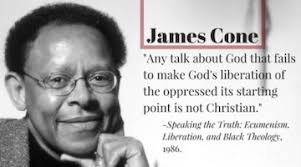
Black History Month has me rereading the late James Cone’s seminal work, The Cross and the Lynching Tree. Cone, of course, is the father of black liberation theology. I’m finding his work especially relevant to the ongoing genocide of Gazans at the hands of white supremacist Zionist Jews.

A central theme of Cone’s writing, public lectures, and teaching focuses on the difference between white versions of Christianity and their black counterpart. He puts that difference succinctly by alleging that whites have used the Bible to oppress blacks and others, while the latter have used that same Bible as a powerful tool to resist that oppression.

The ongoing slaughter in Gaza coupled with the statements of genocidal intent expressed by Benjamin Netanyahu and other Israeli officials have led me to conclude that something similar might be said of Zionists both in Israel and in the U.S. Recently they have used the Bible to ground their genocide of Palestinian children and their mothers. Meanwhile, Islamic Gazans use the Bible along with their Holy Koran to justify their (sometimes violent) resistance.

Who’s right? And what does Cone – what does liberation theology – say about such controversy?

Let’s see.

Consider first how Zionists are using the Bible. Next think about the approach of theologians like James Cone, and how the contrast between the two approaches applies to the Hamas attack of October 7th and Israel’s genocidal response in Gaza. Finally compare the oppressive violence that Zionists have used against Gazans with the violence of Hamas against their overlords. Theologians like Cone as well as his heroes Malcolm X and Martin King find the latter more justifiable than the former.   

Zionist Use of the Bible  

Consider the Zionists’ use of the Bible first.

Early on, Mr. Netanyahu invoked the biblical account of their ancient leaders claiming divine authority to carry out genocide against Israel’s archenemy, the Amalekites (I Samuel 15:1-9). The Gazans are the contemporary equivalent of Israel’s ancient foe, he said. They deserve the same fate of absolute obliteration – i.e. genocide.  

The Prime Minister’s words were turned into a war anthem adopted by the IOF (Israeli Occupation Force). They shocked the world in a video showing them singing and dancing to the words of that anthem calling for the slaughter of Gazans, today’s Amalekites.

Both Netanyahu’s words and the video of the soldiers’ rally were used recently by South African prosecutors in their presentations before the International Court of Justice (ICJ). There the prosecutors alleged that both Netanyahu’s words and the soldiers’ behavior provided convincing evidence of Israel’s intentional violations of the Genocide Convention.

On the one hand, the presentation of such evidence led the ICJ to conclude that the South African charges merit further court deliberation about Israel’s possible conviction for military actions that provide prima facie evidence of being genocidal.

On the other hand, the evidence in question (Netanyahu’s words and the IOC anthem) offers proof positive that (according to Cone’s allegations) white colonial Europeans continue to use the Bible to justify horrendous oppression of their victims.

But what about the Gazans and their use of the Bible? What does liberation theology say about that?

Liberation Theologians & The Bible

For liberation theologians like James Cone, all human beings are loved by the biblical God about whose nature there is evident difference of opinion and controversy throughout sacred scripture. That is, the Bible contains many contradictory understandings of God. In effect, it presents readers with a “battle of the gods.”

For instance, some texts present him (sic) as petty and jealous. Still other texts show him as the national God of the Jews. In that capacity, he is often a God of war like the one demanding the slaughter of the Amalekites.

The Hebrew prophetic tradition presents a very different God. He’s one who in today’s Zionist parlance might be accused of anti-Semitism. That’s because he is often highly critical and fiercely condemnatory of Israel. He frequently punishes them. On at least two occasions he allows their enemies to cart them off for generations-long exiles in Assyria (722-652) and Babylon (586-516).

Again, the prophetic tradition seconds the divine “anti-Semitic” tradition just mentioned. It’s that tradition in which Jesus appears. The Gospel narratives about him along with his preaching and parables sometimes even centralize Jewish enemies (such as “The Good Samaritan”) as heroes while condemning Jewish priests, scribes, Pharisees, and kings. With that in mind, contemporary Zionists would no doubt characterize Jesus as a “self-hating Jew.”

For Jesus, ethnic identity even became entirely immaterial. One thing alone is important, for him, love of God and love of neighbor (Matthew 22:36-40). Connections to Abraham, Jesus says, are no more significant than connections to a stone (Matthew 3: 9-10).

In fact, for the prophets in general (and for liberation theologians like James Cone), what is overwhelmingly central to morality is treatment of widows, orphans, and resident aliens. The prophets constantly remind their fellow religionists that all of them were once slaves in Egypt. They should never forget that. Accordingly, favorable treatment of slaves, aliens, widows, and orphans is the very touchstone of Israel’s identity. In fact, the prophet Jesus makes treatment of “the least of the brethren” the sole criterion of judgment about the final worth of one’s life (Matthew 25: 31-46).

Liberation theologians summarize all of this by asserting that God has made a “preferential option for the poor.” That is, when push comes to shove, and while God loves everyone, the Divine One sides with the poor and oppressed in their struggles against the rich and powerful.

For followers of the Jewish Jesus, that divine preference is evident in the fact that he chose to fully reveal himself not as a king, prince, or rich person, but in the poorest of the poor.  He surfaced in the working class as a construction worker from the nowheresville called Nazareth. He was conceived by an unwed teenage mother. In his youth, he lived as an immigrant in Egypt (Matthew 2: 13-15). He was accused of being a drunkard and a friend of prostitutes (Matthew 11:19). His family thought he was insane (Mark 3:21). He finished disgraced and a victim of torture and capital punishment.

And very significantly for James Cone, forensic archeologists point out that Jesus was probably black and unimposing. He was probably about 5’1” in height and weighed just over 100 pounds. Probably, they say, looked like the figure (below) on the left, not the familiar one on the right. To repeat, it is quite probable that Jesus was literally black. Cone affirms that he was at least figuratively or poetically black. He came from and sided with the poor and oppressed.

Liberation Theology & Violence

Furthermore, it isn’t all that clear that Jesus was a pacifist and non-violent. For instance, all Gospel lists of his apostles identify one of them as “Simon the Zealot.” “Zealot” was the name of patriots in Jesus’ Palestine who resisted Roman occupation by killing Jewish collaborators with Roman occupation. How could “Jesus meek and mild” have associated himself with murderers like that?

On top of that, all four Gospel traditions record that at least one of Jesus’ closest disciples was armed when Jesus was arrested (John 18:10-11). Jesus must have known that. Moreover, the friend in question knew how to use his weapon; he swung it at one of those who came to arrest Jesus and cut off the man’s ear.

Elsewhere, Jesus is remembered as saying, “Don’t think that I have come to bring peace, but the sword” (Matthew 10: 34-36). In another place, he says “Let the man who has no sword, sell his cloak and buy one” (Luke 22:36). And finally, as I said, Jesus was evidently perceived by the Romans as a revolutionary. In any case, they executed him by crucifixion, the means of capital punishment they reserved for violent insurrectionists. He was crucified between two other insurrectionists (not “thieves”}. Jesus must have done something(s) that gave the occupiers the impression that he was in insurrectionist too.

And that brings us back to Gaza, Hamas, and its use of violence on October 7, 2023. Would the revolutionary Jesus have supported such mayhem?

Here’s where distinctions made by liberation theologians {and by James Cone’s primary black hero, Malcolm X} come in. Malcolm was all for peace – but not in response to the oppressor’s aggression. “If someone hits you in the face,” Malcolm would say, “hit him back.” Black people have the right to defend themselves, he was fond of saying, “by any means necessary.”

Liberation theologians like Cone agree. And they go further. They teach that all forms of violence are not the same. At least one form is justifiable; others are not. So, before one can determine possible justification, one must identify its type. Four of them must be considered in any given analysis. Consider them in the context of Israel’s war against Gaza.

  1. The first type of violence is structural and is indefensible. It takes the form of elements such as laws and customs, restrictions, and prohibitions that adversely affect a given population such as inhabitants of the Gaza Strip. European colonialists’ gift of Palestine to white European Jews in 1948 was violent. It resulted in the forced displacement of Palestinians by the hundreds of thousands. Their houses were stolen or destroyed by the Jewish invaders from Germany, Poland, Russia, Lithuania, Latvia, Estonia, and even from the United States. Palestinians who resisted were often simply murdered by the invaders. Moreover, apartheid laws later imposed on Palestinians by Israel’s settler colonists are also violent. Most of the world hasn’t even recognized this structural form of violence as the “original sin” it represents. However, liberation theologians like James Cone do. This form of violence by the powerful against the powerless is never acceptable.
  2. The second type of violence is the truly justifiable violence of self-defense. This is what Malcolm referred to when he spoke of hitting back. It’s a form of violence that the UN recognizes as legitimate in Article 51 of its Charter. Accordingly, people living under occupation have the right to defend themselves against occupying forces. The latter, however, have no right to self-defense. They are robbers, thieves, and murderers. These are the convictions behind the Hamas attacks of October 7th, 2003. Liberation theologians like James Cone agree. This second form of violence is legitimate. However, its adoption is rarely wise. It can be suicidal because it leads to a third type of violence which is always overwhelming.
  3. The third type of violence is reactionary. It is the overwhelming police and military response of those imposing the first type of violence. This third type is on display at this very moment in Gaza. There cowardly Israeli occupation forces have killed more than 27,000 Gazans – more than half of them children and their mothers – in response to Hamas’ employment of the second type of violence. In this case, the response is so overwhelming that according to the ICJ, it provides prima facie evidence of genocide. Obviously, this type of violence cannot be truly justified since it represents restoration of the “order” imposed by violence’s first level. Nonetheless, in most cases such police and military violence is accepted by most as somehow normal.
  4. The fourth type of violence is terroristic. Terrorism is defined as the unlawful use of violence and intimidation, especially against civilians in the pursuit of political aims. Nation states such as Israel and the United States routinely define uprisings against their illegal occupations as “terrorism.” According to them, Hamas is terrorist while Israel and the United States stand for law and order. However, theologians like James Cone maintain that the world’s principal terrorists are states like those just mentioned. They are the ones who impose structural violence and respond with reactionary violence. Their routine murders of those defending their families, homes, and cultures against colonialism’s “legal” crimes are the primary forms of terrorism afflicting our world. By comparison, the violence of groups like Hamas (or even the perpetrators of 9/11) is minor. In other words, though terrorism is never justified, its main perpetrators are those who impose the colonialism of white supremacy in all its forms, not those who resist them.

Conclusion

Yes, the Bible’s Battle of the Gods continues to our day. All of us are involved whether we’re believers or not. But believers especially are called to make up their minds about the nature of the God they believe in and about the nature of the violence they find themselves supporting.

All of this means critical evaluation of Netanyahu’s attempts to biblically justify Zionists’ ongoing genocidal attacks in Gaza and the West Bank. Liberation theologians like James Cone contend that the Prime Minister’s invocation of a genocidal God is a typically white supremacist interpretation. As such it runs completely contrary to Israel’s prophetic tradition and its concerns for the impoverished, widows, and orphans. It runs completely contrary to the words of the Jewish prophet from Nazareth, “Whatever you do to the least of my brethren, you do to me.”

One thing we do know, in the biblical portrayal of its battle of the Gods, the God of the Jewish prophets and the Jewish Jesus is emphatically not the god of I Samuel 15:1-9.

Instead, the divine one is the God of the construction worker from Nazareth, living in a country occupied by invading Europeans, and who gave the invaders reason to believe he supported the Resistance the Romans feared and hated.

In fact, the white European occupiers hated the second level of violence so much that in the year 70 CE, they acted just like Netanyahu and his genocidal army. They reduced Jerusalem and its environs to the same condition we see in Gaza today.

Christmas Cancelled in Bethlehem

Last week, Christian church leaders in the city of Bethlehem announced the cancellation of traditional Christmas festivities in the place traditionally associated with the Jesus’ birth.

And this for at least two obvious reasons. For one, the genocidal killings by colonial settlers in Palestine’s occupied West Bank have made it impossible for tourists to come to Bethlehem.

For another, Palestinian residents of Bethlehem have themselves cancelled festivities in an act of solidarity with their brothers and sisters in Gaza victimized by Apartheid Zionists and their partners in genocide, the United States of America.

But there’s a third reason as well – a theological one that needs highlighting this Christmas weekend.

The motive was explained last Friday on Amy Goodman’s “Democracy Now.” Ms. Goodman began with a clip of the Reverend Isaac Munther, a Lutheran pastor in Bethlehem.

Standing before a nativity scene with the figure of Jesus in a keffiyeh surrounded by rubble, Rev. Munther said:  

“Christmas is a ray of light and hope from the heart of pain and suffering. Christmas is the radiance of life from the heart of destruction and death. In Gaza, God is under the rubble. He is in the operating room. If Christ were to be born today, he would be born under the rubble. I invite you to see the image of Jesus in every child killed and pulled from under the rubble, in every child struggling for life in destroyed hospitals, in every child in incubators. Christmas celebrations are canceled this year, but Christmas itself is not and will not be canceled, for our hope cannot be canceled.”

Elaborating on that theme, Reverend Mitri Raheb, the president of Bethlehem’s Dar al-Kalima University, offered an explanation that echoed the liberation theology perspective on Palestine that my wife and I encountered in the summer of 2006, when we visited the Sabeel Liberation Theology Center in Jerusalem.

Dr. Raheb is the author of a book with a revealing title, Decolonizing Palestine: the Land, the People, the Bible. Here’s what he said:

“The Christmas story actually is a Palestinian story, par excellence. It talks about a family in Nazareth, in the north of Palestine, that is ordered by an imperial decree of the Romans to evacuate to Bethlehem, to go there and register. And this is exactly what our people in Gaza has been experiencing these 75 days. It talks about Mary, the pregnant woman, on the run, exactly like 50,000 women in Gaza who are actually displaced. Jesus was born actually as a refugee. There was no place at the inn for him to be born, so he was put in a manger. And this is exactly what also the kids that are coming to life these days in Gaza are experiencing. You know, most of the hospitals are damaged, out of service, and so there is no delivery places for all of these pregnant women in Gaza. And then you have the bloodthirsty Herod that ordered to kill the kids in Bethlehem to stay in power. And in Gaza, over 8,000 kids, they have been murdered for Netanyahu to stay in power.

And you have this message that the angels declared here, “Glory to God in the highest, peace on Earth,” which was actually a critique of the empire, because glory belongs to the Almighty and not to the mighty. And the peace that Jesus came to proclaim is not the peace, the Pax Romana, the peace that is based on subjugation and military operation, but on human dignity, equality and justice. And this is actually what we call for. And I have to say I find it really a shame that in this season, where every church hears these words, “peace on Earth,” that the United States is vetoing even a ceasefire. It’s a shame.”

Yes, shame on all of us taxpayers and voters.

So much for “Merry Christmas!” this 2023.

Dan Brown’s “Origin”: Asking the Wrong Question about Religious Violence

Sadly, my nearly year-long saga in Spain is coming to an end. Today is my last full day here. Since last September, my wife, Peggy, and I have shared a sabbatical with my daughter and son-in-law and their family of five children (ages 4 to 15). Right now we’re in Mallorca.

The whole experience has been life changing – almost as important as my study of liberation theology in Brazil (1984), my frequent visits to revolutionary and post-revolutionary Nicaragua (beginning in 1985), all those times I’ve visited Cuba (starting in 1997), and my years of study and teaching in Costa Rica (1992-2013).

In Spain I’ve learned more and changed more than I could ever have anticipated.

Unexpectedly, I’ve entered an unusual community here – of street musicians, cave dwellers, hippies, and grassroots philosophers. I love them all, and as I said, it’s changed my life.

One of them, Simon (from Chile) introduced me to the great Chilean film director, Alejandro Jodorowsky, and to Ana Rodriguez Sotomayor and her milestone book, The Precursors of Printing.

My troglodyte friend, Simon

Those sources and my desire to improve my Spanish comprehension sent me back (via YouTube) to my early teachers from Chile, Costa Rica, Argentina, and Puerto Rico: Franz Hinkelammert (who died last week), Enrique Dussel, and (more recently) Ramon Grosfoguel. Together their drive to decolonize world history has rendered irrelevant my previous understandings (and teaching!) of Eurocentric universal history.

Simon and I also studied together the Mayan sacred book, The Popol Vuh. He introduced me to Tarot, marijuana, and mushrooms. At least once a week, we talked for hours.

Another dear friend, Francesco from Italy, showed me how to read tarot cards. Cesco’s a Bob Dylan scholar. My friend’s two long essays (in Italian) helped me appreciate Dylan more deeply and enthusiastically than ever.     

That made my attendance at Dylan’s Granada concert (with my 15-year-old granddaughter, Eva Maria) richer than I could ever have imagined. Eva and I had an artistic experience that night (in the Alhambra) that neither of us will forget. It was magical.

Eva Maria & I pose before entering the Alhambra’s General Life

So, I found it somehow fitting that just a few days ago, with my time in Spain running out, it was Eva who suggested that I read Dan Brown’s novel, Origin. Her suggestion was inspired by connections she saw between my recently published essay on artificial intelligence (AI) on the one hand, and our frequent conversations about faith and religion, along with our shared experience of Spain itself on the other.

Origin is a 2017 “who dunnit” that involves the biblical Book of Genesis, science and evolution, Christian fundamentalism, and artificial intelligence. All of it is set in Spain and many of the places my family and I have visited over the last year.

I’m talking especially about Bilbao and its Guggenheim Museum and Barcelona’s iconic Sagrada Familia cathedral created by Antoni Gaudi. Involved too is what I’ve learned here about Spanish politics, the enduring power of the Spanish Catholic Church, the dictatorship of Francisco Franco (1939-1975), the monarchy in Spain, and resistance to that apparently outmoded institution.  

Gaudi’s Sagrada Familia Cathedral in Barcelona

In short, Origin has Dan Brown’s perennial hero, Robert Langdon attempting to solve the murder of the brilliant futurist scholar, Edmund Kirsch. Kirsch claimed to have discovered definitive atheistic answers to religion’s two most persistent questions: (1) Where did we come from, and (2) where are we going?

Scholars from Christianity, Judaism, and Islam found Kirsch’s discoveries so threatening that the only solution to the problem he represented was to silence him permanently.

With the dastardly deed done, Langdon must locate the responsible forces.

Not surprisingly, doing so involves a stunningly beautiful heroine, several additional murders, frantic chases, and Brown’s usual long (sometimes pedantic) discourses on symbols, codes, architecture, history, mythology, science, and technology.

Also involved are long conversations with “Winston,” a computerized embodiment of the very artificial intelligence that my earlier-referenced essay had speculated might represent the next step in human evolution.

The whole thing was quite fascinating and even exciting from its opening interfaith exchanges to its cliffhanger conclusion.

Still however, the book’s central problem seemed somehow outdated. I found it difficult to imagine that in 2017 the “entire world” [actually, 250 million (of 8 billion) people with access to computers and iPhones] would still be interested in, much less threatened by long-resolved (or dismissed as irrelevant) questions of creationism vs. evolution explained in those pedantic screeds.

Except for a quickly shrinking cadre of Christian fundamentalists, that controversy was solved cinematically years ago by Spencer Tracy in “Inherit the Wind” (1960). Granted, the Scopes Monkey Trial (1925) did garner fevered national attention at least in America. But that was almost a century ago.

Since then, we’ve had the death of God movement, John XIII‘s Second Vatican Council, the Catholic Church’s pedophilia crisis, and the resulting general discrediting of organized religion that has all but emptied (Catholic) churches across the world. (Just go to Mass here in Spain on any given Sunday, and you’ll struggle to find anyone under 60 among the worshippers.)

Today (at least among Christians) only religious crazies (like bombers of abortion clinics) are willing to commit murder over differences about the Bible (in which btw, there’s no denunciation of abortion).

Yes, that’s true about questions of creationism vs. evolution, and believers who understand the Bible as:

  • A single divinely authored book with 73 chapters
  • Whose most important chapter is Genesis
  • Whose data conflicts with modern science
  • And whose meaning is confined to the personal sphere,
  • While supporting American patriotism
  • And “spiritual” questions
  • Of feeling good about oneself
  • And about life after death,
  • Punishment and reward
  • And an apocalyptic, God-willed
  • World destruction
  • As punishment for sin

To repeat: very few among Christians are willing to kill or die for such arcane beliefs.

But that’s not nearly so about the Bible and questions of social justice. Instead, as Noam Chomsky (a Jewish atheist) has shown, the U.S. government has shown itself quite willing to kill hundreds of thousands (including a whole team of liberation theologians in El Salvador in 1989) precisely over biblical interpretation that differs from that of the Christians whose irrelevant fundamentalism U.S. leadership approvingly identifies with Christianity.

On the other hand, the assassination-worthy theological enemies of the United States include those who ALONG WITH VIRTUALLY ALL OF MODERN BIBLICAL SCHOLARSHIP:

  • See the Bible as a library of books written by various authors in various historical periods for various reasons and from various theological (often conflicting) perspectives.
  • Within this canon, the Book of Genesis and its creation myths are peripheral,
  • While the Book of Exodus and Israel’s nation-founding story of the liberation of slaves from Egypt represents the Bible’s central focus
  • Reflecting ancient and modern conflicts between the world’s poor and its rich and powerful classes
  • Whose oppression of marginalized people stand in sharp contrast to the biblical God’s “preferential option for the poor,”
  • [And to “America’s” (and empires’ in general) preferential option for the rich],
  • While identifying the Book of Revelation’s “Apocalypse” as predicting not the end of the world, but the annihilation of the Roman Empire and (by extension) of empires in general.

With all of that in mind, it’s no wonder that Dan Brown chose a safer and less politically controversial approach to religious controversy than that pinpointed by Chomsky, biblical scholarship, and contemporary politics.

Instead, Brown chose to stick with worn out cliches and simplifications.

Regrettably, he steered far away from Chomsky’s advice: “Keep away from clichés, this world is much more complicated.”

So is faith and Sacred Scripture.   

“Indecent” Women Doing Liberation Theology Without Underwear: Saints Tina Turner & Chuck Berry

What is the connection between liberation theology and its feminist theologians refusing to wear underwear while writing their articles and books? That’s right: no underwear.

And what is the connection of their resulting theology with the poor lemon vendors in Buenos Aires who, also without underwear, squat defiantly in their full skirts and urinate on the sidewalks in front of watchful and disapproving city police? (Meanwhile, the lemon sellers complain about their “shi*ty priests”, “mafia politicians” and those “puta policia” – fu*kin’ cops).

And what about the mothers, grandmothers, and great-grandmothers, who proudly display their completely unrobed bodies on so many contemporary internet sites? Presumably many of them identify as Christians. But by religious standards, isn’t such display “indecent?”

And finally, is there any relationship between feminist theologians and those Argentine lemon sellers, on the one hand, and rock ‘n’ roll music, Tina Turner, and Chuck Berry on the other.

The late liberation theologian Marcela Althaus-Reid (1952-2009) provocatively raised and addressed questions like those during her brief career as Senior Lecturer in Christian Ethics, Practical Theology, and Systematic Theology at the University of Edinburgh in Scotland. In doing so, she shed light on women’s rebellions against oppressive patriarchal norms across the planet.

You know what I mean. Think about the reaction to the effective repeal of Roe v. Wade by the U.S. Supreme Court. Think of those Muslim women in Iran who cut their hair in public and refuse to obey the “morality police.” Even consider, if you can, the unspoken meaning behind those mature women around the world who provocatively display their unclothed bodies online for all to see.

Althaus-Reid argued that the above are all doing what she called “Indecent Theology.” Here the reference is to her thesis from her 2004 theological potboiler, From Feminist Theology to Indecent Theology: Readings on Poverty, Sexual Identity, and God.

Because of the important light the book sheds on the feminist rebellions just referenced, as well as on liberation theology itself, please consider with me what Althaus-Reid means. Consider the relevance of indecency to liberation theology and to issues like abortion, the morality police, what some might call “pornography,” as well as to patriarchy in general. Consider its connection to rock ‘n’ roll and to popular “saints” like the recently deceased Tina Turner (1939-2023) and Chuck Berry (1926-2017).

Female Indecency

Althaus-Reid begins by reminding readers that Christianity itself is a highly sexualized affair. It is claustrophobically decent. (In what follows, all references in parentheses are to the book just cited.)

She says it’s not that the morality of the Bible in any way endorses Victorian sexual standards. It does not. Instead, its main concerns are liberation in all the senses (economic, political, and spiritual) that the word “liberation” connotes.

That’s because the Biblical tradition was based on the freeing of slaves from Egypt. Its resulting concern was for the welfare of widows, orphans, and resident aliens. Its prophetic tradition boldly spoke radical truth to priests, kings, and other bosses who legislated against, ignored, and/or exploited the poor.

In general, the biblical tradition promised the latter a new and brighter future. The prophet Yeshua called that future the “Kingdom of God.” By that he meant what the world would be like if God were king instead of the world’s oppressive “Caesars.” Such a world would be turned upside down. Its standards of decency would be transgressed at every turn.

Yet despite such a clear emphasis on social justice, it was the biblical tradition itself that ended up doing a headstand instead of the imperial world order. The revolutionary thrust of “The Book’s” pivotal story was tamed by the kings, princes, and popes of the world (27, 28). Far from being scandalous and revolutionary, the Judeo-Christian tradition thus became the defender of the status quo. Its point became the social control of the revolutionary lower classes, with oppressive standards of decency, especially for women.

And why so much attention to women? It is because of their embodiment of the revolutionary energy that the Greeks called eros. As psychologists and philosophers such as Sigmund Freud and Herbert Marcuse have pointed out, eros represents the basic creative energy of the universe.

In a capitalist patriarchal order dependent on overwork, the powers of patriarchy identify eros in the form of female sexuality as the fundamental factor threatening to undermine their entire project. Hence the powers-that-be covertly vilify women for deliciously “tempting” men to find meaning, fulfillment, happiness, and joy in human (and sexual) relationships that undermine the system’s requirement of “surplus repression” in the form of overwork.

And so, repressive concepts of decency in general and of theological decency in particular emerge to dominate women and, by extension, their potential partners. Theological decency decrees that:

• The woman’s body is a source of temptation

• Therefore, it should be covered by layers of clothing.

• Women need men to regulate female bodies and behavior through special rules written by men and (depending on culture and historical period) governing the integrity of women’s sexual organs, their menstrual periods, and issues surrounding marriage, birth control, abortion, divorce, voting and the ability to own property.

• To do theology (i.e., to speak authoritatively about God even in relation to themselves and their bodily processes), women must earn professional degrees grudgingly bestowed by the patriarchal establishment of academia.

• Therefore, the “degrees” informally awarded by the “School of Life” with its deviant and indecent logic are invalid (14, 32, 137). So is the spirituality resulting from lemon vendors engaging in “witchcraft,” in the informal healing arts, working as midwives, abortionists, and spiritual guides.

Theological Indecency

With all this in mind, feminist liberation theologians like Althaus Reid insist on transgressing the limits of theological decency. They insist that:

• Doing theology is a profoundly sexual act (4, 76). To repeat: this is not because sex was central to Jesus’ preaching. Rather it is because the church has for centuries distorted the teachings of Jesus in the service of the empire, acting in the process as an instrument of social control as explained above. Therefore, theologians are forced to write endless pages refuting such distortions.

• Poor women provide the most radical view of theology (16). Their enforced “otherness” teaches us something new about life and about the Greater Queer that some still insist on calling “God” (19).

• Yes, God is Queer (9, 146) in the sense of exceeding all categories and definitions (175) while subverting decent bourgeois concepts like family. [For those who live on the peripheries of society – under bridges, in slums, favelas and shanty towns, “family” ends up being an oppressive category. It arrogantly invalidates alternative basic social groupings that are just as valid, functional (and dysfunctional) as their bourgeois counterparts (159, 160, 164).]

• Far from being a liberating model for Latin American women, the cult of the Virgin Mary ends up functioning as another instrument of social control, this one aimed directly at women (13, 23, 39, 55). After all, Mary is presented as “a gadget” (88) having sex with God without any pre-coital romantic relationship (85). She does not experience sexual pleasure or orgasm from the union (88). And then afterwards she enjoys no meaningful sex life with her husband, Joseph. Such factors are supposed to set an example for all Christian women.

• Similarly, Jesus himself is strangely asexual: a young Hebrew man with no compañera and no unambiguous sexual interests. He also serves as a model of sexual abstinence (45).

• Thus, Jesus was queer in the sense indicated above: an outcast who rejected and was rejected even by his own family. They thought he was crazy (Mark 3:21). He spent a lot of time in the desert. At least once he was tempted to commit suicide by jumping from the pinnacle of Jerusalem’s Temple itself (170).

• In addition, the evangelical representations of Jesus show him as a victim of the machismo of his own culture (45, 48, 51, 80). Yes, he comes to the aid of a woman considered “impure” because of a menstrual problem (Lk 8, 43-48); and yes, he rejects the male executioners of a woman sentenced to death for adultery (John 8: 1-11). However, Jesus never questions the misogynistic patriarchal laws that govern those situations. He does not reject the laws regarding the stoning of women caught in adultery, nor those that classified menstruating women as “unclean” (6, 13).

• In summary, if liberationists take Jesus’ poverty and otherness seriously along with Paul’s dictum that in Christ there is neither male nor female (Galatians 3:28), perhaps the best contemporary identification of “the Master” would be a twelve-year-old girl prostituted by two men in a public toilet in Buenos Aires (84).

Unclothed Theology in the U.S.

Those are just some of the reflections of Althaus-Reid operating as a professional theologian. Meanwhile, she points out, her less academically prepared Latinx sisters do their theology based on popular beliefs and practices. Their well-earned degrees come from the school of very hard knocks. Their insights, Althaus-Reid suggests, are no less valid than their sisters’ teaching in places like the University of Edinburgh.  

So, they defiantly continue to honor Santa Evita Perón. She, after all, secured voting rights for Argentine women over the objections of Argentine bishops (79). They also pray to Santo La Muerte (St. Death), Jesús Bandito, and local popular “gangster saints” who are seen as robbing and stealing from the real thieves and criminals who support those who run the government (161). They have “canonized” deceased popular singers like Rodrigo and Gilda offering them prayers and novenas in chapels dedicated to El Angel Rodrigo and La Santa Gilda (157). Those who honor such avatars kneel in church like Althaus-Reid herself without underwear, engulfed, she says, in the fragrance of female sex, and offering fervent prayers to rock stars no doubt considered “indecent” by church authorities.

All of which brings me to rock ‘n’ roll, Tina Turner, Chuck Berry, and those unclothed grandmas.

Take the grandmas first. Althaus-Reid I think would see them as doing a kind of negative theology protesting the false church-supported Victorian standards earlier referenced. They take indecency to the extreme not just rejecting underwear, but displaying their bodies completely unclothed — not for personal gain like strippers or aspiring models, but just for the hell of it.     

Their wordless indecency is consistent with Althaus-Reid’s identification of the female body as a privileged locus of rebellion against patriarchal systems of power (45). Such rebellion echoes the status of their sisters in the Global South as “single women” with no visible men (35).

After all, under patriarchy, the skirts that once signified femininity and even priesthood (37), now only convey a deep alienation (20). Set them all aside!

“Do you want indecency?” rebellious women seem to say. “Well, take a look at this! The patriarchs will not tell us how to behave and what to do with our bodies!”

As for rock ‘n’ roll, Tina Turner, and Chuck Berry. . ..  How much saintlier can you get?

During their lives, their music performed the basically feminine function of distracting millions from the overwork mandated by the reigning system denounced by Marcuse. In the process, they brought joy, fun, and happiness to millions of people who ended up attending and participating in the huge liturgies we call “concerts” – even over the protests and askance gazes of uptight Victorians and clergy.  

By the standards of Althaus-Reid nothing could be more constructively indecent and therefore holy. Thank you, Saint Tina! Thank you, holy Chuck! Thank you, dear Marcella.

Report from Spain: I Meet Simon the Street Busker

Since coming to Spain, I’ve made it my business to improve my Spanish. I recently met a very interesting and unlikely friend who’s helping me with that. Let me tell you about him.

But first a word about my Spanish.

I started learning it in 1985 in Nicaragua where I spent six weeks of study at a language school called Casa Nicaraguense de Español. The point there was to spend the mornings in class and the afternoons learning about the Revolution that was then celebrating its sixth anniversary. It was my first experience of living in a revolutionary situation.

Getting some fluency in Spanish wasn’t so hard for me, since I already had studied Latin, French, Italian, and Portuguese. So I could get along.

Seven years later, Peggy and I did an intensive three-month Spanish course in San Jose, Costa Rica at a school set up there to equip evangelical missionaries from the States to learn enough Spanish to convert Tico Catholics to evangelical Protestants.

Both Peggy and I did well enough in our courses for us to participate in a semester-long workshop on liberation theology in a think tank in San Jose called the Departamento Ecumenico de Investigaciones (DEI). We were the first North American “invited researchers” allowed into those hallowed halls where everyone was suspicious of Yankees. (I remember being told about worries that I might be CIA!)

But while Peggy’s Spanish has since taken off because of her work with Spanish-speaking immigrants and refugees, mine has remained where it was twenty years ago.

So, now that we’re in Spain long term, I find myself scrambling to get back on top of Español. To that end, I enrolled for ten hours of conversation with language teachers at a school just minutes away from our apartment in Granada’s picturesque Albaicin barrio. My intention was not just to improve my Spanish, but to learn about Spanish history. I was especially interested in knowing about the years when the fascist caudillo, Francisco Franco ruled the country (1939-’75). My four language teachers at the local school were happy enough to help me with that project.

I learned not only about Franco and how he came to power, but also about Spain’s current government which happens to be run by two left-wing parties, the socialist Spanish Workers’ Party, and a rechristened Communist party called Podemos (“Yes, we can!”). The country’s president is the socialist leader, Pedro Sanchez. But its most popular politician is the Podemos politician (and communist) Yolanda Diaz who is Spain’s Second Deputy Prime Minister.

All of that was fine. I really enjoyed conversations with the teachers just mentioned. But as my daughter, Maggie, said, “Why are you paying $50 an hour for conversations, when you could have the same experience for free with any elderly person sitting on a park bench down in the Plaza Larga?”

I had to admit she had a point. So, just recently I decided to locate such a person. I went down to the local Senior Center and struck up a conversation with a woman there. Her name was Carla. And she was very kind. However, she wasn’t really interested in conversational exchange. She just wanted someone to complain to about how terrible her life had become. The “conversation” was all one-way. On top of that, she spoke so quickly and with such dialect that I only understood about 20% of her complaints.

I decided to seek conversation elsewhere.

So, I approached an interesting looking busker playing at the entrance to the Plaza Larga which around here resembles an outdoor living room where locals gather at the many outdoor cafes and bars for cappuccinos and charlas.

The man’s name is Simon. He’s 60 years old and hasn’t a spare pound on his 5’3” frame. He wears a black tee, and at first peers out at you suspiciously from serious brown eyes framed with long and scraggly gray hair.

After I introduced myself and explained my language project, Simon warmed up and agreed to share a café con leche now and then and talk. He wasn’t interested in getting paid. “Just coffee,” he said.

Turns out that Simon is Chilean, living here for the last fifteen years without papers or passport. He plays a quietly thoughtful guitar.

I’d describe Simon as an old hippie. Looking out at the world, he sees a madhouse that he wants no part of. He’s discovered that he can live by singing and nothing other than his faith that Life will provide him with whatever he needs. It always does, he says. His busking brings him an income of about ten euros a day, sometimes a bit more. And that’s all he needs.  

Simon tells me that he lives in a simple house in San Miguel Arriba, a leisurely half-hour ‘s uphill walk from the Plaza Larga. At home, he cooks the vegetables he purchases at his local market on a butane stove. He defecates in a bag and disposes of his personal waste “more ecologically,” he said than the rest of us. It’s important, he says, to take care of his health, because he has no medical insurance.  

Simon’s mother died when he was very young. So, he was raised by his father who was an automobile mechanic usually paid in kind by his customers. His dad was an anarchist who always kept a statue of La Virgen prominently displayed in the house.

Simon was schooled by the Jesuits in Chile and went as far as his freshman year at a private university, where he studied special education for children suffering from dyslexia and other developmental problems. He left school though to become an artisan working in metal and wood.  

He took up with a woman he lived with for several years, fathering three children (ages 15 to 8) none of which (“sadly,” he says) he ever sees.

Simon is interested in theology and was amused by the fact that I had been a priest. The Jesuits, he said, taught him well and set him on a spiritual path that he’s followed ever since. It has led him to Shamanism and the Psycho-magic of the Chilean artist and filmmaker, Alexander Jodorowsky. Psycho-magic allows practitioners to heal and even perform operations using nothing but their imaginations.   

Simon now finds himself studying Tarot – as a fallback, he laughed, and source of income should he somehow become unable to busk any longer.

I thoroughly enjoyed my first conversation with Simon. On parting we agreed that we are somehow kindred spirits, and both look forward to future conversations.

Over his protests, I gave him ten euros anyway.