3rd Report From Rome: Some Reservations about Leo XIV’s Papal Inauguration

[What follows is the 3rd installment describing a wonderfully synchronic event that coincided with my wife Peggy’s and my visit to Rome to spend three weeks with my son and his family there. The visit just happened to coincide with the elevation of fellow Chicagoan Robert (Fr. Bob) Prevost to the papal throne. Today’s account is about Pope Leo’s inauguration. You can find the other two installments here and here.]  

Peggy and I got up early this morning – 5:00. Our intention was to get to St. Peter’s Square in time to secure seats for Pope Leo’s inauguration which would begin at 10:00.

However, our ride to the basilica was half an hour late. That meant we didn’t get seats.

And though we were able to situate ourselves much closer to the center of action than we did a week ago for the introduction of the new pope, our late arrival left us standing in the increasingly hot sun from 7:00 till noon.

It was worth it though. It gave me plenty of time to observe and reflect on the thousands upon thousands of faithful and simply curious who filled the Square and about a mile of the Via Conciliazione – the broad avenue that extends from the basilica’s piazza towards the Castel Sant’ Angelo.)

The Ceremony

In the meantime, all of us were inspired by the St. Peter’s Basilica choir and their transcendent renditions of Catholic choral classics like “Christus Vincit” and “Salve Regina.” We also ended up praying the five Glorious Mysteries of the rosary in Latin (viz., (1) the Resurrection, (2) the Ascension, (3) the Descent of the Holy Spirit on the Apostles, (4) the Assumption of the Blessed Virgin into Heaven, and (5) Her Crowning as Queen of Heaven and Earth). I was surprised how easily the Latin came back to me.

The whole thing and what followed was made visible for everyone on perhaps 20 huge jumbotrons located strategically throughout the entire venue.

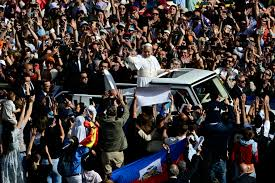
Then about 9:30 Pope Leo arrived. He was standing in the back of his popemobile smiling and giving his blessing to the adoring crowds as the vehicle drove around St. Peter’s square and down the length of the Via Conciliazione.  He passed very close to the place Peggy, our Roman host, and I were standing. The crowd’s enthusiasm, shouts, and applause made it all quite thrilling.

At 10:00 right on the dot, the ceremony began. Everyone in the crowd had been given memorial booklets with the texts of every hymn, litany, and prayer, along with brief descriptions of ceremonies like the bestowal of the papal ring and other signs of papal authority. Texts (including the pope’s homily) were also projected on those large screens. So, it was all quite easy to follow and understand.

The center of it all was the papal Mass, with Leo the celebrant, while various members of the clergy and laity handled the biblical readings and some of the prayers in Latin, Italian, Spanish, English, and Greek.

At communion time, a whole army of priests (perhaps 50 or more) dressed in black cassocks and white surplices processed to various stations throughout the crowd to distribute the “hosts” that Catholics believe are the very body of the risen Christ. I noticed how some recipients received the wafer on their tongues, others in their hands. One priest close to me refused to place the host in extended palms. He repeatedly insisted on laying the host on the recipient’s tongue. The priest who gave me communion placed the wafer reverently in my hand with the traditional words, “The body of Christ.”  

“Amen,” I replied. (I hadn’t received Catholic communion in years.)

All that describes the surface level of my experience this morning. But what did I really see and hear? Let me respond at three levels, one inspirational, one historical, and one political.

Evaluation

At the inspirational level I saw thousands of Catholics and others thirsting for a meaningful spiritual experience of transcendent, invisible dimensions of life. After all, we live in a world rendered increasingly meaningless by materialism, consumerism, war, shifts in global power, and social change almost beyond comprehension. Seeing such people praying the rosary with eyes closed and lips moving was inspiring indeed. So was their reverence in receiving Holy Communion.

At the historical level, I saw something more problematic. I witnessed:

  • An out-of-touch museum performance piece
  • Overwhelmingly led by men in pretentious medieval costume representing the most patriarchal institution in the western world
  • Now led by a nice American priest who actually believes he’s somehow the “Vicar of Christ”
  • Who founded the Catholic Church
  • Despite the evidence of even Catholic scripture scholarship that such conviction remains unsupported by credible evidence. It shows instead that Yeshua of Nazareth remained a good Jew throughout his brief life and had no apparent intention of founding the gentile “church”
  • That emerged definitively in the 4th century when (under Constantine) a powerful faction of the Christian community threw in its lot with the Roman Empire becoming in effect its Department of Religion,
  • Notwithstanding the fact that Yeshua died a victim of Roman torture and capital punishment.

However, most problematic of all were the event’s political dimensions. In that connection I saw a pope who (once again!) during a time of genocide and this time standing before its perpetrators (in the persons of J.D. Vance and Marco Rubio) spoke in generalities and empty platitudes instead of calling attention to their crime. As indicated in yesterday’s piece, I had been hoping for more – perhaps something in the vein of Episcopal Bishop Mariann Edgar Budde’s words to President Trump on behalf of Palestinians and migrants.

Conclusion

When I’ve expressed my concerns to friends and family members, I’m often told that the new pope must be careful and diplomatic. After all, he’s just starting out.

My reply however is that we’re in a state of emergency. The fact of genocide is undeniable in Gaza. Women and children are starving to death. Each morning, it seems, we’re told that as many as 150 Palestinians (mostly those women and children) were killed overnight. Such victims can’t wait.

The pope has potentially more moral power in his voice than anyone else in the world. If he truly believes himself to be the vicar of the prophetic Yeshua, he must use that voice now.

He must forget caution and diplomacy.

2nd Report From Rome: Will Leo Show The Courage of Bishop Budde?

Tomorrow morning at 6:00, Peggy and I will drive to Vatican Square with some new Roman friends to attend the inauguration of Pope Leo XIV. The ceremony will begin at 10:00. That means we’ll be there four hours ahead of time. The attempt to secure good seats promises a long morning.  

As you may recall, what Carl Jung called “synchronicity” has brought us to Rome at this precise time. Our ostensible purpose for being here was simply to spend three weeks with our son, daughter-in-law, and three small granddaughters (ages 5, 3, and 1). We wanted to spend as much time as possible getting to know the girls, whose parents’ foreign employment patterns would otherwise make that far more complicated.

However, my real synchronic purpose for being here, I’m convinced, is to reconnect me with my deep Catholic roots for purposes of final evaluation before transition into Life’s next dimension.

With that process in mind and at the age of 84, I feel overwhelmed by Rome’s beauty – its tree-lined streets, omnipresent sidewalk cafes, its lavish fountains, statuary, Renaissance paintings and churches, its operas and ballets. Today all that seems even more wonderful than it did more than half a century ago when I spent five years here (1967-’72) getting my doctoral degree in moral theology.

Those were magic years for me, when after spending my teenage and early adult years in a seminary hothouse, I finally began waking up to the real world. It all shook me to the core.

And here I’m not just thinking of personal growth experiences, but of the dawning of political awareness about the Vietnam War, the Civil Rights Movement, Women’s Liberation, and of Liberation Theology which I’ve come to understand as “critical faith theory.” (By that last phrase I mean understanding the way Christianity has been used by western colonial powers to enslave, brainwash, and justify repeated exterminations of Muslims, “witches,” Native Americans, kidnapped Africans, and colonized people across the planet.)

Along those lines, being here in Rome during the ongoing holocaust in Gaza makes me think of Pope Pius XII’s virtual silence on the Jewish Holocaust in the 1930s and ‘40s. It has me wondering if Leo XIV will follow in his shameful footsteps.

I mean, the new pope will have a golden opportunity to confront his fellow American Catholics undeniably responsible for the ongoing slaughter in Palestine. I’m referring to J.D. Vance, Marco Rubio, and possibly Joe Biden. It’s as if during the Holocaust, Pius XII had the chance to publicly confront Hitler or Goering.   

Will Leo use this golden opportunity to call them (and the absent Mr. Trump) to task the way the courageous Episcopal bishop Mariann Edgar Budde did when presented with a similar opportunity in the early days of the Trump administration? Recall that as the episcopal leader of 40,000 congregants in the D.C. area, Bishop Budde had Trump and Vance squirming in their seats as she pled for mercy on behalf of the immigrants, refugees, Palestinians, and others whom those key members of her audience show every evidence of despising.

Will the papal leader of 1.2 billion Catholics show similar courage tomorrow? Or will he take refuge in “safe” generalities, “diplomatic” bromides, and empty platitudes about “peace,” justice, and mercy?

My guess is that it will be the latter. But we’ll see.

It’s Christmas & Jesus Remains Buried in the Rubble

It’s Christmas again.
And Jesus is still under the rubble
In Gaza
(Just like last year).

He’s on an operating table
There
Having his infant arms and legs
Sawed off
Without anesthesia.
Screaming for his
Already dismembered mother
Who’s been blown away
By the U.S. and Israel.
He’ll never kiss her again
Or feel her warm embrace.

All but forgotten
By holiday revelers
With mindless
“Merry Christmases!!”

Meanwhile Zionists weaponize the Bible
So the slaughter might continue.
Christians do the same
Singing maudlin carols
They don’t understand
And buying silly trinkets
In Wal-Mart.
As if God were Santa Claus,
A billionaire,
Or a racist killer.

Worse still:
As if God were
A genocidal Amerikan!

It’s as if Yeshua were not
Piss poor
And homeless at birth
Considered by imperialists
As no more than an “animal”
Among stable asses and oxen,
The son of a disgraced
Unwed teenage mother,
An underpaid construction worker,
A drunken friend of prostitutes
Houseless as an adult
The sworn enemy
Of the Jewish power establishment
And the rich
That wanted that child
From nowheresville
Slaughtered.

(Good Christians don't like people like that)

As if Yeshua were just another
Palestinian street rat,
And not
An unwelcome refugee in Egypt,
A terrorist in Roman eyes,
Their inmate on death row,
A victim of torture
And capital punishment.

“Good riddance,”
The Romans said
Just like us.

And the whole world
Wasn’t watching then either.
Few noticed
Or cared.

But should we open our eyes
We’d see a Yeshua
So much more
Than that.

He came to serve the poor.
He said.
God’s kingdom would be theirs
So would the entire earth.
Not Elon’s or Gates’ (Luke 6:24)
Or Amerika’s
Who’s blindness and arrogance
Deserves eternal damnation
Rather than the accolades
The world bestows on
Such fools
Along with Herod and Pilate
Anas and Caiaphas.

______

The pastor of Bethlehem’s
Christmas Church said
Something like that
In his own Christmas sermon
This year
Just like the one
Few noticed
When he said it
Last year.

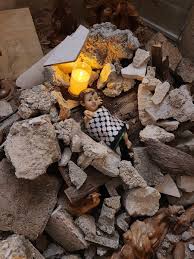
Here’s his Xmas creche
Here’s Pope Francis with his Jesus 
In a keffiyeh-lined crib:
This year
Listen
To these holy men
And to Yeshua’s silenced voice
In the Sacred Land
Of Palestine.

Once again,
The real
Christmas Story
Is unfolding
There
Before our very eyes.

My Homilist’s Writer’s Block in the Face of Genocide

This is the 5th Sunday of Lent. I’ve read the liturgical selections as found on the U.S. Conference of Catholic Bishops’ website. Anticipating Easter in just two weeks, the first reading is about Ezekiel’s 6th century BCE promise of resurrection to a Jewish people in their Babylonian Exile. The day’s selection from the Gospel of John describes Jesus’ raising of his friend Lazarus from his moldering grave.

In in the face of what the odious Benjamin Netanyahu doing in Gaza (with 95% support from his constituents) it all nearly turns my stomach. It has shut down my ability (and desire) to write anything sympathetic to any tradition about “God’s People” returning home.

Think of the ironies contained in today’s readings!

In the selection from Ezekiel, the prophet writes about the sixth century BCE Babylonian Exile. Exile, he laments, has meant death for his people.

So, to encourage them, he writes of a future when graves will be opened, where the dead will rise, and return to Israel, their home. More than that, the prophet promises that the returnees will embody God’s own Holy Spirit.

Then the liturgical response drawn from Psalm 130 acknowledges God as the liberator of the oppressed. It sings of a God whose mercy responds to the prayers of captives by expressing forgiveness and kindness.

Who among us can read such sentiments without throwing up?

I mean, the Zionist Jews with their people’s lamentable history of exiles and occupations by foreigners and with their experience of pogroms, and Holocaust at the hands of Christians have suddenly been revealed as the monsters they’ve always been. Absolute monsters!

Yes, it’s true: the Jewish people have more than once risen from the dead and returned “home” just as Ezekiel promised. But this time since 1948 and especially since October 7th, 2023, contemporary Zionists have completely assumed the identity of their oppressors. They’ve become Nazis! Yes, Nazis!

And the hell of is: so have we Americans. With “Genocide Joe” Biden leading the way, virtually all the U.S. senators and members of Congress have enthusiastically supported Israel’s ethnic cleansing, collective punishment, infanticide, femicide, and starvation tactics. They (and we who fail to protest) are just as guilty of genocide as the Nazi apartheid Zionists.

And in the face of it all, where in the collective west are Christian voices united in protest and calling genocide what it is? Why is Pope Francis not unambiguously joining Jesus portrayed in today’s Gospel selection as railing against death and promising resurrection? Why are he and other Christian leaders not publicly weeping before the mountains of dead bodies who (unlike Jesus’ friend) can’t even claim the dignity of proper burial?

It’s all too much for me.

And so, I’m sorry. In the face of the Zionists’ current genocide against Palestine’s indigenous people, in the face of the apartheid Jews’ utter arrogance and cruelty, I find it impossible to write anything sympathetic to their religious tradition. I find it impossible to comment on “God’s word” that has been invoked so cynically to justify the sadistic slaughter of far more than 31,200 innocents, more than half of them children and their mothers.

My stomach is sickened. I can think of almost nothing else. My heart is broken. My faith is challenged. I can write no more.

Marianne Williamson vs. Sean Hannity: the Radical Jesus vs. the Mainstream Christ

Readings for Ascension Sunday: Acts 1: 1-11; Psalm 47: 2-3, 6-9; Ephesians 1: 17-23; Matthew 28:16-20

The readings for this Seventh Sunday of Easter (Ascension Sunday) should be thought provoking for people with ethical concerns around our upcoming presidential election. In that context, they illustrate the mainstream tendency to domesticate the radical social justice teachings of Yeshua of Nazareth – a tendency vigorously resisted by candidate Marianne Williamson.

The tendency in question stemmed from an early church interested in softening Jesus’ identity as firebrand advocate of social justice who was executed by Rome as an anti-imperial insurgent.

Intent on making peace with Roman imperialism, Christianity’s early message sometimes bordered on “You have nothing to fear from us. We’re not troublemakers. The two of us can get along. We’re not interested in politics.”  

The process is especially noteworthy these days when social justice advocate, Marianne Williamson, raises questions of equity on specifically spiritual grounds.

As a longtime teacher of A Course in Miracles (ACIM) that centralizes the voice of Jesus, Ms. Williamson constantly does so in the context of her own insurgent campaign to unseat Joe Biden as president of the United States.

In that context too, Christians have domesticated Jesus. As a result, Ms. Williamson’s policy positions are portrayed as kooky and incomprehensible even by professed Christians who don’t understand Jesus’ program (Luke 4:14-22) as well as Williamson does.

That was illustrated two weeks ago when the candidate appeared on Sean Hannity’s Fox news program. (See video at the top of this posting.)

In their exchange Hannity ended up specifically advocating the domesticated Jesus. Meanwhile, Ms. Williamson (without directly referencing Jesus) proposed a political spirituality concerned with Spirit, love, equity, and social justice.

To show you what I mean, let me compare the Jewish Ms. Williamson’s understanding of faith with that of the professed Catholic Sean Hannity. Then I’ll show how the roots of the two versions are found in today’s readings. Finally, allow me to draw an important conclusion relative to the current presidential campaign.

Hannity’s Interview

To begin with, Hannity was completely rude. He hardly let his invited guest get a word in edgewise.

His questions were all gotcha queries. For instance, he tried to associate Ms. Williamson’s call for a wealth tax on Americans earning more than $50 million per year ($50 million!!) with Communism’s motto “From each according to his ability to each according to his need.” He said the concept came from Karl Marx. [Too bad Ms. Williamson hadn’t read my homily of a month ago. She would have been able to counter that the concept originates not from Marx, but from the Acts of the Apostles. (See ACTS 2: 45, 4: 35, 11: 29.)]

Of course, Hannity’s bullying style of constant interruption and talking over his guests was absolutely to be expected. That’s what he does.

However, in terms of today’s homily, what was most interesting was the exchange between the Fox News host and Ms. Williamson about faith.

To that point, Hannity ended by saying, “I gotta ask you about some of the weird stuff you’ve said. You have said, ‘Your body is merely your space station from whence you beam your love to the universe. Don’t just relate to the station, relate to the beams. Everyone feels on some level like an alien in this world because we are. We come from another realm of consciousness and are long way from home.’”

With his probably largely “Christian” audience laughing in the background, Hannity asked derisively, “What the hell does that mean?” Ha, ha, ha!

With admirable calm, Ms. Williamson replied, “I’m really surprised to hear you say that. I would think that you would realize that as a very traditional religious and spiritual perspective – that we are spirits, that God created us as spirits. And that is what we are and are here to love one another. And we don’t feel deeply at home on a spiritual level on this planet because this world is not based on love the way it should be. I believe that agrees with the teachings of Jesus.” (That last sentence is my guess. It was obscured by Hannity’s over-talking interruption.)

Then the ex-seminarian said, “That’s fair answer. I’m a Christian. I believe in God the Father, that God created every man, woman, and child on this earth. I believe in Jesus Christ, the Son, that died and resurrected (confused pause) – uh, came back from the dead – to save all of us from our sins. That’s what I believe.”

Do you see what I mean? Williamson’s faith is mildly in tune with the early church’s most radical ideal of “from each according to his ability, to each according to his needs.” In tune with Jesus’ teachings, she holds that we are primarily spiritual creatures called to love one another in a world that believes such idealism is “weird stuff.”

Accordingly, Williamson champions what she calls an “economic and political U-turn.” That involves (among many other policy positions) a wealth tax on the super-rich, something like a Green New Deal, and less of our money transferred to the military industrial complex. For her, all that is a practical expression of Ethics I01.   

Meanwhile, Hannity owns a Christianity whose belief supports (as he put it twice in the interview) limited government, more freedom, lower taxes, and energy independence. In his second iteration of his faith, he added “I want borders secure; I want law and order . . . and freedom from the climate alarmist religious cult.”

As a Republican, Hannity was really saying he wants lower taxes for the rich, fewer restrictions on fossil fuel extraction, the right to ignore international law around asylum for refugees, more policing of poor communities, and less environmental regulation. (He evidently hasn’t read Pope Francis eco-encyclical Laudato Si’ that intimately connects the following of Christ with that U-turn Williamson referenced.)

Today’s Readings

This Sunday’s selections describe Jesus’ ascension into heaven. However, taken together the readings indicate a struggle even in the early church between Hannity’s domestication of Christian faith contrasted with Williamson’s position that gently gestures towards Jesus’ radicalism.

According to the story about following Jesus as a matter of this-worldly justice, the risen Master is said to have spent the 40 days following his resurrection instructing his disciples specifically about “the Kingdom.” For Jews that meant discourse about what the world would be like if God were king instead of Caesar. Jesus’ teaching must have been strong. I mean why else in Jesus’ final minutes with his friends, and after 40 days of instruction about the kingdom, would they pose the question, “Is it now that you’ll restore the kingdom to Israel?” That’s a political and revolutionary question about driving the Romans out of the country.

Moreover, Jesus doesn’t disabuse his friends of their notion as though they didn’t get his point. Instead, he replies in effect, “Don’t ask about precise times; just go back to Jerusalem and wait for my Spirit to come.” Then he takes his leave.

The other story endorsed by Sean Hannity is conveyed by today’s reading from Ephesians. It emphasizes God “up there,” and suggests our going to him after death. In Ephesians, Jesus is less concerned about God’s kingdom, and more about “the forgiveness of sin.” For Ephesians’ Pseudo Paul (probably not Paul himself) Yeshua is enthroned at the father’s right hand surrounded by angelic “Thrones” and “Dominions.” This Jesus has founded a “church,” – a new religion; and he is the head of the church, which is somehow his body.

This is the story that emerged when writers pretending to be Paul tried to make Jesus relevant to gentiles – to non-Jews who were part of the Roman Empire, and who couldn’t relate to a messiah bent on replacing Rome with a world order characterized by God’s justice for an imperialized people.

So, they gradually turned Jesus into a “salvation messiah” familiar to Romans. This messiah offered happiness beyond the grave rather than liberation from empire. It centralized a Jesus whose morality reflected the ethic of empire: “obey or be punished.”

That’s the story that has prevailed for most Christians.

Conclusion

When Sean Hannity professed his faith that “Jesus died for our sins,” Marianne Williamson should have asked, “What sins are you referring to?”

As a traditionalist, Hannity was probably thinking about personal failings – especially anything to do with sex.

However, what actually killed Jesus was the Roman Empire and Jesus’ religious community that (like mainstream churches today) cooperated with empire by going along to get along. That sin accounted for Jesus’ death. It was the sin he died for.

Put otherwise, opposing his people’s cooperation with Rome led to Jesus’ crucifixion – a form of capital punishment reserved for insurrectionists, insurgents, and revolutionaries.

Following in Jesus’ footsteps led his early disciples to “weird” practices like wealth redistribution “from each according to his ability to each according to his need.”

Unlike Jesus’ earliest followers, our compromised contemporary (Christian) religious community as embodied in Sean Hannity finds such practices threatening, ridiculous, laughable, and “weird.”

In tune with today’s Ascension Sunday readings, Marianne Williamson’s candidacy reminds us that they shouldn’t be.


Americans Should Be Dying in Ukraine: Random Notes from the Resistance Underground

Let’s face it. The United States is the world’s classic bully – a synonym for “coward.” It’s like the playground tough who fearful of a bloody nose has others do the dirty work for him. “Let’s you and him fight,” is the bully’s refrain.

When you think about it, that’s exactly what the United States and the gang of thugs called NATO are doing in Ukraine. They admit it’s a proxy war. But our cowardly “leaders” know that a direct battlefield confrontation with Russia would be monumentally unpopular at home. (Imagine having to explain to American wives, children, parents, and grandparents why it’s worth their loved one’s death or maiming to bring “freedom” to a country more than 7000 miles away and which most would have difficulty locating on a map! It would be worse than Vietnam.)

Instead, it’s better to have Ukrainian husbands, fathers, sons, and brothers die rather than Americans. Yes: Let’s you and him fight. Few of us would have it any other way.

What I’m saying is that in the final analysis, it’s our permission, apathetic disinterest, and empty virtue signaling that has transformed the “land of the free and the home of the brave” into the land of cowardly and powerless bullies. I’m talking about you and me.

In other words, if we really believe that we’re the ones at war in Ukraine and (as Joe Biden said) “Putin must go,” then we should be willing to send our brothers, husbands, fathers, and uncles to die there, not Ukrainians. If we’re young enough, we should be willing to enlist and put our own heads into the Russian meat grinder.

But would any of us do that? Why should we dirty our hands? Why should Americans die in the war planned for decades?

No: Let’s you and him fight.

***

In the prolonged conflict in Ukraine, I’ve found that virtually the only completely informed, honest and balanced analysis derives from interviews involving Scott Ritter – the former Marine intelligence officer, Russia expert, and U.N. weapons inspector. Most others (i.e., all the mainstream media) are nothing but U.S., NATO, and Ukraine cheerleaders. Even the few who dare to speak out against “our” country’s belligerent policies miss the big picture that Ritter sees. 

***

Here’s what he’s saying now:

  • Despite its undeniable battlefield successes, Russia is not winning in Ukraine.
  • Russia had three clear objectives in initiating its special operation: (1) Free Ukraine’s Russian-speaking populations in the country’s southeastern region from attacks by the Ukrainian army which over the last six years have cost the Donbass more than 14,000 lives. (2) De-Nazify Ukraine which has incorporated card carrying, swastika-tattooed Nazis into its government and military forces. (3) Force the Kyiv government to drop its ambitions to join NATO – instead adopting a position of neutrality like Sweden once did
  • Russia will surely achieve the first objective. Its forces have surrounded Ukrainian troops in the Donbass in ever-tightening pincers. There, Ukrainians will be compelled to surrender or be annihilated. They have no other options.
  • Russia success in Mariupol (a major Neo-Nazi center) has also removed from action many extreme right-wing cadres. It has achieved the same result in the Donbass where the Ukrainian army had been spearheaded by openly white supremacist, fascist troops. As already indicated, the latter are surrounded and trapped in what Russian military theory describes as an inescapable “cauldron.” In other words, Ukraine has been or will be significantly (though by no means completely) de-nazified.
  • However, the massive and unforeseen influx of U.S. funding and ordnance into Ukraine has rendered virtually impossible the achievement of Russia’s goal of demilitarizing the country and forcing it into political neutrality. (The $40 billion just authorized by Washington means that in just two months, Ukraine will have received dollar amounts exceeding Russian defense budgeting for an entire year!)
  • This unexpected development means that even if Russia declares “mission accomplished,” withdraws, and ends up controlling Donbass, Odessa, Crimea, and a few other cities and regions, it will always have to deal with a massively armed and NATO trained adversary threatening those gains.
  • Russia’s President Putin can counter such moves only by securing his Duma’s permission to move from special military operation to all-out war against Ukraine. That’s because his countermove would necessarily entail national mobilization including a military draft to increase Russian forces in Ukraine far beyond the 200,000 now deployed there.
  • In Ritter’s eyes, there’s no way anything short of the latter change in strategy might be called “victory.”
  • In other words, Russia will have won its battles but lost the war.

***

As he himself admits, Ritter makes the above analysis while wearing only his military glasses that allow him to perceive nothing but highly predictable battlefield realities. Such limited vision, he concedes, blinkers out crucial political factors whose effects are less foreseeable. For instance, how long will it take Ukraine’s mothers and wives to demand that Kyiv stop sending their sons, husbands, brothers, and uncles to certain death in that Russian meat grinder? How long will it take electorates in Europe and the States to rebel against food, petrol, home heating and cooling prices inflated by sanctions interdicting Russia’s supply of oil and natural gas? In other words, rebellion at the ballot box and/or in the streets could pressure NATO representatives to the negotiating table despite their desire to prolong the conflict. Ritter chooses not to highlight such factors.

***

Of course, the same holds true for Moscow. Though Russian casualties are fewer and though (contrary to the intentions of the sanctions) the ruble is now stronger than ever and even though Russia’s producers are successfully locating markets (in China, India, Iran, and by import substitution) and even though Putin’s approval ratings are over 80%, Russian wives and mothers find body bags just as repellant as their Ukrainian counterparts.  

***

I do too. So let’s change the subject.

***

They say that about a thousand Ukrainian Neo-Nazi soldiers have finally surrendered after months of de facto imprisonment in the bowels of Mariupol’s Azovstal steel plant. But our deceitful MSM has called the capitulation an “evacuation” (Where? To Siberia?). They’ve called it a “leaving,” a “withdrawal,” a recognition of “mission accomplished.”

***

Can you imagine the MSM reaction if the situation were reversed – if the Russians were the ones virtually imprisoned for weeks in that steel plant? That, after all, is the way they would have been described – helplessly imprisoned rather than heroically resisting. And their “evacuation” from their underground holes waving their underwear as white flags would have been described as a humiliating surrender.

***

Where’s the peace movement in all of this? Why are the most prominent voices for peace in Ukraine coming from the right — from Trumpists for God’s sake? Can’t figure that one out.

***

And where are the followers of the one who said “Put away your sword. Those who live by the sword will die by the sword” (MT 26:2) and “Love your enemies; do good to them that hate you” (MT 5:44) and “Father, forgive them, for they know not what they do” (LK 23:34)? Catholic Joe Biden’s not saying that — even though Pope Francis lays much of the blame for Ukraine’s war at his feet.

***

Are you saying any of those things?

***

Can anyone say “Bully for you?”

Easter Reflection: Did Jesus Really Rise from the Dead?

Readings for Easter Sunday:ACTS 10:3A, 37-43; PS 118: 1-2, 16-17, 22-23; COL 3:1-4; JN 20: 1-9.

Did Jesus really rise from the dead? Or is belief in his physical resurrection childish and equivalent to belief in the Easter Bunny or Santa Claus?

I suppose the answer to those questions depends on what you mean by “really.” Let’s look at what our tradition tells us.

Following Jesus’ death, his disciples gave up hope and went back to fishing and their other pre-Jesus pursuits. Then, according to the synoptic gospels, some women in the community reported an experience that came to be called Jesus’ “resurrection” (Mt. 28:1-10; Mk. 16: 1-8; Lk. 24:1-11). That is, the rabbi from Nazareth was somehow experienced as alive and as more intensely present among them than he was before his crucifixion.

That women were the first witnesses to the resurrection seems certain. According to Jewish law, female testimony was without value. It therefore seems unlikely that Jesus’ followers, anxious to convince others of the reality of Jesus’ resurrection, would have concocted a story dependent on women as primary witnesses. Ironically then, the story’s “incredible” origin itself lends credence to the authenticity of early belief in Jesus return to life in some way.

But what was the exact nature of the resurrection? Did it involve a resuscitated corpse? Or was it something more spiritual, psychic, metaphorical or visionary?

In Paul (the only 1st person report we have – written around 50 C.E.) the experience of resurrection is clearly visionary. Paul sees a light and hears a voice, but for him there is no embodiment of the risen Jesus. When Paul reports his experience (I Cor. 15: 3-8) he equates his vision with the resurrection manifestations to others claiming to have encountered the risen Christ. Paul writes “Last of all, as to one untimely born, he appeared also to me.”

In fact, even though Paul never met the historical Jesus, he claims that he too is an “apostle” specifically because his experience was equivalent to that of the companions of Jesus who were known by  name. This implies that the other resurrection appearances might also be accurately described as visionary rather than physical.

The earliest gospel account of a “resurrection” is found in Mark, Ch. 16. There a “young man” (not an angel) announces Jesus’ resurrection to a group of women (!) who had come to Jesus’ tomb to anoint him (16: 5-8). But there is no encounter with the risen Jesus.

In fact, Mark’s account actually ends without any narrations of resurrection appearances at all. (According to virtually all scholarly analysis, the “appearances” found in chapter 16 were added by a later editor.) In Mark’s original ending, the women are told by the young man to go back to Jerusalem and tell Peter and the others. But they fail to do so, because of their great fear (16: 8). This means that in Mark there are not only no resurrection appearances, but the resurrection itself goes unproclaimed. This makes one wonder: was Mark unacquainted with the appearance stories? Or did he (incredibly) not think them important enough to include?

Resurrection appearances finally make their own appearance in Matthew (writing about 80) and in Luke (about 85) with increasing detail. Always however there is some initial difficulty in recognizing Jesus. For instance, Matthew 28:11-20 says, “Now the eleven disciples went to Galilee, to the mountain to which Jesus had directed them. And when they saw him they worshipped him; but some doubted.” So the disciples saw Jesus, but not everyone was sure they did. In Luke 24:13-53, two disciples walk seven miles with the risen Jesus without recognizing him until the three break bread together.

Even in John’s gospel (published about 100) Mary Magdalene (the woman with the most intimate relationship to Jesus) thinks she’s talking to a gardener when the risen Jesus appears to her (20: 11-18). In the same gospel, the apostle Thomas does not recognize the risen Jesus until he touches the wounds on Jesus’ body (Jn. 26-29). When Jesus appears to disciples at the Sea of Tiberius, they at first think he is a fishing kibitzer giving them instructions about where to find the most fish (Jn. 21: 4-8).

All of this raises questions about the nature of the “resurrection.” It doesn’t seem to have been resuscitation of a corpse. What then was it? Was it the community coming to realize the truth of Jesus’ words, “Whatever you do to the least of my brethren, you do to me” (Mt. 25:45) or “Wherever two or three are gathered together in my name, I am there in their midst” (Mt. 18:20)? Do the resurrection stories reveal a Lord’s Supper phenomenon where Jesus’ early followers experienced his intense presence “in the breaking of the bread” (Lk. 24:30-32)?

Some would say that this “more spiritual” interpretation of the resurrection threatens to destroy faith.

However, doesn’t such perception of threat reveal a quasi-magical understanding of faith? Does it risk limiting faith to belief in a God who operates outside the laws of nature and performs extraordinary physical feats that amaze and mystify? Doesn’t it flatten the significance of resurrection belief to simply one more “proof” of Jesus’ divinity?

But faith doesn’t seem to be principally about amazement, mystification and proof analogous to the scientific. It is about meaning.

And regardless of whether one believes in resurrection as resuscitation of a corpse or as a metaphor about the spiritual presence of God in communities serving the poor, the question must be answered, “What does resurrection mean?”

Surely it meant that Jesus’ original followers experienced a powerful continuity in their relationship Jesus even after his shameful execution. Their realm of experience had expanded. Both Jesus and his followers had entered broadened dimensions of time and space. They had crossed the threshold of another world where life was fuller and where physical and practical laws governing bodies and limiting spirits no longer applied. In other words, the resurrection was not originally about belief or dogma. It was about a realm of experience that had at the very least opened up in the context of sharing bread – in an experience of worship and prayer.

Resurrection meant that another world is possible — in the here and now! Yes, that other world was entered through baptism. But baptism meant participation in a community (another realm) where all things were held in common, and where the laws of market and “normal” society did not apply (Acts 2:44-45).

In order to talk about that realm, Jesus’ followers told exciting stories of encounters with a revivified being who possessed a spiritual body, that was difficult to recognize, needed food and drink, suddenly appeared in their midst, and which just as quickly disappeared. This body could sometimes be touched (Jn. 20:27); at others touching was forbidden (Jn. 20:17).

Resurrection and Easter represent an invitation offered each of us to enter the realm opened by the risen Lord however we understand the word “risen.” We enter that realm through a deepened life of prayer, worship, community and sharing.

We are called to live in the “other world” our faith tells us is possible – a world that is not defined by market, consumption, competition, technology, or war.

Pope Francis’ encyclical, Fratelli Tutti supplies the details.