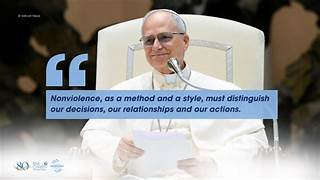
What Does Prayer Mean in An Age of Empire? The Dangerous Simplicity of Pope Leo’s “Nonviolence”

Suddenly, everyone is talking about prayer and theology.

That comes as a surprise to many who, since Harvey Cox’s The Secular City, have assumed that secularization had effectively removed God from serious political consideration. Yet recent controversies have forced the issue back into public view.

The debate surrounding Pete Hegseth’s prayer about U.S. policy in Iran –so reminiscent of Mark Twain’s haunting “War Prayer” has reopened questions many thought settled.

It has even produced the strange spectacle of Donald Trump adopting quasi-messianic language, while J.D. Vance publicly disputes Pope Leo XIV about whose prayers God hears and whose God ignores.

I have addressed those developments elsewhere. Here I want to press further into the deeper issue: What is prayer? What are its political implications? And what does the Bible itself reveal about the competing claims made in God’s name, especially about nonviolence?

What Does Prayer Mean?

To begin with, what exactly is being invoked when Hegseth appeals to the Psalms and asks God to “break the teeth” of enemies, to leave women widowed and children orphaned?

And what does the pope mean when he insists that Jesus rejects such petitions outright and stands unequivocally for nonviolence?

In both cases, the underlying assumption seems the same: a supernatural being “out there,” watching events unfold and selectively intervening on behalf of one side or another.

But can such imagery still be taken seriously?

We live in the age of the James Webb Space Telescope, which reveals a universe so vast that our planet becomes nearly invisible within it. We also live in the age of quantum physics, where matter dissolves into energy and probability. In such a world, the idea of a localized deity monitoring human conflicts and deciding which missiles hit their targets strains credulity.

Is God “up there” listening? Is Jesus literally seated at the Father’s right hand, weighing petitions and choosing sides?

Or are such images relics of an earlier worldview that no longer corresponds to what we know about reality?

And Then There’s the Bible

It is true that the Bible itself often reflects that older worldview. Its language presumes a cosmos structured in ways we now recognize as outdated.

Yet that does not render the Bible irrelevant. On the contrary, its enduring significance lies elsewhere.

As scholars such as Pablo Richard have emphasized, the Bible does not present a single, unified picture of God. Instead, it stages an internal conflict– a “struggle of the gods.”

On one side stands the God of Moses: the liberator of slaves, the defender of the poor, the protector of widows, orphans, and immigrants.

On the other side stands the God claimed by kings and elites, beginning with the royal ideology of David and Solomon, a God invoked to justify wealth, hierarchy, domination, and even genocide.

The prophets– Amos, Isaiah, Jeremiah– consistently take the side of the former against the latter.

Jesus clearly stands in that prophetic tradition: a marginal figure, an artisan, an outsider, a victim of imperial violence. His execution by crucifixion– Rome’s punishment for political dissidents– makes unmistakable where he stood.

In this sense, while the Bible does not address modern cosmology, it does address a far more urgent question: Whose side is Ultimate Reality on? Does Dr. King’s long arc of history really bend towards justice for the poor and marginalized?

The Bible refuses to let that question be answered cheaply.

Was Jesus Unequivocally “Nonviolent?”

This brings us to the claim that Jesus was simply “nonviolent.”

Stated without qualification, that claim risks obscuring more than it reveals. It can even function as a form of moral disorientation– especially for those subjected to systemic oppression.

“Violence” is not a single, simple category. It has at least four distinct forms.

First, there is structural violence: embedded in laws, institutions, and social arrangements that quietly destroy lives. Slavery, segregation, economic deprivation, denial of healthcare, and wars of aggression all belong here.

Second, there is defensive violence: the response of those who resist such conditions. When oppressed peoples fight back, their actions are immediately visible and condemned by the powers that be– yet they are widely recognized as legitimate, even under international law.

Third, there is repressive violence: the state’s attempt to crush resistance and restore the original injustice, often under the banner of “law and order.”

And finally, there is terroristic violence: the deliberate use of fear and destruction to achieve political ends– a practice historically employed most devastatingly and frequently by states, even as they label resisters “terrorists.”

In this light, to describe Jesus simply as “nonviolent” is not only inadequate; it risks distorting the reality of both his life and his context. The Roman authorities who executed him certainly did not regard him as harmless.

Conclusion

We are left, then, with the question that has been with us from the beginning: What does prayer mean in the world just described?

Whatever it means, it cannot be what figures like Hegseth, Trump, or even the pope seem to assume. Prayer is not a way of persuading a distant deity to intervene on behalf of our causes, bless our wars, or guarantee our victories.

Nor can the question of God’s allegiance be resolved by lifting isolated biblical texts or by invoking abstract slogans like “nonviolence,” as though such words settled anything at all.

The Bible itself will not allow that kind of evasion. It presents instead a conflict– deep, unresolved, and unavoidable– between competing visions of God, of humanity, and of justice. It exposes how easily “God” becomes the sacred cover for power.

But our problem runs even deeper. In the light of the James Webb Space Telescope and of quantum physics, the very notion of God must be rethought. The old image of a supreme off-planet being ” watching, judging, intervening, is no longer credible.

What we have called “God” must instead be understood as the creative energy of the universe– indeed, of a universe of universes– the living source in which everything participates, including the mysterious energy of consciousness itself. This is not an object among others, but the depth of reality, the Thou we may still address, not because it sits above us, but because it lives within and among us.

In biblical language, it is the Creator. In Paul’s words, it is “the one in whom we live and move and have our being.” Such a reality cannot be captured by any nation, claimed by any empire, or enlisted in any war. It recognizes no borders, no chosen peoples in the exclusionary sense, no privileged civilizations. The earth belongs to all. Its gifts are not the possession of a few, but the common inheritance of everyone– each of us entitled to no more than our one-eight-billionth share.

Seen in this light, prayer changes meaning entirely.

It is no longer a request for favors from above. It is an act of alignment with the deepest currents of reality itself. It is a way of opening ourselves to the creative, life-giving energy that stands against domination, exclusion, and death.

And so the issue returns to us, stripped of illusion.

When we pray, we are not stepping outside history. We are locating ourselves within it. We are aligning ourselves– consciously or not– with one side of an ongoing struggle between the forces that sustain life and those that diminish it.

This is not theology as speculation. It is theology as decision.

To pray is to choose.

And the choice we make– however piously we disguise it– places us either with the flourishing of the whole or with the systems that deny it.

So the question remains, now more demanding than ever:

When you pray, are you aligning yourself with the life of the whole– or with the powers that divide and destroy it?
“Game of Thrones”: Belated Theological Reflections

I’m probably the last person in “America” to finally watch the fantastically popular video series “Game of Thrones” which concluded in 2019. But that’s what I’ve done over the last month. In a very belated effort (initially at least) to see what all the fuss was about, I watched all 73 episodes.

Like most others, I was hooked from the get-go.

However, because of my peculiar theological background, the whole thing moved my octogenarian self far beyond any superficial desire for cultural literacy. It turned my thought squarely to what many still call “God.”

I mean the behavior of those playing the violent, sadistic game of musical thrones greatly resembled that of the God I and most others in the “Christian” west were taught to believe in. That’s because the dominant understandings of God as king, judge, condemner, and punisher were solidified precisely during the period depicted in the HBO series.

Let me show you what I mean by first briefly recalling what viewers saw on “Game of Thrones,” and then adding what the series revealed about medieval ideas of God. Finally, allow me to describe the alternative suggested by the insights of modern science – of quantum physics in particular.   

My hope in doing this is to bring back from the dead a version of the divine that I at least find more worthy of belief, and helpful (if not necessary) to the project of saving the planet. The resurrected belief also holds promise of redeeming the rest of us from our age-old habit of unquestioning acquiescence while our “betters” repeat with impunity the atrocities depicted on HBO.

Game of Thrones

But first some reminders of what most of us witnessed in the series. It treated us all to kings, lords, and ladies beheading, castrating, and inflicting other forms of torture including skinning victims alive.

Then there were the endless swordfights and battlefield massacres – the spectacle of hundreds of thousands of armed men (and a few women) including spectacular giants, armored soldiers, terrifying ghosts, assaulting castles of various descriptions – wildly setting fires, swinging long knives, daggers, hammers, spears, and scythes, or launching flaming cannonballs, and shooting hundreds of arrows in deadly unison. Fire breathing dragons joined the mayhem to devastating effect.

Significantly, it was all, well, “biblical” in scope and carnage.  

Even closer to the topic at hand, viewers witnessed supposed spiritual masters, witches, and military hierarchs supporting compulsory celibacy, slavery, shaming of women, and a sometimes-prudish morality also enforced by torture and death, along with solitary confinement to dungeons where prisoners were starved, and subjected to insistent commands to “confess.”

And the reactions of both palace officials and commoners to all of it? Apart from the Wildlings or Free Peoples, the universal response was blind obedience. Everybody but the Wildlings accorded to the royal classes absolute power even if orders given were foolish, cruel, selfish, suicidal, sadistic, genocidal, lustful, or completely demeaning. Everything was justified for the sake of “the realm.” Child sacrifice? “Yes, your grace, as you wish.”   

Thrones and God

My point here is that all those medieval practices shaped western ideas of God who ends up being seen primarily as a potentate just like the ones in “Game of Thrones” – or in the Bible. As such he (sic) emerged for western believers primarily as a king, a legislator, judge, condemner, and punisher. God ended up being a torturer too. According to resultant doctrine, he was prepared to commit to an eternal lake of fire (hell) unconfessed sinners who (for Catholics at least) ate meat on Friday, did anything sexual outside of marriage, or even missed Mass on Sunday.

Not only that but, according to the extremely influential Thomas Aquinas (1225-1274), one of the principal delights of those lucky enough to “get to heaven” would be their witnessing the torments of those tortured in hell. They’d take great pleasure in observing the agony of others.

To that point, here’s what Aquinas said: “In order that the happiness of the saints may be more delightful to them and that they may render more copious thanks to God for it, they are allowed to perfectly see the sufferings of the damned …” [Summa Theologica, Third Part, Supplement, Question XCIV, “Of the Relations of the Saints Towards the Damned,” First Article]

It’s no wonder then that so many Christians accept torture on the one hand, but on the other have left aside unacceptable theological convictions straight out of Kings’ Landing, Winterfell, and the Seven Kingdoms depicted in “Game of Thrones.”

Problem is that the removal of such beliefs has confined us to a meaningless world in terms of life’s transcendent dimensions. And it apparently has done little to make us less obedient subjects of the realm.   

A Quantum Alternative

Despite everything however, at least according to the Pew Research Center, 90% of Americans retain belief in some sort of Higher Power, though not always in the God of the Bible. But if “God” is neither that deity described by the bloodier passages in the sacred scripture, nor the eternal torturer celebrated by Thomas Aquinas, what is left to believe in?

It’s here that quantum physics might offer some help. I mean, even those only marginally acquainted with the subject know that contemporary physicists see everything in the universe not as ultimately solid objects, but as packages of light waves – of energy.

Such understanding suggests not only that in a very real sense all of us form a single substance united with each other and with everything that exists – with animals, plants, minerals, soil, air, and water. All of it expresses the same energy, including that of consciousness. In some sense then, everything is united and aware. All reality is one.

Scientific insights like those suggest a Ground of Being who might be described simply as the sum of all the energy in the universe and in the universe of universes of which our solar system is an infinitesimal part. That unfathomable quantum would include, of course, the energy of consciousness. It might even be addressed personally as a Thou. It finds incarnation in each of our apparently solid bodies.

Such realizations have salutary consequences. That is, if we are one with each other, with the natural world, and ultimately with the one we used to call “God,” then wars, borders, and us-and-them thinking of any type should find no place among any but the psychopathically insane.

Moreover, the wisdom of one of the world’s great prophets, Jesus of Nazareth, who instructed us to “Love your neighbor as yourself” becomes evident. Our neighbor is everyone. And everyone is our Self. There is no real distinction, no real separation among us. Loving one’s neighbor makes sense because one’s neighbor is in fact oneself.

Conclusion  

I suppose what I’m saying is that my binge watching of “Game of Thrones” helped me better understand firstly where our ideas of a sadistic god come from. Secondly, it made clear why so many of us have abandoned belief in that God. We can’t any longer accept a deity who acts as cruelly and arbitrarily as King Robert, Cersei, Joffrey, Ramsey Bolton, or Daenerys. 

Thirdly, and even more importantly, such rejection yields practical conclusions that might save us from the insanities of our contemporary political powers whose slaughters, genocides, ecocides – their omnicides – massively eclipse anything depicted in “Game of Thrones.” I’m thinking of modern weapons of war even well below civilization-ending nuclear weapons. So many of them make the fire breathing dragons and “Game of Thrones” massacres look like children’s pets.

And finally, all of this suggests resistance on the part of citizens like us. I mean, when you think about it, we’re not much different from those commoner subjects of the kings and royalty depicted in “Game of Thrones.” “Nuclear war, Mr. President? As you wish, your grace.”

I mean, most of us stand quite ready to turn off our rationality and consciousness and proceed to sacrifice our children and ourselves at the whim of those whose words and actions reveal them to be psychopathic and quite stupid.

It’s time we realize our “kings’” lunatic nature and deny them any authority whatsoever.  The revolution against the medieval mindset of “Game of Thrones” is still incomplete.