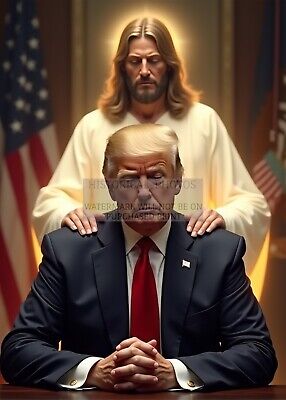
Good Friday: Heretical Trumpists Celebrate an Imperial Jesus

Today is Good Friday. This morning’s New York Times (NYT) correctly identified the day as “part of the holiest week in the Christian calendar.”

It also recalled President Trump’s campaign promise to “bring back Christianity.”  According to him and his first lady that means following “the living Son of God who conquered death, freed us from sin, and unlocked the gates of Heaven for all of humanity.”  The pair wants this to be “one of the great Easters ever.”

The article went on to recall how Mr. Trump’s aspirations were following and expanding the lead of George W. Bush who established the first White House Office of Faith Based and Community Initiatives in the early 2000s.

Mr. Trump’s “personal pastor,” Paula White-Cain who heads the Office affirms its ability “to weigh in on any issue it deems appropriate.” Chief among them, she said, were the desire to “eradicate anti-Christian bias” including deviation from the position that there are two sexes, male and female.  Such concerns have afforded the Faith Office “unprecedented access” for faith leaders to “officials in intelligence, domestic policy and national security.”

Accordingly, Mr. Trump has often met with pastors from states like Colorado and Pennsylvania. On returning home, those reverends have shared photos taken with the president sometimes with heads bowed in prayer, imposing hands of blessing on the president’s head, or with Mr. Trump joining them in singing hymns.

All of this led the NYT article and accompanying video to identify the White House as “one of the safest places in the world to be a Christian.”  In fact, one of the Christian pastors interviewed for the piece said that “he doesn’t see any rails on the limits of the faith office.”

Good Friday Perspective

As a Jesus scholar and theologian, I found all this quite ironic, false, and heretical. In my view it is reminiscent of Germany of the 1930s, when Christian pastors and Catholic bishops routinely endorsed the leader of the Third Reich, who also affirmed allegiance to the Jesus reflected in Mr. and Ms. Trump’s profession of faith.

The reality was, however, that Hitler’s Germany and the policies supported by Trump’s MAGA crowd reveal an actual hatred for Jesus mourned and celebrated this Good Friday. After all he was the son of an impoverished unwed teenage mother who was houseless at birth. He was an immigrant in Egypt. He was an unemployed construction worker. He was a harsh critic of the Jewish political and religious establishment, of the Roman Empire, and of the rich in general. He said that the future belonged to the poor, the non-violent, and those persecuted for justice sake. He ended his life as a victim of imperial torture and capital punishment.

Conclusion

So, if there are no rails, no limits, on Mr. Trump’s faith office how about lowering them for pastors like Episcopal Bishop Mariann Edgar Budde?  (Remember how she infuriated Donald Trump and JD Vance at Trump’s inaugural prayer service at the National Cathedral in Washington. She did so merely by pleading with Mr. Trump to “have mercy” on LGBTQ people and immigrants targeted by his policies.)   

If there are no rails, how about lowering them for rabbis, ministers, priests, and faithful demanding that Mr. Trump stop the Hitlerian genocide he’s committing in Zionist Israel?

If there are no rails, how about implementing policies that recognize and honor Jesus in the children of poor unwed teenage mothers, in the houseless, in immigrants, in the working class, in opponents of the rich and powerful, in those protesting the hypocrisy of Jewish Zionists, in U.S.-supported torture facilities, and on death row.

Only changes like those can convince followers of the historical Jesus that the White House is “one of the safest places in the world to be a Christian.” Only changes like those can make this “one of the great Easters ever.”

So Far, The World Is Better Off with Trump!

I never thought I would find myself writing these words. But I think the world is far better off with Trump as our president than with Genocide Joe Biden.

There I said it. I do so under the threat of great personal detriment. I mean, I can hardly voice such opinion in polite progressive company.  I can’t even say so in my own family.

So, at the risk of complete isolation, let me try to explain myself.

I think the world’s better off with Trump because a head of state should at least be sui compos mentis. Clearly, Joe Biden was not. By most accounts, Jake Sullivan has been running the country for the last four years. Secondly, Trump is better because he’s backing us off from nuclear war with the Russians. Joe wouldn’t even talk with them.  Thirdly, whatever we might think of his words about real estate in Gaza, the Donald has introduced a cease fire there. It seems to be holding. Fourthly, President Trump shows promise of dismantling the CIA and FBI. That has no downside as far as I can see. And finally, and perhaps most surprisingly, he’s unifying the country around the issue of truth-telling. I mean it. Let me explain.

Trump’s Not Senile

I can hardly believe the Democrats knew Joe Biden was mentally over the hill from the first day of his administration. And yet after four years, they were willing to run him out there for a second term, when everybody knew he could scarcely tell up from down.

How cynical is that? How disrespectful to voters! How anti-democratic!

Thank God for the first presidential debate that showed the old man mired in an advanced condition of senility.

As such, his defining issues became:

  • Billions and billions and billions for Ukraine, Ukraine, Ukraine. (Trump stopped that right quick.)
  • His inability to do anything about a ceasefire in Gaza. (Trump turned that around even before he was sworn in.)
  • Unstinting cooperation in the genocide of Palestinians. (We have yet to see Trump’s final policy here, though his words and supply of 2000 pound bombs are not promising.)
  • Maintaining U.S. hegemony at all costs.

Those are the issues that obsessed and defined Genocide Joe – Ukraine, Gaza, genocide itself, and refusal to recognize that we live in a multipolar world. Little else he did really counts.   

Trump Talks Russian

In sharp contrast to Biden’s foolishness, Donald Trump has agreed to peace talks with our proxy adversary in Ukraine. That war could have been entirely avoided had Biden even acknowledged reading and had he responded to Mr. Putin’s peace proposal in December of 2021. However, preferring war to diplomacy, he chose not to.

Shortly afterwards, the war could have been stopped in its tracks had Biden not (through Boris Johnson’s nefarious graces) effectively voided the peace agreement between Russia and Ukraine initialed by both belligerents in March of 2022. Instead, the old man again chose war that so far has exacted more than a million casualties.

In other words, Biden’s version of diplomacy was refusal to even talk with Putin.

Donald Trump has reversed all of that. Simple man that he is, Trump evidently realizes what all of us teach our children – make up with those you’ve been fighting with. Talk with your “enemies.”  Try to see things from their point of view. No good parent would instruct them otherwise.

Diplomacy is as simple as that. Its exercise under Donald Trump has made the world a safer place.

Ceasefire in Gaza

So far, Trump’s policy in Gaza has made Palestinians safer as well.

The whole sequence of events since Trump’s diplomatic intervention illustrates the point. Since then, the whole world has witnessed:

  • Thousands upon thousands of Palestinians returning “home.”
  • The Zionist-caused rubble of their homes, schools, hospitals, libraries, mosques, and churches.
  • The uncovering of untold numbers of friends, relatives, doctors, nurses, and teachers buried and uncounted under the rubble raising the number of Palestinians indiscriminately killed to well over 100.000 – more than half women, children, and the elderly.
  • The survival of Hamas fighters still proud, well-armed, and undefeated by Israel’s genocidal attacks.
  • The testimony of Hamas prisoners about humane treatment on the part of their captors.
  • The contrasting emaciated and evidently tortured bodies of Zionist prisoners released by the Zionists.

None of this has been good for Israel’s image in the world. Instead, it’s made the world aware of the justice of the Palestinian cause.

To repeat, all of that makes Palestinians safer. It has also shown President Trump’s policy in Israel to be better than Mr. Biden’s, at least so far.

Today, Palestinians are better off under Trump.

Dismantling the CIA

And then there’s Mr. Trump’s appointment of Tulsi Gabbard to oversee the country’s 18 spy organizations. Those agencies spy on us! They engage in regime change operations. According to ex-CIA director, Mike Pompeo, they lie, they cheat, they steal all the time. They take entire courses on how to do so. Pompeo was proud of that. He thought it was a big joke.

But ask Julian Assange. Ask Chelsea Manning. Ask Edward Snowden. It’s not a joke.

Tulsi Gabbard realizes all of that. In Senate testimony, she refused to identify Snowden as a traitor.

Clearly, she has the “intelligence” establishment quaking in their boots.

That makes all of us better off.

Conclusion Bringing Us All Together

Recently, I saw a YouTube discussion between leftist comedian Jimmy Dore and progressive journalist Matt Taibbi. Dore raised a question about climate change. He confessed that in view of all the lies that have infected the scientific community (and American public life in general) he was for the first time having doubts about climate change. Was its threat being overblown?

In response, Taibbi admitted that the exposure of so many lies conveyed by politicians, clergymen, journalists, and university researchers had him wondering too. “I’m ashamed to say so,” he said in effect, “but all of that has me wondering about beliefs I’ve taken for granted over the last 30 years of my life.”

The exchange between Dore and Taibbi made me realize that even the falsehoods conveyed by the Liar in Chief currently manning the White House has important benefits.

On all segments of the political spectrum, it has us wondering about truth. We no longer trust those claiming to be truth tellers. We no longer trust the “fact checkers.” They’ve all been shown to be liars.

Regardless of where we stand on politics or climate change, that’s a hugely important point for Americans to realize and agree to. Thank you for bringing us together, Mr. Trump.

On Faith, Wokeness, & DEI

Readings for the Sixth Sunday in Ordinary Time: Jeremiah 19:5-8; Psalm 1:1-6; 1 Corinthians 15: 12, 16-20; Luke 6: 17, 20-26

This Sunday’s readings reject the anti-DEI, anti-Wokeness memes of what Marianne Williamson calls the Trump/Musk power couple.

The selected texts remind us that the natural order is one of diversity, universal love, and complete inclusion (DEI) that prioritizes the needs of women, children, immigrants, and former slaves. As we’ll see, the tradition is outspokenly anti-rich and demands reparations.

The readings also suggest the truth recognized in all major faith traditions that awakening to such reality (rather than remaining asleep) is the whole point of the human project aimed at transcending childish egocentrism and ethnocentrism. The point is what our black brothers and sisters call being “woke.” Even more, it’s to achieve world centrism and ultimately cosmic centrism that understand and respect the unity of all creation.

By contrast, putting oneself first, putting one’s country first, idolizing wealth and the power it brings are all condemned in the teachings of Yeshua.

In other words, the Judeo-Christian tradition represented in today’s readings roundly rejects the villainizing of DEI and wokeness. Even more, they call Yeshua’s followers to a class consciousness and a fundamental option for the world’s poor and oppressed against the rich whom Yeshua condemns in no uncertain terms.

Let me show you what I mean in terms of class consciousness and the warfare of the rich against the poor.

Class Warfare

Whereas in the past it might have been possible to argue that we live in a classless society, that is no longer the case. The accession of Donald Trump to the office of president has rendered such argument moot. The man has declared war on the poor.

Think about the brazenness of it all.

I mean, after the display at Trump’s inauguration, it is now impossible for anyone to deny that Elon Musk and other billionaires play powerful roles in calling the shots. The shot callers include Donald Trump himself, Musk, Mark Zukerberg, Jeff Bezos, Tim Cook of Apple, and Sundar Pichai of Google. All of them were there occupying prominent seats the day that Trump took office. At times it even appears that Elon Musk, the world’s richest man, rather than Mr. Trump is our country’s president. Our system is undeniably plutocratic.

And what is the basic argument of these people? Simply put, it is that THE RICH DON’T HAVE ENOUGH MONEY, WHILE THE UNDESERVING POOR AND MIDDLE CLASS HAVE TOO MUCH MONEY.

They’re convinced that the world’s and our country’s problems are caused by the poorest people on the planet. Accordingly, we’re expected to believe that:

  • In a country of 320 million people, 12 to 15 million impoverished, undocumented, hardworking, tax-paying refugees are “invaders” and bringing us all down.
  • The U.S. with 4.5% of the world’s population (along with its European fellow colonialists) has a God-given right to control the entire planet.
  • Those formerly colonized in Latin America, Africa, and Asia should be sanctioned for uniting (e,g,, in BRICS+) to seek non-violent rectification of the colonial system that has impoverished them for more than 500 years.
  • The wealthy South African cohorts of their erstwhile countryman, Elon Musk, are now victims of black South Africans who must be sanctioned for treating them unfairly.
  • Uniformity, inequity, and exclusion are American and Christian values as opposed to diversity, equity, and inclusion.
  • It’s ludicrous to awaken (become woke) to the absurdity of it all.

Let me say that again: All of this (and so much more) provides unmistakable evidence of the wealthy’s conviction that THE RICH DON’T HAVE ENOUGH MONEY, WHILE THE POOR HAVE TOO MUCH MONEY.

Think about it a bit further. To increase their money supply, the billionaires want lower taxes, less government regulation of their businesses, and continued subsidies to their corporations maintained or increased. Correspondingly, they want “wasteful” programs like those funding Medicaid, HeadStart, food stamps, and public schooling curtailed or eliminated. Even Social Security is questioned. For the rich, minimum wages are an abomination as are unions and the so-called “right” to collective bargaining. The rich see all such government programs and organizing as wasteful, i.e., as excessively enriching the lives of the undeserving poor.

Yes: For the upper class, THE RICH DON’T HAVE ENOUGH MONEY, WHILE THE POOR HAVE TOO MUCH MONEY. That’s what they believe! It can’t be said often enough.

It’s all a declaration of class warfare.

Today’s Readings

Today’s readings contradict all that. Look at my “translations” and summaries immediately below. Compare them with the originals here to see if I got them right.

Jeremiah 17:5-8: In the early 6th century BCE, the great prophet Jeremiah foretold the defeat of his people by the Babylonians (modern day Iraq) because of Judah’s social injustices and moral decay. Of course, his message of doom brought him death threats and cancellation. In today’s reading he says: We who pretend to be God’s People are cursed because we’ve prioritized the wisdom of the world (flesh) over the insights of the heart. Our failure to recognize the rhythms of history makes us like a dried-up bush in a parched desert. Only our hearts’ return to the Divine Mother-Father and to the Mosaic Covenant (that prioritizes the needs of the poor, widows, orphans, and immigrants) will restore our identity as a mighty tree planted near clear running water. 

Psalm 1: 1-6: Yes, God’s law commands care for the poor, the widows, the orphans and immigrants. These are God’s “Chosen People” just as Israel once was when it too was poor and enslaved in Egypt. Then their hope was in the Great I Am rather than in the wisdom of Egyptian slavers with their wicked, sinful, and insolent oppression of Yahweh’s chosen. Never forget that. Such mindfulness will insure prosperity for all. Be encouraged too by the fact that the rich and powerful oppressors will inevitably be blown away like chaff in the wind. Blessed be the hope of the poor!

1 Corinthians 15: 12, 16-20: Yeshua’s return from the realm of the dead cannot be denied without destroying the faith and hope of the poor. He is the quintessential avatar of the poor and oppressed brought back to life from “death” that is no more than a temporary slumber. Alleluia!!

Luke 6: 17, 20-26: In the Gospel of Luke, Matthew’s “Sermon on the Mount” is delivered “on a stretch level ground.” Also, Matthew’s “Blessed are the poor in spirit” becomes a more down-to-earth “Blessed are you who are poor.” In both cases however, the penniless Yeshua promised ultimate political triumph, abundant food, joy, and heaven on earth to the poor, the hungry, the tearful, despised, excluded, insulted, and demonized. (He promises reparations!) Moreover, he cursed the overfed, apparently joyful rich and famous. In Yeshua’s Great Reversal, the rich are destined to be hungry, disconsolate, in tears, and disgraced. (Take that Messrs. Pilate, Herod, and Revs. Anas and Caiaphas! Take that Messrs. Musk and Trump and Rev. Huckabee!)

Conclusion

In an interview with NPR, Evangelical Christian leader Russell Moore said that several pastors had told him disturbing stories about their congregants being upset when the ministers read from the “Sermon on the Mount ” where as we’ve just seen (in Luke’s “Sermon on the Plain”) Yeshua favors the poor over the rich.

“Multiple pastors tell me, essentially, the same story about quoting Jesus in the Sermon on the Mount – [and] to have someone come up after to say, ‘Where did you get those liberal talking points?”

Moore added: “And what was alarming to me is that in most of these scenarios, when the pastor would say, ‘I’m literally quoting Jesus Christ, the response would be, ‘Yes, but that doesn’t work anymore. That’s weak.”

But here are Yeshua’s words:

“Blessed are you who are poor,
                        for the kingdom of God is yours.
            Blessed are you who are now hungry,
                        for you will be satisfied.
            Blessed are you who are now weeping,
                        for you will laugh.
            Blessed are you when people hate you,
                        and when they exclude and insult you,
                        and denounce your name as evil
                        on account of the Son of Man.
Rejoice and leap for joy on that day!
Behold, your reward will be great in heaven.
For their ancestors treated the prophets in the same way.
            But woe to you who are rich,
                        for you have received your consolation.
            Woe to you who are filled now,
                        for you will be hungry.
            Woe to you who laugh now,
                        for you will grieve and weep.
            Woe to you when all speak well of you,
                        for their ancestors treated the false prophets in this way.”

“A Complete Unknown”: An Experience of Time Travel and Personal Challenge

Last week, Peggy and I saw “A Complete Unknown.” It’s that Bob Dylan biopic that everyone’s talking about. Timothee Chalamet deserves an Oscar for his portrayal of Bob Dylan. He captures the man’s spirit – creative, charismatic, moody, mysterious, unpredictable, and quietly headstrong. He even manages to embody Dylan’s distinctive voice, along with his guitar playing and singing style.

I also loved Ed Norton’s saintly Pete Seeger, and Monica Barbaro as the beautiful Joan Baez. However, Elle Fanning’s depiction of Suze Rotolo (fictionalized as Sylvie Russo in the film) was perhaps most moving of all. Her wordless expressions of vulnerability, love, understated jealousy, and disappointment in the face of Dylan’s other love interests were perceptive, touching and sad.   

But for me, the film conveyed much more than accurate information about an iconic artist and celebrity. It represented a kind of time travel to an era of deep personal challenge. It made me review my personal experiences of Bob Dylan. It was one of those wonderful trips down memory lane.    

I mean, as someone roughly Dylan’s age (he’s 83; I’m 84), the film evoked treasured memories of a Golden Age promise and hope and of an incomparable artist who helped define it like no other.

And then even more importantly for me as one concerned with spiritual growth, freedom, and autonomy, I found the film insightful, instructive and encouraging.

Let me start with a few snapshot memories and then move on to the lessons of “A Complete Unknown.”

Time Travel  

My first awareness of Bob Dylan dawned in around 1961 when I was studying for the Catholic priesthood. I was finishing my philosophy degree at St. Columban’s Major Seminary in Milton Massachusetts. That was during the folk music revival that set the scene for the emergence of Dylan along with Baez, Peter Paul and Mary, The Kingston Trio, The Brothers Four and so many other groups and artists. The revival had all of us learning to play the guitar and singing “Blowin’ in the Wind.”

Anyway, I was in the seminary’s community room one evening watching one of the many folk music shows of the time on our group’s 21-inch black and white TV.  Maybe it was “Hootenanny; I don’t remember. But suddenly there appeared on screen this skinny kid with a harp rack around his neck (the first time I saw one). His voice and demeanor were like nothing I had seen before. I don’t remember his song, but his voice was unforgettable – unpretentious, and raspy. He mumbled the words in a way that made them almost unintelligible. I had never heard anything like that. Of course, it was Bob Dylan.

That summer I was visiting my brother who said, “Hey Mike, you’ve got to hear this.” He then played for me in its entirety his 33 1/3 vinyl recording of “The Free-Wheelin’ Boy Dylan.” This time I listened to the words and marveled at their strange, captivating beauty along with Dylan’s unique vocalization. I remember hearing for the first time “Girl from the North Country,” “Oxford Town,” “A Hard Rain’s Gonna Fall,” “Masters of War,” and “Talking World War III Blues.” It was then that I realized for the first time what an important artist Bob Dylan is.

My assessment was confirmed, I remember, by a Time Magazine story that appeared shortly afterwards. It said that Bob Dylan was perhaps the greatest American poet of the 20th century – a judgment definitively reiterated years later (2016) when he received the Nobel Prize in literature.

I was hooked – a Bob Dylan fan for life. And this even though (like Pete Seeger) I was disappointed by Dylan’s electrification and somehow even more so by his Jesus period. At the time, Dylan’s going electric appeared to be a sellout. It also signaled the end of the folk era I came to treasure so dearly. I was sad about that.

As for the Jesus period (1978-’81), it too signified a selling out of sorts. And as a Catholic theologian, I’m not sure why I saw it that way. Maybe it too seemed a normalization of someone I admired as creatively offbeat. Nevertheless, I’ve since come to appreciate the artistry, beauty, and sheer rock genius of that phase of Dylan’s life too.  “Saved” along with “You Gotta Serve Somebody” are prime examples of all that. (See for yourself. Play the video at the top of this blog entry.)

Then, two years ago during an extended stay in Granada Spain, I formed a friendship with an Italian Bob Dylan scholar, Francesco Adreani. Like me he had integrated himself into a group of cave-dwelling street musicians. Cesco (as we called him) shared a 40-page essay he’d written called “Tutte Le Strade Portano a Desolation Row” (All Roads Lead to Desolation Row.”) It was a marvelous read. It connected Dylan with Tarot and astrology as well as with the author’s personal experiences. I remember spending my last Granada afternoon with my brilliant friend in the Alhambra garden smoking weed and discussing “Desolation Row” stanza by stanza.

Finally (still in Granada) there was an unforgettable Dylan moment I shared with my sweet 15-year-old  granddaughter. It happened that towards the end of our shared year in Spain, Bob Dylan gave a concert in the Alhambra. And my daughter made it possible for her daughter and me to attend. Talk about unforgettable! My granddaughter said I was smiling from ear to ear during the entire event.

As for Dylan that night . . .. No guitar, no harmonica, only piano. Not a word addressed to the audience except something like “Isn’t this a wonderful place to be?” But then song after wonderful song delivered in Dylan’s inimitable way – still raspy with words almost unintelligible. (Afterwards, Cesco asked me what I thought of “Every Grain of Sand.” And I had no response because I didn’t realize Dylan had sung it.) But what an unforgettable experience with my granddaughter and Bob Dylan!

Moral of the Story

Yes, Bob Dylan was an important part of my life.

Yet there’s so much more to say about his impact on the most formative span of my 84 years (my 20s and 30s). Along with Woody Guthrie, Pete Seeger, Joan Baez and the others, he gave language to the hope so many of us experienced during the 1960s and early ‘70s.

That was the time of the Civil Rights Movement, Women’s Liberation, the Native American Freedom Drive, Prisoners’ Rights demonstrations, and Gay Liberation. It was a time of the Second Vatican Council (1962-’65) and hopeful reform in the Catholic Church where I had just been ordained a priest. It was an era of awakening, protest, resistance, and great literature and music. How I miss all of that. How I long for its revival. It was all absolutely formative.

In that context, Bob Dylan helped an entire generation find our voices. Unlike Joan Baez with her quasi-operatic tone and range, his singing voice was ordinary to mediocre to poor. But it was his and he made no apologies for it. It was revolutionary. It was meaningful. And in the end, it was beautiful.

If Bob Dylan could sing like that, anyone could. In fact, soon everyone was singing like that. I’m talking about masters like John Prine and Bruce Springsteen. I’m talking about guitar hacks like me. Bob Dylan encouraged (i.e. gave courage to) us all to discern what was blowin’ in the wind in times that were truly a-changin’.

But Timothee Chalamet’s Dylan is far more even than that. He speaks to our very processes of becoming who we really are. In “A Complete Unknown,” Dylan comes across as a kind of mystic whose authenticity, autonomy, and creativity meant more to him than anyone’s stultifying but seductive adulation. It meant more than the approval of rightfully sanctified pillars of the folk music establishment like Seegar, Baez, and even Woody Guthrie.

All of this was epitomized in the film’s climax at the 1965 Newport Folk Festival, when by going electric, Dylan offended so many of those who fawned over him along with everyone who mattered in his musical world. But he was ahead of his time. He recognized that (as his later Oscar winning song put it) “Things Have Changed.” The folk revival was over. It was time to move on.

And move on he did.

However, his transition was not just the expression of one artist’s commitment to his own creative daimon.

It was a statement about life itself. Change is inevitable, it says, though most find it uncomfortable and resist it mightily. The matrix of public expectation is claustrophobic and takes great courage to escape. It requires endurance in the face of slings and arrows often launched even by pillars of the community, family members, experts, and loved ones.

None of us should forget that.    

With all that in mind, don’t miss “A Complete Unknown.” It’s a great movie that recalls an unforgettable era. It’s a teachable moment too.

Like Bishop Budde, Jesus’ Wokeness Infuriated His Neighbors

Readings for the Third Sunday in Ordinary Time: Nehemiah 8:2-4a, 5-6, 8-10; Psalm 19: 8,9, 10, 15; I Corinthians 12: 12-14, 27; Luke 1: 1-4, 4: 14-21

Last Tuesday Episcopal Bishop Mariann Edgar Budde infuriated Donald Trump and JD Vance at Trump’s inaugural prayer service at the National Cathedral in Washington. She did so by echoing in her sermon the Spirit of Yeshua of Nazareth whom this Sunday’s Gospel reading depicts as delivering his own inaugural address to his former neighbors in his hometown of Nazareth.

Bishop Budde’s words asked Mr. Trump “in the name of our God” to “have mercy” on LGBTQ people and immigrants targeted by his policies. Her words chimed with those of her Master who in his programmatic words proclaimed his work as directed towards outsiders – the poor, the blind, the imprisoned, oppressed, and indebted.

Evidently, Messrs. Trump and Vance prefer their version of God and a Jesus who puts America first. They seem to consider Americans (and Zionists) as somehow “chosen” by a God who joins them in despising those with non-binary sexual orientations. Instead of welcoming strangers (as Bishop Budde put it in tune with oft-repeated biblical injunctions) their God would build walls and evict them from our midst.

Ironically, the Trump/Vance position is not far from that articulated by Ezra, Israel’s 6th century BCE priest and scribe who invented the concept of a genocidal Israel as God’s chosen one. (You can read a summary of Ezra’s words immediately below.)

So, predictably, Mr. Trump and his followers (like Yeshua’s contemporaries rejecting him) wasted no time in vilifying Bishop Budde.

Instead, she deserves our admiration and imitation as a woman of vast integrity and courage. Let me show you what I mean.

Today’s Readings

Nehemiah 8:2-4a, 5-6, 8-10

Following the Jews’ return from the Babylonian exile (586-538), the Jewish priest and scribe, Ezra rewrote the Hebrew’s largely oral traditions that eventually became their Bible. He unified those narratives about mysterious beings called “Elohim.”  These were human or perhaps extraterrestrial “Powerful Ones,” some good-willed, some malevolent, who had never been universally considered divine. In Hebrew oral tradition, they had variously been called by names such as “Elohim,” “El,” “El Shaddai,” “Ruach,” Baal, and Yahweh. Ezra unified and rewrote those traditions as if all of them were about Israel’s now “divine” Powerful One (Yahweh). The tales included divinely authorized genocides of Palestinians (identified in biblical texts as Canaanites, Hittites, Amorites, Perizzites, Hivites, Jebusites, Geshurites, Maacaathites, and Philistines). All of them had lived in the “Holy Land” long before the arrival of the ex-slave invaders from Egypt who ruthlessly decimated their numbers in the name of their Powerful One. In Nehemiah chapter 8, Ezra is depicted as spending half a day reading his conflated narrative [now called “The Law” (Torah)] to Israel’s “men, women, and those children old enough to understand.” The new narrative brings everyone to tears as a nationalistic and exclusive consciousness dawns that Yahweh-God had chosen them as his special people.

Psalm 19: 8,9, 10, 15

Despite the genocides, the people praised Yahweh’s words as simple, perfect, refreshing, trustworthy, wise, illuminating, pure, eternal, true, and completely just. They identified Ezra’s words as Spirit and Life.

I Corinthians 12: 12-14, 27  

Yeshua, however, never called his Heavenly Father “Yahweh.” Instead, he (and his principal prophet Paul) understood God as a Divine Parent, the Creator of all things, the “One in whom we live and move and have our being” (Acts 17:28). Yeshua (and Paul) rejected the idea of “Special People” in favor of all humanity as comprising One Human Body. For both men, no part of that Body (even the least presentable) was better or more important than any other. For Paul and Yeshua, Jews and non-Jews were the same. So were slaves and free persons. In fact, for Yeshua’s followers, those the world considers less honorable should be treated “with greater propriety.”

Luke 1: 1-4, 4: 14-21

In the first sermon of his public life, Yeshua addressed his former neighbors. He was asked to read from the scroll of the prophet Isaiah (a contemporary of Ezra) who dissented from genocides and mistreatment of captives. Here’s what Yeshua read:

The Spirit of the Lord is upon me,
because he has anointed me
to bring glad tidings to the poor.

He has sent me to proclaim liberty to captives
and recovery of sight to the blind,
to let the oppressed go free,
and to proclaim a year acceptable to the Lord.

Rolling up the scroll, he handed it back to the attendant and sat down,
and the eyes of all in the synagogue looked intently at him.
He said to them,
“Today this Scripture passage is fulfilled in your hearing.”

When his neighbors heard his words, they wanted to kill him. Who did he think he was?! Everyone knows God favors the rich, not the poor. Just look at the Great Ones’ gaudy lifestyles and possessions. And those people in prison deserved to be there. Once freed, they’d threaten us all. And besides, the blind were sightless because of some sin they or their parents had committed. They deserved their lot in life. As for “the oppressed . . . There are no “victims.” Everyone knows that. Victimology is a hoax. Who did this Yeshua think he was?! Let’s kill him.

Conclusion

Yes, Yeshua, like Bishop Budde confronted his contemporaries to champion the One in whom we live and move and have our being.” For Yeshua that Divine One considers all humankind a single indivisible body. For him this meant incorporating those his world wanted to amputate as outsiders, invaders, criminals, and as official enemies like Samaritans, tax collectors, street walkers, the poor, imprisoned, the sightless, oppressed and indebted.

In Yeshua’s spirit, Bishop Budde urges incorporation of immigrants, LGBT outcasts, and official enemies such as the Palestinians, Russians, Chinese, Iranians, North Koreans, Venezuelans, Nicaraguans, Cubans, Syrians, Iraqis, Afghans, Somalis, Sudanese, Libyans, etc. etc. None of them is our enemy. All of them, she says with Yeshua and Paul, are closer to us than our brothers and sisters. They are parts of our own bodies. None can be amputated.

Such universalism, such wakefulness always infuriates those who would divide and rule over us. It angers as well ordinary people (like Yeshua’s neighbors) who have been brainwashed into accepting prevailing nationalistic understandings of the Bible’s often genocidal “God.”

Today’s readings call us to wake up! Bishop Budde’s got it right. Trump and Vance are heretics.

In Memoriam: Tom Shea (1938-2024)

I lost a dear friend last week. His passing made me cry. 

His name was Tom Shea and I knew him for 70 years – ever since I entered St. Columban’s high school seminary in 1954 at the age of 14. Tom was 16 then, a junior while I was a freshman. Even in such a small school of only about 100 students, juniors didn’t have much to do with freshmen.

Still however, I admired him greatly. Everybody did. He was so smart and such a great athlete. He was a strong-armed quarterback, a terrific basketball guard, a hard-throwing pitcher, excellent at any racket sport, especially good at ice hockey, a super golfer, and even (I was told) a respectable Irish hurler. He was also a crafty poker and bridge player. With all that, he never took himself that seriously and had a great sense of humor.

However, I didn’t really get to know Tom till I got to the major seminary years after high school. Even there it took a while. At the age of 21, I arrived still working on my bachelor’s philosophy degree. Meanwhile, at 23 Tom had already begun his 4 years of graduate theology work. By the time I began my theological studies, he was almost ready for ordination. That happened for him in 1964. He was ordained on December 22nd of that year – 60 years (almost to the day) before his final transition.

Besides playing with and against him on various athletic fields, the only time I remember speaking seriously with Tom in the major seminary was during the Second Vatican Council (1962-1965). I asked him for advice on what to read to catch up with the drastic changes occurring because of that historic event. I forget what he told me. But I remember following his instructions.

Because Tom was so smart, our missionary group, the Society of St. Columban, had singled him out for professorship in the seminary. They wanted him to teach Sacred Scripture. So, after his ordination, they sent him off to Catholic University in Washington, DC to get a preliminary master’s degree in theology. After two years there, he’d go on to Rome (and Jerusalem) for his terminal degree in biblical studies.

That’s when Tom and I really connected.

I was ordained in 1966. And as with Tom, the Columbans wanted me to teach in the major seminary. My field would be moral theology instead of biblical studies. But Tom and I would go off to Rome together to study – he for 3 years, and I for 5.

And oh, what a ride that would be! In Europe, we’d vacation together, ski many of Europe’s great resorts, and as brothers and colleagues sort out the details of our personal and political lives.

It began with both of us living at St. Columban’s major seminary in Milton, MA the summer before we left for the Eternal City. That was in 1967. I forget what Tom was doing in Milton. I was completing a summer course in Hebrew at Harvard. But every night the two of us drove over to Boston’s West Roxbury to play basketball with “the brothers.” We were the white boys who could ball with any of them. (I remember one night the Celtics’ Satch Sanders was there watching.)

The basketball connections continued in Rome. Both of us ended up playing in something like a G League there for a team affiliated with Rome’s professional club, Stella Azzurra. We scrimmaged against them a time or two. And it was all great fun — a great way to learn Italian culture and make Italian friends. Our Stella Azzurra team was coached by Altero Felice who later had a basketball arena named after him. We considered Altero a good friend and father figure.

While in Rome, Tom and I were also invited by Giulio Glorioso [the Italian equivalent (we were told) of Babe Ruth] to play baseball for the Rome team. (We had worked out with them one spring.) I remember the Saturday afternoon Giulio came to the Columban residence to try to persuade us to play ball that summer.

For better or worse, we passed up that offer in favor of studying German two of our summers in Europe at the University of Vienna. (German at that time was still considered essential for any serious theologian or scripture scholar.)

In a sense, both Tom and I grew up in Rome. Following Vatican II, everything was called into question. Over Pasta e Faggioli and salsiccia dinners in the Columban house at Corso Trieste 57, the 20 or so of us graduate students (all ordained priests from Ireland, Great Britain, Australia, New Zealand, Scotland, Tasmania – and we two Yanks) debated fundamental topics never open to question before Vatican II: God (Is there such a being?), Jesus (Was he somehow God? But how?), the nature of the church (Was Luther a heretic or a saint?), the priesthood (Was it necessary?). And what about mandatory celibacy? The discussions were unforgettable and life-changing.

Our friendship continued and deepened to eventually include our wives, Dee (Tom’s bride) and Peggy (mine). We spent several year-end celebrations together. And once we got together in Costa Rica for a long weekend at an all-inclusive resort. Peggy and I attended the wedding of their eldest son, Tommy in Chicago. Tom and Dee came to our daughter Maggie’s wedding in 2007 in Kentucky. Peggy and Dee remain fast friends.

The four of us got together for the last time a year-and-a-half ago in Florida. By then Tom had already been slowed by heart and lung problems. But his sense of humor never faded. Neither did his life-long interest in and commitment to spiritual growth.

Yes, Tom Shea was a close friend of mine. We grew up together for nearly three-quarters of a century, often acting as each other’s counsellor, advisor and confessor — every minute accompanied by stories and laughter.  As Peggy recently pointed out to me, his down-to-earth wisdom and example saved  me  in effect from a closed system and lonely life that otherwise would have throttled me.

So, thank you, Tom Shea for being such a good fellow traveler. You were wise, generous, humble, and always brilliant. I’m grateful for the gift of your impactful life. We’ll see each other again soon, I know.

It’s Christmas & Jesus Remains Buried in the Rubble

It’s Christmas again.
And Jesus is still under the rubble
In Gaza
(Just like last year).

He’s on an operating table
There
Having his infant arms and legs
Sawed off
Without anesthesia.
Screaming for his
Already dismembered mother
Who’s been blown away
By the U.S. and Israel.
He’ll never kiss her again
Or feel her warm embrace.

All but forgotten
By holiday revelers
With mindless
“Merry Christmases!!”

Meanwhile Zionists weaponize the Bible
So the slaughter might continue.
Christians do the same
Singing maudlin carols
They don’t understand
And buying silly trinkets
In Wal-Mart.
As if God were Santa Claus,
A billionaire,
Or a racist killer.

Worse still:
As if God were
A genocidal Amerikan!

It’s as if Yeshua were not
Piss poor
And homeless at birth
Considered by imperialists
As no more than an “animal”
Among stable asses and oxen,
The son of a disgraced
Unwed teenage mother,
An underpaid construction worker,
A drunken friend of prostitutes
Houseless as an adult
The sworn enemy
Of the Jewish power establishment
And the rich
That wanted that child
From nowheresville
Slaughtered.

(Good Christians don't like people like that)

As if Yeshua were just another
Palestinian street rat,
And not
An unwelcome refugee in Egypt,
A terrorist in Roman eyes,
Their inmate on death row,
A victim of torture
And capital punishment.

“Good riddance,”
The Romans said
Just like us.

And the whole world
Wasn’t watching then either.
Few noticed
Or cared.

But should we open our eyes
We’d see a Yeshua
So much more
Than that.

He came to serve the poor.
He said.
God’s kingdom would be theirs
So would the entire earth.
Not Elon’s or Gates’ (Luke 6:24)
Or Amerika’s
Who’s blindness and arrogance
Deserves eternal damnation
Rather than the accolades
The world bestows on
Such fools
Along with Herod and Pilate
Anas and Caiaphas.

______

The pastor of Bethlehem’s
Christmas Church said
Something like that
In his own Christmas sermon
This year
Just like the one
Few noticed
When he said it
Last year.

Here’s his Xmas creche
Here’s Pope Francis with his Jesus 
In a keffiyeh-lined crib:
This year
Listen
To these holy men
And to Yeshua’s silenced voice
In the Sacred Land
Of Palestine.

Once again,
The real
Christmas Story
Is unfolding
There
Before our very eyes.

Syria: Another Regime Change Operation by the U.S. & Israel

I’m always disappointed with Democracy Now’s (DN) coverage of Syria. Its reporting on the fall of the country’s president, Bashar al-Assad was no exception. It described Assad’s deposition as primarily a triumph of freedom and the will of a brutally repressed people.

Absent from DN’s narrative was the straightforward truth that the fall of Assad was the fruit of another regime change operation. It was part of the U.S. plan announced in 2001 to depose seven governments in five years, viz., Iraq, Afghanistan, Libya, Somalia, Sudan, Syria, and Iran.

Though the American timetable was overly optimistic, with the change of regime in Syria, the U.S. has succeeded in hitting six of its seven targets. Only Iran’s government remains in place.

Let me show you what I mean by summarizing DN’s account, contrasting it with its counter narrative, and sketching the way U.S. regime change operations work.

The Official Syrian Story

For years DN’s usually critical founder, Amy Goodman, has for some reason sided with the United States and Israel by uncritically repeating their official story about the Zionists’ neighbor to the north. It tells us that:

  • Bashar al Assad is a brutal dictator who succeeded his dictator father to rule Syria with an iron fist for the last half century and more.
  • He has not only claimed absolute power in Syria,
  • But has run an extensive secret prison system there (a “human slaughterhouse”) where captives are systematically mistreated, tortured, and held without charge.
  • His use of chemical weapons against those objecting to his rule is well documented by independent witnesses such as the Syrian Civil Defense Organization,  the “White Helmets.”
  • For all these reasons, the U.S. and Israel have long held that “Assad must go.”
  • Moderate rebels” have recently transformed that imperative into facts on the ground. Thankfully, they have successfully overthrown the hated dictator.
  • Since his removal from office, his brutality and consequent unpopularity have received ample testimony and denunciation by ordinary Syrians who are universally celebrating his fall from power.
  • Thus the U.S. and Israel (as champions of democracy, just war, and humane incarceration, and as opponents of torture and the killing of innocent civilians) have triumphed once again in yet another mid-east country.
  • The triumph mirrors what they have accomplished so idealistically and benevolently in Iraq, Afghanistan,  Libya, Lebanon, Sudan, Somalia and other countries benefitting from their wars fought for democracy and peace.

That’s the official line DN’s Amy Goodman consistently presents and/or implies.

A More Complete Picture

However, what Goodman’s account fails to explore are its following contradictions that would have us forget that:

  • The foreign powers advocating and celebrating the end of Assad’s cruelty (i.e., Israel and the U.S.) are the current perpetrators of genocide in Palestine. Arguably, that deprives them of ability to convincingly champion human rights in any forum. It demonstrates that they have no concern about civilian deaths, secret prisons, unjust torture, democracy, freedom, or peace.
  • In fact (according to George Galloway) during its war on terror, the U.S. used Syrian prisons as black sites to which they rendered “terrorists” for torturous interrogation.  
  • Moreover, the “moderate” agents fulfilling the U.S. and Israel’s imperative to remove Asad from power are successors to the very “terrorists” responsible for al-Qaeda’s 9/11 attacks 23 years ago).
  • That is, while designating Syria as a “state sponsor of terrorism,” the U.S. has once again allied itself with al-Qaeda as it had in Afghanistan during Russia’s war there (1979-1989).
  • Additionally, the U.S. has crippled the Syrian economy by illegally occupying its eastern oil fields since 2014 effectively stealing its oil revenue since then.
  • While Israel has similarly occupied its neighbor’s Golan Heights.
  • Syria’s economy and population have suffered severe hardships under a U.S. sanctions regime that started in 2011 and whose effects worsened following a massive earthquake in February of 2023. For years they’ve had to function on the provision of a single hour of electricity each day.  

Civil Discontent in Syria

As for the testimony of Syrians applauding and celebrating the fall of Asad . . ..  It too demonstrates the effectiveness of standard American policy against designated enemies whose political “regimes” the U.S. wishes to change. That policy never deviates from the following procedure:

  1. Vilify the regime leader as the latest incarnation of Hitler.
  2. Under the pretext of punishing him, use sanctions, economic blockades, bombing, propaganda, bribery, election interference, terrorism, and internal subversion whose real purpose is to make the lives of locals so miserable
  3. That they will arise,
  4. Overthrow the regime in question,
  5. And celebrate the victory as the triumph of democracy.

This is the standard policy followed not only against Syria, but against official enemies such as Cuba, Nicaragua, and Venezuela.

The subversion invariably causes the threatened governments to adopt their own counter-policies that the U.S. and its allies then describe as authoritarian, oppressive, and brutal. The policies include imprisonment of compromised political opponents, jailing and mistreatment of terrorists (no harsher btw than the mistreatment of prisoners in Israel and the U.S.), and restrictions on (usually foreign allied) press along with fifth column civil and religious organizations. All these government actions provide further evidence of the illegitimacy of the regimes in question.

They also provide well-meaning news sources like Democracy Now with reasons to uncritically repeat imperialist talking points.

Conclusion

Listening to Democracy Now’s account of a people’s triumph in Syria after more than a half century of dictatorship made me think of Cuba. As a friend of the revolution there and as a frequent visitor to the island, I couldn’t help thinking how in the case of a successful uprising there (God forbid!), a similar sort of account might be concocted.

There’d be the same people dancing for joy in Havana’s streets and the same people saying on camera how relieved they are that the hated regime had been deposed. There’d also be the same ex-pat Cuban professors from prestigious U.S. universities sharing the joy and supplying historical details about the brutalities of Castro’s legacy.

Misinformed viewers would be led to conclude “Thank Goodness Cubans are finally free!”

But if the current Syrian template were followed, those viewers would never be stimulated to question the official story. They’d never be reminded of the disastrous effects of 60 years of sanctions, blockade, and acts of terrorism against the state. They’d never know about attempted assassinations of the country’s president. Neither would they think critically about the effect of anti-Cuban propaganda on their own psyches.

The point I’m trying to make here is that questions should always be raised about official stories concerning designated enemies of discredited imperialist countries like the United States and Israel.

They should be asked as well when perpetrators of genocide decry the human rights record “dictators” carefully selected from a long list of tyrants routinely supported by the complaining parties and when the black sites and “slaughterhouses” of the offending dictators have been used by their accusers themselves.

Yes, critical reporters should be able to identify such contradictions.

Simply repeating “the official story” helps no one.

Democracy Now is usually better than that.