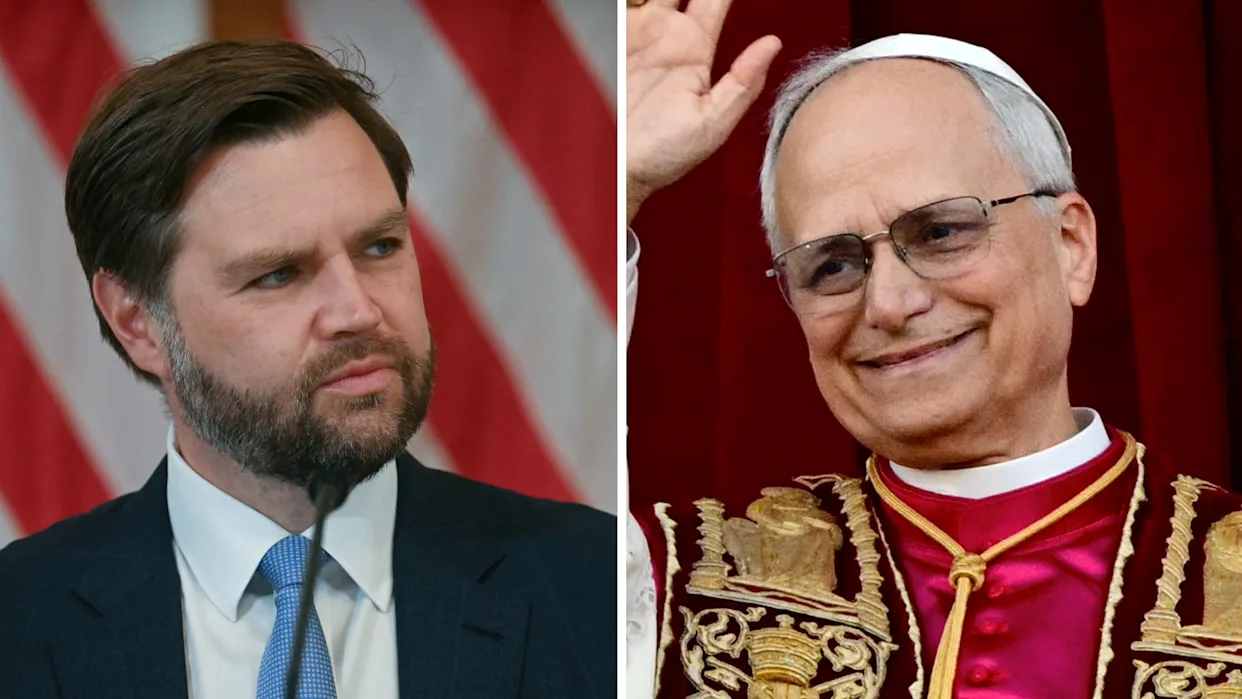
When “God on Our Side” Becomes Dangerous:Vance, the Pope, and the Many Faces of Violence

Not long ago, I wrote about what I called the “dangerous simplicity” of Pope Leo XIV’s claim that “God is never on the side of those who use violence.” At the time, the point may have seemed abstract—more a matter of theological nuance than urgent public concern.

However, a recent exchange between JD Vance and Pope Leo XIV has brought the issue sharply into focus. In fact, somewhat ironically, Vance’s attempt to challenge the pope ends up illustrating exactly the point I was trying to make.

I mean, the JD Vance- Pope Leo disagreement has all the markings of a classic argument: one side appealing to moral clarity, the other to historical reality. But beneath the surface, something more revealing is happening.

In trying to correct the pope, Vance ironically ends up exposing a deeper truth about violence itself – even the violence directly involving vice-president himself and the United States foreign policy he supports.

The Vance-Leo Exchange

The pope’s statement about nonviolence is simple, even beautiful: “God is never on the side of those who use violence.” It sounds like something that ought to end the discussion. Who could be against that?

But Vance pushes back. He begins politely enough: “I like that the pope is an advocate for peace… I think that’s certainly one of his roles.” Then comes the challenge: “On the other hand, how can you say that God is never on the side of those who wield the sword?”

And then he goes straight to the example that almost always ends arguments: World War II.

“Was God on the side of the Americans who liberated France from the Nazis?” he asks. “Was God on the side of the Americans who liberated Holocaust camps and liberated those innocent people? I certainly think the answer is yes.”

The Conceptual Complication

Most people instinctively agree. It’s hard not to. The defeat of Nazism feels like the clearest possible case of justified violence. But that’s exactly where things get interesting.

Because once you admit that not all violence is the same, the pope’s simple statement starts to unravel. And that’s the point.

“Violence” isn’t one thing. It comes in different forms, and if we don’t distinguish between them, we end up confused or, worse, manipulated.

Start with what might be called structural violence. This is the kind most people don’t notice because it’s built into everyday life. It’s the violence of systems that quietly destroy people: poverty wages, lack of healthcare, racism, occupation, economic exploitation, colonialism, imperialism, and wars launched for power or profit. No bombs need to fall for this kind of violence to be deadly.

Then there is defensive violence. This is what Vance is talking about, whether he realizes it or not. It’s the violence used to resist oppression. When Palestinians revolt against settler colonialism, when Iranians resist a war of agression, that’s defensive violence. It’s visible, it’s messy, and it’s almost always condemned by those in power. But it’s also widely recognized as legitimate, even in international law.

Next comes repressive violence. This is what happens when those in power try to crush resistance and restore the unjust system. It comes wrapped in phrases like “law and order,” “security,” or “self-defense.” But its real aim is to keep things exactly as they are – to defend the status quo, illegal occupation, colonialism, unwarranted attacks. . ..

And finally, there is terroristic violence. This is the deliberate use of overwhelming force, fear, and destruction to achieve political goals. It is often associated with non-state actors, but historically it has been most devastatingly practiced by states themselves.

Once you see these distinctions, everything looks different.

The Nazi Example: Gaza & Iran

Take Vance’s World War II example. The Nazi regime embodied structural and terroristic violence on a massive scale. The Allied response can reasonably be understood as defensive violence aimed at stopping that destruction. So far, so good.

But now bring that same framework into the present.

Vance insists, “I certainly think the answer is yes” when asked if God was on the side of those who liberated the camps. Yet at the same time, he supports policies that many observers describe as enabling or excusing mass violence elsewhere. He also adds, almost as a safeguard, “And I agree, Jesus Christ certainly does not support genocide…”

The irony is hard to miss.

Because when it comes to Gaza, what many see is not defensive violence but something much closer to repressive and terroristic violence. Entire neighborhoods flattened. Civilians trapped. Children buried under rubble. These are not incidental side effects. They are the predictable outcomes of overwhelming force used in densely populated areas.

At the same time, those who resist are quickly labeled “terrorists,” regardless of the conditions that gave rise to their resistance. This is exactly how the language of violence gets turned upside down. Structural violence becomes invisible. Defensive violence becomes criminal. Repressive violence becomes “security.” And large-scale destruction becomes “self-defense.”

The same pattern appears in the escalating conflict with Iran, which critics describe as a “war of aggression.” In that case, what is being framed as preemptive defense can just as easily be seen as structural and repressive violence on a global scale. Once again, the categories matter.

Jesus & Nonviolence

This is where the pope’s statement, for all its appeal, begins to look less helpful. Saying that “God is never on the side of those who use violence” might inspire people in the abstract. But in the real world, it risks putting the enslaved and the enslaver, the occupier and the occupied, the bomber and the bombed, all in the same moral category.

That’s not clarity. That’s confusion.

And confusion, in matters like these, is dangerous.

There is another layer to this discussion that makes things even more complicated. Christians often speak of Jesus Christ as if he were simply “nonviolent.” But that description, taken without qualification, can mislead.

Jesus lived under Roman occupation, one of the most brutally efficient systems of structural and repressive violence the world has ever known. The authorities who executed him did not see him as harmless. They saw him as a threat. His message challenged the legitimacy of their power and exposed the injustice built into their system. So they executed him by crucifixion, a method of execution they reserved for rebels against the state.

To call him simply “nonviolent” risks stripping away that context. It can turn a figure who confronted empire into one who passively accepts it.

Conclusion

And that brings us back to a hard but necessary truth: appeals to “nonviolence” are often used selectively. They are frequently directed at those who are already suffering, while those who benefit from structural violence continue largely unchallenged.

That is why some have gone so far as to say that “nonviolence” can function as a kind of scam. Not because the ideal itself is worthless, but because it is so easily weaponized. The powerful celebrate their own violence as necessary or heroic. The resistance of their victims is condemned as dangerous or immoral.

In the end, the exchange between Vance and Pope Leo XIV doesn’t settle anything. Instead, it exposes the fault line.

Vance is right to challenge the idea that all violence is the same. His World War II example makes that clear. But he stops short of applying that insight consistently to the present.

The pope is right to insist that violence is morally perilous and cannot be casually justified. But his sweeping statement risks erasing distinctions that are essential for understanding what is actually happening in the world.

Between those two positions lies a more difficult path. It requires looking honestly at the different forms violence takes and asking, in each case, who is doing what to whom and why.

Only then does the question of where God stands begin to make any sense at all.

O.K. I’m A Putin Apologist: Here’s Why

Recently, on “Democracy Now,” Amy Goodman interviewed a Yale history professor, Timothy Snyder, about the Ukraine War. He was commenting on his New Yorker article “The War in Ukraine is a Colonial War.”

That was his argument: As if we had to guess Putin’s end game in Ukraine, the good professor opined that it probably is to annex Ukraine and afterwards who knows what other country.  Putin’s an imperialist, Snyder charged. Like Hitler, he’s after land and soil.

The colonizer must therefore be stopped, Dr. Snyder concluded, and be brought by force of arms to acknowledge Russia’s total defeat. Turning just war theory on its head, Snyder’s point came across as: war is the first resort; negotiation comes only after your enemy has been militarily defeated and is forced to accept the winner’s terms without reservation.

That kind of support for what has prevailed in America as “the official story,” especially coming from a fellow academic who should know better, struck a fraying nerve within me. I mean, to my understanding, it’s not the function of academics (nor for that matter, of news media such as “Democracy Now”) to lend support to the approved narrative. It is rather to test the received account against documented reality.

So, I decided to find out once and for all (1) who Vladimir Putin is, (2) the detailed background of the Ukraine conflict, and (3) what the Russian president’s intention might be in his “special military operation.”

No need, I found, to speculate on any of that. It’s all quite well recorded – for instance (1) in Oliver Stone’s four interviews (each an hour long) with the Russian president, (2) in the film “Ukraine on Fire” (counterpointed by “Winter on Fire”), and (3) in Putin’s two long pre-war speeches (one delivered last February 21st, the other just after on February 24th).

Reviewing that material quite carefully has convinced me that as a national leader, Putin stands head and shoulders above any others I can think of. His reasons for initiating his “special operation” are defensible historically, legally, and according to U.S. precedent.

Putin as Statesman

Before mounting the “Putin Bad” bandwagon, be sure to view Oliver Stone’s “The Putin Interviews” on Showtime. They’re the product of 12 conversations between Stone and Mr. Putin over two and a half years between July 2015 and February 2017.

I found the interviews revealing a man who is difficult to dislike. He is charming and humorous. He drives his own car, is a judo enthusiast, plays hockey, and rides horses. He describes himself as a “cautious optimist” who believes, he says, “there is always hope until the day they put you in the ground.”

Born into a working-class family in 1952, his father was wounded in what Russians call “The Great Patriotic War,” when the United States and the USSR were allies against Nazi Germany.

From an early age, young Vladimir studied judo, whose practice, he says, summarizes his theory of life: be flexible and disciplined; think ahead. (For political leaders, he adds, that means planning 25 to 50 years into the future).

Movies and books made Putin, who studied law in the university, an admirer of the KGB as a patriotic organization. He joined up and was assigned to East Germany. Life there, he remembers, was not dismal, but “frozen in the 1950s.”

Then came Mikhail Gorbachev’s presidency (March 1990 – Dec. 25, 1991). Gorbachev’s “reforms” made everything fall apart. (Putin does not particularly admire him.) Social programs were destroyed. Millions lost their previously guaranteed rights and fell into poverty. Oligarchs criminally seized property belonging to the Russian people and became instant billionaires. Overnight, 25 million people lost their nationality and became displaced. 

Though opposed to communism, Lenin, and Stalin, Putin recalls that succession of events “one of the greatest catastrophes of the 20th century.” The country moved towards civil war.

Gorbachev was succeeded by Boris Yeltsin (in office 1991-1999). Before the latter’s resignation, he unexpectedly chose the relatively unknown Vladimir Putin as acting prime minister. Later that year (2000), Putin was elected president with 53% of the vote. He recalls his major accomplishments as bringing the oligarchs more under control and cutting the poverty rate by two-thirds.

As a result, Putin was re-elected in 2004 with 70% of the votes cast. Russia’s constitution forbade his running again in 2008, so he served as prime minister under President Dmitry Medvedev (2008-2012). Putin ran again for president in 20012 and won with 63% of the vote.

As for charges that on his watch, Russia’s system is “authoritarian,” Putin calls for historical perspective. He points out that Russia was a monarchy for 1000 years. Then came what he refers to as “the so-called revolution of 1917” followed by dictatorship under Stalin and his successors until the 1990s. In view of such history, it is unreasonable, Putin observes, to expect Russia’s attempts at democracy to rise to the levels of the United States, Germany, or France in such a short time.

Though a survivor of five assassination attempts and criticized mercilessly by the West’s politicians and press, Putin refuses to respond in kind. For instance, Arizona senator John McCain called him “a killer, butcher, thug, and KGB colonel.” Putin replies, “We could make similar comparisons, but due to the level of our political culture, we abstain from extreme statements.”  Instead, Putin consistently refers to the U.S. government at “our friends,” and “our partners,”

“Actually,” he adds, “I admire Senator McCain, because of his patriotism.”

Ukraine

Of course, Oliver Stone’s “Putin Interviews” came long before the present crisis in Ukraine. So, for perspective here, let me turn to President Putin’s speech of February 21, 2022, where he laid out the history of the conflict, as well as to his speech of February 24th, the day his “special military operation” began.

Both addresses were substantial, each lasting more than an hour.  Commentary shows that few in the West have read the speeches. (The earlier-referenced film “Ukraine on Fire,” also contains information mirroring what the Russian president said.)

Here’s the way Vladimir Putin tells the story:

  • The conflict in Ukraine takes place between people who share a history, culture, and spiritual space. They are comrades, colleagues, friends, relatives, and family members.
  • Ukraine was always part of Russia. Its modern form as a state was created by the Bolsheviks.
  • Both the Russian Empire and the USSR always found it difficult to control their colonies and federated states.
  • Beginning in 1922, Stalin did so by complete repression.
  • In the 1980s, the nationalist ambitions of local elites resurfaced, supported by some factions of the Communist Party.
  • By 1989, the Communist Party of the Soviet Union (CPSU) conceded sovereignty to its federated states (including Ukraine).
  • Russia was then pillaged by its own oligarchs, while it continued to economically support states like Ukraine.
  • Ukraine suffered similar pillage at the hands of its oligarchs who began allying themselves with western powers.
  • Those same Ukrainian officials allowed Russophobe Neo-Nazi nationalists to arise who supported terrorists in Chechnya and laid new claims to Russian territories.
  • They terrorized Russian-speaking Ukrainians including politicians, activists, and journalists, even burning alive peaceful protestors in Odessa.
  • All these events, eventually led to the Maidan Coup (2014) supported by the United States with $1million per day.
  • With corrupt leaders in charge, Ukraine is now run from western capitals as a neo-colony.
  • As such, the west threatens to introduce nuclear weapons into Ukraine while flooding it with conventional arms and conducting constant military exercises aimed at Russia.
  • Ukraine’s application for NATO membership represents a further direct threat to Russia’s national security.
  • Russia has appealed for dialog, peace talks, and negotiations, but its appeals have been ignored by the United States which refuses to countenance the existence of any independent country, especially one as large as Russia.
  • Accords between Russia and Ukraine that have been signed (an apparent reference to the Minsk agreements) have been transgressed by Kyiv.
  • This leaves Moscow with no other choice but to take measures to protect its own interests.
  • It will begin by coming to the rescue of the Donbass region which has been under constant attack by Kyiv since 2014 (with more than 14,000 lives lost).
  • Russia therefore recognizes the sovereignty of Donetsk and Lugansk as “People’s Republics.”

Putin’s Justifications

Reviewing the bullet points just noted along with additional justifications advanced three days later in a similar speech, show that at least according to U.S. logic, Vladimir Putin’s action in Ukraine is completely justified.

Together with additional information garnered from the film “Ukraine on Fire,” Putin’s own words show that he clearly recognizes that Ukraine was given sovereignty by the USSR in 1989. He has no intention (pace, Professor Snyder) of refusing to recognize the country’s existence or of colonizing or occupying it militarily.

As affirmed in his speech of February 24th, the Russian president states his focused intention as protecting his country from a clear, present, and illegal threat represented by NATO’s expansion right up to Russia’s borders despite:

  • Ukraine’s constitutional prohibition against the establishment of foreign military bases on the country’s soil
  • The accords of the Organization for Security Interests in Europe (OSCE)
  • As well as the de-escalating provisions of two Minsk Accords.   

Since appeals for negotiation and dialog have been ignored, Putin’s only option, he claims, is military self-defense and rescue of the citizens of Donbass who have appealed to Russia for help in a war which has already taken many thousands of lives.

With all this in mind, Putin declares his intention in Ukraine as restricted to the following goals:

  1. Protecting Donetsk and Luhansk from what he sees as genocide perpetrated there by the Ukrainian Nazi Azov regiment largely responsible for Kyiv’s aggression in Donbass since 2014
  2. Bringing to justice those responsible for the massacres
  3. Denazifying and destroying the Ukrainian army in the process.

Again, those goals are clearly limited. The Russian president completely denies an intention or ability to occupy Ukraine which is a sovereign state.

Moreover, all of this is in accord with U.S. doctrine and policy. For instance, just last week when the Solomon Islands (7000 miles distant from the U.S.) announced an intention of signing a security agreement with China, the U.S. threatened military response, on grounds that such agreement threatened its national interests.

Case closed.

Conclusion

According to the word’s definition, an “apologist” is “a person who offers an argument in defense of something controversial.” It refers to one who defends another from what s/he considers an unjust attack. In the name of even handedness, respect for documentary evidence, and historical fact, that’s the role I’ve attempted to assume here.

Considering such factors , I personally have concluded that Alexander Putin has been defamed. He is no Hitler. He is not insane. He is acting according to the “rules based order” long established and acted upon by U.S. presidents in a whole series of wars that have contravened international law and led to the needless deaths of millions of innocent people.

That is to say that Putin no worse than any U.S. president you care to name. As Chomsky points out (see video above), all of them have committed war crimes far worse than Putin’s – mostly without attempting the detailed justifications found in the Russian president’s extended statements. America’s posture towards the Solomon Islands makes the point.

That’s why I’ve turned into a Putin apologist who hopes for Russia’s success in resisting U.S. aggression at its border that (according to Professor Snyder’s logic) will force Biden and NATO to the negotiation table. But don’t hold your breath. There are still Ukrainian proxies available for cannon fodder.

Islam, Violence and Double Standards

Christian Leadership

(This is the third in a series on Islam as liberation theology. It is based on Karen Armstrong’s Muhammad: a prophet for our times. London: Harper Perennial 2006)

Since 9/11 the West has vilified Islam as a violent religion and Muhammad as a blood thirsty fanatic. Since the mid-sixties, liberation theology has suffered similar accusations. Critics ask: What about Islam and violence, jihad and holy war? Isn’t Islam – isn’t liberation theology – inherently violent?

The question is ironic.

That’s because it is almost invariably posed by those wedded to the nation Martin Luther King called “the greatest purveyor of violence in the world today.” Conservatives there identify themselves as Christian. Yet they are among the strongest supporters of spending $2 billion per day (!) on the military. They love holy war.

Back in 1954, their government overthrew a democratically elected head of a Muslim state in favor of a brutal puppet, Reza Palavi. He proceeded to institute a quarter-century-long reign of terror in Iran, the birthplace of the Islamic currents so feared by Americans today.

Additionally the government of these Christians unconditionally supports Israel, a state which since 1948 has evicted Muslims from their ancestral homes in Palestine killing tens of thousands in the process. The majority of U.S. Christians not only support Israel in general (often on religious grounds), but even its possession of a vast arsenal of nuclear “weapons of mass destruction.”

In response, Muslims have used box cutters, stones, sling shots, primitive IEDs and homemade rockets, (along, one day, with hijacked planes) to defend themselves and counter-attack against forces that have declared a perpetual war against them.

Why this condemnation of the violence of the impoverished adherents Islam alongside virtual worship of the “Gods of Metal” by rich imperialists? The answer lies in Muhammad’s attitude towards war.

Like the vast majority of Christians since the 4th century, including our own day, and along with virtually all the prophets of the Jewish Testament, Muhammad was not a pacifist. Remarkably – once again like most Christians – Muhammad was a proponent of just war theory. In fact, he pioneered the theory’s development far ahead of its Christian proponents. Following its dictates, common sense and Muslim doctrine, the poor, he insisted, have the right to self-defense.

Yes, Muhammad recognized the right to jihad. Most of us are familiar with the term which is translated for us as “holy war.” Actually, the word means “struggle.” It signifies resistance to the forces of self-seeking within the individual believer, the Muslim community, and against those forces as represented by those who attack from without.

It’s that latter application that makes Islam so threatening to the West. The West wants no part of people who defend themselves against western depredations. Meanwhile western powers themselves claim not only the right of self-defense but even the prerogative of “preemptive strikes.”

What the West expects in return on the part of those attacked – especially if the attacked are “religious” – is a pacifism that for more than seventeen hundred years has never been a major part of “Christendom’s” belief system. As a matter of fact, western Christians tend to ridicule pacifists as unrealistic, unpatriotic, even cowardly “bleeding hearts.”

No, the West wants an enemy that simply rolls over for colonialism (in Israel), wars of aggression (in Iraq), policies of torture and illegal imprisonment, drone strikes, mass killings of innocent civilians, support of unpopular dictators, rigged elections, and a host of other crimes. In fact, when religious people defend themselves, westerners cry “foul” and condemn their victims for being hypocritical and “violent.” If the self-defenders are Christians influenced by liberation theology, they are characterized as Marxist, communist, totalitarian dupes. If they are not, their religion itself is perverse. Once again, all of this is as if westerners themselves were somehow religiously pacifist. They clearly are not!

Do you see why I used the term “ironic?” Actually, a stronger word is required but is likely unprintable.

And there’s more to this question of violence and Islam . . . . Muhammad’s own experience of being driven from Mecca by opponents of Islam closely tracks that of Israel’s treatment of Arabs in Palestine.

This becomes evident by recalling Muhammad’s basic story. It’s the account of a prophet and his followers attempting to return to a homeland from which (like today’s Palestinians) they have been exiled by force. Here are the elements of Muhammad’s career:

• An impoverished merchant from Mecca
• Living in a period of cultural crisis
• Characterized by neglect of the poor and vulnerable
• Receives revelations from God
• Centralizing surrender (Islam), humility, equality and peace
• He gradually draws to himself many devoted followers
• Drawn especially from society’s castoffs and despised – especially women
• This community is squeezed out of Mecca
• Its dwellings confiscated by the ruling class
• Now based in Medina, Muhammad and his followers (Muslims) wage a decades-long struggle to return home
• The struggle centralizes guerrilla attacks, economic blockade, “sit-ins,” and non-violent demonstration
• (At times, it is true, the tactics stood in conscious violation of basic Muslim commitment to peace and reconciliation)
• By these means, Muslims finally return to Mecca
• And establish Islam as the dominant religion of Arabia

In view of these details, it’s no wonder that Palestinians claiming “right of return” find inspiration in Muhammad. It’s no wonder that sister and brother Muslims throughout the world sympathize with the Palestinian cause and recognize Muhammad as a prophet for our time.

It’s no wonder that the U.S. and Israel vilify Muhammad’s religion so attractive to the impoverished people they are so intent on oppressing.

(Next week: Islam and Women)