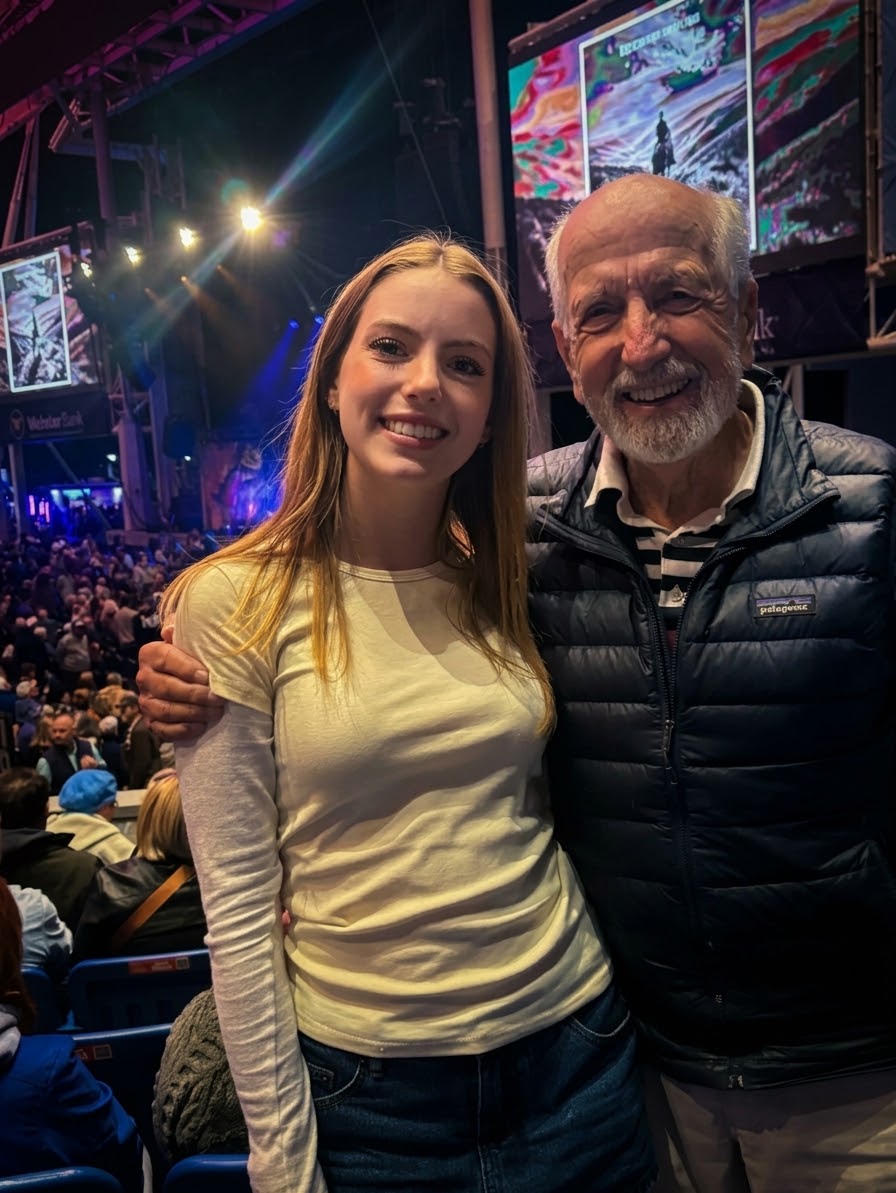
Last night my granddaughter Eva took me to hear Willie Nelson and Neil Young in Bridgeport. That sentence still amazes me.
She is eighteen; I am eighty-six. At her father’s family birthday party two nights earlier, she had surprised me by asking, through him, whether I would go with her. I don’t know why she asked that way. We had recently returned from a trip to Chicago to look at the University of Chicago and Northwestern, and our time together had ended with a silence I couldn’t quite explain. Her invitation touched me deeply. She still wanted her Baba beside her.
On the way to the concert, it was like old times. Eva gave me a short, fascinating lecture on the Roman poet Lucan and his fraught relationship with Nero. Her grasp of Latin, classical history, and mythology already surpasses that of any student I taught during my forty years at Berea. She even surprised her high school Latin teachers by translating Martin Luther King Jr.’s “Beyond Vietnam” speech, delivered at New York’s Riverside Church, into Ciceronian Latin. I encouraged her to somehow publish her work. To call Eva an excellent student is a huge understatement. What delights me most is that she still likes sharing what she learns with me.
We have been going places and talking together for years. Once, in Granada, we went to hear Bob Dylan. More recently, Eva chose to spend part of our Chicago trip with my siblings. When she was fifteen, she gave a school speech about our friendship that moved me almost beyond words. She spoke of our walks, our conversations about economics and religion, and the fact that I had always taken her opinions seriously. Now, riding to Bridgeport, I had the pleasure of listening to her teach me.
The evening began with a video of Willie singing while images passed across the screen: Black and brown people, immigrants, people without homes. I couldn’t make out the song, but I could see whom we were being invited to notice. Before Willie appeared, those faces had claimed a place at his concert. For me, that was a kind of opening prayer.
Willie is ninety-three now and looks his age. At times he seemed to recite the words more than sing them. Still, what words they were. “On the Road Again” sounded different coming from a man who has been on that road so long. “Always on My Mind” carried its familiar regret. And near the end came “Last Leaf,” a song whose title alone had a particular force for an old man listening beside his granddaughter.
Neil Young joined Willie for “Are There Any More Real Cowboys?” Eva noticed something else I might have missed: Willie’s sons were there with him. She found it beautiful to see a father making music with his children. I did too, especially while sitting next to a grandchild who had brought me.
Willie’s set closed with religious music, including “I Thought About You, Lord,” “Will the Circle Be Unbroken?” and “I’ll Fly Away.” Eva leaned toward me and asked, “Why do they have to introduce religion here?”
“This is country music,” I shouted over the sound. “It’s a tradition.”
That was all I could manage over the music, though her question stayed with me. Eva has her own thoughtful relationship to religion. She considers herself an atheist and, years after I baptized her as a baby, even “unbaptized” herself. We have talked about such things all her life. Her question at the concert felt like another moment in that continuing conversation.
Had it been quieter, I might have said that people sing about an unbroken circle and flying away because they know that families part and lives end. The songs give voice to a longing many of us share, whatever language we use for it. Perhaps Eva would have told me more about what she heard in them. That is one of the pleasures of being with her: a question is seldom the end of a conversation.
We hadn’t realized how cold an outdoor concert would be. Eva was dressed for a very different evening. Several times I offered her my padded vest; once I even started taking it off. She firmly refused. Between sets, she bought a Willie Nelson hoodie. It pleased me that she found her own solution, though I kept an eye on whether she was warm enough.
Neil, at eighty, still has much of that unmistakable voice. I could recognize “Old Man,” “Heart of Gold,” “Harvest Moon,” and “After the Gold Rush,” even when I couldn’t follow every word. I felt the frustration of knowing these songs and losing parts of them to the volume and my hearing. For someone who has spent his life listening, teaching, and arguing over words, that loss is hard to ignore.
Then the crowd called Neil back. His first encore was “Living With War”; his second was “Rockin’ in the Free World.” That final song went on and on, loud enough that I briefly wondered what it had done to my ears. Yet somewhere in those ten minutes I forgot the cold. Afterward I turned to Eva and said, “Isn’t rock ’n’ roll great? I forgot I was cold.”
Young’s encore also sent my thoughts back to the faces in Willie’s opening video. A song about freedom ought to make us ask who gets to enjoy it, and who is left out in the cold. That question has guided much of my theology. It was there, too, among the amps and guitars.
But the deepest meaning of the night was simpler. On the drive there, Eva had brought Lucan and Nero into the car with us. At the concert, we noticed a father singing with his sons, talked as best we could over the music, and tried to keep warm. At the end, we let Neil’s guitar carry us along with everyone else.
I hope we have many more walks, conversations, and songs ahead of us. Last night gave me this much: Eva was beside me, Willie’s family was singing, Neil’s guitar was ringing through the cold, and for a while we listened together.


O Mike! This is so beautiful !
Bob Coughlin
LikeLike