On our eighth wedding anniversary, Peggy and I had dinner in São Paulo with Paulo Freire and his wife, Elza. Afterward, one of the world’s great educators read aloud from Peggy’s unfinished doctoral dissertation on Freire himself. At one point, he encountered a lengthy quotation from his own work. He paused and exclaimed in English, “Right now, I am loving these words.”
I still remember that moment. There was something wonderfully unguarded about it: a thinker rediscovering his own thought through the work of a student who had become his friend. For me, it captures something essential about Paulo. Learning remained an encounter, even when the words being encountered were his own.
That memory returned recently when a friend, an editor at OpEdNews, asked about our relationship with Freire. He had just seen Reading the World, the new documentary directed by Catherine Murphy and Iris de Oliveira. Knowing that Peggy and I had a long history with its subject, he wanted to hear more.
Our story began before Peggy and I knew each other. Separately, we had read Pedagogy of the Oppressed. It helped shape us as students and eventually as teachers. Looking back, I would say that Paulo entered our marriage before we ever met him.
His book’s brilliant title suggested two meanings to me. First, it concerned an education through which oppressed people could acquire literacy and participate more fully in public life. In Brazil, where literacy was a condition of voting, teaching people to read could change the electorate. At Angicos in 1963, approximately 300 people became literate through 40 hours of instruction spread over several weeks. Education was opening a political door previously closed to them.
The title’s second meaning was even more challenging: the oppressed themselves have something indispensable to teach the rest of us. People who endure hunger, exploitation, exclusion, and humiliation know things about society that comfortable people can spend their lives avoiding. Their experience raises questions that respectable institutions often discourage. Why are some hungry while others accumulate fortunes? Who benefits from the arrangements we are taught to consider natural?
Education begins to become revolutionary when those questions enter the classroom. For Peggy and me, that meant reconsidering our authority as teachers. Students arrived with knowledge acquired through their families, work, struggles, and communities. Our responsibility included helping them examine that knowledge—and allowing it to challenge our own.
When we married in 1976, we were both working at Berea College. Over the ensuing years, our reading and teaching included Neil Postman and Charles Weingartner’s Teaching as a Subversive Activity, Howard Zinn’s A People’s History of the United States, James W. Loewen’s Lies My Teacher Told Me, and books recovering Black history and women’s history. Frances Moore Lappé and Joseph Collins’s Food First further challenged our assumptions about hunger and poverty.
Freire supplied a thread connecting those works. Each invited us to examine the world from perspectives pushed to its margins. Each questioned the innocence of conventional education.
Then, in 1982, we attended a weeklong seminar led by Freire at Boston University. At the time, Peggy was pursuing her doctorate in philosophy of education at the University of Kentucky. Her dissertation explored Paulo Freire and moral imagination: our capacity to envision human possibilities beyond the arrangements we have inherited. She approached Paulo and asked whether she might study with him at his center in São Paulo. He warmly encouraged her.
That invitation changed our lives. During my first sabbatical at Berea and still studying Portuguese, we went to Brazil in 1984. Peggy’s dissertation was already well underway. She studied at Freire’s center and worked directly with literacy teams in the city’s favelas. There, the questions raised by his books belonged to people’s daily lives. Words emerged from experience. Learning to read involved examining the conditions under which people worked, raised children, found shelter, and struggled to survive.
Meanwhile, I enrolled in a liberation theology seminar that placed Freire’s methods at the center of biblical reflection. I found myself sitting at the feet of theologians I had been studying for years. They helped me understand how “Base Christian Communities” used Freire’s methods in “biblical circles” to consider their efforts to follow Jesus. Their reading connected Scripture with high rents, inadequate water, starvation wages, and government repression.
Those connections transformed the questions brought to the Bible. What did Exodus mean to people seeking freedom? What did Jesus’ good news to the poor require in a neighborhood where families could barely eat? How might faith help people organize to change their circumstances? The poor were becoming interpreters of a tradition too often explained to them by others.
In 1984, Brazil was still under military rule. Freire had already experienced the consequences of awakening such questioning. After the 1964 coup, he had been imprisoned for 70 days. The authorities understood that people learning to name their circumstances might also begin to change them.
During our stay, Peggy and I came to know Paulo and Elza personally. That friendship gave a human face to ideas that had already transformed our work. Our anniversary evening remains its clearest expression. Paulo’s willingness to read Peggy’s developing dissertation aloud conveyed attention, encouragement, and intellectual generosity. The renowned educator took a student’s work seriously enough to enter into it with her. Her dissertation later received national recognition from the American Educational Research Association (AERA). But that evening offered a recognition of its own.
Our friendship continued after we returned to the United States. More than once, we attended workshops with Paulo and Myles Horton at the Highlander Folk School in New Market, Tennessee. We also became friends with Freirean scholars Henry Giroux and Peter McLaren, who helped us publish two books after Paulo’s death in 1997. The relationships continued the learning.
Today, when I think about Paulo Freire, I return to a question that has followed me through decades of teaching, writing, and theological reflection: whose experience helps us see what we have been missing? For Peggy and me, his answer led toward the poor and oppressed—and toward classrooms where teachers could also learn.
I remember the great thinker at his apartment, reading Peggy’s pages and delighting in words that still had the power to surprise him. That openness was part of his greatness. He helped us understand that a teacher’s work begins again whenever another person helps us see differently.
Last Tuesday, before the United Nations, President Trump said he had “a big decision to make.” Would there be a deal allowing Iran to rebuild? Or would he “annihilate the Islamic Republic” and drive its people “into hell with no chance of survival”? Those are his words, as recorded in the available transcript of the speech. They sound like a man who thinks he’s God.
In any case, I keep coming back to the people who would have to live under such threat: a mother trying to get her children to school, a nurse caring for the sick, an elderly man who has already lived through too many wars. What decision have they made that gives an American president authority over their future? How can anyone speak of leaving a people without hope for future generations and call it a choice that belongs to him?
The United Nations was created so that nations would settle their conflicts without threatening one another with destruction. Its charter forbids members to use threat or unauthorized force against other states. Yet there stood the president of the United States, before that very assembly, speaking of annihilation in his illegal war of aggression.
This Sunday’s readings give us a way to judge what we heard.
Through Ezekiel, God asks a question: “Is it my way that is unfair, or rather, are not your ways unfair?” It is a question worth putting to every government that speaks of security while treating other people’s lives as expendable. Would we accept such words from the leader of another nation directed at us? Would we call them statesmanship if our own grandchildren lived under the threatened bombs?
Ezekiel does more than condemn wrongdoing. He says that people can turn from it. The one who has done evil can begin to do what is right and just—and live. The word turn matters. God does not demand that we defend yesterday’s course simply because we chose it yesterday. God calls us to change course when we see where it leads.
That is a word for our president and for everyone helping to prosecute this war. It is also a word for us. Americans can turn. We can refuse to lend our silence to threats made in our name. We can insist that diplomacy, the protection of civilians, and an end to the killing are possible and necessary. Ezekiel will not let us say that it is too late to do what is right.
Then Paul asks us to have the mind of Christ Jesus. In one of the most beautiful passages in the New Testament, he says that Jesus, though in the form of God, did not treat equality with God as something to be grasped. Instead, he emptied himself, took the form of a slave, and accepted death on a cross.
Think of the direction of that movement. Jesus goes toward those with the least power. He shares their vulnerability. He ends among the people an empire could execute.
Christ refused to grasp at godlike power. Our president appears eager to exercise it.
For Christians, that contrast should be impossible to miss. No human being has the right to decide that another people will have no future. And no follower of the crucified Jesus should be comfortable hearing such power claimed on our behalf. We cannot kneel before a man executed by an empire and then applaud an empire’s threat to destroy others.
Paul’s words are addressed to a community. He asks the Philippians to look not only to their own interests but also to those of others. For us, that means asking what the war looks like from beneath the bombs and from inside Iranian homes. It means seeing the people who will suffer before we repeat a government’s account of its aims.
We need not approve of Iran’s rulers to do that. We need not overlook injustice committed by any government. Iranian civilians do not lose their claim on our conscience because of what their leaders may have done. Their lives cannot be reduced to a bargaining chip in a dispute between states.
That brings us to Jesus’ story of the two sons. Their father asks each of them to work in the vineyard. One says no but later changes his mind and goes. The other says yes, sir, and never appears. Jesus asks which one did the father’s will. Everyone knows the answer.
He tells this story to the chief priests and elders. They know how to give the proper religious answer. But when John calls them to change their ways, they refuse. Meanwhile, people they look down upon—tax collectors and prostitutes—hear the call and respond.
It is hard to read that Gospel this week without thinking about the churches. We know how to say yes to Jesus. We praise the Prince of Peace. We recite Paul’s hymn about his self-emptying. Some Christian leaders have spoken against this war and pleaded for diplomacy; Pope Leo has done so. But after a threat as stark as the one voiced at the UN, why don’t we hear church leaders speak with unmistakable clarity about the lives at stake?
And I have to ask the same of myself. It is easy for me to preach against a president. The Gospel asks what I will do once I have finished speaking. Will I make my opposition known to those who represent me? Will I stand alongside people organizing for peace? Will I keep paying attention to Iranian lives when the speech has passed from the headlines? Jesus asks whether we actually go into the vineyard.
Perhaps some of us have supported the war. Perhaps some have feared speaking against it. Perhaps many of us have simply grown weary and stopped listening. The first son gives us reason for hope. His first answer was no. It was not his final answer. He changed his mind and went.
That possibility is the mercy running through all today’s readings. In the psalm we pray, “Teach me your paths.” Ezekiel says that we can turn and live. Paul shows us the path of Christ, who gave up power and stood with the vulnerable. Jesus tells us that what matters is whether we will take that path today.
I pray that our president will turn from the language of annihilation. I pray that our churches will find their voices. And I pray that we, who say yes to Christ every Sunday, will hear the invitation he places before us now: go into the vineyard. Defend the lives being threatened. Work for peace. RESIST. VOTE.
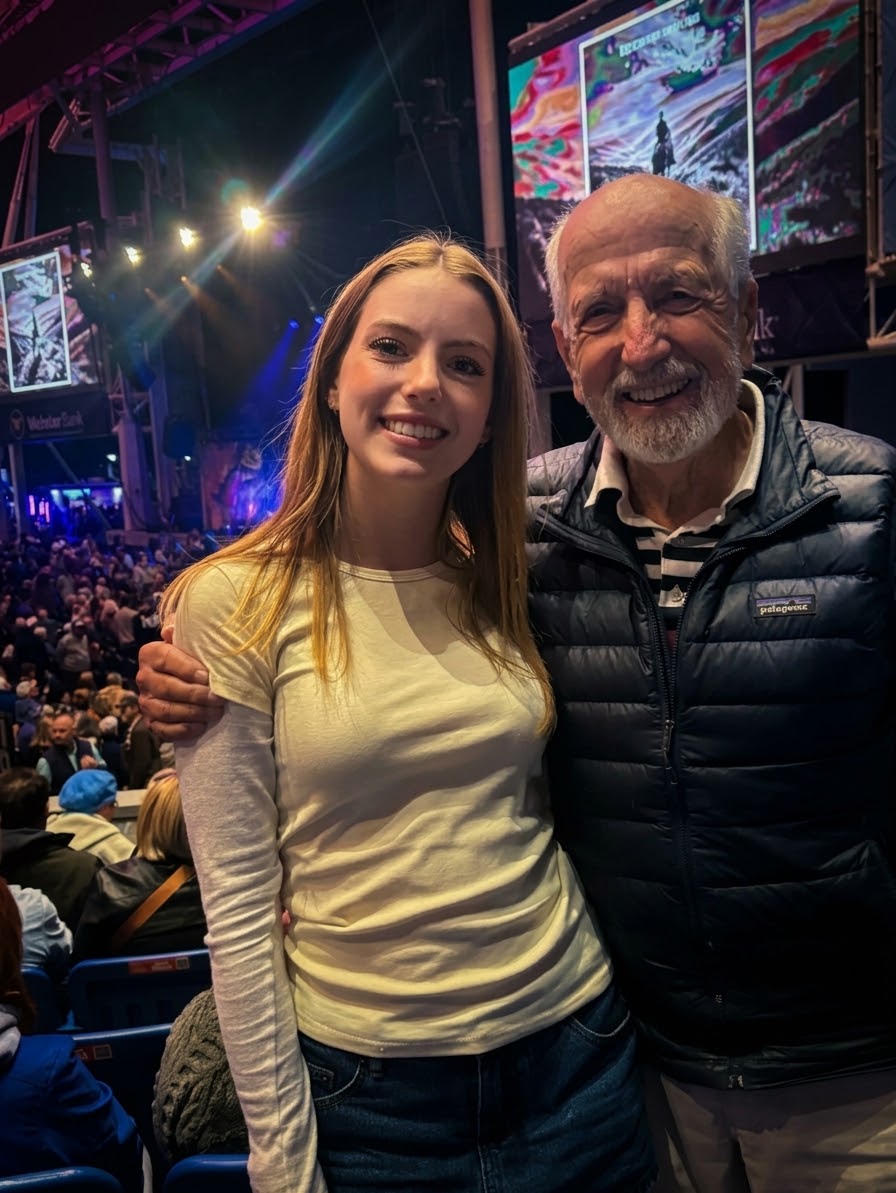
Last night my granddaughter Eva took me to hear Willie Nelson and Neil Young in Bridgeport. That sentence still amazes me.
She is eighteen; I am eighty-six. At her father’s family birthday party two nights earlier, she had surprised me by asking, through him, whether I would go with her. I don’t know why she asked that way. We had recently returned from a trip to Chicago to look at the University of Chicago and Northwestern, and our time together had ended with a silence I couldn’t quite explain. Her invitation touched me deeply. She still wanted her Baba beside her.
On the way to the concert, it was like old times. Eva gave me a short, fascinating lecture on the Roman poet Lucan and his fraught relationship with Nero. Her grasp of Latin, classical history, and mythology already surpasses that of any student I taught during my forty years at Berea. She even surprised her high school Latin teachers by translating Martin Luther King Jr.’s “Beyond Vietnam” speech, delivered at New York’s Riverside Church, into Ciceronian Latin. I encouraged her to somehow publish her work. To call Eva an excellent student is a huge understatement. What delights me most is that she still likes sharing what she learns with me.
We have been going places and talking together for years. Once, in Granada, we went to hear Bob Dylan. More recently, Eva chose to spend part of our Chicago trip with my siblings. When she was fifteen, she gave a school speech about our friendship that moved me almost beyond words. She spoke of our walks, our conversations about economics and religion, and the fact that I had always taken her opinions seriously. Now, riding to Bridgeport, I had the pleasure of listening to her teach me.
The evening began with a video of Willie singing while images passed across the screen: Black and brown people, immigrants, people without homes. I couldn’t make out the song, but I could see whom we were being invited to notice. Before Willie appeared, those faces had claimed a place at his concert. For me, that was a kind of opening prayer.
Willie is ninety-three now and looks his age. At times he seemed to recite the words more than sing them. Still, what words they were. “On the Road Again” sounded different coming from a man who has been on that road so long. “Always on My Mind” carried its familiar regret. And near the end came “Last Leaf,” a song whose title alone had a particular force for an old man listening beside his granddaughter.
Neil Young joined Willie for “Are There Any More Real Cowboys?” Eva noticed something else I might have missed: Willie’s sons were there with him. She found it beautiful to see a father making music with his children. I did too, especially while sitting next to a grandchild who had brought me.
Willie’s set closed with religious music, including “I Thought About You, Lord,” “Will the Circle Be Unbroken?” and “I’ll Fly Away.” Eva leaned toward me and asked, “Why do they have to introduce religion here?”
“This is country music,” I shouted over the sound. “It’s a tradition.”
That was all I could manage over the music, though her question stayed with me. Eva has her own thoughtful relationship to religion. She considers herself an atheist and, years after I baptized her as a baby, even “unbaptized” herself. We have talked about such things all her life. Her question at the concert felt like another moment in that continuing conversation.
Had it been quieter, I might have said that people sing about an unbroken circle and flying away because they know that families part and lives end. The songs give voice to a longing many of us share, whatever language we use for it. Perhaps Eva would have told me more about what she heard in them. That is one of the pleasures of being with her: a question is seldom the end of a conversation.
We hadn’t realized how cold an outdoor concert would be. Eva was dressed for a very different evening. Several times I offered her my padded vest; once I even started taking it off. She firmly refused. Between sets, she bought a Willie Nelson hoodie. It pleased me that she found her own solution, though I kept an eye on whether she was warm enough.
Neil, at eighty, still has much of that unmistakable voice. I could recognize “Old Man,” “Heart of Gold,” “Harvest Moon,” and “After the Gold Rush,” even when I couldn’t follow every word. I felt the frustration of knowing these songs and losing parts of them to the volume and my hearing. For someone who has spent his life listening, teaching, and arguing over words, that loss is hard to ignore.
Then the crowd called Neil back. His first encore was “Living With War”; his second was “Rockin’ in the Free World.” That final song went on and on, loud enough that I briefly wondered what it had done to my ears. Yet somewhere in those ten minutes I forgot the cold. Afterward I turned to Eva and said, “Isn’t rock ’n’ roll great? I forgot I was cold.”
Young’s encore also sent my thoughts back to the faces in Willie’s opening video. A song about freedom ought to make us ask who gets to enjoy it, and who is left out in the cold. That question has guided much of my theology. It was there, too, among the amps and guitars.
But the deepest meaning of the night was simpler. On the drive there, Eva had brought Lucan and Nero into the car with us. At the concert, we noticed a father singing with his sons, talked as best we could over the music, and tried to keep warm. At the end, we let Neil’s guitar carry us along with everyone else.
I hope we have many more walks, conversations, and songs ahead of us. Last night gave me this much: Eva was beside me, Willie’s family was singing, Neil’s guitar was ringing through the cold, and for a while we listened together.
Americans live in a society obsessed with debt—and strangely selective about forgiveness.
When banks gamble recklessly and threaten the economy, governments rescue them. When corporations fail, bankruptcy courts allow them to reorganize and begin again. When wealthy investors lose money, tax laws often permit them to deduct those losses from future income.
But when poor people cannot pay medical bills, student loans, rent, or credit-card debt accumulated simply to survive, forgiveness suddenly becomes morally objectionable. Then we hear about personal responsibility. Then every dollar must be repaid. Then mercy will supposedly encourage laziness.
The same double standard operates internationally. Wealthy nations accumulate enormous debts and continue functioning. Poor countries are forced by international lenders to cut food subsidies, healthcare, education, and public employment to satisfy creditors whose loans have often enriched local elites and foreign corporations rather than ordinary people.
We readily forgive from the top down. We become merciless when forgiveness might benefit those at the bottom.
That is precisely the contradiction exposed in this morning’s Gospel.
Peter asks Jesus how often he must forgive someone who sins against him. Seven times? Peter probably thinks he is being extraordinarily generous. But Jesus answers, “Not seven times but seventy-seven times.”
In biblical language, that does not mean keeping a notebook until offense number seventy-eight. It means refusing to make vengeance a way of life. It means breaking the cycle in which injury produces retaliation, retaliation creates another injury, and violence continues from generation to generation.
To explain, Jesus tells a story about debt.
A servant owes a king “a huge amount.” The original Greek is more dramatic: ten thousand talents. A single talent represented roughly fifteen or twenty years of a laborer’s wages. Ten thousand talents, therefore, was not merely a large personal loan. It was an unimaginable sum—more than a worker could repay in thousands of lifetimes.
In other words, this is not simply a story about hurt feelings. It is about an economic system capable of creating impossible indebtedness.
The king orders the servant sold, along with his wife, his children, and all his possessions. That single sentence reveals the violence hidden beneath respectable financial arrangements. Debt has become a claim not only upon the servant’s labor, but upon his body, his family, and his entire future.
The servant falls to his knees and begs for time. Instead, the king does something astonishing: he cancels the entire debt.
According to Israel’s ancient ideal, debts were to be periodically forgiven, enslaved debtors released, and land returned to families who had lost it. The purpose was to prevent wealth from accumulating permanently in a few hands while everyone else sank into hereditary poverty.
Jesus stands within that Jubilee tradition. At the beginning of his public life, he announces good news to the poor, release to captives, and liberation for the oppressed. In the prayer he teaches his disciples, “forgive us our debts” is inseparable from “as we forgive our debtors.”
The servant in today’s parable has been offered a new life. But he has not undergone conversion.
Leaving the king’s presence, he encounters a fellow servant who owes him one hundred denarii—a real debt, but tiny compared with the ten thousand talents just canceled. He grabs the man by the throat and demands payment. The second servant repeats almost word for word the plea the first servant had made: “Be patient with me, and I will pay you back.”
But the forgiven servant refuses. He has received mercy without learning mercy. He has escaped the machinery of oppression, yet immediately uses that same machinery against someone weaker than himself.
That is the central sin in this story.
The problem is not merely personal ingratitude. It is the refusal to extend downward the liberation received from above.
That makes this parable especially relevant to Christians in the United States. Our country has received advantages that cannot honestly be attributed to virtue alone: fertile land taken from Indigenous peoples, labor extracted from enslaved Africans, resources drawn from colonized countries, and a privileged position within the global financial system.
Yet instead of recognizing our enormous inherited debt, we often seize poorer nations by the throat and demand, “Pay what you owe.” We impose sanctions, collect interest, confiscate resources, and punish entire populations for resisting an international order designed largely without them.
The same pattern appears within our country. People whose families benefited from subsidized mortgages, inexpensive education, union wages, Social Security, and public investment may oppose similar assistance for younger workers, immigrants, or the poor. Like the servant in the parable, we forget what has been forgiven, subsidized, or simply handed to us.
But here we must make an essential distinction. Christian forgiveness does not mean that privileged observers may forgive crimes committed against other people.
I cannot forgive the slaughtered child’s killer on behalf of the child’s parents. Settler societies cannot absolve themselves of crimes against Indigenous peoples. White people cannot declare slavery and segregation forgiven without the participation of their victims. Governments responsible for war, torture, ethnic cleansing, or genocide cannot invoke reconciliation while the killing continues.
Only victims can forgive the injuries done to them.
Nor does forgiveness eliminate the need for truth, accountability, restitution, or protection of the vulnerable. There can be no genuine reconciliation without truth. Stolen land and wealth may require restitution. Those who remain dangerous may need confinement—not for revenge, but for rehabilitation and the protection of others.
Forgiveness is not forgetting. It is not pretending that evil did not happen. It is not allowing abusers to continue abusing. And it is never a command to the oppressed to accept oppression more politely.
Instead, forgiveness means refusing to become what has wounded us. It means relinquishing vengeance without relinquishing justice. It seeks restoration rather than humiliation, conversion rather than annihilation, and a future not permanently imprisoned by the past.
That is why Sirach asks, “Could anyone nourish anger against another and expect healing from the Lord?” Notice the word healing. Forgiveness is not presented primarily as obedience to an arbitrary rule. It is a form of healing. Hatred binds the injured person to the offender. Vengeance allows the perpetrator to continue occupying the victim’s heart and imagination.
Paul adds another dimension: “None of us lives for oneself.” That is the direct opposite of the individualism our culture teaches. We are not isolated competitors whose debts and injuries concern only ourselves. We belong to one another. Our lives are entangled. The suffering of immigrants, Palestinians, prisoners, impoverished workers, and sanctioned populations is not somebody else’s problem.
If none of us lives for oneself, then none of us is saved alone.
The Gospel’s final image of the unforgiving servant handed over to torturers is disturbing. It should not be used to portray God as an eternal torturer. The parable is showing what a world without mercy becomes. When we organize society around unpayable debts, resentment, punishment, and revenge, we build our own torture chambers—and eventually everyone lives inside them.
Jesus offers another possibility: receive mercy, practice mercy, and reorganize life around mercy. That means personal forgiveness, certainly. Families and communities cannot survive if every injury is preserved forever as ammunition.
But it also means social forgiveness: canceling predatory debts, ending sanctions that punish civilians, releasing those unjustly imprisoned, repairing the damage of racism and colonialism, and replacing retributive systems with restorative justice.
The test of whether we have understood God’s mercy is not how beautifully we praise it in church. The test comes when we meet someone who owes us—or someone our society has placed beneath us.
Will we seize that person by the throat? Or will we remember how much we ourselves have received?
“The Lord is kind and merciful, slow to anger, and rich in compassion.” A church that sings those words must become what it sings: a community that tells the truth, repairs what has been broken, defends victims, cancels impossible debts, and refuses to surrender the future to vengeance. That is forgiveness from the heart.
And that is what God’s Kingdom looks like when it enters history.
[On September 6th, I celebrated my 86th birthday with my family here in Westport CT. It was so much fun for me. During our pre-breakfast conversation (I suppose because of my age) the topic turned to death, the afterlife, and Dante’s Divine Comedy. My son-in-law remarked that someone should make a modern adaptation of that famous 14th century trilogy. I said that I think Disney has already done it in his classic “Soul.” The conversation sent me back to the following essay I wrote along those lines five years ago. Rereading it made me want to republish what I wrote then. That was even before I started studying Tarot, which I now see would have enriched the piece enormously. Anyway, here it is without that enrichment.]
Pixar’s “Soul”: Profound Spiritual Wisdom from a Soulless Corporation
Isn’t it ironic that one of the most powerful businesses in the world, the Disney conglomerate, has ended up being one of our nation’s most effective spiritual teachers?
I mean, in Disney you have a typical heartless corporation that controls so much of our deceitful mainstream media and our superficial entertainment industry. Yet that very transnational firm has consistently produced popular art that calls viewers to introspection, identification with wildlife and nature, and to qualities of generosity, selflessness, and love.
I’m thinking of celebrated productions like “The Lion King,” “Beauty and the Beast,” and even “Bambi.” Arguably, such animated films issue more effective calls to spiritual values (especially to the young) than do most churches.
How that’s possible remains a mystery to me. It’s probably because even Disney Productions discerns a deep hunger for meaning in audiences throughout the world. So, in its effort to enhance its bottom line, it acquires scripts authored by spiritually attuned writers. But that’s only a guess.
The Film
Nevertheless, that was probably the case with Disney’s latest issuance, “Soul” whose screenplay was written by Pete Docter, Mike Jones and Kemp Powers. It’s a charming, comedic yet penetrating probe into the meaning of life and death. Its depiction of the afterlife suggests characterization as a poor man’s version of Dante’s Divine Comedy. It has all the ingredients: a guided trip through the great beyond, a painful process of purgation, and finally arrival at peaceful beatitude.
(At this point, some might think it appropriate to give a “spoiler alert,” though that hardly seems necessary for a spiritually themed work like “Soul.” It’s not some cliffhanger. In any case, be forewarned.)
More specifically, as Disney’s first all-black production, “Soul” tells the story of Joe Gardner (Jamie Foxx), a frustrated middle school band teacher obsessed with jazz and landing his dream job of playing piano in a quartet headed by a diva saxophonist named Dorothea Williams.
Joe is himself an unappreciated musical genius as becomes evident every time his riffs transport him into the “Zone” of his prodigious brilliance. In his audition for the Williams quartet, the diva immediately recognizes Joe’s talent and hires him on the spot.
Joe is overjoyed. On his way home, he practically floats and dances down the streets of NYC. In his distracted oblivion he is narrowly missed by busses, cars, motorcycles and bikes. However, Joe himself doesn’t miss an open manhole, which swallows him up and apparently ends his life.
The next thing he knows, he’s is in the afterlife on his way towards the Bright Light invariably reported in the accounts of most near-death experiences (NDE). But possessed by his obsession with finally realizing his dream job, Joe refuses to die.
The Underworld
So, instead of escalating into the world of light, he’s returned to heaven’s underworld – a kind of limbo – a so-called “Youth Seminar” where unborn souls are prepared by the recently departed to enter into bodies on planet earth. There Joe is introduced to a rebellious unborn soul (Tina Fey) called #22 (seemingly because she was the 22nd soul ever created).
Despite its status as a truly “old soul,” #22 has remained unembodied for eons because she finds the prospect of life on earth boring. No mentor, no matter how prestigious – not Copernicus, Marie Antoinette, Abraham Lincoln, Karl Jung, George Orwell, Mother Theresa, or Muhammad Ali – has been able to successfully coax 22 to incarnate on the Milky Way’s “stinky rock,” where she knows that life is inevitably soul crushing.
Despite that history, Joe Gardner accepts the task of mentoring #22 in hopes that if successful, he might be allowed to return to earth and his dream gig. Joe is convinced that if he can help 22 find her passion – her Spark – then her fierce resistance to life on earth will dissolve.
So, acting like Dante’s Virgil, Joe leads 22 through the “Great Before.” She accompanies him as he reviews his own life and identifies jazz as the spark which had given his frustrated existence the modicum of meaning it’s had. From there the two travel through the Hall of Everything where Joe shows 22 her own life’s possibilities as a baker, fire fighter, artist, librarian, mathematician, gymnast, office worker, or astronaut. Not surprisingly, 22 remains unmoved.
However, it’s at this point that roles suddenly reverse as the unborn soul takes pity on Joe. He’s unlike any of her previous mentors, she says, because his life has been so sad and pathetic. Despite the fact that 22 can’t imagine why Joe wants so desperately to return to such pathos, she leads her mentor to the Zone – a state between the physical and spiritual – where he’s made to recall the times his music has induced a state of happiness and bliss.
From there, 22 takes Joe to the Realm of Lost Souls where she introduces him to “a guy I know” – a mad psychedelic captain, a self-described “mystic without borders.” Captain Moonwind (who doubles as a NYC sign spinner on the other side) helps lost souls find their way out of obsessions and anxieties that leave them disconnected from life. For instance, he once helped liberate a soulless hedge funder from his alienated labor. In the aftermath, the frustrated Wall Streeter completely trashes his obsessed, anxious and confining work environment while finally screaming “I’m alive! I’m alive!”
To the tune of Dylan’s “Subterranean Homesick Blues,” Moonwind ferries Joe and 22 across the Sea of Lost Souls. On the way, the captain tellingly instructs Joe that lost souls are not that different from those striving to live constantly in the Zone. In both cases, he warns, “When your joy becomes an obsession, you end up tragically disconnected from life.”
With the warning ringing in his ears, and after entering a deep state of meditation, Joe and 22 suddenly find themselves returned to earth – to the intensive care unit where Joe’s NDE began. He’s not dead after all. However, both Joe and 22 are surprised to find that they remain completely displaced. Joe’s personality is now located in the hospital’s therapy cat, Mr. Mittens. Meanwhile, 22 finds itself animating Joe’s just-revived body.
Desperate and confused, the two narrowly escape from intensive care and emerge onto NYC’s noisy, smelly and dirty streets. It’s in this Purgatorio that Joe resumes his role as 22’s Virgil. Trapped in the cat’s body, he is intent on leading his newly ensouled form to what he imagines as heaven – the Half Note Jazz Club where his platonic Beatrice (Dorothea Williams) awaits him impatiently.
Purgatorio
On the way, 22 learns more about inhabiting Joe’s body. For the first time, she discovers the soul-purging joys of pizza; of simply walking, sky watching, taking a shower, tasting toothpaste, and of fitting into a comfortable old brown suit. She recognizes a kindred spirit in 12-year-old Connie, Joe’s gifted middle school trombonist who finds school stultifying. When Connie expresses her boredom with school, 22 approvingly quotes her former mentor, George Orwell, “State-sponsored education is like the rattling of a stick inside a swill bucket.”
22 even revels in subway rudeness and in the talent of an underground street musician. Above all, 22 likes “jazzing” – spontaneous self-expression or any kind.
Now Mr. Mittens is the one to object. “No,” he insists, jazz is a completely other category. “Music and life,” he says, “operate by very different rules.”
Undeterred, 22 continues jazzing during a visit to Joe’s neighborhood barbershop. There, with Mr. Mittens sitting in her lap, Dez the barber reveals the possibility of finding joy in a second-choice career even when one’s first choice has been frustrated. Despite his genius at cutting hair, Dez explains that he originally wanted to become a vet. However, since barber school was less expensive than training for veterinary medicine, Dez chose the former. But it’s made him “happy as a clam.”
The lesson is not lost on Mr. Mittens. His wide eyes tell that he’s thoughtfully considering his own life in the light of Dez’s revelation. Meanwhile he listens incredulously as 22 philosophizes free form while Dez cuts the hair on the head she’s now thinking with.
Everyone’s enthralled as she pontificates about “existing as a theoretical construct in a hypothetical waystation between life and death. . . left wondering whether all this (obsessed and over-focused) living was really worth dying for.”
Then she responds smartly to Paul, a hip barbershop customer, who rips Joe for falling short of his dreams. 22 fires back, “He’s just criticizing me to make up for the pain of his own failed dreams.” Her barbershop audience laughs at Paul derisively.
Later, 22 ecstatically explains to Joe: Didn’t you see? “I was jazzing.”
22’s jazzing continues through the next stage of Joe’s purgatory – an encounter with his mother who has constantly urged her son to abandon his musical ambitions in favor of steady employment with pension and health care.
Still encased in Joe’s body and tentatively coached by Mr. Mittens, 22 boldly responds on Joe’s behalf, “Mom, I’m just afraid that if I died today, then my life would have amounted to nothing.”
That particular jazz riff opens Mrs. Gardner’s heart. In tears, she embraces her son and tells him how proud she is of him. She adds that his deceased father would have been proud too. She even gives Joe his dad’s handsome wool suit to wear at the anticipated performance that evening. (Joe’s father too had been a musician dependent for support on his wife’s real job as a seamstress. No wonder she was worried about Joe.)
Paradiso
Finally, Joe arrives at the Half Note Jazz Club. By now, with the help of Captain Moonwind and a brief return to the Great Before, the difference between Joe and 22 has been completely overcome. Joe’s come to realize that 22 is the same as his own unappropriated unborn soul.
Whole at last, Joe is now ready for his beatific vision. Imagining that it will happen on the Half-Note’s stage, Joe persuades Dorothea Williams to rehire him despite his late arrival at the jazz club. Reluctantly, she acquiesces.
However, all doubts vanish as Joe gives the performance of his life thrilling everyone present including his mother and Ms. Williams herself. Amid the applause, Joe’s mother is heard shouting proudly, “That’s my son!”
Nonetheless in the aftermath, Joe remains strangely detached. In effect, he wonders aloud, “Is that all there is? I’ve been waiting for this my entire life. I thought it would be different.”
The diva explains, “You’ve been like a fish discontent with his water habitat because he’s been searching for the ocean. You’ve had what you’ve been looking for all your life. It’s what you live in, move in and where you have your being.”
With that, Joe’s penny finally drops. Now his life flashes before him summarized in the symbolic trinkets that awakened the soul of # 22:
A Metro pass
A pizza crust
A piece of a bagel whose other half had been thrown into the tip basket of that subway musician
The lollypop Dez the barber shared during the session in his “magic chair”
A spool of blue thread that Joe’s mother used to refashion his father’s wool suit
A seed from a maple tree brought by a gentle breeze into Joe’s waiting hand
Yes, Dorothea’s version of Beatrice was right: Joe’s had everything he’s needed right from the beginning – in his father’s sharing his passion for jazz, in fireworks over New York City, in the heat blowing from city street grates, in the taste of pecan pie, in the star filled sky . . .
So have we all.
Conclusion
Such “morals of the story” might strike some as typically Hollywood – trite truisms generated algorithmically by pretentious but ultimately soulless corporations interested only in easy pandering to the peasant gallery. However, conclusions of this sort overlook the fact that most preaching and motivational talks contain similar messages. Fact is: we need the reminders.
Nonetheless, the morals of “Soul” go far beyond what’s already been itemized. A more comprehensive catalog might include the following.
Life on planet earth need not be boring or meaningless.
Death is not our enemy, but a portal to profound insight and expanded awareness.
Animals from which we evolved (symbolized in Mr. Mittens) continue to guide us.
So do previous human incarnations (like 22’s George Orwell and Muhammed Ali) who somehow persist as our mentor guardian angels.
When our joys become obsessive, they disconnect us from life’s richness.
Even our “dream jobs” are comparatively insignificant – carried out in the equivalent of a small basement jazz club.
The same holds true for the heroes we idolize (like the self-important diva Dorothea Williams).
In the light of impending death, (if we’re lucky) consciousness of such relativity eventually dawns as we realize that wish fulfillment isn’t all it’s cracked up to be.
Instead, life is about overcoming separations – male from female, black from white, animal from human, body from soul.
It’s important “to jazz” and free flow at every opportunity; music and life both operate by the same rules.
These insights merit not only superficial review, but serious meditation by those whose spiritual hunger evokes them from sensitive writers like Docter, Jones and Powers despite their employment by Disney.
Do yourself a favor and see Pixar’s “Soul.” It will set you on the path of Dante, Virgil, Beatrice — and Joe Gardner.