Readings for 28th Sunday in Ordinary Time: Isaiah 25:6-10a; Psalm 23:1-3a, 3b-4, 5, 6; Philippians 4:12-14, 19-20; Ephesians 1:17-18; Matthew 22:1-14
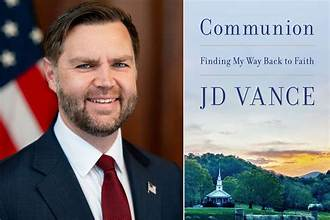
Vice President JD Vance has published a book called Communion: Finding My Way Back to Faith. It recounts his spiritual journey toward Catholicism and presents his faith as a guide to his public life.
Communion is a beautiful word. It suggests belonging, reconciliation, and a shared table. For Catholics, it names our most intimate encounter with Jesus Christ in the Eucharist. But the title also raises a question that a conversion story cannot answer by itself: Communion with whom?
Does it include the immigrant threatened with deportation, the Muslim family living beneath American bombs, or the Palestinian child searching for food? Does it include the gay or transgender believer who wants to belong without becoming a political target?
Those questions become unavoidable when a Catholic vice president defends an immigration crackdown the pope has criticized, dismissing the Vatican’s views as “troubling.” They become more urgent when he defends the administration’s war of aggression in Iran and supports restrictions on LGBT rights.
I cannot judge the sincerity of Vance’s conversion. But when a political leader says his faith guides his public life, we have every right—and responsibility—to ask where that guidance leads.
Today’s readings give us a remarkably concrete test. They place a table before us. Isaiah describes God preparing a magnificent banquet with rich food, excellent wine, an end to humiliation, and tears wiped from every face. And who is invited? All peoples. The invitation extends beyond any favored nation, race, religion, or group possessing the correct documents. God’s generosity overturns the arrangements by which some eat extravagantly while others struggle to survive. The feast announces a world in which abundance sustains everyone and nobody’s suffering is dismissed as the price of someone else’s security.
Psalm 23 brings that promise close to home. The threatened person receives nourishment, rest, and protection. A table appears in the presence of enemies, and someone who has lived in fear can finally sit down and eat. Paul makes the same promise practical. He has known hunger and distress, and his friends have shared his troubles. Their solidarity gives faith a material expression. Taken together, these readings describe salvation through the experience of people whose needs are finally met.
Then Jesus tells his wedding banquet parable. The invited guests refuse to come. Some prefer their farms and businesses; others attack the messengers. So, the servants go into the streets and gather whoever they find, people considered bad as well as good. The hall fills with unexpected guests. Those who presumed they belonged are absent, while those who never expected to belong are inside. Matthew’s telling contains allegorical features, but its Kingdom question reaches beyond identifying what each character represents: Will we accept the life God offers?
The text does not explicitly say that the original guests refused because they disliked the other invitees. Yet Jesus’ wider ministry makes that an unavoidable question for us. We know what happened when he shared his table: respectable people objected. He ate with tax collectors and sinners, welcomed people whose reputations supposedly disqualified them, and told religious authorities that prostitutes were entering God’s Kingdom ahead of them. His enemies accused him of being a glutton and a drunkard. The scandal was the company he kept.
Jesus himself would hardly have satisfied the expectations of white Christian nationalism. He was a Jewish Galilean from an ordinary working family, living under Roman imperial domination. He belonged to a subject people. This man of the eastern Mediterranean scarcely resembled the pale European Jesus displayed in so many churches. We do not know his precise complexion, but we do know that making him the guardian of white supremacy requires erasing his historical identity.
Now imagine arriving at his banquet. There sit the immigrants Mr. Vance wants removed, the Muslims he suspects, and the Palestinians whose deaths he explains away as necessary. There sit black and brown neighbors whose belonging nationalist Christians repeatedly question, alongside LGBT Christians whose lives have become ammunition in right-wing campaigns. And Jesus is sitting with them. Do we join him, or do we discover that the Kingdom we thought we wanted has the wrong people in it?
That is the contradiction Communion brings into focus. Vance’s own family crosses religious and ethnic boundaries: his Hindu wife, Usha, is of Indian descent, and they have four brown-skinned children. Their family makes visible the human richness that narrow definitions of national belonging cannot contain. The question is whether the recognition embodied in family love extends to strangers. Can the Muslim mother, the immigrant father, and the Palestinian child claim the same concern we instinctively offer those closest to us? Christian love demands that extension. The stranger’s dignity cannot depend on becoming a member of our household.
Nor does national security relieve us of that obligation. Whatever governments say about their enemies, children do not become expendable because they live across a border. Iran’s families and Gaza’s families possess the same claim to life as our own. Isaiah promises to wipe away tears. A Christianity that blesses policies producing those tears must answer to that promise. We cannot celebrate God’s universal banquet while accepting the destruction of people invited to attend it.
This is where Pope Francis and Pope Leo place the preferential option for the poor. Francis taught that the poor can teach the Church how to encounter Christ. Leo’s Dilexi Te continues that emphasis and calls for confronting the structures that produce deprivation. Their teaching asks us to recognize Christ among people whose suffering powerful institutions overlook. Catholicism’s “best kept secret”—its social teaching—therefore belongs at the center of any public account of Catholic conversion. What good is speaking eloquently about the Eucharistic table while defending arrangements that deny people food, shelter, safety, or belonging?
The preferential option asks whose hunger, whose dispossession, and whose fear our policies address first. It challenges us to see the world from the place of those left outside.
That challenge brings us to the guest without a wedding garment. He has entered the hall, but entering is not the whole of accepting. In literature, clothing often reveals more than appearance: it signals identity, allegiance, or a person’s place in the world. A change of clothing can therefore alert us to a deeper transformation—a new way of being, a different relationship to others.
Here, the wedding garment points toward conversion made visible in conduct. Applied to our circumstances, it asks whether we have merely secured a place for ourselves or accepted the shared life the banquet represents. We can enter the Catholic Church while refusing its demands upon our politics. We can receive Communion while supporting exclusion and profess devotion to Jesus while treating his neighbors as disposable. The garment asks whether our conduct expresses the communion our lips proclaim.
That warning confronts Vance, and it also confronts us. Political loyalty cannot serve as our wedding garment; neither can correct religious language. The garment must be woven from the life we actually practice: mercy, justice, generosity, and solidarity. Whom do we welcome? Whose suffering interrupts our comfort? What are we prepared to share, and whose struggles will we make our own? Those questions reveal whether we have accepted the invitation or merely claimed the privileges of being invited.
Today’s Gospel leaves us facing the table we have been discussing all along. The people we wanted excluded have arrived, God has welcomed them, and Jesus has taken his place among them. Communion with him means accepting communion with them.
If their presence makes us turn away, we should be honest about what we are refusing: the table where Christ is waiting.

