One might easily argue that fake news antedates our modern world altogether. Back in the 4rd century BCE, Plato of Athens described something like it in his “Allegory of the Cave,” which has always played a central part in my own teaching.
In the context of critical thinking, it is pertinent to recall its details, and to compare them with a more contemporary version of Plato’s tale suggested by Noam Chomsky’s Necessary Illusions. Recall that in effect, Chomsky argues that most of what we read in the mainstream media flirts, at the very least, with fake news.
Here’s the way I’ve told the story to my students.
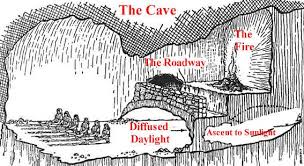
In Book VII of The Republic, Plato says that those trapped in ethnocentrism are like prisoners confined from birth to a cave. Within its confines, they live within a shadow world.
That’s because the prisoners pass their entire lives chained alongside one another, unable to move or even turn their heads to see companions seated alongside them similarly constricted. Instead, everyone confined to the cave faces the cavern’s back wall. Upon that surface, what the prisoners take for themselves and life itself are imaged before them in the form of shadows.
The shadows appear because behind the prisoners’ backs a fire is burning. It acts like a movie camera in a dark theater, causing the shadows of those before it to be projected on the cave’s blank wall. So the prisoners see themselves and those beside them only in specter form. They think the sentences they themselves utter are coming from those relatively distant dark figures. In other words, the prisoners are completely alienated from their true selves.
But there’s more.
Behind the prisoner’s back, and between them and the fire there stretches what Plato calls a parapet. It’s a long elevated pathway that runs the width of the cave. Shielded by the parapet’s wall, men walk unseen, each carrying a statue overhead. There are statues of everything you might think of: flowers, trees, animals, buildings, gods and goddesses … As they pass before the fire, the statues, but not their bearers, appear as shadows on the cave’s wall.
The prisoners watching the parade, imagine that life is unfolding before them, even though, in reality, their perception is artificial to say the least.
Still however, the “wise ones” among the cave’s prisoners become adept at identifying and naming the shadows and at predicting the order of their appearance. Such “teachers” are held in high esteem, though their reality, like the others, is limited to shadows of objects made of stone and wood.
Then one day everything changes. One of the prisoners (we’re not told how) has his chains struck. Slowly, and with great discomfort, he manages to stand. In the fire’s light, he observes the actual bodies of those chained alongside him. He turns and though the fire’s light stabs his eyes, his vision gradually adjusts allowing him to see the blaze and the parapet running before it. He sees the statues for what they are and eventually even the ones carrying them.
“And what’s that beyond the fire?” he asks himself. Why, it’s a pathway leading who knows where. The freed prisoner decides to follow the path. Stumbling and falling, he’s swallowed up in the darkness of the cave’s elongated entrance tunnel. Finally, however, things brighten as he approaches the cave’s entrance.
Then all at once, he’s there. He emerges into the real world, blinded by the terrible brightness of the sun. His eyes adjust and the panorama before him is stunning. For the first time, he sees real flowers, real trees, animals, birds, buildings, and people walking freely about. Finally, he’s able to look fleetingly at the source enabling such wonderful visions, the sun itself. He has entered the real world and is free at last.
But then he remembers his fellow prisoners left behind in the dark cave. He pities their bereft condition, and resolves to set them free.
Back to the cave he goes, this time feeling the cavern’s darkness more oppressive than before.
He stumbles back to the fire and presents himself before the prisoners with his good news.
“This is not reality!” he exclaims. “There’s a whole world outside this cave more wonderful than anything you can imagine. I have only to strike your chains, so you might leave here and enjoy an unimaginably fuller life. Let me set you free!”
Plato asks, how do you suppose the prisoners will receive the escapee’s message? Will they welcome him and follow his lead to freedom?
Far from it, Plato replies. On the contrary, if they could, they would rise up and kill him for disturbing their comfortable tranquility.
Such is the fate of all great teachers, Plato observes. It’s what happened to his beloved Socrates whom the citizens of Athens executed for “corrupting the youth.” Socrates’ crime was teaching the young to think critically. Plato’s allegory describes the journey of critical thinking – from acceptance of shadow-reality through facing the hard truth of having been tricked, to a thrilling sense of liberation followed in many cases by rejection and hostility from friends, relatives, and strangers content with being duped.
Plato’s message seems to be that we are all prisoners by choice. We’re locked in our cultural cave whose world vision is so profoundly distorted that it deprives us of life itself. In fact, we love the chains that bind us. And that love has created a drab, stultifying reality. Our chains’ links are forged from fear of the unknown – of life itself – and of our own freedom and power. We’re afraid of what might happen to us if we embrace life without illusion. We’re wedded to our comfort with what we’ve always known. From that perspective, liberation strikes us as threatening and insane. Nonetheless, our prison cell’s door stands open before us. We have only to replace fear with courage, love of life, and willingness to change. The reward is new vision – another way of looking at things, and fullness of life itself.
(Next week: Plato Updated: Chomsky’s Necessary Illusions)