Meet Declan Coyle, a Real Liberation Theologian (Sunday Homily)

Declan

My Easter homily two weeks ago evoked a wonderful response from one of my former priest-colleagues from the Society of St. Columban – the missionary community of priests I belonged to before I left in 1976. The colleague is Declan Coyle (pictured above).

Declan, it turns out, is a wonderful and witty writer. In a future blog I’ll share his moving piece on his son, Alexander who has Mowat Wilson Syndrome. It’s a truly inspiring essay on the meaning of living in the present moment.

When I asked for permission to share his Easter thoughts, here’s how Declan responded.

Of course Mike you can share it with you audience.

I soldiered (how easily the old militaristic verb crops up, “Who has a blade for a splendid cause … our horses are red to the hocks with the blood of the heathen”) with the Columbans for 27 years from seminary to moving on to marry Annette, an Australian in 1990.

I studied Liberation Theology in St Paul’s Ottawa after ordination, and then I asked the Superior General for five years in a slum in Latin America or Asia. After nine years of post-high school academic study I felt I was not fit to teach in Boston. But I knew that if I got some years in a slum where the slum dwellers who had survived and graduated from the University of Life taught me some life lessons, and I got these in my blood and my guts and my bones and my being, then I could teach Liberation Theology with passion and enthusiasm.

I got five years in the Philippines and six in Taiwan.

I got married to Annette, my wife in 1990. We have three children, Genevieve (19), Fionn (16) and little Alexander who is eight. He is a very special child. He has Mowat Wilson Syndrome. It was only discovered in 1997 and he was the first child in Ireland to be diagnosed with it. I’ll attach a reflection I wrote recently about him. He’s the epitome of the idea that he’s not a human being having the odd spiritual experience, he’s a spiritual being having a human experience.

The last 90 days I was in the Philippines I buried 65 children under two years old … all who died from hunger or hunger related diseases. In the slums we lived Jesus’ Synagogue Speech and Matthew 25 and life to the full and joy overflowing.

From where I’ve lived my so called Christian life, you’ve got your hand on the heart and the soul of the gospel and what the carpenter poet of Galilee was all about. I’m still baffled as to why John Paul II didn’t jump on a plane and go out and finish that Mass that stopped when Romero was shot. Would that not have been a symbolic gesture to lift the hearts of the poor and baffle Reagan?

Every blessing in your great work. You are real good news for the poor. You are real liberation for those oppressed by the historical accretions of the empire and real new sight for those of us who have been blind to the real meaning of the gospels for our world today. You remind me of the great prophet Micah whose words you live: To act justly, to love tenderly with kindness and to walk humbly with your God.

All the lovely things of the Holy Spirit on this Easter Week.

Declan

And now Declan Coyle’s Easter Reflection:

Years ago here at home our eldest two children Genevieve and Fionn were playing hide and seek all over the house. All I could hear all day was, “ready or not, here I come!”

That evening Genevieve asked me how did Jesus rise from the dead. I told her that on Easter Sunday morning the soldiers were outside the tomb, cooking their Easter eggs in a pot on the fire. Then suddenly from the tomb came this thunderous voice, “Ready or not here I come!” Then the rock rolled away and out came Jesus.

The two soldiers fainted with the fright.

The following week, the teacher asked the children to explain how the resurrection happened. Genevieve told her how. The teacher was not impressed.

I asked Genevieve which story she preferred. She said yours Daddy. In one fell swoop, she turned me into the fifth evangelist – a storyteller with a myth, a story, a lie that tells the truth. She understood hermeneutics.

In our recent discussions I told her that if ever she is tempted to go literal, she’ll lose the meaning. Always go symbolic. If you go literal, then you’re wondering at Christmas was Jesus born in a stable, or a cave or was it a kindergarten for the Essenes?

Literal is a dead end. But when you go symbolic you realize that the Christmas story simply means that great power comes in humble packages.

Keep up the great work Mike.

And send your material to Pope Francis.

Happy Easter. Declan

Did Jesus Really Rise from the Dead?

resurrection

Did Jesus really rise from the dead? Or is belief in his physical resurrection childish and equivalent to belief in the Easter Bunny or Santa Claus?

I suppose the answer to those questions depends on what you mean by “really.” Let’s look at what our tradition tells us.

Following Jesus’ death, his disciples gave up hope and went back to fishing and their other pre-Jesus pursuits. Then, according to the synoptic tradition, some women in the community reported an experience that came to be called Jesus’ “resurrection” (Mt. 28:1-10; Mk. 16: 1-8; Lk. 24:1-11). That is, the rabbi from Nazareth was somehow experienced as alive and as more intensely present among them than he was before his crucifixion.

That women were the first witnesses to the resurrection seems certain. According to Jewish law, female testimony was without value. It therefore seems unlikely that Jesus’ followers, anxious to convince others of the reality of Jesus’ resurrection, would have concocted a story dependent on women as primary witnesses. Ironically then, the story’s “incredible” origin itself lends credence to the authenticity of early belief in Jesus return to life in some way.

But what was the exact nature of the resurrection? Did it involve a resuscitated corpse? Or was it something more spiritual, psychic, metaphorical or visionary?

In Paul (the only 1st person report we have – written around 50 C.E.) the experience of resurrection is clearly visionary. Paul sees a light and hears a voice, but for him there is no embodiment of the risen Jesus. When Paul reports his experience (I Cor. 15: 3-8) he equates his vision with the resurrection manifestations to others claiming to have encountered the risen Christ. Paul writes “Last of all, as to one untimely born, he appeared also to me.” In fact, even though Paul never met the historical Jesus, he claims that he too is an “apostle” specifically because he shared the same resurrection experience as the companions of Jesus who were known by that name. This implies that the other resurrection appearances might also be accurately described as visionary rather than physical.

The earliest Gospel account of a “resurrection” is found in Mark, Ch. 16. There a “young man” (not an angel) announces Jesus’ resurrection to a group of women (!) who had come to Jesus’ tomb to anoint him (16: 5-8). But there is no encounter with the risen Jesus. In fact, Mark’s account actually ends without any narrations of resurrection appearances at all. (According to virtually all scholarly analysis, the “appearances” found in chapter 16 were added by a later editor.) In Mark’s original ending, the women are told by the young man to go back to Jerusalem and tell Peter and the others. But they fail to do so, because of their great fear (16: 8). This means that in Mark there are not only no resurrection appearances, but the resurrection itself goes unproclaimed. This makes one wonder: was Mark unacquainted with the appearance stories? Or did he simply not think them important enough to include?

Resurrection appearances finally make their own appearance in Matthew (writing about 80) and in Luke (about 85) with increasing detail. Always however there is some initial difficulty in recognizing Jesus. For instance Matthew 28: 11-20 says, “Now the eleven disciples went to Galilee, to the mountain to which Jesus had directed them. And when they saw him they worshipped him; but some doubted.” So the disciples saw Jesus, but not everyone was sure they did. In Luke 24: 13-53, two disciples walk seven miles with the risen Jesus without recognizing him until the three break bread together.

Even in John’s gospel (published about 90) Mary Magdalene (the woman with the most intimate relationship to Jesus) thinks she’s talking to a gardener when the risen Jesus appears to her (20: 11-18). In the same gospel, the apostle Thomas does not recognize the risen Jesus until he touches the wounds on Jesus’ body (Jn. 26-29). When Jesus appears to disciples at the Sea of Tiberius, they at first think he is a fishing kibitzer giving them instructions about where to find the most fish (Jn. 21: 4-8).

All of this raises questions about the nature of the “resurrection.” It doesn’t seem to have been resuscitation of a corpse. What then was it? Was it the community coming to realize the truth of Jesus’ words, “Whatever you do to the least of my brethren, you do to me” (Mt. 25:45) or “Wherever two or three are gathered together in my name, I am there in their midst” (Mt. 18:20)? Do the resurrection stories reveal a Lord’s Supper phenomenon where Jesus’ early followers experienced his intense presence “in the breaking of the bread” (Lk. 24:30-32)?

Some would say that this “more spiritual” interpretation of the resurrection threatens to destroy faith.
However, doesn’t such perception of threat reveal a quasi-magical understanding of faith? Does it risk limiting faith to belief in a God who operates outside the laws of nature and performs extraordinary physical feats that amaze and mystify? Doesn’t it reduce the significance of resurrection belief to simply another “proof” of Jesus’ divinity?

But faith doesn’t seem to be principally about amazement, mystification and proof analogous to the scientific. It is about meaning.

And regardless of whether one believes in resurrection as resuscitation of a corpse or as a metaphor about the spiritual presence of God in communities serving the poor, the question must be answered, “What does resurrection mean?”

Surely it meant that Jesus’ original followers experienced a powerful continuity in their relationship Jesus even after his shameful execution. Their realm of experience had expanded. Both Jesus and his followers had entered broadened dimensions of time and space. They had crossed the threshold of another world where life was fuller and where physical and practical laws governing bodies and limiting spirits no longer applied. In other words, the resurrection was not originally about belief or dogma. It was about a realm of experience that had at the very least opened in the context of sharing bread – in an experience of worship and prayer.

Resurrection meant that another world is possible — in the here and now! Yes, that other world was entered through baptism. But baptism meant participation in a community (another realm) where all things were held in common, and where the laws of market and “normal” society did not apply (Acts 2:44-45).

In order to talk about that realm, Jesus’ followers told exciting stories of encounters with a revivified being who possessed a spiritual body, that was difficult to recognize, needed food and drink, suddenly appeared in their midst, and which just as quickly disappeared. This body could sometimes be touched (Jn. 20:27); at others touching was forbidden (Jn. 20:17).

Resurrection and Easter represent an invitation offered each of us to enter the realm opened by the risen Lord however we understand the word “risen.” We enter that realm through a deepened life of prayer, worship, community and sharing.

I for one feel a need to think together about practical responses to an Easter invitation understood in this way.

Easter and Drone Warfare: Religious Leaders Deliver an Easter Message to President Obama

Happy Easter! Yes, today is Easter Sunday. Spring is here. We celebrate nature returned to life after a long dark winter. This is a time of physical rebirth that fills us with hope and optimism. It’s a time for planting gardens, cleaning house and just generally starting over.

But today is not just (or even principally) about celebrating spring. Today’s focus is Yeshua returned to life after the tragic events of his arrest, rigged trials, torture, and execution. This is a time to celebrate spiritual rebirth and the fact that a new transformed life is possible not only for Yeshua of Nazareth, but for all of us as individuals, and as members of communities and nations.

Easter promises that all of us can enter God’s sphere and live new lives there as though we believed Yeshua’s words about treating others as we would like to be treated ourselves.

Resurrection in that sense means overcoming our fears of death. As Americans supposedly living in the “home of the brave,” we appear to be an especially timorous people. So we arm ourselves to the teeth and pass “Stand Your Ground” laws allowing us to shoot one another if we feel threatened by them. And these days we seem to be threatened by everyone – especially if they’re different in color, nationality, religion (especially Muslim), or sexual orientation. Truth be told: our lack of bravery borders on shameful cowardice.

In foreign policy our monumental American terror in the face of death has brought our “leaders” to implement a policy of remotely controlled death squads (drones). This means that from the comfort of air-conditioned “theaters” our brave drone “pilots” prowl about the world looking for suspected terrorists and “signature” targets. They patrol Iraq, Afghanistan, Pakistan, Ethiopia, and who knows where else looking for impoverished young men who meet the target profile. The victims are young, poor, and probably Muslim. They are carrying the very weapons we claim the right to bear; they are associates of or nearby others merely suspected of being terrorists.

So we bomb them – and any others who happen to be at hand including women, young children, the elderly and babies. We classify the casualties as “collateral damage.” Better that they die, we think, than that we endure the remote possibility of someday being attacked and deprived of life.

All of that seems terribly out-of-sync with the Christian faith 70-75% of us claim as our own. Yeshua had no fear of death. Or rather, he overcame his fear and endured torture and death on behalf of others. Saving his own life in favor of sacrificing others was not Yeshua’s Way. Quite the opposite.

Imagine if 70-75% of U.S. citizens refused to fight our unending wars simply because we claim to follow Yeshua’s Way. Imagine if we called upon our faith to demand that President Obama and CIA chief John Brennan stop the cowardly drone death squads. A faith like that would be worth embracing; it would make a difference.

In the film clip at the top of this post, religious leaders use the occasion of Easter to express such faith. Their words contrast sharply with the cowardly justifications fearfully mouthed by Obama and Brennan also centralized in the clip. As you watch our officials speak, see them as the fearful, timorous, cowardly bullies their words attempt to disguise.

How might we as believers add our voices to the call of our true leaders in this Easter invitation to rise with Yeshua to a new truly transformed way of life?

(Discussion follows)

Reading the Passion Narrative again for the First Time: The Origins of Submission to Authority and Anti-Semitism

no-jews-allowed

Readings for Palm Sunday: http://www.usccb.org/bible/readings/032413.cfm

Since the beginning of Lent, I’ve been teaching a seminar on the historical Jesus. About twenty-five of us have come together each week to get closer to the Jesus who taught and served the poor in Palestine two millennia ago.

In that context, it’s nearly impossible for me not to read this Sunday’s Passion Narrative from Luke without applying what we’ve been learning at our group’s Wednesday night meetings. Doing so provides a fresh set of ears for understanding a familiar story as if hearing it for the first time. The result can in turn cause us to re-vision and re-conceptualize our lives as Jesus’ followers living under the sway of U.S. Empire.

As part of our seminar’s study, we’ve been watching excerpts the PBS video series “From Jesus to Christ.” It has helped us see that Jesus and his audiences were first and foremost Jews whose lives were shaped more than anything else by the Roman occupation of their homeland. As such, they weren’t waiting for a Roman-Greco “messiah” who, like the Sun God Mithra, would die and lead them to heaven. They were awaiting a Davidic messiah who would liberate them from the Romans.

Roman rule was especially odious for Jews. After all, they believed they had been given the land of Palestine by their God, Yahweh, whom Jews regarded as their land’s rightful sovereign. And yet, at the time of Jesus, Roman occupiers claimed that their emperor was god. In other words, the Palestine of Jesus’ day was blasphemously controlled by a foreign god. That was intolerable for Jews in general and for Jesus of Nazareth in particular.

So on this Palm Sunday, what do you think was on the minds of the crowds who Luke tells us lined the streets of Jerusalem to acclaim Jesus the Nazarene? Were they shouting “Hosanna! Hosanna!” (Save us! Save us!) because they thought Jesus was about to die and by his sacrificial death open the gates of heaven closed since Adam’s sin by a petulant God? Of course not. They were shouting for Jesus to save them from the Romans. They looked to him to play a key role in the Great Rebellion everyone knew about to take place against the hated Roman occupiers.

And what do you suppose was on Jesus’ mind? He was probably intending to take part in the rebellion just mentioned. It had been plotted by the Jews’ Zealot insurgency. Jesus words at the “Last Supper” show his anticipation that the events planned for Jerusalem might cause God’s Kingdom to dawn that very weekend.

At least Jesus’ Passover words show that something big was brewing for him – something on a par with the liberation from Egypt that had occurred more than 1000 years earlier. So over bread and wine he speaks of a “new covenant” to replace the old one the rebel Moses had mediated from Yahweh. After spending three years preaching about it, God’s Reign seemed so immediate to Jesus that he evidently thought it might dawn even before their next meal. He says “I will not drink wine with you again before the kingdom comes.”

So Jesus issues new and mysterious tactical orders. The advocate of simple living says “Whereas once I sent you out without money or a change of clothes, I’m telling you now to fill your wallet and pack a suitcase.” The non-violent one tells his friends to arm themselves. The courageous teacher of “the Twelve” warns darkly about intrigue, betrayal and denial by members of his innermost circle. Anticipation of all that causes such stress that Jesus eventually sweats blood over it.

Clearly Jesus had his differences with the Zealots. They were nationalists; he was inter-nationalist who was open to gentiles. The Zealots were violent; Jesus was not. And yet the Zealots and Jesus came together on their abhorrence of Roman presence in the Holy Land. They found common ground on the issues of debt forgiveness, non-payment of taxes to the occupiers, and of land reform. Within Jesus’ inner circle there was at least one Zealot (Simon). Indications might also implicate Peter, Judas, James, and John. And Jesus’ friends were armed when he is arrested. Whoever cut off the right ear of the high priest’s servant was used to wielding a sword – perhaps as a “sicarius” (the violent wing of the Zealots who specialized in knifing Roman soldiers).

But we’re getting ahead of our story. . . Following his triumphant entry into Jerusalem, Jesus soon found himself and his disciples inside the temple participating in what we’d call a “direct action” protest. They were demonstrating against the collaborative role the temple and its priesthood were fulfilling on behalf of the Romans.

As collaborators, the temple priests were serving a foreign god within the temple precincts. For Jesus that delegitimized the entire system. So, as John Dominic Crossan puts it, Jesus’ direct action was not so much a “cleansing” of the temple as the symbolic destruction of an institution that had completely lost its way.
It was this demonstration that represented the immediate cause of Jesus’ arrest and execution described so poignantly in today’s long gospel reading.

Following the temple demonstration, Jesus and his disciples became “wanted” men (Lk. 19:47). At first Jesus’ popularity affords him protection from the authorities (19:47-48). The people constantly surround him eager to hear Jesus’ words denouncing their treasonous “leaders” (20:9-19), about the issue of Roman taxation (20:20-25), the destruction of the temple (21:1-6), the coming war (21:20-24) and the imminence of God’s Kingdom (21:29-33). By night Jesus and his friends repair to their Garden of Olives hideout (21:37).

Eventually however, Jesus has to go underground. On Passover eve he sends out Peter and John to arrange for a safe-house to celebrate the feast I described earlier. The two disciples are to locate the “upper room.” They do so by exchanging a set of secret signs and passwords with a local comrade.

Then comes Jesus’ arrest. Judas has betrayed Jesus to collect the reward on Jesus’ head – 30 pieces of silver. The arrest is followed by a series of “trials” before the Jewish Council (the Sanhedrin), before Pilate and Herod. Eventually, Jesus is brought back to Pilate. There he’s tortured, condemned and executed between two other insurgents.

The trials point up an interesting and important difference between the Jesus of history and the political project of the author of Luke’s Gospel. In the past, we’ve been told the real charge against Jesus was blasphemy; the Jewish authorities were offended because Jesus claimed to be God. However, under Roman law, the Jewish leaders lacked authority to execute criminals. So they were forced to trump up political charges and involve the Romans who alone had the power to inflict capital punishment.

Clearly, however, this was not the case. As we saw last week with the woman taken in adultery, the Jews had the authority to execute people for religious crimes such as adultery or (in Jesus’ case, blasphemy). If Jesus had committed blasphemy, they could have stoned him using the Jewish form of execution.

Instead, Luke presents Jesus as hauled off to Pilate. And completely out-of-character, and after the presentation of clear-cut evidence that the Nazarene rabbi was “stirring up the people,” and despite Jesus’ own admission to crimes against the state (claiming to be a rival king), Pilate insists three times that the carpenter is innocent of capital crime. Such tolerance of rebellion contradicts what we know of Pilate as described for example by the Jewish historian Josephus.

Contradicting all of this as well, Crossan insists that Pilate had standing orders to execute anyone associated with lower class rebellion during the extremely volatile Passover festivities. In other words, there would have been no drawn-out trial.

What’s going on here? Two things.

First of all, like everyone else, Luke knew that Jesus had been crucified by the Romans. That was an inconvenient truth for Luke’s audience who around the year 85 CE (when Luke was writing) was desperately trying to reconcile with the Roman Empire which lumped the emerging Christian community with the Jews whom the Romans despised.

Luke’s account represents an attempt to create distance between Christians and Jews. So he creates an account that exonerates Pilate (and the Romans) from guilt for Jesus’ execution. Simultaneously, he lays the burden of blame for Jesus’ execution at the doorstep of Jewish authorities.

In this way, Luke made overtures of friendship towards Rome. He wasn’t worried about the Jews, since by the year 70 the Romans had destroyed Jerusalem and its temple along with more than a million of its inhabitants. After 70 Jewish Christians no longer represented the important factor they once were. Their leadership had been decapitated with the destruction of Jerusalem.

Relatedly, Jesus’ crucifixion would have meant that Rome perceived him as a rebel against the Empire. Luke is anxious to make the case that such perception was false. Rome had nothing to fear from Christians.
As we have seen in today’s readings, that assurance itself was untrue. It domesticated the Jesus of history who shines through even in Luke’s account when it is viewed contextually. That’s the vision we’ve been attempting grasp in the Historical Jesus Seminar.

And so what?

Well, if you wonder why Christians have lost their edge . . . if you wonder why they so easily succumb to empires (Roman, Nazi, U.S.) you’ve got your answer. It all starts here – in the gospels themselves – with the great cover-up of the rebel Jesus.

And if you wonder where the West’s and Hitler’s anti-Semitism came from . . .

Jesus’ Message to Angry White Christians: Join the Party! (Sunday Homily)

angry-white-man

Readings for 4th Sunday of Lent: Jos. 5:9A, 10-12; Ps. 34:2-7; 2 Cor. 5: 17-21; Lk. 15: 1-3, 11-32 http://www.usccb.org/bible/readings/031013-fourth-sunday-of-lent.cfm

There’s a lot of anger in our culture these days, isn’t there? And a lot of anger among Christians. . . . That was apparent in the last elections – and really in the politics of the last 35 years or so. Over that period, Catholic and Evangelical fundamentalists (especially men) have identified more and more closely with conservative politics. That’s because conservative politicians have presented themselves as upholding what they take to be Christian values.

In the name of those values, they and their constituents find themselves resentful of the social advancement of African Americans, women, gays, welfare recipients, and undocumented immigrants. Such groups are seen as threatening Christian values with their alleged disregard of white middle class values around families, sexuality, work, and legality.

This morning’s gospel “Parable of the Prodigal Son” addresses resentment of that kind. It is one of the most beautiful and well-known stories in World Literature. However, standard readings of the parable domesticate it. They turn the parable into an allegory and in so doing rob it of the cutting edge which makes it relevant to our age of Angry White Christians. Please think about that with me.

Standard readings of “The Prodigal Son” make it a thinly veiled allegory about God and us. God is the father in the story, non-judgmental, full of compassion, willing to overlook faults and sins. Meanwhile, each of us is the wayward son who temporarily wanders away from home only to return after realizing the emptiness of life without God. The older brother represents the few who have never wandered, but who are judgmental towards those who have.

Such reading never fails to touch our hearts and fill us with hope, since the story presents such a loving image of God so different from the threatening Judge of traditional Christian preaching. And besides, since most of us identify with the prodigal rather than with the older brother, we’re drawn to the image of a God who seems more loving towards the sinner than towards the saint.

Though beautiful and inspiring, such allegorical reading distorts Jesus’ message, because it makes us comfortable rather than shaking us up. At least that’s what modern scripture scholarship tells us. Those studies remind us that Jesus’ stories were parables not allegories. Allegories, of course, are general tales in which each character stands for something else.

Parables on the other hand are very particular rather than being general stories about the human condition. Unlike allegories, they’re not about human beings in general – everywoman and everyman. Instead, parables are addressed to particular people – to make them uncomfortable with their preconceptions and cause them to think more deeply about the central focus of Jesus’ teaching, the Kingdom of God. In the gospels, Jesus’ parables are usually aimed at his opponents who ask him questions with an eye to trapping or discrediting him. Jesus’ parables turn the tables on his opponents and call them to repentance.

That’s the case with the “Parable of the Prodigal Son.” It contrasts two very particular historical groups absolutely central to the teaching career of Jesus of Nazareth. On the one hand, there is Jesus’ inner circle, “tax collectors and sinners.” These including sex workers, lepers, beggars, poor peasants, fishermen, shepherds, day-laborers, insurgents, and non-Jews, all of whom were especially receptive to Jesus’ teaching. On the other there are the Pharisees and Scribes. They along with the rabbis and temple priesthood were responsible for safeguarding the purity of the Jewish religion. They were Jesus’ antagonists.

Today’s gospel tells us that the sinners were “coming near to Jesus and listening to him.” For their part the Pharisees and Scribes stood afar and were observing Jesus’ interaction with the unwashed and shaking their heads in disapproval. They were “grumbling,” the gospel says, and saying, “This fellow welcomes sinners and eats with them.” That’s a key point in the reading – Jesus was eating with the hungry, poor, and unclean.

The gospel goes on, “So he told them this parable” – the parable of the prodigal son. In other words, the parable was addressed to the Pharisees and Scribes. And the story not about God and humans in general. It’s simply about a father and two sons and the way things work in the Kingdom of God, which (to repeat) was consistently the focus of Jesus’ preaching.

According to Jesus, that New Order will be a Great Party to which everyone is invited. The party will go on and on. There will be laughter, singing and dancing and the wine will never run out. The “fatted calf” will be slaughtered and there will be an overabundance of food. What fun!

Jesus was anticipating that order by practicing table fellowship with sinners and outcasts. At the kingdom’s banquet, the sinners gathered around Jesus in this morning’s gospel will be the first to accept the invitation. And though the Scribes and Pharisees are invited as well, they freely choose to exclude themselves. Like the older brother, they are “angry and refuse to go in.”

What I’m saying is that the lesson of today’s gospel (read as a parable rather than an allegory) is: Join the Party! Anticipate the New Order of the Kingdom in the here and now. Follow Jesus’ example, sit down with the unwashed, poor and despised. After all, the kingdom of God belongs to them – and to anyone (even the priests, scribes, rabbis, Pharisees, and any of us) who can overcome our reluctance to descend to Jesus’ level and to that of the kind of people he counted as his special friends.

What can that possible mean for us today? First of all it means don’t allegorize Jesus’ parables. It’s easy to understand how parables were turned into allegories as time passed. After all, Christians found themselves distanced further and further from the historical circumstances of Jesus in Galilee. They were looking for meaning and forgot who the scribes and Pharisees were. They forgot how those religious leaders despised the Great Unwashed. As well, with growing emphasis on heaven, Christians gradually lost capacity to recall the here and now nature of God’s Kingdom as envisioned by Jesus. They eventually came to identify it completely with the afterlife.

Additionally, there is no denying the truth to be found in allegorizing a parable like the Prodigal Son. Even according to the historical Jesus, God is good, forgiving, compassionate and non-judgmental. We are wayward people indeed. And like a loving father, God does receive us back no matter how far afield we may have gone. Nonetheless such allegorizing distorts the message of the historical Jesus which, as always, centralizes the Kingdom of God, and not the general human condition.

However, if we keep Jesus’ original meaning in mind, we’ll more likely see “the Prodigal Son” as a call to change our attitudes towards the second and third class citizens of our culture. That’s a hard message for most middle-to-upper class white people to hear. Like the culture of the professionally religious of Jesus’ day, our own despises those with whom Jesus ate and drank. In fact, it teaches us to dislike people like Jesus himself. Our culture sees those in Jesus’ class as lazy, dishonest, and undeserving.

So rather than making us feel more comfortable, today’s gospel should have the same effect Jesus’ parables in general were intended to have. It should make us squirm just as Jesus’ original words must have embarrassed the scribes and Pharisees.

But Jesus’ parable shouldn’t just embarrass us. His words should be hopeful too. Like the father in the parable, he’s telling us, his self-righteous sons and daughters, “We’re having a party. Why don’t you join us? Come in and share what you have, adopt God’s political program which creates a world with room for everyone – even the undeserving.”

In other words, it’s not God who excludes us from the Kingdom’s feast. It’s our own prejudice and choice.

Jesus’ Case for Non-Violent Resistance to Rome (Sunday Homily)

images16[1]

Readings for 3rd Sunday of Lent: Ex. 3:1-8A, 13-15; Ps. 103: 1-4, 6-8, 11; I Cor. 10:1-6, 10-12; Lk. 13: 1-9 http://www.usccb.org/bible/readings/030313-third-sunday-lent.cfm

I’m currently teaching a little Lenten seminar on the historical Jesus. Its central emphasis explores the context of Jesus life and words. The idea is that understanding that context will help us better interpret the gospel readings we encounter in church each Sunday. Our goal is to get closer to the meaning intended by the Four Evangelists and beyond that by the historical Jesus who stands behind the evangelists’ interpretations of the carpenter from Nazareth.

We’ve discovered that one of the criteria for identifying the authentic words and deeds of Jesus is the unconventionality of Jesus’ teaching. By all the accounts we find in the gospels, Jesus regularly scandalized and angered his straight-laced listeners – especially the professional rabbis, priests and scribes. So anything in the gospels that smacks of the scandalous has a point in its favor regarding the authenticity that concerns our seminar. By the same token, expressions of conventional wisdom are doubtfully authentic for that very reason.

With this in mind, there are at least two ways of interpreting today’s gospel reading from Luke. The more or less standard reading boils down to conventional wisdom. It’s what we usually hear from the pulpit. The other interpretation is truer to Jesus’ context. The difference between the two interpretations illustrates what we’re about in the seminar I mentioned. Contrasting the understandings also uncovers a strong challenge otherwise concealed in this more contextualized reading.

Before we get to that, consider the standard interpretation of this text. Jesus is asked about “the Galileans whose blood Pilate had mingled with the blood of their sacrifices.” Evidently, Roman soldiers had surprised some Galilean insurgents while the rebels were engaged in worship. The soldiers had slaughtered the men then and there. Jesus asks “Do you think that because these Galileans suffered in this way because they were greater sinners than all other Galileans?” Then he answers his own question, “By no means! But I tell you, if you do not repent, you will all perish as they did!”

Jesus continues his questioning. He asks,

“Or those eighteen people who were killed
when the tower at Siloam fell on them—
do you think they were more guilty
than everyone else who lived in Jerusalem?
By no means!
But I tell you, if you do not repent,
you will all perish as they did!”

Here interpreters unfamiliar with the historical context in question usually understand Jesus as referring to a random accident that was well-known in his time. A tower had fallen by chance and killed some innocents. It raised the familiar question, “Why do bad things happen to good people?”

In both cases, Jesus’ answer seems to be: bad things happen to good people because the people aren’t really good. The insurgents were guilty and deserved what they got. The same is true about the apparently innocent bystanders killed by the tower’s freak accident. Even more, Jesus seems to be saying, everyone is guilty and needs to repent or all will perish in the same way. “Repentance” is usually understood as more faithful observance of the 10 Commandments – especially those having to do with sex.

There are obvious problems with this interpretation. To begin with, the “wisdom” attributed to Jesus is nothing if not “conventional.” That in itself distances the explanation from the decidedly unconventional historical Jesus. Secondly, the standard interpretation ignores the political nature of this passage. It places in the same category of “acts of God” the accidental collapse of a tower on the one hand and the murder of Jewish patriots on the other. This equivalency has Jesus more or less endorsing Pilate as the agent of God’s punishment for the sins of the Galileans in question. Such endorsement and lack of political nuance is hard to imagine coming from the mouth of a Galilean Jew of the 1st century.

An explanation more faithful to Jesus’ context takes the topic of today’s readings to be violence, counter-violence and the need for non-violent resistance. According to this reading, Jesus’ words are not taken as an abstract statement about bad things happening to good people. His pronouncement doesn’t equate Pilate’s murder of innocents with the accidental collapse of a building. Instead the two incidents are seen as mirror images of each other. Together they warn about the cycle of violence Jesus sees as destroying his people. This approach contextualizes Jesus’ words and takes seriously the political intent of the news item shared with Jesus at the very outset. Luke tells us,

“Some people told Jesus about the Galileans
whose blood Pilate had mingled with the blood of their sacrifices.”

No doubt, this was not news to Jesus. Everyone in Galilee must have been talking about it. Some Galileans – people from Jesus’ own province – had been slaughtered by Roman soldiers while offering sacrifice. The opening words of today’s gospel were not meant to communicate news but to complain about the Roman occupiers. Those introducing the topic were looking for sympathy and agreement. Jesus does not disappoint.

Pilate, of course, would have claimed that his victims were insurgents against the Roman occupation; they were “guilty” as terrorists, he would have said. That was his official line. Jesus says, “Don’t believe it” – as if his audience were tempted to believe Roman lies. “Do you think they were guilty?” Jesus asks. “By no means,” he answers.

Here Jesus is agreeing with his Galilean compatriots. If the ones Pilate killed were terrorists, he says, so are all Galileans; we’re all guilty in Pilate’s eyes. None of us wants the Romans here, Jesus implies. After all, it wasn’t the Galileans who threw the first stone; it was Pilate and the Roman soldiers who did so by invading Israel’s sovereign territory.

But then Jesus suddenly takes another tack. He connects Pilate’s butchery with another headline of his day – an act of counter-violence taken by the “Zealot” forces Pilate was attempting to punish. (Zealots were the revolutionary force committed to ousting the Roman occupiers from Palestine.) Pilate’s action, Jesus suggests, started the cycle of violence that evoked a disaster at Siloam at a spot near the Fountain of Ezekias. Siloam was the location of a small arsenal, where the Romans kept their swords, shields, battering rams and other weapons.

According to Maria and Ignacio Lopez-Vigil, a group of Zealot insurgents had tried to dig a tunnel up to the tower with hopes of seizing the weapons and turning them against the Romans. But the tower’s foundation was already in a state of decay, and the tunnel caused the entire construction to suddenly collapse. The falling tower claimed the lives of several Galilean families who had built their houses near the arsenal.

Jesus point: Pilate is certainly a bloodthirsty man. None of us want him or his armies on our soil. However, those who return his violence with their own are bloodthirsty too. And if we don’t reform our ways we’ll all drown in a bloody deluge. Or as Jesus put it, “I tell you, if you do not repent, you will all perish as they did!”

And time is running short, he adds with his parable about a fig tree. The bloody deluge has been building for at least three years. We have maybe another twelve months before the chickens of the deadly cycle of violence come home to roost. Without repentance, without replacing violent resistance to Roman butchery with non-violent tactics, we’ll all be cut down like a barren fig tree. (Later on, remember, Jesus himself demonstrates the kind of non-violent direct action he had in mind, with his “cleansing” of Jerusalem’s temple.)

Jesus’ prediction of bloodbath, of course, eventually comes true, but not as soon as he thought. The Romans would defeat the Zealot uprising in the year 70, and definitively squash all Jewish rebellion in 132. Jesus was right however about the extent of the slaughter. It was horrific resulting in the deaths of more than a million Jews. Such disaster is inevitable, Jesus teaches for all who “live by the sword.”

What does all of this say to us today? The message is quite relevant. It says first of all that we must be careful about domesticating Jesus and the gospel. The standard interpretation of this passage has the effect of making us comfortable with empire as somehow the instrument of God. It is not. Instead, empire represents the systematized oppression of the poor and defenseless by the rich and powerful. That was true of Rome; it’s true of U.S. empire today. We’re still killing insurgents in their churches and mosques.

Secondly, this passage calls us to non-violence and warns us about where the cycle of violence will inevitably lead. Sandy Hook provides a window into the world created by the worship of guns. Another window is provided by Afghanistan and Iraq, Vietnam, Hiroshima, the Cold War, and the general impoverishment of our country and world brought on by so-called “defense” spending. All of it has us drowning in a deluge of blood. And it promises to get worse and eventually destroy us all. How much time do we have before our chickens come home to roost – three years, one year. . .?

Christians represent about 30% of the world’s inhabitants. There are more than 2 billion of us. Imagine the world we’d create if we insisted on following the call to non-violence represented by Jesus’ words in this morning’s gospel!

Christians Have Been Worshipping the Devil for Millennia: Lent calls us to change Gods

Empires[1]

Readings for First Sunday of Lent: Dt. 26: 4-10; Ps. 91: 1-2; 10-15; Rom. 10: 8-13; Lk. 4: 1-13. http://www.usccb.org/bible/readings/021713.cfm

Today is the first Sunday of Lent. Lent is a time of renewal – of getting back to basics – to asking questions about what we really believe and what God we truly worship. Today’s liturgy of the word helps us to do both. Deuteronomy 26 directs us to the authentic faith of Jesus – in the God who liberates the enslaved. Today’s reading from Luke’s Gospel calls us to worship that God rather than devil – the evil one that our culture and church (!) have been worshipping for centuries – ever since they first embraced imperialism in the 4th century C.E. Let me explain.

Start with that reading from Deuteronomy 26. It’s a key text if we want to understand the God in whom Jesus placed his faith. Jesus, remember, was a Jew, not a Christian. And Deuteronomy 26 provides us with the creedal statement that the Jewish Jesus accepted as did all Jews of his time. I mean, for them, Deuteronomy 26 functioned much like our Nicene Creed does for us each Sunday. It was a reminder of their basic belief. As such, it can be summarized in the passage’s seven points:

1. Our father (Abraham) was a wandering Aramean (a Syrian).
2. “Abraham” (i.e. his descendents) went down into Egypt.
3. There we became a great people.
4. But the Egyptians enslaved us.
5. We cried out to our God, Yahweh, who raised up the rebel prophet, Moses.
6. He led us out of Egypt, across the sea, through the desert, and to this land “flowing with milk and honey.”
7. This land is our gift from Yahweh; Thanks be to God!

That’s it! That was the faith that Jesus, the Jewish prophet, inherited from his ancestors. It was a tribal faith centered on the ownership of a God-given piece of land (Palestine) which (despite its dryness and desert character) the descendents of Jacob saw as rich and productive (flowing with milk and honey).

Notice that this Jewish faith had nothing to do with an afterlife, heaven or hell. (In fact, belief in the afterlife was a very late development among the Jews; it didn’t emerge even for debate until about 200 years before Jesus’ birth.) Instead, as among all hunter-gatherers, herds people and agriculturalists, Jewish faith was centered on land. Obviously then, it had little tolerance for colonial military forces like the Assyrians, Babylonians, Persians, Greeks or Romans all of whom at various times occupied Palestine. Colonialism and foreign occupation contradicted Jewish faith in a fundamental way. It was intolerable.

That was true for Jesus too. As a prophet, his fundamental proclamation was not about himself or about a new religion. Much less was it about the after-life or “going to heaven.” Instead, Jesus proclaimed the “Kingdom of God.” That phrase referred to what the world would be like without empire – if Yahweh were king instead of Rome’s Caesar. In other words, “Kingdom of God” was a political image among a people unable and unwilling to distinguish between politics and religion.

In God’s Kingdom, everything would be reversed and guiding principles would be changed. The first would be last; the last would be first. The rich would weep, and the poor would laugh. Prostitutes and tax collectors would enter the Kingdom, while the priests and “holy people” – all of them collaborators with Rome – would find themselves excluded. The world would belong not to the powerful, but to the “meek,” i.e. to the gentle, humble and non-violent. It would be governed not by force and “power over” but by compassion and gift (i.e. sharing).

The creedal account of Deuteronomy 26 sets the stage for today’s gospel narrative about Jesus’ temptations in the desert. (And it’s here that the devil-worship connected with empire enters the picture. Listen closely.) In a context of Roman occupation, Luke’s account raises the question of whom to worship. The choice he presents is stark: one can worship the devil the author of empire or Yahweh, the opponent of imperial power of all types.

That clear choice becomes apparent in Luke’s version of Jesus’ second temptation. From a high vantage point, the devil shows Jesus all the kingdoms of the earth. Then he says,

“I shall give to you all this power and glory;
for it has been handed over to me,
and I may give it to whomever I wish.
All this will be yours, if you worship me.”

Notice what’s happening here. The devil shows Jesus an empire infinitely larger than Rome’s – “all the kingdoms of the world.” Such empire, the devil claims, belongs to him: “It has been handed over to me.” This means that those who exercise imperial power do so because the devil has chosen to share his possession with them: “I may give it to whomever I wish.” The implication here is that Rome (and whoever exercises empire) is the devil’s agent. Finally, the tempter underlines what all of this means: devil-worship is the single prerequisite for empire’s possession and exercise: “All this will be yours, if you worship me.”

But Jesus responds,
“It is written:
You shall worship the Lord, your God,
and him alone shall you serve.”

Here Jesus quotes the Mosaic tradition summarized in Deuteronomy 26 to insist that empire and worship of Yahweh are incompatible. Put otherwise, at the beginning of his public life, Jesus declares his anti-imperial position in the strongest possible (i.e. scriptural) terms.

Now fast forward to the 4th century – 381 CE to be exact. In 313 Constantine’s Edict of Milan had removed from Christianity the stigma of being a forbidden cult. From 313 on, it was legal. By 325 Constantine had become so involved in the life of the Christian church that he himself convoked the Council of Nicaea to determine the identity of Jesus. Who was Jesus after all – merely a man, or was he a God pretending to be a man, or perhaps a man who became a God? Was he equal to Yahweh or subordinate to him? If he was God, did he have to defecate and urinate? These were the questions.

However, my point is that by the early 4th century the emperor had a strong hand in determining the content of Christian theology. And as time passed, the imperial hand grew more influential by the day. In fact, by 381 under the emperor Theodosius Christianity had become not just legal, but the official religion of the Roman Empire. As such its job was to attest that God (not the devil) had given empire to Rome in exchange for worshipping him (not the devil)!

Do you get my point here? It’s the claim that in the 4th century, Rome presented church fathers with the same temptation that Jesus experienced in the desert. But whereas Jesus had refused empire as diabolical, the prevailing faction of 4th century church leadership embraced it as a gift from God. In so doing they also said “yes” to the devil worship as the necessary prerequisite to aspirations to control “all the kingdoms of the world.” Christians have been worshipping the devil ever since, while calling him “God.”

No, today’s readings insist: all the kingdoms of the world belong only to God. They are God’s Kingdom to be governed not by “power over,” not by dominion and taking, but by love and gift which leave people like the liberated daughters and sons of Abraham free to live in control of their own God-given piece of earth. Or in the words of Jesus, the earth is meant to belong to those “meek” I mentioned – the gentle, humble, and non-violent.

All of this has implications for us as would-be followers of Jesus and as citizens of a country whose “leaders” (supported by their “Christian” counterparts) increasingly embrace empire as the inevitable and fitting destiny of the United States.

In fact, in 2003, then vice-president, Dick Cheney sent out a Christmas card on which was inscribed the words, “And if a sparrow cannot fall to the ground without His notice, is it probable that an empire can rise without His aid?” Cheney’s implication was that the United States is God’s new chosen people. Empire as practiced by the United States represents God’s will.

Instead, today’s Liturgy of the Word tells us the opposite. Empires arise only with the devil’s aid.

Does this mean that faithful followers of Jesus must pray for the defeat of the United States in its imperial conquests? Must we discourage our sons and daughters from joining the military?
(Discussion follows)

Marx and Jesus: The Trouble with Prophets

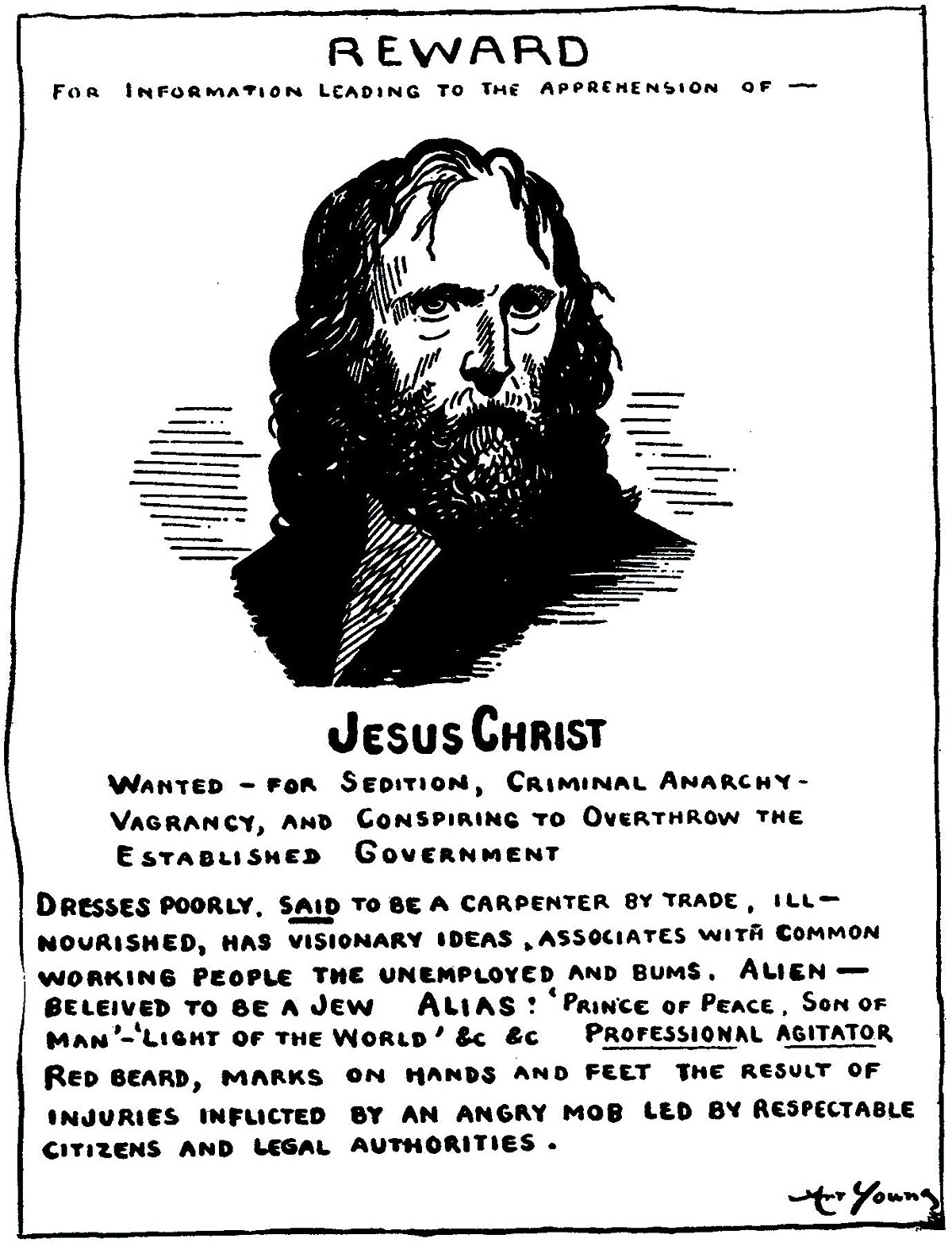
00-art-young-jesus-wanted-poster-he-stirreth-up-the-people-1913

Readings for 4th Sunday in Ordinary Time: Jer. 1: 4-5, 17-19; Ps. 71: 1-6, 15-17; I Cor. 12: 31-13; Lk. 4: 21-30 http://www.usccb.org/bible/readings/020313.cfm

I remember when my ideas about prophecy changed – when I really began to understand the term’s implications. I was a graduate student in Rome – already a priest – and completing my doctoral studies at the Academia Alfonsiana on the Via Merulana there in the “Holy City.” I was taking a class in I’ve forgotten what. But my professor (a German Redemptorist as I recall) got my attention during one of his lectures by referring to Karl Marx as “the last of the great Jewish prophets.” That was in 1970 at the height of the Cold War, and I had been reading Marx and about the then-flourishing Marxist-Christian dialog. I realized that my professor was right.

Marx of course was a Jew like Jesus, and Jeremiah who are centralized in today’s liturgy of the word. Like them, Marx was totally absorbed by questions of social justice for the poor and exploited. He was pretty much penniless, like most prophets, and spent his time thinking, writing, speaking, and organizing workers against exploitive employers. He was also highly critical of organized religion and its idols.

Marx’s insight (shared with the biblical prophets) was to realize that both Judaism and Christianity worshipped idols more often than the God of Israel. And by that he meant “gods” who not only justified an oppressive status quo, but who anesthetized the workers and unemployed to the fact that they were indeed oppressed by the capitalist system. Marx called such idols “the gods of heaven.”

We’re all familiar with what he meant. These idols are worshipped each Sunday – usually from 11:00 to 12:00 in what a theologian friend of mine used to call the “be kind to God hour.” You can encounter the “gods of heaven” any day at any hour on Cable television’s Channel 3 or in most Catholic Churches any Sunday morning. “God” there is concerned with correct worship, with bows, genuflections, and with correct terms such as “consubstantial,” “chalice,” “with thy spirit,” “under my roof” and so on. The stories or mythology upholding such idols have to do with “Jesus as your personal savior,” with “going to heaven,” and with avoiding hell.

Marx was also critical of what he called the “gods of earth.” They’re what people worship all those days and hours when they’re not in church. They include Capitalism, “America,” Nationalism, National Defense, Homeland Security, the Military, Money, and Profit. The issues of this God focus on sexuality: contraception, abortion, and same-sex marriage. This God is a War God – always on the side of “America.” He’s celebrated in songs like “The Battle Hymn of the Republic” and “Proud to Be an American.” He is the protector of “religious freedom” understood as privileging Christianity over other faiths while preserving tax exemptions worth billions each year. He blesses the bishops’ “Fortnight for Freedom” concerned as it is with protecting such benefits.

Marx’s prophetic work made him extremely popular with working classes. It was not uncommon for a worker to request that he be buried with a copy of “The Communist Manifesto” placed on his chest.

At the same time, Marx was vilified as the devil himself by factory owners, businessmen, bankers, and the professors and politicians representing their interests. Defenseless against such “education,” most of us have accepted such defamation of this last of the great Jewish prophets.

You see, that’s the trouble with prophets like Marx, Jesus and Jeremiah. They have to take on the “powers and principalities” of their cultures. They must swim against the torrential stream of public opinion.

In today’s first reading, Jeremiah is informed of his lot. But he must “man-up,” he’s told. He must steel himself to confront the “whole land,” along with kings and princes, priests and people. All of these, he’s warned, will fight against him. Nevertheless, God will make of Jeremiah a ‘fortified city,” a “pillar of iron,” and a “wall of brass.”

I suppose God followed through on those promises. But that didn’t prevent Jeremiah from being imprisoned, tortured, and left for dead.

Of course, the same thing happened to Jesus from the beginning to the end of his public ministry. He was vilified, demonized (literally!) and defamed.

That process begins for Jesus in today’s selection from Chapter 4 of Luke’s gospel. As we saw last week, he returns to his hometown of Nazareth and criticizes his neighbors’ narrow nationalism. In today’s episode his neighbors try to kill him. Later on, of course, Jesus goes more public. Like Jeremiah, he takes on his nation’s priests and scribes, princes and king. Ultimately his words and deeds threaten the Roman Empire itself which classifies him as a terrorist. Together those powers and principalities (national and international) not only defame Jesus the way Jeremiah and Marx were defamed; they actually kill him just as so many prophets have been killed from John the Baptist and Paul to Martin Luther King and Gandhi.

All of them – Jesus, Jeremiah, Gandhi, King, Paul and Marx – followed the same “prophetic script” whose inevitable directive prescribes that no prophet is accepted in her or his native place. It’s easy to see why. It’s because their “native place” bears the brunt of their prophetic words.

Meanwhile, it’s easier for outsiders to recognize prophets. The “outsiders” who concerned Jesus were the uneducated, poor, and unclean. However, even those seem to turn against him this morning. It’s unlikely that there were any rich or powerful resident in Nazareth – a place scripture scholar Ched Myers describes as “Nowheresville.”

Few of us are rich and powerful. Yet we’ve been schooled by those entities to reject prophets who speak in our name and defend our interests – those belonging to our “native land” to use the words of this morning’s gospel. It’s as though we’re looking at reality in that “darkened mirror” Paul wrote about in today’s excerpt from his letter to Corinth. The darkened mirror not only turns things backward, but it’s smudged with the fingerprints and dirt of ignorant and/or perverse propagandists.

The trouble – the trouble with prophets – is that most of us have bought into all that anti-prophet propaganda. So we hate Karl Marx without realizing that he’s on our side and speaks for us. We honor the Martin Luther King who has been reduced to a “dreamer,” but not the MLK who described the United States as the most violent and destructive country in the world. We don’t remember the King who was slandered as a communist and encouraged to commit suicide by the FBI and the COINTELPRO program.

We’re willing to stand by while Wikileaks journalist Julian Assange is persecuted by the governments of Great Britain and the United States. We presume that Bradley Manning is guilty of treason because our government, (despite its record of lies and heinous crimes) says so. We wonder what all the fuss is about Aaron Swartz.

These are the prophets of our time who, like Jesus, do not find a sympathetic hearing in their native place. It might be time to embrace them as our own and see what difference that makes in the way we look at the world and our country. The examples of Jeremiah, Jesus, and Paul — and the hopes of the world’s poor and victims of U.S. wars — beg us to do so.

Jesus as Self-Hating Jew!

Readings for Third Sunday in Ordinary Time: NEH 8; 2-6, 8-10; Ps. 19: 8-10, 15; I Cor. 12: 12-30; Lk. 1:1-4; 4: 14-21 http://www.usccb.org/bible/readings/012713.cfm

Last week I published an editorial on my blog site that was picked up by the Lexington Herald-Leader (http://www.kentucky.com/2013/01/19/2482073/ky-voices-the-chosen-people-are.html) and by OpEdNews (http://www.opednews.com/articles/Unconditional-Support-for-by-Mike-Rivage-Seul-130118-813.html.) It was about Chuck Hegel and the criticism he has endured from the American Israel Public Affairs Committee (AIPAC) and people like Elliot Abrams, the former Undersecretary of State for Human Rights in the Reagan administration.

Hegel had been nominated for Secretary of Defense by President Obama. Abrams and the others had criticized the nominee for being insufficiently supportive of Israel and therefore unfit for the “Sec Def” position. Hegel’s critics were looking for “unconditional support” for Israel, and didn’t find it in President Obama’s candidate. Their criticism was so effective that Hegel has since been forced to apologize for his past criticisms of the Jewish-Zionist Lobby.

Many Christians probably felt vindicated by Hegel’s groveling before his Jewish critics. After all, they might reason, Israel is God’s Chosen People; they deserve unconditional support.

However, today’s liturgy of the word underlines the point I tried to make in my op-ed: the phrase “God’s Chosen People” does not primarily refer to a national entity, but to the poor and oppressed.

Biblically speaking, it is true that Israel did fit that profile at the time of its origin – in Egyptian slavery (13th century B.C.E.) – and later during its captivity in Babylon (6th century B.C.E.). They were oppressed as well as when Israel was under the control of the Assyrians (8th century), Persians (6th century), Greeks (2nd century), and Romans (1st century). Then, precisely as oppressed, they were the object of God’s special love and protection.

At Mt. Zion, Moses enshrined in the law protection of people like them – slaves, widows,orphans, immigrants, the imprisoned, and the poor.

That’s the Law that the scribe, Ezra is recorded as reading to the people for hours in today’s first reading. They had just returned from exile in Babylon. For them “The Law” (the first five books of the Bible) was a source of joy and strength. After all, those books recounted what for Jews was the liberation of all liberations – from Egypt under the leadership of the great rebel hero, Moses. With Ezra in charge, they were celebrating the end of a long and painful experience in the geographical area that is now “Iraq.” Ezra reminded the assembled people that in their return to the Promised Land, they were experiencing Exodus all over again. Indeed, he said, it was a time for celebration – eating rich meats and drinking sweet drinks.

Today’s second and third readings pick up on Ezra’s theme – that God favors the poor and oppressed. However both Jesus and Paul do so emphasizing the point that Yahweh’s favored ones are not always Jews. When Jesus said that in his hometown synagogue, it enraged his former neighbors. (Their response reminds me of Elliot Abrams and the AIPAC demanding “unconditional support” for Israel.)

By the way, did you notice the strangeness of the reading from Luke’s gospel today? It starts out with the very first verses of Luke, verses 1-4. There the evangelist announces his intention – to carefully draw on the oral traditions of eyewitnesses and present an orderly researched account of what Jesus said and did.

But then the reading suddenly jumps ahead to Luke chapter 4 and presents Jesus’ preaching in his hometown synagogue in Nazareth. That gives the impression that Jesus’ first significant act was that Nazareth sermon. Perhaps it was – since Luke’s “infancy narratives” belong more to the realm of poetic imagination than of history.

Today’s reading also leaves out the response of those who heard Jesus’ words in Nazareth. (And that’s where the theme of “chosen people” becomes relevant.) Verses 22-30 tell us that the Nazarenes were outraged by Jesus’ implied criticism of Jews and his openness to non-Jews. After all, he had charged that prophets like Elijah and Elisha found more receptivity to their work in Lebanon (Sidon) and Syria than they found among Jews in Israel.

“Who does this guy think he is?” the Nazarenes asked indignantly. “We know his family; he’s nothing special. Yet here he is speaking critically about his own people! He must be one of those ‘self-hating Jews’.” Luke says Jesus’ hometown citizens were so outraged that they tried to kill him. (Chuck Hegel is in good company!)

Jesus’ words before the Nazarene’s attempted assassination do not merely underline the identity of God’s chosen as the poor and oppressed rather than exclusively the Jews. The words are also central in terms of Luke’s definition of Jesus’ entire project. In fact they connect that project with God’s very identity as described throughout the Jewish Testament particularly by the prophet Isaiah whose words Jesus quotes: “The Spirit of the Lord is upon me, because he has anointed me to bring good news to the poor. He has sent me to proclaim release to the captives and recovery of sight to the blind.”

Did you notice the importance of the word “because?” It absolutely identifies the “Spirit of the Lord” with Ezra’s good news to the poor about release from captivity and recovery of sight? Jesus is saying we know that “The Spirit of the Lord is upon” him because he brings good news to the poor, those in captivity and the blind. Jesus goes on to say that his commitment to the poor is what will define his entire mission. (The implication here is that anyone who brings good news to the poor, those in captivity and the blind embodies the Spirit of God.)

Today’s excerpt from Paul’s letter to the Greeks in Corinth continues that theme of Isaiah, Ezra, and Jesus. Only Paul does so in terms of a familiar yet powerful metaphor – what he calls the “Body of Christ” enlivened by the “One Spirit” of God. For Paul followers of Jesus constitute the way the Master is present today long after Jesus’ death. As that presence, we are Jesus’ hands, feet, eyes, ears, and tongue. And Paul specifically says it makes no difference whether one is Jew or Greek, slave or free, male or female.

What does make a difference though is one’s social standing. Paul goes out of his way to say that the “less honorable” and the “less presentable” in Christ’s body are to be more honored and cared for than the more presentable and more honorable according to the standards of the world. The weaker parts, he says are somehow “more necessary” than the stronger parts. This could hardly be a clearer reference to the poor and those who are normally neglected and looked down upon. Here Paul is following the thrust of Jesus’ words and deeds by turning the social order upside-down. The poor and oppressed come first in God’s order.

Today’s readings are calling us to grow out of our nationalism that understands Jews or Americans as God’s favorites. They call us to become citizens of the world – or in Jesus’ words to be cured of our blindness.

He wants us to finally see, the readings suggest, that the Jews as such are not God’s people. Neither are Americans. In God’s eyes, (despite the protests of our politicians and talking heads) our country is not the greatest in the world. For in the body of Christ there is neither Jew nor Greek, American, Afghani, Iraqi or Cuban.

Instead, true followers of Christ recognize that our allegiance belongs to the Body of Christ. This means that our care should be showered on the widows, orphans, undocumented immigrants, beggars, and social outcasts – LGBTQs, victims of AIDS, mothers on welfare, and on Mother Earth herself. These are the poor and oppressed. These are God’s people.

Our presence at this Eucharist represents our pledge to put the needs of those groups and individuals before our own.

Given the numbers of those who claim to be Christian, if we followed through on that pledge, how drastically different our world would be! Don’t you agree?

Jesus Decides to Redeem His Wasted Life (Sunday’s Homily)

Readings for Feast of Baptism of the Lord: http://www.usccb.org/bible/readings/011313.cfm

Today is the Feast of the Baptism of the Lord. In that context, let’s think about baptism and the differences between the understandings we’ve inherited and those reflected in the practice of John the Baptist and Jesus of Nazareth. Those differences hold practical implications for our own lives as we wrestle with a faith that may have lost meaning for us, and as we struggle with the relative smallness and insignificance of our lives.

To begin with, think about traditional beliefs about baptism. If you’re like me, you may find them hard to swallow. A friend of mine, theologian Tony Equale, has recently pointed out that theology doesn’t really determine worship patterns. Instead superstitious temple and church rituals have shaped our beliefs. Practice determines belief, not the other way around. (See http://tonyequale.wordpress.com/2013/01/03/the-religiosity-of-the-people/)

What my friend means is that theology’s job has traditionally been to rationalize what people actually do in their efforts to tame life and achieve contact with the numinous, the mysterious, and the transcendent. They sacrifice chickens, behead bullocks, or vivisect lambs and then burn the animals’ carcasses. The smoke thus ‘feeds’ the Gods who are believed to need nourishment, placation, and cajoling in order to do the will of the people and their priests. Those congregations actually turn out to be more intelligent than the God who must be informed of their needs and what is best for their welfare. That’s superstition.

Catholic beliefs around baptism and the “sacrifice of the Mass” are cases in point. They were actually formed by the People’s credulous practice of baptism which was informed more by ancient ideas of all-powerful angry Gods than by Jesus’ radical teaching that God is Love. I mean early on, in a time of very high rates of infant mortality, popular belief came to see infant baptism as necessary to somehow save deceased children from a hell created by a threatening God.

This practice of the people rather than reflection on the words and deeds of Jesus led St. Augustine at the beginning of the 5th century to theorize that people have been born guilty – at enmity with God. Augustine thought that since children were condemned even before any personal sin on their parts, they must be born in sin. And that must be, Augustine reasoned, because they had inherited sin from their forebears and ultimately from the first human beings, Adam and Eve. Because of that “original sin,” God is justly angry with humans.

Now, as I said, the ancients believed that sacrifice was necessary to placate an angry God like that. So, in the Roman world, where sacrifice was understood in the terms I’ve just explained, Jesus’ death eventually became to be seen as a sacrifice whose primary purpose was to secure God’s approval of the Roman state. In this way, the “Mass” was transformed from a memorial meal to a re-enactment of Jesus’ sacrificial death. It was moved from a table with friends gathered around sharing food, to a “sacrifice” performed at an “altar” by a priest with his back turned to the people who watched the show from afar.

This Mass differed very little from what Romans were used to before Christianity became the state’s official religion in 381. In fact, it is entirely possible that ordinary people saw no difference between the “Mass” and the religious ritual they had been accustomed to when Jupiter or Mithra were worshipped as the official Gods of Rome. In other words, Christianity was transformed by the Roman Empire rather the empire being transformed by Christianity. There was a “theogony,” a battle of the Gods, between Jupiter and the Bible’s Yahweh; and Jupiter won. We’ve been worshipping him ever since.

How different all this is from what happens to Jesus at the baptism which today’s liturgy of the word celebrates! (And that brings me to my point about meaning in our seemingly wasted lives.) In today’s gospel, there is nothing suggesting “original sin.” Nor is Jesus presented as the incarnation of a God who needs to be mollified by sacrifice. Rather, Jesus comes as a disciple of John. (Scripture scholars tell us that John’s words about his inferiority before Jesus were inventions of the early church in a Jewish context where many still believed that John rather than Jesus was the long-awaited Messiah.)

So at the age of 30 or so, this young peasant from Nazareth presents himself for a ritual washing at the prophet’s hands in the legendary Jordan River. In Israel’s idealized past, that river had been crossed by slaves escaped from Egypt who on the river’s opposite shore found the “Promised Land” that became their national home. Eventually that crossing came to be understood as transforming a motley horde of renegade slaves into a unified nation of free people at the service of the God who had liberated them from demeaning servitude.

John’s practice of baptism in the Jordan (far from the corruption of the priests’ Temple and its endless sacrifices) summoned his Jewish contemporaries to reclaim their ancient identity that had been lost by the priests and scribes who had sold out to Roman re-enslavement of a once proud and liberated people.

John’s was a revivalist movement of Jewish reform. Those presenting themselves for baptism were expressing a desire to return to their religious roots and to alter their lives in a profound way.

Evidently, that’s why Jesus came to be baptized too. This country boy who (according to Luke’s “infancy narratives”) had begun his life with such promise is now about 30 years old. Perhaps in view of his parents’ expectations of him, his life so far seemed wasted. Perhaps he had resolved to finally make a difference. In any case, by approaching John in the Jordan’s waters, he expresses an intense need for change in his life. He wants to be John’s follower.

So John performs his baptismal ritual. And the miraculous happens. An epiphany occurs for Jesus. He hears a voice. It informs him that he is a child of God. Immediately he sets out on a vision quest to discover what those words might mean. Forty days of prayer and fasting bring on the visions – of angels and devils, of temptations, dangers and possibilities.

In the light of his desert experience, Jesus chooses not only to follow John as the leader of a reform movement. He chooses as well to follow Moses as the liberator of an enslaved people. He has truly crossed the Jordan. So he brings his message to the captive poor. Like him, they too are children of God — God’s specially chosen people. God’s kingdom belongs to them, he says, not to their rich oppressors. The poor must not allow themselves to be misled by the stultifying and domesticating doctrines of the priests and scribes. That was the thrust of Jesus’ teaching.

Coherent acts follow Jesus’ words. He discovers wondrous healing powers within himself. By touch, by faith, by his friendship, he cures stinking lepers, dirty beggars, street walkers who have lost their self-respect, the deaf, the dumb, the blind and lame. Jesus eats food with the social outcasts and street people of his day, sharing nourishment the way God does – without cost or expectation of reciprocation. Jesus finds himself explaining the mysterious, transcendent and ineffable in unforgettable stories that capture the imaginations of simple people hungry for the spiritual sustenance that he offers – that he embodies. No wonder his early followers tried to imitate Jesus by choosing John’s baptism as a sign of membership in their community and by following the Master’s example of sharing food the way God does in their re-enactment of the Lord’s Supper.

That was the understanding of baptism and Lord’s Supper that the first generations of Christians embraced. But it didn’t last long. Within a few generations (and especially after Christianity became the official religion of the Roman Empire at the end of the 4th century) the superstitions I referenced earlier had replaced the understanding and practice of Jesus and the Baptist. Soon baptism became an instrument for saving babies from original sin and hell. Soon the Lord’s Supper became the “Holy Sacrifice of the Mass” differing very little in ritual and spirit from offerings to Jupiter and Mithra.

Today’s liturgy of the word calls us beyond all of that. It summons us to follow Jesus who shows us the way to truly change our lives. Change comes by leaving behind the superstitious faith that supports empires past and present. Transformation comes when we share our food with each other and with the poor. It happens by committing ourselves to the “other world” represented by God’s Kingdom that has room for everyone, not just for the 1% served by our own churches, priests, scribes and their superstitious rituals.

Today’s liturgy of the word summons us to the banks of the Jordan to stand with Jesus and to hear God’s voice calling us from what has been so far wasted in our lives. Like Jesus, we are daughters and sons of God. We are beloved by the God of Love. Jesus’ example reminds us that It’s not too late to change our commitments and way of life.

After all (if we take our tradition literally) Jesus redeemed the insignificance of his own life in a single meaningful year – or maybe it was three.