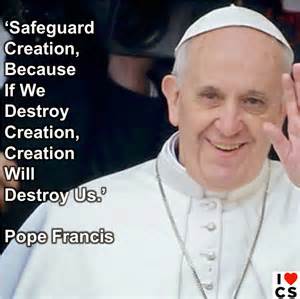
(Sunday Homily) Pope Francis Calls for a Global Catholic Climate Movement

Italy Pope Epiphany

Readings for 1st Sunday in Ordinary Time: I SAM 3: 3B-10, 19; PS 40: 4, 7-10; I COR 6: 13C-15A, 17-20; JN 35-42

Recently Pope Francis has come in for some hard criticism from the U.S. right wing. It’s not just because of his rejection of free market capitalism, trickle-down theory, and huge income disparities between the rich and poor. It’s not just his openness to gays and divorcees, and his refusal to obsess about abortion and contraception.

Yes, all of these have undermined what conservatives have seen as a close alliance between the Catholic Church and their pet causes and thinking modes.

However, the straw breaking the back of reactionaries is the pope’s unequivocal warnings about climate change. They’ve gone apoplectic about his intention to publish an encyclical on the matter, and his plans to convoke a conference of religious leaders to address it. The pope’s expressed intention is to influence this year’s U.N. Paris Conference on Climate Change. All of that has raised the specter of a global Catholic climate change movement potentially mobilizing the world’s 1.2 billion members. Think about that for a minute!

In such context, Francis visit this week to the Philippines is extremely significant. The Philippines is not only the home of 80% Asia’s Catholics – more than 100 million. It is also the poster child for the devastation that climate change wreaks on the principal victims of global warming, the world’s poor. In 2013 the archipelago was raked by Typhoon Yolanda whose winds and floods killed more than 7000.

So the world listened when on his way to Manila Pope Francis was asked if climate change is “mostly due to the work of man and his lack of care for nature?” In reply, the pope said:

(F)or the greater part, it is man who gives a slap to nature continually, and we have to some degree become the owners of nature, of sister earth, of mother earth. I recall, and you have heard, what an old peasant once told me: God always forgives, we men forgive sometimes, but nature never forgives. If you give her a slap, she will give you one. I believe that we have exploited nature too much, deforestation, for example.

With words like those, the pope’s critics charge he is speaking beyond his expertise, which involves matters of “faith and morals.” But that’s just the point. The pope is making climate change a moral issue, a matter of ethics even more important than more “traditional” Catholic moral concerns about sex which after all presume the survival of the human species and the planet.

The pope’s critics also ignore, of course, that Francis bases his judgments not only on the testimony of 97% of all climate scientists, but on the research of the Pontifical Academy of Sciences. Its membership roster features the names of the world’s most respected scientists. These include Nobel laureates such as Ernest Rutherford, Max Planck, Otto Hahn, Niels Bohr, and Charles Hard Townes. The Academy’s current president is Werner Arber, himself a Nobel laureate, and the first Protestant to head the group.

But why such right-wing fury? It’s because like Naomi Klein, conservatives see the (for them) disastrous implications of addressing the issue. As announced in the title of Klein’s book, they sense that This Changes Everything. That is, taking on climate change as a moral issue undermines the political right’s program of market deregulation and continued extraction of non-renewable resources.

So pundits like First Things blogger, Maureen Mullarkey have given up on lip sticking the pope and are now in full attack mode. According to Mullarkey Pope Francis is simply “an ideologue and a meddlesome egoist. His clumsy intrusion into the Middle East and covert collusion with Obama over Cuba makes that clear. Megalomania sends him galloping into geopolitical—and now meteorological—thickets, sacralizing politics and bending theology to premature, intemperate policy endorsements.”

For Mullarkey, Pope Francis pretty much stinks.

And that brings me to today’s gospel reading. It’s all about stink – about what Pope Francis calls “the smell of the sheep.” Famously, you recall, the pontiff called on Catholic priests to live closer to the poor, to recognize them as God’s people and their welfare as the guideline for economic and social policy – to “take on,” he said, “the smell of the sheep.”

In other words, conservatives are suspicious of Pope Francis and are on the point of vilifying him because he smells too much like sheep — like the poor. He smells too much like Jesus.

Notice that in today’s gospel, John the Baptizer identifies Jesus as “the Lamb of God.” To begin with, the phrase reminds us of the tribal, Bedouin origin of the biblical “People of God.” Abraham, Isaac, and Jacob, and the great King David were all shepherds. They were primitive people close to the earth. They were tribalists. Jesus was a tribalist. According to John’s image, Jesus didn’t just smell like sheep; he was a sheep! He was in spades like his slave and Bedouin ancestors — like the poor people the pope is centralizing in his visit to the Philippines.

Pope Francis is a tribalist too. And he’s practicing what he preaches — both liberation theology’s “preferential option for the poor,” and the traditionally Catholic principle of subsidiarity. Once again, that means endorsing economic and environmental policy not on the basis of market dictates, but according to human decisions about values like the common good. Humane policy, the pope implies, originates not on Wall Street, but in places like the Philippines’ Tacloban City which was leveled by Typhoon Yolanda. It’s there that the pope’s itinerary reportedly has him dining in the shack of a hurricane victim. (Can you imagine a humble Catholic housewife setting her family table to include the pope?)

As our century’s most powerful illumined voice of conscience, Francis is using his bully pulpit to wake us up. We’re like Samuel in today’s first reading – fast asleep even before the Ark of the Covenant (a reminder of Israel’s enslaved and Bedouin past). But we fail to recognize the biblical tradition’s significance to our lives – its call to tribal values which unfailingly center on animals, human family, and Mother Earth. We fail to see the implications of Paul’s observation in today’s second reading that all human beings – especially the poor and outcast – are temples of God’s spirit. That’s our tradition! That same Spirit resides, the pope says, in the planet that he (like St. Francis himself) calls our Mother and Sister.

So what would a global Catholic climate movement look like? It would entail:

  • Waking up like the young prophet Samuel. Like him we’ve heard God’s call many times. But at last in Pope Francis, we have a thought-leader speaking in a voice the simplest of us can hear. It’s the voice of conscience. And like Eli it’s giving us the proper way to respond: “Speak Lord, for your servant is listening.”

A global Catholic climate movement further entails:

  • Rejection of corporation-based globalization which has us (over)consuming imported necessities that could be home-grown. (This involves lobbying against the Trans-Pacific Partnership.)
  • Joining the fight against fracking and projects like the XL Pipeline
  • Voting accordingly.
  • Urging the institutions we can influence (churches, universities, hospitals . . .) to divest from fossil fuel industries.
  • Adopting a “zero waste” policy in our homes and places of work.
  • Cultivating home gardens.
  • Adopting a vegetarian diet.
  • Educating ourselves about “green burial” and including plans for that in our “living wills.”

The list, of course, goes on. But you get the idea.

This stinkin’ pope is waking us up. He’s showing us the way. Thank God!

(Sunday Homily) The Torture Report: Cheney Channels King David in the Struggle over Historical Narrative

Cheney

Readings for 4th Sunday of Advent: 2nd SAM 7:1-5, 8-12, 14A, 16; PS 89: 2-5, 27-29; ROM 16: 25-27; LK 1: 21-38 http://usccb.org/bible/readings/122114.cfm

Strange that according to a poll last week, more than half the “American” people think torture is permissible. I say “strange” because nearly 80% of Americans consider themselves “Christian.” And Jesus himself was a victim of torture. On the other hand, can you imagine Jesus torturing anyone?

You’d think the similarities between the Romans’ treatment of Jesus and the “Americans’” treatment of countless innocent victims would make devout Christians less accepting of torture.  Maybe they’d oppose torture on principle, as a matter of faith.

Or perhaps it’s that they just agree with ex-VP, Dick Cheney. After all, he wouldn’t consider “torture” what the Romans’ enhanced interrogation techniques (EITs) did to  Jesus  – not the prolonged beating we all witnessed portrayed in Mel Gibson’s “The Passion of the Christ,” not the crowning with thorns, not forcing a beaten man to carry his own instrument of execution, not driving nails into his hands and feet, not leaving him for hours struggling for breath on a cross whose chief agony was bringing the victim to the point of asphyxiation (like waterboarding) and beyond.

According to Mr. Cheney, that punishment would have crossed the line to torture only at the point when death proved imminent. Unfortunately, as with untold (literally) victims of U.S. enhanced interrogation, that line was crossed in the case of Jesus.

But in the end, as supporters of U.S. Empire, “American” Christians probably understand and forgive what the Romans did. After all, like its U.S. counterpart, the Roman Empire was under siege on all sides. And the Jews were particularly rebellious. And Jesus (in Roman eyes) gave every indication of leading a rebellion. An empire’s got to do what an empire’s got to do – even if it means killing the innocent like Jesus.

I think however that there’s something more than compassion failure at work here.  The “more” is the power of propaganda. That’s something addressed in today’s liturgy of the word. There the author of 2nd Samuel whitewashes the brutal King David and turns him from something like a mafia don into a national hero. In today’s gospel selection, even the evangelist, Luke buys the distortion. He makes Jesus the successor of David.

I’ll get to that in a moment. But let me first finish with the torture document. You see, (as Glen Greenwald has pointed out) it’s no wonder that “Americans” can’t identify with the tortured much less connect them with Jesus.

That’s because since the Report’s release on December 9th, the mainstream media (MSM) has treated us to an endless parade of torturers and torture enablers explaining away the conclusions of the Senate’s years-long study.  We haven’t heard a word from the victims of torture or from the families of those whose sons and daughters were killed at the hands of sadistic representatives of our government.

The result of this one-sided silencing of the victims has been to rob them of their humanity – of their very existence.  Given the deafening silence, why would we feel compassion for people who don’t even exist? Out of sight, out of mind.

Imagine how better informed we’d be if on “Meet the Press” or somewhere Mr. Cheney had to defend his policies against his victims – many of whom, Greenwald reminds us (because he has interviewed them) are incredibly articulate. Perhaps the victims might suggest waterboarding the ex-VP to see if he really believes that practice doesn’t sink to the level of torture.

According to University of Wisconsin –Madison Professor Alfred McCoy (the author of Torture and Impunity) this erasure of victims is all part of a five-stage policy on the question of torture. After the Abu Ghraib scandal broke in 2004, the first step was identifying the low level perpetrators with “bad apples.” The second stage kept rumors of more widespread torture at bay in the name of national security. Thirdly, President Obama adopted the “let’s look forward, not backward” approach. Fourthly came the move to exonerate all those guilty of torture or enabling the practice. Finally we’ve reached the stage which emerged last week: vindication before the bar of history of all those connected with U.S. torture.

Again, that’s where the battle has been joined today; we’re struggling over historical narrative. This is the stage all empires come to eventually as their crimes inevitably come to light. It’s what we witness in today’s liturgy of the word and the white-washing of Israel’s King David. The example is instructive. It suggests practical responses to the Torture Report at both the level of faith and political action.

You see, there are really two separate king David traditions in the Bible. One presents the good David, the other, the bad. The good David is the one largely presented in I Chronicles 10:14-29:30. He also appears in today’s first reading from 2nd Samuel and in the responsorial psalm.

This David is pious, and wants to build a temple for God. According to the story, God is pleased, and rewards him with everything a king could want: victory over his enemies, immortal fame, prosperity for his people, thriving descendants, and a dynasty that will last forever.

Then there’s the bad David who begins to appear in I Samuel, chapter 16. This David is a murderous tyrant. He rebels against Saul, Israel’s first king. He’s a womanizer, a murderer and an object of popular hate.  Far from lasting forever, his dynasty ends with the death of his successor, Solomon. He’s the David whose death-bed instructions are worthy of any Mafia godfather. To Solomon he says, “Take care of my friends, Sol – and my enemies too (wink, wink). You know what I mean?” (IKGS 2: 1-9)

Besides that, the bad David bastardizes the Mosaic Covenant and its protection of widows, orphans, and resident aliens and turns it into a tool of the ruling classes – from Moses’ “I will be your God and you will be my people,” into David’s “You are my son, the king of Israel, and your dynasty will last forever.”

Of course, the bad David has been swallowed up by popular memory of its competing tradition. David is uniformly remembered by the majority of believers as the man “after God’s own heart.” As I said, in today’s familiar gospel selection, Luke falls into that trap. He makes Jesus (through his foster father, Joseph, no less) the successor of David. And this even though Jesus as portrayed by Luke is no friend of the Temple or of kings and emperors. Rather he is the friend of the beneficiaries of the Mosaic Covenant – the widows, orphans, aliens, prostitutes, tax collectors, lepers, Samaritans. His values do not include enemies (much less victory over them) or prosperity, fame, or everlasting dynasties.

Recognizing this struggle over which narrative will prevail sheds light on the Torture Report. It enables followers of the simple man from Nazareth to judge that the struggle even before the bar of biblical history has been won by the likes of Cheney and Bush. It has been won by the bad David.

Our conclusion: we must not allow that to happen as we fight over whose story should prevail concerning the latest revelations about the powerful organized crime syndicate known as the CIA.

So what should we do?  Our response should be at two levels.

At the level of faith believers should be exposed to the historical Jesus I’m attempting to present in these homilies. We neglect those powerful myths at our own peril. Even the uninformed can understand them.  This means that the Jesus’ story represents a powerful tool for raising consciousness about torture (and other issues of social justice).

It’s true that the MSM might not expose the story of the tortured to that 80% of “Americans” who claim to be Christian. However, if those with the responsibility for explaining the sacred texts assume that responsibility and do their homework, there’s no reason why those wishing to follow Jesus can’t understand that:

  • Jesus himself was a victim of torture at the hands of an empire very like the United States.
  • He taught universal love.
  • He was non-violent
  • He said he considers what’s done to the least of the human race as done to him.
  • He said we should love our enemies.

At the political level we should:

  • Urge outgoing senator Mark Udall (D Colorado) to use his senatorial privilege of unlimited free speech to release the entire unredacted torture document.
  • Pressure the media through phone calls and letters to the editor to present the other side of the torture story including interviews with torture victims and with the families of those whose sons and daughters, husbands and wives were killed under CIA torture.

(Sunday Homily) Towards a Counter-Cultural Christmas: Becoming Nobody

Santa garbage

Readings for Third Sunday in Advent: IS 61:1-2A, 10-11; LK 1: 46-50; 53-54; I THES 5: 16-24; JN 1: 6-8, 19-28. http://usccb.org/bible/readings/121414.cfm

As I mentioned in my previous blog, I had an important spiritual experience last Sunday. It was the privilege of visiting the hermitage of St. Thomas Merton, the great Trappist mystic. It all happened in New Haven, Kentucky, just down the road from the Maker’s Mark distillery – far from any great urban centers and nearer to places with names like Bardstown, Paint Lick, and Gravel Switch. The experience inspired counter-cultural thoughts about Christmas. It made me struggle with the question (still unresolved for me): is it possible to once and for all break with this annual orgy of consumerism so counter to the gospel’s commitment to the poor?

At Fr. Louis’ Gethsemane, twenty of us sat in a circle in his living room absorbing the Life Force that still hovers over his simple cinderblock cabin. Trappist Brother Paul, the convener of the Merton Study Group responsible for the event, marvelously channeled “Louie’s” spirit by reading Brother Paul’s own poetic reflection on Matthew’s words, “Blessed are the poor in spirit.”

Paul’s thoughts connected nicely not only with Merton, but with this morning’s liturgy of the word on this third Sunday of Advent. After all, in today’s readings, John the Baptizer, his predecessor Isaiah, and Jesus’ own mother Mary reiterate the essential connection between Jesus’ gospel and standing in solidarity with the poor not only in spirit, but in actual fact. As Christmas approaches, the sentiments of the Baptizer, Isaiah and Mary suggest counter-cultural ways of commemorating the birth of the prophet from Nazareth.  I wonder if I and my family are strong enough to entertain them.

For me those culturally eccentric suggestions began emerging when in the course of his remarks, Brother Paul recalled Sister Emily Dickinson’s words that reflect the mystical dimension of Matthew’s (and presumably Jesus’) understanding of both spiritual and physical poverty. As for the former, Brother Paul defined spiritual poverty as the emptiness reflected in Monk Dickinson’s words,

“I am nobody.

Who are you?

Are you nobody too?

. . . How dreary to be somebody.”

Those words almost paraphrase what John the Baptist says in today’s Gospel selection. When asked who he is, the one identified by Jesus as the greatest man who ever lived (MT 11:11) says in effect, I am a poor man in Emily Dickinson’s sense. I’m a nobody – merely a voice out of nowhere. I am “a voice crying out in the wilderness.”  Only an empty vessel can be filled with the Holy Spirit.

So forget about me, John says, and focus on the one who is to come. His words will set you on fire that will sear everything in you that is not of the Spirit Jesus embodies – everything that separates you from your brothers and sisters, especially material wealth. That kind of self-denial and openness to Jesus’ Holy Spirit is the very definition of Matthew’s spiritual poverty.

And the specific message of the One to come?  (And here’s where material poverty enters the picture.)  Jesus announces the Divine Spirit’s preferential option for the actually poor and its rejection of the materially rich. That bias towards the actually poor is reflected in today’s first reading. As remembered by Luke in Jesus’ preview of his own career, the words of the prophet Isaiah read:

The Spirit of the Lord is upon me, because he has anointed me to bring good news to the poor. He has sent me to proclaim release to the captives and recovery of sight to the blind, to let the oppressed go free, to proclaim the year of the Lord’s favor.” (LK 4: 16-22)

Here Jesus’ focus is real poverty and people subject to captivity and oppression.

As for the Holy Spirit’s rejection of the rich, that is clearly stated in the revolutionary poem attributed to Jesus’ mother and read today as our responsorial hymn. Mary describes her understanding of God with the following words:

“The Mighty One . . . has shown strength with his arm; he has scattered the proud in the thoughts of their hearts. He has brought down the powerful from their thrones, and lifted up the lowly; he has filled the hungry with good things, and sent the rich away empty.”

These are truly revolutionary words about dissolving the ideological mind-sets that unify the rich (“the thoughts of their hearts”), about overthrowing the powers that be (removing them from their thrones), about ending hunger, and rejecting wealth on principle.

The class consciousness reflected in this categorical rejection the rich as such reminds us that in the eyes of Jesus’ mother and (the record shows) of her son, there is something intrinsically wrong with any wealth that differentiates rich from poor. This implies that for Mary and Jesus, poverty is not the opposite of wealth.  Rather, the opposite of wealth is God’s justice – a new order possible in this here and now, in this “year of the Lord’s favor,” as Jesus puts it. There, the rich will be necessarily unseated and the poor will have their fill.

If all of this is true – if God’s salvation means eliminating differences between rich and poor – what are we to do in this world of income gaps, torture, racism and militarized police?  The question is particularly apt at this Christmas season. And Thomas Merton’s monastic spirit along with the testimony of his ascetic counterpart, John the Baptizer, implies answers.  It suggests that at the Christmas season we might do well to:

  • Generally withdraw our allegiance from the cultures of New York and Los Angeles and in spirit draw closer to Paint Lick, Gravel Switch – and Merton’s Gethsemane.
  • Consciously simplify our Christmas celebration this year.
  • On the feast commemorating the birth of a homeless child whose mother saw so clearly the opposition between wealth and justice, imitate John’s simple vestment (and that of the Trappists) by giving our gifts of clothes not to the already well-attired, but to the poor.
  • Imagine what would happen if we took those gifts so carefully wrapped and placed beneath our tree and simply gave them away unopened and at random to poor people and their children as we meet them on the street.
  • In the spirit of John the Baptizer, located far from Jerusalem’s temple, boycott church this Christmas, especially if your community (after distributing its de rigueur Christmas baskets) ignores Mary’s summons to social revolution in favor of “Christmas as usual.”
  • Instead make up our own liturgy (around the Christmas tree) to replace the normal orgy of material gift-exchange. (More about this in a later posting.)
  • Boycott entirely this year’s “white Christmas” and (in the light of Mike Brown, Eric Brown and Tamir Rice) celebrate Kwanzaa instead – telling our children why this year is different.
  • Make a Christmas resolution to at last get serious about changing our lives in 2015 by beginning (or intensifying) the regular practice of prayer (or meditation) in the spirit of John the Baptist, Jesus, his mother and Thomas Merton.
  • Realize that inevitably the cultivation of spiritual emptiness (“nobodiness”) resulting from such regular spiritual practice will lead us to serve others in a way that will address the seemingly intractable problems of poverty (both spiritual and material), hunger, captivity and oppression.

I’m not suggesting that any of this would be easy. Going counter-cultural, especially around an event like Christmas, involves a certain self-emptying. It involves detaching from cultural expectations (not to mention those of our children and other family members). In some sense, it means becoming nobody in front of those who expect us to do what everyone else is doing. In other words, going counter-cultural at Christmas conflicts with what Sister Emily calls our dreary attempts to be somebody.

In fact, the cultural pressures are so strong, that it might be impossible for most of us to withdraw cold-turkey from Christmas as we’ve known it. Still, if we desire to be change agents like John the Baptist, Isaiah, Mary, Jesus and Thomas Merton, we’ve got to start somewhere.

Do you have other ideas about where or how to start? If so, please share them. And what about that alternative Christmas celebration involving the whole family on Christmas morning? Can you help with any suggestions there?

(Sunday Homily) Black Lives, Muslim Lives Matter: Obama’s as Guilty as Wilson & Pantaleo

awlaki-killing-of-american

Readings for Second Sunday of Advent: IS 40:1-5, 9-11; PS 85: 9-14; 2 PT 3: 8-14; MK 1: 1-8. http://usccb.org/bible/readings/120714.cfm

Michael Brown, Eric Garner, and 12-year-old Tamir Rice. . . .

The very mention of those names calls to mind the protests that have filled our nation’s streets over the past week – in Ferguson Missouri, New York, Chicago, Los Angeles and places in between. The teenager, the father of six, and the sixth grade child represent deeply racist and unjust social structures where criminals and thugs masquerading as law enforcement officers have implicitly been granted a license to kill with impunity.

The nation-wide demonstrations on behalf of black and brown victims of the resulting “American” police state remind us that our country is decidedly on the wrong track. Like John the Baptist in today’s gospel excerpt, statements by New York’s Mayor de Blasio, Eric Holder, President Obama, and the U.N. special rapporteur on torture call us all to what the Greeks called metanoia – a drastic change of direction.

Ironically however that call to repentance is especially addressed to Messrs. Holder and Obama themselves. They, after all, find themselves in charge of a national and world-wide police state of which Mike Brown’s Ferguson and Eric Garner’s Staten Island represent merely the tip of an iceberg. The call to repentance invites all of us to apply pressure for profound systemic reform that far surpasses anything those “leaders” have in mind.

Today’s liturgical readings inspire such thoughts. Listen to the prophet Isaiah as he cries out for repentance and a restructuring of reality so intense that he imagines mountains being levelled and valleys filled. The point is to smooth the way for the advent of a profoundly non-violent God in our midst. The peace-filled change Isaiah envisions is not trivial.

Listen to Jesus’ mentor, John the Baptizer, as he echoes Isaiah word-for-word. (Needless to say, neither Isaiah’s nor John’s words have anything to do with the artificially excited anticipation of our culture’s Winter Festival and its orgy of selling, buying, and conspicuous consumption – even though “Christmas” deceptively continues to somehow associate itself with the homeless child from Nazareth.)

As a matter of fact, the cult of materialism and “Christmas cheer” couldn’t be more antithetical to sincere recollection of the birth of Jesus who had more in common with Mike Brown and Eric Garner than with the white middle-class culture Christmas celebrates.

More specifically, Jesus was the embodiment of nearly everything “good Christians” (presumably) like Officers Wilson and Pantaleo (the executioners of Brown and Garner) give evidence of despising.  After all, the working man from Nazareth was not only the poor son of an unwed teenage mother. He was an immigrant whose family took refuge in Egypt, the penniless friend of prostitutes and drunkards, and the prophet drummed out of his faith community as villain possessed by demons. He was the victim of torture and capital punishment who was treated as a terrorist by the reigning imperial power.

To the authorities of their day, both the Baptizer and Jesus even looked like Eric Garner and Michael Brown. Both were dark-skinned, either black or brown; they were not white men. Today’s gospel emphasizes how poorly John was dressed.

To repeat: during his life Jesus was impoverished, homeless, unemployed, accused of being subversive, placed on death row, and ultimately executed. As a Jew, he was considered as “other” and worthless to Roman authorities as Mike Brown was to Darren Wilson or Eric Garner to Daniel Pantaleo. He was as worthless as Abdulrahman Al-awlaki (pictured above) was to Barack Obama.

And that brings me to today’s real call to repentance.

It can’t merely be:

  • A superficial call to “trust” – an echo of Rodney King’s “Can’t we all get along?”
  • A reform of police culture
  • A de-militarization of police arsenals
  • A mandating of special independent prosecutors to handle incidents like those in Ferguson and Staten Island
  • Or even prosecution and conviction of police thugs like Wilson and Pantaleo

Instead, our nation has to address the root of the problem which is a world-wide policy of extra-judicial killings of racially-profiled Muslims and dark-skinned poor people. (That’s what a “signature strike” means as executed by drone “pilots.”)

Put otherwise, President Obama, Eric Holder and their minions are as guilty as Wilson and Pantaleo. All of them place themselves above the law. They kill with impunity those “others” they consider expendable. They answer to no one. They refuse to investigate much less prosecute such crimes.

John the Baptizer’s call to repentance summons us to publicize such guilt and completely withdraw support from the policies of the thug leaders of the world-wide U.S. police state.

That, I think, is what metanoia and repentance mean for “Americans” this particular advent.

(Sunday Homily) The Islamic Caliphate and the Final Judgment of “America”

Caliphate

Readings for the Solemnity of Our Lord Jesus Christ, King of the Universe: EZ 34: 11-12, 15-17; PS 23: 1-3, 5-6; I COR 15: 20-26, 28; MT 25: 31-46. http://www.usccb.org/bible/readings/112314.cfm

At the moment, I’m teaching a wonderful course at Berea College, REL 126. It’s called “Poverty and Social Justice” and qualifies as part of the “Religion Requirement” all Berea students must fulfill. The course is populated by 19 very smart and engaged, (mostly third and fourth year) students.

Part of our goal is to become literate about the problems of poverty and justice in our very confusing world. And that has us tuning in to “Democracy Now” each day. We’re getting involved with a powerful group of local activists, “Kentuckians for the Commonwealth” (KFTC). We attend the group’s meetings each month and have volunteered for KFTC activities like voter registration and mobilization.

Additionally, students have been researching burning issues including the war in Ukraine, the conflict in Palestine, voter suppression, police militarization, and the philosophy of Ayn Rand.

All of that has discussing the purpose of government. In that connection, students are finally getting clarity about what I consider THE fundamental political debate in our country: is the government’s role simply to provide infrastructure for commerce and to protect private property? Or is it to sponsor programs to directly help the poor who (unlike their rich counterparts) cannot on their own afford adequate food, shelter, clothing, health care, and education – even if they are working full-time?

For the last thirty-five years or so, the former view has carried the day in the U.S. So it has become fashionable and politically correct even (especially?) for Christians to advocate depriving the poor of health care to help them achieve the American Dream, “ennobling” the unemployed by removing their benefits, criminalizing sharing food with the poor, and “punishing” perpetrators of victimless crimes by routinely placing them in solitary confinement.

Today’s readings reject all of that. And they do so on a specifically political liturgical day – the commemoration of the “Solemnity of Our Lord Jesus Christ, King of the Universe.” Yes, this is a political liturgy if ever there was one. It’s all about “Lords” and “Kings” and how they should govern in favor of the poor. It’s about a new political order presided over by an unlikely monarch – a king who was executed as a terrorist by the imperial power of his day. I’m referring, of course, to the worker-rebel, Jesus the poor carpenter from Nazareth.

Today’s readings promise that the rebel – the “terrorist” – Jesus will institute an order utterly different from Rome’s. That order recognizes the divine nature of immigrants, dumpster-divers, those whose water has been ruined by fracking and pipe lines, the ragged, imprisoned, sick, homeless, and those (like Jesus) on death row. Jesus called it the “Kingdom of God.” It’s what we celebrate on this “Solemnity of Jesus Christ King of the Universe.”

(Btw: in the eyes of Jesus’ executioners, today’s commemoration would be as unlikely as some future world celebrating the “Solemnity of Osama bin Laden, King of the Universe.” Think about that for a minute!)

In any case, today’s readings delineate the parameters of God’s new universal political order. To get from here to there, they call governments to prioritize the needs of the poor and those without public power. Failing to do so will bring destruction for the selfish leaders themselves and for the self-serving political mess they inevitably cultivate.

Today’s first reading gets quite specific about that mess. There the prophet Ezekiel addresses the political corruption Lord Acton saw as inevitable for leaders with absolute power. Ezekiel’s context is the southern kingdom of Judah in the 6th century BCE. It found itself under immediate threat from neighboring Babylon (Iraq). In those circumstances, the prophet words use a powerful traditional image (God as shepherd) to inveigh against Israel’s pretentious potentates. In God’s eyes, they were supposed to be shepherds caring for their country’s least well-off.  Instead, they cared only for themselves. Here’s what Ezekiel says in the lines immediately preceding today’s first lesson:

“Woe to you shepherds of Israel who only take care of yourselves! . . . But you do not take care of the flock. You have not strengthened the weak or healed the sick or bound up the injured. You have not brought back the strays or searched for the lost. You have ruled them harshly and brutally.”

In other words, according to Ezekiel’s biblical vision, government’s job is to address the needs of the weak, the sick and the injured. It is to tenderly and gently bring back the wayward instead of punishing them harshly and brutally.

A great reversal is coming, Ezekiel warns. The leaders’ selfishness will bring about their utter destruction at the hands of Babylon.

On the other hand, Judah’s poor will be saved. That’s because God is on their side, not that of their greedy rulers. This is the message of today’s responsorial psalm – the familiar and beloved Psalm 23 (“The Lord is my shepherd. . . “)  It reminds us that the poor (not their sleek and fat overlords) are God’s “sheep.”  To the poor God offers what biblical government should: nothing but goodness and kindness each and every day. Completely fulfilling their needs, the divine shepherd provides guidance, shelter, rest, refreshing water, and abundant food. Over and over today’s refrain had us singing “There is nothing I shall want.” In the psalmist’s eyes, that’s God’s will for everyone – elimination of want. And so the task of government leaders (as shepherds of God’s flock) is to eradicate poverty and need.

The over-all goal is fullness of life for everyone. That’s Paul’s message in today’s second reading.  It’s as if all of humanity were reborn in Jesus. And that means, Paul says, the destruction of “every sovereignty, every authority, every power” that supports the old necrophiliac order of empire and its love affair with plutocracy, war and death instead of life for God’s poor.

And that brings us to today’s culminating and absolutely transcendent gospel reading. It’s shocking – the most articulate vision Jesus offers us of the basis for judging whether our lives have been worthwhile – whether we have “saved our souls.” The determining point is not whether we’ve accepted Jesus as our personal savior. In fact, the saved in the scene Jesus creates are confused, because their salvific acts had nothing to do with Jesus. So they ask innocently, “Lord, when did we see you hungry and feed you, or thirsty and give you drink?  When did we see you a stranger and welcome you, or naked and clothe you?  When did we see you ill or in prison, and visit you?”

Jesus’ response? “Amen, I say to you, whatever you did for one of the least brothers of mine, you did for me.”

But more than personal salvation is addressed here. Jesus homage to Ezekiel’s sheep and shepherd imagery reminds us of judgment’s political dimension. So does Jesus’ reference to the judge (presumably himself) as “king.” And then there’s the church itself which centralizes this climactic scene precisely on this Solemnity of Jesus Christ King of the Universe. All three elements say quite clearly that “final judgment” is not simply a question of personal salvation, but of judgment upon nations and kingdoms as well. To reiterate: in Matthew’s account, the final judgment centralizes the political.

And what’s the basis for the judgment on both scores? How are we judged as persons and societies? The answer: on the basis of how we treated the immigrants, the hungry, ill-clad, sick, and imprisoned.

On that basis, Jesus’ attitude towards the United States as earlier described ought to be quite clear. It’s the same as Ezekiel’s when he predicted the destruction of Israel at the hands of Iraq:

“Depart from me, you accursed, into the eternal fire prepared for the devil and his angels. For I was hungry and you gave me no food, I was thirsty and you gave me no drink, a stranger and you gave me no welcome, naked and you gave me no clothing, ill and in prison, and you did not care for me.”

Ironically enough that “fire prepared for the devil and his angels” is today being stoked in Iraq just as it was in the days of Ezekiel. This time the Babylonians call themselves the Islāmic Caliphate.

As Ezekiel might say, “You read it here first.”

(Sunday Homily) Happy Day of the Dead: Remembrances & Prayers

Day of Dead

Readings for the Commemoration of All the Faithful Departed (All Souls): WIS 3:1-9; PS 23:1-6; ROM 5: 6-11; JN 6: 37-40. http://usccb.org/bible/readings/110214.cfm

Today is the feast of All Souls – or as they call it in Latin America, the “Day of the Dead.” In Mexico, the commemoration of “the faithful departed” is really a triduum that begins on Halloween, proceeds through the Feast of All Saints (Nov. 1st) and finishes today with “All Souls Day” (Nov. 2nd).

In Mexico there are parades and costumes, and skeleton manikins dressed up in silks and finery. In a mocking, light-hearted way, the day reminds everyone of the shortness of life, the impermanent nature of pleasure, prestige, profit and power, and the inevitability of our own fast-approaching demise.

Since death is inevitable and an integral part of life, the Day of the Dead invites us all – “believers” or not – to recall those who have gone before us to “rest in the sleep of peace” and to ready ourselves for The Great Transformation by looking death square in the face.

So to begin with, think about your own loved ones who have passed away. No doubt, there’s some pain in doing that. After all, we loved them. In those terms, today I’m thinking especially of a dear friend and mentor of mine, Glen Stassen. He died unexpectedly this last year. He was a great scholar, teacher, author and peace activist. He taught me so much. And then there are those public figures – like Pete Seeger, Maya Angelou and Robin Williams – whom we all recently lost.

We miss people like that. Nonetheless, death does not wound us without at the same time offering new understandings and appreciations of the ways the lives of those loved ones continue in and around us. In some sense, the ripples of their stories have influenced not only us, but the entire universe.

That’s especially true of the mother and father figures in our lives (not always our biological parents, of course).

Allow me to set the tone by recalling (and honoring) my own parents for a moment.

I am fortunate to be able to identify my original Gift-Givers as my actual mom and dad – Edith and Ray Seul. I owe so much to them and the innumerable ways their lives and deaths have made me and my three siblings what we are. They were wonderful parents – not perfect to be sure – but wonderful all the same.

I think of my mother as my spiritual teacher. She was lovely and gentle, light-hearted, but at the same time quite serious about doing the right thing. Above all her simple faith governed her life. She was a convert to Catholicism having been brought up a Swedish Lutheran – as Edith Swanson. And while she was serious about being Catholic, she somehow made it clear that Protestants were O.K. too. Along with my female grade school teachers (the faithful Sisters of St. Joseph) mom’s example started me on the path to the priesthood and to ecumenical thinking. I love her for that.

I think of my dad whom I had the privilege of attending full time during the final weeks of his life. Dad was strong, a truck driver, and fun-loving. His brothers say he was a wild street-fighter in his youth. But then (they’d joke) he met my mother and she “made a man of him.” That’s how they put it.

Like my mother, Dad took his faith quite seriously too. He was a member of the Holy Name Society and went on spiritual retreats several times, I recall. He brought us back medals and “holy cards.” Dad clearly wanted to live a good life. That was true to such an extent that when I left the priesthood and decided to marry my wife, Peggy, he chose not to come to our wedding. I’m convinced it was a matter of conscience for him. Peggy and I would be living in sin, he thought, and he could not appear to give his approval. None of that however prevented him from later accepting Peggy and loving her.

Yes, I’m grateful for my parents. I love them, and miss them. Not a morning passes without my offering prayers of thanksgiving for mom and dad. So on this Day of the Dead, my mind is filled with nostalgia (rather than sadness) over their loss.

The Day of the Dead also brings that urgency I mentioned earlier – around my own fast-approaching death and the need I feel to use these declining years to make my contribution to a world careening towards disaster as never before. It’s also a time for imagining what awaits me after I breathe my last.

For the past few years the great fifth century mystic, Augustine of Hippo, has helped me think about death, its process and what comes after. He wrote a very long sentence I’ve found so helpful in thinking about death that I’ve committed it to memory and often use for meditation. Here’s what Augustine said. See if his words help you:

Imagine if all the tumult of the body were to quiet down, along with all our busy thoughts about earth and sea and air; if the very world should stop, and the mind stop thinking about itself, go beyond itself, and be quite still;

if all the fantasies that appear in dreams and imagination should cease, and there be no speech, no sign:
Imagine if all things perishable grew still – for if we listen they are saying, “We did not make ourselves; he made us who abides forever” – imagine then, that they should say this and fall silent, listening to the very voice of the one who made them and not to that of God’s creation;

So that we should hear not his word through the tongues of men, nor the voice of angels, nor the clouds’ thunder, nor any symbol, but the very Self which in these things we love, and go beyond ourselves to attain a flash of that eternal wisdom which abides above all things:

And imagine if that moment were to go on and on, leaving behind all other sights and sounds but that one vision which ravishes, absorbs, and fixes the beholder in joy; so that the rest of eternal life were like that moment of illumination that leaves us breathless:

Would this not be what is bidden in scripture, “Enter thou into the joy of thy Lord?

So that’s what happens in death, is it? The end of the world – bodily sensations, thought, and fantasies; great stillness within and without; no sound from human voice or nature itself; but immersion in wisdom, light and breathless joy. That’s what awaits us. At least Augustine thought so.

How different (and so much more consoling) is that vision from what I once anticipated in terms of “the last things” as so wonderfully, but (for the naïve) misleadingly expressed in Dante’s immortal Divina Comedia: death, judgment, heaven, hell. I can no longer believe that as literally as I once did. In fact, I’m persuaded to make my own the prayer of a medieval mystic. (This is another passage I use for my meditations):

Lord, if I love you because I desire the joys of heaven, close its gates to me. And if I love you because I fear the pains of hell, bury me in its depths. But if I love you for the sake of loving you, hide not your face from me.

The mystic’s prayer is a rejection of the childish, hedonistic, and self-interested beliefs about the after-life that I was brought up on. It’s an embrace of the mystical vision that recognizes harmony with God (or Ultimate Reality, the Ground of Being, or Nature with a capital “N”) as the purpose of life. All those other goals (pleasure, profit, power, prestige), I’ve found, are empty and quite misleading.

That learning was reinforced in India last year during our four months in Mysore. The idea of reincarnation, I learned, is not far-fetched and is in some way supported by the theory of evolution. And so on this Day of the Dead, I make my own the prayer that my meditation teacher, Eknath Easwaran recited on his own death bed – once again using the personal term “Lord” to address the mysterious Origin of the things that matter: Life and Love:

Lord, fill my heart with love and devotion for you. And burn out the seeds of selfish desire and sense craving from my mind. Grant that I might be carried by you from this life to the next without suffering, and that I might be born into a holy family with my hear overflowing with love and devotion to you from my earliest childhood onward.

I want that to be my prayer on my death bed.

There’s a final thought I’d like to share with you on this day of the dead – this one from the great American poet, Stanley Kunitz. “The Long Boat” is a poem that reminds me strongly of my father in law, Bob duRivage, who was a sailor and (in my opinion) a sage, and a saint. He loved life and left this world reluctantly. Because of its sailing theme and the poem’s last line, I committed it to memory in Bob’s honor. Because the poem is about death, I hope (on this Day of the Dead) that it may also you think deep thoughts about your own approaching demise and make decisions accordingly:

When his boat snapped loose
from its mooring, under
the screaking of the gulls,
he tried at first to wave
to his dear ones on shore,
but in the rolling fog
they had already lost their faces.
Too tired even to choose
between jumping and calling,
somehow he felt absolved and free
of his burdens, those mottoes
stamped on his name-tag:
conscience, ambition, and all
that caring.
He was content to lie down
with the family ghosts
in the slop of his cradle,
buffeted by the storm,
endlessly drifting.
Peace! Peace!
To be rocked by the Infinite!
As if it didn’t matter
which way was home;
as if he didn’t know
he loved the earth so much
he wanted to stay forever.

(Sunday Homily) Jesus Endorses “Slow Money”

slow money

Readings for 29th Sunday in Ordinary Time: IS 45: 1, 4-6; PS 96: 1-5, 7-10; I THES 1: 1-5B; MT 22: 15-21. http://usccb.org/bible/readings/101914.cfm

Well, it’s time for your pastor to trot out those well-worn platitudes around Jesus’ famous “Render” riddle. So after reading this morning’s gospel about payment of taxes to Caesar, your priest or minister will say something about separation of church and state. Ho-hum. Caesar’s realm is the political, he’ll say; God’s is the religious. Caesar’s is less important than God’s, of course. But be sure to vote (Republican) on November 4th anyway – just to make sure that the anti-abortionists win. Never mind that their policies are pro-war, anti-life (apart, I suppose, from their single issue) and suicidal in terms of climate change. Those are merely political concerns. See ya next week.

Problem is: all that has nothing to do with today’s reading. In fact, it entirely misses the point of Jesus outwitting his questioners in their attempt to entrap him with a question about taxation that had no good answer – except the unforeseen one that Jesus gave.

Jesus is smarter than his opponents. That’s the obvious point.

The less obvious one is that Jesus’ response attacks the Roman Empire itself. It undercuts its economic base by rejecting Rome’s “fast money” in favor of the Jewish insurgency’s “slow money.”

Have you heard of that concept – I mean slow money? It’s explained in Woody Tasch’s book, Slow Money: Investing as if food, farms, and fertility mattered (White River Junction, Vermont: Chelsea Green Publishing 2008).

Building off Carlo Petrini’s idea of Slow Food, Tasch’s book presents the case for divesting from the haste of the global economy whose lightning fast computerized operations are necessarily devoid of thought about things that really matter. “Fast money,” as Tasch calls such transactions thinks of nothing but the corporate bottom line.

The outcomes of such inattention are evident for all to see. They include climate chaos, topsoil loss, water waste and pollution, as well as loss of jobs at home in favor of low labor costs abroad. Fast money causes inequalities which give 35 men as much wealth as half the world’s population. Fast money is like “fast food” which fills bellies but destroys health.

Slow money, on the other hand, invests locally, thoughtfully, and at a pace that imitates the very leisurely processes of nature. So Tasch’s book calls for a correspondingly paced economy. The slow money approach preserves family farms, encourages the growth of organic foods, and prevents waste of soil and water, while eliminating the contradiction of widespread hunger existing alongside fast-food induced obesity.

Once again, I bring that up because Jesus’ response to his interlocutors in today’s gospel represents rejection of Rome’s fast money. At the same time, it implicitly endorses a local form of slow money that almost everyone overlooks.

Recall the story’s pivotal question. “Is it lawful to pay the census tax to Caesar or not?”

If Jesus answered the way your pastor says, the Great Teacher would have fallen into the trap set by an unlikely alliance of Herodians (pro-Rome lackeys) and Pharisees (anti-Rome populists).

Saying “Yes, pay taxes to Caesar,” would have discredited Jesus in the eyes of the poor who comprised his main audience hanging on his every word. The hated Roman tax system cost them as much as 50% of their yearly income.

On the other hand, if Jesus had said “No,” that would be reason enough to have him arrested and turned over to the imperial authorities on charges of subversion. [In fact, that did become one of the charges at Jesus’ trial: “We found this man misleading our nation and forbidding to pay taxes to Caesar, and saying that He Himself is Christ . . . (LK 23:2)] Does that sound like Jesus ever said “Pay your taxes?”

So instead of saying “yes” or “no,” Jesus turns the tables on his questioners in a way that convicts them instead of himself.

“Show me an imperial coin,” Jesus asks; “I, of course, don’t carry any.”

One of the interrogators (probably from among Rome’s collaborating Herodians) obligingly reaches into his pocket and pulls out a shiny denarius. By that very act, he’s already fallen into Jesus’ trap. All bystanders can hear the cage door slam, as the insincerity of the Pharisees and Herodians stands exposed for all to see. Jesus’ follow-up question makes clear why.

“Whose image and inscription is on that coin, he asks?

“Caesar’s” his antagonists reply.

“Then give to Caesar what is Caesar’s,” Jesus says, “and to God what is God’s.”

Case closed.

You see, no good Jew would carry Roman money. (And here comes the part about slow money.) Instead, Jewish nationalists did business using coins minted by Jerusalem’s Revolutionary Provisional Government. On its face was the image of a palm branch – the Provisionals’ “flag.” Such money was of no use to the Romans and could only be used locally to support the Jewish economy.

In fact, the insurgents forbade using Roman currency at all. That’s because doing so benefitted the Romans by giving them control over the Jewish economy.

And besides, carrying Roman coin recognized Caesar’s claim to own Judea which in Jewish eyes belonged only to God. In fact for good Jews (as today’s first reading and responsorial make clear), EVERYTHING belongs to God. That leaves absolutely NOTHING for Caesar – except his own idolatrous servants clutching his pathetic coins in their bloated hands.

Even more, the face of Roman coins displayed a forbidden image – that of Augustus himself with the inscription surrounding the image identifying the emperor as “the Son of God.” The image and inscription made carrying the coin not only unpatriotic, but an act of idolatry. That in turn meant that the bearers of the coin themselves belonged to Caesar not Israel’s God, Yahweh.

Again, case closed.

All of this should remind us that our attitude towards money and its connection with imperialism is a spiritual matter of deep concern to those wishing to follow the Way of Jesus. As today’s readings remind us, everything belongs to God who (as Isaiah puts it in today’s first reading) is concerned about the welfare of “all nations” and not about the 1% or any abstract corporate bottom line. Empire’s God (as in “in God we trust”) is the God of fast money and not the God of Jesus who stood with those resisting the wholesale robbery that empire always represents.

So how do we avoid empire’s fast money when our wallets’ contents and those of our closets and garages convict us of idolatry? Here are a few of Tasch’s suggestions:

• Imitate Nature and her pace.
• Slow down everything – from your thinking processes to the way you walk and wash dishes.
• Change thinking patterns from fast money’s quarter and years to slow money’s seasons and eons.
• Where available (as with “Ithacash” in Ithaca, New York) use local currencies instead of greenbacks for local purchases.
• Adopt role models like poet, Wendell Berry, and Amish farmer, Scott Savage, rather than Bill Gates and Jeff Bezos.
• Change allegiances from institutions and organizations (like “America” and members of its military-industrial complex) to land, household, community and place.
• Grow a garden and eat its produce.
• Stay away from fast food and out of Wal-Mart’s and Lowes’ Big Boxes.
• If you must invest in the stock market, “create a portfolio of venture investments in early-stage sustainability-promoting food companies.”

Like Jesus’ response to the Pharisees and Herodians, such practices undercut empire and its destructive haste.

What other strategies can you think of to subvert fast money structures and practices?

(Sunday Homily) Jesus Has More in Common with ISIS than with the United States

King Purveyor

Readings for Feast of Exaltation of the Holy Cross: NM 21:48-49; PS 78: 1BC-2, 34-38; PHIL 2: 6-11; JN 3: 13-17 http://www.usccb.org/bible/readings/091414.cfm

Today is the feast of “The Exaltation of the Holy Cross.” It might as well be called the feast of “The Exaltation of the Electric Chair” or of the exaltation of death row or of torture or terrorist martyrs. For relevance’s sake, we might today call the feast “The Exaltation of ISIS or Al Qaeda.”

That’s because the cross on which Jesus died was not only empire’s instrument of unspeakable torture and capital punishment. It was also the punishment the Romans reserved for terrorist insurgents against their empire. Among many others, biblical scholar, Reza Aslan underlines that point in his best-selling study, Zealot. (I recommend the book.)

All of that indicates that the Romans thought of Jesus as a terrorist – just as “Americans” do its enemy du jour whether we call them ISiS, ISIL, or al Qaeda. Let me repeat, Christians worship someone whom the quintessential empire (Rome) and its hangers-on vilified as much as President Obama vilified ISIS last Wednesday night in his address to the nation announcing yet another war. In the eyes of Rome and its Jewish collaborators, Jesus was a terrorist. They said he was stirring up the people and trying to take Caesar’s throne by force (LK 23:5, JN 19:15).

And yet, in today’s liturgy of the word, Jesus himself tells us to follow his example. You might say that he urges us to do what’s necessary to merit the charge of “terrorism” and even its punishment. That’s right. He says, “You cannot be my disciple unless you too take up your cross and follow me to Golgotha – or as we might put it, to Abu Ghraib, Guantanamo, death row, and ultimately to the electric chair or gurney to be lethally injected. That is, following Jesus means all of us should be traitors and rebels and enemies of the murderous state the U.S. has become. This is particularly true since our “leaders” have chosen the path of war without end.

However, (if we’re to believe the polls) instead of taking up our crosses, those calling themselves “Christians” have identified with another of the empires in the long line that has succeeded Rome. In other words, we’ve refused the project of Jesus who had more in common with ISIS than with the United States.

Think about it. Jesus’ “gang” was filled with insurgents. How could it be otherwise – poor working class men coming from the hotbed of rebellion in Galilee? They followed a man proclaiming “God’s Kingdom” as a world where Yahweh is king instead of Caesar. In fact, there were many points of convergence between Jesus’ program and that of Zealot terrorists. Like them he favored land reform, cancellation of debts, and justice for the poor. Both the terrorists of his day and Jesus opposed the Jewish leaders who collaborated with Rome. Both detested Roman occupation of God’s lands.

Even more, one member of Jesus’ inner circle was specifically called “the Zealot” (the 1st century equivalent of ISIS). Another’s nom de guerre was “Iscariot” [quite possibly a “sicarius” or assassin of occupation forces). Peter’s nickname was “Rock Thrower.” And James and John were fierce enough to merit the name “Sons of Thunder.” Recall that one of Jesus’ closest friends tried to cut off the head of one of Jesus’ arresters. Yes, cut off his head! Luckily for the militarized cop in question, Peter narrowly missed and only cut off the man’s ear.

But it was at that point, though traveling with an armed group (Think about that for a minute!) that Jesus made the pronouncement that separated him from his band of patriotic resisters to imperial occupation. It’s here that he departs from ISIS as well. He rebukes Peter for drawing his sword. Jesus said, “Put away your sword. All those who live by the sword will perish by it” (MT 26:52).

Those words should astound would-be Christians so ready to bomb, kill and live by the sword to an extent unsurpassed in all of human history. You’d think that if there’s ever been justification for using weapons, it would be to defend the life of a man like Jesus. But no, Jesus insisted that the way to liberation is not by taking life, but by giving one’s own life in non-violent surrender – an insistence echoed by Martin Luther King Jr. and Mahatma Gandhi.

Last Thursday, the day following President Obama’s war speech, Amy Goodman ran a segment on “Democracy Now” asking the question, “What would Martin King do in the face of ISIS?” The segment recalled for viewers Dr. King’s 1967 speech at the Riverside Church in New York City. There he memorably called our beloved country ”the greatest purveyor of violence in the world today.” http://www.hartford-hwp.com/archives/45a/058.html

King, of course, was right in 1967 when he spoke those words. They ring even truer today. Without the U.S. there would be no ISIS, no al-Qaeda. We’ve trained many of their troops; they’re using weapons the United States military has poured into the region. Without “America,” there would be no crisis in Ukraine evoking threats of World War III. Without U.S. unconditional support of Israel, there would be no “Operation Protective Edge” with more than 2500 Palestinians dead – mostly women and children. Libya would still be intact and so, of course, would Iraq. More than a million people our brutal military has slaughtered in Iraq would still be alive.

(Talk about transubstantiation! Everything our country touches is transformed into the crucified body of Christ. Wine people share at droned weddings and funerals in a sense becomes Jesus’ blood.)

So what would King do? According to Tavis Smiley who has just published Death of a King: the Real Story of Dr. Martin Luther King Jr.’s Final Year, King would urge a sharp turn in U.S. policy. Such repentance would entail:

• Confessing our nation’s responsibility for the crises in Afghanistan, Iraq, Israel-Palestine, Libya, Assyria, Yemen, Somalia, Bahrain, Egypt, Ukraine. . . .
• Paying reparations to all those countries.
• Redirecting the billions (and trillions) wasted in war to health care, education, and infrastructure reconstruction in our own United States.
• Using presidential speeches not to announce further wars, but to lay out emergency plans for addressing the genuine crises that face us, viz. climate chaos world-wide and the Ebola outbreak in Africa.
• Announcing expedited plans to wean the U.S. from the oil consumption that drives our country’s perpetual war policy.

In today’s second reading St. Paul quotes an ancient Christian hymn which scholars universally recognize as encapsulating the belief of the earliest Christians. It’s a song about the Divine One choosing to appear in history not as an exalted king, but as a human being, a slave, and an executed criminal.

If we wish to find God, the hymn suggests, we should look and listen not to our presidents, but to “the other – those the Empire hates – and make their cause our own. It’s in the ranks of the oppressed that God’s Son is found – among empire’s designated enemies, among the enslaved, the tortured and those our “leaders” identify as terrorists.

Does this mean we are being called to somehow recognize Jesus in ISIS?

Yes it does. ISIS has legitimate demands. We need to talk with them, not bomb them. Followers of Jesus should be demanding that – even if it means being branded “terrorists” ourselves.

(Sunday Homily) Listen to ISIS and Stop Committing Suicide!

steven sotloff

Readings for 23rd Sunday in Ordinary Time: EZ 33: 7-9; PS 95: 1-2, 6-9; ROM 13: 8-10; MT 18: 15-20 http://usccb.org/bible/readings/090714.cfm.

We’ve met the enemy and it is us!

Indeed! Over the past number of weeks, we’ve been introduced to the Islamic State in Iraq and Syria (ISIS). Its militants seem to have somehow appeared from nowhere.

However, as Tom Engelhardt has pointed out, they actually represent the largely Sunni blowback from U.S. policies over the last 13 years. In fact, ISIS would not exist were it not for the United States.

Think about it. ISIS is the direct result of:

• The U.S. invasion of Afghanistan and its over-the-top, loosely-target response to 9/11.
• The 2003 criminal occupation and destruction of Iraq.
• The thoughtless dismantling of Saddam Hussein’s army with its largely Sunni command structure (which is now directing ISIS).
• The crimes of Abu Ghraib, Fallujah, Haditha, and other massacres perpetrated by barbaric elements in the U.S. military.
• The more than one million Iraqis who have lost their lost their lives as their country has been systematically pulverized by bombings, white phosphorous, and the nuclear waste called “depleted uranium.”
• Former President Bush and Vice President Cheney bragging about ordering the war crimes of water boarding and other forms of torture.
• U.S. soldiers urinating on the bodies of Iraqi insurgents and on copies of the Holy Koran.
• The horrors of the film clip, “Collateral Murder” released by Chelsey Manning.
• Drone strikes across the world in Afghanistan, Iraq, Pakistan, Somalia, Yemen and elsewhere routinely killing women and children, revelers at weddings and mourners at funerals.
• Blind U.S. support of Israel’s pogrom aimed at “the Jews’ Jews” concentrated in the world’s largest open-air prison camp called Gaza.

Such horrendous provocations make it entirely possible for ISIS leaders to echo the words solemnly intoned by President Obama last week in response to their movement’s brutal beheading of journalist Steven Sotloff. ISIS leaders might well have said:

“We will not be intimidated. Those who make the mistake of harming Muslims will learn that we will not forget and that our reach is long and that justice will be served . . . such horrific acts only unite us as movement. . . ISIS will continue to lead the battle against the kind of barbaric and empty vision that the United States represents. We will degrade their forces and destroy them completely.”

In fact, the whole ISIS phenomenon and the response it has evoked only illustrate the senselessness of any strategy of revenge and fatuous, doomed attempts to solve conflict by the unapologetic use of military first response to violence perpetrated against “Americans” or Muslims.

A different way of responding is outlined for followers of Jesus’ Way in today’s liturgy of the word. It might seem idealistic and perhaps even unrealistic in the face of ISIS. But give it a chance.

In today’s gospel reading, Matthew the Evangelist addresses the problem of conflict resolution. He emphasizes dialog not revenge and violence. In fact, he outlines four alternatives towards resolving disputes. He has Jesus say that if step one doesn’t work, move on to the subsequent strategies. The four alternatives include (1) healing conversation with one’s adversary, (2) arbitration with a mediator or two, (3) consultation with the entire community, and (4) shunning the offending party.

More specifically, Matthew has Jesus say, “If your brother sins against you, go and tell him his fault between you and him alone . . . If he does not listen, take one or two others along with you, so that ‘every fact may be established on the testimony of two or three witnesses.’ If he refuses to listen to them, tell the church. If he refuses to listen even to the church, then treat him as you would a Gentile or a tax collector.”

Obviously, these words did not come from Jesus himself. To begin with, there was no “church” at Jesus’ time. Jesus was thoroughly Jewish and a reformer of Judaism rather than the founder of some new religion or “church.”

It was different for Matthew who was writing for a community of specifically Jewish Christians some fifty years after Jesus’ death. By then, questions of community order within the emerging church had become prominent. So Matthew invents this saying of Jesus to deal with them.

Another reason for reaching this conclusion is the reference to treating a recalcitrant individual “as you would a Gentile or a tax collector.” This phrase reflects traditional Jewish avoidance of Gentiles and hatred of Roman collaborators. It runs counter to the practice of Jesus who time and again in the Gospels causes scandal by practicing table fellowship and community with the very people Matthew’s instruction indicates are outsiders to be shunned by believers.

Were Matthew following the Spirit of Jesus, the evangelist’s instructions for addressing conflict resolution might involve the following process: (1) private dialog with one’s adversary, (2) arbitration with a mediator or two, (3) consultation with the entire community, and (4) moving in with the offending party – or at least taking them out for dinner regularly.

In any case, the emphasis in Jesus’ own approach is communion, not shunning or refusal to talk. Nowhere does Jesus’ approach say that one should refuse meeting until the offending party stops offending. Much less does the process outlined include “if he refuses to listen, shoot him, cut his head off, or kill his family.”

“But,” you object, “The words attributed to Jesus in today’s gospel selection are about church order, not about international politics, much less the barbarity of a movement like ISIS. Jesus’ instruction, you might say, is about private disputes among Christians and are laughably impractical in the political sphere.

And that’s just my point. To repeat: Matthew’s account does not reflect the teaching or practice of Jesus. Jesus’ actual teaching was not confined to the private realm. His practice was highly political.

Eating with tax collectors, street walkers, lepers, Pharisees, Gentiles (including members of the Roman army) represented doing the unthinkable, the unexpected, the forbidden. . . . It meant crossing boundaries, breaking taboos, acting counter-culturally, and offending people on all sides of sizzling debates.

This is what the example of Jesus calls us to do even in the case of ISIS. Its emergence calls for departure from business as usual. It requires admission of guilt and responsibility on the part of the United States. It demands a complete reversal of “American” policy.

Today’s second reading from Paul’s letter to the Christian community at Rome puts a finer point on the reasons for such response on the part of those pretending to follow the teachings of Jesus.

Paul reminds us of Jesus’ summary of God’s law. He writes:

“Brothers and sisters: Owe nothing to anyone, except to love one another; for the one who loves another has fulfilled the law. The commandments, ‘You shall not commit adultery; you shall not kill; you shall not steal; you shall not covet,’ and whatever other commandment there may be, are summed up in this saying, namely, ‘You shall love your neighbor as yourself.’ Love does no evil to the neighbor;
hence, love is the fulfillment of the law.”

Emmanuel Levinas helps us understand that Jesus’ teaching on neighbor love is much more radical than commonly accepted. Loving your neighbor as yourself, Levinas says, does not mean “Love your neighbor because s/he is like you.” No, according to Levinas, it means, “Love your neighbor as yourself, because s/he is you.”

In other words, there is no meaningful distinction between you and any other human being you care to name – even if we call them “terrorists.” Moreover, if you shared the same history as your “enemy,” you would be doing exactly the same thing that currently enrages you. As a result, no killing can be justified. It is suicide. That’s the thrust of Jesus’ words: to kill the other is to kill yourself. Killing of any kind is suicide.

What does that mean for followers of Jesus’ way as we try to respond to the ISIS phenomenon? At least the following, I think:

• Facing the fact that the ONLY REASON for our Middle Eastern policy and wars is oil, and doing everything necessary to wean our lives away from dependence on fossil fuels.
• Realizing that we cannot expect politicians like President Obama to initiate any other policy than revenge as if the U.S. were principled, civilized, innocent, and pure before an enemy that is completely unlike us.
• Nonetheless demanding that our officials absolutely reverse course, recognize responsibility for the emergence of ISIS, and establish dialog with their leaders.
• Refusing to allow our children to serve in an armed force that commits ISIS-like crimes on a wholesale scale.
• Imagining what would happen if even a quarter of our country’s 160 million people who claim to be Christian refused the self-destruction the words of Jesus and Paul imply.

For Christ’s sake, do the unthinkable. Hard as it might be: listen to ISIS. Reverse course. Put a stop to our collective suicide!

Sunday Homily: The Ayatollah Was Correct: the U.S. IS “the Great Shaytan”

Ayatollah

During the 1979 Islamic revolution in Iran, the West became aware of Muslims’ profound mistrust of the United States. The Ayatollah Khomeini repeatedly referred to “America” as “the Great Satan.” Today’s liturgy of the word suggests that the Ayatollah’s reference was spot on. The United States is indeed the Great Satan leading the world astray with its beliefs for instance that limitless wealth brings happiness, that bombing can be a humanitarian act, and that “fearing for our lives” justifies killing others.

As we’ll see in today’s readings, such beliefs are ‘satanic” both in the eyes of Jesus and of the Great Prophet Mohammed. In the United States, their infernal results are on display in each morning’s headlines where:

• The rich and famous end their lives in despair
• The U.S. bombs and drones to save the Yazidis in Iraq (or Libyans in Libya, Afghans in Afghanistan, Ethiopians in Ethiopia . . .)
• Police killings are uniformly justified by the claim “I feared for my life.”

I raise the issue because the term “Satan” is prominent in today’s gospel reading. There Jesus uses it in contrast to his own beliefs about life’s divine purpose which turns out to be incompatible with dominant western beliefs. According to both Jesus and Mohammed, life’s purpose is not to accumulate riches. Nor is life rendered meaningful by killing others even to save one’s friends. Neither do Jesus’ followers have the mandate to protect their own lives at any cost. Quite the opposite!

What is life about then? Consider Jesus’ answer in this morning’s gospel reading.

There Jesus uses the epithet “Satan” to refer to the leader of his inner circle of twelve. In Jesus’ eyes, Peter merits the name because he misunderstands what life is for. That’s shown by the fisherman’s efforts to dissuade the Master from following his divine “prophetic script.” For Jesus, that pattern would require him to lose his life for speaking truth to power. As we’ll see, using such speech in an effort to change the world – to bring on God’s Kingdom – turns out to be central to Jesus’ understanding of life’s purpose.

In any case, like the prophet Jeremiah in today’s first reading, God’s spirit has put Jesus out of control. So, like Jeremiah, he feels compelled by an inner fire to speak the truth, whatever its cost. As the earlier prophet had put it, God’s truth “becomes like fire burning in my heart, imprisoned in my bones; I grow weary of holding it in; I cannot endure it.”

So in today’s reading Jesus “began to show his disciples that he must go to Jerusalem and suffer greatly from the elders, the chief priests and the scribes and be killed and on the third day be raised.”
Peter objects. “God forbid! This will never happen to you,” he says.

It’s then that Jesus replies: “Get behind me, Satan. You are an obstacle to me. You are thinking not as God does, but as human beings do.”

Hearing those words, most of us inevitably connect with images right out of Dante’s Divina Comedia – enhanced by subsequent satanic glosses to include a fire-red body, horns, cloven hooves, tail and pitchfork. But that wasn’t the image in Jesus’ mind.

Instead, Jesus was thinking in terms of the Hebrew tradition. There Satan was a member of God’s heavenly court. He was God’s prosecuting attorney who typically raised questions that Yahweh’s overwhelming goodness and generosity might otherwise obscure.

In Jewish tradition, Satan was a realist who believed that faith and prosperity go together. Take away prosperity and goodness and faith will disappear too.

That was the thrust of Satan’s bet with Yahweh that we find in the book of Job. Job is good and rich. God is proud of his servant’s devotion. Satan says, “Don’t be naïve. All of that will change if you simply remove your servant’s wealth, children, and health. Just watch and see.” The familiar story unfolds from there.

So when Jesus calls Peter “Satan,” he’s not really telling his friend to go to hell. No, he means what he says, “You are an obstacle to me. You are thinking not as God does, but as human beings do.” Human beings (like Satan) connect faith with prosperity. But in Jesus’ eyes, prosperity is not life’s overriding purpose. Neither is personal safety protected by violence.

But what does God really “think” about the purpose of life? Jesus words about saving and losing life provide a clue.

Jesus says, “Whoever wishes to come after me must deny himself, take up his cross, and follow me. For whoever wishes to save his life will lose it, but whoever loses his life for my sake will find it. What profit would there be for one to gain the whole world and forfeit his life? Or what can one give in exchange for his life?”

These are stunning words. They turn the world’s values upside down. They imply that God “thinks” that life’s purpose involves opposing empire. (Remember Rome reserved “taking up the cross” as a punishment for insurgents.) Life’s purpose entails self-denial, not self-gratification. It means holding life loosely, being prepared to surrender it “for justice’s sake” at any moment. It means preferring God’s Reign to possessing the entire world. It means returning kindness for evil, even if that means losing one’s own life as a result. Or as the psalmist puts it in today’s responsorial, “God’s kindness is a greater good than life itself.”

All such ideals run counter to the U.S. culture which Muslims find so threatening. They have become the ideals of the world which in today’s second reading Paul tells us to resist. “Do not conform yourselves to this age,” he writes, “But be transformed.” Only personal transformation, he adds, will enable your mind to discern what is good, pleasing and perfect in God’s eyes – even if it leads to the sacrifice of your own life.

As a Muslim who embraced the New Testament tradition, the Ayatollah Khomeini understood Jesus’ words. He saw that the order championed by the United States contradicts the basic values of Islam and the Judeo-Christian tradition about community, compassion and care for society’s most vulnerable.

So he viewed “America” as what Muslims call “Shaytan.” For Muslims Shaytan is not the devil either. Instead, he is “the Great Deceiver,” whose promises mislead, corrupt and immiserate those who believe them.

In fact, while promising peace, prosperity, and happiness, the West’s elevation of commercial values to a position of supremacy in the moral hierarchy could not be (in Muslim eyes) more deceptive and disastrous. Without care for society’s poor and vulnerable, commercial values lead to individualism, competition, war and unhappiness.

None of those represent God’s purposes for human beings.

Would that we Christians could embrace those teachings and stop our mindless pursuit of wealth, our belief that violence saves, and our cowardly conviction that anything is justified by “fear for our lives.”

As Paul says, the authentic teachings of Jesus challenge such conformity to “this age.” Who among us is willing to embrace such challenging truths?