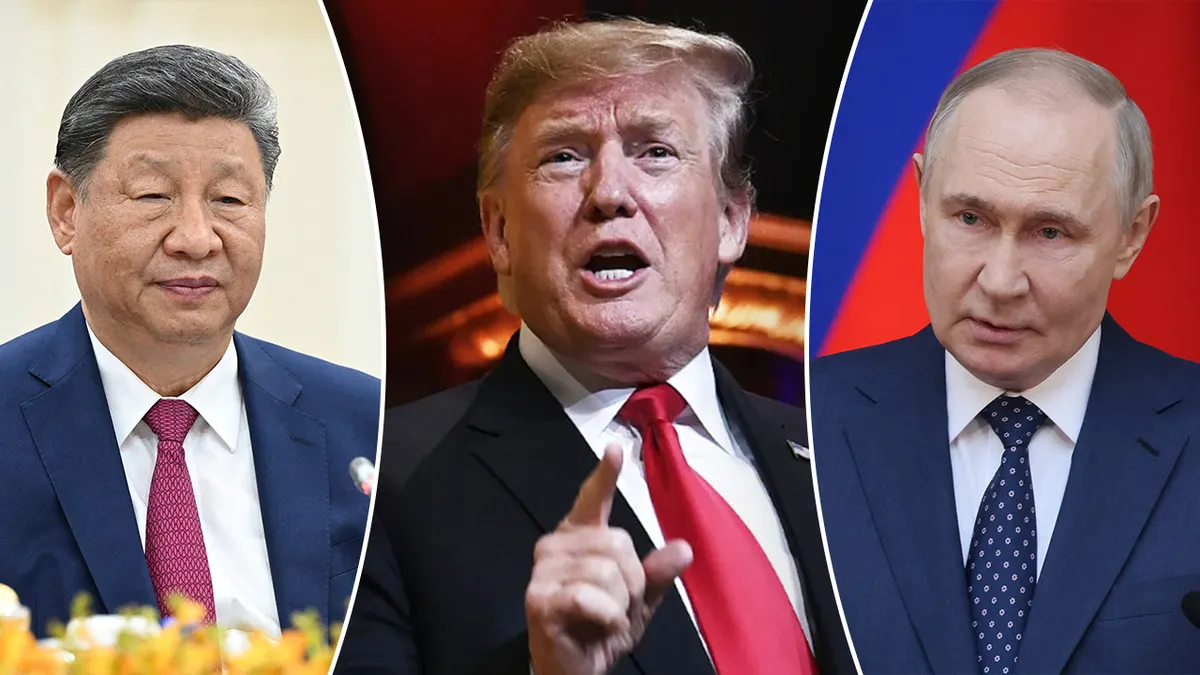
Though sometimes dismissed as a mere photo-op, the upcoming meeting in Shenzhen between Xi Jinping, Vladimir Putin, and Donald Trump represents a hopeful triumph for the global majority.
Think about what that signifies. It means that the world’s principal imperial power and the leader of white-world colonialists is finally meeting as a co-equal with heads of the two major members of the global majority organization called BRICS+ [Brazil, Russia, India, China, South Africa plus (so far) Egypt, Ethiopia, Indonesia, Iran, Saudi Arabia, and the United Arab Emirates.].
It’s one of the most hopeful developments in global politics that I’ve witnessed over my 86 years on this planet.
My optimism is inspired by the sea change such meeting represents – transition from past colonial exploitation, and present forever wars, to a possible future characterized by dialog, diplomacy, and reparations for all that colonial and neo-colonial exploitation.
Colonial Exploitation
For more than 500 years, Europe and European settlers have built up vast fortunes and have created “developed world” ways of life by invading and conquering by force, divide-and-rule strategies, and the establishment of obedient local monarchs. That’s what colonialism is.
It’s a system of plunder whereby “civilized” armies invade weaker “uncivilized” territories to steal their goods and govern them by force of arms often taking the form of outright genocide (as happened in what eventually became the Unites States of America). Often, it’s all been justified on religious grounds – to save the souls of the “natives.”
Typically, the colonized countries are balkanized by imposition of arbitrary borders drawn up by colonizers grossly ignorant of the impositions’ effects separating extended families, allied tribes, and cultural sites such as temples, and community burial grounds. In Exterminate All The Brutes, Raoul Peck summarizes the dynamic in three words: civilization, colonialization, and extermination.
In China, the exploitation in question took the form of events that unfolded during that civilizational state’s “Century of Humiliation.” The most disgraceful events during those hundred years were the two Opium Wars waged by Great Britain against China (1839-1842 and 1856-1860). Till those wars, China had been the world’s most productive rival of the British Empire. China was largely self-sufficient without need of British products. As described by Enrique Dussel, it had long since anticipated the great achievements of Europe’s Industrial Revolution – including printing press, paper money, the steam engine and steel production. The forced import of English opium changed all that reducing China to comparative passivity, dependency, and yes, humiliation.
Following the triumph of its revolution in 1949 Chinese leaders beginning with Mao Zedong realized that such disgrace was made possible by their country’s military weakness. They resolved never again to replicate such debility.
For its part, Russia’s association with the colonized Global Majority came much later.
More than ever, it incurred the wrath of the collective west by the success of its October Revolution in 1917. That groundbreaking workers’ rebellion introduced into Eurasia at a national level a country and its satellites that refused to conform to the standard capitalist system of exploitation. Though constantly accused by the west of merely exchanging one form of colonialism for another, it successfully endured invasions by European and American colonialists along with subsequent continuous threats and an extended Cold War to protect the undeniable gains of its revolution that with unprecedented speed transformed Russia from what Marxist economist Richard Wolff calls Eurasia’s most backward country in a world superpower.
All of that changed in the early 1990s when a series of socio-economic reforms by Russian president Mikhail Gorbachev introduced reforms mirroring the values of his western adversaries. He termed them glasnost (openness) and perestroika (restructuring).
Such changes opened the door to the unexpected deterioration of the Soviet system.
Very quickly Russian anti-communists cooperating with the anti-Russian collective west saw their opening to finally end any alternative to their system of control. Overwhelming western funding and propaganda inserted themselves into the electoral process that followed on the heels of Gorbachev’s reforms. This led to the replacement of the president himself with a more-malleable head of state, Boris Yeltsin.
Yeltsin oversaw what his virulently anti-communist successor Vladimir Putin called “the greatest geopolitical catastrophe of the 20th century.” He was evidently referring to the sale of Russian national assets at fire-sale prices to western investors and local oligarchs. He was referring to the eruption of widespread poverty – the consequence of lost employment following on the “restructuring” of Russia’s economy, to the disappearance of socialist programs including the disappearance of pensioners’ income. According to Putin, Yeltsin’s reforms impoverished ordinary people and enriched foreign investors and their local allies in ways completely reminiscent of IMF “structural adjustments” imposed on the west’s former colonies. In this way, Russia was reduced to Third World status.
Putin himself was seen by the west as a worthy successor of Boris Yeltsin when he succeeded the latter in the year 2000. However, in his famous Munich Speech of 2007, Putin shocked his western supporters by a kind of declaration of independence. He decried the unipolar system that he described as the root of the world’s problems. He denounced the rise of oligarchical classes and declared his intention to redirect his presidency accordingly. He also expressed concerns over NATO’s expansion and advocated for a multipolar global structure.
As far as the collective west was concerned, Putin’s election and that Munich speech marked a break in Russia’s reform trajectory. It identified Russia’s president as an enemy to be vilified and as an object of regime change efforts.
The point here is that under Yeltsin, Russia was reduced to Third World status. It became the victim of IMF structural adjustment policies. However, by playing a leading role in the formation of BRICS Putin transformed Russia into a powerful leader and champion of the Global Majority.
War vs. BRICS
All of that, in summary goes a long way towards explaining the current wars in Ukraine and Iran. Arguably, both are really wars against BRICS – against the united Global Majority. Both can be seen as wars to reassert the unipolar authority of the United States along with the subservient, impoverished, and dependent status of the Global Majority. The wars represent steps to the dethronement of Russia and China as champions of the former colonies. Or, as expressed by Secretary of Defense Lloyd Austin, United States goals in Ukraine were to weaken Russia and to remove Vladimir Putin from office. According to Secretary of State Marco Rubio Ukraine is a proxy war between the United States and Russia.
Facing up to such realities is no doubt difficult for most Americans to accept. After all, isn’t the United States a benefactor of the former colonies? Isn’t a major point of its foreign policy to alleviate poverty and spread democracy throughout the world?
Apparently not, if we are to believe the words of President Trump. He sees not only the “developing world” united in BRICS as inimical, but in addition any country that does trade with them.
And this anti-poor position is not peculiar to Donald Trump. In 1949, it was recommended as official U.S. policy by George Kennan, the author of the U.S. policy of containing the Soviet Union during the Cold War. Kennan wrote: “We have about 50 percent of the world’s wealth, but only 6.3 percent of its population, In this situation, we cannot fail to be the object of envy and resentment. Our real task in the coming period is to devise a pattern of relationships which will permit us to maintain this position of disparity without positive detriment to our national security. To do so we will have to dispense with all sentimentality and daydreaming and our attention will have to be concentrated everywhere on our immediate national objectives. We need not deceive ourselves that we can afford today the luxury of altruism and world benefaction. We should cease to talk about vague and unreal objectives such as human rights, the raising of living standards and democratization. The day is not far off when are going to have to deal in straight power concepts. The less we are hampered by idealistic slogans, the better.”
According to Kennan, a very key player in the formation of U.S. policy, the purpose of it all is to maintain (not alleviate) the extreme wealth-disparity between the United States and the rest of the world. The United States is not about making life better for others or about acting unselfishly. Rather, human rights, democratization, and improving the living standards of other nations are considered ill-defined and even unreal. Such considerations are not to be factored into decision-making. Mouthing slogans to the contrary may be fine, but their content must be ignored in favor of unadulterated power relationships – i.e. in favor of forcing others to conform. As President Trump has put it, the only acceptable slogan is “America first.”
In contrast to such convictions, the unabashed stated point of BRICS is to foster respect for human rights, democratization, and improving the living standards of all. This makes the leaders of BRICS, Russia and China, as well as BRICS members such as Iran, enemies of the unipolar state.
The contrast also lends added color and deeper importance to the upcoming Shenzhen meeting.
Hopes for Shenzhen
As I indicated at the beginning, it might be a grave mistake to consider the coming Shenzhen meeting as a mere photo op for heads of state concerned about advancing their own self-interests and those of their nations similarly seeking world dominance. While such concerns are self-admittedly true for the North American participant, the considerations I’ve just shared indicate something else for the Russian and Chinese presidents.
All indications are that besides seeking what’s best for their own countries, Presidents Xi and Putin are internationalists whose national experience enables them to identify with the Global South and the exploitation that the former colonies have experienced over the last 500 years.
While it might be true that nothing substantial is unlikely to occur at Shenzhen, simply understanding the meeting as an encounter of equals – between the exploited and their principal exploiter – is more than enough to justify its success even before the principals shake hands. The meeting puts many things into perspective including borders, immigration, reparations, and internationalism itself. It also helps transcend narrow Overton windows concerning Putin, Xi and the wars in Ukraine and Iran.
In the perspective just shared, the two Global South leaders potentially emerge as statesmen representing the interests of the world’s historically oppressed. Their policies as embodied in BRICS and in China’s Belt and Road Initiative become understandable as departures from the cruel orientations of “diplomats” like George Kennan. The installation of high-speed rail across the planet and the construction of ports, bridges, highways and dams can be seen as extremely generous acts of what the U.S. once called “foreign aid.”
Moreover, considered in this way, Shenzhen reminds all concerned that borders are not sacred; they change all the time, and colonizers not only drew them (often haphazardly) to satisfy their larcenous interests, but even once drawn, their authors assumed permission to cross and violate their demarcations with abandon.
This puts into salvific perspective the immigration of the colonized into the countries of their exploiters. Turn-about is fair play. And whether they realize it or not, immigrants from the Global South are peacefully voting with their feet to exact reparations for the crimes of would-be civilizers who wantonly colonized and cruelly exterminated the inhabitants of the lands they ravaged. The “invasions” of immigrants across the “developed world” call into question the legitimacy of all the planet’s borders.
None of these profound realizations is likely to register in the presses of the colonial powers.
But keep them in mind as events in Shenzhen unfold. Their day will come.


