Let’s Not Be Fooled Again – this time about Venezuela

How are we to think about the crisis in Venezuela when the main proponents of U.S. policy are known liars and war criminals? Specifically, of course, I’m thinking about Donald Trump and Elliot Abrams — not to mention John Bolton. That, for me is the question.

It seems to me in such tragic circumstances, our attitude towards the crisis (regardless of our judgments about Nicolas Maduro and socialism) should be governed by principle.

In fact, the current policy of the United States violates at least half a dozen principles. They include:

  1. National Sovereignty: Venezuela’s political and economic problems should be of no concern to our government.  
  2. Self-Determination: Venezuela has the right to choose its own form of government and economy.
  3. Anti-Imperialism: Revealingly, most of the countries aligned with the Trump administration are either charter members of Europe’s Axis of Colonialism or representatives of Euro-American client states. Meanwhile those opposing Trump’s policy are former colonies of the U.S. and Europe and/or have been invaded by the military forces of those inveterate imperialists. The latter include Russia, China, India, South Africa, and Mexico along with countries such as Ecuador, Bolivia, and Nicaragua. All of those countries know a thing or two about European and U.S. imperialist tyranny.
  4. Nuremberg (forbidding the punishment of civilian populations)
  5. Skepticism about the statements of proven liars
  6. Consistency

For starters, let me focus here on consistency. This principle dictates that:

  • If we’re worried about foreign interference in our own electoral process, we should stay out of Venezuela’s.
  • If Maduro’s jailing of political opponents concerns us, the same should be true relative to Brazil and Bolsonaro’s jailing of Luiz Ignacio Lula da Silva, the country’s most popular politician. (And yet, our government had no hesitation in recognizing Bolsonaro’s legitimacy.)
  • If we worry about humanitarian crises, we should stop cooperating with Saudi Arabia and its war against Yemen, the poorest country in the Middle East. That war has caused the worst humanitarian crisis in the world.
  • If crooked elections are cause for delegitimizing governments, we shouldn’t recognize the current government of Honduras, whose election of Juan Orlando Hernandez was certified as unfree and unfair by the OAS. It called for new elections. (But, of course, both the Obama and Trump administrations have recognized Hernandez as a legitimate head of state.)
  • If we’re outraged by police violence against demonstrators, we should cut off all aid to Israel for killing hundreds of unarmed demonstrators (including women and children) at the Gaza border and wounding thousands of others.

But none of these issues matter at all to the Trump administration. They care not a bit about humanitarian crises, fair elections, the right to protest or the jailing of political opponents. As both Trump and John Bolton have said openly, their concern is Venezuelan oil, controlling it and profiting from that control. That’s imperialism.

Moreover, the so-called “humanitarian aid” at the country’s borders in Brazil and Colombia is a pittance worth some millions of dollars, while the profits frozen from the country’s sale of oil and its access to its own gold reserves are worth billions – as are the mercantile transactions with other countries now prevented by the U.S. embargo. According to the Red Cross and the U.N.  (both of whom refuse to participate in its distribution) the disputed humanitarian aid is nothing more than a political ploy. In other words, if the U.S. truly cared about the welfare of the people of Venezuela, it would stop its embargo and allow Venezuela access to its money and markets so the country itself could buy food and medicine on the open market.

The appointment of Elliot Abrams as the Trump’s point man for Venezuela speaks volumes about the administration’s criminal intentions. Abrams, of course, is a convicted felon. He was the U.S. brains behind the genocidal policy of Rios Montt in Guatemala during the 1980s, when more than 200,000 Guatemalans (mostly indigenous) were slaughtered by Montt and his generals. Elliot Abrams is a war criminal. And his selection by Mr. Trump to run his show in Venezuela indicates an embrace of the old CIA playbook used again and again in its more than 68 regime-changes operations since World War II – with most of the removed officials having been democratically elected.

The playbook runs like this:

  • Any country attempting to establish an economy that serves the interests of its poor majority
  • Is routinely accused of being run by a dictatorship
  • It is subject to regime change by direct U.S. invasion
  • Or by right wing (often terrorist) elements within the local population
  • To keep said country within the capitalist system
  • So that the U.S. might once again use the country’s resources for its own enrichment
  • And for that of the local elite.

Standardly, the strategy is to use a combination of terrorism, sanctions, embargoes to make civilians within the country so miserable that even the poor will rise up and join forces with the elite to remove the so-called “dictator” from office.  That’s what’s happening in Venezuela at this very moment. To repeat: it’s a violation of the Nuremberg Principles forbidding punishment of civilian populations.

Perhaps the most surprising thing about Venezuela is how we believe our politicians on the subject of regime change. You’d think that at least after Iraq and Libya (not to mention Panama and Grenada) we’d show some skepticism. What was it that Great Man tried to say a few years ago? “Fool me once, shame on you. Fool me twice, shame on me”? I mean, how many times do we have to be fooled before we’re shamed out of our minds by our collective stupidity?

After all, these people (the Trumpists) are proven liars. Everybody knows that. It’s the subject of jokes every night on Colbert and on Saturday Night Live. Trump is a laughing stock. And yet when he speaks about his compassion for the Venezuelan people, about the lies of its government (!!), his concern for democracy and the integrity of elections, or about Maduro’s corruption (!!) the press actually takes him seriously. Give me a break, please!

Let me say it clearly, Donald Trump and his administration have not a shred of credibility. Period! Not a shred! Whatever he says (whatever they say) should be taken as an outright lie unless proven otherwise by absolutely unimpeachable sources.

And by the way, let me conclude by saying that it’s clearly wrong to blame Venezuela’s problems on socialism. First of all, Venezuela is not a socialist country. It’s governed by a socialist party, but its economy is dominated by private corporations. So is its news media.

France is more socialist than Venezuela. And besides, under Hugo Chavez, the economy thrived (largely because oil prices remained high). And just six years ago (after 14 years of so-called Bolivarian Socialism), polls determined that Venezuela was the happiest country in South America. As a matter of fact, it won that distinction two years in a row – in 2012 and 2013. Worldwide, in those years, its happiness index came out ahead of France, Spain, Italy, and Germany.

Right now, of course, it is not a happy place. Its condition is roughly the same as when Chavez took over in 1999 after decades of governance by its white elite creols. And, it’s true, the current unhappiness is surely due to mismanagement and corruption on the part of the Maduro administration. But it also has a lot to do with the fall of oil prices on the world market, but especially with the U.S. embargo and sanctions against Venezuela.

Bottom line: Please realize that we are being lied to about Venezuela! Our government is the main criminal there. Whatever we might think of Maduro or of socialism, the principles articulated at Nuremberg, as well as those of national sovereignty, self-determination, anti-imperialism, consistency, and common-sense skepticism before liars should be our guides.

Tell the president, your senators and congressional representatives: Yankee go home! Get out of Venezuela!

Americans Love Jesus, but Hate His Politics

Readings for 7th Sunday in Ordinary Time: 1 SM 28: 2, 7-9, 12-13, 22-23; PS 103: 1-4, 8, 10, 12-13; I COR 15: 45-49; LK 6: 27-38

This Sunday’s instruction from Jesus stands on its own. Comment seems hardly necessary.

Instead, Jesus’ unadorned words should turn bright red the faces of all in our country who claim to be his followers. For they contradict our economic system and entire way of life driven as it is by the military-industrial complex, unending wars, and an economic system that victimizes the poorest among us, while enriching beyond belief a tiny minority.

Moreover, Jesus’ teachings call entirely into question the “realism” of mainstream politicians. Such realism ridicules anyone (like Marianne Williamson) who might have us adopt Jesus’ approach before it’s too late.

Think about that in the light of our readings from the Gospel of Luke these past few weeks. In case you’ve forgotten, here’s a summary of Jesus’ absolutely radical, highly political program found in the passages we’ve read. To begin with, he describes his entire purpose in this way:

“The Spirit of the Lord is upon me,
because he has anointed me 
to bring glad tidings to the poor.
He has sent me to proclaim liberty to captives
and recovery of sight to the blind,
to let the oppressed go free,
and to proclaim a year acceptable to the Lord.”

Notice the undeniable political thrust of Jesus’ teaching. He emphasizes bringing good news to the impoverished. He wants to clear out the prisons, to cure the disabled and liberate those oppressed (by the Roman empire that controlled Israel in Jesus’ day). Notice he is proclaiming a Jubilee Year with its debt forgiveness, release of slaves, and radical land reform. That’s Jesus’ agenda. It’s undeniably political; it’s directed towards the poor.

And just in case we might miss the point, our readings of just last week had Jesus continue like this:

“Blessed are you who are poor,
for the kingdom of God is yours.
Blessed are you who are now hungry,
for you will be satisfied.
Blessed are you who are now weeping,
for you will laugh . . .
But woe to you who are rich . . .
Woe to you who are filled now,
for you will be hungry.
Woe to you who laugh now,
for you will grieve and weep.
Woe to you when all speak well of you,
for their ancestors treated the false
prophets in this way.”

As I indicated last week, those words should shock us. Jesus’ words turn everything upside-down. It’s the poor who are God’s favored, not the rich. According to his promise, the poor will govern God’s Kingdom (a highly politicized image for what the world would be like if God were king instead of Caesar). By contrast, the rich, well-fed, the apparently happy and admired stand in God’s disfavor.

Read those words again. Imagine if our leaders insisted that they instead of the Ten Commandments be posted in front of our court houses and on school walls! “Blessed are you poor! Woe to you rich!”

But the evangelist still isn’t finished. Here’s what he has Jesus say in today’s Gospel selection:

“To you who hear, I say, love your enemies, do good to those who hate you, bless those who curse you, pray for those who mistreat you. To the person who strikes you on one cheek, offer the other one as well, and from the person who takes your cloak, do not withhold even your tunic. Give to everyone who asks of you, and from the one who takes what is yours do not demand it back. Do to others as you would have them do to you . . .  (L) end expecting nothing back . . .”

And yet, despite such clear instruction, here’s what our “Christian” criminals in Washington do (with scarcely a whimper of objection from us “believers”):

  • They spend more on war than the next 12 countries combined.
  • They’re currently fighting wars against poor people in Afghanistan, Iraq, Syria, and Ethiopia – having just destroyed Libya and previously most of the countries in Central America.
  • Against all the principles of international law, they’re tightening the screws on Venezuela causing hunger and shortages of medicine in order to spark rebellion against a government that has not attacked the United States.
  • They have their eyes set on regime change in Nicaragua and Cuba which have harmed the U.S. in no way at all.
  • They’re cooperating with Saudi Arabia in bombing to smithereens Yemen, the poorest country in the Middle East. (And virtually none of us can explain exactly why. Can you?)

With that in mind, doesn’t it seem true to say U.S. policy (especially towards the world’s poor) is 180 degrees opposed to what Jesus is reported to have said? It’s as if Jesus taught:

“To you who hear I say, hate your enemies. Annihilate those who disagree with you. Curse those who speak ill of you. Condemn those who retaliate against you. If someone defends himself by striking you back, waste him. And take everything from the person who tries to recover what you yourselves have stolen; put them in prison and throw away the key. Ignore those who seek alms from you; they’re just lazy freeloaders. And jail the one who takes what your system denies him making sure he pays back every cent with interest. Do others before they can do you. Lend at the highest rate of interest the market will bear – even if it causes women and children to starve.”

Just look at the world such departures from Jesus’ wisdom have produced!

Still, when someone (e.g. like Marianne Williamson) comes forward calling the nation to a radical spiritual change based on the elementary teaching found not only in Christianity but in all religions – viz. “Do unto others as you would have them do unto you” – she’s dismissed as “impractical,” “unrealistic,” and “new age”

No, that teaching is “old age.” It comes from Jesus! It represents his political program.

Isn’t it time for politicians to reverse course and follow the teachings of the spiritual Master they claim as the Savior of the world? For starters, truly following Jesus’ political program that we’ve reviewed these past few weeks would have us:

  • Assume leadership in the fight against climate change
  • Cut our defense budget by at least two-thirds
  • Withdraw from all foreign wars
  • Repair the damage done by those conflicts
  • Close our country’s military bases across the world
  • Forgive the debt of the former colonies
  • Completely reform our prison system from one dominated by punishment to one centered on rehabilitation
  • Make reparation to the descendants of former slaves
  • Renounce interference in foreign elections (as we would have others do in relation to our own voting system)
  • And so much more

You get the idea. I get the idea. Or maybe we can’t . . .

In Memoriam: Matthew Setlik (Aug. 20, 1985-Feb. 5, 2019)

I experienced a great sorrow and privilege over the last couple of weeks. The sorrow was the loss of a dear nephew, Matthew – the son of my younger sister, Mary. At the age of just 33, Matthew died suddenly from a virulent strain of cancer following a brief illness. All of us remain devastated. None of us can believe what on the surface we’ve experienced as a great tragedy. Our tears are not yet dry. They won’t be for some time to come.

Nonetheless, I found myself also experiencing Matthews death as a privilege. It took the form of an urgent call to stop my hurried and harried routine to ponder and appreciate the significance of this exemplary young man’s brief life. Even more importantly, Life itself gifted and summoned the entire community of those who love Matthew to reflect on death and its meaning in the light of the faith that formed my nephew. I share that faith with my sister, with Matthew’s family, his Methodist church community in Riverside California, and with many of his dearest friends.

My own fondest memories of Matthew are of his playing with our youngest son, Patrick when they were small children of approximately the same age. They both loved video games. Then, there were the several Suzuki music camps our families shared in Steven’s Point, Wisconsin. Like Patrick and my other son, Brendan, along with my daughter, Maggie, and, of course, Matthew’s sister, Amanda, Matthew was a musician – the son of a dedicated Suzuki mom (and only Suzuki parents know how they can be!). Back then, Matthew was doing piano. Later on, he switched to drumming. He played in a Jazz band, though I never heard him perform. Those summer times in Steven’s Point were memorable.

Afterwards, my connections with Matthew came through Mary. She told me of his studies at the University of Kansas, where he majored in business and finance. She’s described to me his work as a sports agent and with the Special Olympics organization. After Kansas, Matthew taught in Spain. He loved that country and its language. Mary visited him there three times recording it all in lovely artistic photos. She treasured every minute of her time with her son.

Mary told me of Matthew’s marriage to Emily Ann whom he met through their shared work with Special Olympics. Everyone said they were a perfect match. They bought a lovely home near Emily’s parents, Patti and Bob. Matthew loved both of them and considered Bob a father-figure.   

Then several years ago, our paths crossed again at his sister, Amanda’s wedding. My wife, Peggy, and I came away from that experience as enthusiastic members of the very large Matthew Setlik Fan Club. We were completely won over by his out-going spirit, his light-heartedness, and his desire to make everyone feel comfortable and welcome. He was a complete joy. And afterwards, we bragged about him to everyone who would listen.

And now, all of a sudden, it seems, his life has been cut off at just 33 years of age. As I said, and like everyone else we found ourselves confused and moved to tears.

And somehow that brings me to a deeper dimension of this turn of events. I’m reminded that faith was important to Matthew and remains so for Emily, his bride of just two years. To begin with, Matthew’s tragically shortened life reminds me that in our Christian tradition, Jesus himself died at that very age. His life too was cut off just as it seemed to be getting started. The same was true of Martin Luther King whose life ended at just 39 years of age.

Those numbers remind us that the length of time we’re given here on planet earth is all relative. The examples of Jesus and Dr. King tell us that in the big scheme of things, the number of years we spend here is immaterial. I mean, time itself is relative. It’s actually an illusory construct that is nothing but a measure of motion. Einstein himself said something like that. He called time “an illusion – albeit a persistent one.”

The fact is that all of our life-spans are incredibly brief. Outwardly, we’re born, go to school, get a job, some of us marry and perhaps have some children. We buy and sell a few things, accumulate a truckload of trinkets and then die.

All of that is on the outside. Inwardly however, there’s so much more going on, isn’t there? Quite early on, we begin to wonder what our lives are for. What should I do with mine?

Why are we here? Where are we going? Am I wasting – have I wasted – my life? Is there a God? And what happens after we lay our bodies aside?

Surely those question occurred to Matthew. And the choices he made during his all-too-brief life indicate the conclusions he must have drawn. Instead of focusing on money, power and prestige, he and Emily joined forces to become elementary and middle school teachers. As we all know, what an important vocation that is. Yes, it’s a vocation. No one chooses that path to become rich. Instead, the choice is made out of a sense of calling, service, and responsibility for others. Each of us, I’m sure has a special place in our heavens for our dearest teachers.

As for what happens after death . . . None of us really knows. Hindus emphasize one thing, Muslims another. Life after death has been described as a Great Banquet or a great family reunion. Some believe in reincarnation. Then there’s the approach of Dante Alighieri in his Paradiso. It centralizes the “beatific vision” and the “resurrection of the body.” It’s important to note that for all those ancient traditions, the afterlife, for virtuous people like Matthew, is something joyous and fulfilling. The fact that all traditions across the world agree on that point should give us great comfort.

For followers of Jesus, death has a dreamlike quality. It’s not an ending, but a beginning. We fall asleep in the Lord and then wake up. And there’s a reason for that dream connection. Genesis 2:24 tells us that the Lord caused a deep sleep to fall upon Adam. But nowhere does it say that Adam woke up. Instead, what we have in effect throughout the entire Bible is the dream of Adam.

He dreams that death is somehow a punishment (GEN 3:19) as is his relationship with woman and nature. He dreams of a war-God who demands the slaughter of thousands – men, women, and children. He dreams of restrictive laws and of a God who severely punishes breaking them. He dreams that his ethnic group is special, and that all others are God’s enemies worthy of death.

But then come the prophets; then come Jesus and Paul to save us from that nightmare. They correct all of that. They call us to wake up from Adam’s dream. God is not a war-God, they tell us. God is not a punisher, but a loving father. Even the holiest of laws are meant to be broken when human welfare is at stake (MK 2:27).

Death is nothing more than falling asleep and waking up to fullness of life. Jesus demonstrates that by raising Lazarus to life (JN 11: 1-44). He does the same for the daughter of Jairus (MK 5:26-43; MT 9:18-26; LK 8: 40-56). (Everyone was convinced that she was dead. No, Jesus says, she’s only sleeping.) Above all, Jesus’ own resurrection – the center of our shared faith – teaches that death is not the end but a glorious beginning. Reflecting on Jesus’ death and our own, Paul asks triumphantly, “O, death, where is your victory; where is your sting?” (I COR 15: 55-57).

As followers of Jesus, we share that faith. We’ve awakened from the dream of Adam to realize there’s nothing to fear in death. Despite our present overwhelming feelings of severe loss, death is not tragic. It is an inevitable part of life. It is a bridge leading to what Jesus called “fullness of life.” For Matthew and the rest of us, it represents a promotion. Our faith tells us he is better off now than any of us. Yes, that’s our faith.

As for our feelings of loss . . .  Eckhart Tolle tells the story of a Zen master who communicated to his student the secret of dealing with such pain.

The student was about to leave on a year-long journey. Before going, he asked the master for a practice he might use while on his trip. He complained, “Look, I’ve been here in the monastery for five years. I’ve been a good monk and have done everything according to the book. But I still haven’t achieved enlightenment. Help me.”

“Well,” the master said, “here’s something I’d recommend. . .  No matter what happens to you during the coming year, simply accept it with the words, ‘This is good. It could not be better. Thank you. I have no complaints whatsoever.’”

The student was surprised. “You mean that’s it?” he asked.

“Yes,” the master said. “No matter what happens to you – good, bad, or indifferent, wonderful or tragic – say, ‘This is good; it couldn’t be better. Thank you. I have no complaints whatsoever.’”

With that, the student left on his trip.

A year later, he returned completely frustrated. He said, “Master, I did what you said. No matter what happened to me, pleasant or unpleasant, I always said, ‘This is good; it could not be better; thank you; I have no complaints whatsoever. But nothing has changed.  I haven’t yet achieved enlightenment.’”

The master replied, “Hmm. . .  This is good; it could not be better. Thank you. I have no complaints whatsoever.”

The student heard that . . .  He pondered . . . And at that moment, he achieved enlightenment.

Do you see what the story teaches? It means that even in the apparently tragic situation of Matthew’s death – keeping in mind the relativity of time, the dreamlike quality of all our experiences, and given what Jesus taught us about Adam’s dream and the triumph of life over death – there is something extremely important for us to learn. It’s that all of life is a gift. And in the light of that gift, the proper faith response to absolutely everything – even this apparent tragedy – is “Thank you Lord. This is perfect and could not be better. I have no complaints whatsoever.”

So, if you can, join me in saying that prayer now – but perhaps in the following form:

“Dear Lord, thank you for the gift of life and for the experiences we enjoyed with our beloved Matthew. Each of the moments we spent with him was infinitely precious. But so is this present one. All our lives are incredibly short. We thank you for Jesus’ teaching that death is merely a bridge to complete fullness of life. We are happy that Matthew has crossed that bridge and is now happier than he ever was here. Yes, we believe he has received a promotion and is now happier than he ever was here. We know that it’s only a matter of time before we each join him in that better home. So, thank you, Lord. We know this present moment could not be better. It is a complete blessing. We have no complaints whatsoever.

And so, it is; we all pray, ‘Amen.’”   

Billionaires Threaten a Hostile Takeover of the Catholic Church

Readings for 6th Sunday in Ordinary Time: JER 17:5-8; PS 1: 1-5; I COR 15: 12, 16-20; LK 6: 17, 20-21;

There’s a plot going on to neutralize Pope Francis. Even worse, it’s about neutralizing Jesus and his “preferential option for the poor” that has dominated our liturgical readings for the past several weeks.

This week’s readings are no exception. In fact, in today’s Gospel selection, that option for the poor receives its starkest expression so far. There, Luke the evangelist has Jesus say clearly that the poor are the object of God’s special favor, while the rich are not. In Luke’s version of the Sermon on the Mount, Jesus speaks frankly: “You poor are blessed.” He tells the rich just as clearly, “you are cursed.” And he does so for no other apparent reason than that the objects of Jesus’ blessing and cursing are poor and rich respectively.

Before I get to that, let me say a word about the plot I just mentioned.

What I’m talking about was reported in January’s Sojourner’s Magazine – the progressive Christian Evangelical monthly published by Jim Wallis. It all appeared there in a piece authored by Tom Roberts, the executive editor of the National Catholic Reporter. The article was entitled “How Right-Wing Billionaires Are Attempting a Hostile Takeover of the Catholic Church.”

There, Roberts described an aggressive project to establish what I would call an ecclesiastical “shadow administration” bent on usurping the authority of the church’s U.S. Conference of Catholic Bishops (USCCB). The undertaking is “financed by the Koch brothers, by Domino Pizza founder Thomas Monaghan, and a slew of other billionaires linked to the Knights of Columbus and conservative Catholic Cardinals – all of whom enjoy favor with Breitbart’s Steve Bannon and the Trump administration.

Seeking to replicate the rise of the Evangelical right in the 1980s, the group advocates a Catholic version of the prosperity gospel described by Roberts as “a hybrid of traditional pieties wrapped in American-style excess and positioned most conspicuously in service of free-market capitalism.” It is “. . . ‘in your face Catholicism’ . . . often expressed amid multi-course meals followed by wine and cigar receptions, private cocktail parties for the especially privileged, traditional Catholic devotionals, Mass said in Latin for those so inclined, ‘patriotic rosary’ sessions that include readings from George Washington and Robert E. Lee, and the occasional break for a round of golf.”

Doctrinally, the goal is to bury more deeply than ever what many have called “the best kept secret of the Catholic Church,” viz. its progressive social teachings. Since Pope Leo XIII’s 1891 encyclical, Rerum Novarum, those teachings have repeatedly criticized the abuses of both capitalism and socialism while advocating workers’ rights, labor unions, fair wages, social security, and (especially with Pope Francis) care for the earth in the face of human-caused climate chaos.

The billionaire cabal in question finds especially offensive not just Francis’ emphasis on social justice themes, but the 1983 pastoral by the USCCB questioning the morality of modern warfare and of nuclear weapons. They resent above all the bishops’ 1986 letter entitled “Economic Justice for All” which disagreed specifically with the economic policies of the group’s great hero, Ronald Reagan.

In place of such teachings, the billionaires in question think that the Catholic social narrative should focus exclusively on sexual issues: abortion, contraception, gay rights, and the rights of divorced and remarried people within the Catholic Church. They want the church to be more celebratory of individualism, entrepreneurship, and of free market fixes for society’s problems. Their goal is to shrink government in general and diminish its services to the poor and marginalized in particular.

Doesn’t that sound completely like the Republican agenda?

And with the Catholic Church currently weakened and reeling from its sex-abuse scandals, the billionaire conspirators are convinced that the time is completely ripe for their hostile takeover.

But could anything be further from the teachings of Jesus which a few weeks ago, our Gospel reading summarized as “good news to the poor?”

There, Jesus announced his program with the following words: “The Spirit of the Lord is upon me, because he has anointed me to bring glad tidings to the poor. He has sent me to proclaim liberty to captives and recovery of sight to the blind, to let the oppressed go free, and to proclaim a year acceptable to the Lord.”

This was a proclamation of a new order (what Jesus called “the Kingdom of God”) directed towards improving the lot of the poor, the imprisoned, the ill and oppressed. It was the proclamation of the Jewish “Jubilee Year,” where debts would be forgiven, slaves freed, and wealth redistributed.

Now in today’s Gospel reading, the Master expresses the same sentiment, only this time in even a more in-your-face manner. Here, it’s worth quoting the words Luke attributes to Jesus.

“Blessed are you who are poor,
for the kingdom of God is yours.
Blessed are you who are now hungry,
for you will be satisfied.
Blessed are you who are now weeping,
for you will laugh.
Blessed are you when people hate you,
and when they exclude and insult you,
and denounce your name as evil
on account of the Son of Man . . .
But woe to you who are rich,
for you have received your consolation.
Woe to you who are filled now,
for you will be hungry.
Woe to you who laugh now,
for you will grieve and weep.
Woe to you when all speak well of you,
for their ancestors treated the false
prophets in this way.”

Shocking words – all of them, don’t you agree? They are part of the great reversal in the new order proclaimed by Jesus. There, the values of the world will be turned on their heads. The poor will be in charge. They will have food to eat. Laughter will replace their tears.

But the rich will experience great misery (woe).  That’s because they have been led astray by false prophets like those cardinals participating in the billionaire hostile takeover of the Catholic Church. Those fake prophets console the super-rich with honeyed words about their specialness

But according to Luke’s Jesus, the rich may be enjoying those multi-course meals, private cocktail parties, cigar receptions and rounds of golf now. But when the Kingdom’s new order comes, they will find themselves hungry. They may be laughing now, but then they will weep and cry. Their false prophets may praise them now but come the new order, the wealthy will be cursed as the most wretched of men.

Obviously, Jesus’ teaching contradicts our culture’s worship of the rich. We think of the rich as heroic entrepreneurs. Jesus sees them as worthless wretches. We see the poor as losers. Jesus sees them as objects of God’s special favor.

In other words, Jesus turns our thinking upside down. As Marianne Williamson puts it: Jesus’ truth (God’s truth) is 180 degrees opposed to what our culture values and teaches.

That realization should be Christians’ fundamental guide in reading the news and thinking about world events. It should be the confident guide of our activist efforts.

Everything is the opposite of what our culture claims!

President Marianne Williamson?? Yes, That Miracle Can Happen!

Readings for 5th Sunday in Ordinary Time: IS 6:1-2A, 3-8; PS 138: 1-8; ICOR 15: 1-11; LK 5: 1-8

In today’s Gospel reading, we encounter Jesus’ radical message of social justice and of the abundance-for-all that results from accepting his insights. Significantly for this series on the presidential candidacy of Marianne Williamson, her program parallels that of the Master whose miraculous teaching has constituted the center of her own career for the last 30 years and more.

Before I get to that, however, allow me a word about miracles and Marianne’s presidential campaign.  

For starters, she herself is very clear about one thing: without a miracle, our country (and the world) is doomed. But that doesn’t mean her thinking is negative or pessimistic.

That’s because (and this is crucial) Marianne’s use of the term “miracle” does not reference marvels contrary to the laws of nature. Instead, her understanding of the word is something more significant even than the “miraculous” catch of fish reported in today’s Gospel reading. By miracle she means a profound change in consciousness. It’s a change in attitude from one governed by fear and guilt to an outlook inspired by love and forgiveness. As I said, without that change, we’re all finished.

Think about it. Isn’t it true that fear and guilt absolutely govern our lives? We’re taught to be very afraid of the Russians, Iranians, the Taliban, ISIS, Muslims, immigrants, climate change, nuclear holocaust, poverty, the police, gun violence, and death. And standard answers to such threats always include denial and violence in the form of war, more guns, sanctions, walls, prisons, weapons-modernization-programs, and an unlimited consumerism that has us drowning in our own waste.

In fact, it’s precisely that fearful thinking that continues to inform the candidacies of our country’s political classes (Democrats as well as Republicans). All of them except Marianne Williamson are imprisoned in old thought patterns. All of them are locked into political group think which typically dismisses Marianne’s approach as “unrealistic,” “impractical,” “inexperienced,” too idealistic.

Ignored is the fact that their own “realistic” thinking has brought us to the brink of extinction. Their “practical” consciousness has given us the war in Iraq and at least six other countries, the resulting uptick in terrorism, a planet on fire, world hunger in the face of enormous food waste, homeless populations freezing to death outside abandoned buildings, huge wealth disparities, the threat of nuclear war, more prisoners than anywhere else in the word, and a whole host of other problems.

All of those catastrophes, Marianne tells us, will remain without solution absent the miracle – absent the change in consciousness – that her campaign represents. She’s fond of quoting Einstein who said that the same kind of thinking that brought us into a crisis cannot extricate us from its predicament.

Now get ready: For Marianne, the answer to all those perceived threats is love and forgiveness. Yes, she actually dares to say that – to say what Jesus said!  But for Williamson, both love and forgiveness are understood in terms of realizing the unity of all human beings. In other words, only a switch in consciousness from seeing others as separate to envisioning humankind’s underlying unity can save us.

Can you imagine seeing ISIS, the Taliban, Muslims, immigrants, refugees, people of all races, religions and skin colors – and Mother Earth Herself – as truly related to us at an intimate level?

Actually, it’s more than that. As Marianne tells us repeatedly, “There is really only one of us here.” All those demonized groups are us. That’s the meaning of Jesus’ teaching about loving our neighbor as ourselves. Our neighbor is our self. When we hate and kill him or her, we’re hating ourselves. We’re committing suicide!

Radicality like Marianne’s is precisely what today’s liturgical readings call us to. They remind us that followers of Jesus (and about 75% of Americans claim to be that) should not shy away from love and forgiveness in the form of wealth redistribution and reparations to exploited classes. No, it’s the heart of our faith. It’s the only realistic solution to our problems, both personal and political.

Consider today’s Gospel story. According to Luke, the crowds of those following Jesus are so thick that he has to get into a boat, a little bit from shore to address the people.

Thanks to what we read from Luke two weeks ago, we know who was in the crowd and why they were so enthusiastic. They were poor people responding to Jesus’ proclamation of a Jubilee Year. (For Jews, Jubilee, “the year of the Lord’s favor,” was good news for the poor. That’s because every 50 years it called for radical wealth redistribution in Israel. Debts were forgiven, slaves were set free, harvests were left un-gleaned and land was returned to its original owners.)  

Recall that using the words of Isaiah, Luke had Jesus summarize his Jubilee message like this: “The Spirit of the Lord is upon me, because he has anointed me to bring good news to the poor. He has sent me to proclaim release to the captives and recovery of sight to the blind, to let the oppressed go free, and to proclaim the year of the Lord’s favor.”  

Yes, Jubilee represented biblical law. But it was honored more in the breach than in the observance. Astoundingly, Jesus was calling for its revival. Hence the overwhelming crowd. 

Not accidentally, Isaiah’s words are a description not only of Jesus’ highly popular program, but of Marianne Williamson’s presidential agenda. It embodies Jubilee Spirit by advocating:

  • Concern for our society’s and the world’s dispossessed (Good News to the poor)
  • Prison reform (Release of captives)
  • Health care (Recovery of sight to the blind)
  • An end to neocolonial wars (Letting the oppressed go free)
  • Reparations to descendants of African slaves (Jubilee)
  • Wealth redistribution that has the rich paying their fair share (Jubilee)
  • Forgiveness of student loans (Jubilee)

Next Jesus demonstrates the counter-intuitive abundance-for-all that inevitably results when his program is implemented. He tells his friends to go out into deeper waters and cast their nets despite the fact that their previous efforts had yielded no results. [Marianne constantly stresses the need for us to “go deeper” if we’re ever to go about Healing the Soul of America (the title of the 20th anniversary edition of her 1997 book.)]

Following Jesus’ instruction, the fishermen net a catch so great that it threatens to tear their nets apart and sink both of their boats. The message: abundance is the result of following Jesus’ program prioritizing “good news to the poor.” Abundance doesn’t trickle down from the elite; it percolates up from the poor.

And, of course, that latter point is underlined by Jesus’ final words in today’s reading, “Do not be afraid. From now on you will be catching men.” In other words, Jesus confirms his “preferential option for the poor” by selecting working class fishermen – not the rich and elite – as his first disciples.

Like Marianne Williamson (and all who miraculously overcome the fear Jesus references), Peter, James, and John leave everything (including evidently the fish they’ve just caught) and follow Jesus into the unknown.

Their audacious act, their detachment from fear, possessions, the past, and the relative wealth they’ve just attained all demonstrate their readiness for further expansions of consciousness – for further miracles.

In our own day, Marianne Williamson’s unusual presidential candidacy summons us to similar changes – to similar miracles.

Yes, it’s true: it may take a miracle to get her elected. But that’s her point. It will also take a profound change in consciousness to save our world.

Let’s work for both wonders. Let’s expect both. We desperately need to change our minds. We desperately need a woman like Marianne Williams as president.

Announcing: A New Series on Presidential Candidate, Marianne Williamson

[The quadrennial election-season is upon us. Accordingly, today’s posting is the first in a series on Marianne Williamson and her candidacy for President of the United States. The series will explore parallels between her platform (as articulated in her 20th anniversary edition of “Healing the Soul of America”) on the one hand and “A Course in Miracles” (ACIM) on the other. Postings to follow will also connect ACIM and Williamson’s policies with liberation theology – the most important theological development of the last 1500 years, and the inspiration for the Global South’s most effective social movement since the middle of the 19th century. The thesis here will be that Marianne Williamson is actually a U.S. liberation theologian, but in the tradition of 19th century abolitionists, as well as that of women suffragists, Martin Luther King, and Mohandas Gandhi. As such, her candidacy promises our country the revolutionary impetus that liberation theology provided for the profound socio-political changes Latin America has experienced over the last six decades.  Apart from more formal explanations of this thesis, the latter’s point will be made in the form of weekly Sunday homilies reflecting on the narratives of Jesus’ words and deeds as presented in each week’s liturgical readings.]

Marianne Williamson for President! She’s a Liberation Theologian

On Monday, January 28th, Marianne Williamson declared herself a candidate for President of the United States. In making her declaration, this great spiritual leader, who has a larger social media following than any Democratic candidate declared so far, implicitly proposed addressing in 21st century, non-religious ways the spiritual hunger that Williamson and others in the “higher consciousness community” consider endemic to the human condition, whether that hunger is recognized or not.

However, the difference between Williamson and others in that community is that she consistently applies her spiritual insights to the public sphere. And as we shall see shortly, she does so in a manner that completely respects the convictions of Christians, Jews, Muslims, Sikhs – and atheists, along with those who describe themselves as “spiritual but not religious.”

Because of its inclusive approach, Ms. Williamson’s candidacy promises to build on the accomplishments of 19th century abolitionists, and on those of 20th century women suffragists, and participants in the American civil rights movement. The abolitionists and many suffragists were highly committed Quakers. And, of course, King was a Baptist minister.  Following in their footsteps, Williamson promises to at last offer progressives (and the country at large) entry into a sphere that conservatives – Christian fundamentalists to be exact – have controlled at least since the 1980s. It’s the essential realm of faith and spirituality.

Failure to enter that sphere has hamstrung the left whose “enlightened” tendency has been to reject and ridicule rather than embrace what many consider the deepest dimension of being human. That tendency has not simply cost progressives votes on election day. Even more fundamentally, it has incapacitated them by its implied blindness to the spiritual hunger shared even by humans in general. Put otherwise, Williamson is confronting the right on its own turf.

In daring to do so, she is boldly following in the footsteps of Martin Luther King who demonstrated the ability of faith to awaken critical thinking capacities belonging to ordinary people. King as well as Malcolm X, and the abolitionists that preceded them all tapped into the undeniable power that religious language, symbols and metaphors possess to actually motivate ordinary people to work for social justice and profound political change. The same, of course, is true of Mahatma Gandhi and the liberation theologians of the Global South. In fact, I’ll argue in future postings that Marianne Williamson could easily be classified as a liberation theologian.

Before I get to that however, please recognize that during her campaign Williamson does not plan to wear her identity as spiritual teacher on her sleeve. And that’s her strength too. Instead, she’ll employ her spiritual consciousness and conviction fostered by years of spiritual discipline to guide her campaign in the right direction which will inevitably call for deep psychological – not to say – spiritual – transformation for all of us.

Recently, she described that transformational direction in an extended interview with CNN’s John Berman. Williamson said her most prominent issues would be:

  • Medicare for All
  • A permanent tax cut for the middle class
  • Free education for all children (including tuition for public colleges)
  • Government support for children’s services
  • A Green New Deal

Those, of course, are proposals similar to what have been proposed by Elizabeth Warren and Bernie Sanders, whom Williamson supported in 2016.

Why then run, Berman asked, before Sanders and Warren have officially announced? Won’t her campaign be somewhat redundant in the face of two veteran politicians who, he intimated, have a much better chance of getting elected?

Williamson’s response was significant in that it clearly underlined not so much her competitive edge even over candidates like those just mentioned, but the added value her candidacy represents. Ms. Williamson wants to expand the conversation, she said, to address the psychological and spiritual issues underlying what she sees as the severe disease that mortally threatens the American body politic. As long as those remain unaddressed, conversation and policy proposals, however excellent and whatever their sources, will remain at less-helpful superficial levels. It will be like watering the leaves of a plant, when its roots remain dry and shriveling.

And what root causes is Williamson referring to? Basically, she says, it’s an amoral economic system. It is capitalism-as-we-know-it that has focused on short term gains while allowing market forces instead of common-sense spiritual principles (as elementary as the Golden Rule and democracy) to assume their irreplaceable and decisive roles in the organization of our country’s politics.

Such assumption now has millions of children living in chronic despair and trauma. (Williamson always begins with child welfare.) The system has also created layers of racism and fostered wars across the planet. It has made our country destructively expert at waging wars but unwilling to wage peace.

Williamson reminded her interviewer that Franklin Roosevelt considered the administrative aspects of the presidency as secondary to the moral leadership the position affords. She pointed out that her 35 years of naming and addressing such moral dimensions of public policy is what qualifies her to exercise the moral leadership F.D.R. referenced. That’s Williamson’s competitive edge. It’s her added value. It’s what no other Democratic candidate offers so clearly.

When asked about paying for her program, Williamson chuckled. She asked: Isn’t it interesting that interviewers always raise that tired canard? When it comes to giving a $2 trillion tax break to billionaires, very few, she said, will ask, “Where will the money come from?” Even less do they raise that question when it comes to fighting wars – not even wars like the one against Saddam Hussein in Iraq that was entirely illegal and based on lies.

Marianne Williamson had a similar response when asked about the reparations she advocates for African-American descendants of slaves. She’s proposing a fund of $100 billion for the purpose. It would be paid out over a period of 10 years to finance economic and educational projects to benefit the community in question.

There are precedents for this she added. After World War II, Germany paid out $89 billion in reparations to Jewish organizations in the country. President Reagan signed into law the American Civil Liberties Act to similarly repair harm done to every survivor of the internment camps set up for the Japanese-Americans during the same World War. Moreover, following our nation’s Civil War, General Tecumseh Sherman proposed giving every freed slave 40 acres and a mule. Instead, former slaves were given the Black Code Laws that plagued them till the mid-1960s. It’s time, Ms. Williams said, to make good on Sherman’s reparational promise which was never kept.

From all of this, you can see that Marianne Williamson with her huge social media following is a serious candidate. For people of faith and advocates of social justice without a shred of religious faith, she presents a strong antidote to the religious right that has cornered the field of language, symbols, and metaphors by which most people in the world make sense of the world.

Williams knows that field inside-out. She recognizes that surrendering that field to reactionary forces is what renders progressives relatively weak before the 75% of Americans who identify as Christians. In the spirit of the abolitionists, women suffragists, and civil rights activists – in the spirit of Gandhi and liberation theologians – she wants to reclaim that turf and the specifically moral influence missing in the Democratic White House since the FDR era.

(Next week: My Meeting with Marianne Williamson. )

Lexington (KY) Bishop Questions Catholic Support of Donald Trump: He’s Brutally Vilified

Readings for 4th Sunday in Ordinary Time: JER 1:4-5, 17-19; PS 7:1-6, 15-17; I COR 12:31-13:13; LK 4:21-30

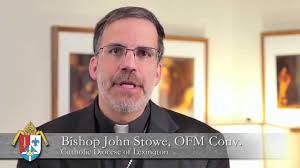
Last week, the bishop of Lexington, Kentucky, profoundly sharpened the recent controversy involving a student from Covington Catholic High School who confronted a Native American elder after this year’s pro-life march in Washington, D.C.

Writing an op-ed in the Lexington Herald-Leader, Bishop John Stowe attempted to deepen the entire conversation. He suggested changing it from superficial wrangling about the apparent disrespect the student displayed to a discussion of whether or not Catholics can support the current occupant of the White House and still be true to their faith.

Bishop Stowe said “no.” It’s a matter of faith, he said.

By taking that position, the Lexington bishop created what I would call a much-needed Dietrich Bonhoeffer moment for the church at a time when Mr. Trump exhibits traits and policies reminiscent of Adolf Hitler during his rise to power in the 1930s. (In the name of their faith, Bonhoeffer and members of his Confessing Church separated themselves from German Christians who supported der Fuhrer.)

The bishop’s words also incurred the wrath of Catholic Trump supporters much as Jesus in today’s Gospel selection sparked anger in his own hometown when he called his neighbors’ faith into question.

Let me explain.

First, recall the context of the bishop’s words. Then connect them to our reading and finally to Bonhoeffer and his church of resistance.  

As for context, a video of the stand-off between the high school student, Nick Sandman and the Native American, Nathan Phillips, had just gone viral. Initial viewings led many to condemn the student’s apparent disrespect.

Then, Sandman’s parents hired a P.R. firm to spin his side of the story. As a result, public commentary quickly changed from blaming the adolescent for his apparently offensive smirk. It centered instead on whose version of the story was correct. Was the student (as the PR firm put it) merely smiling in an attempt to deescalate a threatening situation? Or was he making fun of the Native elder by placing his grin inches from the old man’s face?

In an op-ed published in the Lexington Herald-Leader, Bishop Stowe reframed the debate by adopting the prophetic tack I just mentioned. He focused on the fact that the young student and many of his companions were wearing red “Make America Great Again” hats. That’s what the bishop found incompatible with Catholic faith and its comprehensive approach to life-issues.

He wrote:   

“Without engaging the discussion about the context of the viral video or placing the blame entirely on these adolescents, it astonishes me that any students participating in a pro-life activity on behalf of their school and their Catholic faith could be wearing apparel sporting the slogans of a president who denigrates the lives of immigrants, refugees and people from countries that he describes with indecent words and haphazardly endangers with life-threatening policies.”

In other words, Bishop Stowe was broadening the concept of being “pro-life” – the reason many Catholics back President Trump – to question that support itself. Catholic faith, the bishop implied, cannot tolerate Trump’s policies on immigration, refugees or other words or actions that disrespect Global South countries and endanger life (think capital punishment, drone assassinations, bombings, and illegal wars). Such behavior offends core Catholic beliefs about the inviolable sanctity of human life.

Specifically in reference to abortion, the Lexington bishop added:

“As the leader of the Catholic Church in the 50 counties of Central and Eastern Kentucky . . . I believe that U.S. Catholics must take a look at how our support of the fundamental right to life has become separated from the even more basic truth of the dignity of each human person. . .  While the church’s opposition to abortion has been steadfast, it has become a stand-alone issue for many and has become disconnected to other issues of human dignity.”

Still referencing the abortion issue, Bishop Stowe concluded:

“The pro-life movement claims that it wants more than the policy change of making abortion illegal but aims to make it unthinkable. That would require deep changes in society and policies that would support those who find it difficult to afford children. The association of our young people with racist acts and a politics of hate must also become unthinkable.”

Notice how these words unabashedly connect President Trump with racism and policies that embody hatred. They also recognize that many women are driven to abortion by government policies that make unplanned pregnancies problematic.

Now, that brings me to this Sunday’s Gospel reading and to Jesus’ words that “No prophet is accepted in his hometown.” I make the connection because dozens of people chose to comment very harshly on the bishop’s op-ed. Instead of dealing with the more comprehensive understanding of the phrase “pro-life,” they called Bishop Stowe vile names, brought up the pedophilia issue, and defended Donald Trump as God’s servant. I was surprised that some of the on-line language was actually permitted by the Herald-Leader’s editors.

It was like what happened to Jesus in today’s reading. There the Master himself is pilloried by his neighbors in Nazareth for challenging (like Bishop Stowe) their narrow religious prejudices. When Jesus reminds the people from Nazareth that God cares as much about Syrians and Lebanese as about Jews, they actually try to murder him.

As I said, that proved the truth of his saying that “No prophet is accepted in his hometown.” After all, prophets are those who speak for God. They connect God’s word to events of the day. And that’s what John Stowe did in his op-ed. He made the connection not only between the teaching of Jesus on the one hand and the event in Washington on the other. Echoing Dietrich Bonhoeffer and his Confessing Church, he also used the occasion to denounce Catholic support for latter-day fascism.

In similar circumstances 85 years ago, Bonhoeffer and the German Confessing Church courageously published their famous Barmen Declaration. It held that no one professing to follow Jesus could possibly accept Hitler as their Fuhrer; only Christ could hold that position.

In response, both Protestants and Catholics denounced Bonhoeffer and the others as traitors. Pope Pius XII would even persist in endorsing Hitler as “an indispensable bulwark against the Russians.”

The words of Bishop Stowe seem intent on preventing Catholics in his diocese from recommitting a similar error.

As a long-time Kentuckian and member of the loyal opposition within the Catholic Church, I’m proud of his courage. It’s time for Catholics and the rest of us to take Bishop Stowe’s words seriously.

Simply put, people of faith cannot support Donald Trump and still be authentic followers of Jesus. We must do all we can to frustrate Trump’s policies and see that he is not elected to a second term.

Yes, Bishop Stowe is correct: it’s a matter of faith!

Don’t Buy What Israel’s Selling: Support BDS

Readings for Third Sunday in Ordinary Time: NEH 8; 2-6, 8-10; Ps. 19: 8-10, 15; I Cor. 12: 12-30; Lk. 1:1-4; 4: 14-21 

In these days of rising right-wing fascism, a dangerous religious alliance has emerged. I’m talking about the supportive relationship between Christian Evangelicals and Israeli Zionists. For many, the basis of the support is the belief that Israel represents God’s Chosen People.

However, today’s liturgy of the word suggests something quite different for Christians honoring the Bible as God’s word. It underlines the point that the phrase “God’s Chosen People” does not primarily refer to a national entity, but to the poor and oppressed in general. It even implies that in our present historical context, the phrase “God’s Chosen” applies more aptly to the Palestinians than to the Zionists who kill Palestinians on a daily basis – without the least objection from our government or from most U.S. Christians. (In fact, since last March, Zionist soldiers have shot with impunity peaceful protestors in Gaza. They’ve killed more than 200 and wounded more than 18,000 — with many crippled for life — since the Palestinian rallies around the “Great March of Return” started on March 30th.)

Right now, this point about the identity of God’s People needs to be underlined because so many religiously-motivated people, and legislators in particular have taken such a strong stance against the Boycott Divest and Sanction Movement (BDS) that activists have directed against Israel to stop the slaughter in Gaza, which has been described as the world’s largest open-air prison camp. The conviction behind the divestment campaign is that a Zionist version of apartheid rivals South Africa’s hated system that economic boycotts, divestment and sanctions helped to bring down in 1994. (President Jimmy Carter’s book on the topic, Peace Not Apartheid, supports that conviction. So do the words I’ll soon quote of Dr. Martin Luther King.)

However, in response, anti-BDS legislators in Congress and in 26 of our states have proposed and/or passed legislation forbidding support of the movement. Anti-BDS legislation prohibits government investments, for example, in companies or in pension funds that support BDS. In some cases, anti-BDS laws even require employees (e.g. public-school teachers) to, in effect, pledge allegiance to Israel despite its genocidal policies.

Nonetheless, (as I said earlier) today’s liturgy of the word calls all of that into question.

Biblically speaking, it’s true that Israel did fit the “God’s Chosen” profile at the time of its origin – in Egyptian slavery (13th century B.C.E.) – and later during its captivity in Babylon (6th century B.C.E.). As poor and oppressed, they were “chosen” as well as when Israel was under the control of the Assyrians (8th century), Persians (6th century), Greeks (2nd century), and Romans (1st century). In all those instances, precisely as oppressed, Israel was the paradigmatic object of the biblical God’s special love and protection. In fact, at Mt. Zion, Moses enshrined in Israel’s law protection of people like them – slaves, widows, orphans, immigrants, the imprisoned, and the poor.

That’s the Law that the scribe, Ezra is remembered as reading to the people for hours in today’s first reading. They had just returned from exile in Babylon. For them “The Law” (the first five books of the Jewish Testament) was a source of joy and strength. After all, those books recounted what for Jews was the liberation of all liberations – from Egypt under the leadership of the great rebel hero, Moses. Now in the 6th century BCE, with Ezra in charge, they were celebrating the end of a long and painful Babylonian Captivity in the geographical area that is now “Iraq.” Ezra reminded the assembled people that in their return to the Promised Land, they were experiencing Exodus all over again. Indeed, he said, it was a time for celebration – for eating, as he put it, rich meats and drinking sweet drinks.

Today’s second and third readings pick up on Ezra’s theme – that God favors the poor and oppressed. However, both Jesus and Paul do so emphasizing the point that Yahweh’s favored ones are not always Jews.

When Jesus said that in his hometown synagogue (in the verses immediately following today’s excerpt), it enraged his former neighbors. “Who does this guy think he is?” the Nazarenes asked indignantly. “We know his family; he’s nothing special. Yet here he is speaking critically about his own people! He must be one of those ‘self-hating Jews’.” Luke says Jesus’ hometown citizens were so outraged that they tried to kill him.

Jesus’ words before the Nazarene’s attempted assassination do not merely underline the identity of God’s chosen as the poor and oppressed rather than exclusively the Jews. The words are also central in terms of Luke’s definition of Jesus’ entire project. In fact, they connect that project with God’s very identity as described throughout the Jewish Testament particularly by the prophet Isaiah whose words Jesus quotes: “The Spirit of the Lord is upon me, because he has anointed me to bring good news to the poor. He has sent me to proclaim release to the captives and recovery of sight to the blind.”

Did you notice the importance of the word “because?” It absolutely identifies the “Spirit of the Lord” with Ezra’s good news to the poor about release from captivity and recovery of sight. Jesus is saying we know that “The Spirit of the Lord is upon” him because he brings good news to the poor, those in captivity and the blind. Jesus goes on to say that his commitment to the poor is what will define his entire mission.

Today’s excerpt from Paul’s letter to the Greeks in Corinth continues that theme of Isaiah, Ezra, and Jesus. Only Paul does so in terms of a familiar yet powerful metaphor – what he calls the “Body of Christ” enlivened by the “One Spirit” of God. For Paul followers of Jesus constitute the way the Master is present today long after Jesus’ death. As that presence, we are Jesus’ hands, feet, eyes, ears, and tongue. And elsewhere Paul specifically says it makes no difference whether one is Jew or Greek, slave or free, male or female (GAL 3:28-29).

What does make a difference though is one’s social standing. Paul goes out of his way to say that the “less honorable” and the “less presentable” in Christ’s body are to be more honored and cared for than the more presentable and more honorable according to the standards of the world. The weaker parts, he says are somehow “more necessary” than the stronger parts. This could hardly be a clearer reference to the poor and those who are normally neglected and looked down upon. Here Paul is following the thrust of Jesus’ words and deeds by turning the social order upside-down. The poor and oppressed come first in God’s order.

Today, part of that revolutionary inversion is recognizing that Zionists have nothing positive to do with God’s preferences. Quite the contrary: as the Palestinians’ oppressors, they are the imperial analogues of the Egyptians, Babylonians – and yes, fascists – who persecute God’s Chosen.

Meanwhile, because they side with the poor to whom Jesus brought Good News, the BDS activists stand with Jesus – and Gandhi and Martin Luther King.

With last week’s MLK celebrations still fresh in our minds, and with today’s readings ringing in our ears, we do well to recall Dr. King’s words spoken on December 7th, 1964 – just days before he received the Nobel Peace Prize in Oslo. In a major address in London, he said,

“If the United Kingdom and the United States decided tomorrow morning not to buy South African goods, not to buy South African gold, to put an embargo on oil, if our investors and capitalists would withdraw their support for that racial tyranny that we find there, then apartheid would be brought to an end. Then the majority of South Africans of all races could at last build the shared society they desire.”

King’s words (and those of Jesus, Paul, and Ezra in today’s readings) are as true in relation to Zionist Israel as ever they were of South Africa. Today, the Palestinians not the Zionists are God’s chosen and should be treated as such.

Jesus, the Law, and “Les Miserables” of Today

Les-Miserables[1]

Readings for 2nd Sunday in Ordinary Time: Is. 62; 1-5; Ps. 96: 1-3, 7-10; I Cor. 12: 4-11; Jn. 2: 1-11

During our family’s recent Christmas trip to France, we spent a couple of evenings watching “on location” films. We saw Woody Allen’s “Midnight in Paris” and loved it. Owen Wilson did such a good job of imitating Allen himself. And seeing Wilson wander through the famous sites we were passing each day was great fun.

But on a more serious note, we also took in “Les Miserables” which was such a success back in 2013. At the Golden Globes that year, “Les Miserables” won the “best film” award in the category of musicals and comedies. Hugh Jackson was named best actor for his portrayal of Jean Valjean. Anne Hathaway won best supporting actress for her role as Fantine. She went on to win an Oscar as well.

Watching the film in France this time made it especially poignant. I ended up in quiet tears at its conclusion.

“Les Miserables” is Victor Hugo’s familiar tale of Jean Valjean, a Christ figure intimately connected with today’s Gospel reading about Jesus at the wedding feast in Cana.

Following the royal restoration after the French Revolution of 1789, Valjean was convicted of stealing a loaf of bread to feed his starving children. He was sentenced to twenty years of hard labor in the most brutal conditions.

Having completed his sentence under the watchful and threatening eye of the cruel Inspector Javert (Russell Crowe in the film), a bitter and vengeful Valjean journeyed homeward. As he passed through the town of Digne, he was given food and shelter by the kindly Bishop Myriel, the pastor of the local cathedral.

But Valjean is not impressed. He rises in the dead of night, steals the bishop’s silverware and candelabra, and flees the rectory. Soon he’s captured by the gendarmes. When he’s dragged back to the bishop by the police, Bishop Myriel secures Valjean’s release by confirming the thief’s lie that the stolen goods had been given him as a gift by the priest. Valjean cannot believe his ears. The bishop’s act of generosity, forgiveness, and mercy transforms him. He goes on to become a successful factory owner and champion of the poor.

However the former convict has broken his parole. So he’s pursued by his prison tormentor, Inspector Javert. Javert is determined to return Valjean to chains. The inspector is a lawman in the strictest sense of the word. He believes he is doing God’s work in pursuing Valjean, and often prays for success in his mission.

Nonetheless towards the film’s end, Javert falls into Valjean’s hands. His former ward has the opportunity to kill Javert with impunity for opposing the People in their revolution against the French crown. Yet Valjean refuses to do so, opting instead to follow the example of bishop Myriel, even though releasing Javert means Valjean will likely return to prison.

Javert can neither believe nor accept Valjean’s generosity. In his eyes, since the law has been broken, Valjean must pay the price. Yet Valjean has acted towards him with such generosity. . . . Javert doesn’t know how to handle such kindness. His life dedicated to law enforcement now seems entirely wasted in the light of Valjean’s compassion and wonderful disregard of the law. Confused and disheartened Javert commits suicide.

Of course, Victor Hugo’s tale is much more complex than that – and much more beautiful. (The singing and lyrics are gorgeous!) But that’s the story’s kernel – a portrayal of a conflict between love, compassion, and mercy on the one hand and respect for the law on the other. That’s what makes it relevant to today’s Gospel.

There we find Jesus attending a wedding. With the other revelers at this feast of seven days, he’s been dancing, singing, eating and drinking already for days. Then the wine runs out. The party is in danger of losing its spirit; the guests will go home; the bridal couple will be disgraced. So Jesus responds to the alcohol shortage by providing about 200 gallons of the best wine the partiers had ever tasted. Significantly, he takes the large stone vessels full of water for ritual washing according to Jewish law, and turns that water into wine. As a result, the fun never stops. And believers have never ceased telling this story – the very first of Jesus’ “signs” as John calls them. We’ve come consider them miracles.

But let’s take John at his word. He sees this rather trivial event at what turns out to be Jesus’ coming out party as a sign, a symbol, a metaphor. . . . (I say “trivial” because on its surface nothing “great” is accomplished. A party is saved from petering out. Some friends – the bridal couple and their families – save face. But was that worth this exercise of divine power?) Nevertheless, John says this is a sign. But of what?

The answer, of course, is that changing water into wine so early in John’s story constitutes an image providing indication of Jesus’ entire mission as John understands it. Jesus’ mission is to obey the spirit of the law even when that means disobeying its letter.

In John’s poetic narrative, the letter of the law is cold, hard, and insipid – as hard and frigid as the stone vessels John takes care to mention, and as tasteless as water in comparison with wine. But it’s even worse than that. The law as Jesus will criticize it in John’s pamphlet is routinely used against the poor (people like Valjean in Hugo’s tale) – the lepers, prostitutes, beggars, Samaritans, tax collectors, and the generally “unclean.” The law is used to oppress “Les Miserables.” Meanwhile, the privileged and elite use legalisms for their own benefit – to enrich themselves and elevate their prestige. Jesus, John is saying, has come to transform all of that.

He has come to change the water of the law’s letter into everything wine symbolizes. The wine of Jesus’ teaching and life is meant to lift the spirit. (It’s not for nothing that alcohol is called “spirits.”) Wine is red like blood not colorless and neutral like water. Wine relieves pain. It evokes laughter, and singing and dancing as it did for the revelers at the Cana wedding feast. Wine enlivens life which, John implies, has more to do with a seven-day party than with what happens in the Temple (or our churches!).

We need to be reminded of all that don’t we? That’s especially true today when the law is used so clearly against the poor, while the rich typically escape its reach. Think about the way our political “leaders” villainize the world’s most impoverished people. They tell us that the dirt poor are the cause of the very problems they and their rich friends have produced. (For example, the poor had nothing to do with the Great Recession whose disastrous effects are still ruining the lives of the poor and middle classes.)

Even worse, the coalition of the rich creates refugees by sending planes, missiles and drones to destroy the homes, schools, hospitals of already desperate people throughout the Middle East and Global South. They overthrow the governments the poor have elected, and afterwards install dictators and drug lords to take their places. Then they complain when the refugees they’ve created seek escape in countries like our own.

In the process, distressed mothers and their children are described as drug dealers, gang members, and murderers. So, in the name of unjust laws, our leaders rationalize the separation of pre-teens from their parents and even create baby jails. Meanwhile, the business of privatized prisons prospers, while their dungeons are increasingly filled with the poor and minorities.

In the meantime, the those who dedicate their lives to exposing such crimes are treated like Jesus and Valjean. The Julian Assanges and Chelsea Mannings — the whistle-blowers of the world – are arrested, tortured and threatened with life imprisonment. “The law is the law,” the criminal arresters remind us. Once again, it’s the story of Jesus and Jean Valjean all over again.

Like “Les Miserables,” John’s story of Cana can raise our consciousness about all of that. The tale of water turned into wine can move us to defend the poor, powerless, imprisoned and whistle-blowers that the law routinely oppresses. Jesus’ example calls us to celebrate “spirit,” and feasts, and food, laughter and dancing. It invites us to destroy by our own hands the law-worshipping Javert who resides within each of us.

Both John the Evangelist and Victor Hugo call us to imitate those who dedicate their scandalous lives to obeying the Spirit of God’s Law by disobeying the letter of human law.

France’s Yellow Vests: Their Program Should Be Our Program

As I reported recently, I spent my Christmas vacation tracking down and studying France’s “Yellow Vest” movement. In December, New York Times columnist Thomas Friedman did something similar. However, as expressed in his piece, “The End of Europe,” his conclusions mirror old threadbare thinking about social transformation. Most tellingly, while honoring the voices of the Yellow Vests as grassroots activists, Friedman’s responses exclude the very democratic input the Yellow Vests demand. Instead, he looks to government and business leaders to save what he termed “the idea of Europe.”    

My own conclusions are the reverse. I see the Yellow Vests as advocating a democratically radical, comprehensive and bottom-up approach to what distresses our world. In fact, the issues and demands of the Yellow Vests suggest proven reforms that are clearly feasible, since they’ve worked in the past. The economic and political restructurings implicit in their working-class demands could save our planet and create the other world that all progressives sense is possible. Consciously or unconsciously, the Yellow vests propose a program worthy of support by us all.    

Friedman & the Yellow Vests

According to Friedman, France represents the last barrier against the disintegration of Europe itself. Across the European Union (EU), England is committing collective suicide (because of Brexit), Germany is turning inward, and Italy (along with Greece) is in full rebellion against EU austerity measures. Meanwhile, the United States incipient withdrawal from the world increasingly leaves the continent without its traditional life insurance policy against “predatory threats from the East.” That insurance is needed now more than ever in a world where Russia is again asserting its power, and where China promises to become the center of the world.

However, Friedman says, the Yellow Vest Movement reveals that France itself is in danger of disintegration. The movement has arisen because the country’s working poor and anxious middle class have not benefitted from the liberal order of political-economy characterized by globalization, technological development, and mass migration of workers from the former Soviet Union and from France’s colonial empire. In the face of such developments, the poor have been completely marginalized, while robotics, artificial intelligence, outsourcing and competition from Chinese imports have made it increasingly difficult for middle class wage-earners to sustain accustomed life styles.

For France, all of this has been complicated by the ineptitude of its president Emmanuel Macron. On Friedman’s analysis, Macron has done the right things, but in an arrogant top-down, “let them eat cake” manner. The right things have included giving tax breaks to the rich, while imposing austerity (and job re-training programs) on workers. Austerity has meant raising taxes on diesel fuel, reducing pensions, and making it easier for employers to fire their workers.

In other words, Friedman approves of the very policies that have given rise to the “Yellow Vests” in the first place. For him, it’s just that austerity’s necessarily bitter pill wasn’t administered with the proper bedside manner.

And, according to the New York Times columnist, there is no apparent alternative. In the face of globalization, he holds that old solutions (simply cutting or raising taxes) cannot work. Instead, he vaguely calls for cities and local leaders to become “more nimble.” In his words, that means forming coalitions of business leaders, educators, and small entrepreneurs who can compete locally, regionally, nationally and globally.

That’s it. That’s Friedman’s analysis and solution.

Entirely absent from his considerations is any mention of “Yellow Vests” (i.e. working class) involvement in the solutions he finds so elusive.  That is, Friedman’s own approach, like that of Macron is entirely top-down. Like Macron he seems tone deaf to the “Yellow Vest” demand for inclusion in decision-making processes.

Necessary Changes in Consciousness

But what would such inclusion entail?

It would first of all necessitate changes in the very consciousness exhibited in the Friedman piece. These changes would include recognition of:

  • The Fundamental Failure of Capitalism: Friedman begins his article by celebrating capitalism. He writes “Ever since World War II, the liberal global order. . . has spread more freedom and prosperity around the world than at any other time in history. . .” Granted, such triumphalism might have been defensible (for those ignoring, for example, U.S. interventions in the Global South) before the dawn of the climate and immigration crises. However, today its uncritical hubris is embarrassing as the system’s train of destruction stretching back to capitalism’s dawning are seen as threatening the very continuation of human life as we know it. We can now see that capitalism has not really been successful. Quite the opposite. Persisting in lionizing the system while ignoring its run-away destruction prevents serious analysts from imagining the fundamental changes necessary to address the system’s basic failure. Apparently, it prevented Friedman from doing so.
  • Yellow Vest Criticism of Neo-liberalism: What consciously or unconsciously irks the international working class about neo-liberal globalization is the fact that the reigning economic model accords rights to capital that it steadfastly denies or severely restricts in the case of labor. It grants capital the right to cross borders wherever it will in pursuit of low wages and high profits. Meanwhile, it insists that labor, an equally important element of the capitalist equation, respect borders and/or severe restrictions on its mobility. Evidently, this is because the authors of the system (politicians, corporate boards, and lawyers) realize that freer movement of labor especially from the East or Global South would outrage constituents and consumers within industrialized countries in the developed world. The “Yellow Vests” prove that such outrage has taken hold in France and threatens to spread across the continent as workers from Europe’s former colonies extend and appropriate for themselves the logic of “free trade” heretofore acted upon only by capitalists and denied to labor. The immigration crisis is the result.

Necessary Reforms

As noted earlier, the Friedman article throws up its hands in surrender before the changes he describes as perhaps signaling the end of Europe. He writes, “Here is what’s really scary, though. I don’t think there are national solutions to this problem — simply cut taxes or raise taxes — in the way there were in the past.” So (to repeat) our author is left with the standard neo-liberal policies earlier described – trickle-down tax cuts for corporations and austerity for workers – implemented by the usual suspects with no mention of worker input.

None of that will work for the Yellow Vests. They want their voices heard. They want democracy at all levels. Such democratic ideal suggests changes far beyond the tired nostrums offered by Friedman – or perhaps even imagined by the French protestors themselves. These might include:

  • Democratized International Trade Agreements: Trade agreements like the European Union or NAFTA for that matter need to be negotiated with workers taking part. That means that the real EU question isn’t whether or not Great Britain should renegotiate its Brexit. The real issue is the reformulation of the EU Charter itself. The whole thing has to be rethought with the circle of negotiators widened to include all stakeholders. This means going beyond politicians, corporate heads, and lawyers to include trade unionists, environmentalists, indigenous peoples, educators, social workers, women, and representatives of children. In the process, each stake-holding group must have equal votes to complement their intellectual input. The same holds true for NAFTA.
  • Democracy at Work: Workers like the Yellow Vests spend most of their lives at work. Hence, their demands for democracy suggest, that any concept of self-governance must be broadened from the exercise of voting franchise every few years to include democracy at work. In its most effective form, democracy there takes the form of worker-owned cooperatives, where workers decide what to produce, where to produce it, and what to do with the profits. Enterprises of this type would never elect to pollute their neighborhoods, to pay outlandish salaries to administrators, to move their firm to a foreign country, or to lay off workers because of technological advance (all Yellow Vest complaints). Introducing such change is entirely possible. For instance, since 1985 Italy has taken steps to favor cooperative ownership. According to the country’s Marcora Law any company going out of business must extend to workers the right of first refusal in the case of a firm’s transfer of ownership.
  • Democratization of the New Technology: Democratic movements like the Yellow Vests need not be Luddite vis a vis the introduction of new technology. Instead, they might welcome any “labor saving” technologies. However, the point of such introduction would not be to down-size the labor force, but to shrink time spent on-the-job. For too long computers and artificial intelligence have been used by employers to cut labor costs and increase profits rather than to expand worker free time. By contrast, worker-friendly technological policies could make widespread job-sharing possible to eliminate unemployment. Four-hour workdays could replace present overwork. It could become possible to work only 6 months per year, or to take sabbaticals every few years without any reduction in pay.
  • A Green New Deal: Part of eliminating unemployment entails implementation of a Green New Deal (GND) to address climate chaos in ways that mirror Roosevelt’s original New Deal to combat the disastrous effects of the Great Depression. Prominent among the GND’s provisions must be the contemporary equivalent of the old Civilian Conservation Corps – this time to accomplish the environmental ends that the economy’s private sector is unwilling or unable to achieve.  
  • A Marshall Plan for the Former Colonies: To reverse the influx of immigrant workers, the former colonial powers must stop the wars and environmental policies that end up creating refugees and migrants in the first place. This means, first of all, ending their resource-wars and the failed war-on-terrorism. Secondly, however, the old colonists need to implement a New Marshall Plan in Latin America, Africa, and South Asia, where centuries-long resource-extraction policies have created the very poverty, hunger, and unemployment that has transformed the Global South from a natural paradise to a cauldron of social inequities. Besides being a remedy for the migration crisis, a grand Marshal Plan for the Global South is a matter of reparations.
  • Implementation of the NIEO: Specifically, reparations should entail something like the implementation of the New International Economic Order (NIEO) demanded by the Group of 77 within the United Nations in 1974. The New Order would grant Global South countries the power to control multinational investments within their borders. Recognizing that no country has ever achieved “development” as a mere supplier of raw materials to already industrialized countries, the order would require the latter to make large transfers of capital to the former colonies in the form of money and technology. It would also guarantee stable prices for raw materials from previously colonized nations in exchange for finished products (like tractors and computers), with the prices for the latter indexed to the established value of the raw materials.
  • Implementation of A New World Information and Communication Order (NWICO): As recognized by the UNESCO McBride Report in 1980, the former colonies need not only a new economic order, but one in which special attention is given to the international flow of information. The Global South needs a world information system that gives its inhabitants themselves the ability to portray and understand their own reality rather than being dependent on their former keepers for information about their lives, cultures and politics.     
  • Deep Cuts in Military Spending: All of this would be financed by higher taxes on the world’s 1% and by developed world cuts in military spending. Such increases and cuts would (1) recognize that the present war on terror is an utter failure, and (2) divert money now spent on attacking countries in the less developed world to constructive projects there such as rebuilding homes, schools, hospitals, power plants and water purification systems. Arguably, this would do more to combat terrorism than wars and bombing campaigns which many see as aggravating the problem of global terror. Again, this is a question of reparations.  

Conclusion

The elegance of the just-listed responses to France’s Yellow Vests and to the crisis of the neo-liberal order the protestors are rebelling against is that they are not new. In the cases of the New Deal and Marshall Plan, they enjoy a proven track record. At the same time, the prescriptions are much more detailed than the abstract cliches reflected in Thomas Friedman’s endorsements of neo-liberal austerity and “more nimble” decision-makers drawn from the professional classes.

Instead, the suggestions just listed have been with us since the 1930s (in the case of the New Deal), since the 1940s with the Marshall Plan, and since the mid’70s and early ‘80s with the proposed NIEO and NWICO. For their part, as Richard Wolff points out, worker co-ops have been hugely successful, for instance in the Mondragon Corporation in Spain and throughout the world, including France and the United States. Across the globe, worker cooperatives already employ 250 million people and in 2013 represented $3 trillion in revenue. Meanwhile, a huge body of literature from the 1960s and early ‘70s described a world in which computers and robotics would be used not to one-sidedly increase corporate profits, but to provide lives of leisure and enjoyment for ordinary people.

None of this is unrealistic, dreamy or impractical. In other words, we have the Yellow Vests to thank for helping us recall that another world is not only possible, but that we’ve already experienced it!