China’s Example and the Need to Rethink Democracy Itself

More than a year ago, OpEdNews’ visionary editor-in-chief, Rob Kall, started a project called the Arc of Justice Alliance (AJA). Its original intent was to offer a progressive alternative to the Republican Project 2025. The latter’s goal is to reduce the federal government to a size (in the words of Republican operative Grover Norquist) that could be drowned in a bathtub.

The AJA agenda would rescue democracy from Norquist’s tub.

But what exactly might that mean in a political environment where the old slogans no longer persuade anyone. Frankly put, “defending democracy” sounds hollow when millions increasingly suspect that what we call democracy has already been purchased, managed, and stage-directed by forces far beyond ordinary citizens’ control.

What I intend to argue here is that if the AJA hopes to become more than another mildly progressive pressure group orbiting around a dying Democratic Party, it must become far more radical in addressing the fact that in terms of “democracy,” the United States is a failed state. It must reform to a system more closely resembling China’s “whole process democracy.”

A Failed Epstein State  

Facing America’s failure might be uncomfortable. However, the facts speak for themselves.  “Our” country is not governed primarily by its voters. Instead, it is run by what might best be called the Epstein Class.

By that phrase I do not mean only the disgraced financier Jeffrey Epstein himself. Epstein has become symbolic of something much larger — a transnational ruling network of billionaires, intelligence operatives, media owners, financiers, weapons contractors, corporate monopolists, and political fixers whose power transcends elections and party labels.

Others call this network the “Deep State.” But that term can become too vague or conspiratorial. “Epstein Class” points more directly to the fusion of wealth, secrecy, sexual compromise, surveillance, and political immunity characterizing elite power in late capitalism.

The point is not that every billionaire belongs to a secret cabal meeting in underground bunkers. The point is structural. Wealth itself has become sovereign. Under contemporary capitalism, money no longer merely influences politics. It governs politics.

This is why elections change so little.

Wars continue regardless of campaign promises. Wall Street remains untouchable. Pharmaceutical corporations write healthcare policy. Silicon Valley harvests personal data with almost no restraint. Intelligence agencies operate beyond meaningful democratic oversight. Billionaires evade taxes while homelessness explodes beneath the skyscrapers they own.

And yet we are constantly told we live in “the world’s greatest democracy.”

The AJA should challenge that phrase directly.

Because what if the central political issue of our time is not “democracy versus dictatorship,” but rather which class exercises dictatorship?

That was, of course, the insight of Karl Marx. Marx argued that every state ultimately serves one ruling class or another. Under capitalism, democratic institutions often mask what is essentially the dictatorship of wealth. We live under the dictatorship of the Epstein Class.

In America today that dictatorship increasingly stands exposed.

China’s Democracy

Ironically, this is where China enters the conversation in ways many Western progressives still fear to acknowledge.

Western media constantly portrays China as authoritarian. And certainly, the Chinese Communist Party exercises centralized authority in ways foreign to American political culture. But the deeper question is rarely asked: centralized authority on behalf of whom?

China’s defenders argue that the CCP, whatever its flaws, governs primarily in the interests of long-term national and collective development rather than in the interests of an unrestrained billionaire oligarchy.

One need not romanticize China to recognize the force of that claim.

Over the last forty years China has lifted hundreds of millions out of poverty, constructed immense infrastructure systems, expanded public transportation, modernized entire regions, and maintained long-range national planning capacities almost unimaginable in the contemporary United States.

Meanwhile America’s political system appears increasingly incapable of governing at all.

Bridges collapse. Infrastructure decays. Healthcare bankrupts families. Universities drown students in debt. Entire cities become unaffordable. And yet the billionaire class accumulates wealth on a scale previously unimaginable in human history.

This is why the AJA must begin questioning not simply particular policies, but the very definition of democracy itself.

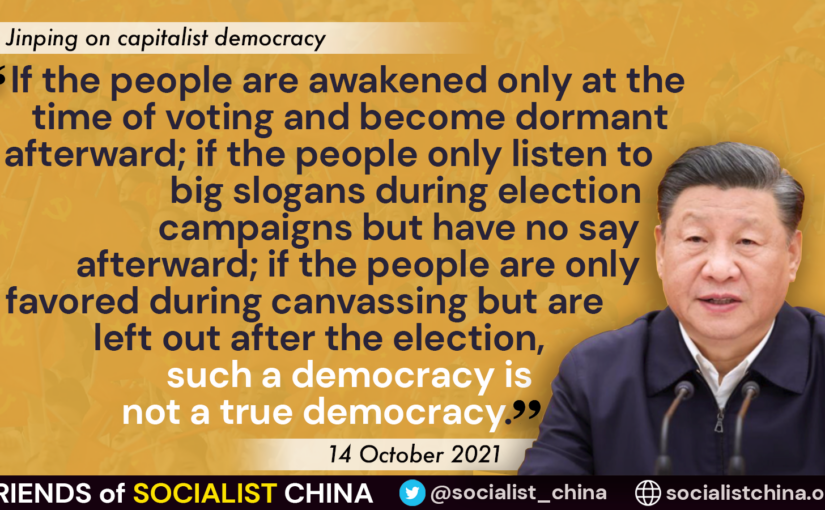
China’s political system offers at least one important conceptual challenge through its notion of “whole-process democracy.”

Whole Process Democracy

To Western ears the phrase often sounds like propaganda. But its underlying critique of Western liberal democracy deserves serious attention.

Western democracies generally define democracy procedurally: elections, competing parties, free speech, and formal civil rights. Chinese political theory argues that such democracy is incomplete because it leaves economic power largely untouched.

What good is voting, Chinese critics ask, if billionaires own the media, shape public consciousness, finance political campaigns, dominate economic life, and effectively dictate policy no matter which party wins office?

Chinese “whole-process democracy” proposes that democracy should involve continuous public participation throughout governance — consultation, planning, implementation, supervision, and evaluation — not merely occasional voting rituals.

Equally important, Chinese theorists insist democracy must be evaluated not only by procedures but by outcomes: poverty reduction, healthcare, infrastructure, education, housing, stability, and collective well-being. In other words, Chinese democracy is not procedural; it is consequentialist.

Again, one need not idealize China to recognize how devastating this critique becomes when applied to the United States.

Because by those standards, America’s democratic system increasingly looks dysfunctional and oligarchic.

The AJA should say this openly.

Practical Goals

Indeed, the Alliance should become one of the few organizations in the United States willing to demand a redefinition of democracy itself.

That redefinition would begin by acknowledging at least four realities.

  1. Democracy cannot exist where billionaires dominate the economy, media, intelligence structures, and political system simultaneously.
  2. The “free market” has evolved into a form of private tyranny insulated from democratic accountability.
  3. What Americans call “freedom” increasingly means freedom for oligarchs to exploit, speculate, surveil, monopolize, and destabilize society itself.
  4. A functioning democracy requires some form of permanent public authority strong enough to restrain oligarchic power.

This last point is especially difficult for Americans because our political culture has long distrusted centralized authority. Yet history increasingly suggests that Norquist’s bathtub and Project 2025 did not eliminate concentrated power. It merely transferred power into private hands.

Democracy w/ Chinese Characteristics

China’s concept of “socialism with Chinese characteristics” emerged precisely from this recognition. The “Chinese characteristics” refer not only to economics but to China’s deep civilizational traditions emphasizing social harmony, collective responsibility, long-term planning, and state obligation toward public welfare.

Influenced by centuries of Confucius and Confucian political philosophy, Chinese political culture traditionally viewed government not as a neutral referee between competing private interests, but as guardian of social balance and national continuity.

That outlook was reinforced by China’s traumatic “Century of Humiliation,” when foreign powers fragmented, occupied, and exploited the country. From the Chinese perspective, weak government invited chaos, colonization, and national disintegration.

Consequently, modern China developed a system combining market activity with strong state direction over finance, infrastructure, industrial policy, and long-term development.

In this, western critics see authoritarianism. Many Chinese citizens see protection against billionaire fragmentation and social collapse.

Conclusion

The AJA need not endorse every aspect of the Chinese model. But it should have the courage to learn from it.

At minimum, the Alliance should recognize that what presently exists in the United States is not genuine democracy but governance by the Epstein Class — a billionaire oligarchy shielded by intelligence systems, media control, campaign financing, and corporate monopolization.

And once that truth is acknowledged, new political possibilities emerge. Those possibilities include:

  1. Recognition that the real enemy of democracy is the Epstein Class that must be controlled and directed towards serving the rest of us.
  2. This means that democracy should no longer mean merely choosing between competing representatives of the same donor class every four years.
  3. Instead, it should mean collective power over finance, healthcare, media, technology, housing, infrastructure, and long-term social priorities.
  4. In summary, democracy should mean subordinating wealth to human need rather than subordinating human beings to wealth.

The bottom line here is that the central struggle of our century will not be between democracy and dictatorship at all. It is a contest between the dictatorship of billionaire capital and some new democratic form of collective public authority capable of restraining it.

If the Arc of Justice Alliance truly hopes to change America, it must become bold enough to say so. It must directly confront anti-Chinese propaganda and be willing to learn from Chinese experience.

Russia in Ukraine: Champion & Proxy for the World’s Oppressed

I never thought I’d live to see something like the biblical battle of Armageddon unfold before my eyes. But it’s happening, I’m convinced, as we speak.

However, in this case, the field of battle is not the fabled Plain of Esdraelon. In this case, it is the entire country of Ukraine.

I put it that way because the war in Ukraine is far more than a conflict between Russia and NATO. It’s far more than a proxy war between the U.S. and its former Cold War foe. No, the Ukrainian conflict represents at the very least an opening salvo in the long-awaited definitive showdown between the world’s oppressed and those who have subjugated them for half a millennium and more.

In other words, (as even U.S. officials have agreed) the war in Ukraine is surely a proxy affair. But in this case, I’m arguing, Russia is a stand-in for the world’s oppressed. NATO on the other hand is an umbrella organization whose core comprises Europe’s and the New World’s traditional colonizers. It represents the oppressors. (Grasping that fact, as the poorer countries evidently have, explains why virtually the entire Global South has refused to get on board with NATO’s proxy war.)

I realize that no one is saying what I’ve just written. I realize too that at first glance saying so might seem outrageous. After all, the dominant and simplistic narrative, “Russia bad, NATO good” is carrying the day.

So, let me explain by first presenting my reasons for identifying Russia as the champion of the world’s oppressed. Then, I’ll describe NATO as a desperate union of former colonial powers losing its larcenous grip on the world. Finally, I’ll try to show how Armageddon in Ukraine holds the possibility of producing a new and better world order.

Russia as Champion of the Oppressed

But you might object, surely, you’re not saying that Russia can be classed with the oppressed Global South.

However, that’s exactly what I’m saying. And I’ll tell you why.

After its rise from its Czarist ashes in 1917, Russia used its version of socialism to become in record time a kind of superpower. As phoenix, it quickly transformed from Europe’s most backward nation into a worthy opponent of the United States and its European allies. The development of the USSR’s nuclear capabilities insured a level of invulnerability against direct attacks from the colonial powers in Europe and America.

Despite the revolution’s many mistakes, Russia’s example frightened beyond description the capitalist nations. Its success inspired revolutions throughout the latter’s vast colonial holdings in Africa, Latin America, and South Asia.

Capitalist panic increased exponentially when China’s socialist revolution colored red its 20% of the world’s population in 1949. The fear rose higher still in 1959 when socialism entered the sphere the United States claimed as its backyard in the form of Cuba’s successful revolt against U.S. hegemony – and even higher in 1979 when Nicaragua attempted to establish a socialist system within driving distance of U.S. borders.

Opposing all of this involved a 70-year Cold War intended to thwart the possibility of any other former colonies imitating Russia’s and China’s socialist triumphs which removed them so rapidly from the list of the world’s underdeveloped countries.

Thwarting worldwide socialist aspirations involved a familiar four-step pattern invariably implemented by the U.S. and its allies relative to their former colonial possessions: (1) install a puppet government by hook or crook, (2) equip that regime with police and military hardware to eliminate from society all communist and socialist elements, (3) rob the country blind of its valued assets and (4) repeat steps one and two as necessary should the proxy puppet decide to disobey imperial orders.

Well, long story short, here comes Russia’s reduction to Third World status for fully a quarter century.

That is, when the Soviet Union fell apart in 1991, the U.S. and other colonial powers quickly followed the above pattern. They (1) installed a puppet government – this time under the “leadership” of Boris Yeltsin. (2) They used Yeltsin to largely neutralize Russian communists already drastically weakened and discredited by the widely perceived failure of all things Marxist. (3) Yeltsin obediently did the puppeteers bidding reducing his country to Third World status by selling off Russia’s publicly owned assets at fire sale prices to invading capitalist opportunists. He thus left the Russian people with nothing while creating a whole new class of billionaire mafia oligarchs. Then, after Yeltsin drank himself out of his job, the west endorsed Vladimir Putin as a worthy replacement marionette. (So far, so good.) (4) However, when Putin unexpectedly proved less than reliable (like other puppets such as Manuel Noriega and Saddam Hussein) it became necessary to discredit and replace him. After all, he tried to tame the oligarch class and objected to NATO threats to the Russian independence he unacceptably sought to restore. So, the imperialists embarked on their tried-and-true regime change gambit.

That’s where the Ukraine War fits in. As Joe Biden admitted, NATO wants Putin out of office. And as Secretary of Defense, Lloyd Austin put it, “We want to see Russia weakened” (i.e., returned to its third world status as “a gas station masquerading as a country.”) And as John Bolton recently admitted, regime change is for the United States its standard outlaw operating procedure.

But unlike Third World victims of similar imperial thuggery, Putin would have none of it. Unlike those others, Russia had managed to retain credible means of defending itself. Its well-trained and expertly led military was still intact and it possessed the world’s largest stockpile of nuclear weapons. Moreover, all of Europe was dependent on that Russian gas station – as well as on its supply of grain and fertilizer. Putin had those aces up his sleeve. They distinguished him from his less advantaged Global South counterparts. So, he found himself willing and able to take on the oppressive west either directly or by proxy.

Additionally, even though he presents himself as an enemy of socialism, the clever leader of the largest country in the world allied himself with the planet’s most populous country which happens to be socialist. Of course, I’m referring to China. It too is a nuclear power and is armed to the teeth. After what it calls its “century of humiliation” by the west (1839-1949) China has vowed never again to experience such imperial subjugation, come what may.

According to Russia’s and China Declaration of a NEW WORLD ORDER (Feb. 4, 2022) the friendship between the two countries “knows no limit.” That means that capitalist Russia (with its socialist history and large communist party) has allied itself with its ally’s “socialism with Chinese characteristics.” Together they have pledged to establish a new era of sustainable development. In its service, they have specifically expressed their refusal to submit to U.S. hegemony. (I’ll return to this point later.)

NATO’s Union of Oppressors

Of course, the U.S. led NATO has been slow to understand the changed circumstances I’ve just described. Having performed their four-step tango in Ukraine, they’ve made the mistake of underestimating their Russian opponent. They’ve continued to treat it like some banana republic.

Explicitly attempting to throttle the Russian economy (to “make it scream” as Kissinger described the dance in Allende’s Chile) the western colonial powers have failed miserably.

Instead of making Putin’s economy shriek, their own economies are the ones suffering from the “mother of all sanction regimes” vaunted by Biden and company.

The sanctions have backfired in Europe and the United States with the recoil taking the form of general inflation and unacceptable price tags on fuel and food. It’s as if NATO members have sanctioned themselves.

Meanwhile, Russia’s economy remains relatively unaffected. As a result, NATO leaders are facing angry electorates in Great Britain, France, Italy, Germany, and America, while Putin’s popularity in Russia soars. Watch the political heads roll. Bojo has just resigned from Downing Street, hasn’t he? Macron has lost his majority. Italy’s Draghi will likely fall next. Then it will be Biden’s turn.

Who’s gloating now? Is that a satisfied smile I see crossing Mr. Putin’s face? Is that cheering sound in the background coming from the Global South as it finally witnesses their imperial oppressors getting their just deserts from their new champion?

The Emerging New World Order

Where all of this will likely lead is no mystery. The destination has already been envisioned in detail. It is an order that incorporates the west’s former colonies as respected partners rather than as objects of exploitation.

Towards that end, on February 4, less than three weeks before the onset of Russia’s “special military operation” in Ukraine, Russia and China issued a 12-page declaration with the mouthful title “Joint Statement of the Russian Federation and the People’s Republic of China on the International Relations Entering a New Era and the Global Sustainable Development.” (The declaration was largely ignored in western media.)

There, the combined superpower alliance (calling itself “the Sides”) directly challenged the United States. The statement’s parties minced no words in criticizing the expansion of NATO and similar military alliances (specifically, the one between the U.S., Australia, and Great Britain called AUKUS). The sides rejected such unions as remnants of the long-ended Cold War concealed under deceptive rhetoric about the spread of democracy.

The joint statement also proclaimed the strength of the two powers and their refusal to submit to U.S. hegemony. Towards defending themselves against that now defunct unipolar arrangement, they announced a new Russia-India-China East Asian Cooperation Association. It will include, they stated, mutual trade and defense provisions whose purpose is “peaceful and gradual development” across the planet without arms races or nuclear proliferation.

According to the Side’s declaration, such alliance should be seen by everyone as mutually beneficial. Therefore, the new Asian trade partnership and China’s Belt and Road Initiative should be encouraged and joined (not opposed) by the rest of the world. Their purpose after all is to help developing countries catch up with the developed world by prioritizing sustainable transport and fighting climate change.

As for democracy, the Russia-China joint declaration recognized that no one system fits every context. The validity of various systems (based on specific national and cultural contexts, histories, and traditions) should be recognized by all. According to the Sides, it is up to the people of individual countries (not outsiders) to judge whether their country is democratic. They further affirmed that outside interference in the name of foreign concepts of democracy and human rights only incites divisions within given countries and undermines local systems.

Finally, the Sides called for world peace founded on true multilateralism, mutual respect, peaceful coexistence, and win/win cooperation. The new order, they said, should be based on international solidarity rather than on artificial divisions, confrontation, and the law of the strongest. This means the end, they asserted, of international bullying, idiosyncratic “rules,” and arbitrary sanctions.

Instead, the Sides called for international relations governed by the United Nations and the World Trade Organization. Only under such predictable international governance, they said, can regionally balanced powers have a chance of being respected.

It should be no surprise then if the Global South welcomes the proposed new order and suspects that the war in Ukraine has its interests at heart.

Conclusion

In the light of what I’ve just sharedis it an exaggeration to describe the war in Ukraine as an Armageddon showdown? Perhaps. However, at the very least (and by the accounts of many) the war portends a shift in global power from unipolarity to multipolarity. And that can only be good.

Moreover, in Ukraine, we’re dealing with an agent of that shift that enjoys vital links not only with the Third World, but with world history and culture. All of us are hugely indebted to Russia which should be seen as an ally whose record identifies it as an irreplaceable beneficiary of humankind instead of a one-dimensional axis of evil.

Think of what Russia has conferred on us all by way of art, music, and politics. Think Chagall, Tolstoy, Dostoevsky, Pasternak, Stravinsky, Nureyev, and Pavlova. Think of Russia’s political accomplishments as the first nation in the world courageous enough to experiment with socialism as an alternative to capitalist exploitation. Despite its numerous inevitable, and lamentable errors, the new system demonstrated its power to lift an entire people out of misery in an extremely short time. Think of how its Great Patriotic War played the key role in the defeat of Nazism, though at the cost of 22 million deaths of its heroic people.

Though we might not be witnessing in Ukraine Armageddon’s final confrontation between good and evil, we’ve got to go beyond the official narrative of “Russia bad, NATO good.” It’s simply not true. The reality is much more complicated. NATO, I’m arguing is closer to bad, and Russia to good.

And we shouldn’t be surprised if the poorer nations see it that way.