(Sunday Homily) Transforming Our Addiction to Child Sacrifice

child sacrifice 2

Readings for 2nd Sunday of Lent: GN 22: 1-2, 3A, 10-13, 15-18; PS 118: 10, 15-19; ROM 8: 31B-34; MK 9: 2-10

Question most Americans – perhaps the majority in this congregation – and they would profess pride to be able to sacrifice their sons and daughters to defend “American interests” even in far off places like Iraq and Afghanistan.

Question the Christians among us, and many would shed no tears over the innumerable children incinerated by our drones, napalm, and white phosphorous. Of course, we’d rather avoid such casualties, but collateral damage is collateral damage.

Question most of us benefitting from our present economic system. Tell us that it causes 30,000 children to die each day from perfectly preventable causes like starvation and diarrhea, and most will simply shrug. We accept such deaths as the inevitable cost of doing business. It’s preferable that children die rather than interfere with the out-workings of the global free market. (Even though it ends up giving 85 men as much wealth as the world’s 3.5 billion poorest.)

In other words, most of us – even the most “pro-life” among us – have little problem with most forms of child sacrifice. In fact, it’s not far off to say that most who identify themselves as pro-life are not really pro-life, but simply anti-abortion. Otherwise, child sacrifice is perfectly acceptable and even celebrated.

Today’s liturgy of the word (centering on the “transfigurations” of Abraham and Jesus) calls all of that into question.

First of all, consider the familiar story of Abraham and Isaac, its rejection of child sacrifice, and how it transfigured or transformed the roots of Jewish faith.

At first glance, the text seems to praise the great patriarch for his readiness to plunge a knife into Isaac’s heart. It has God saying, “For now I know that your fear God, since you have not withheld your son, your only son from me.” It’s as though Abraham’s readiness to do violence to his son were a unique proof of his faith.

Such understanding however is to forget that in ancient Mesopotamia it was required of all parents to sacrifice their firstborn sons. So despite the text’s claim, there would have been nothing remarkable about Abraham’s willingness to sacrifice his son. Everyone in Abraham’s culture had that sort of primitive “faith.”

Scripture scholars conclude that the words just quoted (“For now I know that your fear God, since you have not withheld your son, your only son from me.”) represent an editorial addition inserted centuries after the reported event, when people no longer remembered the ancient and universal requirement of tribal gods to sacrifice the first-born of family and flock.

The editors were priests and scribes in service to Israel’s royal family. They adjusted the Abraham story to suit their employers’ needs for patriotic cannon-fodder. This explains the addition of the words indicating God’s pleasure at parents’ willingness to sacrifice their children.

In contrast to that textual adjustment, and as originally told, the Abraham-Isaac tale was about the ancient patriarch’s transfigured understanding of God. It was about his discovery of Yahweh as the God of Life who prohibited rather than required child sacrifice. [Note that even in this morning’s English translation, it is “God” (meaning Baal, the biblical name denoting foreign idols) who gives Abraham the order to sacrifice his son. But it is “the Lord” (meaning Yahweh, the God of Abraham) who tells the patriarch to stay his hand.]

So Abraham’s real merit is found not in his willingness to sacrifice his son, but in his unwillingness to do so.  In that sense, Abraham in this instance is like Yahweh, the non-violent God of life, who (Abraham discovers) never endorses child sacrifice. That realization should have transfigured Abrahamic faiths forever. Unfortunately, it did not.

Jesus carries on and expands Abraham’s insight.  He rejects violence of any type. He is the one who said: “love one another. Love your enemies. Forgive one another. Be compassionate. Be merciful. Seek God’s reign and God’s justice. Put away the sword. Rise and do not be afraid.”

Today’s gospel about Jesus’ “transfiguration” concludes with a voice directing us to “Listen to him.”

If we did, our world would indeed be transfigured. We would be transfigured – totally transformed.

What do you think is entailed in Jesus’ call – in Abraham’s call – to non-violence? How do we “listen to them?”

Discussion follows

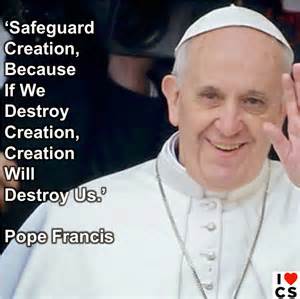
(Sunday Homily) Pope Francis on Climate Change: Nature Never Forgives!

Francis creation

Readings for 1st Sunday of Lent: GN 9: 8-15; PS 25: 4-9; I PT 3: 18-22; MK 1: 12-15

Pope Francis is going to be a busy man this spring. In June he’ll publish his much-anticipated encyclical on climate change. He’ll then convoke a meeting of world religious leaders to discuss the topic. Presumably, they’ll endorse the encyclical’s main points.

Then in September, the pope will travel to New York to bring the message of those leaders to the United Nations. Afterwards, he’ll head off to D.C. to do the same before the U.S. Congress.

Clearly, the pope is a man on a mission. At the age of 78, he’s evidently experiencing a sense of urgency. He has a clear spiritual and practical vision for saving the world from impending disaster brought on by unregulated industrial capitalism and by a neo-liberal world order that he has rejected out of hand on more than one occasion during his brief reign as Supreme Pontiff.

The liturgy of the word for this first Sunday of Lent highlights the pope’s concern for the environment and calls us to become visionaries like him – and especially like the young prophet, Jesus of Nazareth, as depicted in today’s Gospel.

Take this morning’s first reading. Its focus, like the pope’s, is environmental destruction. Genesis, chapter nine gives the ending of the familiar story of Noah and his Ark.  There God makes a promise (3 times in fact) to Noah, his sons, their descendants, and (significantly) to the birds and animals, that he will never again destroy “all bodily creatures” by flood waters.

The Responsorial Psalm then reminds us that we can trust God’s word, because God, in the psalmist’s words, is compassionate, loving, kind, good, upright and just.

It’s that loving God whose Spirit in today’s gospel drives Jesus out to the desert for his “Lenten Retreat” – 40 days and nights of prayer and fasting. The Spirit sends him on a vision quest intimately connected with Pope Francis’ vision for the world’s future.

Recall the circumstances of Jesus’ quest. John the Baptizer has just baptized Jesus as one of his disciples. On emerging from the waters of the Jordan, Jesus receives a startling revelation about his true identity. A voice from heaven addresses him, “You are my beloved son,” it says.

Surprised and perhaps shaken by that revelation, Jesus retreats to the desert to determine what it all might mean. As I said, it’s a vision quest. And immediately the visions come – more heavenly voices, Satan, angels, and wild beasts.

All of these elements are important. They belong to Israel’s “apocalyptic” tradition – a highly political genre promising the overthrow of the nation’s imperial oppressors. Jesus’ visions call him to continue the work of John the Baptist, who, Mark informs us, has just been arrested. Jesus’ task is to announce the proximity of “God’s Kingdom.” It’s a world where God is king instead of Caesar. It’s a world like the one promised in the Book of Genesis.  There human beings live in complete harmony with their Heavenly Father/Mother, with one another, with animals, birds, fish, and plants.

That’s the vision Pope Francis will evoke in his upcoming encyclical. If his past statements are any guide, he’ll remind us that God may have promised not to destroy the earth by flood. But Mother Nature has given no such guarantee.

A month ago, on his flight to Manila, the pontiff told reporters, “God always forgives, we sometimes forgive, but when nature — creation — is mistreated, she never forgives!”

This Lent we would do well to ponder those words and to implement changes in our own spiritual, political and economic visions to prevent a disaster completely reminiscent of Noah’s familiar story.

What Lenten changes do you think most appropriate – for us as individuals and for our country?

Discussion follows

(Sunday Homily) Ten Reasons for Hope in a Time of Despair: Empire Is Crumbling before Our Eyes

Syriza (SYRIZA Poster: http://keithpp)

Readings for 4th Sunday in Ordinary Time: JB 7: 1-4, 6-7; PS 147: 1-6; I COR 9: 16-19; 22-23; MK 1: 29-39 http://www.usccb.org/bible/readings/020815.cfm

Today’s liturgy of the word is about hope in a world wracked by despair. All of us are starved for such hope. In fact, discouragement and apparent powerlessness describe not only our personal consciousness but the larger zeitgeist that is the constant focus of these Sunday reflections dedicated to confronting the world with the Bible in one hand and the newspaper in the other. Today’s confrontation should help progressives realize that our times are actually changing for the better.

Think of the most recent historical roots of today’s despair – the way the world was just 20 years ago. As described recently by Andre Vitchek, it was an unbelievably hard time for opponents of empire.

Then think of how things are different today. It’s the difference between the condition of Job in this Sunday’s first reading, and the healing Jesus brought to the poor in today’s gospel selection.

Twenty years ago Russia was controlled by Boris Yeltsin, a boozy western puppet who betrayed his own people. Like Yeltsin, other heads of state throughout Eastern Europe joined their western counterparts in a shameless surrender to imperial interests. They were largely “led” by the offspring of the elites who preceded them. China 20 years ago was still under the spell of the free market reforms introduced by Deng Xiaoping. Meanwhile, Latin America reeling from decades of dictatorships imposed by the West had turned its economies over to neo-liberals trained in the Chicago School of Economics. The same was largely true of the Middle East and Africa. In those cases, dictators and the one-percenters were firmly in control. Christian vision of a kingdom where the earth belonged to everyone had been completely hijacked by religious fundamentalists and reactionaries including in his own way, the pope of Rome. All of this was largely hidden by both local and international mainstream media (MSM) which applauded dictatorships and plutocracies as “emerging democracies.”

Those were indeed hard times for anti-imperialists. I remember the despair. We were like Job in today’s first reading sitting on a dung heap lamenting the loss of hope enkindled by the Civil Rights and Anti-War movements of the ‘60s and ‘70s.

Remember Job? He too was the victim of an incredible series of misfortunes. They reduced him to a condition worse than poverty. Without warning, he lost all his wealth; his children died; he became terribly sick; and his reputation went entirely south.

Job is the image of us all 20 years ago. Like Job, progressives couldn’t be blamed for wondering if our situation could ever change.

Perhaps believers among us had forgotten the general hope offered in today’s responsorial psalm. It reminds us of the goodness of Life – the divine energy in which we live and move and have our being. (Some call that Energy, “God.”) The psalmist reminds us that time and history itself have a way of healing broken hearts.  Life has a way of supporting even the most devastated.  And (as Job’s case illustrates) it eventually topples even those who appear to live on top of the world. God is good, the Psalmist reminds us. God is gracious and wise beyond our wildest imaginings. God unifies the poor, even when they’re hopelessly fragmented by elite strategies of “divide and rule.”

Today’s gospel reading offers more particular hope.  It recounts the first acts of a prophet from and imperial backwater, Israel – Jesus, the carpenter-preacher from Nazareth, a “Nowheresville” if there ever was one.

There he encourages the downtrodden every bit as crushed as Job. He heals with a touch, an embrace, a smile, a kiss of the foot, a word of encouragement as the afflicted assemble before him to find health and hope and relief from their demons.  In other words, today’s gospel locates hope outside the political structure of the day, outside the realm of priests, lawyers, kings and emperors. It finds hope on the margins of empire.

And when you think of it, that’s where hope is to be found today. It’s not grounded in American presidents, in our imperial army, in the European Union, or in “foreign aid.” As I said, it’s not even reported in the mainstream media.

And yet the world is changing for the better right before our eyes. And the locus of change is on the margins – in the 50% of the world that has almost invisibly (for Americans) broken free of the imperial order that has governed the world since the end of World War II. Eventually the gains of that 50% will change us too.

Think of the progress I’m referring to. To even perceive it you have to step outside the powerful system of propaganda that envelops us all. Here are 10 signs of hope emerging from the margins. They have for years been signaled by J.W. Smith and his Institute for Economic Democracy:

  1. World-wide people have lost faith in the western model of mainstream media (the Great Wurlitzer” as Smith terms it). Most have awakened to the fact that it’s all lies. In Latin America, Russia, China, and Iran, the new media is not even “alternative” any longer. Its mission is exposing the crimes of the West, its Empire and client states. Its message couldn’t be more straight-forward: No more torture, rape or genocide.
  2. Russia has risen from the ashes and is confronting the Empire on all fronts. Vladimir Putin has emerged as the world’s most effective international leader and practitioner of diplomacy and independence from Empire.
  3. Russia and China are both returning to their socialist roots advancing policies far more humane than their western counterparts.
  4. In Greece the overwhelming victory of SYRIZA has threatened the neo-liberal order in the heart of the European Union. The party’s anti-austerity message is already being spread to Italy, Spain, and France.
  5. Latin America has broken free of the shackles of the Monroe Doctrine. Cuba, Venezuela, Ecuador, Bolivia, Nicaragua, Chile, Argentina, Uruguay and Brazil are all forging their own paths while cooperating with and supporting one another. All are moving closer to Russia and China.
  6. The BRICS countries (Brazil, Russia, India, China, and South Africa) themselves represent at least half the planet’s population. They are trading with each other in their own currencies now making themselves immune from western sanctions.
  7. On June 17th of this year, under BRICS leadership, 133 of the world’s 196 countries declared their intention to “destroy the New World Order” championed by western Empire.
  8. For those paying attention, even the ISIS barbarians are unwittingly serving the cause of peace by demonstrating the horror of wars instigated by the West. They behead on YouTube videos, while U.S. moviegoers cheer American Snipers who blow the heads off unsuspecting Iraqis defending their homes from Seals. ISIS barbarians set fire to prisoners with matches, while their U.S. counterparts use napalm and white phosphorous. The clash of barbarisms highlighted by ISIS promises to make pacifists of anyone capable of seeing parallels. (It’s up to progressives to make them apparent.)
  9. Even the U.S. president (the first ever influenced by liberation theology) sees parallels like the ones just referenced. He has criticized American exceptionalism by challenging his people to “remember that during the Crusades and the Inquisition, people committed terrible deeds in the name of Christ. In our home country, slavery and Jim Crow all too often was justified in the name of Christ.”
  10. The pope of Rome is attempting mightily to defeat Catholic fundamentalism and to turn 1/7 of the world’s population (i.e. 1.2 billion Catholics) in the direction of social justice and environmental protection as advocated by liberation theology.

None of these are “pie in the sky” hopes. They are simply facts known to the world outside our borders but hidden from us by the MSM.

Along with today’s liturgical readings, such changes should be cause for hope and encouragement. More than half the world has left Job’s dung heap. The world’s poor whom Jesus served and embodied are leading the way. The rest of us will join them soon.

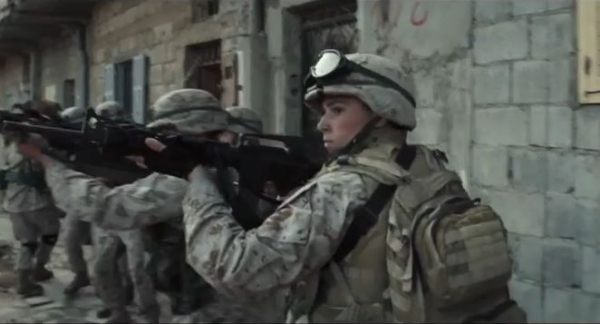
(Sunday Homily) Why I Liked “American Sniper”

american-sniper

Readings for 3rd Sunday in ordinary time: DT 18: 15-20; PS 95: 1-2, 6-9; I COR 7: 32-35; MK 1: 21-28

Today’s readings are about resistance to oppression. They invite us to side with the oppressed and poor in their fight against world-class bullies – to understand the world from the viewpoint of the “unclean.” Seen from that perspective, “American Sniper” is full of insight. It calls us to think critically about whose side we are on in the endless wars our country wages.

The need to see reality “from below” is a major point of today’s first reading. There the message of Moses announcing liberation of the oppressed is presented as the criterion of prophetic truth. Those who teach like Moses (on behalf of the enslaved) should be listened to. False prophets with another message will be punished. This first reading from the Jewish tradition goes on to promise the advent of another prophet like Moses.

By virtue of its inclusion in the liturgy of the word, today’s gospel selection from the Christian tradition identifies Jesus as fulfilling the Mosaic promise. He not only astounds people by his authoritative way of speaking. His action on behalf of a man considered “unclean” demonstrates Jesus’ prophetic authenticity.

That insight was on my mind last week when I decided to see “American Sniper” for myself. I had read the reviews. I knew the criticisms. But I wondered what it would look like if I followed the suggestions of today’s readings and viewed the film “from below,” from an Iraqi perspective.

What I discovered was surprising.

Viewed from the underside of history, “American Sniper” was a tribute to the world’s poor and oppressed – especially to the heroic people of Iraq. That’s because “American Sniper” was about resisting bullies the way the Iraqis have since 2003.

That bully theme is not farfetched. It was announced in one of the film’s opening scenes.

There an adolescent Chris Kyle is instructed by his father about three ways of being in the world. Kyle, of course, is the film’s central character – the most lethal sniper in the history of the American military. He is believed to have killed 255 Iraqis in his 4 tours of duty. Many, it is certain, had their heads blown right off.

“You can be a wolf, a sheep, or a sheepdog” Kyle’s father tells him (in my paraphrase). “Wolves are bullies; they are cowards preying on the weak. Sheep are the naïve who simply go along, following the herd; they do nothing about bullies. They too are cowards. The way to deal with bullies” says Kyle’s father,” is to be a sheepdog and protect those the bully preys upon.

“I want you to be sheepdogs!” the elder Kyle shouts at his sons, “Don’t let the bullies have their way.”

Ironically, the rest of “American Sniper” shows how Chris Kyle entirely rejected his father’s advice, but also how Iraqi patriots unconsciously heeded it. They emerge in the film as the sheepdogs Kyle’s father admired.

For his part, Kyle joins a gang that specifically preys upon the weak for no good reason – simply because it can and because (as Kyle writes) it’s fun. Chris Kyle became a gangster bully.

No, he didn’t join the “Crips” or “Bloods,” “Sharks” or “Jets.” He joined the “Seals.” And their destructive power was beyond belief. To begin with, their gang attire was fearful including matching helmets and boots, flak jackets, camouflage, wrap-around sunglasses, and night vision goggles. They had guns of all types, unlimited supplies of bullets, grenades, missile launchers, armored vehicles, helicopters, planes, and sophisticated communication devices. They prowled in menacing groups along the streets of Bagdad pointing guns at open windows and doors, pedestrians and drivers.

But it wasn’t easy for aspiring bullies to become Seals; doing so required absolute submission and humiliation. So as with all gangs, they had their initiation rites. These included merciless hazing and demeaning tests of endurance. Such rites of passage were accompanied by constant indoctrination that left initiates exhausted and absolutely malleable. In terms of today’s responsorial psalm, their hearts were sufficiently hardened for the inhuman tasks before them.

As a result, and with no knowledge whatever of their intended victims, Seals became convinced that anyone their superiors identified as “targets” were savages. They knew that because their indoctrinators told them so.  They knew nothing else about Iraq, Iraqis or their culture. And so, and like their Indian Fighter predecessors, Seals hated “savages” and wanted them all dead.

In other words, gang aspirants became servile and submissive sheep. They obeyed orders without question or understanding of context. (It’s the military way.) Seals stood ready to kill women, children, the elderly and disabled – anyone identified by their superiors or who threatened their mafia-like ethos of “family.” Protecting one’s “brothers” in crime became the justification of any slaughter. As a result of that brainwashing, Seals were entirely unable to see their “enemies” human beings.

Such identification was difficult for audiences of “American Sniper” as well. Nonetheless, Iraqi humanity inevitably surfaced for anyone remembering today’s readings about Moses and Jesus.  Those prophetic lenses revealed the Seals’ victims to be the successors of the poor and oppressed that both of those prophets came to rescue.

Think about the Iraqis for a minute.

Like their predecessors in Egypt, they were perfect targets for bullies. They had no army, no sophisticated weapons, no helicopters, planes or armored vehicles. They wore no uniforms or protective clothing. Apart from unemployed members of Iraq’s Republican Guard, almost none had formal military training.

Instead they were simple peasants, merchants, teachers, barbers and taxi drivers. They were fathers and mothers, children barely able to lift a grenade launcher, grandparents, friends and neighbors banding together as best they could to protect their homes, families from the ignorant, marauding invaders who proudly called themselves “The Seals.” Unable to show weapons in public (like their menacing occupiers), Iraqis hid them by day under floor boards in their homes.

Some were so desperate that they were willing to sacrifice themselves and their children to resist the Seal home-invaders. So they became suicide bombers. Others experimented with non-violent resistance. They were willing to share their tables with the barbarians from abroad, offering them food and shelter in hopes that kindness might win them over.

But no such luck.

So the majority resorted to defending themselves and each other with weapons – mostly captured or left over from previous Seal invasions (there have been many). What else were these brave patriots to do?

One of them became particularly admired. He had been a national hero, called Mustafa. In the story, this fictional character was an Olympic gold medal winner like the American’s Michael Phelps. But instead of resting on his laurels or using his status to protect himself from harm, he employed his skills as a sharp shooter to defend his people.

We can only imagine the pride that swelled the hearts of Iraqis when they heard how he inspired fear in the American bullies who constantly kicked in their doors, destroyed and looted their property, belittled their culture and faith, intimidated their children, frightened their elders, and demeaned their women.

In the end, Mustafa became a glorious martyr.

Again ironically, he was gunned down by his ignorant American counterpart. He was killed by the bully without a thought in his head who was in the game for fun, for the rush of battle, and to protect his relatively invulnerable “brothers” from the harm they deserved at the hands of the civilian victims they tormented.

In what can only be described as an act of self-loathing, that counterpart, Chris Kyle, takes careful aim and from a great and safe distance shoots a patriot he considers “savage,” because he mirrors so well his own bloody “work.”

It’s easy to vilify Chris Kyle. But he’s not to blame. He was no different from any other soldier serving in Iraq. He was no different from drone “pilots” operating from their air-conditioned “theaters” in Nevada or New Mexico. Sad to say, all of them are unwitting bullies and gangsters. They are brainwashed sheep.

Today’s readings are a reminder of all that. So is “American Sniper.”

Both call us to put ourselves in the shoes of those we are taught to hate.

Shockingly, they call us to change sides!

(Sunday Homily) Pope Francis’ Prophetic Warning on Climate Change: Repent or Else; the Time Is Short

Pope-in-Philippines

Readings for 2nd Sunday in Ordinary Time: JON 3: 1-5, 10; PS 25: 4-9; I COR 7: 29-31; MK 1: 4-20; http://usccb.org/bible/readings/012515.cfm

Last week, Pope Francis offered a preview of his eagerly anticipated encyclical on climate change – to be published next June or July. While visiting the Philippines, the country most devastated by climate chaos, it wasn’t that the pope merely joined the chorus of scientists, environmental activists, and those who heed them. He went much further, promising to transform the issue of climate change from a debate topic trivialized on Fox News into a matter of “faith and morals” (The phrase used by Catholics to define the area within which the pope has overriding authority.)

In doing so, Francis follows the traditions of prophets like Jonah and Jesus – each centralized in today’s liturgy of the word. Both prophets called for repentance (change of thought and action). However, the repentance they summoned pales in comparison to what the pope evidently has in mind.

Yes, the pope is a contemporary prophet. At this moment in history, he is arguably the most powerful ever in terms of his consciousness, courage, credibility and constituency. He literally embodies our best hope for “saving the world.” So it’s incumbent on progressives to heed, highlight and support his efforts.

With that in mind, consider today’s readings about prophetic warnings and how to respond.

The first recalls the message of the Bible’s fictional character Jonah. He’s a reluctant ethnocentric prophet forced by God to call Israel’s mortal enemy, Nineveh, to repentance. “Forty days more and Nineveh shall be destroyed” Jonah proclaimed with some delight.

Ultimately though, Jonah’s ethno-centricity is frustrated when against his desires, the Ninevites quickly and unexpectedly take his message to heart, change their ways, and God repents “of the evil he had planned.” In this way, the Divine One showed God’s character as depicted in today’s responsorial. There the psalmist says that (unlike Jonah) God is compassionate, loving, kind, good, and upright. God guides humble sinners on the path of truth – i.e. reality as it is, not as humans would like it to be.

Jesus’ proclamation was similar to Jonah’s, but without that prophet’s nationalist limitations. As depicted in today’s gospel reading, Jesus’ basic message was a call to profound change: “This is the time of fulfillment,” he said. “The Kingdom of God is at hand. Repent and believe in the gospel.” That notion of fulfillment and the nearness of God’s Kingdom introduces a profound element of hope to complement Jesus’ summons to repentance.

Like the Ninevites in the Jonah story, Peter and Andrew, James and John take Jesus’ words to heart profoundly altering their lives. They leave their former employment as fishermen abandoning their nets, their fathers’ boats and hired men. They follow instead a penniless itinerant preacher and community organizer, adopting his life of complete dependence on others for daily sustenance.

In today’s second reading, Paul shows that the early church embraced Jesus’ message. “Time is running out,” Paul warns. It’s time to prioritize the Kingdom even before family, emotional ups and downs, attachment to property — and to the world as it is. Paul is uncompromising in his perception of the profundity of change “repentance” calls for.

However the apostle’s perception is nothing like the lack of compromise called for by the historically unprecedented crisis of climate change. And this brings me back to Pope Francis and the promise of his prophetic consciousness, courage, credibility, and constituency.

Begin with Francis’ consciousness. He alone among our elected thought “leaders” recognizes contemporary historical patterns – the links between climate change, capitalism, its neo-liberal order, corporate power, income inequality, poverty, colonialism, and a host of other problems (including absence of universal education and health care). For Francis, climate change is not merely one issue among many. It is the frame which makes evident the solutions to those other issues.

More than this, the pope has the uncommon courage to identify without equivocation the cause of such problems – neo-liberal capitalism. He says what politicians like President Obama and other heads of state (with the exception of Raul Castro of Cuba) find impossible to say. Their dependence for survival on billionaires and plutocrats render them impotent before the ideologies of unfettered markets and their “trickle-down” theories. By contrast Pope Francis terms the latter homicidal (53), ineffective (54) and unjust at their roots (59). (Parenthetical numbers refer to sections of “The Joy of the Gospel.”)

Additionally while speaking the unspeakable, the pope enjoys tremendous credibility. With the exception of neo-liberalism’s intractable apologists, the world loves and embraces the man. His efforts to distance himself from the traditional luxurious papal lifestyle, his honesty in responding to difficult questions, his humility and genuine love for the poor make him our century’s most credible moral leader.

And finally, there’s the pope’s constituency. Unlike prophets before him (including Jesus of Nazareth) sheer numbers give Pope Francis unprecedented power to change the world. Jonah’s potential respondents to his calls for repentance were only inhabitants of the city of Nineveh. In today’s gospel reading Jesus’ respondents were four simple fishermen: Peter, Andrew, James and John. Eventually, only a minority of poor Palestinian peasants took to heart Jesus’ words. By contrast, and in virtue of his office, this pope’s constituency is trans-national and world-wide. There are 1.2 billion Catholics on the planet the pope calls “Mother” and “Sister.”

Evidently Francis’ plan is to use his credibility to courageously spread his consciousness and widen his constituency. He plans to do so in five steps. He will (1) publish an encyclical (the most authoritative form of communication at his disposal), (2) convoke an ecumenical meeting of world religious leaders, (3) presumably secure from them a statement paralleling his encyclical’s conclusions, (4) present that statement in his speech to the United Nations in September, and (5) attempt in doing all of that to influence the conclusions of this year’s Climate Summit in Paris two months later.

That’s prophetic activism unparalleled in the recent history of the papacy.

And what specifically is entailed in the repentance necessary to save our Mother? Of course, to share the pope’s vision, we await details in the forthcoming encyclical. However, today’s liturgy of the word points us in the general direction. In the meantime, secular prophets like Naomi Klein fill in the challenging details.

General directions include (as Paul says in today’s second reading) transcending emotions like fear-inspired denial. They include willingness to cut family ties (i.e. narrow nationalism), re-examining our career paths, attachments to property and neo-liberal dreams of unlimited consumption and getting rich.

Specific repentance is more radical than any of our politicians dare articulate. According to Klein, author of This Changes Everything, that’s because our planet has reached “decade zero.” Denialists have led us to squander the leeway we had twenty-five years ago. If we don’t decisively alter within the next ten years our path of production and consumption, the planet’s temperature is bound to rise 4 to 6 degrees Celsius. However, according to climate scientists, any rise beyond 2 degrees will make disastrous climate change irreversible. And that will result in disastrous droughts, water shortages, typhoons, flooding, wildfires, and crop losses with whole cities under water and Islands swallowed by the sea.

To avoid such disasters, required repentance includes:

  • Rejecting the neo-liberal myth that has shaped our world over the last 35 years.
  • Replacing it (the pope will say) with the biblical vision of the Kingdom (proclaimed by Jesus in today’s gospel reading). God’s Kingdom is characterized not by competition and privatization, but by cooperation, sharing, prioritizing the needs of the poor and respecting the earth as commons.
  • Setting aside neo-liberalism’s fetish about regulation, and setting bold national policies guided by clear goals, a strictly imposed time table, and severe penalties for non-compliance.
  • Implementing corresponding policies to cut annual emissions in the industrialized world by 8- 10%.
  • Recognizing that exchange of myths means rejection of market-driven models of untargeted economic growth.
  • Redesigning our cities and redistributing population to eliminate long commutes between home and work.
  • Investing massively in light rail and other means of public transportation so that commuters might travel efficiently and free of cost.
  • Similarly subsidizing renewable sources of energy – solar, wind, geothermal, and biomass.
  • Turning the roof of every available building into an energy plant.
  • Respecting the rights of indigenous people under whose lands so much carbon deposit remains.
  • Eliminating by law, controlling by strong regulation or penalizing by heavy taxation industries that are wasteful and/or destructive of the planet such as arms manufacturers, the fast-food industry, GMO firms, and middle-man industries like health insurance.
  • Dealing with climate impact and damage according to “the polluter pays” principle. This recognizes that the 500 million richest people on the planet are responsible for 50% of the world’s pollution and that the U.S. military is by some estimates the largest single consumer of petroleum in the world.
  • According to “the polluter pays” principle, withdrawing from foreign wars, cutting the military budget by at least 25% and making the rich 1% pay their fair share of taxes.
  • Tolerating as necessary increased taxes on everyone, except the poor.
  • Drastically reducing the amount of energy each of us consumes.

You get the idea. The agenda necessary to save our planet from “the evil Nature has planned” is challenging indeed. But it contains that surprising element of hope Jesus signaled when he termed “repentance” as “good news” and “fulfillment.”

After all, our destructive way of life is anything but fulfilling. On the other side of the repentance just described is a cleaner, healthier, less stressful life with full employment, more leisure, greater equality, and harmony with one another and our world.

That’s the vision behind the pope’s courageous prophetic work. It deserves our undivided attention and support.

(Sunday Homily) The Torture Report: Cheney Channels King David in the Struggle over Historical Narrative

Cheney

Readings for 4th Sunday of Advent: 2nd SAM 7:1-5, 8-12, 14A, 16; PS 89: 2-5, 27-29; ROM 16: 25-27; LK 1: 21-38 http://usccb.org/bible/readings/122114.cfm

Strange that according to a poll last week, more than half the “American” people think torture is permissible. I say “strange” because nearly 80% of Americans consider themselves “Christian.” And Jesus himself was a victim of torture. On the other hand, can you imagine Jesus torturing anyone?

You’d think the similarities between the Romans’ treatment of Jesus and the “Americans’” treatment of countless innocent victims would make devout Christians less accepting of torture.  Maybe they’d oppose torture on principle, as a matter of faith.

Or perhaps it’s that they just agree with ex-VP, Dick Cheney. After all, he wouldn’t consider “torture” what the Romans’ enhanced interrogation techniques (EITs) did to  Jesus  – not the prolonged beating we all witnessed portrayed in Mel Gibson’s “The Passion of the Christ,” not the crowning with thorns, not forcing a beaten man to carry his own instrument of execution, not driving nails into his hands and feet, not leaving him for hours struggling for breath on a cross whose chief agony was bringing the victim to the point of asphyxiation (like waterboarding) and beyond.

According to Mr. Cheney, that punishment would have crossed the line to torture only at the point when death proved imminent. Unfortunately, as with untold (literally) victims of U.S. enhanced interrogation, that line was crossed in the case of Jesus.

But in the end, as supporters of U.S. Empire, “American” Christians probably understand and forgive what the Romans did. After all, like its U.S. counterpart, the Roman Empire was under siege on all sides. And the Jews were particularly rebellious. And Jesus (in Roman eyes) gave every indication of leading a rebellion. An empire’s got to do what an empire’s got to do – even if it means killing the innocent like Jesus.

I think however that there’s something more than compassion failure at work here.  The “more” is the power of propaganda. That’s something addressed in today’s liturgy of the word. There the author of 2nd Samuel whitewashes the brutal King David and turns him from something like a mafia don into a national hero. In today’s gospel selection, even the evangelist, Luke buys the distortion. He makes Jesus the successor of David.

I’ll get to that in a moment. But let me first finish with the torture document. You see, (as Glen Greenwald has pointed out) it’s no wonder that “Americans” can’t identify with the tortured much less connect them with Jesus.

That’s because since the Report’s release on December 9th, the mainstream media (MSM) has treated us to an endless parade of torturers and torture enablers explaining away the conclusions of the Senate’s years-long study.  We haven’t heard a word from the victims of torture or from the families of those whose sons and daughters were killed at the hands of sadistic representatives of our government.

The result of this one-sided silencing of the victims has been to rob them of their humanity – of their very existence.  Given the deafening silence, why would we feel compassion for people who don’t even exist? Out of sight, out of mind.

Imagine how better informed we’d be if on “Meet the Press” or somewhere Mr. Cheney had to defend his policies against his victims – many of whom, Greenwald reminds us (because he has interviewed them) are incredibly articulate. Perhaps the victims might suggest waterboarding the ex-VP to see if he really believes that practice doesn’t sink to the level of torture.

According to University of Wisconsin –Madison Professor Alfred McCoy (the author of Torture and Impunity) this erasure of victims is all part of a five-stage policy on the question of torture. After the Abu Ghraib scandal broke in 2004, the first step was identifying the low level perpetrators with “bad apples.” The second stage kept rumors of more widespread torture at bay in the name of national security. Thirdly, President Obama adopted the “let’s look forward, not backward” approach. Fourthly came the move to exonerate all those guilty of torture or enabling the practice. Finally we’ve reached the stage which emerged last week: vindication before the bar of history of all those connected with U.S. torture.

Again, that’s where the battle has been joined today; we’re struggling over historical narrative. This is the stage all empires come to eventually as their crimes inevitably come to light. It’s what we witness in today’s liturgy of the word and the white-washing of Israel’s King David. The example is instructive. It suggests practical responses to the Torture Report at both the level of faith and political action.

You see, there are really two separate king David traditions in the Bible. One presents the good David, the other, the bad. The good David is the one largely presented in I Chronicles 10:14-29:30. He also appears in today’s first reading from 2nd Samuel and in the responsorial psalm.

This David is pious, and wants to build a temple for God. According to the story, God is pleased, and rewards him with everything a king could want: victory over his enemies, immortal fame, prosperity for his people, thriving descendants, and a dynasty that will last forever.

Then there’s the bad David who begins to appear in I Samuel, chapter 16. This David is a murderous tyrant. He rebels against Saul, Israel’s first king. He’s a womanizer, a murderer and an object of popular hate.  Far from lasting forever, his dynasty ends with the death of his successor, Solomon. He’s the David whose death-bed instructions are worthy of any Mafia godfather. To Solomon he says, “Take care of my friends, Sol – and my enemies too (wink, wink). You know what I mean?” (IKGS 2: 1-9)

Besides that, the bad David bastardizes the Mosaic Covenant and its protection of widows, orphans, and resident aliens and turns it into a tool of the ruling classes – from Moses’ “I will be your God and you will be my people,” into David’s “You are my son, the king of Israel, and your dynasty will last forever.”

Of course, the bad David has been swallowed up by popular memory of its competing tradition. David is uniformly remembered by the majority of believers as the man “after God’s own heart.” As I said, in today’s familiar gospel selection, Luke falls into that trap. He makes Jesus (through his foster father, Joseph, no less) the successor of David. And this even though Jesus as portrayed by Luke is no friend of the Temple or of kings and emperors. Rather he is the friend of the beneficiaries of the Mosaic Covenant – the widows, orphans, aliens, prostitutes, tax collectors, lepers, Samaritans. His values do not include enemies (much less victory over them) or prosperity, fame, or everlasting dynasties.

Recognizing this struggle over which narrative will prevail sheds light on the Torture Report. It enables followers of the simple man from Nazareth to judge that the struggle even before the bar of biblical history has been won by the likes of Cheney and Bush. It has been won by the bad David.

Our conclusion: we must not allow that to happen as we fight over whose story should prevail concerning the latest revelations about the powerful organized crime syndicate known as the CIA.

So what should we do?  Our response should be at two levels.

At the level of faith believers should be exposed to the historical Jesus I’m attempting to present in these homilies. We neglect those powerful myths at our own peril. Even the uninformed can understand them.  This means that the Jesus’ story represents a powerful tool for raising consciousness about torture (and other issues of social justice).

It’s true that the MSM might not expose the story of the tortured to that 80% of “Americans” who claim to be Christian. However, if those with the responsibility for explaining the sacred texts assume that responsibility and do their homework, there’s no reason why those wishing to follow Jesus can’t understand that:

  • Jesus himself was a victim of torture at the hands of an empire very like the United States.
  • He taught universal love.
  • He was non-violent
  • He said he considers what’s done to the least of the human race as done to him.
  • He said we should love our enemies.

At the political level we should:

  • Urge outgoing senator Mark Udall (D Colorado) to use his senatorial privilege of unlimited free speech to release the entire unredacted torture document.
  • Pressure the media through phone calls and letters to the editor to present the other side of the torture story including interviews with torture victims and with the families of those whose sons and daughters, husbands and wives were killed under CIA torture.

(Sunday Homily) Towards a Counter-Cultural Christmas: Becoming Nobody

Santa garbage

Readings for Third Sunday in Advent: IS 61:1-2A, 10-11; LK 1: 46-50; 53-54; I THES 5: 16-24; JN 1: 6-8, 19-28. http://usccb.org/bible/readings/121414.cfm

As I mentioned in my previous blog, I had an important spiritual experience last Sunday. It was the privilege of visiting the hermitage of St. Thomas Merton, the great Trappist mystic. It all happened in New Haven, Kentucky, just down the road from the Maker’s Mark distillery – far from any great urban centers and nearer to places with names like Bardstown, Paint Lick, and Gravel Switch. The experience inspired counter-cultural thoughts about Christmas. It made me struggle with the question (still unresolved for me): is it possible to once and for all break with this annual orgy of consumerism so counter to the gospel’s commitment to the poor?

At Fr. Louis’ Gethsemane, twenty of us sat in a circle in his living room absorbing the Life Force that still hovers over his simple cinderblock cabin. Trappist Brother Paul, the convener of the Merton Study Group responsible for the event, marvelously channeled “Louie’s” spirit by reading Brother Paul’s own poetic reflection on Matthew’s words, “Blessed are the poor in spirit.”

Paul’s thoughts connected nicely not only with Merton, but with this morning’s liturgy of the word on this third Sunday of Advent. After all, in today’s readings, John the Baptizer, his predecessor Isaiah, and Jesus’ own mother Mary reiterate the essential connection between Jesus’ gospel and standing in solidarity with the poor not only in spirit, but in actual fact. As Christmas approaches, the sentiments of the Baptizer, Isaiah and Mary suggest counter-cultural ways of commemorating the birth of the prophet from Nazareth.  I wonder if I and my family are strong enough to entertain them.

For me those culturally eccentric suggestions began emerging when in the course of his remarks, Brother Paul recalled Sister Emily Dickinson’s words that reflect the mystical dimension of Matthew’s (and presumably Jesus’) understanding of both spiritual and physical poverty. As for the former, Brother Paul defined spiritual poverty as the emptiness reflected in Monk Dickinson’s words,

“I am nobody.

Who are you?

Are you nobody too?

. . . How dreary to be somebody.”

Those words almost paraphrase what John the Baptist says in today’s Gospel selection. When asked who he is, the one identified by Jesus as the greatest man who ever lived (MT 11:11) says in effect, I am a poor man in Emily Dickinson’s sense. I’m a nobody – merely a voice out of nowhere. I am “a voice crying out in the wilderness.”  Only an empty vessel can be filled with the Holy Spirit.

So forget about me, John says, and focus on the one who is to come. His words will set you on fire that will sear everything in you that is not of the Spirit Jesus embodies – everything that separates you from your brothers and sisters, especially material wealth. That kind of self-denial and openness to Jesus’ Holy Spirit is the very definition of Matthew’s spiritual poverty.

And the specific message of the One to come?  (And here’s where material poverty enters the picture.)  Jesus announces the Divine Spirit’s preferential option for the actually poor and its rejection of the materially rich. That bias towards the actually poor is reflected in today’s first reading. As remembered by Luke in Jesus’ preview of his own career, the words of the prophet Isaiah read:

The Spirit of the Lord is upon me, because he has anointed me to bring good news to the poor. He has sent me to proclaim release to the captives and recovery of sight to the blind, to let the oppressed go free, to proclaim the year of the Lord’s favor.” (LK 4: 16-22)

Here Jesus’ focus is real poverty and people subject to captivity and oppression.

As for the Holy Spirit’s rejection of the rich, that is clearly stated in the revolutionary poem attributed to Jesus’ mother and read today as our responsorial hymn. Mary describes her understanding of God with the following words:

“The Mighty One . . . has shown strength with his arm; he has scattered the proud in the thoughts of their hearts. He has brought down the powerful from their thrones, and lifted up the lowly; he has filled the hungry with good things, and sent the rich away empty.”

These are truly revolutionary words about dissolving the ideological mind-sets that unify the rich (“the thoughts of their hearts”), about overthrowing the powers that be (removing them from their thrones), about ending hunger, and rejecting wealth on principle.

The class consciousness reflected in this categorical rejection the rich as such reminds us that in the eyes of Jesus’ mother and (the record shows) of her son, there is something intrinsically wrong with any wealth that differentiates rich from poor. This implies that for Mary and Jesus, poverty is not the opposite of wealth.  Rather, the opposite of wealth is God’s justice – a new order possible in this here and now, in this “year of the Lord’s favor,” as Jesus puts it. There, the rich will be necessarily unseated and the poor will have their fill.

If all of this is true – if God’s salvation means eliminating differences between rich and poor – what are we to do in this world of income gaps, torture, racism and militarized police?  The question is particularly apt at this Christmas season. And Thomas Merton’s monastic spirit along with the testimony of his ascetic counterpart, John the Baptizer, implies answers.  It suggests that at the Christmas season we might do well to:

  • Generally withdraw our allegiance from the cultures of New York and Los Angeles and in spirit draw closer to Paint Lick, Gravel Switch – and Merton’s Gethsemane.
  • Consciously simplify our Christmas celebration this year.
  • On the feast commemorating the birth of a homeless child whose mother saw so clearly the opposition between wealth and justice, imitate John’s simple vestment (and that of the Trappists) by giving our gifts of clothes not to the already well-attired, but to the poor.
  • Imagine what would happen if we took those gifts so carefully wrapped and placed beneath our tree and simply gave them away unopened and at random to poor people and their children as we meet them on the street.
  • In the spirit of John the Baptizer, located far from Jerusalem’s temple, boycott church this Christmas, especially if your community (after distributing its de rigueur Christmas baskets) ignores Mary’s summons to social revolution in favor of “Christmas as usual.”
  • Instead make up our own liturgy (around the Christmas tree) to replace the normal orgy of material gift-exchange. (More about this in a later posting.)
  • Boycott entirely this year’s “white Christmas” and (in the light of Mike Brown, Eric Brown and Tamir Rice) celebrate Kwanzaa instead – telling our children why this year is different.
  • Make a Christmas resolution to at last get serious about changing our lives in 2015 by beginning (or intensifying) the regular practice of prayer (or meditation) in the spirit of John the Baptist, Jesus, his mother and Thomas Merton.
  • Realize that inevitably the cultivation of spiritual emptiness (“nobodiness”) resulting from such regular spiritual practice will lead us to serve others in a way that will address the seemingly intractable problems of poverty (both spiritual and material), hunger, captivity and oppression.

I’m not suggesting that any of this would be easy. Going counter-cultural, especially around an event like Christmas, involves a certain self-emptying. It involves detaching from cultural expectations (not to mention those of our children and other family members). In some sense, it means becoming nobody in front of those who expect us to do what everyone else is doing. In other words, going counter-cultural at Christmas conflicts with what Sister Emily calls our dreary attempts to be somebody.

In fact, the cultural pressures are so strong, that it might be impossible for most of us to withdraw cold-turkey from Christmas as we’ve known it. Still, if we desire to be change agents like John the Baptist, Isaiah, Mary, Jesus and Thomas Merton, we’ve got to start somewhere.

Do you have other ideas about where or how to start? If so, please share them. And what about that alternative Christmas celebration involving the whole family on Christmas morning? Can you help with any suggestions there?

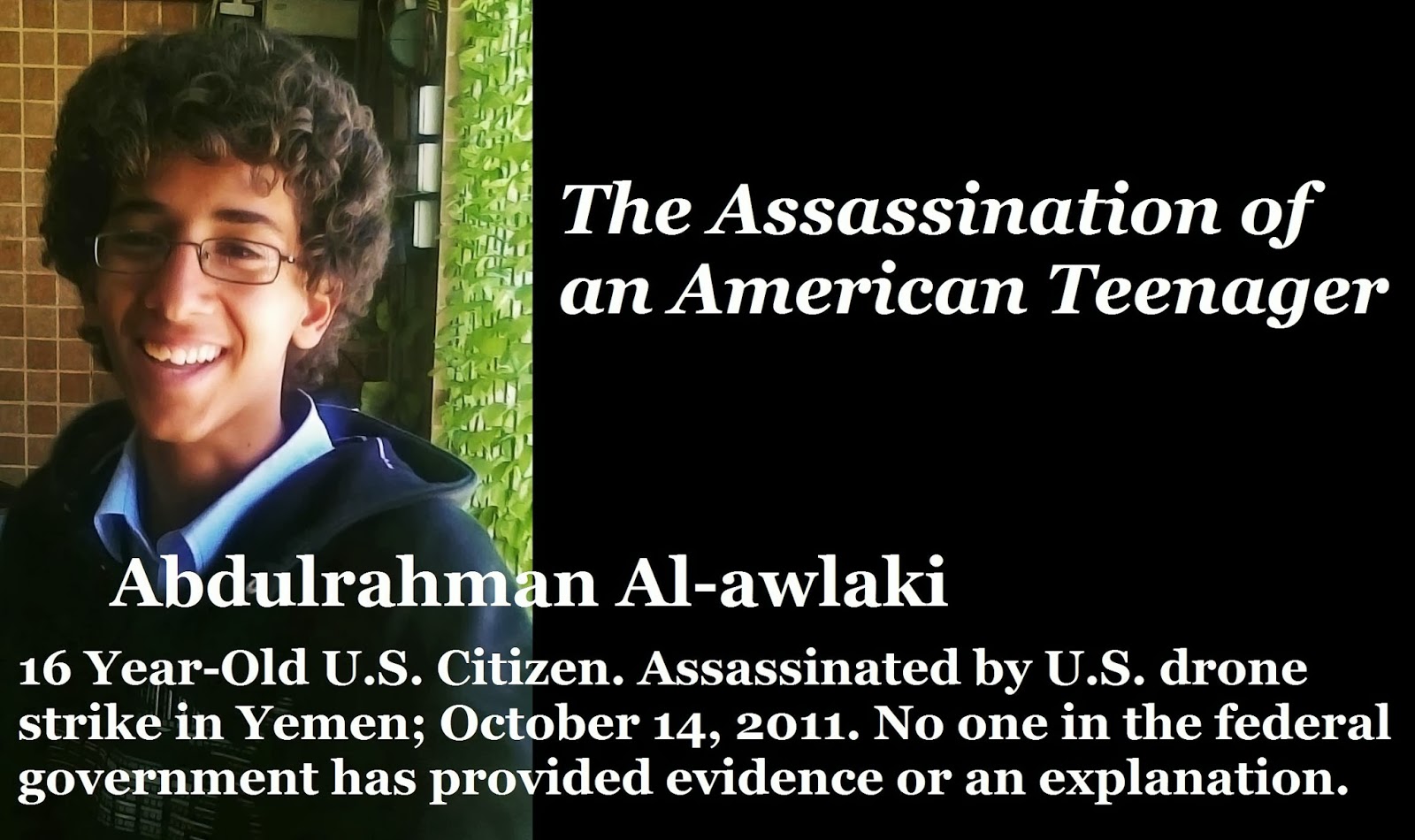
(Sunday Homily) Black Lives, Muslim Lives Matter: Obama’s as Guilty as Wilson & Pantaleo

awlaki-killing-of-american

Readings for Second Sunday of Advent: IS 40:1-5, 9-11; PS 85: 9-14; 2 PT 3: 8-14; MK 1: 1-8. http://usccb.org/bible/readings/120714.cfm

Michael Brown, Eric Garner, and 12-year-old Tamir Rice. . . .

The very mention of those names calls to mind the protests that have filled our nation’s streets over the past week – in Ferguson Missouri, New York, Chicago, Los Angeles and places in between. The teenager, the father of six, and the sixth grade child represent deeply racist and unjust social structures where criminals and thugs masquerading as law enforcement officers have implicitly been granted a license to kill with impunity.

The nation-wide demonstrations on behalf of black and brown victims of the resulting “American” police state remind us that our country is decidedly on the wrong track. Like John the Baptist in today’s gospel excerpt, statements by New York’s Mayor de Blasio, Eric Holder, President Obama, and the U.N. special rapporteur on torture call us all to what the Greeks called metanoia – a drastic change of direction.

Ironically however that call to repentance is especially addressed to Messrs. Holder and Obama themselves. They, after all, find themselves in charge of a national and world-wide police state of which Mike Brown’s Ferguson and Eric Garner’s Staten Island represent merely the tip of an iceberg. The call to repentance invites all of us to apply pressure for profound systemic reform that far surpasses anything those “leaders” have in mind.

Today’s liturgical readings inspire such thoughts. Listen to the prophet Isaiah as he cries out for repentance and a restructuring of reality so intense that he imagines mountains being levelled and valleys filled. The point is to smooth the way for the advent of a profoundly non-violent God in our midst. The peace-filled change Isaiah envisions is not trivial.

Listen to Jesus’ mentor, John the Baptizer, as he echoes Isaiah word-for-word. (Needless to say, neither Isaiah’s nor John’s words have anything to do with the artificially excited anticipation of our culture’s Winter Festival and its orgy of selling, buying, and conspicuous consumption – even though “Christmas” deceptively continues to somehow associate itself with the homeless child from Nazareth.)

As a matter of fact, the cult of materialism and “Christmas cheer” couldn’t be more antithetical to sincere recollection of the birth of Jesus who had more in common with Mike Brown and Eric Garner than with the white middle-class culture Christmas celebrates.

More specifically, Jesus was the embodiment of nearly everything “good Christians” (presumably) like Officers Wilson and Pantaleo (the executioners of Brown and Garner) give evidence of despising.  After all, the working man from Nazareth was not only the poor son of an unwed teenage mother. He was an immigrant whose family took refuge in Egypt, the penniless friend of prostitutes and drunkards, and the prophet drummed out of his faith community as villain possessed by demons. He was the victim of torture and capital punishment who was treated as a terrorist by the reigning imperial power.

To the authorities of their day, both the Baptizer and Jesus even looked like Eric Garner and Michael Brown. Both were dark-skinned, either black or brown; they were not white men. Today’s gospel emphasizes how poorly John was dressed.

To repeat: during his life Jesus was impoverished, homeless, unemployed, accused of being subversive, placed on death row, and ultimately executed. As a Jew, he was considered as “other” and worthless to Roman authorities as Mike Brown was to Darren Wilson or Eric Garner to Daniel Pantaleo. He was as worthless as Abdulrahman Al-awlaki (pictured above) was to Barack Obama.

And that brings me to today’s real call to repentance.

It can’t merely be:

  • A superficial call to “trust” – an echo of Rodney King’s “Can’t we all get along?”
  • A reform of police culture
  • A de-militarization of police arsenals
  • A mandating of special independent prosecutors to handle incidents like those in Ferguson and Staten Island
  • Or even prosecution and conviction of police thugs like Wilson and Pantaleo

Instead, our nation has to address the root of the problem which is a world-wide policy of extra-judicial killings of racially-profiled Muslims and dark-skinned poor people. (That’s what a “signature strike” means as executed by drone “pilots.”)

Put otherwise, President Obama, Eric Holder and their minions are as guilty as Wilson and Pantaleo. All of them place themselves above the law. They kill with impunity those “others” they consider expendable. They answer to no one. They refuse to investigate much less prosecute such crimes.

John the Baptizer’s call to repentance summons us to publicize such guilt and completely withdraw support from the policies of the thug leaders of the world-wide U.S. police state.

That, I think, is what metanoia and repentance mean for “Americans” this particular advent.

(Sunday Homily) The Islamic Caliphate and the Final Judgment of “America”

Caliphate

Readings for the Solemnity of Our Lord Jesus Christ, King of the Universe: EZ 34: 11-12, 15-17; PS 23: 1-3, 5-6; I COR 15: 20-26, 28; MT 25: 31-46. http://www.usccb.org/bible/readings/112314.cfm

At the moment, I’m teaching a wonderful course at Berea College, REL 126. It’s called “Poverty and Social Justice” and qualifies as part of the “Religion Requirement” all Berea students must fulfill. The course is populated by 19 very smart and engaged, (mostly third and fourth year) students.

Part of our goal is to become literate about the problems of poverty and justice in our very confusing world. And that has us tuning in to “Democracy Now” each day. We’re getting involved with a powerful group of local activists, “Kentuckians for the Commonwealth” (KFTC). We attend the group’s meetings each month and have volunteered for KFTC activities like voter registration and mobilization.

Additionally, students have been researching burning issues including the war in Ukraine, the conflict in Palestine, voter suppression, police militarization, and the philosophy of Ayn Rand.

All of that has discussing the purpose of government. In that connection, students are finally getting clarity about what I consider THE fundamental political debate in our country: is the government’s role simply to provide infrastructure for commerce and to protect private property? Or is it to sponsor programs to directly help the poor who (unlike their rich counterparts) cannot on their own afford adequate food, shelter, clothing, health care, and education – even if they are working full-time?

For the last thirty-five years or so, the former view has carried the day in the U.S. So it has become fashionable and politically correct even (especially?) for Christians to advocate depriving the poor of health care to help them achieve the American Dream, “ennobling” the unemployed by removing their benefits, criminalizing sharing food with the poor, and “punishing” perpetrators of victimless crimes by routinely placing them in solitary confinement.

Today’s readings reject all of that. And they do so on a specifically political liturgical day – the commemoration of the “Solemnity of Our Lord Jesus Christ, King of the Universe.” Yes, this is a political liturgy if ever there was one. It’s all about “Lords” and “Kings” and how they should govern in favor of the poor. It’s about a new political order presided over by an unlikely monarch – a king who was executed as a terrorist by the imperial power of his day. I’m referring, of course, to the worker-rebel, Jesus the poor carpenter from Nazareth.

Today’s readings promise that the rebel – the “terrorist” – Jesus will institute an order utterly different from Rome’s. That order recognizes the divine nature of immigrants, dumpster-divers, those whose water has been ruined by fracking and pipe lines, the ragged, imprisoned, sick, homeless, and those (like Jesus) on death row. Jesus called it the “Kingdom of God.” It’s what we celebrate on this “Solemnity of Jesus Christ King of the Universe.”

(Btw: in the eyes of Jesus’ executioners, today’s commemoration would be as unlikely as some future world celebrating the “Solemnity of Osama bin Laden, King of the Universe.” Think about that for a minute!)

In any case, today’s readings delineate the parameters of God’s new universal political order. To get from here to there, they call governments to prioritize the needs of the poor and those without public power. Failing to do so will bring destruction for the selfish leaders themselves and for the self-serving political mess they inevitably cultivate.

Today’s first reading gets quite specific about that mess. There the prophet Ezekiel addresses the political corruption Lord Acton saw as inevitable for leaders with absolute power. Ezekiel’s context is the southern kingdom of Judah in the 6th century BCE. It found itself under immediate threat from neighboring Babylon (Iraq). In those circumstances, the prophet words use a powerful traditional image (God as shepherd) to inveigh against Israel’s pretentious potentates. In God’s eyes, they were supposed to be shepherds caring for their country’s least well-off.  Instead, they cared only for themselves. Here’s what Ezekiel says in the lines immediately preceding today’s first lesson:

“Woe to you shepherds of Israel who only take care of yourselves! . . . But you do not take care of the flock. You have not strengthened the weak or healed the sick or bound up the injured. You have not brought back the strays or searched for the lost. You have ruled them harshly and brutally.”

In other words, according to Ezekiel’s biblical vision, government’s job is to address the needs of the weak, the sick and the injured. It is to tenderly and gently bring back the wayward instead of punishing them harshly and brutally.

A great reversal is coming, Ezekiel warns. The leaders’ selfishness will bring about their utter destruction at the hands of Babylon.

On the other hand, Judah’s poor will be saved. That’s because God is on their side, not that of their greedy rulers. This is the message of today’s responsorial psalm – the familiar and beloved Psalm 23 (“The Lord is my shepherd. . . “)  It reminds us that the poor (not their sleek and fat overlords) are God’s “sheep.”  To the poor God offers what biblical government should: nothing but goodness and kindness each and every day. Completely fulfilling their needs, the divine shepherd provides guidance, shelter, rest, refreshing water, and abundant food. Over and over today’s refrain had us singing “There is nothing I shall want.” In the psalmist’s eyes, that’s God’s will for everyone – elimination of want. And so the task of government leaders (as shepherds of God’s flock) is to eradicate poverty and need.

The over-all goal is fullness of life for everyone. That’s Paul’s message in today’s second reading.  It’s as if all of humanity were reborn in Jesus. And that means, Paul says, the destruction of “every sovereignty, every authority, every power” that supports the old necrophiliac order of empire and its love affair with plutocracy, war and death instead of life for God’s poor.

And that brings us to today’s culminating and absolutely transcendent gospel reading. It’s shocking – the most articulate vision Jesus offers us of the basis for judging whether our lives have been worthwhile – whether we have “saved our souls.” The determining point is not whether we’ve accepted Jesus as our personal savior. In fact, the saved in the scene Jesus creates are confused, because their salvific acts had nothing to do with Jesus. So they ask innocently, “Lord, when did we see you hungry and feed you, or thirsty and give you drink?  When did we see you a stranger and welcome you, or naked and clothe you?  When did we see you ill or in prison, and visit you?”

Jesus’ response? “Amen, I say to you, whatever you did for one of the least brothers of mine, you did for me.”

But more than personal salvation is addressed here. Jesus homage to Ezekiel’s sheep and shepherd imagery reminds us of judgment’s political dimension. So does Jesus’ reference to the judge (presumably himself) as “king.” And then there’s the church itself which centralizes this climactic scene precisely on this Solemnity of Jesus Christ King of the Universe. All three elements say quite clearly that “final judgment” is not simply a question of personal salvation, but of judgment upon nations and kingdoms as well. To reiterate: in Matthew’s account, the final judgment centralizes the political.

And what’s the basis for the judgment on both scores? How are we judged as persons and societies? The answer: on the basis of how we treated the immigrants, the hungry, ill-clad, sick, and imprisoned.

On that basis, Jesus’ attitude towards the United States as earlier described ought to be quite clear. It’s the same as Ezekiel’s when he predicted the destruction of Israel at the hands of Iraq:

“Depart from me, you accursed, into the eternal fire prepared for the devil and his angels. For I was hungry and you gave me no food, I was thirsty and you gave me no drink, a stranger and you gave me no welcome, naked and you gave me no clothing, ill and in prison, and you did not care for me.”

Ironically enough that “fire prepared for the devil and his angels” is today being stoked in Iraq just as it was in the days of Ezekiel. This time the Babylonians call themselves the Islāmic Caliphate.

As Ezekiel might say, “You read it here first.”

(Sunday Homily) Happy Day of the Dead: Remembrances & Prayers

Day of Dead

Readings for the Commemoration of All the Faithful Departed (All Souls): WIS 3:1-9; PS 23:1-6; ROM 5: 6-11; JN 6: 37-40. http://usccb.org/bible/readings/110214.cfm

Today is the feast of All Souls – or as they call it in Latin America, the “Day of the Dead.” In Mexico, the commemoration of “the faithful departed” is really a triduum that begins on Halloween, proceeds through the Feast of All Saints (Nov. 1st) and finishes today with “All Souls Day” (Nov. 2nd).

In Mexico there are parades and costumes, and skeleton manikins dressed up in silks and finery. In a mocking, light-hearted way, the day reminds everyone of the shortness of life, the impermanent nature of pleasure, prestige, profit and power, and the inevitability of our own fast-approaching demise.

Since death is inevitable and an integral part of life, the Day of the Dead invites us all – “believers” or not – to recall those who have gone before us to “rest in the sleep of peace” and to ready ourselves for The Great Transformation by looking death square in the face.

So to begin with, think about your own loved ones who have passed away. No doubt, there’s some pain in doing that. After all, we loved them. In those terms, today I’m thinking especially of a dear friend and mentor of mine, Glen Stassen. He died unexpectedly this last year. He was a great scholar, teacher, author and peace activist. He taught me so much. And then there are those public figures – like Pete Seeger, Maya Angelou and Robin Williams – whom we all recently lost.

We miss people like that. Nonetheless, death does not wound us without at the same time offering new understandings and appreciations of the ways the lives of those loved ones continue in and around us. In some sense, the ripples of their stories have influenced not only us, but the entire universe.

That’s especially true of the mother and father figures in our lives (not always our biological parents, of course).

Allow me to set the tone by recalling (and honoring) my own parents for a moment.

I am fortunate to be able to identify my original Gift-Givers as my actual mom and dad – Edith and Ray Seul. I owe so much to them and the innumerable ways their lives and deaths have made me and my three siblings what we are. They were wonderful parents – not perfect to be sure – but wonderful all the same.

I think of my mother as my spiritual teacher. She was lovely and gentle, light-hearted, but at the same time quite serious about doing the right thing. Above all her simple faith governed her life. She was a convert to Catholicism having been brought up a Swedish Lutheran – as Edith Swanson. And while she was serious about being Catholic, she somehow made it clear that Protestants were O.K. too. Along with my female grade school teachers (the faithful Sisters of St. Joseph) mom’s example started me on the path to the priesthood and to ecumenical thinking. I love her for that.

I think of my dad whom I had the privilege of attending full time during the final weeks of his life. Dad was strong, a truck driver, and fun-loving. His brothers say he was a wild street-fighter in his youth. But then (they’d joke) he met my mother and she “made a man of him.” That’s how they put it.

Like my mother, Dad took his faith quite seriously too. He was a member of the Holy Name Society and went on spiritual retreats several times, I recall. He brought us back medals and “holy cards.” Dad clearly wanted to live a good life. That was true to such an extent that when I left the priesthood and decided to marry my wife, Peggy, he chose not to come to our wedding. I’m convinced it was a matter of conscience for him. Peggy and I would be living in sin, he thought, and he could not appear to give his approval. None of that however prevented him from later accepting Peggy and loving her.

Yes, I’m grateful for my parents. I love them, and miss them. Not a morning passes without my offering prayers of thanksgiving for mom and dad. So on this Day of the Dead, my mind is filled with nostalgia (rather than sadness) over their loss.

The Day of the Dead also brings that urgency I mentioned earlier – around my own fast-approaching death and the need I feel to use these declining years to make my contribution to a world careening towards disaster as never before. It’s also a time for imagining what awaits me after I breathe my last.

For the past few years the great fifth century mystic, Augustine of Hippo, has helped me think about death, its process and what comes after. He wrote a very long sentence I’ve found so helpful in thinking about death that I’ve committed it to memory and often use for meditation. Here’s what Augustine said. See if his words help you:

Imagine if all the tumult of the body were to quiet down, along with all our busy thoughts about earth and sea and air; if the very world should stop, and the mind stop thinking about itself, go beyond itself, and be quite still;

if all the fantasies that appear in dreams and imagination should cease, and there be no speech, no sign:
Imagine if all things perishable grew still – for if we listen they are saying, “We did not make ourselves; he made us who abides forever” – imagine then, that they should say this and fall silent, listening to the very voice of the one who made them and not to that of God’s creation;

So that we should hear not his word through the tongues of men, nor the voice of angels, nor the clouds’ thunder, nor any symbol, but the very Self which in these things we love, and go beyond ourselves to attain a flash of that eternal wisdom which abides above all things:

And imagine if that moment were to go on and on, leaving behind all other sights and sounds but that one vision which ravishes, absorbs, and fixes the beholder in joy; so that the rest of eternal life were like that moment of illumination that leaves us breathless:

Would this not be what is bidden in scripture, “Enter thou into the joy of thy Lord?

So that’s what happens in death, is it? The end of the world – bodily sensations, thought, and fantasies; great stillness within and without; no sound from human voice or nature itself; but immersion in wisdom, light and breathless joy. That’s what awaits us. At least Augustine thought so.

How different (and so much more consoling) is that vision from what I once anticipated in terms of “the last things” as so wonderfully, but (for the naïve) misleadingly expressed in Dante’s immortal Divina Comedia: death, judgment, heaven, hell. I can no longer believe that as literally as I once did. In fact, I’m persuaded to make my own the prayer of a medieval mystic. (This is another passage I use for my meditations):

Lord, if I love you because I desire the joys of heaven, close its gates to me. And if I love you because I fear the pains of hell, bury me in its depths. But if I love you for the sake of loving you, hide not your face from me.

The mystic’s prayer is a rejection of the childish, hedonistic, and self-interested beliefs about the after-life that I was brought up on. It’s an embrace of the mystical vision that recognizes harmony with God (or Ultimate Reality, the Ground of Being, or Nature with a capital “N”) as the purpose of life. All those other goals (pleasure, profit, power, prestige), I’ve found, are empty and quite misleading.

That learning was reinforced in India last year during our four months in Mysore. The idea of reincarnation, I learned, is not far-fetched and is in some way supported by the theory of evolution. And so on this Day of the Dead, I make my own the prayer that my meditation teacher, Eknath Easwaran recited on his own death bed – once again using the personal term “Lord” to address the mysterious Origin of the things that matter: Life and Love:

Lord, fill my heart with love and devotion for you. And burn out the seeds of selfish desire and sense craving from my mind. Grant that I might be carried by you from this life to the next without suffering, and that I might be born into a holy family with my hear overflowing with love and devotion to you from my earliest childhood onward.

I want that to be my prayer on my death bed.

There’s a final thought I’d like to share with you on this day of the dead – this one from the great American poet, Stanley Kunitz. “The Long Boat” is a poem that reminds me strongly of my father in law, Bob duRivage, who was a sailor and (in my opinion) a sage, and a saint. He loved life and left this world reluctantly. Because of its sailing theme and the poem’s last line, I committed it to memory in Bob’s honor. Because the poem is about death, I hope (on this Day of the Dead) that it may also you think deep thoughts about your own approaching demise and make decisions accordingly:

When his boat snapped loose
from its mooring, under
the screaking of the gulls,
he tried at first to wave
to his dear ones on shore,
but in the rolling fog
they had already lost their faces.
Too tired even to choose
between jumping and calling,
somehow he felt absolved and free
of his burdens, those mottoes
stamped on his name-tag:
conscience, ambition, and all
that caring.
He was content to lie down
with the family ghosts
in the slop of his cradle,
buffeted by the storm,
endlessly drifting.
Peace! Peace!
To be rocked by the Infinite!
As if it didn’t matter
which way was home;
as if he didn’t know
he loved the earth so much
he wanted to stay forever.