Easter and Drone Warfare: Religious Leaders Deliver an Easter Message to President Obama

Happy Easter! Yes, today is Easter Sunday. Spring is here. We celebrate nature returned to life after a long dark winter. This is a time of physical rebirth that fills us with hope and optimism. It’s a time for planting gardens, cleaning house and just generally starting over.

But today is not just (or even principally) about celebrating spring. Today’s focus is Yeshua returned to life after the tragic events of his arrest, rigged trials, torture, and execution. This is a time to celebrate spiritual rebirth and the fact that a new transformed life is possible not only for Yeshua of Nazareth, but for all of us as individuals, and as members of communities and nations.

Easter promises that all of us can enter God’s sphere and live new lives there as though we believed Yeshua’s words about treating others as we would like to be treated ourselves.

Resurrection in that sense means overcoming our fears of death. As Americans supposedly living in the “home of the brave,” we appear to be an especially timorous people. So we arm ourselves to the teeth and pass “Stand Your Ground” laws allowing us to shoot one another if we feel threatened by them. And these days we seem to be threatened by everyone – especially if they’re different in color, nationality, religion (especially Muslim), or sexual orientation. Truth be told: our lack of bravery borders on shameful cowardice.

In foreign policy our monumental American terror in the face of death has brought our “leaders” to implement a policy of remotely controlled death squads (drones). This means that from the comfort of air-conditioned “theaters” our brave drone “pilots” prowl about the world looking for suspected terrorists and “signature” targets. They patrol Iraq, Afghanistan, Pakistan, Ethiopia, and who knows where else looking for impoverished young men who meet the target profile. The victims are young, poor, and probably Muslim. They are carrying the very weapons we claim the right to bear; they are associates of or nearby others merely suspected of being terrorists.

So we bomb them – and any others who happen to be at hand including women, young children, the elderly and babies. We classify the casualties as “collateral damage.” Better that they die, we think, than that we endure the remote possibility of someday being attacked and deprived of life.

All of that seems terribly out-of-sync with the Christian faith 70-75% of us claim as our own. Yeshua had no fear of death. Or rather, he overcame his fear and endured torture and death on behalf of others. Saving his own life in favor of sacrificing others was not Yeshua’s Way. Quite the opposite.

Imagine if 70-75% of U.S. citizens refused to fight our unending wars simply because we claim to follow Yeshua’s Way. Imagine if we called upon our faith to demand that President Obama and CIA chief John Brennan stop the cowardly drone death squads. A faith like that would be worth embracing; it would make a difference.

In the film clip at the top of this post, religious leaders use the occasion of Easter to express such faith. Their words contrast sharply with the cowardly justifications fearfully mouthed by Obama and Brennan also centralized in the clip. As you watch our officials speak, see them as the fearful, timorous, cowardly bullies their words attempt to disguise.

How might we as believers add our voices to the call of our true leaders in this Easter invitation to rise with Yeshua to a new truly transformed way of life?

(Discussion follows)

Reading the Passion Narrative again for the First Time: The Origins of Submission to Authority and Anti-Semitism

no-jews-allowed

Readings for Palm Sunday: http://www.usccb.org/bible/readings/032413.cfm

Since the beginning of Lent, I’ve been teaching a seminar on the historical Jesus. About twenty-five of us have come together each week to get closer to the Jesus who taught and served the poor in Palestine two millennia ago.

In that context, it’s nearly impossible for me not to read this Sunday’s Passion Narrative from Luke without applying what we’ve been learning at our group’s Wednesday night meetings. Doing so provides a fresh set of ears for understanding a familiar story as if hearing it for the first time. The result can in turn cause us to re-vision and re-conceptualize our lives as Jesus’ followers living under the sway of U.S. Empire.

As part of our seminar’s study, we’ve been watching excerpts the PBS video series “From Jesus to Christ.” It has helped us see that Jesus and his audiences were first and foremost Jews whose lives were shaped more than anything else by the Roman occupation of their homeland. As such, they weren’t waiting for a Roman-Greco “messiah” who, like the Sun God Mithra, would die and lead them to heaven. They were awaiting a Davidic messiah who would liberate them from the Romans.

Roman rule was especially odious for Jews. After all, they believed they had been given the land of Palestine by their God, Yahweh, whom Jews regarded as their land’s rightful sovereign. And yet, at the time of Jesus, Roman occupiers claimed that their emperor was god. In other words, the Palestine of Jesus’ day was blasphemously controlled by a foreign god. That was intolerable for Jews in general and for Jesus of Nazareth in particular.

So on this Palm Sunday, what do you think was on the minds of the crowds who Luke tells us lined the streets of Jerusalem to acclaim Jesus the Nazarene? Were they shouting “Hosanna! Hosanna!” (Save us! Save us!) because they thought Jesus was about to die and by his sacrificial death open the gates of heaven closed since Adam’s sin by a petulant God? Of course not. They were shouting for Jesus to save them from the Romans. They looked to him to play a key role in the Great Rebellion everyone knew about to take place against the hated Roman occupiers.

And what do you suppose was on Jesus’ mind? He was probably intending to take part in the rebellion just mentioned. It had been plotted by the Jews’ Zealot insurgency. Jesus words at the “Last Supper” show his anticipation that the events planned for Jerusalem might cause God’s Kingdom to dawn that very weekend.

At least Jesus’ Passover words show that something big was brewing for him – something on a par with the liberation from Egypt that had occurred more than 1000 years earlier. So over bread and wine he speaks of a “new covenant” to replace the old one the rebel Moses had mediated from Yahweh. After spending three years preaching about it, God’s Reign seemed so immediate to Jesus that he evidently thought it might dawn even before their next meal. He says “I will not drink wine with you again before the kingdom comes.”

So Jesus issues new and mysterious tactical orders. The advocate of simple living says “Whereas once I sent you out without money or a change of clothes, I’m telling you now to fill your wallet and pack a suitcase.” The non-violent one tells his friends to arm themselves. The courageous teacher of “the Twelve” warns darkly about intrigue, betrayal and denial by members of his innermost circle. Anticipation of all that causes such stress that Jesus eventually sweats blood over it.

Clearly Jesus had his differences with the Zealots. They were nationalists; he was inter-nationalist who was open to gentiles. The Zealots were violent; Jesus was not. And yet the Zealots and Jesus came together on their abhorrence of Roman presence in the Holy Land. They found common ground on the issues of debt forgiveness, non-payment of taxes to the occupiers, and of land reform. Within Jesus’ inner circle there was at least one Zealot (Simon). Indications might also implicate Peter, Judas, James, and John. And Jesus’ friends were armed when he is arrested. Whoever cut off the right ear of the high priest’s servant was used to wielding a sword – perhaps as a “sicarius” (the violent wing of the Zealots who specialized in knifing Roman soldiers).

But we’re getting ahead of our story. . . Following his triumphant entry into Jerusalem, Jesus soon found himself and his disciples inside the temple participating in what we’d call a “direct action” protest. They were demonstrating against the collaborative role the temple and its priesthood were fulfilling on behalf of the Romans.

As collaborators, the temple priests were serving a foreign god within the temple precincts. For Jesus that delegitimized the entire system. So, as John Dominic Crossan puts it, Jesus’ direct action was not so much a “cleansing” of the temple as the symbolic destruction of an institution that had completely lost its way.
It was this demonstration that represented the immediate cause of Jesus’ arrest and execution described so poignantly in today’s long gospel reading.

Following the temple demonstration, Jesus and his disciples became “wanted” men (Lk. 19:47). At first Jesus’ popularity affords him protection from the authorities (19:47-48). The people constantly surround him eager to hear Jesus’ words denouncing their treasonous “leaders” (20:9-19), about the issue of Roman taxation (20:20-25), the destruction of the temple (21:1-6), the coming war (21:20-24) and the imminence of God’s Kingdom (21:29-33). By night Jesus and his friends repair to their Garden of Olives hideout (21:37).

Eventually however, Jesus has to go underground. On Passover eve he sends out Peter and John to arrange for a safe-house to celebrate the feast I described earlier. The two disciples are to locate the “upper room.” They do so by exchanging a set of secret signs and passwords with a local comrade.

Then comes Jesus’ arrest. Judas has betrayed Jesus to collect the reward on Jesus’ head – 30 pieces of silver. The arrest is followed by a series of “trials” before the Jewish Council (the Sanhedrin), before Pilate and Herod. Eventually, Jesus is brought back to Pilate. There he’s tortured, condemned and executed between two other insurgents.

The trials point up an interesting and important difference between the Jesus of history and the political project of the author of Luke’s Gospel. In the past, we’ve been told the real charge against Jesus was blasphemy; the Jewish authorities were offended because Jesus claimed to be God. However, under Roman law, the Jewish leaders lacked authority to execute criminals. So they were forced to trump up political charges and involve the Romans who alone had the power to inflict capital punishment.

Clearly, however, this was not the case. As we saw last week with the woman taken in adultery, the Jews had the authority to execute people for religious crimes such as adultery or (in Jesus’ case, blasphemy). If Jesus had committed blasphemy, they could have stoned him using the Jewish form of execution.

Instead, Luke presents Jesus as hauled off to Pilate. And completely out-of-character, and after the presentation of clear-cut evidence that the Nazarene rabbi was “stirring up the people,” and despite Jesus’ own admission to crimes against the state (claiming to be a rival king), Pilate insists three times that the carpenter is innocent of capital crime. Such tolerance of rebellion contradicts what we know of Pilate as described for example by the Jewish historian Josephus.

Contradicting all of this as well, Crossan insists that Pilate had standing orders to execute anyone associated with lower class rebellion during the extremely volatile Passover festivities. In other words, there would have been no drawn-out trial.

What’s going on here? Two things.

First of all, like everyone else, Luke knew that Jesus had been crucified by the Romans. That was an inconvenient truth for Luke’s audience who around the year 85 CE (when Luke was writing) was desperately trying to reconcile with the Roman Empire which lumped the emerging Christian community with the Jews whom the Romans despised.

Luke’s account represents an attempt to create distance between Christians and Jews. So he creates an account that exonerates Pilate (and the Romans) from guilt for Jesus’ execution. Simultaneously, he lays the burden of blame for Jesus’ execution at the doorstep of Jewish authorities.

In this way, Luke made overtures of friendship towards Rome. He wasn’t worried about the Jews, since by the year 70 the Romans had destroyed Jerusalem and its temple along with more than a million of its inhabitants. After 70 Jewish Christians no longer represented the important factor they once were. Their leadership had been decapitated with the destruction of Jerusalem.

Relatedly, Jesus’ crucifixion would have meant that Rome perceived him as a rebel against the Empire. Luke is anxious to make the case that such perception was false. Rome had nothing to fear from Christians.
As we have seen in today’s readings, that assurance itself was untrue. It domesticated the Jesus of history who shines through even in Luke’s account when it is viewed contextually. That’s the vision we’ve been attempting grasp in the Historical Jesus Seminar.

And so what?

Well, if you wonder why Christians have lost their edge . . . if you wonder why they so easily succumb to empires (Roman, Nazi, U.S.) you’ve got your answer. It all starts here – in the gospels themselves – with the great cover-up of the rebel Jesus.

And if you wonder where the West’s and Hitler’s anti-Semitism came from . . .

Jesus’ Message to Angry White Christians: Join the Party! (Sunday Homily)

angry-white-man

Readings for 4th Sunday of Lent: Jos. 5:9A, 10-12; Ps. 34:2-7; 2 Cor. 5: 17-21; Lk. 15: 1-3, 11-32 http://www.usccb.org/bible/readings/031013-fourth-sunday-of-lent.cfm

There’s a lot of anger in our culture these days, isn’t there? And a lot of anger among Christians. . . . That was apparent in the last elections – and really in the politics of the last 35 years or so. Over that period, Catholic and Evangelical fundamentalists (especially men) have identified more and more closely with conservative politics. That’s because conservative politicians have presented themselves as upholding what they take to be Christian values.

In the name of those values, they and their constituents find themselves resentful of the social advancement of African Americans, women, gays, welfare recipients, and undocumented immigrants. Such groups are seen as threatening Christian values with their alleged disregard of white middle class values around families, sexuality, work, and legality.

This morning’s gospel “Parable of the Prodigal Son” addresses resentment of that kind. It is one of the most beautiful and well-known stories in World Literature. However, standard readings of the parable domesticate it. They turn the parable into an allegory and in so doing rob it of the cutting edge which makes it relevant to our age of Angry White Christians. Please think about that with me.

Standard readings of “The Prodigal Son” make it a thinly veiled allegory about God and us. God is the father in the story, non-judgmental, full of compassion, willing to overlook faults and sins. Meanwhile, each of us is the wayward son who temporarily wanders away from home only to return after realizing the emptiness of life without God. The older brother represents the few who have never wandered, but who are judgmental towards those who have.

Such reading never fails to touch our hearts and fill us with hope, since the story presents such a loving image of God so different from the threatening Judge of traditional Christian preaching. And besides, since most of us identify with the prodigal rather than with the older brother, we’re drawn to the image of a God who seems more loving towards the sinner than towards the saint.

Though beautiful and inspiring, such allegorical reading distorts Jesus’ message, because it makes us comfortable rather than shaking us up. At least that’s what modern scripture scholarship tells us. Those studies remind us that Jesus’ stories were parables not allegories. Allegories, of course, are general tales in which each character stands for something else.

Parables on the other hand are very particular rather than being general stories about the human condition. Unlike allegories, they’re not about human beings in general – everywoman and everyman. Instead, parables are addressed to particular people – to make them uncomfortable with their preconceptions and cause them to think more deeply about the central focus of Jesus’ teaching, the Kingdom of God. In the gospels, Jesus’ parables are usually aimed at his opponents who ask him questions with an eye to trapping or discrediting him. Jesus’ parables turn the tables on his opponents and call them to repentance.

That’s the case with the “Parable of the Prodigal Son.” It contrasts two very particular historical groups absolutely central to the teaching career of Jesus of Nazareth. On the one hand, there is Jesus’ inner circle, “tax collectors and sinners.” These including sex workers, lepers, beggars, poor peasants, fishermen, shepherds, day-laborers, insurgents, and non-Jews, all of whom were especially receptive to Jesus’ teaching. On the other there are the Pharisees and Scribes. They along with the rabbis and temple priesthood were responsible for safeguarding the purity of the Jewish religion. They were Jesus’ antagonists.

Today’s gospel tells us that the sinners were “coming near to Jesus and listening to him.” For their part the Pharisees and Scribes stood afar and were observing Jesus’ interaction with the unwashed and shaking their heads in disapproval. They were “grumbling,” the gospel says, and saying, “This fellow welcomes sinners and eats with them.” That’s a key point in the reading – Jesus was eating with the hungry, poor, and unclean.

The gospel goes on, “So he told them this parable” – the parable of the prodigal son. In other words, the parable was addressed to the Pharisees and Scribes. And the story not about God and humans in general. It’s simply about a father and two sons and the way things work in the Kingdom of God, which (to repeat) was consistently the focus of Jesus’ preaching.

According to Jesus, that New Order will be a Great Party to which everyone is invited. The party will go on and on. There will be laughter, singing and dancing and the wine will never run out. The “fatted calf” will be slaughtered and there will be an overabundance of food. What fun!

Jesus was anticipating that order by practicing table fellowship with sinners and outcasts. At the kingdom’s banquet, the sinners gathered around Jesus in this morning’s gospel will be the first to accept the invitation. And though the Scribes and Pharisees are invited as well, they freely choose to exclude themselves. Like the older brother, they are “angry and refuse to go in.”

What I’m saying is that the lesson of today’s gospel (read as a parable rather than an allegory) is: Join the Party! Anticipate the New Order of the Kingdom in the here and now. Follow Jesus’ example, sit down with the unwashed, poor and despised. After all, the kingdom of God belongs to them – and to anyone (even the priests, scribes, rabbis, Pharisees, and any of us) who can overcome our reluctance to descend to Jesus’ level and to that of the kind of people he counted as his special friends.

What can that possible mean for us today? First of all it means don’t allegorize Jesus’ parables. It’s easy to understand how parables were turned into allegories as time passed. After all, Christians found themselves distanced further and further from the historical circumstances of Jesus in Galilee. They were looking for meaning and forgot who the scribes and Pharisees were. They forgot how those religious leaders despised the Great Unwashed. As well, with growing emphasis on heaven, Christians gradually lost capacity to recall the here and now nature of God’s Kingdom as envisioned by Jesus. They eventually came to identify it completely with the afterlife.

Additionally, there is no denying the truth to be found in allegorizing a parable like the Prodigal Son. Even according to the historical Jesus, God is good, forgiving, compassionate and non-judgmental. We are wayward people indeed. And like a loving father, God does receive us back no matter how far afield we may have gone. Nonetheless such allegorizing distorts the message of the historical Jesus which, as always, centralizes the Kingdom of God, and not the general human condition.

However, if we keep Jesus’ original meaning in mind, we’ll more likely see “the Prodigal Son” as a call to change our attitudes towards the second and third class citizens of our culture. That’s a hard message for most middle-to-upper class white people to hear. Like the culture of the professionally religious of Jesus’ day, our own despises those with whom Jesus ate and drank. In fact, it teaches us to dislike people like Jesus himself. Our culture sees those in Jesus’ class as lazy, dishonest, and undeserving.

So rather than making us feel more comfortable, today’s gospel should have the same effect Jesus’ parables in general were intended to have. It should make us squirm just as Jesus’ original words must have embarrassed the scribes and Pharisees.

But Jesus’ parable shouldn’t just embarrass us. His words should be hopeful too. Like the father in the parable, he’s telling us, his self-righteous sons and daughters, “We’re having a party. Why don’t you join us? Come in and share what you have, adopt God’s political program which creates a world with room for everyone – even the undeserving.”

In other words, it’s not God who excludes us from the Kingdom’s feast. It’s our own prejudice and choice.

Jesus’ Case for Non-Violent Resistance to Rome (Sunday Homily)

images16[1]

Readings for 3rd Sunday of Lent: Ex. 3:1-8A, 13-15; Ps. 103: 1-4, 6-8, 11; I Cor. 10:1-6, 10-12; Lk. 13: 1-9 http://www.usccb.org/bible/readings/030313-third-sunday-lent.cfm

I’m currently teaching a little Lenten seminar on the historical Jesus. Its central emphasis explores the context of Jesus life and words. The idea is that understanding that context will help us better interpret the gospel readings we encounter in church each Sunday. Our goal is to get closer to the meaning intended by the Four Evangelists and beyond that by the historical Jesus who stands behind the evangelists’ interpretations of the carpenter from Nazareth.

We’ve discovered that one of the criteria for identifying the authentic words and deeds of Jesus is the unconventionality of Jesus’ teaching. By all the accounts we find in the gospels, Jesus regularly scandalized and angered his straight-laced listeners – especially the professional rabbis, priests and scribes. So anything in the gospels that smacks of the scandalous has a point in its favor regarding the authenticity that concerns our seminar. By the same token, expressions of conventional wisdom are doubtfully authentic for that very reason.

With this in mind, there are at least two ways of interpreting today’s gospel reading from Luke. The more or less standard reading boils down to conventional wisdom. It’s what we usually hear from the pulpit. The other interpretation is truer to Jesus’ context. The difference between the two interpretations illustrates what we’re about in the seminar I mentioned. Contrasting the understandings also uncovers a strong challenge otherwise concealed in this more contextualized reading.

Before we get to that, consider the standard interpretation of this text. Jesus is asked about “the Galileans whose blood Pilate had mingled with the blood of their sacrifices.” Evidently, Roman soldiers had surprised some Galilean insurgents while the rebels were engaged in worship. The soldiers had slaughtered the men then and there. Jesus asks “Do you think that because these Galileans suffered in this way because they were greater sinners than all other Galileans?” Then he answers his own question, “By no means! But I tell you, if you do not repent, you will all perish as they did!”

Jesus continues his questioning. He asks,

“Or those eighteen people who were killed
when the tower at Siloam fell on them—
do you think they were more guilty
than everyone else who lived in Jerusalem?
By no means!
But I tell you, if you do not repent,
you will all perish as they did!”

Here interpreters unfamiliar with the historical context in question usually understand Jesus as referring to a random accident that was well-known in his time. A tower had fallen by chance and killed some innocents. It raised the familiar question, “Why do bad things happen to good people?”

In both cases, Jesus’ answer seems to be: bad things happen to good people because the people aren’t really good. The insurgents were guilty and deserved what they got. The same is true about the apparently innocent bystanders killed by the tower’s freak accident. Even more, Jesus seems to be saying, everyone is guilty and needs to repent or all will perish in the same way. “Repentance” is usually understood as more faithful observance of the 10 Commandments – especially those having to do with sex.

There are obvious problems with this interpretation. To begin with, the “wisdom” attributed to Jesus is nothing if not “conventional.” That in itself distances the explanation from the decidedly unconventional historical Jesus. Secondly, the standard interpretation ignores the political nature of this passage. It places in the same category of “acts of God” the accidental collapse of a tower on the one hand and the murder of Jewish patriots on the other. This equivalency has Jesus more or less endorsing Pilate as the agent of God’s punishment for the sins of the Galileans in question. Such endorsement and lack of political nuance is hard to imagine coming from the mouth of a Galilean Jew of the 1st century.

An explanation more faithful to Jesus’ context takes the topic of today’s readings to be violence, counter-violence and the need for non-violent resistance. According to this reading, Jesus’ words are not taken as an abstract statement about bad things happening to good people. His pronouncement doesn’t equate Pilate’s murder of innocents with the accidental collapse of a building. Instead the two incidents are seen as mirror images of each other. Together they warn about the cycle of violence Jesus sees as destroying his people. This approach contextualizes Jesus’ words and takes seriously the political intent of the news item shared with Jesus at the very outset. Luke tells us,

“Some people told Jesus about the Galileans
whose blood Pilate had mingled with the blood of their sacrifices.”

No doubt, this was not news to Jesus. Everyone in Galilee must have been talking about it. Some Galileans – people from Jesus’ own province – had been slaughtered by Roman soldiers while offering sacrifice. The opening words of today’s gospel were not meant to communicate news but to complain about the Roman occupiers. Those introducing the topic were looking for sympathy and agreement. Jesus does not disappoint.

Pilate, of course, would have claimed that his victims were insurgents against the Roman occupation; they were “guilty” as terrorists, he would have said. That was his official line. Jesus says, “Don’t believe it” – as if his audience were tempted to believe Roman lies. “Do you think they were guilty?” Jesus asks. “By no means,” he answers.

Here Jesus is agreeing with his Galilean compatriots. If the ones Pilate killed were terrorists, he says, so are all Galileans; we’re all guilty in Pilate’s eyes. None of us wants the Romans here, Jesus implies. After all, it wasn’t the Galileans who threw the first stone; it was Pilate and the Roman soldiers who did so by invading Israel’s sovereign territory.

But then Jesus suddenly takes another tack. He connects Pilate’s butchery with another headline of his day – an act of counter-violence taken by the “Zealot” forces Pilate was attempting to punish. (Zealots were the revolutionary force committed to ousting the Roman occupiers from Palestine.) Pilate’s action, Jesus suggests, started the cycle of violence that evoked a disaster at Siloam at a spot near the Fountain of Ezekias. Siloam was the location of a small arsenal, where the Romans kept their swords, shields, battering rams and other weapons.

According to Maria and Ignacio Lopez-Vigil, a group of Zealot insurgents had tried to dig a tunnel up to the tower with hopes of seizing the weapons and turning them against the Romans. But the tower’s foundation was already in a state of decay, and the tunnel caused the entire construction to suddenly collapse. The falling tower claimed the lives of several Galilean families who had built their houses near the arsenal.

Jesus point: Pilate is certainly a bloodthirsty man. None of us want him or his armies on our soil. However, those who return his violence with their own are bloodthirsty too. And if we don’t reform our ways we’ll all drown in a bloody deluge. Or as Jesus put it, “I tell you, if you do not repent, you will all perish as they did!”

And time is running short, he adds with his parable about a fig tree. The bloody deluge has been building for at least three years. We have maybe another twelve months before the chickens of the deadly cycle of violence come home to roost. Without repentance, without replacing violent resistance to Roman butchery with non-violent tactics, we’ll all be cut down like a barren fig tree. (Later on, remember, Jesus himself demonstrates the kind of non-violent direct action he had in mind, with his “cleansing” of Jerusalem’s temple.)

Jesus’ prediction of bloodbath, of course, eventually comes true, but not as soon as he thought. The Romans would defeat the Zealot uprising in the year 70, and definitively squash all Jewish rebellion in 132. Jesus was right however about the extent of the slaughter. It was horrific resulting in the deaths of more than a million Jews. Such disaster is inevitable, Jesus teaches for all who “live by the sword.”

What does all of this say to us today? The message is quite relevant. It says first of all that we must be careful about domesticating Jesus and the gospel. The standard interpretation of this passage has the effect of making us comfortable with empire as somehow the instrument of God. It is not. Instead, empire represents the systematized oppression of the poor and defenseless by the rich and powerful. That was true of Rome; it’s true of U.S. empire today. We’re still killing insurgents in their churches and mosques.

Secondly, this passage calls us to non-violence and warns us about where the cycle of violence will inevitably lead. Sandy Hook provides a window into the world created by the worship of guns. Another window is provided by Afghanistan and Iraq, Vietnam, Hiroshima, the Cold War, and the general impoverishment of our country and world brought on by so-called “defense” spending. All of it has us drowning in a deluge of blood. And it promises to get worse and eventually destroy us all. How much time do we have before our chickens come home to roost – three years, one year. . .?

Christians represent about 30% of the world’s inhabitants. There are more than 2 billion of us. Imagine the world we’d create if we insisted on following the call to non-violence represented by Jesus’ words in this morning’s gospel!

Abram’s Self-Butchering God (Sunday Homily)

imagesCA1FKCW5

Readings for 2nd Sunday of Lent: Gn. 15:5-12, 17-18; Ps. 27:1, 7-9, 13-14; Phil. 3:17-4:1; Lk. M9:28B-36. http://www.usccb.org/bible/readings/022413.cfm

For the last several months I’ve been involved with an alternative faith community in central Kentucky. It calls itself the “Ecumenical Table.” It’s composed of people like me who for one reason or another find ourselves dissatisfied with our local church experiences.

In my own case, I find Sunday experiences in my Catholic parish irrelevant to my life and disconnected from reality in general. Here we are living in a world of rampant violence, widespread addictions, permanent war, torture, climate change, drone attacks on the innocent, and rather complete cultural disintegration, and yet in church none of these problems is even mentioned.

We pretend to be following the example of a Martyr who opposed empire and religious hypocrisy on the one hand, and who literally identified with the tortured and victims of capital punishment on the other. And still we carry on as though that Martyr, Jesus of Nazareth, was somehow like white bourgeois Americans and blessed our addiction to imperial overconsumption and violence. I find that painful to endure.

And so I find myself following the hallowed example of religious protesters (Protestants) over the last 2000 years, and looking for something better. Actually, I find myself following the example of the Jewish Testament’s Abram, and that of Jesus himself as he’s pictured in today’s gospel account of his transfiguration. Abram was himself looking for something better. And in today’s reading, he receives assurance that the One in whom we live and move and have our being would lead him there. For his part, Jesus of Nazareth, received reassurance in today’s gospel episode that his life as professional troublemaker was on the right track. Let me explain. . . .

Abram was an ancient sheik, who turned out to be the furthest back ancestor the Jews could remember. He originally lived in ancient Babylon but felt called to move off to the west, to start over, find a new homeland, and start a new independent tribe. He somehow felt that God was calling him to do all these things. Problem was, Abram was already advanced in years and his wife, Sarah, was beyond menopause. Still, he felt that God was promising him a large family – a tribe whose people would be as numerous as the stars of the heavens.

In today’s readings, Abram evidently feels time is running out on God’s promise. The sheik is looking for reassurance. It comes in the form of a dream. The dream answers his question: how trustworthy is God? How far can you trust an agreement – a covenant – with this God who has promised him a large family? Can God be trusted to guide Abram as he starts over and begins a new life?

Abram’s question makes this tribal pastoralist dream of the most solemn human covenant he knew of – the “Covenant of Pieces.” According to tribal practice, when an inferior made an important agreement with a patron – say to transfer property, do work, fight a battle, or repay a debt – he had to go through an extremely graphic pledge ritual. The ceremony involved sacrificing animals from the client’s flock (in today’s reading a mature heifer, she goat and a ram along with a turtle dove and a pigeon). The inferior was to split the animals in two, and align the carcasses in rows so that they formed a path with one half the heifer’s carcass on the left and the other on the right, and the same with the she goat and ram. Then with the patron holding his hand, the client was to solemnly walk between the carcasses taking note of their dead rotting state, their putrid smell, and of the vultures flying overhead.

All of this was a reminder of the power the client was handing over to his patron. He was saying in effect, if I don’t keep my pledge, I’m giving you permission to do this to me and to my family. You can butcher us all and leave us to rot in the sun. That’s a pretty serious commitment. Sheik Abram could think of nothing more solemn, reassuring or binding.

So his dream which at first glance seems so strange and confusing to us was extremely comforting to him as a tribal pastoralist. It had God (in the form of fire and smoke) playing the role of client to Abram. God was performing the “pieces” ritual in Abram’s presence by running the gauntlet formed by rotting meat. That is if God did not keep his word, God was willing to be butchered! This, of course, could never happen. So the dream meant God could never not keep God’s word. A God willing to be butchered rather than break his word? Reassuring indeed!

Jesus obtains similarly strong reassurance from Abram’s Servant God in today’s reading from Luke. The young carpenter is on his way to Jerusalem. And something extremely risky is about to happen there. He’s determined to be part of it. The risky action has to do with the temple and Jesus’ dissatisfaction with what routinely happens there. (It was not unlike the dissatisfaction with church that I referenced earlier.)

The temple has become worse than irrelevant to the situation of his people living under Roman oppression. What happens there not only ignores Jewish political reality. The temple leadership has become the most important Jewish collaborator of the oppressing power. And Jesus has decided to address that intolerable situation.

Everyone knows that a big demonstration against the Romans is planned in Jerusalem for the weekend of Passover. There’ll be chanting mobs. The slogans are already set. “Hosanna, hosanna, in the highest” will be one chant. Another will be “Hosanna to the Son of David!” “Hosanna” is the key word here. It means “save us!” The Romans won’t notice that the real meaning is “Save us from the Romans.” “Restore an independent Israel – like David’s kingdom!”

Jesus has heard that one of the main organizers of the demonstration is the guerrilla Zealot called Barabbas. Barabbas doesn’t call what’s planned a “demonstration.” He prefers the term “The Uprising” or “ the Insurrection” (Mk. 15). Barabbas has a following as enthusiastic as that of Jesus. After all, Barabbas is a “sicarius” – a guerrilla whose solemn mission is to assassinate Roman soldiers. His courage has made him a hero to the crowds. (John Dominic Cross compares him to the Mel Gibson character in “The Patriot.”)

Jesus’ assigned part in the demonstration will be to attack the Temple and symbolically destroy it. He plans to enter the temple with his friends and disrupt business as usual. They’ll all shout at the money-changers whose business exploits the poor. They’ll turn over their tables. As a proponent of non-violence, they’re thinking not in Barabbas’ terms of “uprising,” but of forcing God’s hand to bring in the Lord’s “Kingdom” to replace Roman domination. Passover, the Jewish holiday of national independence could not be a more appropriate time for the planned event. Jesus is thinking in terms of “Exodus.”

And yet, this peasant from Galilee is troubled by it all. What if the plan doesn’t work and God’s Kingdom doesn’t dawn this Passover? What if the Romans succeed in doing what they’ve always done in response to uprisings and demonstrations? Pilate’s standing order to deal with lower class disturbances is simply to arrest everyone involved and crucify them all as terrorists. Why would it be different this time? Like Abram before him, Jesus has doubts.

So before setting out for Jerusalem, he takes his three closest friends and ascends a mountain for a long night of prayer. He’s seeking reassurance before the single most important act in his life. As usual, Peter, James and John soon fall fast asleep. True to form they are uncomprehending and dull.

However, while the lazy fall into unconsciousness, the ever-alert and thoughtful Jesus has a vision. Moses appears to him, and so does Elijah. (Together they represent the entire Jewish scriptural testament – the law and the prophets.) This means that on this mountain of prayer, Jesus considers his contemplated path in the light of his people’s entire tradition.

Last week, we saw in the reading from Deuteronomy 26, that tradition centered on the Exodus. Fittingly then, Jesus, Moses, and Elijah “discuss” what is about to take place in Jerusalem. Or as Luke puts it, “And behold, two men were conversing with him, Moses and Elijah, who appeared in glory and spoke of his exodus that he was going to accomplish in Jerusalem.” Jesus Exodus!

It is easy to imagine Moses’ part in the conversation. That would be to remind Jesus of the chances Moses took when he led the original Exodus from Egypt. That might have failed too. Elijah’s part was likely to recall for Jesus the “prophet script” that all prophets must follow. That script has God’s spokespersons speaking truth to power and suffering the inevitable consequences. Elijah reminds Jesus: So what if Barabbas and those following the path of violence are defeated again? So what if Jesus’ non-violent direct action in the temple fails to bring in the Kingdom? So what if Jesus is arrested and crucified? That’s just the cost of doing prophetic business. Despite appearances to the contrary, Abram’s faithful God will somehow triumph in the end.

Is there a message here for us – in the experience of Abram and of Jesus, both of them seeking reassurance as they embark on risky paths in response to a compassionate Servant God? Is there hidden meaning for those of us who like Abram are seeking a new home and “church” community blessed by a God who would rather die than be unfaithful? Is there a message here for followers of the Nazarene rabbi who cannot separate worship and political commitment and activism?

Those are the kind of questions Christians should ask and discuss around Ecumenical Tables everywhere on this Second Sunday of Lent.

(Discussion follows)

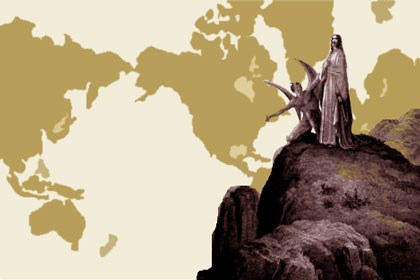
Christians Have Been Worshipping the Devil for Millennia: Lent calls us to change Gods

Empires[1]

Readings for First Sunday of Lent: Dt. 26: 4-10; Ps. 91: 1-2; 10-15; Rom. 10: 8-13; Lk. 4: 1-13. http://www.usccb.org/bible/readings/021713.cfm

Today is the first Sunday of Lent. Lent is a time of renewal – of getting back to basics – to asking questions about what we really believe and what God we truly worship. Today’s liturgy of the word helps us to do both. Deuteronomy 26 directs us to the authentic faith of Jesus – in the God who liberates the enslaved. Today’s reading from Luke’s Gospel calls us to worship that God rather than devil – the evil one that our culture and church (!) have been worshipping for centuries – ever since they first embraced imperialism in the 4th century C.E. Let me explain.

Start with that reading from Deuteronomy 26. It’s a key text if we want to understand the God in whom Jesus placed his faith. Jesus, remember, was a Jew, not a Christian. And Deuteronomy 26 provides us with the creedal statement that the Jewish Jesus accepted as did all Jews of his time. I mean, for them, Deuteronomy 26 functioned much like our Nicene Creed does for us each Sunday. It was a reminder of their basic belief. As such, it can be summarized in the passage’s seven points:

1. Our father (Abraham) was a wandering Aramean (a Syrian).
2. “Abraham” (i.e. his descendents) went down into Egypt.
3. There we became a great people.
4. But the Egyptians enslaved us.
5. We cried out to our God, Yahweh, who raised up the rebel prophet, Moses.
6. He led us out of Egypt, across the sea, through the desert, and to this land “flowing with milk and honey.”
7. This land is our gift from Yahweh; Thanks be to God!

That’s it! That was the faith that Jesus, the Jewish prophet, inherited from his ancestors. It was a tribal faith centered on the ownership of a God-given piece of land (Palestine) which (despite its dryness and desert character) the descendents of Jacob saw as rich and productive (flowing with milk and honey).

Notice that this Jewish faith had nothing to do with an afterlife, heaven or hell. (In fact, belief in the afterlife was a very late development among the Jews; it didn’t emerge even for debate until about 200 years before Jesus’ birth.) Instead, as among all hunter-gatherers, herds people and agriculturalists, Jewish faith was centered on land. Obviously then, it had little tolerance for colonial military forces like the Assyrians, Babylonians, Persians, Greeks or Romans all of whom at various times occupied Palestine. Colonialism and foreign occupation contradicted Jewish faith in a fundamental way. It was intolerable.

That was true for Jesus too. As a prophet, his fundamental proclamation was not about himself or about a new religion. Much less was it about the after-life or “going to heaven.” Instead, Jesus proclaimed the “Kingdom of God.” That phrase referred to what the world would be like without empire – if Yahweh were king instead of Rome’s Caesar. In other words, “Kingdom of God” was a political image among a people unable and unwilling to distinguish between politics and religion.

In God’s Kingdom, everything would be reversed and guiding principles would be changed. The first would be last; the last would be first. The rich would weep, and the poor would laugh. Prostitutes and tax collectors would enter the Kingdom, while the priests and “holy people” – all of them collaborators with Rome – would find themselves excluded. The world would belong not to the powerful, but to the “meek,” i.e. to the gentle, humble and non-violent. It would be governed not by force and “power over” but by compassion and gift (i.e. sharing).

The creedal account of Deuteronomy 26 sets the stage for today’s gospel narrative about Jesus’ temptations in the desert. (And it’s here that the devil-worship connected with empire enters the picture. Listen closely.) In a context of Roman occupation, Luke’s account raises the question of whom to worship. The choice he presents is stark: one can worship the devil the author of empire or Yahweh, the opponent of imperial power of all types.

That clear choice becomes apparent in Luke’s version of Jesus’ second temptation. From a high vantage point, the devil shows Jesus all the kingdoms of the earth. Then he says,

“I shall give to you all this power and glory;
for it has been handed over to me,
and I may give it to whomever I wish.
All this will be yours, if you worship me.”

Notice what’s happening here. The devil shows Jesus an empire infinitely larger than Rome’s – “all the kingdoms of the world.” Such empire, the devil claims, belongs to him: “It has been handed over to me.” This means that those who exercise imperial power do so because the devil has chosen to share his possession with them: “I may give it to whomever I wish.” The implication here is that Rome (and whoever exercises empire) is the devil’s agent. Finally, the tempter underlines what all of this means: devil-worship is the single prerequisite for empire’s possession and exercise: “All this will be yours, if you worship me.”

But Jesus responds,
“It is written:
You shall worship the Lord, your God,
and him alone shall you serve.”

Here Jesus quotes the Mosaic tradition summarized in Deuteronomy 26 to insist that empire and worship of Yahweh are incompatible. Put otherwise, at the beginning of his public life, Jesus declares his anti-imperial position in the strongest possible (i.e. scriptural) terms.

Now fast forward to the 4th century – 381 CE to be exact. In 313 Constantine’s Edict of Milan had removed from Christianity the stigma of being a forbidden cult. From 313 on, it was legal. By 325 Constantine had become so involved in the life of the Christian church that he himself convoked the Council of Nicaea to determine the identity of Jesus. Who was Jesus after all – merely a man, or was he a God pretending to be a man, or perhaps a man who became a God? Was he equal to Yahweh or subordinate to him? If he was God, did he have to defecate and urinate? These were the questions.

However, my point is that by the early 4th century the emperor had a strong hand in determining the content of Christian theology. And as time passed, the imperial hand grew more influential by the day. In fact, by 381 under the emperor Theodosius Christianity had become not just legal, but the official religion of the Roman Empire. As such its job was to attest that God (not the devil) had given empire to Rome in exchange for worshipping him (not the devil)!

Do you get my point here? It’s the claim that in the 4th century, Rome presented church fathers with the same temptation that Jesus experienced in the desert. But whereas Jesus had refused empire as diabolical, the prevailing faction of 4th century church leadership embraced it as a gift from God. In so doing they also said “yes” to the devil worship as the necessary prerequisite to aspirations to control “all the kingdoms of the world.” Christians have been worshipping the devil ever since, while calling him “God.”

No, today’s readings insist: all the kingdoms of the world belong only to God. They are God’s Kingdom to be governed not by “power over,” not by dominion and taking, but by love and gift which leave people like the liberated daughters and sons of Abraham free to live in control of their own God-given piece of earth. Or in the words of Jesus, the earth is meant to belong to those “meek” I mentioned – the gentle, humble, and non-violent.

All of this has implications for us as would-be followers of Jesus and as citizens of a country whose “leaders” (supported by their “Christian” counterparts) increasingly embrace empire as the inevitable and fitting destiny of the United States.

In fact, in 2003, then vice-president, Dick Cheney sent out a Christmas card on which was inscribed the words, “And if a sparrow cannot fall to the ground without His notice, is it probable that an empire can rise without His aid?” Cheney’s implication was that the United States is God’s new chosen people. Empire as practiced by the United States represents God’s will.

Instead, today’s Liturgy of the Word tells us the opposite. Empires arise only with the devil’s aid.

Does this mean that faithful followers of Jesus must pray for the defeat of the United States in its imperial conquests? Must we discourage our sons and daughters from joining the military?
(Discussion follows)

Lenten Reflection: The Ash Wednesday after the Pope’s Resignation

ash-wednesday-1[1]

Well, it’s Lent. Today is Ash Wednesday. My question is what does that mean for activists who are aspiring to follow in the footsteps of the great prophet, dissident, teacher of unconventional wisdom, story-teller, mystic, and movement founder, Yeshua of Nazareth?

The question is obscured by long centuries of covering up those identities in favor of Jesus’ overwhelming identification as “Son of God.” That title swallows up all the rest and makes it difficult, if not impossible to engage in what Thomas a Kempis called “The Imitation of Christ.”

But for the moment, suppose we set aside “Jesus the Christ,” and concentrate on that man his mother named Yeshua. He lived in a time not unlike our own, in a province occupied by an empire similar to ours. He found such occupation unbearable, and devoted his public life to replacing the “Pax Romana” with what he called the “Kingdom of God.” There the world would be governed not by Roman jackboots, or by the law of the strongest, but by compassion and gift – even towards those his culture saw as undeserving.

The latter was “Good News” for the poor and oppressed among whom he found himself and his friends – laborers, working girls, beggars, lepers infected with a disease not unlike AIDS, and those fortunate enough to have government work as toll gatherers. He ate with such people. He drank wine with them. Some said he got drunk with them. He defended such friends in public. And he harshly criticized their oppressors, beginning with his religion’s equivalents of popes, bishops, priests, ministers, and TV evangelists. “Woe to you rich!” he said. “White-washed tombs!” he called the religious “leaders.”

What does it mean to follow such an activist and champion of the poor this Ash Wednesday February 13, 2013?

I would say it means first of all to ask that question and to pray humbly for an answer.

Other questions for this Lent: Does following Jesus mean taking a public stance against empire and “church” as he did? Does it mean praying for the defeat of U.S. imperial forces wherever they wage their wars of expansion and aggression? Does it mean discouraging our daughters and sons from participating in a disgrace-full military? Does it mean leaving our churches which have become the white-washed tombs of a God who through failed church leadership has lost credibility and the vital capacity to effectively summon us beyond our nationalism, militarism, and addiction to guns and violence? Does it mean lobbying, making phone calls on behalf of and generally supporting those our culture finds undeserving and “unclean?”

Does it mean for Catholics that we somehow make our voices heard all the way to Rome demanding that any new pope save the church from itself by rejecting the anti-Vatican II schismatic tendencies of the last two popes, healing the wounds of the pedophilia crisis, reversing the disaster of “Humanae Vitae’s” prohibition of contraception, allowing women to become priests, eliminating mandatory celibacy as a prerequisite for ordination, and recognizing and honoring the contributions of Catholic women like the members of the Leadership Conference of Women Religious (LCWR)?

Yes, I think, it means all of those things. But Lent also calls for self-purification from the spirit that arrogantly locates all the world’s evils “out there” in “those people.” In its wisdom, the grassroots church of Hildegard of Bingen, Francis of Assisi and St. Clare, of Daniel and Phil Berrigan, Dorothy Day, Martin Luther King, Oscar Romero, Ignacio Ellacuria, Jean Donovan, and Matthew Fox calls us to deepen our interior lives for purposes of sharpening our discernment about how to contribute towards replacing empire with God’s Kingdom. All of those saints, remember, were condemned by the hierarchy just the way Yeshua was in his own day.

Six weeks is a relatively long time for the purification necessary to eliminate undesirable patterns in our lives and to replace them with habits exemplified in the lives of the saints I’ve just mentioned. It’s plenty of time for working on our addictions to the pursuit of pleasure, profit, power, and prestige. Each of us knows what behaviors in our own lives are associated with those categories. So it’s time to get to work.

As for myself . . . besides using this period for training my senses, I intend to recommit myself with renewed fervor to my daily practice of meditation, my mantram (“Yeshua, Yeshua”), spiritual reading, slowing down, one-pointed attention, spiritual companionship, and putting the needs of others first – the eight-point program outlined by Eknath Easwaran in his book Passage Meditation. I’m going to keep a spiritual journal this Lent to make sure I stay focused.

I’m also joining some friends of mine in a resolution to give up church for Lent. We’re doing so in favor of a six week experiment with an “Ecumenical Table” — a lay-led liturgical gathering often featuring a woman as homilist and Eucharistic Prayer leader. Though some in the group will also continue to attend their normal churches, the experiment may help us discern how to finally cope with the white-washed tombs of God I mentioned earlier.

And then there’s our parish Lenten Program I’ll be facilitating. It’s called “The Quest of the Historical Jesus: from Jesus to Christ.” It will be devoted to discovering the carpenter Yeshua behind the Jesus Christ of the gospels. In the light of our discoveries, we’ll unpack the liturgical readings for the following Sunday in hopes of making those Lenten liturgies more meaningful and challenging.

Additionally, my wife Peggy and I will also be working hard on our communication and have decided to devote significant time each evening to listening to each other in a loving respectful way.

In these ways I hope to pass my most fruitful Lent ever, to be truly able to rise with Yeshua to a new level of Kingdom-commitment on Easter Sunday.

More Happiness in the Barrios than in the Suburbs

Moon-lightening

Here is a thoughtful comment on my posting of February 6th, “Why Bother with the Historical Jesus?” It’s authored by a friend of mine, Jim Cashman (photo above), who studied with me for three years at St. Columban’s Major Seminary in Milton, Massachusetts when I was there from 1961-1967. Jim was an exchange student from Ireland, where he was ordained in 1964. Like most of us from that era, he left the priesthood after the Great Awakening which followed the Second Vatican Council (1962-’65). Jim writes:

In my view if all we have is subjective and “bias” and hence doubtful history on Jesus, then the more digging one does, especially based on modern science, the better it is for us getting to the reality on Jesus. The Jesus uncovered by science is vastly superior to the faith or propaganda-based version. I have always been dubious about taking anything on faith. It leads to too many wars! What we seek is the truth not support for our environmental brainwashing.

The thing which I regard as above debate is the focal point of your blog. I’m referring to the nature or qualities of God. Factually we know so little about that – maybe nothing. Given that reality, it seems better not to think of Jesus as the son of god or of God being Jesus, but as simply reflecting the nature of God. That seems to be the important point you make. I never had any hang-up/special needs for the divinity of Jesus or the virginity/motherhood of God. I do not feel it is central to the Jesus message. It might be central to Catholicism, but not to understanding of the meaning of my life. Why the hell am I here?

What I find central is that Jesus (like many of the prophets), reflects the core nature of God and that is Love. I feel this Love is not what we think it is. It’s not charitable foundations or helping old folks like me cross the street?

Maybe as Paul hints we are not yet sufficiently evolved or “spiritual” to accept Jesus’ very simple revelation about the nature of God as Love. Now we known in part; then we shall know fully – even as we are fully known. From Krishna to Christ this is the common unifying thread of human development: giving without any payback or satisfaction!. All of this contradicts where we are in the world of greed, self interest and now the ultimate decadence – endless ‘shopping.’

If we all take from nature only enough for what we need, then the poor we could “always have with us” – as equals. Even with the little they have, the stats show there is more happiness in the barrios than in the suburbs.

The worst outcome we could have from the present move against the hypocrisy of Rome (and Washington) is that we achieve “renewal” and leave the real task – the search for truth, for another millennium.

Keep pushing out the boundaries, Mike; we are at the early stage of evolution. And in your downtime you might find this of interest:
http://archive.org/details/ACanticleForLiebowitz The irony like. “1984”, is chilling. Jim

PS – the “stream” may need some manual help in this dramatized audio edition.

Churches, Popes, Women, and the “V” Word (Sunday Homily)

thevaginamonologues[1]

Readings for 5th Sunday in Ordinary Time: Is. 6:1-2a, 3-8; Ps. 138: 1-5, 7-8; I Cor. 15: 1-11; Lk. 5: 1-11. http://www.usccb.org/bible/readings/021013.cfm

Have you ever seen Eve Ensler’s “Vagina Monologues?” A few years ago that series of dramatic readings was presented at Berea College where I taught for 37 years. The readings were as provocative as the play’s title. All of them reflect the unique experience of being woman that most of us Christian males find so difficult to understand, especially after so many years of brain-washing at the hands of predominantly male clergies.

Significantly, Ensler refers to that particular churchly indoctrination in the prologue to her text. There she quotes Gloria Steinem who recalls:

“In the sixties, while I was doing research in the Library of Congress, I found a little known treatise about the history of religious architecture which blithely stated a thesis, as it were known by everybody, to the effect that the traditional shape of most patriarchal buildings of worship imitates the female body. Thus, there is an external entrance and another internal one, the labia majora and the labia minora; there is a vaginal central nave, which leads to the altar; there are two curved ovarian structures on either side; and finally, in the sacred center is the altar or uterus, where the great miracle takes place: men give birth.

“Though this comparison was new for me, it opened my eyes with a shock. Of course, I thought. The central ceremony of the patriarchal religions is nothing else but the ceremony in which men take control of the “yoni” power of creation by giving birth symbolically. It is no wonder that male religious leaders state so often that we human beings are born in sin … because we are born from female tummies. Only by obeying the rules of the patriarchy can we be “reborn” through men. It is no wonder that priests and pastors decked out in long vestments sprinkle our heads with a fluid that mimics the waters of birth. It is no wonder that they give us new names and promise us we will be reborn in eternal life. It is no wonder that the male priesthood attempts to keep women far removed from the altar, just as we are kept far removed from control of our own powers of reproduction. Whether symbolic or real, everything is aimed at controlling the power that resides in the female body.”

Talk about provocative! Here Ms. Steinem is claiming that creative power is focused chiefly in the female body, though men obviously have an ancillary role in the begetting of life. Because their role is so obviously secondary, a primary male purpose in organized religion, Ms. Steinem says, is for men to alienate or steal the vastly superior womanly power of life and to control it – against women themselves.

Patriarchal religion accomplishes its task by dressing men up like women. It has them sprinkling their congregations with the waters of birth introducing them to “eternal life.” This form of life is held to be more important than physical life, and male pastors claim to control it to the exclusion of women. The prerequisite for women’s access to life eternal is that they adopt the rules of the exclusively male priesthood especially those connected with female powers of reproduction centered in the woman’s body whose architecture the male priestly domain of church actually mimics.

I bring all of that up because today’s liturgy of the word is so obviously male-centered in a very misleading way. Together with Ms. Steinem’s reflections, the readings of the day suggest why someone like our present Pope Benedict XVI along with Christian pastors of many denominations participate so enthusiastically in what has been called a 21st century “War on Women” and why the pope is so afraid of women priests.

Female priests might inspire women to recognize their inherent superiority over men in terms of centrality to the life processes (both physical and spiritual) that the patriarchy struggles so mightily to control. If women were allowed the leadership that their biology suggests, what would become of the male-centered church – of the male-centered world?

Today’s liturgy of the word tries to keep us from asking such questions. It begins with a description of God in highly masculine terms centered in the macho realm of palace and court. God is depicted as “king.” He (sic!) is “Lord.” He inspires fear and awe. He dwells in a smoke-filled room surrounded by all the trappings of power and might. Like the prophet Isaiah, those who appear before him feel small and ashamed of the very words that come from their lips.

This, of course, is the image of God we’ve been offered from the cradle. (Can you imagine how different we’d feel personally, ecclesiastically, nationally and internationally if the familiar image of God were a mother nursing her child? Would you feel any different towards such a Mother God? – Remember, it’s all just symbolism. And the image of God that’s come to dominate arises from one of the most patriarchal traditions in the history of the world.)

The male-centeredness of today’s readings continues in the selection from Paul’s first letter to Christians living in Corinth. It’s a key passage because Paul is trying to establish his identity as an “apostle,” even though he never met Jesus personally. Paul bases his claim on the fact that Jesus appeared to him just as he did to the other apostles. So he says “Remember what I preached to you:” Christ died for our sins. He was buried and raised on the third day. He appeared to the 12, then to 500 “brothers” at once, then to all of the apostles, and finally to Paul himself.

There is so much interesting in this summary of Paul’s preaching. What, for instance, happened to Jesus’ words and deeds? Paul’s gospel begins with Jesus’ death! What about Jesus’ life which revealed the character of God as compassionate and “womb like?” (See Marcus Borg, Meeting Jesus again for the First Time, chapter 3.)

However, even more to the point is Paul’s omission of the fact that according to ALL of the accounts of Jesus’ resurrection appearances in the canonical gospels, Jesus’ first appearances were to women, not to men!! (Remember Jesus’ appearance to Mary Magdalene in John 20:1-18?) Using Paul’s logic, doesn’t that establish the primacy of women in the church – and in the priesthood? The misogynistic Paul doesn’t want to go near that question. And neither does the equally misogynistic Pope Benedict XVI.

And then we have today’s gospel selection from Luke. It’s the call of the first apostles. According to Luke, Peter, James, and John are the first to follow Jesus. That leaves us with the usual impression that Jesus called only men.

Omitted from our vision is the fact that according to Luke himself (8:3) there were “many women” taking an active part in the Jesus Movement. Besides Jesus’ mother Mary, we know the names of some of them: Mary Magdalene, several other Marys, Suzanne, Salome, Martha and Mary of Bethany, Joanna. . And the roles of these women weren’t confined to preparing food and washing clothes.

In the first Christian communities, men and women met and worshiped together. Both men and women preached the message of Jesus with the same authority, and both men and women presided at the celebration in remembrance of their crucified Master. Like the men, the women had representation and decision-making power in the communities as priests and bishops.

That was even true of the communities of Paul. Paul himself taught that “In Christ there is no male or female” (Galatians 3,28). With this claim he legitimized the active participation of women in the first Christian communities. Also, he makes emphatic mention of many women in his letters and lavishly praises their work. For example, he mentions by name the deaconess Phoebe (Romans 16,1), Junia (Romans 16,7), Prisca, Julia, Evodia and Sintece, all of whom he called his “collaborators” (Philippians 4,2). He also mentions Claudia, Trifena, Trifosa, Prisca, Lyida, Tiatira and Nympha of Laodicea. Of the 28 persons to whom Paul accords special praise in his letters to the early churches, 10 are women!

All of that changed in the 4th century, when Christianity lost its soul and became the official religion of the Roman Empire. Then Christianity adopted for good the courtly vision today’s first reading affirmed: macho-kings, courts, palaces, smoke-filled rooms, men dressed like women, denigration of women’s bodies, men trying desperately to affirm their superiority against all the evidence of biology, life’s processes, Jesus’ own example, and women’s traditional roles as nourishers, healers and spiritual counselors.

Let’s talk about how women might take back those roles both in church and in politics. How do we “get to” someone as closed as Benedict XVI? How do we get to our bishops and priests? How do we get to our own acquiescence to the misogyny of our church and culture?
(Discussion follows)

Why Bother with the Historical Jesus?

I’m about to offer a Lenten course on the historical Jesus to the members of my faith communities – to my fellow parishioners at St. Clare’s Catholic Church in Berea, Kentucky, and to an “Ecumenical Table” fellowship I attend.

A course on the historical Jesus? A friend of mine asked why. After all, everyone knows we can’t know much about the Jesus of history. Virtually all we have for sources are the highly subjective gospels produced by several Christian communities long after Jesus had died. And close examination of those gospels show them to be unreliable in terms of modern ideas about history. At best they’re propaganda intended to win converts to Christianity. They contain lots of made-up stories and words attributed to Jesus long after the fact. If that’s all we have, how can we really say anything about the Jesus of history? And what does it matter?

Many highly credentialed and very credible scholars have seconded my friend’s skepticism. Theologians as weighty as Rudolf Bultmann and Karl Barth have said in effect “fagedaboudit.” It’s not for nothing that St. Paul concentrated on Jesus’ death, resurrection and glorification “at the right hand of the Father.” And he was writing less than 20 years after Jesus’ death. For Bultmann and Barth (and it seems for Paul) that’s all Christians have to know. Jesus words and deeds actually matter very little.

Still, others have disagreed – most notably the four canonical evangelists (Mark, Matthew, Luke, and John) and the authors of more than 20 “gospels” discovered since the middle of the 20thcentury at the Dead Sea and Nag Hammadi in Palestine. They found it necessary to record what Jesus said and did.

Modern scholars on a par with Barth and Bultmann have followed suit. Albert Schweitzer, liberation theologians, and members of the Jesus Seminar have insisted that it’s necessary and possible to know what Jesus said and did. He after all (and not what later believers made of him) was the definitive Symbol of God. His every word and action is full of meaning in terms of revealing God’s identity. In that sense, Jesus is not God. Rather God is Jesus. Without the historical revelation of what Jesus said and did, we would have very little idea of who God is.

In order to know what Jesus revealed, it is therefore necessary to decipher the symbols of God that Jesus’ words and deeds provide. And besides, the Judeo-Christian tradition as a whole claims to be historical. It’s not mythological like Greco-Roman religious systems. So the historical Jesus is important as a final criterion of faith. We impoverish that faith by relying merely on Jesus’ death, resurrection and glorification as related by Paul and others.

Not only is it necessary to know what Jesus said and did in order to know the fullness of revelation of God that Christians find in him. It is also possible to do so – at least according to “Jesus scholars.” They have developed an elaborate set of criteria for separating the events of Jesus life that surely took place from those made up by the early Christian community. Similarly, their standards help readers identify what Jesus actually said from the words that early Christians put into Jesus’ mouth.

Chief among such criteria is the standard of “embarrassment.” That means that events and sayings that would have caused embarrassment to the early Christian community must have happened, otherwise early believers wouldn’t have recorded them. The crucifixion of Jesus is a case in point. And so is his baptism at the hands of John the Baptist – as well as his association with outcasts and “unclean” sinners. Jesus’ baptism gives the impression that John was superior to Jesus. His crucifixion was a huge stumbling block for those trying to convince people that he was the Messiah. Nobody would have made up such events from whole cloth. They were too embarrassing.

Still doubts remain about the historical Jesus – as they do by the way for all historical characters and events all of which become obscured by rumor, myth, falsehood, and the agenda of those writing the “history.”

What we can know a great deal about is Jesus’ historical context. In fact knowledge of Jesus’ context is knowledge about him. Take for instance the work of forensic archeologists. They can tell us what the people of Jesus time and place looked like – something none of the gospels offer. Forensic archeologists tell us that he stood about 5’1 and weighted about 110 pounds, and looked like this:

SON OF GOD

Not like this:

th[7] (2)

The bottom line here (and in the course I’ll offer) is that the work of the Jesus Seminar and others involved in quests for the historical Jesus is extremely helpful, but not crucial. What is crucial is to read the gospels we have with as much knowledge of context as we can. The gospel reading that results is called “historical literal.” It takes the gospels at their word keeping in mind what we can know of the author’s intentions, literary strategy, theology, and context (social, political, economic, religious . . .).

Reading the gospels with such new knowledge in mind yields an extraordinary picture of an individual the likes of whom mainstream history routinely ignores, denigrates and erases from the collective memory — a poor man who inspired other poor people to realize that they meant a lot more to God than their rich and powerful contemporaries.