Birthday Reflection: Disney’s “Soul”

[On September 6th, I celebrated my 86th birthday with my family here in Westport CT. It was so much fun for me. During our pre-breakfast conversation (I suppose because of my age) the topic turned to death, the afterlife, and Dante’s Divine Comedy. My son-in-law remarked that someone should make a modern adaptation of that famous 14th century trilogy. I said that I think Disney has already done it in his classic “Soul.” The conversation sent me back to the following essay I wrote along those lines five years ago. Rereading it made me want to republish what I wrote then. That was even before I started studying Tarot, which I now see would have enriched the piece enormously. Anyway, here it is without that enrichment.]

Pixar’s “Soul”: Profound Spiritual Wisdom from a Soulless Corporation

Isn’t it ironic that one of the most powerful businesses in the world, the Disney conglomerate, has ended up being one of our nation’s most effective spiritual teachers?

I mean, in Disney you have a typical heartless corporation that controls so much of our deceitful mainstream media and our superficial entertainment industry. Yet that very transnational firm has consistently produced popular art that calls viewers to introspection, identification with wildlife and nature, and to qualities of generosity, selflessness, and love.

I’m thinking of celebrated productions like “The Lion King,” “Beauty and the Beast,” and even “Bambi.” Arguably, such animated films issue more effective calls to spiritual values (especially to the young) than do most churches.

How that’s possible remains a mystery to me.  It’s probably because even Disney Productions discerns a deep hunger for meaning in audiences throughout the world. So, in its effort to enhance its bottom line, it acquires scripts authored by spiritually attuned writers. But that’s only a guess.

The Film

Nevertheless, that was probably the case with Disney’s latest issuance, “Soul” whose screenplay was written by Pete Docter, Mike Jones and Kemp Powers. It’s a charming, comedic yet penetrating probe into the meaning of life and death. Its depiction of the afterlife suggests characterization as a poor man’s version of Dante’s Divine Comedy. It has all the ingredients: a guided trip through the great beyond, a painful process of purgation, and finally arrival at peaceful beatitude.

(At this point, some might think it appropriate to give a “spoiler alert,” though that hardly seems necessary for a spiritually themed work like “Soul.” It’s not some cliffhanger. In any case, be forewarned.)

More specifically, as Disney’s first all-black production, “Soul” tells the story of Joe Gardner (Jamie Foxx), a frustrated middle school band teacher obsessed with jazz and landing his dream job of playing piano in a quartet headed by a diva saxophonist named Dorothea Williams.

Joe is himself an unappreciated musical genius as becomes evident every time his riffs transport him into the “Zone” of his prodigious brilliance. In his audition for the Williams quartet, the diva immediately recognizes Joe’s talent and hires him on the spot.

Joe is overjoyed. On his way home, he practically floats and dances down the streets of NYC. In his distracted oblivion he is narrowly missed by busses, cars, motorcycles and bikes. However, Joe himself doesn’t miss an open manhole, which swallows him up and apparently ends his life.

The next thing he knows, he’s is in the afterlife on his way towards the Bright Light invariably reported in the accounts of most near-death experiences (NDE). But possessed by his obsession with finally realizing his dream job, Joe refuses to die.

The Underworld

So, instead of escalating into the world of light, he’s returned to heaven’s underworld – a kind of limbo – a so-called “Youth Seminar” where unborn souls are prepared by the recently departed to enter into bodies on planet earth. There Joe is introduced to a rebellious unborn soul (Tina Fey) called #22 (seemingly because she was the 22nd soul ever created).

Despite its status as a truly “old soul,” #22 has remained unembodied for eons because she finds the prospect of life on earth boring. No mentor, no matter how prestigious – not Copernicus, Marie Antoinette, Abraham Lincoln, Karl Jung, George Orwell, Mother Theresa, or Muhammad Ali – has been able to successfully coax 22 to incarnate on the Milky Way’s “stinky rock,” where she knows that life is inevitably soul crushing.

Despite that history, Joe Gardner accepts the task of mentoring #22 in hopes that if successful, he might be allowed to return to earth and his dream gig. Joe is convinced that if he can help 22 find her passion – her Spark – then her fierce resistance to life on earth will dissolve.

So, acting like Dante’s Virgil, Joe leads 22 through the “Great Before.” She accompanies him as he reviews his own life and identifies jazz as the spark which had given his frustrated existence the modicum of meaning it’s had. From there the two travel through the Hall of Everything where Joe shows 22 her own life’s possibilities as a baker, fire fighter, artist, librarian, mathematician, gymnast, office worker, or astronaut. Not surprisingly, 22 remains unmoved.

However, it’s at this point that roles suddenly reverse as the unborn soul takes pity on Joe. He’s unlike any of her previous mentors, she says, because his life has been so sad and pathetic. Despite the fact that 22 can’t imagine why Joe wants so desperately to return to such pathos, she leads her mentor to the Zone – a state between the physical and spiritual – where he’s made to recall the times his music has induced a state of happiness and bliss.

From there, 22 takes Joe to the Realm of Lost Souls where she introduces him to “a guy I know” – a mad psychedelic captain, a self-described “mystic without borders.” Captain Moonwind (who doubles as a NYC sign spinner on the other side) helps lost souls find their way out of obsessions and anxieties that leave them disconnected from life. For instance, he once helped liberate a soulless hedge funder from his alienated labor. In the aftermath, the frustrated Wall Streeter completely trashes his obsessed, anxious and confining work environment while finally screaming “I’m alive! I’m alive!”

To the tune of Dylan’s “Subterranean Homesick Blues,” Moonwind ferries Joe and 22 across the Sea of Lost Souls. On the way, the captain tellingly instructs Joe that lost souls are not that different from those striving to live constantly in the Zone. In both cases, he warns, “When your joy becomes an obsession, you end up tragically disconnected from life.”

With the warning ringing in his ears, and after entering a deep state of meditation, Joe and 22 suddenly find themselves returned to earth – to the intensive care unit where Joe’s NDE began. He’s not dead after all. However, both Joe and 22 are surprised to find that they remain completely displaced. Joe’s personality is now located in the hospital’s therapy cat, Mr. Mittens. Meanwhile, 22 finds itself animating Joe’s just-revived body.

Desperate and confused, the two narrowly escape from intensive care and emerge onto NYC’s noisy, smelly and dirty streets. It’s in this Purgatorio that Joe resumes his role as 22’s Virgil. Trapped in the cat’s body, he is intent on leading his newly ensouled form to what he imagines as heaven – the Half Note Jazz Club where his platonic Beatrice (Dorothea Williams) awaits him impatiently.     

Purgatorio

On the way, 22 learns more about inhabiting Joe’s body. For the first time, she discovers the soul-purging joys of pizza; of simply walking, sky watching, taking a shower, tasting toothpaste, and of fitting into a comfortable old brown suit. She recognizes a kindred spirit in 12-year-old Connie, Joe’s gifted middle school trombonist who finds school stultifying.  When Connie expresses her boredom with school, 22 approvingly quotes her former mentor, George Orwell, “State-sponsored education is like the rattling of a stick inside a swill bucket.”

22 even revels in subway rudeness and in the talent of an underground street musician. Above all, 22 likes “jazzing” – spontaneous self-expression or any kind. 

Now Mr. Mittens is the one to object. “No,” he insists, jazz is a completely other category. “Music and life,” he says, “operate by very different rules.”

Undeterred, 22 continues jazzing during a visit to Joe’s neighborhood barbershop. There, with Mr. Mittens sitting in her lap, Dez the barber reveals the possibility of finding joy in a second-choice career even when one’s first choice has been frustrated. Despite his genius at cutting hair, Dez explains that he originally wanted to become a vet. However, since barber school was less expensive than training for veterinary medicine, Dez chose the former. But it’s made him “happy as a clam.”

The lesson is not lost on Mr. Mittens. His wide eyes tell that he’s thoughtfully considering his own life in the light of Dez’s revelation. Meanwhile he listens incredulously as 22 philosophizes free form while Dez cuts the hair on the head she’s now thinking with.

Everyone’s enthralled as she pontificates about “existing as a theoretical construct in a hypothetical waystation between life and death. . .  left wondering whether all this (obsessed and over-focused) living was really worth dying for.”

Then she responds smartly to Paul, a hip barbershop customer, who rips Joe for falling short of his dreams. 22 fires back, “He’s just criticizing me to make up for the pain of his own failed dreams.” Her barbershop audience laughs at Paul derisively.

Later, 22 ecstatically explains to Joe: Didn’t you see? “I was jazzing.”  

22’s jazzing continues through the next stage of Joe’s purgatory – an encounter with his mother who has constantly urged her son to abandon his musical ambitions in favor of steady employment with pension and health care.

Still encased in Joe’s body and tentatively coached by Mr. Mittens, 22 boldly responds on Joe’s behalf, “Mom, I’m just afraid that if I died today, then my life would have amounted to nothing.”

That particular jazz riff opens Mrs. Gardner’s heart. In tears, she embraces her son and tells him how proud she is of him. She adds that his deceased father would have been proud too. She even gives Joe his dad’s handsome wool suit to wear at the anticipated performance that evening.  (Joe’s father too had been a musician dependent for support on his wife’s real job as a seamstress. No wonder she was worried about Joe.)

Paradiso

Finally, Joe arrives at the Half Note Jazz Club. By now, with the help of Captain Moonwind and a brief return to the Great Before, the difference between Joe and 22 has been completely overcome. Joe’s come to realize that 22 is the same as his own unappropriated unborn soul.

Whole at last, Joe is now ready for his beatific vision. Imagining that it will happen on the Half-Note’s stage, Joe persuades Dorothea Williams to rehire him despite his late arrival at the jazz club.  Reluctantly, she acquiesces.

However, all doubts vanish as Joe gives the performance of his life thrilling everyone present including his mother and Ms. Williams herself. Amid the applause, Joe’s mother is heard shouting proudly, “That’s my son!”

Nonetheless in the aftermath, Joe remains strangely detached. In effect, he wonders aloud, “Is that all there is? I’ve been waiting for this my entire life. I thought it would be different.”

The diva explains, “You’ve been like a fish discontent with his water habitat because he’s been searching for the ocean. You’ve had what you’ve been looking for all your life. It’s what you live in, move in and where you have your being.”

With that, Joe’s penny finally drops. Now his life flashes before him summarized in the symbolic trinkets that awakened the soul of # 22:

  • A Metro pass
  • A pizza crust
  • A piece of a bagel whose other half had been thrown into the tip basket of that subway musician
  • The lollypop Dez the barber shared during the session in his “magic chair”
  • A spool of blue thread that Joe’s mother used to refashion his father’s wool suit
  • A seed from a maple tree brought by a gentle breeze into Joe’s waiting hand

Yes, Dorothea’s version of Beatrice was right: Joe’s had everything he’s needed right from the beginning – in his father’s sharing his passion for jazz, in fireworks over New York City, in the heat blowing from city street grates, in the taste of pecan pie, in the star filled sky . . .

So have we all.

Conclusion

Such “morals of the story” might strike some as typically Hollywood – trite truisms generated algorithmically by pretentious but ultimately soulless corporations interested only in easy pandering to the peasant gallery. However, conclusions of this sort overlook the fact that most preaching and motivational talks contain similar messages. Fact is: we need the reminders.

Nonetheless, the morals of “Soul” go far beyond what’s already been itemized. A more comprehensive catalog might include the following.

  • Life on planet earth need not be boring or meaningless.
  • Death is not our enemy, but a portal to profound insight and expanded awareness.
  • Animals from which we evolved (symbolized in Mr. Mittens) continue to guide us.
  • So do previous human incarnations (like 22’s George Orwell and Muhammed Ali) who somehow persist as our mentor guardian angels.
  • When our joys become obsessive, they disconnect us from life’s richness.
  • Even our “dream jobs” are comparatively insignificant – carried out in the equivalent of a small basement jazz club.
  • The same holds true for the heroes we idolize (like the self-important diva Dorothea Williams).
  • In the light of impending death, (if we’re lucky) consciousness of such relativity eventually dawns as we realize that wish fulfillment isn’t all it’s cracked up to be.
  • Instead, life is about overcoming separations – male from female, black from white, animal from human, body from soul.
  • It’s important “to jazz” and free flow at every opportunity; music and life both operate by the same rules.

These insights merit not only superficial review, but serious meditation by those whose spiritual hunger evokes them from sensitive writers like Docter, Jones and Powers despite their employment by Disney.

Do yourself a favor and see Pixar’s “Soul.” It will set you on the path of Dante, Virgil, Beatrice — and Joe Gardner.

In Memoriam: Michele DuRivage (1953-2026)

Last Friday, our family celebrated a memorial for my wife Peggy’s sister, Michele (Mitchy) DuRivage, a mother, wife, sister, sister-in-law, aunt, cousin, acquaintance and friend who transitioned from this life several weeks ago. After the funeral Mass in Katonah NY, we all gathered at our daughter Maggie’s splendid green house in nearby Westport CT to share reflections on Michele’s life. What follows are my remarks as I remember them in somewhat expanded form:

When someone dies, there is always a temptation to simplify them. We smooth out the rough edges. We make them easier than they really were. But Mitchy would have hated that. She refused performance in life, and she would not want performance now.

She was a truth seeker. She cared far less about what people thought of her than about whether something was true. In a world built so much on appearances, and social performance, that could make her difficult for some people. Her refusal to pretend was sometimes interpreted as selfishness or entitlement. A former friend once described her as “the most aggressively entitled person I have ever met.”

But I came to see something else in her.

In the process of helping her write her memoir, I came to see a woman who simply could not comfortably live inside lies — not personal lies, not social lies, not emotional lies. She was outspokenly aware that she lived in a dishonest world. As a result, she was often dismissed as a conspiracy theorist. But Mitchy herself once said something quite unforgettable because it has so often proven true: “The difference between a conspiracy theory and the truth is about six months.”

That line was funny. But it was also revealing. Mitchy distrusted appearances. She kept looking beneath surfaces. Sometimes she was wrong, as we all are. But she was committed to honesty in a way many people never dare to be.

Her memoir made that especially clear to me. Before we worked together, I realize now that I had never known her very well. Through telling her story, I discovered someone morally sensitive almost to a fault. She was haunted by guilt over tragedies for which she bore no real responsibility — especially the death of her sister Suzy when Mitchy was a mere adolescent. That kind of unnecessary guilt does not come from lack of conscience, but from an excess of it. Mitchy felt things deeply.

She was also a woman with a powerful sense of beauty. She was a photographer, someone who trained herself to notice light, texture, faces, moments. She carried that same artistic instinct into the way she dressed and presented herself. She loved fashion, elegance, style — not, I think, out of vanity, but because she wanted life itself to be beautiful. She understood that beauty matters.

And she was deeply committed to the people she loved, especially as a mother. Beneath the toughness, beneath the sharp observations and fierce honesty, there was loyalty and protectiveness.

Over time, I grew to love Mitchy very much as we together finished what amounts to her last will and testament which inevitably evokes thoughts about our own endings and what we’re leaving behind.

Mitchy was tough. Passionate. Self-respecting. Honest sometimes to the point of danger. She laughed at herself — and of course at everybody else too. She loved nature. She liked getting dressed up for a drink and to work in her garden. She made mistakes and could admit them without endless defensiveness or self-justification. In that sense, she taught something important about love itself.

She taught us that love is not pretending.

Love tells the truth. Love admits weakness. Love keeps its eyes open. Love refuses falseness. Love remains passionate despite disappointment. Love laughs. Love suffers. Love keeps searching.

That is the Mitchy I came to know.

And now, whatever we believe lies beyond this life, I hope she has found what she spent so much of her life searching for — peace, truth, beauty, and freedom from the burdens she carried too long.

May she rest in peace.

A Second Excerpt From “Against All Odds”— Chapter Seven, “The Sovereign Ledger”

Editor’s Note / Author’s Introduction

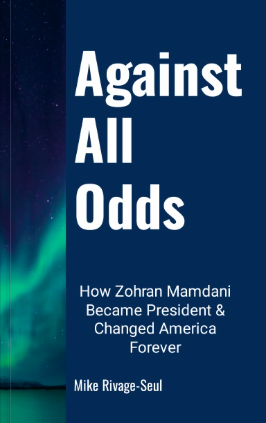
I recently shared here and at OpEdNews the opening chapter of my novella Against All Odds: How Zohran Mamdani Became President & Changed America Forever. I published the novella in the belief that narrative can sometimes open moral and political reflection in ways that formal analysis does not.

Rather than continuing sequentially, I’m offering today a later, stand-alone chapter — Chapter Seven, “The Sovereign Ledger.” I chose this chapter because of its real-life echoes of The Epstein Files. Like the latter, this chapter confronts a question that democratic societies routinely avoid: how do nations acknowledge wrongdoing, make accountability public, and prevent political reconciliation from becoming mere collective amnesia?

Although this chapter occurs well into the story, it does not depend on detailed knowledge of earlier events. It represents a turning point where personal courage gives way to institutional reckoning — and where justice becomes a matter of public structure rather than private virtue.

I offer it in the hope that it may prompt reflection not only about the future imagined in this story, but about the present we are still struggling to shape.

Chapter Seven: The Sovereign Ledger

“There are moments when a nation learns that its worst suspicions were not paranoid enough.”
— Arc of Justice Alliance, Internal Briefing, March 2026

The first sign was not outrage. It was nausea.

People would later remember where they were when the Ledger surfaced, but few would remember what they felt in those first minutes.

Not anger. Not disbelief. Something colder. Something intimate. As if a locked room inside the American psyche had been opened, and the air that escaped was foul beyond imagination.

The file appeared without announcement.
No whistleblower stepped forward.
No press conference was called.
No government agency took credit or responsibility.

At 2:14 a.m. Eastern Time, mirrored across thousands of servers worldwide, a compressed archive appeared under a single title:

THE SOVEREIGN LEDGER
Internal Records of Federal Continuity, 1998–2028

Within minutes, links propagated across independent newsrooms, encrypted forums, municipal networks, and university servers. By sunrise, attempts to suppress it had already failed. The file had been copied too many times, by too many hands, in too many jurisdictions.

It was not a leak. It was an exhumation.

The Ledger was not one scandal. It was a system. Thousands of pages documented how power in the United States had long operated through a shadow economy of indulgence, coercion, and silence.

What the public had been encouraged to understand as “isolated incidents” appeared instead as recurring patterns—engineered, financed, and protected.

There were private air manifests tied to shell corporations. There were sealed settlements paid with public funds.
There were non-prosecution agreements signed by federal prosecutors who later received corporate board appointments.

And there were the names.

Lawmakers.
Judges.
Intelligence officials.
Media executives.
Foreign dignitaries.

Some appeared once. Others appeared again and again.

The most disturbing files concerned what the Ledger referred to—with chilling bureaucratic neutrality—as “leverage assets.” Young women. Underage girls.
Migrants without documentation.
Runaways pulled from foster systems.

They were trafficked not primarily for profit, but for control. Sex was the currency. Shame was the collateral.

The Ledger documented how parties, retreats, “philanthropic conferences,” and private residences were used to compromise powerful individuals—and how those compromises were then archived, categorized, and deployed when obedience was required.

One internal memo summarized the logic plainly: “Exposure risk ensures policy compliance across administrations.”

What shocked readers most was not the existence of depravity—Americans had learned to expect that—but the scale of institutional cooperation required to keep it hidden.

FBI investigations were quietly reassigned. Victims were pressured into silence through civil settlements.
Journalists were warned off stories by editors citing “national stability.” Judges were persuaded to seal records indefinitely. Even deaths the public had been told were suicides appeared in the Ledger as “containment events.”

One line, buried deep in a Justice Department review, froze the nation:

“Subject’s death neutralized further reputational cascade.”

The Ledger did not accuse. It docu-mented. Emails. Bank transfers.
Flight logs. Surveillance transcripts.

It showed that the system had not merely tolerated abuse—it had absorbed it, metabolized it, and used it as governance.

By midmorning, the country had stopped pretending. Trading halted on multiple exchanges. Congressional offices closed without explanation. Cable news anchors struggled to read prepared statements with steady voices. Parents read the Ledger and felt ill. Survivors read it and wept. And millions who had never trusted Washington finally understood why.

It wasn’t incompetence. It wasn’t polar-ization. It wasn’t gridlock. It was rot.

Trust did not collapse slowly. It vanished.

Zohran Mamdani read the Ledger alone.

He sat in the Blue Room at City Hall long after staff had gone home, the city glowing beneath the windows like a living organism unaware of its diagnosis. He read until his eyes burned.

What struck him was not outrage—that came later—but grief. The Ledger did not describe monsters hiding in shadows. It described men in suits, speaking softly, shaking hands, protecting one another. It described a republic that had confused continuity with morality.

When he reached the annex detailing municipal pressure programs—how cities like New York were financially squeezed into compliance, how mayors were surveilled, how reform efforts were quietly strangled—he closed the laptop.

“So,” he said aloud, “this is why nothing ever changes.”

Naomi entered without knocking. Her eyes were red.


“They’ll deny it,” she said.

“They already are,” he replied. “They’ll say it’s foreign disinformation.”

“Too many fingerprints,” she said.

“They’ll say it doesn’t matter.”

“It matters,” Zohran said, “because people believed them once.”

She hesitated. “Do you know what this means?”

He nodded slowly. “It means the country is going to look for someone who isn’t in that file.”

The Ledger did what no election, protest, or ideology had managed to do. It made the old system unbelievable. Not unjust—unbelievable.

People stopped asking which party was responsible and began asking whether the system itself deserved to survive.

Governors issued contradictory statements. Federal agencies fell silent. Courts postponed hearings without explanation. And in living rooms, kitchens, union halls, and classrooms across the country, the same realization settled in: We were governed by people who could not govern themselves.

When authority evaporates, something always rushes in to replace it. In New York, the Arc of Justice Alliance released a single statement:

“Legitimacy is not inherited. It is earned—and it can be lost.”

Zohran said nothing publicly for three days. When he finally spoke, he did not attack Washington. He did not cite the Ledger. He did not accuse. He said only this: “Power that survives by hiding crimes forfeits the right to rule.”

The silence afterward was absolute.

Somewhere between that moment and the next sunrise, the republic crossed a line it could not uncross. The Sovereign Ledger had not merely exposed corruption. It had revealed that the American government no longer governed by consent—but by concealment.

And once concealment failed, nothing remained.

Concluding Reminder

Against All Odds: How Zohran Mamdani Became President & Changed America Forever, explores questions of political accountability, public trust, and democratic repair through narrative rather than policy argument.

Readers interested in the complete story can find information about the book by clicking here. All proceeds from the novella’s sales go to the Arc of Justice Alliance which is applying for tax-exempt status.

A Day in the Life of Americans Observing the UN Declaration of Human Rights


Recently, at our Arc of Justice Alliance (AJA) meeting, the Planning Committee discussed what daily life in the U.S. would look like if the AJA vision were implemented and the United States actually lived up to the UN Universal Declaration of Human Rights (UDHR)? Here’s an answer provided by ChatGPT.


Morning Light

The sun rises over Dayton, Ohio, and the Thompson family’s house wakes up with it — lights brightening automatically, powered by rooftop solar panels. The air is fresh, the street is quiet, and not a single car rumbles by. Most people bike or hop the community tram these days.

Maria Thompson rolls out of bed around seven. She’s a nurse practitioner at a neighborhood health co-op. Her hours are flexible; her paycheck is guaranteed. No side hustles, no “gig economy,” no hustling just to survive.

She remembers her mom, back in the 2020s, juggling three part-time jobs with no health insurance and no savings. That world — the world of burnout and precarity — is gone. Work now comes with dignity, fair pay, and time to rest.

“No one should have to earn the right to live with dignity.”

Downstairs, her husband Daniel sips coffee and scrolls through the Public Knowledge Network. It’s news without ads or algorithms — funded by the community, not corporations. Since media reform followed Article 19 of the Universal Declaration of Human Rights, journalism stopped being a ratings game and started being a public service.

At the table, their kids, Lila (16) and Jordan (11), eat fruit and cereal from their weekly co-op basket. There are no food deserts anymore — local farms supply every community with fresh produce. Healthy food is a right, not a luxury.


Midday Work, Human Style

Maria bikes to the clinic along quiet, tree-lined streets. Fossil fuels are long gone; the city runs on clean energy owned by its residents. The air smells like rain and lilacs, not gasoline.

At work, Maria greets patients by name. No billing forms, no deductibles, no endless phone calls with insurance companies. Health care isn’t a privilege anymore — it’s a right.

She spends real time with people. One of her patients, an older man with diabetes, used to ration his meds before universal care took hold. Now he’s thriving. He thanks her — but it’s not the thank-you of desperation. It’s gratitude born of mutual respect.

Meanwhile, Daniel’s high school history class is buzzing. The topic today: Why did it take so long for America to treat human rights as real?

A student asks, “If the Declaration was written in 1948, why didn’t people just do it?”
Daniel smiles. “Because first,” he says, “we had to believe we deserved it.”

“The biggest revolution wasn’t political — it was psychological.”


Afternoon: The Culture of Care

At lunch, Daniel joins other teachers in the school garden, munching on sandwiches and talking about the next community project. Teachers work six-hour days now, and every job comes with paid time for family, creativity, or civic engagement.

Across town, Lila is at her art studio internship, painting a mural about climate recovery. Her school believes in learning through doing — part of Article 27’s promise that everyone has the right to participate in cultural life.

At the community center, Jordan and his friends build solar robots in the after-school program. When the seniors arrive for tea, the kids pause their project to help set up tables. It’s normal now — generations sharing space, stories, and laughter. Loneliness has dropped, community ties have grown, and life feels… connected.


Evening: Democracy in Real Life

Dinner at the Thompson home is simple but joyful: vegetable paella, salad, fresh bread. No one eats in a rush. They talk, laugh, argue a little — about the next Community Assembly.

The Assemblies happen every month. People from every neighborhood vote on local issues through secure digital platforms. It’s democracy that actually feels like participation, not just voting every four years.

“Democracy isn’t an event. It’s a daily habit.”

After dinner, they stream a short documentary about how the world came together to rebuild after the climate crisis. The voiceover reminds them: “The Universal Declaration of Human Rights was always a blueprint. It just took humanity seventy-five years to start building.”

Maria looks over at her family — fed, healthy, safe — and smiles. The dream didn’t die; it just took time to grow up.


Night: A Quiet Confidence

Later, Maria steps outside. The neighborhood glows softly under solar lamps. From the park, she hears music and laughter. She breathes deeply. The air is clean, the stars visible again.

Upstairs, Lila writes in her journal about becoming an environmental architect. She knows college will be free and open to everyone. Jordan’s reading a bedtime story about the first moon colony signing the Earth Charter.

Maria crawls into bed beside Daniel.
“Can you believe our grandparents lived without all this?” she whispers.
He grins. “They didn’t give up,” he says. “That’s why we have it.”

Outside, the world hums — steady, hopeful, human.

“When every person matters, everything changes.”


A New Normal

This isn’t a perfect world. Storms still come, people still disagree, and life still surprises. But the old fear — of losing your home, your job, your health, your future — is gone.

Now, human rights aren’t slogans. They’re the structure of everyday life.

Housing is guaranteed.
Healthcare is free.
Education is also free and lifts everyone.
Work supports, not consumes.
News informs, not divides.
Democracy belongs to all.

In this America, the extraordinary has become ordinary: breakfast with family, work with meaning, art without debt, democracy without despair.

The Thompsons aren’t special. They’re just people living in a country that finally remembered what the Declaration promised back in 1948:

“All human beings are born free and equal in dignity and rights.”

And this time, we meant it.